
A California smog check usually looks at four layers, an OBD II scan, a visual equipment check, a functional inspection, and, where applicable, a tailpipe or opacity measurement. In plain English, the technician is checking the car's computer, its emissions parts, how those parts behave, and, on some vehicles, what comes out of the exhaust.
You're probably here because the registration notice showed up, the check engine light came on and went off again, or a friend told you to “just clear the code” before you go. That advice can backfire, because the inspection is built to catch more than one kind of problem, and California's numbers show those layers matter. In calendar years 2024–2025, about 19 million model year 2000-and-newer vehicles were tested, and about 1.3 million, roughly 7%, failed, which tells you the system is catching real issues, not just paperwork mistakes (California Smog Check Performance Report).
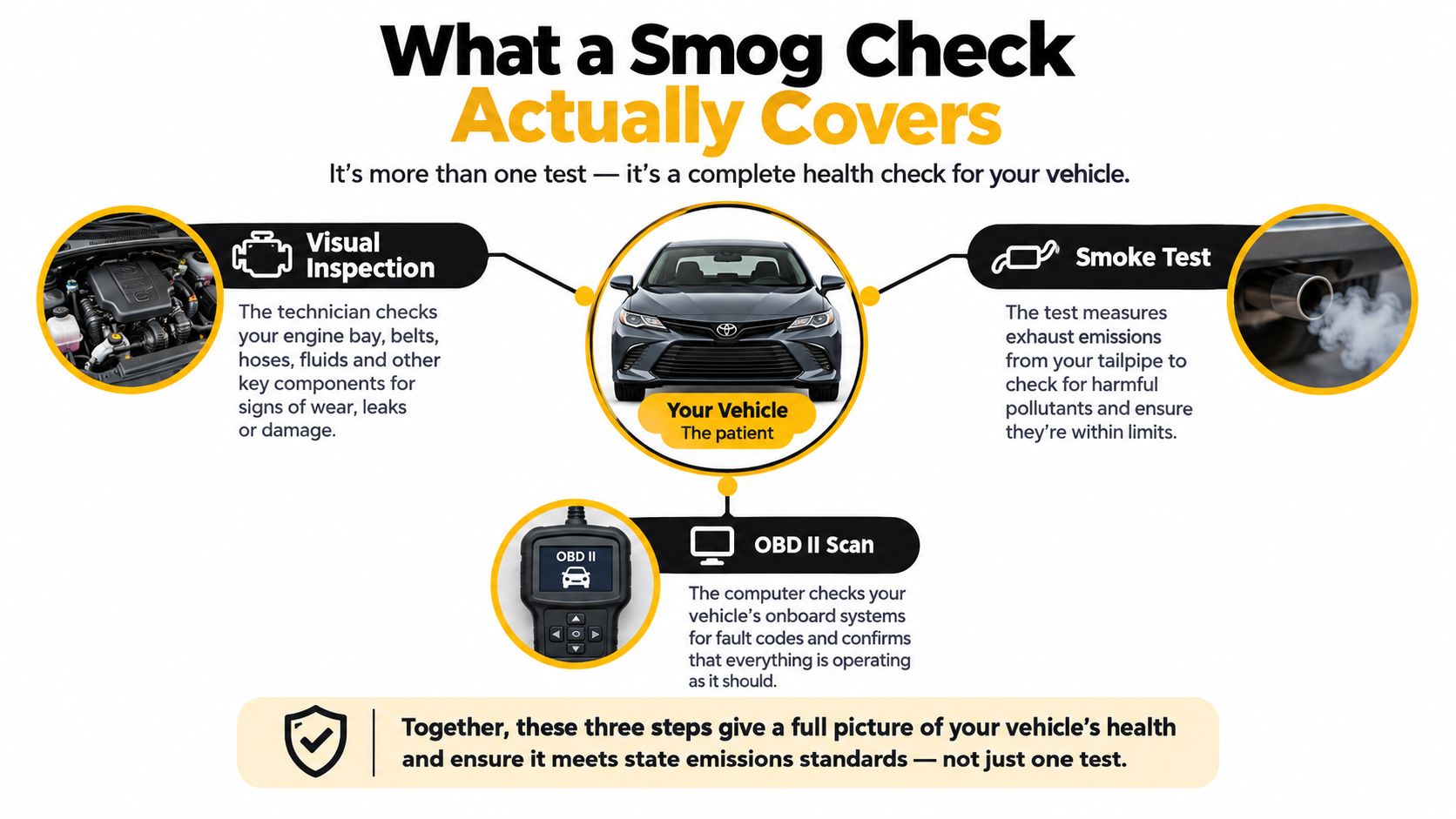
Table of Contents
- What a Smog Check Actually Covers
- The Four Layers of a Modern Smog Inspection
- OBD II Scans Readiness Monitors and the Check Engine Light
- Tailpipe Tests Opacity Checks and Older Vehicles
- What Causes Cars to Fail the Inspection
- Clearing Codes Before a Smog Check and Other Myths
- How to Prepare Your Car Before the Appointment
What a Smog Check Actually Covers
A smog check is more like a layered health check than a single measurement. When you pull into the bay, the technician isn't just looking for one bad number at the tailpipe, they're checking whether the vehicle's emissions system is functioning as a whole, the same way a doctor checks blood pressure, pulse, and breathing instead of one vital sign alone.
The first pass is about the vehicle's own evidence
For many California vehicles, the inspection starts with the car's onboard diagnostics. The computer reports whether emissions-related systems have run their self-tests, whether any faults are stored, and whether the warning lamp is behaving properly. At the same time, the technician looks under the hood and around the vehicle for required emissions parts and signs that something has been removed, damaged, or tampered with (BAR smog overview).
That's why the answer to “smog check what do they check” is broader than most drivers expect. The inspector is not only asking, “Does the car look clean?” They're also asking, “Does the car prove it can control emissions the way it should?”
Why the state uses more than one test
Different vehicles need different checks. Newer gasoline vehicles are usually handled through the computer-based inspection, while older vehicles may be measured at the tailpipe, and diesel vehicles can be tested with opacity equipment that looks at exhaust smoke density (BAR executive summary). California uses those layers because a car can look fine, sound fine, and still fail once the inspection reaches the part the driver can't see.
Practical rule: if a test looks at the computer, the hardware, and the exhaust itself, a car has three different chances to show a problem.
That matters in California because registration often depends on passing the smog check, and the state's testing program is overseen by the Bureau of Automotive Repair. Some stations are also STAR Certified, which means they meet higher performance standards set by the state, so the inspection result carries extra confidence for DMV use.
The Four Layers of a Modern Smog Inspection
A modern inspection moves in layers, and each one can surface a different problem. A car may pass the computer scan and still fail if a required emissions part is missing, damaged, or if the exhaust reading does not meet the standard.
The computer scan checks the car's memory
For a newer vehicle, the technician connects to the OBD II system, the car's self-monitoring network. The scan shows stored trouble codes, monitor status, and warning-lamp behavior, so the inspector can see whether the emissions system has been doing its job (BAR smog). This is closer to reading the vehicle's report card than a quick glance.
The visual inspection checks what's physically present
The next layer is the under-hood and under-car review. The technician confirms that required emissions equipment is present and appears correctly installed, including parts such as the catalytic converter, evaporative-emissions components, and exhaust-gas recirculation equipment when applicable (BAR executive summary report). If a part has been removed, bypassed, or clearly tampered with, the car can fail even if the engine sounds fine.
The functional and measured-emissions checks catch what the eye can't
Some inspections also include a functional review, which checks whether the emissions controls respond properly, not just whether they are installed. On older vehicles, there may also be a measured exhaust test or opacity test, depending on fuel type and model year (BAR-97 manual). That separates a part that is merely there from one that still does its job.
The three layers work together. The computer shows the system's history, the visual check confirms the hardware, and the tailpipe or smoke measurement checks the result. A car can clear one layer and still fail another.
Model year decides the path
California's rules split vehicles by age and engine type. Vehicles with 2013-and-newer model-year engines are required to undergo OBD testing, while vehicles with 2012-and-older model-year engines may need an opacity test and emissions-control-equipment inspection (BAR executive summary report). That is why two cars that look similar on the street can face different inspection lanes at the station.
OBD II Scans Readiness Monitors and the Check Engine Light
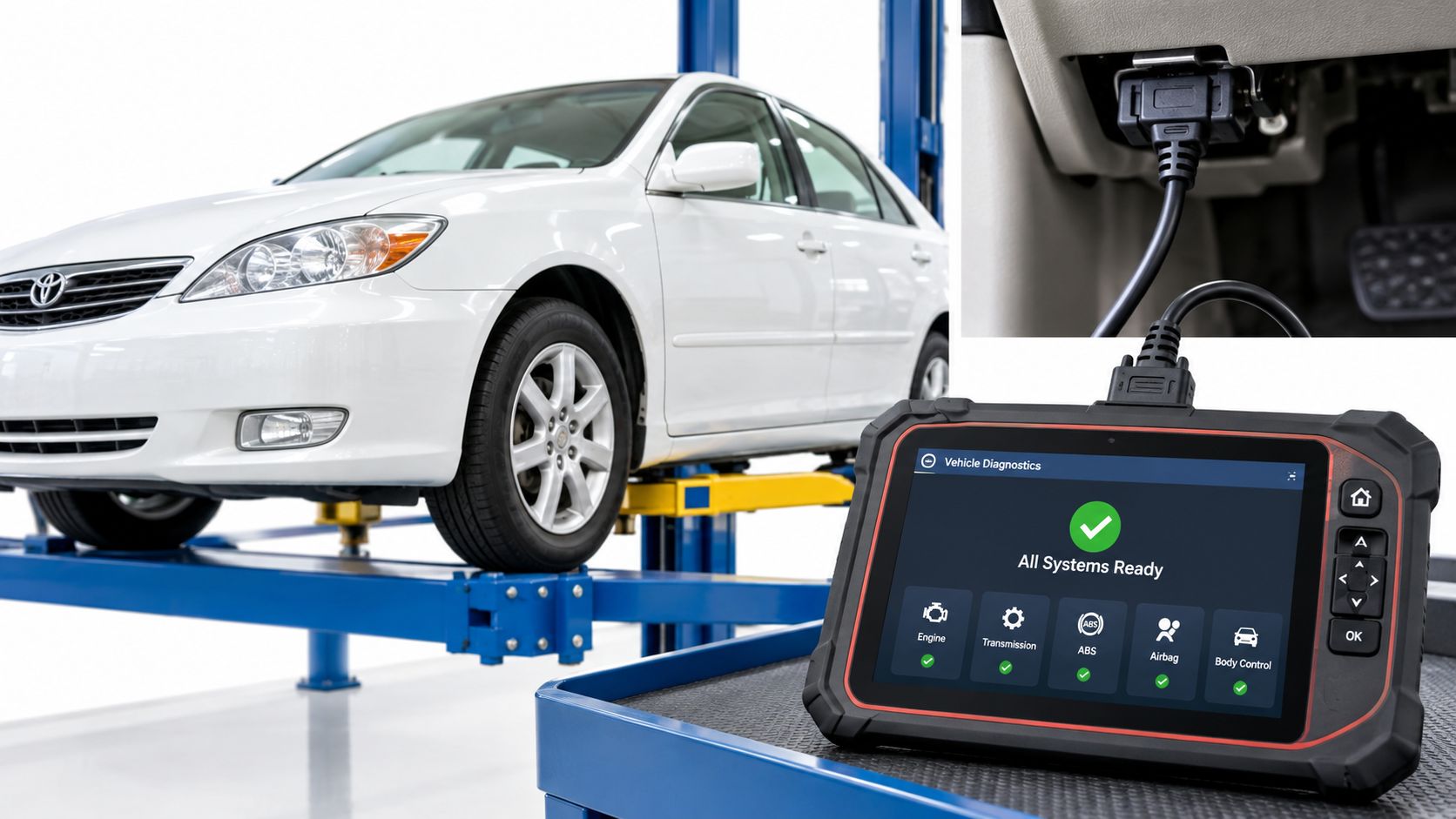
For a 2000-and-newer California vehicle, the OBD II scan is often the heart of the inspection. Think of it as the car's own self-diagnostic report card, it tells the inspector whether the emissions systems have checked themselves, whether faults are stored, and whether the warning lamp is behaving the way it should (BAR smog).
Ready is not the same as no light
Many drivers get tripped up here. A dashboard with no active check engine light does not automatically mean the car is ready to pass. The car also has to finish its readiness monitors, which are self-tests for systems such as oxygen sensors, the catalytic converter, evaporative-emissions controls, and misfire detection (BAR readiness guidance). If the monitors are still “not ready,” the vehicle may fail even though the light is off.
That's why disconnecting the battery, clearing codes, or doing a repair right before the appointment can cause trouble. Those actions can reset the monitors, and the car may need normal driving before the self-tests complete. In plain terms, you can make the warning go dark faster than you can make the car prove it's healthy.
Practical rule: a smog station cares about both the absence of an active fault and the presence of completed self-tests.
What the inspector actually looks for
The technician verifies that the malfunction indicator lamp comes on with the ignition and turns off after startup, then checks for diagnostic trouble codes and monitor status through certified equipment (BAR smog). CARB describes the inspection as both a visual and functional OBD II check, so the computer side is never just a “plug it in and hope” process.
How OBD codes help you understand a smog result
A simple example helps. If someone disconnects the battery to replace a stereo, the clock resets, the monitor history clears, and the car may look fine on the dash but still be unready for inspection. That's why the week before the test matters more than the hour before it.
The OBD side is also why code clearing can be a trap. The problem doesn't disappear just because the light disappears. The inspector is checking whether the emissions system has completed its own checks and can demonstrate normal operation.
Tailpipe Tests Opacity Checks and Older Vehicles
Older cars follow a different path because they don't all speak the same diagnostic language. California's BAR-97 procedure measures exhaust pollutants from 1999-and-older vehicles at the tailpipe, while applicable 1996–1999 gasoline vehicles receive both OBD inspection and tailpipe testing (BAR-97 manual).
Gasoline vehicles get measured, not guessed
A tailpipe test asks a direct question, what is the vehicle putting out under test conditions? If the readings are high, the issue may be an inefficient catalytic converter, an air-fuel imbalance, ignition misfire, or worn oxygen-control hardware. That's different from a computer fault, because the exhaust numbers show the result of the engine's behavior, not just the stored record of it.
Visual compliance still matters on these cars. Inspectors check that emissions equipment is present, that visible smoke isn't excessive, and that there aren't obvious liquid fuel leaks or fuel-cap problems where the test applies (BAR-97 manual). A loose or damaged cap can surprise drivers because it looks small, but it affects whether the system seals properly.
Diesels are judged by smoke opacity
Diesel vehicles may face an opacity test, which measures how much light is blocked by exhaust smoke. That gives the inspector a practical way to see whether the vehicle is producing too much visible soot, even when there isn't a gasoline-style tailpipe measurement in play (BAR executive summary).
A 1999 Civic and a 2018 Civic can therefore live in different worlds at inspection time. The older car may face a more physical emissions test, while the newer one is mainly judged by its onboard diagnostics and emissions-system behavior. Same brand, different rulebook.
What Causes Cars to Fail the Inspection
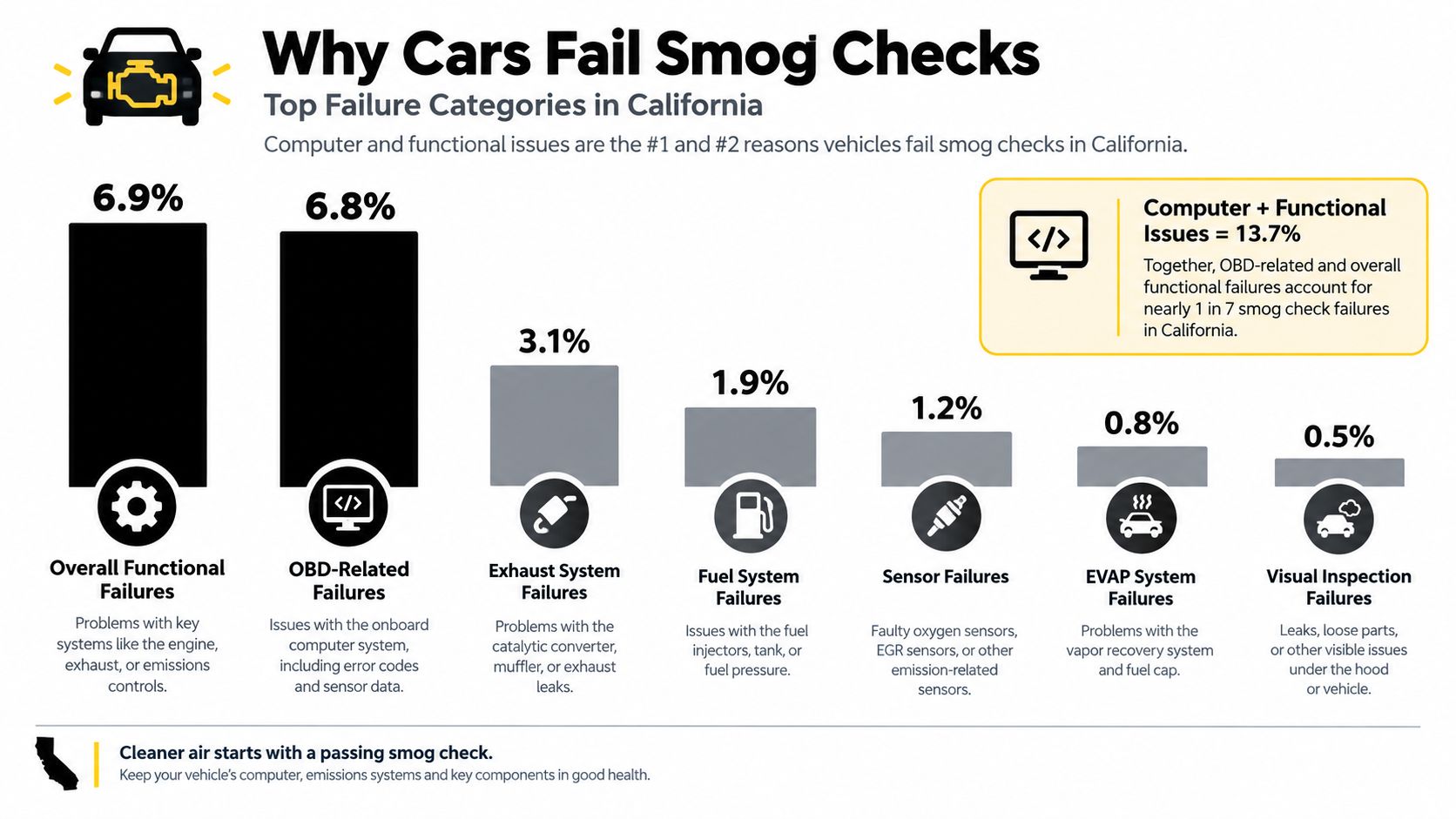
A smog check failure usually comes from one of three places. The car's onboard computer is unhappy, the required equipment does not function the way it should, or something visible is missing or tampered with. The California Smog Check Performance Report shows that OBD-related failures accounted for 6.84% of initial tests, while overall functional failures were 6.92%. Visual failures were lower, at 1.28%.
The table that matches what inspectors see
| Failure Category | Initial Failures | Share of Initial Tests |
|---|---|---|
| OBD-related failures | 714,956 | 6.84% |
| Overall functional failures | 724,477 | 6.92% |
| Visual failures | 134,222 | 1.28% |
The numbers are not separate boxes on every car. A single vehicle can trigger more than one problem during the same visit. The useful takeaway is simpler. If the check engine light is on, if a readiness monitor has not finished, or if a code is stored, that is usually the first thing to fix before the appointment.
A car that feels fine on the road may still have monitor issues that the inspection will catch.
Most failures fall into familiar patterns. A check engine light, a catalytic converter-related code, an evaporative emissions leak, a missing gas cap, or tampered emissions equipment can stop a pass. Those are the parts worth checking before you start guessing at more complicated causes.
Common smog failure reasons explained simply
The smartest pre-test question is not whether the car runs well. It is whether the emissions system can show, right now, that it is working as required. A loose cap can fail like a bad seal on a water bottle, small on the outside, but enough to break the system's pressure check. A missing monitor works the same way. The car may drive normally, but the inspection still sees the gap.
Clearing Codes Before a Smog Check and Other Myths
The most expensive myth is simple, clear the code, the light goes off, and the car should pass. The problem is that clearing codes can reset readiness monitors, which puts the car back into “not ready” status until the self-tests complete. That can turn a temporary dashboard fix into a failed appointment.
Three common myths that waste time
“Idling it for a few minutes warms it up enough.” Not always. Warm engine oil helps, but the car still needs the right drive conditions for monitors to finish their checks. A short idle can't replace a proper drive cycle.
“Disconnecting the battery resets everything in a good way.” It resets the memory, yes, but that includes stored codes and monitor history. If the inspection depends on ready monitors, you've just created more work for the car.
“Aftermarket parts automatically fail the test.” Not by themselves. What matters is whether the required emissions controls are present, correctly installed, and functioning the way the inspection requires.
What to do instead
If the check engine light is on, fix the cause rather than hiding it. If the light was recently cleared, drive the car normally until the readiness monitors have had a chance to complete. If the gas cap looks old or damaged, replace it before the appointment because a simple seal problem can become a simple failure.
A lot of drivers want a shortcut. Smog testing usually rewards the opposite, steady repairs and a normal drive pattern.
How to Prepare Your Car Before the Appointment
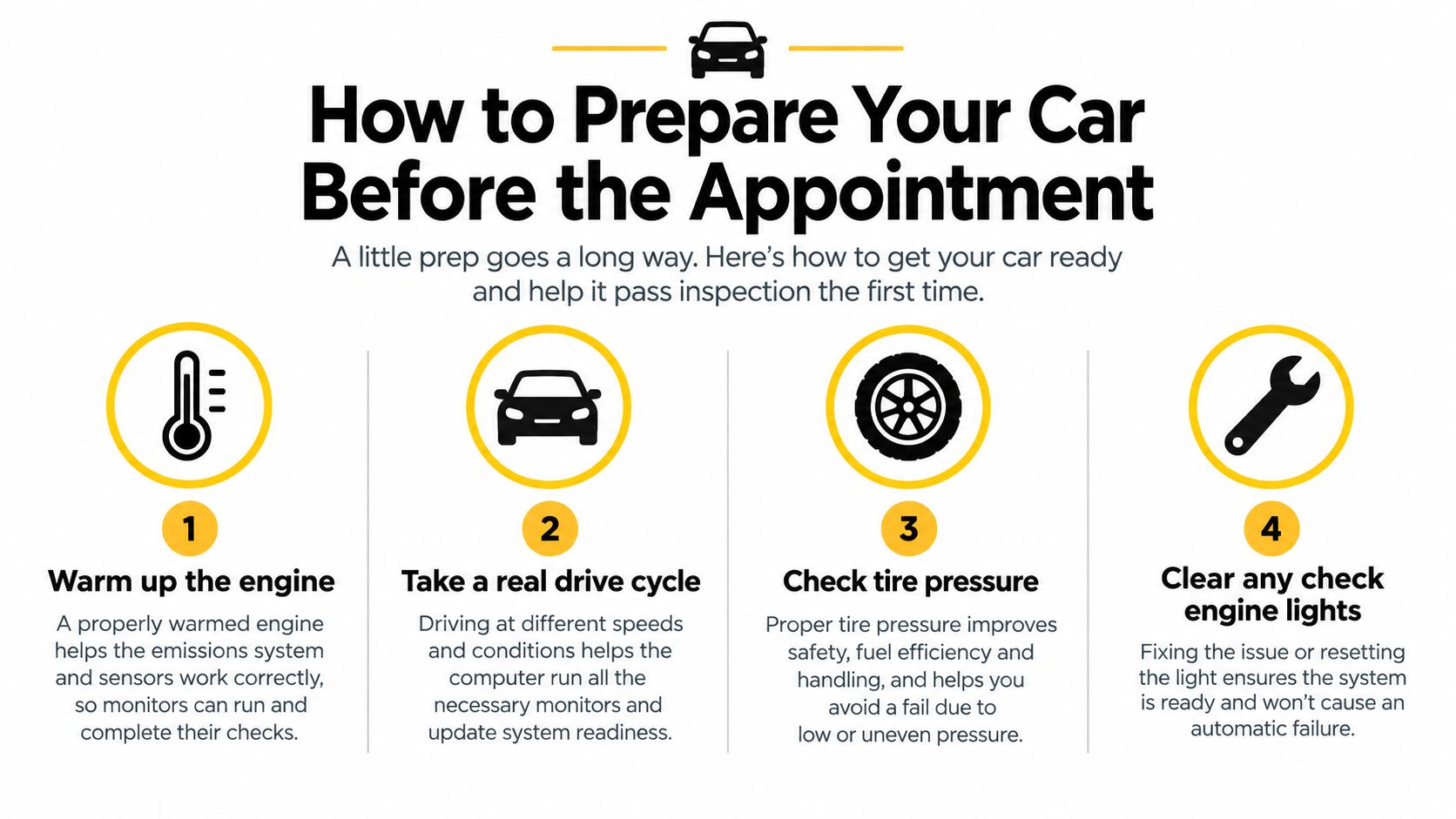
Start with a real drive, not a quick shuffle around the block. A properly warmed engine and catalytic converter give the emissions system a fair chance to operate the way it does in normal use, and that matters before any inspection that depends on operating temperature. If you've recently repaired something or disconnected the battery, give the car enough normal driving to finish its self-checks.
Check the light, then check the cause
If the check engine light is on, don't erase it and hope. Have the fault diagnosed and repaired, because the inspection is built to look past the dashboard glow and into the stored data. If the light recently turned off on its own, make sure the underlying issue is fully resolved before you head in.
Replace obvious wear items
A tired gas cap is cheap to fix and easy to overlook. If the seal is cracked, loose, or missing its grip, replace it before the appointment. That one part can save you a retest, especially on vehicles where the evap system is part of the evaluation.
Give the car a normal mix of driving
A commute with stops and highway speeds is better than a mile of idling in the driveway. Mixed driving helps the monitors run through the tests they need, and it gives the engine a chance to settle into the same conditions the inspection assumes. If you've only driven the car short distances lately, don't assume it's ready just because the dash looks calm.
Bring the paperwork with you
Have your registration or renewal notice ready so the station can process the inspection without delay. If you want a station that handles California-required testing for many vehicle types, including newer models and older or diesel vehicles, a STAR Certified shop like Speedy Smog is one option to consider alongside other licensed stations.
What to do before a smog check
Most vehicles pass on the first try. The prep above isn't about fear, it's about protecting the small share of drivers whose car is hiding a monitor issue, a seal problem, or a fault the dash didn't make obvious.
If you want a straightforward smog check with clear guidance on what the inspector is looking for, Speedy Smog handles California emissions testing for a wide range of vehicles in San Leandro. Visit Speedy Smog to schedule a visit and get your inspection done by a STAR Certified station that understands the layers behind a passing result.