
Your DMV renewal notice is on the kitchen counter, and one line has created an immediate question: “Smog Certification Required.” You may be wondering whether the car needs a test every year, whether a recent inspection still counts, or whether its hybrid, diesel, or electric powertrain changes the answer.
California's DMV smog check requirements depend on the event you're handling, not just the vehicle itself. Registration renewal, a change of ownership, and first-time registration in California can trigger different obligations. Model year, fuel type, vehicle weight, and the wording on your DMV notice all matter.
Table of Contents
- Decoding Your DMV Renewal Notice
- Navigating Exemptions by Transaction and Vehicle Age
- Understanding OBD and Tailpipe Testing Differences
- STAR Station Mandates and Readiness Monitor Prep
- Special Rules for Hybrids Diesels and Electric Vehicles
- Handling Test Failures and the BAR Referee Process
- Your Action Plan for a Smooth Smog Check Experience
Decoding Your DMV Renewal Notice
California doesn't generally require a smog inspection on a fixed annual calendar. The obligation is tied primarily to vehicle registration, and gasoline-powered, hybrid, and alternative-fuel vehicles from model year 1976 onward generally need testing every other year when the DMV renewal notice says certification is required, according to the California Bureau of Automotive Repair's Smog Check guidance.
Start with the notice itself. Look for language such as:
- “Smog Certification Required” means you can generally use an authorized Smog Check station.
- “Smog Certification Required at a STAR station” means the vehicle must be inspected at a STAR-certified location.
- No smog certification instruction usually means the renewal doesn't currently require a test, although you should still follow any other DMV directions.
The notice is more reliable than guessing from the car's age or from the date of its last inspection. California may require a test for a renewal, a sale, or a first California registration even when the vehicle passed an inspection for a different transaction.
Practical rule: Read the DMV notice before booking an appointment. It tells you whether a test is required and whether the station must have STAR certification.
A registration renewal test is normally required biennially, or every other year, rather than annually. The DMV can't finalize a renewal when required smog certification is missing, even if you've already paid the registration fees, as explained in the DMV registration renewal instructions.
If the notice requires testing, use a service such as Smog Check registration renewal assistance to understand the process, then choose a station that matches the notice. Bring the vehicle, the notice if available, and any relevant repair information. Handling the inspection before the renewal deadline gives you time to respond if the vehicle needs repairs or the DMV record needs attention.
Navigating Exemptions by Transaction and Vehicle Age
The phrase “new car exemption” causes many California drivers trouble because it can describe different rules for different DMV events. A vehicle that avoids a biennial renewal inspection may still face a different requirement during a sale or first California registration.
For renewal, gasoline, hybrid, and alternative-fuel vehicles that are eight model years old or newer generally don't need the biennial inspection. The owner instead pays a smog abatement fee, subject to DMV eligibility rules. California gives a separate transfer rule to vehicles four model years old or newer, which can generally avoid the change-of-ownership inspection through the applicable smog-related fee.
Those exemptions don't automatically apply to every transaction. An out-of-state vehicle being registered in California for the first time generally needs a California Smog Check if it falls within the covered model-year and fuel categories. A recent inspection completed for another state or another DMV event shouldn't be treated as a universal exemption.
California Smog Check Exemption Matrix
| DMV Transaction Type | Vehicle Age / Model Year | Smog Check Required? |
|---|---|---|
| Registration renewal | Gasoline, hybrid, or alternative-fuel vehicle eight model years old or newer | Generally no biennial inspection, but a smog abatement fee may apply |
| Registration renewal | Covered gasoline, hybrid, or alternative-fuel vehicle beyond the newer-vehicle renewal exemption | Generally yes when the DMV notice identifies certification as required |
| Change of ownership | Vehicle four model years old or newer | Generally no transfer inspection, with the applicable smog-related fee |
| Change of ownership | Covered vehicle older than the transfer exemption | Generally yes, unless another exemption applies |
| First California registration | Covered out-of-state vehicle | Generally yes |
| Any transaction | Fully electric vehicle | Exempt |
| Any transaction | Gasoline vehicle from model year 1975 or older | Exempt |
| Any transaction | Diesel vehicle from model year 1997 or older | Generally exempt |
| Any transaction | Diesel vehicle above 14,000 pounds GVWR | Exempt from the standard requirement described here |
The most useful question isn't “Is my car exempt?” Ask instead: What DMV event am I completing, what is the model year, what fuel does it use, and what does the notice say? That four-part check prevents owners from applying a renewal exemption to a transfer or assuming an older out-of-state inspection will satisfy California registration.
If your situation involves an unusual transfer or exemption, review the DMV smog exemption form information before making an appointment. Keep your registration documents available, because the correct answer can depend on the transaction being processed rather than on the vehicle alone.
Understanding OBD and Tailpipe Testing Differences
Two vehicles can visit the same station and receive very different inspections. California chooses the testing method based on the vehicle's configuration, including its model year, fuel type, weight, and whether it has OBD II, the onboard diagnostic system used to monitor emissions equipment.
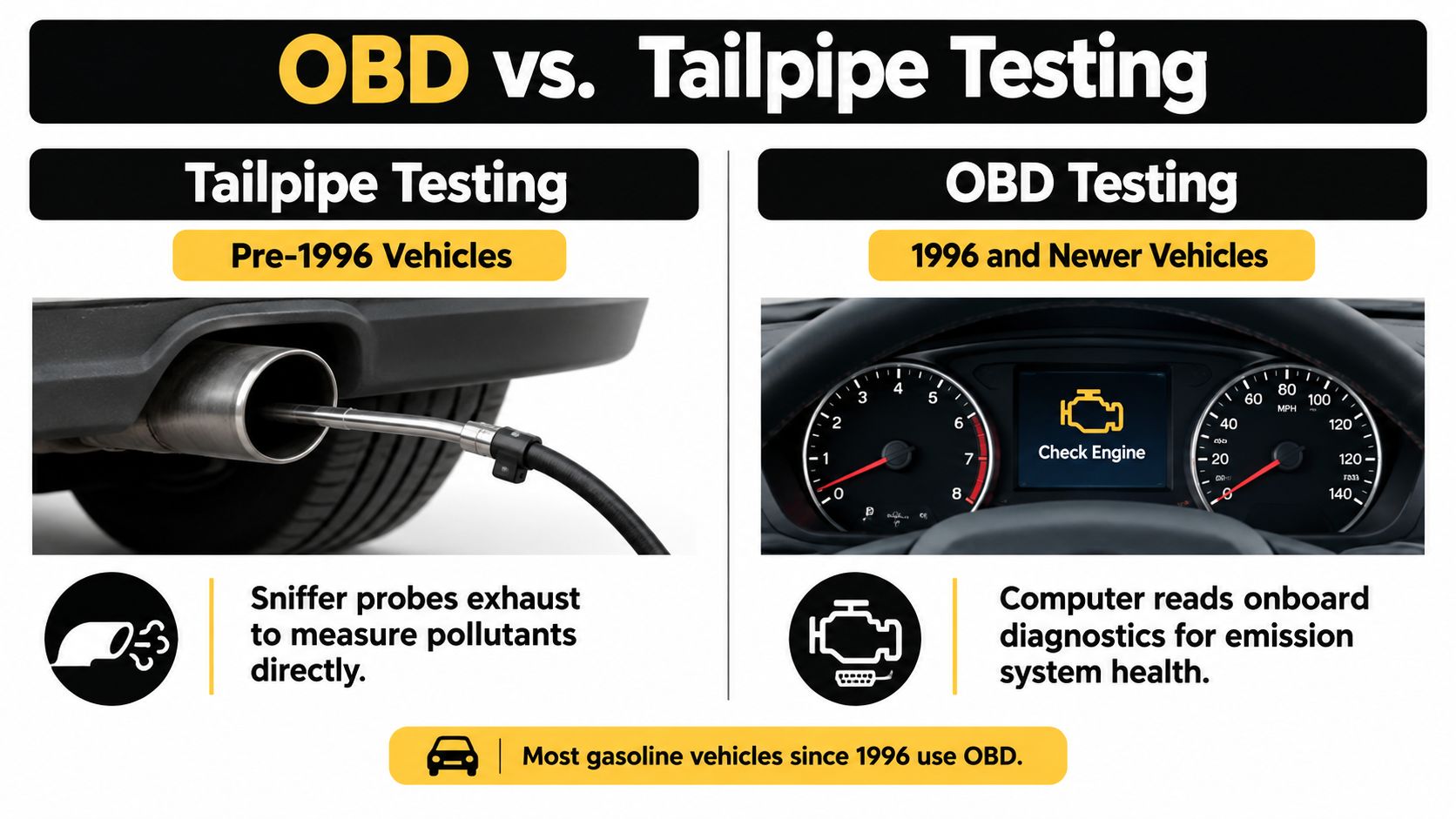
Most gasoline and hybrid vehicles from 2000 and newer, with a GVWR of 14,000 pounds or less and equipped with OBD II, are generally inspected through BAR-OIS. The technician connects approved equipment to the vehicle and electronically evaluates diagnostic information, emissions-related fault codes, readiness monitors, and required vehicle details. The process focuses on what the vehicle's computer reports about the health of its emissions systems.
Gasoline vehicles from 1976 through 1999, heavier gasoline vehicles, and qualifying vehicles without OBD II are generally tested with BAR-97. Instead of relying primarily on onboard computer data, this method measures pollutants directly from the exhaust through a tailpipe test. The BAR Smog Check executive summary describes the distinction between BAR-OIS electronic evaluation and BAR-97 tailpipe measurement.
The difference matters when you prepare:
- OBD-equipped vehicles: Diagnostic trouble codes and incomplete readiness monitors can affect the result, even when the dashboard warning light is currently off.
- Older vehicles: Emissions performance is assessed through measured exhaust, so engine condition, fuel delivery, ignition, and emissions components play a direct role.
- Both types: The inspector must use the procedure that matches the vehicle's configuration. You shouldn't assume a newer vehicle receives a tailpipe test because it has an exhaust system.
For a clearer explanation of how the terms relate, compare Smog Check and smog test terminology before arriving at the station.
STAR Station Mandates and Readiness Monitor Prep
A DMV notice that names a STAR station changes where you can test. STAR is California's standards-based program for vehicles assigned to higher-performing inspection locations. The DMV distinguishes between a notice that says certification is required at any authorized station and one that specifically directs the owner to a STAR-certified station.
Check the exact wording before you leave home. If the notice says “Smog Certification Required at a STAR station,” a regular licensed station isn't enough for that transaction. If it says only “Smog Certification Required,” you can generally choose an authorized Smog Check station.
Prepare the vehicle's diagnostic system
Readiness monitors are internal checks that help the vehicle confirm whether its emissions systems have completed their self-tests. A dead battery, battery replacement, or recent code clearing can erase this stored readiness information. The car may start normally and show no illuminated check-engine light, yet the inspection can still identify the monitors as incomplete.
Avoid disconnecting the battery or clearing codes immediately before testing. If a repair shop has recently erased diagnostic trouble codes, ask whether the vehicle has completed the required driving conditions for its monitors to run. The exact driving pattern varies by vehicle, so consult the owner's manual or a qualified repair professional rather than relying on a universal mileage claim.
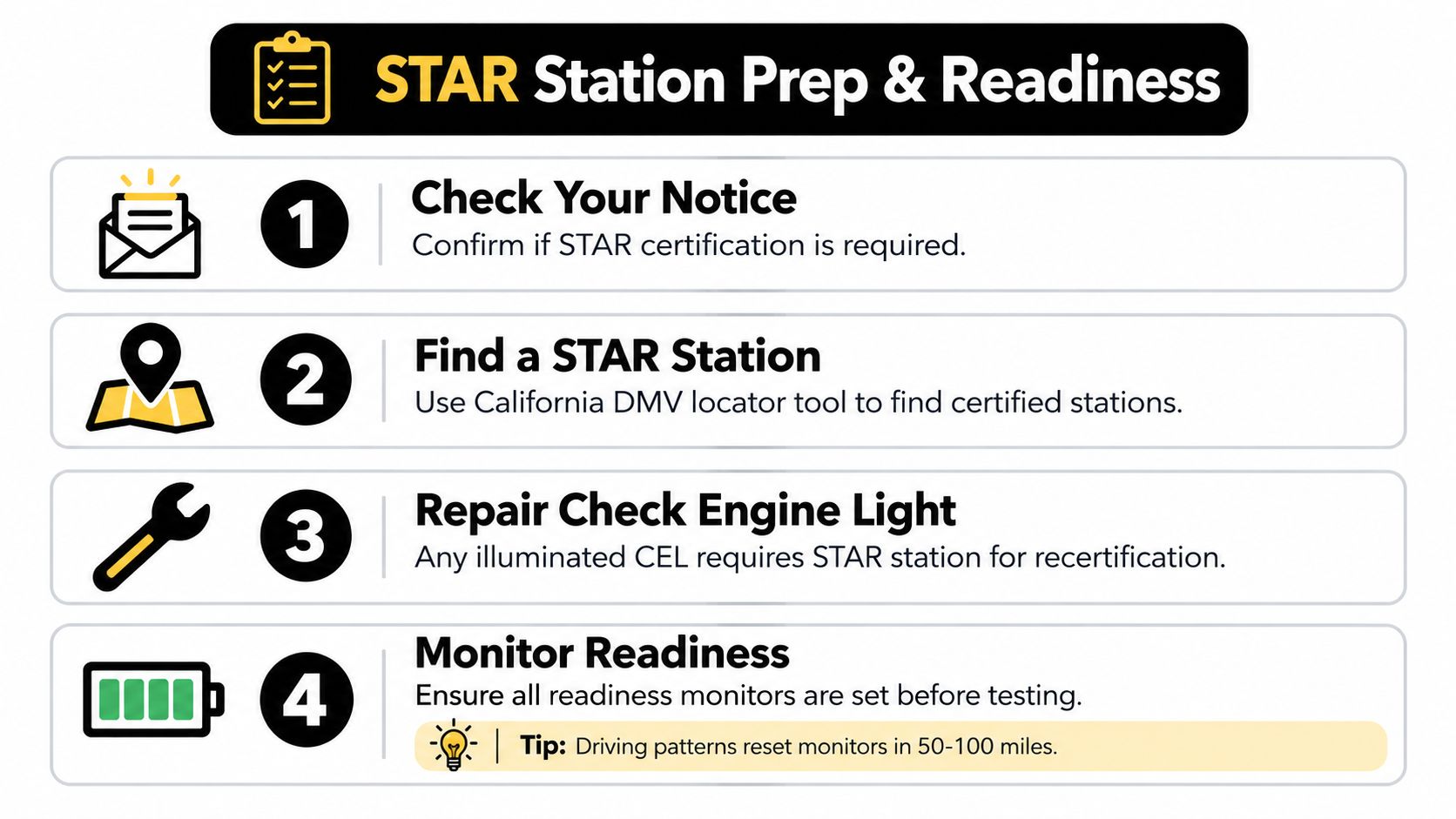
A practical preparation sequence looks like this:
- Read the notice. Confirm whether the DMV requires a STAR station.
- Check the warning light. An illuminated emissions warning lamp needs diagnosis before testing.
- Ask about readiness. If the battery was disconnected or codes were cleared, verify that the monitors have had time to complete.
- Bring the paperwork. Keep the DMV notice and any recent repair documents with you.
California also requires the engine to reach normal operating temperature, and the Smog Check procedure specifies at least three minutes of continuous low-idle operation immediately before the tailpipe test for applicable vehicles. Arriving prepared helps the technician perform a valid inspection instead of encountering a preventable readiness or temperature issue.
Special Rules for Hybrids Diesels and Electric Vehicles
A hybrid owner often asks whether the gasoline engine changes the answer. In California, hybrids generally follow the same broad Smog Check framework as covered gasoline vehicles. Their onboard diagnostic systems can be evaluated electronically when the vehicle meets the applicable BAR-OIS configuration, so the hybrid label alone doesn't create a blanket exemption.
Consider a hybrid during registration renewal. The owner should read the DMV notice, confirm the transaction, and determine whether the vehicle falls within the newer-vehicle renewal exemption. If the notice requires certification, the hybrid needs an inspection at the station type named by the DMV.
Diesel owners need a different decision path. Diesel vehicles from model year 1998 onward and with a GVWR of 14,000 pounds or less generally require testing. The BAR consumer FAQ identifies diesel rules as materially different from the newer-vehicle exemption available to many gasoline and hybrid vehicles.
Three powertrain examples
- Hybrid: Treat it as a covered vehicle unless the DMV notice and applicable exemption rules say otherwise. Its testing method depends on its configuration.
- Diesel: Check both model year and GVWR. A newer diesel may require testing even when a similarly aged gasoline vehicle could use a renewal exemption.
- Fully electric: A battery-electric vehicle is exempt from California's Smog Check requirement because it has no gasoline or diesel emissions system to inspect.
Fuel type is only part of the diesel decision. Weight matters because the standard rule described here applies to diesel vehicles at or below the relevant GVWR threshold, while heavier diesel vehicles are treated differently. If you're unsure, locate the GVWR on the vehicle label or manufacturer documentation and compare it with the DMV notice.
Don't use another owner's experience as your guide. Two vehicles registered in the same household can receive different instructions because one is a hybrid, one is diesel, or one is fully electric.
Handling Test Failures and the BAR Referee Process
A failed inspection gives you information, not an automatic dead end. First, ask for the Vehicle Inspection Report, or VIR, and read the specific reason for the result. The report helps separate an emissions failure from an incomplete-readiness issue, missing information, or another inspection condition.
Use this order of operations:
- Review the VIR. Identify the failed area and ask the technician to explain any unfamiliar code or monitor status.
- Confirm the transaction deadline. A renewal can remain incomplete while required certification is missing.
- Diagnose before replacing parts. A warning light or emissions code identifies a system that needs attention, but it doesn't automatically identify one specific failed component.
- Repair the cause. Use a qualified repair professional when the issue requires specialized diagnostic equipment or emissions-system knowledge.
- Return for the appropriate inspection. If the first result involved incomplete monitors, verify that the vehicle is ready before retesting.
A car that has recently lost battery power may produce a “not ready” result rather than a conventional pollutant failure. That distinction matters because clearing codes again can restart the readiness process and delay a valid inspection.
The DMV directs owners with Smog Check failures toward the Bureau of Automotive Repair Referee Program when additional help is needed. The Referee can be relevant for complex cases, disputed situations, or vehicles that need a state-level review of their emissions compliance. Ask the station or consult BAR guidance about whether your circumstances fit the program before scheduling.
A failed test should lead to a documented diagnosis. Replacing parts at random can add cost without resolving the condition that caused the result.
Keep the VIR, repair invoices, and any follow-up test documentation together. Those records give the repair shop and, when appropriate, the BAR Referee a clear timeline of what the vehicle reported and what work was performed.
Your Action Plan for a Smooth Smog Check Experience
You open your DMV notice and just want one clear answer. Start with the transaction on that notice, because a renewal, a transfer, and a first California registration can trigger different smog obligations even for similar vehicles. Then check the vehicle type. A hybrid often follows gasoline-based rules, a diesel follows its own year and weight rules, and a fully electric vehicle is exempt.
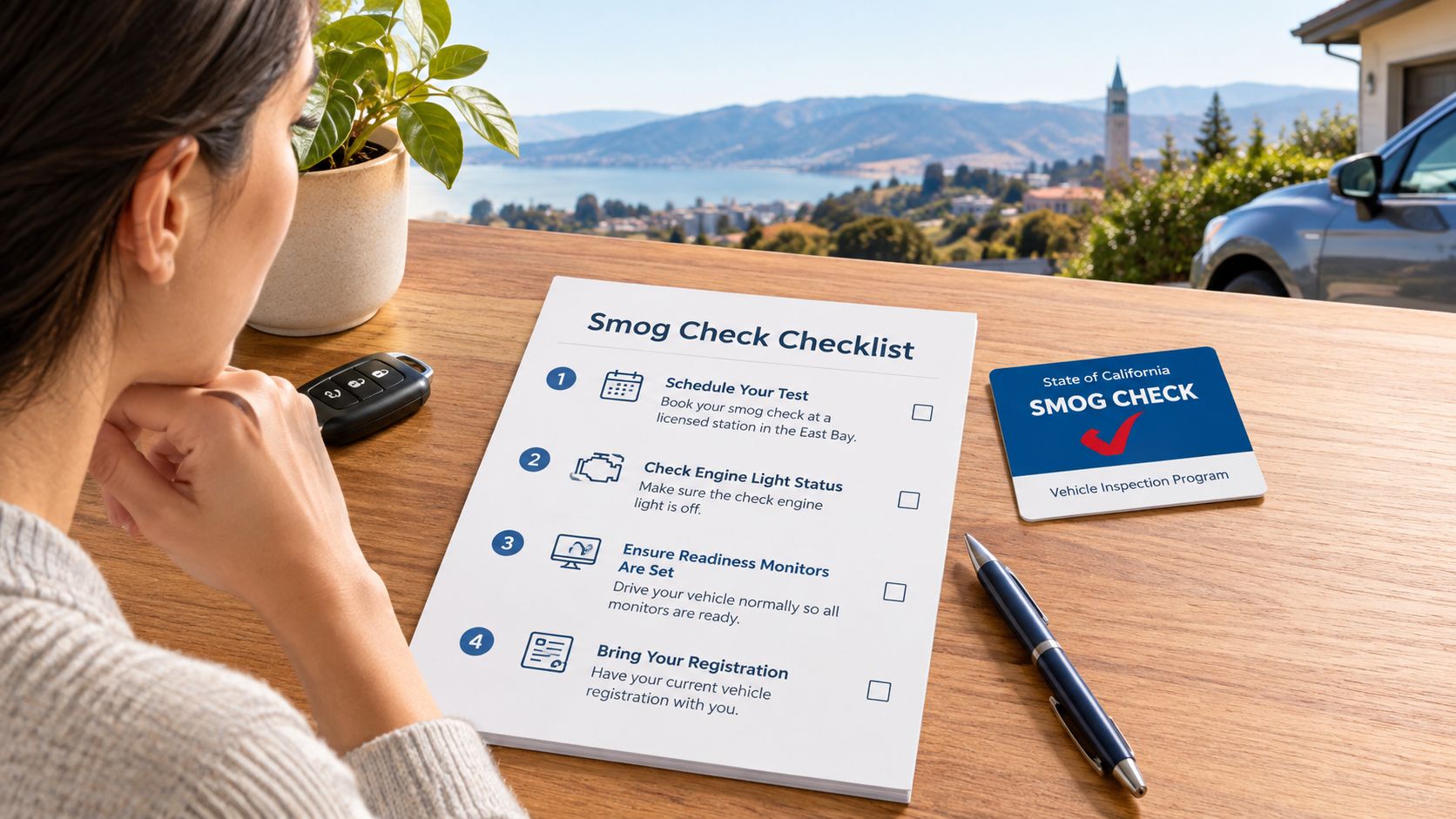
Use this quick check
- Renewal: Read the notice to confirm whether biennial certification is required.
- Ownership transfer: A recent renewal inspection may not satisfy the transfer requirement.
- New California registration: An out-of-state vehicle that is covered usually needs a California inspection unless a specific exemption applies.
- Hybrid: Apply the gasoline and vehicle-configuration rules, then follow the notice.
- Diesel: Check model year and GVWR separately. Diesel exemptions differ from gasoline exemptions.
- Electric: Fully electric vehicles are exempt from Smog Check.
- STAR instruction: Use a STAR-certified station if the notice requires one.
- OBD preparation: Do not clear codes or disconnect the battery right before testing.
- Failed result: Keep the VIR, get a targeted diagnosis, and contact BAR resources if the case may need Referee help.
That order matters. The notice tells you what DMV needs, and the powertrain tells you which smog rules apply to the vehicle in front of you. If you skip either step, you can end up at the wrong station or arrive before the car is ready to test.
For East Bay drivers, Speedy Smog in San Leandro is one local option. It is a STAR-certified station at 15275 Washington Ave, San Leandro, and it performs inspections for many gasoline, hybrid, older, and diesel vehicles, with results transmitted electronically for DMV registration processing. Its published service information also describes a comfortable indoor waiting area and typical testing for many newer vehicles in about 10 to 15 minutes.
Visit Speedy Smog with your DMV notice so the team can confirm whether your vehicle needs a standard or STAR inspection and help you address the correct registration requirement. The San Leandro station provides Smog Checks for newer vehicles, older cars, diesels, and hybrids, giving East Bay drivers a practical place to complete certification before renewal or transfer paperwork.
A typical California smog check total lands in the low-to-mid $70s after the $8.25 state certificate fee is added to the station's inspection charge. Statewide averages are about $70.00 for BAR-97 tests and $62.04 for OIS tests, before that certificate fee is included.
Your DMV renewal notice is probably sitting on the counter, and the deadline is getting close. You call a station, hear an advertised price, and assume that number is the whole bill. In California, it often isn't.
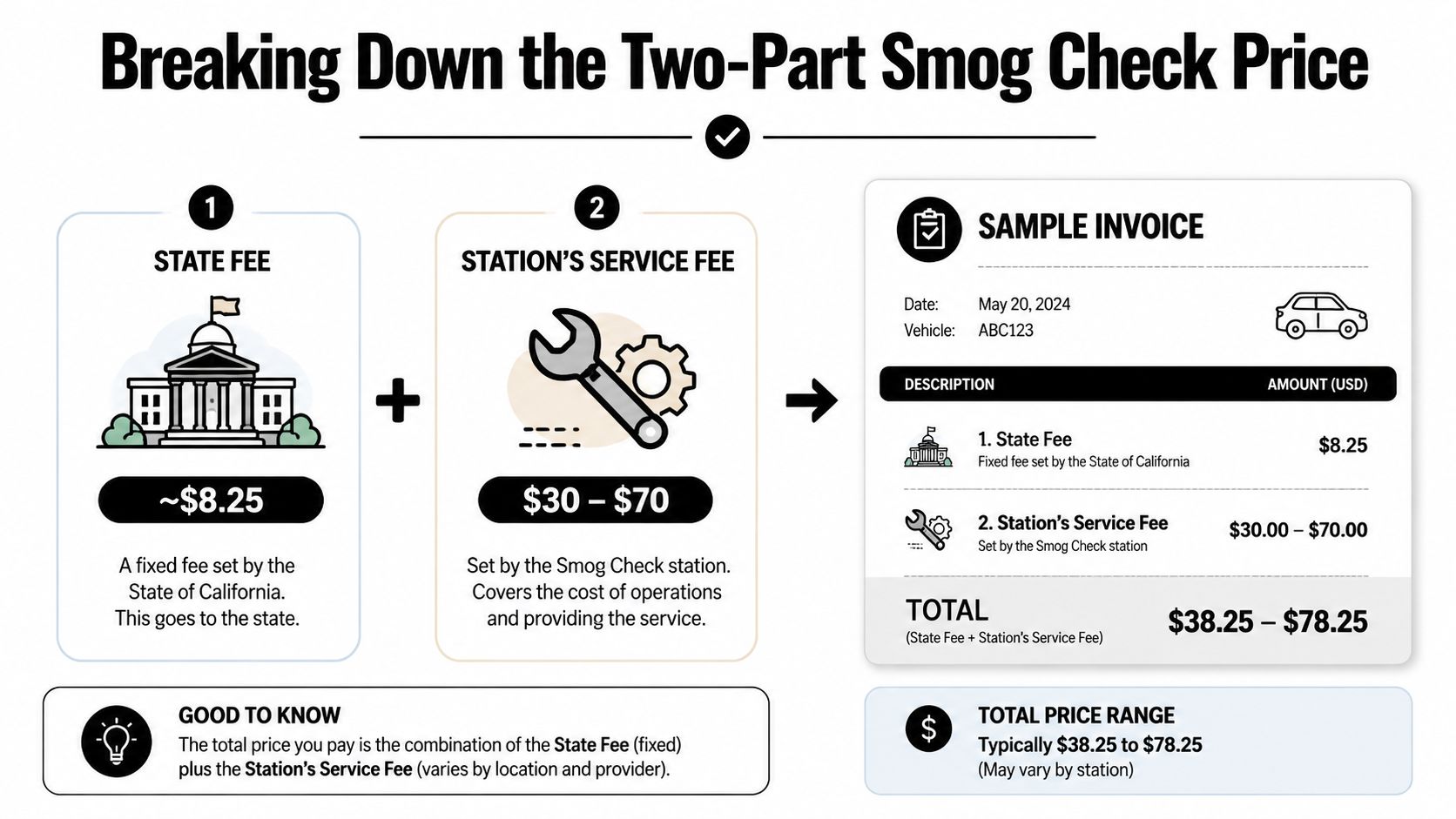
The CA smog check price has two parts. The station chooses the inspection fee, while the state adds its certificate charge only when the vehicle passes. Vehicle age, test method, station designation, and whether the station performs repairs can all change the amount you pay. The California Bureau of Automotive Repair's smog check guidance confirms that inspection prices vary by station, while the certificate fee is the universal state add-on.
Table of Contents
- What a California Smog Check Actually Costs
- Breaking Down the Two-Part Price Structure
- STAR vs Non-STAR Station Pricing Compared
- How Your Vehicle Type Changes the Price
- Why a STAR Station Is Often the Smarter Choice
- Practical Ways to Lower Your Smog Check Bill
- Your Pre-Visit Smog Check Checklist
What a California Smog Check Actually Costs
A San Leandro driver renewing registration might see a station advertise a low inspection price, then discover that the final receipt is higher after certification. That doesn't automatically mean the station added an improper charge. It usually means the advertised price covered the station's inspection only.
For a normal compliant vehicle, plan on a final bill in the low-to-mid $70s, depending on the inspection method and the station's posted fee. BAR's 2025 Executive Summary lists statewide average inspection costs of $70.00 for BAR-97 tests and $62.04 for OIS tests (California BAR 2025 Executive Summary Report). Adding the $8.25 certificate fee brings those averages into roughly the low-to-upper $70s for a passing vehicle.
What the advertised price leaves out
The inspection fee pays the station for the test itself. It can reflect the vehicle's emissions system, the equipment required, labor, and the station's operating costs. California doesn't set one statewide retail inspection price, so two licensed stations in the East Bay can post different prices for what appears to be the same service.
The state certificate fee is separate and applies only after a pass. If the vehicle fails, the certificate isn't issued, so that fee isn't charged at that stage. Repairs and a later retest are separate costs.
Practical rule: When you call, ask for the total price for your exact vehicle, including the certificate fee if it passes.
Have the station confirm the model year, fuel type, and whether your DMV notice requires STAR. For a more detailed explanation of the smog inspection cost, compare the inspection charge with the final out-the-door amount, not just the number on a coupon.
Breaking Down the Two-Part Price Structure
Most confusion starts with the phrase “smog check price.” Drivers use it to mean the inspection, certification, repairs, and retest together. The invoice is simpler than that, but only if you separate the charges.
The first line is the station inspection fee. That amount is set by the business and can vary according to location, station category, equipment, and vehicle. A station may quote one price for a newer OBD-based inspection and another for an older BAR-97 test.
The second line is the $8.25 California smog certificate fee. It's mandatory when the vehicle passes, and the amount is statewide rather than negotiated between the customer and the station. The California DMV's smog certification fee guidance explains the state fee and related certification rules.
What happens after a pass or failure
A passing test creates the certification transaction needed for the DMV process, and the state certificate fee appears on the bill. A failed test doesn't create that certificate, so the certificate charge isn't the part that drives the next bill.
The expensive surprise usually comes afterward. Diagnosis, emissions repairs, parts, labor, and a retest aren't automatically included in the original inspection fee. Ask whether the quoted amount covers only the initial test or also includes a retest policy.
| Invoice component | Who sets it | When it applies |
|---|---|---|
| Station inspection fee | The smog station | For the inspection |
| State certificate fee | California | Only when the vehicle passes |
| Repairs and diagnosis | The repair provider | When the vehicle needs corrective work |
| Retest charge | The station's policy | After repairs, if another test is required |
Before booking, use the station's smog check station information to find a licensed location, then ask one direct question: “What will I pay if the vehicle passes today?” That answer is more useful than a low headline price with no explanation.
STAR vs Non-STAR Station Pricing Compared
A STAR station is not automatically the expensive option. STAR is a Bureau of Automotive Repair performance designation. The station's business model still matters: it may be Test-Only or Test-and-Repair, and each sets its own inspection price.
The inspection fee is only one part of your out-the-door cost. Add the state certificate fee when the vehicle passes. Compare the complete total, not a coupon headline or a station label.
Average inspection costs by station type
| Station type | Average inspection cost |
|---|---|
| STAR Test-and-Repair | $66.90 |
| STAR Test-Only | $58.90 |
| Non-STAR Test-and-Repair | $70.77 |
| Non-STAR Test-Only | $56.40 |
The BAR 2024 Smog Check Executive Summary Report lists these as inspection averages, not final passing totals. The state certificate fee remains separate. The figures also show that STAR Test-Only averaged less than STAR Test-and-Repair, while Non-STAR Test-Only averaged less than Non-STAR Test-and-Repair. STAR status alone does not determine the bill.
The equipment path changes the quote too. STAR Test-and-Repair stations averaged $72.87 for BAR-97 inspections and $60.99 for OIS inspections. STAR Test-Only stations averaged $52.44 for OIS inspections. Ask which test method applies to your vehicle before accepting a price.
Choose based on the DMV requirement
Read the registration notice first. If the DMV requires a STAR inspection, a cheaper non-STAR quote will not complete the job. You may pay once, then pay again at an approved station.
Test-Only stations perform inspections. Test-and-Repair stations can diagnose and repair emissions problems, which can save a second trip if the vehicle fails. Review this guide to what a STAR station is before choosing from a coupon alone.
Call with one question: “What is the full price, including the certificate fee if I pass?” Confirm the test method and whether a retest has a separate charge. Choose STAR or non-STAR based on the DMV requirement, vehicle, and complete quoted total.
How Your Vehicle Type Changes the Price
Your vehicle determines the test path, and the test path affects the inspection charge. A newer gasoline car with a functioning diagnostic system generally follows a different process from an older vehicle that requires more involved emissions equipment.
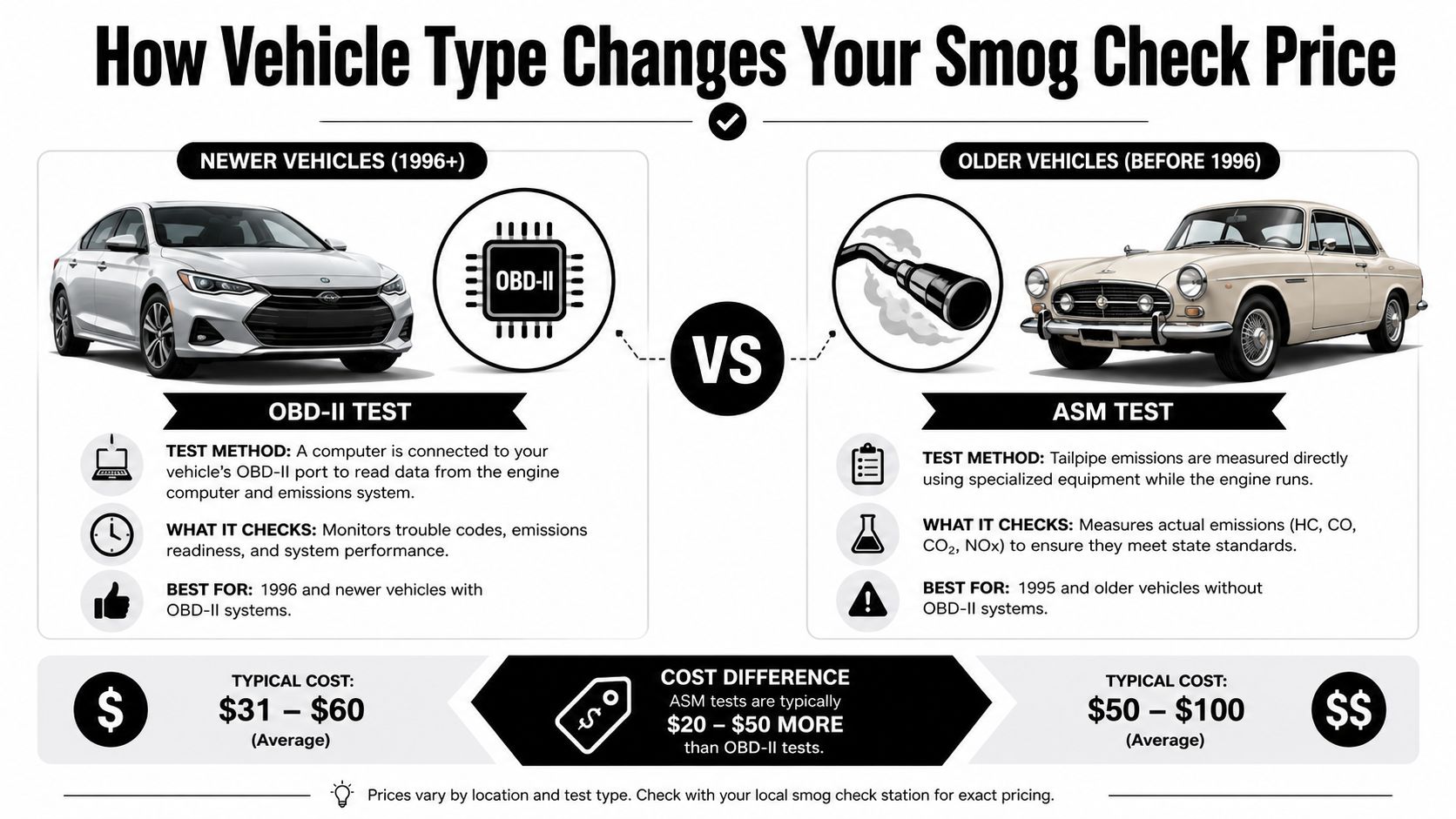
California commonly uses OIS testing for many 2000-and-newer vehicles, while older vehicles may require BAR-97 testing. The BAR averages above show that OIS inspections generally carry a lower average than BAR-97 inspections, but the exact charge still belongs to the station.
Start with the model year
Check the model year before calling. The DMV states that most vehicles need certification every two years after the initial smog-abatement period, while newer vehicles may qualify for an abatement fee instead of an immediate inspection. The California DMV vehicle registration guidance is the right place to confirm your vehicle's requirement.
A newer vehicle can often communicate emissions information through its onboard diagnostic system. Older vehicles may need a more labor-intensive inspection using BAR-97 equipment. That difference can explain why one vehicle receives a lower quote than another at the same station.
Fuel type and drivetrain still matter
Diesel vehicles don't follow the same pricing assumptions as ordinary gasoline cars. Older diesels, commercial vehicles, and vehicles with specialized emissions systems may require different equipment or procedures, so give the station the exact fuel type before accepting a quote.
Hybrids can also require certification once they are no longer within the applicable exemption period. Electric vehicles don't use the same tailpipe emissions process, but registration rules still depend on the vehicle category and DMV instructions.
Bring the vehicle identification details when you call:
- Model year: This helps the technician identify the likely test method.
- Fuel type: Gasoline, diesel, hybrid, and electric vehicles can follow different rules.
- Registration notice: The notice may identify whether STAR certification is required.
- Modification history: Emissions-related modifications can change what the station needs to inspect.
Don't guess based on the car's appearance or age alone. A precise quote requires the vehicle information and the registration requirement.
Why a STAR Station Is Often the Smarter Choice
Drivers often assume STAR means higher cost. The BAR averages show that assumption doesn't hold consistently, because STAR Test-Only inspection averages can be lower than STAR Test-and-Repair averages and can also compare favorably with non-STAR categories.
STAR is a performance designation, not a luxury service tier. The station has to meet the program's standards, but its retail inspection fee remains its own business decision. Your first question should be whether STAR is required, not whether STAR sounds expensive.
Avoid the wrong-station expense
If your DMV notice calls for a STAR inspection, going elsewhere can create a compliance problem. You may leave with a test result but still need a STAR certification before the registration process is complete. That means another appointment, another inspection charge, and more lost time.
A STAR Test-Only station makes sense when the vehicle is straightforward and you only need the inspection. A STAR Test-and-Repair station is more practical when the vehicle has an emissions warning light, previous failure, or an uncertain repair history. The ability to diagnose the issue at the same location can reduce unnecessary handoffs.
Choose the station that matches the DMV instruction and the vehicle's risk, then compare its complete passing price.
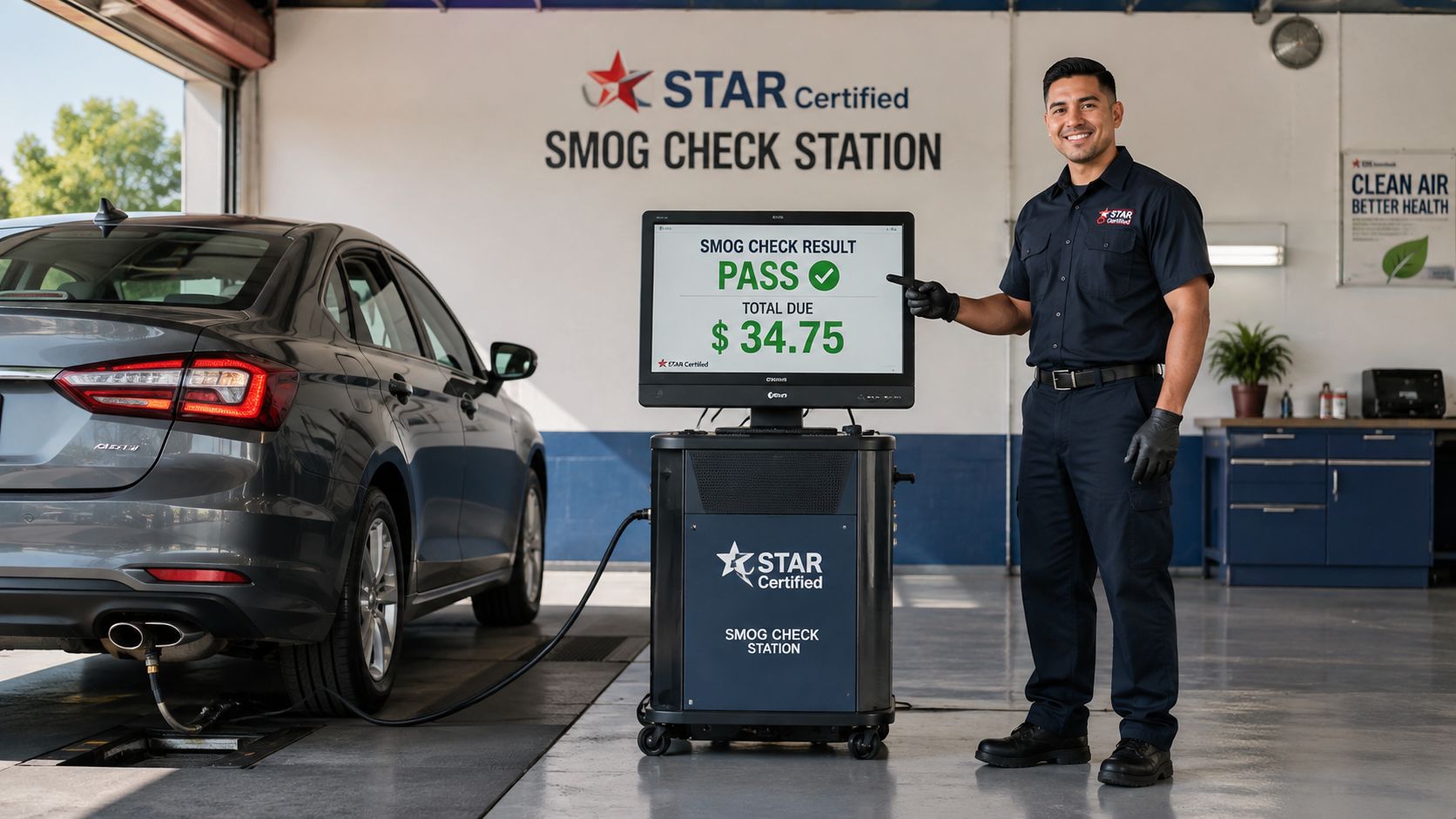
For East Bay drivers, Speedy Smog is one local option. It operates as a STAR Certified station in San Leandro and handles inspections for newer vehicles, older vehicles, diesels, and hybrids. The right choice still depends on your registration notice and the quote you receive.
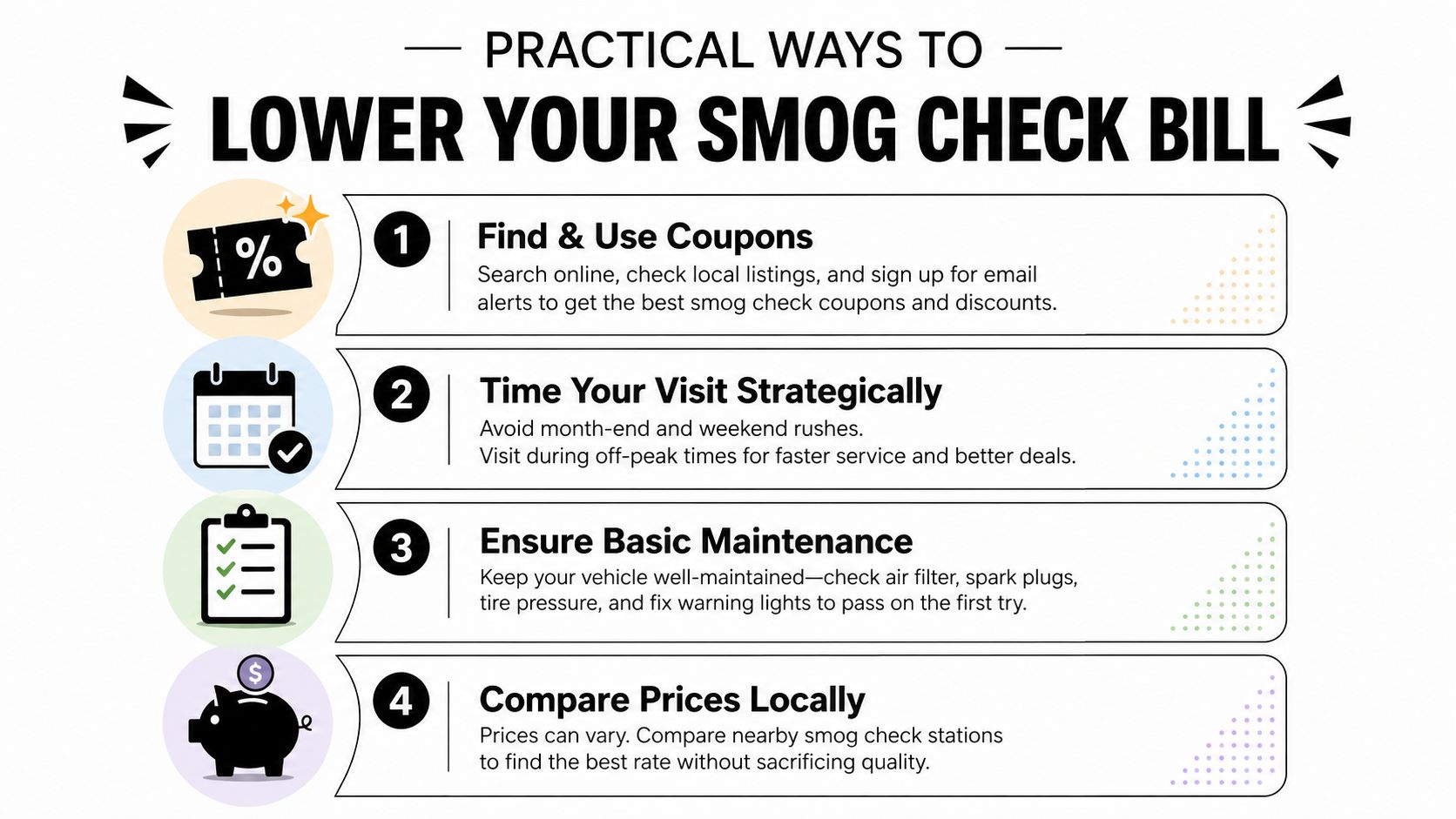
Practical Ways to Lower Your Smog Check Bill
The cleanest way to reduce the bill is to avoid paying for the wrong service. Confirm the DMV requirement, identify the likely test method, and ask for the passing total before you authorize the inspection.
Use discounts carefully
Coupons can lower the station's inspection portion, but read the fine print. A discount may apply only to certain model years or standard inspections, and it may not remove the separate state certificate fee after a pass. Ask whether the coupon changes the inspection fee only or the final amount.
Speedy Smog publishes a $25-off offer for most smogs on newer vehicles, so East Bay drivers should check the current terms before relying on it. Treat any coupon as a price tool, not proof that the station's final total is lowest.
Time the appointment instead of rushing
Last-minute registration pressure limits your choices. Schedule early enough to call several stations, compare the passing total, and confirm whether STAR is required. If the vehicle fails, early scheduling also leaves room for diagnosis and repair without turning the renewal deadline into an emergency.
A basic pre-visit check can prevent avoidable complications:
- Inspect warning lights: An illuminated emissions warning light can lead to a failed inspection.
- Check the registration notice: Confirm the due date and station designation requirement.
- Ask about retests: Learn whether the station offers a retest policy and what conditions apply.
- Bring recent repair information: Service records can help the technician understand prior emissions work.
Check whether testing is required
Some newer vehicles may use a smog abatement fee during registration instead of receiving a smog inspection. Don't pay for a test because the renewal process mentions emissions. Verify the requirement through the DMV notice or the DMV's official guidance first.
If the vehicle fails, don't approve every repair offered without understanding the failure reason. Ask for the failure report, separate diagnosis from repairs, and check whether you qualify for assistance through California's Consumer Assistance Program. The cheapest legitimate repair is the one that addresses the documented emissions problem, not a parts swap based on guesswork.
Your Pre-Visit Smog Check Checklist
Before driving to the station, run through this short list:
- Read the DMV notice: Confirm whether certification is required and whether STAR is specified.
- Identify the vehicle: Have the model year, fuel type, and vehicle details ready.
- Ask for the passing total: Confirm the station inspection fee plus the $8.25 certificate fee if the vehicle passes.
- Clarify the test method: Ask whether the vehicle receives OIS or BAR-97 testing.
- Check the failure policy: Find out what a retest costs and whether repairs must be completed at that station.
- Verify discounts: Make sure a coupon applies to your vehicle and understand which charge it reduces.
- Bring documents: Take the registration notice and any relevant repair records.
The number that matters is the out-the-door passing price, not the largest discount in the window. A clear quote, the correct station designation, and the right test method will prevent most billing surprises.
For a transparent quote and California-compliant testing in San Leandro, visit Speedy Smog with your DMV notice and vehicle details ready. Ask the team to confirm the inspection method, STAR requirement, certificate fee, and any applicable discount before the test begins.
A passing California smog certificate is valid for 90 days from the test date for DMV registration and ownership transfer purposes. Most vehicles also need a new smog check every other year to renew registration.
That's the part drivers miss. They pass the test, set the paperwork aside, and assume they're covered until the next renewal cycle. Then the DMV window turns into a delay, a duplicate fee, or a full re-test.
The trap is simple. The smog result and the registration timeline are not the same thing, and California treats them as two separate clocks. If you know which clock is running, you can avoid a wasted trip and keep the registration moving.
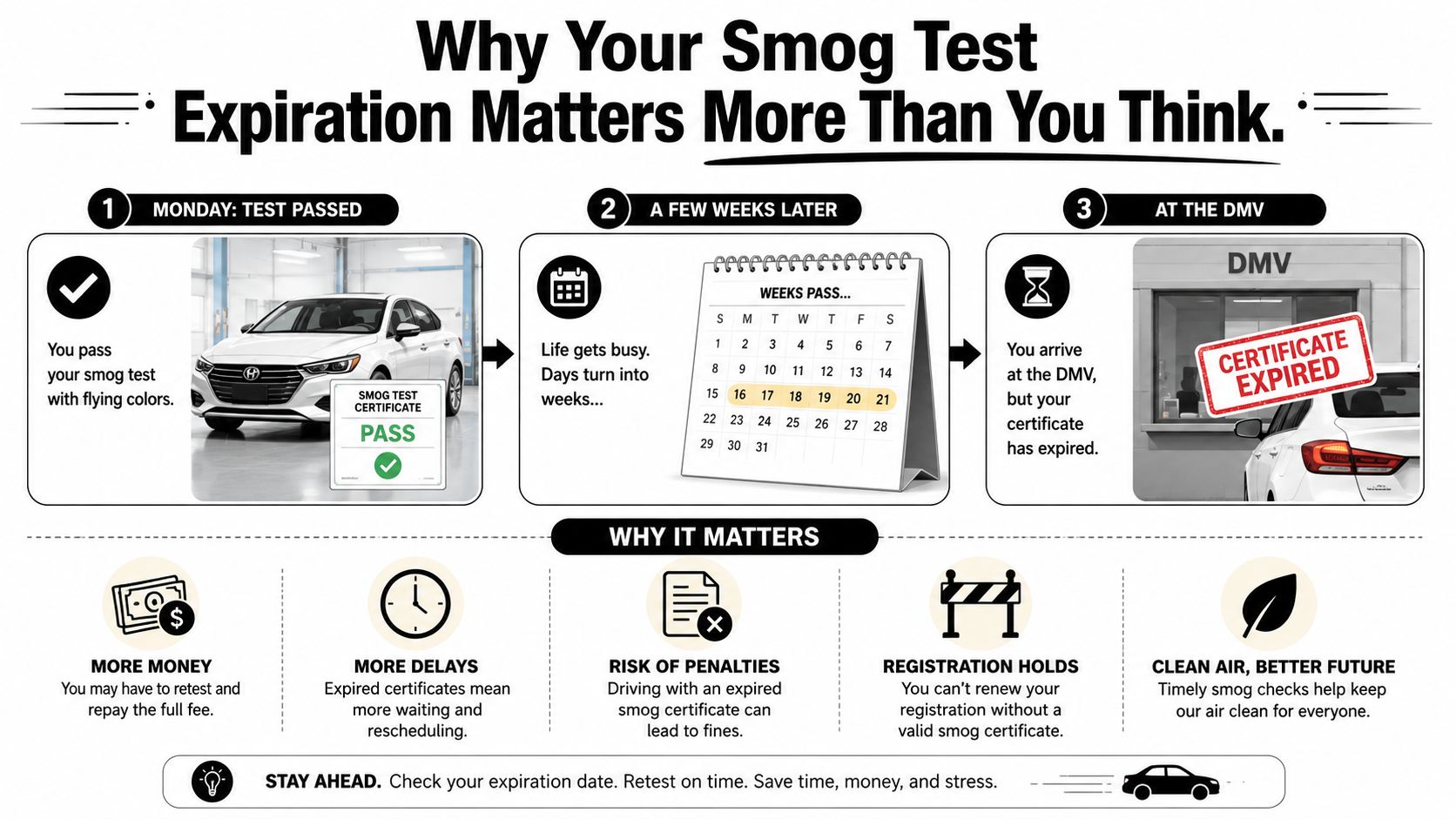
Table of Contents
- Why Your Smog Test Expiration Matters More Than You Think
- California Smog Test Validity Rules Explained
- Exceptions for Sales, Diesels, Hybrids, and Newer Vehicles
- How to Verify Your Electronic Smog Record
- What to Do If Your Smog Certificate Has Expired
- Staying Compliant in a Data-Driven Smog Program
Why Your Smog Test Expiration Matters More Than You Think
A driver passes a smog check on Monday, leaves the station thinking the job is done, then waits a few weeks before handling the DMV paperwork. At the counter, the certificate no longer works for that transaction. Passing the test is one achievement. Keeping it valid for DMV purposes is a separate requirement.
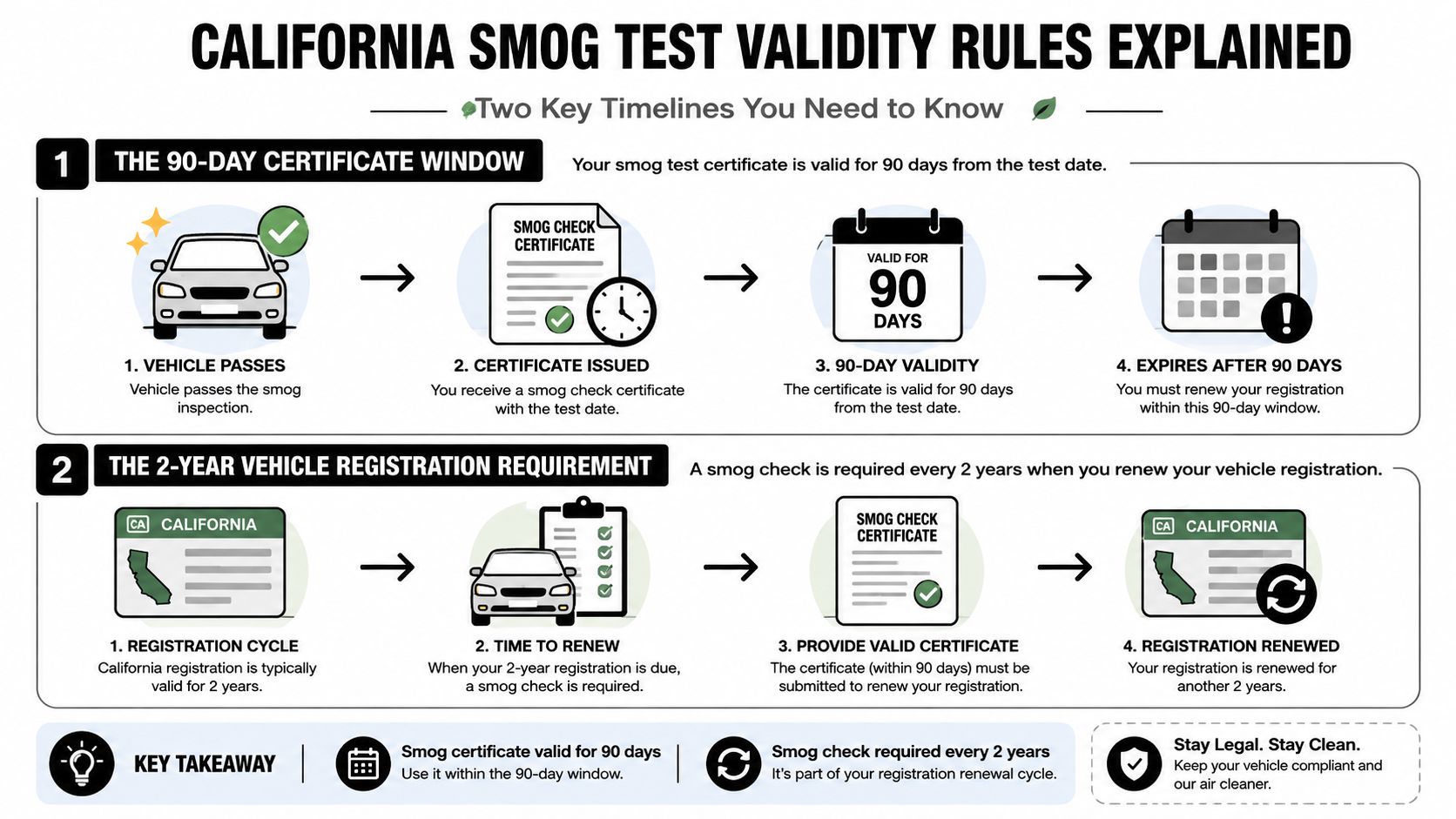
California keeps the timing tight. A passing smog certificate is valid for 90 days from the test date for registration and ownership transfer purposes, and most vehicles must get a smog check every other year to renew registration. That timing comes straight from the DMV and Bureau of Automotive Repair DMV smog inspection guidance.
Two clocks run at the same time
The first clock is the 90-day certificate window. That window decides whether the DMV can accept your passing result for the transaction you want to complete. If the paperwork slips past that window, you need another inspection, even if the car already passed.
The second clock is the biennial renewal cycle. BAR says most vehicles need a smog check every other year for registration renewal, which keeps compliance tied to recurring review instead of one old test carrying forward BAR smog check overview.
Practical rule: book the test when you're ready to finish the DMV step, not when you're just starting to think about it.
That timing is where drivers get burned. They treat the certificate like a long-term pass. It is a short-use document tied to a specific registration action, and the 90-day limit is what delays clean drivers who did everything else right.
California Smog Test Validity Rules Explained
California ties smog results to the transaction, not to the date you first got the inspection. A passing result goes straight to DMV electronically and stays usable for 90 days for registration and transfer processing. Once that window closes, the DMV will not treat the old result as current for the paperwork you are trying to finish.
The 90-day window sets the hard limit
Wait too long after a pass, and the certificate stops helping. The state wants a current emissions record at the moment you submit the registration or title work, because the inspection is meant to support that specific filing.
The Bureau of Automotive Repair says station results are transmitted directly to DMV, so the record is part of the official file right away BAR smog check overview. That electronic system does not extend the life of the certificate. It just makes the timing easier for DMV to enforce.
The biennial cycle governs renewal, not certificate reuse
Most vehicles still need a smog check every other year for registration renewal. That rule sets the renewal rhythm, but it does not let you recycle one passing result until the next cycle comes around DMV smog inspection guidance.
Newer vehicles follow separate rules. DMV guidance says vehicles less than 4 model years old can pay a smog abatement fee instead of being inspected for the first 8 years they are registered, and BAR says vehicles 8 model years and newer do not need a biennial smog check, while vehicles 4 model years and newer do not need a change-of-ownership smog check. Those are age-based exemptions, not a shortcut for older cars.
If you want the rules in plain English, the California smog check rules summary tracks the same timing problem drivers run into at the counter.
Keep the filing window tight. The DMV only accepts a result while it is still current, and the 90-day clock is what protects you from a registration delay.
Exceptions for Sales, Diesels, Hybrids, and Newer Vehicles
The mistake drivers make is assuming one passing smog test covers every situation. California treats sales, diesel vehicles, hybrids, and newer cars under different rules, and the timing depends on the transaction, not on how recently someone passed an inspection.
| California Smog Check Exceptions by Vehicle and Transaction Type | Smog Check Required? | Validity Rule or Exemption |
|---|---|---|
| Private-party sale or title transfer | Usually yes | The seller needs a passing certificate within 90 days before the transfer, unless an exemption applies |
| Transfer between qualifying family members | Sometimes no | Some family transfers are exempt under California transfer rules, so the standard sale requirement may not apply |
| Diesel vehicle | Depends on model year and class | Diesel rules are different from gasoline vehicles, and the state uses diesel-specific testing standards, including opacity-based checks for applicable vehicles |
| Hybrid vehicle | Usually yes | Hybrids are not exempt by default, but they follow a modified smog procedure under California rules |
| 8 model years old or newer | No, for biennial renewal | These vehicles do not require a biennial smog check |
| 4 model years old or newer | No, for change of ownership | These vehicles do not require a change-of-ownership smog check |
For a sale or title transfer, time the inspection carefully. Get the test done close enough to the paperwork that the certificate stays valid, but leave room for DMV processing so the transfer does not stall. A passing result that sits too long is useless once the 90-day window closes.
Buyers should check the seller's certificate before they assume the deal is ready to move. A recent pass is not the same thing as a usable pass, especially when the title is changing hands and the DMV has to accept the record.
Diesel owners need to verify the exact requirement before they show up. Diesel rules do not match gasoline rules, and that difference sends a lot of drivers to the wrong station. For a straight local breakdown, diesel smog check requirements is the right reference.
If the title is changing hands, the safest assumption is that the smog clock matters right away.
The newer-vehicle exemptions help, but they are narrow. They apply only when the vehicle and transaction fit the rule. They do not revive an old certificate, and they do not stretch a test past its usable period.
How to Verify Your Electronic Smog Record
A pass is only useful if DMV can see it. California uses an electronic smog record, so the station sends the result into the state system instead of handing you a paper certificate. That makes your job simple. Check that the record showed up before you rely on it for renewal or transfer.
Start with the smog database
Use the smog status lookup with your license plate or VIN to confirm the pass is on file. If it appears, the station submitted it and the record is live. If it does not, do not assume the system will fix itself.
The public lookup at how to check smog status is the quickest way to verify the result. Keep your inspection receipt too, because it gives you proof if the record is missing or entered wrong.
Then check the DMV side
The station can send a clean result and DMV can still lag behind. That delay shows up most often when the smog test and the registration step happen close together. A pass at the station is not the same thing as DMV already accepting it.
Good habit: verify the electronic record before you stand in line for the transaction.
If the record is missing or wrong, call the smog station first and ask them to retransmit. If that does not fix it, bring the receipt to DMV and keep the station in the loop. Catching the problem early keeps a simple paperwork issue from turning into a registration delay.
For the state's own overview of how smog records are handled, see the BAR smog check overview. The key point is straightforward. The result has to exist in the electronic record, and you should confirm it before you count on it.
What to Do If Your Smog Certificate Has Expired
A passed smog check can still miss the DMV cutoff. The certificate only helps if you finish the renewal or transfer while it is still valid, and once that window closes, you need a new inspection.
When the clock runs out after a pass
This is the trap that catches drivers all the time. The car passes, the paperwork sits for a while, and the DMV step happens after the certificate has aged out. At that point, the old result no longer gets you through registration.
Book another smog inspection at a licensed station and use the new result to finish the transaction. Do not wait for the system to sort it out on its own. There is no extension to request and no shortcut that makes an expired certificate usable again.
When a sale falls apart
Private-party transfers create the same problem fast. The buyer and seller may agree on the deal, but by the time title paperwork is ready, the smog certificate can be past 90 days. Then the earlier pass cannot support the transfer, and the vehicle needs a fresh inspection before the DMV can complete the paperwork DMV smog inspection guidance.
If you need a quick retest, go to the station that can turn the car around without delay, especially if the DMV sent you to a STAR station. A STAR-certified shop like Speedy Smog can help you get the retest done, but it does not change the rules.
Don't try to stretch an expired result. You will lose more time arguing with the process than you would spend on a retest.
A few habits keep the problem from coming back:
- Test late in the process: get the inspection only when renewal or sale paperwork is nearly ready.
- Keep the receipt: it helps if the electronic record needs to be traced.
- Check the DMV timing: same-day processing is not guaranteed.
- Plan for a new test if you miss the window: once the certificate expires, you start over.
The mistake is treating the smog test as the finish line. The test is only one step in the registration process, and it only counts if you finish the DMV transaction while the certificate is still usable.
Staying Compliant in a Data-Driven Smog Program
A passing smog test does not protect you if the DMV file is stale. California's system is increasingly electronic, and the state uses program data to check emissions patterns and station performance under California Health and Safety Code section 44024.5. In plain terms, your certificate has to exist in the system, and it has to be timely.
What that means at the counter
The DMV can flag a missing or expired certificate automatically because the result is already in the record. That makes timing discipline more important, not less.
Keep the process tight.
- Confirm submission: make sure the station sent the result electronically.
- Verify DMV receipt: check that the record shows up before you renew.
- Track the 90-day window: finish the DMV step inside that period.
- Watch sale and transfer timing: private-party deals often slip past the usable window.
- Save your receipt digitally: if the record stalls, you have proof.
If the result is not visible, do not assume the paperwork will sort itself out. DMV processing lag creates avoidable delays, especially when a renewal or transfer is already underway.
A station that sends results quickly and accurately is the kind of shop worth keeping. Speedy Smog fits that role without drama. It handles the test and the electronic transmission, which is what keeps you out of registration trouble.
Use the certificate while it is valid, confirm the record, and do not wait on the DMV to catch up.