
A passing California smog certificate is valid for 90 days from the test date for DMV registration and ownership transfer purposes. Most vehicles also need a new smog check every other year to renew registration.
That's the part drivers miss. They pass the test, set the paperwork aside, and assume they're covered until the next renewal cycle. Then the DMV window turns into a delay, a duplicate fee, or a full re-test.
The trap is simple. The smog result and the registration timeline are not the same thing, and California treats them as two separate clocks. If you know which clock is running, you can avoid a wasted trip and keep the registration moving.
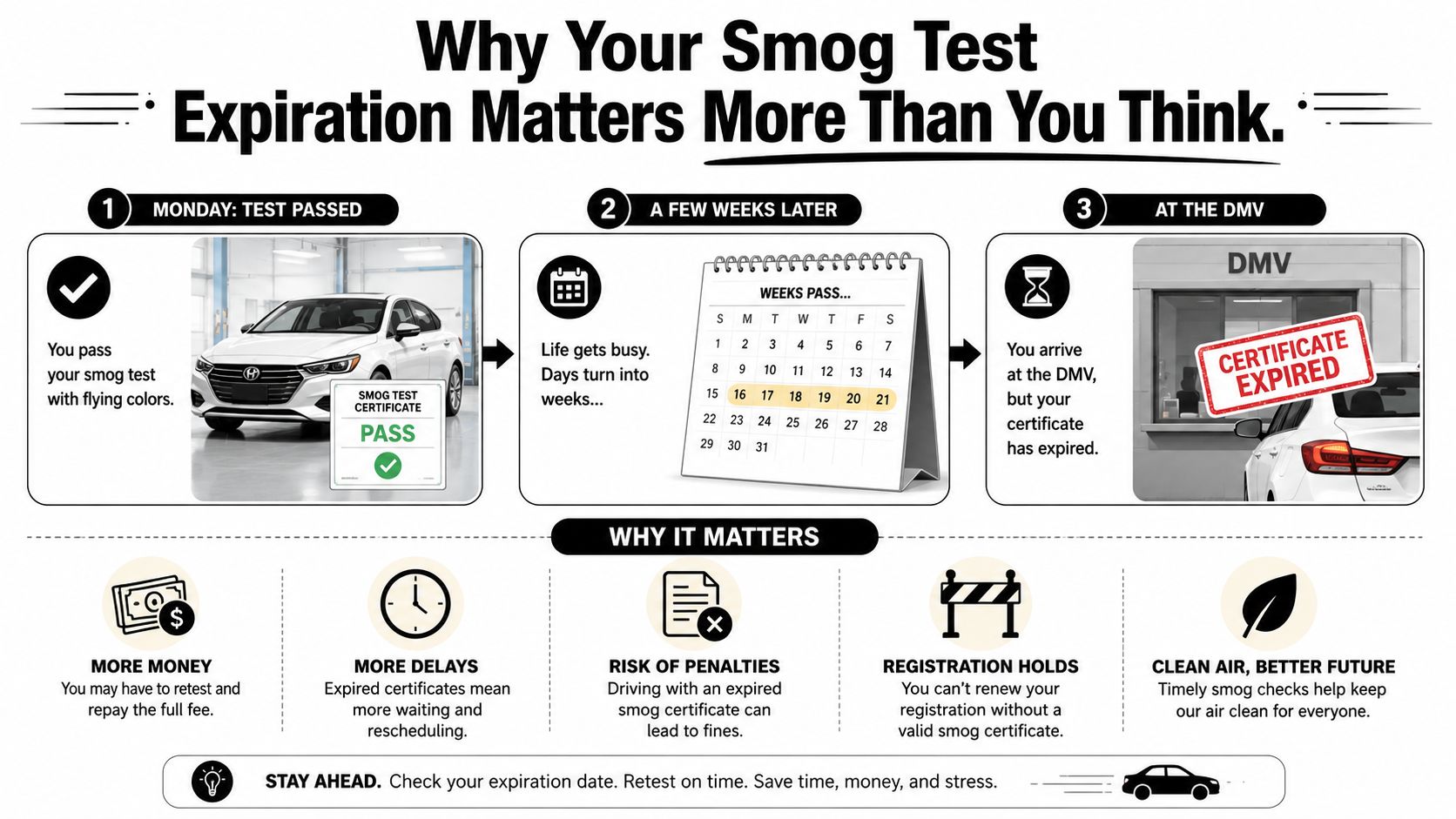
Table of Contents
- Why Your Smog Test Expiration Matters More Than You Think
- California Smog Test Validity Rules Explained
- Exceptions for Sales, Diesels, Hybrids, and Newer Vehicles
- How to Verify Your Electronic Smog Record
- What to Do If Your Smog Certificate Has Expired
- Staying Compliant in a Data-Driven Smog Program
Why Your Smog Test Expiration Matters More Than You Think
A driver passes a smog check on Monday, leaves the station thinking the job is done, then waits a few weeks before handling the DMV paperwork. At the counter, the certificate no longer works for that transaction. Passing the test is one achievement. Keeping it valid for DMV purposes is a separate requirement.
California keeps the timing tight. A passing smog certificate is valid for 90 days from the test date for registration and ownership transfer purposes, and most vehicles must get a smog check every other year to renew registration. That timing comes straight from the DMV and Bureau of Automotive Repair DMV smog inspection guidance.
Two clocks run at the same time
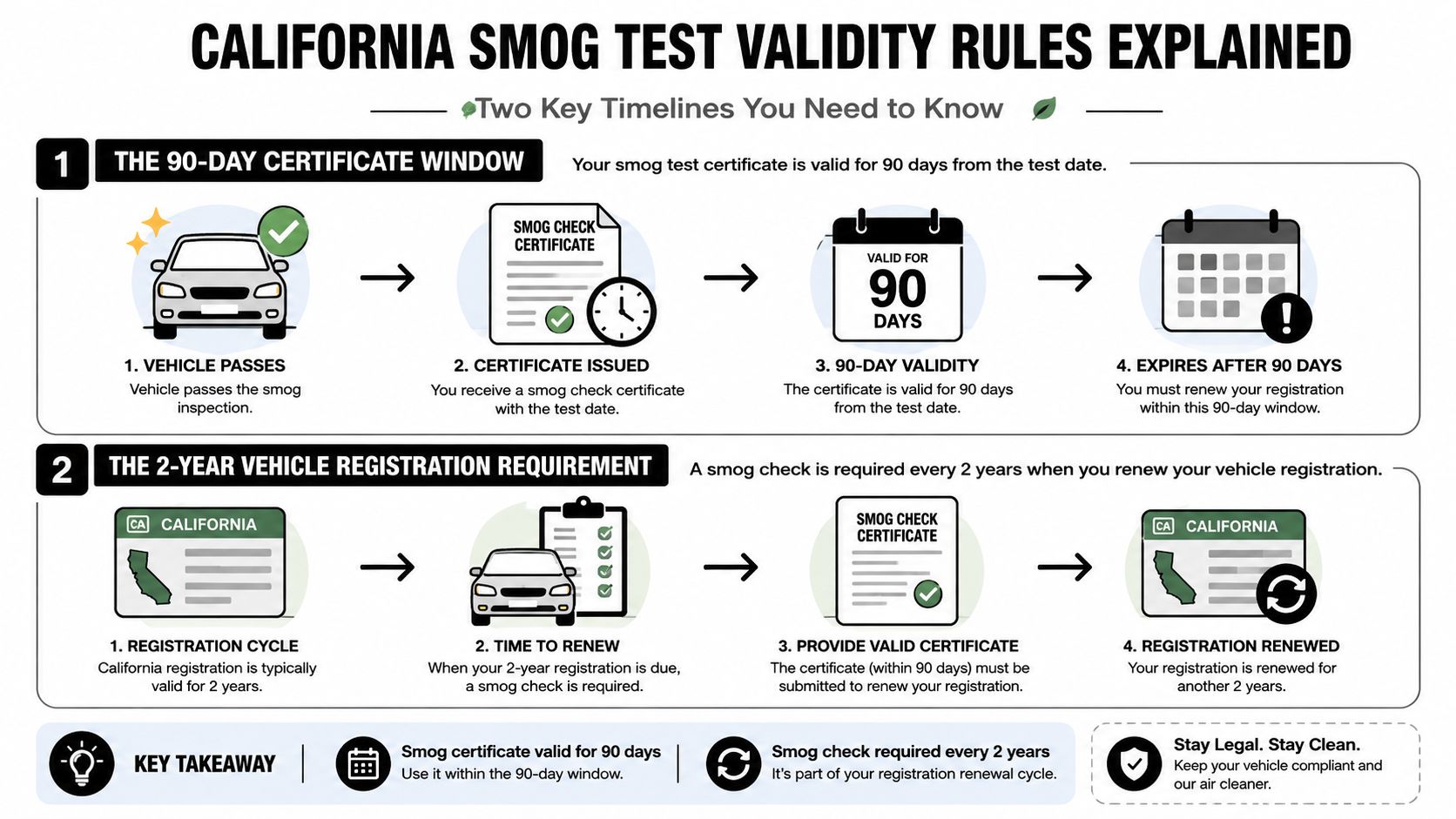
The first clock is the 90-day certificate window. That window decides whether the DMV can accept your passing result for the transaction you want to complete. If the paperwork slips past that window, you need another inspection, even if the car already passed.
The second clock is the biennial renewal cycle. BAR says most vehicles need a smog check every other year for registration renewal, which keeps compliance tied to recurring review instead of one old test carrying forward BAR smog check overview.
Practical rule: book the test when you're ready to finish the DMV step, not when you're just starting to think about it.
That timing is where drivers get burned. They treat the certificate like a long-term pass. It is a short-use document tied to a specific registration action, and the 90-day limit is what delays clean drivers who did everything else right.
California Smog Test Validity Rules Explained
California ties smog results to the transaction, not to the date you first got the inspection. A passing result goes straight to DMV electronically and stays usable for 90 days for registration and transfer processing. Once that window closes, the DMV will not treat the old result as current for the paperwork you are trying to finish.
The 90-day window sets the hard limit
Wait too long after a pass, and the certificate stops helping. The state wants a current emissions record at the moment you submit the registration or title work, because the inspection is meant to support that specific filing.
The Bureau of Automotive Repair says station results are transmitted directly to DMV, so the record is part of the official file right away BAR smog check overview. That electronic system does not extend the life of the certificate. It just makes the timing easier for DMV to enforce.
The biennial cycle governs renewal, not certificate reuse
Most vehicles still need a smog check every other year for registration renewal. That rule sets the renewal rhythm, but it does not let you recycle one passing result until the next cycle comes around DMV smog inspection guidance.
Newer vehicles follow separate rules. DMV guidance says vehicles less than 4 model years old can pay a smog abatement fee instead of being inspected for the first 8 years they are registered, and BAR says vehicles 8 model years and newer do not need a biennial smog check, while vehicles 4 model years and newer do not need a change-of-ownership smog check. Those are age-based exemptions, not a shortcut for older cars.
If you want the rules in plain English, the California smog check rules summary tracks the same timing problem drivers run into at the counter.
Keep the filing window tight. The DMV only accepts a result while it is still current, and the 90-day clock is what protects you from a registration delay.
Exceptions for Sales, Diesels, Hybrids, and Newer Vehicles
The mistake drivers make is assuming one passing smog test covers every situation. California treats sales, diesel vehicles, hybrids, and newer cars under different rules, and the timing depends on the transaction, not on how recently someone passed an inspection.
| California Smog Check Exceptions by Vehicle and Transaction Type | Smog Check Required? | Validity Rule or Exemption |
|---|---|---|
| Private-party sale or title transfer | Usually yes | The seller needs a passing certificate within 90 days before the transfer, unless an exemption applies |
| Transfer between qualifying family members | Sometimes no | Some family transfers are exempt under California transfer rules, so the standard sale requirement may not apply |
| Diesel vehicle | Depends on model year and class | Diesel rules are different from gasoline vehicles, and the state uses diesel-specific testing standards, including opacity-based checks for applicable vehicles |
| Hybrid vehicle | Usually yes | Hybrids are not exempt by default, but they follow a modified smog procedure under California rules |
| 8 model years old or newer | No, for biennial renewal | These vehicles do not require a biennial smog check |
| 4 model years old or newer | No, for change of ownership | These vehicles do not require a change-of-ownership smog check |
For a sale or title transfer, time the inspection carefully. Get the test done close enough to the paperwork that the certificate stays valid, but leave room for DMV processing so the transfer does not stall. A passing result that sits too long is useless once the 90-day window closes.
Buyers should check the seller's certificate before they assume the deal is ready to move. A recent pass is not the same thing as a usable pass, especially when the title is changing hands and the DMV has to accept the record.
Diesel owners need to verify the exact requirement before they show up. Diesel rules do not match gasoline rules, and that difference sends a lot of drivers to the wrong station. For a straight local breakdown, diesel smog check requirements is the right reference.
If the title is changing hands, the safest assumption is that the smog clock matters right away.
The newer-vehicle exemptions help, but they are narrow. They apply only when the vehicle and transaction fit the rule. They do not revive an old certificate, and they do not stretch a test past its usable period.
How to Verify Your Electronic Smog Record
A pass is only useful if DMV can see it. California uses an electronic smog record, so the station sends the result into the state system instead of handing you a paper certificate. That makes your job simple. Check that the record showed up before you rely on it for renewal or transfer.
Start with the smog database
Use the smog status lookup with your license plate or VIN to confirm the pass is on file. If it appears, the station submitted it and the record is live. If it does not, do not assume the system will fix itself.
The public lookup at how to check smog status is the quickest way to verify the result. Keep your inspection receipt too, because it gives you proof if the record is missing or entered wrong.
Then check the DMV side
The station can send a clean result and DMV can still lag behind. That delay shows up most often when the smog test and the registration step happen close together. A pass at the station is not the same thing as DMV already accepting it.
Good habit: verify the electronic record before you stand in line for the transaction.
If the record is missing or wrong, call the smog station first and ask them to retransmit. If that does not fix it, bring the receipt to DMV and keep the station in the loop. Catching the problem early keeps a simple paperwork issue from turning into a registration delay.
For the state's own overview of how smog records are handled, see the BAR smog check overview. The key point is straightforward. The result has to exist in the electronic record, and you should confirm it before you count on it.
What to Do If Your Smog Certificate Has Expired
A passed smog check can still miss the DMV cutoff. The certificate only helps if you finish the renewal or transfer while it is still valid, and once that window closes, you need a new inspection.
When the clock runs out after a pass
This is the trap that catches drivers all the time. The car passes, the paperwork sits for a while, and the DMV step happens after the certificate has aged out. At that point, the old result no longer gets you through registration.
Book another smog inspection at a licensed station and use the new result to finish the transaction. Do not wait for the system to sort it out on its own. There is no extension to request and no shortcut that makes an expired certificate usable again.
When a sale falls apart
Private-party transfers create the same problem fast. The buyer and seller may agree on the deal, but by the time title paperwork is ready, the smog certificate can be past 90 days. Then the earlier pass cannot support the transfer, and the vehicle needs a fresh inspection before the DMV can complete the paperwork DMV smog inspection guidance.
If you need a quick retest, go to the station that can turn the car around without delay, especially if the DMV sent you to a STAR station. A STAR-certified shop like Speedy Smog can help you get the retest done, but it does not change the rules.
Don't try to stretch an expired result. You will lose more time arguing with the process than you would spend on a retest.
A few habits keep the problem from coming back:
- Test late in the process: get the inspection only when renewal or sale paperwork is nearly ready.
- Keep the receipt: it helps if the electronic record needs to be traced.
- Check the DMV timing: same-day processing is not guaranteed.
- Plan for a new test if you miss the window: once the certificate expires, you start over.
The mistake is treating the smog test as the finish line. The test is only one step in the registration process, and it only counts if you finish the DMV transaction while the certificate is still usable.
Staying Compliant in a Data-Driven Smog Program
A passing smog test does not protect you if the DMV file is stale. California's system is increasingly electronic, and the state uses program data to check emissions patterns and station performance under California Health and Safety Code section 44024.5. In plain terms, your certificate has to exist in the system, and it has to be timely.
What that means at the counter
The DMV can flag a missing or expired certificate automatically because the result is already in the record. That makes timing discipline more important, not less.
Keep the process tight.
- Confirm submission: make sure the station sent the result electronically.
- Verify DMV receipt: check that the record shows up before you renew.
- Track the 90-day window: finish the DMV step inside that period.
- Watch sale and transfer timing: private-party deals often slip past the usable window.
- Save your receipt digitally: if the record stalls, you have proof.
If the result is not visible, do not assume the paperwork will sort itself out. DMV processing lag creates avoidable delays, especially when a renewal or transfer is already underway.
A station that sends results quickly and accurately is the kind of shop worth keeping. Speedy Smog fits that role without drama. It handles the test and the electronic transmission, which is what keeps you out of registration trouble.
Use the certificate while it is valid, confirm the record, and do not wait on the DMV to catch up.