
A typical California smog check total lands in the low-to-mid $70s after the $8.25 state certificate fee is added to the station's inspection charge. Statewide averages are about $70.00 for BAR-97 tests and $62.04 for OIS tests, before that certificate fee is included.
Your DMV renewal notice is probably sitting on the counter, and the deadline is getting close. You call a station, hear an advertised price, and assume that number is the whole bill. In California, it often isn't.
The CA smog check price has two parts. The station chooses the inspection fee, while the state adds its certificate charge only when the vehicle passes. Vehicle age, test method, station designation, and whether the station performs repairs can all change the amount you pay. The California Bureau of Automotive Repair's smog check guidance confirms that inspection prices vary by station, while the certificate fee is the universal state add-on.
Table of Contents
- What a California Smog Check Actually Costs
- Breaking Down the Two-Part Price Structure
- STAR vs Non-STAR Station Pricing Compared
- How Your Vehicle Type Changes the Price
- Why a STAR Station Is Often the Smarter Choice
- Practical Ways to Lower Your Smog Check Bill
- Your Pre-Visit Smog Check Checklist
What a California Smog Check Actually Costs
A San Leandro driver renewing registration might see a station advertise a low inspection price, then discover that the final receipt is higher after certification. That doesn't automatically mean the station added an improper charge. It usually means the advertised price covered the station's inspection only.
For a normal compliant vehicle, plan on a final bill in the low-to-mid $70s, depending on the inspection method and the station's posted fee. BAR's 2025 Executive Summary lists statewide average inspection costs of $70.00 for BAR-97 tests and $62.04 for OIS tests (California BAR 2025 Executive Summary Report). Adding the $8.25 certificate fee brings those averages into roughly the low-to-upper $70s for a passing vehicle.
What the advertised price leaves out
The inspection fee pays the station for the test itself. It can reflect the vehicle's emissions system, the equipment required, labor, and the station's operating costs. California doesn't set one statewide retail inspection price, so two licensed stations in the East Bay can post different prices for what appears to be the same service.
The state certificate fee is separate and applies only after a pass. If the vehicle fails, the certificate isn't issued, so that fee isn't charged at that stage. Repairs and a later retest are separate costs.
Practical rule: When you call, ask for the total price for your exact vehicle, including the certificate fee if it passes.
Have the station confirm the model year, fuel type, and whether your DMV notice requires STAR. For a more detailed explanation of the smog inspection cost, compare the inspection charge with the final out-the-door amount, not just the number on a coupon.
Breaking Down the Two-Part Price Structure
Most confusion starts with the phrase “smog check price.” Drivers use it to mean the inspection, certification, repairs, and retest together. The invoice is simpler than that, but only if you separate the charges.
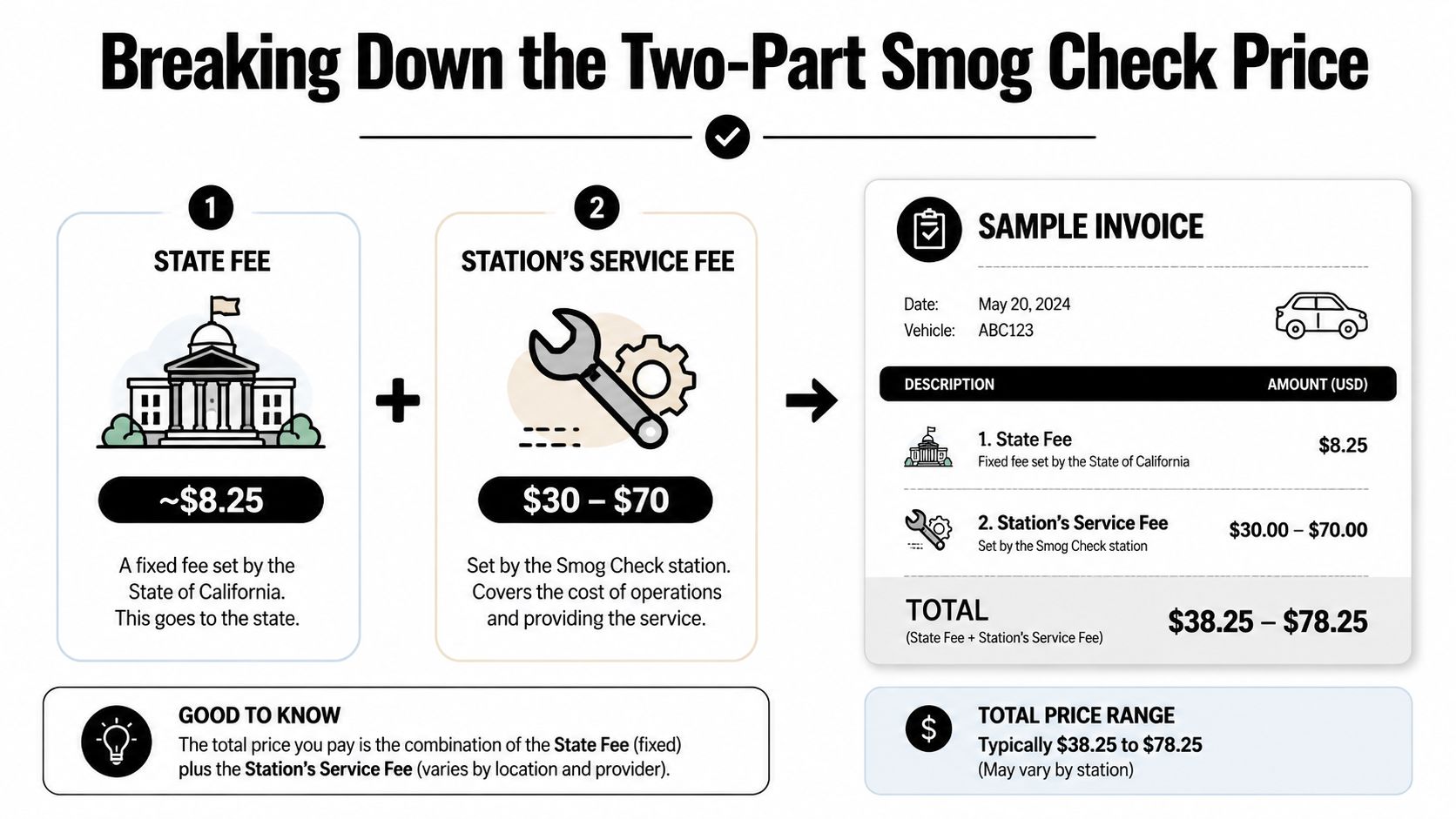
The first line is the station inspection fee. That amount is set by the business and can vary according to location, station category, equipment, and vehicle. A station may quote one price for a newer OBD-based inspection and another for an older BAR-97 test.
The second line is the $8.25 California smog certificate fee. It's mandatory when the vehicle passes, and the amount is statewide rather than negotiated between the customer and the station. The California DMV's smog certification fee guidance explains the state fee and related certification rules.
What happens after a pass or failure
A passing test creates the certification transaction needed for the DMV process, and the state certificate fee appears on the bill. A failed test doesn't create that certificate, so the certificate charge isn't the part that drives the next bill.
The expensive surprise usually comes afterward. Diagnosis, emissions repairs, parts, labor, and a retest aren't automatically included in the original inspection fee. Ask whether the quoted amount covers only the initial test or also includes a retest policy.
| Invoice component | Who sets it | When it applies |
|---|---|---|
| Station inspection fee | The smog station | For the inspection |
| State certificate fee | California | Only when the vehicle passes |
| Repairs and diagnosis | The repair provider | When the vehicle needs corrective work |
| Retest charge | The station's policy | After repairs, if another test is required |
Before booking, use the station's smog check station information to find a licensed location, then ask one direct question: “What will I pay if the vehicle passes today?” That answer is more useful than a low headline price with no explanation.
STAR vs Non-STAR Station Pricing Compared
A STAR station is not automatically the expensive option. STAR is a Bureau of Automotive Repair performance designation. The station's business model still matters: it may be Test-Only or Test-and-Repair, and each sets its own inspection price.
The inspection fee is only one part of your out-the-door cost. Add the state certificate fee when the vehicle passes. Compare the complete total, not a coupon headline or a station label.
Average inspection costs by station type
| Station type | Average inspection cost |
|---|---|
| STAR Test-and-Repair | $66.90 |
| STAR Test-Only | $58.90 |
| Non-STAR Test-and-Repair | $70.77 |
| Non-STAR Test-Only | $56.40 |
The BAR 2024 Smog Check Executive Summary Report lists these as inspection averages, not final passing totals. The state certificate fee remains separate. The figures also show that STAR Test-Only averaged less than STAR Test-and-Repair, while Non-STAR Test-Only averaged less than Non-STAR Test-and-Repair. STAR status alone does not determine the bill.
The equipment path changes the quote too. STAR Test-and-Repair stations averaged $72.87 for BAR-97 inspections and $60.99 for OIS inspections. STAR Test-Only stations averaged $52.44 for OIS inspections. Ask which test method applies to your vehicle before accepting a price.
Choose based on the DMV requirement
Read the registration notice first. If the DMV requires a STAR inspection, a cheaper non-STAR quote will not complete the job. You may pay once, then pay again at an approved station.
Test-Only stations perform inspections. Test-and-Repair stations can diagnose and repair emissions problems, which can save a second trip if the vehicle fails. Review this guide to what a STAR station is before choosing from a coupon alone.
Call with one question: “What is the full price, including the certificate fee if I pass?” Confirm the test method and whether a retest has a separate charge. Choose STAR or non-STAR based on the DMV requirement, vehicle, and complete quoted total.
How Your Vehicle Type Changes the Price
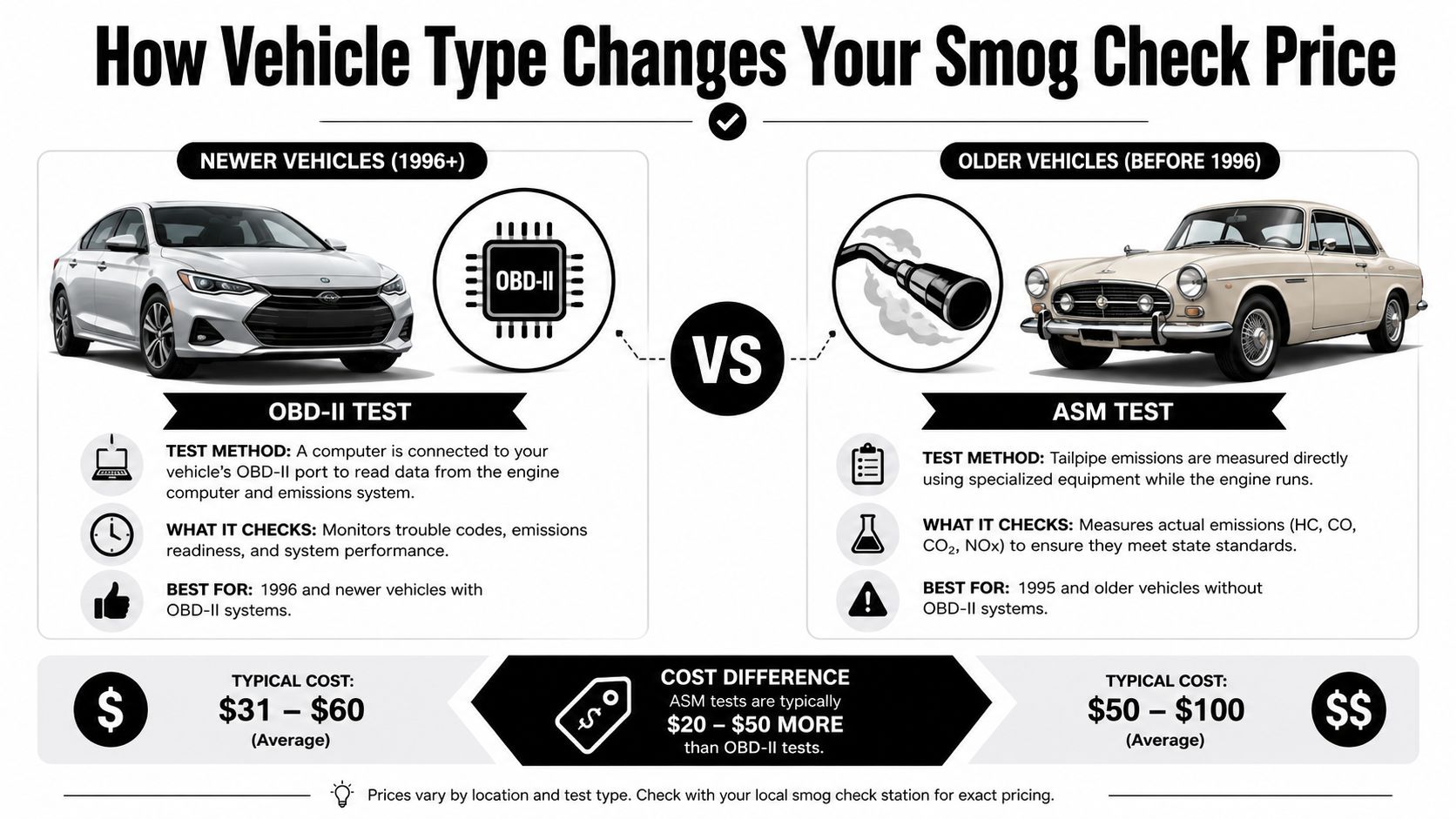
Your vehicle determines the test path, and the test path affects the inspection charge. A newer gasoline car with a functioning diagnostic system generally follows a different process from an older vehicle that requires more involved emissions equipment.
California commonly uses OIS testing for many 2000-and-newer vehicles, while older vehicles may require BAR-97 testing. The BAR averages above show that OIS inspections generally carry a lower average than BAR-97 inspections, but the exact charge still belongs to the station.
Start with the model year
Check the model year before calling. The DMV states that most vehicles need certification every two years after the initial smog-abatement period, while newer vehicles may qualify for an abatement fee instead of an immediate inspection. The California DMV vehicle registration guidance is the right place to confirm your vehicle's requirement.
A newer vehicle can often communicate emissions information through its onboard diagnostic system. Older vehicles may need a more labor-intensive inspection using BAR-97 equipment. That difference can explain why one vehicle receives a lower quote than another at the same station.
Fuel type and drivetrain still matter
Diesel vehicles don't follow the same pricing assumptions as ordinary gasoline cars. Older diesels, commercial vehicles, and vehicles with specialized emissions systems may require different equipment or procedures, so give the station the exact fuel type before accepting a quote.
Hybrids can also require certification once they are no longer within the applicable exemption period. Electric vehicles don't use the same tailpipe emissions process, but registration rules still depend on the vehicle category and DMV instructions.
Bring the vehicle identification details when you call:
- Model year: This helps the technician identify the likely test method.
- Fuel type: Gasoline, diesel, hybrid, and electric vehicles can follow different rules.
- Registration notice: The notice may identify whether STAR certification is required.
- Modification history: Emissions-related modifications can change what the station needs to inspect.
Don't guess based on the car's appearance or age alone. A precise quote requires the vehicle information and the registration requirement.
Why a STAR Station Is Often the Smarter Choice
Drivers often assume STAR means higher cost. The BAR averages show that assumption doesn't hold consistently, because STAR Test-Only inspection averages can be lower than STAR Test-and-Repair averages and can also compare favorably with non-STAR categories.
STAR is a performance designation, not a luxury service tier. The station has to meet the program's standards, but its retail inspection fee remains its own business decision. Your first question should be whether STAR is required, not whether STAR sounds expensive.
Avoid the wrong-station expense
If your DMV notice calls for a STAR inspection, going elsewhere can create a compliance problem. You may leave with a test result but still need a STAR certification before the registration process is complete. That means another appointment, another inspection charge, and more lost time.
A STAR Test-Only station makes sense when the vehicle is straightforward and you only need the inspection. A STAR Test-and-Repair station is more practical when the vehicle has an emissions warning light, previous failure, or an uncertain repair history. The ability to diagnose the issue at the same location can reduce unnecessary handoffs.
Choose the station that matches the DMV instruction and the vehicle's risk, then compare its complete passing price.
For East Bay drivers, Speedy Smog is one local option. It operates as a STAR Certified station in San Leandro and handles inspections for newer vehicles, older vehicles, diesels, and hybrids. The right choice still depends on your registration notice and the quote you receive.
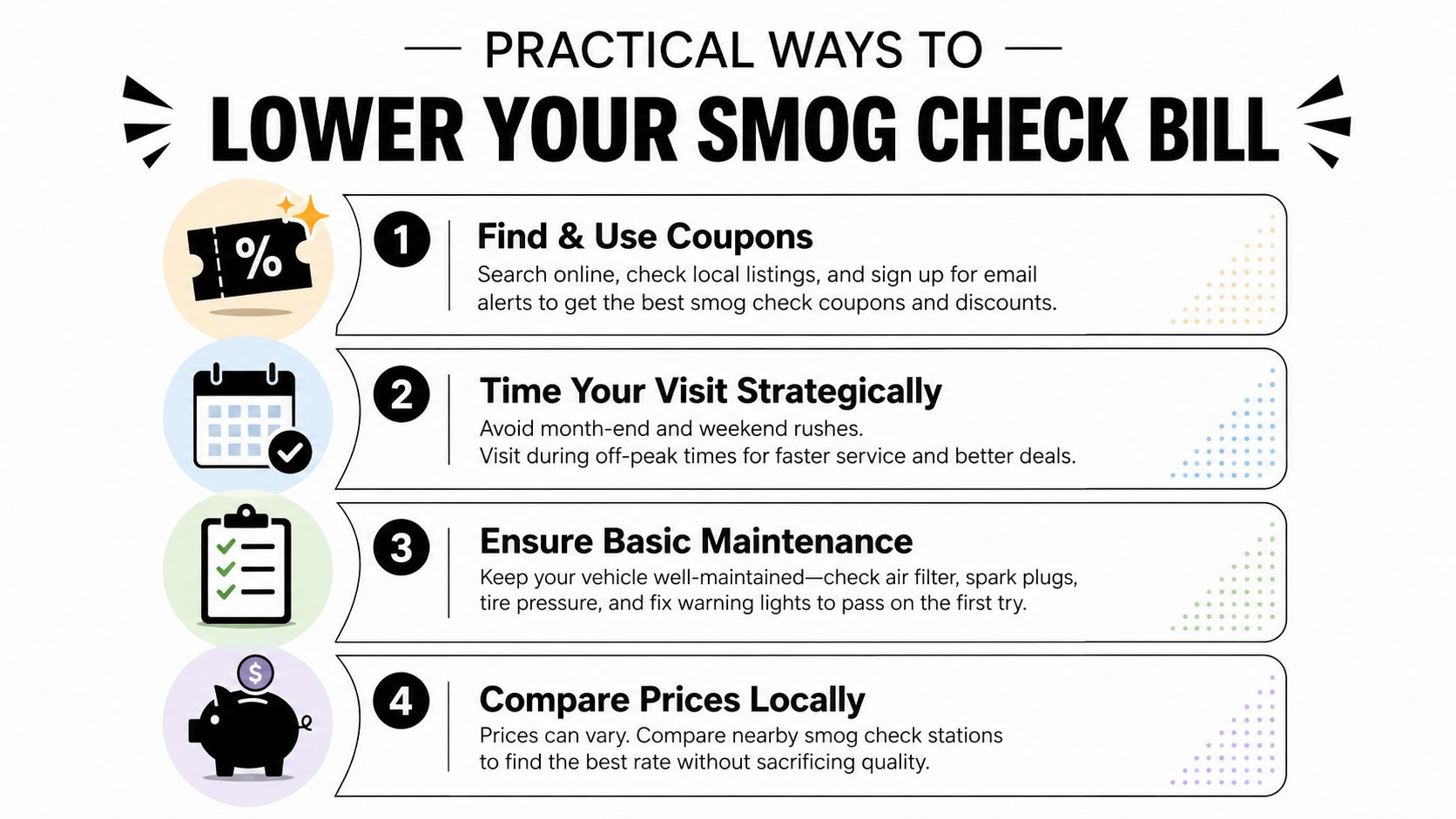
Practical Ways to Lower Your Smog Check Bill
The cleanest way to reduce the bill is to avoid paying for the wrong service. Confirm the DMV requirement, identify the likely test method, and ask for the passing total before you authorize the inspection.
Use discounts carefully
Coupons can lower the station's inspection portion, but read the fine print. A discount may apply only to certain model years or standard inspections, and it may not remove the separate state certificate fee after a pass. Ask whether the coupon changes the inspection fee only or the final amount.
Speedy Smog publishes a $25-off offer for most smogs on newer vehicles, so East Bay drivers should check the current terms before relying on it. Treat any coupon as a price tool, not proof that the station's final total is lowest.
Time the appointment instead of rushing
Last-minute registration pressure limits your choices. Schedule early enough to call several stations, compare the passing total, and confirm whether STAR is required. If the vehicle fails, early scheduling also leaves room for diagnosis and repair without turning the renewal deadline into an emergency.
A basic pre-visit check can prevent avoidable complications:
- Inspect warning lights: An illuminated emissions warning light can lead to a failed inspection.
- Check the registration notice: Confirm the due date and station designation requirement.
- Ask about retests: Learn whether the station offers a retest policy and what conditions apply.
- Bring recent repair information: Service records can help the technician understand prior emissions work.
Check whether testing is required
Some newer vehicles may use a smog abatement fee during registration instead of receiving a smog inspection. Don't pay for a test because the renewal process mentions emissions. Verify the requirement through the DMV notice or the DMV's official guidance first.
If the vehicle fails, don't approve every repair offered without understanding the failure reason. Ask for the failure report, separate diagnosis from repairs, and check whether you qualify for assistance through California's Consumer Assistance Program. The cheapest legitimate repair is the one that addresses the documented emissions problem, not a parts swap based on guesswork.
Your Pre-Visit Smog Check Checklist
Before driving to the station, run through this short list:
- Read the DMV notice: Confirm whether certification is required and whether STAR is specified.
- Identify the vehicle: Have the model year, fuel type, and vehicle details ready.
- Ask for the passing total: Confirm the station inspection fee plus the $8.25 certificate fee if the vehicle passes.
- Clarify the test method: Ask whether the vehicle receives OIS or BAR-97 testing.
- Check the failure policy: Find out what a retest costs and whether repairs must be completed at that station.
- Verify discounts: Make sure a coupon applies to your vehicle and understand which charge it reduces.
- Bring documents: Take the registration notice and any relevant repair records.
The number that matters is the out-the-door passing price, not the largest discount in the window. A clear quote, the correct station designation, and the right test method will prevent most billing surprises.
For a transparent quote and California-compliant testing in San Leandro, visit Speedy Smog with your DMV notice and vehicle details ready. Ask the team to confirm the inspection method, STAR requirement, certificate fee, and any applicable discount before the test begins.