You're standing at the inspection station with a Vehicle Inspection Report in your hand. The top of the page says FAIL, but that word doesn't tell you whether the problem is a loose gas cap, an emissions component, an incomplete computer check, or a repair that needs deeper diagnosis. Before authorizing parts or paying for another test, read the report as a diagnostic document.
A California smog check report, formally called the Vehicle Inspection Report, or VIR, records what the technician inspected, what the vehicle's onboard system reported, and why the final result was issued. Once you know where to look, the report can help you speak clearly with a repair shop and choose the right next step.
Table of Contents
- What a Smog Check Report Actually Tells You
- Reading the Key Fields on Your Vehicle Inspection Report
- Understanding California Smog Check Failure Rates
- Most Common Reasons Vehicles Fail Smog Checks
- Why STAR Certification Matters for Your Smog Check
- What to Do After Receiving Your Smog Check Results
- How Speedy Smog Helps East Bay Drivers Get Certified Fast
What a Smog Check Report Actually Tells You
Most drivers look at the final result first. If the report says “PASS,” they put it in the glove box. If it says “FAIL,” they start searching for a repair shop. That reaction is understandable, but the result line is only the summary. The useful details appear in the fields underneath it.
The VIR identifies the vehicle, documents the inspection, and records special circumstances or failure notes. California's Bureau of Automotive Repair says the station must provide the customer with a copy of the VIR, while the smog certificate is sent electronically to the DMV. You therefore receive a paper or electronic report for your records, but the DMV receives the certificate through the state's electronic system. Read the BAR Smog Check FAQ if you need clarification about the report or certificate process.
The report is more than proof of payment
Suppose your vehicle fails because the OBD system shows an emissions fault. That result points toward diagnosis and repair. A visual failure, such as an emissions component that appears missing or modified, leads to a different conversation. A readiness failure may mean the vehicle's computer hasn't completed its checks, especially after a battery replacement, code clearing, or recent repair.
The report helps separate those possibilities. It can show whether the issue involved:
- Vehicle identification, confirming that the inspection belongs to your car.
- Inspection type, showing which testing method applied.
- OBD or emissions results, recording the system's response.
- Readiness monitors, showing whether required self-tests were complete.
- Visual and functional checks, identifying equipment or warning-light problems.
- Failure notes, documenting the condition that prevented a pass.
- Final status, stating whether the vehicle passed or failed.
Keep the VIR with your repair invoices and diagnostic paperwork. If you return for a retest, the document gives the repair technician a starting point and helps you verify that the retest addresses the original failure rather than creating a new guess-and-replace cycle.
Reading the Key Fields on Your Vehicle Inspection Report
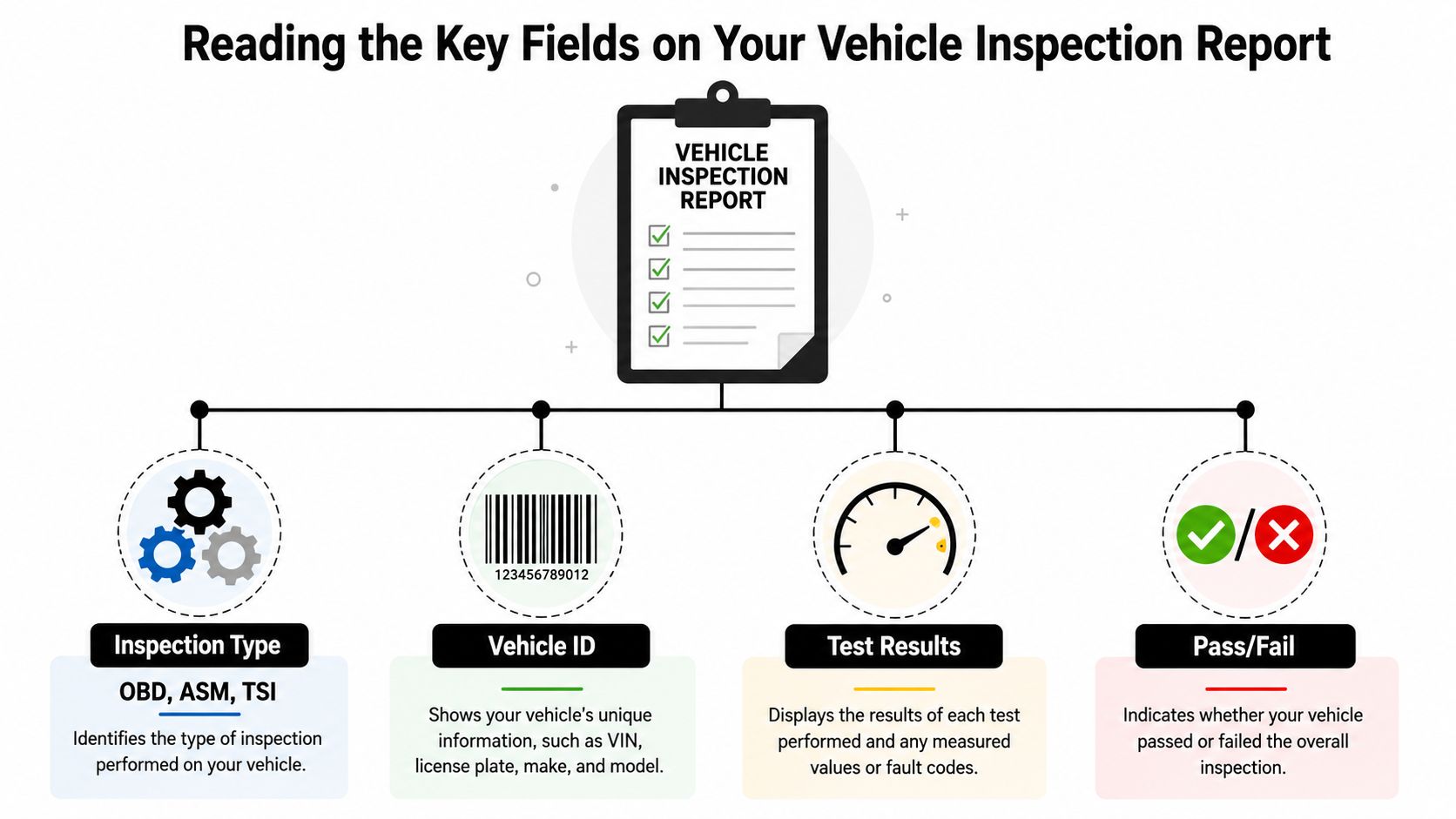
Start at the top and work downward. Don't begin with the repair estimate. First confirm that the report describes the vehicle you brought in and the inspection that was performed.
1. Confirm the vehicle information
Check the VIN, license plate information, model year, make, and other identifying details. A mismatch can create registration problems even if the mechanical inspection itself was completed correctly. Ask the station to correct an error before you leave, rather than assuming the DMV will fix it automatically.
The model year also helps explain the test method. BAR's OBD inspection data covers 2000-and-newer vehicles, making the 2000 model year an important technical breakpoint in California's modern inspection system. Older vehicles may be evaluated through a different procedure, depending on the vehicle and applicable requirements.
2. Identify the inspection type
Look for references to OBD, ASM, or TSI. An OBD inspection communicates with the vehicle's onboard diagnostic computer. ASM and TSI refer to testing approaches associated with emissions measurement and vehicle operation. The method matters because a report showing a computer fault should be interpreted differently from one showing measured emissions above an applicable limit.
If the report includes a diagnostic trouble code, don't treat the code as a complete diagnosis. A code identifies a monitored system or condition, but a technician still needs to test the underlying cause. This guide to reading OBD codes can help you understand why a code is a starting point, not automatically a parts order.
3. Read the result fields
Look for monitor status, warning-light information, emissions readings where applicable, and visual or functional inspection notes. A failed visual item means the technician observed a problem with required emissions equipment or configuration. A functional failure means a system did not operate as required. An emissions failure means the vehicle exceeded the applicable test standard or its OBD system detected a qualifying emissions issue.
The final pass or fail line combines those findings. Read the reason immediately above or beside it. That line usually tells you whether to seek diagnosis, restore equipment or approved software, complete the required drive conditions, or ask about a Referee review.
Practical rule: A diagnostic trouble code, an incomplete monitor, and a failed emissions measurement are different findings. Your repair plan should match the finding printed on the VIR.
Understanding California Smog Check Failure Rates
A failed result can feel unusual when you're the only driver in the waiting room dealing with one. Statewide data shows that failures are a normal part of the program, even though most inspected vehicles pass.
BAR reported that about 19 million 2000-and-newer vehicles were tested during calendar years 2024 to 2025, and about 1.3 million failed, an overall failure rate of roughly 7%. The same report says roadside inspection sampling found an overall fleet-weighted failure rate of about 14%, which indicates that real-world emissions problems can be higher than the rate observed during routine station testing. These figures come from the BAR Smog Check Performance Report.
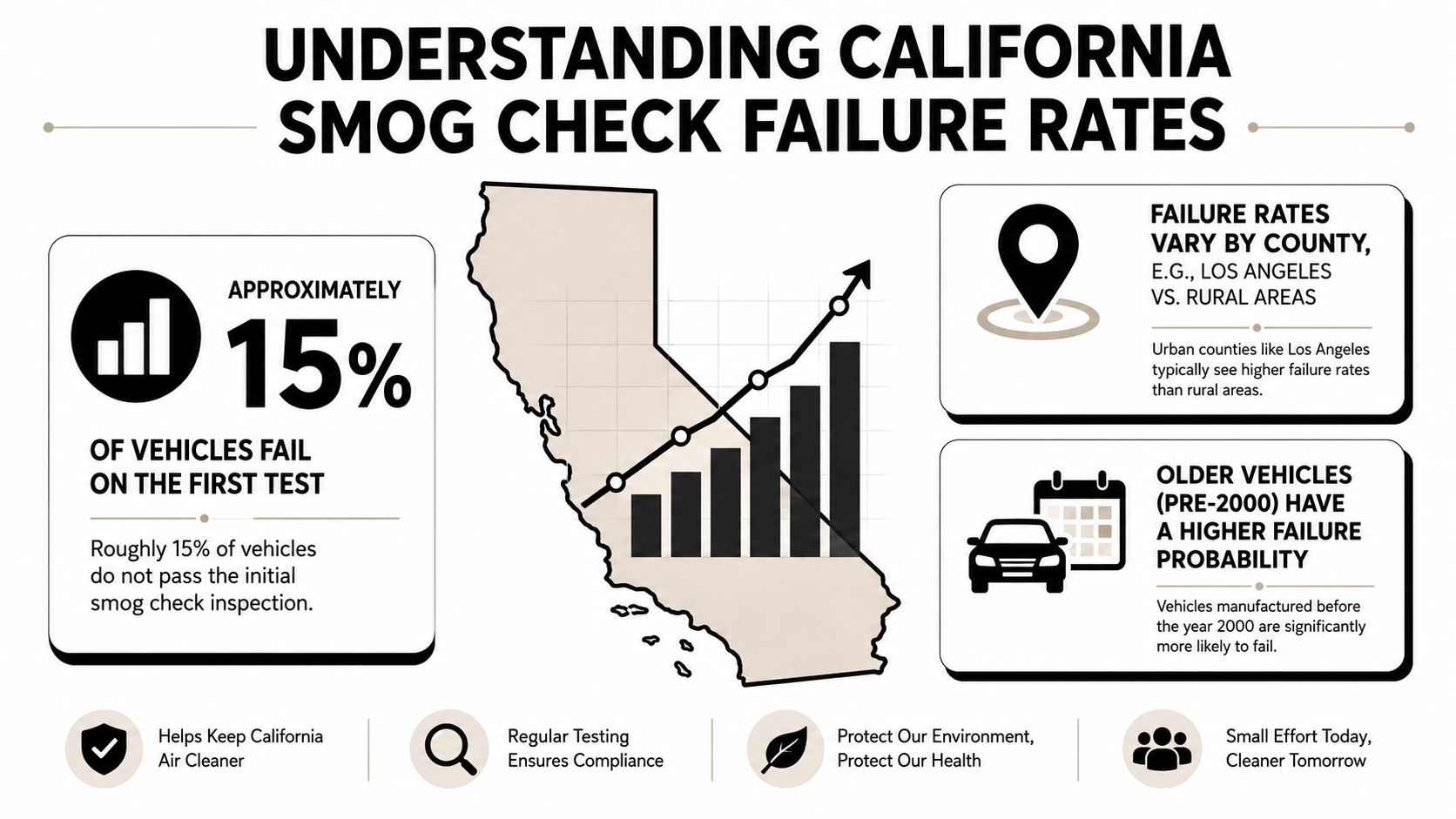
BAR's 2025 executive summary lists 11,275,981 initial tests and 959,667 failures, producing an initial-test failure rate of 8.51%. That report also tracks testing volume, failure rates, station data, and repair costs. The 2025 BAR Executive Summary Report places an individual failed inspection within the larger operation of California's compliance system.
Why the numbers differ
Station testing and roadside sampling answer different questions. A station inspection evaluates vehicles presented for testing under the applicable procedure. Roadside sampling examines vehicles in normal use, where maintenance condition, driving patterns, load, and operating temperature can vary.
The difference doesn't prove that a particular vehicle will fail at roadside or that a station test missed a defect. It shows why California uses more than a simple annual pass-or-fail event. OBD-era inspections collect information from vehicles at scale, allowing BAR to monitor fleet performance and identify compliance patterns.
For a driver, the practical lesson is straightforward. A failed report isn't a random administrative inconvenience. It identifies a condition that California's inspection process considers relevant to emissions compliance, and the repair should address the recorded cause rather than only erase the warning.
Most Common Reasons Vehicles Fail Smog Checks
The failure section of the VIR should answer the first question, “What prevented the pass?” It may not provide a complete mechanical diagnosis, but it narrows the problem into a category.
Incomplete readiness monitors
Readiness monitors are self-checks performed by the vehicle's OBD system. After a battery disconnect, computer reset, code clearing, or some repairs, the monitors may show “not ready.” The vehicle can run normally and still fail because the computer hasn't completed the required emissions checks.
California's rules set different limits by model year. For 1996 through 2000 vehicles, more than two incomplete emissions-related monitors causes a failure. For 2001-and-newer vehicles, more than one incomplete monitor causes a failure. BAR says that, effective October 1, 2025, all readiness monitors must be set for a vehicle to pass, as explained in its readiness-monitor regulation guidance.
Don't ask a technician to just clear the monitors again. That generally removes useful information and can leave the vehicle unready at the next inspection. Ask what drive conditions the manufacturer requires and whether the underlying fault has been repaired.
Warning-light and OBD faults
A commanded check-engine light, stored emissions fault, or failed OBD communication check can produce a failure. The repair could involve a sensor, wiring, an intake or exhaust leak, fuel control, catalytic-converter performance, or another monitored system. The code alone doesn't identify which component should be replaced.
Emissions readings above the limit
For test procedures that measure tailpipe output, the VIR can show readings that exceed the applicable standard. The technician may then need to evaluate combustion, fuel delivery, ignition, exhaust treatment, or other emissions-related systems. Avoid approving an expensive repair solely from the number on the report. A qualified repair shop should confirm the cause.
Visual and functional problems
A missing, disconnected, modified, or improperly configured emissions component can cause a visual failure even when the engine feels fine. Functional tests may identify a warning-light problem, a gas-cap issue, or another system that doesn't perform as required. Restoration to original equipment or approved software may be the correct path, rather than replacing unrelated parts.
Before authorizing work: Show the complete VIR to the repair shop and ask the technician to identify the exact failed field, the proposed diagnostic test, and the condition that will be verified before retesting.
For a category-by-category explanation, use this guide to common smog check failure reasons.
Why STAR Certification Matters for Your Smog Check
A STAR station is not a shop with a different sign. STAR certification is part of California's program for stations that meet specified performance and equipment requirements. Some vehicles are directed by the DMV to receive an inspection at a STAR station, so the first question is whether your registration notice or vehicle record includes that direction.
A non-STAR station may be appropriate when your vehicle isn't directed to STAR and the station performs the required test. A STAR station, however, may be the necessary choice for a directed inspection. The station's status should be confirmed before testing, because using the wrong station can mean paying for an inspection that doesn't satisfy the registration requirement.
Compare the practical differences
| Question | Non-STAR station | STAR station |
|---|---|---|
| Can it perform a required inspection? | Only when its license and your vehicle's requirements match | Designed for inspections covered by STAR requirements |
| Does the designation matter for every vehicle? | Not necessarily | It matters when DMV directs the vehicle to STAR |
| What should you verify first? | Test type and licensing | STAR status, test type, and DMV direction |
| What does the report still provide? | Inspection findings and final result | Inspection findings and final result under STAR procedures |
STAR status doesn't guarantee that a vehicle will pass. No station can legitimately promise a pass before inspecting the car. The value is procedural: when STAR is required, the station has the certification needed for that inspection, and drivers can avoid choosing a location that cannot complete the required transaction.
Ask the station to confirm its status before the test, especially if your renewal notice directs you to a STAR inspection. You can also review what a smog STAR station is before deciding where to go.
What to Do After Receiving Your Smog Check Results
Your next step depends on the final line and the notes that support it. Treat a pass and a fail as separate administrative paths.
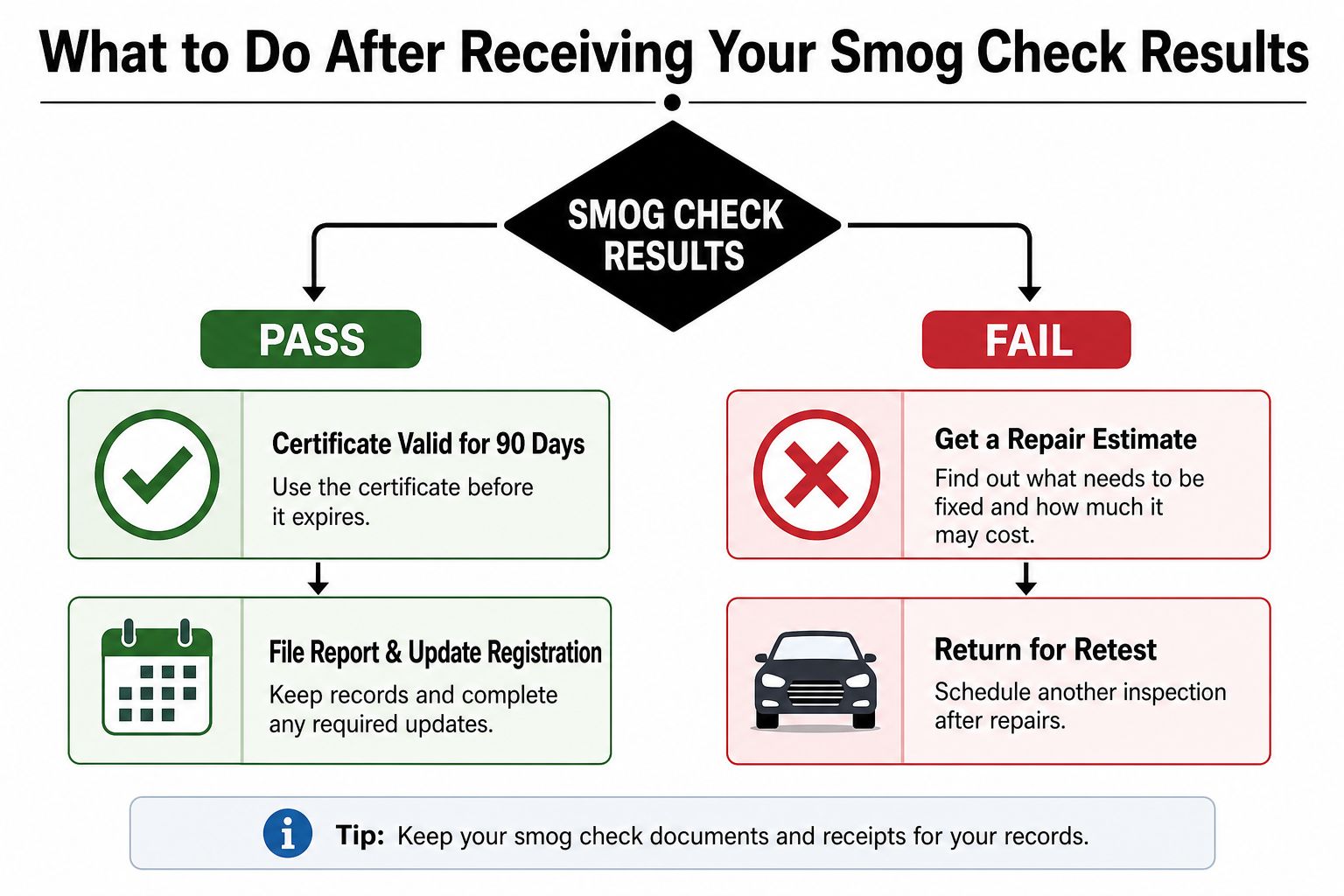
If the report says pass
Confirm that the vehicle information is correct and keep the VIR with your registration records. The station electronically sends the smog certificate to the DMV, so you generally shouldn't need to carry a paper certificate to the DMV for the electronic submission itself. Keep your copy anyway. It documents what was inspected and can help if a registration record needs review.
Complete your registration process promptly and follow any instructions on your renewal notice. If the vehicle is changing ownership or being registered in California for the first time after coming from another state, check the applicable DMV requirement before assuming an older inspection will satisfy the transaction. BAR states that a smog check is required for all out-of-state 1976 model-year and newer vehicles registering in California for the first time, along with other initial registration events.
If the report says fail
Use the failure notes to choose a repair path:
- Save the report and supporting records. Keep diagnostic printouts, invoices, and parts information.
- Ask for diagnosis before repairs. The repairer should connect the symptom or code to a confirmed cause.
- Address the listed failure. Do not rely on clearing codes or disconnecting the battery.
- Verify readiness and repairs. The vehicle must be ready for the applicable inspection procedure.
- Return for a retest. Bring the original VIR and repair documentation.
Some cases call for a licensed repair station. Others may require a Referee review, particularly when the report involves unusual equipment, configuration, or an unresolved dispute about compliance. If the likely repair cost creates financial difficulty, ask the appropriate California program office or repair professional about current waiver or assistance rules. Eligibility depends on the vehicle, failure, documentation, and applicable program requirements, so don't assume a waiver is automatic.
How Speedy Smog Helps East Bay Drivers Get Certified Fast
For San Leandro and nearby East Bay drivers, Speedy Smog offers smog inspections at its STAR-certified station at 15275 Washington Ave, San Leandro, California 94579. The shop handles many vehicle categories, including 2000-and-newer vehicles, 1999-and-older vehicles, diesels, and hybrids, so drivers can confirm the appropriate test before arriving.
Typical tests for 2000-and-newer vehicles take about 10 to 15 minutes, according to the supplied business information. Speedy Smog also provides electronic DMV submission after a passing inspection, explains the result fields, and offers an indoor waiting area, transparent pricing, and periodic coupons. It operates Monday through Saturday.
Bring your vehicle information and any renewal notice, and tell the technician if you've recently cleared a code, disconnected the battery, or completed emissions repairs. That context helps the station interpret readiness status correctly and keeps the report focused on what your vehicle needs.
If you want a clear explanation of your smog check report before handling DMV registration, visit Speedy Smog in San Leandro. Their STAR-certified team can inspect eligible vehicles, explain the VIR findings, and electronically submit passing results to the DMV.