
You've got the DMV renewal notice on the counter, a registration deadline getting closer, and one practical question. Do you need a Smog Check in Oakland, CA, what kind of station can test your vehicle, and is the car ready to pass when you get there? Answer those three questions in order and the visit stops feeling like a gamble. It becomes a short workflow you can control.
Table of Contents
- Start With Your Oakland Smog Check Decision
- Determine Whether Your Vehicle Needs Testing
- Choose the Right Smog Station in Oakland
- Prepare Documents and Your Vehicle
- What Happens During a Typical Smog Check
- Understand Common Smog Check Failures
- Choose Your Next Step After a Failure
- Use a Smog Check Visit Checklist
Start With Your Oakland Smog Check Decision
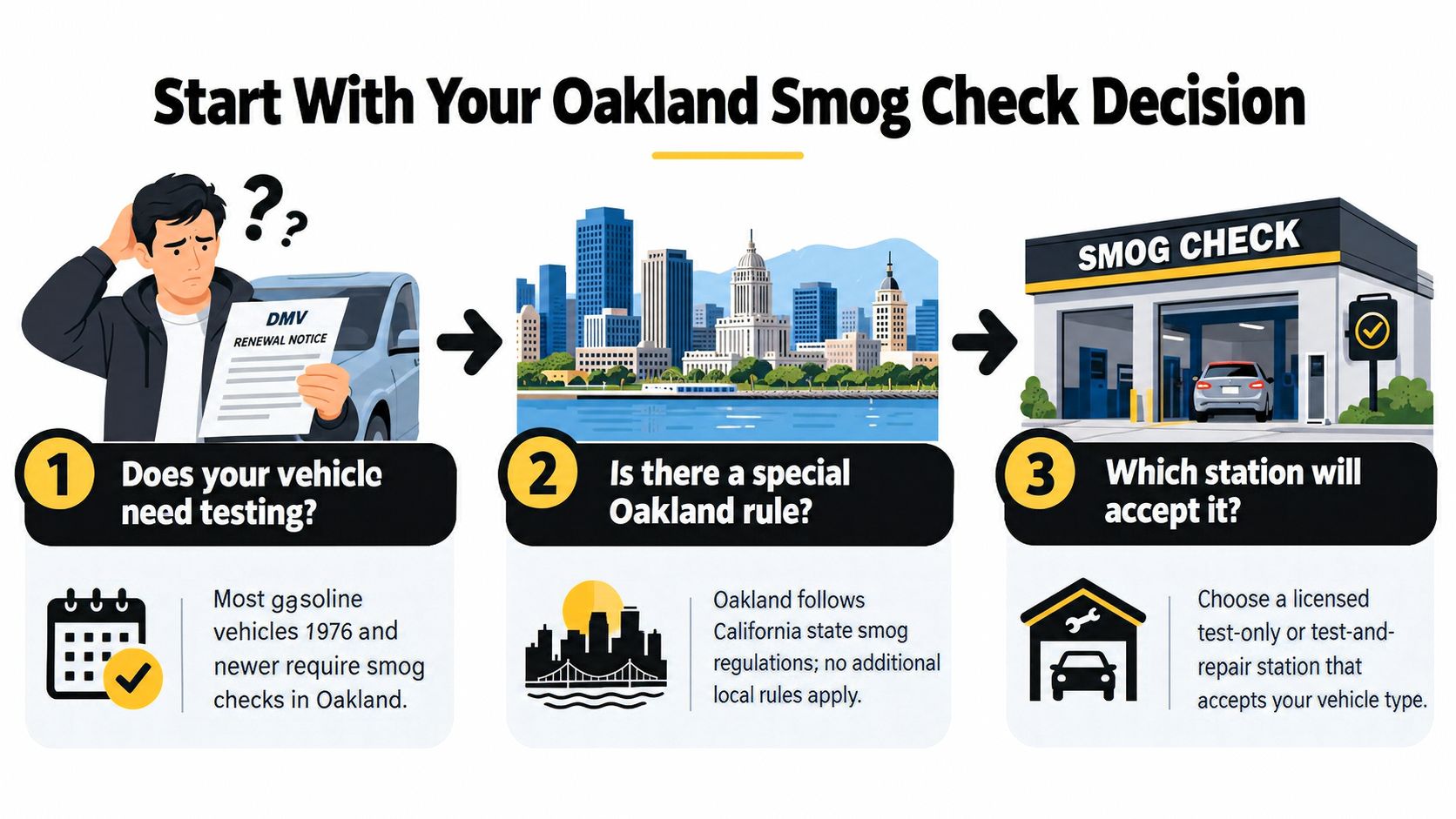
An Oakland driver finishing a commute opens that renewal envelope and sees smog certification requested. The car runs fine, so the first instinct is to search for the closest station and drive over. That's the wrong order. You need to decide whether a test is required, where your vehicle must be tested, and whether it's ready before you pick a shop.
Boarding a flight is a useful comparison. The destination doesn't matter if you've brought the wrong document or your bag can't clear the scanner. Your DMV notice is the boarding pass here. It controls the route for this transaction, and it tells you more than a generic search result can.
Why Oakland Follows a State System
Oakland doesn't run its own separate smog program. California established its Smog Check program as a statewide emissions-control system in the 1980s, and in its first year approximately 4 million vehicles were inspected under the mandatory biennial law, with about 70% passing without repairs. Vehicles that failed and were repaired showed an average 17% reduction in hydrocarbon and carbon-monoxide emissions right after repair, per that same early reporting.
That history explains the present workflow. A test isn't an optional maintenance add-on you can skip because the car feels fine. It's tied to specific registration transactions, and the result has to match the vehicle and transaction the DMV has on file.
There's also a difference between a routine renewal and other triggers. A biennial renewal is the familiar case, but a first California registration or a change of ownership can also put you in line for certification. Don't assume the rules from your last car carry over to this one.
Practical rule: Start with the paper in your hand, not the station map. If the notice, model year, and fuel type don't line up with your assumptions, resolve that first.
Expect the visit itself to vary. A newer gasoline car with complete diagnostic monitors is a different appointment from an older vehicle, a diesel, or a hybrid that follows another inspection path. Getting the decision right up front saves you a second trip, which is where most wasted time goes.
Determine Whether Your Vehicle Needs Testing
Don't classify your vehicle by age alone. That's the most common mistake East Bay drivers make, and it leads to the false idea that anything old is exempt. Age matters, but so do fuel type, model year, weight, and the type of registration transaction you're completing.
Match Model Year to Fuel Type First
Start with the broad categories, then check exemptions against them. Official California guidance places gasoline, hybrid, and alternative-fuel vehicles from model year 1976 onward generally within the program, while diesel vehicles from model year 1998 onward generally require testing. That same guidance identifies gasoline vehicles from 1975 or earlier, diesel vehicles from 1997 or earlier, electric vehicles, and certain heavy vehicles as exempt.
Read those two sentences together and the logic becomes clear. A 1999 diesel isn't exempt just because it feels old. A hybrid isn't automatically out of the program because it uses less gasoline. The category comes first, and the exemption, if one applies, has to override it clearly.
- Gasoline, hybrid, and alternative-fuel vehicles: Generally covered from 1976 onward, so a recently purchased older car in this group usually still needs attention.
- Diesel vehicles: Generally covered from 1998 onward, which catches many older trucks owners assume are grandfathered out.
- Electric vehicles: Listed as exempt, so don't book a test you don't need.
- Certain heavy vehicles: Treated as exempt under the DMV categories, but weight details matter, so don't guess from vehicle size alone.
Check the Transaction, Not Just the Calendar
Your vehicle can need certification even when it's not renewal time. Certification is also generally required when an affected vehicle is first registered in California or changes ownership. That covers a driver moving into Oakland with an out-of-state car, and it covers a private sale in San Leandro or Oakland where the buyer assumes the car is ready to register because the tags look current.
Imported and recently purchased vehicles trip people up. The relevant question isn't whether the previous owner tested it recently for their own renewal. It's whether your transaction triggers a requirement now. Those are different events, and the DMV treats them on their own terms.
If you're working through the broader rules before you call a station, the California smog check rules overview is a useful place to confirm how these categories fit together. Use it as a cross-check, not a replacement for your notice.
Let the Notice Resolve Conflicts
When your memory of the rules conflicts with the notice, the notice wins. Match the vehicle information on it to your actual model year and fuel type, then look for any instruction about station type. Some vehicles may use any licensed station, while others are directed to a STAR station.
If anything still doesn't add up, call the station before you travel and describe the vehicle and transaction. A two-minute verification beats arriving with the wrong expectation and being turned away. Bring the notice with you either way, so the station can transmit the correct vehicle information for your record.
Choose the Right Smog Station in Oakland
A STAR station isn't mandatory for everyone, and a regular station isn't a lesser choice if your notice doesn't direct you otherwise. What matters is matching the station to three things. Your DMV instructions, your vehicle type, and the transaction you're completing determine the right fit, in that order.
STAR certification is a performance distinction set through the Bureau of Automotive Repair. Some DMV notices direct specific vehicles to a STAR station, and when yours does, that instruction isn't optional. When it doesn't, you have more flexibility, and convenience, pricing clarity, and vehicle capability can carry more weight.
Compare the Two Routes Side by Side
| Consideration | Regular Station | STAR-Certified Station | Reader Action |
|---|---|---|---|
| DMV direction | Works when your notice doesn't specify STAR | Required when your notice directs you there | Read the notice before calling anyone |
| Certification recognition | Valid for transactions that accept any licensed station | Recognized for directed vehicles and general testing | Confirm the result will be transmitted for your transaction |
| Vehicle capability | Varies by station and equipment | Varies too, so don't assume every vehicle is accepted | Ask about your fuel type and model year in advance |
| Convenience trade-off | May be the closest option in Oakland | May mean a short drive elsewhere in the East Bay | Weigh travel time against a possible second trip |
| Pricing clarity | Ask for the full amount up front | Same standard applies | Don't compare stations on a partial quote |
That last trade-off deserves emphasis. The closest station to your house is only convenient if it can inspect your vehicle and its result counts for your transaction. A slightly longer drive to a station that handles your vehicle class correctly is faster than two short drives.
For a clearer explanation of what the designation means in practice, review the STAR certified smog station details before you decide. Then ask any station you're considering the same short set of questions. Can you test my fuel type and model year, does my notice require STAR, and will you transmit the certification electronically?
As one transparent East Bay example, Speedy Smog operates as a STAR Certified station at 15275 Washington Ave in San Leandro, 94579, not in Oakland itself. It serves Oakland-area drivers, handles 2000 and newer models, 1999 and older vehicles, diesels, and hybrids, and states that typical inspections for 2000-and-newer vehicles take about 10 to 15 minutes. Treat those specifics as a checklist for evaluating any station, not just this one. A good station should be able to state its status, its supported vehicle categories, and a realistic time window just as plainly.
Don't shop for a smog station the way you'd shop for a car wash. Proximity helps, but recognition for your specific transaction comes first.
Prepare Documents and Your Vehicle
Most avoidable failures and repeat trips happen before the technician touches your car. Preparation splits into two jobs. You need the right document in hand, and you need the vehicle's computer ready to report complete information.
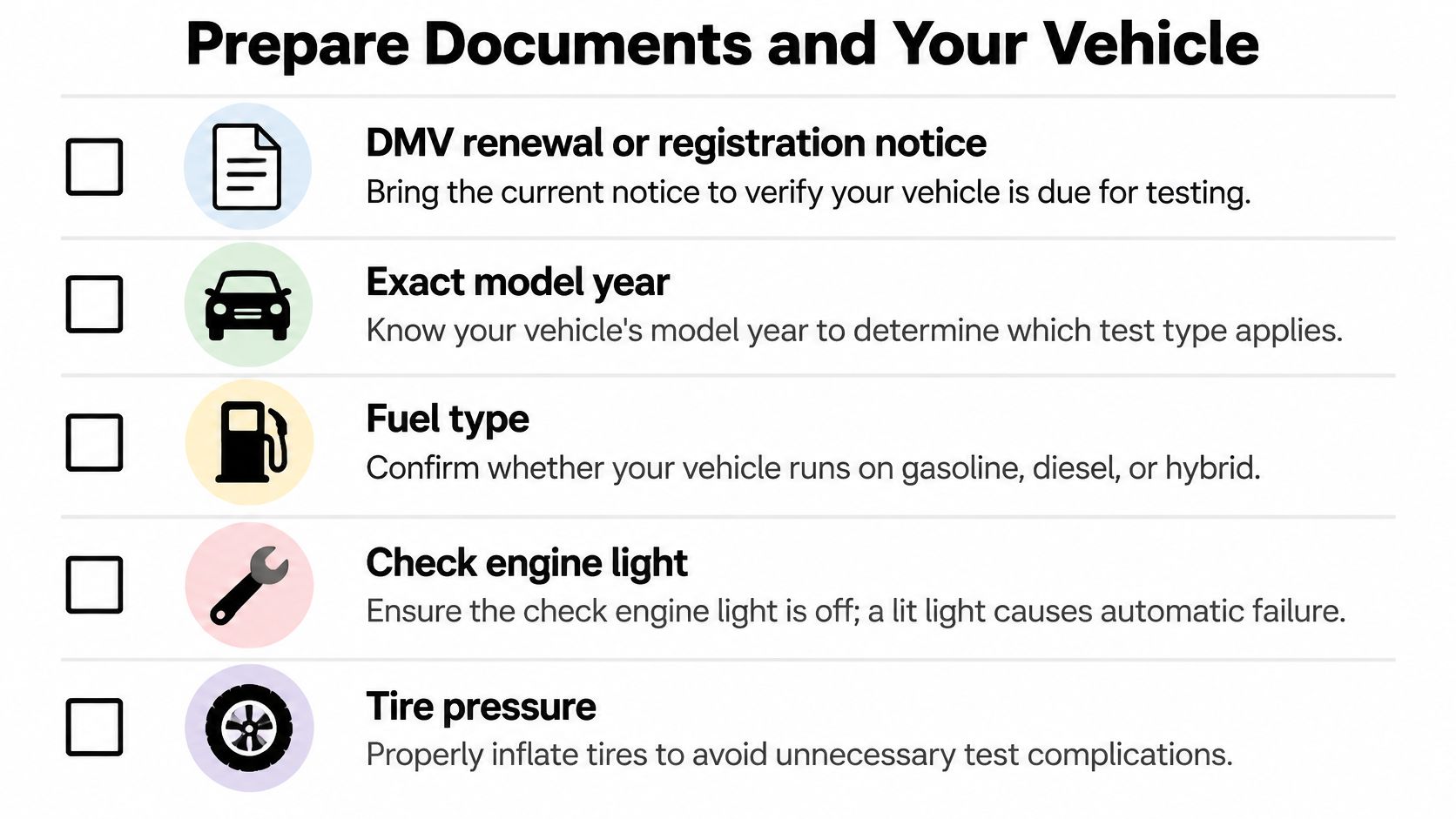
Bring this checklist image to mind as you work through the steps below.
Assemble the Paperwork and Vehicle Facts
- DMV renewal or registration notice: Bring the current notice, since it's the document that defines your transaction and any STAR direction.
- Exact model year: Know it precisely, because a one-year difference can change which rule applies.
- Fuel type: Confirm gasoline, diesel, hybrid, or alternative fuel before you call, so the station can confirm it can test you.
- Registration status: Be ready to explain whether this is a renewal, a first California registration, or an ownership change.
For a fuller walkthrough of pretest steps, the guide on what to do before a smog check covers the preparation sequence in more detail. Read it before you schedule, not in the parking lot.
Get the Onboard Computer Ready
For gasoline vehicles from model year 1996 onward and diesel vehicles from model year 1998 onward, the inspection relies heavily on the On-Board Diagnostics system. That check verifies the malfunction indicator lamp works correctly, looks for diagnostic trouble codes, and evaluates whether required emissions monitors are complete. It's closer to a computer health report than a simple tailpipe sniff.
Don't clear codes or disconnect the battery right before your appointment hoping to erase a warning. That resets the readiness monitors and leaves the computer without enough operating data. You're trading a known fault for an incomplete report, and both can stop you from passing. Repair the underlying problem instead, then complete the manufacturer-specific drive cycle so the monitors rebuild their data through normal driving.
This short video walkthrough shows what readiness preparation looks like in practice.
If your check engine light is on, treat that as a stop sign. Get the fault diagnosed before you test, because showing up hoping it won't matter wastes the trip. Also allow time for the vehicle to cool after driving, and confirm the station can inspect your vehicle class before you head out. None of this guarantees a pass, and any station promising one in advance isn't being straight with you. That removes the preventable reasons for failure.
What Happens During a Typical Smog Check
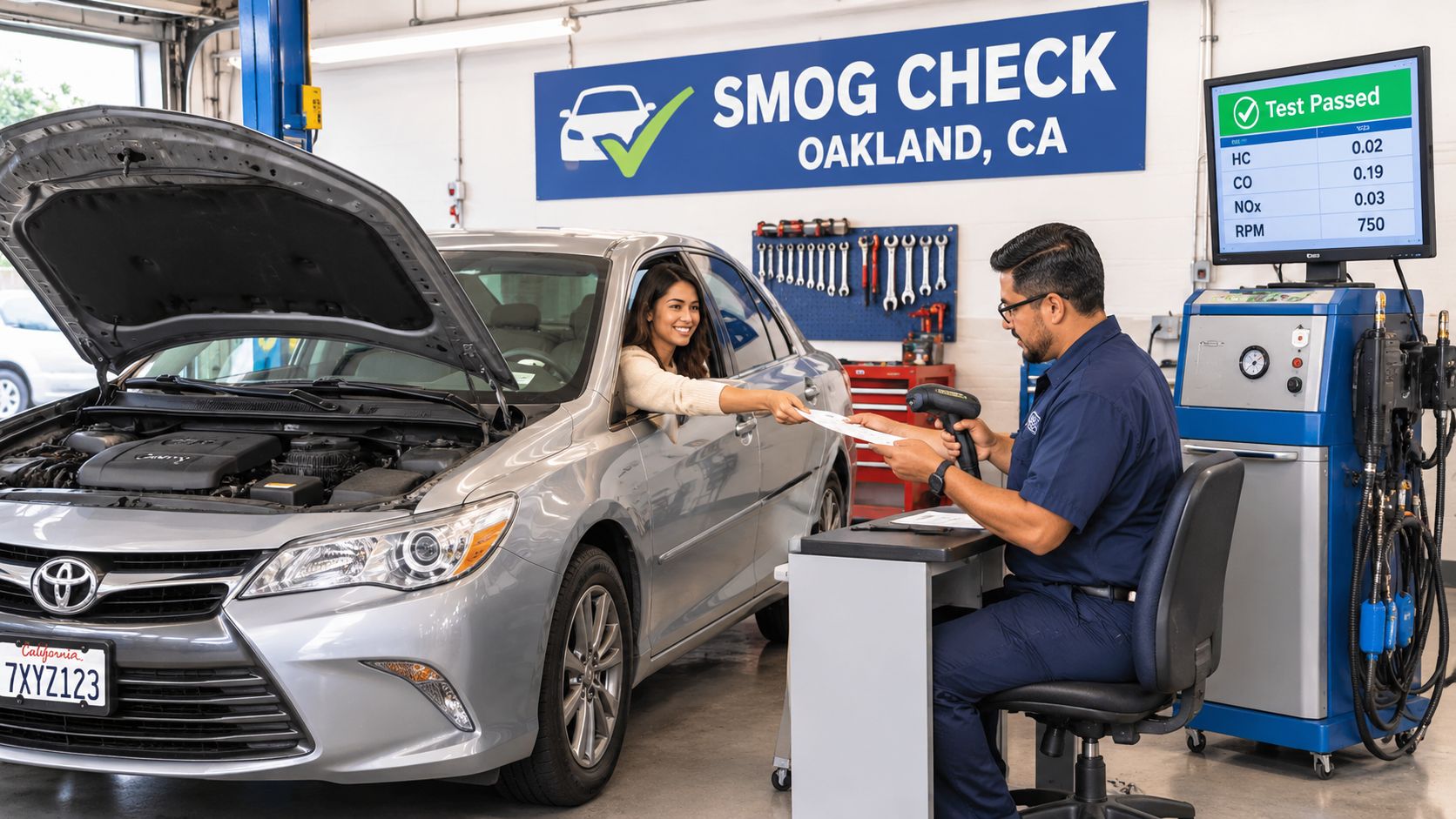
Follow a representative 2000-and-newer sedan through a visit and the whole process looks manageable. The driver arrives with the renewal notice, the station verifies the vehicle record against that document, and only then does the inspection begin. That record check isn't bureaucracy for its own sake. It's what ensures the result attaches to the right vehicle and transaction.
From Check-In to Result
Here's the sequence most drivers of newer vehicles experience.
- Arrival and verification: You hand over the notice, the station confirms model year, fuel type, and any STAR requirement.
- Inspection: The technician runs the test path appropriate to your vehicle, which for a newer model centers on the diagnostics described in the section above.
- Result handling: On a pass, the certification is transmitted electronically, so you aren't carrying a paper certificate to the DMV yourself.
For planning purposes, a typical inspection for 2000-and-newer vehicles takes about 10 to 15 minutes at the East Bay example mentioned earlier. Read that as a typical window, not a guarantee. A station can be busy, a vehicle can need extra attention, and your own arrival paperwork can add time. Budget a buffer around the test itself rather than scheduling something tight immediately after.
Where the Experience Changes
Older gasoline vehicles, 1999-and-older vehicles, diesels, and hybrids may follow different inspection paths. If yours falls into one of those groups, don't assume the newer-car timeline applies to you. Ask the station when you book how your category is handled and how long you should allow.
The surroundings matter less than the process, but they aren't irrelevant on a workday. A clean indoor waiting room makes a short wait easier, and transparent pricing stated before the test starts prevents an awkward surprise at the counter. Limited promotional offers exist at some stations, but don't let a discount distract you from the basic questions. Is this station right for my vehicle, and will its result count for my transaction? Those answers matter more than a few dollars saved on a test you'd have to redo.
Before you leave after a pass, confirm the result has been sent. That's your final step at the station, and it closes the loop between the inspection and your registration.
Understand Common Smog Check Failures
A failure doesn't automatically mean your engine is falling apart. On a modern vehicle, it often means the computer reported a problem, or hadn't collected enough data to report at all. Reading the result correctly is the difference between a targeted repair and throwing parts at the car.
Read the Result Like a Traffic Light
Use a simple comparison. The dashboard warning light is the signal you can see. Stored diagnostic trouble codes are the reason the signal changed. Readiness monitors are whether the system has run long enough to trust its own report. You need all three pieces before you can interpret a failure, not just the light.
That structure also explains why a vehicle can fail even when its tailpipe emissions look acceptable. If the OBD system reports an emissions-related fault or shows insufficient monitor readiness, the inspection can't certify the vehicle on tailpipe behavior alone. The computer's evidence and the exhaust evidence are separate checks, and either one can stop a pass.
The scale here is worth knowing. In statewide 2024 to 2025 data, approximately 19 million model-year-2000-and-newer vehicles were tested and about 1.3 million, roughly 7%, failed, with OBD-related failures at approximately 6.8% of OBD inspections. You're not dealing with a rare edge case when diagnostics cause a failure. It's the central failure path for newer vehicles.
Know the Usual Technical Causes
Four causes come up repeatedly in diagnostic failures.
- Catalytic-converter inefficiency: The converter isn't cleaning exhaust to the expected level.
- Evaporative-emissions leaks: Fuel vapor escapes where it should stay contained.
- Oxygen-sensor faults: The sensor feeding the computer bad data throws off the whole emissions picture.
- Misfire detection: The engine isn't firing consistently, and the computer catches it.
These range from relatively contained repairs to expensive ones, which is exactly why you shouldn't guess. The failure information narrows the diagnosis, and a proper diagnosis narrows the parts list.
After a failure: Keep the inspection details, don't reset anything, and diagnose from the codes before you buy a single part.
Clearing codes on the drive home undoes that advantage. You erase evidence and reset monitors at the same time, leaving the next technician and the next test with less to work from. Preserve the data and let it guide the next step.
Choose Your Next Step After a Failure
Repair immediately is bad default advice. Sometimes it's right. Sometimes you're about to spend real money on a vehicle where repair isn't the sensible path, and California runs a program specifically because that situation is common. Lay out your three actual options before you commit.
Compare Repair, Assistance, and Retirement
Diagnose and repair on your own suits a vehicle you intend to keep, with a contained fault and no history of repeated failures. Program-supported repair suits an income-eligible driver whose needed work qualifies. Vehicle retirement suits an older vehicle where repair costs and repeat failures have started to outweigh the car's remaining value to you.
The financial structure is specific. California's Consumer Assistance Program can provide income-eligible drivers up to $1,450 toward emissions-related repairs, while qualifying owners may receive up to $2,000 to retire a vehicle. The retirement option generally requires household income at or below 225% of the federal poverty level and, for the higher incentive, a failed Smog Check. A vehicle that passes may still qualify under a separate retirement pathway if the inspection occurred within the required 180-day window.
Those numbers change the math for a lower-income East Bay driver. A repair that looks unavoidable on your own budget may be partly covered, or retiring the vehicle may return more value than one more repair cycle on a car that keeps failing.
Respect the Eligibility Limits
Don't assume every mechanic's bill qualifies. Assistance is limited to eligible emissions-related work, requires program approval, and depends on income rules and documentation. Apply and get approved through the proper channel before you authorize work expecting reimbursement. Work done outside those conditions is your expense, whatever the total comes to.
There's a reason older vehicles deserve extra scrutiny in this decision. Lawrence Berkeley National Laboratory research using 1999 data estimated that one inspection-and-repair cycle reduced daily emissions by approximately 97 tons of hydrocarbons, 1,690 tons of carbon monoxide, and 81 tons of nitrogen oxides, with automobiles more than 10 years old accounting for over 90% of the hydrocarbon and carbon-monoxide benefits despite being only about half of vehicles tested. Older vehicles carry the greatest emissions-control deterioration risk. That doesn't make yours unsalvageable, but it does mean a single repair may not be the last one.
Sequence your decision this way. Get the diagnosis, check whether you qualify for assistance, compare the realistic repair path against retirement, and watch your registration timing throughout. A failed test doesn't force the cheapest-looking choice. It forces an informed one.
Use a Smog Check Visit Checklist
Run this sequence once and you've covered the article's decisions in order.
- Confirm the trigger: Renewal, first California registration, or ownership change, and check whether your notice specifies STAR.
- Verify vehicle fit: Make sure your station handles your fuel type and age group.
- Assemble information: Bring the notice, exact model year, fuel type, and registration status.
- Protect readiness: Repair known faults, complete the drive cycle, and don't clear codes or disconnect the battery.
- Budget time: Allow extra room around the test, especially for older, diesel, or hybrid vehicles.
After a pass, confirm the result was transmitted electronically before you leave. After a failure, keep the details and don't commit to a quick repair until diagnosis and assistance options are clear. Verify anything specific to your vehicle with your chosen station before you travel.
If your notice calls for a STAR inspection or you're testing a diesel, hybrid, older vehicle, or 2000-and-newer model, Speedy Smog can confirm your vehicle fit, explain the process in plain language, and complete the inspection for your DMV transaction. Bring your renewal notice, verify your vehicle is diagnostically ready, and visit to get tested and back on the road without a second trip.