
How to Check Vehicle Registration Status: Simple Steps For
You go to grab your registration card and it isn't where you thought it was. Or you've got a road trip coming up, a smog notice in the mail, and that nagging feeling that your tags might not be current. That's a familiar California driver problem, especially in the East Bay, where people are juggling commute schedules, DMV mail, renewal emails, and smog requirements that don't always line up neatly.
The good news is that checking your registration status is usually simple once you know the right path. The bad news is that a lot of advice online skips the parts that trip people up in real life, like the exact information the DMV requires, what a hold really means, or why a renewal can show as incomplete even after you already paid.
If you're trying to figure out how to check vehicle registration status without wasting half your day, the process comes down to three practical options: online, by phone, or in person. If you're also dealing with renewal questions, this overview of the California registration renewal process helps connect the status check to the next step.
Table of Contents
- Is Your Car's Registration Actually Current
- Your Three Options for Checking Registration Status
- Decoding Your California Registration Status
- How to Resolve Common Registration Problems
- The Critical Role of Smog Checks for California Drivers
- Frequently Asked Questions About Vehicle Registration
Is Your Car's Registration Actually Current
A driver often finds out there's a problem at the worst time. The renewal notice never showed up. The glove box has old paperwork but not the current card. The family is loading up for Tahoe, Sacramento, or a weekend in Southern California, and suddenly someone asks, “Are the tags even good?”
That uncertainty is worse than the lookup. California's DMV system can feel confusing until you know what it wants from you and what each result means. Once you know the method, checking status is usually a short task, not a project.
A common East Bay example goes like this. Someone paid a renewal, handled insurance, maybe even completed a smog check, and still isn't sure whether the state shows the vehicle as current. Another person is trying to sort out a used car in the driveway that hasn't moved for a while and needs to know where things stand before spending more money.
Practical rule: Don't guess based on stickers, memory, or a missing notice. Check the live DMV status first, then decide what action to take.
There are three workable ways to handle it:
- Online through the DMV: Best when you want the fastest answer.
- By phone with the DMV: Useful if you'd rather confirm details with a person or automated system.
- In person: Best for unusual cases, paperwork errors, or issues that can't be solved from home.
The method matters less than accuracy. If you enter the wrong vehicle details or use an unofficial service, you can lose time and still end up unsure whether the registration is valid.
Your Three Options for Checking Registration Status
Start with the DMV's own system. For a routine status check, it is usually the quickest path and the one least likely to send you in circles with outdated or incomplete third-party information.
California gives drivers three practical ways to check registration status: online, by phone, or in person. The best choice depends on whether you need speed, clarification, or help with a problem that goes beyond a basic lookup.
The Fastest Method. Checking Online Through the DMV
For most East Bay drivers, online is the first move. If the tags are due, the renewal notice never arrived, or you are trying to confirm whether a smog-related hold cleared, the DMV portal gives you the fastest read on what the state currently shows.
You will need:
- Your license plate number
- The last five digits of the VIN
Enter both exactly as requested. A lot of lookup problems come from simple input mistakes, especially using the full VIN instead of the last five digits or typing the plate in the wrong format.
The practical process is simple:
- Open the official California DMV registration status tool.
- Enter the plate number exactly as shown on the vehicle record.
- Enter the last five digits of the VIN.
- Submit the request.
- Review the status before you assume the renewal went through.
If the result does not match what you expected, stop there and verify your information before trying again. In the shop, I see this all the time. A driver is sure registration should be current because the payment was made, but the DMV still shows a hold because the smog certificate has not posted yet, or the wrong VIN digits were entered.
A Good Backup. Calling the DMV
Phone support works well when the online result is unclear or you want a second layer of confirmation. It is also useful for older drivers, family members helping someone else, or anyone who wants to ask a follow-up question instead of guessing at DMV wording.
Call 1-800-777-0133 and have the same basic details ready:
- License plate number
- Last five digits of the VIN
The trade-off is time. Phone support can take longer than the online check, especially during busy periods. Still, it can save a trip if the issue is minor and the representative can explain whether you are looking at an expiration, a hold, or a record issue.
When an In-Person Visit Makes Sense
Some registration problems cannot be cleaned up online or over the phone. If the record does not match your paperwork, the vehicle changed hands recently, or there is a hold tied to title, insurance, or identity details, an office visit is often the straightest route.
Go in person for cases like these:
- Record mismatches: The DMV record and your documents do not agree
- Ownership issues: Title transfer, sale, or prior-owner problems are tied to the registration
- Unclear holds: The status shows a block, but you still do not know what action clears it
- Smog complications: You completed a test, but the registration has not updated, or the vehicle needs a STAR station inspection to move forward
That last point matters in California more than many drivers expect. Around the East Bay, a registration delay often turns out to be a smog issue, not a payment issue. If the DMV is waiting on a valid smog certificate, the status check tells you there is a problem, but it does not fix the cause. You still need the test completed and transmitted properly.
Here is the quick comparison.
| Method | Speed | Required Info | Best For |
|---|---|---|---|
| Online DMV portal | Fastest | License plate number and last five digits of VIN | Routine checks and quick confirmation |
| DMV phone line | Moderate | License plate number and last five digits of VIN | Drivers who want clarification or verbal help |
| In person | Slowest | Vehicle documents and any supporting paperwork | Title issues, record problems, and unresolved holds |
Use the official DMV route first. If the status suggests a smog hold, handle that issue right away so you do not lose more time chasing the wrong problem.
Decoding Your California Registration Status
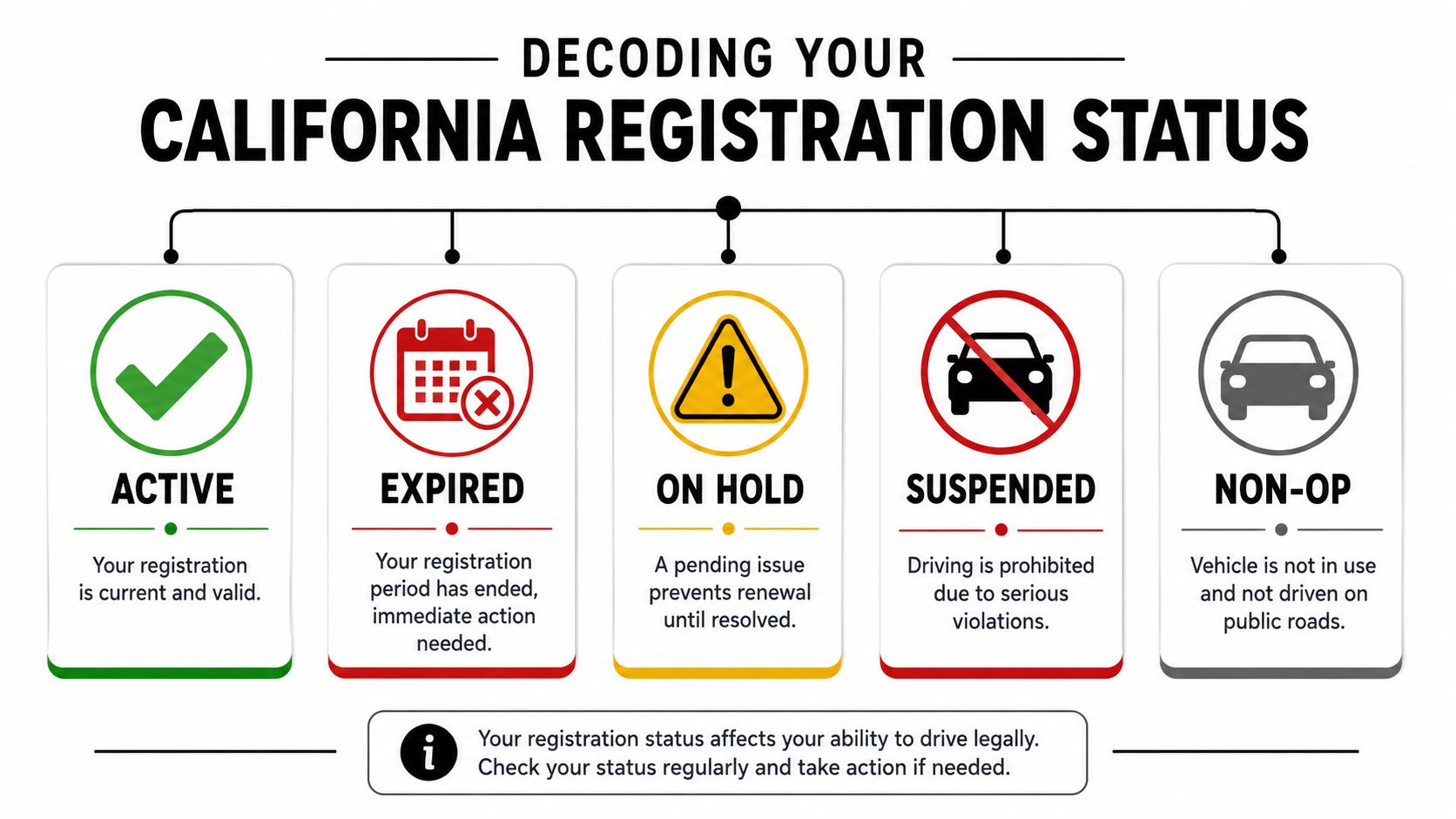
Once the DMV gives you a result, the next issue is understanding what that result means in plain English. Some statuses are straightforward. Others sound administrative but prevent you from renewing or driving legally.
What Current or Valid Means
If the status shows current or valid, that's the clean outcome. The vehicle is registered, the DMV recognizes it as active, and there isn't an obvious stop on the account from the status check itself.
That doesn't mean you should ignore your paperwork. Keep the registration card where you can find it, and if anything recently changed, make sure your address and vehicle records stay consistent.
What Expired Suspended and Hold Usually Mean
These are the results that cause the most confusion.
- Expired: The registration period has ended. If your car is expired, you should treat it as an immediate problem and resolve it before driving.
- Suspended: This is more serious. It means the registration is not in good standing due to a larger issue, and the car shouldn't be driven until that issue is cleared.
- Registration hold: This often means the DMV is waiting on something before it will complete or recognize the renewal.
California drivers often run into holds because of unfinished requirements tied to the renewal. In day-to-day shop conversations, the most common thing people discover is that some step they assumed was automatic wasn't completed in the DMV's system.
Another status you may hear about is non-op, short for non-operation. That usually means the vehicle isn't intended for use on public roads. If that status appears on a car you plan to drive, you'll need to correct it before relying on the vehicle.
A hold doesn't always mean something dramatic is wrong. It often means the DMV is waiting for one missing piece.
How to Resolve Common Registration Problems
Finding the status is only half the job. The useful part is knowing what to do next without running in circles.
If Your Registration Is Expired
Start by checking whether the issue is simple expiration or expiration plus a hold. Those are not the same situation. An ordinary expired record may just need completion of the renewal. An expired record with a hold means some other requirement is blocking the process.
A practical checklist helps:
- Confirm the exact status first: Don't pay or submit forms blindly.
- Look for a missing renewal step: Insurance, paperwork, or another DMV requirement may still be open.
- Review your documents: Your current registration card and renewal notice often reveal what's outstanding.
If you're unsure whether the issue is mechanical, administrative, or emissions-related, don't keep refreshing the DMV page and hoping the wording changes. Find the missing requirement and clear that first.
If the DMV Shows a Hold
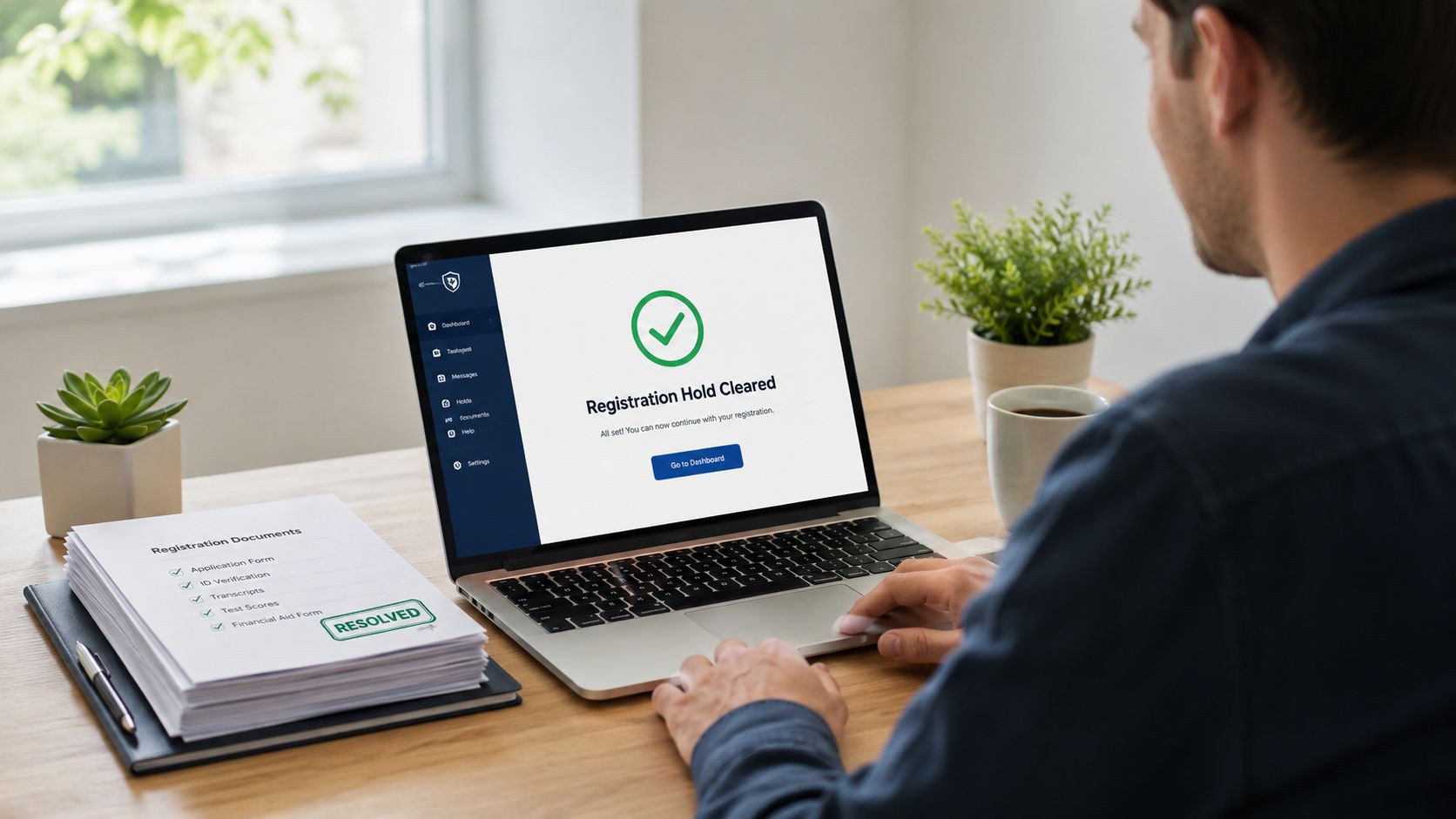
A hold usually means the state won't finalize the registration until another issue is resolved. In California, one of the most common real-world causes is a needed smog certification that hasn't been completed or transmitted yet.
Other holds can involve document mismatches, insurance problems, or unresolved obligations tied to the vehicle record. The smart move is to narrow it down instead of assuming it's only a payment issue.
Use this sequence:
- Read the status carefully.
- Check your renewal paperwork for any stated requirement.
- If smog is due, complete that step promptly.
- Then recheck the status after the requirement is processed.
If you're trying to understand whether an emissions test result has already been reported, this explanation of how smog test results are handled can help connect the DMV hold to the inspection side.
If You Already Renewed but the Status Hasn't Updated
This is one of the most frustrating situations because you've done what you were supposed to do, but the system still looks wrong. A recognized issue is the gap period after renewal, when a driver has confirmation but the main database hasn't fully synced yet. That problem is described in this discussion of post-renewal sync delays.
What to do:
- Save your confirmation: Keep digital proof and any receipt handy.
- Give the system some time: Not every completed renewal appears instantly in the main status record.
- Use the DMV directly if needed: If the lag seems excessive or the status creates a practical problem, contact the DMV and ask them to verify what has posted.
Keep your renewal confirmation until the DMV status catches up. That small habit avoids a lot of panic.
The Critical Role of Smog Checks for California Drivers
You pay the renewal, expect the tag, and then the DMV record still won't clear. Around San Leandro and the East Bay, that usually points back to smog.
Why Smog Causes So Many Registration Delays
California ties registration renewal to emissions compliance for many vehicles. If a smog certification is required and the DMV has not received it yet, the registration can stay on hold even after a driver has handled the other parts of renewal.
I see this trip people up all the time. The driver focuses on fees, insurance, or the online DMV status page, but the underlying problem is that the car still needs a test, failed a recent test, or completed a test that has not posted yet.
That is why East Bay drivers should check smog status early, especially if the renewal notice mentions it or the vehicle is due this cycle. If you want to confirm that requirement before you waste time guessing, review how to check whether your vehicle is due for a smog check.
There is also a practical timing issue. A smog check done close to the deadline can still leave you sweating for a day or two if the DMV record has not updated yet. The test may be complete, but the registration problem does not feel resolved until the hold disappears.
How to Avoid a Preventable DMV Problem
The simplest approach is to treat smog as part of registration, not as a separate errand.
Use this routine:
- Read the renewal notice early: California usually tells you if smog is required for that renewal period.
- Schedule the inspection before the deadline gets tight: That leaves room if the car needs repairs or a retest.
- Use a STAR station when your notice calls for one: Some vehicles are specifically directed there, and going to the wrong place creates delay you do not need.
- Keep your paperwork until the DMV updates: Save your receipt and renewal confirmation in case the record lags.
For many local drivers, the fastest fix is not another round with the DMV website. It is getting the required smog inspection done at the right station, then giving the system a little time to catch up. That is the part generic registration guides often miss, and it is why smog holds are such a common California headache.
Frequently Asked Questions About Vehicle Registration
Can I check the registration status of a car I want to buy?
Only to a point. California limits what non-owners can see, so a buyer usually cannot pull the same registration details the registered owner can.
For a used car purchase, ask to see the current registration card, the renewal notice if one was recently issued, and the seller's ID so the names match. If anything feels off, slow the deal down. In the East Bay, I have seen buyers focus on the price and miss a registration hold tied to smog, unpaid fees, or incomplete transfer paperwork.
What if my DMV address is wrong?
Update it with the DMV right away. A bad address can mean missed renewal notices, a registration card sent to the wrong place, or confusion that makes a simple issue look bigger than it is.
This comes up more than people expect after a move across Oakland, San Leandro, Hayward, or Castro Valley. If your online status does not make sense, confirm the mailing address before chasing other problems.
How long after a smog check can I renew?
Renew after the smog certification has been completed and the DMV record shows it. The inspection may be done, but the registration hold can remain until the system updates.
That gap is one of the biggest California pain points. Drivers come in assuming the DMV made a mistake, when the primary issue is timing. Keep your receipt, give it a little time to post, and if your renewal notice requires a STAR station, make sure the test was done at the right place in the first place.
What if I have the plate number but not the VIN?
You will need the required identifiers for the official California lookup. If you do not have the last five digits of the VIN, pull the registration card, insurance paperwork, or sale documents before you start.
Trying to guess usually wastes time.
Should I use a third-party registration check site?
Usually, no. California's official status tool is the better first stop because it pulls from the DMV's own system: https://www.dmv.ca.gov/portal/vehicle-registration/vehicle-registration-status/
Third-party sites can be useful for vehicle history in some situations, but they are not the best source for current California registration standing. If the problem turns out to be a smog hold, the faster fix is often getting the car tested at the correct station and waiting for the DMV record to catch up.
If your registration is being held up by a smog requirement, Speedy Smog is a practical local option for East Bay drivers who want the process handled quickly and correctly. Their STAR Certified station in San Leandro helps motorists get the emissions certification they need for DMV compliance, with fast service, clear pricing, and a straightforward experience that takes some of the stress out of renewal.