A DMV smog test only station performs the emissions inspection but cannot perform repairs, so a failed vehicle must go elsewhere for diagnosis and fixes. California had 8,213 licensed Smog Check stations in December 2018, including 4,225 STAR stations, and STAR locations handled 82% of approximately 11.4 million initial tests that year (California Bureau of Automotive Repair performance report).
You may be looking at a renewal notice, searching for “dmv smog test only,” and wondering whether the first station you find can also repair your car if something goes wrong. That uncertainty matters. The right choice depends on what the DMV notice says, whether your vehicle appears ready for testing, and whether you need only a certification or also expect emissions repairs.
A test-only visit can be straightforward when your vehicle is prepared and the DMV needs a valid result. It can also become an unnecessary second trip if your car has a warning light, incomplete readiness monitors, or a known emissions problem. The station type is part of the decision, not just a label on a sign.
Table of Contents
- Understanding DMV Smog Test Only Stations
- The STAR Certification Ecosystem and What the Numbers Reveal
- Comparing Test Only Stations and Full Service Repair Stations
- What to Expect at a STAR Certified Test Only Location
- Why Test Readiness Matters More Than Test Speed
- Making the Right Choice for Your Vehicle Situation
Understanding DMV Smog Test Only Stations
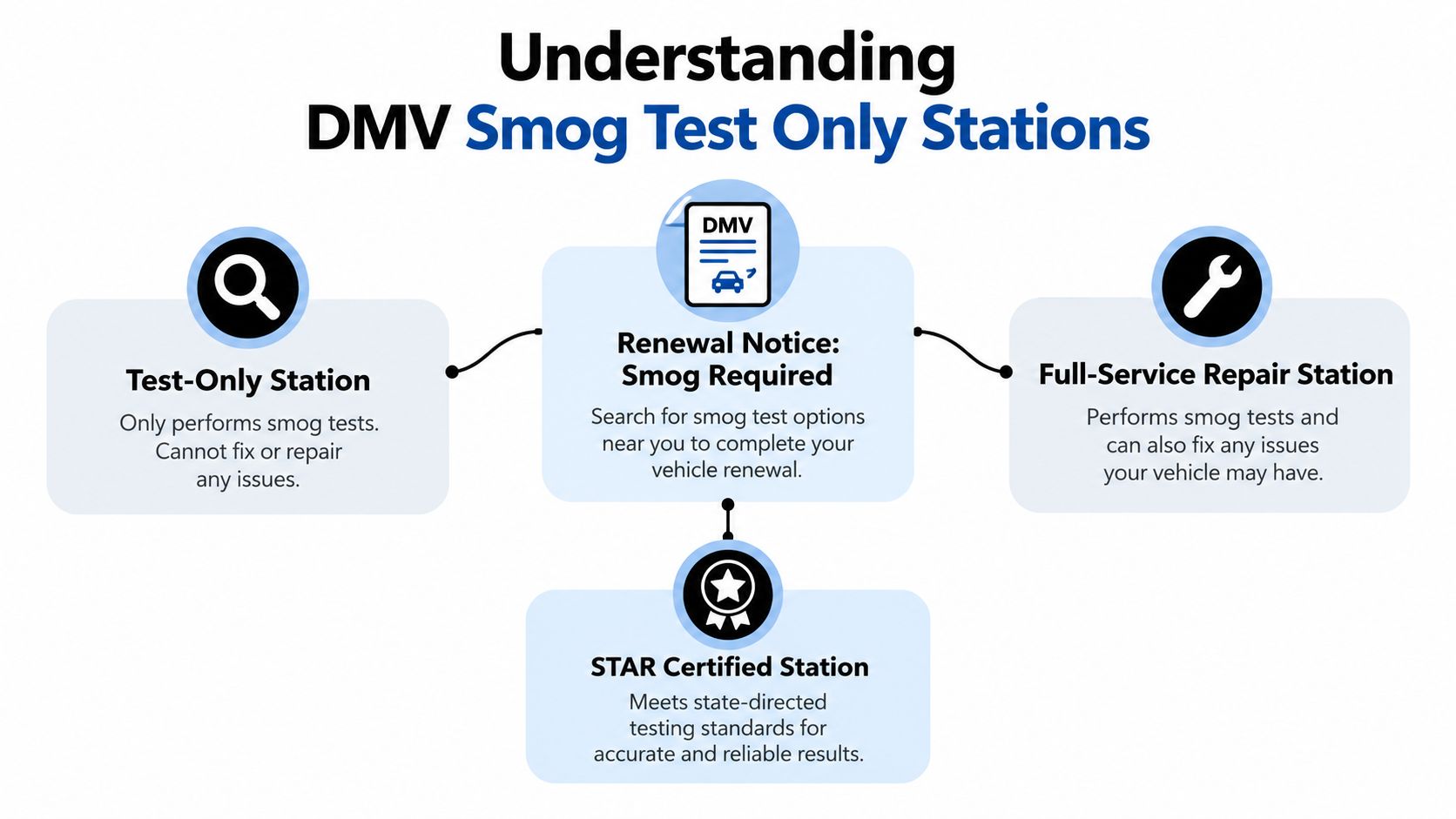
A DMV renewal notice arrives, the word “smog” catches your eye, and you start comparing nearby shops. One advertises testing only. Another offers testing and repairs. The difference is simple but important: a DMV smog test only station is authorized to inspect your vehicle, not repair its emissions system.
Think of the station as a medical testing office. It can examine the patient, run the required checks, and report the result, but it doesn't provide the treatment. If your vehicle fails, you'll receive information about the failure and then need a qualified repair facility for diagnosis or correction.
What the inspection includes
California's Smog Check inspection can involve several parts:
- Visual examination: The technician checks emissions-control hardware for missing, disconnected, or visibly altered components.
- Functional checks: The station verifies that required systems operate as expected.
- Computer testing: On most model-year 2000 and newer vehicles, an OBD test reads emissions-related data from the vehicle computer.
- Tailpipe testing: Pre-2000 vehicles generally receive a tailpipe emissions test instead.
The California Bureau of Automotive Repair describes the inspection process and vehicle testing pathways in its Smog Check guidance. An OBD-equipped car can fail even when it feels normal if the malfunction indicator lamp is illuminated or the computer reports an emissions issue.
Why the distinction affects your next move
A test-only station suits a driver who needs a certification and expects the vehicle to pass. It may be less convenient if you've already diagnosed an emissions fault and want one business to test, repair, and retest the car.
Before booking, check whether the DMV notice directs you to a STAR station. If it doesn't, you can generally compare station type, location, availability, and service scope. For a more detailed explanation of the test-only model, see this guide to what a test-only smog station does.
Practical rule: Choose a test-only station for an inspection. Choose a repair-capable station when you already need emissions diagnosis or correction.
The STAR Certification Ecosystem and What the Numbers Reveal
A lot of frustration around smog checks comes from treating every station like it does the same job. The network is more like a road system with different lanes. Some stations can handle standard inspections. Some can also handle vehicles the state wants reviewed under tighter rules.
That is where STAR fits. The Bureau of Automotive Repair uses the STAR Program to identify stations that meet added performance requirements and can inspect vehicles assigned for enhanced scrutiny. If your renewal notice points you to a STAR location, the station type is part of the transaction, not a small technical detail.
The scale of that role becomes clearer when you look at inspection volume instead of repeating station totals. In 2018, California conducted about 11.4 million initial Smog Check tests. STAR stations performed about 9.3 million, or 82%, while non-STAR stations performed roughly 2.1 million, or 18%, according to BAR's 2019 performance report.
Those numbers help explain the system. A station category can represent only part of the network on paper and still carry most of the day-to-day workload. For drivers, that means STAR is not a rare label you can ignore. It is a major part of how vehicles move through California's registration process.
The second confusion point is what STAR does not mean. STAR certification does not mean your car is more likely to pass. It also does not automatically tell you whether the shop repairs vehicles. The label speaks to the station's standing in the regulatory system. Your vehicle still has to satisfy the inspection requirements, and the business may be test-only or may also offer repairs.
A simple way to sort this out is to start with the notice in your hand.
- Read the DMV notice first: it may name the station category you need.
- Treat a STAR direction as a requirement: a nearby non-STAR shop may not complete the inspection the DMV expects.
- Separate certification from service model: a STAR station can be test-only, or it can also perform repairs.
- Use station type as a planning tool: it helps you choose a shop that matches your registration step, not just the closest address.
If you want a plain-language overview before booking, this explanation of what a STAR station is can help clarify the label.
Comparing Test Only Stations and Full Service Repair Stations
The best station depends on what you need after the technician connects the equipment. If your goal is a DMV certificate and your vehicle appears healthy, a test-only location may provide the cleanest path. If you expect a failure or already know about an emissions fault, a repair-capable shop may reduce the number of separate visits.
| Criterion | Test-Only Station | Full-Service Station |
|---|---|---|
| Inspection scope | Performs the required smog inspection and reports the result | Performs the inspection and may diagnose or repair emissions problems |
| After a failure | Provides the test result, but repairs must happen elsewhere | May diagnose and correct the issue on site |
| Convenience | Efficient when you only need certification | More convenient when testing and repair belong in the same visit |
| Best fit | A prepared vehicle needing a DMV result | A vehicle with a known or suspected emissions problem |
Speed
Test-only facilities focus their workflow on inspection. That specialization can be useful when your vehicle is ready and you don't need troubleshooting. A shorter visit doesn't necessarily mean a better outcome, though. Testing an unready vehicle quickly still produces an inconvenient result.
Scope
A full-service repair station combines two jobs. The technician can inspect the vehicle, identify a likely cause of failure, and potentially perform the necessary work. That broader scope matters when the check engine light is on, an emissions component is missing, or a prior diagnostic scan identified a fault.
A test-only station isn't withholding a service by refusing to repair. Its authorization and business model focus on independent inspection. You'll need to treat the result as a decision point, then take the vehicle to a repair professional if necessary.
Cost
Prices vary by station, vehicle, and service arrangement. A test-only visit may involve only the inspection, while a full-service visit can lead to diagnostic and repair charges if the vehicle fails. Ask what the quoted price covers before authorizing work, especially if you're choosing a repair-capable shop because you expect a problem.
Appropriateness
Use this quick filter:
- Choose test-only when the DMV requires certification and you have no reason to suspect an emissions fault.
- Choose full-service when a warning light is active, readiness is incomplete, or a technician has already identified a likely emissions problem.
- Confirm STAR status when the DMV or BAR directs your vehicle to a STAR facility.
- Plan for a separate repair visit if you use test-only and the vehicle doesn't pass.
The important question isn't “Which station is always best?” It's “What does my vehicle need before the DMV can accept the result?”
What to Expect at a STAR Certified Test Only Location
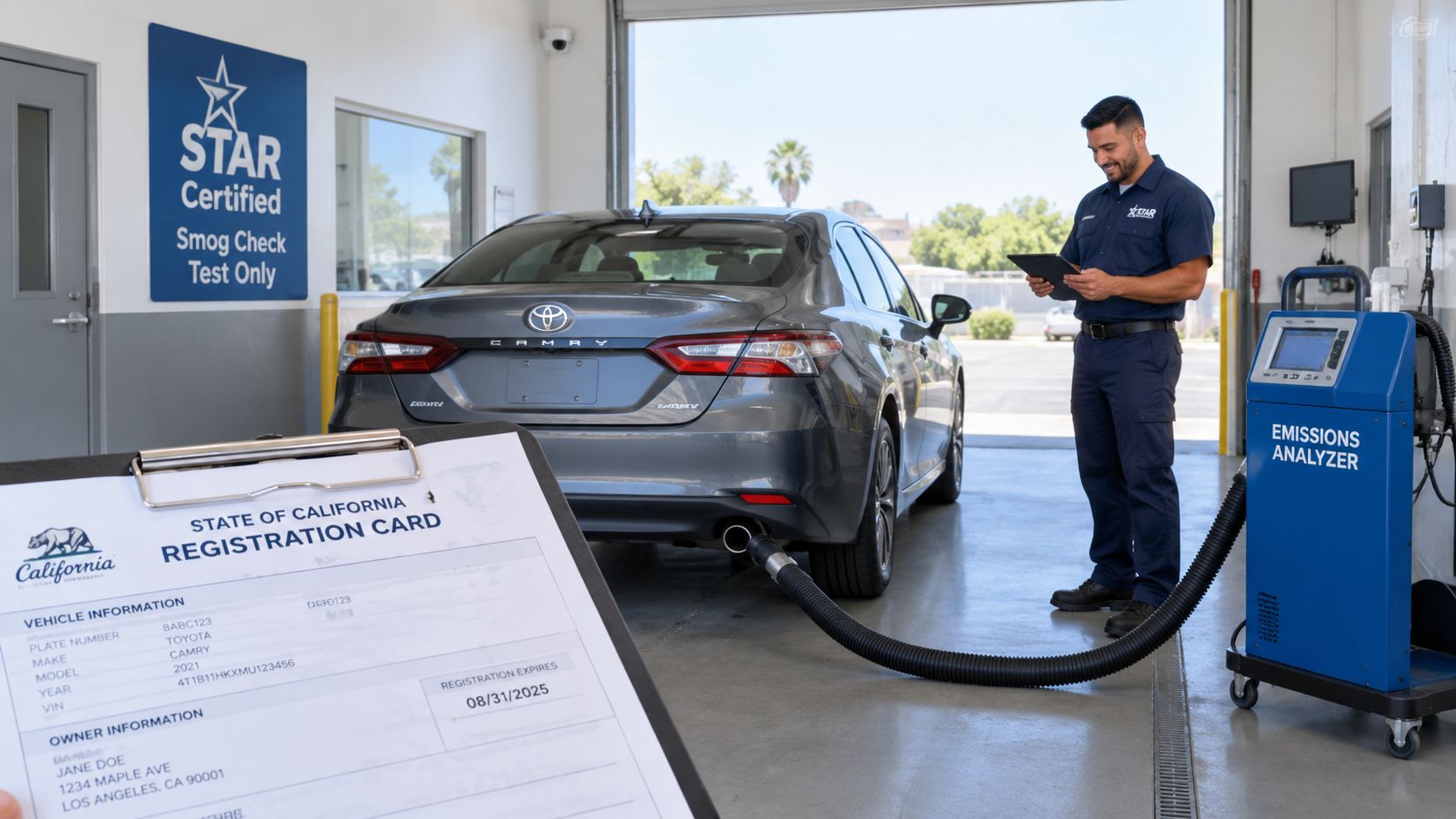
At a STAR-certified test-only location such as Speedy Smog in San Leandro, the visit follows a defined inspection process. The facility is at 15275 Washington Avenue, and its role is to perform the test and transmit the result, not repair emissions faults.
Bring the vehicle and the registration information connected with the DMV transaction. The technician begins by checking the emissions-control equipment, then performs the appropriate functional and computer-based inspection for the vehicle.
The visit from arrival to result
For most 2000 and newer vehicles, the technician connects to the OBD system and reads emissions-monitoring information. The process also includes a visual review of relevant hardware. Older vehicles generally follow the applicable tailpipe testing pathway.
A STAR-certified location can handle a DMV-directed inspection when the vehicle's paperwork requires that category. The certification relates to the station's authorization and performance standards. It doesn't remove the vehicle's responsibility to meet the inspection criteria.
The result is transmitted electronically to the DMV when the transaction calls for electronic reporting. If the vehicle passes, that result supports the registration process. If it fails, the station provides the failure information, but you'll need to arrange repairs somewhere else before seeking another test.
What a failed result means
A failure isn't proof that the station performed the wrong kind of test. It means the vehicle didn't satisfy one or more inspection requirements at that visit. The next step might involve diagnosis, a repair, additional driving to restore monitor readiness, or a combination of these.
Don't authorize repairs based only on a vague assumption. Ask for the specific failure information, then use a qualified repair facility that can interpret emissions codes and test the affected system. A test-only business can identify the result without creating a repair plan on site.
Why Test Readiness Matters More Than Test Speed
You find an open smog appointment for this afternoon, drive over, and expect to be done in twenty minutes. Then the test stops on a detail you cannot see from the driver's seat. The engine feels fine, but the car's computer is still "not ready."
That is why station speed is only one part of the decision. A test-only visit works like a checkpoint, not a repair bay. If the vehicle has not completed its own emissions self-checks, the fastest line in town does not change the result.
BAR data shows emissions problems are common enough that preparation matters. California's 2024–25 roadside inspection failure rate was reported at 14% (BAR report). That number does not measure station Smog Check results directly, but it does show that out-of-compliance vehicles are not rare.
OBD readiness monitors work like a checklist the car fills out on its own while you drive. Each monitor confirms that an emissions-related system has run its self-test. If you disconnect the battery or clear trouble codes, parts of that checklist can reset to incomplete. The car may drive normally, yet still lack the information needed for a complete inspection.
Common readiness traps
- Battery replacement: Disconnecting the battery can erase stored readiness status.
- Code clearing: Clearing a diagnostic code can hide the symptom for the moment without fixing the cause.
- Recent repairs: A successful repair can still leave monitors incomplete until the vehicle is driven enough.
- Warning-light concerns: A malfunction indicator lamp can point to an emissions problem that should be diagnosed first.
BAR's owner guidance advises against clearing trouble codes or disconnecting the battery immediately before testing, because those actions can erase readiness monitors and may require additional driving.
A vehicle that isn't ready can't be made ready by a shorter queue.
Schedule diagnosis before the smog test if the check engine light is on, the battery was recently disconnected, or a scan tool shows incomplete monitors. That extra step often saves time overall. Otherwise, a quick appointment can turn into a failed visit, a repair appointment, more driving, and a retest. Before you shop for speed, get the vehicle ready.
Making the Right Choice for Your Vehicle Situation
Station selection becomes easier when you treat it as a decision tree rather than a search for the fastest appointment. Start with the DMV transaction. A routine renewal, an initial California registration for an out-of-state vehicle, and an ownership-related transaction can create different requirements, so follow the exact notice and DMV instructions connected with your vehicle.
California's DMV guidance explains that many registration transactions require inspections, while some vehicles and situations are exempt. Gasoline vehicles less than eight model-years old are generally exempt from biennial testing, electric vehicles are exempt entirely, and hybrid vehicles can still fall within the Smog Check program (California DMV smog inspection guidance). Diesel rules also depend on model year and vehicle weight, so don't rely on a blanket assumption.
Four questions to ask before booking
- Does the DMV require a smog result? Check the renewal notice or registration instructions rather than assuming every transaction follows the same rule.
- Does the notice require STAR? If the vehicle is directed to a STAR station, select a location with that certification.
- Is the vehicle ready? Consider recent battery work, cleared codes, repairs, or an active warning light.
- Do you need repairs as well as testing? A test-only station handles the inspection. A repair-capable shop may be more suitable when you already suspect a fault.
For drivers comparing nearby options, this guide to where to get a car emissions test can help organize the choice.
Match the station to the situation
A prepared vehicle that only needs certification is a natural fit for a test-only station. A vehicle with a known emissions problem belongs with a repair-capable provider, unless you deliberately want an independent test before authorizing any work.
Hybrid owners should pay attention to the same warning lights and readiness issues as gasoline-vehicle owners. Electric propulsion doesn't automatically mean a hybrid is exempt, and the applicable rules depend on the vehicle type and transaction.
The most useful question isn't “How quickly can I get tested?” It's “What result do I need, and what will I do if the result is incomplete or unsuccessful?” Answer that first, then choose the station.
Speedy Smog is a STAR-certified, test-only station in San Leandro that performs DMV smog inspections for vehicles including newer cars, older vehicles, diesels, and hybrids, with electronic result transmission for registration purposes. Visit Speedy Smog at 15275 Washington Avenue when you need a focused inspection and understand that repairs after a failure must be handled by a separate repair provider.
You're staring at a DMV renewal notice, and one line jumps out: smog check required. Maybe your car runs fine, maybe you just bought it, or maybe you're already worried because the repair bill from last year still stings. In California, that little notice can feel like a bureaucratic trap, especially when you're trying to keep costs down and just get the registration done.
The good news is that the process is usually more straightforward than it looks. If you know what type of vehicle you have, whether the state wants a routine test or a change-of-ownership test, and what the technician is checking, you can walk in prepared and avoid most surprises. California's high poverty rate in 2024, 17.7%, makes clear, plain guidance even more important, because cost-sensitive drivers are more likely to delay compliance or rely on incomplete information, and that can turn a routine renewal into a headache (California Budget & Policy Center).
Table of Contents
- Decoding Your CA DMV Smog Notice
- Who Needs a Smog Check in California
- The Importance of a STAR Certified Station
- Your Smog Check Step by Step
- How to Prepare Your Car to Pass the First Time
- Finding a Fast and Reliable Test at Speedy Smog
- Smog Check Common Questions Answered
Decoding Your CA DMV Smog Notice
A lot of drivers open the renewal packet, see a smog requirement, and immediately assume the car must be failing something. That's not what the notice means. In most cases, it just means the state wants proof that your vehicle still meets California's emissions rules before the registration can move forward.
That matters because California treats emissions control as part of the registration process, not as an optional maintenance suggestion. The state also has an unusually large economic footprint, so the rules reach a huge number of drivers and vehicles. California's economy reached $4.25 trillion in nominal GDP by 2025, according to the Governor's Office, and it represented about 14% of U.S. GDP in recent PPIC analysis (Governor's Office). When a state operates at that scale, its air-quality rules have to be broad, consistent, and enforceable.
Practical rule: A smog notice is usually a paperwork checkpoint, not a judgment on how well your car drives.
If your renewal letter says you need emissions verification, don't guess. Check the notice, check your vehicle type, and confirm whether you're dealing with a routine renewal, a title transfer, or an exemption situation. If you're unsure where to start, a quick status check can save you a wasted trip, and this smog status guide is a useful place to verify the basics before you leave home.
Who Needs a Smog Check in California
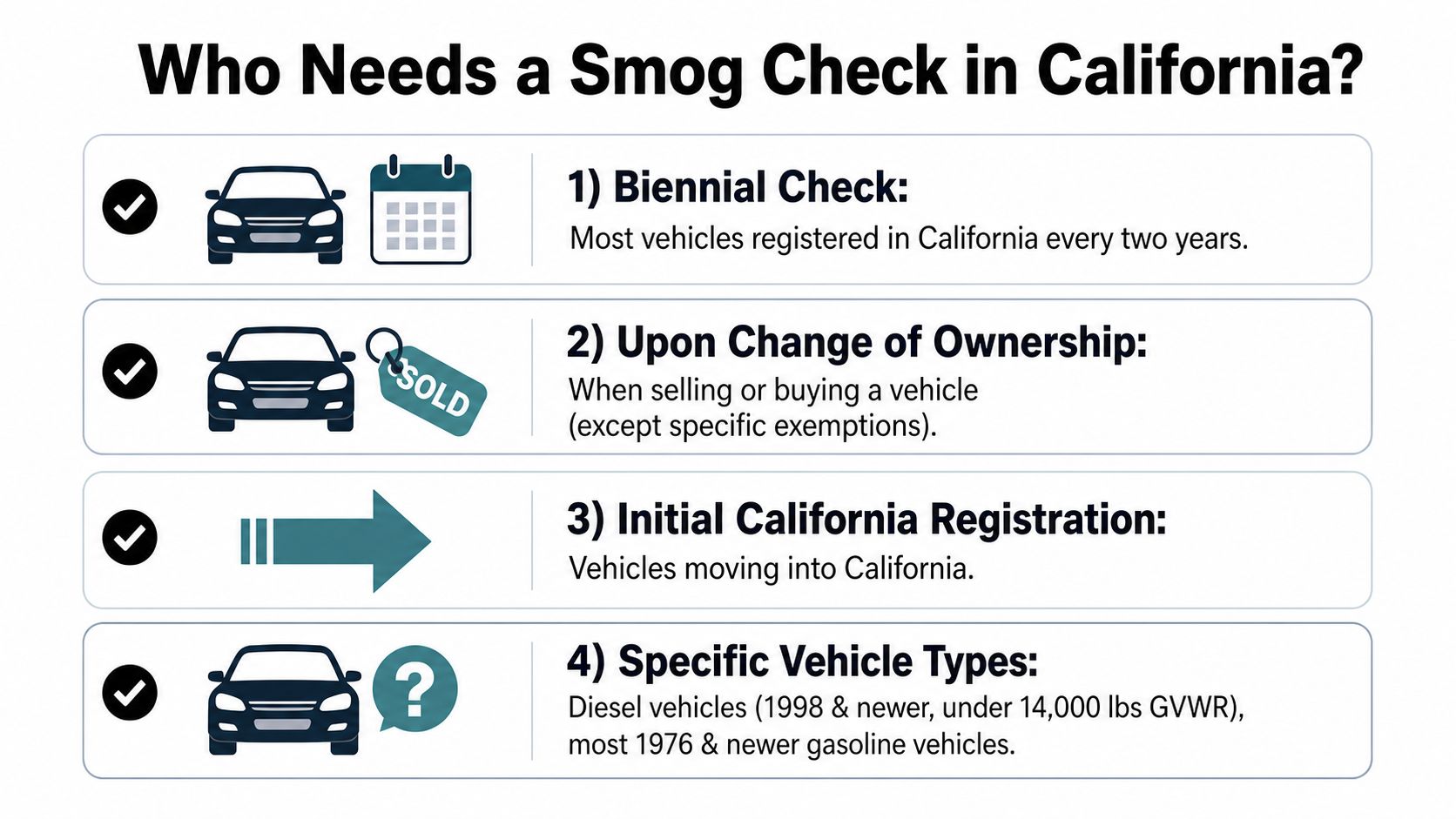
A California smog check usually becomes clear once you separate two questions, what kind of vehicle you have and why you are at the DMV counter. Some drivers need emissions verification at renewal, some only during a sale or transfer, and some vehicles fall into an exemption category. The confusion starts when people assume every car follows the same path, but California sorts vehicles by class, model year, and transaction type.
Gasoline Vehicles
Most gasoline vehicles fit into the standard California emissions system. For a first-time driver, the simplest way to read the rules is to ask whether the car is due for a renewal test, changing owners, or coming into the state from somewhere else. That is usually where the answer starts.
A clean way to sort it out is this:
- Routine registration: Many California vehicles need a smog check tied to registration renewal.
- Ownership change: A smog check is commonly needed when a car is sold or transferred, unless an exemption applies.
- Out-of-state move: A car brought into California may need emissions verification before full registration.
- Older gasoline vehicles: Model year matters, especially for cars near exemption lines or vehicles that follow different test procedures.
Diesel Vehicles
Diesels create extra confusion because they do not always follow the same path as gasoline cars. A driver with a diesel can easily assume the paperwork works the same way, then find out the inspection rules are different.
The state's underserved-community guidance calls out exactly this kind of confusion, especially for drivers asking what changes for 1999-and-older vehicles, diesels, and hybrids (California underserved communities report).
If you drive a diesel, use the notice and the vehicle category, not a neighbor's gas-car experience. Older diesels, work vehicles, and secondhand purchases deserve extra attention because the test path can change based on what the car is and how it is being registered.
Hybrids and Special Cases
Hybrid owners often assume the electric motor means the car skips emissions testing. That is not a safe shortcut. Hybrids can still fall under California's emissions-check system depending on the vehicle and the transaction.
Older cars and unusual ownership situations deserve the same careful check. If your vehicle does not fit the usual commuter-car pattern, confirm the rule before the registration deadline gets close. Drivers who are already watching every dollar can feel the cost of a repeat visit more sharply, so it helps to verify the requirement first instead of paying for a test you did not need.
If you want a practical way to sort out the details before you leave home, this smog status guide explains the basic checks in plain language. A few minutes at home is usually easier than a second trip across town.
If your car is unusual, older, or newly purchased, confirm the rule before you pay for a test. Guessing is what gets people stuck with repeat visits.
The Importance of a STAR Certified Station
When your renewal notice says STAR Station Required, that's not a warning that your car is bad. It means the state wants the test done at a station that meets stricter performance standards. In California, STAR certification is about station quality and oversight, so the results are more tightly controlled than at a basic test-only shop.
The reason a driver gets sent to STAR usually falls into one of two buckets. The vehicle itself may be considered more likely to produce emissions issues, or the driver may have been selected through a quality-control process. Either way, the notice is telling you where to go, not trying to make the process harder.
For a driver, the practical takeaway is simple. A STAR-certified station is a safe choice whether you were required to use one or not, because it can test the full range of vehicle types that show up for compliance work. If you want a deeper look at what helps on a STAR visit, this STAR smog guide is a useful reference.
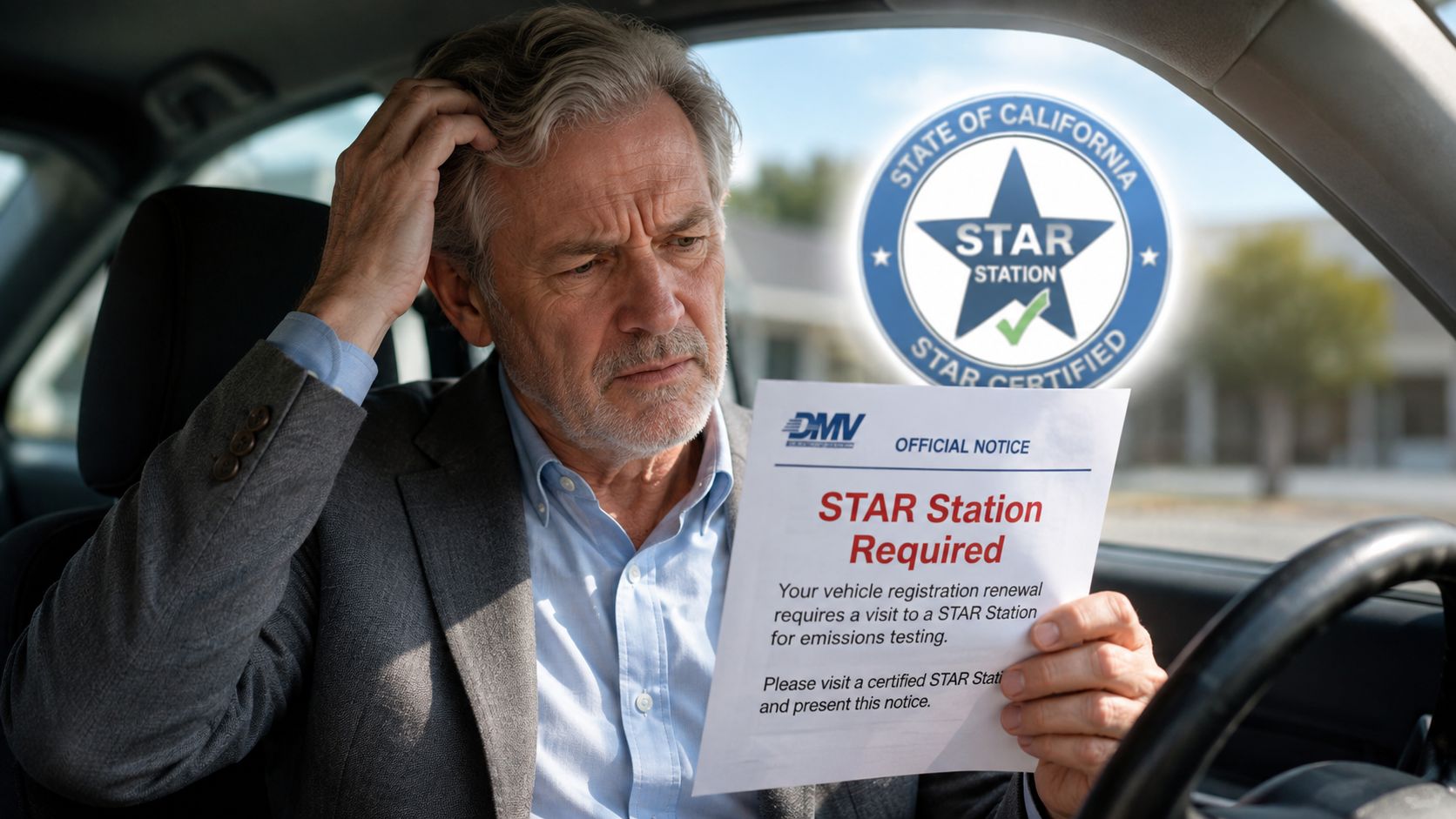
Practical rule: If the notice says STAR, go to a STAR station. Don't try to save time by guessing, because the wrong shop can waste your day.
A lot of first-time drivers worry they'll need to understand the state's technical certification system before they can get tested. You don't. Just read the notice, choose a certified station, and bring the vehicle in as required. The station handles the technical side, and you handle the paperwork and timing.
Your Smog Check Step by Step
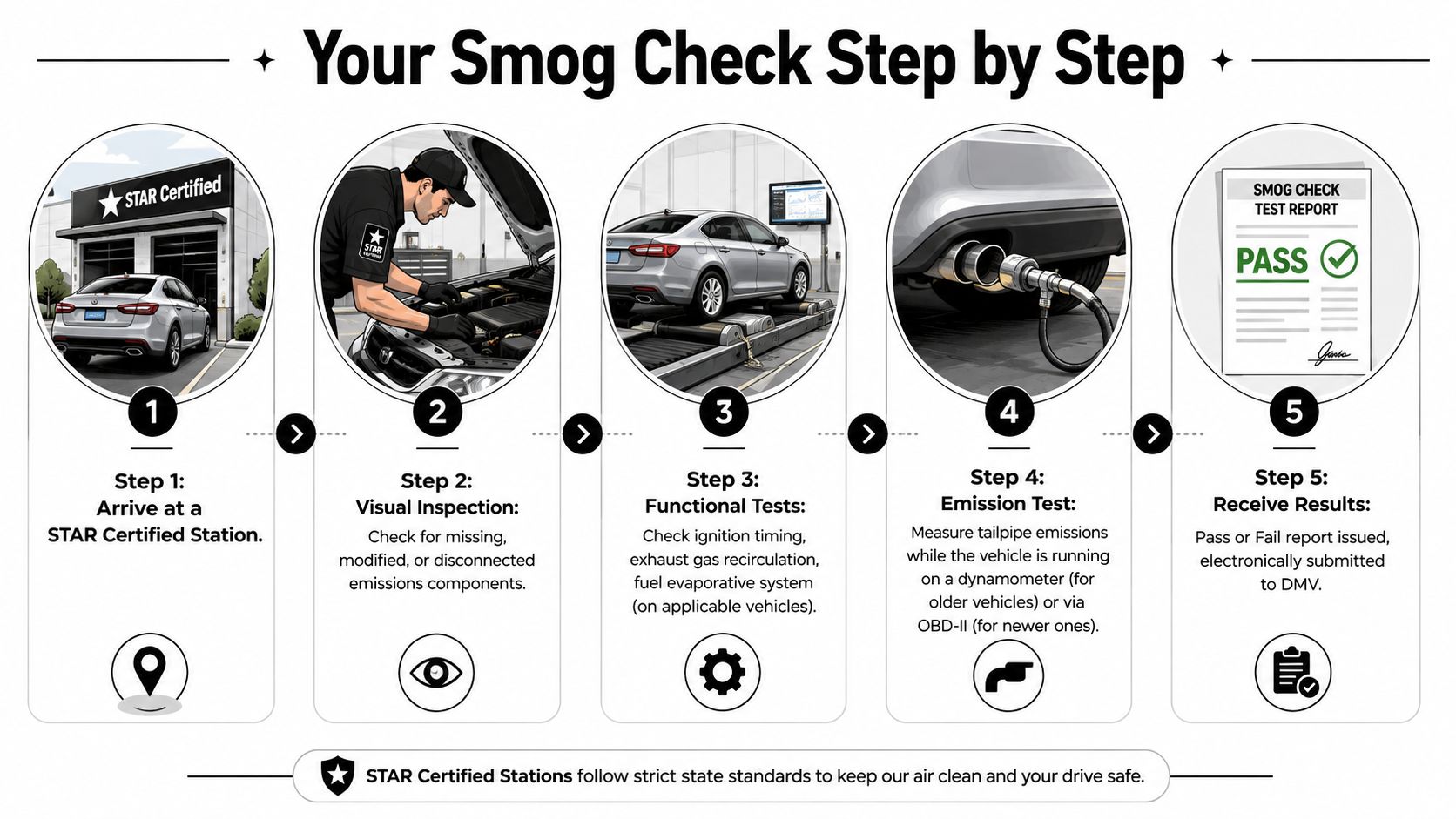
The test feels mysterious until you watch it unfold once. From the driver's side, it's usually a quick sequence, and the technician is looking for specific signs that the emissions system is present, functional, and reporting correctly.
What the technician checks first
The first part is usually a visual inspection. The technician looks under the hood and around the emissions system to make sure the required parts are there and haven't been removed, modified, or disconnected. That matters because California's quality-measure framework shows how much denominator and definition consistency affects reported results in regulated systems, and emissions testing depends on the same kind of consistency in how vehicles are evaluated (DHCS CaTS framework).
If something obvious is missing, the vehicle can fail before the more detailed checks even begin. That's why a car that “runs fine” can still come back with a failed result.
What happens during the functional check
Next comes the functional side of the test. On newer vehicles, the station usually uses onboard diagnostics, while older vehicles may go through additional equipment-based inspection. The point is to confirm that the emissions system is working, not just installed.
Older vehicles can involve more physical testing because the car's computer system may not carry all the needed information. Newer vehicles usually make the process faster because the onboard diagnostics communicate directly with the tester.
How the result gets handled
At the end, the station issues a pass or fail result and transmits it electronically to the DMV. Speed matters here because most newer-vehicle inspections can be completed in about 10 to 15 minutes at an efficient shop, according to the publisher's service information. That doesn't mean every car finishes that fast, but it does mean the process is usually much shorter than people expect.
How to Prepare Your Car to Pass the First Time
You can't control every outcome, but you can avoid the mistakes that trip up a lot of first-time drivers. The best prep is simple, mechanical, and boring, which is exactly what you want before an emissions test.
Start with the warning lights and recent repairs
If the Check Engine light is on, fix that before the test. A lit warning light often points to a problem the station can see right away, and it's one of the most common reasons people leave with a failed result. If you're trying to understand the usual failure triggers, this smog fail reasons guide is a helpful place to compare symptoms before you book the test.
Also think about recent battery work. If the battery was disconnected recently, the car may need time to relearn or repopulate diagnostic readiness information. That's the kind of detail that can turn a seemingly healthy car into a problem at the inspection lane.
Warm the car up before you arrive
Drive the car for a bit before the appointment. A warm engine and catalytic converter are usually more representative of normal operation than a cold start, and the vehicle is more likely to behave consistently during testing. This is one of those small, practical moves that helps the technician get a clean read instead of a borderline one.
Good habit: Arrive after a normal drive, not straight from a cold start in the driveway.
Don't overlook the small stuff
Tire pressure sounds unrelated, but it affects how the car behaves during the inspection process, especially if the vehicle needs more involved testing. Keep the car clean enough for the technician to inspect the emissions equipment easily, and bring the paperwork the DMV notice asks for.
A simple pre-test checklist looks like this:
- Fix the warning lights first.
- Drive the car long enough to warm it up.
- Avoid disconnecting the battery right before the visit.
- Make sure the car is easy to inspect and the paperwork is ready.
Finding a Fast and Reliable Test at Speedy Smog
If you want the process handled without a lot of back-and-forth, a STAR-certified station in San Leandro can take care of the inspection for most vehicle types, including newer cars, older vehicles, diesels, and hybrids. Speedy Smog is located at 15275 Washington Ave, San Leandro, CA 94579, and it's open Monday through Saturday.
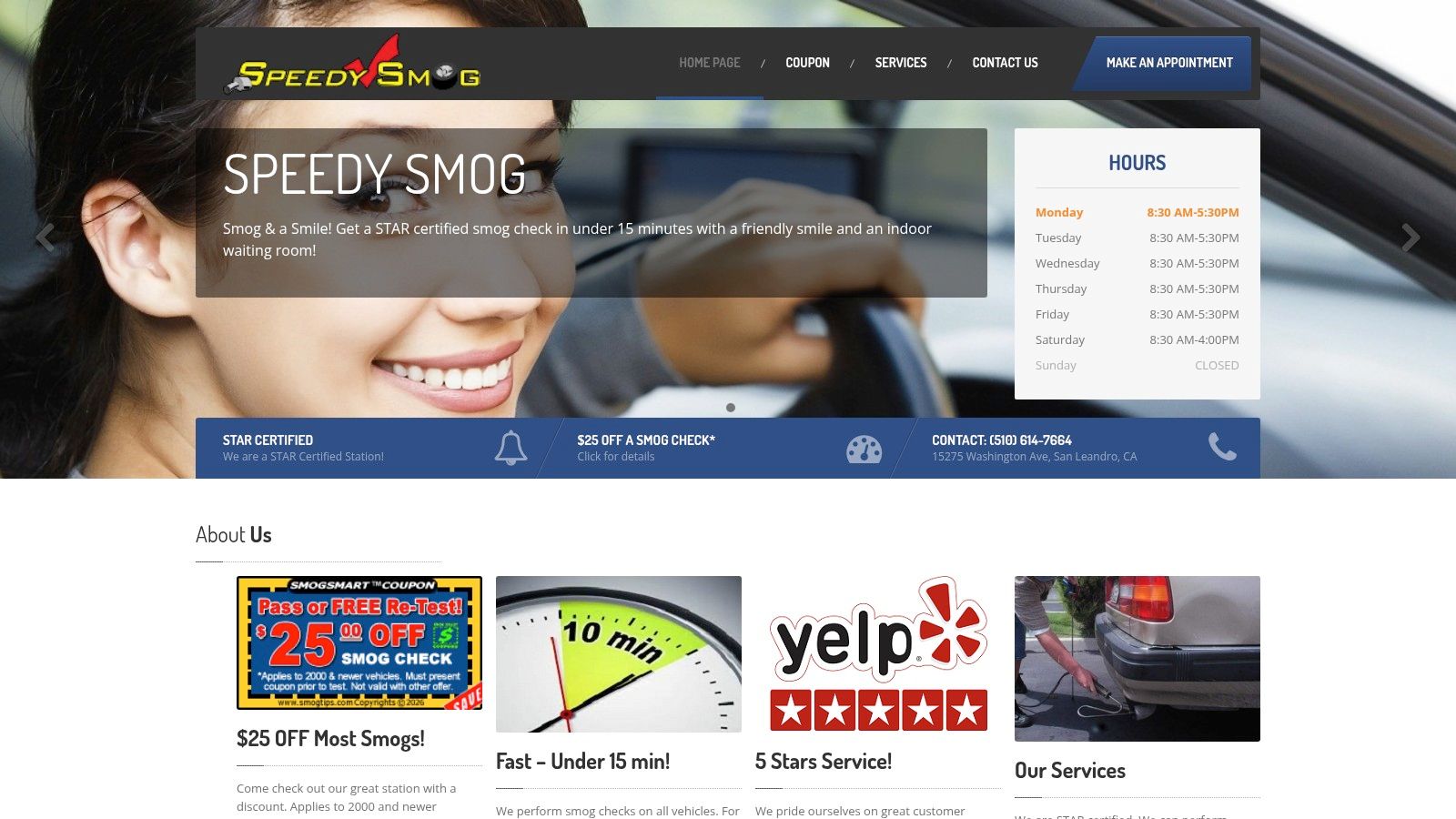
The practical value is speed and simplicity. Most newer-vehicle tests are completed in about 10 to 15 minutes, the waiting area is indoors and clean, and the shop offers a $25-off coupon for many newer-vehicle smogs, according to the publisher's service information. The station also transmits results electronically to the DMV, which helps cut down on extra steps.
For drivers who just want to get the test done, the primary benefit is predictable service. You show up, the car gets inspected, and the paperwork goes where it needs to go without you having to manage complex state language on your own.
Smog Check Common Questions Answered
What happens if my car fails the smog check?
You'll need to repair the issue and retest before the registration process can move forward. The useful move is to ask for the reason code or failure explanation, then fix the specific problem instead of guessing.
Can I get a smog check if I'm selling my car?
Usually yes, and in many cases you should, because buyers often want the transfer handled cleanly. If ownership is changing, that's one of the situations where emissions verification commonly comes into play.
Do hybrids need smog checks?
Some do, depending on the vehicle and the transaction. Don't assume the hybrid badge means an exemption, because California's rules are more specific than that.
What if I'm out of state right now?
Check your renewal situation carefully and confirm whether the DMV allows a delay or other handling for your case. Don't wait until the deadline has passed, because that's when a manageable paperwork issue becomes a registration problem.
If you want a straightforward inspection from a STAR Certified station that handles most vehicle types and sends results to the DMV, visit Speedy Smog and book your smog check in San Leandro. Bring the notice, bring the car, and let the station handle the testing so you can get your registration back on track without extra hassle.
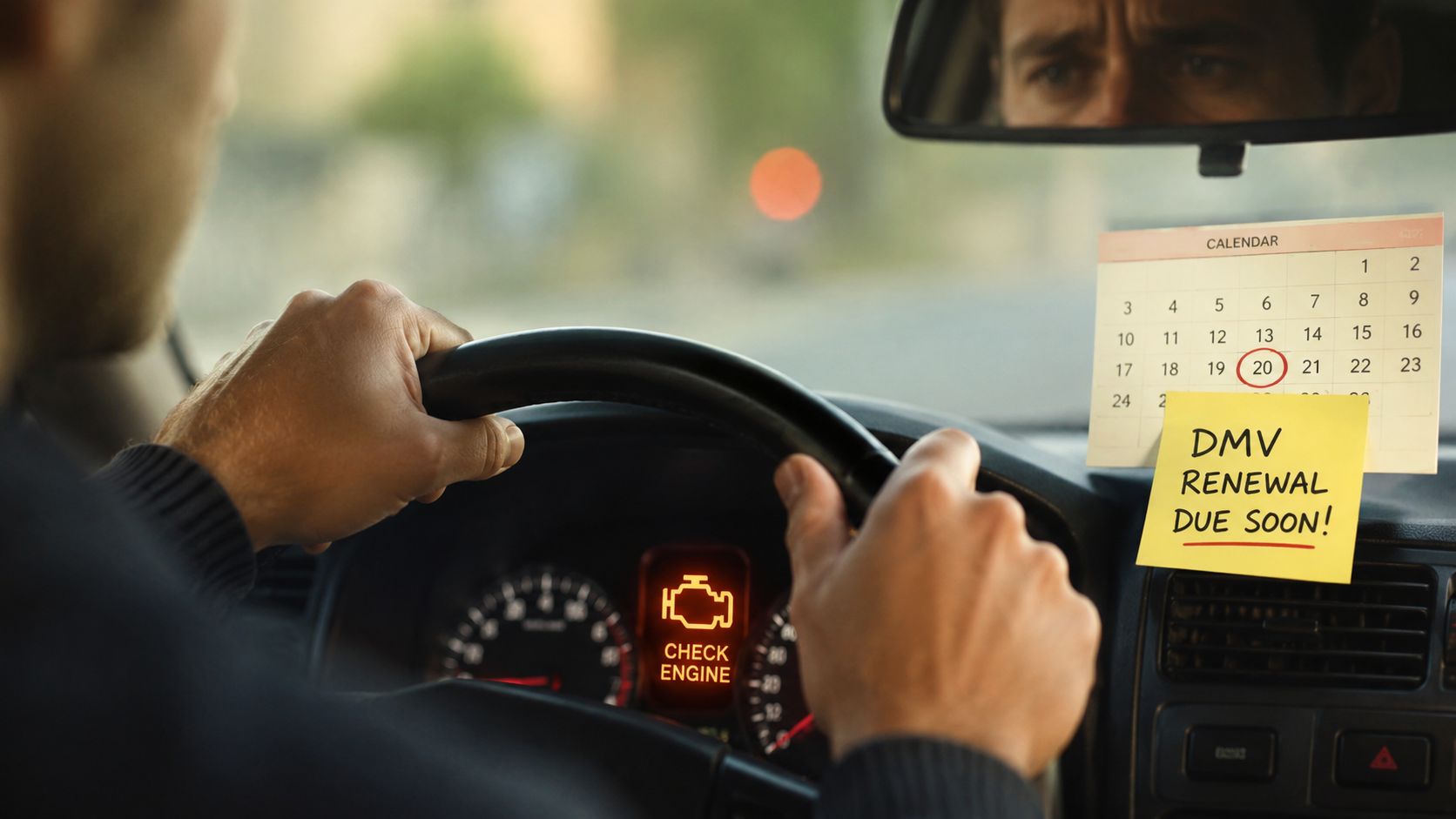
You're driving in the East Bay, the DMV renewal notice is sitting on the counter, and then that orange check engine light comes on. It's the kind of timing that makes a simple errand feel like a deadline you can't ignore. In California, that light isn't just annoying, it's tied directly to whether your car can pass Smog Check.
The good news is that this problem is usually manageable if you handle it in the right order. Diagnose the fault, repair it, make sure the light stays off, and then give the car enough time to finish its self-checks before you test. California's Smog Check program is built to catch emissions problems at scale, and the California Air Resources Board says it removes about 400 tons of smog-forming pollutants every day from California's air. California Smog Check program background
Table of Contents
- That Sinking Feeling Your Check Engine Light and the Smog Test
- California Rules Why an Engine Light Guarantees a Fail
- Decoding the Message Reading Your Car's Trouble Codes
- Common Culprits Behind the Check Engine Light
- The Critical Step The Post-Repair Drive Cycle
- When to Visit a STAR Station Like Speedy Smog
That Sinking Feeling Your Check Engine Light and the Smog Test
The timing usually feels personal. A driver notices the check engine light on the commute home, then finds the DMV notice that says the smog certificate is due, and suddenly the whole week turns into calls, guesses, and maybe one too many internet searches. At a STAR-certified station, that combination shows up all the time, and the pattern is familiar enough to be reassuring.
A common mistake is treating the light like a simple warning lamp. In California, it's also a sign that the vehicle is reporting an emissions-related problem, which is exactly what Smog Check is designed to catch. That's why a quick reset or a hopeful drive around the block usually doesn't solve the bigger issue.
The state's program is not small or casual. The California Air Resources Board says the Smog Check program removes about 400 tons of smog-forming pollutants every day from California's air, which explains why the inspection rules stay strict. When a system is supposed to protect air quality at that scale, an illuminated warning light gets taken seriously.
The most useful mindset is simple. Don't treat the light as a mystery to outsmart, treat it as a diagnostic clue that needs to be understood before you show up for the test. That approach saves time, avoids repeat visits, and keeps the repair path clear.
Practical rule: if the light is on now, the inspection problem starts at the repair bay, not at the test lane.
California Rules Why an Engine Light Guarantees a Fail
California's rule is direct. If the check engine light is on, the vehicle has to be repaired before Smog Check, and it will not pass with the light illuminated. The California BAR Smog Check rules make that clear, and there isn't a workaround built into the inspection.
That matters because this rule reaches a wide range of vehicles. California's Smog Check program applies to gasoline, hybrid, and alternative-fuel vehicles model year 1976 and newer, and also to diesel vehicles model year 1998 and newer. So this is not a niche issue for one engine type or one age group, it affects a broad slice of drivers.
Why the state treats the light as a hard fail
The light is tied to the emissions system, not just engine performance. When it comes on, the vehicle's computer is telling you that something in the emissions control path needs attention. The inspection is built to catch exactly that condition, which is why the light itself is enough to stop the test.
If you want the state-level rule in plain English, it's this. A lit malfunction indicator means the car is currently reporting an emissions problem, and California won't certify a car in that condition. That's the same reason drivers often hear that the repair comes first and the test comes second.
For a simple overview of what California drivers should expect at the station, see these California Smog Check rules explained for drivers. The key takeaway is still the same, don't book the test until the light is out and the vehicle is ready to be checked.
A lit warning light isn't a judgment call at the counter. It's a pass-fail condition built into the program.
Decoding the Message Reading Your Car's Trouble Codes
A code reader gives you the first real clue. Most cars use an OBD-II port, which is the small connector the technician or scanner plugs into to read stored trouble codes. Once you know the code, you're no longer guessing, and that changes the whole repair conversation.
There are two practical ways to get those codes. You can buy a basic scanner and read them yourself, or you can go to an auto parts store that offers code reading as a free service. Either way, the point is the same, get the code before anyone starts clearing lights or replacing parts.
Start with the code, not the dashboard light
The dashboard only tells you that the car sees a problem. The code tells you where to look. A P0420 code usually points toward catalyst efficiency concerns, while a P0455 code generally points to a large evaporative emissions leak.
| DTC Code | Common Cause | What It Means |
|---|---|---|
| P0420 | Catalyst system concern | The catalytic converter system may not be working efficiently |
| P0455 | Large EVAP leak | The evaporative emissions system may have a major leak |
| P0300 | Random misfire | The engine is misfiring in more than one cylinder |
| P0171 | Lean fuel condition | The engine may be getting too much air or not enough fuel |
| P0442 | Small EVAP leak | A small leak is affecting fuel vapor control |
A code is not a diagnosis by itself. It points you toward the system that needs inspection, which might be something simple or something that needs a shop's tools and experience. That distinction matters because replacing the wrong part gets expensive fast.
Two ways to use the code without wasting money
If the code points to a loose cap or an obvious hose issue, you may be able to solve it quickly. If it points to an emissions sensor, a catalyst issue, or a recurring misfire, it's smarter to confirm the repair path before you pay for parts. For a step-by-step example of this process, this guide to reading OBD codes is a practical place to start.
The code is the map. The repair is the trip.
Common Culprits Behind the Check Engine Light
Some check engine lights come from problems you can spot with a few minutes under the hood. Others point to parts that need proper diagnosis, because replacing them by guesswork usually doesn't fix the underlying issue. A good triage process keeps you from overspending on the easy stuff and underestimating the hard stuff.
The simple checks drivers can handle first
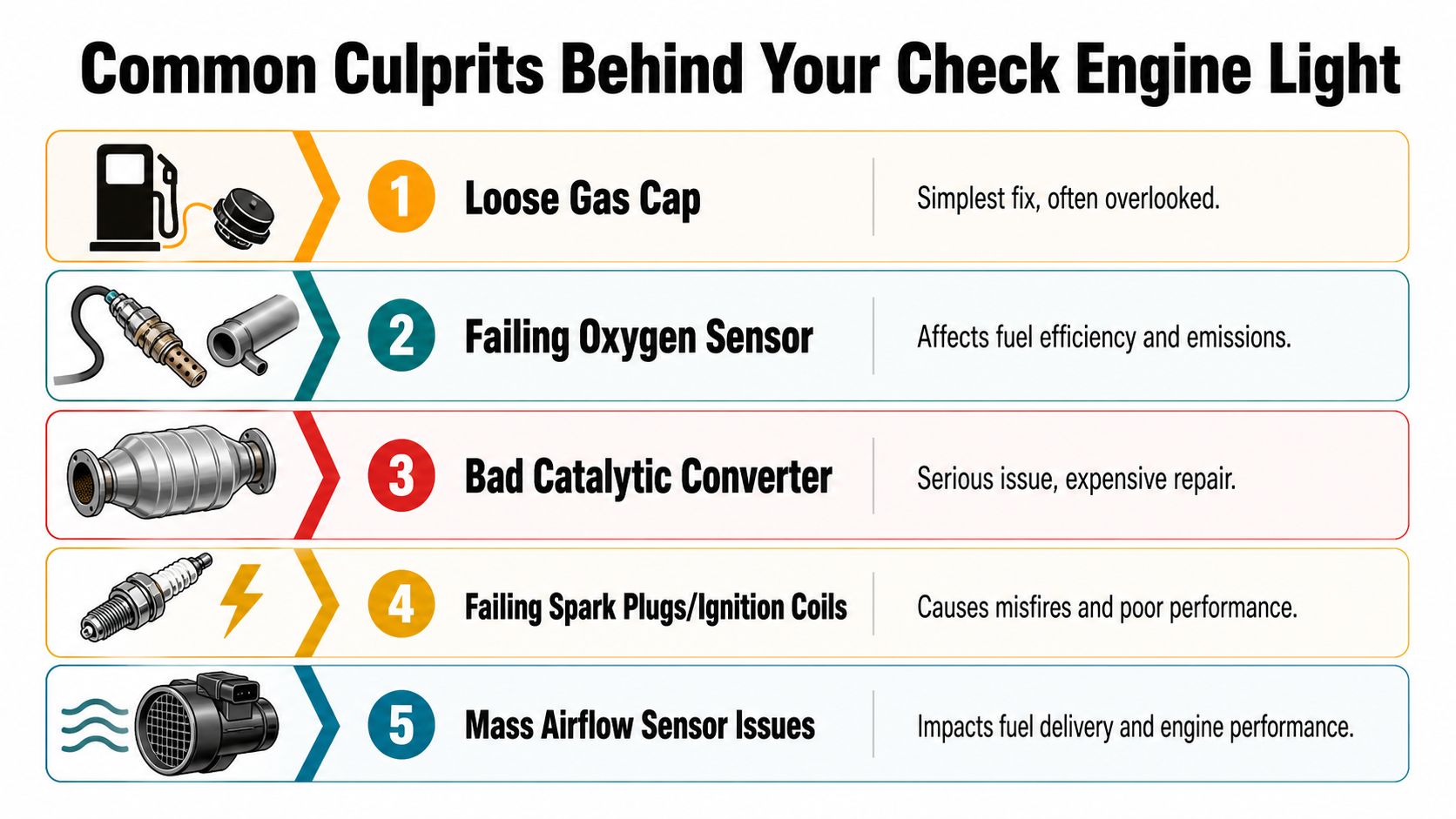
A loose gas cap is the classic quick fix. Tighten it until it clicks, then give the car time to see whether the system clears on its own. That small step can matter because the evaporative emissions system is sensitive to pressure loss.
A code tied to the evap system does not always mean a major repair. Sometimes the problem is a cap that wasn't sealed fully, or a small leak in a hose you can inspect visually. That's the kind of issue worth checking before you spend money on parts.
The problems that usually need a shop
A failing oxygen sensor can affect how the engine manages fuel and emissions. A bad catalytic converter is usually a bigger repair and often points to an upstream problem that needs to be corrected too. A mass airflow sensor issue can throw off air measurement and lead to poor drivability or a recurring light.
Spark plugs and ignition coils are worth attention as well, especially when misfire codes are present. Those parts can create rough running, and a car that misfires won't give you a clean inspection result. The important thing is not to replace parts in isolation when the code points to a deeper fault.
Speedy Smog in San Leandro is one option drivers use when they want the inspection side handled by a STAR Certified station that understands these common failure patterns. That doesn't replace a real repair, but it does help once the vehicle is close and you want the testing done by a station that works under BAR standards.
The practical rule is simple. If the fix is obvious and cheap, handle it first. If the code points to a sensor, catalyst, or misfire path, get the diagnosis right before the retest.
The Critical Step The Post-Repair Drive Cycle
A common pitfall for many drivers is that the light goes off, the repair seems successful, and the car still fails because the computer hasn't finished its internal self-checks yet. Those self-checks are the readiness monitors, and they matter just as much as the lamp itself.
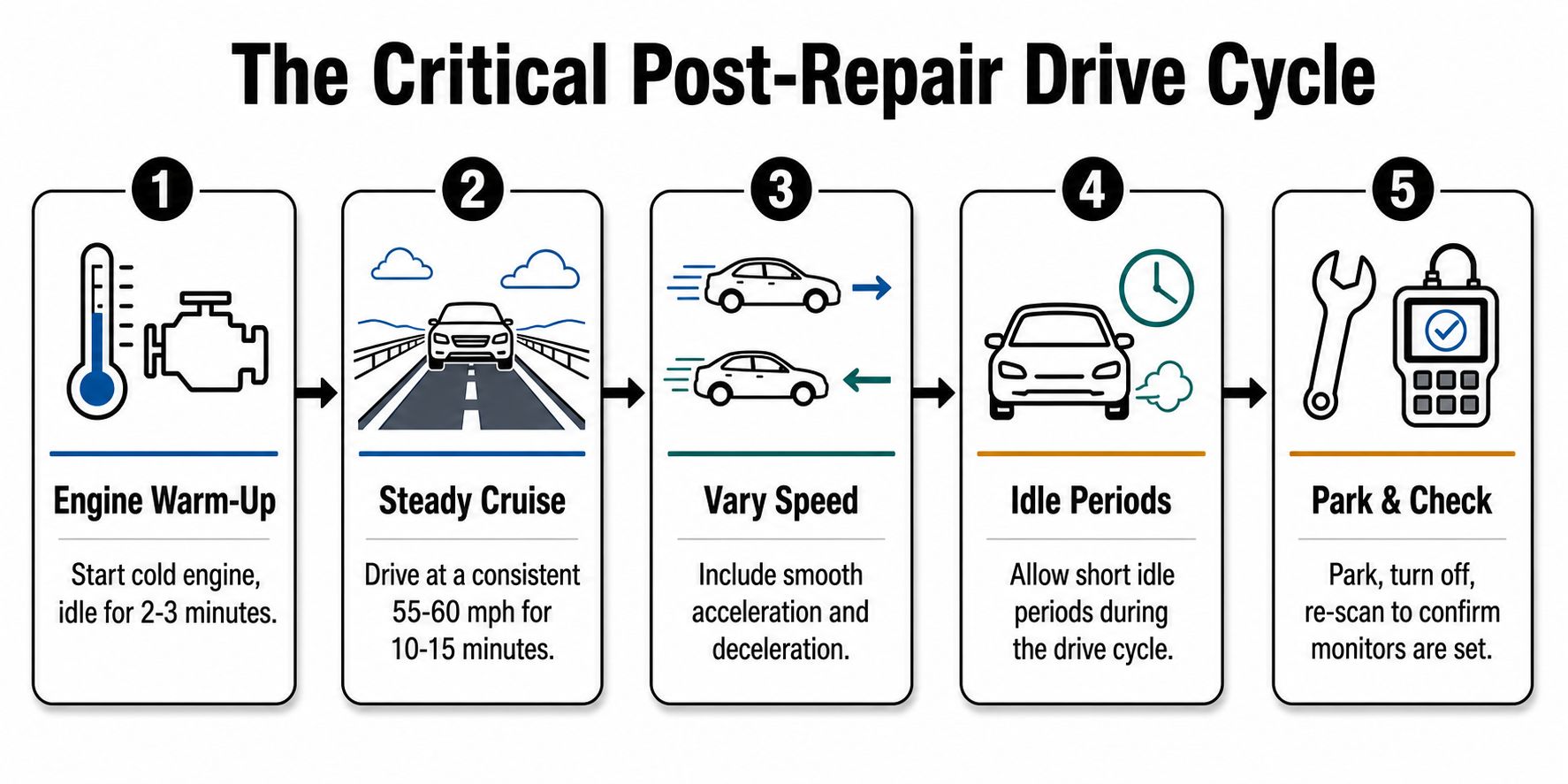
The BAR says that after a battery disconnect or replacement, drivers may need to drive one to two weeks so readiness monitors reset before testing. That's because modern inspections use the vehicle's onboard diagnostics to confirm that emissions-related checks have completed. If the monitors are still not ready, the car can still miss certification even if the dashboard looks calm.
Why clearing the code is not the finish line
A scan tool can erase a code, and a disconnected battery can wipe memory, but neither one proves the repair worked. The computer still needs normal driving time to rerun its tests. That gap between “light is off” and “car is ready” is where many unnecessary return trips happen.
For 2000-and-newer vehicles, this matters especially because BAR says most of these are checked through the onboard diagnostic system rather than tailpipe testing. So the station is looking at what the car knows about itself, not just whether the warning lamp is visible. The repair has to be confirmed by the monitor status.
What the drive cycle really means in practice
A drive cycle is just a period of normal driving that lets the car complete its self-checks. The exact pattern varies by vehicle, but the goal is steady, mixed driving with enough time for the system to run. Short errands around the corner usually aren't enough.
If you just repaired the car, don't rush the retest. Give it the time the BAR recommends, drive it normally, and confirm the readiness status before you return to the station. That one habit prevents a lot of failed inspections that feel confusing to drivers who already paid for a repair.
Practical rule: no ready monitors, no certificate, even if the light is off.
When to Visit a STAR Station Like Speedy Smog
There's a point where DIY stops being efficient. If the code keeps coming back, if the car has an intermittent problem, or if the monitor status won't set after a repair, a professional inspection lane gives you a cleaner next step. A STAR Certified station is held to higher performance standards set by the BAR, which matters when you want the test handled in a compliant, straightforward way.
A good station doesn't replace the repair, but it does reduce confusion. The technician can verify whether the light is off, whether the monitors are ready, and whether the vehicle is positioned for a clean test. If you're trying to avoid repeated trips across town, that kind of clarity is worth a lot.
When professional testing makes more sense
- Complex or repeating codes: If the same fault returns after a basic fix, the cause probably goes deeper than the first part you swapped.
- Post-repair uncertainty: If the light is off but you're not sure the monitors are ready, the station can confirm the inspection status before you guess.
- Convenience and compliance: If you want the smog work done by a station that handles the inspection cleanly and explains the result, that's the time to use a certified shop.
For drivers who want a more detailed look at the STAR path, this explanation of how to pass a STAR smog test gives a useful overview. In San Leandro, Speedy Smog is one station that offers the inspection side of that process for drivers who already know the repair situation is under control.
Bring the car in when the light is off, the repair is done, and the monitors have had time to set. That's the cleanest path to certification, and it keeps the whole process from turning into a cycle of failed retests and extra downtime.
A CTA for Speedy Smog.