
CA Smog Check Guide: Requirements & What to Expect in 2026
You're staring at a DMV renewal notice, and one line jumps out: smog check required. Maybe your car runs fine, maybe you just bought it, or maybe you're already worried because the repair bill from last year still stings. In California, that little notice can feel like a bureaucratic trap, especially when you're trying to keep costs down and just get the registration done.
The good news is that the process is usually more straightforward than it looks. If you know what type of vehicle you have, whether the state wants a routine test or a change-of-ownership test, and what the technician is checking, you can walk in prepared and avoid most surprises. California's high poverty rate in 2024, 17.7%, makes clear, plain guidance even more important, because cost-sensitive drivers are more likely to delay compliance or rely on incomplete information, and that can turn a routine renewal into a headache (California Budget & Policy Center).
Table of Contents
- Decoding Your CA DMV Smog Notice
- Who Needs a Smog Check in California
- The Importance of a STAR Certified Station
- Your Smog Check Step by Step
- How to Prepare Your Car to Pass the First Time
- Finding a Fast and Reliable Test at Speedy Smog
- Smog Check Common Questions Answered
Decoding Your CA DMV Smog Notice
A lot of drivers open the renewal packet, see a smog requirement, and immediately assume the car must be failing something. That's not what the notice means. In most cases, it just means the state wants proof that your vehicle still meets California's emissions rules before the registration can move forward.
That matters because California treats emissions control as part of the registration process, not as an optional maintenance suggestion. The state also has an unusually large economic footprint, so the rules reach a huge number of drivers and vehicles. California's economy reached $4.25 trillion in nominal GDP by 2025, according to the Governor's Office, and it represented about 14% of U.S. GDP in recent PPIC analysis (Governor's Office). When a state operates at that scale, its air-quality rules have to be broad, consistent, and enforceable.
Practical rule: A smog notice is usually a paperwork checkpoint, not a judgment on how well your car drives.
If your renewal letter says you need emissions verification, don't guess. Check the notice, check your vehicle type, and confirm whether you're dealing with a routine renewal, a title transfer, or an exemption situation. If you're unsure where to start, a quick status check can save you a wasted trip, and this smog status guide is a useful place to verify the basics before you leave home.
Who Needs a Smog Check in California
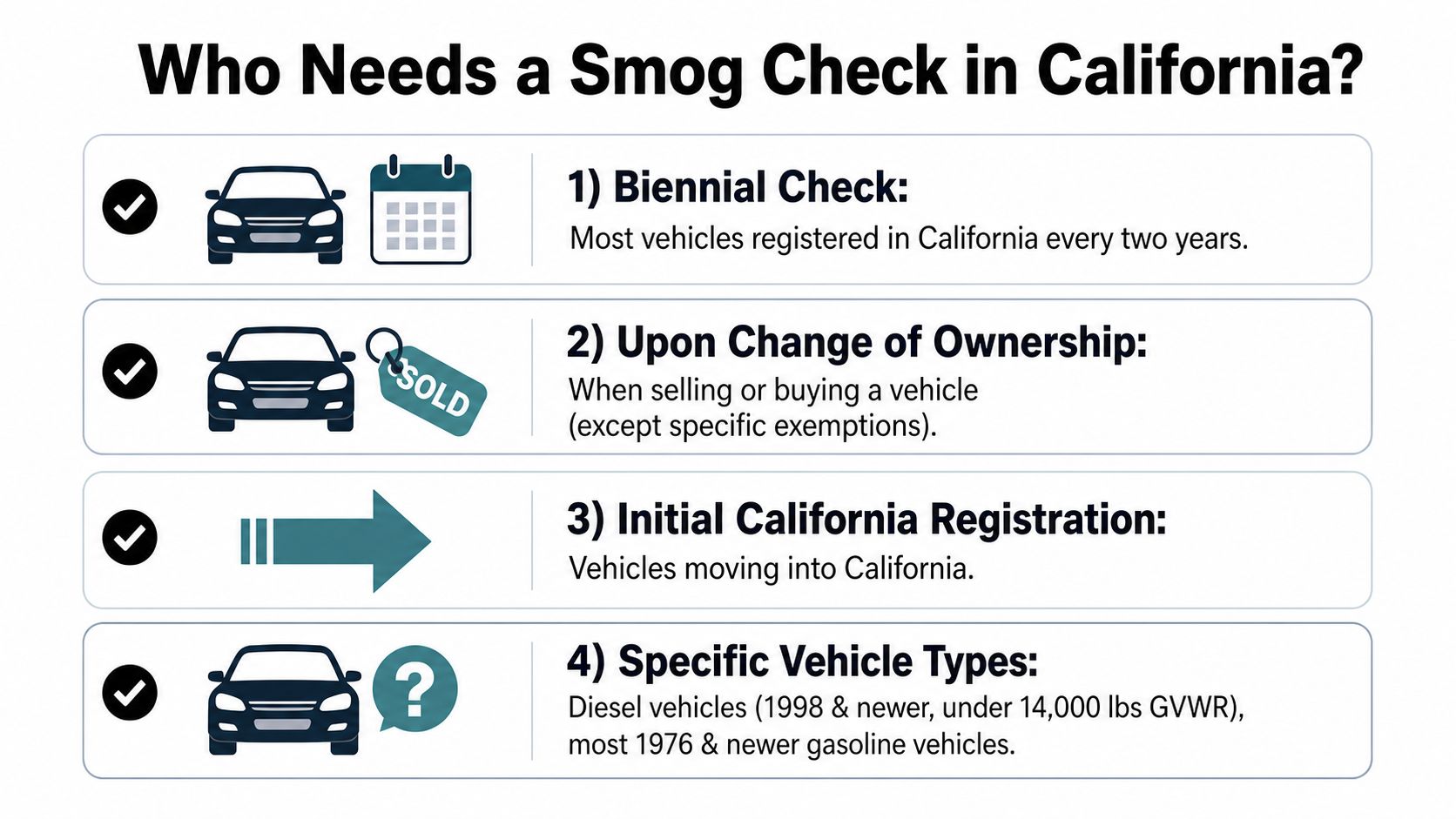
A California smog check usually becomes clear once you separate two questions, what kind of vehicle you have and why you are at the DMV counter. Some drivers need emissions verification at renewal, some only during a sale or transfer, and some vehicles fall into an exemption category. The confusion starts when people assume every car follows the same path, but California sorts vehicles by class, model year, and transaction type.
Gasoline Vehicles
Most gasoline vehicles fit into the standard California emissions system. For a first-time driver, the simplest way to read the rules is to ask whether the car is due for a renewal test, changing owners, or coming into the state from somewhere else. That is usually where the answer starts.
A clean way to sort it out is this:
- Routine registration: Many California vehicles need a smog check tied to registration renewal.
- Ownership change: A smog check is commonly needed when a car is sold or transferred, unless an exemption applies.
- Out-of-state move: A car brought into California may need emissions verification before full registration.
- Older gasoline vehicles: Model year matters, especially for cars near exemption lines or vehicles that follow different test procedures.
Diesel Vehicles
Diesels create extra confusion because they do not always follow the same path as gasoline cars. A driver with a diesel can easily assume the paperwork works the same way, then find out the inspection rules are different.
The state's underserved-community guidance calls out exactly this kind of confusion, especially for drivers asking what changes for 1999-and-older vehicles, diesels, and hybrids (California underserved communities report).
If you drive a diesel, use the notice and the vehicle category, not a neighbor's gas-car experience. Older diesels, work vehicles, and secondhand purchases deserve extra attention because the test path can change based on what the car is and how it is being registered.
Hybrids and Special Cases
Hybrid owners often assume the electric motor means the car skips emissions testing. That is not a safe shortcut. Hybrids can still fall under California's emissions-check system depending on the vehicle and the transaction.
Older cars and unusual ownership situations deserve the same careful check. If your vehicle does not fit the usual commuter-car pattern, confirm the rule before the registration deadline gets close. Drivers who are already watching every dollar can feel the cost of a repeat visit more sharply, so it helps to verify the requirement first instead of paying for a test you did not need.
If you want a practical way to sort out the details before you leave home, this smog status guide explains the basic checks in plain language. A few minutes at home is usually easier than a second trip across town.
If your car is unusual, older, or newly purchased, confirm the rule before you pay for a test. Guessing is what gets people stuck with repeat visits.
The Importance of a STAR Certified Station
When your renewal notice says STAR Station Required, that's not a warning that your car is bad. It means the state wants the test done at a station that meets stricter performance standards. In California, STAR certification is about station quality and oversight, so the results are more tightly controlled than at a basic test-only shop.
The reason a driver gets sent to STAR usually falls into one of two buckets. The vehicle itself may be considered more likely to produce emissions issues, or the driver may have been selected through a quality-control process. Either way, the notice is telling you where to go, not trying to make the process harder.
For a driver, the practical takeaway is simple. A STAR-certified station is a safe choice whether you were required to use one or not, because it can test the full range of vehicle types that show up for compliance work. If you want a deeper look at what helps on a STAR visit, this STAR smog guide is a useful reference.
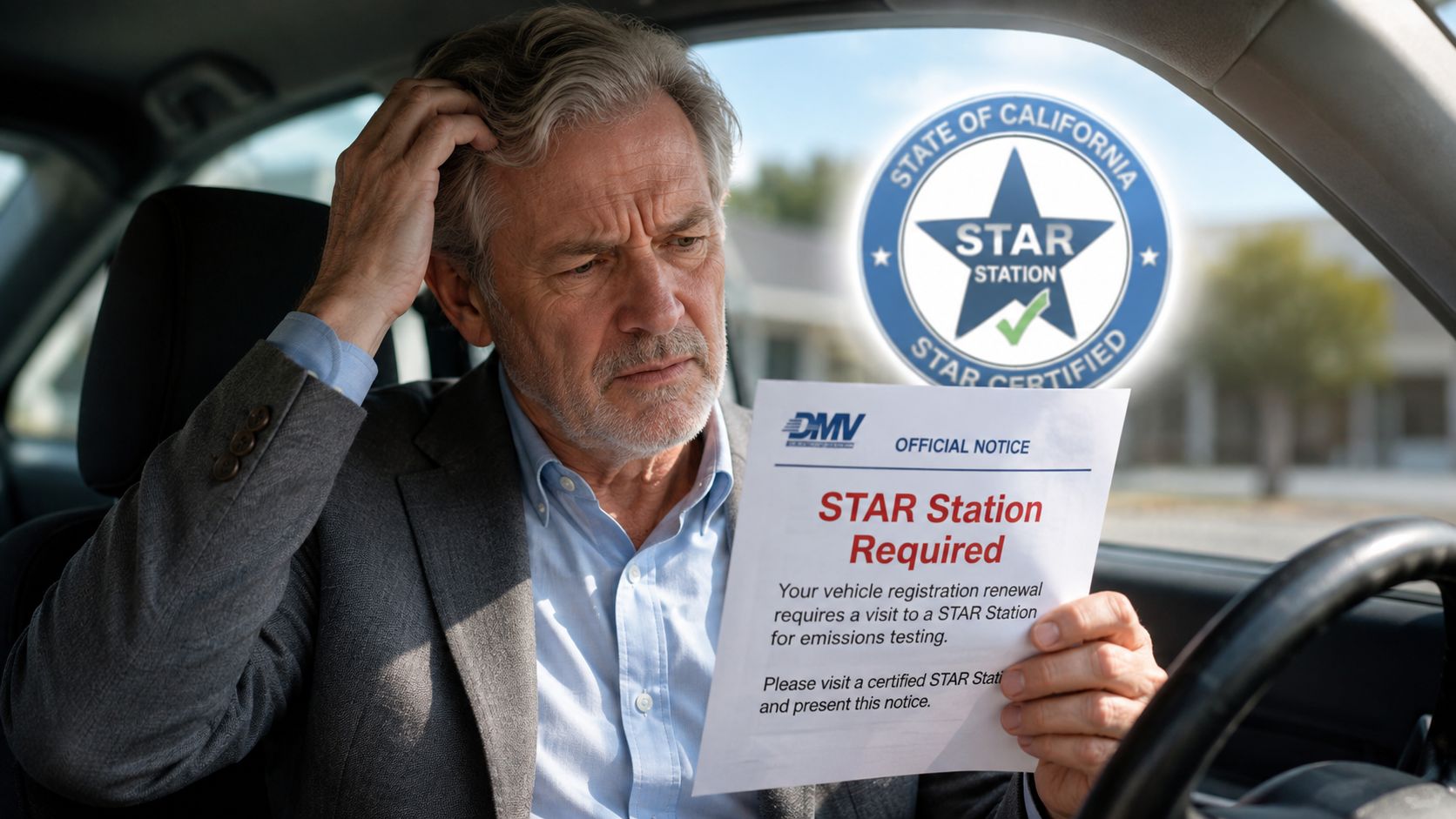
Practical rule: If the notice says STAR, go to a STAR station. Don't try to save time by guessing, because the wrong shop can waste your day.
A lot of first-time drivers worry they'll need to understand the state's technical certification system before they can get tested. You don't. Just read the notice, choose a certified station, and bring the vehicle in as required. The station handles the technical side, and you handle the paperwork and timing.
Your Smog Check Step by Step
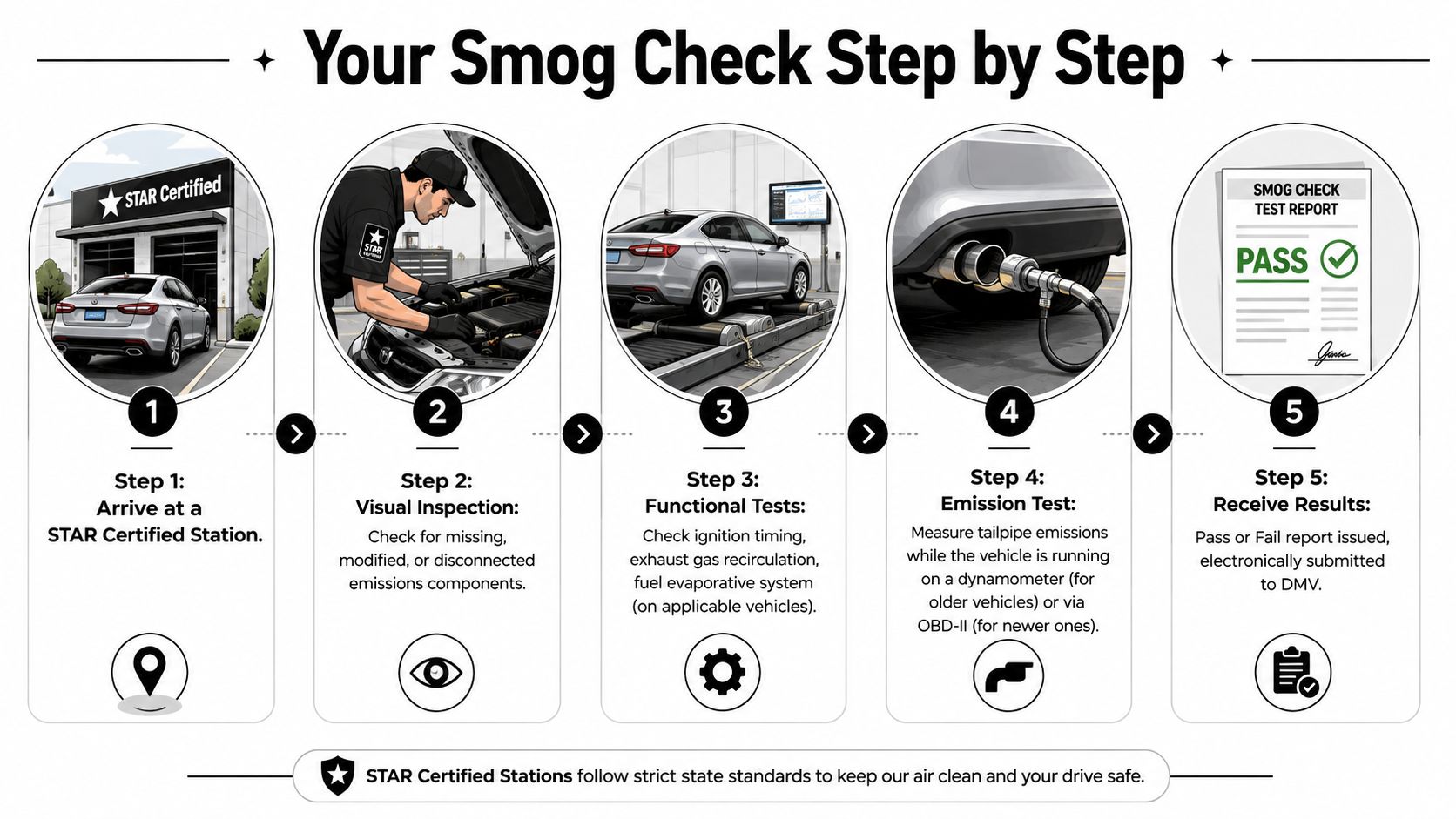
The test feels mysterious until you watch it unfold once. From the driver's side, it's usually a quick sequence, and the technician is looking for specific signs that the emissions system is present, functional, and reporting correctly.
What the technician checks first
The first part is usually a visual inspection. The technician looks under the hood and around the emissions system to make sure the required parts are there and haven't been removed, modified, or disconnected. That matters because California's quality-measure framework shows how much denominator and definition consistency affects reported results in regulated systems, and emissions testing depends on the same kind of consistency in how vehicles are evaluated (DHCS CaTS framework).
If something obvious is missing, the vehicle can fail before the more detailed checks even begin. That's why a car that “runs fine” can still come back with a failed result.
What happens during the functional check
Next comes the functional side of the test. On newer vehicles, the station usually uses onboard diagnostics, while older vehicles may go through additional equipment-based inspection. The point is to confirm that the emissions system is working, not just installed.
Older vehicles can involve more physical testing because the car's computer system may not carry all the needed information. Newer vehicles usually make the process faster because the onboard diagnostics communicate directly with the tester.
How the result gets handled
At the end, the station issues a pass or fail result and transmits it electronically to the DMV. Speed matters here because most newer-vehicle inspections can be completed in about 10 to 15 minutes at an efficient shop, according to the publisher's service information. That doesn't mean every car finishes that fast, but it does mean the process is usually much shorter than people expect.
How to Prepare Your Car to Pass the First Time
You can't control every outcome, but you can avoid the mistakes that trip up a lot of first-time drivers. The best prep is simple, mechanical, and boring, which is exactly what you want before an emissions test.
Start with the warning lights and recent repairs
If the Check Engine light is on, fix that before the test. A lit warning light often points to a problem the station can see right away, and it's one of the most common reasons people leave with a failed result. If you're trying to understand the usual failure triggers, this smog fail reasons guide is a helpful place to compare symptoms before you book the test.
Also think about recent battery work. If the battery was disconnected recently, the car may need time to relearn or repopulate diagnostic readiness information. That's the kind of detail that can turn a seemingly healthy car into a problem at the inspection lane.
Warm the car up before you arrive
Drive the car for a bit before the appointment. A warm engine and catalytic converter are usually more representative of normal operation than a cold start, and the vehicle is more likely to behave consistently during testing. This is one of those small, practical moves that helps the technician get a clean read instead of a borderline one.
Good habit: Arrive after a normal drive, not straight from a cold start in the driveway.
Don't overlook the small stuff
Tire pressure sounds unrelated, but it affects how the car behaves during the inspection process, especially if the vehicle needs more involved testing. Keep the car clean enough for the technician to inspect the emissions equipment easily, and bring the paperwork the DMV notice asks for.
A simple pre-test checklist looks like this:
- Fix the warning lights first.
- Drive the car long enough to warm it up.
- Avoid disconnecting the battery right before the visit.
- Make sure the car is easy to inspect and the paperwork is ready.
Finding a Fast and Reliable Test at Speedy Smog
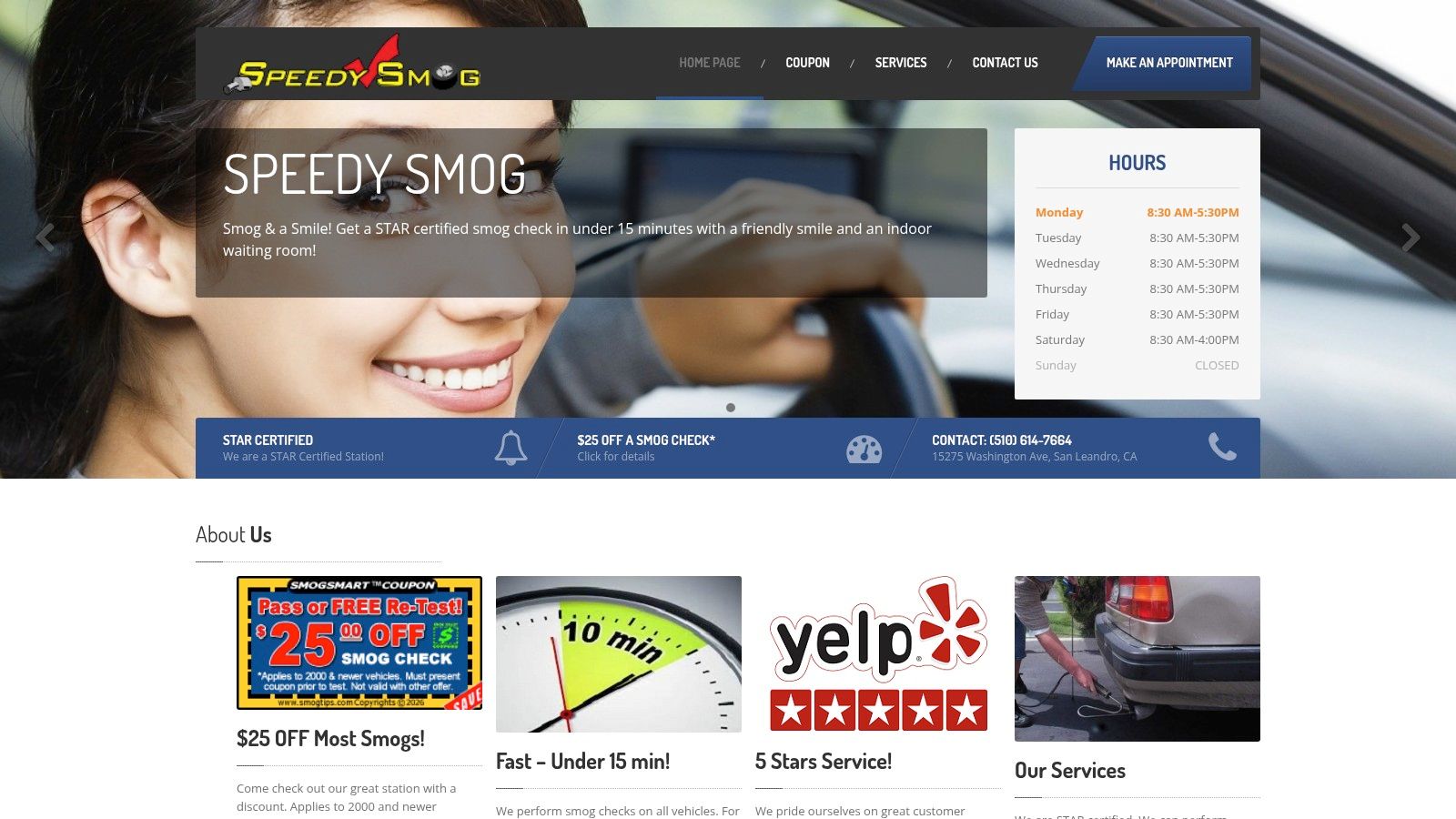
If you want the process handled without a lot of back-and-forth, a STAR-certified station in San Leandro can take care of the inspection for most vehicle types, including newer cars, older vehicles, diesels, and hybrids. Speedy Smog is located at 15275 Washington Ave, San Leandro, CA 94579, and it's open Monday through Saturday.
The practical value is speed and simplicity. Most newer-vehicle tests are completed in about 10 to 15 minutes, the waiting area is indoors and clean, and the shop offers a $25-off coupon for many newer-vehicle smogs, according to the publisher's service information. The station also transmits results electronically to the DMV, which helps cut down on extra steps.
For drivers who just want to get the test done, the primary benefit is predictable service. You show up, the car gets inspected, and the paperwork goes where it needs to go without you having to manage complex state language on your own.
Smog Check Common Questions Answered
What happens if my car fails the smog check?
You'll need to repair the issue and retest before the registration process can move forward. The useful move is to ask for the reason code or failure explanation, then fix the specific problem instead of guessing.
Can I get a smog check if I'm selling my car?
Usually yes, and in many cases you should, because buyers often want the transfer handled cleanly. If ownership is changing, that's one of the situations where emissions verification commonly comes into play.
Do hybrids need smog checks?
Some do, depending on the vehicle and the transaction. Don't assume the hybrid badge means an exemption, because California's rules are more specific than that.
What if I'm out of state right now?
Check your renewal situation carefully and confirm whether the DMV allows a delay or other handling for your case. Don't wait until the deadline has passed, because that's when a manageable paperwork issue becomes a registration problem.
If you want a straightforward inspection from a STAR Certified station that handles most vehicle types and sends results to the DMV, visit Speedy Smog and book your smog check in San Leandro. Bring the notice, bring the car, and let the station handle the testing so you can get your registration back on track without extra hassle.