
Car registration renewal in California isn't complete until the required smog certification is filed, and the DMV won't finalize the sticker just because you paid the fee. If your smog result is still missing, the renewal can stay stuck even after payment.
That's the part most drivers miss, especially when the notice looks simple and the online form seems to accept the payment. In practice, car registration renewal California is a compliance workflow, not just a checkout page, and the order matters if you want the renewal to clear on time.
Table of Contents
- The Two Parts of California Vehicle Renewal
- Do You Need a Smog Check
- Renewal Options and Timelines
- Finding a Reliable STAR Station
- Smog Check Failure Rates and Planning
- Common Issues and Final Steps
The Two Parts of California Vehicle Renewal
A common failure pattern goes like this. The driver pays online, assumes the job is done, then discovers the renewal is still blocked because the smog record never cleared, a citation is open, or insurance isn't verified.
Payment is not the same as completion
California's DMV says renewal is not finalized until required smog certification is completed, and it also says there's no grace period for annual registration fees, so the payment has to land on or before the expiration date or penalties apply. That makes timing important, but sequencing matters just as much. The right order is simple, confirm the notice calls for smog, finish the inspection, make sure the result is transmitted, then pay the renewal before the deadline. DMV registration fees and renewal processing
Practical rule: If the smog result hasn't cleared, the payment is only half the job.
What usually stalls a renewal
The DMV lists smog certification, unpaid citations, and insurance gaps as barriers to renewal. That means you should treat the notice as a checklist, not an invoice.
The workflow that avoids surprises is straightforward:
- Check the renewal notice first. If it calls for smog, don't pay and hope for the best.
- Complete the test at an authorized station. A passed inspection is what gives DMV the clearance it needs.
- Verify transmission or retention. The record has to be available for DMV processing, not sitting in your glove box.
- Pay before the expiration date. Missing the deadline creates avoidable penalties.
Drivers who handle the steps in that order usually avoid the worst bottleneck, the false sense that a receipt equals a finished renewal.
Do You Need a Smog Check
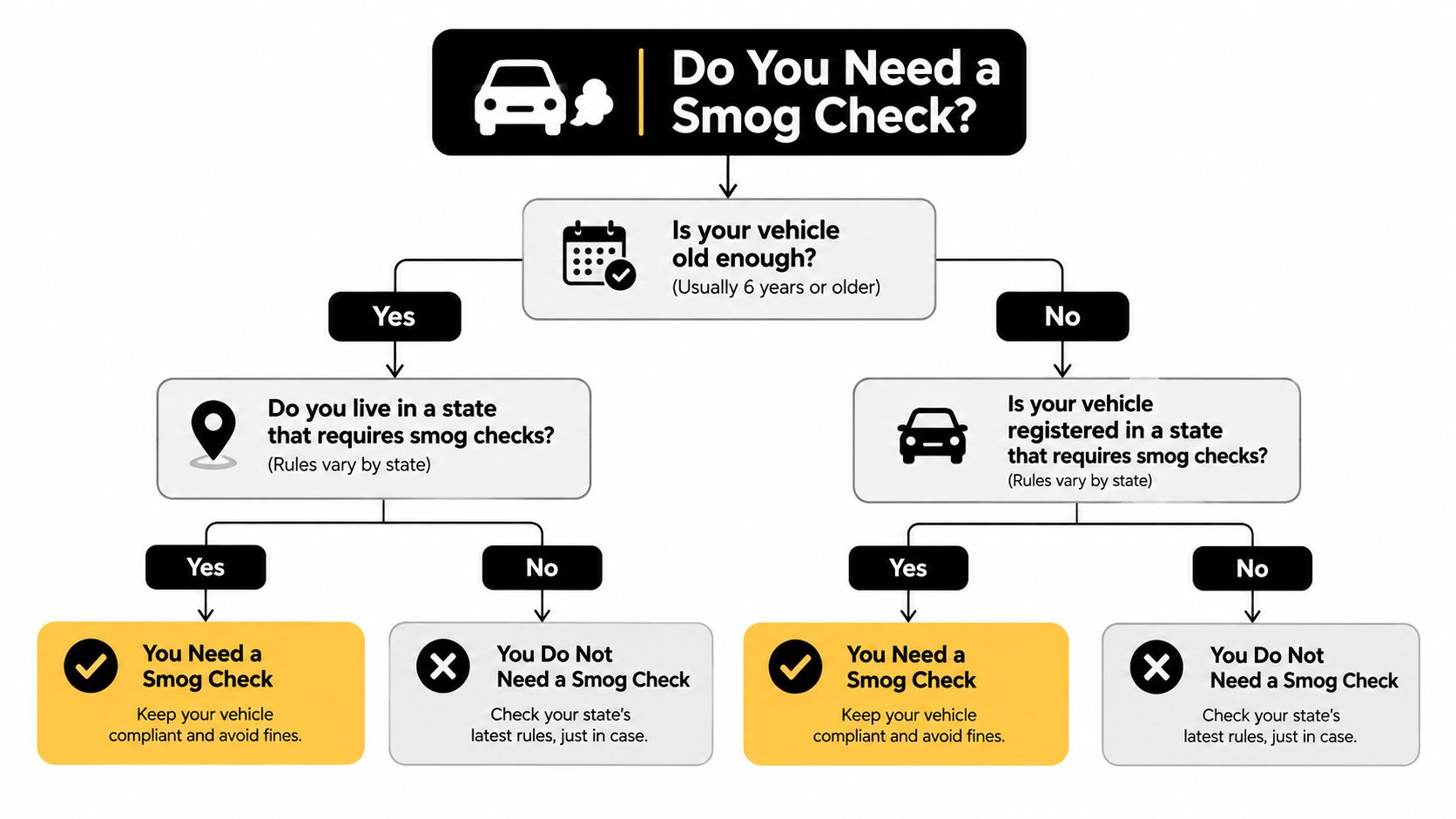
Not every vehicle sits in the same lane. California uses age-based rules, fuel-type rules, and registration timing to decide whether a car needs an inspection, so the fastest way to waste time is to assume everyone gets treated the same.
The exemption paths that matter
Gasoline-powered vehicles that are 1975 model year or older are exempt. Diesel vehicles that are 1997 and older are exempt, and electric vehicles are exempt as well. California also says gasoline-powered vehicles that are less than eight model years old do not need a smog inspection. California DMV smog inspections
That means a lot of newer drivers never need to book a test, while a lot of older daily drivers do. The middle of the fleet is where the compliance burden sits.
Where very new cars fit
California also notes that for vehicles less than four model years old, owners may pay a smog abatement fee instead of getting an inspection for the first 8 years the vehicle is registered. That's a niche path, but it matters if you bought a newer car and are trying to understand why your renewal notice doesn't look like your neighbor's.
If you're not sure which category you fall into, read the registration notice before booking anything. A clear notice saves a trip, and a wrong assumption can cost you a day.
For drivers comparing options, the key distinction is simple. Exempt vehicles can move toward renewal more directly, while inspection-required vehicles need the smog step cleared first. If you're checking a San Leandro or Oakland car, a local station that handles renewal-linked tests can remove some friction, including the process explained at Speedy Smog's registration renewal guide.
Renewal Options and Timelines
Once you know whether the smog requirement applies, choose the renewal method based on your deadline and the condition of your DMV record. Paying the fee starts the transaction, but it does not finish registration if a smog result, hold, or other requirement remains unresolved.
The channel you choose changes the clock
The DMV states that online and phone renewals take about one week, while mail takes about two weeks. A DMV kiosk can process the transaction instantly when every requirement is already satisfied. That timing makes the kiosk the fastest option, while online and phone renewal offer convenience with a short processing wait. California DMV vehicle registration renewal
Online renewal is practical when the record is clear and the expiration date is not pressing. It becomes a poor choice when you are still waiting for a smog result to post or for a hold to clear. The payment may go through while the registration remains incomplete.
The fastest path is the one that matches your actual renewal status.
How to pick the right method
Use the channel that fits both your record and your remaining time:
- Kiosk: Choose this when all requirements are satisfied and you need immediate processing.
- Online: Use it for a clean renewal when a short wait is acceptable.
- Phone: Expect timing similar to online renewal, with no office visit.
- Mail: Use it when convenience matters more than speed. It is a poor fit near expiration.
Check the renewal notice before submitting payment. If it indicates a smog requirement, confirm that the inspection has been completed and transmitted. If the account shows a hold, resolve that issue first. A kiosk cannot bypass a missing smog record or another unresolved requirement.
One practical East Bay habit
East Bay drivers often lose time by paying first and investigating the record afterward. The more reliable sequence is simple: read the notice, confirm the smog status, clear any hold, then submit through the method that fits the deadline.
For the inspection side of that workflow, Speedy Smog's STAR station overview explains how station selection connects with renewal planning. The practical point is to treat registration as a compliance workflow, not just an online payment.
Finding a Reliable STAR Station
A smog station is not just where a test gets plugged in. For renewal work, the station has to do more than inspect the car. The result must be valid, transmitted, and accepted without extra follow-up, or you can still end up stuck even after paying the fees.
Why STAR certification changes the experience
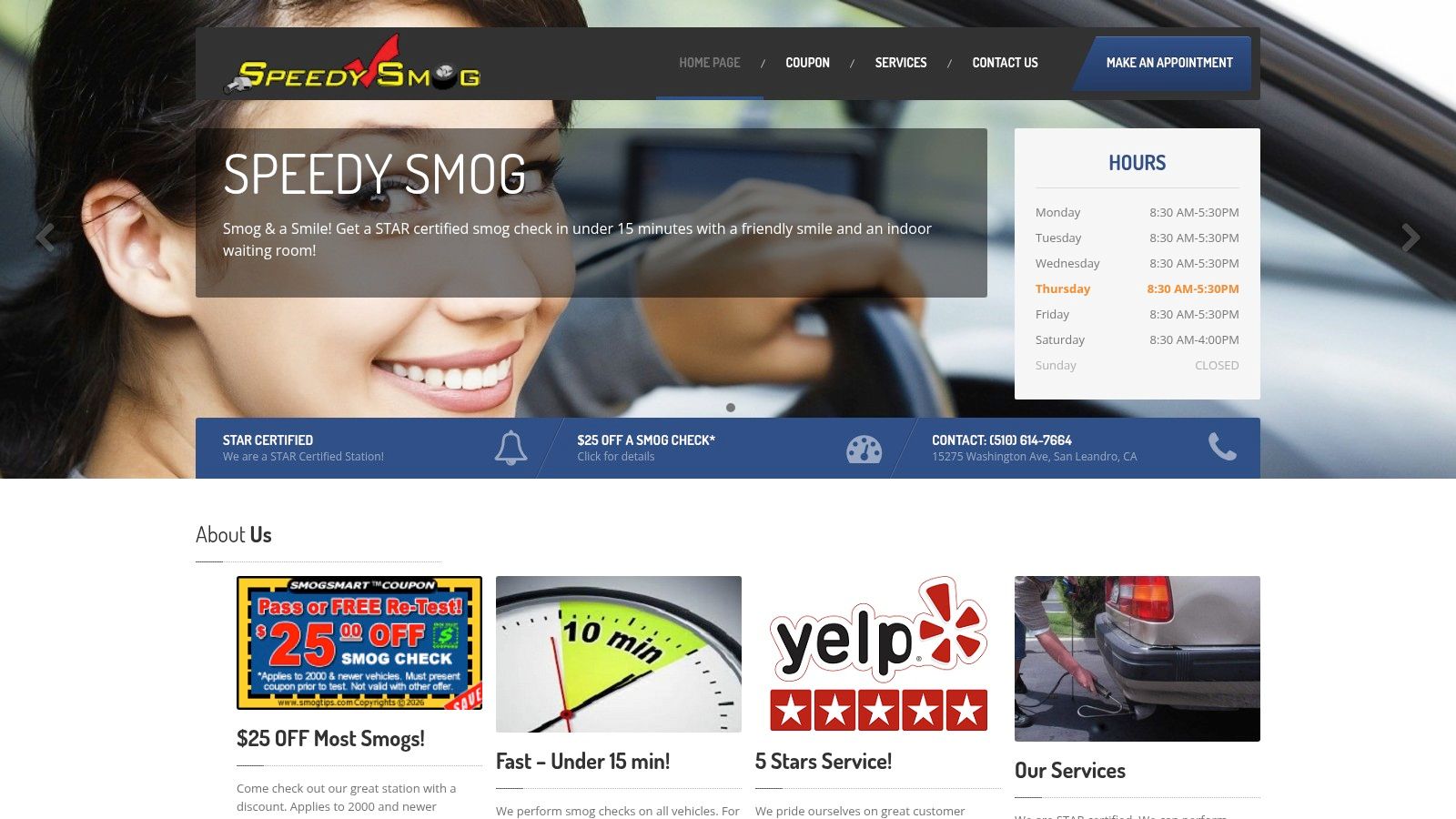
California's BAR sets higher performance standards for STAR Certified stations, which makes them the safer choice when a renewal cannot afford a bad inspection. In San Leandro, Speedy Smog operates as a STAR Certified station at 15275 Washington Ave, and it handles inspections for most vehicles, including 2000 and newer models, 1999 and older vehicles, diesels, and hybrids. Typical tests for newer vehicles are completed in about 10 to 15 minutes. Speedy Smog station information
That speed helps, but predictability matters more. A clean test and proper transmission keep the renewal moving instead of leaving you in DMV limbo with a paid fee and an unfinished record.
What to look for before you drive over
A reliable station should make the process boring in the best way. Clear intake, a clean waiting area, and staff who know which vehicles need which inspection path save time and avoid rework.
Before you go, check a few basics:
- Confirm STAR status. Use it if your renewal notice requires a STAR station.
- Ask about electronic transmission. The result should go to DMV without extra handling.
- Check vehicle fit. Diesel, hybrid, older, and newer cars can have different testing needs.
- Ask about pricing up front. You want the cost explained before the test starts.
The East Bay advantage is simple. You do not need a statewide scavenger hunt for a valid inspection. A nearby station that understands renewal timing can reduce the friction that turns a normal renewal into a delay.
For drivers who want to understand how station type affects the process, what a smog STAR station is gives the practical context.
Why nearby beats “good enough”
A station can be technically valid and still be the wrong choice if it adds delay. If you are trying to beat an expiration deadline, the key question is whether the station gets you through the compliance step fast enough to keep the renewal moving. A clean inspection, prompt transmission, and a simple checkout beat a longer drive to a place that complicates the process.
Smog Check Failure Rates and Planning
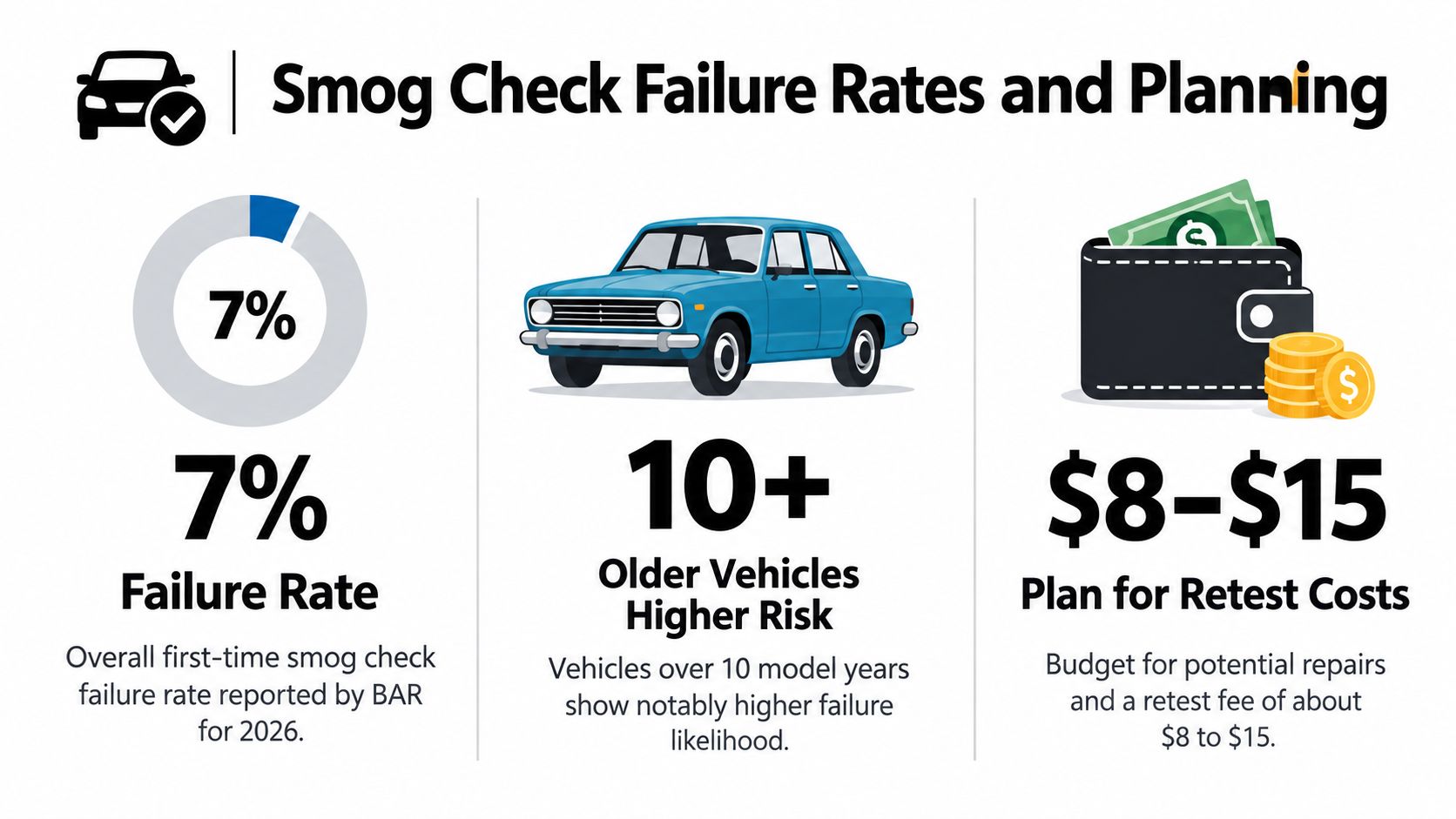
Older cars are not just more likely to need a smog check, they are more likely to slow down renewal. That is why planning before the inspection matters. A failed test can stall the whole compliance chain, and the risk rises as the vehicle ages. BAR smog check performance report
What the failure pattern tells you
BAR's 2026 performance report says about 1.3 million of 19 million 2000-and-newer vehicles tested in CY 2024-2025 failed Smog Check, roughly 7%, while roadside inspection failure averaged about 14% statewide in 2024-2025. Its 2024 report also shows failure rates rising sharply with age, from about 4% for 8-year-old vehicles to 15% for 23-year-old vehicles.
That age pattern matters. If your car is older, the odds of a delay go up, and your renewal plan should reflect that.
What to do before the test
Preparation will not fix a real emissions problem, but it can keep you from failing for avoidable reasons. Warm the vehicle before inspection, and treat a check engine light as a real fault until diagnostics prove otherwise. If you suspect a problem, verify the repair before you pay for the official test.
A practical pre-test checklist looks like this:
- Warm the car up properly. A cold car can give you a bad read.
- Inspect the dash. A check engine light usually means diagnostics first.
- Verify recent repairs. Do not assume a cleared code means the issue is gone.
- Use the right station. A station that understands your vehicle type reduces avoidable confusion.
For a local breakdown of common failure causes, Speedy Smog's smog fail guide is a useful starting point.
Planning beats panic
Older vehicles should be treated as a project, not a gamble. If you go in expecting a clean pass without checking the basics, you are betting your renewal on luck. If you confirm the obvious issues first, you give yourself a much better shot at getting through the compliance step in one visit.
Common Issues and Final Steps
A renewal can still stall after the smog step is done. The usual blockers are operational. An unpaid citation, an insurance gap, or a missing clearance can keep the file from moving even after you think everything is complete.
What to verify before you submit
If your renewal notice shows a smog requirement but you believe you qualify for an exception, check the vehicle's model year, fuel type, and registration status against the California DMV vehicle registration renewal page before you assume the notice is wrong.
Use this checklist before you submit:
- Smog status is correct. If a test is required, it has been completed and transmitted.
- Citations are clear. Any open violation can stop renewal.
- Insurance is active. A coverage gap can hold the file.
- Payment is on time. California does not give a fee grace period.
- The channel matches the deadline. If time is tight, do not choose a slow method.
California also allows a temporary operating permit for failed-smog cases for a $50 fee, which gives drivers a way to keep the vehicle legally usable while repairs are finished. It is not a free pass. It only buys time to complete the compliance work.
What a finished renewal actually looks like
A finished renewal means the record is clear, not just paid. The notice is satisfied, the smog result is accepted if required, and the DMV can complete the transaction without a hold. That is the standard to use before you assume the sticker is on the way.
For East Bay drivers, the practical move is to separate the payment step from the compliance step. If the account has a hold, or the smog data has not posted yet, paying online does not finish the job. Handle the missing piece first, then confirm the record has cleared.
If you want the inspection side handled without extra friction, Speedy Smog can handle official smog certification for renewal-linked cases and move the result through the process quickly. Visit Speedy Smog to get the smog step handled and keep your car registration renewal on track.
The envelope shows up, or the registration email lands in your inbox, and one phrase jumps out fast: Smog Certification Required. For a lot of East Bay drivers, that's the moment the questions start. Do you need a test right now? What does the shop do to your car? If something fails, are you stuck?
The good news is that California's emissions testing requirements are usually much simpler than the paperwork makes them sound. Most of the stress comes from not knowing the rules, not knowing what happens during the inspection, or not knowing what to do if a notice says something unfamiliar like STAR Station Required.
If this is your first time dealing with smog, or you just want the quickest path from DMV notice to registration renewal, a little clarity goes a long way. The process is meant to verify that your vehicle isn't putting out excessive pollution, and for most drivers, it's a short stop with a clear result.
Table of Contents
- Your Guide to California Smog Check Rules
- Determining If Your Vehicle Needs a Smog Check
- What Happens During a Smog Inspection
- Why Your DMV Notice Might Say STAR Station Required
- Simple Prep Tips to Help Your Vehicle Pass
- Next Steps After a Failed Emissions Test
Your Guide to California Smog Check Rules
Most drivers don't spend much time thinking about emissions rules until the DMV makes it their problem. That's normal. Smog requirements sit in the background until renewal time, a vehicle sale, or a move from out of state brings them front and center.
California's system can feel local and bureaucratic, but it's part of a much bigger push to clean up vehicle pollution. Around the world, governments have tightened testing methods and emissions limits. China's Stage 6 standards are described as among the world's most stringent, and a 2021 UN regulation created a harmonized method for testing heavy vehicles globally, including lifetime monitoring of pollution levels throughout a vehicle's operating life, as described by Automotive IQ's overview of global emissions regulations.
That global context matters because it explains the basic “why.” Smog checks aren't just a DMV hoop. They're one way states make sure vehicles still operate cleanly after years on the road.
What California drivers usually need to know
For most East Bay drivers, the practical questions are much smaller:
- Do I need a smog check now
- What kind of station does my notice require
- What happens during the inspection
- What should I do before I show up
- What are my options if my car fails
Practical rule: Start with the DMV notice, but don't stop there. Once you understand the trigger behind that notice, the rest of the process gets much easier.
The smog check itself is usually straightforward. A technician verifies that the emissions system is present and functioning, checks your vehicle's computer where applicable, and submits the result electronically if the vehicle passes. That's why drivers who prepare ahead of time usually have a much smoother experience than drivers who show up with a check engine light on and hope for the best.
Determining If Your Vehicle Needs a Smog Check
A lot of confusion starts with one wrong assumption: that every car needs a smog check every time registration comes up. That isn't how it works. The key question is what event triggered the requirement.
The situations that usually trigger a test
In everyday California driving, three situations commonly lead to a smog requirement:
Registration renewal
Many vehicles are brought in when registration renewal comes due and the DMV requests certification.Transfer of ownership
When a vehicle changes hands, a smog certificate is often part of the process.First California registration for an out of state vehicle
If you recently moved and brought a car with you, the state may require a smog inspection before registration can be completed.
That's the broad picture. Your DMV paperwork is still the deciding document, but understanding the trigger helps you avoid guessing.
California Smog Check Requirements at a Glance 2026
| Situation | Smog Check Required? | Notes |
|---|---|---|
| DMV registration renewal notice says certification is required | Usually yes | Follow the notice instructions and complete the inspection before renewal deadlines |
| You're selling or buying a used vehicle | Often yes | Check the transfer paperwork and current state rules for the vehicle involved |
| You moved to California with a vehicle from another state | Often yes | Initial California registration commonly triggers the requirement |
| Your vehicle is newer or falls into an exempt category | Sometimes no | Exemptions exist, so verify before scheduling |
| Your notice says STAR Station Required | Yes, at a qualifying station | The test requirement is real, but the process is still a standard smog inspection |
Drivers also get tripped up by timing. They remember a prior test and assume they're covered, or they hear a friend mention an exemption and apply it to the wrong vehicle. If you want a quick refresher on recurring requirements, this short guide on whether a smog check is needed every year helps clear up a common misunderstanding.
One easy point that confuses new residents
California generally ties smog obligations to the vehicle's registration address. But if you've moved recently, it's smart to check the exact local rule set instead of assuming your old state handled things the same way.
That matters because some states use commuter rules that many drivers never hear about. In Colorado, for example, vehicles registered outside the Denver metro program area still need inspection if they're driven into the area for work or school 90+ days a year, according to the Colorado AirCare commuter requirement FAQ. California doesn't use that exact framework in the same way, but the lesson is useful: address alone doesn't tell the whole story when you've recently moved, changed registration, or commute across regional boundaries.
If you're new to the East Bay, don't rely on what applied in your last state. Check the California notice, the registration paperwork, and the actual vehicle status.
What Happens During a Smog Inspection
Most first-timers expect something mysterious. In reality, it's a routine inspection with a set order. You pull in, provide the vehicle details, and the technician works through the required checks.
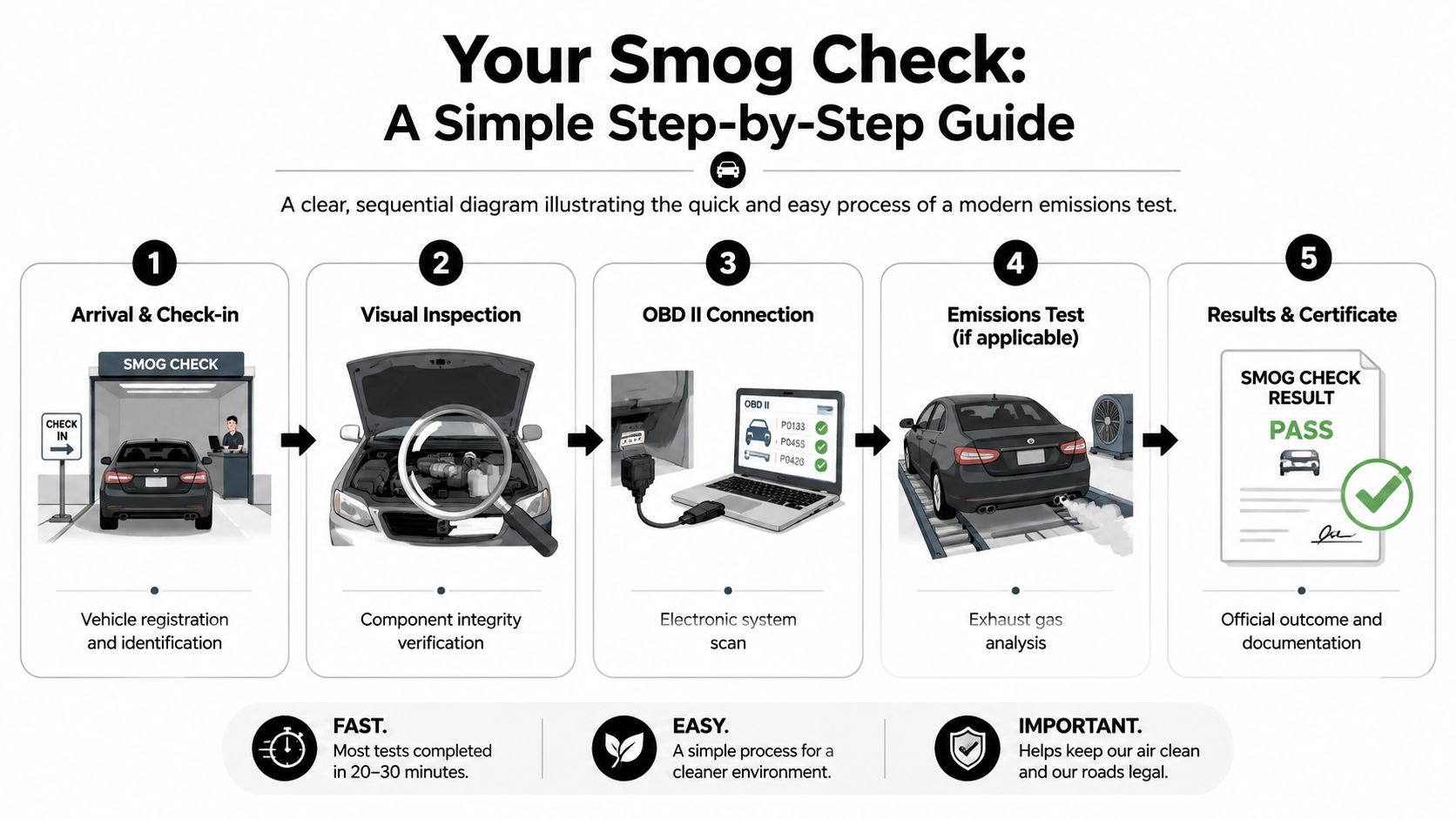
From check in to electronic results
The first part is basic check-in. The shop confirms the vehicle information and matches it to what's needed for the inspection.
Then comes the visual inspection. The technician looks for missing, disconnected, or obviously modified emissions components. If a vehicle left the factory with certain equipment, that equipment generally needs to still be there and appear intact.
After that, many vehicles get an OBD II connection. That means the technician plugs into the car's onboard computer to look for emissions-related trouble codes and monitor status. This is one reason a check engine light is such a big deal. If the car is already reporting an emissions problem, the inspection is unlikely to go your way.
Some vehicles also go through an exhaust emissions measurement procedure. In plain language, the system checks what's coming out of the tailpipe and whether it stays within allowed limits for the test being performed.
What the machine is actually looking for
At idle-style testing, the process can sound technical, but the basics are easy to understand. The engine may be run at a fast-idle speed of 2500 to 3000 rpm and a normal idle speed. In the fast-idle portion, the carbon monoxide limit is 0.2% and the lambda value must stay between 0.97 and 1.03, according to the UK in-service exhaust emission testing standards.
Why does that matter to a driver? Because those numbers give clues about how well the engine is burning fuel and whether the emissions system is doing its job. A poor air-fuel balance, a weak catalytic converter, or another fault can show up in those readings.
Here's the simple version of what the technician wants to see:
- No obvious equipment problems under the hood or underneath
- No active emissions-related computer faults
- Clean enough exhaust output for the applicable test method
A smog inspection isn't trying to “catch” you. It's checking whether the engine, computer, and emissions hardware still work together the way they're supposed to.
For many modern vehicles, the whole process is brief. The final result is typically sent electronically, which helps the registration side move along without extra paperwork from the driver.
Why Your DMV Notice Might Say STAR Station Required
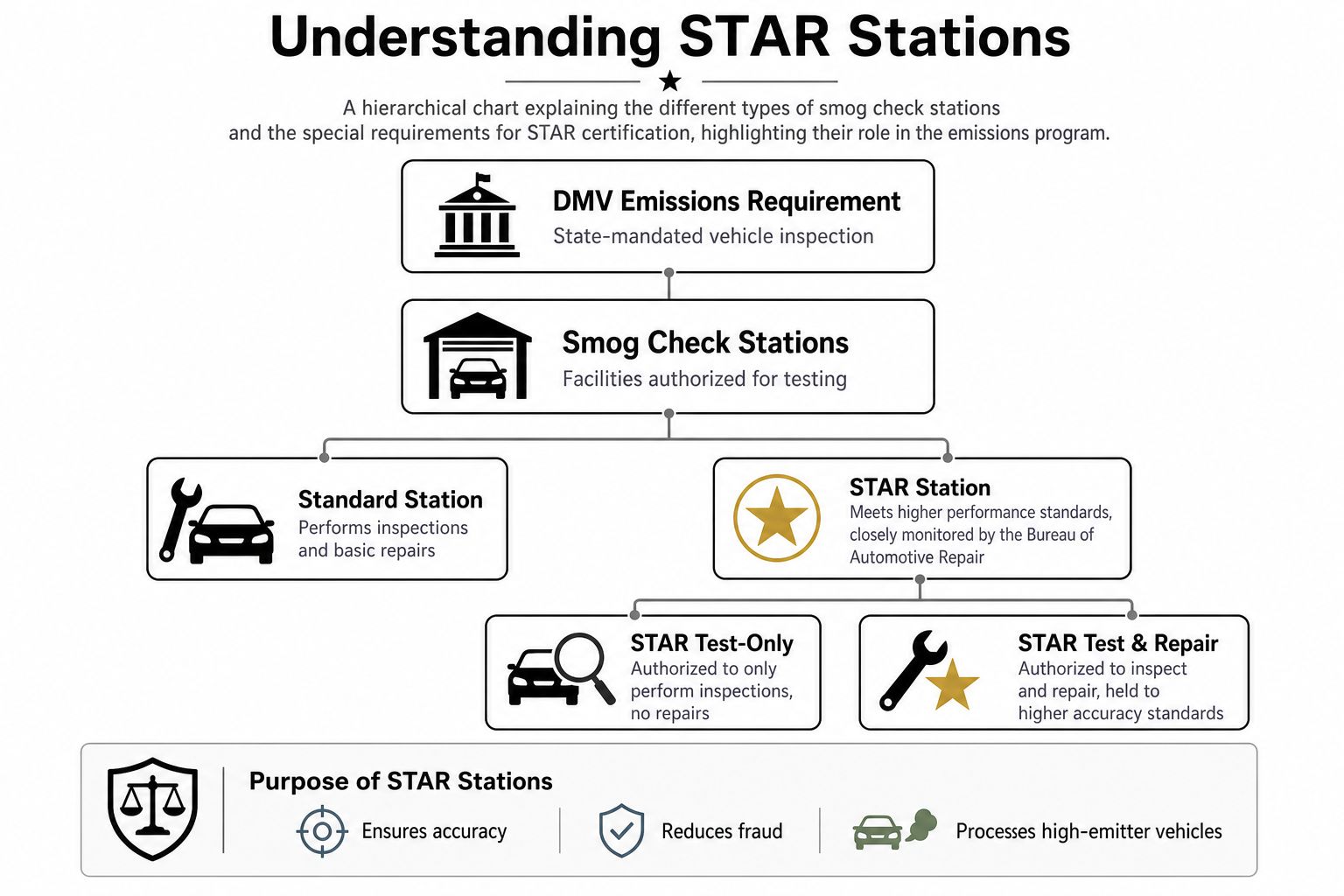
A DMV notice that says STAR Station Required makes some people think their car is in trouble. Usually, it just means the vehicle must be inspected at a station that meets a higher program standard.
What STAR means in plain English
A STAR station is still doing a smog inspection. It isn't a separate kind of emissions law, and it doesn't automatically mean your vehicle is a gross polluter.
The practical difference is station qualification. These stations operate under stricter performance expectations and oversight. That's why the DMV may direct certain vehicles there.
Drivers are often sent to a STAR station for reasons such as:
- Program quality control where some vehicles are selected for closer oversight
- Vehicle profile factors that place certain models or histories into a category needing a STAR inspection
- Specific DMV notice instructions that make station type part of the requirement
Who can handle the inspection
The key is simple. If your notice says STAR, use a STAR-qualified shop. If it doesn't, you may have more options.
If you want the details in plain language, this explainer on what a smog STAR station is breaks down the station types and what each one can do. One local option is Speedy Smog, a STAR Certified station in San Leandro that performs official smog inspections for vehicles that need that designation.
Some drivers also wonder whether hybrids, diesels, or older cars change the equation. They can, but not in the way people expect. The biggest difference is usually procedure, not whether the law applies at all. Certain vehicles require a different testing path or a station equipped and authorized to handle them correctly.
The words “STAR Station Required” don't mean punishment. They mean the DMV wants the inspection completed at a specifically qualified station.
That distinction saves a lot of wasted trips. Drivers often lose time not because the test is hard, but because they went to the wrong place first.
Simple Prep Tips to Help Your Vehicle Pass
There's no magic trick that guarantees a pass. But there are several common mistakes that cause completely avoidable failures.
The avoidable reasons people fail
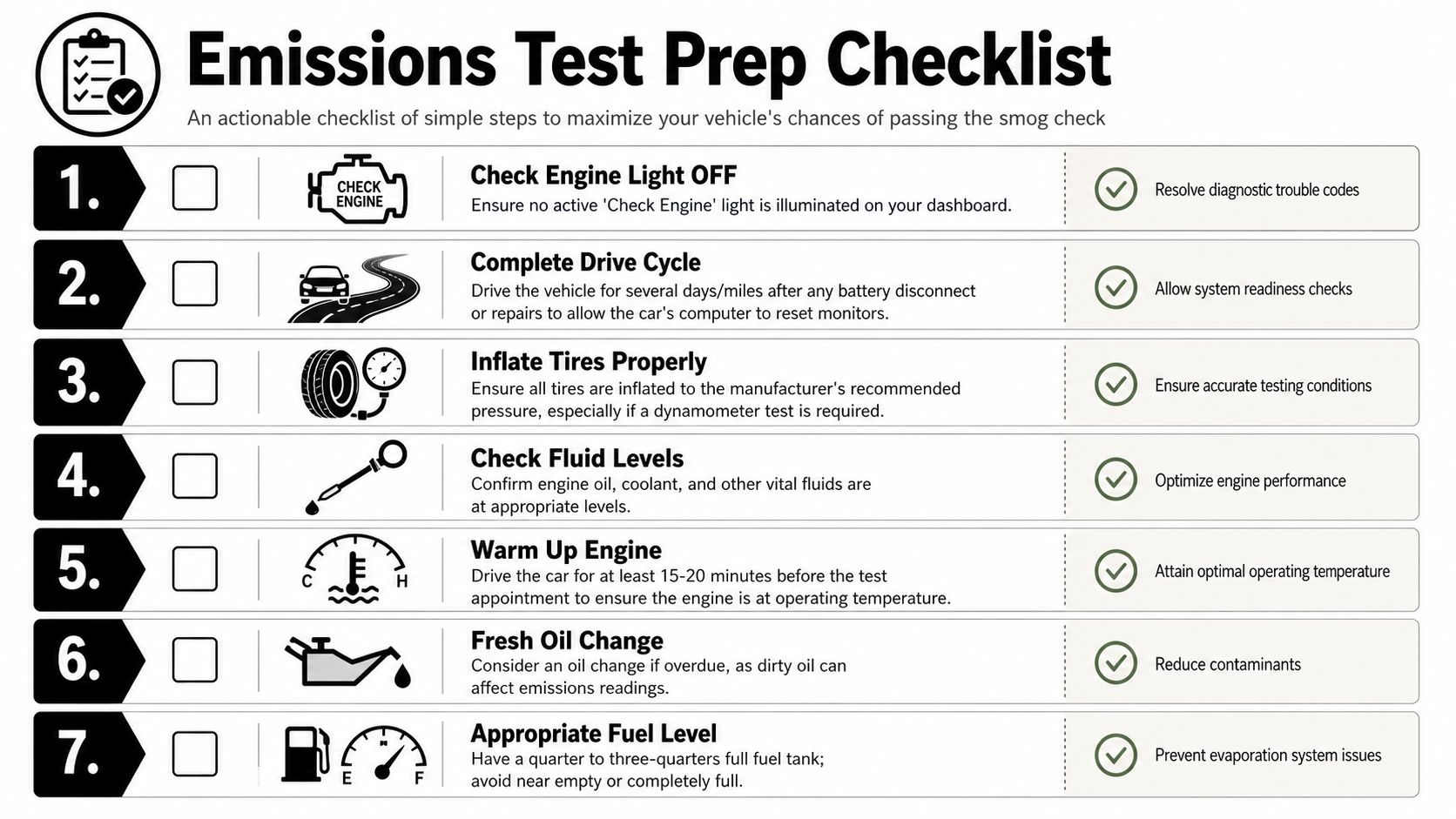
The biggest one is simple: if the check engine light is on, handle that first. Don't spend time or money on a smog inspection before diagnosing it. The light means the vehicle has detected a fault, and emissions-related faults are exactly what the inspection is designed to catch.
Another common problem happens after a battery disconnect or recent repair. The car may run fine, but the onboard monitors may not be ready yet. That can create a failure even when the underlying repair is complete.
A cold engine can also work against you. Cars generally test better when they've been driven long enough to reach normal operating temperature.
A practical pre test checklist
Use this as your pre-appointment routine:
- Look at the dash first. If the check engine light is on, get the cause diagnosed before you book the smog.
- Don't rush in right after battery work. Give the vehicle time to complete its drive cycle and reset readiness monitors.
- Drive the car before the appointment. A normal drive helps warm the engine and emissions components.
- Check basic maintenance. Old oil, neglected tune-up items, and obvious running issues can all hurt your chances.
- Make sure the fuel level is reasonable. Extremely low or completely topped-off fuel levels can create issues for some vehicles.
- Bring the right documents. It keeps the visit moving and avoids easy delays.
If you like a visual reminder, this short video gives a helpful overview before your visit:
One more practical note. Don't treat the smog test as the diagnostic step if your car is already showing symptoms. Rough idle, hard starts, poor fuel economy, or a recent repair history usually mean it's smarter to sort out the mechanical issue first and test second.
Next Steps After a Failed Emissions Test
A failed test feels frustrating, but the report you get is useful. It tells you where to start. The mistake many drivers make is jumping straight into expensive repairs without understanding whether the failure came from a computer monitor issue, a missing component, or a genuine emissions fault.
Read the report before spending money
Start with the Vehicle Inspection Report and read the reason for failure carefully. Then take that report to a qualified repair shop and ask for diagnosis based on the listed issue, not a generic “make it pass” approach.
Your next step usually falls into one of these paths:
- Computer-related issue such as unset readiness monitors after recent battery work or repair
- Emissions system repair involving the catalytic converter, oxygen sensors, evaporative components, or related hardware
- Visual or functional correction where a missing, altered, or malfunctioning component has to be restored
If the failure is minor, the fix may be straightforward. If the car is older and the issue is deeper, you may need to think in terms of repair value, not just repair possibility. For drivers who need another inspection after repairs, a station offering a smog check free retest can make the process easier to manage.
When repairs and waivers get complicated
It is common for people to get bad advice from friends, forums, or random social posts. They hear “just get a waiver” as if it's automatic. It usually isn't.
What matters is documentation, eligibility, and state-specific rules. In some states, drivers must fail twice and show repair bills before a waiver is even considered. The broader takeaway, noted by Illinois Legal Aid's discussion of emissions testing and waiver questions, is that waiver thresholds and repair requirements can be difficult for drivers to evaluate, especially when older vehicles need major work and the financial math isn't obvious.
That same uncertainty shows up anywhere drivers are trying to decide between repairing, retiring, or selling a vehicle. If the repair is modest and the rest of the vehicle is solid, fixing it often makes sense. If the car needs repeated emissions work and has other problems piling up, the right answer may be different.
Don't make the decision based on emotion right after a failed test. Make it after diagnosis, written estimates, and a realistic look at the vehicle's overall condition.
If you need an official California smog inspection for registration, transfer, diesel, hybrid, older vehicle, or a DMV notice that requires a STAR station, Speedy Smog in San Leandro is one local option for East Bay drivers who want a straightforward inspection process without the usual confusion.