
You've just left a California smog station, and the technician has handed you a failing report marked gross polluter. Your first thoughts are usually the same: Can I still drive, will the DMV stop my registration, and how much will the repair cost?
Take a breath. This designation is serious, but it isn't a dead end. California gives you a defined path through diagnosis, repair, assistance or retirement decisions, and restricted retesting. The mistake I see most often is treating the result like an ordinary smog failure and sending the vehicle to the first available station.
Table of Contents
- You Got the Gross Polluter Notice Now What
- What Makes a Vehicle a Gross Polluter in California
- How the Gross Polluter Designation Affects Your Registration
- Diagnosing and Repairing Excessive Emissions
- Repair Assistance Programs and Appeal Options
- Choosing a STAR Certified Station for Your Retest
- Your Complete Action Plan From Gross Polluter to Certified
You Got the Gross Polluter Notice Now What
The driver I'll call Maria came into an East Bay shop after receiving a gross polluter result on her aging sedan. She had expected a routine inspection. Instead, she had a failed certificate, a registration deadline approaching, and no clear explanation beyond the two words that scared her.
Her first job wasn't authorizing an expensive repair. It was gathering the paperwork. The report identifies what the vehicle failed, whether the problem came from tailpipe emissions or the onboard diagnostic system, and whether the station directed the vehicle into the gross-polluter process. Keep that document, because the next technician needs the actual test information rather than a verbal summary.
Practical rule: Don't replace parts until someone has explained what the test result points to.
A gross polluter designation doesn't automatically tell you which component failed. It tells you that the emissions result crossed a much stricter regulatory category. The repair may involve an inexpensive ignition or vacuum problem, or it may involve a catalytic converter or another major emissions component. Guessing makes the situation more expensive.
Your immediate plan should be straightforward:
- Read the result carefully: Confirm the vehicle identification, failure codes, measured emissions, and instructions for the next test.
- Check your registration status: A failed or missing certification can prevent the DMV from completing the registration process.
- Avoid casual retesting: Before booking another inspection, ask whether the vehicle must return through a STAR station or another authorized facility.
- Get a diagnostic opinion: Choose a technician who will test the cause instead of selling a standard package of parts.
- Ask about assistance early: Repair assistance may affect which repairs you authorize and how you pay for them.
The California Bureau of Automotive Repair's official Smog Check reference guide explains the special certification rules that apply after a vehicle is identified as a gross polluter. Your car may still be usable for necessary purposes depending on its registration and legal status, but the smog result itself doesn't give you permission to ignore registration requirements. If you're unsure, confirm your status with the DMV or a qualified professional before driving routinely.
What Makes a Vehicle a Gross Polluter in California
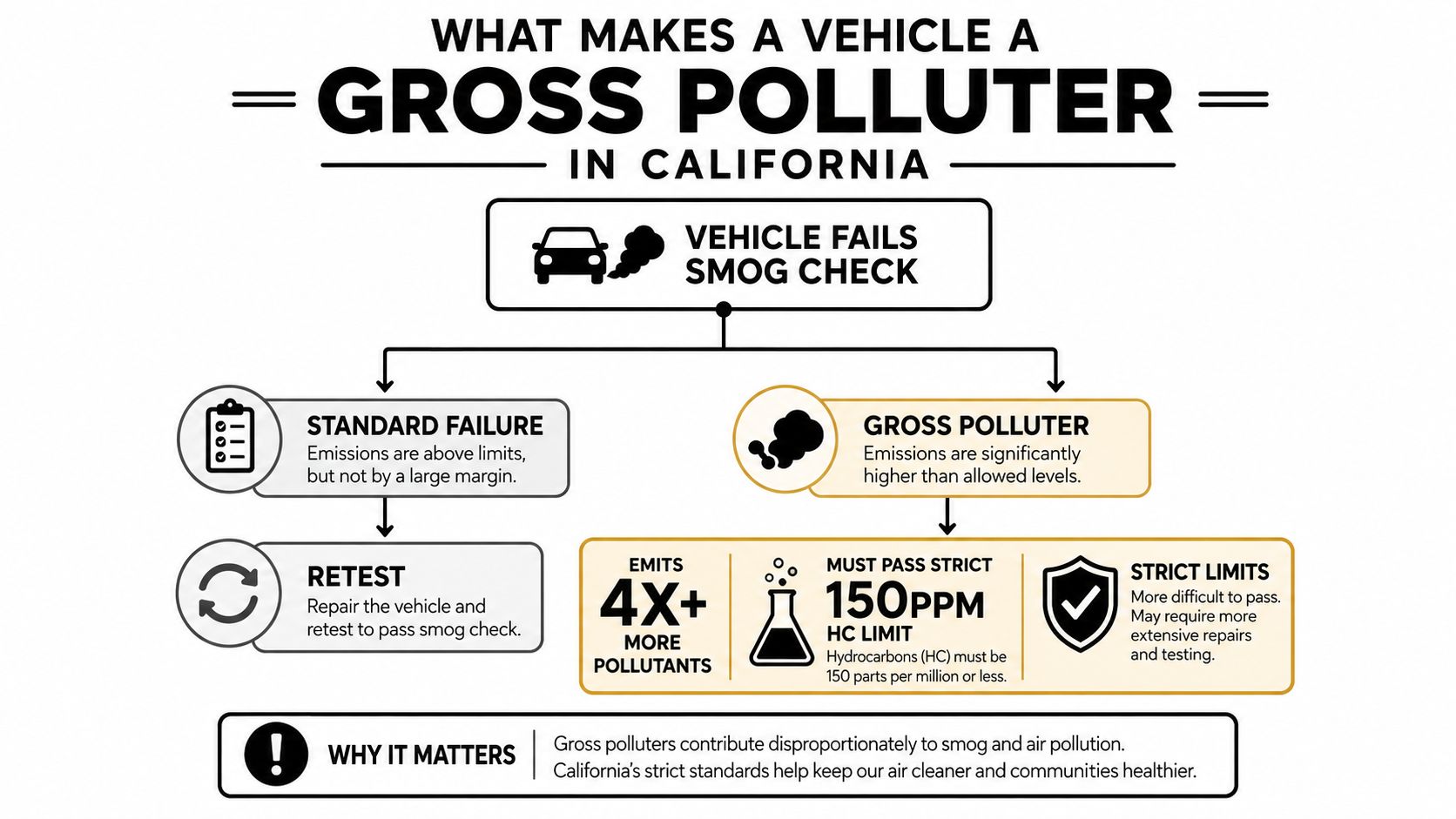
A failed smog test does not automatically make a vehicle a gross polluter. The distinction matters because the repair path, testing requirements, and potential assistance can change after the higher designation.
California classifies a vehicle as a gross polluter when its tailpipe emissions exceed the gross-polluter standards in California Code of Regulations section 3340.42. The BAR reference guide linked earlier explains that the label depends on the measured emissions compared with the limits for that vehicle, not just on receiving a failed result.
A regular failure means the vehicle missed an applicable test requirement. A gross polluter result means it crossed a separate, more severe emissions threshold. Treat those results differently. Do not approve repairs from the word “failed” alone. Ask the technician to show the measured emissions, the applicable limits, and the test data supporting the designation.
Why the vehicle's details matter
The applicable limit depends on the vehicle's specific make, model, and model year. Two vehicles can produce the same measured emissions and receive different results because their standards differ. Give the technician the vehicle identification and complete test report before accepting an estimate.
Historical research on California's gross-polluter definition described eligibility as at least twice the allowed emissions level for the vehicle's specific make, model, and model year. The distinction between an ordinary failure and the separate gross-polluter threshold is documented in this University of California research record.
Use that historical description for context, not as the current testing rule. The current test report and California requirements control. In practice, the designation signals a more severe emissions problem, so insist on diagnosis before replacing parts. Check ignition, fuel, vacuum, oxygen-sensor, and catalytic-converter systems in a logical order, based on the test results. That approach gives you a better chance of finding a repairable cause before paying for major components.
How the Gross Polluter Designation Affects Your Registration
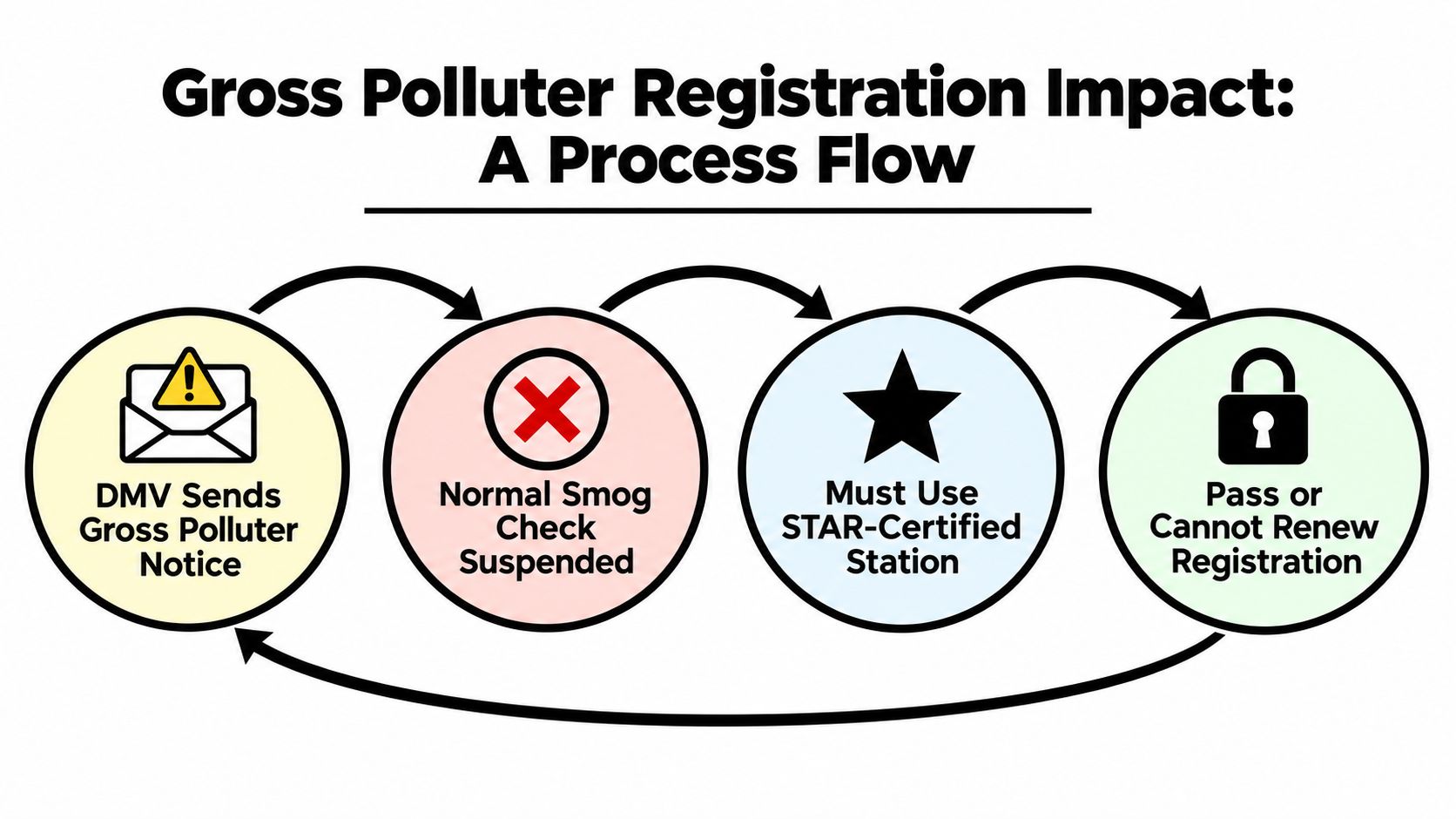
A gross-polluter designation can stop the registration process until the vehicle earns a passing smog certificate. The next step is choosing a facility authorized to handle the required inspection, then confirming that facility before paying for repairs. The current BAR reference guide outlines the applicable testing pathway.
The available options include:
- STAR test-only station: Performs the inspection but does not repair the vehicle.
- STAR test-and-repair station: Can diagnose or repair the vehicle and complete the authorized inspection.
- Referee facility: May be required if the vehicle is directed to the Referee process or needs specialized review.
Choose the facility before authorizing repairs
Call first. Give the station the exact designation, ask whether it handles gross-polluter inspections, and confirm whether it can perform the official certification after repairs. A regular smog station may offer general information, but the wrong facility can leave you paying for another visit and test.
Your existing repair relationship should guide the choice. A test-only station can provide an independent result if you already have a trusted mechanic. A test-and-repair station can keep diagnosis, repairs, and retesting in one workflow. Either way, require a written explanation of the failed test before approving parts.
Protect the registration timeline
The designation does not extend the DMV registration deadline. If the DMV requires a passing certificate and you have not obtained one, registration can remain incomplete. A smog station cannot waive penalties or resolve a separate registration issue.
Before authorizing work, have the technician document:
- The findings on the original test report.
- Repairs supported by diagnostic results.
- Whether the station performs the official retest.
- The documents provided after a passing result.
- Whether a Referee appointment is required.
This record keeps the repair and certification steps connected. It also prevents paying for repairs at one location, then learning that the final inspection must be completed elsewhere.
Diagnosing and Repairing Excessive Emissions
Gross-polluter repairs should begin with evidence. A scan tool, visual inspection, emissions readings, fuel-trim data, ignition checks, and exhaust-system testing can help a technician separate the cause from the symptom. A check engine light or stored code can point toward a system, but it doesn't automatically identify the failed part.
The likely suspects depend on the test pattern and vehicle condition. A worn ignition component can leave fuel partially unburned. A vacuum leak can disturb the air-fuel mixture. A failing oxygen sensor can send inaccurate feedback to the engine computer. A leaking or stuck fuel injector can add too much fuel. A damaged catalytic converter may fail to process pollutants after the engine has already burned the mixture.
What a competent diagnostic visit should include
A technician should explain what was tested and why the recommended repair follows from those results. Ask for scan-tool codes, monitor status, fuel-trim observations, ignition findings, and any evidence from the exhaust system. If the recommendation is a catalytic converter, ask what caused the original failure and whether that cause has been addressed.
learning how to read OBD codes helps. Codes are clues, not verdicts. Replacing an oxygen sensor because the code mentions oxygen-sensor performance can waste money if the actual issue is a vacuum leak, wiring problem, exhaust leak, or mixture problem.
A temporary code reset isn't a repair. It only removes information the next technician needs.
Decide whether to repair or seek another opinion
Get a written estimate that separates diagnostic work, parts, labor, and retest-related services. If the estimate is large, ask for the test results supporting each major component. A second opinion makes sense when the first shop recommends several expensive parts without showing how it reached that conclusion.
Avoid shortcuts such as clearing codes immediately before testing, disconnecting the battery, or installing an unverified used emissions component. Those actions can hide the problem temporarily, leave monitors incomplete, or create another failure. The goal is a stable repair that brings emissions back within the applicable limits, not a vehicle that merely looks clean for a brief inspection.
Repair Assistance Programs and Appeal Options
The right decision depends on the vehicle's condition, your finances, and the quality of the original test information. Don't commit automatically to a major repair, and don't send a repairable car to a dismantler without checking assistance options first.
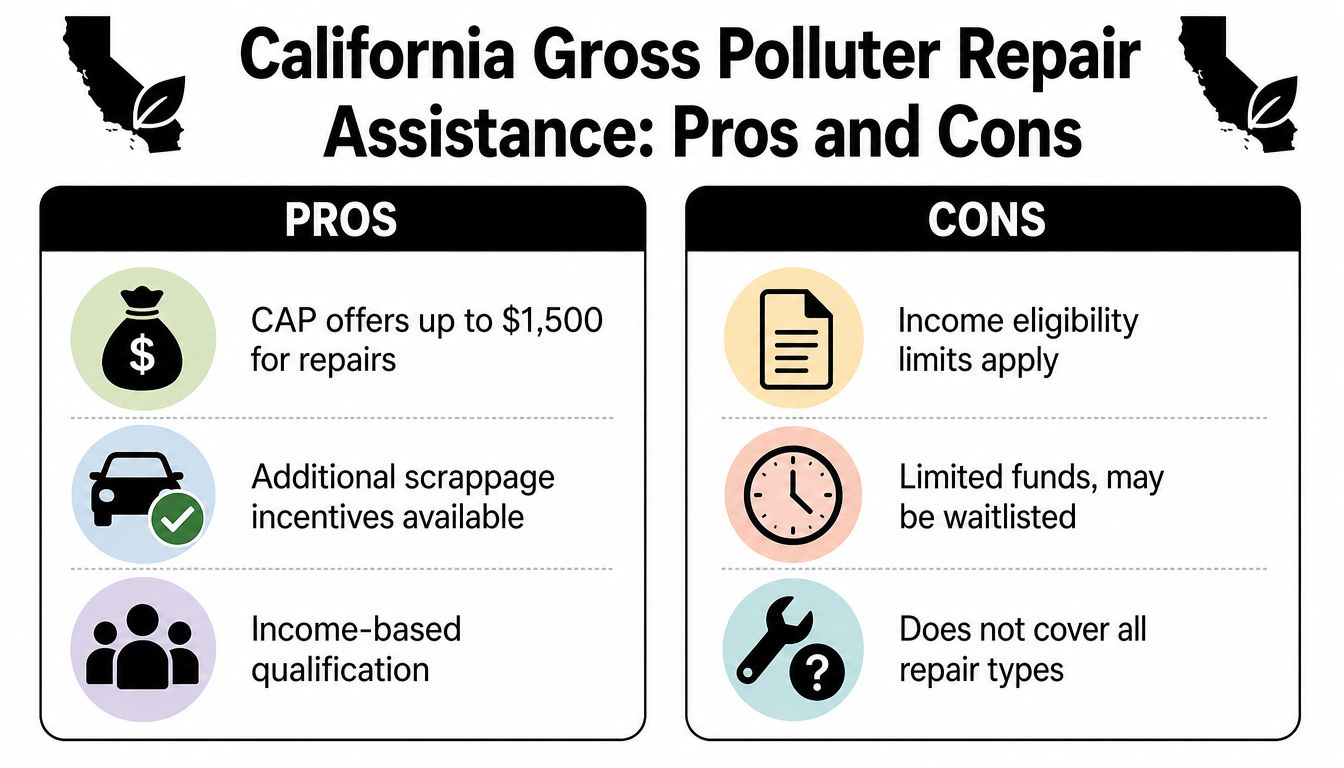
California's Consumer Assistance Program, commonly called CAP, can help qualifying owners with emissions-related repair costs. The available support depends on program rules, eligibility, funding, and the vehicle's documentation. Start with the Smog Check repair assistance information and verify current requirements directly through the Bureau of Automotive Repair before authorizing work.
Compare the three practical paths
| Path | Makes sense when | First move |
|---|---|---|
| Repair with assistance | The vehicle is worth keeping and you meet program requirements | Confirm eligibility before repairs begin |
| Retire the vehicle | The repair cost and vehicle condition don't justify continued ownership | Check retirement requirements and available incentives |
| Challenge the result | The test information appears inconsistent or the designation may be incorrect | Preserve the report and request guidance through BAR or the Referee process |
Income eligibility limits and program funding can change. Some repairs may not qualify, and approval isn't automatic. Ask whether the program requires authorization before work starts, because completing repairs first can affect your options.
If you believe the designation was issued in error, don't argue only from how the car feels or drives. Gather the failed inspection report, repair records, maintenance history, and any independent diagnostic findings. Contact the Bureau of Automotive Repair or ask whether a Referee evaluation applies. A challenge needs documentation, patience, and a clear technical reason, not just a disagreement with the result.
Choosing a STAR Certified Station for Your Retest
After repairs, choose the retest location before you finish the repair plan. A STAR-certified station is the practical choice when the vehicle's designation requires STAR testing, because California restricts gross-polluter certification to specified STAR facilities or an applicable Referee facility.
A STAR test-only station can be useful when you want the final inspection separated from the repair shop. A STAR test-and-repair station can be more convenient when the same team will verify repairs and complete the retest. Ask which service the vehicle requires, and don't assume a standard smog appointment will satisfy the DMV.
Prepare the vehicle properly
The check engine light should be off for the right reason, not because someone erased the code. If the battery was disconnected or codes were cleared, the vehicle may need normal driving before its emissions monitors complete. Your technician should tell you whether the monitors are ready and whether another drive cycle is needed.
Arrive with the engine fully warmed through ordinary driving. Check the fuel cap, address obvious warning lights, and bring the failed report plus repair invoices. Don't make last-minute modifications that haven't been tested.
For East Bay owners, Speedy Smog in San Leandro, located at 15275 Washington Ave, is one STAR-certified option. The shop handles inspections for newer and older vehicles, diesels, and hybrids, but call first to confirm the correct gross-polluter workflow and whether your vehicle needs a Referee appointment instead.
The best station is the one that understands the designation, explains the result, and gives you a clear answer about what happens next. That standard matters more than choosing a shop based only on proximity.
Your Complete Action Plan From Gross Polluter to Certified
Use this sequence as your working checklist. Keep every report, estimate, invoice, and approval document in one folder.
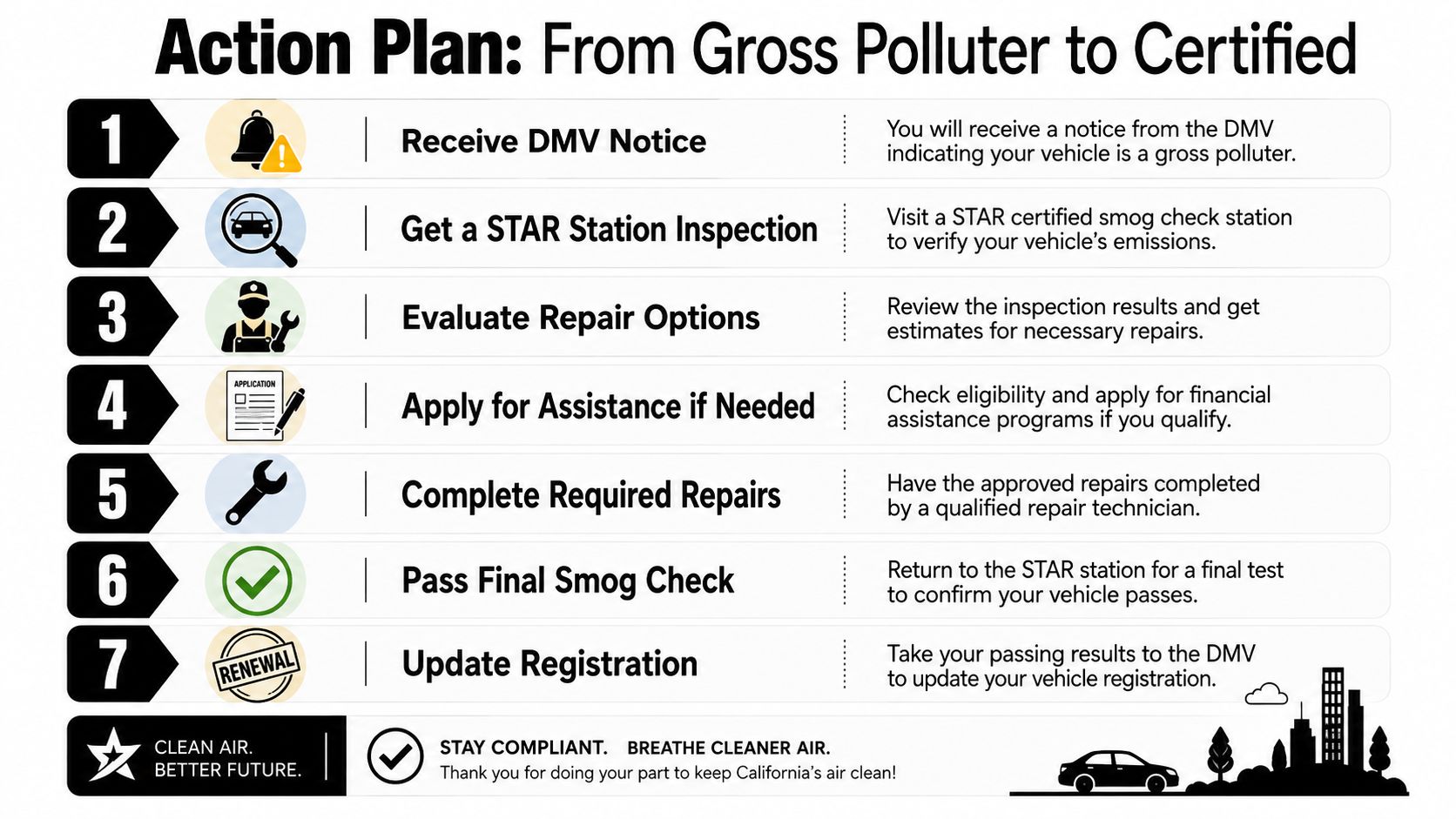
- Save the failed report: Record the designation, codes, measured results, and registration deadline.
- Confirm the testing path: Ask a STAR station or BAR whether your vehicle needs test-only, test-and-repair, or Referee handling.
- Get a documented diagnosis: Require test results before approving major emissions parts.
- Choose the financial path: Compare repair, CAP assistance, retirement, and appeal based on the vehicle's condition.
- Complete root-cause repairs: Fix the underlying engine or emissions problem, not only the stored code.
- Prepare for retesting: Confirm monitors are ready, the warning light is properly off, and the engine is warm.
- Submit the passing certification: Follow the DMV instructions and retain the certificate and repair records.
Don't assume you can drive normally while waiting. Check your registration and any DMV restrictions, and ask the appropriate agency or qualified professional about lawful use. If the retest fails again, stop authorizing random parts. Compare the new report with the original, identify what changed, and return to diagnosis or the Referee process if the results conflict.
The fastest route is usually the most organized route: correct station, accurate diagnosis, approved assistance, proper repair, then retest.
Speedy Smog provides STAR-certified smog inspections in San Leandro for gross-polluter-related workflows, along with testing for newer and older vehicles, diesels, and hybrids. Bring your failed report and ask the team to clarify whether you need a normal retest, a repair pathway, or Referee guidance, then visit Speedy Smog to schedule the next step.
You open the DMV renewal notice, glance at the due date, and realize you've got two choices. You can gamble on a random smog station and hope the car passes, or you can check the basics first and save yourself a wasted trip, a retest, and a repair bill you didn't need yet. For smog check berkeley ca, the smartest move is simple, know whether your car even needs testing, then make sure the car is ready before you book.
Table of Contents
- What a Smog Check Involves for Berkeley Drivers
- California Smog Check Exemptions and Requirements
- How to Prepare Your Vehicle Before the Test
- Where to Get Your Smog Check in the East Bay
- Why Vehicles Fail and What to Do Next
- Your Complete Smog Check Action Plan
What a Smog Check Involves for Berkeley Drivers
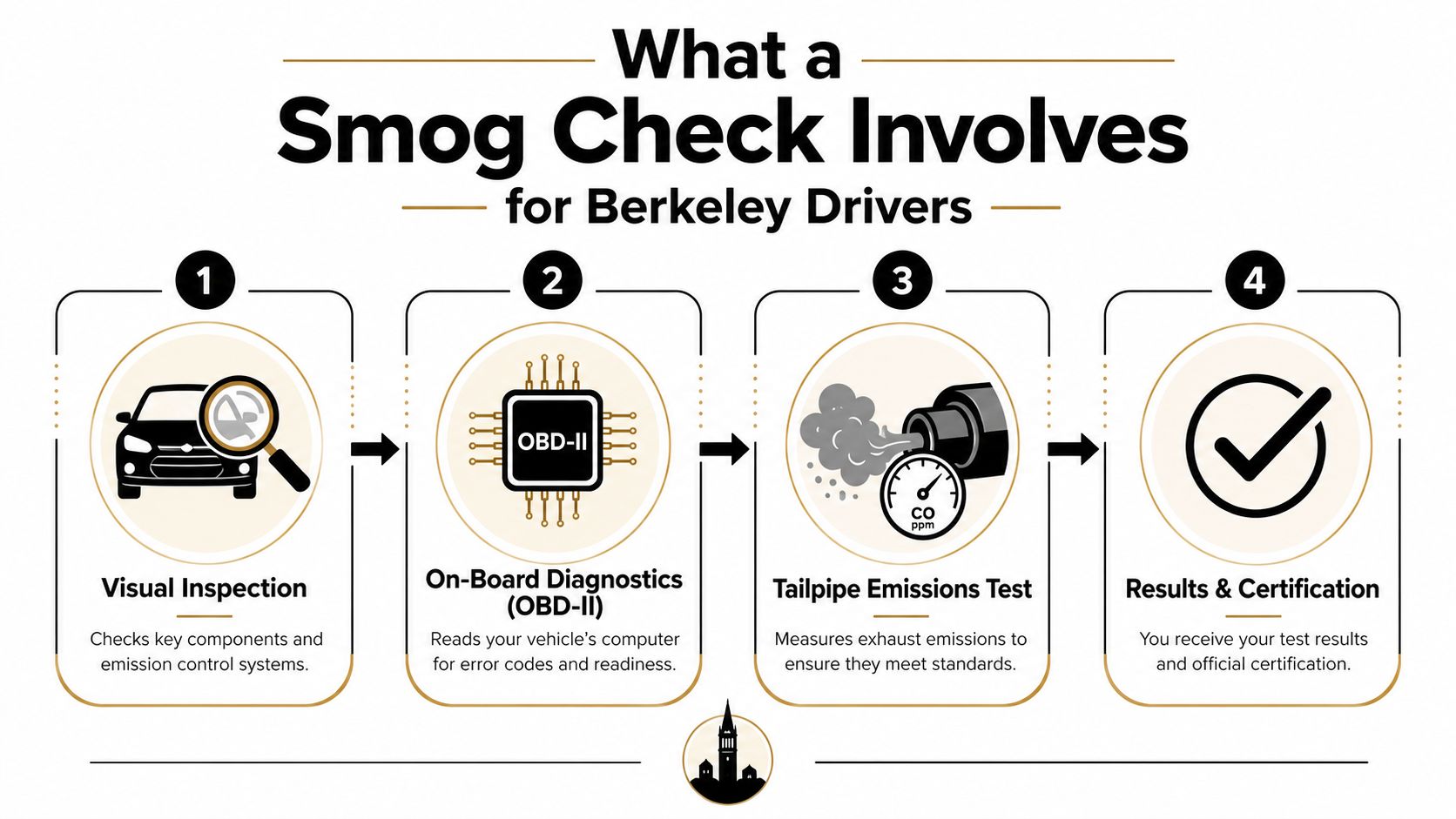
A Berkeley driver gets the renewal notice, books a test, and usually assumes the inspector is just plugging in a machine and printing a pass-or-fail slip. That oversimplifies the job. California's Smog Check program combines visual inspection, functional checks, and, depending on the vehicle, emissions testing, because the state is looking for the cars that pollute the most and getting them repaired before they stay on the road.
The reason is plain. A peer-reviewed analysis estimated that in 1999, Smog Check reduced tailpipe emissions by 97 tons/day of hydrocarbons, 1,690 tons/day of carbon monoxide, and 81 tons/day of nitrogen oxides, equal to 26%, 34%, and 14% of what would otherwise have been produced without the program. It also found that more than 90% of HC and CO benefits and over 80% of NOx benefits came from vehicles older than 10 years, even though those cars were only about half of the vehicles tested, which tells you where the program does the most work. Peer-reviewed Smog Check analysis
What the inspector checks
For newer gasoline and hybrid cars, the test is mostly OBD-focused. The station reads readiness monitors and emissions-related trouble codes through the BAR On-Board Diagnostic Inspection System, and the car fails if the check-engine light is on. That is the core of the test for a lot of vehicles. BAR OBD inspection guidance
For older gasoline vehicles, the process shifts to tailpipe measurement with the BAR-97 Emissions Inspection System. The inspector looks at exhaust behavior, warms the car up properly, and follows a standardized snap-test sequence. If you want a plain-English breakdown of the process, this smog check explained simply guide lays out the station flow without the regulatory jargon.
Practical rule: If your car is newer, the computer matters. If it's older, mechanical condition and warm-up matter more.
The facility type matters too. A STAR-certified station meets higher Bureau of Automotive Repair performance standards, which is why some DMV notices point you there instead of any test-only shop. Read the notice, match the station type, and do not pay for the wrong inspection.
California Smog Check Exemptions and Requirements
Berkeley drivers waste time when they book first and check the rules later. Start with the vehicle, not the shop. A quick exemption check tells you whether you need a station at all, and it keeps you from paying for a test you never had to take.
The vehicles that skip testing
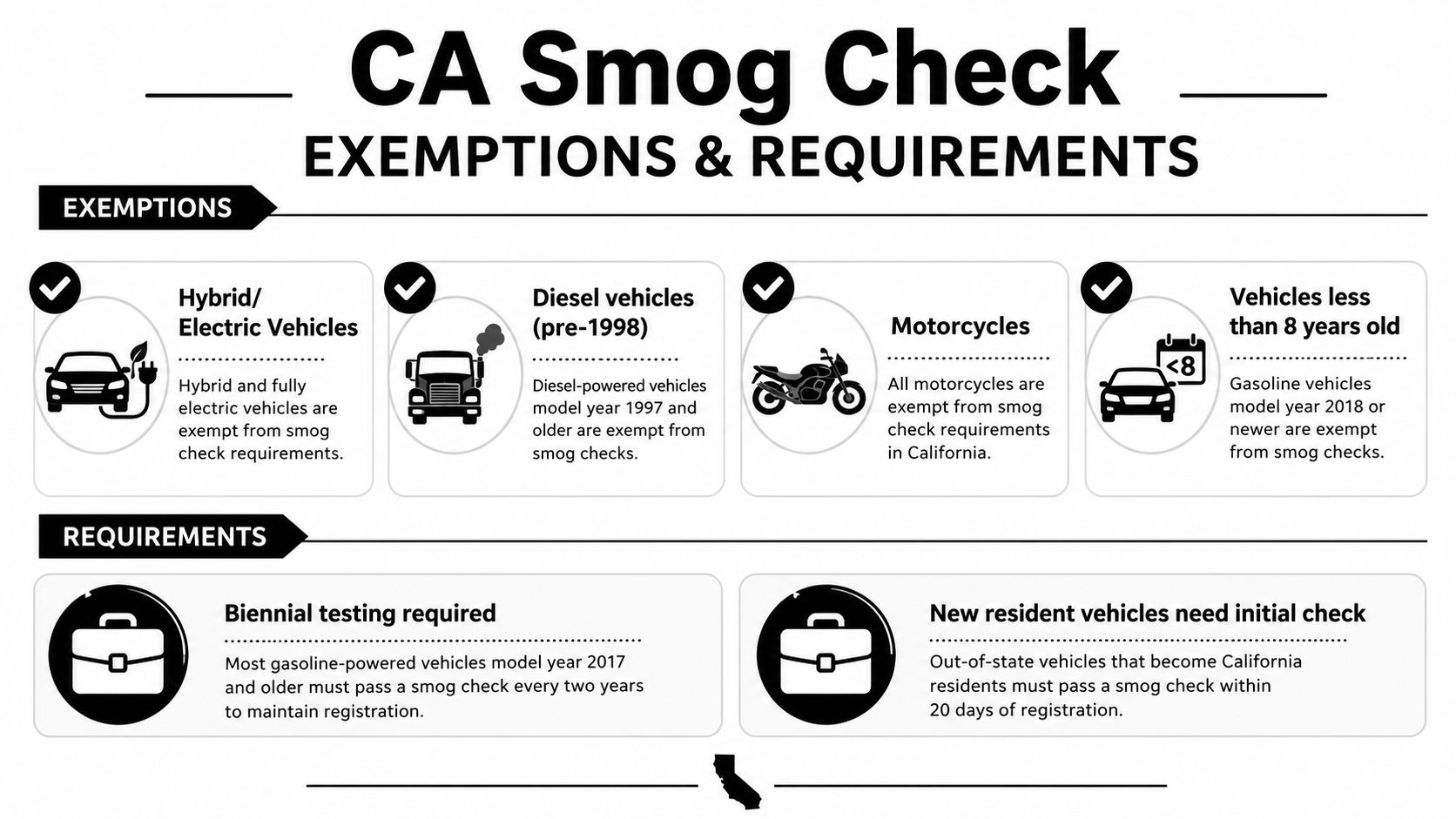
Gasoline vehicles are exempt if they are 1975 model year or older or less than eight model-years old, and electric vehicles are also exempt. California also says the first test for a new vehicle is generally due eight model years after the model year, and some newer vehicles can pay a smog abatement fee instead of testing for the first 8 years of registration. That is the first thing to verify before you book, because a lot of Berkeley and Oakland owners assume every renewal needs a test when it does not. California DMV smog inspection rules
If you want the state rule in plain English, use the California smog check rules reference and match it against your title or registration.
The clean way to think about it is this.
- Classic gasoline cars: 1975 and older, exempt.
- Newer gasoline cars: under eight model-years old, exempt.
- Electric vehicles: exempt.
- Some new registrations: may use a smog abatement fee instead of an immediate test.
For a lot of households, that ends the question right there. If your vehicle falls into one of those categories, stop shopping for a station and keep your money.
When you still need to book
If your vehicle is outside those exemptions, the test becomes part of registration compliance. That applies whether you are renewing on time, transferring ownership, or following a notice that points to a specific inspection type. Berkeley drivers get tripped up by local marketing pages that bury the state rule under shop promotions, but the state rule is what counts.
A smog check is not a neighborhood decision. It is a vehicle-status decision.
Do not guess based on age alone. Check the model year, check the fuel type, and read the DMV notice before you leave the house. That takes less time than calling around town and asking shops whether you “think” you need one.
How to Prepare Your Vehicle Before the Test
A lot of failed smog checks are self-inflicted. The car wasn't ready, the battery was just replaced, or the driver showed up with a warning light on and hoped for the best. That is not a plan. It is a wasted trip and a second bill.
For 2000-and-newer vehicles
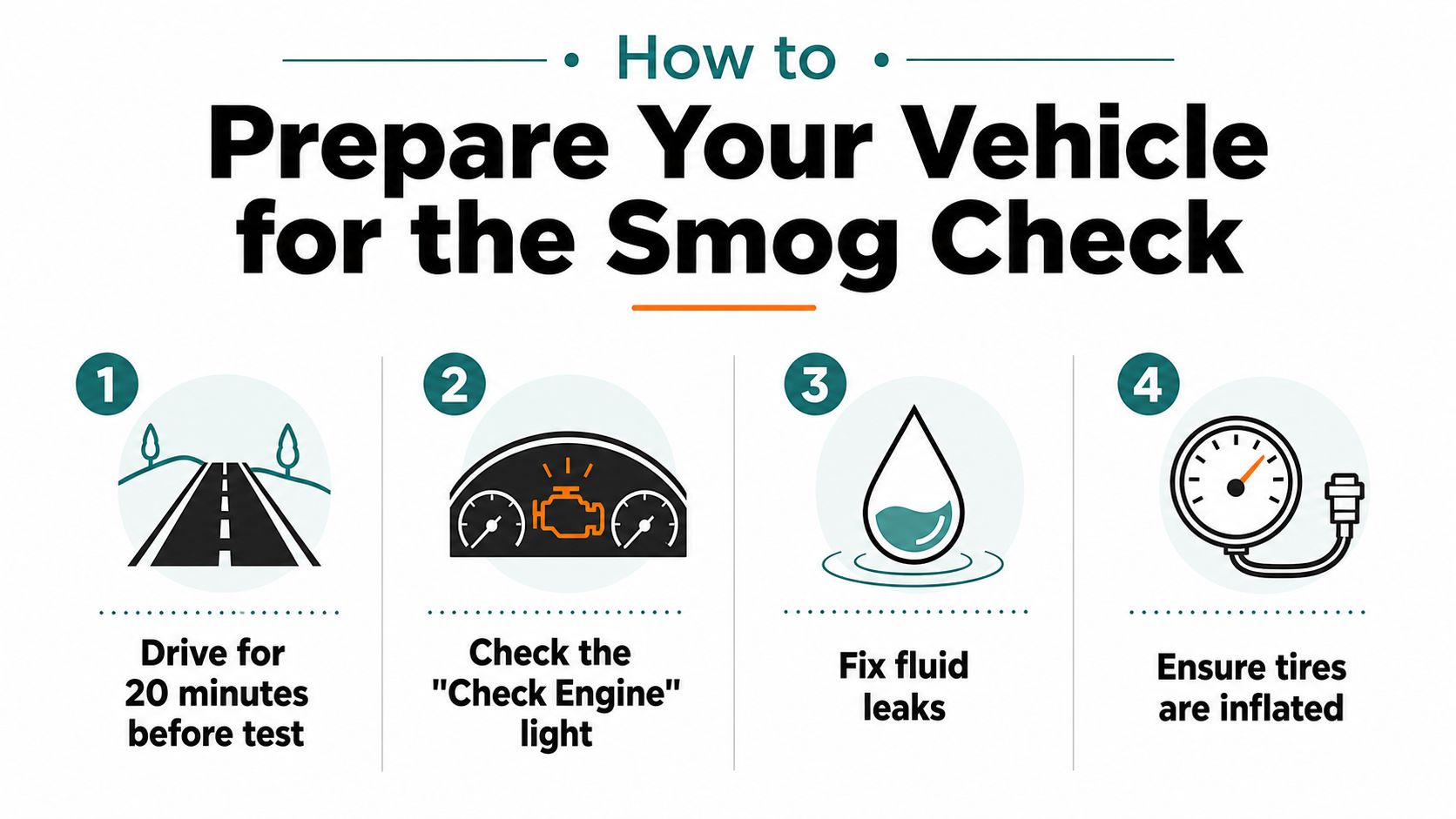
If your gas or hybrid vehicle is 2000 or newer, the test centers on OBD readiness. The station checks readiness monitors and stored trouble codes, and California BAR says a car with the check-engine light on will not pass. If the battery was recently disconnected, BAR says to drive 1 to 2 weeks so the monitors can reset before testing.
That means the pre-test check is simple, and Berkeley drivers should do it before booking a slot.
- Confirm the check-engine light is off. If it is on, fix the fault first.
- Check readiness status. Do not assume the car is ready after a battery swap.
- Drive long enough for monitors to reset. Short trips usually do not do it.
Do this before you pay a shop to look at the car. If the monitors are not set, the station cannot turn a half-ready vehicle into a pass.
For 1999-and-older gasoline vehicles
Older gasoline cars are handled differently. California uses the BAR-97 Emissions Inspection System, and the Smog Check Manual calls for the engine to be at normal operating temperature, idling for at least 3 minutes, then performing a BAR Snap Test by revving from idle to about 2,000 to 3,000 RPM and returning to idle. The vehicle must be in Park or Neutral, parking brake set, and accessories off. Smog Check Manual
Cold starts and sloppy prep can knock an older car out before the test gets going.
If the engine is cold, the test starts at a disadvantage. Warm the car up before you ever pull into the lot.
Older cars are also more sensitive to obvious safety issues like leaks, overheating, abnormal engine noise, or visible smoke. If the car shows those signs, fix them first. Do not pay for a test you already know is likely to go nowhere.
Check exemption status before you book
A lot of Berkeley drivers waste time on a test they never needed. Verify the model year, fuel type, and registration notice before you schedule anything. If your vehicle falls into an exemption category, skip the station search and keep the money in your pocket.
If you want a quick reference while you sort out your paperwork, use the smog check station guide for East Bay drivers and match the station type to your notice. That is the faster way to avoid booking the wrong place for the wrong car.
Where to Get Your Smog Check in the East Bay
Once the car is ready, pick the right station, not just the nearest one. A clean waiting room doesn't pass your car, and the cheapest ad on the internet doesn't tell you whether the shop can handle your model year or your DMV notice.
What to look for in a station
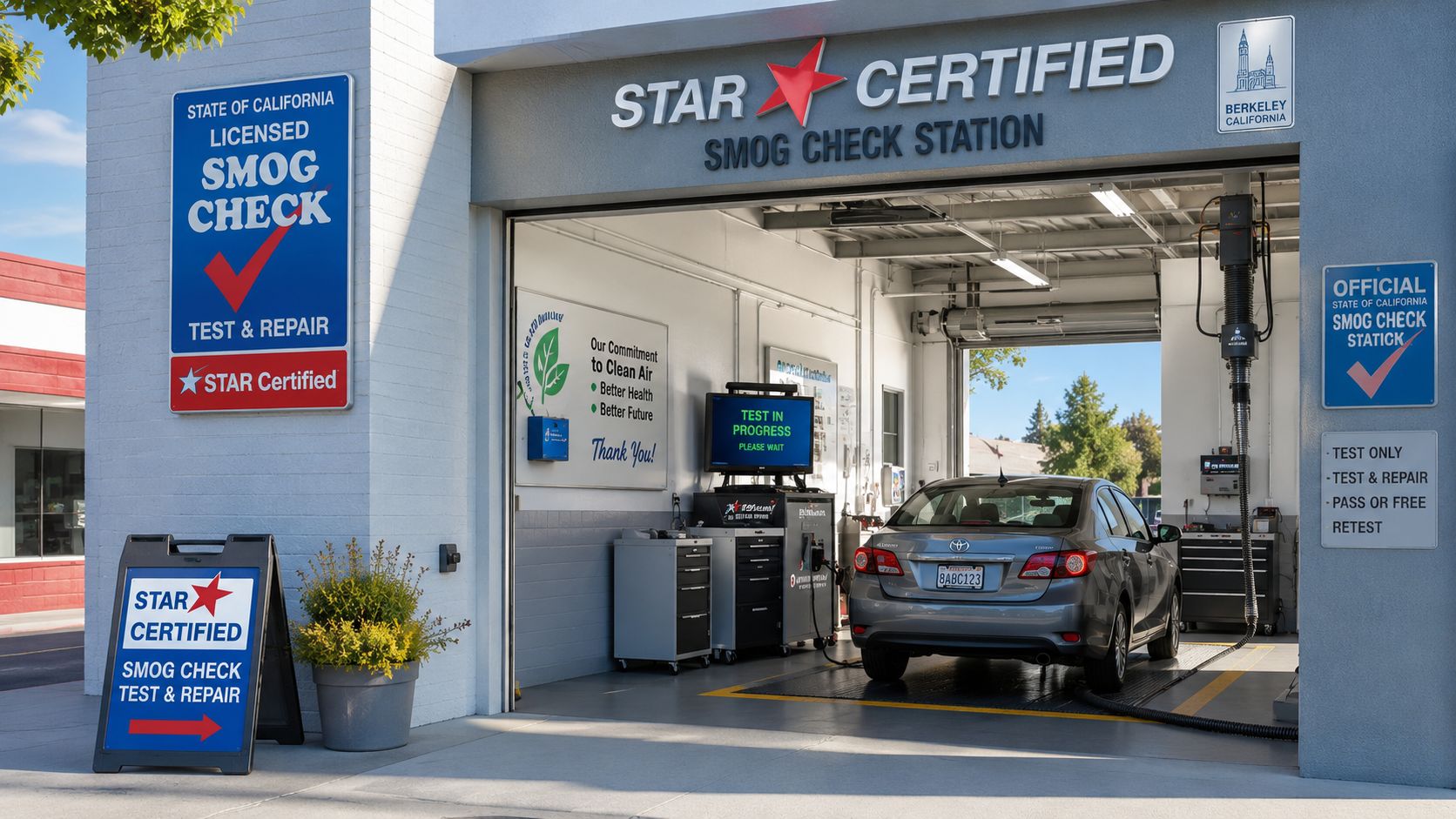
Start with certification. If your notice requires a STAR-certified station, don't waste time at a general test-only place. Then look at the station's workflow. A decent shop should tell you whether it handles newer OBD-based cars, older tailpipe-test cars, diesels, and hybrids without making you decode a marketing page.
The quality markers are simple.
- Clear station type: STAR, test-only, or test-and-repair.
- Straight pricing: no weird add-ons hidden in the quote.
- Fast intake: the test should start without a circus.
- Plain communication: you should know what failed and why.
If you want a local example, Speedy Smog in San Leandro is a STAR-certified station that says it handles most vehicles, including 2000-and-newer models, 1999-and-older vehicles, diesels, and hybrids. Its published address is 15275 Washington Ave, and it positions itself as a quick option for East Bay drivers who want a straightforward inspection. Speedy Smog station info
Why location matters less than fit
Berkeley drivers often fixate on distance, but that's the wrong filter. A slightly farther shop that can test your exact vehicle type correctly beats a nearby place that sends you away or fails you for a readiness issue nobody checked in advance.
The state also says the inspection usually takes about 30 minutes, and the station must charge an $8.25 certificate fee, which helps you separate the regulatory part from whatever the shop charges for labor. BAR Smog Check overview
Choose the station that matches your vehicle and your notice. That saves time, and it keeps the whole process predictable.
Why Vehicles Fail and What to Do Next
A failed smog check usually points to a specific problem. Berkeley drivers waste time when they assume a newer car should pass on age alone. California's January 2025 data shows that assumption does not hold up.
The failure rates are real
In that month, California recorded 1,063,192 total tests and 98,063 overall failures, for a statewide failure rate of 9.22%. Model year 2008 vehicles had an overall failure rate of 9.75% across 35,492 initial tests, model year 2024 vehicles failed at 5.11% across 6,601 tests, and model year 2025 vehicles failed at 11.09% across 1,298 tests, according to the BAR January 2025 Executive Summary.
| Model Year | Total Tests | Failure Rate |
|---|---|---|
| 2008 | 35,492 | 9.75% |
| 2024 | 6,601 | 5.11% |
| 2025 | 1,298 | 11.09% |
That table should end the myth that only old cars fail. Late-model vehicles miss too, and sometimes the problem is only a readiness issue or a fault code that got ignored.
What usually causes the fail
The common trouble spots are incomplete monitor readiness, stored diagnostic faults, exhaust leaks, catalyst deterioration, and software tampering. For Berkeley drivers, the right next step is to read the Vehicle Inspection Report, identify whether the failure is a readiness problem, a repairable code, or a deeper emissions issue, then decide if the car needs a mechanic before the next test.
A blind retest costs money. Every inspection includes the $8.25 certificate fee, whether the car passes or fails, so repeating the same bad setup just buys another chance to fail. The BAR Smog Check program details make that fee part of the inspection process.
Smart move: If the report points to readiness or a fault code, fix the cause first. Retesting a broken car just creates a second bill.
If the car passes, keep the paperwork and finish the DMV registration right away. If it fails, repair the problem before you return. That is the only way to avoid wasting time and money.
Your Complete Smog Check Action Plan
Start with the question most drivers skip. Does your car need a test this year? If it's a gasoline car that's 1975 or older, a gasoline or hybrid vehicle that's less than eight model-years old, or an electric vehicle, you may not need to book anything at all. California DMV smog inspection rules
If your car does need testing, check the check-engine light and make sure the OBD monitors are ready before you leave home. For a battery that was recently disconnected, give it 1 to 2 weeks of driving so the system can reset. If the car is 1999 or older, warm it up, remove the guesswork, and don't roll in cold.
Use this order and you'll avoid most of the dumb failures.
- Confirm exemption status.
- Check the warning lights.
- Verify readiness or warm-up status.
- Book the right station type.
- Bring the renewal notice and get the test done.
If you fail, don't chase a quick retest. Read the report, fix the actual problem, then come back. If you pass, handle DMV registration right away and keep your records.
For Berkeley drivers, the key to a smooth smog check is preparation.
If you want a fast, straightforward inspection without guessing at the station type, Speedy Smog handles Berkeley-area drivers, tests a wide range of vehicles, and keeps the process focused on getting you certified and back on the road. Bring in a ready car, ask direct questions, and you'll spend less time waiting and less money chasing a fail you could've prevented.
You're probably familiar with the feeling. You're inching along East Bay traffic, the car in front of you keeps tapping its brakes, and the air outside looks a little dirtier than it did a few blocks ago. Even with the windows up, a busy commercial corridor can feel heavier than an open stretch of road.
That difference isn't just in your head. In dense city streets, pollution can build up in ways that surprise people. And that's why a smog check matters for more than DMV paperwork. In places like Oakland and San Leandro, emissions compliance is also part of how neighbors reduce the pollution everyone shares.
Table of Contents
- What Is High Street Smog and Why It Matters in the Bay Area
- The Science and Health Impact of Urban Air Pollution
- Californias Smog Check A Key Solution for Cleaner Air
- The Speedy Smog Check Process Explained
- How to Prepare Your Car for a Passing Smog Test
- Your High Street Smog Questions Answered
What Is High Street Smog and Why It Matters in the Bay Area
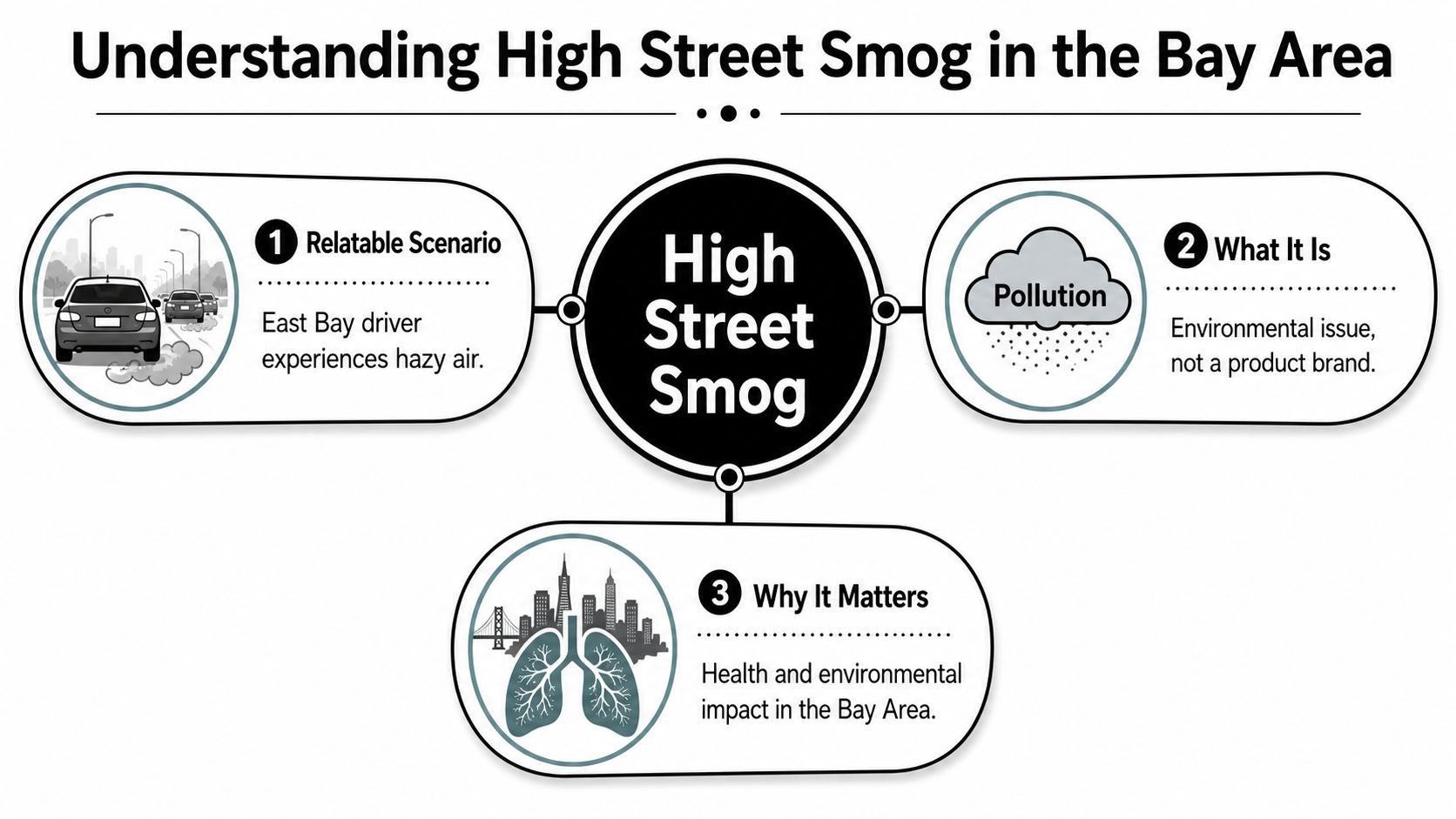
High street smog is concentrated air pollution that builds up along busy commercial streets where traffic, buildings, and stop-and-go driving all work together. It's not a special kind of California-only smog, and it's not just “bad air” in a general sense. It's the more intense pollution you get when emissions collect in a street environment that doesn't clear out easily.
Why busy streets feel different from open roads
The key idea is the street canyon effect. Think of a narrow road with taller buildings on both sides. Instead of wind moving pollution away, the buildings can disrupt airflow and keep emissions hanging lower and longer.
That's why the same amount of traffic can feel different depending on the street. A wider, more open road gives pollution more room to disperse. A tighter corridor can trap it closer to where people walk, drive, bike, wait for the bus, or stand outside a shop.
Researchers have noted that streets under 20 meters wide with tall buildings can cause irregular, dangerously high spikes in particulate matter because airflow gets trapped according to reporting on street canyon pollution physics.
Practical rule: If a street feels boxed in, has frequent braking, and keeps traffic close to storefronts and sidewalks, it can hold onto pollution more than an open roadway.
Why this matters locally
In the Bay Area, many drivers think mainly about freeway exposure. That matters, but local commercial corridors matter too. A dense block in Oakland or San Leandro can create a concentrated exposure zone even during short trips like school drop-offs, errands, or a commute through downtown.
Often, confusion arises. People assume, “My car is just one car.” But on a crowded corridor, every extra bit of exhaust adds to a shared pocket of pollution. The environment amplifies what would otherwise disperse more quickly.
A smog check doesn't solve every air-quality issue. It does something important, though. It helps identify vehicles emitting more pollution than they should, which is especially relevant in places where the shape of the street can make each vehicle's emissions more harmful to the people nearby.
The Science and Health Impact of Urban Air Pollution
Smog sounds like one thing, but it's really a mix of gases and particles. Some are released directly from vehicles. Others form in the air after those emissions react with sunlight.
How smog forms
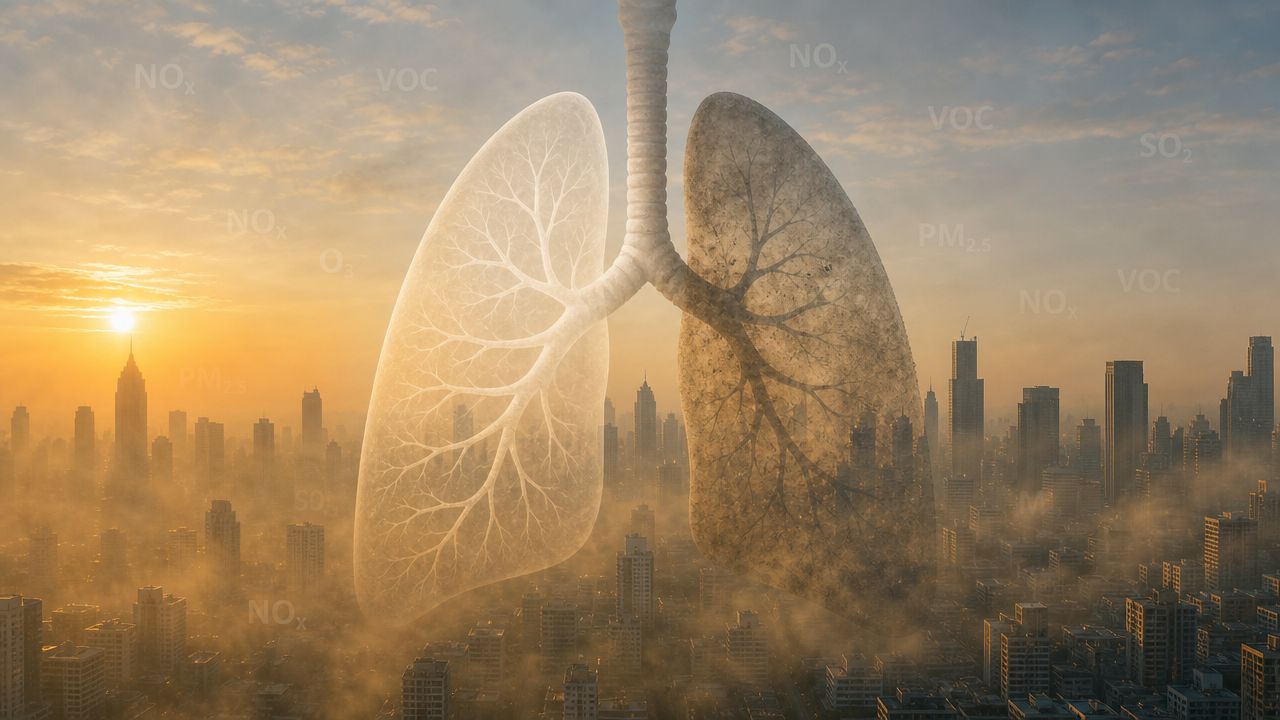
A simple way to think about it is as a harmful recipe. Cars release nitrogen oxides (NOx) and volatile organic compounds (VOCs). Sunlight acts like the heat. The result is ground-level ozone, one of the signature ingredients of photochemical smog.
According to Caltech's explanation of what causes smog, photochemical smog on high streets is primarily driven by NOx and VOCs reacting in sunlight, generating ground-level ozone that typically peaks at 40 to 80 parts per billion in dense urban corridors during summer afternoon hours.
If you want a plain-English breakdown of what comes out of a vehicle and why it matters, this guide on car emissions explained is a helpful companion.
Why the health risks are taken seriously
This isn't only about visible haze. The smallest pollutants are often the most concerning because people can breathe them deep into the lungs. Near-roadway pollution can also include ultrafine particles, black carbon, and other byproducts that aren't obvious from a quick glance outside.
The broader health burden is global. The World Health Organization states that ambient air pollution was responsible for an estimated 4.2 million premature deaths worldwide in 2019, and 99% of the world's population lives in places where WHO air quality guidelines are not met, according to the WHO fact sheet on ambient air quality and health-air-quality-and-health).
Another point often missed is how concentrated roadway pollution can be. The National Academies review notes that ultrafine particles, black carbon, and particle-bound PAHs can be 3 to 10 times more concentrated near roadways than at 500-meter distances, and that fine particulate pollution in the most polluted cities can shorten life expectancy by 1 to 3 years, as summarized in the traffic-related air pollution and health review.
The closer pollution is to where people breathe it, the less “average city air” matters and the more local street conditions matter.
That's why high street smog deserves its own explanation. It turns a general air-pollution issue into a block-by-block community problem.
Californias Smog Check A Key Solution for Cleaner Air
California's Smog Check program exists because tailpipe emissions are a public issue, not just a private maintenance issue. When a vehicle emits more pollution than it should, the effects don't stay in the engine bay. They move into the air everyone else uses.
Why the program exists
The case for emissions control becomes clearer when you look beyond one city or one state. In the United Kingdom, approximately 76% of high streets exceed the World Health Organization's recommended annual limit for nitrogen dioxide, according to reporting on UK high street air pollution. That's a strong reminder that dense commercial corridors often struggle with the same underlying problem.
California's response is practical. The state requires emissions testing for many vehicles because cleaner-running cars help lower the pollution load in the places people live, shop, and commute. The point isn't perfection. The point is removing avoidable excess emissions from the road.
For drivers, that means a smog check is best viewed as a maintenance checkpoint with a public-health benefit. A vehicle that passes is meeting the emissions standard it's supposed to meet. A vehicle that fails may need repair because something in the emissions system isn't working as intended.
What drivers should know about STAR testing
Some vehicles are directed to a STAR Certified station. That doesn't mean your car is in trouble. It means the inspection has to be done at a station that meets higher state performance standards.
Here's the practical distinction:
| Situation | What it usually means for the driver |
|---|---|
| Regular Smog Check need | Your vehicle needs the standard emissions inspection for registration or renewal |
| STAR station requirement | The state requires testing at a station recognized for higher performance standards |
| Failing inspection | Repairs may be needed before the vehicle can be certified |
If you're not sure what your registration notice requires, California-specific guidance on smog check rules and vehicle requirements can help you decode the paperwork before you book an appointment.
A smog check isn't about blaming drivers. It's a system for catching excess emissions before they keep circulating through crowded streets.
The Speedy Smog Check Process Explained
For most drivers, the hardest part of a smog check is uncertainty. People don't know how long it'll take, what the technician is checking, or whether their particular vehicle type changes the process.
What the visit looks like
At Speedy Smog in San Leandro, the process is designed to be straightforward. You arrive, check in, confirm the vehicle details, and the inspection begins. For most 2000 and newer vehicles, tests are typically completed in about 10 to 15 minutes, according to the publisher's business information provided for this article.
That short turnaround matters if you're squeezing the appointment into a workday, handling a registration deadline, or just trying to avoid spending half your afternoon waiting around. The shop is also set up with a clean indoor waiting room, which makes the stop feel more manageable than the old stereotype of a grimy inspection line.
What happens during the inspection
The exact testing details depend on the vehicle, but the customer experience is simple. The technician verifies what kind of smog inspection your car needs, performs the required emissions-related checks, and then lets you know whether the vehicle passed or if it needs follow-up work before certification.
People often appreciate two things most:
- Clear pricing: You know what the inspection costs without having to guess.
- Fast workflow: The visit is built around getting you in and out quickly when the vehicle is ready.
- Friendly communication: Questions about registration, timing, and next steps get answered in plain language.
That last point matters more than it sounds. Smog compliance can feel technical, especially if the DMV notice mentions STAR requirements or if you drive an older vehicle. A technician who explains the process clearly can lower a lot of stress.
For a quick look at the shop environment and service setup, this short video gives helpful context before you go:
What kinds of vehicles can be tested
One common misconception is that smog testing is mainly for standard late-model gas cars. In reality, Speedy Smog also handles a broader mix of vehicles based on the publisher information provided:
- 2000 and newer vehicles for drivers who want a quick inspection
- 1999 and older vehicles that may have different testing requirements
- Diesels that still need compliant emissions inspection
- Hybrids when certification is required
There are also periodic $25-off coupons for most smogs on newer vehicles, according to the publisher details. That won't apply in every case, but it's worth checking before you visit.
“Smog & a Smile” works because most drivers don't want a lecture. They want a clean process, a fair price, and an accurate result.
The main thing to know is that a smog check doesn't need to become a half-day project. When the vehicle is ready and the station is organized, it can be one of the easier items on your registration list.
How to Prepare Your Car for a Passing Smog Test
A little preparation can improve your chances of passing on the first try. None of these steps are complicated, but each one addresses a common reason a vehicle shows up unready for inspection.
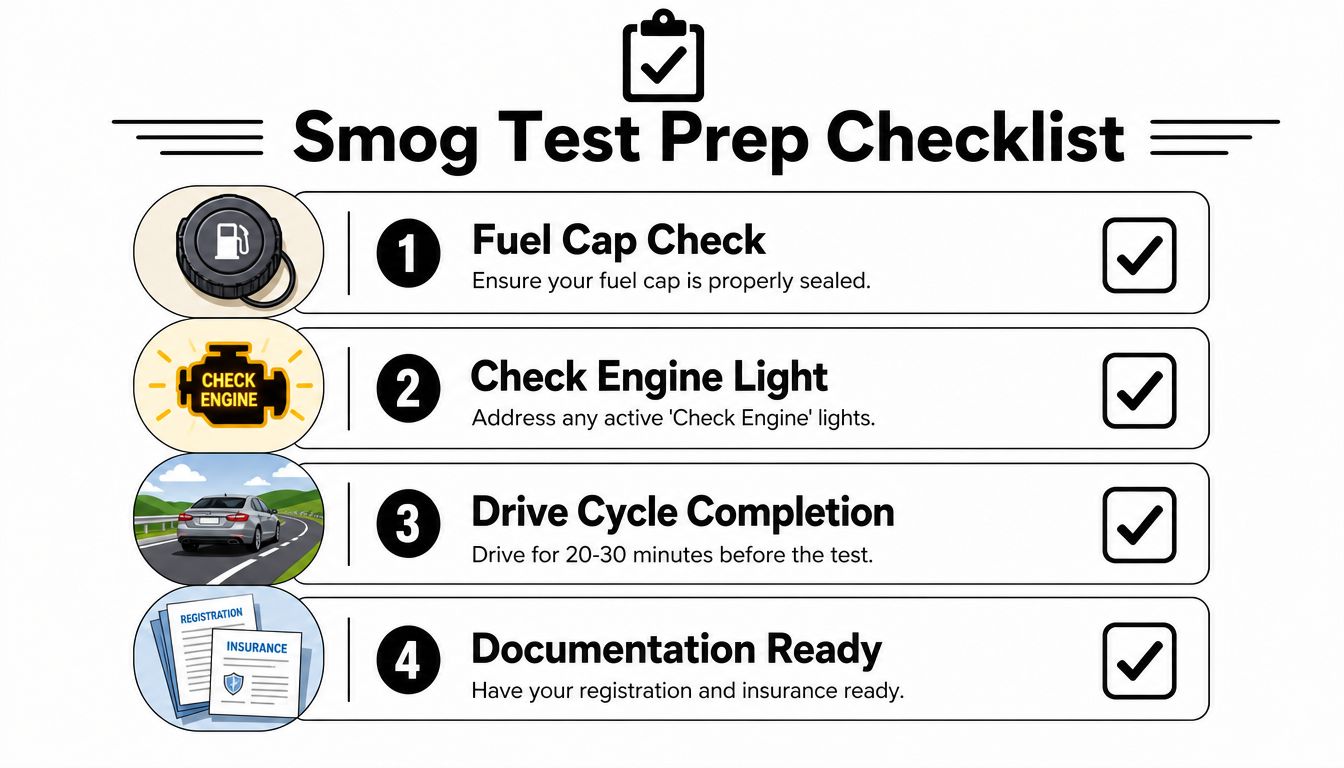
A simple pre-test checklist
Use this as a practical day-of checklist:
Drive the car before the test. A short drive helps warm up the engine and emissions equipment. Many drivers aim for about 20 to 30 minutes of normal driving before the appointment so the system is operating at normal temperature.
Make sure the Check Engine light is off. If it's on, don't ignore it and hope for the best. That light often signals an emissions-related problem, and it can block a passing result.
Tighten the gas cap. A loose or damaged gas cap can create evaporative-emissions issues. It's a small part, but it matters.
Bring your paperwork. Having your registration and insurance ready helps the visit move faster and avoids last-minute scrambling.
If you're wondering whether recent maintenance can affect test timing, this article on whether to get an oil change before a smog check answers a question many drivers have right before booking.
What to avoid right before your appointment
People sometimes overcomplicate smog prep. You usually don't need exotic fuel additives, last-minute tricks, or internet folklore. Stick to the basics.
A few sensible reminders help:
- Don't show up with an active warning light. If the dashboard is telling you something's wrong, take that seriously first.
- Don't skip the warm-up drive. A cold vehicle may not be in its best testing condition.
- Don't wait until the registration deadline. If the vehicle needs repair after a failed test, extra time helps.
Good prep is simple: warm the car up, check for warning lights, secure the gas cap, and bring your documents.
That approach won't fix a broken emissions component, but it will help you avoid preventable issues.
Your High Street Smog Questions Answered
Does passing mean the air around me is safe
No. Passing means your vehicle meets the emissions standard required for certification. It does not mean near-road air is harmless in heavy traffic.
That distinction matters in dense corridors. Research discussed in the near-roadway exposure study notes that ultrafine particulates and black carbon remain at increased levels within 30 meters of heavy traffic even after compliance. So certification is important, but compliance and personal exposure are not the same thing.
What happens if my car fails
A failed result usually means the vehicle needs diagnosis and repair before it can be certified. Common causes can involve sensors, the catalytic converter, evaporative-emissions components, or other emissions-related faults. The next best step is to find out what triggered the failure instead of guessing.
What does STAR Certified mean for me
It means your vehicle must be tested at a station that meets higher state performance standards. For the driver, the practical takeaway is simple. Go to the right kind of station the first time so your inspection counts for DMV purposes.
Is one smog check really meaningful for community air
By itself, one inspection won't erase high street smog. But each properly functioning vehicle adds less pollution to shared streets. In a street canyon environment, that local reduction matters more than many people realize.
If your registration is due and you want a fast, straightforward inspection, Speedy Smog in San Leandro offers STAR Certified testing for a wide range of vehicles, including newer cars, older models, diesels, and hybrids. With typical 10 to 15 minute tests for many 2000 and newer vehicles, a clean waiting room, transparent pricing, and a friendly local approach, it's a convenient option for East Bay drivers who want to get certified and get back on the road.