
You open the DMV renewal notice, glance at the due date, and realize you've got two choices. You can gamble on a random smog station and hope the car passes, or you can check the basics first and save yourself a wasted trip, a retest, and a repair bill you didn't need yet. For smog check berkeley ca, the smartest move is simple, know whether your car even needs testing, then make sure the car is ready before you book.
Table of Contents
- What a Smog Check Involves for Berkeley Drivers
- California Smog Check Exemptions and Requirements
- How to Prepare Your Vehicle Before the Test
- Where to Get Your Smog Check in the East Bay
- Why Vehicles Fail and What to Do Next
- Your Complete Smog Check Action Plan
What a Smog Check Involves for Berkeley Drivers
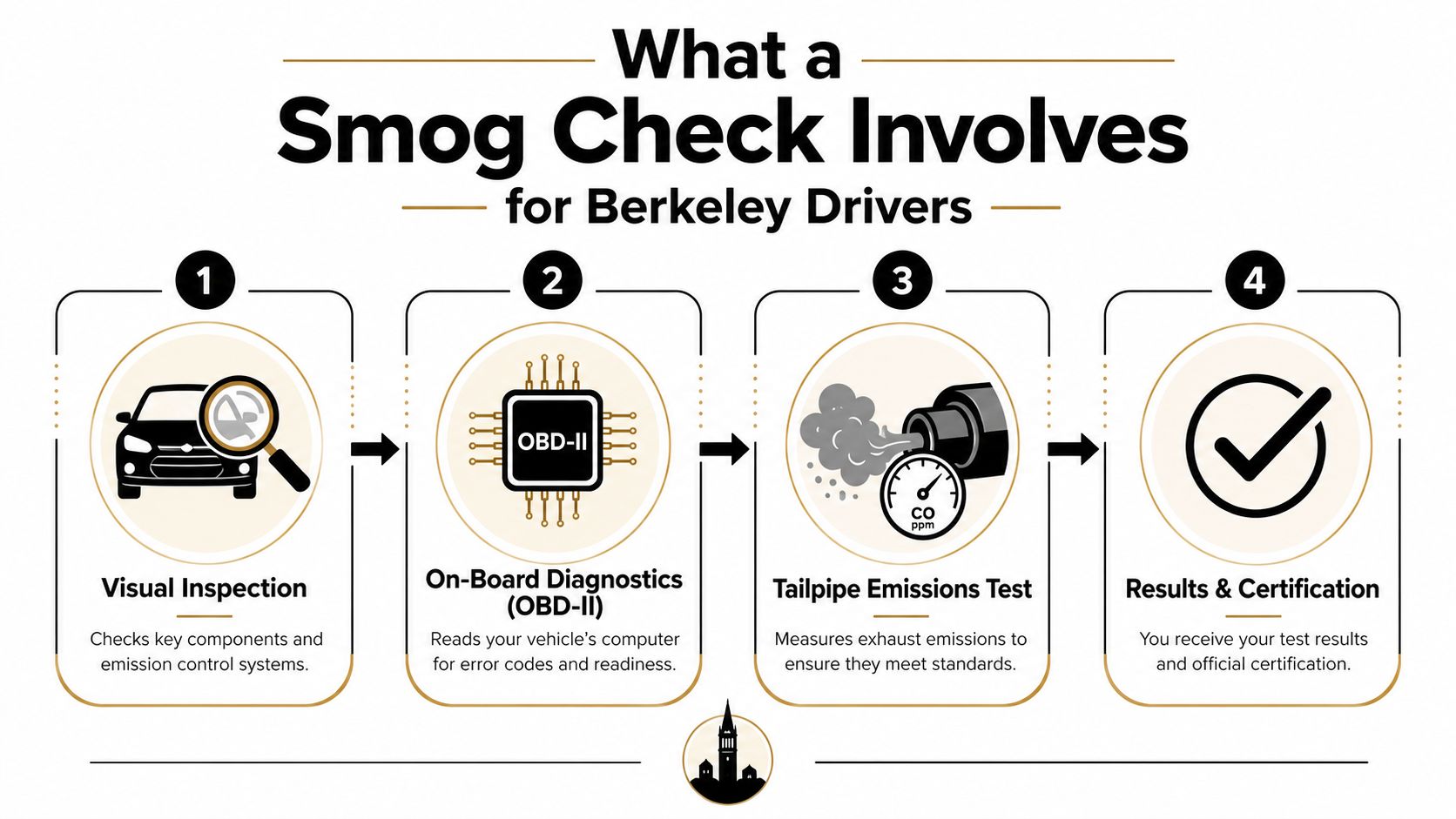
A Berkeley driver gets the renewal notice, books a test, and usually assumes the inspector is just plugging in a machine and printing a pass-or-fail slip. That oversimplifies the job. California's Smog Check program combines visual inspection, functional checks, and, depending on the vehicle, emissions testing, because the state is looking for the cars that pollute the most and getting them repaired before they stay on the road.
The reason is plain. A peer-reviewed analysis estimated that in 1999, Smog Check reduced tailpipe emissions by 97 tons/day of hydrocarbons, 1,690 tons/day of carbon monoxide, and 81 tons/day of nitrogen oxides, equal to 26%, 34%, and 14% of what would otherwise have been produced without the program. It also found that more than 90% of HC and CO benefits and over 80% of NOx benefits came from vehicles older than 10 years, even though those cars were only about half of the vehicles tested, which tells you where the program does the most work. Peer-reviewed Smog Check analysis
What the inspector checks
For newer gasoline and hybrid cars, the test is mostly OBD-focused. The station reads readiness monitors and emissions-related trouble codes through the BAR On-Board Diagnostic Inspection System, and the car fails if the check-engine light is on. That is the core of the test for a lot of vehicles. BAR OBD inspection guidance
For older gasoline vehicles, the process shifts to tailpipe measurement with the BAR-97 Emissions Inspection System. The inspector looks at exhaust behavior, warms the car up properly, and follows a standardized snap-test sequence. If you want a plain-English breakdown of the process, this smog check explained simply guide lays out the station flow without the regulatory jargon.
Practical rule: If your car is newer, the computer matters. If it's older, mechanical condition and warm-up matter more.
The facility type matters too. A STAR-certified station meets higher Bureau of Automotive Repair performance standards, which is why some DMV notices point you there instead of any test-only shop. Read the notice, match the station type, and do not pay for the wrong inspection.
California Smog Check Exemptions and Requirements
Berkeley drivers waste time when they book first and check the rules later. Start with the vehicle, not the shop. A quick exemption check tells you whether you need a station at all, and it keeps you from paying for a test you never had to take.
The vehicles that skip testing
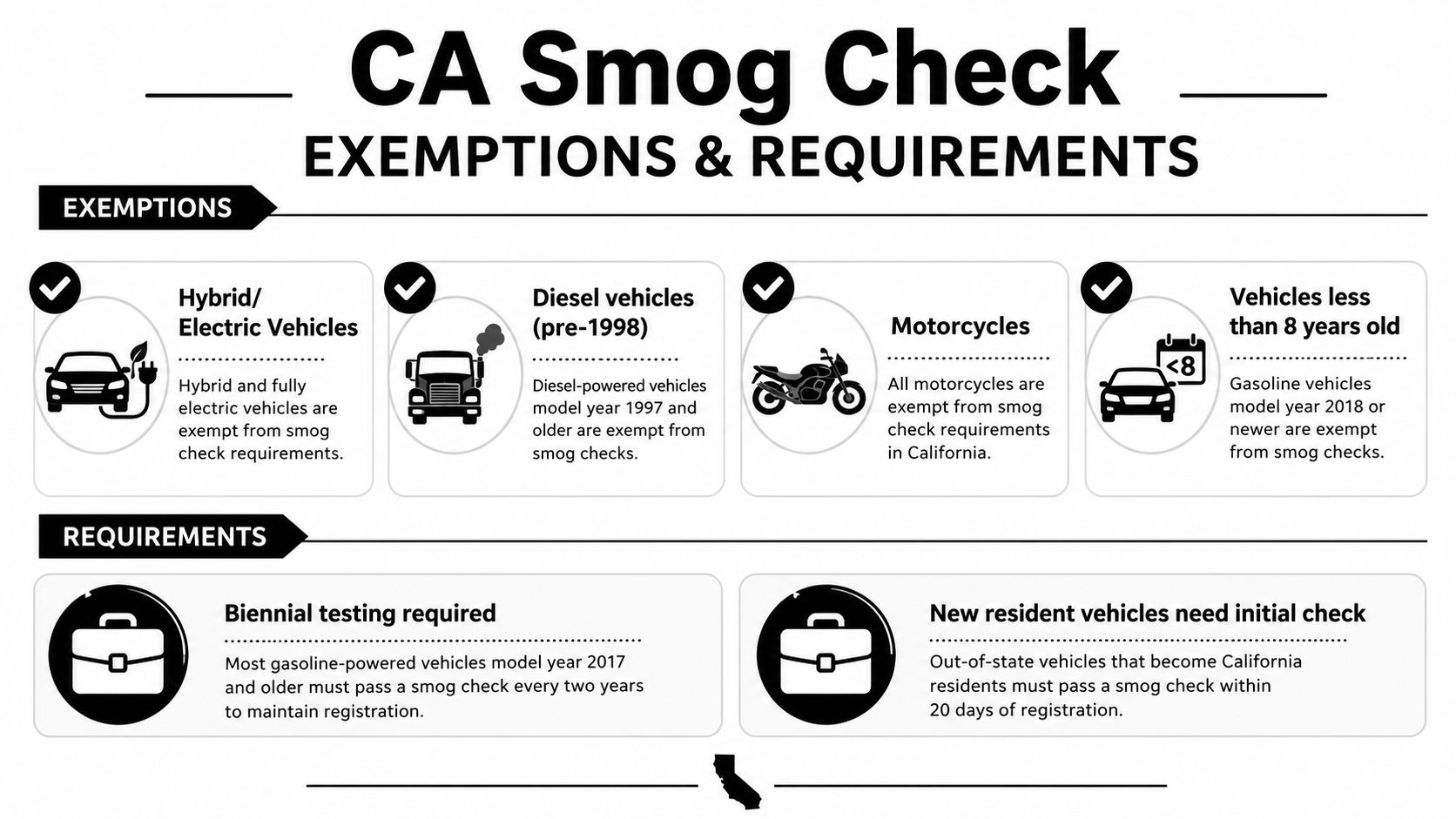
Gasoline vehicles are exempt if they are 1975 model year or older or less than eight model-years old, and electric vehicles are also exempt. California also says the first test for a new vehicle is generally due eight model years after the model year, and some newer vehicles can pay a smog abatement fee instead of testing for the first 8 years of registration. That is the first thing to verify before you book, because a lot of Berkeley and Oakland owners assume every renewal needs a test when it does not. California DMV smog inspection rules
If you want the state rule in plain English, use the California smog check rules reference and match it against your title or registration.
The clean way to think about it is this.
- Classic gasoline cars: 1975 and older, exempt.
- Newer gasoline cars: under eight model-years old, exempt.
- Electric vehicles: exempt.
- Some new registrations: may use a smog abatement fee instead of an immediate test.
For a lot of households, that ends the question right there. If your vehicle falls into one of those categories, stop shopping for a station and keep your money.
When you still need to book
If your vehicle is outside those exemptions, the test becomes part of registration compliance. That applies whether you are renewing on time, transferring ownership, or following a notice that points to a specific inspection type. Berkeley drivers get tripped up by local marketing pages that bury the state rule under shop promotions, but the state rule is what counts.
A smog check is not a neighborhood decision. It is a vehicle-status decision.
Do not guess based on age alone. Check the model year, check the fuel type, and read the DMV notice before you leave the house. That takes less time than calling around town and asking shops whether you “think” you need one.
How to Prepare Your Vehicle Before the Test
A lot of failed smog checks are self-inflicted. The car wasn't ready, the battery was just replaced, or the driver showed up with a warning light on and hoped for the best. That is not a plan. It is a wasted trip and a second bill.
For 2000-and-newer vehicles
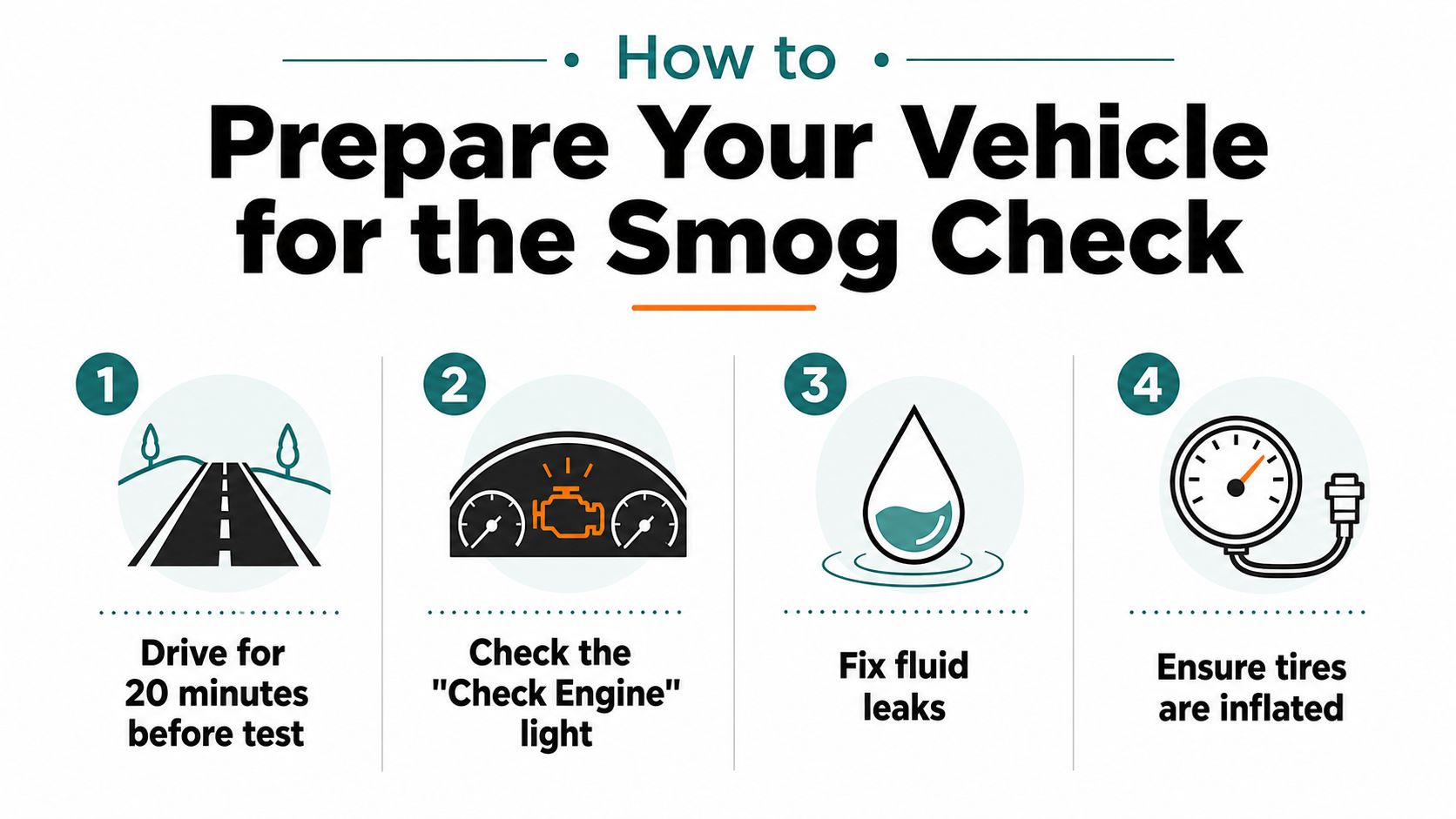
If your gas or hybrid vehicle is 2000 or newer, the test centers on OBD readiness. The station checks readiness monitors and stored trouble codes, and California BAR says a car with the check-engine light on will not pass. If the battery was recently disconnected, BAR says to drive 1 to 2 weeks so the monitors can reset before testing.
That means the pre-test check is simple, and Berkeley drivers should do it before booking a slot.
- Confirm the check-engine light is off. If it is on, fix the fault first.
- Check readiness status. Do not assume the car is ready after a battery swap.
- Drive long enough for monitors to reset. Short trips usually do not do it.
Do this before you pay a shop to look at the car. If the monitors are not set, the station cannot turn a half-ready vehicle into a pass.
For 1999-and-older gasoline vehicles
Older gasoline cars are handled differently. California uses the BAR-97 Emissions Inspection System, and the Smog Check Manual calls for the engine to be at normal operating temperature, idling for at least 3 minutes, then performing a BAR Snap Test by revving from idle to about 2,000 to 3,000 RPM and returning to idle. The vehicle must be in Park or Neutral, parking brake set, and accessories off. Smog Check Manual
Cold starts and sloppy prep can knock an older car out before the test gets going.
If the engine is cold, the test starts at a disadvantage. Warm the car up before you ever pull into the lot.
Older cars are also more sensitive to obvious safety issues like leaks, overheating, abnormal engine noise, or visible smoke. If the car shows those signs, fix them first. Do not pay for a test you already know is likely to go nowhere.
Check exemption status before you book
A lot of Berkeley drivers waste time on a test they never needed. Verify the model year, fuel type, and registration notice before you schedule anything. If your vehicle falls into an exemption category, skip the station search and keep the money in your pocket.
If you want a quick reference while you sort out your paperwork, use the smog check station guide for East Bay drivers and match the station type to your notice. That is the faster way to avoid booking the wrong place for the wrong car.
Where to Get Your Smog Check in the East Bay
Once the car is ready, pick the right station, not just the nearest one. A clean waiting room doesn't pass your car, and the cheapest ad on the internet doesn't tell you whether the shop can handle your model year or your DMV notice.
What to look for in a station
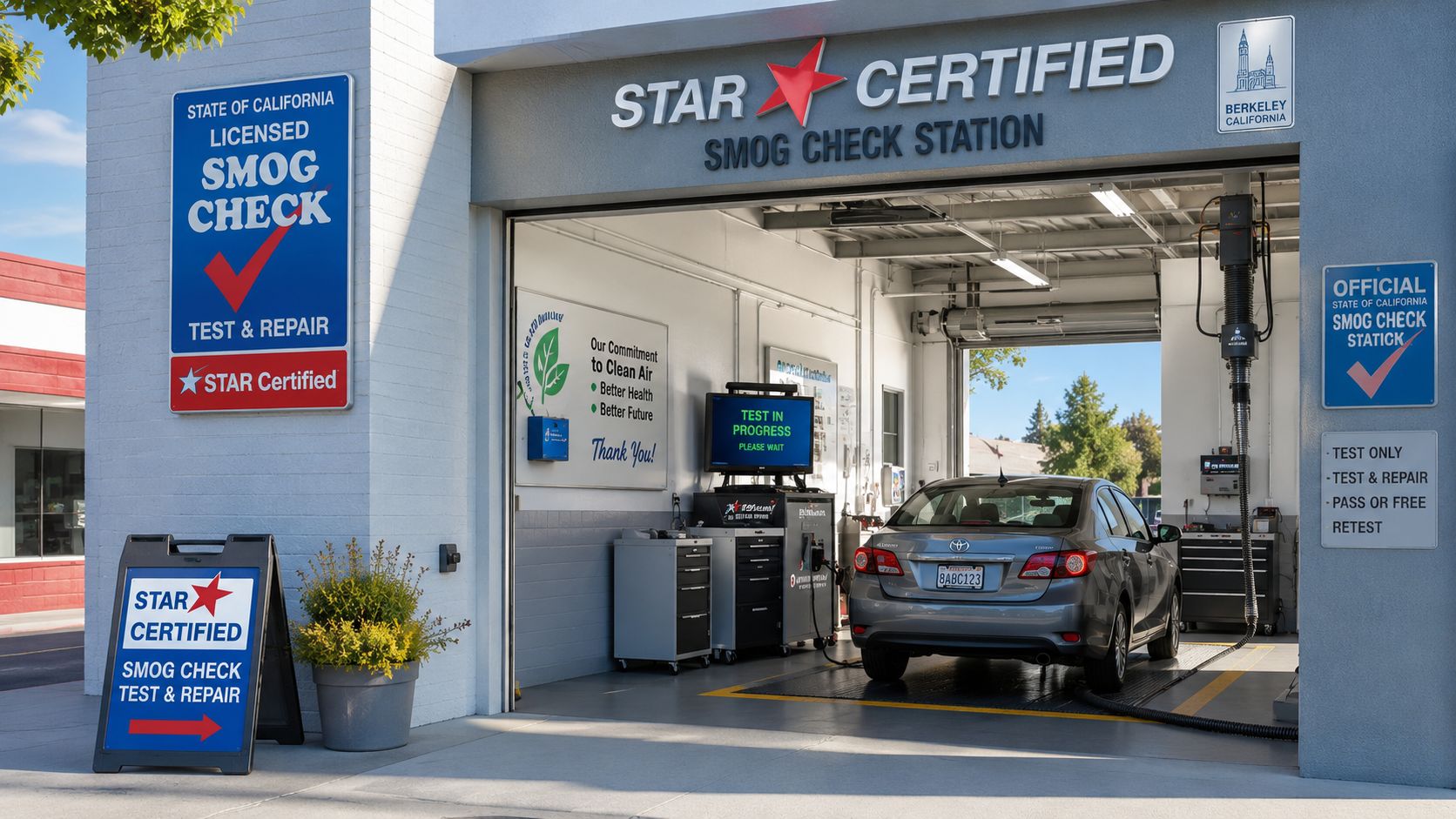
Start with certification. If your notice requires a STAR-certified station, don't waste time at a general test-only place. Then look at the station's workflow. A decent shop should tell you whether it handles newer OBD-based cars, older tailpipe-test cars, diesels, and hybrids without making you decode a marketing page.
The quality markers are simple.
- Clear station type: STAR, test-only, or test-and-repair.
- Straight pricing: no weird add-ons hidden in the quote.
- Fast intake: the test should start without a circus.
- Plain communication: you should know what failed and why.
If you want a local example, Speedy Smog in San Leandro is a STAR-certified station that says it handles most vehicles, including 2000-and-newer models, 1999-and-older vehicles, diesels, and hybrids. Its published address is 15275 Washington Ave, and it positions itself as a quick option for East Bay drivers who want a straightforward inspection. Speedy Smog station info
Why location matters less than fit
Berkeley drivers often fixate on distance, but that's the wrong filter. A slightly farther shop that can test your exact vehicle type correctly beats a nearby place that sends you away or fails you for a readiness issue nobody checked in advance.
The state also says the inspection usually takes about 30 minutes, and the station must charge an $8.25 certificate fee, which helps you separate the regulatory part from whatever the shop charges for labor. BAR Smog Check overview
Choose the station that matches your vehicle and your notice. That saves time, and it keeps the whole process predictable.
Why Vehicles Fail and What to Do Next
A failed smog check usually points to a specific problem. Berkeley drivers waste time when they assume a newer car should pass on age alone. California's January 2025 data shows that assumption does not hold up.
The failure rates are real
In that month, California recorded 1,063,192 total tests and 98,063 overall failures, for a statewide failure rate of 9.22%. Model year 2008 vehicles had an overall failure rate of 9.75% across 35,492 initial tests, model year 2024 vehicles failed at 5.11% across 6,601 tests, and model year 2025 vehicles failed at 11.09% across 1,298 tests, according to the BAR January 2025 Executive Summary.
| Model Year | Total Tests | Failure Rate |
|---|---|---|
| 2008 | 35,492 | 9.75% |
| 2024 | 6,601 | 5.11% |
| 2025 | 1,298 | 11.09% |
That table should end the myth that only old cars fail. Late-model vehicles miss too, and sometimes the problem is only a readiness issue or a fault code that got ignored.
What usually causes the fail
The common trouble spots are incomplete monitor readiness, stored diagnostic faults, exhaust leaks, catalyst deterioration, and software tampering. For Berkeley drivers, the right next step is to read the Vehicle Inspection Report, identify whether the failure is a readiness problem, a repairable code, or a deeper emissions issue, then decide if the car needs a mechanic before the next test.
A blind retest costs money. Every inspection includes the $8.25 certificate fee, whether the car passes or fails, so repeating the same bad setup just buys another chance to fail. The BAR Smog Check program details make that fee part of the inspection process.
Smart move: If the report points to readiness or a fault code, fix the cause first. Retesting a broken car just creates a second bill.
If the car passes, keep the paperwork and finish the DMV registration right away. If it fails, repair the problem before you return. That is the only way to avoid wasting time and money.
Your Complete Smog Check Action Plan
Start with the question most drivers skip. Does your car need a test this year? If it's a gasoline car that's 1975 or older, a gasoline or hybrid vehicle that's less than eight model-years old, or an electric vehicle, you may not need to book anything at all. California DMV smog inspection rules
If your car does need testing, check the check-engine light and make sure the OBD monitors are ready before you leave home. For a battery that was recently disconnected, give it 1 to 2 weeks of driving so the system can reset. If the car is 1999 or older, warm it up, remove the guesswork, and don't roll in cold.
Use this order and you'll avoid most of the dumb failures.
- Confirm exemption status.
- Check the warning lights.
- Verify readiness or warm-up status.
- Book the right station type.
- Bring the renewal notice and get the test done.
If you fail, don't chase a quick retest. Read the report, fix the actual problem, then come back. If you pass, handle DMV registration right away and keep your records.
For Berkeley drivers, the key to a smooth smog check is preparation.
If you want a fast, straightforward inspection without guessing at the station type, Speedy Smog handles Berkeley-area drivers, tests a wide range of vehicles, and keeps the process focused on getting you certified and back on the road. Bring in a ready car, ask direct questions, and you'll spend less time waiting and less money chasing a fail you could've prevented.