
High Street Smog Your Guide to California Smog Checks
You're probably familiar with the feeling. You're inching along East Bay traffic, the car in front of you keeps tapping its brakes, and the air outside looks a little dirtier than it did a few blocks ago. Even with the windows up, a busy commercial corridor can feel heavier than an open stretch of road.
That difference isn't just in your head. In dense city streets, pollution can build up in ways that surprise people. And that's why a smog check matters for more than DMV paperwork. In places like Oakland and San Leandro, emissions compliance is also part of how neighbors reduce the pollution everyone shares.
Table of Contents
- What Is High Street Smog and Why It Matters in the Bay Area
- The Science and Health Impact of Urban Air Pollution
- Californias Smog Check A Key Solution for Cleaner Air
- The Speedy Smog Check Process Explained
- How to Prepare Your Car for a Passing Smog Test
- Your High Street Smog Questions Answered
What Is High Street Smog and Why It Matters in the Bay Area
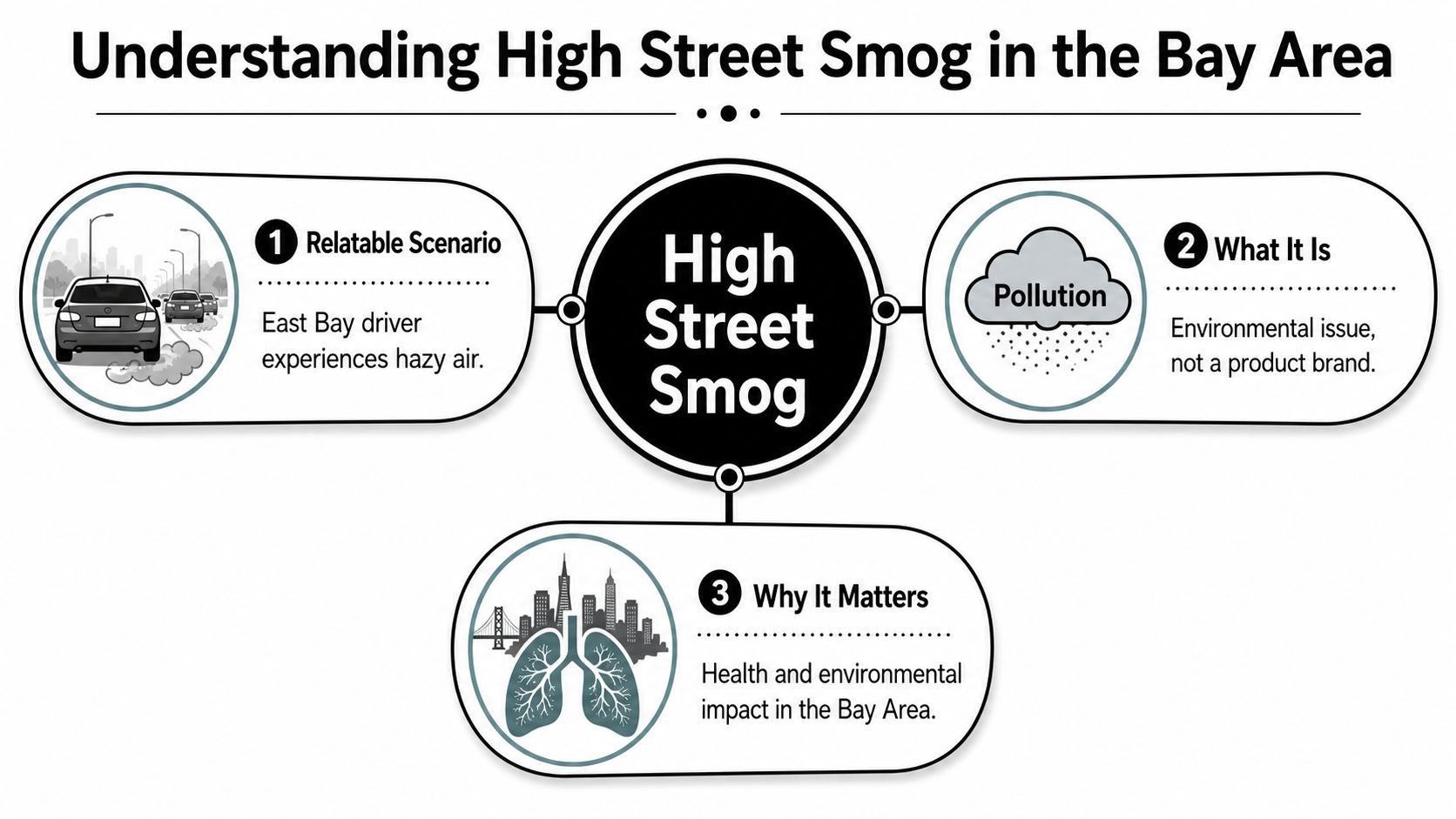
High street smog is concentrated air pollution that builds up along busy commercial streets where traffic, buildings, and stop-and-go driving all work together. It's not a special kind of California-only smog, and it's not just “bad air” in a general sense. It's the more intense pollution you get when emissions collect in a street environment that doesn't clear out easily.
Why busy streets feel different from open roads
The key idea is the street canyon effect. Think of a narrow road with taller buildings on both sides. Instead of wind moving pollution away, the buildings can disrupt airflow and keep emissions hanging lower and longer.
That's why the same amount of traffic can feel different depending on the street. A wider, more open road gives pollution more room to disperse. A tighter corridor can trap it closer to where people walk, drive, bike, wait for the bus, or stand outside a shop.
Researchers have noted that streets under 20 meters wide with tall buildings can cause irregular, dangerously high spikes in particulate matter because airflow gets trapped according to reporting on street canyon pollution physics.
Practical rule: If a street feels boxed in, has frequent braking, and keeps traffic close to storefronts and sidewalks, it can hold onto pollution more than an open roadway.
Why this matters locally
In the Bay Area, many drivers think mainly about freeway exposure. That matters, but local commercial corridors matter too. A dense block in Oakland or San Leandro can create a concentrated exposure zone even during short trips like school drop-offs, errands, or a commute through downtown.
Often, confusion arises. People assume, “My car is just one car.” But on a crowded corridor, every extra bit of exhaust adds to a shared pocket of pollution. The environment amplifies what would otherwise disperse more quickly.
A smog check doesn't solve every air-quality issue. It does something important, though. It helps identify vehicles emitting more pollution than they should, which is especially relevant in places where the shape of the street can make each vehicle's emissions more harmful to the people nearby.
The Science and Health Impact of Urban Air Pollution
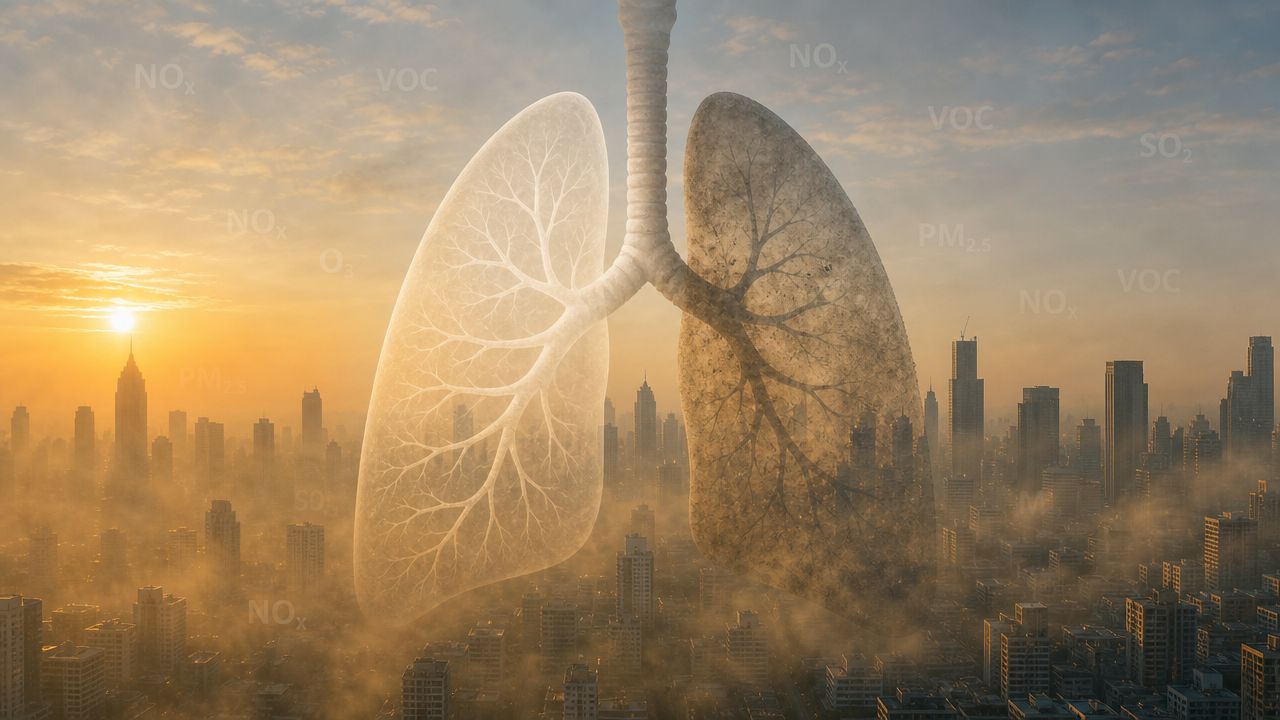
Smog sounds like one thing, but it's really a mix of gases and particles. Some are released directly from vehicles. Others form in the air after those emissions react with sunlight.
How smog forms
A simple way to think about it is as a harmful recipe. Cars release nitrogen oxides (NOx) and volatile organic compounds (VOCs). Sunlight acts like the heat. The result is ground-level ozone, one of the signature ingredients of photochemical smog.
According to Caltech's explanation of what causes smog, photochemical smog on high streets is primarily driven by NOx and VOCs reacting in sunlight, generating ground-level ozone that typically peaks at 40 to 80 parts per billion in dense urban corridors during summer afternoon hours.
If you want a plain-English breakdown of what comes out of a vehicle and why it matters, this guide on car emissions explained is a helpful companion.
Why the health risks are taken seriously
This isn't only about visible haze. The smallest pollutants are often the most concerning because people can breathe them deep into the lungs. Near-roadway pollution can also include ultrafine particles, black carbon, and other byproducts that aren't obvious from a quick glance outside.
The broader health burden is global. The World Health Organization states that ambient air pollution was responsible for an estimated 4.2 million premature deaths worldwide in 2019, and 99% of the world's population lives in places where WHO air quality guidelines are not met, according to the WHO fact sheet on ambient air quality and health-air-quality-and-health).
Another point often missed is how concentrated roadway pollution can be. The National Academies review notes that ultrafine particles, black carbon, and particle-bound PAHs can be 3 to 10 times more concentrated near roadways than at 500-meter distances, and that fine particulate pollution in the most polluted cities can shorten life expectancy by 1 to 3 years, as summarized in the traffic-related air pollution and health review.
The closer pollution is to where people breathe it, the less “average city air” matters and the more local street conditions matter.
That's why high street smog deserves its own explanation. It turns a general air-pollution issue into a block-by-block community problem.
Californias Smog Check A Key Solution for Cleaner Air
California's Smog Check program exists because tailpipe emissions are a public issue, not just a private maintenance issue. When a vehicle emits more pollution than it should, the effects don't stay in the engine bay. They move into the air everyone else uses.
Why the program exists
The case for emissions control becomes clearer when you look beyond one city or one state. In the United Kingdom, approximately 76% of high streets exceed the World Health Organization's recommended annual limit for nitrogen dioxide, according to reporting on UK high street air pollution. That's a strong reminder that dense commercial corridors often struggle with the same underlying problem.
California's response is practical. The state requires emissions testing for many vehicles because cleaner-running cars help lower the pollution load in the places people live, shop, and commute. The point isn't perfection. The point is removing avoidable excess emissions from the road.
For drivers, that means a smog check is best viewed as a maintenance checkpoint with a public-health benefit. A vehicle that passes is meeting the emissions standard it's supposed to meet. A vehicle that fails may need repair because something in the emissions system isn't working as intended.
What drivers should know about STAR testing
Some vehicles are directed to a STAR Certified station. That doesn't mean your car is in trouble. It means the inspection has to be done at a station that meets higher state performance standards.
Here's the practical distinction:
| Situation | What it usually means for the driver |
|---|---|
| Regular Smog Check need | Your vehicle needs the standard emissions inspection for registration or renewal |
| STAR station requirement | The state requires testing at a station recognized for higher performance standards |
| Failing inspection | Repairs may be needed before the vehicle can be certified |
If you're not sure what your registration notice requires, California-specific guidance on smog check rules and vehicle requirements can help you decode the paperwork before you book an appointment.
A smog check isn't about blaming drivers. It's a system for catching excess emissions before they keep circulating through crowded streets.
The Speedy Smog Check Process Explained
For most drivers, the hardest part of a smog check is uncertainty. People don't know how long it'll take, what the technician is checking, or whether their particular vehicle type changes the process.
What the visit looks like
At Speedy Smog in San Leandro, the process is designed to be straightforward. You arrive, check in, confirm the vehicle details, and the inspection begins. For most 2000 and newer vehicles, tests are typically completed in about 10 to 15 minutes, according to the publisher's business information provided for this article.
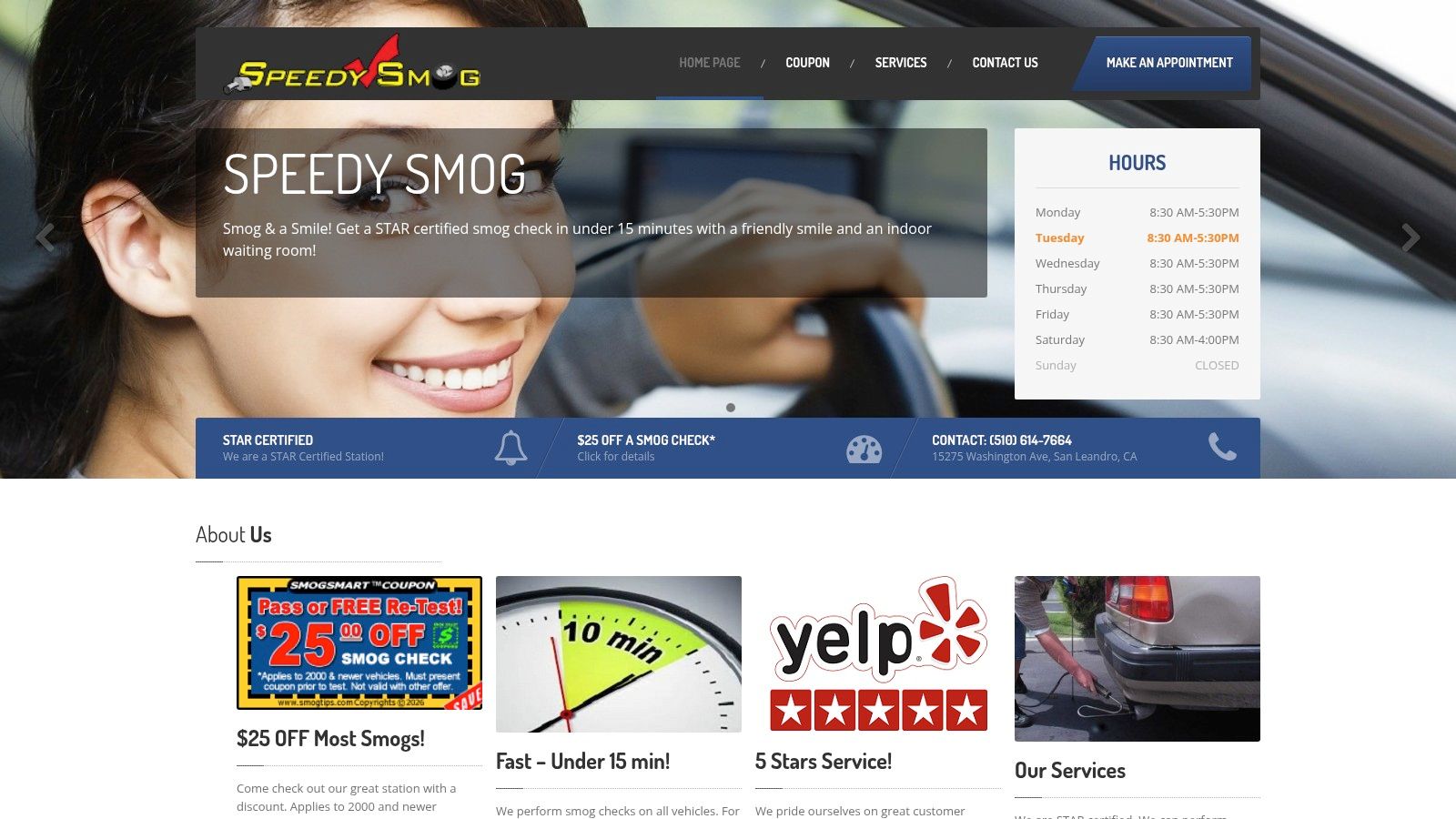
That short turnaround matters if you're squeezing the appointment into a workday, handling a registration deadline, or just trying to avoid spending half your afternoon waiting around. The shop is also set up with a clean indoor waiting room, which makes the stop feel more manageable than the old stereotype of a grimy inspection line.
What happens during the inspection
The exact testing details depend on the vehicle, but the customer experience is simple. The technician verifies what kind of smog inspection your car needs, performs the required emissions-related checks, and then lets you know whether the vehicle passed or if it needs follow-up work before certification.
People often appreciate two things most:
- Clear pricing: You know what the inspection costs without having to guess.
- Fast workflow: The visit is built around getting you in and out quickly when the vehicle is ready.
- Friendly communication: Questions about registration, timing, and next steps get answered in plain language.
That last point matters more than it sounds. Smog compliance can feel technical, especially if the DMV notice mentions STAR requirements or if you drive an older vehicle. A technician who explains the process clearly can lower a lot of stress.
For a quick look at the shop environment and service setup, this short video gives helpful context before you go:
What kinds of vehicles can be tested
One common misconception is that smog testing is mainly for standard late-model gas cars. In reality, Speedy Smog also handles a broader mix of vehicles based on the publisher information provided:
- 2000 and newer vehicles for drivers who want a quick inspection
- 1999 and older vehicles that may have different testing requirements
- Diesels that still need compliant emissions inspection
- Hybrids when certification is required
There are also periodic $25-off coupons for most smogs on newer vehicles, according to the publisher details. That won't apply in every case, but it's worth checking before you visit.
“Smog & a Smile” works because most drivers don't want a lecture. They want a clean process, a fair price, and an accurate result.
The main thing to know is that a smog check doesn't need to become a half-day project. When the vehicle is ready and the station is organized, it can be one of the easier items on your registration list.
How to Prepare Your Car for a Passing Smog Test
A little preparation can improve your chances of passing on the first try. None of these steps are complicated, but each one addresses a common reason a vehicle shows up unready for inspection.
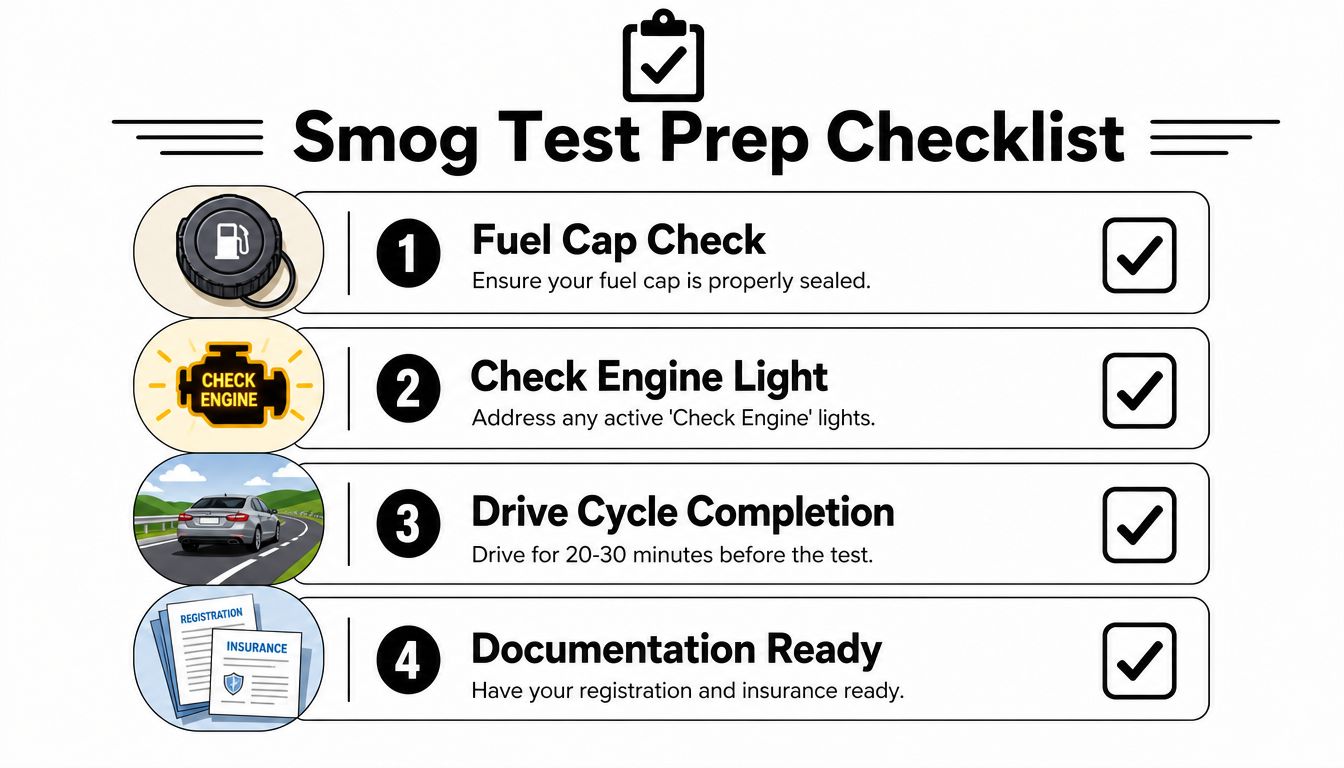
A simple pre-test checklist
Use this as a practical day-of checklist:
Drive the car before the test. A short drive helps warm up the engine and emissions equipment. Many drivers aim for about 20 to 30 minutes of normal driving before the appointment so the system is operating at normal temperature.
Make sure the Check Engine light is off. If it's on, don't ignore it and hope for the best. That light often signals an emissions-related problem, and it can block a passing result.
Tighten the gas cap. A loose or damaged gas cap can create evaporative-emissions issues. It's a small part, but it matters.
Bring your paperwork. Having your registration and insurance ready helps the visit move faster and avoids last-minute scrambling.
If you're wondering whether recent maintenance can affect test timing, this article on whether to get an oil change before a smog check answers a question many drivers have right before booking.
What to avoid right before your appointment
People sometimes overcomplicate smog prep. You usually don't need exotic fuel additives, last-minute tricks, or internet folklore. Stick to the basics.
A few sensible reminders help:
- Don't show up with an active warning light. If the dashboard is telling you something's wrong, take that seriously first.
- Don't skip the warm-up drive. A cold vehicle may not be in its best testing condition.
- Don't wait until the registration deadline. If the vehicle needs repair after a failed test, extra time helps.
Good prep is simple: warm the car up, check for warning lights, secure the gas cap, and bring your documents.
That approach won't fix a broken emissions component, but it will help you avoid preventable issues.
Your High Street Smog Questions Answered
Does passing mean the air around me is safe
No. Passing means your vehicle meets the emissions standard required for certification. It does not mean near-road air is harmless in heavy traffic.
That distinction matters in dense corridors. Research discussed in the near-roadway exposure study notes that ultrafine particulates and black carbon remain at increased levels within 30 meters of heavy traffic even after compliance. So certification is important, but compliance and personal exposure are not the same thing.
What happens if my car fails
A failed result usually means the vehicle needs diagnosis and repair before it can be certified. Common causes can involve sensors, the catalytic converter, evaporative-emissions components, or other emissions-related faults. The next best step is to find out what triggered the failure instead of guessing.
What does STAR Certified mean for me
It means your vehicle must be tested at a station that meets higher state performance standards. For the driver, the practical takeaway is simple. Go to the right kind of station the first time so your inspection counts for DMV purposes.
Is one smog check really meaningful for community air
By itself, one inspection won't erase high street smog. But each properly functioning vehicle adds less pollution to shared streets. In a street canyon environment, that local reduction matters more than many people realize.
If your registration is due and you want a fast, straightforward inspection, Speedy Smog in San Leandro offers STAR Certified testing for a wide range of vehicles, including newer cars, older models, diesels, and hybrids. With typical 10 to 15 minute tests for many 2000 and newer vehicles, a clean waiting room, transparent pricing, and a friendly local approach, it's a convenient option for East Bay drivers who want to get certified and get back on the road.