
You've just left a California smog station, and the technician has handed you a failing report marked gross polluter. Your first thoughts are usually the same: Can I still drive, will the DMV stop my registration, and how much will the repair cost?
Take a breath. This designation is serious, but it isn't a dead end. California gives you a defined path through diagnosis, repair, assistance or retirement decisions, and restricted retesting. The mistake I see most often is treating the result like an ordinary smog failure and sending the vehicle to the first available station.
Table of Contents
- You Got the Gross Polluter Notice Now What
- What Makes a Vehicle a Gross Polluter in California
- How the Gross Polluter Designation Affects Your Registration
- Diagnosing and Repairing Excessive Emissions
- Repair Assistance Programs and Appeal Options
- Choosing a STAR Certified Station for Your Retest
- Your Complete Action Plan From Gross Polluter to Certified
You Got the Gross Polluter Notice Now What
The driver I'll call Maria came into an East Bay shop after receiving a gross polluter result on her aging sedan. She had expected a routine inspection. Instead, she had a failed certificate, a registration deadline approaching, and no clear explanation beyond the two words that scared her.
Her first job wasn't authorizing an expensive repair. It was gathering the paperwork. The report identifies what the vehicle failed, whether the problem came from tailpipe emissions or the onboard diagnostic system, and whether the station directed the vehicle into the gross-polluter process. Keep that document, because the next technician needs the actual test information rather than a verbal summary.
Practical rule: Don't replace parts until someone has explained what the test result points to.
A gross polluter designation doesn't automatically tell you which component failed. It tells you that the emissions result crossed a much stricter regulatory category. The repair may involve an inexpensive ignition or vacuum problem, or it may involve a catalytic converter or another major emissions component. Guessing makes the situation more expensive.
Your immediate plan should be straightforward:
- Read the result carefully: Confirm the vehicle identification, failure codes, measured emissions, and instructions for the next test.
- Check your registration status: A failed or missing certification can prevent the DMV from completing the registration process.
- Avoid casual retesting: Before booking another inspection, ask whether the vehicle must return through a STAR station or another authorized facility.
- Get a diagnostic opinion: Choose a technician who will test the cause instead of selling a standard package of parts.
- Ask about assistance early: Repair assistance may affect which repairs you authorize and how you pay for them.
The California Bureau of Automotive Repair's official Smog Check reference guide explains the special certification rules that apply after a vehicle is identified as a gross polluter. Your car may still be usable for necessary purposes depending on its registration and legal status, but the smog result itself doesn't give you permission to ignore registration requirements. If you're unsure, confirm your status with the DMV or a qualified professional before driving routinely.
What Makes a Vehicle a Gross Polluter in California
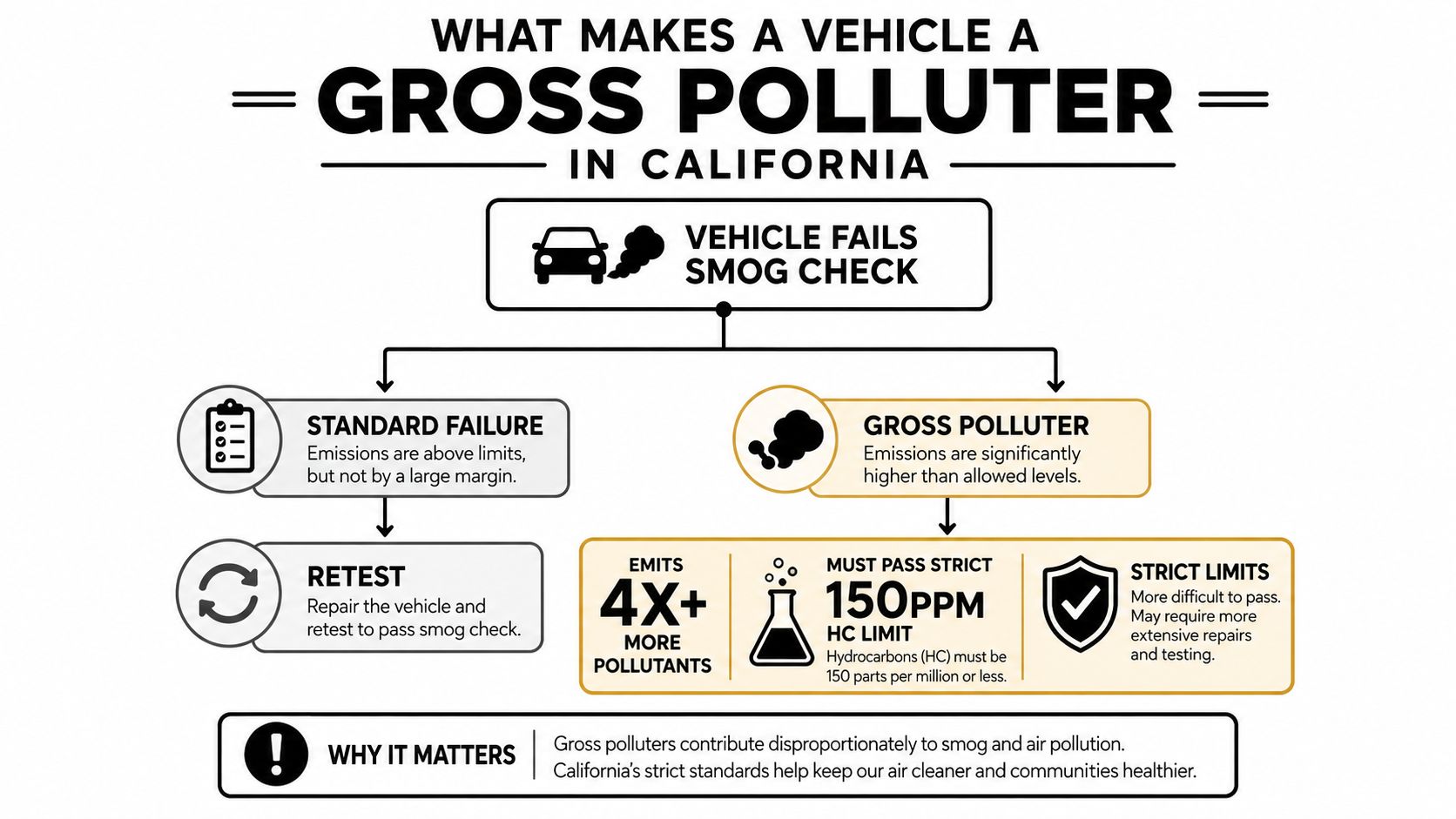
A failed smog test does not automatically make a vehicle a gross polluter. The distinction matters because the repair path, testing requirements, and potential assistance can change after the higher designation.
California classifies a vehicle as a gross polluter when its tailpipe emissions exceed the gross-polluter standards in California Code of Regulations section 3340.42. The BAR reference guide linked earlier explains that the label depends on the measured emissions compared with the limits for that vehicle, not just on receiving a failed result.
A regular failure means the vehicle missed an applicable test requirement. A gross polluter result means it crossed a separate, more severe emissions threshold. Treat those results differently. Do not approve repairs from the word “failed” alone. Ask the technician to show the measured emissions, the applicable limits, and the test data supporting the designation.
Why the vehicle's details matter
The applicable limit depends on the vehicle's specific make, model, and model year. Two vehicles can produce the same measured emissions and receive different results because their standards differ. Give the technician the vehicle identification and complete test report before accepting an estimate.
Historical research on California's gross-polluter definition described eligibility as at least twice the allowed emissions level for the vehicle's specific make, model, and model year. The distinction between an ordinary failure and the separate gross-polluter threshold is documented in this University of California research record.
Use that historical description for context, not as the current testing rule. The current test report and California requirements control. In practice, the designation signals a more severe emissions problem, so insist on diagnosis before replacing parts. Check ignition, fuel, vacuum, oxygen-sensor, and catalytic-converter systems in a logical order, based on the test results. That approach gives you a better chance of finding a repairable cause before paying for major components.
How the Gross Polluter Designation Affects Your Registration
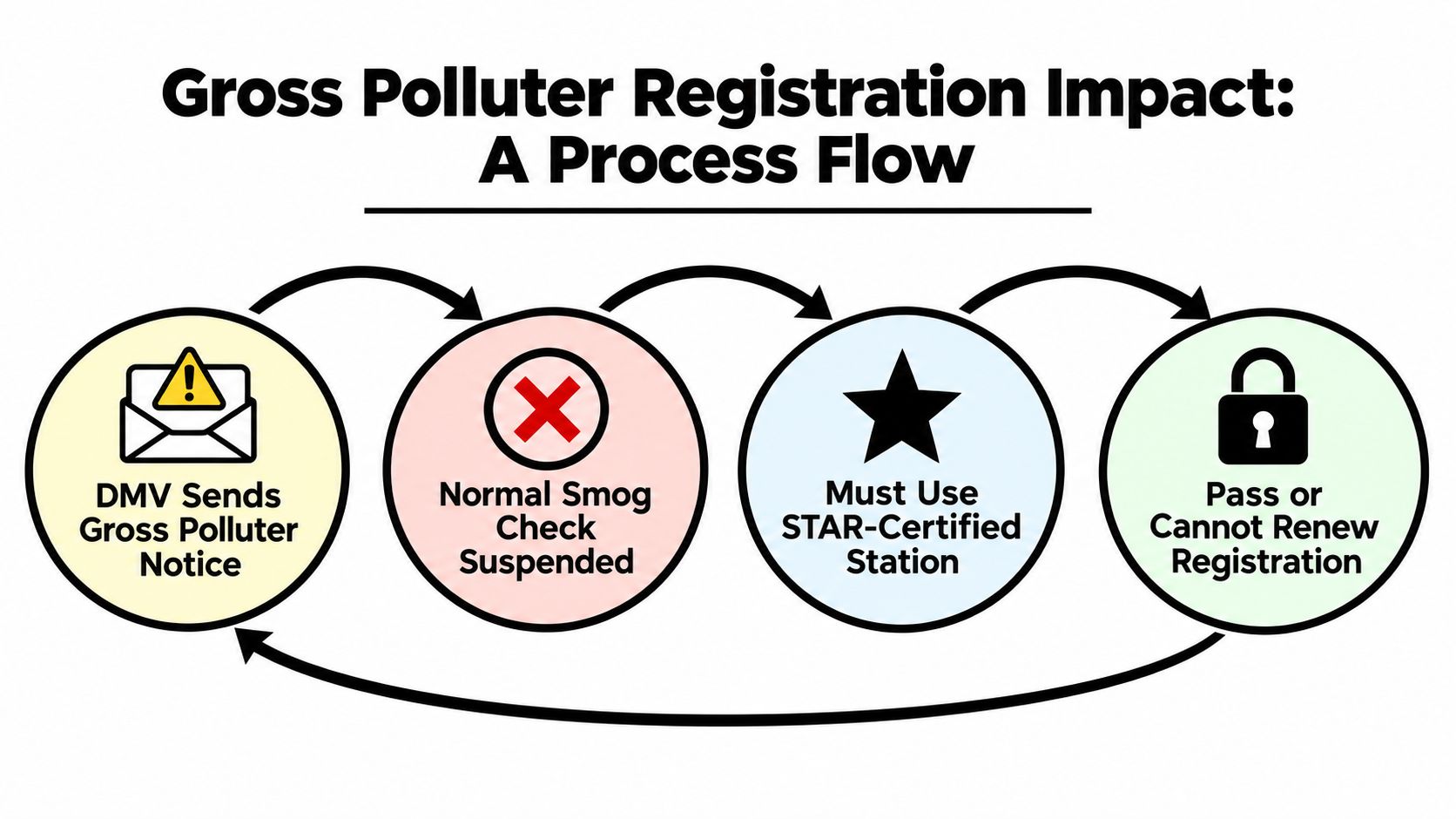
A gross-polluter designation can stop the registration process until the vehicle earns a passing smog certificate. The next step is choosing a facility authorized to handle the required inspection, then confirming that facility before paying for repairs. The current BAR reference guide outlines the applicable testing pathway.
The available options include:
- STAR test-only station: Performs the inspection but does not repair the vehicle.
- STAR test-and-repair station: Can diagnose or repair the vehicle and complete the authorized inspection.
- Referee facility: May be required if the vehicle is directed to the Referee process or needs specialized review.
Choose the facility before authorizing repairs
Call first. Give the station the exact designation, ask whether it handles gross-polluter inspections, and confirm whether it can perform the official certification after repairs. A regular smog station may offer general information, but the wrong facility can leave you paying for another visit and test.
Your existing repair relationship should guide the choice. A test-only station can provide an independent result if you already have a trusted mechanic. A test-and-repair station can keep diagnosis, repairs, and retesting in one workflow. Either way, require a written explanation of the failed test before approving parts.
Protect the registration timeline
The designation does not extend the DMV registration deadline. If the DMV requires a passing certificate and you have not obtained one, registration can remain incomplete. A smog station cannot waive penalties or resolve a separate registration issue.
Before authorizing work, have the technician document:
- The findings on the original test report.
- Repairs supported by diagnostic results.
- Whether the station performs the official retest.
- The documents provided after a passing result.
- Whether a Referee appointment is required.
This record keeps the repair and certification steps connected. It also prevents paying for repairs at one location, then learning that the final inspection must be completed elsewhere.
Diagnosing and Repairing Excessive Emissions
Gross-polluter repairs should begin with evidence. A scan tool, visual inspection, emissions readings, fuel-trim data, ignition checks, and exhaust-system testing can help a technician separate the cause from the symptom. A check engine light or stored code can point toward a system, but it doesn't automatically identify the failed part.
The likely suspects depend on the test pattern and vehicle condition. A worn ignition component can leave fuel partially unburned. A vacuum leak can disturb the air-fuel mixture. A failing oxygen sensor can send inaccurate feedback to the engine computer. A leaking or stuck fuel injector can add too much fuel. A damaged catalytic converter may fail to process pollutants after the engine has already burned the mixture.
What a competent diagnostic visit should include
A technician should explain what was tested and why the recommended repair follows from those results. Ask for scan-tool codes, monitor status, fuel-trim observations, ignition findings, and any evidence from the exhaust system. If the recommendation is a catalytic converter, ask what caused the original failure and whether that cause has been addressed.
learning how to read OBD codes helps. Codes are clues, not verdicts. Replacing an oxygen sensor because the code mentions oxygen-sensor performance can waste money if the actual issue is a vacuum leak, wiring problem, exhaust leak, or mixture problem.
A temporary code reset isn't a repair. It only removes information the next technician needs.
Decide whether to repair or seek another opinion
Get a written estimate that separates diagnostic work, parts, labor, and retest-related services. If the estimate is large, ask for the test results supporting each major component. A second opinion makes sense when the first shop recommends several expensive parts without showing how it reached that conclusion.
Avoid shortcuts such as clearing codes immediately before testing, disconnecting the battery, or installing an unverified used emissions component. Those actions can hide the problem temporarily, leave monitors incomplete, or create another failure. The goal is a stable repair that brings emissions back within the applicable limits, not a vehicle that merely looks clean for a brief inspection.
Repair Assistance Programs and Appeal Options
The right decision depends on the vehicle's condition, your finances, and the quality of the original test information. Don't commit automatically to a major repair, and don't send a repairable car to a dismantler without checking assistance options first.
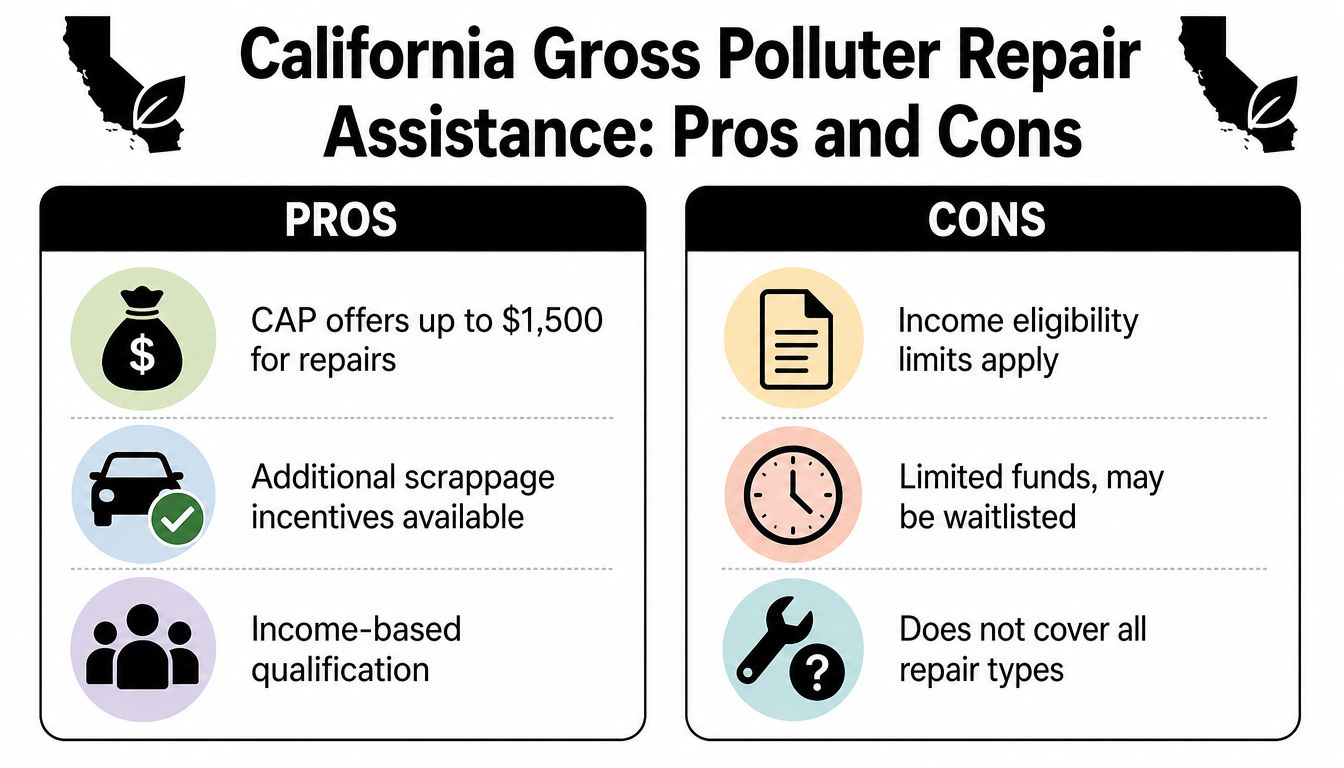
California's Consumer Assistance Program, commonly called CAP, can help qualifying owners with emissions-related repair costs. The available support depends on program rules, eligibility, funding, and the vehicle's documentation. Start with the Smog Check repair assistance information and verify current requirements directly through the Bureau of Automotive Repair before authorizing work.
Compare the three practical paths
| Path | Makes sense when | First move |
|---|---|---|
| Repair with assistance | The vehicle is worth keeping and you meet program requirements | Confirm eligibility before repairs begin |
| Retire the vehicle | The repair cost and vehicle condition don't justify continued ownership | Check retirement requirements and available incentives |
| Challenge the result | The test information appears inconsistent or the designation may be incorrect | Preserve the report and request guidance through BAR or the Referee process |
Income eligibility limits and program funding can change. Some repairs may not qualify, and approval isn't automatic. Ask whether the program requires authorization before work starts, because completing repairs first can affect your options.
If you believe the designation was issued in error, don't argue only from how the car feels or drives. Gather the failed inspection report, repair records, maintenance history, and any independent diagnostic findings. Contact the Bureau of Automotive Repair or ask whether a Referee evaluation applies. A challenge needs documentation, patience, and a clear technical reason, not just a disagreement with the result.
Choosing a STAR Certified Station for Your Retest
After repairs, choose the retest location before you finish the repair plan. A STAR-certified station is the practical choice when the vehicle's designation requires STAR testing, because California restricts gross-polluter certification to specified STAR facilities or an applicable Referee facility.
A STAR test-only station can be useful when you want the final inspection separated from the repair shop. A STAR test-and-repair station can be more convenient when the same team will verify repairs and complete the retest. Ask which service the vehicle requires, and don't assume a standard smog appointment will satisfy the DMV.
Prepare the vehicle properly
The check engine light should be off for the right reason, not because someone erased the code. If the battery was disconnected or codes were cleared, the vehicle may need normal driving before its emissions monitors complete. Your technician should tell you whether the monitors are ready and whether another drive cycle is needed.
Arrive with the engine fully warmed through ordinary driving. Check the fuel cap, address obvious warning lights, and bring the failed report plus repair invoices. Don't make last-minute modifications that haven't been tested.
For East Bay owners, Speedy Smog in San Leandro, located at 15275 Washington Ave, is one STAR-certified option. The shop handles inspections for newer and older vehicles, diesels, and hybrids, but call first to confirm the correct gross-polluter workflow and whether your vehicle needs a Referee appointment instead.
The best station is the one that understands the designation, explains the result, and gives you a clear answer about what happens next. That standard matters more than choosing a shop based only on proximity.
Your Complete Action Plan From Gross Polluter to Certified
Use this sequence as your working checklist. Keep every report, estimate, invoice, and approval document in one folder.
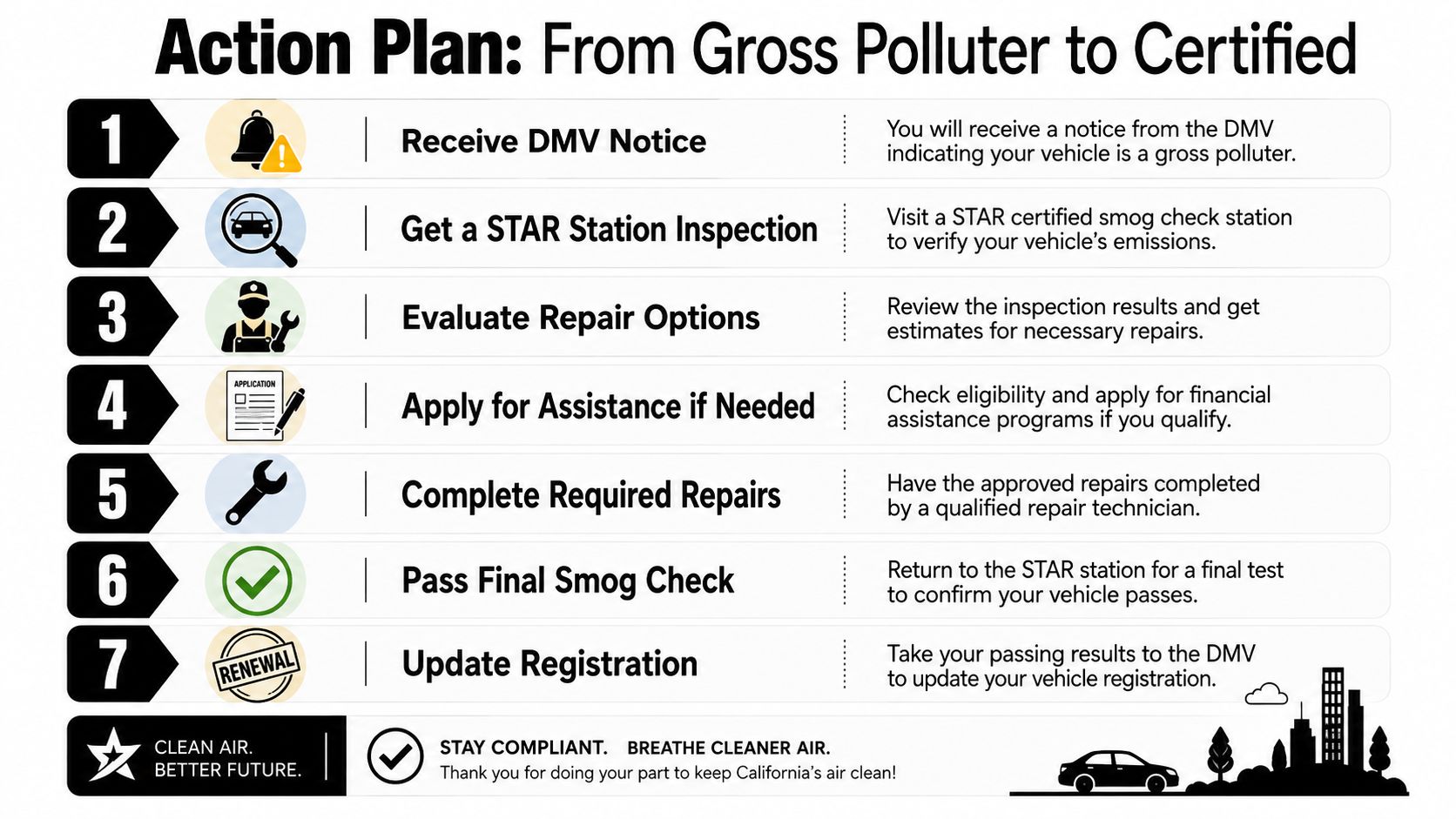
- Save the failed report: Record the designation, codes, measured results, and registration deadline.
- Confirm the testing path: Ask a STAR station or BAR whether your vehicle needs test-only, test-and-repair, or Referee handling.
- Get a documented diagnosis: Require test results before approving major emissions parts.
- Choose the financial path: Compare repair, CAP assistance, retirement, and appeal based on the vehicle's condition.
- Complete root-cause repairs: Fix the underlying engine or emissions problem, not only the stored code.
- Prepare for retesting: Confirm monitors are ready, the warning light is properly off, and the engine is warm.
- Submit the passing certification: Follow the DMV instructions and retain the certificate and repair records.
Don't assume you can drive normally while waiting. Check your registration and any DMV restrictions, and ask the appropriate agency or qualified professional about lawful use. If the retest fails again, stop authorizing random parts. Compare the new report with the original, identify what changed, and return to diagnosis or the Referee process if the results conflict.
The fastest route is usually the most organized route: correct station, accurate diagnosis, approved assistance, proper repair, then retest.
Speedy Smog provides STAR-certified smog inspections in San Leandro for gross-polluter-related workflows, along with testing for newer and older vehicles, diesels, and hybrids. Bring your failed report and ask the team to clarify whether you need a normal retest, a repair pathway, or Referee guidance, then visit Speedy Smog to schedule the next step.
You're already at the point where the smog appointment is on the calendar, the renewal deadline is creeping closer, and you're trying to figure out whether one more drive around the block will save the day. Most failures I see don't start at the station, they start in the driveway, with a cold engine, a hidden warning light, or a monitor that never finished setting. The good news is that passing an emissions test in California is usually about preparation, not luck.
California's rules are strict for a reason. The EPA says today's vehicles are up to 99% cleaner than those on the road in the early 1970s, which shows how far emissions control has come, but it also means modern inspections are built around whether the vehicle's systems are doing their job. For many drivers, the difference between a pass and a fail comes down to OBD-II readiness, a clean visual inspection, and showing up with the car in the right condition for the test.
Table of Contents
- Pre-Test Checklist Before You Arrive at the Station
- Completing the Drive Cycle and OBD Readiness Monitors
- Visual and Mechanical Items Inspectors Check
- What to Expect on Test Day at a STAR Station
- Common Failure Causes and Realistic Fixes
- What to Do If Your Vehicle Fails the Smog Check
Pre-Test Checklist Before You Arrive at the Station
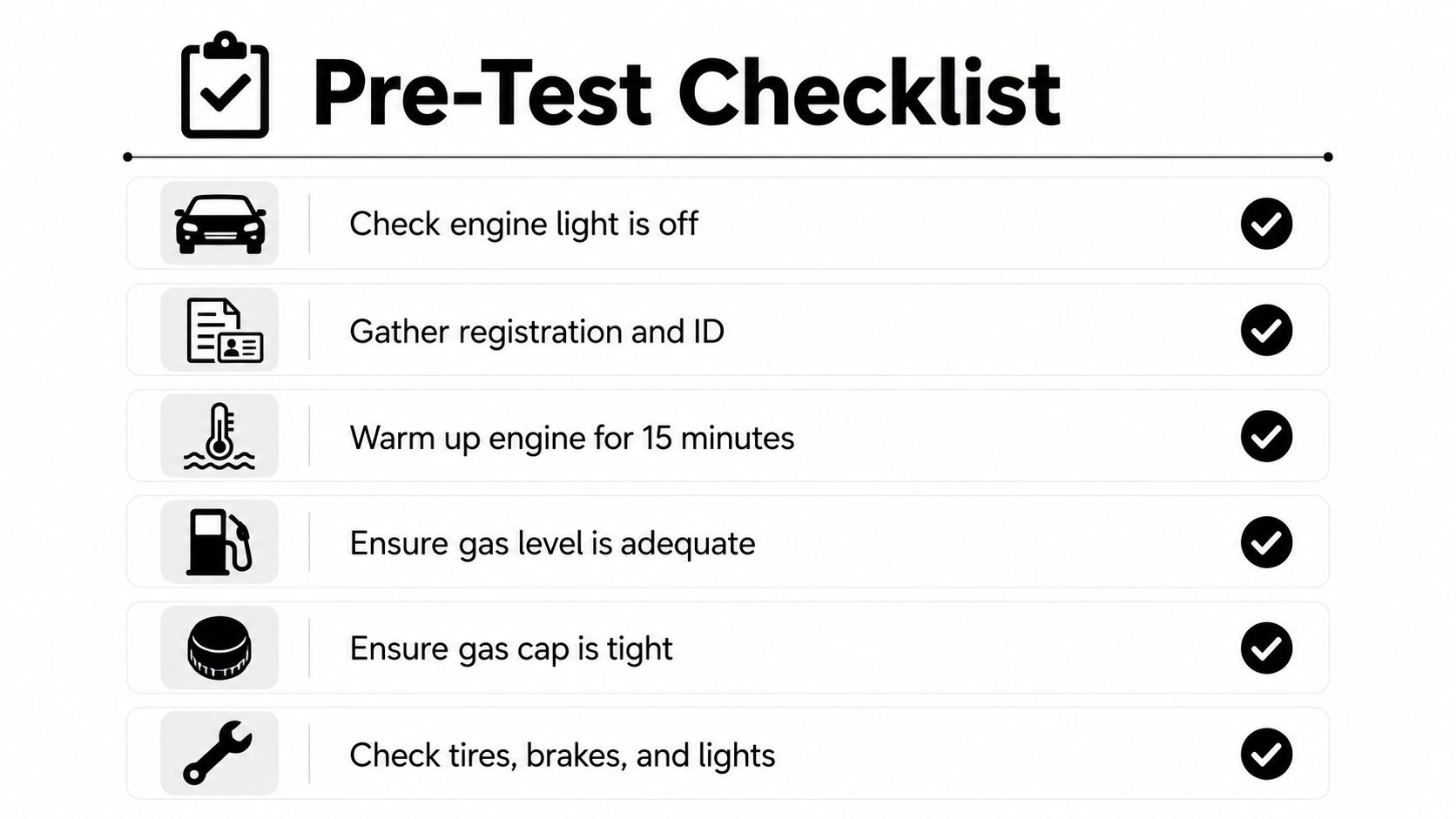
The most common bad appointment I see is the one where the driver rolls in with the engine still cold, the check engine light glowing, and a look that says, “Maybe they won't notice.” They will notice. A lit check engine light is not a detail you can talk your way around, and if the engine computer hasn't finished its emissions checks, the vehicle may not be ready to pass even if it drives fine.
Start with the obvious things
Before you leave home, look at the dashboard with the key on and the engine running. If the check engine light is on, don't assume it'll magically disappear on the way to the station. In OBD-era vehicles, a car can still pass when the light is operating normally but off and all but one monitor is completed under most conditions, but that only helps if the rest of the system is in good shape too.
Practical rule: if the car is alerting you on the dash, treat that as a repair problem first, not a testing problem.
Then check the simple visual items that cause wasted trips. Open the hood and look for loose hoses, wet spots, obvious leaks, or anything that looks disconnected. On California inspections, a car can fail for visual issues even when it runs normally, especially under the state's more detailed Smog Check process, which looks beyond just tailpipe behavior and routine drivability, as the California Smog Check Manual makes clear.
Don't skip paperwork and basic condition checks
Bring what the station needs for DMV processing, and make sure the car is reasonably presentable. A loose gas cap, missing under-hood label, or obvious mechanical issue can slow the inspection or end it early. If the car recently had service, keep a mental note of what changed, because a fresh repair sometimes explains a pending code or a monitor that hasn't reset yet.
If you're the type who likes to prep everything in one shot, it helps to review an oil-change and service checklist before the smog visit, since neglected maintenance often shows up as emissions trouble later. One useful reference is this guide on oil change timing before a smog check.
The short version is simple. No warning lights, no obvious leaks, no missing parts, and a warm, healthy car gives you the best shot at a clean first visit. If any of those pieces are off, fix them before you burn time in the waiting room.
Completing the Drive Cycle and OBD Readiness Monitors
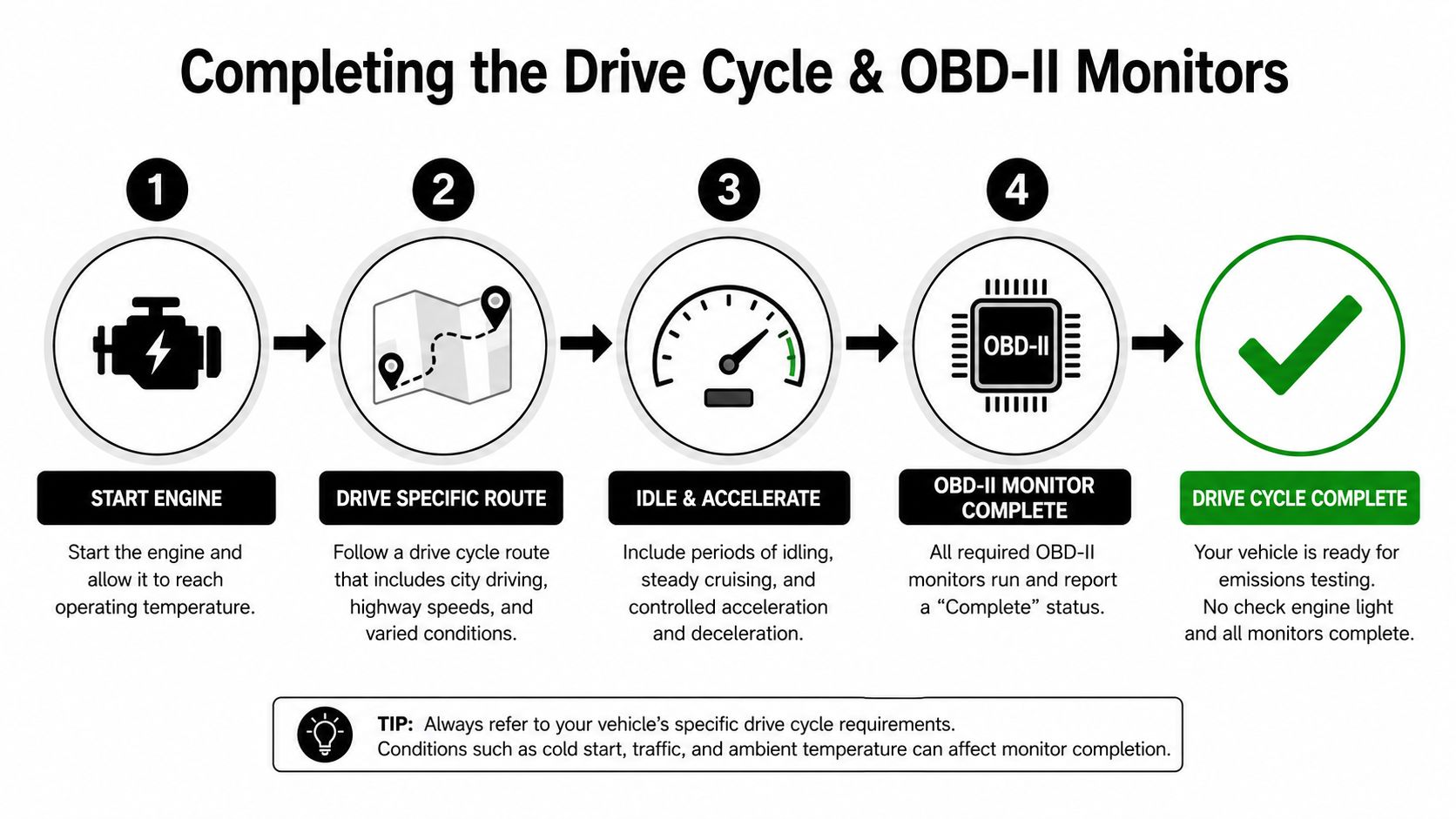
Modern California smog checks lean heavily on what your car's computer says about itself. That's the whole point of OBD-II readiness, the system's way of confirming that emissions monitors have run and passed. For many 2000-and-newer vehicles, the inspection is less about a dramatic tailpipe reading and more about whether the vehicle has completed the checks that prove the emissions system is functioning under real driving conditions.
What the drive cycle is really doing
The typical advice is to complete a full drive cycle of about 30–60 miles (50–100 km) with mixed conditions, because the computer needs enough varied driving to run its emissions monitors. That means some city-style stops, some steady cruising, and enough time for the car to settle into normal operating behavior. Current guidance also points to warming the engine to about 70–105°C (160–220°F), since colder engines can produce more pollutants and may keep monitors from setting. See the practical drive-cycle guidance in the OBD readiness preparation guide.
That's why a short hop to the gas station doesn't count. A monitor that hasn't completed isn't the same thing as a broken car, but it can still stop you from passing.
Fuel level matters more than most drivers think
Keep the fuel tank roughly 25% to 75% full before the test. That range matters because evaporative-emissions checks are sensitive to fuel level, and showing up near empty or completely full can interfere with readiness. The car can be mechanically fine and still fail to set the right monitor if the tank level is off.
Drive it like a real trip, not like a test lap. The computer wants varied conditions, normal temperature, and enough time to finish its checks.
If you've had codes cleared recently, especially after a battery disconnect or repair, give the car time to relearn everything before the appointment. That reset wipes the readiness status, which is one of the fastest ways to turn a potentially easy pass into an automatic delay.
For drivers who want to understand the codes themselves before heading in, a solid starting point is a guide on reading OBD codes. The value there isn't in guessing a fix, it's in knowing whether you're dealing with a simple readiness issue or an actual fault that needs repair.
The practical move is to schedule your drive cycle a few days before the appointment, not the morning of. If the monitors don't finish, you'll know in time to correct course instead of discovering it at the counter.
Visual and Mechanical Items Inspectors Check
A clean dashboard doesn't guarantee a clean result. California inspectors also look at visual and mechanical condition, and that's where a lot of “but the car drives fine” stories fall apart. A vehicle can run smoothly and still fail if the inspector sees missing equipment, leaks, overheating signs, or a modified setup that doesn't match what the car is supposed to have.
The stuff that gets missed in the driveway
One of the first things an inspector pays attention to is whether the emissions hardware is all there. That includes the catalytic converter, related hoses, and any parts that look tampered with, missing, or out of place. If a previous repair shop used a shortcut, or an owner removed something during a modification, the station may flag it even if the car seems happy on the road.
California's inspection manual also makes it clear that inspectors look for obvious safety hazards and visual issues like leaks or overheating. That means a fresh oil film, coolant seepage, or a hose that's hanging by a thread can become a failure point even before anyone digs into the computer data.
Gas caps, exhaust, and aftermarket parts
The gas cap still matters because it affects the evaporative system. A bad seal, missing cap, or cap that doesn't tighten properly can trigger trouble during the inspection process. Exhaust leaks, loose clamps, and cracked hoses are just as annoying, because they can point to a deeper problem or make the emissions system behave unpredictably.
Aftermarket modifications are another trap. A part that looks cleaner or newer isn't automatically compliant. If the car has been altered in a way that changes the emissions equipment layout, the inspector may treat it as a missing-component issue rather than a cosmetic upgrade.
If you hear a rattle, smell fuel, or see a fluid trail, don't gamble on the test. Fix the mechanical issue first, then come back ready.
Older vehicles and modified cars deserve extra attention here because the visual portion matters more when the car has a longer history of repairs, swaps, or nonstandard parts. What fails people most often is not a dramatic breakdown. It's a small oversight, like a cracked hose, a loose clamp, or an evaporative component that never got reinstalled after service.
What to Expect on Test Day at a STAR Station
At a well-run station, test day should feel organized, not mysterious. You bring the documents, hand over the keys, and the technician starts with the required checks for your vehicle type. If your car is one of the vehicles required to use a STAR-certified location, that matters because STAR stations meet higher performance standards set by the Bureau of Automotive Repair.
What the station actually does
For a 2000-and-newer car, the process usually centers on the OBD system, readiness monitors, and visual confirmation that the emissions equipment is in order. Older models, diesels, and hybrids can follow different testing paths, which is why assuming every smog appointment is the same is a mistake. The vehicle may be inspected, plugged in, and checked for compliance items that don't show up on a generic “my car runs fine” readout.
A clean station should also tell you what it needs up front, so you aren't guessing about paperwork or waiting around with an unprepared car. If you're trying to understand why one station is required over another, the basics of what a STAR station is matter more than most drivers realize, especially if registration renewal is on the line.
Time, waiting, and choosing the right place
A good smog shop respects your time. Speedy Smog in San Leandro, for example, completes most tests for 2000-and-newer vehicles in about 10 to 15 minutes, and that kind of turnaround is exactly what you want when the goal is to get in, get certified, and get back on the road. The indoor waiting area also matters more than people admit, especially when you're dealing with a second visit or a busy weekday schedule.
One thing I tell drivers is to treat the station choice as part of the test preparation. A place that knows California compliance, handles different vehicle types correctly, and doesn't waste your time makes the whole process easier. You don't need a sales pitch, you need accurate testing and clean paperwork.
If your vehicle is one of the newer models, the practical advantage is speed. If it's older, diesel, or a hybrid, the advantage is finding a station that already knows how to handle those protocols without improvising.
Common Failure Causes and Realistic Fixes
Most failed smog checks come from a handful of repeat offenders. The frustrating part is that many of them look small from the driver's seat, but they're enough to stop the test cold. I see a lot of people hoping for a shortcut, then learning the hard way that emissions systems don't care about last-minute additives, battery tricks, or a dash of optimism.
What usually breaks the pass
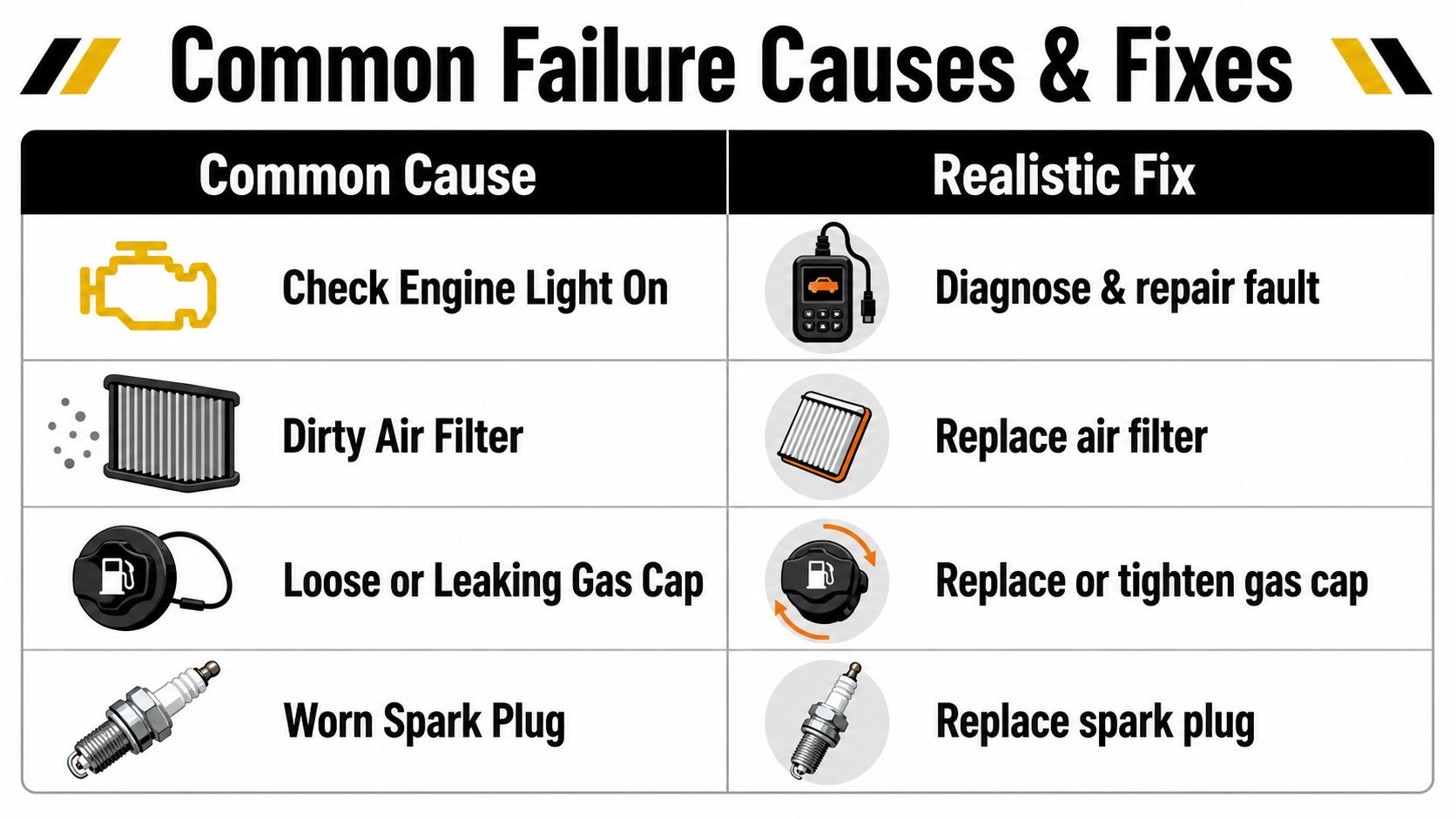
A loose or failing gas cap is an easy one to miss, and it's often one of the first things worth checking because it affects the evaporative system. Worn oxygen sensors and degrading catalytic converters are more serious, because they point to actual emissions-control problems that need diagnosis and repair rather than a quick reset. Vacuum leaks are another classic issue, especially on older vehicles or cars that have had recent work.
Pending diagnostic trouble codes are the sneaky ones. The check engine light might still be off, but the car has already logged a problem that can keep it from passing. That's why a scan tool matters more than a guess.
Disconnecting the battery is not a fix. It clears memory, resets readiness, and often sets you back instead of moving you forward.
What actually works
The honest answer is to repair the fault that triggered the code, then drive the car long enough for the monitors to reset. If the gas cap is bad, replace it. If a sensor is lazy, diagnose it properly instead of throwing parts at the problem. If the catalytic converter is degraded, don't expect a fuel additive to rescue it.
For some drivers, a trusted smog station that also understands the repair path can save a round trip. Speedy Smog is one option that offers smog checks and free retests, which can help when you're working through a repair and need to come back after the vehicle is ready.
The trade-off is time versus guessing. Guessing is cheap for about five minutes, then it becomes expensive.
What to Do If Your Vehicle Fails the Smog Check
A failed result isn't the end of the road, it's a repair roadmap. Start with the Vehicle Inspection Report, because that's the document that tells you whether the problem is readiness, a code, a visual issue, or something deeper. Fixing the wrong item first is how people waste money and miss registration deadlines.
Prioritize the failure, not the noise
If the report points to one clear fault, handle that first. A weak gas cap, a sensor issue, or a vacuum leak should be addressed before you think about anything else. If there are multiple items, a good mechanic will sort them in order of what blocks the pass fastest and what might be secondary damage from the main fault.
California also has a repair cost waiver program for some situations, and the state's rules are the place to look if repairs start to spiral. The key is not to assume a waiver applies automatically. You need to check eligibility against the official requirements and follow the process carefully.
Know your retest and timing options
Many stations offer a free retest policy, which matters if you've already fixed the underlying issue and just need the car checked again. That saves you from starting over at a random shop when the same station can verify the repair. It also helps to retest before the registration deadline gets tight, because waiting too long turns one fix into a paperwork problem.
Get the repair done, drive the car enough to restore readiness, and go back before you start cutting it close on registration.
Special protocols still apply for diesel vehicles, hybrids, and 1999-and-older models, so don't assume the same repair strategy fits every car. Some vehicles need a different inspection path, and some need more patience before they're ready to pass again.
If you want the cleanest route, schedule the repair, confirm the readiness status, and return with a car that's prepared, not just recently reset. That's how you turn a failure into a pass without chasing your tail.
If you want a station that understands California smog rules, handles different vehicle types, and keeps the process moving, visit Speedy Smog in San Leandro. They offer smog checks, free retests, and DMV submission after a passing result, which makes them a practical stop when you need the car certified and the paperwork handled the right way.
East Bay drivers can get their car emissions tested at a California BAR-certified smog check station, and the DMV renewal notice will tell you if a STAR-certified station is required. If you've got that notice in your hand right now, don't guess, use the station type the state tells you to use and save yourself a wasted trip.
That's the answer to where can I get my car emissions tested, and in California the details matter. Go to the wrong shop, show up without the right paperwork, or bring a vehicle that isn't ready, and you'll burn time and money for nothing. I've seen plenty of East Bay drivers come in frustrated because they picked a convenient place instead of the correct one.
Table of Contents
- Who Needs a Smog Check in California
- Understanding STAR Certified vs Standard Smog Stations
- How to Prepare Your Vehicle Before the Test
- What to Expect During Your Smog Check Visit
- Why East Bay Drivers Choose Speedy Smog in San Leandro
- Your Complete Smog Check Action Plan
Who Needs a Smog Check in California
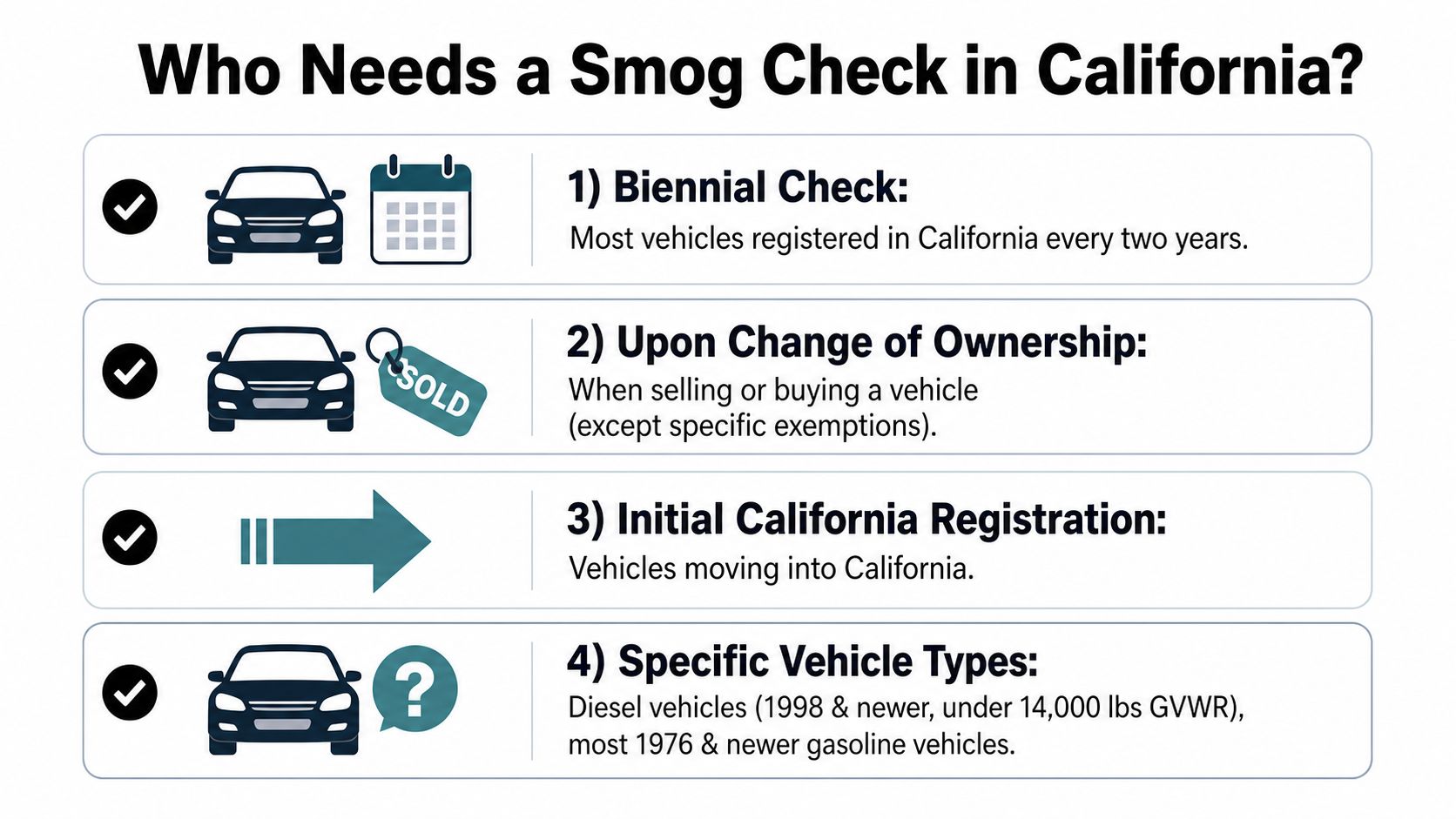
Your DMV renewal notice is the first thing to read, before you check a shop website or head to the nearest station. California requires biennial smog checks for most vehicles in participating counties, plus a smog check at change of ownership and when a vehicle is first registered in California from out of state, as outlined in the official DMV smog check requirements. That puts a lot of East Bay drivers on a deadline sooner than they expect.
Start with the renewal notice
If your notice says you need a smog check, follow it exactly. The notice can also tell you whether a STAR station is required, and that matters because STAR is a compliance tier, not a convenience label. If the notice calls for STAR and you go to a regular station, you can waste an entire trip and still have the same problem.
Practical rule: the DMV notice wins. If it points you to STAR, use STAR. If it doesn't, a certified station that can legally test your vehicle is the right move.
Some drivers do not need a test at all, but only if their vehicle fits an exemption under California's rules. Newer vehicles, electric cars, and motorcycles are commonly handled differently from the standard smog-check crowd, so do not assume every registration renewal means a test. Read the notice, check the vehicle class, and confirm whether you need to do anything before you drive across town.
If you want the state rule summary in one place, use the local guide here: California smog check rules.
Understanding STAR Certified vs Standard Smog Stations
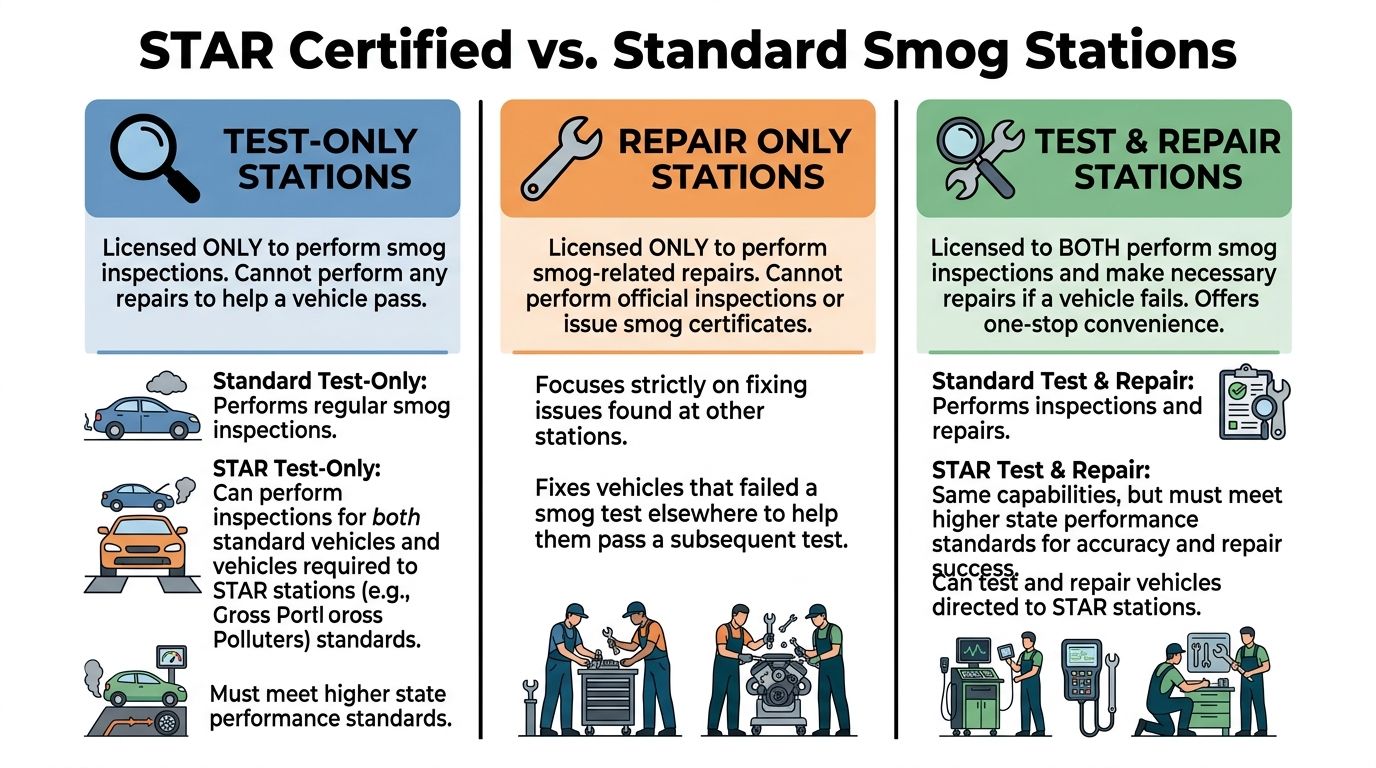
East Bay drivers waste time when they guess at the wrong shop type. California uses test-only, test-and-repair, and STAR-certified stations, and the right choice depends on your vehicle and the DMV notice. If you show up at the wrong category, you still have the same registration problem and you've burned a trip for nothing.
Station Types Explained
A test-only station inspects the vehicle and sends you out with the result. A test-and-repair station can inspect the car and handle repairs, which is useful if the vehicle needs work before it can pass. A STAR-certified station operates under a stricter program inside California's smog system, and the BAR locator shows whether a site is test-only, test-and-repair, or STAR-certified.
The point of STAR is accountability. California puts that tier under tighter oversight, so some vehicles get sent there by rule instead of preference. That is why the DMV notice matters so much. If it calls for STAR, a standard station is the wrong stop.
For a plain-English breakdown of how STAR fits into the local testing setup, use what is a smog STAR station.
Why This Matters in the East Bay
Drivers around the East Bay lose time when they assume every smog shop can handle every case. A shop can be close, fast, and easy to reach, but if it does not match the requirement on your renewal notice, it does not solve the problem. Match the station type before you leave home, and you avoid a second trip, a second wait, and a second fee.
Keep the station category straight, and the rest gets simpler. If your notice points to STAR, go to a STAR station. If it does not, use a certified station that is allowed to test your vehicle, and bring the paperwork the station asks for so the visit stays on track.
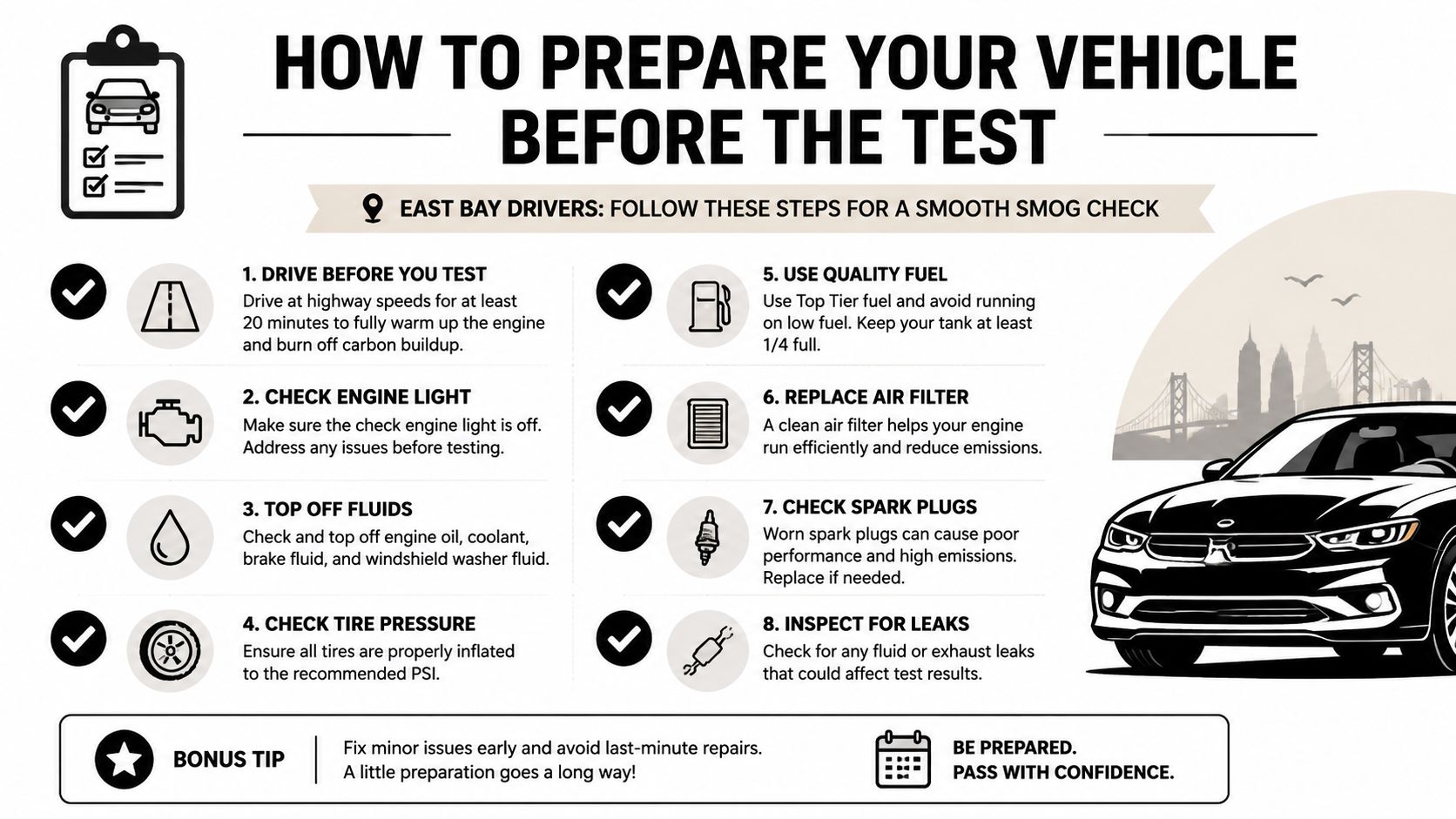
How to Prepare Your Vehicle Before the Test
A smog failure is expensive in the dumbest possible way, because many failures start with something small and fixable. Show up with a warm engine, a clean dash, and basic maintenance handled, and you give yourself a much better shot at clearing the test on the first visit. That's the job, not hoping the station will make up for neglect.
Do the simple stuff first
Drive the car long enough to get it fully warmed up before you arrive. A warm drivetrain and catalytic converter are part of a clean test run, and a vehicle that's been sitting cold all morning is not doing you any favors. If the car has been parked for a while, fresh fuel and a proper warm-up beat rushing straight to the station.
The check engine light has to be off before you walk in. If it's on, fix the underlying issue before you waste a test fee, and if the battery was recently disconnected, give the vehicle time to reset its readiness monitors. A lot of drivers skip that step and then act surprised when the car isn't ready.
Keep the car predictable. Fresh oil, a tight gas cap, and properly inflated tires don't guarantee a pass, but they remove avoidable reasons to fail.
Use this checklist before you leave
- Warm the engine: Drive the car before the test so it's not cold when inspection starts.
- Check the dash: Make sure the check engine light is off.
- Seal the gas cap: A loose cap is a classic avoidable problem.
- Review recent work: If the battery was disconnected, confirm the monitors are ready.
- Top off fluids: Basic maintenance keeps the car from acting up during inspection.
- Inspect tire pressure: Proper inflation helps the vehicle stay stable during the test process.
- Bring fresh fuel if needed: A car that's been sitting benefits from a normal drive cycle first.
If you need help clearing the warning light before you waste a trip, use this local resource: how to clear check engine light.
Here's a quick video walkthrough if you like to see the process before you go.
What to Expect During Your Smog Check Visit
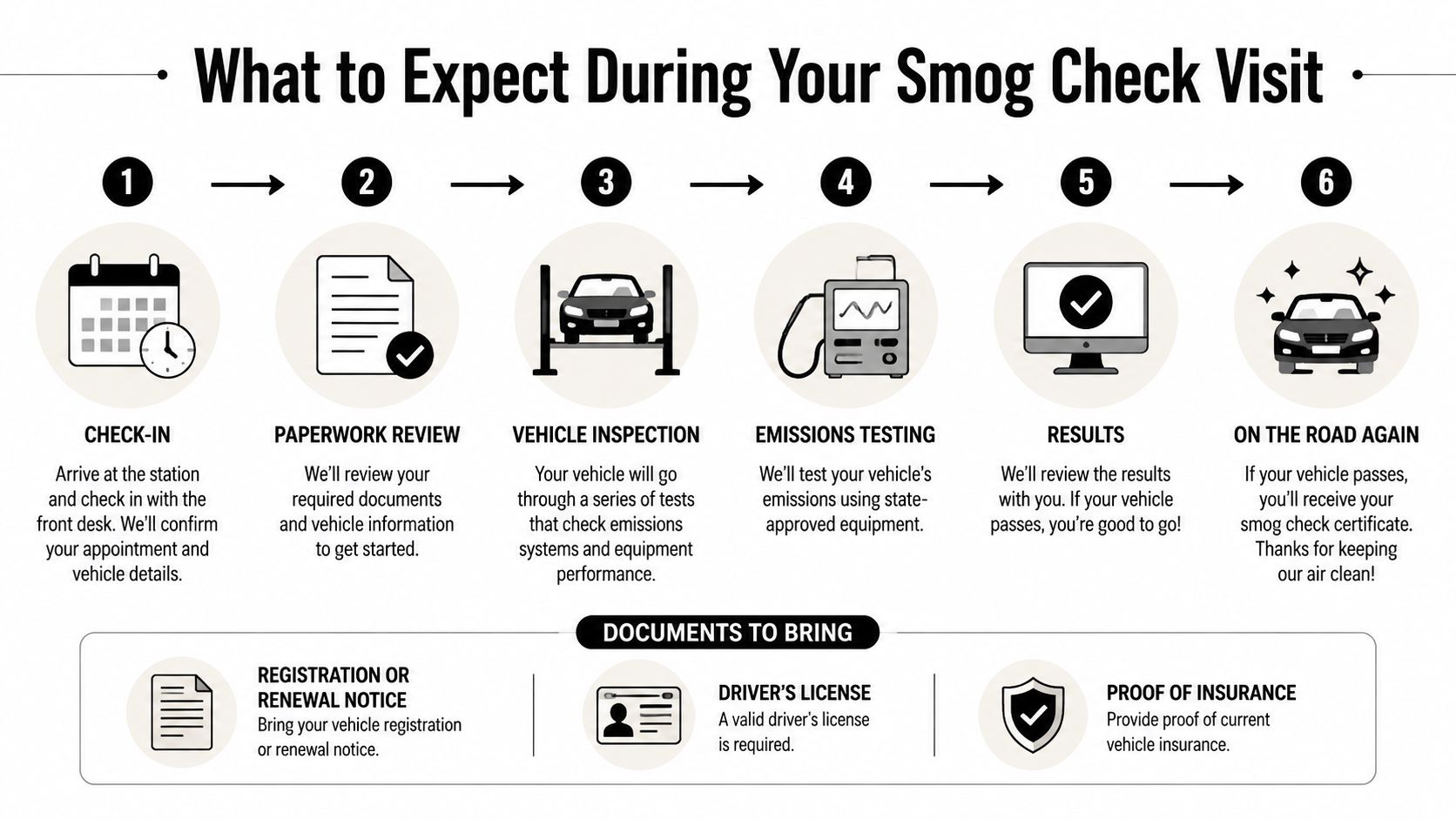
A good smog visit is simple. You arrive with the right paperwork, the technician checks the car, and you leave with the result the DMV needs for registration. If you show up unprepared, you waste time at the counter answering basic questions and risk making a second trip.
What to bring and why it matters
Bring your registration or renewal notice, driver's license, proof of insurance, and payment. Some stations do not take every payment method, so confirm what the shop accepts before you leave. DMV emissions test guidance That small detail is enough to turn a quick stop into a wasted trip.
The test itself depends on the vehicle. Newer cars usually get an OBD-II scan, while older vehicles may go through a different inspection path. Either way, the station is checking whether the car meets the requirement for registration, not whether it looks clean on the outside.
The visit should feel efficient
The right station keeps the line moving and the instructions clear. In California, use the BAR station locator to find a licensed smog station near you, then call ahead if you want to confirm hours and testing style before you drive over. state station-locator guidance In the East Bay, that matters because the wrong station costs you time, gas, and another errand.
If the counter line is long but the test lane moves fast, that is normal. The real question is whether the station is certified and whether it can issue the result your DMV needs.
After the test, you leave with the result tied to your registration renewal. If the car passes, keep the paperwork until the DMV side is finished. If it fails, the station should tell you what went wrong so you can fix it before retesting.
Why East Bay Drivers Choose Speedy Smog in San Leandro
Speed matters when you're trying to keep a registration from going sideways. A local station that already understands California's requirements is easier to trust than a random place that treats smog checks like an afterthought. Speedy Smog in San Leandro is one of the East Bay options that fits that job because it's a STAR Certified station, it handles a wide range of vehicles, and it's built around fast inspections.
The shop is located at 15275 Washington Ave, San Leandro, 94579, and it works with 2000 and newer vehicles, 1999 and older vehicles, diesels, and hybrids. That matters because a lot of drivers want one place that can handle the car they own, not a station that only likes the newest sedans. For newer vehicles, typical tests are completed in about 10 to 15 minutes, which is exactly the kind of turnaround busy East Bay drivers care about.
Speedy Smog also gives drivers the practical things that reduce friction. The shop is open Monday through Saturday, has a clean indoor waiting room, and offers periodic $25-off coupons for most smogs on newer vehicles. Those details don't change the law, but they do change how painful the day feels.
If you want a station that's focused on speed, certification, and a simple visit, this is the kind of place to put on your list. It's not about hype, it's about getting a legal test done without turning it into a half-day project.
Your Complete Smog Check Action Plan
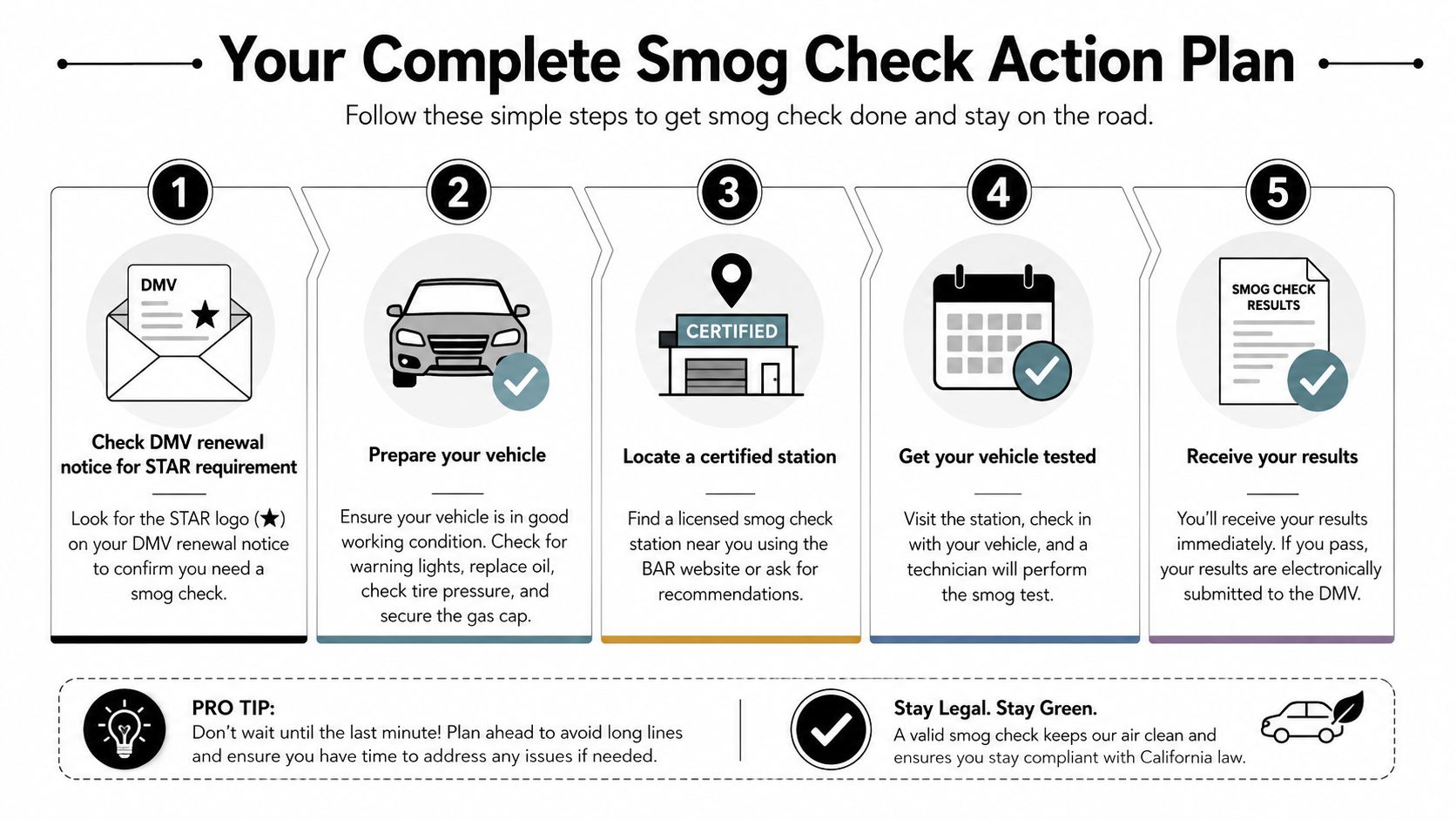
Your DMV renewal notice tells you what to do first. If it calls for STAR, go straight to a STAR Certified station. If it does not, use the state station locator and choose a certified place that can legally test your vehicle type and fit your schedule. That is the cleanest way to answer where can I get my car emissions tested without wasting time on the wrong shop California BAR station locator.
Use this order every time
- Check the notice. Confirm whether your DMV renewal requires a standard smog check or a STAR station.
- Prep the car. Warm it up, check the light on the dash, and deal with obvious maintenance issues before you go.
- Gather documents. Bring your registration or renewal notice, driver's license, proof of insurance, and payment.
- Choose the right station. Pick a certified location that can legally test your vehicle type.
- Get the result. Hold onto the paperwork until your registration issue is closed.
If you want a local station that handles the process efficiently, keep Speedy Smog in San Leandro on your short list. For East Bay drivers, a certified shop that moves quickly and knows the state requirements saves time and avoids extra trips.
Set a reminder for your next smog cycle now, not later. Drivers who avoid registration headaches plan ahead, keep the car ready, and do not wait until the last week to find a station.
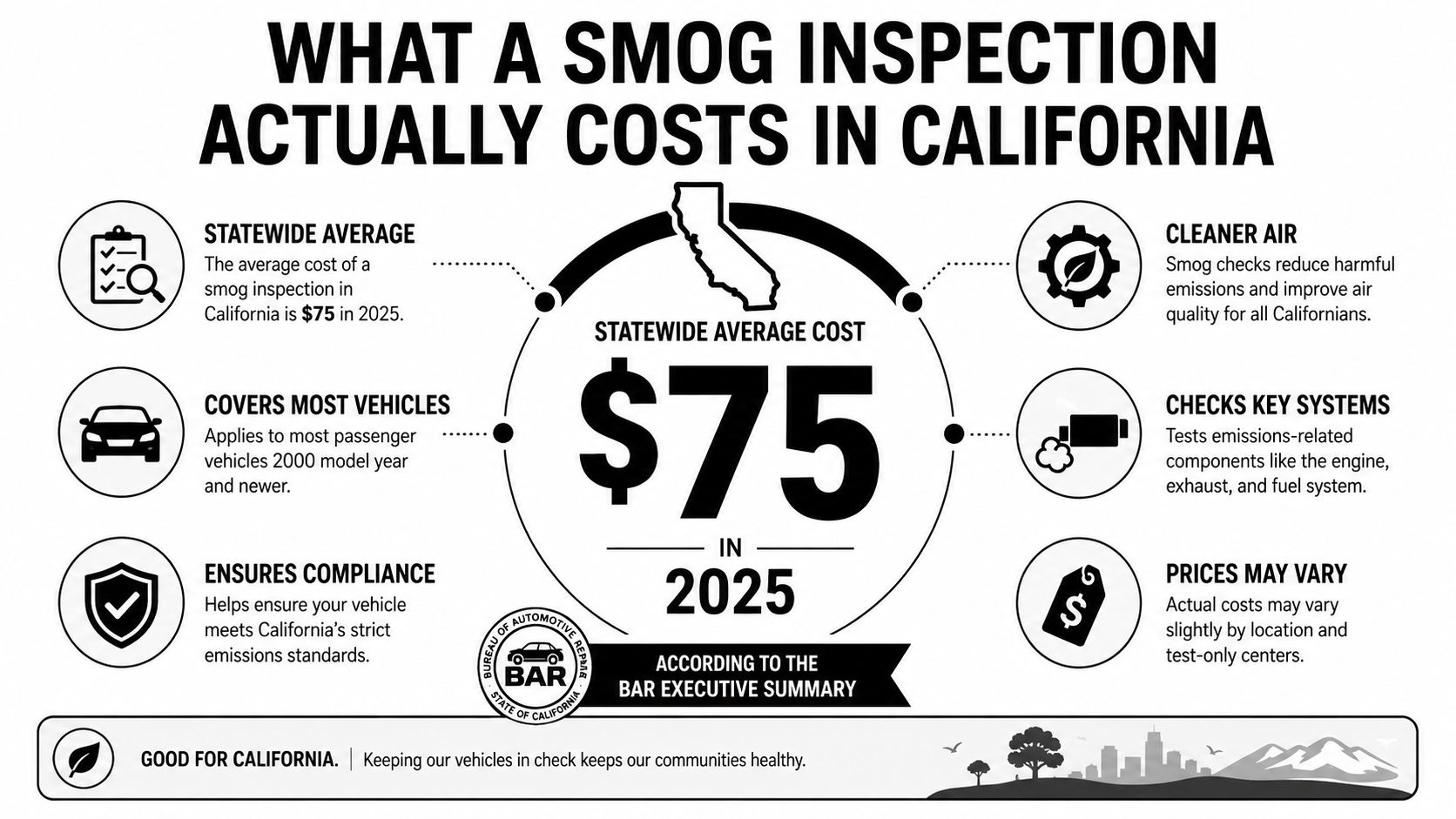
The statewide average smog inspection cost is $67.20 in California. In the East Bay, most drivers should expect roughly $30 to $90 before the mandatory $8.25 certificate fee gets added.
A lot of drivers only find out what they'll pay when they're already standing at the counter with a renewal notice in hand. That's where the surprise comes from, not the test itself. The quote on the phone is usually the inspection fee, but the final receipt can look different once the certificate fee, vehicle type, and station type are all part of the bill.
Table of Contents
- What a Smog Inspection Actually Costs in California
- How Station Type Shapes the Price You Pay
- Vehicle Class and Inspection Path
- Sample East Bay Receipts and What the Numbers Mean
- How to Avoid Paying for a Retest
- STAR Certification and Why It Matters for DMV Registration
- Putting It All Together Before You Book
- Smog Inspection Pricing Questions East Bay Drivers Ask
What a Smog Inspection Actually Costs in California
A driver in San Leandro opens a DMV renewal notice, checks the date, and asks the same question almost everyone asks, what is this going to cost me? The cleanest statewide answer is $67.20, California's overall average inspection cost across all initial tests in the 2025 BAR Smog Check Executive Summary Report. That figure comes from 11,213,580 initial tests statewide, including 10,408,947 OIS inspections and 804,633 BAR-97 inspections (BAR 2025 Smog Check Executive Summary Report).
That average helps, but it does not set the price you will pay at a shop in the East Bay. In day-to-day shop traffic, the usual passenger-car quote sits around $30 to $90 before the certificate fee, because California doesn't regulate the station's smog inspection price. The station sets the labor charge, then the state adds the certificate fee when the vehicle passes, so the amount on the counter can be different from the number you heard on the phone (California BAR smog check guidance).
Practical rule: if a quote sounds unusually low, ask whether it covers the inspection only or the inspection plus the certificate fee. That difference separates a fair quote from a misleading one.
The number that matters most to a driver is the out-the-door total, not the sticker price. A shop may advertise one fee, but the final receipt still has to account for the mandatory state certificate charge when applicable. If you want a local price check, start with East Bay emissions testing prices near me, then confirm what is included before you book.
How Station Type Shapes the Price You Pay
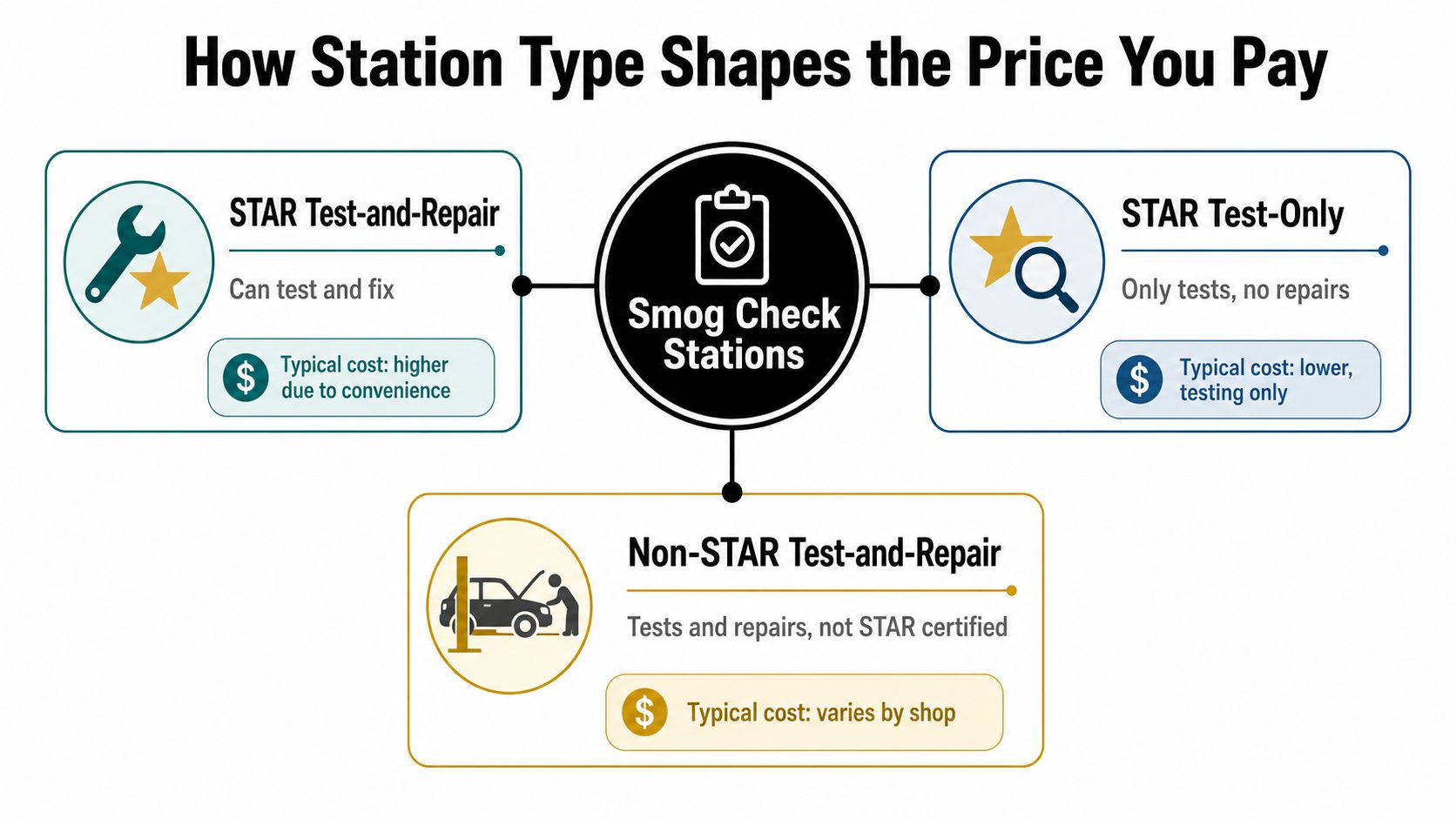
A driver in San Leandro can call three nearby smog stations and get three different quotes for what looks like the same service. That spread usually comes from station type, not from a mystery fee. California stations generally fall into STAR Test-and-Repair, STAR Test-Only, and Non-STAR Test-and-Repair, and the 2025 BAR summary shows statewide average inspection costs of $69.22 at STAR Test-and-Repair stations, $60.85 at STAR Test-Only stations, and $72.64 at Non-STAR Test-and-Repair stations (BAR 2025 Smog Check Executive Summary Report).
In the East Bay, that matters because the quote you hear often reflects how the shop is allowed to operate, how busy its lane is, and whether it can handle both testing and repair work. STAR Test-Only stations handled 6,408,489 initial tests, which helps explain why that price point shows up so often when drivers compare shops (BAR 2025 Smog Check Executive Summary Report). If you spend much time at a local counter, you see the same pattern: the station type shapes the number before any car-specific issue even enters the picture.
Why the same test costs different amounts
STAR stations carry more oversight, so they usually build tighter procedures into the way they run the lane. That can raise overhead, and overhead shows up in the quote. Test-only stations do not perform repairs, so their workflow is narrower, while repair-capable stations have to balance inspection work with the realities of the repair side, parts ordering, and bay turnover. A shop that can inspect and fix the car may price the visit differently from one that only tests vehicles and sends everyone else elsewhere.
The practical difference shows up at the counter. A test-only station may move faster because it is set up for one job, while a repair-capable shop may quote higher if it carries more staffing or equipment costs. Some drivers prefer a STAR station because their renewal notice requires it. Others choose one because they want fewer surprises if the vehicle has a problem and needs a second look. The cheaper quote is not the better deal if the shop cannot legally certify the car you brought in.
The bottom line is straightforward. Station type changes price because it changes the shop's obligations, equipment, and customer mix. That is why two honest, licensed stations in the same part of the East Bay can give different receipts for a similar inspection.
Vehicle Class and Inspection Path
A 2004 Camry, a 1997 pickup, a diesel truck, and a hybrid can all sit in the same lot, but they will not all leave with the same receipt. The inspection path drives the price. California pricing examples put 2000 and newer cars and SUVs at about $59.75, 1996 to 1999 vehicles at about $79.75, and 1995 and older at about $99.75, with larger vans, trucks, RVs, and heavy-duty diesel checks priced higher, sometimes $99.75 to $300 depending on gross vehicle weight and model year (Smog N Tag pricing).
What changes under the hood
Newer gasoline vehicles usually go through the OBD-based inspection flow, which is faster and less labor-heavy. Older vehicles often need a different emissions pathway, and that means more time, more setup, and a greater chance that the station will need a specialist lane or extra equipment. Vehicle age shows up in the quote for a simple reason, the station spends more time getting the right test done.
Practical rule: the older or more specialized the vehicle, the more the station is paying in time and setup, and that cost gets built into the quote.
Hybrids can still require a smog check once they are past the exemption period, and diesel vehicles often need specialized handling that not every shop can do cleanly. Some California stations also include a free retest for 2000 and newer vehicles, which lowers the total bill if the first visit does not go smoothly.
| Typical Inspection Pricing by Vehicle Class | Inspection Pathway | Typical Price Range |
|---|---|---|
| 2000 and newer cars, SUVs | OBD-based inspection | About $59.75 |
| 1996 to 1999 vehicles | Older-vehicle emissions path | About $79.75 |
| 1995 and older vehicles | More labor-intensive emissions path | About $99.75 |
| Larger vans, trucks, RVs, heavy-duty diesel | Specialized inspection setup | About $99.75 to $300 |
That table is the part many drivers need most. The vehicle itself drives the inspection path, and the inspection path drives the cost. In the East Bay, that means a clean-running sedan can be a straightforward visit at one station, while a heavier truck or diesel pickup may push you toward a shop with the right lane, the right tools, and a higher quote. If you know your model year and fuel type, you already know more about the final bill than many drivers do when they start calling around.
Sample East Bay Receipts and What the Numbers Mean
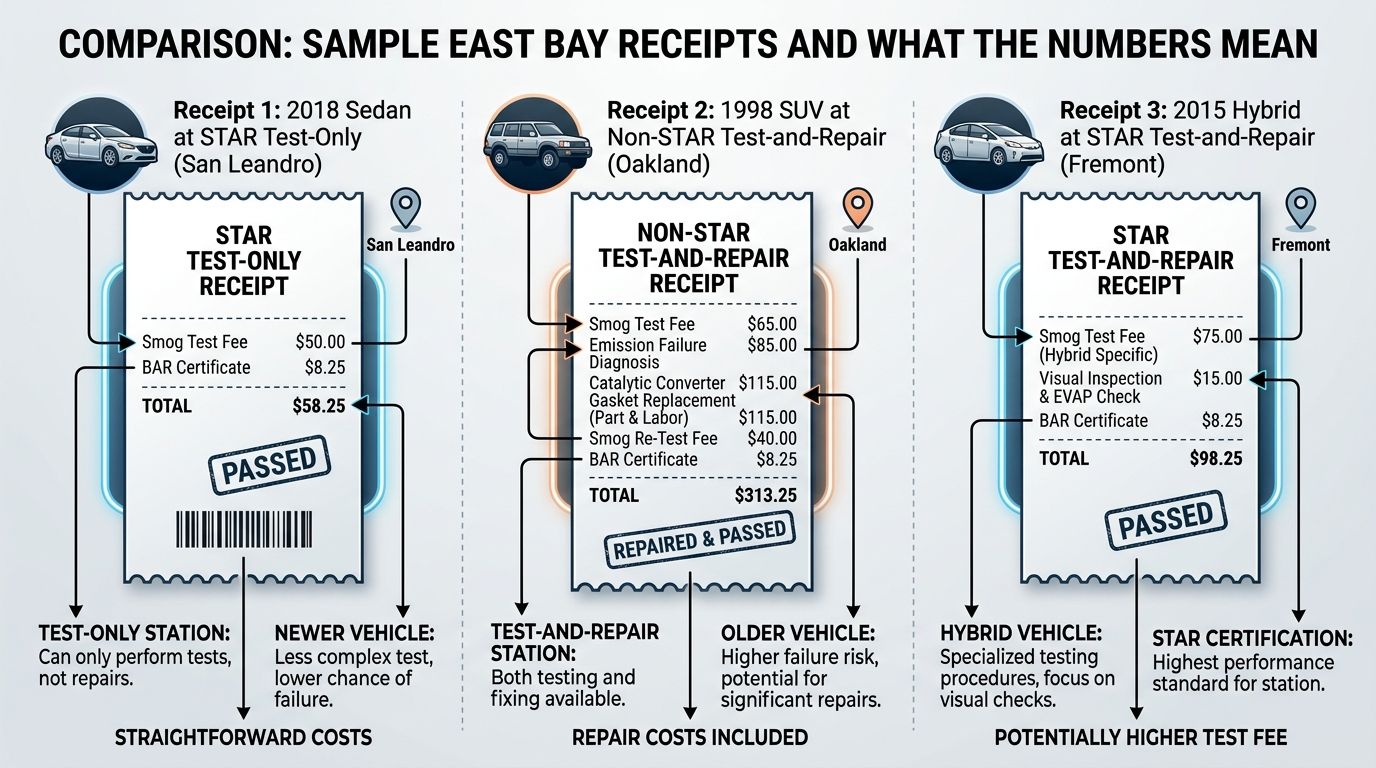
A real shop receipt is never just the inspection line. It's the inspection fee, the state certificate fee, and sometimes a small transmission fee if the station uses EFT processing. That's why a quote that looks cheap can still land closer to the actual average once everything gets added together.
Three common East Bay examples
A 2018 sedan at a STAR Test-Only station in San Leandro usually lands near the lower end of the local range if the car is ready to go. A 1998 light truck at a STAR Test-and-Repair shop usually costs more because the inspection path is less straightforward. A diesel pickup routed to a specialist station tends to be the highest of the three, since the test setup is more demanding and fewer stations can handle it efficiently.
A low base price only matters if the shop can certify your exact vehicle the first time.
That's the part drivers miss when they shop only on the advertised fee. A coupon can help, and East Bay shops do run periodic discounts, but the final math still depends on the vehicle category and whether the station can complete the job without extra hassle. I've seen drivers focus on a smaller posted price, then end up paying more once they've driven to a shop that wasn't a fit for their vehicle.
If you want to compare a quote against a real local station structure, look at the posted inspection and coupon details before you leave home. The important question isn't “What does the sign say?” It's “What will I hand over after the inspection, certificate, and any processing fees are included?”
How to Avoid Paying for a Retest
A smog bill usually gets painful after the first visit, not before it. A failed inspection means another appointment, more time out of your day, and sometimes a retest charge that wipes out the savings from a cheap first quote. The smartest way to protect your wallet is to treat the visit like a checklist, because the cheapest posted price is not always the cheapest final receipt.
The night-before routine that saves money
Start with the basics. Make sure the check-engine light is off, drive the car long enough for the monitors to settle, and do not disconnect the battery right before your appointment. A reset right before the test can create a failed first visit even when the car feels normal on the road.
- Check the dashboard first: If the warning light is on, do not assume the station can work around it.
- Take a normal drive: A steady drive before the appointment helps the car reach a better testing state.
- Skip last-minute battery resets: Clearing codes too close to the test can create readiness issues.
- Inspect simple wear items: A loose gas cap or obvious maintenance problem can turn into a second visit.
I tell drivers the same thing I tell customers at the counter in San Leandro. If the car is borderline, the retest policy matters almost as much as the inspection price. One station may include a return visit, while another charges again, and that difference can matter more than a small discount on the front end.
A retest fee can erase the benefit of a bargain inspection very quickly, especially if the first visit fails for something small that could have been handled the night before. That is why a cheap sticker price should never be the only number you look at.
If you want to see how one local shop handles repeat visits, review the policy on free retest terms in San Leandro. A policy like that does not change the test result, but it can change how much you pay if the car does not pass on the first try.
STAR Certification and Why It Matters for DMV Registration
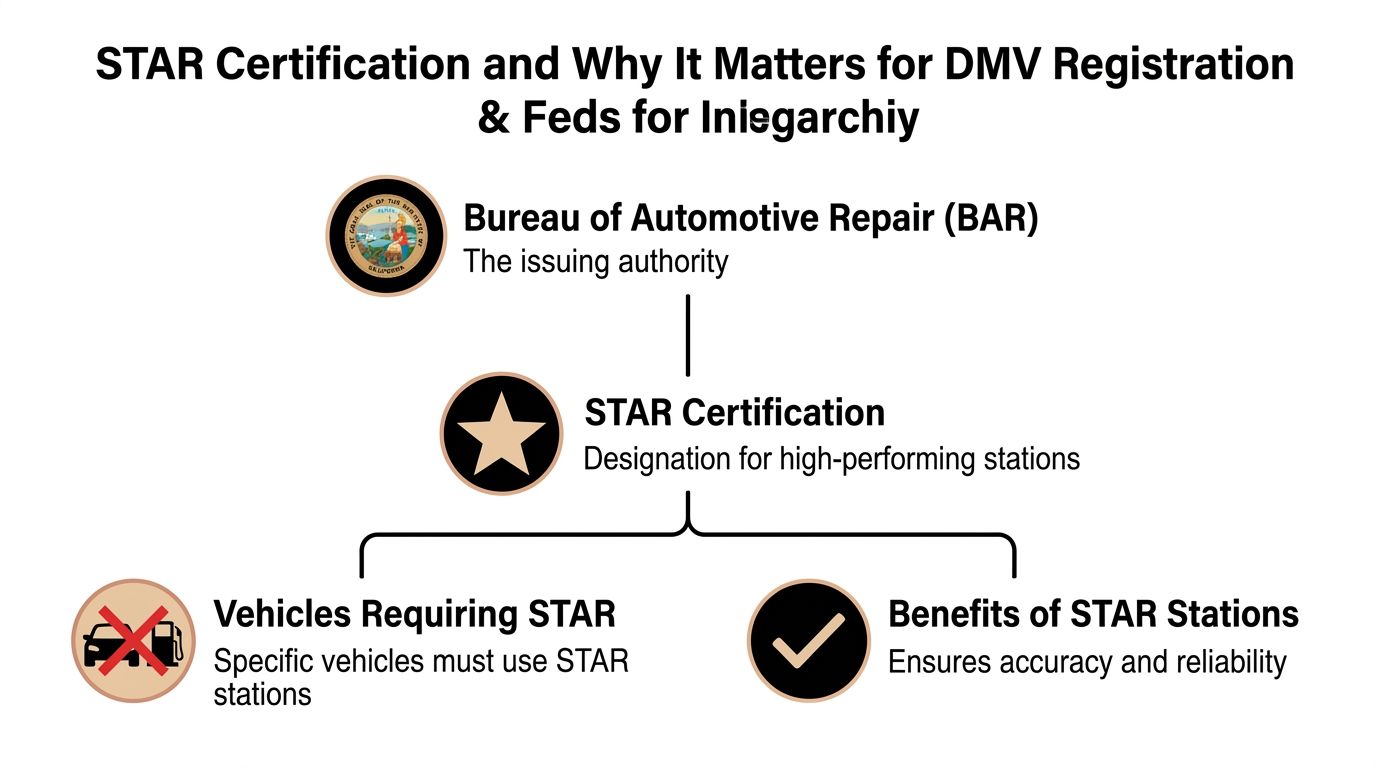
STAR certification is the state's higher-standard lane for smog inspection work. It's tied to the Bureau of Automotive Repair, and the designation exists because not every vehicle should be tested at just any station. Some DMV renewal notices direct drivers to STAR, and when that happens, the station choice is no longer optional.
Why the label affects your bill
A STAR station has to meet stricter performance expectations, and that changes the compliance side of the business. Drivers who are directed to STAR can't choose a cheaper non-STAR shop and call it good, because the right station type is part of the registration requirement. That means cost shopping has to start with eligibility, not price.
The practical piece is straightforward. If the DMV paperwork says STAR, your cheapest legal option might still be a STAR station that is a little more expensive than a non-STAR alternative. If the paperwork doesn't require STAR, you still might choose a STAR station for convenience, but that's a preference, not a regulatory need.
For a plain-English breakdown of the station designation, see what a STAR station means in San Leandro. Once you understand the label, the pricing conversation gets a lot cleaner, because you stop comparing shops that don't all have the same authority to certify your vehicle.
Putting It All Together Before You Book
The smartest way to judge a smog quote is to stack the variables in the right order. First, identify the vehicle year and fuel type. Next, check whether the DMV notice directs you to STAR. Then ask about the retest policy and confirm the quote includes the station fee, the certificate fee, and any processing charge.
A driver with a newer gasoline car usually has the easiest path. An older vehicle, diesel, hybrid, or STAR-directed vehicle can still be handled cleanly, but the quote has to match the actual inspection path. That's why two East Bay drivers can get different answers on the same morning and both be hearing a fair price.
Best habit: ask the shop what the final out-the-door total is before you drive over.
Speedy Smog in San Leandro is one option for drivers who want a STAR-certified station that handles a range of vehicle types and explains the receipt clearly. Before you book your next test, compare the quote, the retest policy, and the certificate fee so you know what you're really paying for.
Smog Inspection Pricing Questions East Bay Drivers Ask
Coupons come up first because everybody wants to know whether a discount sticks. They usually do when the vehicle qualifies and the shop is running the promotion, but the coupon should never be the only reason you choose a station. If the shop can't test your vehicle type, the discount doesn't matter.
The certificate fee is a different story. It's mandatory when applicable, so it isn't something a station can casually waive just because the customer asks. If you're budgeting for the visit, treat that fee as part of the total, not an optional add-on.
Out-of-state vehicles and unusual inspection cases often cost more because they create extra work for the station and sometimes require a different testing path. Hybrids are not automatically cheap either, they're priced by the same practical factors as everything else, especially vehicle year and the inspection method required. The cleanest rule is still the simplest one, ask whether the shop can certify your exact vehicle before you leave home.
If you want a clear quote before you drive across the bridge or sit in a waiting room, Speedy Smog can help you match your vehicle, station type, and certificate fee to a real out-the-door total. Bring your renewal notice, ask about the retest policy, and you'll walk in with a much better idea of what the receipt should look like.
You can drive a car that feels perfectly normal, roll into a smog station, and still leave with a failure sheet because the oxygen sensor didn't like what the computer saw. That's the part that confuses most drivers, the car may start, idle, and accelerate fine, yet the emissions system can still decide the vehicle isn't clean enough for California inspection.
An oxygen sensor smog test failure usually isn't about one broken part. It's about whether the engine computer can trust the sensor, whether the sensor is switching fast enough, and whether the readiness monitor has finished its self-check. That's why the fix is sometimes a sensor, sometimes a wiring issue, and sometimes just the wrong drive-cycle timing after a battery disconnect or code clear.
Table of Contents
- Why Your O2 Sensor Decides If You Pass Smog
- How an Oxygen Sensor Works
- What the OBDII Readiness Monitor Is Really Checking
- Common O2 Sensor Trouble Codes and Symptoms You Can Feel
- From Diagnosis to Repair and What It Usually Costs
- Why Replacing the Sensor Does Not Always Fix the Failure
- Bringing Your Car to a STAR Station Like Speedy Smog
- Quick Answers Drivers Ask After the Repair
Why Your O2 Sensor Decides If You Pass Smog
A driver comes in after a smog failure and says the same thing you hear all the time, “The car drives fine, so how can the test fail?” That question makes sense on the surface, but the emissions system is judging something different from how the car feels on the road. The oxygen sensor is one of the parts that decides whether the engine is controlling fuel well enough to keep hydrocarbons and carbon monoxide low.
That matters because a Sierra Research study from 1996 described oxygen sensor failure as the single greatest source of excessive emissions for fuel-injected vehicles, and the EPA and CARB later linked oxygen-sensor replacement to 42%–58% of vehicles that failed emissions checks for high HC or CO. Those numbers explain why a failing sensor can turn a car that still runs into a car that still fails a smog check. AutoHausAZ's emissions and oxygen sensor overview captures that historical link clearly.
Why the sensor gets blamed so often
The engine computer depends on the sensor to keep the air-fuel mix close to the point where the engine burns cleanly. If the reading is late, lazy, or wrong, the computer can't correct fuel delivery fast enough, and tailpipe emissions climb. That's why a single sensor can affect the outcome even when nothing feels dramatic from the driver's seat.
Practical rule: a smooth drive doesn't prove the sensor is healthy, it only proves the car is still moving.
The rest of the puzzle is that smog stations aren't only looking for rough running. They're also looking for whether the emissions system has finished its own testing, which is why a car can fail for reasons that have nothing to do with a dramatic symptom. Some failures are a bad component, some are a monitor that hasn't completed, and some are wiring or heater faults hiding behind a normal-looking idle.
How an Oxygen Sensor Works
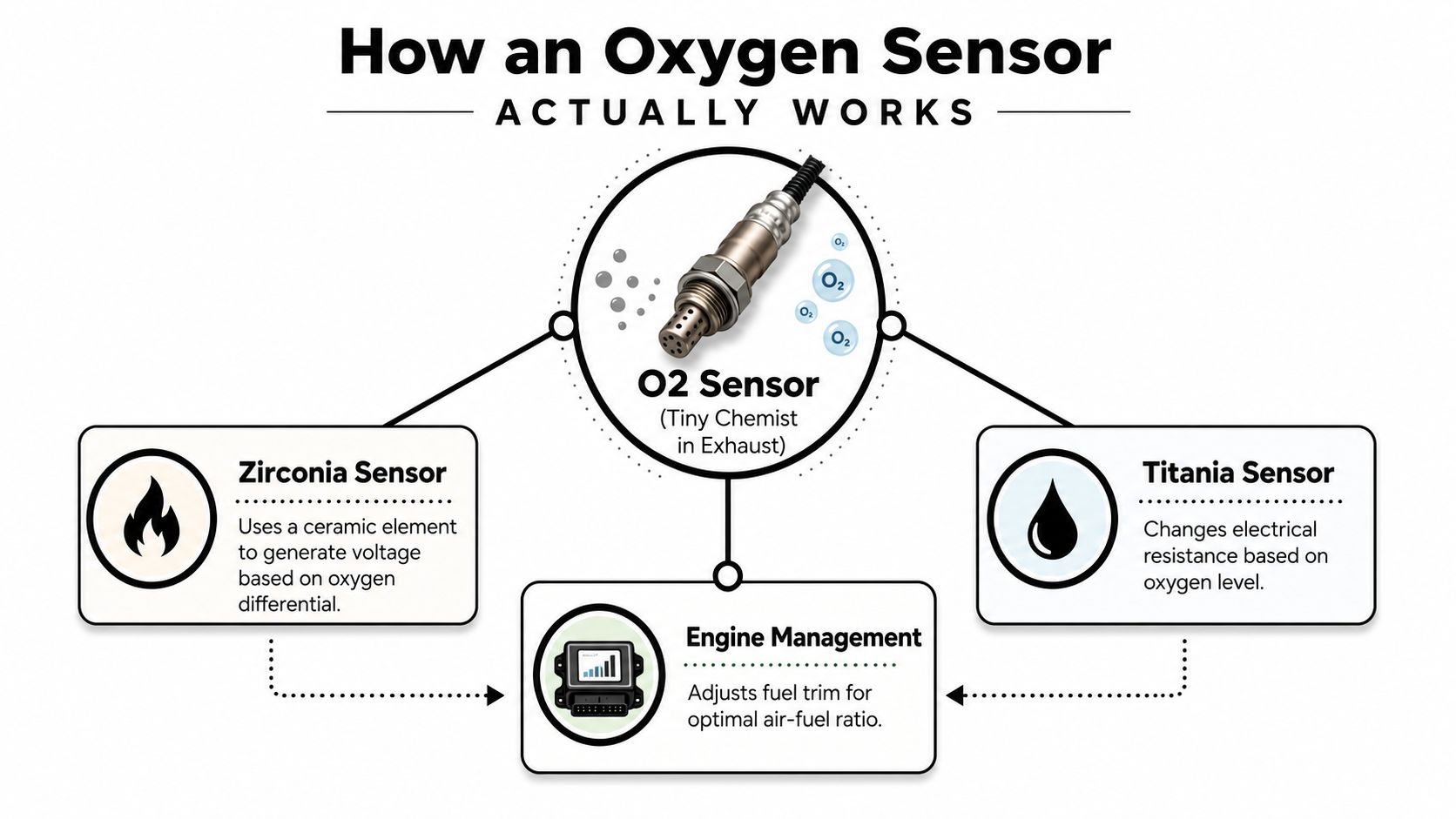
The oxygen sensor sits in the exhaust stream and measures how much oxygen is left after combustion. The engine computer uses that signal to adjust fuel delivery, a feedback loop that keeps the engine close to the clean-burn point. When the sensor is off, the car may still drive normally, but the emissions test can expose the problem.
Zirconia and titania in plain English
A zirconia sensor generates a voltage based on the oxygen difference between exhaust gas and outside air. A titania sensor changes resistance instead of creating the same kind of voltage signal. The purpose is the same in both cases, to give the engine computer a signal that shows whether the engine is running rich or lean.
That signal only matters if it changes the right way. For a zirconia narrowband sensor used in smog diagnostics, the reading should switch from about 0–175 mV on a lean condition to about 800 mV–1.0 V on a rich condition, and it should do that with a transition time of ≤ 100 ms after a throttle snap. Slower switching points to degraded response, contamination, or an exhaust leak. The technician training material on zirconia O2 testing spells out that switching behavior.
Why heat matters so much
The sensor has to get hot enough to work properly. That is why the heater circuit matters so much on modern cars, especially during cold start and early closed-loop operation. If the sensor never reaches the right operating temperature, the computer may not get a reliable signal, and the monitor logic can judge the system as incomplete or faulty.
A good sensor is not just one sitting in the exhaust. It heats up, switches fast, and keeps feeding the computer a believable signal.
Drivers often miss that part. They assume the sensor is either dead or fine, but emissions testing cares about signal quality, heater support, wiring integrity, and how quickly the sensor responds under real operating conditions.
If you want a plain-language breakdown of scan results, this guide on how to read OBD codes helps connect the dots between trouble codes and readiness.
What the OBDII Readiness Monitor Is Really Checking
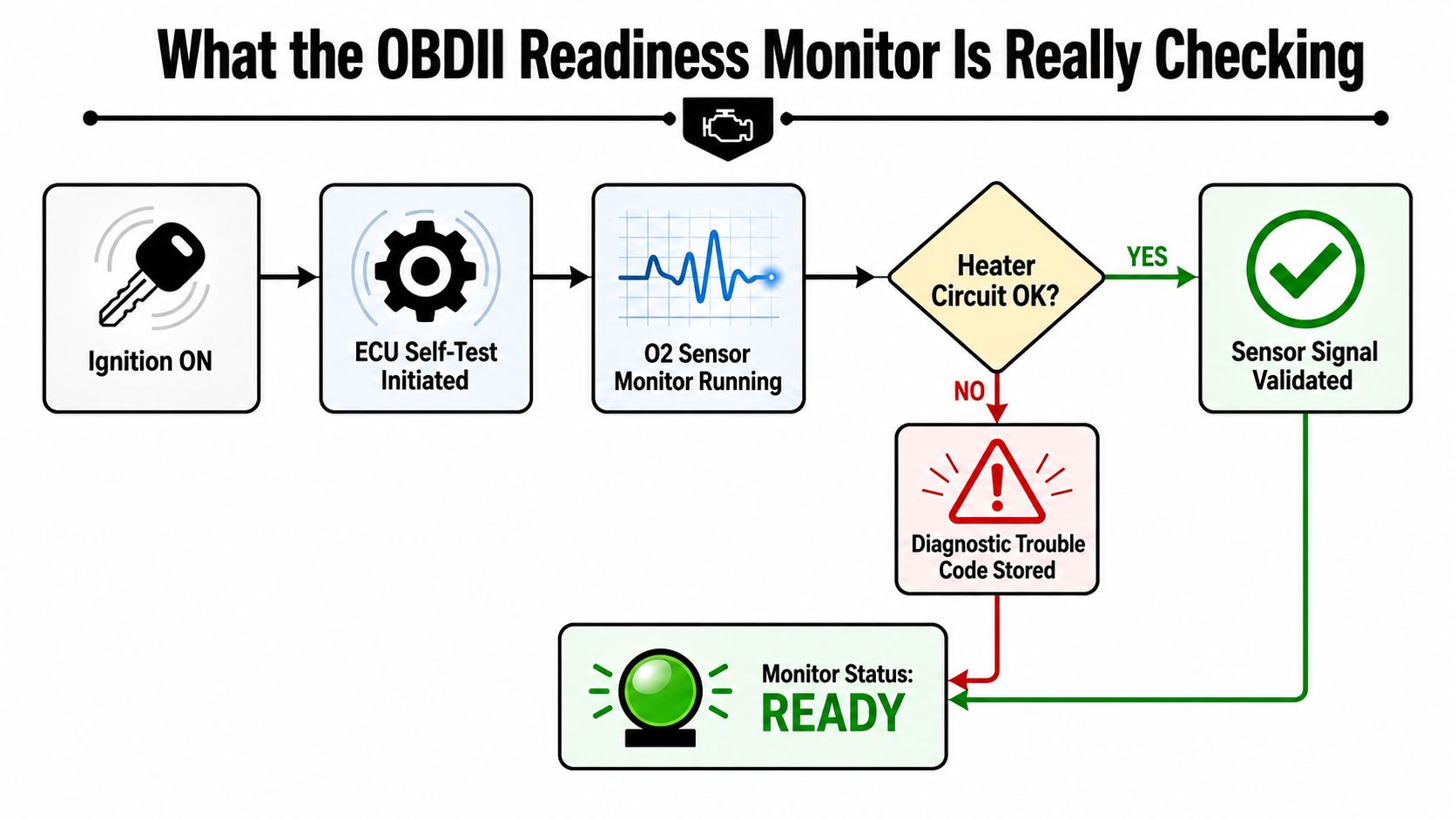
For 2000-and-newer gasoline vehicles, the inspection leans heavily on OBDII readiness. The car isn't just being judged on what comes out of the tailpipe, it's being judged on whether its self-tests have run and passed. The O2 monitor is part of that logic, and it's looking for evidence that the sensor can do its job under the right conditions.
If you want a plain-language breakdown of scan results, this guide on how to read OBD codes helps connect the dots between trouble codes and readiness.
Upstream and downstream monitors aren't doing the same job
The upstream sensor has to prove it can respond correctly while the engine is in closed loop fuel control. The downstream sensor has a different test, it has to recognize lean conditions during fuel cutoff. Those are separate checks, and a car can fail one without the other.
California BAR rules allow only limited incomplete monitors on 2000-and-newer gasoline vehicles, so a monitor that never finishes can block a pass even if the car seems to run normally. The oxygen sensor monitor overview explains that readiness issue in the same terms inspectors use.
Why a battery disconnect can create a surprise failure
A battery disconnect or code clear doesn't just erase a light, it can reset monitor history. If the O2 monitor hasn't completed again, the smog station may see the car as not ready, even if the sensor itself is fine. That's where a lot of drivers get tripped up, because the problem looks like a failed part from the outside but behaves like a timing and drive-cycle issue inside the computer.
The important distinction is simple. A failed sensor component is one problem. An O2 monitor not ready result is another. Treating them the same leads people to replace parts before the car has even had a fair chance to finish its self-tests.
Common O2 Sensor Trouble Codes and Symptoms You Can Feel
The codes matter, but so do the symptoms you notice before the scan tool is plugged in. A bad O2-related code often shows up alongside rough idle, hesitation, surging at light throttle, or a check engine light that won't stay off. The EPA durability data also helps set expectations, since oxygen sensor failure rates were just 0.5% up to 30,000 miles and 3.3% at mileages up to 100,000 in one durability study, which means many sensors last a long time before problems begin. EPA durability study
Codes technicians look at first
Common upstream code families include P0130 through P0135, and downstream code families include P0136 through P0141. Those code ranges point technicians toward the circuit, the heater, the switching behavior, or the downstream response depending on the exact number. A scan tool gives the starting point, not the whole diagnosis.
What the driver may actually feel
- Rough idle or stalling: The fuel mixture is drifting because the computer is getting poor feedback.
- Poor acceleration: The engine hesitates when the computer can't correct the mixture fast enough.
- Fuel smell or sulfur-like odor: The engine may be running richer than it should.
- Check engine light that returns: The fault is persistent, or the monitor keeps seeing the same problem.
- No obvious symptom at all: The car can still fail readiness before you ever feel a driveability issue.
If you want a quick cross-check of common inspection failures, this page on smog check fail reasons is useful for comparing an O2 issue against other emissions problems.
The quiet clue most people miss
A slow sensor doesn't always throw a dramatic symptom. Sometimes it just reacts too slowly for the monitor logic to accept it. That's why a car can feel basically normal and still fail inspection, the computer saw a response problem even when the driver didn't.
From Diagnosis to Repair and What It Usually Costs
Good diagnosis starts with the scan, not the parts counter. A technician checks the code, looks at live O2 data, inspects the harness, confirms heater operation, and verifies battery supply before calling the sensor bad. That order matters because the sensor is only one piece of the system, and a bad assumption can waste money fast.
The repair ladder that makes sense
- Read the code and freeze-frame data. This shows what the computer saw when the fault happened.
- Watch live O2 voltage or switching behavior. The sensor has to move, not sit flat.
- Check the connector and harness. Corrosion, broken insulation, and loose pins can interrupt the signal.
- Test the heater circuit. A sensor may look alive but still fail because it isn't warming correctly.
- Look for exhaust leaks. Leaks upstream of the sensor can skew the reading.
- Confirm the battery and charging system are healthy. Low voltage can make the monitor act up.
Cost and time table
| Repair | Typical Cost | Time to Complete |
|---|---|---|
| Diagnostic scan and live-data check | Varies by shop | Short visit |
| Single upstream oxygen sensor replacement | Varies by vehicle and parts choice | About an hour or less in many cases |
| Single downstream oxygen sensor replacement | Varies by vehicle and parts choice | About an hour or less in many cases |
| Wiring or connector repair | Varies by fault location | Depends on access |
| Exhaust leak repair near sensor | Varies by leak and hardware | Depends on severity |
The cost difference comes from what failed first. A clean sensor swap is one job. Chasing a wiring problem through a corroded connector or a damaged harness is another. If the issue is only a readiness reset after prior repairs, the fix may be a correct drive cycle instead of any part at all.
Useful habit: keep the repair receipt and the code printout together. That makes the retest easier to explain if the monitor still hasn't finished.
The smartest repair plan is the one that treats the sensor as evidence, not a guess. When the diagnosis is careful, the repair list gets shorter and the retest goes smoother.
Why Replacing the Sensor Does Not Always Fix the Failure
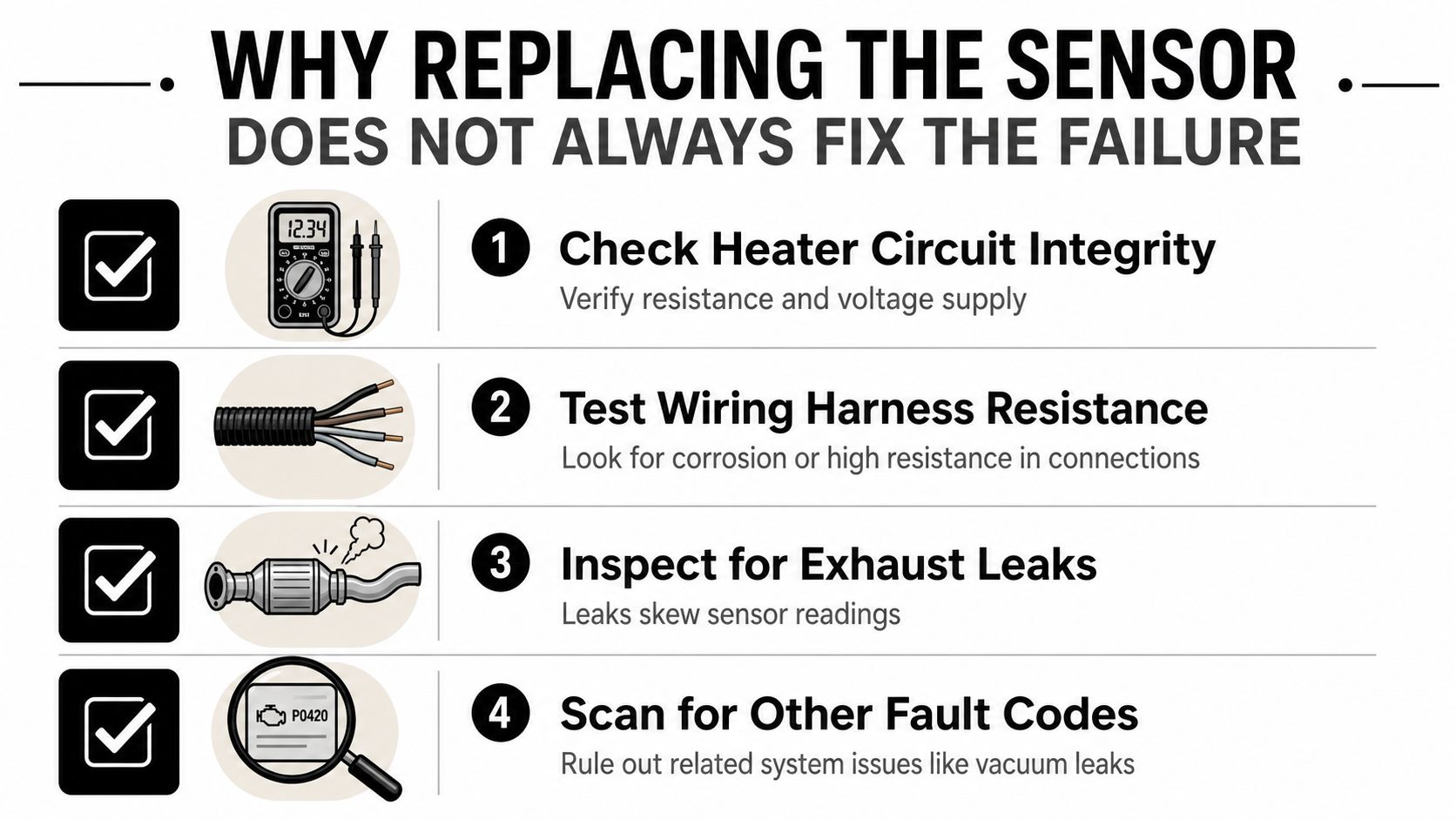
A new sensor can solve the problem, but it isn't a magic answer. Technician sources show that a sensor can still produce a plausible signal while a bad heater circuit, high resistance, or power-supply problem keeps it from operating correctly. That's why a smog failure can survive even after the sensing element itself looks fine. The technician video on heater and wiring faults makes that point clearly.
Four things that can beat a parts swap
- Check heater circuit integrity. The sensor needs the right temperature to work as intended.
- Test wiring harness resistance. Corrosion and poor connections can distort the signal.
- Inspect for exhaust leaks. Fresh air pulled in upstream can fool the sensor reading.
- Scan for related fault codes. A different emissions problem can be the reason the monitor won't finish.
A slow-switching sensor points you toward contamination or sensor aging. A sensor that looks alive on the scan tool but never passes readiness points you toward a circuit issue, a wiring fault, or a drive-cycle problem. Those are different diagnoses, even if both produce the same frustration at the smog station.
Why drive-cycle timing matters more than random mileage
After a battery disconnect or code clear, the car doesn't become ready just because you drove around for a while. It needs the correct conditions to finish its monitor. That can mean the right engine temperature, speed range, and operating time, depending on the vehicle.
That's the hidden trap. Drivers often spend money on a sensor when the monitor hasn't had a chance to complete. If the fault memory is clear and the system is not ready, the next move isn't always a replacement part. Sometimes it's a deliberate drive cycle and a recheck.
Bringing Your Car to a STAR Station Like Speedy Smog
A STAR Certified station matters when the state wants a tighter inspection standard or when your vehicle is directed to one. It also matters when you want a shop that checks readiness carefully instead of rushing the process. For drivers in the East Bay, a good station saves time because it knows how to separate a real O2 fault from a monitor that just hasn't completed yet.
If you're trying to understand whether your vehicle needs a STAR shop, this guide on what a smog STAR station is lays out the difference in plain language.
What to bring and what to expect
Bring your registration, your payment method, and any repair receipts if you've already fixed an emissions issue. If the last shop cleared a code, bring that paperwork too, because it helps explain why a monitor may still be incomplete. That makes the inspection faster and reduces confusion if the car needs a retest.
For many 2000 and newer vehicles, the visit is usually quick, and the useful part is the scan result, not just the final pass or fail. Older vehicles, diesels, and hybrids may follow different inspection paths, so the station's experience matters just as much as its equipment. A clean waiting room and clear communication help, but the value is accuracy.
A simple pre-test checklist
- Confirm the check engine light is off. If it isn't, don't assume the car will pass.
- Check readiness before you go. An incomplete O2 monitor can block the test.
- Review any recent battery disconnect or code clear. Those reset monitor status.
- Bring proof of recent repairs. It helps the technician see the sequence of events.
- Don't swap parts blindly. The scan result should guide the next move.
A STAR station is the right stop when you want the inspection handled cleanly and the result explained without guesswork. That's especially useful when the difference between a failed sensor and a not-ready monitor is the difference between one quick fix and a wasted repair.
Quick Answers Drivers Ask After the Repair
How long do you have to retest after a failure? Usually long enough to finish the repair properly, but not so long that you forget the readiness issue. If the sensor was replaced, the car still needs the monitor to complete before a fair retest. If the same car fails twice, the next step is a deeper diagnosis of heater, wiring, or exhaust leaks, not another blind parts swap.
If your car failed on an oxygen sensor smog test, bring it to Speedy Smog for a careful inspection that separates a bad sensor from a readiness problem. You'll get a fast, clear smog check from a STAR Certified station that understands the difference between a failed component and a monitor that just isn't ready yet.
You're staring at a DMV renewal notice, and one line jumps out: smog check required. Maybe your car runs fine, maybe you just bought it, or maybe you're already worried because the repair bill from last year still stings. In California, that little notice can feel like a bureaucratic trap, especially when you're trying to keep costs down and just get the registration done.
The good news is that the process is usually more straightforward than it looks. If you know what type of vehicle you have, whether the state wants a routine test or a change-of-ownership test, and what the technician is checking, you can walk in prepared and avoid most surprises. California's high poverty rate in 2024, 17.7%, makes clear, plain guidance even more important, because cost-sensitive drivers are more likely to delay compliance or rely on incomplete information, and that can turn a routine renewal into a headache (California Budget & Policy Center).
Table of Contents
- Decoding Your CA DMV Smog Notice
- Who Needs a Smog Check in California
- The Importance of a STAR Certified Station
- Your Smog Check Step by Step
- How to Prepare Your Car to Pass the First Time
- Finding a Fast and Reliable Test at Speedy Smog
- Smog Check Common Questions Answered
Decoding Your CA DMV Smog Notice
A lot of drivers open the renewal packet, see a smog requirement, and immediately assume the car must be failing something. That's not what the notice means. In most cases, it just means the state wants proof that your vehicle still meets California's emissions rules before the registration can move forward.
That matters because California treats emissions control as part of the registration process, not as an optional maintenance suggestion. The state also has an unusually large economic footprint, so the rules reach a huge number of drivers and vehicles. California's economy reached $4.25 trillion in nominal GDP by 2025, according to the Governor's Office, and it represented about 14% of U.S. GDP in recent PPIC analysis (Governor's Office). When a state operates at that scale, its air-quality rules have to be broad, consistent, and enforceable.
Practical rule: A smog notice is usually a paperwork checkpoint, not a judgment on how well your car drives.
If your renewal letter says you need emissions verification, don't guess. Check the notice, check your vehicle type, and confirm whether you're dealing with a routine renewal, a title transfer, or an exemption situation. If you're unsure where to start, a quick status check can save you a wasted trip, and this smog status guide is a useful place to verify the basics before you leave home.
Who Needs a Smog Check in California
A California smog check usually becomes clear once you separate two questions, what kind of vehicle you have and why you are at the DMV counter. Some drivers need emissions verification at renewal, some only during a sale or transfer, and some vehicles fall into an exemption category. The confusion starts when people assume every car follows the same path, but California sorts vehicles by class, model year, and transaction type.
Gasoline Vehicles
Most gasoline vehicles fit into the standard California emissions system. For a first-time driver, the simplest way to read the rules is to ask whether the car is due for a renewal test, changing owners, or coming into the state from somewhere else. That is usually where the answer starts.
A clean way to sort it out is this:
- Routine registration: Many California vehicles need a smog check tied to registration renewal.
- Ownership change: A smog check is commonly needed when a car is sold or transferred, unless an exemption applies.
- Out-of-state move: A car brought into California may need emissions verification before full registration.
- Older gasoline vehicles: Model year matters, especially for cars near exemption lines or vehicles that follow different test procedures.
Diesel Vehicles
Diesels create extra confusion because they do not always follow the same path as gasoline cars. A driver with a diesel can easily assume the paperwork works the same way, then find out the inspection rules are different.
The state's underserved-community guidance calls out exactly this kind of confusion, especially for drivers asking what changes for 1999-and-older vehicles, diesels, and hybrids (California underserved communities report).
If you drive a diesel, use the notice and the vehicle category, not a neighbor's gas-car experience. Older diesels, work vehicles, and secondhand purchases deserve extra attention because the test path can change based on what the car is and how it is being registered.
Hybrids and Special Cases
Hybrid owners often assume the electric motor means the car skips emissions testing. That is not a safe shortcut. Hybrids can still fall under California's emissions-check system depending on the vehicle and the transaction.
Older cars and unusual ownership situations deserve the same careful check. If your vehicle does not fit the usual commuter-car pattern, confirm the rule before the registration deadline gets close. Drivers who are already watching every dollar can feel the cost of a repeat visit more sharply, so it helps to verify the requirement first instead of paying for a test you did not need.
If you want a practical way to sort out the details before you leave home, this smog status guide explains the basic checks in plain language. A few minutes at home is usually easier than a second trip across town.
If your car is unusual, older, or newly purchased, confirm the rule before you pay for a test. Guessing is what gets people stuck with repeat visits.
The Importance of a STAR Certified Station
When your renewal notice says STAR Station Required, that's not a warning that your car is bad. It means the state wants the test done at a station that meets stricter performance standards. In California, STAR certification is about station quality and oversight, so the results are more tightly controlled than at a basic test-only shop.
The reason a driver gets sent to STAR usually falls into one of two buckets. The vehicle itself may be considered more likely to produce emissions issues, or the driver may have been selected through a quality-control process. Either way, the notice is telling you where to go, not trying to make the process harder.
For a driver, the practical takeaway is simple. A STAR-certified station is a safe choice whether you were required to use one or not, because it can test the full range of vehicle types that show up for compliance work. If you want a deeper look at what helps on a STAR visit, this STAR smog guide is a useful reference.
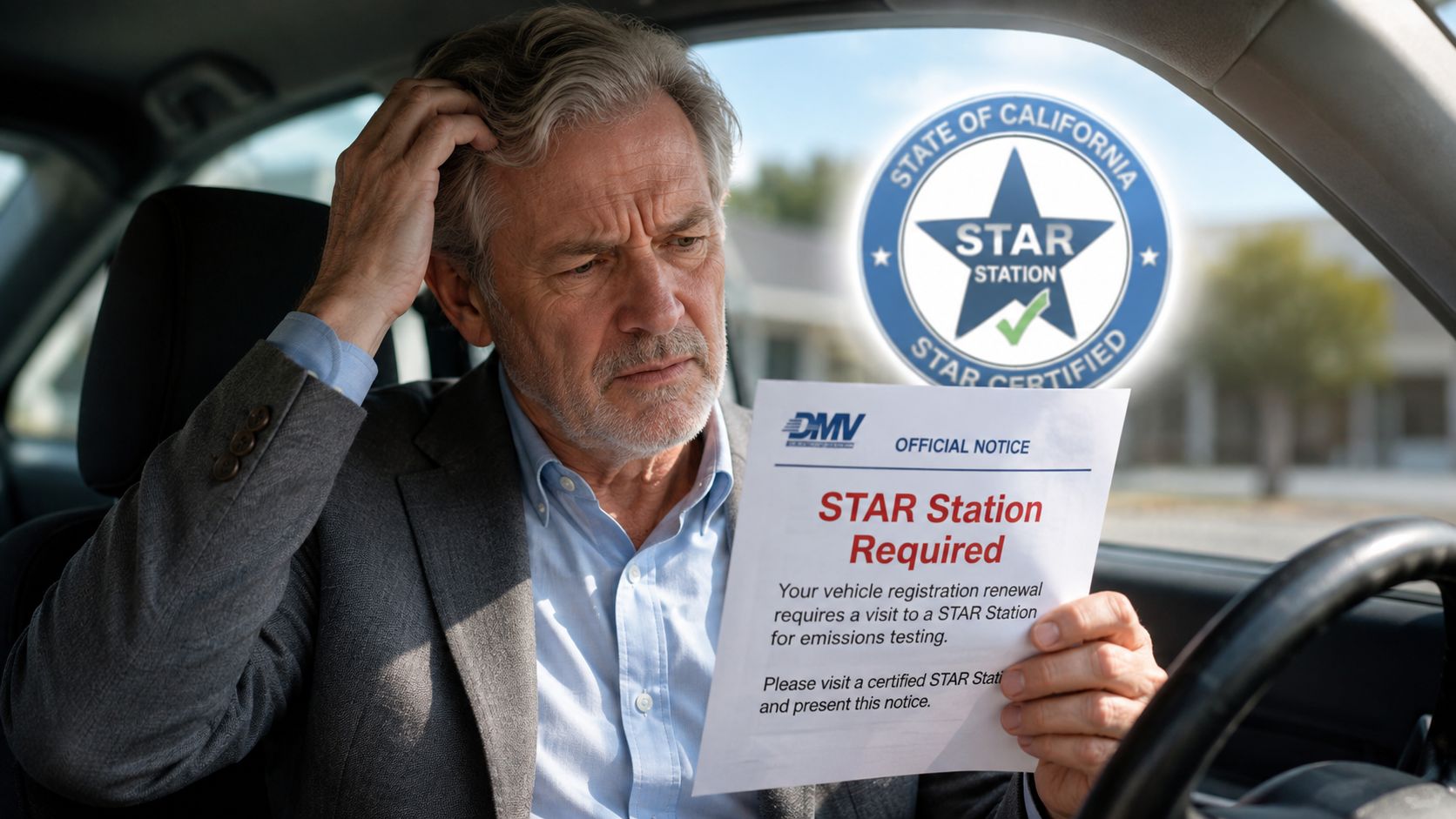
Practical rule: If the notice says STAR, go to a STAR station. Don't try to save time by guessing, because the wrong shop can waste your day.
A lot of first-time drivers worry they'll need to understand the state's technical certification system before they can get tested. You don't. Just read the notice, choose a certified station, and bring the vehicle in as required. The station handles the technical side, and you handle the paperwork and timing.
Your Smog Check Step by Step
The test feels mysterious until you watch it unfold once. From the driver's side, it's usually a quick sequence, and the technician is looking for specific signs that the emissions system is present, functional, and reporting correctly.
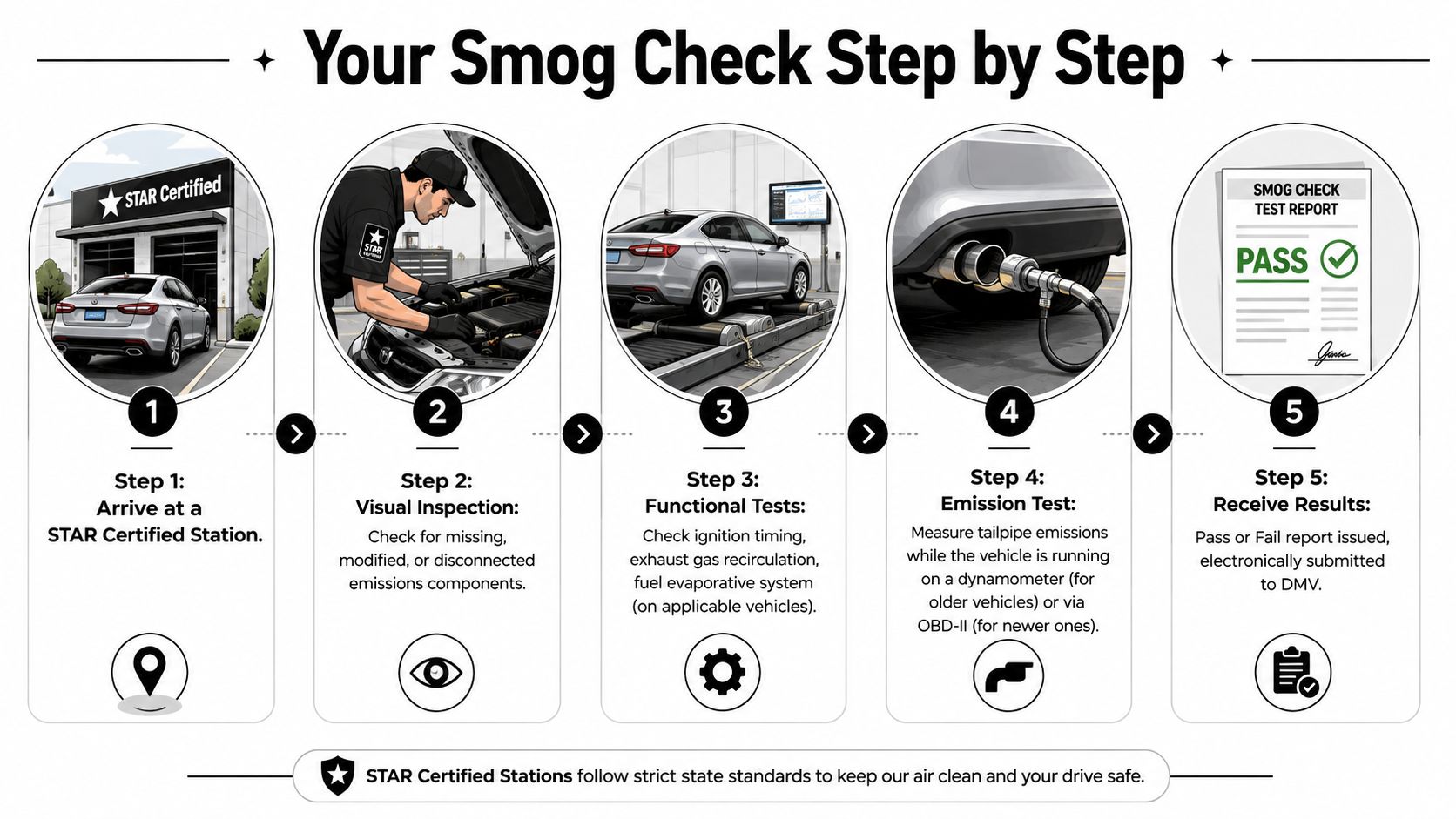
What the technician checks first
The first part is usually a visual inspection. The technician looks under the hood and around the emissions system to make sure the required parts are there and haven't been removed, modified, or disconnected. That matters because California's quality-measure framework shows how much denominator and definition consistency affects reported results in regulated systems, and emissions testing depends on the same kind of consistency in how vehicles are evaluated (DHCS CaTS framework).
If something obvious is missing, the vehicle can fail before the more detailed checks even begin. That's why a car that “runs fine” can still come back with a failed result.
What happens during the functional check
Next comes the functional side of the test. On newer vehicles, the station usually uses onboard diagnostics, while older vehicles may go through additional equipment-based inspection. The point is to confirm that the emissions system is working, not just installed.
Older vehicles can involve more physical testing because the car's computer system may not carry all the needed information. Newer vehicles usually make the process faster because the onboard diagnostics communicate directly with the tester.
How the result gets handled
At the end, the station issues a pass or fail result and transmits it electronically to the DMV. Speed matters here because most newer-vehicle inspections can be completed in about 10 to 15 minutes at an efficient shop, according to the publisher's service information. That doesn't mean every car finishes that fast, but it does mean the process is usually much shorter than people expect.
How to Prepare Your Car to Pass the First Time
You can't control every outcome, but you can avoid the mistakes that trip up a lot of first-time drivers. The best prep is simple, mechanical, and boring, which is exactly what you want before an emissions test.
Start with the warning lights and recent repairs
If the Check Engine light is on, fix that before the test. A lit warning light often points to a problem the station can see right away, and it's one of the most common reasons people leave with a failed result. If you're trying to understand the usual failure triggers, this smog fail reasons guide is a helpful place to compare symptoms before you book the test.
Also think about recent battery work. If the battery was disconnected recently, the car may need time to relearn or repopulate diagnostic readiness information. That's the kind of detail that can turn a seemingly healthy car into a problem at the inspection lane.
Warm the car up before you arrive
Drive the car for a bit before the appointment. A warm engine and catalytic converter are usually more representative of normal operation than a cold start, and the vehicle is more likely to behave consistently during testing. This is one of those small, practical moves that helps the technician get a clean read instead of a borderline one.
Good habit: Arrive after a normal drive, not straight from a cold start in the driveway.
Don't overlook the small stuff
Tire pressure sounds unrelated, but it affects how the car behaves during the inspection process, especially if the vehicle needs more involved testing. Keep the car clean enough for the technician to inspect the emissions equipment easily, and bring the paperwork the DMV notice asks for.
A simple pre-test checklist looks like this:
- Fix the warning lights first.
- Drive the car long enough to warm it up.
- Avoid disconnecting the battery right before the visit.
- Make sure the car is easy to inspect and the paperwork is ready.
Finding a Fast and Reliable Test at Speedy Smog
If you want the process handled without a lot of back-and-forth, a STAR-certified station in San Leandro can take care of the inspection for most vehicle types, including newer cars, older vehicles, diesels, and hybrids. Speedy Smog is located at 15275 Washington Ave, San Leandro, CA 94579, and it's open Monday through Saturday.
The practical value is speed and simplicity. Most newer-vehicle tests are completed in about 10 to 15 minutes, the waiting area is indoors and clean, and the shop offers a $25-off coupon for many newer-vehicle smogs, according to the publisher's service information. The station also transmits results electronically to the DMV, which helps cut down on extra steps.
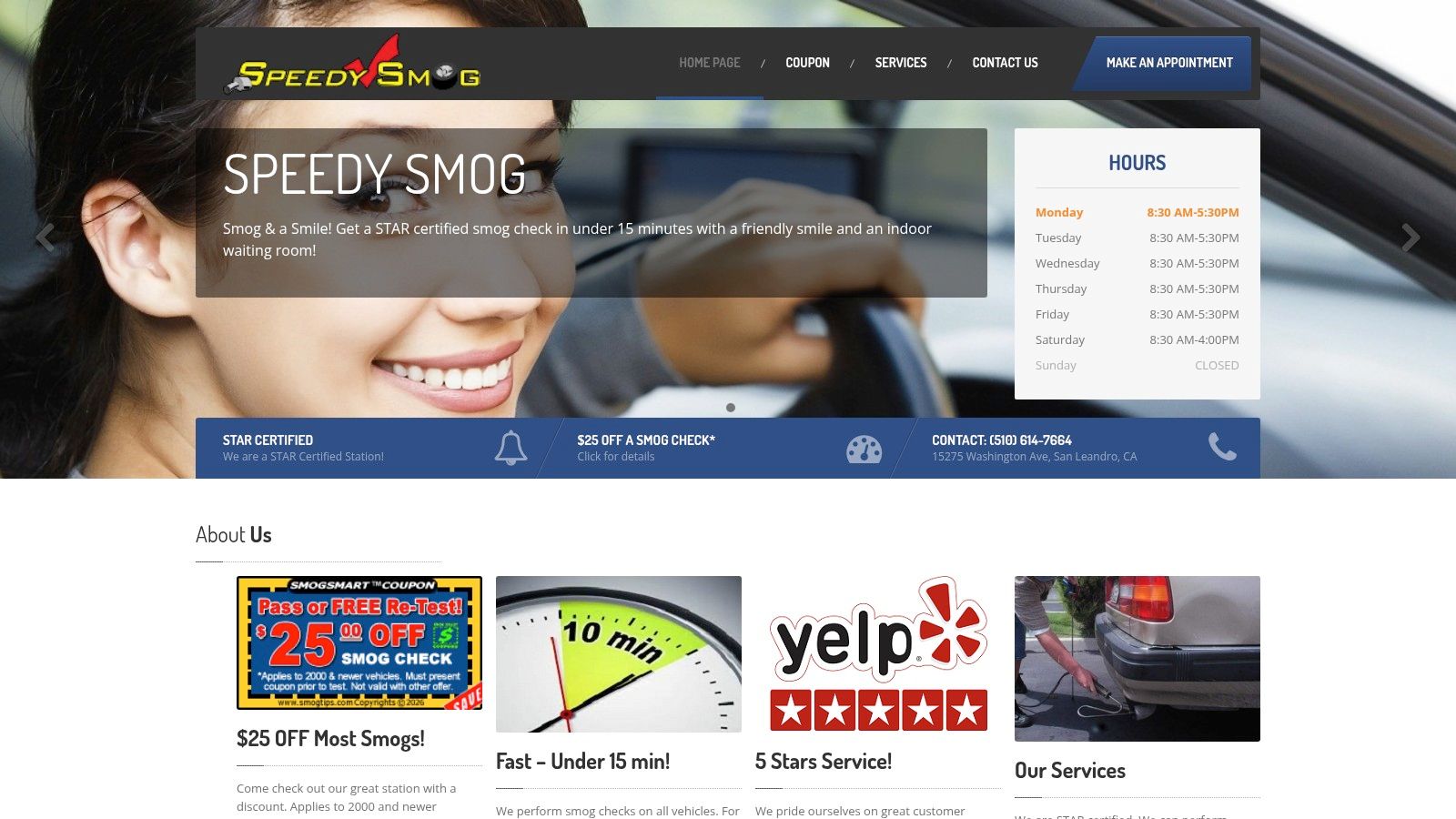
For drivers who just want to get the test done, the primary benefit is predictable service. You show up, the car gets inspected, and the paperwork goes where it needs to go without you having to manage complex state language on your own.
Smog Check Common Questions Answered
What happens if my car fails the smog check?
You'll need to repair the issue and retest before the registration process can move forward. The useful move is to ask for the reason code or failure explanation, then fix the specific problem instead of guessing.
Can I get a smog check if I'm selling my car?
Usually yes, and in many cases you should, because buyers often want the transfer handled cleanly. If ownership is changing, that's one of the situations where emissions verification commonly comes into play.
Do hybrids need smog checks?
Some do, depending on the vehicle and the transaction. Don't assume the hybrid badge means an exemption, because California's rules are more specific than that.
What if I'm out of state right now?
Check your renewal situation carefully and confirm whether the DMV allows a delay or other handling for your case. Don't wait until the deadline has passed, because that's when a manageable paperwork issue becomes a registration problem.
If you want a straightforward inspection from a STAR Certified station that handles most vehicle types and sends results to the DMV, visit Speedy Smog and book your smog check in San Leandro. Bring the notice, bring the car, and let the station handle the testing so you can get your registration back on track without extra hassle.
You're standing at the DMV counter or staring at a renewal notice in the mail, and the message is the same, your registration won't go through until the smog issue is handled. For a lot of East Bay drivers, that's the moment the California Air Resources Board suddenly feels very real, even if you've never thought about the agency before. The rule feels like paperwork pressure, but it's really the last link in a chain that starts with emissions standards and ends with a test station, a report, and DMV approval.
If you've ever wondered why one car breezes through and another gets sent to a STAR station, or why a newer vehicle can still trigger a registration hold, the answer usually sits inside CARB's rules and the way those rules get enforced on the ground. That's the part most drivers never get explained in plain language. Once you see how the system works, the DMV notice stops looking random and starts looking like a checklist.
Table of Contents
- Why Your DMV Registration Mentions the California Air Resources Board
- How CARB Became the Nation's Toughest Air Quality Regulator
- Understanding the Smog Check Program and STAR Certification
- Your Step-by-Step Path to CARB Compliance in the East Bay
- Common Exemptions and What to Do When Your Vehicle Fails
- CARB's Zero-Emission Future and What It Means for Bay Area Renters
- How Speedy Smog Makes CARB Compliance Fast and Stress-Free
Why Your DMV Registration Mentions the California Air Resources Board
The first time this usually hits home is a renewal notice. Your plate sticker is due, the DMV says a smog certification is needed, and now you're trying to figure out why a state agency you barely think about gets a say in whether you can keep driving your own car. The short answer is that the California Air Resources Board sets the emissions standards behind the test, and the DMV uses that result before it finishes registration.
That's why the request doesn't feel optional. If the vehicle is in a category that needs testing, the station checks whether it meets the state's emissions rules, then the result gets sent forward for registration processing. Speedy Smog's registration renewal overview is a useful reminder of how that DMV step and the test station step fit together.
The chain from rule to renewal
CARB writes the standards. The inspection station verifies the vehicle against those standards. The DMV uses the verified result to decide whether your paperwork can move ahead.
That chain matters because it explains why a smog test is not just a shop decision. The test isn't there to sell you a repair you didn't ask for, it's there to confirm that the vehicle is meeting the state's emissions requirements before the registration gets renewed. If the vehicle passes, the station sends the result electronically. If it fails, the DMV wait continues until the issue is resolved.
Practical rule: If your renewal notice calls for a smog certificate, don't treat the station visit as separate from registration. For many East Bay drivers, they're part of the same compliance step.
A lot of confusion comes from the wording on the notice. Drivers see DMV language, but the underlying requirement traces back to CARB's authority over emissions controls, fuel limits, and vehicle compliance programs. Once you know that, the notice stops looking like a mystery letter and starts looking like a straightforward instruction, get the car tested, get the result recorded, then finish the registration.
How CARB Became the Nation's Toughest Air Quality Regulator
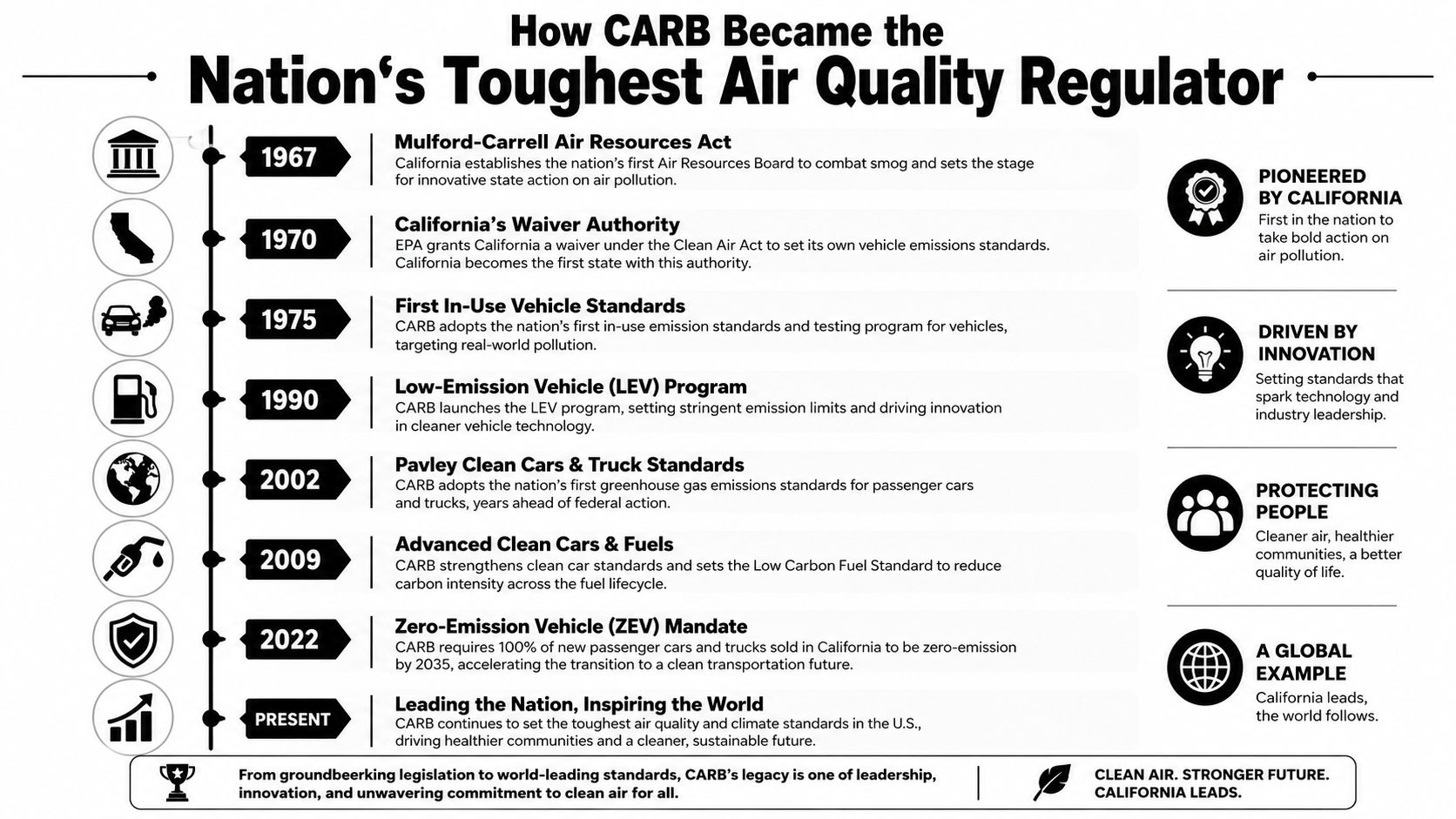
CARB didn't appear out of nowhere. It was created in 1967 when Governor Ronald Reagan signed the Mulford-Carrell Air Resources Act, which merged the Bureau of Air Sanitation and the California Motor Vehicle Pollution Control Board into one statewide agency. That timing matters, because California had already moved in 1966 to adopt the nation's first tailpipe emissions standards, and the federal Air Quality Act of 1967 later recognized California's special authority to set stricter vehicle emissions rules because of the state's geography, weather, and vehicle density. CARB's history page lays out that foundation clearly.
Why the early milestones still matter
The point of the timeline isn't just history trivia. It shows how California kept building a regulatory model that other places later copied. CARB's early milestones included the first national tailpipe standards for hydrocarbons and carbon monoxide in 1966, nitrogen oxides in 1971, and diesel particulate matter in 1982. Those dates show a pattern, CARB was not only reacting to smog, it was shaping the framework that later became normal in major vehicle markets.
The legal structure also matters for drivers who think CARB is just a policy name. Its authority lives in the California Code of Regulations, mainly Title 13, Division 3 for motor vehicles and Title 17, Division 3 for public health. Those titles are where the enforceable rules sit, which means compliance comes from actual rule text, test methods, and program sections, not from broad statements about clean air. CARB's laws and regulations page is where that framework is organized.
What the federal backstop means for you
California's special authority helps explain why a vehicle can pass one state's expectations and still run into trouble here. CARB can set stricter requirements for vehicles sold, registered, or tested in California, and those rules affect design choices, fuels, and compliance paths. For East Bay drivers, that's why a vehicle's paperwork and emissions status can depend on California standards even when the car itself was built elsewhere.
The important thing for a driver is simple. If the vehicle is in California's system, California's rulebook is the one that counts.
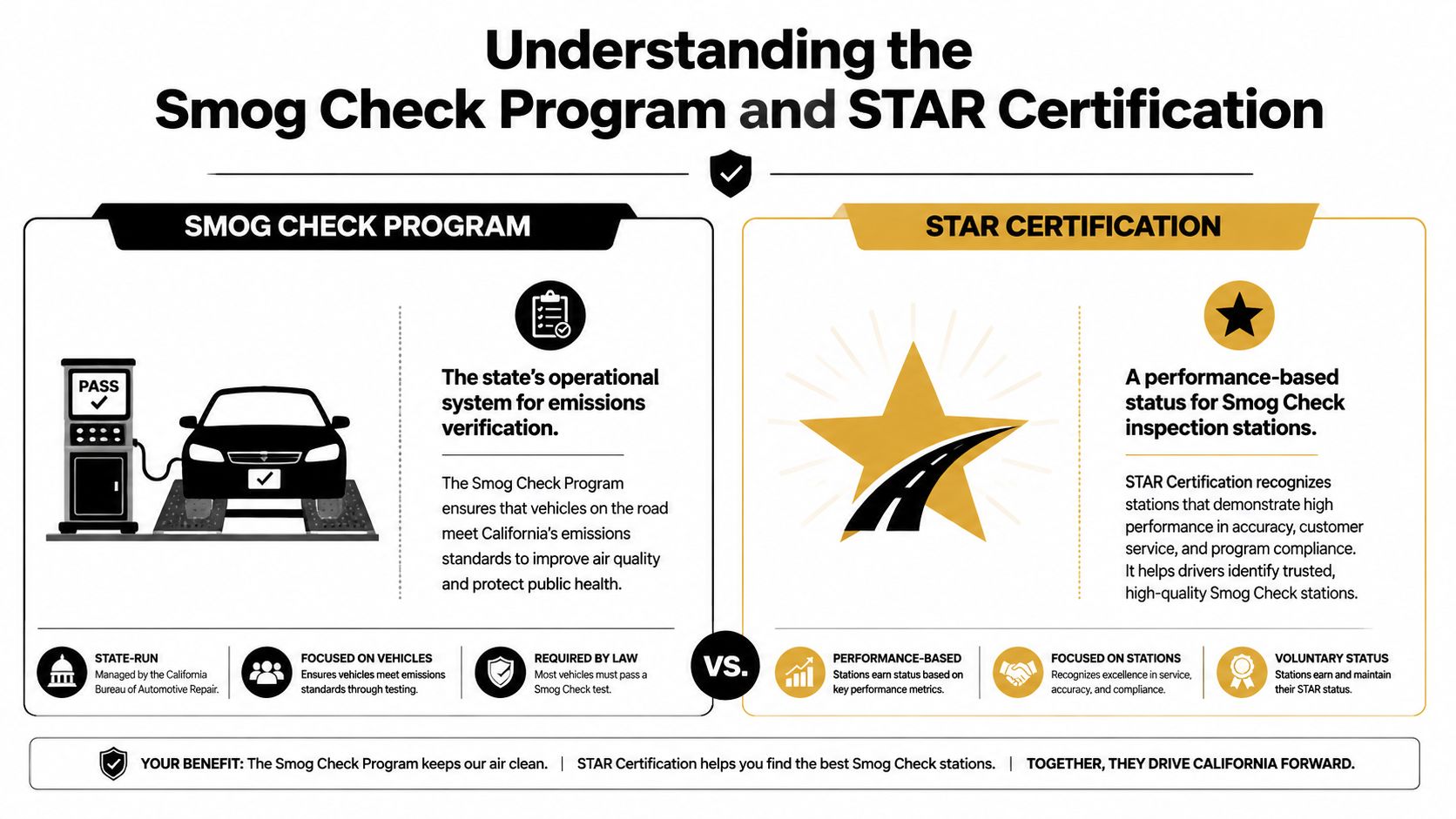
If you want to see how CARB's authority translates into day-to-day inspection rules, this emissions testing guide connects the legal side to the practical station-side side without the jargon.
Understanding the Smog Check Program and STAR Certification
People often use “smog check” and “STAR station” as if they mean the same thing. They don't. The Smog Check Program is the state's testing system, while STAR certification is a higher performance status for stations that meet stricter standards for accuracy and equipment under the Bureau of Automotive Repair framework. A STAR station can perform tests, but not every test needs a STAR station.
Smog Check Program vs STAR station
The Smog Check Program is the process that confirms whether a vehicle meets emissions requirements before registration moves forward. The station checks the car, records the result, and sends that result into the state system. If the vehicle passes, the DMV can proceed with the registration workflow.
STAR status is about the station, not the car. Some drivers get directed to STAR stations because of the vehicle's profile, the registration situation, or a DMV notice. That's why two neighbors can have different instructions even if both are just trying to renew tags. The station type requirement is part of the compliance path, not a judgment about the owner.
What a STAR station means in practice is easier to understand if you think of it as a stricter lane within the larger smog system.
What happens during the inspection
A typical inspection can include a visual check, a functional review, and emissions-related measurement through the vehicle's onboard systems or tailpipe-related testing, depending on the vehicle and model year. The station is looking for whether the vehicle's emissions controls are present, working, and communicating properly. That's why a check engine light can be a problem before the test even gets going.
The driver's job is to show up with a vehicle that's ready to be evaluated. The station's job is to verify the system the state requires. If the DMV notice specifies STAR, use a STAR station, because the wrong station type can send you home without the result you need.
Your Step-by-Step Path to CARB Compliance in the East Bay
Start with the renewal notice, not with the test station. That notice tells you whether a smog check is required and whether a STAR station is named or implied by the registration instructions. If you miss that detail, you can end up at the wrong place and lose time you didn't need to lose.
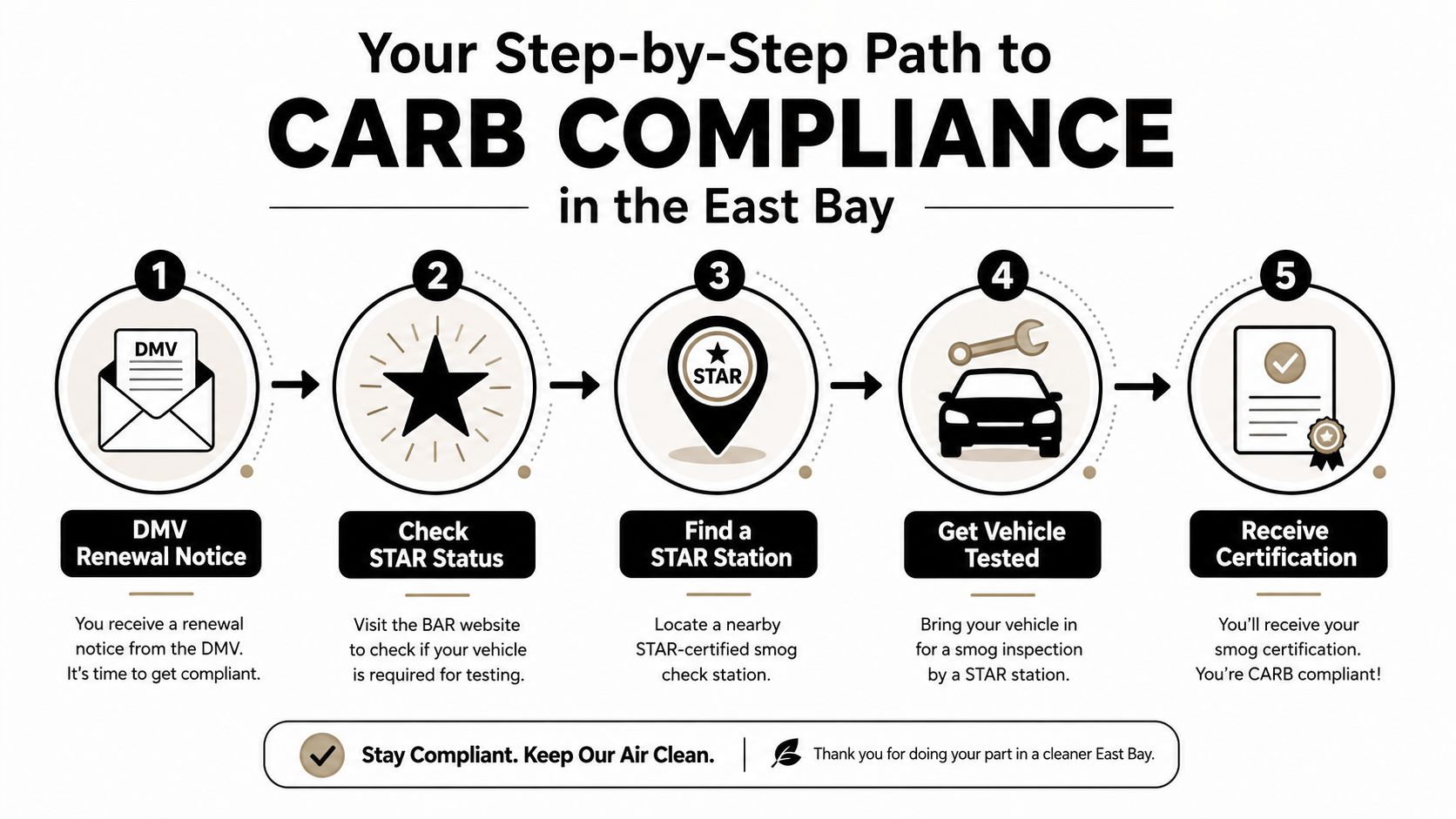
How drivers usually move through the process
- Read the DMV notice carefully. Look for the smog requirement, the deadline, and any station-type instruction.
- Check whether the vehicle is ready. If the check engine light is on, or the car has just been disconnected from power, the vehicle may not be ready for a clean inspection.
- Choose the right station. If the notice points you to a STAR station, use one.
- Let the station test the vehicle. The technician performs the required checks and records the result.
- Wait for certification to post. A pass is sent electronically so the DMV can continue the registration process.
That path sounds simple, but drivers get tripped up at the second and third steps. A car that hasn't been driven enough after a battery reset may not have completed its internal readiness checks. A car that's clearly headed for a STAR requirement can't be fixed by choosing a non-STAR station.
Practical rule: If the car has been repaired recently, ask whether the systems are ready before you go. A clean-looking dashboard doesn't always mean the vehicle is inspection-ready.
The point of the step-by-step approach is to keep the inspection from feeling like a gamble. You're not guessing whether the DMV will accept the result, you're lining up the right notice, the right station, and a vehicle that's prepared to be tested. For East Bay drivers juggling work, school runs, and long commutes, that preparation is usually the difference between one trip and two.
Common Exemptions and What to Do When Your Vehicle Fails
Not every vehicle needs the same kind of test, and not every driver is looking at the same problem. A newer car may be exempt in one situation and required in another, while a diesel or hybrid can follow a different path than a conventional gasoline vehicle. The trick is to match the vehicle type to the DMV instruction instead of assuming everyone gets the same result.
Vehicle types and the common questions drivers ask
| Vehicle Type | Model Year Range | Smog Check Required | STAR Station Required | Special Notes |
|---|---|---|---|---|
| Newer gasoline passenger vehicles | Qualifying newer model years under California rules | Sometimes no, depending on the renewal situation | Only if the DMV notice says so | Model-year rules can change the answer |
| Older gasoline vehicles | Qualifying older model years that fall under the program | Often yes | Only if directed | Registration status matters |
| Diesel vehicles | Subject to California diesel testing rules | Sometimes yes | Only if directed | Testing method can differ from gasoline vehicles |
| Hybrid vehicles | Subject to California hybrid testing rules | Sometimes yes | Only if directed | Drivers often assume hybrids are exempt, but that isn't always true |
| Classic or specialty vehicles | Depends on the registration category and model year | Sometimes no, sometimes yes | Only if directed | Always check the specific notice |
That table is the safest way to think about exemptions. The exact answer depends on the vehicle's year, fuel type, and registration circumstance, not just on whether the car is “old” or “new.” If the DMV asks for a certificate, the notice wins over assumptions.
What a failure usually means
A failed test doesn't mean the car is done. It usually means the station has issued a vehicle inspection report that tells you what needs attention before a retest. In some cases, drivers may qualify for an economic hardship extension tied to repair-cost rules, but that depends on the situation and the program requirements, so the safest move is to read the report carefully and ask the station what the next compliance step should be.
The mistake I see most often is drivers treating a failure like a dead end. It's more accurate to treat it like a repair map. The report points to the issue, and the next visit is about proving the problem was fixed, not starting over from zero.
CARB's Zero-Emission Future and What It Means for Bay Area Renters
CARB's long-range direction points toward 100% zero-emission new car sales by 2035, which sounds straightforward until you look at where many East Bay drivers live. Renters, apartment dwellers, and households with older multifamily housing don't always have a driveway, a garage, or a simple place to plug in. That's where the policy gets practical fast.
Charging access is the real bottleneck for many drivers
CARB-backed research from listening sessions in historically underserved areas, including Oakland, found that the biggest barriers to ZEV adoption were lack of public charging infrastructure, lack of home charging access, and cost. That matters because the usual advice, just charge at home, doesn't fit a lot of Bay Area households. If you live in an apartment building or rely on street parking, the charging plan can be the hardest part of the whole equation.
The core issue isn't whether the technology works. It's whether the driver can use it consistently without special access to private charging. In older housing stock, landlord cooperation and building constraints can make installation complicated, which means incentives alone may not solve the adoption problem.
Why environmental justice monitoring is changing the conversation
CARB's environmental-justice work is also moving closer to street level. Its 2024 roundtables surfaced resident concerns about the cumulative effects of traffic, industry, wildfires, agriculture, and climate on pollutants like PM2.5, ozone, VOCs, and NOx, along with the question of the best way to monitor local disparities and reduce them. The gap is not just whether monitoring happens, it's how the results turn into actual cleanup or enforcement.
CARB's 2025 launch of mobile air monitoring in 64 heavily burdened communities, with more than 60% of the monitoring serving priority populations, suggests a shift toward block-by-block accountability. That doesn't solve the charging problem for renters, but it does show CARB paying closer attention to who bears the heaviest air-quality burden and where the gaps still sit.
How Speedy Smog Makes CARB Compliance Fast and Stress-Free
For East Bay drivers who just need the registration finished, a STAR Certified station can remove a lot of guesswork. Speedy Smog in San Leandro, at 15275 Washington Ave, handles smog inspections for most vehicles, including 2000 and newer models, 1999 and older vehicles, diesels, and hybrids. Typical tests for 2000 and newer vehicles are completed in about 10 to 15 minutes, and the result is electronically reported to the DMV so the registration process can move ahead.
The setup matters too. Drivers get a clean indoor waiting room, transparent pricing, and periodic $25-off coupons for most smogs on newer vehicles. Open Monday through Saturday, the station is built for the kind of quick, no-drama compliance visit East Bay owners usually want when a renewal notice is already hanging over them.
If your renewal letter is asking for a smog certificate, or if you've been sent to a STAR station, the easiest move is to line up the test first and avoid a second trip to the DMV. Visit Speedy Smog to check the station details, see what kind of inspection your vehicle needs, and get the certification handled without dragging the process out.
You're staring at the dash in the parking lot, the smog appointment is coming up, and that check engine light is sitting there like a warning you can't ignore. In that moment, a lot of drivers want the fastest fix possible, especially if the car still feels fine. The problem is that clearing the light is not the same thing as fixing the fault, and in California that difference can decide whether you leave with a clean result or get turned away.
Table of Contents
- What the Check Engine Light Actually Means
- Using an OBD2 Scanner to Read and Clear Codes
- Alternative Reset Methods and Their Trade-Offs
- Common Causes Behind the Light and When to Seek Repair
- California Smog Test Implications You Cannot Ignore
- Prevention Tips and Your Reset Decision Framework
What the Check Engine Light Actually Means
A driver rolls into the bay after tightening a gas cap, then asks why the light is still on. That's a normal scene, because the dashboard warning does not care whether the problem feels small. It is triggered by the vehicle's ECU or ECM, which watches emissions and engine behavior, stores trouble codes, and turns on the light when something falls outside expected limits.
The light is a diagnostic alert, not a bulb problem
The most important thing to understand is that the light itself is not the issue. The ECU controls the alert, so clearing it only removes the warning, it does not repair the underlying fault. That is why a reset can make the dash look better for a while and still leave the car failing emissions in the background.
Practical rule: if the car needed a code to turn the light on, it still needs a real diagnosis to make the light stay off.
A steady light usually points to a fault that needs attention, but a flashing light is a different situation. That warning usually means a more serious active problem, and it should not be treated like a simple clear-it-and-go job. If the light is flashing, the car needs attention before you keep driving it hard.
What a successful reset looks like
Real success is not a dark dashboard for ten minutes. It is a repaired system, cleared codes, and a vehicle that does not immediately object again after a few trips. In California, that matters even more because the vehicle has to convince the inspection equipment that the emissions systems are behaving normally, not just that someone erased memory.
OBD-II troubleshooting became universal in the 1990s, which is why reset steps are so standardized across brands and models. That universal structure is helpful, but it also creates a trap. It makes code clearing look easy, so people forget that the code existed for a reason.
For a plain-English breakdown of reading and clearing fault codes, see this OBD code guide for California drivers.
Using an OBD2 Scanner to Read and Clear Codes
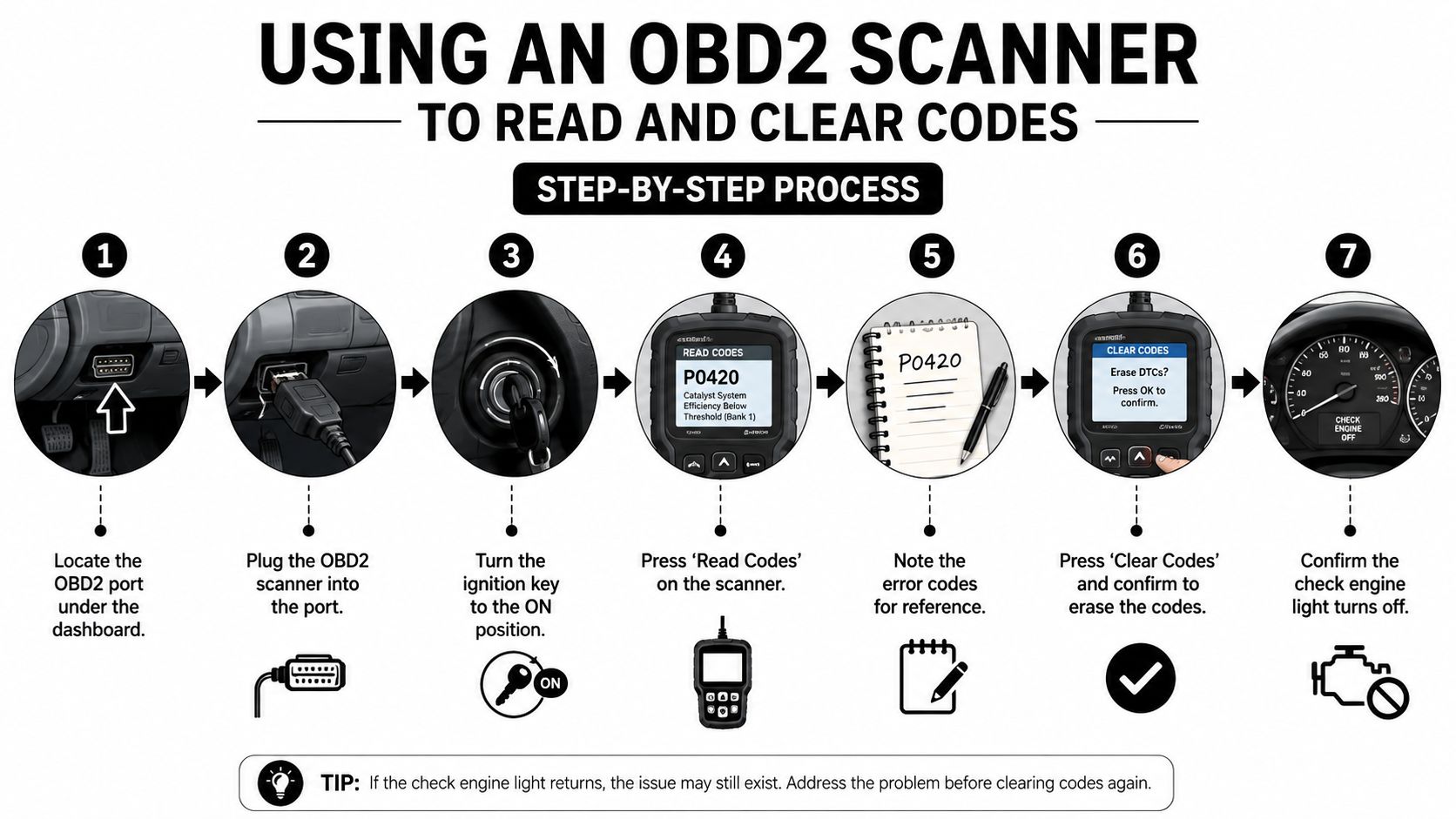
The scanner method works because it matches the way the car's computer stores faults. Plugging in the tool under the dashboard lets you read the codes before you clear them, and that order matters because erasing the memory also erases the clue trail. If you are trying to clear a check engine light before a California smog test, reading first helps you avoid guessing at a fix that may not hold up in inspection.
Read first, clear second
Plug the OBD2 scanner into the diagnostic port with the ignition turned to ON and the engine off. Then read both stored and pending codes, and save or write them down before you touch the erase function. If you skip that step, you lose the most useful information the car can give you.
A lot of drivers try to clear the light first and then see whether it returns. That approach leaves you blind if the fault comes back, and it does nothing to tell you whether the problem is an intermittent sensor issue, a wiring problem, or a repair that did not take. Keep the record even if you do not know what it means yet, because the code family and the freeze-frame context usually tell more than the warning lamp itself.
If you want help understanding the numbers before you clear anything, this OBD code guide for San Leandro drivers is a useful companion.
Clear codes only after the repair is confirmed
The better sequence is straightforward. Fix the fault, reconnect the scanner with the ignition on and the engine off, check the stored and pending codes again, confirm the repair, then use “Erase Codes” or “Clear DTCs” Automotoflux's clear-code guide. If the light goes out, that only means the computer memory was cleared.
Readiness is the part many guides leave out. The monitor status needs to return to “Ready” or “Complete” in Mode 01 PID 01 before the reset means much for smog purposes Automotoflux's clear-code guide. A dark dash and a ready vehicle are not the same thing, and California inspection equipment cares about the second one.
A cleared code is not the same as a fixed car. The scanner can turn off the warning, but it cannot prove the fault stayed gone.
A note on using a professional station
If you do not want to guess, a smog-focused shop can help you check the result after repairs. A station such as Speedy Smog in San Leandro fits that workflow because it performs emissions testing for California drivers who need a compliance result, not just a blank dashboard.
Alternative Reset Methods and Their Trade-Offs
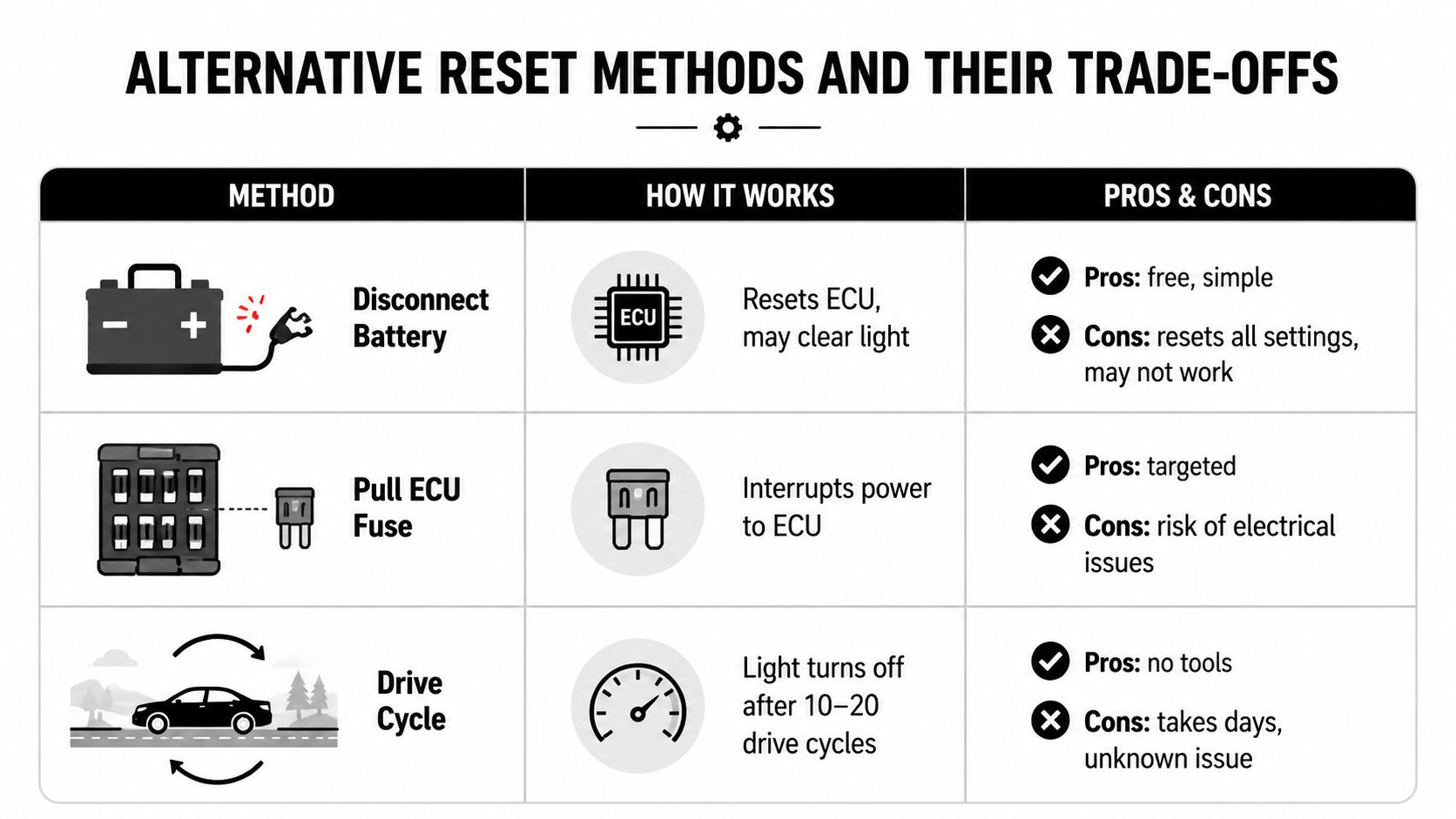
A lot of drivers reach for a power reset when they do not have a scanner handy. It can make the light disappear for a while, but it also skips the part that matters before a California smog test, confirming the fault is resolved AMP Auto's clear-light guide.
Battery disconnect and ECU fuse removal
Disconnecting the negative battery terminal is the common shortcut. Some guides say to wait about 10 to 15 minutes before reconnecting so the ECU reboots and the light turns off AMP Auto's clear-light guide. That can work, but it also wipes radio presets and learned settings, and the same issue can return as soon as the car sees the fault again.
Pulling the ECU fuse does something similar by cutting power to the computer. It is a little more targeted than removing the whole battery, but it still means you are changing the electrical system instead of finding the cause. For a driver trying to quiet the dash before an appointment, that is a risky trade.
Drive cycle resets take patience
The slowest route is letting the car clear itself after the original problem has corrected. One expert source says that after a self-corrected issue such as a tightened gas cap, the ECU may clear the code automatically after 3 to 5 drive cycles, with confirmation recommended over roughly 100 miles of mixed driving AMP Auto's clear-light guide. That approach makes sense only when the problem was temporary and the repair has already happened.
If the fault is still there, a battery disconnect only buys time. The code comes back because the ECU sees the same problem again.
The practical comparison is simple. Battery disconnect is fast but messy. Fuse removal is a little more precise but still a shortcut. Drive cycles are gentle on the vehicle and do not erase settings, but they only make sense when the problem corrected itself and you can afford to wait. For drivers trying to avoid a smog-day surprise, a clear-light trick is not the same as a compliant car. If you want a fuller look at what tends to trigger inspection trouble, this smog fail reasons guide for San Leandro drivers is a useful reference.
Common Causes Behind the Light and When to Seek Repair
A light on the dash doesn't tell the whole story, but the code family usually points in the right direction. A loose gas cap is one of the easiest fixes, while issues tied to sensors, misfires, or the catalytic converter often need more attention. The smart move is to match the symptom to the repair, not to clear the alert and hope the problem behaves.
What the usual suspects look like in practice
| Common Cause | Typical Code | DIY Fixable | Estimated Cost Range |
|---|---|---|---|
| Loose or damaged gas cap | EVAP-related codes | Yes, often | Usually low |
| Oxygen sensor problem | Sensor-related codes | Sometimes, if accessible | Moderate |
| Mass airflow sensor issue | Air metering codes | Sometimes | Moderate |
| Spark plug wear or misfire | Misfire codes such as P0300 | Sometimes, if the service is basic | Variable |
| Catalytic converter issue | Efficiency codes such as P0420 | No, usually not | High |
The exact code matters because different failures affect the car in different ways. A gas cap may be a quick driveway fix, while a catalytic converter concern is a different level of problem altogether. If you want a fuller breakdown of what tends to trip a smog inspection, this smog fail reasons guide for San Leandro drivers is a useful reference.
Which repairs are worth doing yourself
A gas cap replacement is the easiest DIY call when the cap is cracked, loose, or won't seal properly. Some spark plug work is also reasonable if you already know the vehicle and have the right tools. But once the issue involves emissions sensors, misfires that keep returning, or catalyst efficiency codes, the odds favor a proper diagnosis instead of repeated resets.
Real-world test: if the code returns after a reset and a short drive, the car is telling you the fault is still live.
The mistake many drivers make is treating every code like a nuisance. That approach can backfire fast because a small issue left alone can become a larger repair later. A reset is useful only when it follows the right repair, not when it replaces one.
California Smog Test Implications You Cannot Ignore
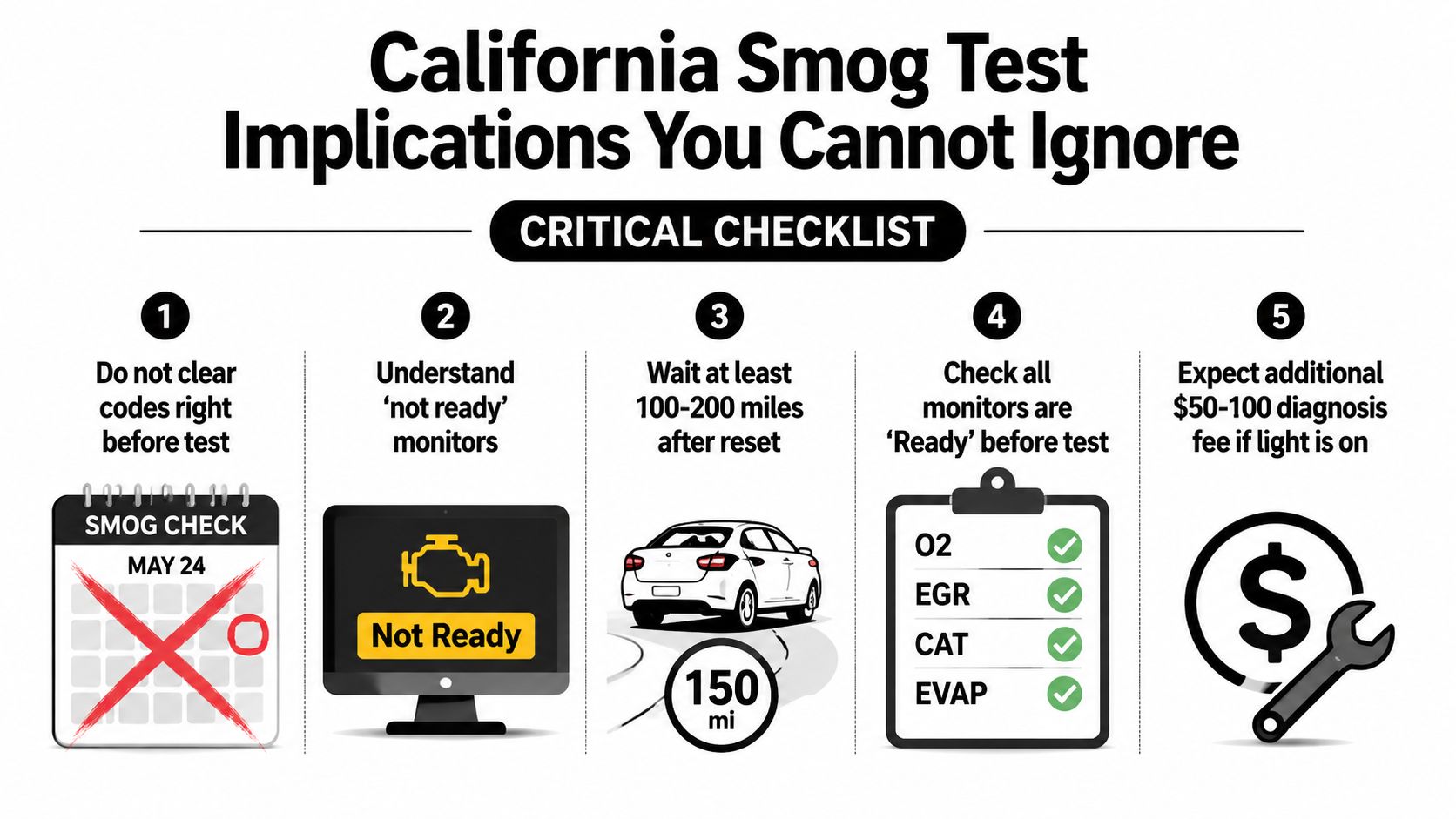
Many East Bay drivers get burned here. Clearing the light right before a smog appointment feels like a fast fix, but it also resets the readiness monitors that inspectors check before the emissions test. If those monitors show Not Ready, the car can be turned away even when the dashboard looks clear.
That is the hidden cost of a quick reset. You may erase the warning on the dash, but you do not erase the inspection problem.
Why timing matters more than most drivers think
After a reset, the vehicle needs time and the right driving conditions to rebuild readiness. Clearing codes the night before a test often leaves the computer without enough time to rerun its self-checks, so the station sees an incomplete snapshot instead of a verified one. A five-step checklist illustrating important tips for passing a California smog test for vehicles. spells out the same basic problem, a recent reset can leave the monitors unfinished when it matters most.
California drivers also need to treat the smog appointment as a compliance check, not a convenience check. If the system is not ready, the station does not give extra credit for a recent reset. It just has less to verify.
Repair first, then drive long enough for the monitors to complete before you book the test. A monitor that says Ready means the car has had a fair chance to run its checks after the repair and reset. That is the condition you want before you pull into a California inspection lane.
Smog stations and the compliance angle
For drivers who want an inspection that lines up with California requirements, a STAR Certified station is usually the safer lane because it follows the higher standard used for DMV-recognized testing. If the goal is a registration renewal that does not come back with another problem, a place like Speedy Smog's check engine light smog test page fits that need because it focuses on the testing process instead of a guess-and-hope reset.
A recent reset can make a car look cleaner than it really is. That matters because a smog lane is checking for readiness and compliance, not just a blank dash. As noted earlier, code clearing has its place, but using it as a last-minute smog strategy usually creates more trouble than it solves.
The practical move is simple. Clear the code after the repair, then give the car time to prove it is ready before the test.
Prevention Tips and Your Reset Decision Framework
The cheapest check engine light is the one that never shows up. Regular maintenance keeps the emissions system from drifting into the kind of fault that turns into a code, a failed test, or a hurried reset attempt. That means handling routine service before the car starts complaining.
Maintenance habits that prevent nuisance codes
- Change oil on schedule: Dirty oil can create avoidable stress on the engine and related systems.
- Tighten the gas cap properly: A sloppy seal is one of the simplest ways to invite an emissions warning.
- Replace air filters when they're due: Restricted airflow can make the engine work harder than it should.
- Keep spark plugs in good shape: Old plugs can contribute to rough running and misfire behavior.
- Take longer drives now and then: Short trips alone don't always let the system run its checks cleanly.
Use a simple decision tree
If the light is steady, read the codes first. If the code points to a clear mechanical issue, repair it before clearing anything. If the issue looks minor and the fault has already been corrected, a proper scanner reset makes sense, followed by a drive cycle and monitor check.
If the light is flashing, stop treating it like a maintenance task and get help. If the code comes back after a reset, the fault wasn't solved. If your smog deadline is close and the monitors haven't finished, don't gamble on a last-minute clear.
A final practical note for East Bay drivers. Speedy Smog handles smog checks for 2000 and newer vehicles, 1999 and older models, diesels, and hybrids, and typical tests for newer vehicles are completed in about 10 to 15 minutes at its San Leandro location Speedy Smog about page. That makes it a sensible stop when you want a compliant result instead of a rushed reset.
If your check engine light is on, bring the car in after the repair and let a proper smog station confirm where it stands. Visit Speedy Smog for a fast, California-compliant inspection in San Leandro, and avoid the mistake of clearing codes right before your test only to get sent back for unreadiness.
If your car is 1975 model year or older, battery-electric, or one of the specific out-of-state or fee-based cases, the DMV smog exemption form can help. If it isn't one of those buckets, paperwork won't save you, and you'll waste time filing the wrong thing.
You're probably staring at a renewal notice right now and wondering whether a form can replace a test. That's the right question, because California doesn't hand out blanket smog waivers. The DMV treats exemption requests as narrow, rule-based filings tied to age, fuel type, weight, and whether the vehicle is outside California. Get that part wrong and the rest of the paperwork is noise.
Table of Contents
- Who Actually Needs a DMV Smog Exemption Form
- Matching Your Vehicle to the Right Exemption Category
- How to Fill Out the REG 5103 Form Correctly
- Submission Options and the Documents You Need
- Common Mistakes That Get Exemption Requests Rejected
- Timing the Filing With Your Renewal Cycle
- When Skipping the Form and Getting Tested Is the Better Move
Who Actually Needs a DMV Smog Exemption Form
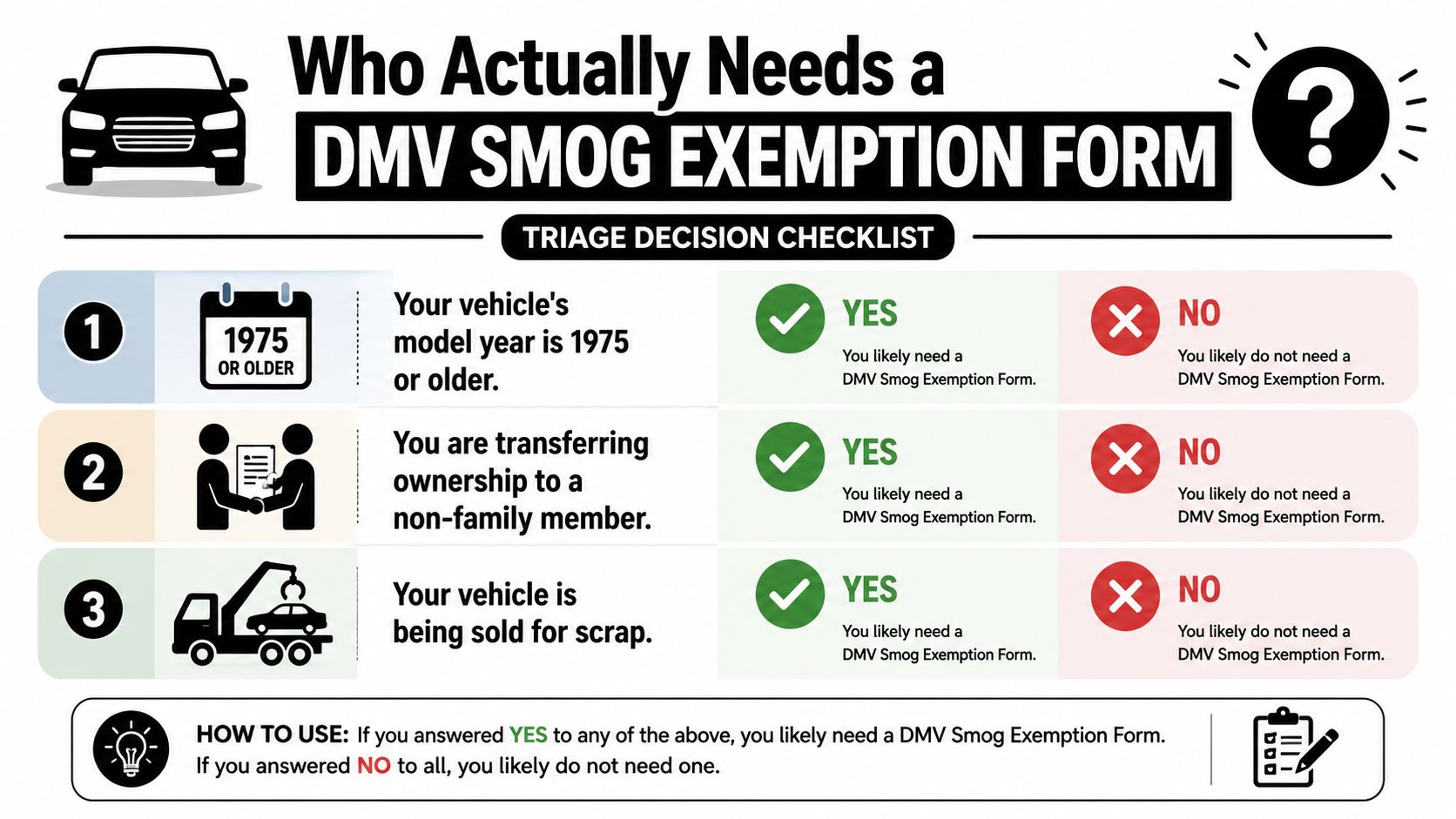
Drivers usually reach for the DMV smog exemption form because they want a shortcut around a smog issue. That approach causes trouble fast. The form only fits a narrow set of vehicles and situations, and California's DMV rules tie those exemptions to age, fuel type, weight, or temporary out-of-state status. California DMV smog inspection guidance
Start with the vehicle, not the paperwork
If you drive a gasoline vehicle that is 1975 model year or older, you do not need a smog inspection under DMV rules. The same guidance also exempts battery-electric vehicles, certain diesel vehicles based on age and weight, and natural gas vehicles over 14,000 pounds. Those are category rules, and filing the wrong form does nothing for a vehicle that does not fit one of them.
If your vehicle is newer, check the model-year rule before you reach for exemption paperwork. California says gasoline-powered vehicles less than eight model-years old do not need a smog inspection, so plenty of owners are chasing a waiver they never needed in the first place. A newer gas car usually belongs in the regular renewal path, not in the exemption stack. California DMV smog inspection guidance
Practical rule: If the car is in California and does not fall into one of the listed exemption types, you probably need a smog test, not a waiver.
Don't confuse exemption with a test workaround
The DMV smog exemption form applies only to a narrow set of vehicles and situations. The requests that go sideways at the counter usually start with someone trying to make the form fit a car that does not qualify. If your vehicle is due for inspection and still registered in the state, expect smog-test territory, not exemption territory.
That is why the counter conversation turns into a sorting exercise. One driver has a classic car, another has an electric vehicle, another has a car parked out of state, and another has a newer gas car that falls under the abatement-fee rule. Those are different cases with different paperwork, and the DMV expects you to know which one you are in before you submit anything. For a plain-language overview of waiver language, some drivers also start with this DMV waiver explainer, but the official exemption category still controls the decision.
Matching Your Vehicle to the Right Exemption Category
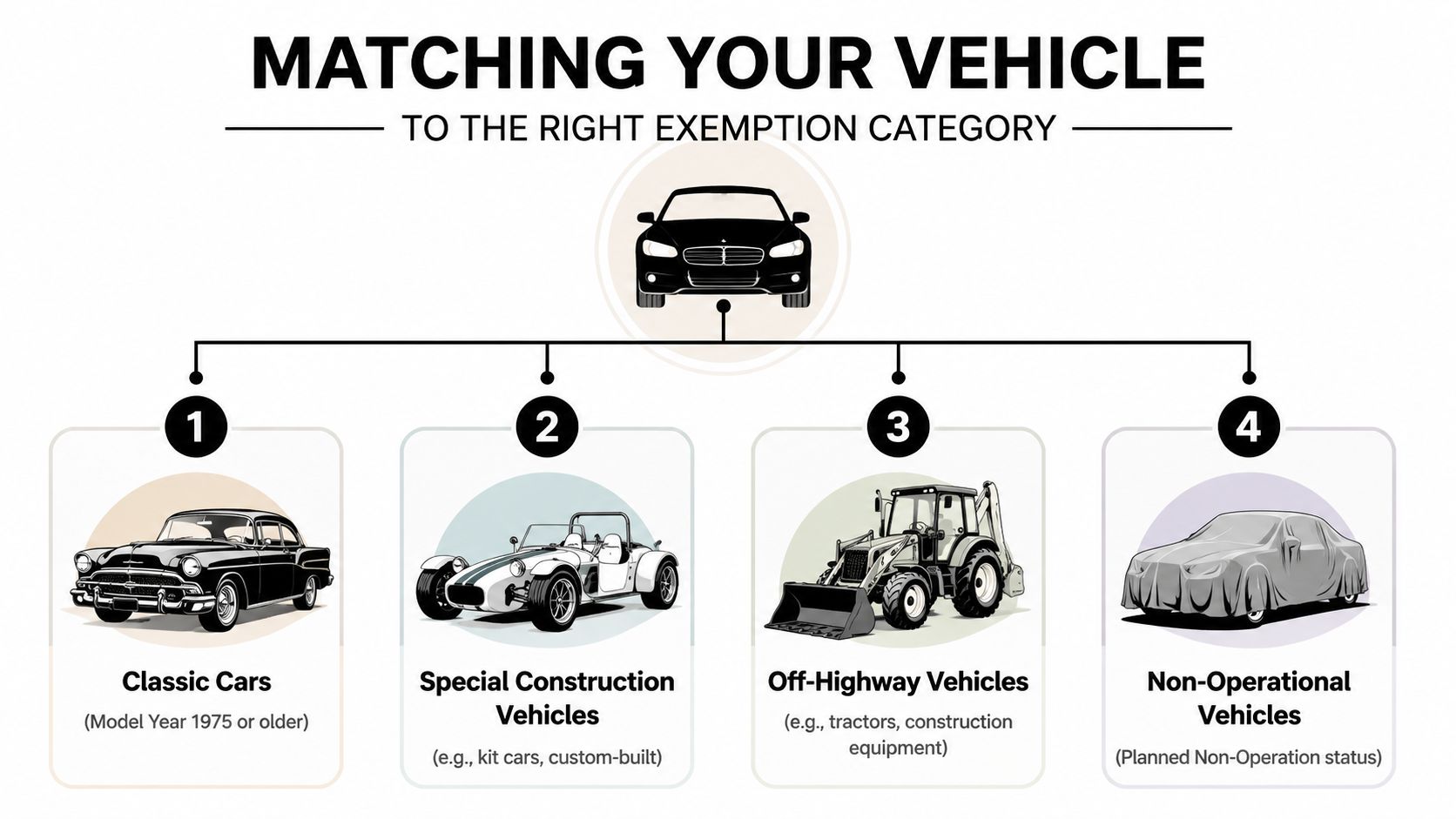
California's exemption framework is built around clear cutoffs. The Senate Transportation Committee factsheet says AB 1274 (O'Donnell), Chapter 633, Statutes of 2017 expanded the smog-check exemption to eight model years beginning January 1, 2019, and created the $25 smog abatement fee for those vehicles. Senate Transportation Committee factsheet
The rule bucket that fits your car
Start with the oldest cars. If your gasoline vehicle is 1975 or older, it is outside the smog-check lane under DMV rules. That is a clean yes, and there is no reason to force it into a newer-car process.
Diesel is its own bucket, and people miss the line all the time. Diesel vehicles are exempt if they are 1997 or older or if their Gross Vehicle Weight is more than 14,000 pounds. Age alone does not tell the whole story, weight matters too. California DMV smog inspection guidance
Fuel type creates another clean split. Battery-electric vehicles are exempt, and natural gas vehicles over 14,000 pounds are exempt as well. If your vehicle does not fit those definitions, do not try to squeeze it into them.
The newer cars people forget about
The last bucket catches drivers off guard at the counter. California also gives some gasoline-powered vehicles less than four model years old the option to pay the smog abatement fee instead of getting a smog inspection for the first 8 years the vehicle is registered, starting January 1, 2019. That means the DMV smog exemption form is not just for antiques or unusual equipment. It also comes up for newer vehicles that qualify for the fee path. Senate Transportation Committee factsheet
The counter mistake is usually simple. A driver shows up with the wrong bucket in mind, and the paperwork gets treated like a mismatch instead of a valid exemption request. California's exemption framework is built around clear cutoffs. If you cannot point to the bucket your vehicle fits, the request is going to stall.
Bottom line: match the car to the rule first. If you cannot name the exemption bucket, you probably do not qualify yet.
How to Fill Out the REG 5103 Form Correctly
For the temporary out-of-state case, REG 5103 is a document-first form. It does not reward guesswork. The DMV wants a clean paper trail that proves the vehicle is outside California and will not be available for a timely smog check. REG 5103 guidance
Fill the form like DMV verification will read it
Start with the basics, VIN, year, make, model, and license plate. Then add the exact out-of-state garaging address, the reason the vehicle is temporarily outside California, the expected return date, and the operator's contact information. Every one of those fields exists because DMV staff need enough detail to verify that the vehicle is really where you say it is.
The landmine is consistency. The garaging address, the “as of” date, and the return date have to tell the same story. If the car is supposedly in another state, but the dates or location details do not line up, the request looks shaky and usually gets delayed or rejected. If you need a quick check before you file, review your current registration status with a smog status lookup so you know whether you are dealing with a filing issue or a testing issue.
Counter rule: If the vehicle's location story does not make sense on paper, the DMV will not rescue it for you.
Know the substitute if REG 5103 is not the route you use
Some drivers will not file REG 5103 itself. In that case, a Statement of Facts (REG 256) Section G has to carry equivalent details, including the full out-of-state address and the return timing. That substitute is not less serious. It just uses a different form to prove the same thing, that the car is temporarily unavailable for a California smog check.
Use the form as a template, not a memory test. Write the vehicle details exactly as they appear on your paperwork, then make sure the out-of-state details are specific enough that someone at the DMV can check them without guessing. If the filing is meant to support renewal, do not treat it like a standalone letter. It belongs inside the registration process.
Submission Options and the Documents You Need
You can fill out the form correctly and still lose time at the counter if you send it the wrong way. California drivers usually have three routes, online for certain fee or eligibility situations, mail for the out-of-state packet, or an in-person DMV visit when the case is unusual or urgent. Each route creates a different paper trail, and a mismatch there is a common reason the request stalls.
Pick the route that matches the problem
If you are dealing with the smog abatement fee or another electronic DMV workflow, online handling can make sense. If you are filing the temporary out-of-state exemption, the packet usually belongs with the registration renewal mailing to Vehicle Registration Operations in Sacramento, not as a loose note sent on its own. Drivers miss that detail all the time, then wonder why the request disappears into the system.
In-person help works best when the file is messy, the paperwork is incomplete, or a clerk needs to review the packet before it moves forward. Bring the form and the vehicle documents that show the request fits the rule. If you are in the East Bay and the car is in California, some drivers need exemption paperwork while others need a STAR-certified smog test. That is the fork in the road.
Attach the right documents the first time
Do not send a half-finished packet. The DMV workflow expects the form to be signed, attached to the renewal packet when required, and mailed to the proper operations address. If you are using a substitute document, it still needs the same out-of-state details, or the filing can come back with a request for more information. REG 5103 guidance
If you are still trying to decide whether you need a test instead of a form, this smog status check guide is the faster place to start than guessing.
The BAR also says STAR-directed workflows may require a STAR station, which matters if your renewal notice sends you there. If that is your situation, paperwork will not fix it. The car needs the inspection path, not the exemption path. For a visual reminder of the three submission routes, use the embedded checklist below.
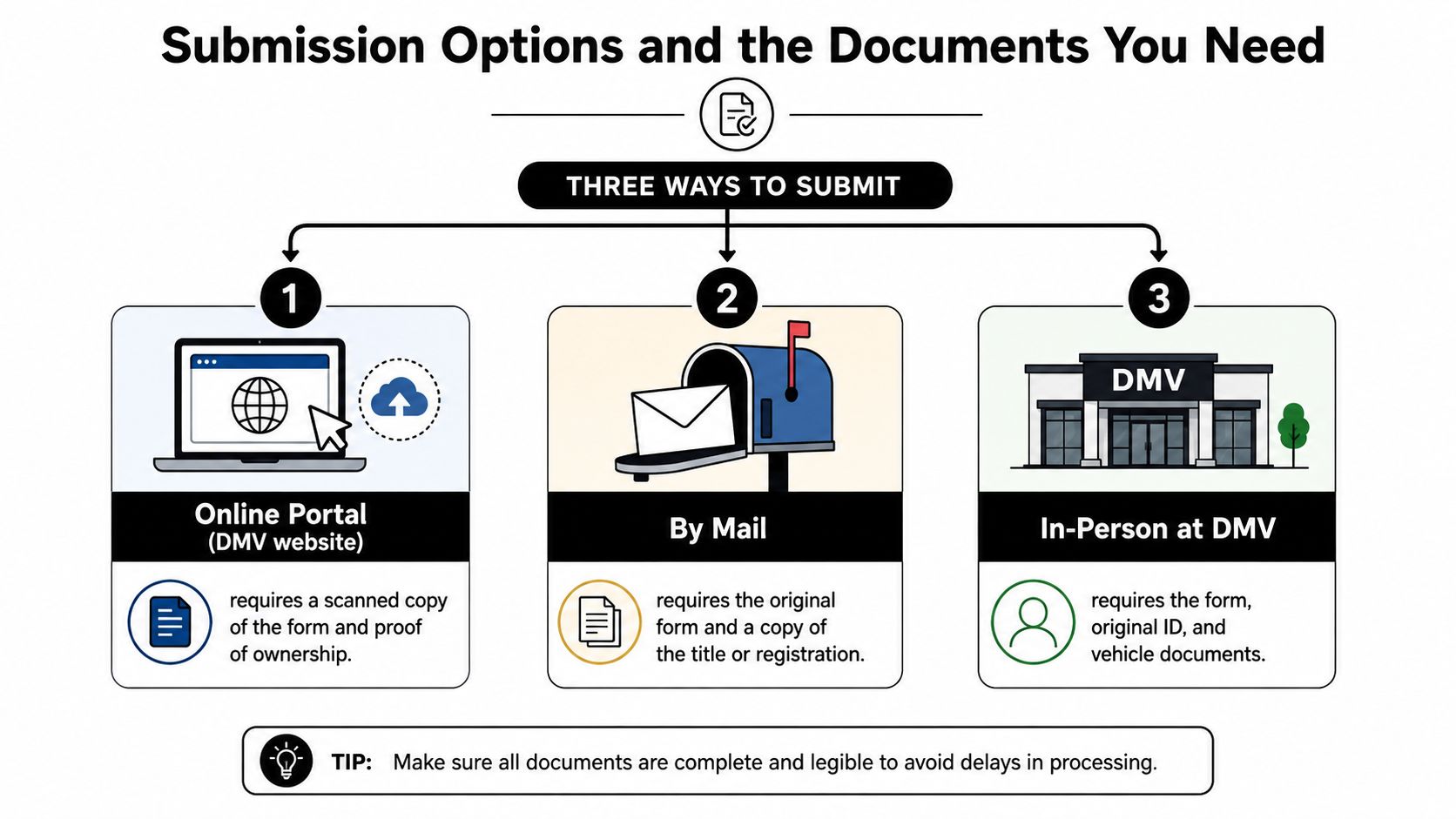
Common Mistakes That Get Exemption Requests Rejected
The DMV does not reject exemption requests at random. It rejects them when the file does not prove the reason the exemption was filed in the first place. That is a paperwork problem rooted in how the DMV processes filings.
The big mistakes are predictable
The first mistake is trying to use REG 5103 to cover an emissions problem. A vehicle with the check-engine light on is not a candidate for exemption, and the form only fits when the car cannot be tested for a valid reason. If the driver is trying to avoid repairs, the filing is going to miss the point, and the counter clerk will spot it fast. BAR smog check guidance
The second mistake is bad timing after a battery disconnect or replacement. BAR guidance says drivers should do about one to two weeks of normal driving so readiness monitors can reset before testing. If the car still needs a smog test, get the monitors ready first and file later if you still have a real exemption reason.
Paperwork errors that sink the filing
The most common clerical failures are easy to avoid:
- Missing renewal packet: The exemption is sent without the registration renewal documents, so the DMV has nowhere clean to attach it.
- Wrong garaging address: The out-of-state address does not match the DMV's picture of where the car is kept.
- Incomplete location story: The address, dates, and return timing do not line up.
- Wrong substitute form: REG 5103 is not used, and REG 256 Section G does not include equivalent details.
Those mistakes slow everything down because the DMV has to verify the file before it can move it forward.
The exemption postpones the smog obligation. It does not delete it.
If your renewal notice says STAR testing, assume the DMV wants the vehicle tested at a STAR station unless told otherwise. If the car is in California and the issue is getting the test done, stop forcing an exemption request through the wrong lane. Use the smog-status and renewal workflow described in this registration renewal guide to decide whether the car needs a form or a test.
Timing the Filing With Your Renewal Cycle
The exemption form only works when it's tied to the renewal cycle. That's the part that trips people up. If you wait until the deadline is breathing down your neck, you've already made the filing harder than it needs to be.
File early and tie it to the renewal
Start with the renewal notice, then decide whether you're paying the abatement fee, mailing the REG 5103 packet, or going in for a test. That order matters because the DMV's process is built around registration events, not open-ended approvals. The temporary exemption is a bridge, not a permanent status. For a more detailed renewal workflow, this registration renewal guide is a useful companion.
Snowbirds, students, military families, and out-of-state workers are the drivers most likely to misuse the form. They're not trying to break the rules, but they often assume the exemption lasts as long as they're gone. It doesn't. It lasts only for the temporary situation the filing describes, and the next smog obligation comes back when the car returns to California.
Plan the return before you file
The cleanest filing is the one that already includes the return plan. If the car is coming back soon, build the return date into the packet and be ready to schedule the smog check once the vehicle is back in state. That keeps the next renewal from turning into the same problem all over again.
The DMV's model-year rules and fee paths are updated on a statutory timeline, so the right move is to file according to the renewal cycle you're in now, not based on whatever worked for a friend last year. If the vehicle is out of state, use the exemption. If it isn't, handle the test now and keep the file clean.
When Skipping the Form and Getting Tested Is the Better Move
Sometimes the smartest move is to stop looking for a waiver and just get the car inspected. If the vehicle is in California, the renewal deadline is close, or the car is 2000 or newer with readiness issues, a smog station is usually the faster answer. If the renewal notice calls for STAR testing, the form route isn't the fix.
| Situation | Best Path | What You Need |
|---|---|---|
| Vehicle is out of state and temporarily unavailable | DMV exemption filing | REG 5103 or equivalent, renewal packet, accurate location details |
| Vehicle is in California and due for inspection | Smog test | Renewal notice, vehicle ready for inspection |
| Renewal notice requires STAR testing | STAR station test | STAR-directed inspection, readiness and emissions status |
| 2000 and newer vehicle after battery work | Test after readiness reset | Normal driving time, engine light off, monitors ready |
If you're in San Leandro or Oakland and the car needs a test instead of paperwork, Speedy Smog at 15275 Washington Ave (94579) handles STAR smog checks, including 2000 and newer vehicles, 1999 and older vehicles, diesels, and hybrids. For newer vehicles, the shop says the test is usually completed in about 10 to 15 minutes.
The decision rule is simple. If the car is outside California and fits the exemption bucket, file the form. If it's here, get it tested and move on.
If you've got a renewal notice in hand and you're still unsure whether you need paperwork or a test, bring the car to Speedy Smog and let a STAR Certified station sort out the inspection side fast. If your vehicle fits the exemption rules, you'll know that too before you waste a day filing the wrong form.
You just got the renewal notice, and now the clock's running. If your car needs a smog check, the wrong station can waste your afternoon, trigger a second trip, or leave you stuck wondering why a car that “runs fine” still won't clear DMV.
The fix is to treat dmv smog check stations like a decision system, not a random shop visit. The right station has the right certification, the right equipment, the right testing path for your vehicle, and the right process to get your result into the DMV workflow without drama.
Table of Contents
- Why DMV Smog Check Stations Matter to California Drivers
- What a DMV Smog Check Station Does
- STAR Certification and Why It Changes the Outcome
- How the Test Changes by Model Year and Fuel Type
- Step-by-Step From Booking to DMV Confirmation
- Preparing Your Car to Avoid a Surprising Failure
- How to Choose the Right Station Near You
- Speedy Smog in San Leandro and What to Expect
Why DMV Smog Check Stations Matter to California Drivers
A driver pulls into the DMV with a renewal notice in hand and asks the same question I hear all the time, where do I go, and does it matter which shop I pick? It matters because the smog check is a compliance step tied directly to registration renewal and to the state's emissions program.
California runs a large, statewide Smog Check system that performs more than 10 million inspections each year at more than 5,000 independently owned stations, and state materials say it removes about 400 tons of smog-forming pollutants every day. That scale tells you exactly what these stations are, part of the state's enforcement and air-quality infrastructure, not just repair shops with a scanner on the counter. California Smog Check program overview
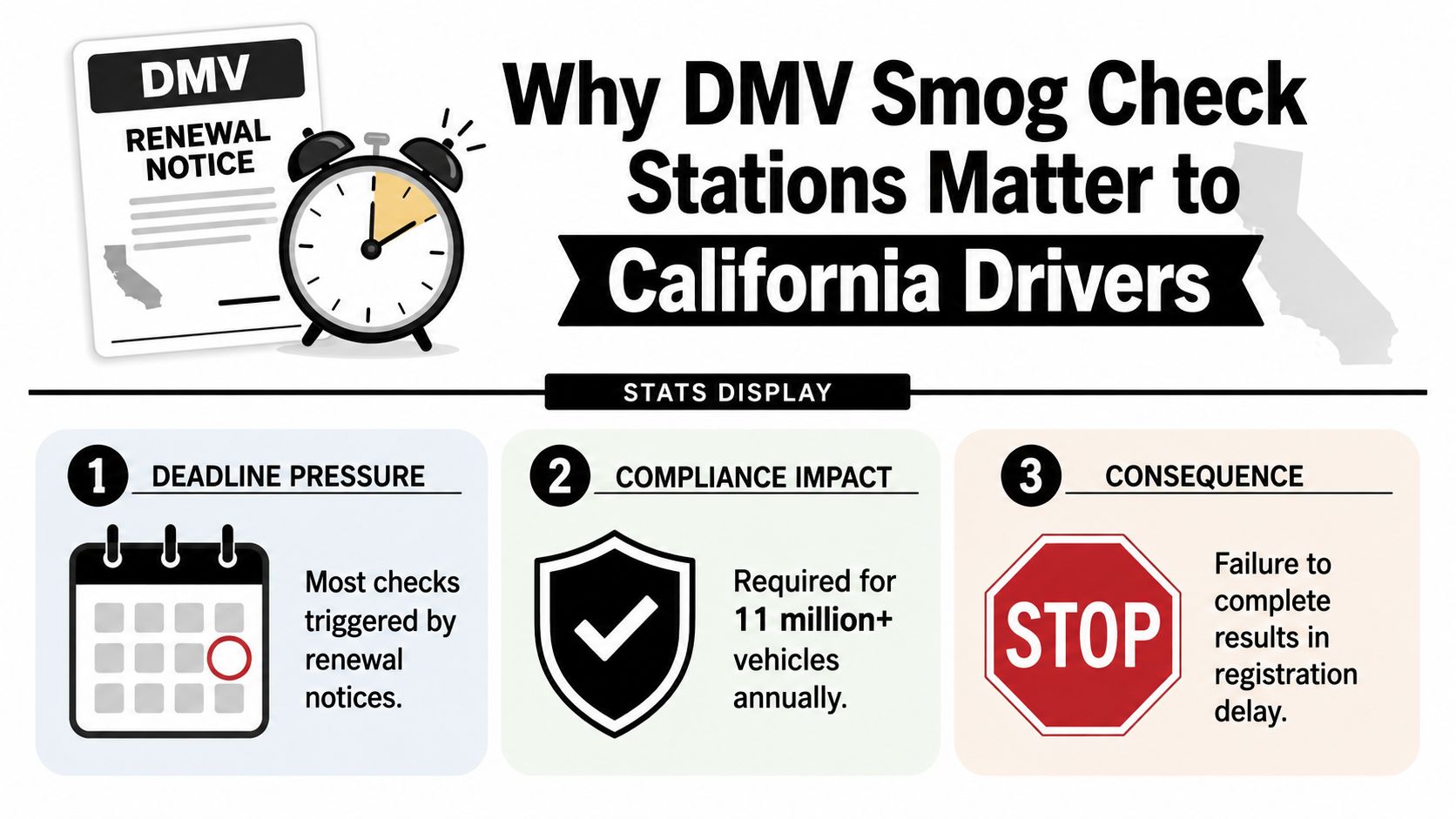
What that means at the counter
The station you choose affects both paperwork and time. If the result does not satisfy the DMV requirement for your vehicle, you are still not done, even if the car drove perfectly into the bay.
Practical rule: Do not ask only, “Can this shop test my car?” Ask, “Will this result actually clear my renewal?”
Drivers frequently get tripped up when they treat the smog check like a repair estimate. The test is a regulated pass-fail workflow, and the station has to feed the result into the state system correctly. That is why the right shop is not just about convenience. It is about whether your renewal moves forward cleanly or gets held up at the worst possible time.
What a DMV Smog Check Station Does
A licensed dmv smog check station keeps BAR-approved inspection equipment, a continuous internet connection, and a Windows-based system that BAR has tested and approved so results can go into the state workflow. BAR smog checklist requirements
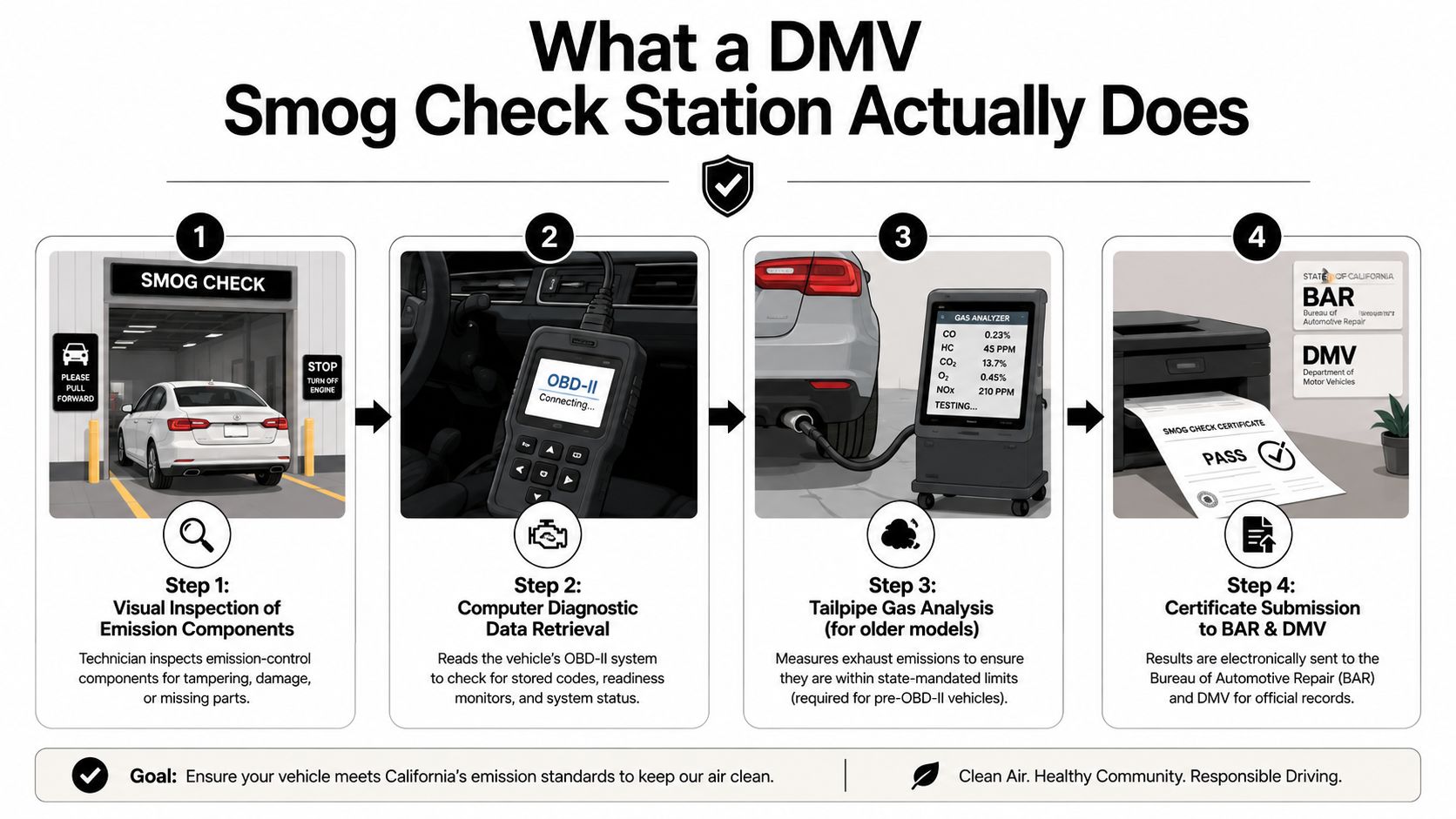
What happens when your car pulls in
Your car rolls into the bay, and the tech follows the inspection path the state requires. The station then runs the test through the correct equipment and software for that vehicle class, so the result reflects regulated emissions data, not a quick guess from somebody leaning over the fender.
If you want a station that is set up to handle STAR-directed work too, a good place to start is this overview of a STAR certified smog station in San Leandro. That matters because the test method and the station's authorization both shape what happens next.
The station has to keep its equipment and software in compliance. If the hardware drifts, the internet connection fails, or the approved system is not working right, the record can turn into a headache even when the driver brought in a clean car.
Why this matters for drivers
A smog station earns its value by doing three things correctly, testing, documenting, and transmitting the result. A repair bay can have good mechanics and still miss the mark if it cannot complete the state process the right way.
That is the part drivers trip over. They show up with a renewal notice, assume any shop with a smog sign can finish the job, and then lose time when the result does not move through the system cleanly.
A clean pass only helps if the station gets it into the state system without friction.
STAR Certification and Why It Changes the Outcome
Pull into the wrong station and you burn time. Pull into the right one, and the DMV process moves the way it should. STAR certified stations sit in a higher performance tier, and that tier affects which vehicles they can inspect and how much confidence you should put in the result. If you want a practical local reference, start with this plain-English explanation of a STAR certified smog station in San Leandro.
California's Bureau of Automotive Repair reported 11,275,981 initial tests with an 8.51% initial failure rate in 2025, and said shifting all inspections to high-performing stations could reduce ROG and NOx emissions by 44 tons per day. BAR Smog Check Executive Summary Report 2025
Licensed station versus STAR station
A licensed station can handle standard testing. A STAR certified station has to meet stricter performance standards, and that difference matters the moment the DMV routes a vehicle to STAR. If your renewal notice calls for STAR, a regular shop will not clear that step.
Drivers need to read the notice first and pick the station second. If STAR is required, the wrong bay costs you a second trip. If STAR is not required, you still want a shop with disciplined procedures, because the station tier reflects how well it handles compliance work, paperwork, and transmission into the state system.
Why the data matters
The BAR's 2026 performance reporting also says vehicles certified by high performing stations failed at a lower rate at roadside than those certified by low performing stations. That is the point of the tiering. The state uses station performance as a practical measure of how well a shop's work holds up after the car leaves the bay.
The result is simple for a driver. STAR is the station class that can keep up with DMV-directed work, and it tells you the shop has to stay sharp on process, not just on repairs. If you want the station to be accepted without drama, the performance tier matters as much as the pass or fail itself.
A pass is only useful when the station handles the documentation and transmission correctly. If the DMV wants STAR, the station has to be STAR. If the DMV does not require it, STAR still gives you a cleaner bet that the result will hold inside the state's compliance system.
How the Test Changes by Model Year and Fuel Type
Don't assume every smog check looks the same. A 2015 gasoline sedan and a 1995 pickup do not go through the same workflow, and that difference shapes what you'll see in the bay.
OBD testing versus tailpipe testing
California's rules route 2000-and-newer gasoline vehicles and 1998-and-newer diesel vehicles into an OBD-focused inspection. Older vehicles can require loaded-mode or two-speed idle testing, and in enhanced areas loaded-mode testing uses ASM equipment with a chassis dynamometer. California Smog Check test methods
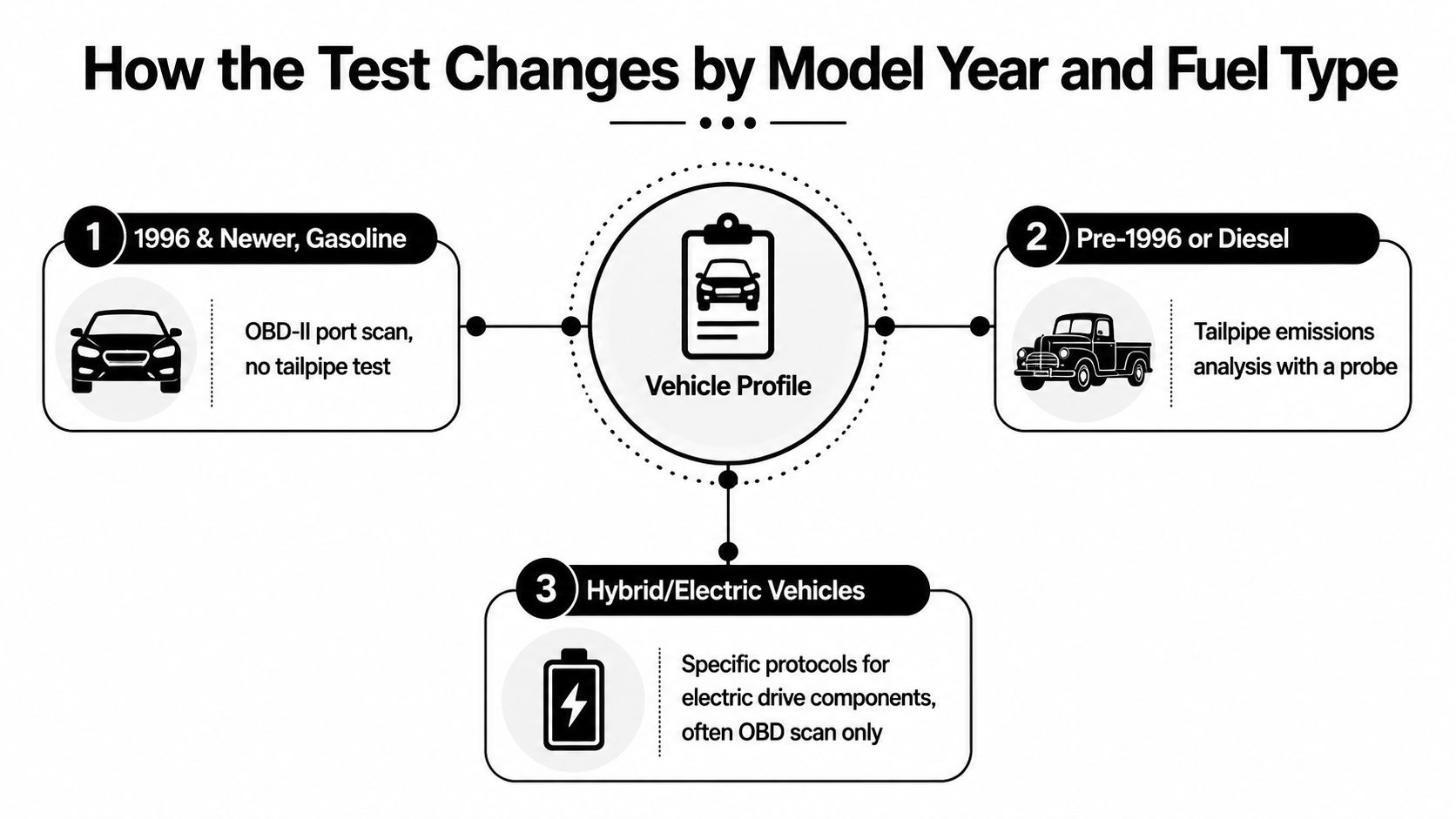
A newer gasoline car usually means a quick scan at the diagnostic port. Older cars can mean a probe in the tailpipe, rollers under the tires, and more time spent measuring emissions behavior under load. Diesel and hybrid paths follow their own compliance logic, so the station has to be ready for more than one kind of vehicle profile.
What you should expect physically
If your car is newer, the visit often feels simple, because the tech is mostly verifying electronic data. If your car is older, the inspection can look more old-school and mechanical, with more equipment involved around the exhaust and drivetrain.
That's why the best stations are built for range, not just speed. They need the equipment mix, the staffing, and the workflow discipline to handle very different vehicles without slowing the line.
If a shop only talks about “plugging in,” it's probably not thinking about the full vehicle range it's supposed to serve.
Step-by-Step From Booking to DMV Confirmation
A driver rolls in with a renewal notice in hand, the station checks the paperwork, and the first decision is already made. If the notice says STAR, choose a STAR station first. If it does not, make sure the shop can handle your exact vehicle type before you head over.
The actual sequence
- Check the DMV notice. Read the renewal paperwork for STAR language and any special instruction tied to your registration.
- Book the station. A scheduled visit cuts the wait and lets the shop set up the right bay. For local scheduling, use the Smog Check Appointment page.
- Bring the basics. Have your registration paperwork and a payment method ready.
- Watch the test run. The station performs the inspection in the bay and sends the result electronically.
- Wait for DMV confirmation. Once the result posts, the renewal process can continue without paper shuffling.
A standard emissions test usually takes 10 to 20 minutes once the car is in the bay, which is why station speed and bay setup matter as much as the inspection itself.
Where people lose time
The delay usually comes from the wrong station, a car that is not ready, or missing the STAR requirement already printed on the notice.
If the test passes, the station transmits the result and the DMV side moves. If it fails, you fix the cause before paying for another visit.
Preparing Your Car to Avoid a Surprising Failure
A lot of drivers fail smog because they assume “the car drives fine” means “the car is ready.” That's the wrong assumption.
Battery resets and readiness monitors
If your battery was recently disconnected or replaced, BAR advises driving the car for a week or two so the readiness monitors can reset. A car with a check-engine light on will not pass. BAR smog check guidance
That's the part people miss. The engine can feel normal, but the emissions system may still be incomplete in the state's eyes. Recent repairs can create the same problem if the readiness status hasn't settled yet.
Simple pre-test discipline
- Don't disconnect the battery right before the visit.
- Drive the car normally after recent battery work so monitors can reset.
- Fix the check-engine light first if it's on.
- Use a station that can explain the failure reason clearly if the car doesn't pass.
For a deeper look at failure causes, this local guide is useful: Smog Check Fail Reasons
The smart move is to treat the pre-test period like a readiness window, not a gamble. If the car just had work done, give it time. If the light is on, don't assume the scanner will be kind to you. It won't.
How to Choose the Right Station Near You
Stop choosing the nearest station automatically. That's how drivers waste time. Choose the station that matches the vehicle and the DMV requirement.
Your checklist should be short
- Confirm STAR status if the renewal notice requires it.
- Ask whether your vehicle type is covered, especially for older gasoline, diesel, or hybrid inspections.
- Check the posted turnaround time for your class of vehicle.
- Look for current pricing and any coupon offers before you leave home.
- Confirm hours and waiting setup so you're not stuck outside or missing a same-day window.
Practical rule: The cheapest station on the map isn't a deal if it can't accept your renewal paperwork.
If you're comparing shops, focus on three things, eligibility, turnaround, and result transmission. Everything else is secondary. A clean waiting room is nice, but a station that can't handle the DMV requirement is still the wrong stop.
Speedy Smog in San Leandro and What to Expect
Speedy Smog in San Leandro is a STAR Certified station at 15275 Washington Ave, with Monday through Saturday hours, an indoor waiting room, and service for drivers coming from San Leandro, Oakland, and nearby East Bay neighborhoods. It handles the vehicle mix you see around here, including newer cars, older vehicles, diesels, and hybrids.
For 2000-and-newer vehicles, the shop says inspections are usually completed in about 10 to 15 minutes, and it offers periodic $25-off coupons for most smog tests on newer vehicles. That lines up with what matters most in a real DMV visit, fast turnaround, clear pricing, and a station that can satisfy a STAR-required renewal when the notice calls for it.
If you want one example of how the whole system should feel in practice, this is it. The car goes in, the paperwork gets handled, and you leave with a result that's built for DMV acceptance, not just a quick look under the hood.
If you need a STAR certified smog check in the East Bay, visit Speedy Smog and book a visit that fits your renewal notice, your vehicle type, and your schedule. You'll get a station that understands DMV requirements, keeps the process moving, and helps you get back on the road without extra trips.