
You're standing at the DMV counter or staring at a renewal notice in the mail, and the message is the same, your registration won't go through until the smog issue is handled. For a lot of East Bay drivers, that's the moment the California Air Resources Board suddenly feels very real, even if you've never thought about the agency before. The rule feels like paperwork pressure, but it's really the last link in a chain that starts with emissions standards and ends with a test station, a report, and DMV approval.
If you've ever wondered why one car breezes through and another gets sent to a STAR station, or why a newer vehicle can still trigger a registration hold, the answer usually sits inside CARB's rules and the way those rules get enforced on the ground. That's the part most drivers never get explained in plain language. Once you see how the system works, the DMV notice stops looking random and starts looking like a checklist.
Table of Contents
- Why Your DMV Registration Mentions the California Air Resources Board
- How CARB Became the Nation's Toughest Air Quality Regulator
- Understanding the Smog Check Program and STAR Certification
- Your Step-by-Step Path to CARB Compliance in the East Bay
- Common Exemptions and What to Do When Your Vehicle Fails
- CARB's Zero-Emission Future and What It Means for Bay Area Renters
- How Speedy Smog Makes CARB Compliance Fast and Stress-Free
Why Your DMV Registration Mentions the California Air Resources Board
The first time this usually hits home is a renewal notice. Your plate sticker is due, the DMV says a smog certification is needed, and now you're trying to figure out why a state agency you barely think about gets a say in whether you can keep driving your own car. The short answer is that the California Air Resources Board sets the emissions standards behind the test, and the DMV uses that result before it finishes registration.
That's why the request doesn't feel optional. If the vehicle is in a category that needs testing, the station checks whether it meets the state's emissions rules, then the result gets sent forward for registration processing. Speedy Smog's registration renewal overview is a useful reminder of how that DMV step and the test station step fit together.
The chain from rule to renewal
CARB writes the standards. The inspection station verifies the vehicle against those standards. The DMV uses the verified result to decide whether your paperwork can move ahead.
That chain matters because it explains why a smog test is not just a shop decision. The test isn't there to sell you a repair you didn't ask for, it's there to confirm that the vehicle is meeting the state's emissions requirements before the registration gets renewed. If the vehicle passes, the station sends the result electronically. If it fails, the DMV wait continues until the issue is resolved.
Practical rule: If your renewal notice calls for a smog certificate, don't treat the station visit as separate from registration. For many East Bay drivers, they're part of the same compliance step.
A lot of confusion comes from the wording on the notice. Drivers see DMV language, but the underlying requirement traces back to CARB's authority over emissions controls, fuel limits, and vehicle compliance programs. Once you know that, the notice stops looking like a mystery letter and starts looking like a straightforward instruction, get the car tested, get the result recorded, then finish the registration.
How CARB Became the Nation's Toughest Air Quality Regulator
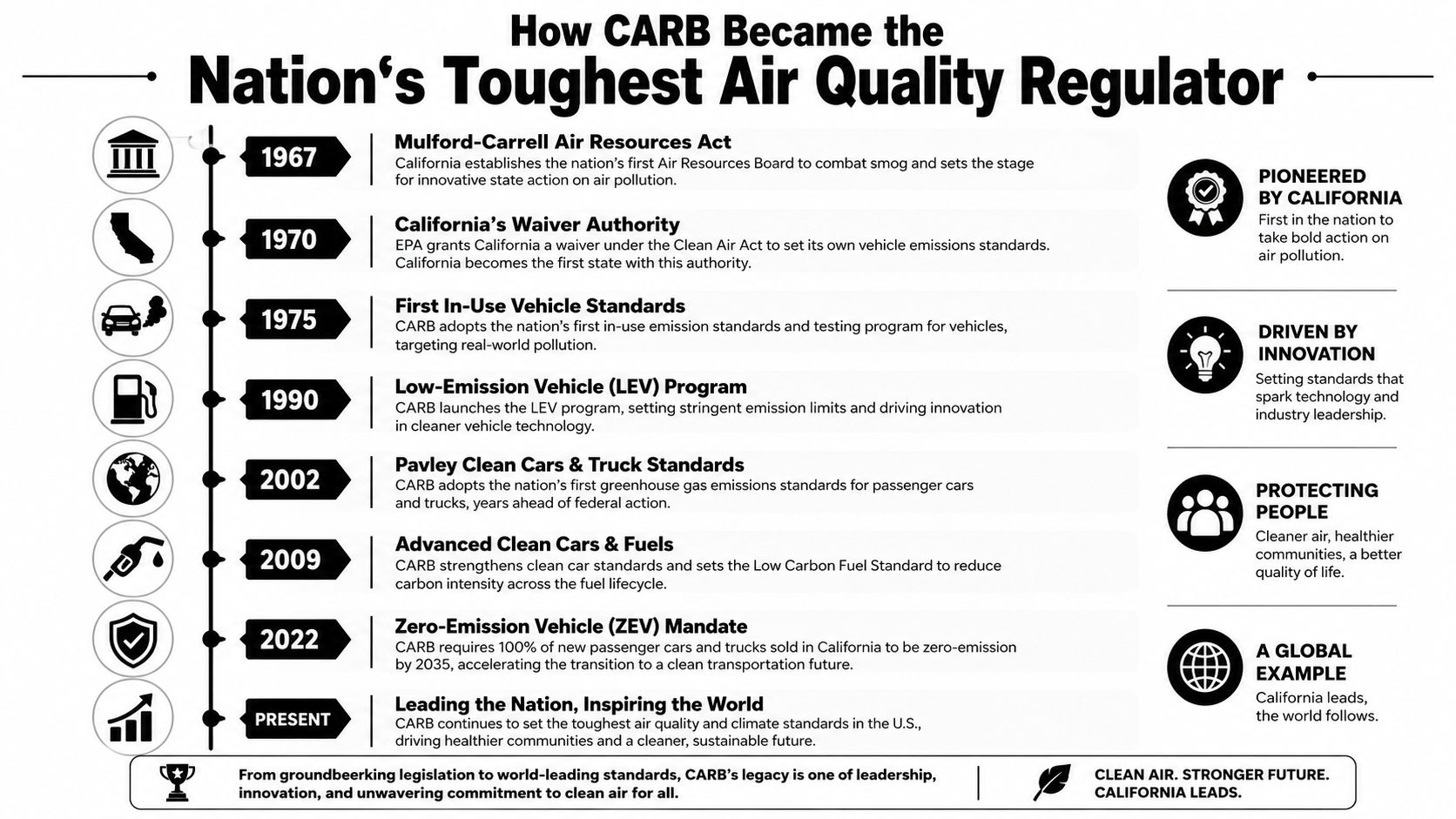
CARB didn't appear out of nowhere. It was created in 1967 when Governor Ronald Reagan signed the Mulford-Carrell Air Resources Act, which merged the Bureau of Air Sanitation and the California Motor Vehicle Pollution Control Board into one statewide agency. That timing matters, because California had already moved in 1966 to adopt the nation's first tailpipe emissions standards, and the federal Air Quality Act of 1967 later recognized California's special authority to set stricter vehicle emissions rules because of the state's geography, weather, and vehicle density. CARB's history page lays out that foundation clearly.
Why the early milestones still matter
The point of the timeline isn't just history trivia. It shows how California kept building a regulatory model that other places later copied. CARB's early milestones included the first national tailpipe standards for hydrocarbons and carbon monoxide in 1966, nitrogen oxides in 1971, and diesel particulate matter in 1982. Those dates show a pattern, CARB was not only reacting to smog, it was shaping the framework that later became normal in major vehicle markets.
The legal structure also matters for drivers who think CARB is just a policy name. Its authority lives in the California Code of Regulations, mainly Title 13, Division 3 for motor vehicles and Title 17, Division 3 for public health. Those titles are where the enforceable rules sit, which means compliance comes from actual rule text, test methods, and program sections, not from broad statements about clean air. CARB's laws and regulations page is where that framework is organized.
What the federal backstop means for you
California's special authority helps explain why a vehicle can pass one state's expectations and still run into trouble here. CARB can set stricter requirements for vehicles sold, registered, or tested in California, and those rules affect design choices, fuels, and compliance paths. For East Bay drivers, that's why a vehicle's paperwork and emissions status can depend on California standards even when the car itself was built elsewhere.
The important thing for a driver is simple. If the vehicle is in California's system, California's rulebook is the one that counts.
If you want to see how CARB's authority translates into day-to-day inspection rules, this emissions testing guide connects the legal side to the practical station-side side without the jargon.
Understanding the Smog Check Program and STAR Certification
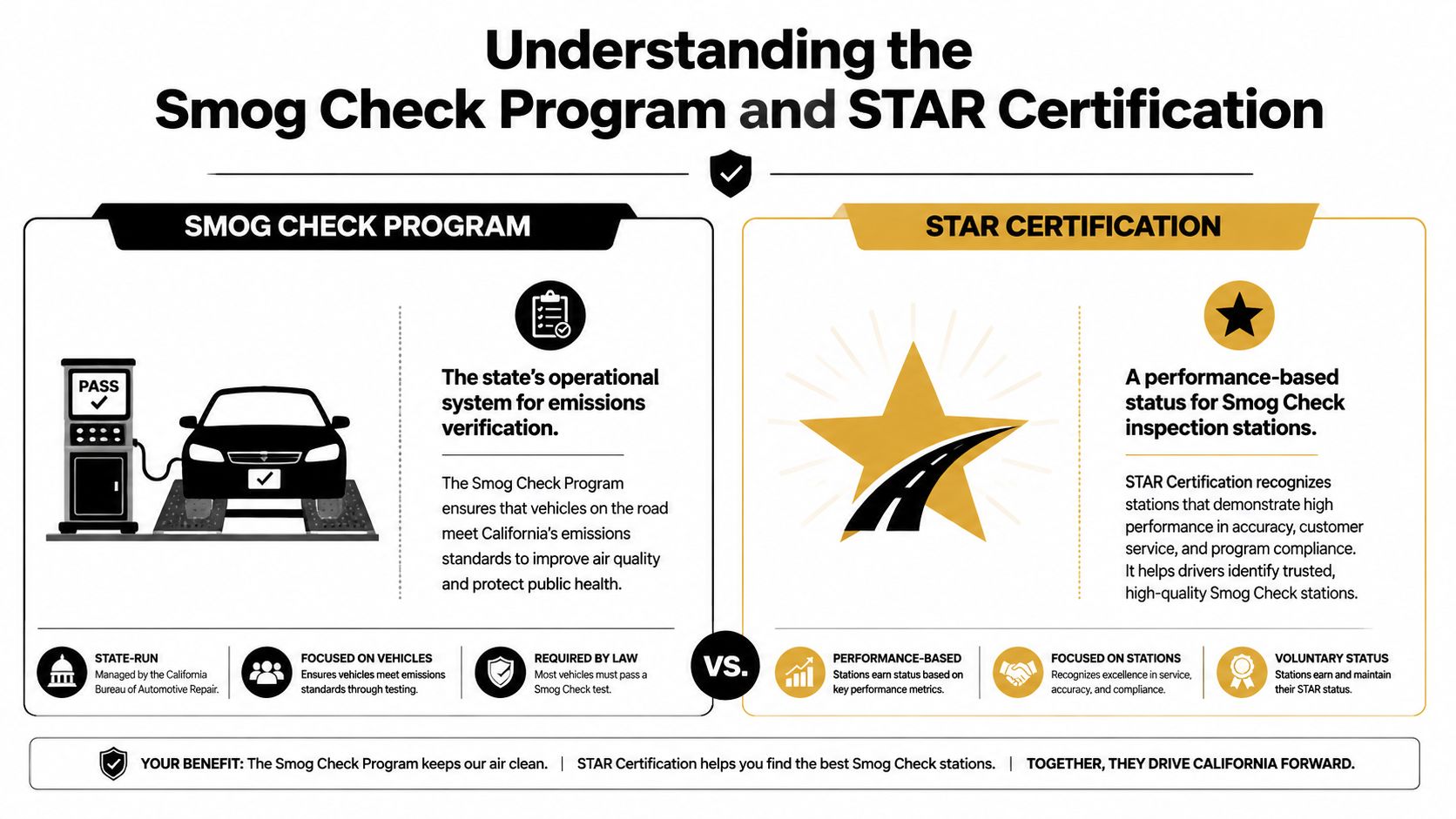
People often use “smog check” and “STAR station” as if they mean the same thing. They don't. The Smog Check Program is the state's testing system, while STAR certification is a higher performance status for stations that meet stricter standards for accuracy and equipment under the Bureau of Automotive Repair framework. A STAR station can perform tests, but not every test needs a STAR station.
Smog Check Program vs STAR station
The Smog Check Program is the process that confirms whether a vehicle meets emissions requirements before registration moves forward. The station checks the car, records the result, and sends that result into the state system. If the vehicle passes, the DMV can proceed with the registration workflow.
STAR status is about the station, not the car. Some drivers get directed to STAR stations because of the vehicle's profile, the registration situation, or a DMV notice. That's why two neighbors can have different instructions even if both are just trying to renew tags. The station type requirement is part of the compliance path, not a judgment about the owner.
What a STAR station means in practice is easier to understand if you think of it as a stricter lane within the larger smog system.
What happens during the inspection
A typical inspection can include a visual check, a functional review, and emissions-related measurement through the vehicle's onboard systems or tailpipe-related testing, depending on the vehicle and model year. The station is looking for whether the vehicle's emissions controls are present, working, and communicating properly. That's why a check engine light can be a problem before the test even gets going.
The driver's job is to show up with a vehicle that's ready to be evaluated. The station's job is to verify the system the state requires. If the DMV notice specifies STAR, use a STAR station, because the wrong station type can send you home without the result you need.
Your Step-by-Step Path to CARB Compliance in the East Bay
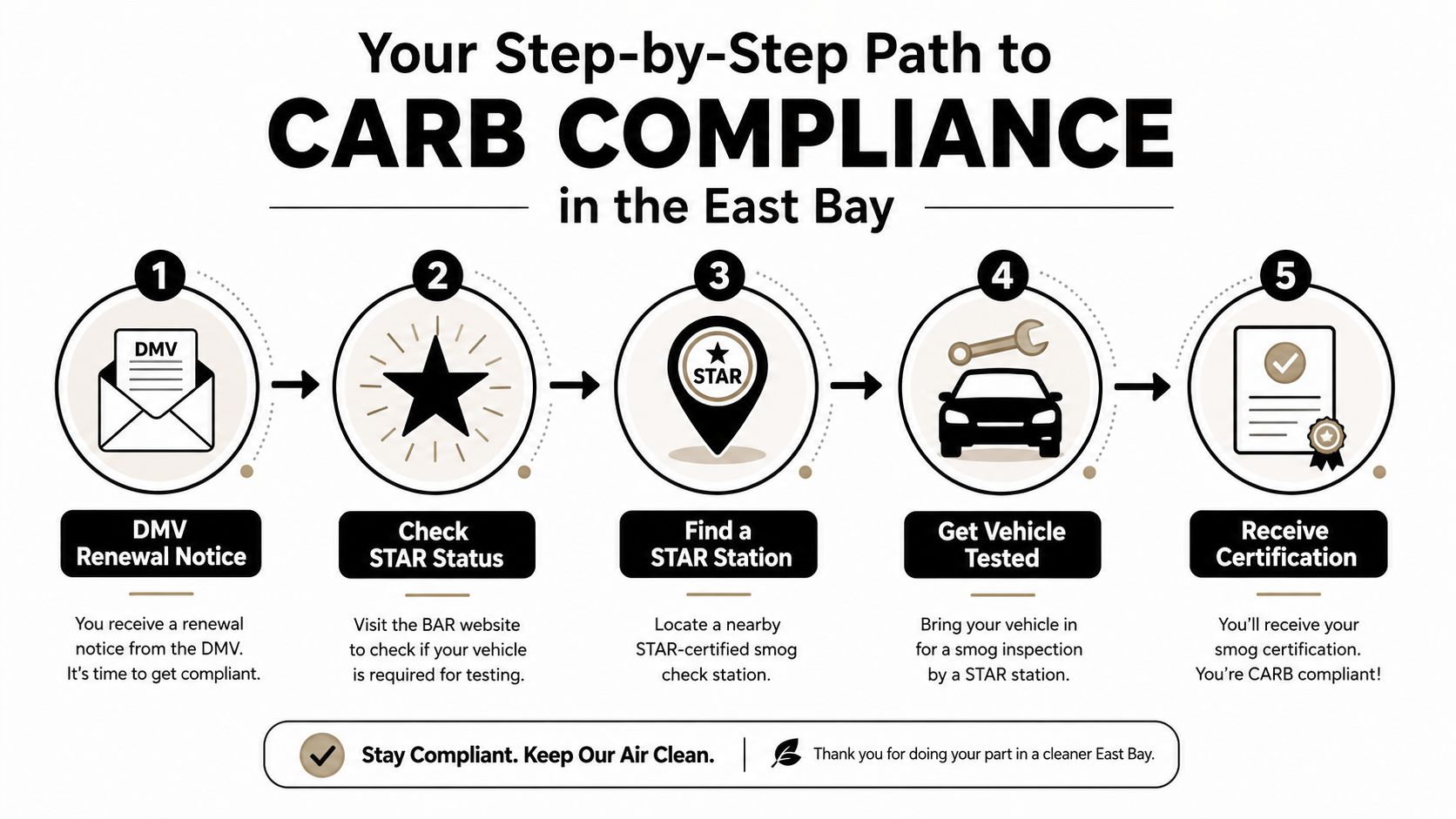
Start with the renewal notice, not with the test station. That notice tells you whether a smog check is required and whether a STAR station is named or implied by the registration instructions. If you miss that detail, you can end up at the wrong place and lose time you didn't need to lose.
How drivers usually move through the process
- Read the DMV notice carefully. Look for the smog requirement, the deadline, and any station-type instruction.
- Check whether the vehicle is ready. If the check engine light is on, or the car has just been disconnected from power, the vehicle may not be ready for a clean inspection.
- Choose the right station. If the notice points you to a STAR station, use one.
- Let the station test the vehicle. The technician performs the required checks and records the result.
- Wait for certification to post. A pass is sent electronically so the DMV can continue the registration process.
That path sounds simple, but drivers get tripped up at the second and third steps. A car that hasn't been driven enough after a battery reset may not have completed its internal readiness checks. A car that's clearly headed for a STAR requirement can't be fixed by choosing a non-STAR station.
Practical rule: If the car has been repaired recently, ask whether the systems are ready before you go. A clean-looking dashboard doesn't always mean the vehicle is inspection-ready.
The point of the step-by-step approach is to keep the inspection from feeling like a gamble. You're not guessing whether the DMV will accept the result, you're lining up the right notice, the right station, and a vehicle that's prepared to be tested. For East Bay drivers juggling work, school runs, and long commutes, that preparation is usually the difference between one trip and two.
Common Exemptions and What to Do When Your Vehicle Fails
Not every vehicle needs the same kind of test, and not every driver is looking at the same problem. A newer car may be exempt in one situation and required in another, while a diesel or hybrid can follow a different path than a conventional gasoline vehicle. The trick is to match the vehicle type to the DMV instruction instead of assuming everyone gets the same result.
Vehicle types and the common questions drivers ask
| Vehicle Type | Model Year Range | Smog Check Required | STAR Station Required | Special Notes |
|---|---|---|---|---|
| Newer gasoline passenger vehicles | Qualifying newer model years under California rules | Sometimes no, depending on the renewal situation | Only if the DMV notice says so | Model-year rules can change the answer |
| Older gasoline vehicles | Qualifying older model years that fall under the program | Often yes | Only if directed | Registration status matters |
| Diesel vehicles | Subject to California diesel testing rules | Sometimes yes | Only if directed | Testing method can differ from gasoline vehicles |
| Hybrid vehicles | Subject to California hybrid testing rules | Sometimes yes | Only if directed | Drivers often assume hybrids are exempt, but that isn't always true |
| Classic or specialty vehicles | Depends on the registration category and model year | Sometimes no, sometimes yes | Only if directed | Always check the specific notice |
That table is the safest way to think about exemptions. The exact answer depends on the vehicle's year, fuel type, and registration circumstance, not just on whether the car is “old” or “new.” If the DMV asks for a certificate, the notice wins over assumptions.
What a failure usually means
A failed test doesn't mean the car is done. It usually means the station has issued a vehicle inspection report that tells you what needs attention before a retest. In some cases, drivers may qualify for an economic hardship extension tied to repair-cost rules, but that depends on the situation and the program requirements, so the safest move is to read the report carefully and ask the station what the next compliance step should be.
The mistake I see most often is drivers treating a failure like a dead end. It's more accurate to treat it like a repair map. The report points to the issue, and the next visit is about proving the problem was fixed, not starting over from zero.
CARB's Zero-Emission Future and What It Means for Bay Area Renters
CARB's long-range direction points toward 100% zero-emission new car sales by 2035, which sounds straightforward until you look at where many East Bay drivers live. Renters, apartment dwellers, and households with older multifamily housing don't always have a driveway, a garage, or a simple place to plug in. That's where the policy gets practical fast.
Charging access is the real bottleneck for many drivers
CARB-backed research from listening sessions in historically underserved areas, including Oakland, found that the biggest barriers to ZEV adoption were lack of public charging infrastructure, lack of home charging access, and cost. That matters because the usual advice, just charge at home, doesn't fit a lot of Bay Area households. If you live in an apartment building or rely on street parking, the charging plan can be the hardest part of the whole equation.
The core issue isn't whether the technology works. It's whether the driver can use it consistently without special access to private charging. In older housing stock, landlord cooperation and building constraints can make installation complicated, which means incentives alone may not solve the adoption problem.
Why environmental justice monitoring is changing the conversation
CARB's environmental-justice work is also moving closer to street level. Its 2024 roundtables surfaced resident concerns about the cumulative effects of traffic, industry, wildfires, agriculture, and climate on pollutants like PM2.5, ozone, VOCs, and NOx, along with the question of the best way to monitor local disparities and reduce them. The gap is not just whether monitoring happens, it's how the results turn into actual cleanup or enforcement.
CARB's 2025 launch of mobile air monitoring in 64 heavily burdened communities, with more than 60% of the monitoring serving priority populations, suggests a shift toward block-by-block accountability. That doesn't solve the charging problem for renters, but it does show CARB paying closer attention to who bears the heaviest air-quality burden and where the gaps still sit.
How Speedy Smog Makes CARB Compliance Fast and Stress-Free
For East Bay drivers who just need the registration finished, a STAR Certified station can remove a lot of guesswork. Speedy Smog in San Leandro, at 15275 Washington Ave, handles smog inspections for most vehicles, including 2000 and newer models, 1999 and older vehicles, diesels, and hybrids. Typical tests for 2000 and newer vehicles are completed in about 10 to 15 minutes, and the result is electronically reported to the DMV so the registration process can move ahead.
The setup matters too. Drivers get a clean indoor waiting room, transparent pricing, and periodic $25-off coupons for most smogs on newer vehicles. Open Monday through Saturday, the station is built for the kind of quick, no-drama compliance visit East Bay owners usually want when a renewal notice is already hanging over them.
If your renewal letter is asking for a smog certificate, or if you've been sent to a STAR station, the easiest move is to line up the test first and avoid a second trip to the DMV. Visit Speedy Smog to check the station details, see what kind of inspection your vehicle needs, and get the certification handled without dragging the process out.