
Most California vehicles need a Smog Check every 2 years, usually when registration is renewed, if the DMV notice says certification is required. Newer cars and certain sale situations can change that timing, so the date on your renewal notice matters more than a guess.
You open the DMV envelope, look at the renewal date, and wonder if this is the year you need to get the car tested. For a lot of East Bay drivers, that's the whole question in one moment, and the good news is the normal answer is simple once you know what to check.
Table of Contents
- How Often Most California Drivers Need a Smog Check
- How Biennial Renewal Testing Actually Works
- Newer Cars and the Model Year Countdown
- When Selling or Transferring Changes Your Smog Timing
- Exemptions and Special Vehicles Made Simple
- Why County and Air Quality Rules Can Affect Timing
- Staying on Schedule Without Stress
How Often Most California Drivers Need a Smog Check
A first-time car owner in San Leandro often assumes smog testing works like an annual tune-up. For most California vehicles subject to the program, it follows a different rhythm, once every two years, and it lines up with registration renewal rather than routine maintenance, according to the California Bureau of Automotive Repair's Smog Check guidance (BAR Smog Check overview).
The renewal notice is the signal that matters
If your DMV renewal notice says the vehicle needs certification, that notice controls your next step. BAR says the notice identifies whether a particular vehicle requires certification, and registration cannot be finalized when the required smog certificate is missing.
Paying the fee does not always finish the job. If the car still needs a passing certificate, the DMV side of renewal stays open until the smog requirement is satisfied.
Practical rule: treat the renewal notice like a green light or red light. If it asks for certification, get the test done before the deadline.
A simple way to think about the timing
For a normal vehicle in the program, smog testing works like a repeating checkpoint at renewal, not like a yearly oil change. One renewal cycle may need it, the next may not, and then it comes back again on the following cycle.
That pattern is why drivers get tripped up. They remember testing the car recently, then assume they are covered for another year, but the renewal schedule does not follow that logic. It follows the DMV record for that specific vehicle and whether the notice says certification is required.
The safest habit is straightforward. Open the renewal notice, look for the smog requirement, and plan the inspection before the registration deadline if it is listed. That keeps the process calm instead of last-minute.
How Biennial Renewal Testing Actually Works
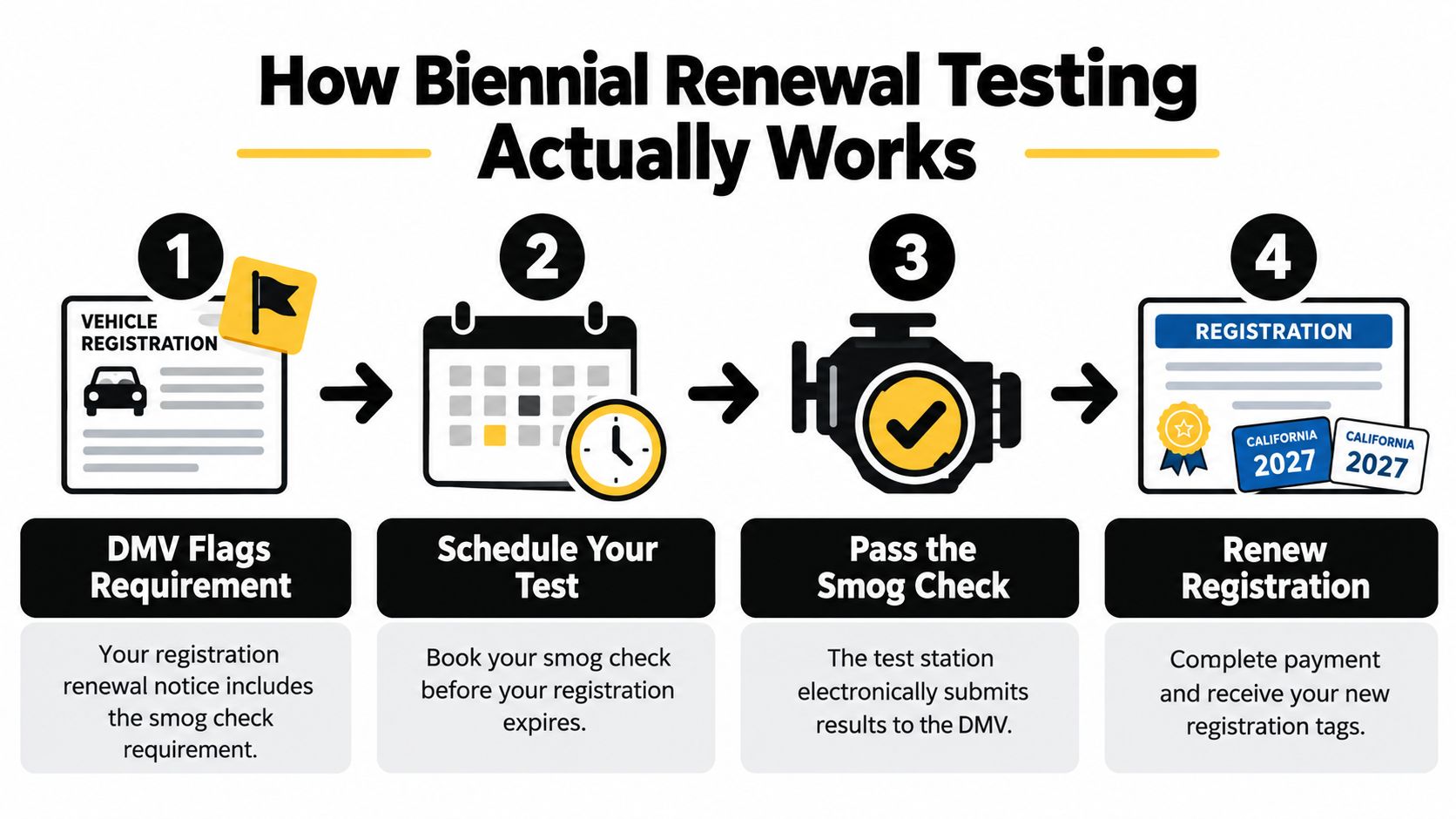
A biennial smog check works like a relay between the DMV, the inspection station, and your registration renewal. One office starts the process, the station reports the result, and the DMV closes the loop once the record shows a passing certificate, as outlined in the BAR brochure (BAR brochure).
Four steps that keep the process moving
- DMV flags the requirement. Your renewal notice shows whether certification is needed for that specific vehicle.
- You schedule the test. Book it before the registration expires, so you are not racing the deadline.
- The station submits the result. The test station electronically sends the outcome to the DMV.
- You renew registration. Once the certificate is on file, payment and tags can be completed.
The notice matters more than a general calendar rule. For a normal vehicle in the program, the test usually comes back at renewal time, then drops out on the next cycle, then returns again later. A simple way to keep that pattern straight is to follow the renewal paper in front of you, not memory or the last time you visited a station.
If the notice asks for smog certification, do not wait until the last week. A little lead time gives you room if the car needs attention before it passes.
What happens if the certificate is missing
If the required smog result is not on file, registration cannot be completed. That is the part that catches people off guard, because the renewal letter may look routine even though the DMV side is still waiting for a passing result.
If you want a plain-English refresher on how a result fits into the renewal window, this guide on smog test validity in California breaks down the timing in a simple way. A retest window is usually the part that saves the day. If the first inspection does not pass, the driver can use the extra time to fix the problem, return for another check, and then finish renewal after the certificate clears.
Newer Cars and the Model Year Countdown
A car can still feel new and already be on a different Smog Check schedule. The key is model year, not how long you have owned it, and newer vehicles stay in a separate category for a while (BAR executive summary report).
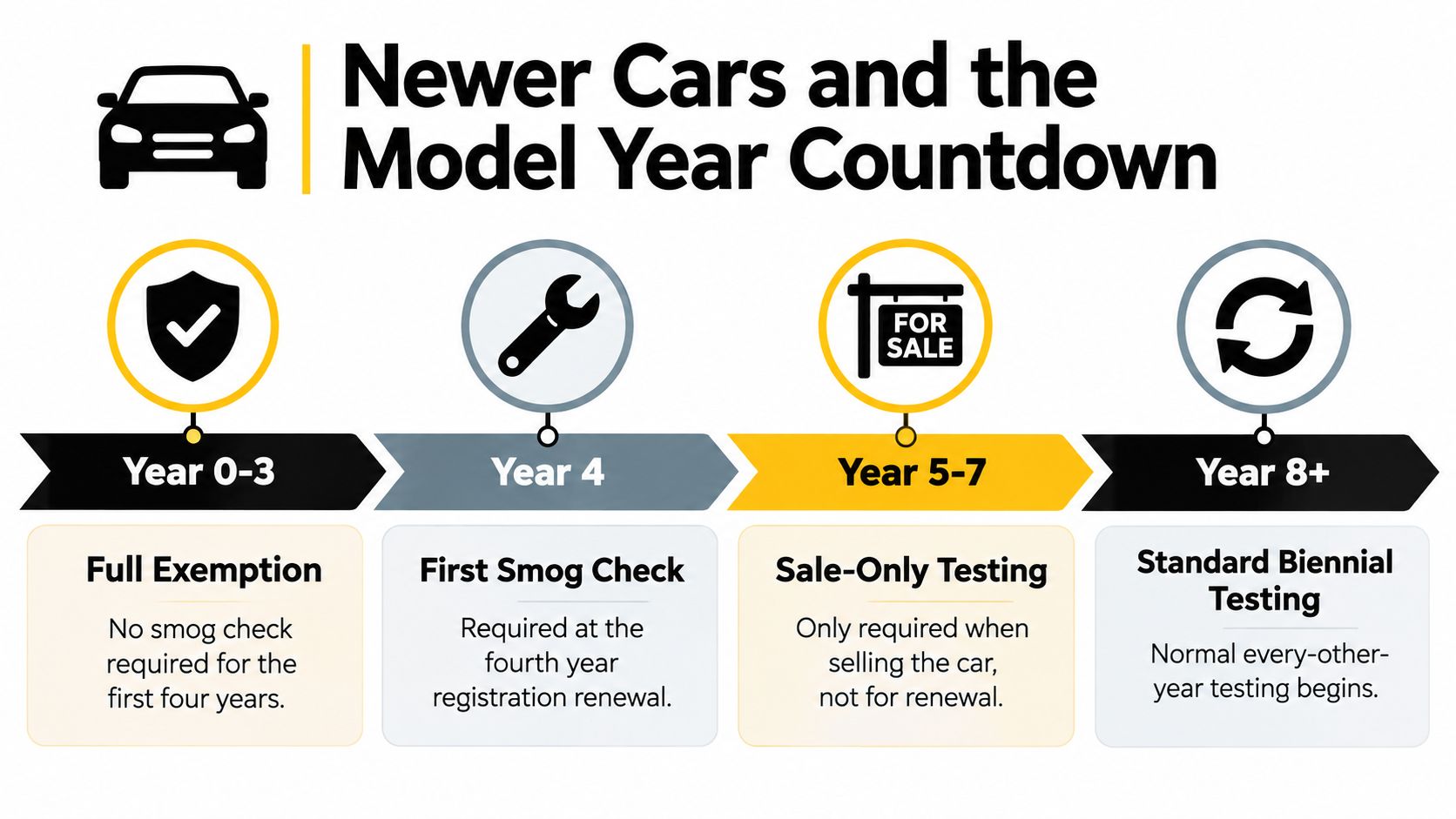
The first years are exempt
Vehicles four model-years old or newer are exempt from both biennial and change-of-ownership Smog Checks. That means a recent purchase does not automatically need a test (BAR executive summary report).
BAR's example makes the timing easier to follow. A 2020 vehicle first becomes subject to change-of-ownership testing in 2024 and biennial testing in 2028. Model years work like birthdays: nothing is due at first, one milestone arrives at the sale window, and the every-other-year cycle starts later.
Why the sale window is different from the renewal window
Vehicles in their fifth through eighth model years generally need a Smog Check when ownership changes, but they are not yet in the normal biennial renewal cycle. That is the point that catches many owners, because the car can still be off the renewal schedule and still need a certificate for a sale (BAR executive summary report).
For San Leandro drivers comparing that timing with a real station option, the page on California smog check for newer cars is a useful reference.
The practical move is simple. Count the model year before you assume the car is due. If the vehicle is newer than you thought, you may avoid an unnecessary trip. If it is older than you thought, you do not want to miss the first required certificate.
When Selling or Transferring Changes Your Smog Timing
A sale can change the timing even when a registration renewal would not. That is where many first-time owners get caught, because the DMV cares about the transaction itself, not just the normal renewal cycle.
| Situation | Usual Timing | What To Check |
|---|---|---|
| Registration renewal | Every other year for most subject vehicles | Read the DMV renewal notice |
| Sale or transfer | Can be required even when renewal testing isn't due yet | Check the vehicle's model year and ownership-change status |
| Recent purchase | Depends on age and registration circumstances | Confirm whether the car is still in the exempt range |
For a seller, the right question is simple. What proof needs to be ready before the title changes hands? A buyer should ask the same thing from the other side: is the car clear for transfer, or will a passing certificate be needed before the paperwork moves ahead?
If you want a plain-language walkthrough of the renewal side, the guide on smog check registration renewal is a useful companion.
A car can also shift into the sale-testing window before it reaches the normal renewal schedule. That is why an owner who has never needed a renewal test can still be asked for a certificate during a transfer. The model-year cutoff is the part to verify first, then the title status, then the DMV paperwork.
The cleanest habit is to separate the two triggers. Renewal timing tells you whether the DMV wants a certificate for the current registration cycle. Sale timing tells you whether the ownership change itself needs one. Keep those apart, and the process is much easier to follow.
Exemptions and Special Vehicles Made Simple
A car's smog schedule can change with its fuel type, model year, and registration situation, so two vehicles in the same driveway may not follow the same rule.
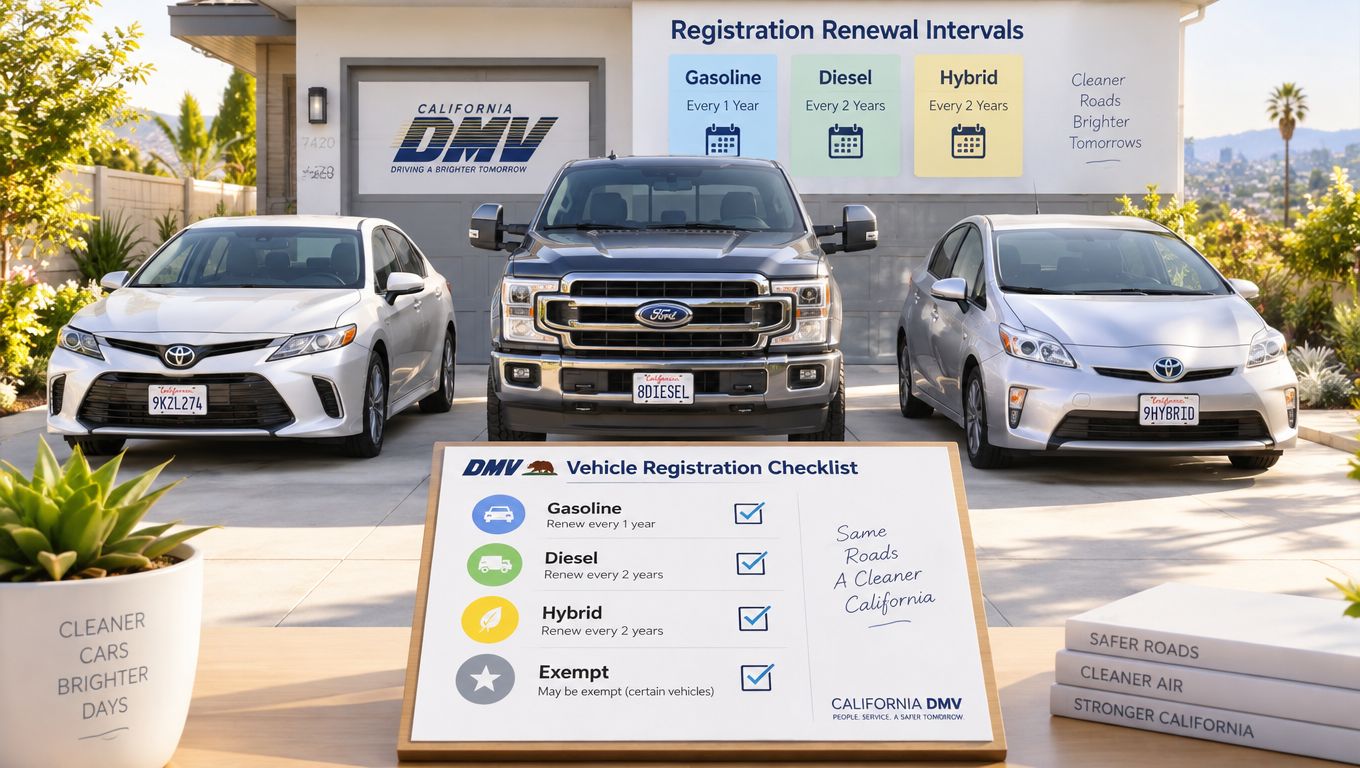
Who usually stays out of the normal cycle
Older and newer vehicles do not all sit in the same lane. Passenger cars in the newer age range can be outside the usual testing rhythm, while other vehicles may only come up for testing during a change of ownership.
Diesel owners should pause here and check the official vehicle category rather than guess from the body style. California does not use the same simple model-year rule for every diesel vehicle, and some older or heavier diesels fall under separate criteria.
Hybrids can also cause confusion. The safest move is to read the DMV notice and confirm the vehicle type on the paperwork, because the notice often tells you more than appearance ever will. A clean, quiet car can still have a testing step attached to it, while a vehicle that looks older may still be outside the current cycle.
Not every vehicle uses the same lane. Fuel type, model year, and the DMV notice all matter together.
How to sort yourself fast
Start with the renewal notice if you drive a standard passenger car. Start with the vehicle category if you own a diesel. For hybrids, check the notice and the registration record together so you do not assume the car follows the same path as a regular gas model.
That same habit helps with older cars and vehicles that have unusual registration histories. Appearance is a poor guide. The paperwork and the official vehicle class decide the timing, and that is usually the part drivers miss.
A simple rule keeps it clear. Age explains a lot, but it does not explain everything.
Why County and Air Quality Rules Can Affect Timing
A smog check can feel like a statewide rule, then a county rule changes the timing. California uses a baseline schedule, but some air-quality programs create local exceptions for specific areas.
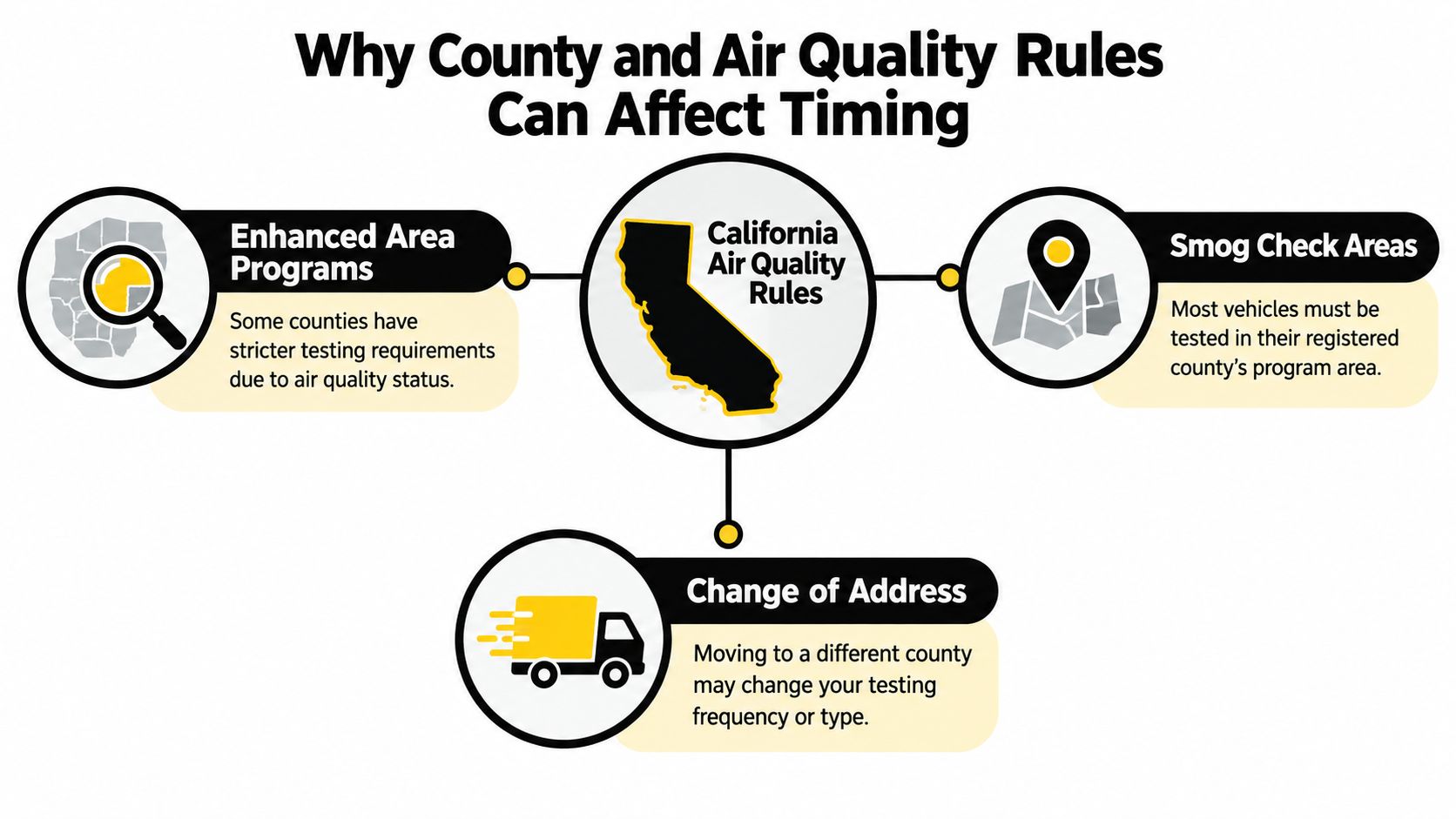
The San Joaquin Valley is the exception, not the template
The San Joaquin Valley is the clearest example. After the U.S. EPA found in October 2025 that the area failed to attain the 80-ppb ozone standard, California triggered a contingency measure that would reduce the new-vehicle renewal exemption there from eight model years to seven, with a possible reduction to six if another trigger occurs (San Joaquin Valley contingency measure).
That rule is described as applying only to the San Joaquin Valley, not statewide. A driver in Oakland or San Leandro should not assume the same timing applies just because the car is the same age.
Why this matters if you move
A move can change the answer. If you shift counties or enter a different program area, the local timing rules may be different from the ones on your old registration. A vehicle can look exempt in one place and fall back into the testing cycle in another.
The safest check is simple. Read the DMV renewal notice first, then confirm whether your current location has a special air-quality rule in force. A model-year rule works like a road map, but local rules can add a detour.
Practical reminder: do not guess from the county name alone. Use the renewal notice, then verify local guidance if the vehicle is tied to a special air-quality area.
That is why county-based timing deserves careful attention. Most California drivers still follow the standard biennial rhythm, but local air-quality action can move the first testing point for some vehicles in some places.
Staying on Schedule Without Stress
The least stressful way to handle smog timing is to make it a habit tied to the DMV envelope. Open the notice, look for the certification requirement, and set your test date early enough that you're not trying to finish registration on the last day.
A simple checklist for East Bay drivers
- Check the renewal notice first. It tells you whether the vehicle needs certification for that cycle.
- Count the model year if the car is newer. Newer vehicles may be exempt for a while, and that changes the answer.
- Separate renewal from sale timing. A car can be fine for renewal and still need a certificate for a transfer.
- Confirm special categories carefully. Diesel and other special vehicles can follow different criteria.
- Book early if the deadline is close. That leaves room if the vehicle needs attention before it passes.
If you want a nearby station that handles STAR-certified smog inspections in San Leandro, Speedy Smog is one option to check when your renewal notice says it's time. The shop focuses on inspections for many vehicle types, including newer vehicles, older vehicles, diesels, and hybrids.
The calmest rule is the one you can repeat. Read the notice, confirm the vehicle's age and category, then get the inspection done before renewal closes. That's how you stay compliant without turning registration season into a scramble.
If your renewal notice is coming up, bring it to Speedy Smog and get the timing sorted before the deadline. The shop handles smog inspections in San Leandro with a STAR Certified process, so you can check the requirement, complete the test, and move on with registration.
In California, gasoline and hybrid vehicles from model year 1976 and newer generally need a smog check, while 1975 and older vehicles are generally exempt. The DMV renewal notice controls what's required for your vehicle in any given year.
You're holding the renewal notice at the kitchen counter, or you've just bought a used car and the seller says, “It probably doesn't need smog.” That's where confusion starts. The model year gives you the starting point, but the transaction determines the test requirement.
For East Bay drivers, the three situations that matter are registration renewal, ownership transfer, and first California registration. A newer vehicle may skip a routine renewal inspection but still need a test when it comes from another state. An older vehicle may fall inside the program but be treated differently depending on whether you're renewing, selling, or registering it for the first time in California.
Table of Contents
- The Quick Answer Every East Bay Driver Wants
- The 1976 Cutoff and the Big Exceptions
- How the Eight-Year Renewal Exemption Works
- OBD-II Versus the Older Tailpipe Test
- Real Situations That Change the Answer
- What to Do Before You Head to a Smog Shop
- Putting It All Together for Your Next Renewal
The Quick Answer Every East Bay Driver Wants
If you're asking what year cars need smog in California, start with model year 1976. Gasoline, flex-fuel, hybrid, and other qualifying alternative-fuel vehicles from 1976 and newer generally fall under California's Smog Check program. Vehicles from 1975 and older are generally exempt, according to the California Bureau of Automotive Repair's vehicle coverage guidance.
That answer is useful, but it isn't the final answer for your DMV paperwork. Your DMV renewal notice is the authority for what you must do now. It will tell you whether the state wants a smog certificate, a fee during the newer-vehicle exemption period, or another form of compliance.
A 2020 hybrid, for example, is inside the general program because it's newer than the 1976 cutoff. That doesn't mean it needs a smog inspection every time the owner renews registration. Newer vehicles receive an age-based exemption for routine renewal, and the relevant transaction can change the result.
Use this three-question check at the counter:
- Is this a registration renewal? The vehicle's model year and age-based exemption determine when recurring inspections begin.
- Is ownership changing? The change-of-ownership exemption is shorter than the renewal exemption.
- Is this the vehicle's first California registration? An out-of-state vehicle from model year 1976 or newer generally needs a Smog Check for that initial California registration event.
Practical rule: Don't schedule a test based only on the year printed on the title. Read the DMV notice first, then match the test to the transaction.
The rest of the rules make sense once you separate those three situations. The 1976 cutoff tells you whether the vehicle is generally in the program. The renewal and transfer exemptions tell you when a test starts. The registration history tells you whether an exception applies.
The 1976 Cutoff and the Big Exceptions
California's foundational line is simple: 1976 and newer generally means Smog Check territory, while 1975 and older generally means exemption. BAR specifically identifies gasoline and flex-fuel vehicles from model years 1976 through 1999 as generally requiring a Smog Check, with 1975 and older gasoline and flex-fuel vehicles generally exempt. Hybrids and other qualifying fuel types can also fall within the program, so “hybrid” doesn't automatically mean “no smog.”
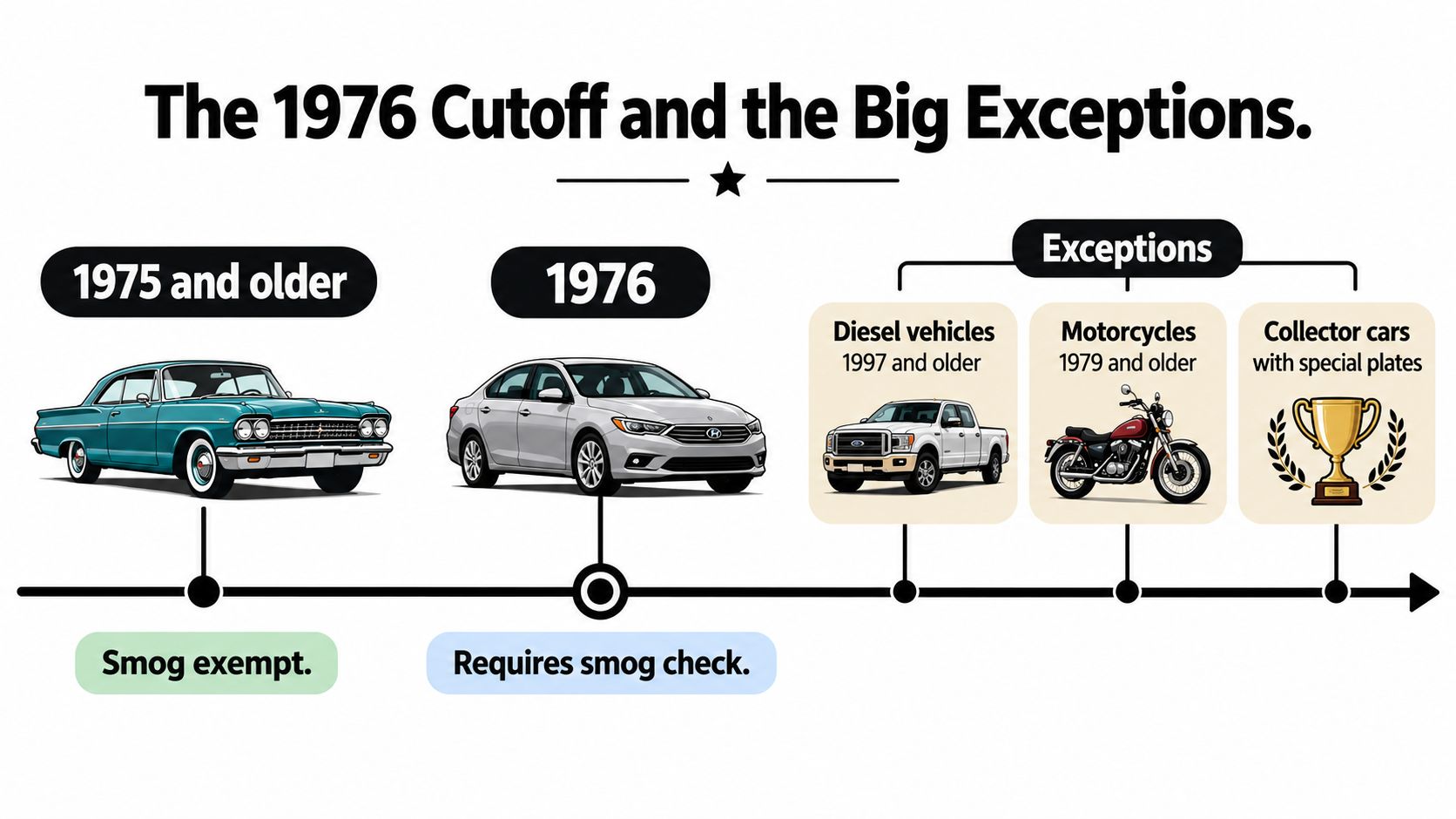
A 1972 Mustang is generally outside the program because it predates the cutoff. An 1985 gasoline sedan is generally inside it, even if it's well maintained and driven only occasionally. The age of the car doesn't move the legal line. Its model year does.
Weight and inspection equipment matter
The standard answer changes when the vehicle falls outside the usual passenger-vehicle category. For 2000-and-newer vehicles with a gross vehicle weight rating of 14,000 pounds or less, California generally uses an OBD-II-based inspection. Vehicles above that weight, or vehicles without the applicable onboard diagnostic system, may follow a different testing path.
That's why I don't give a blanket answer based on the year alone. A heavy vehicle, unusual fuel type, missing diagnostic system, or special registration status can change how the inspection is performed.
The out-of-state exception catches people
BAR states that all out-of-state 1976-and-newer vehicles need a Smog Check for first-time California registration. That requirement can apply even when the vehicle is still within the normal exemption period for a recurring California renewal.
If you've brought a vehicle to San Leandro from Nevada, Oregon, Arizona, or anywhere else, don't assume its previous state inspection carries over. California's first-registration event is its own trigger. For older vehicles, the guidance for smog checks on older cars can help you identify which inspection path may apply.
How the Eight-Year Renewal Exemption Works
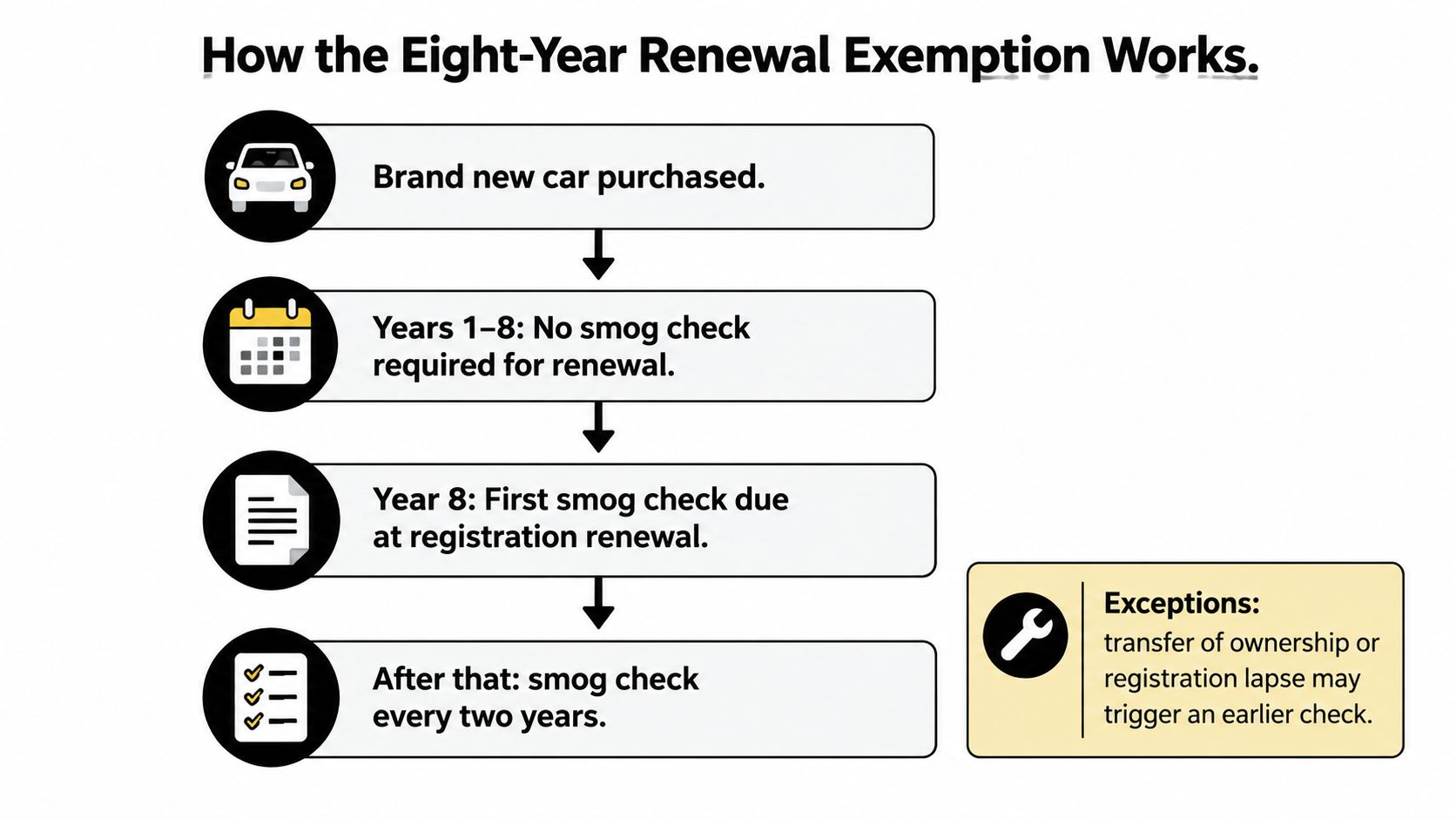
A newer car can be inside California's Smog Check program without needing an inspection at every renewal. For regular registration renewal, BAR says gasoline vehicles eight or fewer model years old are generally exempt from the biennial inspection. During that period, the owner generally pays a smog-abatement fee instead. The BAR renewal exemption guidance explains the practical calculation, add eight to the model year to find the first year a renewal inspection is generally required.
Take a 2020 model-year vehicle. Add eight to the model year, and the first recurring renewal inspection generally arrives in 2028. That's a model-year calculation, not a calculation based on the day you bought the car. The DMV notice still decides what you must complete for the specific renewal.
A 2018 model-year vehicle is already beyond that eight-model-year window. If its registration renewal calls for certification, the owner should plan for a smog inspection rather than assuming the car is still covered by the newer-vehicle exemption.
Renewal and ownership transfer use different clocks
The ownership-transfer rule is shorter. Vehicles four or fewer model years old are generally exempt from the change-of-ownership Smog Check, but the buyer pays a smog-transfer fee instead. BAR's practical method is to add four to the vehicle's model year to identify when that transfer exemption ends.
| Transaction | General age rule | What usually happens |
|---|---|---|
| Registration renewal | Eight or fewer model years old | Smog-abatement fee instead of the routine inspection |
| Ownership transfer | Four or fewer model years old | Smog-transfer fee instead of the transfer inspection |
| Older qualifying vehicle | Beyond the applicable exemption | Certification is generally required for the transaction |
A 2022 vehicle reaches the change-of-ownership threshold in 2026, while a 2018 vehicle is already beyond the four-model-year exemption. Those examples show why a car can avoid a renewal inspection yet still face a different requirement when sold.
For a practical explanation of the newer-car rule, see this guide to a California smog check for new cars. Then look at the paperwork, not just the calendar. An out-of-state vehicle, a registration event, or a transfer can override the assumption that the car is too new to test.
OBD-II Versus the Older Tailpipe Test
The inspection your car receives depends largely on its model year and equipment. California generally uses an OBD-II-based inspection for 2000-and-newer vehicles with a gross vehicle weight rating of 14,000 pounds or less. A technician connects to the vehicle's diagnostic port and checks the emissions computer rather than measuring the exhaust at the tailpipe.
A 1976–1999 gasoline vehicle generally receives the older BAR-97-style tailpipe inspection. That process evaluates emissions coming out of the exhaust, so it measures a different part of the vehicle's emissions system than an OBD-II inspection.
| Model year | Typical test type | What it measures |
|---|---|---|
| 1976–1999 gasoline | BAR-97-style tailpipe test | Exhaust emissions at the tailpipe |
| 2000 and newer, up to 14,000 pounds GVWR | OBD-II-based test | Diagnostic data and emissions-system status |
| Outside the standard category | Different test path may apply | Vehicle-specific emissions requirements |
The failure patterns aren't the same. With an OBD-II test, a lit check-engine light, stored emissions fault, or incomplete readiness information can stop the vehicle from passing. Clearing the battery or a trouble code immediately before testing can also leave the computer without the information it needs to show that its self-checks are complete.
The older test focuses more directly on measured exhaust output. A clean dashboard doesn't guarantee a 1985 vehicle will pass if its actual emissions exceed the applicable limits.
The connector tells the technician what the computer sees. The tailpipe test tells the technician what the engine is actually producing.
Hybrids, diesels, vehicles above 14,000 pounds GVWR, and vehicles without the applicable onboard system can follow different testing rules. Don't choose a shop based only on the assumption that every car receives the same inspection. If you want the technical distinction in one place, review the explanation of OBD versus tailpipe testing.
Real Situations That Change the Answer
An Oakland resident moves back to California with a 2019 SUV purchased and registered in another state. The vehicle may still be within the regular renewal exemption period, but this isn't a routine California renewal. It's the vehicle's first California registration, and an out-of-state 1976-and-newer vehicle generally needs a Smog Check for that event.
That driver should read the DMV registration instructions and schedule the appropriate inspection before assuming the newer vehicle can skip testing. The previous state's inspection history doesn't erase California's first-registration requirement.
A San Leandro driver sells a 2016 sedan to a private buyer. The car is beyond the four-model-year ownership-transfer exemption, so the seller should expect a smog certification requirement for the transfer unless the paperwork or transaction falls under a separate rule. The fact that the vehicle may have passed a previous renewal test doesn't settle the transfer requirement.
That's the distinction people miss at the DMV. The model year sets the default, but the transaction type decides which rule applies.
Three quick counter examples
- A 1972 Mustang: Generally exempt because it's 1975 or older. The owner should still follow the DMV instructions for registration and title paperwork.
- A 2019 out-of-state SUV: Generally requires a Smog Check for first California registration, despite being a newer vehicle.
- A 2016 private-party sedan: Generally beyond the transfer exemption, so certification is generally needed for the ownership change.
The same vehicle can have different requirements at different points in its life. Ask whether you're renewing, transferring, or registering from out of state before asking only what year the vehicle is.
What to Do Before You Head to a Smog Shop
Run through this checklist before driving across the East Bay. It prevents wasted trips and helps the technician identify the right inspection quickly.
- Read the DMV notice. Confirm whether the state wants a renewal inspection, transfer certification, or first-registration test.
- Check the dashboard. A lit check-engine light is a warning sign for an OBD-II vehicle. Have the cause diagnosed before you pay for an inspection.
- Bring the paperwork. Take the renewal notice, registration, title or transfer documents, and any instructions from the DMV.
- Confirm the station type. Some DMV-directed vehicles must use a STAR Certified station. If your notice or vehicle record directs you to STAR, don't use a non-STAR location.
- Ask about preparation. The technician can tell you whether the vehicle needs a particular warm-up or readiness procedure before testing.
Speedy Smog is one San Leandro option for drivers who need a STAR Certified station and inspections for newer vehicles, older vehicles, diesels, or hybrids. Its site also publishes periodic $25-off coupons for most smogs on newer vehicles, so check the current offer before scheduling if your vehicle qualifies.
The practical point is simple: bring the notice and let the paperwork drive the appointment. A shop can inspect the vehicle, but the DMV decides which compliance event you're completing.
Putting It All Together for Your Next Renewal
Remember three anchors. 1976 generally defines which gasoline and qualifying alternative-fuel vehicles are in the Smog Check program. The eight-year renewal exemption and four-model-year transfer exemption determine when newer vehicles generally start needing certification. The transaction, renewal, transfer, or first California registration, determines which rule applies.
Before you book anything, read the DMV renewal notice. That one habit prevents most confusion and keeps you from paying for the wrong type of appointment.
For an East Bay inspection, visit a STAR Certified station such as Speedy Smog in San Leandro, where staff can check the requirement against your paperwork and handle many 2000-and-newer tests efficiently.
Bring your DMV notice to Speedy Smog in San Leandro for a STAR Certified inspection matched to your renewal, transfer, or California registration requirement. The shop handles newer vehicles, older cars, diesels, and hybrids, so you can confirm the correct test before getting back on the road.
A California smog check usually looks at four layers, an OBD II scan, a visual equipment check, a functional inspection, and, where applicable, a tailpipe or opacity measurement. In plain English, the technician is checking the car's computer, its emissions parts, how those parts behave, and, on some vehicles, what comes out of the exhaust.
You're probably here because the registration notice showed up, the check engine light came on and went off again, or a friend told you to “just clear the code” before you go. That advice can backfire, because the inspection is built to catch more than one kind of problem, and California's numbers show those layers matter. In calendar years 2024–2025, about 19 million model year 2000-and-newer vehicles were tested, and about 1.3 million, roughly 7%, failed, which tells you the system is catching real issues, not just paperwork mistakes (California Smog Check Performance Report).
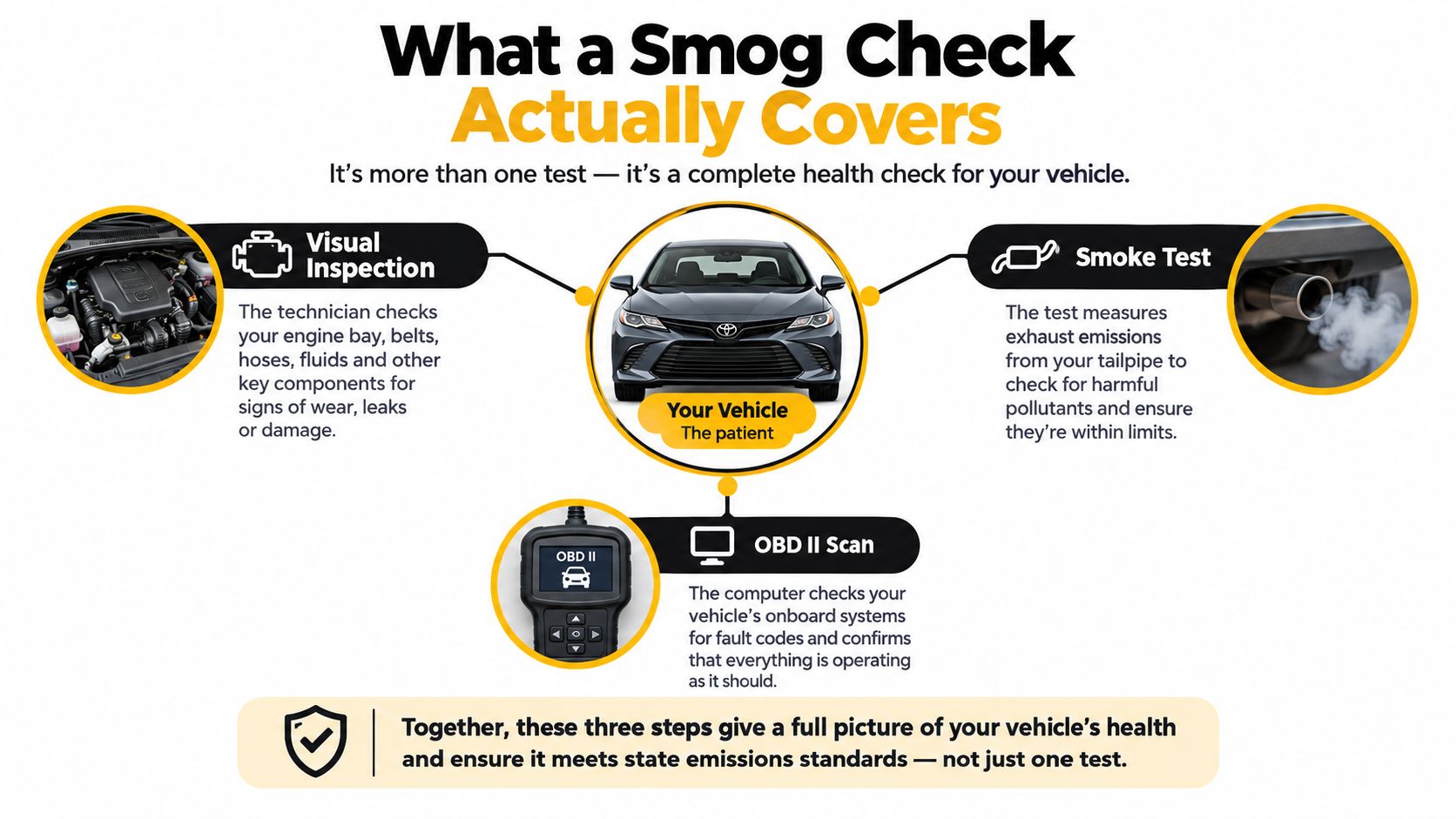
Table of Contents
- What a Smog Check Actually Covers
- The Four Layers of a Modern Smog Inspection
- OBD II Scans Readiness Monitors and the Check Engine Light
- Tailpipe Tests Opacity Checks and Older Vehicles
- What Causes Cars to Fail the Inspection
- Clearing Codes Before a Smog Check and Other Myths
- How to Prepare Your Car Before the Appointment
What a Smog Check Actually Covers
A smog check is more like a layered health check than a single measurement. When you pull into the bay, the technician isn't just looking for one bad number at the tailpipe, they're checking whether the vehicle's emissions system is functioning as a whole, the same way a doctor checks blood pressure, pulse, and breathing instead of one vital sign alone.
The first pass is about the vehicle's own evidence
For many California vehicles, the inspection starts with the car's onboard diagnostics. The computer reports whether emissions-related systems have run their self-tests, whether any faults are stored, and whether the warning lamp is behaving properly. At the same time, the technician looks under the hood and around the vehicle for required emissions parts and signs that something has been removed, damaged, or tampered with (BAR smog overview).
That's why the answer to “smog check what do they check” is broader than most drivers expect. The inspector is not only asking, “Does the car look clean?” They're also asking, “Does the car prove it can control emissions the way it should?”
Why the state uses more than one test
Different vehicles need different checks. Newer gasoline vehicles are usually handled through the computer-based inspection, while older vehicles may be measured at the tailpipe, and diesel vehicles can be tested with opacity equipment that looks at exhaust smoke density (BAR executive summary). California uses those layers because a car can look fine, sound fine, and still fail once the inspection reaches the part the driver can't see.
Practical rule: if a test looks at the computer, the hardware, and the exhaust itself, a car has three different chances to show a problem.
That matters in California because registration often depends on passing the smog check, and the state's testing program is overseen by the Bureau of Automotive Repair. Some stations are also STAR Certified, which means they meet higher performance standards set by the state, so the inspection result carries extra confidence for DMV use.
The Four Layers of a Modern Smog Inspection
A modern inspection moves in layers, and each one can surface a different problem. A car may pass the computer scan and still fail if a required emissions part is missing, damaged, or if the exhaust reading does not meet the standard.
The computer scan checks the car's memory
For a newer vehicle, the technician connects to the OBD II system, the car's self-monitoring network. The scan shows stored trouble codes, monitor status, and warning-lamp behavior, so the inspector can see whether the emissions system has been doing its job (BAR smog). This is closer to reading the vehicle's report card than a quick glance.
The visual inspection checks what's physically present
The next layer is the under-hood and under-car review. The technician confirms that required emissions equipment is present and appears correctly installed, including parts such as the catalytic converter, evaporative-emissions components, and exhaust-gas recirculation equipment when applicable (BAR executive summary report). If a part has been removed, bypassed, or clearly tampered with, the car can fail even if the engine sounds fine.
The functional and measured-emissions checks catch what the eye can't
Some inspections also include a functional review, which checks whether the emissions controls respond properly, not just whether they are installed. On older vehicles, there may also be a measured exhaust test or opacity test, depending on fuel type and model year (BAR-97 manual). That separates a part that is merely there from one that still does its job.
The three layers work together. The computer shows the system's history, the visual check confirms the hardware, and the tailpipe or smoke measurement checks the result. A car can clear one layer and still fail another.
Model year decides the path
California's rules split vehicles by age and engine type. Vehicles with 2013-and-newer model-year engines are required to undergo OBD testing, while vehicles with 2012-and-older model-year engines may need an opacity test and emissions-control-equipment inspection (BAR executive summary report). That is why two cars that look similar on the street can face different inspection lanes at the station.
OBD II Scans Readiness Monitors and the Check Engine Light
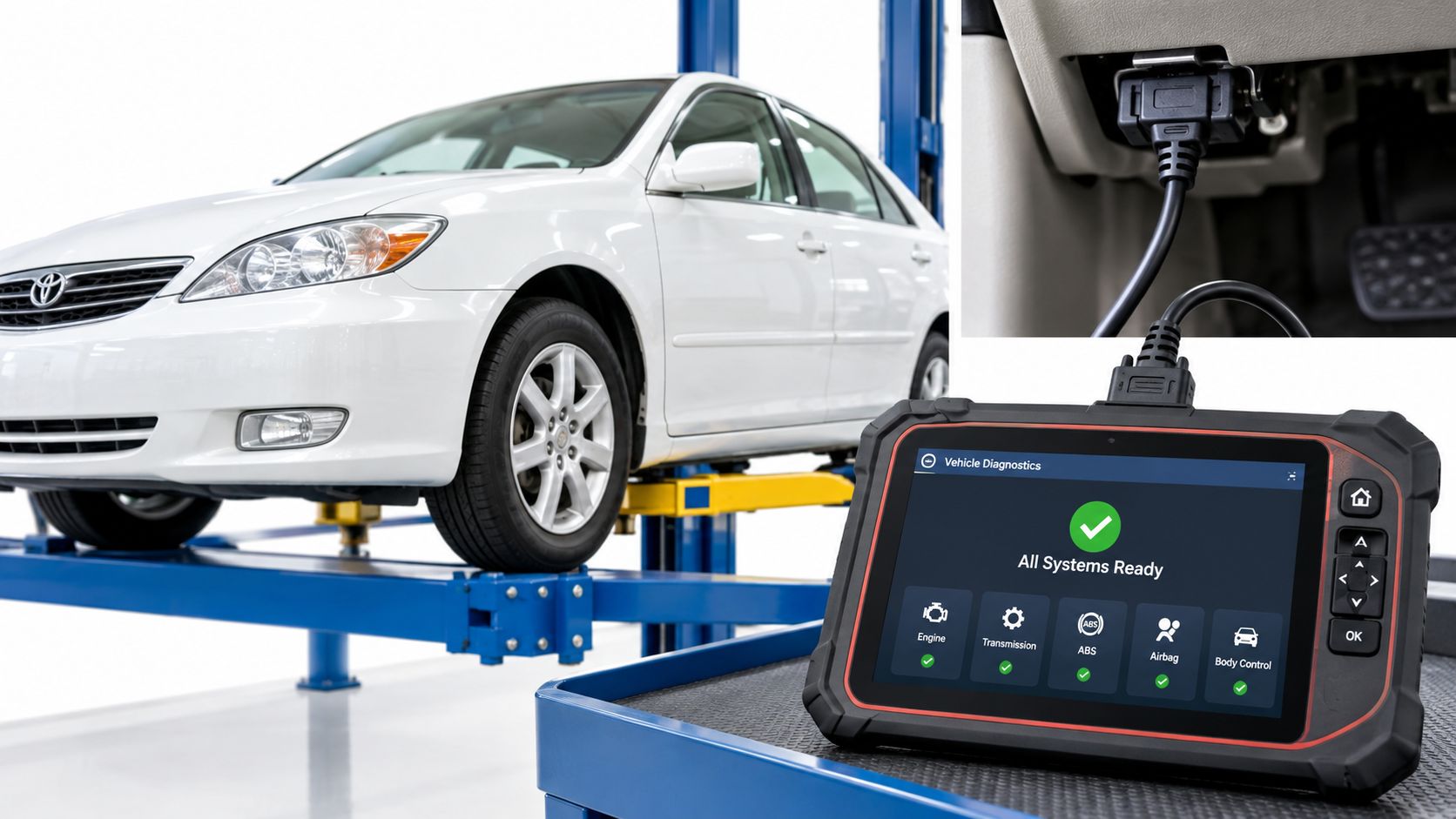
For a 2000-and-newer California vehicle, the OBD II scan is often the heart of the inspection. Think of it as the car's own self-diagnostic report card, it tells the inspector whether the emissions systems have checked themselves, whether faults are stored, and whether the warning lamp is behaving the way it should (BAR smog).
Ready is not the same as no light
Many drivers get tripped up here. A dashboard with no active check engine light does not automatically mean the car is ready to pass. The car also has to finish its readiness monitors, which are self-tests for systems such as oxygen sensors, the catalytic converter, evaporative-emissions controls, and misfire detection (BAR readiness guidance). If the monitors are still “not ready,” the vehicle may fail even though the light is off.
That's why disconnecting the battery, clearing codes, or doing a repair right before the appointment can cause trouble. Those actions can reset the monitors, and the car may need normal driving before the self-tests complete. In plain terms, you can make the warning go dark faster than you can make the car prove it's healthy.
Practical rule: a smog station cares about both the absence of an active fault and the presence of completed self-tests.
What the inspector actually looks for
The technician verifies that the malfunction indicator lamp comes on with the ignition and turns off after startup, then checks for diagnostic trouble codes and monitor status through certified equipment (BAR smog). CARB describes the inspection as both a visual and functional OBD II check, so the computer side is never just a “plug it in and hope” process.
How OBD codes help you understand a smog result
A simple example helps. If someone disconnects the battery to replace a stereo, the clock resets, the monitor history clears, and the car may look fine on the dash but still be unready for inspection. That's why the week before the test matters more than the hour before it.
The OBD side is also why code clearing can be a trap. The problem doesn't disappear just because the light disappears. The inspector is checking whether the emissions system has completed its own checks and can demonstrate normal operation.
Tailpipe Tests Opacity Checks and Older Vehicles
Older cars follow a different path because they don't all speak the same diagnostic language. California's BAR-97 procedure measures exhaust pollutants from 1999-and-older vehicles at the tailpipe, while applicable 1996–1999 gasoline vehicles receive both OBD inspection and tailpipe testing (BAR-97 manual).
Gasoline vehicles get measured, not guessed
A tailpipe test asks a direct question, what is the vehicle putting out under test conditions? If the readings are high, the issue may be an inefficient catalytic converter, an air-fuel imbalance, ignition misfire, or worn oxygen-control hardware. That's different from a computer fault, because the exhaust numbers show the result of the engine's behavior, not just the stored record of it.
Visual compliance still matters on these cars. Inspectors check that emissions equipment is present, that visible smoke isn't excessive, and that there aren't obvious liquid fuel leaks or fuel-cap problems where the test applies (BAR-97 manual). A loose or damaged cap can surprise drivers because it looks small, but it affects whether the system seals properly.
Diesels are judged by smoke opacity
Diesel vehicles may face an opacity test, which measures how much light is blocked by exhaust smoke. That gives the inspector a practical way to see whether the vehicle is producing too much visible soot, even when there isn't a gasoline-style tailpipe measurement in play (BAR executive summary).
A 1999 Civic and a 2018 Civic can therefore live in different worlds at inspection time. The older car may face a more physical emissions test, while the newer one is mainly judged by its onboard diagnostics and emissions-system behavior. Same brand, different rulebook.
What Causes Cars to Fail the Inspection
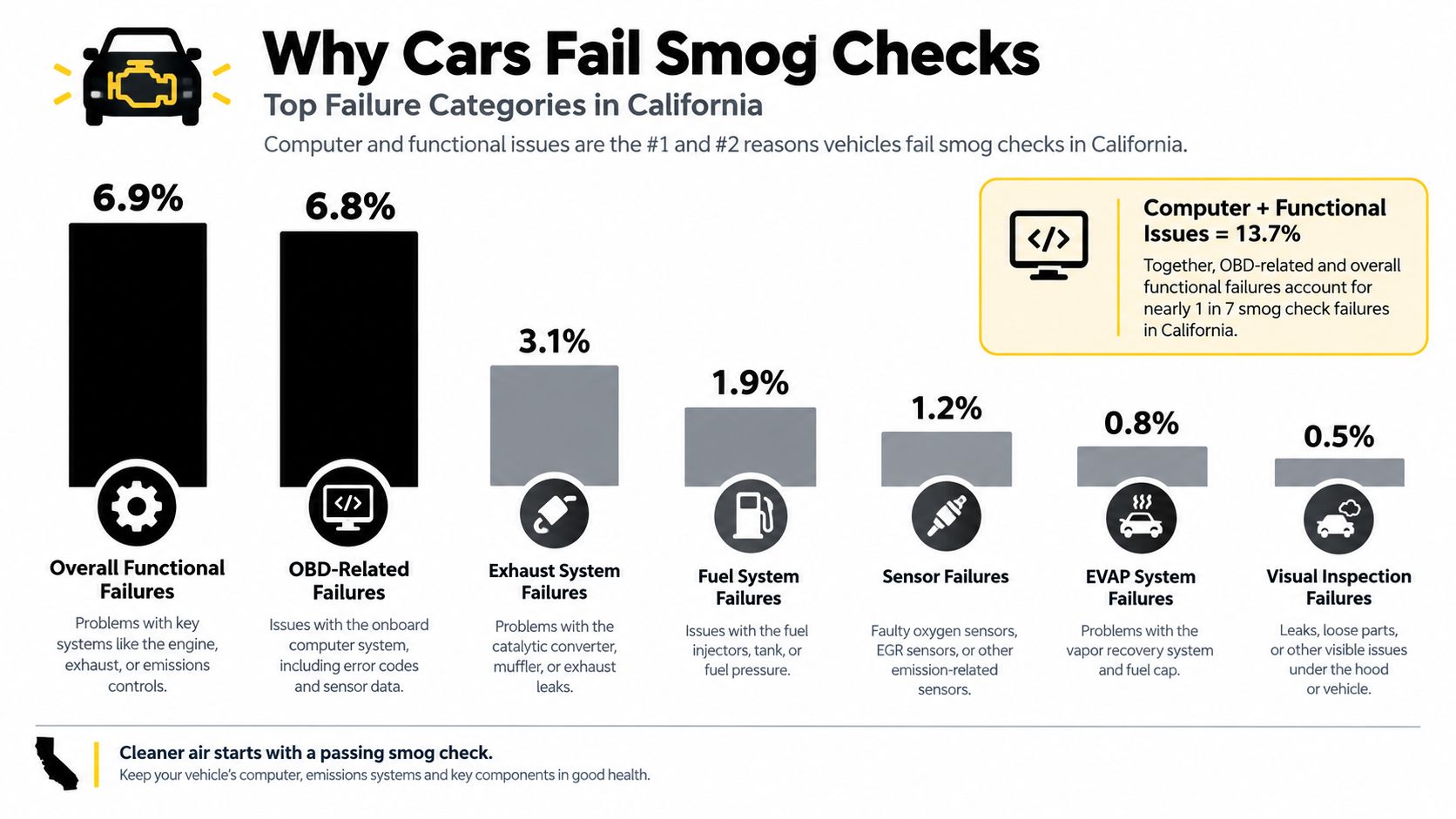
A smog check failure usually comes from one of three places. The car's onboard computer is unhappy, the required equipment does not function the way it should, or something visible is missing or tampered with. The California Smog Check Performance Report shows that OBD-related failures accounted for 6.84% of initial tests, while overall functional failures were 6.92%. Visual failures were lower, at 1.28%.
The table that matches what inspectors see
| Failure Category | Initial Failures | Share of Initial Tests |
|---|---|---|
| OBD-related failures | 714,956 | 6.84% |
| Overall functional failures | 724,477 | 6.92% |
| Visual failures | 134,222 | 1.28% |
The numbers are not separate boxes on every car. A single vehicle can trigger more than one problem during the same visit. The useful takeaway is simpler. If the check engine light is on, if a readiness monitor has not finished, or if a code is stored, that is usually the first thing to fix before the appointment.
A car that feels fine on the road may still have monitor issues that the inspection will catch.
Most failures fall into familiar patterns. A check engine light, a catalytic converter-related code, an evaporative emissions leak, a missing gas cap, or tampered emissions equipment can stop a pass. Those are the parts worth checking before you start guessing at more complicated causes.
Common smog failure reasons explained simply
The smartest pre-test question is not whether the car runs well. It is whether the emissions system can show, right now, that it is working as required. A loose cap can fail like a bad seal on a water bottle, small on the outside, but enough to break the system's pressure check. A missing monitor works the same way. The car may drive normally, but the inspection still sees the gap.
Clearing Codes Before a Smog Check and Other Myths
The most expensive myth is simple, clear the code, the light goes off, and the car should pass. The problem is that clearing codes can reset readiness monitors, which puts the car back into “not ready” status until the self-tests complete. That can turn a temporary dashboard fix into a failed appointment.
Three common myths that waste time
“Idling it for a few minutes warms it up enough.” Not always. Warm engine oil helps, but the car still needs the right drive conditions for monitors to finish their checks. A short idle can't replace a proper drive cycle.
“Disconnecting the battery resets everything in a good way.” It resets the memory, yes, but that includes stored codes and monitor history. If the inspection depends on ready monitors, you've just created more work for the car.
“Aftermarket parts automatically fail the test.” Not by themselves. What matters is whether the required emissions controls are present, correctly installed, and functioning the way the inspection requires.
What to do instead
If the check engine light is on, fix the cause rather than hiding it. If the light was recently cleared, drive the car normally until the readiness monitors have had a chance to complete. If the gas cap looks old or damaged, replace it before the appointment because a simple seal problem can become a simple failure.
A lot of drivers want a shortcut. Smog testing usually rewards the opposite, steady repairs and a normal drive pattern.
How to Prepare Your Car Before the Appointment
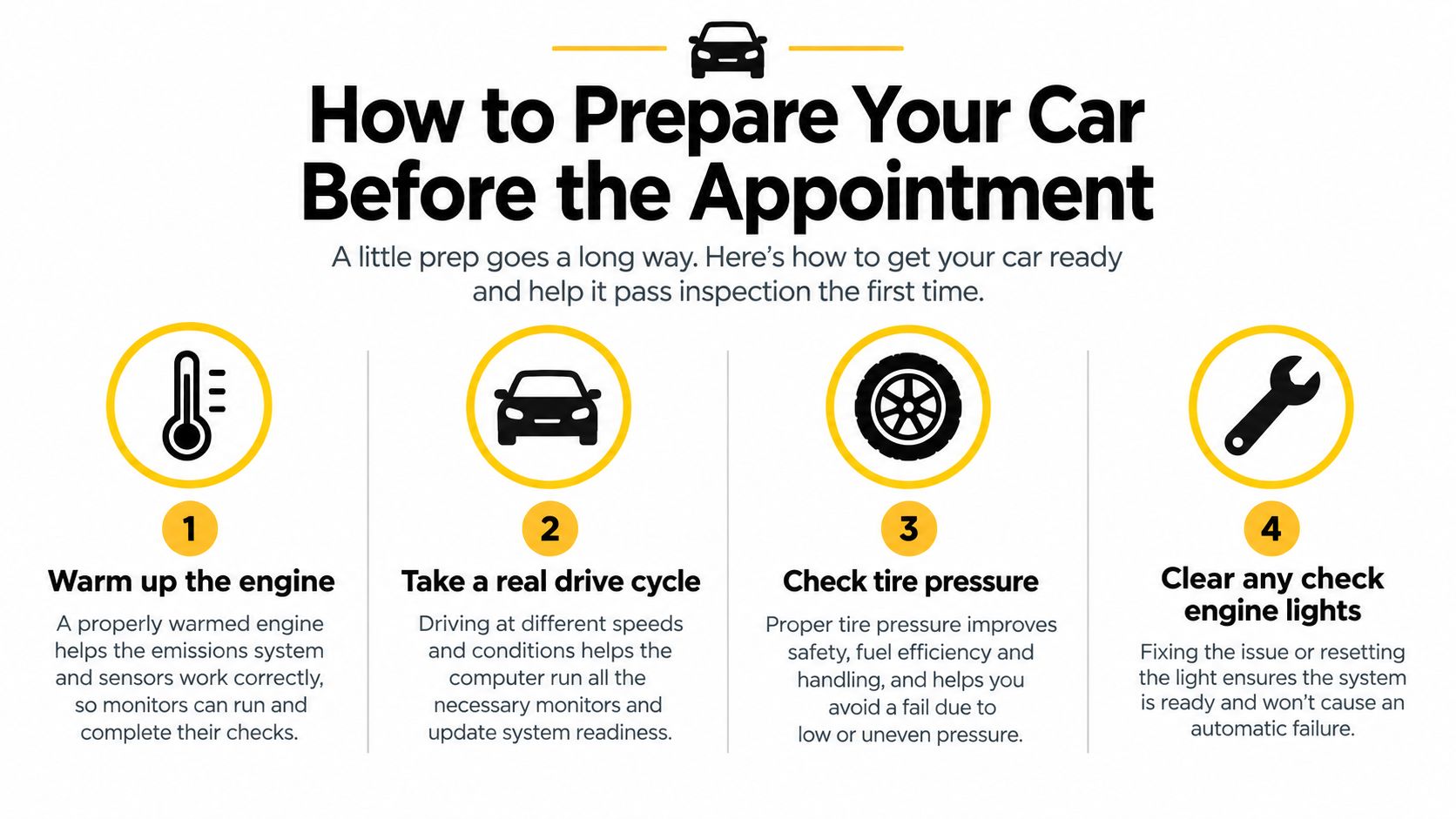
Start with a real drive, not a quick shuffle around the block. A properly warmed engine and catalytic converter give the emissions system a fair chance to operate the way it does in normal use, and that matters before any inspection that depends on operating temperature. If you've recently repaired something or disconnected the battery, give the car enough normal driving to finish its self-checks.
Check the light, then check the cause
If the check engine light is on, don't erase it and hope. Have the fault diagnosed and repaired, because the inspection is built to look past the dashboard glow and into the stored data. If the light recently turned off on its own, make sure the underlying issue is fully resolved before you head in.
Replace obvious wear items
A tired gas cap is cheap to fix and easy to overlook. If the seal is cracked, loose, or missing its grip, replace it before the appointment. That one part can save you a retest, especially on vehicles where the evap system is part of the evaluation.
Give the car a normal mix of driving
A commute with stops and highway speeds is better than a mile of idling in the driveway. Mixed driving helps the monitors run through the tests they need, and it gives the engine a chance to settle into the same conditions the inspection assumes. If you've only driven the car short distances lately, don't assume it's ready just because the dash looks calm.
Bring the paperwork with you
Have your registration or renewal notice ready so the station can process the inspection without delay. If you want a station that handles California-required testing for many vehicle types, including newer models and older or diesel vehicles, a STAR Certified shop like Speedy Smog is one option to consider alongside other licensed stations.
What to do before a smog check
Most vehicles pass on the first try. The prep above isn't about fear, it's about protecting the small share of drivers whose car is hiding a monitor issue, a seal problem, or a fault the dash didn't make obvious.
If you want a straightforward smog check with clear guidance on what the inspector is looking for, Speedy Smog handles California emissions testing for a wide range of vehicles in San Leandro. Visit Speedy Smog to schedule a visit and get your inspection done by a STAR Certified station that understands the layers behind a passing result.
You're staring at the renewal notice on the kitchen counter, wondering whether you need a smog test, which station to use, and whether the whole thing will clear DMV before the tags expire. That's the core task here. DMV smog check registration isn't just a tailpipe test, it's a paperwork gate that decides whether your renewal moves or sits stuck.
In California, the smart move is to treat smog as part of the registration transaction from the start. Bring the notice, read the station instructions, and test at the right place the first time. Miss that, and you can end up with a passing inspection that still doesn't clear the hold.
Table of Contents
- What DMV Smog Check Registration Means in California
- Reading Your DMV Renewal Notice Before You Book
- Booking the Test and What to Bring on the Day
- STAR Stations Test Only Versus Test and Repair Explained
- Readiness Monitors and Pre-Test Preparation
- What to Do When the Test Fails
- Closing the DMV Registration Once the Certificate Posts
What DMV Smog Check Registration Means in California
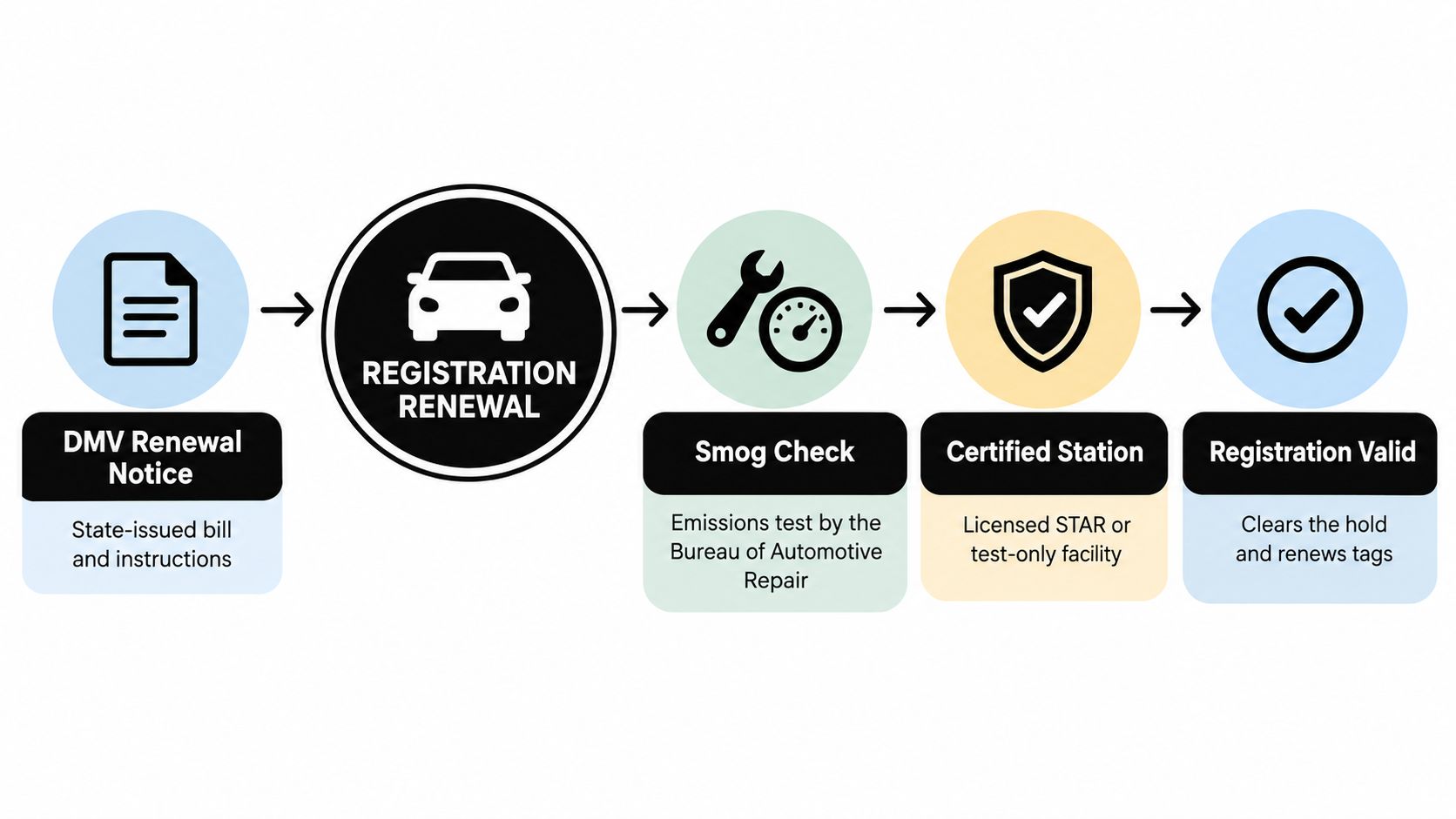
A driver pulls up for a smog test and thinks the job is done once the tailpipe numbers look good. In California, the key job is getting the result attached to vehicle registration so DMV can clear the renewal. The state cares about the test, the station, and the record that gets transmitted.
What triggers the requirement
For most gasoline-powered, hybrid, and alternative-fuel vehicles, California requires a Smog Check for model year 1976 and newer. For diesels, the general cutoff starts with the 1998 model year. Vehicles eight model years old or newer generally pay a smog abatement fee instead of getting inspected for renewal since January 1, 2019. The DMV also excludes several categories, including electric vehicles, motorcycles, trailers, gasoline vehicles from 1975 and older, diesel vehicles from 1997 and older, and certain heavy natural-gas or diesel vehicles. The question is always the same, what vehicle is on the record, and what registration event is happening? California DMV smog inspection rules
Practical rule: if the registration event needs a smog certification, the DMV uses the exact vehicle record, not your memory of the car's last test.
Why the registration frame matters
In California, smog is tied to vehicle registration and renewal, so the DMV and the Bureau of Automotive Repair care about the result and the station that produced it.
Bring a vehicle into California for the first time, and the state usually wants a smog certification before registration goes through. The same holds on renewal when the notice calls for a test. The inspection is the checkpoint that clears the DMV hold and lets the renewal move.
For East Bay drivers, the cleanest way to handle it is simple. Read the renewal notice as the controlling document. If it calls for a test, a fee, or a specific station type, follow that instruction and get the transaction lined up correctly the first time.
Reading Your DMV Renewal Notice Before You Book
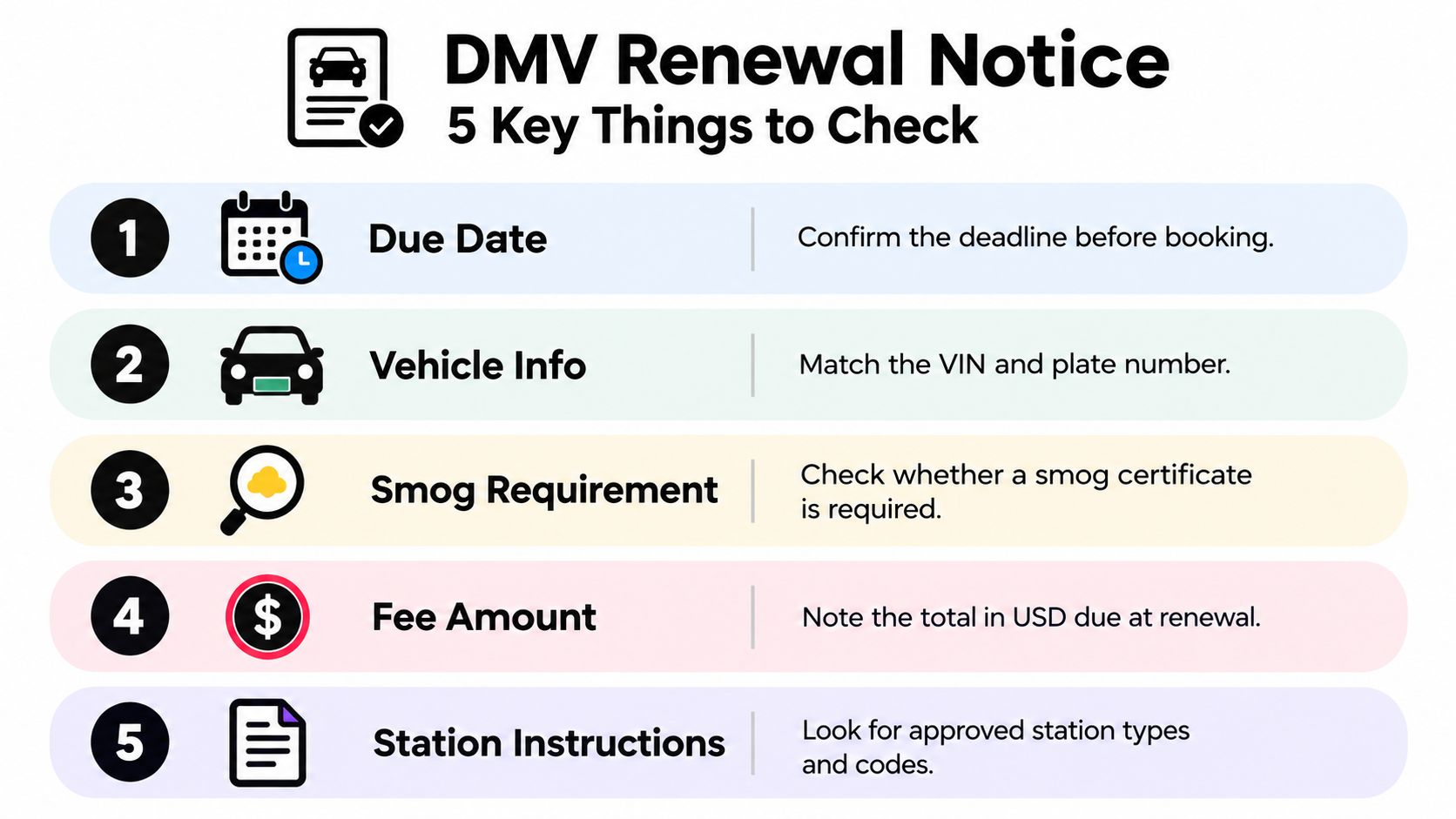
The renewal notice is the piece of paper many drivers skim and regret later. Don't skim it. Read it like a bill with instructions, because that's exactly what it is.
The lines that matter
Look for whether the notice says Smog Check Required or shows that the smog certificate is already submitted. Then check the station instruction line. Some notices point you to any authorized Smog Check station, while others require a STAR station or another specific category. If you ignore that line, you can get a perfectly good test at the wrong shop and still have a registration problem. California DMV renewal workflow
The barcode matters too. The station scans it and transmits the certification electronically to DMV, so bring the notice in person. If you leave it in the glovebox at home, the station may be able to test the car, but you've made the actual registration step harder than it needs to be.
Transaction type changes the answer
Change-of-ownership cases work differently from renewals. Out-of-state vehicles coming into California usually need inspection for first-time registration, while family transfers are usually exempt from the transfer smog check. Vehicles four model years old or newer generally use a smog-transfer fee, not a standard transfer test. That's why you don't want a generic answer, you want the answer that matches your exact transaction.
Keep the notice with your registration paperwork until the certificate posts. If the DMV record and the car record don't line up, you're the one who has to sort it out.
If you want a local walk-through of the renewal flow, use this guide on the registration renewal process as a companion while you check your notice.
Booking the Test and What to Bring on the Day
Book the test like a grown-up, not like someone gambling on luck. A quick call ahead saves a dead trip, especially if your notice calls for a station category you don't use every day. Most shops can tell you right away whether they can handle the job.
The bare minimum to bring is the renewal notice, your payment method, and the vehicle itself. I'd also bring the registration card if you have it, because matching the car to the record is what keeps the DMV side clean. If you're in a hurry, don't make the shop guess which vehicle is yours.
What the visit actually looks like
For modern cars, the process is usually straightforward. The technician plugs into the OBD-II port on 2000-and-newer vehicles, checks the vehicle's emissions readiness, and verifies the system status. Older vehicles may need a different inspection path, and diesels and hybrids can bring their own visual and functional checks depending on the vehicle. The point is the same either way, the station verifies that the car meets the state's requirement and sends that result forward.
Here's the part drivers care about most, the inspection should end with a Vehicle Inspection Report and an electronic certificate transmission to DMV if the vehicle passes. Keep the report. If anything looks off later, that paper trail helps.
The station doesn't have to be a mystery. If the process is set up right, you hand over the notice, the tech scans the barcode, the car gets checked, and the result moves into the DMV system. That's the job.
Later, when you're waiting for the car, this embedded walkthrough is useful:
What to expect from the paperwork side
Once the station submits the result, DMV can finalize the renewal after the certificate posts. Until then, the test alone isn't the finish line. You're not done when the exhaust probe comes out, you're done when the registration side is clear.
STAR Stations Test Only Versus Test and Repair Explained
Not every station can solve every registration problem. That's where people waste time. The station categories exist for a reason, and the renewal notice tells you which lane you're supposed to be in.
The three categories
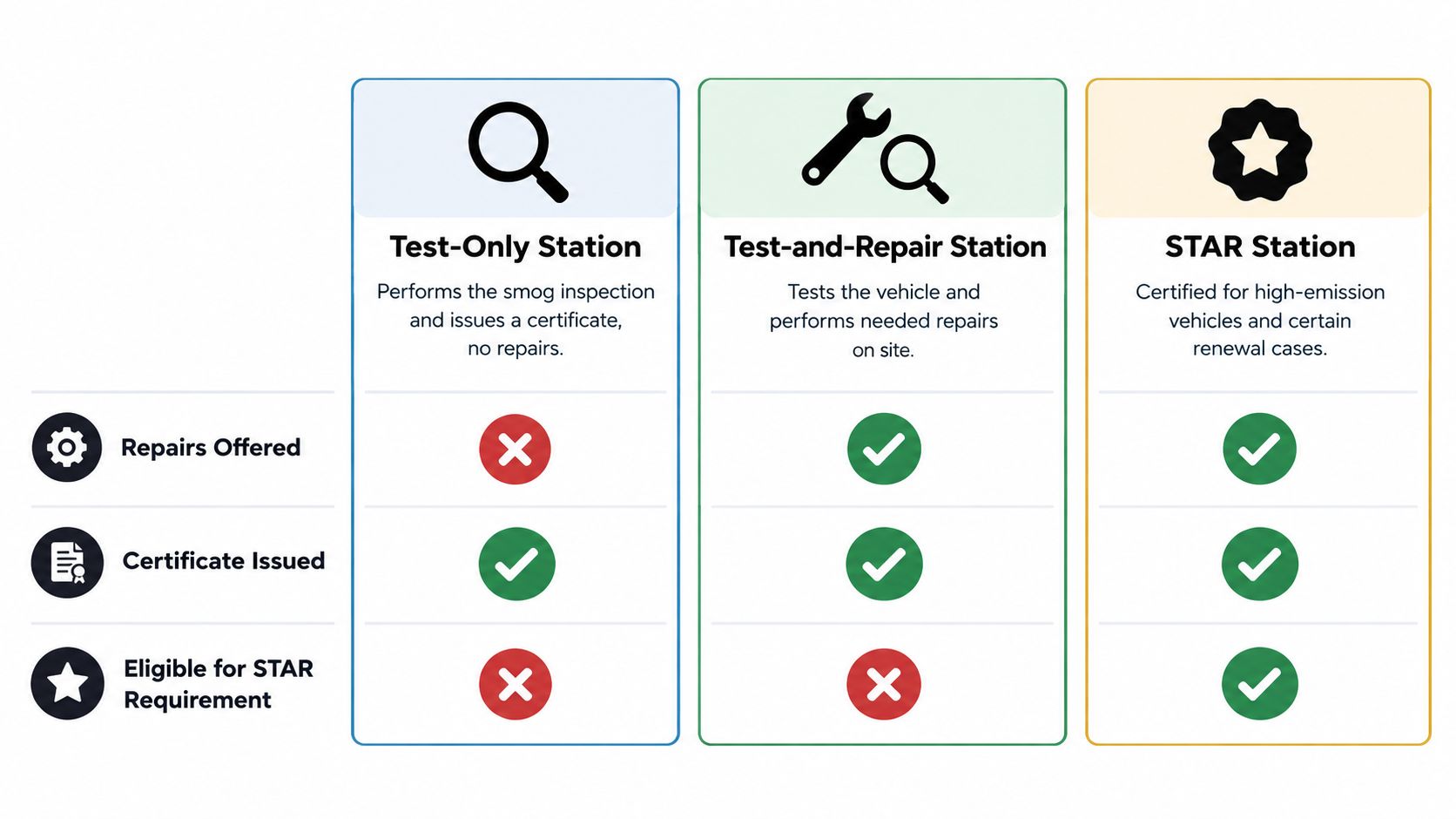
A test-only station inspects the vehicle and issues the certificate if it passes. A test-and-repair station can inspect and fix the vehicle on site. A STAR station is a state-certified station used for certain renewal cases, especially where DMV wants a higher-compliance path. If your notice says STAR, you go to STAR. Don't freelance this part.
California's station system is broad enough that different drivers end up in different lanes. In the Bureau of Automotive Repair's April 2026 executive summary, 223,221 certificates came from test-and-repair stations and 488,032 certificates came from test-only stations in the reported categories. That's a good reminder that the DMV routes a lot of vehicles to specific station types, not just “any place with a smog sign.” BAR April 2026 executive summary
Why STAR status matters
STAR certification isn't just branding. It's part of California's compliance structure. If your renewal notice calls for STAR, a passing test somewhere else may not remove the hold. That's the mistake people make when they think any certificate is enough.
If you want a local explainer on why some vehicles get routed to STAR, this STAR station guide helps keep the categories straight. Use that when you're choosing where to go, not after you've already burned a trip.
Bottom line: the wrong station type can waste a day and still leave your registration incomplete.
Readiness Monitors and Pre-Test Preparation
A car can run fine and still get turned away because the computer is not ready. That is the trap. An off check-engine light does not mean the vehicle is ready for a smog test.
A common mistake is clearing codes right before the appointment, disconnecting the battery, or rushing in after emissions work. Any of those can reset the readiness monitors to incomplete, which can trigger a rejection or failure even if the car drives normally. BAR inspector performance data puts the statewide average for inspections involving the maximum permitted incomplete readiness monitors at roughly 2.1% to 2.2%, so this comes up often enough to matter. BAR readiness monitor benchmark
The night-before checklist
- Do not clear codes: Erasing a stored issue can create a bigger problem at the test lane.
- Confirm the light is off: A lit check-engine lamp means stop and fix it first.
- Drive normally: Give the car time to finish its monitors under ordinary driving.
- Check status with a scan tool: If you have one, look before you leave.
- Use a pre-scan if needed: A quick check beats a wasted trip.
If you want a full pre-test walkthrough, see this guide on what to do before a smog check.
I'd rather see a driver wait an extra day than roll in with incomplete monitors and start over. The DMV deadline does not change how the car's readiness logic works, and the station cannot override it.
If the monitors are still incomplete, follow the manufacturer drive cycle under safe conditions and return only after they are ready. That is the cleanest move, and it saves time at the counter.
What to Do When the Test Fails
Failure isn't the end of the process. It's a fork. You either repair it, dispute it, or use the state programs that exist for exactly this situation.
California recorded 1,019,416 initial tests and 85,135 initial failures in July 2025, an 8.35% initial failure rate. BAR July 2025 executive summary That's not a fringe event. Plenty of drivers run into this, which is why you need a plan before you leave the house.
Your four moves after a failure
- Get the repair conversation started. Ask the shop what failed and what they'd fix first. Don't assume the whole car needs to be torn apart.
- Use the BAR Referee if the result looks wrong. If the vehicle has unusual emissions equipment or the result doesn't make sense, a referee can help sort out the dispute.
- Check Consumer Assistance Program eligibility. BAR identifies this program for consumers who may qualify for repair or retirement help.
- Protect the registration deadline. If you're running out of time, DMV allows a 60-day Temporary Operating Permit when you submit the failed inspection report, proof of insurance, registration fees, and the $50 nonrefundable fee. Only one such permit may be issued in a two-year period.
A failure should push you into action, not panic. The wrong move is to keep paying fees and hoping the certificate magically shows up. Get the cause, pick the right path, and move.
If the car failed for something obvious, fix that first. If the result doesn't fit the vehicle, stop guessing and get a referee involved.
Closing the DMV Registration Once the Certificate Posts
Once the smog certificate posts, the job is to close the DMV transaction cleanly. The station sends the result electronically, DMV picks it up, and you finish the renewal online if your record is clear. That is the part people miss when they assume a paid fee means everything is done.
The fee helps, but it does not finish registration if DMV still shows a missing smog record. Check your renewal status and wait for the certificate to appear before you call it closed. Read how the DMV finalizes renewal after the smog certificate posts.
Use this order:
- Notice in hand
- Correct station chosen
- Inspection completed
- Certificate posted electronically
- Fees paid
- Online renewal finished
- Sticker arrives in the mail
That is the dmv smog check registration workflow. It works when you read the notice, match the station to the job, and keep the paperwork straight.
If you want a local station that handles the registration side the way California expects, Speedy Smog can take your renewal notice, complete the inspection, and electronically send the result so your DMV transaction can move forward. Visit Speedy Smog to book your smog check in San Leandro and get the registration piece handled without extra back-and-forth.
A typical smog inspection runs about 20 to 30 minutes under California BAR guidance, and the emissions portion on a ready 2000 or newer vehicle can often be finished in about 10 to 15 minutes at an efficient station. If you're staring at a renewal deadline, the key question isn't just how long the bay visit takes, it's whether your car is ready to pass.
Table of Contents
- What Smog Check Time Means for Drivers
- How an Inspection Works in the Bay
- The Biggest Factors That Speed Up or Slow Down Your Visit
- Why a Faster Station Does Not Always Mean Faster Certification
- Pre-Appointment Checklist for the Shortest Possible Wait
- What a STAR Certified Station Brings to the Timeline
- Setting Realistic Expectations for Your Visit
What Smog Check Time Means for Drivers
You pull into the station expecting a quick stop, and that is fair. The mistake is treating every smog check like the same job, because smog check time depends on what the inspector has to do, not just how fast the lane looks.
California's Bureau of Automotive Repair puts a typical inspection at about 30 minutes because the inspector is not only measuring emissions, they are also selecting the correct procedure, checking components visually, running the required functional tests, and recording the result. BAR's STAR guidance also says a full inspection often takes 20 minutes or more, with faster outcomes possible when the inspector knows the vehicle well and the car is straightforward to test. BAR smog check guidance
The honest split between regulation and shop speed
The 20 to 30 minute range is the safe planning number. It covers the whole inspection, not just the machine reading.
The 10 to 15 minute number is the shop workflow goal for a ready newer vehicle, especially when the car shows up with no warning lights, no weird configuration issues, and no extra diagnostic work. That is a real-world speed target, not a promise that every vehicle gets the same treatment. BAR also ties inspection time to vehicle age, fuel type, inspection type, and the condition of emissions-control parts.
Practical rule: plan for the regulatory range, then be pleasantly surprised if your newer vehicle moves through faster.
If you want the cleanest way to think about it, separate the bay visit from the readiness problem. The bay visit is the part you can control on the day, but the readiness monitors can keep a car from being testable for two weeks or more after repairs or battery loss. Most drivers budget for the bay visit and forget that the car may need time before it is even ready to certify.
How an Inspection Works in the Bay
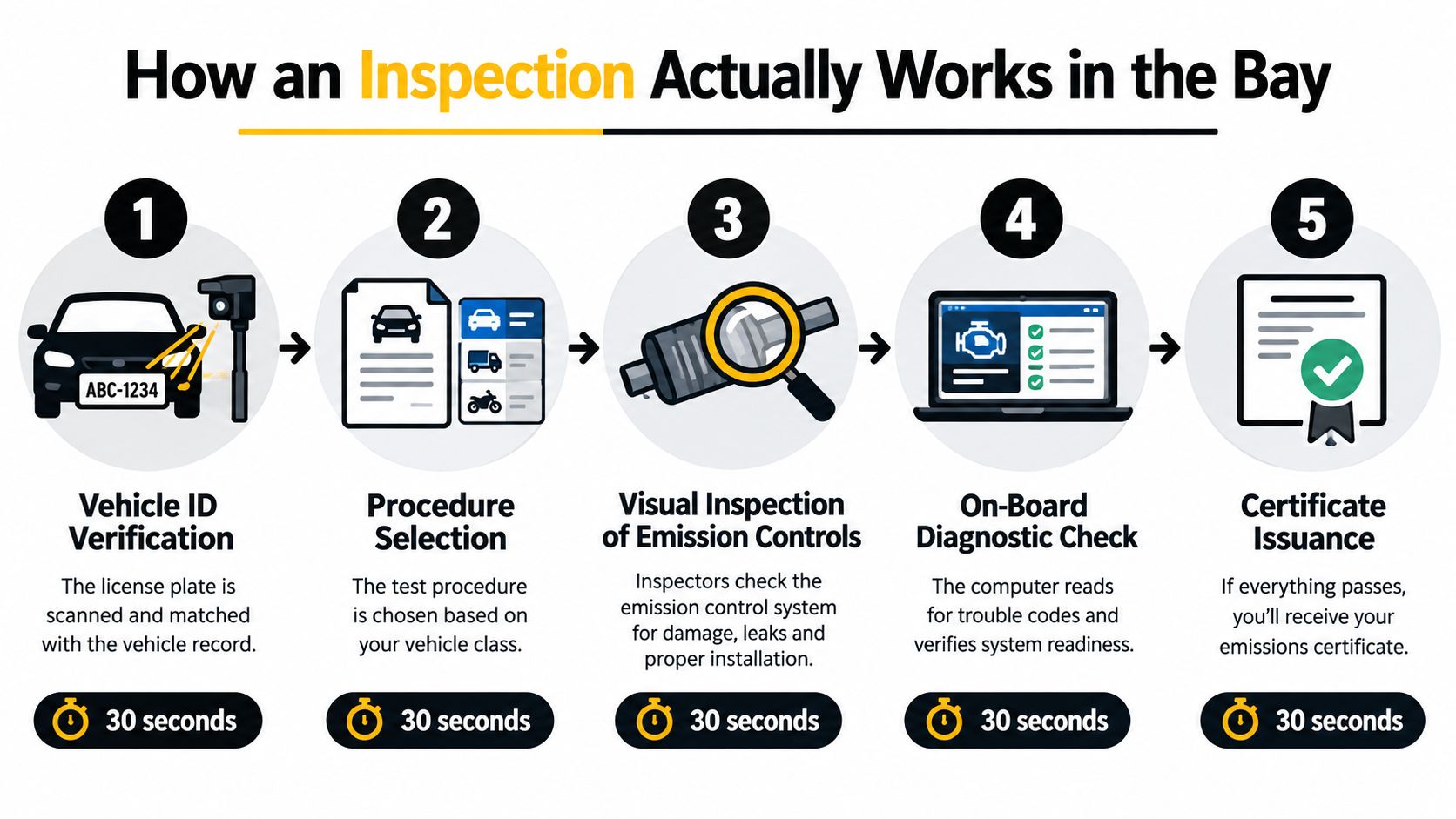
From the waiting room, the bay move looks like one machine reading. In practice, the inspector works through a fixed sequence that cannot be shortened.
What happens before the certificate
First comes vehicle identification and procedure selection. The inspector has to confirm what the car is, because the test changes by model year, fuel type, and equipment.
Then comes the visual inspection. That means checking for required emissions-control parts, confirming they are present, and spotting modifications that change the approved procedure. After that, the inspector runs the functional checks and pulls the required data from the vehicle.
For 2000 and newer gasoline vehicles, the process usually depends heavily on OBD data, including diagnostic trouble codes, malfunction-light status, and readiness monitors. Older vehicles may need direct exhaust measurement and more hands-on verification. The BAR smog check manual also explains that a pre-2000 gasoline vehicle may need a warmed-up tailpipe procedure before the actual test begins. BAR smog check manual
That is why station time varies so much. A newer sedan with everything in order can move quickly through the bay. An older pickup, a diesel, or a vehicle with unusual equipment gives the inspector more to check, more to document, and more chances for delay.
The Biggest Factors That Speed Up or Slow Down Your Visit
Vehicle age drives a lot of the timing. So does fuel type. So does whether the car is stock, modified, or configured in a way that needs a different approved procedure.
BAR's statewide data show why inspectors stay methodical. In the 2025 summary, 11,275,981 initial tests produced 959,667 failures, an initial failure rate of 8.51%. The report also shows that older vehicles fail more often, including 19.45% for 1980 model-year vehicles in the cited initial-test category. BAR STAR FAQ
Typical smog check duration by vehicle type
| Vehicle category | Typical duration | Main reason |
|---|---|---|
| 2000 and newer gasoline | About 10 to 15 minutes | OBD-driven inspection, usually quicker when ready |
| Older gasoline vehicles | Longer than newer cars | More visual and functional checks, sometimes tailpipe work |
| Diesels | Often longer or more variable | Different approved procedure and configuration checks |
| Hybrids or nonstandard setups | Variable | Extra procedure selection and verification |
An illuminated check-engine light is a hard stop, not a small delay. BAR says it means the vehicle will not pass, and modified or non-approved software can also cause failure. That's why a station can't just “run it fast” and hope for the best. The inspector still has to verify the car the right way, or the result won't hold up. BAR smog check manual
For a practical Bay Area example, a station with a quick lane still has to slow down when the car itself demands it. If you want to compare operating style and access, this local smog check hours page is a useful reference point for how shops structure their day.
Why a Faster Station Does Not Always Mean Faster Certification
A clean bay does not fix an unready car. That's the part drivers miss, and it's the part that wastes the most time.
Readiness is the real gatekeeper
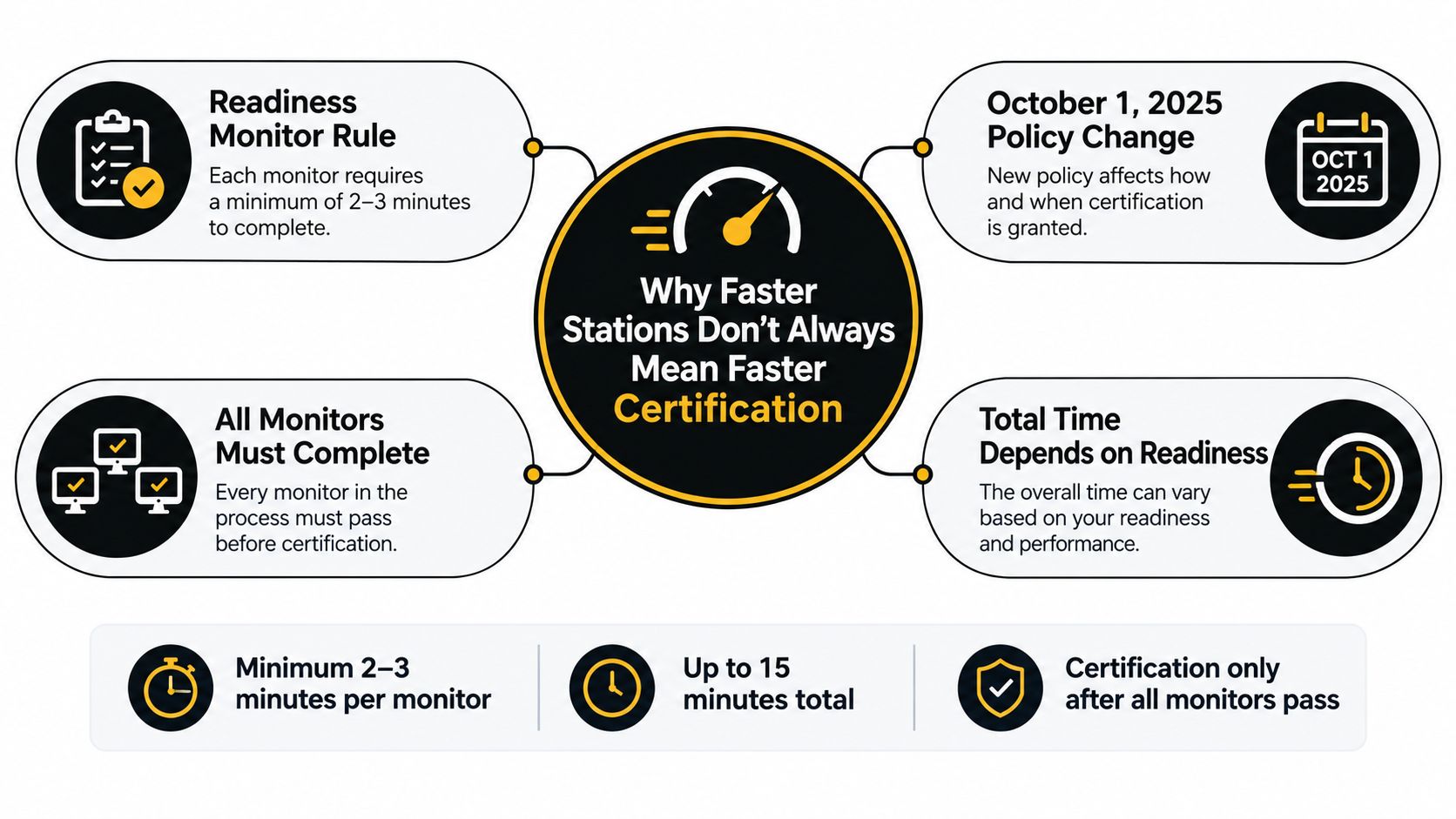
Readiness monitors are the car's own emissions self-tests. They rerun after things like battery disconnection, repair work, or clearing codes, and they need to show as complete before the vehicle can pass. BAR says that beginning October 1, 2025, all monitors that can feasibly be completed must be set before a vehicle can pass inspection. BAR readiness monitor regulations
That change matters because it kills the old shortcut mentality. Clearing the code right before the appointment doesn't make the car ready. It just resets the clock.
BAR says most properly functioning vehicles can set the required monitors within about two weeks, but that depends on the car, the driving pattern, and the monitor involved. So the bottleneck isn't the inspection lane. It's the drive cycle. If the monitors aren't ready, a quick station can't rescue the visit.
A fast station can shorten the bay time. It can't cheat the readiness process.
That's the distinction worth remembering if you need a same-day outcome. The appointment might be short, but certification only happens after the car has done its own part first.
Pre-Appointment Checklist for the Shortest Possible Wait
The night before your appointment is where you win or lose the day. If you show up ready, the visit stays short. If you show up half-prepared, you'll probably pay for it with a repeat trip.
What to do before you leave home
- Confirm renewal needs: Check whether the vehicle requires smog certification for registration or renewal before you head out.
- Watch the dash: If the check-engine light is on, don't expect a pass.
- Leave the battery alone: Don't disconnect it right before testing, because that can reset readiness monitors.
- Drive the car normally: Give it a mix of trips so the monitors can complete on their own.
- Tell the shop the setup: Diesel, hybrid, all-wheel-drive, or other nonstandard configurations should be disclosed up front.
- Warm the engine on older vehicles: Arrive with the car already at normal operating temperature if your vehicle uses a procedure that needs it.
If you're dealing with a recent repair, think in terms of repair, drive cycle, retest. Don't treat the appointment as a one-and-done errand, because the car may need time after the fix before it can certify.
For drivers who want a local shop workflow that handles this cleanly, Speedy Smog is one option in San Leandro that focuses on quick inspections and straightforward service. The value isn't magic, it's knowing the car shows up in the right state and the station doesn't waste time figuring out what it is.
What a STAR Certified Station Brings to the Timeline
Station choice matters because some places are built for speed, and some are built for guesswork. You want the first kind.
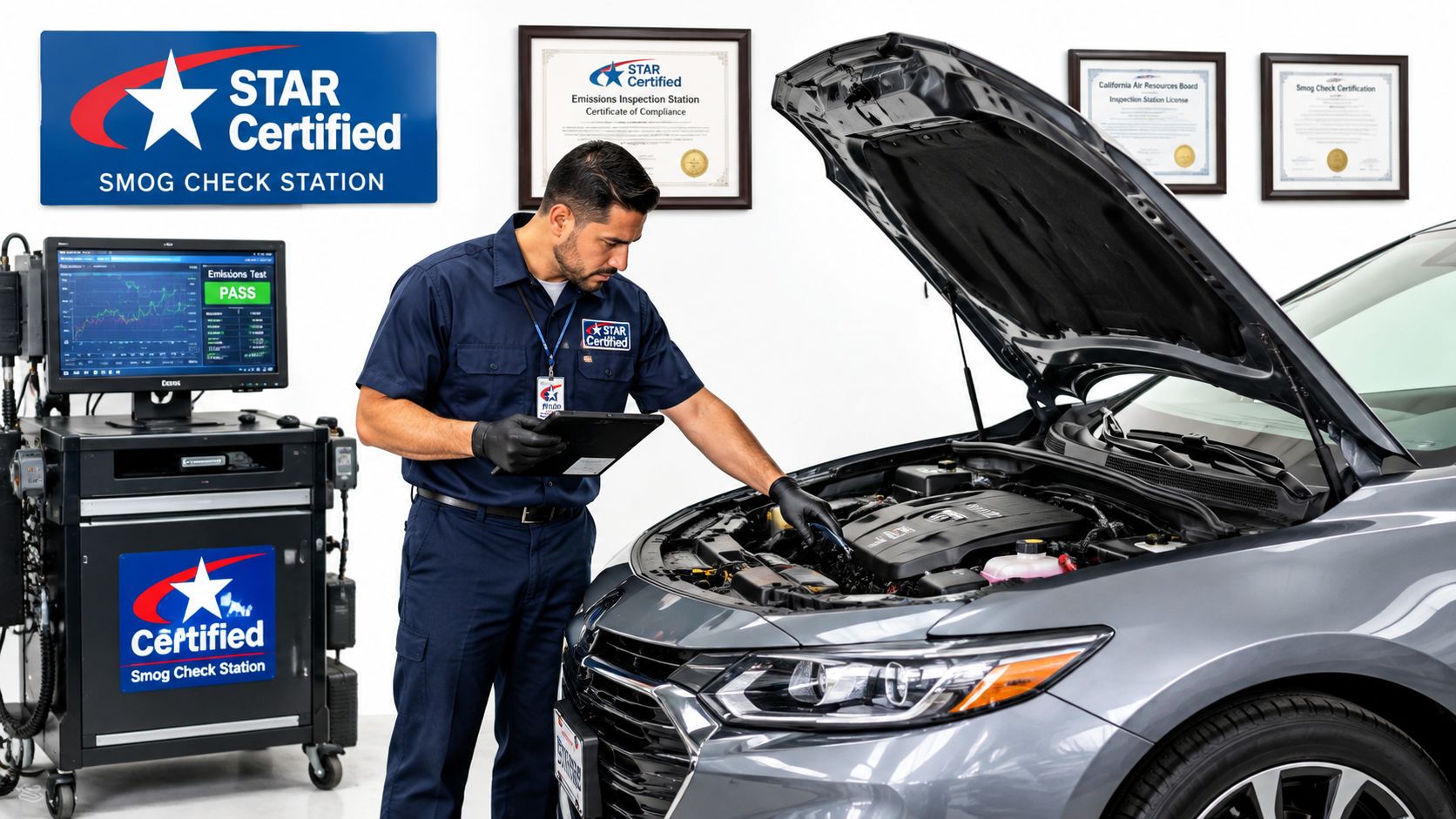
STAR Certified stations meet higher performance standards set by the Bureau of Automotive Repair, and they're allowed to inspect higher-risk vehicles. That usually means better procedure discipline, better equipment, and fewer delays caused by confusion over what test to run. What is a smog STAR station
A good STAR station also keeps the process moving after the test, with electronic result transmission and a workflow designed around compliant inspections rather than improvisation. That matters because slow paperwork can stretch a visit even after the car has passed.
The right station won't just be fast on paper. It'll be fast because it knows what to do with older vehicles, hybrids, diesels, and cars that need a little more attention. That's what cuts repeat visits, and repeat visits are what wreck your day.
Setting Realistic Expectations for Your Visit
A fast visit starts long before you pull into the bay. The timeline is readiness, then inspection, then any retest work, then DMV processing after the result goes out. If the car is not ready, the wait grows before the test even begins.
For a fuller breakdown of station-side timing, see our guide on how long a smog check takes.
That is the part drivers miss. They fixate on the minutes in the stall, then get burned by readiness issues, missing repairs, or a result that sends them back for another round. A station can be quick and still leave you with a longer certification path if the car is not prepared.
If you want the shortest possible visit, show up with the obvious problems handled, the car warmed up, and your paperwork squared away. That is how you get same-day results without turning a simple inspection into a half-day errand.
A DMV smog test only station performs the emissions inspection but cannot perform repairs, so a failed vehicle must go elsewhere for diagnosis and fixes. California had 8,213 licensed Smog Check stations in December 2018, including 4,225 STAR stations, and STAR locations handled 82% of approximately 11.4 million initial tests that year (California Bureau of Automotive Repair performance report).
You may be looking at a renewal notice, searching for “dmv smog test only,” and wondering whether the first station you find can also repair your car if something goes wrong. That uncertainty matters. The right choice depends on what the DMV notice says, whether your vehicle appears ready for testing, and whether you need only a certification or also expect emissions repairs.
A test-only visit can be straightforward when your vehicle is prepared and the DMV needs a valid result. It can also become an unnecessary second trip if your car has a warning light, incomplete readiness monitors, or a known emissions problem. The station type is part of the decision, not just a label on a sign.
Table of Contents
- Understanding DMV Smog Test Only Stations
- The STAR Certification Ecosystem and What the Numbers Reveal
- Comparing Test Only Stations and Full Service Repair Stations
- What to Expect at a STAR Certified Test Only Location
- Why Test Readiness Matters More Than Test Speed
- Making the Right Choice for Your Vehicle Situation
Understanding DMV Smog Test Only Stations
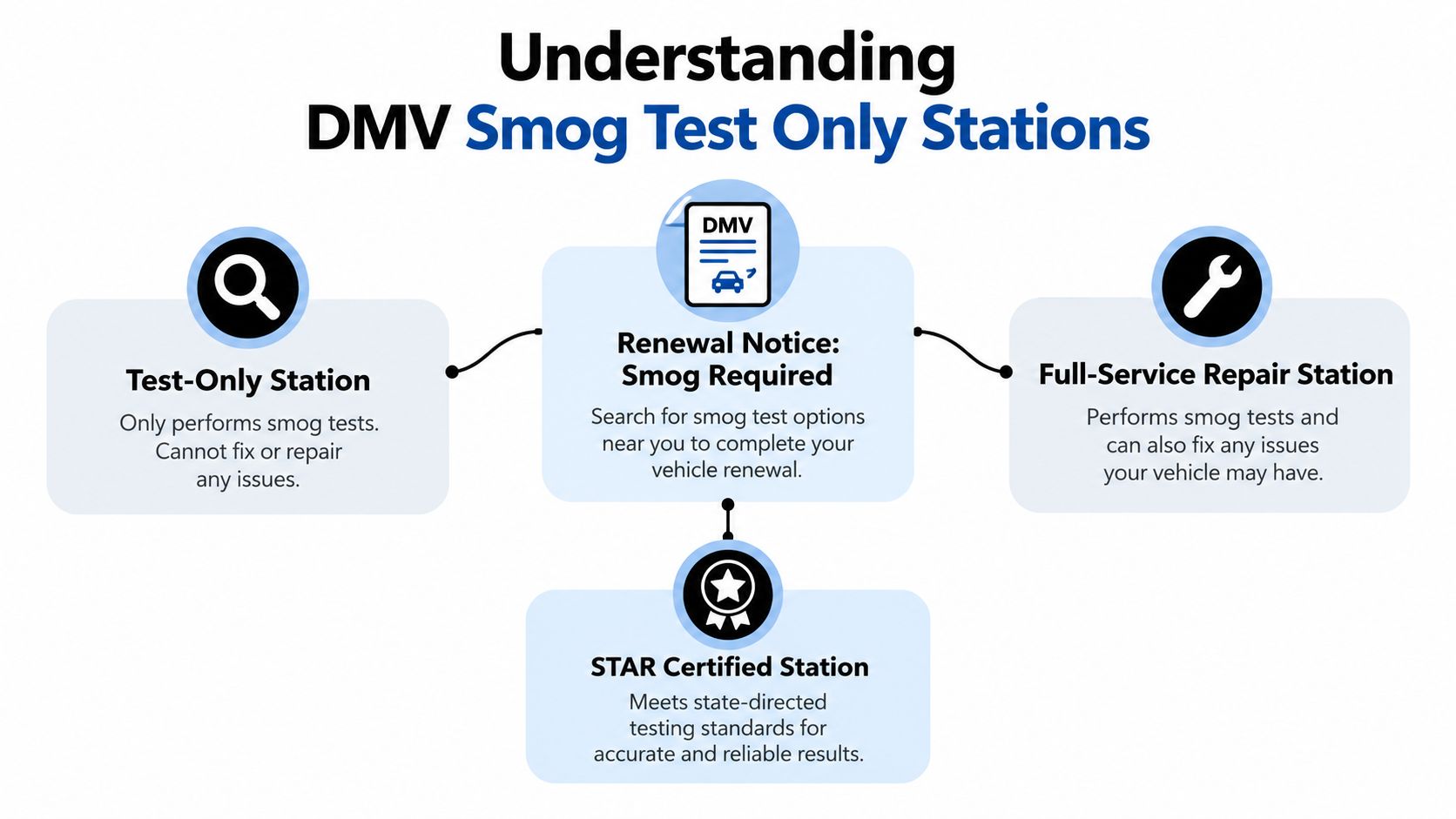
A DMV renewal notice arrives, the word “smog” catches your eye, and you start comparing nearby shops. One advertises testing only. Another offers testing and repairs. The difference is simple but important: a DMV smog test only station is authorized to inspect your vehicle, not repair its emissions system.
Think of the station as a medical testing office. It can examine the patient, run the required checks, and report the result, but it doesn't provide the treatment. If your vehicle fails, you'll receive information about the failure and then need a qualified repair facility for diagnosis or correction.
What the inspection includes
California's Smog Check inspection can involve several parts:
- Visual examination: The technician checks emissions-control hardware for missing, disconnected, or visibly altered components.
- Functional checks: The station verifies that required systems operate as expected.
- Computer testing: On most model-year 2000 and newer vehicles, an OBD test reads emissions-related data from the vehicle computer.
- Tailpipe testing: Pre-2000 vehicles generally receive a tailpipe emissions test instead.
The California Bureau of Automotive Repair describes the inspection process and vehicle testing pathways in its Smog Check guidance. An OBD-equipped car can fail even when it feels normal if the malfunction indicator lamp is illuminated or the computer reports an emissions issue.
Why the distinction affects your next move
A test-only station suits a driver who needs a certification and expects the vehicle to pass. It may be less convenient if you've already diagnosed an emissions fault and want one business to test, repair, and retest the car.
Before booking, check whether the DMV notice directs you to a STAR station. If it doesn't, you can generally compare station type, location, availability, and service scope. For a more detailed explanation of the test-only model, see this guide to what a test-only smog station does.
Practical rule: Choose a test-only station for an inspection. Choose a repair-capable station when you already need emissions diagnosis or correction.
The STAR Certification Ecosystem and What the Numbers Reveal
A lot of frustration around smog checks comes from treating every station like it does the same job. The network is more like a road system with different lanes. Some stations can handle standard inspections. Some can also handle vehicles the state wants reviewed under tighter rules.
That is where STAR fits. The Bureau of Automotive Repair uses the STAR Program to identify stations that meet added performance requirements and can inspect vehicles assigned for enhanced scrutiny. If your renewal notice points you to a STAR location, the station type is part of the transaction, not a small technical detail.
The scale of that role becomes clearer when you look at inspection volume instead of repeating station totals. In 2018, California conducted about 11.4 million initial Smog Check tests. STAR stations performed about 9.3 million, or 82%, while non-STAR stations performed roughly 2.1 million, or 18%, according to BAR's 2019 performance report.
Those numbers help explain the system. A station category can represent only part of the network on paper and still carry most of the day-to-day workload. For drivers, that means STAR is not a rare label you can ignore. It is a major part of how vehicles move through California's registration process.
The second confusion point is what STAR does not mean. STAR certification does not mean your car is more likely to pass. It also does not automatically tell you whether the shop repairs vehicles. The label speaks to the station's standing in the regulatory system. Your vehicle still has to satisfy the inspection requirements, and the business may be test-only or may also offer repairs.
A simple way to sort this out is to start with the notice in your hand.
- Read the DMV notice first: it may name the station category you need.
- Treat a STAR direction as a requirement: a nearby non-STAR shop may not complete the inspection the DMV expects.
- Separate certification from service model: a STAR station can be test-only, or it can also perform repairs.
- Use station type as a planning tool: it helps you choose a shop that matches your registration step, not just the closest address.
If you want a plain-language overview before booking, this explanation of what a STAR station is can help clarify the label.
Comparing Test Only Stations and Full Service Repair Stations
The best station depends on what you need after the technician connects the equipment. If your goal is a DMV certificate and your vehicle appears healthy, a test-only location may provide the cleanest path. If you expect a failure or already know about an emissions fault, a repair-capable shop may reduce the number of separate visits.
| Criterion | Test-Only Station | Full-Service Station |
|---|---|---|
| Inspection scope | Performs the required smog inspection and reports the result | Performs the inspection and may diagnose or repair emissions problems |
| After a failure | Provides the test result, but repairs must happen elsewhere | May diagnose and correct the issue on site |
| Convenience | Efficient when you only need certification | More convenient when testing and repair belong in the same visit |
| Best fit | A prepared vehicle needing a DMV result | A vehicle with a known or suspected emissions problem |
Speed
Test-only facilities focus their workflow on inspection. That specialization can be useful when your vehicle is ready and you don't need troubleshooting. A shorter visit doesn't necessarily mean a better outcome, though. Testing an unready vehicle quickly still produces an inconvenient result.
Scope
A full-service repair station combines two jobs. The technician can inspect the vehicle, identify a likely cause of failure, and potentially perform the necessary work. That broader scope matters when the check engine light is on, an emissions component is missing, or a prior diagnostic scan identified a fault.
A test-only station isn't withholding a service by refusing to repair. Its authorization and business model focus on independent inspection. You'll need to treat the result as a decision point, then take the vehicle to a repair professional if necessary.
Cost
Prices vary by station, vehicle, and service arrangement. A test-only visit may involve only the inspection, while a full-service visit can lead to diagnostic and repair charges if the vehicle fails. Ask what the quoted price covers before authorizing work, especially if you're choosing a repair-capable shop because you expect a problem.
Appropriateness
Use this quick filter:
- Choose test-only when the DMV requires certification and you have no reason to suspect an emissions fault.
- Choose full-service when a warning light is active, readiness is incomplete, or a technician has already identified a likely emissions problem.
- Confirm STAR status when the DMV or BAR directs your vehicle to a STAR facility.
- Plan for a separate repair visit if you use test-only and the vehicle doesn't pass.
The important question isn't “Which station is always best?” It's “What does my vehicle need before the DMV can accept the result?”
What to Expect at a STAR Certified Test Only Location
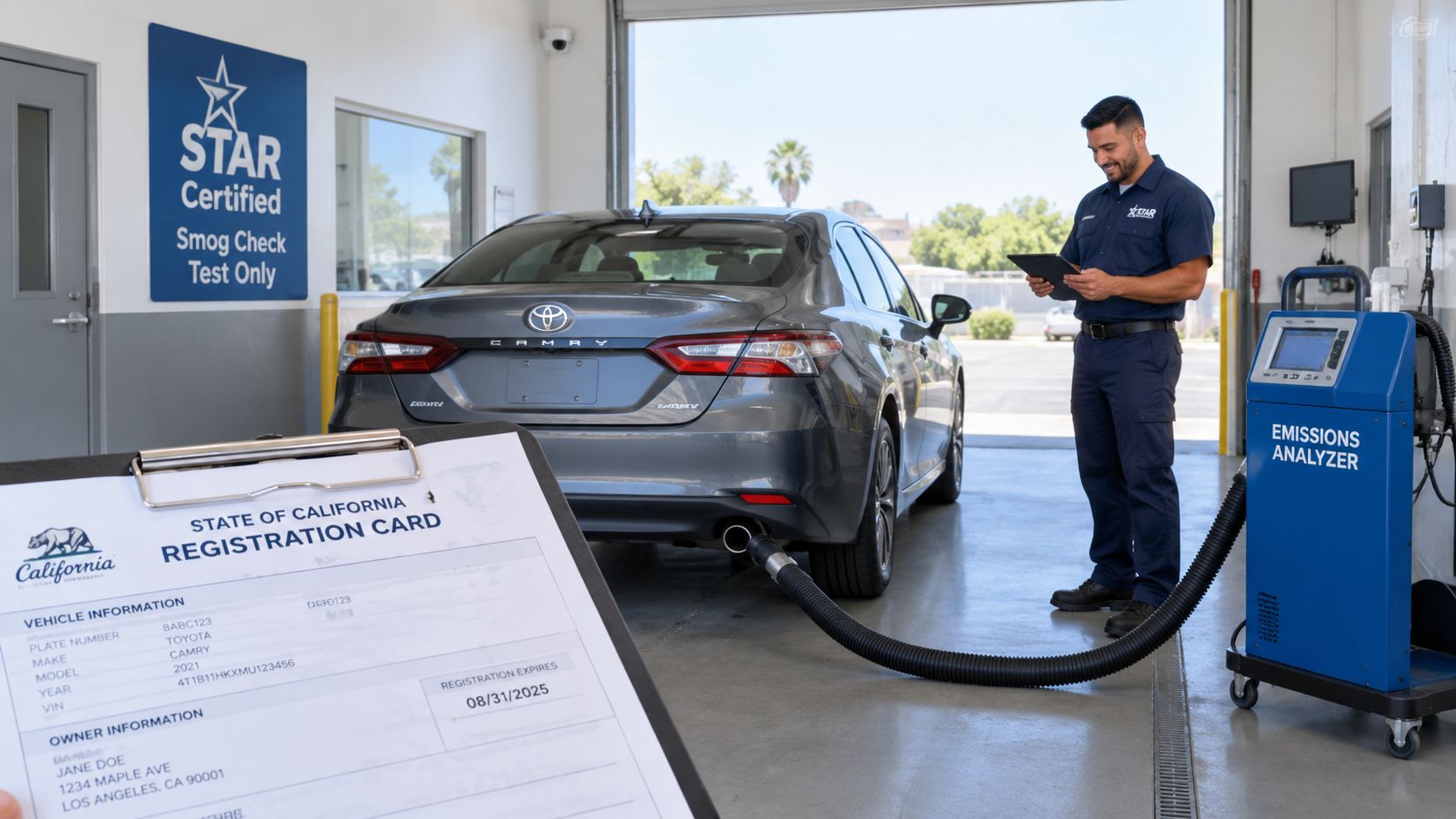
At a STAR-certified test-only location such as Speedy Smog in San Leandro, the visit follows a defined inspection process. The facility is at 15275 Washington Avenue, and its role is to perform the test and transmit the result, not repair emissions faults.
Bring the vehicle and the registration information connected with the DMV transaction. The technician begins by checking the emissions-control equipment, then performs the appropriate functional and computer-based inspection for the vehicle.
The visit from arrival to result
For most 2000 and newer vehicles, the technician connects to the OBD system and reads emissions-monitoring information. The process also includes a visual review of relevant hardware. Older vehicles generally follow the applicable tailpipe testing pathway.
A STAR-certified location can handle a DMV-directed inspection when the vehicle's paperwork requires that category. The certification relates to the station's authorization and performance standards. It doesn't remove the vehicle's responsibility to meet the inspection criteria.
The result is transmitted electronically to the DMV when the transaction calls for electronic reporting. If the vehicle passes, that result supports the registration process. If it fails, the station provides the failure information, but you'll need to arrange repairs somewhere else before seeking another test.
What a failed result means
A failure isn't proof that the station performed the wrong kind of test. It means the vehicle didn't satisfy one or more inspection requirements at that visit. The next step might involve diagnosis, a repair, additional driving to restore monitor readiness, or a combination of these.
Don't authorize repairs based only on a vague assumption. Ask for the specific failure information, then use a qualified repair facility that can interpret emissions codes and test the affected system. A test-only business can identify the result without creating a repair plan on site.
Why Test Readiness Matters More Than Test Speed
You find an open smog appointment for this afternoon, drive over, and expect to be done in twenty minutes. Then the test stops on a detail you cannot see from the driver's seat. The engine feels fine, but the car's computer is still "not ready."
That is why station speed is only one part of the decision. A test-only visit works like a checkpoint, not a repair bay. If the vehicle has not completed its own emissions self-checks, the fastest line in town does not change the result.
BAR data shows emissions problems are common enough that preparation matters. California's 2024–25 roadside inspection failure rate was reported at 14% (BAR report). That number does not measure station Smog Check results directly, but it does show that out-of-compliance vehicles are not rare.
OBD readiness monitors work like a checklist the car fills out on its own while you drive. Each monitor confirms that an emissions-related system has run its self-test. If you disconnect the battery or clear trouble codes, parts of that checklist can reset to incomplete. The car may drive normally, yet still lack the information needed for a complete inspection.
Common readiness traps
- Battery replacement: Disconnecting the battery can erase stored readiness status.
- Code clearing: Clearing a diagnostic code can hide the symptom for the moment without fixing the cause.
- Recent repairs: A successful repair can still leave monitors incomplete until the vehicle is driven enough.
- Warning-light concerns: A malfunction indicator lamp can point to an emissions problem that should be diagnosed first.
BAR's owner guidance advises against clearing trouble codes or disconnecting the battery immediately before testing, because those actions can erase readiness monitors and may require additional driving.
A vehicle that isn't ready can't be made ready by a shorter queue.
Schedule diagnosis before the smog test if the check engine light is on, the battery was recently disconnected, or a scan tool shows incomplete monitors. That extra step often saves time overall. Otherwise, a quick appointment can turn into a failed visit, a repair appointment, more driving, and a retest. Before you shop for speed, get the vehicle ready.
Making the Right Choice for Your Vehicle Situation
Station selection becomes easier when you treat it as a decision tree rather than a search for the fastest appointment. Start with the DMV transaction. A routine renewal, an initial California registration for an out-of-state vehicle, and an ownership-related transaction can create different requirements, so follow the exact notice and DMV instructions connected with your vehicle.
California's DMV guidance explains that many registration transactions require inspections, while some vehicles and situations are exempt. Gasoline vehicles less than eight model-years old are generally exempt from biennial testing, electric vehicles are exempt entirely, and hybrid vehicles can still fall within the Smog Check program (California DMV smog inspection guidance). Diesel rules also depend on model year and vehicle weight, so don't rely on a blanket assumption.
Four questions to ask before booking
- Does the DMV require a smog result? Check the renewal notice or registration instructions rather than assuming every transaction follows the same rule.
- Does the notice require STAR? If the vehicle is directed to a STAR station, select a location with that certification.
- Is the vehicle ready? Consider recent battery work, cleared codes, repairs, or an active warning light.
- Do you need repairs as well as testing? A test-only station handles the inspection. A repair-capable shop may be more suitable when you already suspect a fault.
For drivers comparing nearby options, this guide to where to get a car emissions test can help organize the choice.
Match the station to the situation
A prepared vehicle that only needs certification is a natural fit for a test-only station. A vehicle with a known emissions problem belongs with a repair-capable provider, unless you deliberately want an independent test before authorizing any work.
Hybrid owners should pay attention to the same warning lights and readiness issues as gasoline-vehicle owners. Electric propulsion doesn't automatically mean a hybrid is exempt, and the applicable rules depend on the vehicle type and transaction.
The most useful question isn't “How quickly can I get tested?” It's “What result do I need, and what will I do if the result is incomplete or unsuccessful?” Answer that first, then choose the station.
Speedy Smog is a STAR-certified, test-only station in San Leandro that performs DMV smog inspections for vehicles including newer cars, older vehicles, diesels, and hybrids, with electronic result transmission for registration purposes. Visit Speedy Smog at 15275 Washington Avenue when you need a focused inspection and understand that repairs after a failure must be handled by a separate repair provider.
Your DMV renewal notice is on the kitchen counter, and one line has created an immediate question: “Smog Certification Required.” You may be wondering whether the car needs a test every year, whether a recent inspection still counts, or whether its hybrid, diesel, or electric powertrain changes the answer.
California's DMV smog check requirements depend on the event you're handling, not just the vehicle itself. Registration renewal, a change of ownership, and first-time registration in California can trigger different obligations. Model year, fuel type, vehicle weight, and the wording on your DMV notice all matter.
Table of Contents
- Decoding Your DMV Renewal Notice
- Navigating Exemptions by Transaction and Vehicle Age
- Understanding OBD and Tailpipe Testing Differences
- STAR Station Mandates and Readiness Monitor Prep
- Special Rules for Hybrids Diesels and Electric Vehicles
- Handling Test Failures and the BAR Referee Process
- Your Action Plan for a Smooth Smog Check Experience
Decoding Your DMV Renewal Notice
California doesn't generally require a smog inspection on a fixed annual calendar. The obligation is tied primarily to vehicle registration, and gasoline-powered, hybrid, and alternative-fuel vehicles from model year 1976 onward generally need testing every other year when the DMV renewal notice says certification is required, according to the California Bureau of Automotive Repair's Smog Check guidance.
Start with the notice itself. Look for language such as:
- “Smog Certification Required” means you can generally use an authorized Smog Check station.
- “Smog Certification Required at a STAR station” means the vehicle must be inspected at a STAR-certified location.
- No smog certification instruction usually means the renewal doesn't currently require a test, although you should still follow any other DMV directions.
The notice is more reliable than guessing from the car's age or from the date of its last inspection. California may require a test for a renewal, a sale, or a first California registration even when the vehicle passed an inspection for a different transaction.
Practical rule: Read the DMV notice before booking an appointment. It tells you whether a test is required and whether the station must have STAR certification.
A registration renewal test is normally required biennially, or every other year, rather than annually. The DMV can't finalize a renewal when required smog certification is missing, even if you've already paid the registration fees, as explained in the DMV registration renewal instructions.
If the notice requires testing, use a service such as Smog Check registration renewal assistance to understand the process, then choose a station that matches the notice. Bring the vehicle, the notice if available, and any relevant repair information. Handling the inspection before the renewal deadline gives you time to respond if the vehicle needs repairs or the DMV record needs attention.
Navigating Exemptions by Transaction and Vehicle Age
The phrase “new car exemption” causes many California drivers trouble because it can describe different rules for different DMV events. A vehicle that avoids a biennial renewal inspection may still face a different requirement during a sale or first California registration.
For renewal, gasoline, hybrid, and alternative-fuel vehicles that are eight model years old or newer generally don't need the biennial inspection. The owner instead pays a smog abatement fee, subject to DMV eligibility rules. California gives a separate transfer rule to vehicles four model years old or newer, which can generally avoid the change-of-ownership inspection through the applicable smog-related fee.
Those exemptions don't automatically apply to every transaction. An out-of-state vehicle being registered in California for the first time generally needs a California Smog Check if it falls within the covered model-year and fuel categories. A recent inspection completed for another state or another DMV event shouldn't be treated as a universal exemption.
California Smog Check Exemption Matrix
| DMV Transaction Type | Vehicle Age / Model Year | Smog Check Required? |
|---|---|---|
| Registration renewal | Gasoline, hybrid, or alternative-fuel vehicle eight model years old or newer | Generally no biennial inspection, but a smog abatement fee may apply |
| Registration renewal | Covered gasoline, hybrid, or alternative-fuel vehicle beyond the newer-vehicle renewal exemption | Generally yes when the DMV notice identifies certification as required |
| Change of ownership | Vehicle four model years old or newer | Generally no transfer inspection, with the applicable smog-related fee |
| Change of ownership | Covered vehicle older than the transfer exemption | Generally yes, unless another exemption applies |
| First California registration | Covered out-of-state vehicle | Generally yes |
| Any transaction | Fully electric vehicle | Exempt |
| Any transaction | Gasoline vehicle from model year 1975 or older | Exempt |
| Any transaction | Diesel vehicle from model year 1997 or older | Generally exempt |
| Any transaction | Diesel vehicle above 14,000 pounds GVWR | Exempt from the standard requirement described here |
The most useful question isn't “Is my car exempt?” Ask instead: What DMV event am I completing, what is the model year, what fuel does it use, and what does the notice say? That four-part check prevents owners from applying a renewal exemption to a transfer or assuming an older out-of-state inspection will satisfy California registration.
If your situation involves an unusual transfer or exemption, review the DMV smog exemption form information before making an appointment. Keep your registration documents available, because the correct answer can depend on the transaction being processed rather than on the vehicle alone.
Understanding OBD and Tailpipe Testing Differences
Two vehicles can visit the same station and receive very different inspections. California chooses the testing method based on the vehicle's configuration, including its model year, fuel type, weight, and whether it has OBD II, the onboard diagnostic system used to monitor emissions equipment.
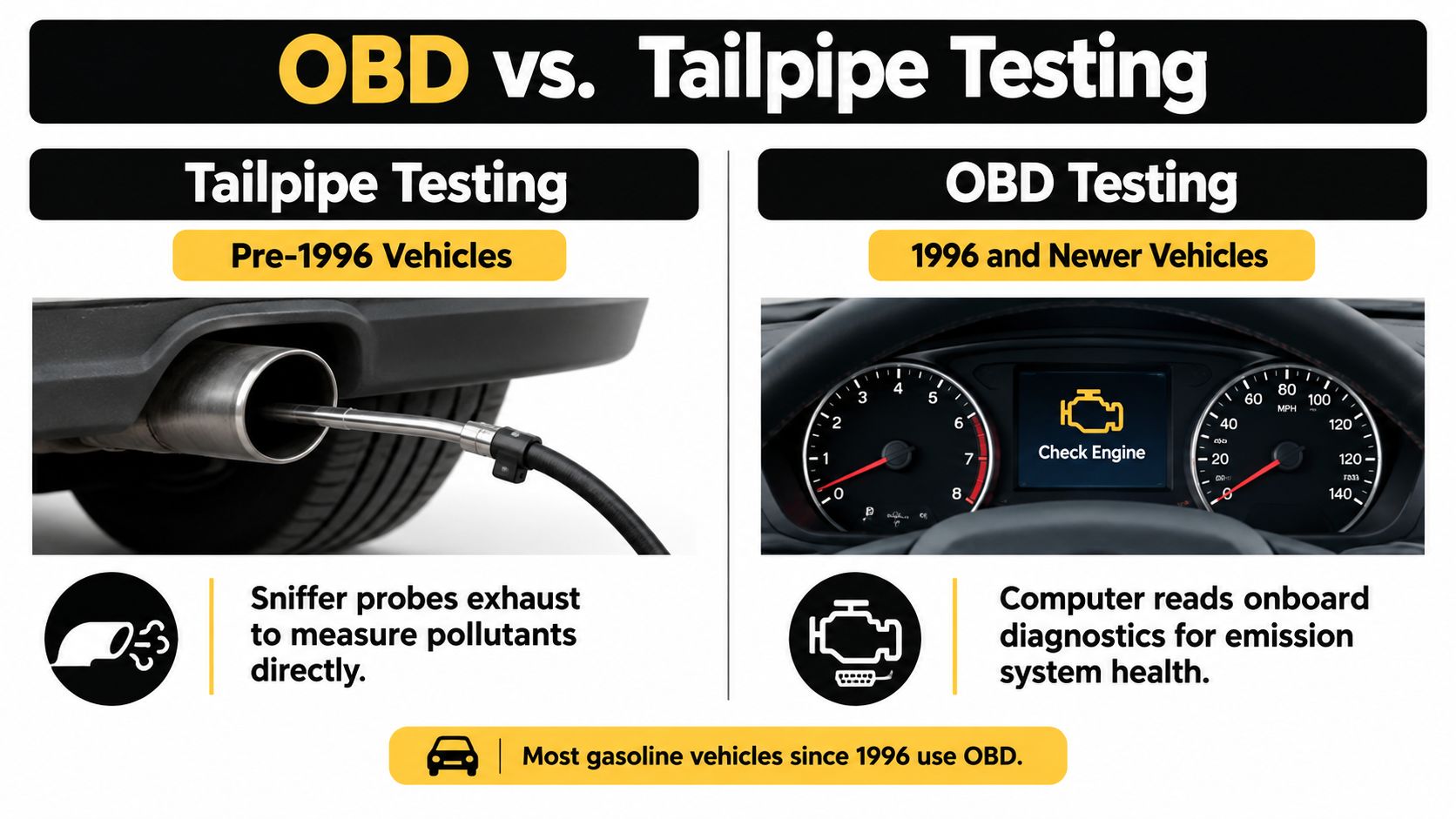
Most gasoline and hybrid vehicles from 2000 and newer, with a GVWR of 14,000 pounds or less and equipped with OBD II, are generally inspected through BAR-OIS. The technician connects approved equipment to the vehicle and electronically evaluates diagnostic information, emissions-related fault codes, readiness monitors, and required vehicle details. The process focuses on what the vehicle's computer reports about the health of its emissions systems.
Gasoline vehicles from 1976 through 1999, heavier gasoline vehicles, and qualifying vehicles without OBD II are generally tested with BAR-97. Instead of relying primarily on onboard computer data, this method measures pollutants directly from the exhaust through a tailpipe test. The BAR Smog Check executive summary describes the distinction between BAR-OIS electronic evaluation and BAR-97 tailpipe measurement.
The difference matters when you prepare:
- OBD-equipped vehicles: Diagnostic trouble codes and incomplete readiness monitors can affect the result, even when the dashboard warning light is currently off.
- Older vehicles: Emissions performance is assessed through measured exhaust, so engine condition, fuel delivery, ignition, and emissions components play a direct role.
- Both types: The inspector must use the procedure that matches the vehicle's configuration. You shouldn't assume a newer vehicle receives a tailpipe test because it has an exhaust system.
For a clearer explanation of how the terms relate, compare Smog Check and smog test terminology before arriving at the station.
STAR Station Mandates and Readiness Monitor Prep
A DMV notice that names a STAR station changes where you can test. STAR is California's standards-based program for vehicles assigned to higher-performing inspection locations. The DMV distinguishes between a notice that says certification is required at any authorized station and one that specifically directs the owner to a STAR-certified station.
Check the exact wording before you leave home. If the notice says “Smog Certification Required at a STAR station,” a regular licensed station isn't enough for that transaction. If it says only “Smog Certification Required,” you can generally choose an authorized Smog Check station.
Prepare the vehicle's diagnostic system
Readiness monitors are internal checks that help the vehicle confirm whether its emissions systems have completed their self-tests. A dead battery, battery replacement, or recent code clearing can erase this stored readiness information. The car may start normally and show no illuminated check-engine light, yet the inspection can still identify the monitors as incomplete.
Avoid disconnecting the battery or clearing codes immediately before testing. If a repair shop has recently erased diagnostic trouble codes, ask whether the vehicle has completed the required driving conditions for its monitors to run. The exact driving pattern varies by vehicle, so consult the owner's manual or a qualified repair professional rather than relying on a universal mileage claim.
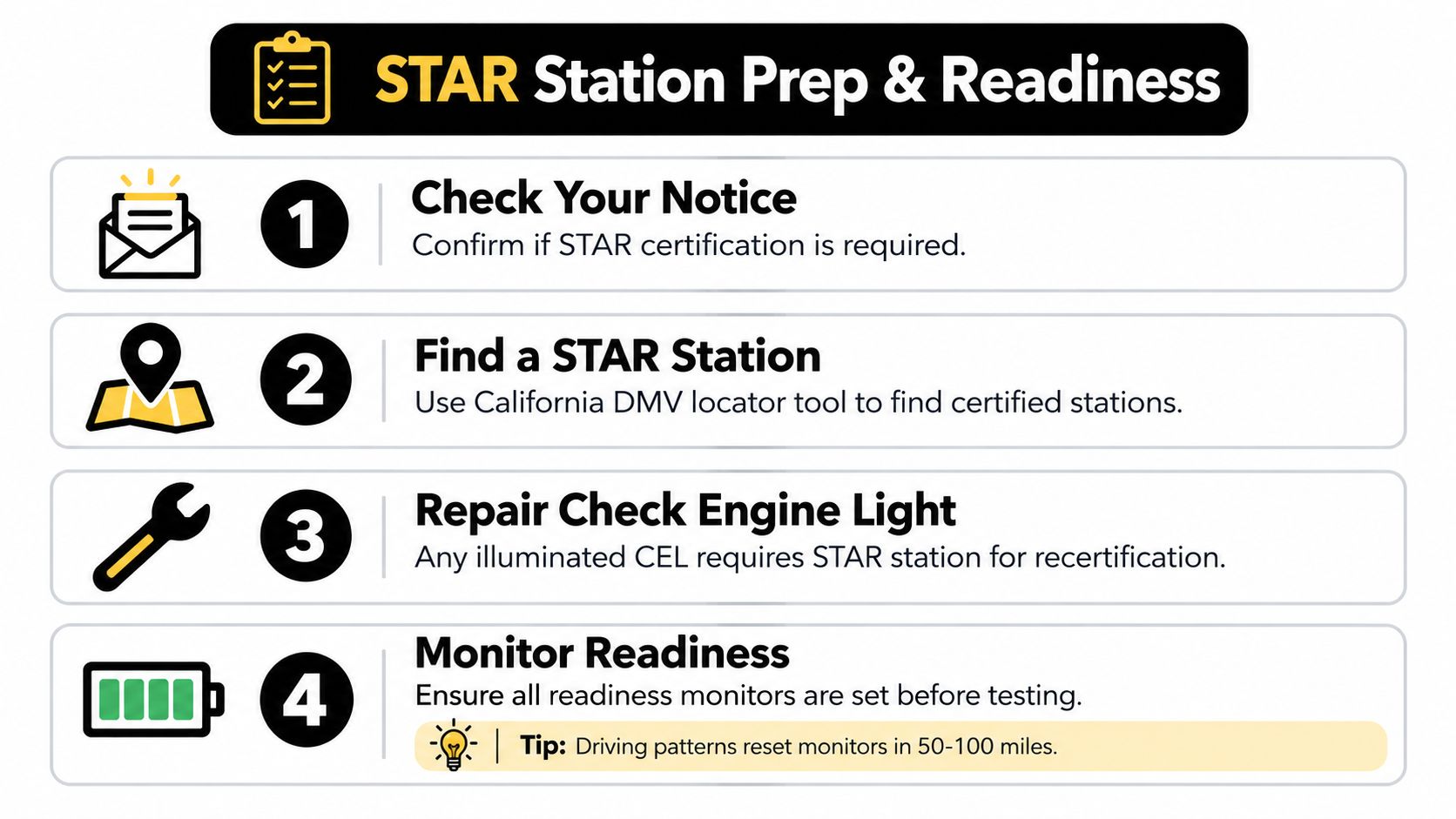
A practical preparation sequence looks like this:
- Read the notice. Confirm whether the DMV requires a STAR station.
- Check the warning light. An illuminated emissions warning lamp needs diagnosis before testing.
- Ask about readiness. If the battery was disconnected or codes were cleared, verify that the monitors have had time to complete.
- Bring the paperwork. Keep the DMV notice and any recent repair documents with you.
California also requires the engine to reach normal operating temperature, and the Smog Check procedure specifies at least three minutes of continuous low-idle operation immediately before the tailpipe test for applicable vehicles. Arriving prepared helps the technician perform a valid inspection instead of encountering a preventable readiness or temperature issue.
Special Rules for Hybrids Diesels and Electric Vehicles
A hybrid owner often asks whether the gasoline engine changes the answer. In California, hybrids generally follow the same broad Smog Check framework as covered gasoline vehicles. Their onboard diagnostic systems can be evaluated electronically when the vehicle meets the applicable BAR-OIS configuration, so the hybrid label alone doesn't create a blanket exemption.
Consider a hybrid during registration renewal. The owner should read the DMV notice, confirm the transaction, and determine whether the vehicle falls within the newer-vehicle renewal exemption. If the notice requires certification, the hybrid needs an inspection at the station type named by the DMV.
Diesel owners need a different decision path. Diesel vehicles from model year 1998 onward and with a GVWR of 14,000 pounds or less generally require testing. The BAR consumer FAQ identifies diesel rules as materially different from the newer-vehicle exemption available to many gasoline and hybrid vehicles.
Three powertrain examples
- Hybrid: Treat it as a covered vehicle unless the DMV notice and applicable exemption rules say otherwise. Its testing method depends on its configuration.
- Diesel: Check both model year and GVWR. A newer diesel may require testing even when a similarly aged gasoline vehicle could use a renewal exemption.
- Fully electric: A battery-electric vehicle is exempt from California's Smog Check requirement because it has no gasoline or diesel emissions system to inspect.
Fuel type is only part of the diesel decision. Weight matters because the standard rule described here applies to diesel vehicles at or below the relevant GVWR threshold, while heavier diesel vehicles are treated differently. If you're unsure, locate the GVWR on the vehicle label or manufacturer documentation and compare it with the DMV notice.
Don't use another owner's experience as your guide. Two vehicles registered in the same household can receive different instructions because one is a hybrid, one is diesel, or one is fully electric.
Handling Test Failures and the BAR Referee Process
A failed inspection gives you information, not an automatic dead end. First, ask for the Vehicle Inspection Report, or VIR, and read the specific reason for the result. The report helps separate an emissions failure from an incomplete-readiness issue, missing information, or another inspection condition.
Use this order of operations:
- Review the VIR. Identify the failed area and ask the technician to explain any unfamiliar code or monitor status.
- Confirm the transaction deadline. A renewal can remain incomplete while required certification is missing.
- Diagnose before replacing parts. A warning light or emissions code identifies a system that needs attention, but it doesn't automatically identify one specific failed component.
- Repair the cause. Use a qualified repair professional when the issue requires specialized diagnostic equipment or emissions-system knowledge.
- Return for the appropriate inspection. If the first result involved incomplete monitors, verify that the vehicle is ready before retesting.
A car that has recently lost battery power may produce a “not ready” result rather than a conventional pollutant failure. That distinction matters because clearing codes again can restart the readiness process and delay a valid inspection.
The DMV directs owners with Smog Check failures toward the Bureau of Automotive Repair Referee Program when additional help is needed. The Referee can be relevant for complex cases, disputed situations, or vehicles that need a state-level review of their emissions compliance. Ask the station or consult BAR guidance about whether your circumstances fit the program before scheduling.
A failed test should lead to a documented diagnosis. Replacing parts at random can add cost without resolving the condition that caused the result.
Keep the VIR, repair invoices, and any follow-up test documentation together. Those records give the repair shop and, when appropriate, the BAR Referee a clear timeline of what the vehicle reported and what work was performed.
Your Action Plan for a Smooth Smog Check Experience
You open your DMV notice and just want one clear answer. Start with the transaction on that notice, because a renewal, a transfer, and a first California registration can trigger different smog obligations even for similar vehicles. Then check the vehicle type. A hybrid often follows gasoline-based rules, a diesel follows its own year and weight rules, and a fully electric vehicle is exempt.
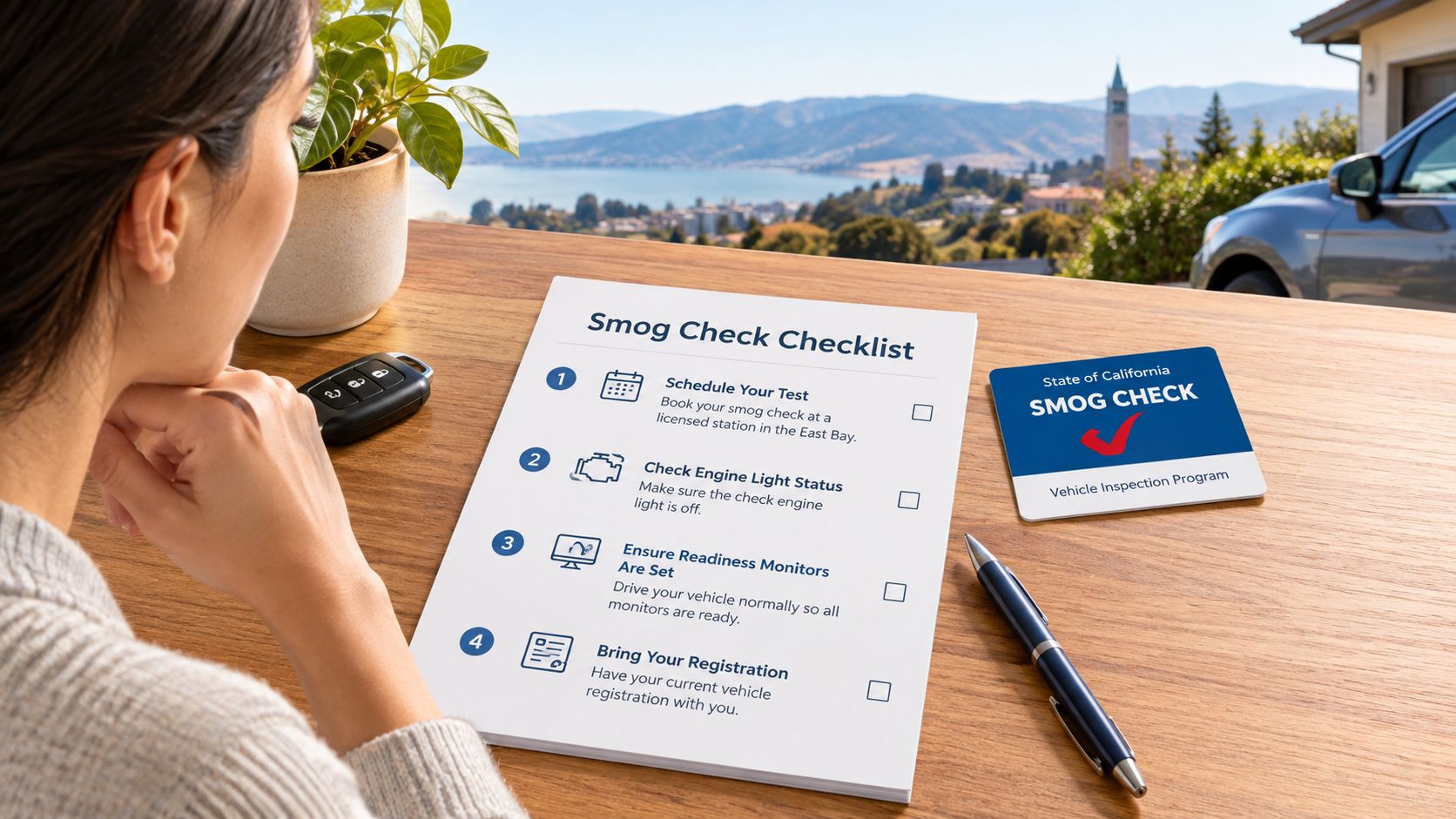
Use this quick check
- Renewal: Read the notice to confirm whether biennial certification is required.
- Ownership transfer: A recent renewal inspection may not satisfy the transfer requirement.
- New California registration: An out-of-state vehicle that is covered usually needs a California inspection unless a specific exemption applies.
- Hybrid: Apply the gasoline and vehicle-configuration rules, then follow the notice.
- Diesel: Check model year and GVWR separately. Diesel exemptions differ from gasoline exemptions.
- Electric: Fully electric vehicles are exempt from Smog Check.
- STAR instruction: Use a STAR-certified station if the notice requires one.
- OBD preparation: Do not clear codes or disconnect the battery right before testing.
- Failed result: Keep the VIR, get a targeted diagnosis, and contact BAR resources if the case may need Referee help.
That order matters. The notice tells you what DMV needs, and the powertrain tells you which smog rules apply to the vehicle in front of you. If you skip either step, you can end up at the wrong station or arrive before the car is ready to test.
For East Bay drivers, Speedy Smog in San Leandro is one local option. It is a STAR-certified station at 15275 Washington Ave, San Leandro, and it performs inspections for many gasoline, hybrid, older, and diesel vehicles, with results transmitted electronically for DMV registration processing. Its published service information also describes a comfortable indoor waiting area and typical testing for many newer vehicles in about 10 to 15 minutes.
Visit Speedy Smog with your DMV notice so the team can confirm whether your vehicle needs a standard or STAR inspection and help you address the correct registration requirement. The San Leandro station provides Smog Checks for newer vehicles, older cars, diesels, and hybrids, giving East Bay drivers a practical place to complete certification before renewal or transfer paperwork.
A test-only smog station is a California-licensed facility authorized to perform emissions inspections and issue compliance certificates, but not to repair your vehicle. In California's 2024 data, test-only stations handled 6,133,329 initial tests and issued 5,562,526 certificates, so this isn't a side option, it's a major part of the registration system.
Why build a station that can inspect but not fix? Because the state wants the people measuring the problem to be separate from the people who profit from the repair. That separation is the whole point, and it's what makes the test-only model easier to trust when you're nervous about a smog check.
Table of Contents
- Defining the Test Only Smog Station
- Test Only versus Test and Repair Stations
- The Role of Test Only Stations in California
- Understanding STAR Certification Requirements
- What to Expect at a Local Smog Station
- Making Your Smog Check Decision
Defining the Test Only Smog Station
A test-only smog station is exactly what it sounds like, a place that checks your car's emissions status but does not repair the car if it fails. California's Bureau of Automotive Repair licenses these facilities to perform Smog Check inspections and report the result for DMV purposes, while repair work has to happen somewhere else. That split keeps the inspection side independent from the money side.
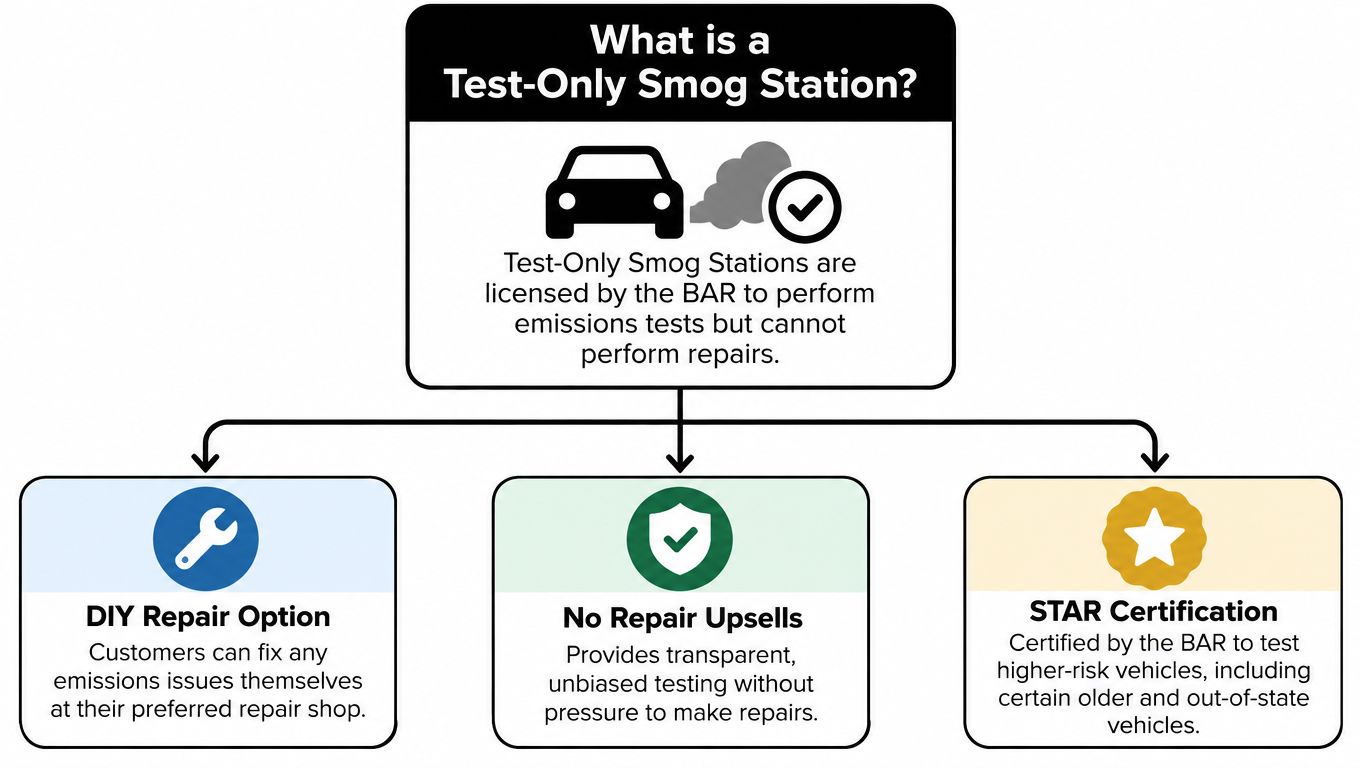
Why the separation matters
If the same business both fails your car and sells you the fix, the setup can feel like a conflict of interest. California's test-only structure avoids that problem by making the inspection a stand-alone decision. The station collects the data, records the result, and sends it on for registration compliance.
Practical rule: if a shop is test-only, it can tell you whether your vehicle passed or failed, but it can't turn around and diagnose or repair the emissions issue on the same ticket.
That's why the category is useful for drivers who want a cleaner line between judgment and repair. It doesn't make the process harsher, it makes the result more neutral.
For a plain-language comparison of station types, see this STAR station versus test-only guide.
Test Only versus Test and Repair Stations
Why do California drivers see two different station types? The answer is simple. One type checks the car, the other can check and fix it.
A test-only station is limited to inspection work. It records the result and sends that result for DMV compliance, but it does not repair emissions problems on the same visit. A test-and-repair station can perform the inspection and then handle the fix if the vehicle fails.
What happens after a failed test
At a test-only station, a failed result ends the inspection. The station cannot turn the failure into a repair order, so you must take the car to a separate licensed repair shop for diagnosis and repairs, then return for retesting. That separation is the point of the model. The inspection side stays independent from the repair side, which helps prevent the shop from profiting from the outcome it just gave you.
| Station type | Can inspect | Can repair emissions problems | Best fit |
|---|---|---|---|
| Test-only | Yes | No | Drivers who want an independent inspection |
| Test-and-repair | Yes | Yes | Drivers who want testing and repair in one place |
The process is straightforward. Get tested first. If the car fails, repair it elsewhere, then come back for the next inspection step.
A failed result is a signal, not a repair plan. It tells you another technician needs to look under the hood.
For people who like to prepare ahead of time, reviewing this pre-smog checklist can help you avoid avoidable delays.
The Role of Test Only Stations in California
Test-only stations matter because they carry a large share of the state's compliance workload, not because they're a niche convenience. In 2024, they performed 6,133,329 initial tests and issued 5,562,526 certificates, while test-and-repair stations performed 2,941,524 initial tests and issued 2,654,288 certificates (California Legislative Information, HSC division 26 article 2). That means test-only stations handled about 67.6% of all initial tests in the figures provided for that year.
What that scale tells you
Those numbers show that test-only stations aren't an unusual workaround. They're built into the normal path millions of California drivers use to stay registered. When a system uses one station type for most of the initial testing volume, that station type is part of the core infrastructure, not an edge case.
The same state report also shows why the model stays relevant for different vehicle groups. Some cars are directed to STAR stations based on emissions history or other program factors, which means the state is not only checking vehicles, it's routing them through the type of facility it considers appropriate for compliance control.
In practical terms, that helps explain why a test-only station can feel more formal than a general repair shop. The whole setup is closer to an objective checkpoint than to a sales counter.
Understanding STAR Certification Requirements
A STAR-certified test-only station is still a test-only station, but it also meets BAR performance controls that go beyond the basic license. Those controls include valid licensing, recordkeeping compliance, enough inspection volume for evaluation, and measured thresholds tied to inspection quality. If your DMV notice says STAR is required, that detail matters.
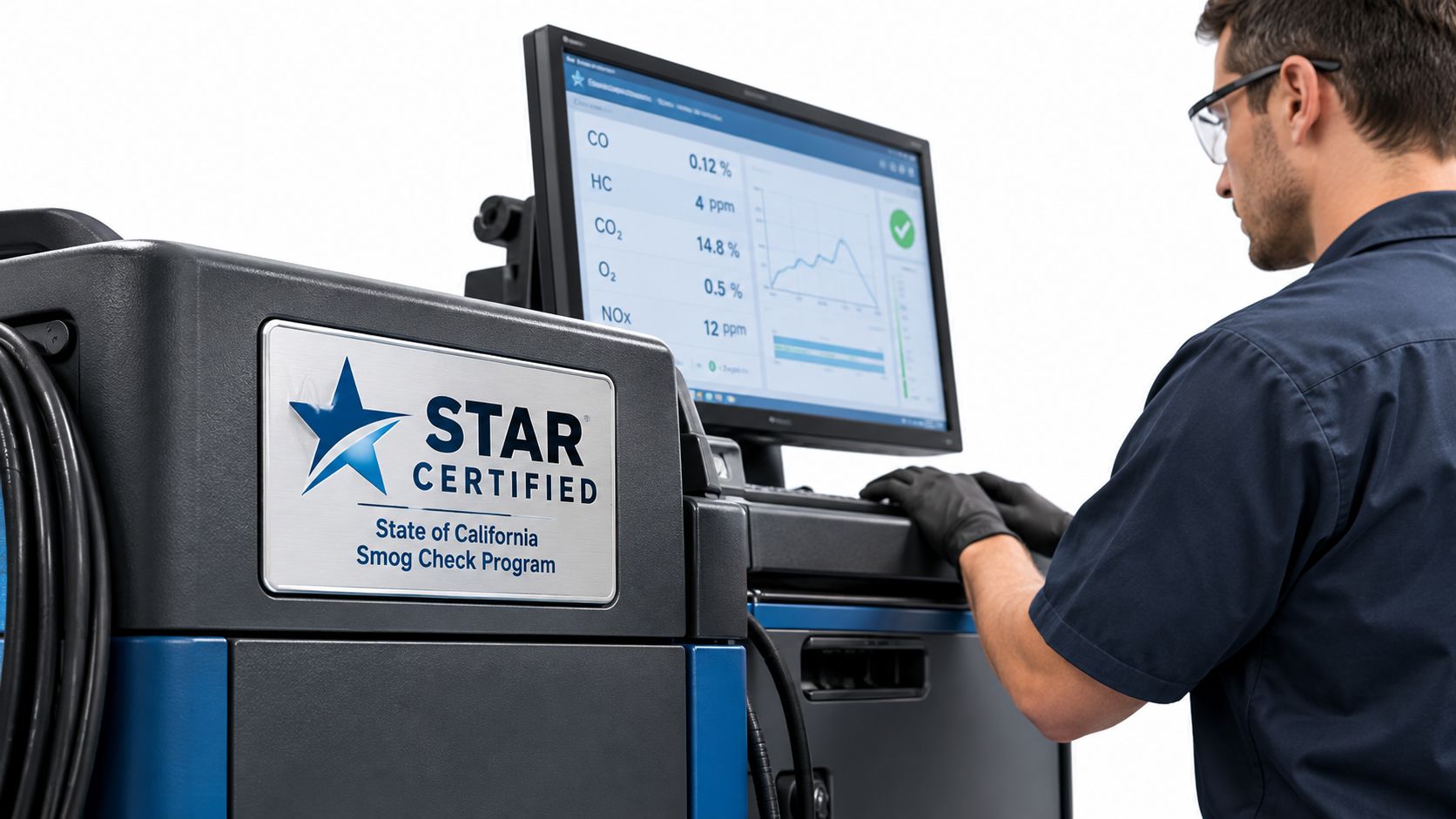
What BAR is checking
BAR looks at short-term performance indicators such as Similar Vehicle Failure Rate, incorrect gear selection during the Acceleration Simulation Mode test, and Excessive Test Deviation Rate. The published criteria include an incorrect-gear-selection rate no higher than 2% of certified vehicles and an Excessive Test Deviation Rate no greater than one (BAR STAR certification criteria). BAR also uses the Follow-up Pass Rate, with qualifying scores required to meet the stated threshold of 0.40.
These are quality controls, not labels for marketing. They're meant to reduce inaccurate certification and improve consistency when the state sends a driver to a STAR station. That's why STAR is more specific than “a good shop.”
If your renewal notice points you toward STAR, this station guide is worth reviewing before you book.
What to Expect at a Local Smog Station
What happens at a local smog station? Usually, it involves far less stress than drivers expect. A test-only station keeps inspection separate from repair, so the person checking your car is not the same person selling the fix. That separation is the point.
Speedy Smog in San Leandro is a STAR Certified smog check station at 15275 Washington Ave, 94579, and it handles inspections for most vehicles, including 2000 and newer models, 1999 and older vehicles, diesels, and hybrids. For 2000+ vehicles, typical tests take about 10 to 15 minutes.
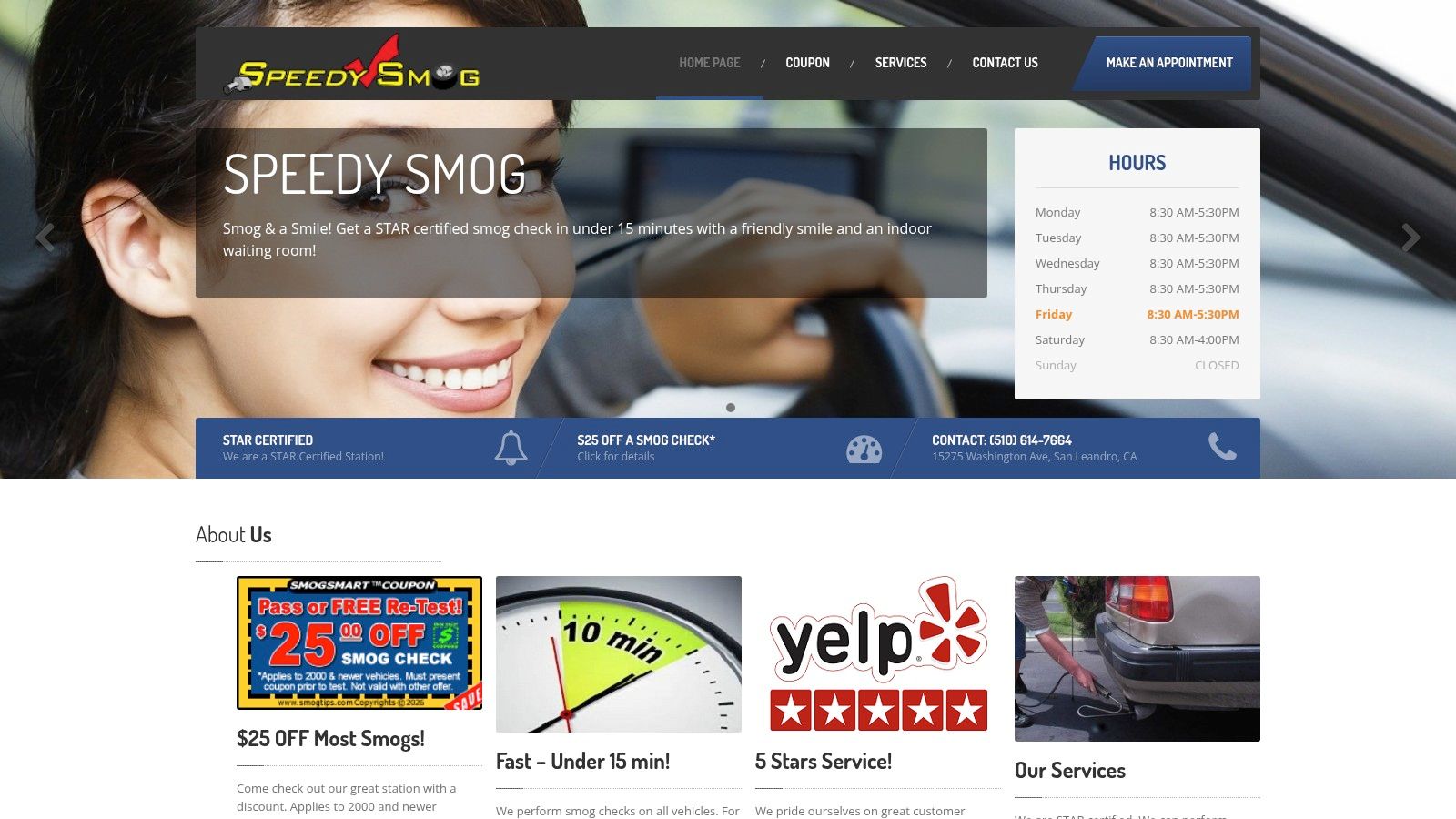
How the visit usually feels
You pull in, hand over the vehicle information, and wait while the inspector runs the check. If the car passes, the station can send the result to DMV electronically. If it does not, you leave with the result and take the repair step somewhere else.
That split helps remove conflict of interest. The station has no reason to steer you into a repair estimate just to make the failure go away.
For drivers who like to prepare ahead of time, the shop's before-your-visit checklist on the site can help you avoid avoidable delays.
Making Your Smog Check Decision
The simplest way to choose is to look at your DMV notice first. If it requires STAR, you need a STAR-certified station, not just any smog shop. If it doesn't, a standard test-only station can still give you the same separation between inspection and repair that many drivers want.
A practical way to decide
- Read the renewal notice first: the notice tells you whether STAR is required.
- Choose test-only if you want independence: the shop can inspect your car, but it can't profit from fixing the result.
- Choose STAR when the state directs you there: that's the higher-control option for specific vehicles and compliance situations.
- Plan for a possible second stop: if the car fails, you'll need another licensed repair facility before retesting.
Good rule of thumb: the best station is the one that matches your notice and makes the process clear, not the one that promises the most.
A test-only station gives you a clean compliance check. A STAR-certified test-only station adds state performance standards on top of that. Together, they're designed to make the smog process more objective, not more confusing.
If you're in the East Bay and want a straightforward inspection from a STAR-certified test-only station, visit Speedy Smog to see what they offer and plan your visit. They provide emissions testing without repair pressure, which fits the test-only model explained above, and their San Leandro location is built for drivers who want a fast DMV-ready result.
Your DMV renewal notice is on the kitchen counter, the deadline is getting close, and the obvious plan seems simple: drive to a smog station, pass the test, and renew your registration. That plan can fail before the technician even checks the exhaust, especially if your car recently had a battery replaced, diagnostic codes cleared, or repairs completed.
California vehicle inspection rules depend on why you're dealing with the DMV, not just how old your vehicle is. Renewal, a private-party sale, a dealer purchase, and first registration after moving to California can trigger different requirements. Your fuel type, model year, weight rating, and onboard computer also determine what happens at the station.
Table of Contents
- Deciding If You Need a Smog Check
- Understanding the Testing Protocols
- The Readiness Monitor Trap
- Why STAR Certification Matters
- Recovering From a Failed Inspection
- What to Expect at the Station
- Your Pre-Inspection Compliance Checklist
Deciding If You Need a Smog Check
Start with the transaction. If you're renewing registration, California generally requires a smog inspection every two years, unless your vehicle qualifies for an exemption or the newer-vehicle abatement option. Owners of vehicles less than eight model-years old can generally pay a smog-abatement fee instead of obtaining an inspection, as explained by the California Bureau of Automotive Repair's smog check guidance.
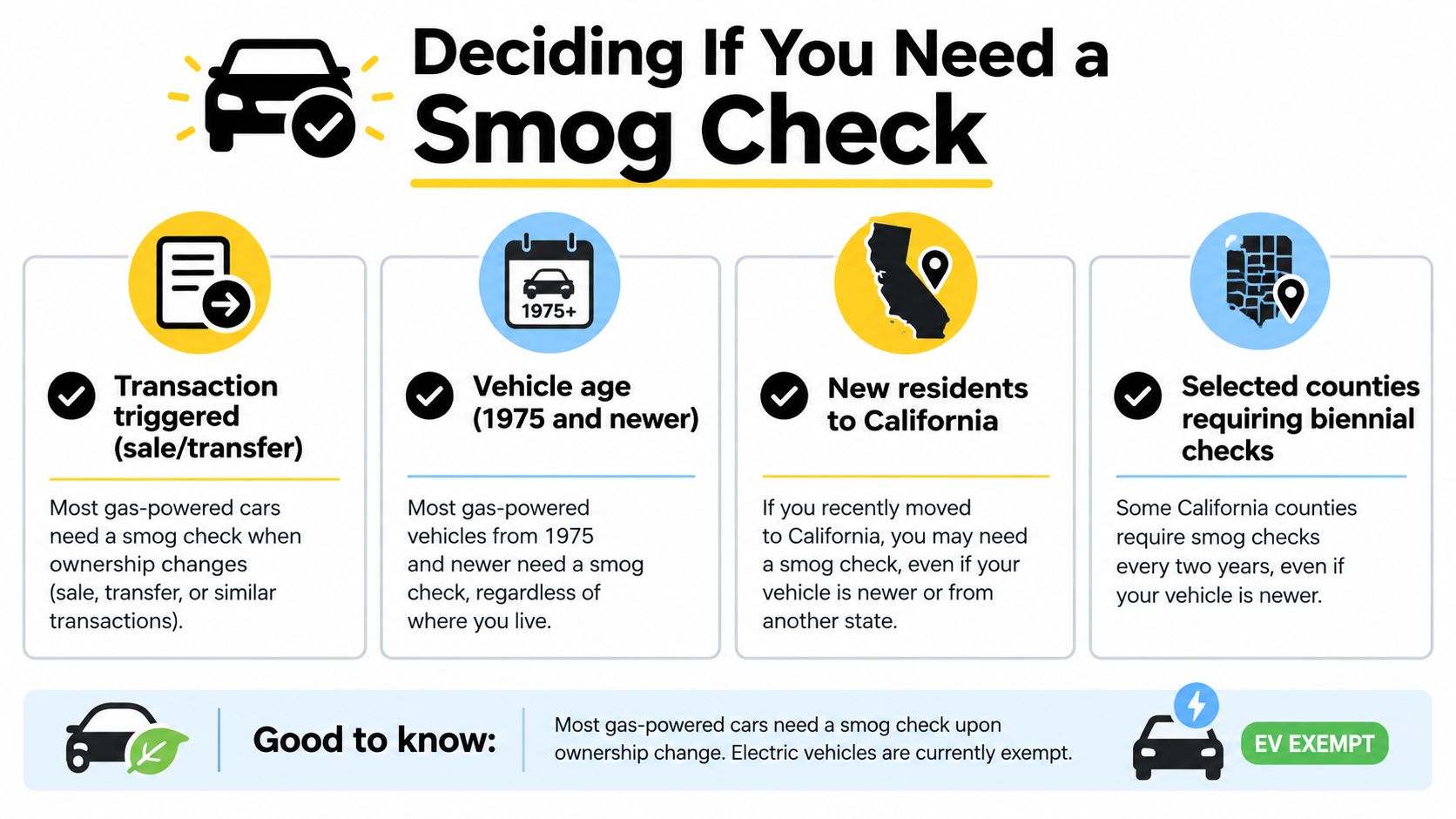
Use the transaction first
For registration renewal: Read the DMV notice carefully. If it calls for certification, book the appropriate inspection. If your vehicle is within the newer-vehicle window, check whether paying the abatement fee is the available alternative.
For a private-party sale or transfer: Don't assume the buyer can handle everything later. Most gasoline-powered vehicles that are subject to California's program need current certification when ownership changes. The seller and buyer should confirm the DMV requirements for the specific transaction before signing over the title.
For a dealer purchase: Dealer transactions can follow different certification responsibilities depending on the vehicle's age and recent certification history. Ask the dealer who is responsible for the inspection and whether the certification is already recorded before you make a separate appointment.
For a first California registration: An out-of-state vehicle from model year 1976 or newer generally needs a California inspection when registered in the state for the first time. This catches many new residents off guard because an inspection from another state usually doesn't answer California's certification requirement.
Check the vehicle before booking
Electric vehicles are exempt from the standard smog check because they don't produce tailpipe emissions from an internal combustion engine. Other exemptions include gasoline vehicles from model year 1975 or earlier, diesel vehicles from model year 1997 or earlier, diesel vehicles above 14,000 pounds GVWR, and some natural-gas vehicles.
A gasoline car, hybrid, diesel, or imported vehicle may fall into a less obvious category. If you're unsure, use the vehicle identification information on your registration and confirm the requirement with the DMV or BAR before paying for a test.
Practical rule: Decide whether the transaction requires certification before you decide which station to visit. A renewal appointment and a first California registration aren't interchangeable situations.
Understanding the Testing Protocols
The inspection machine depends on the vehicle's technology. Most gasoline-powered vehicles from model year 2000 onward and hybrids with a GVWR of 14,000 pounds or less are tested through the BAR-OIS, which reads the vehicle's OBD-II system. Vehicles without a compatible OBD-II system, vehicles above 14,000 pounds GVWR, and certain vehicles identified by the Bureau of Automotive Repair require a BAR-97 inspection that can include tailpipe emissions measurement, according to the California Smog Check manual.
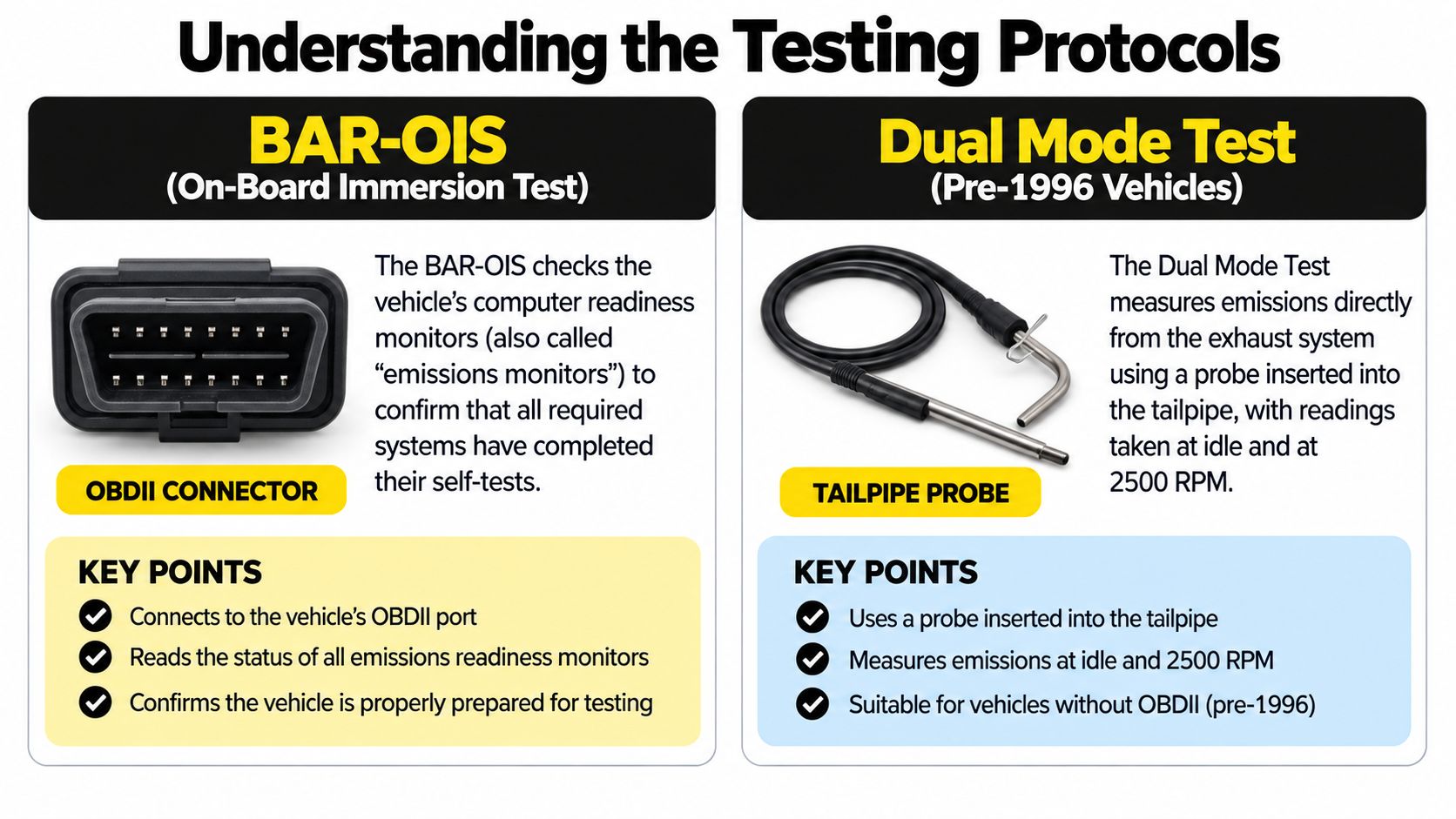
BAR-OIS reads the vehicle's computer
Think of BAR-OIS as an electronic health check. The technician connects to the diagnostic port and verifies that the malfunction-indicator lamp behaves correctly, then checks whether the computer reports emissions faults that disqualify the vehicle.
The inspection isn't just asking whether the check-engine light is currently illuminated. The computer also tracks whether its emissions self-tests have completed and whether stored fault information points to a problem. That's why a vehicle can look and drive normally yet still fail.
A newer vehicle isn't automatically an OBD-only case. The station must confirm the vehicle's certification configuration, model year, fuel type, and identifying information before selecting the protocol. A wrong entry or wrong test path can create unnecessary trouble, particularly with hybrids, imported vehicles, specialty configurations, and heavier trucks.
BAR-97 measures the exhaust
BAR-97 works more like taking a sample directly from the tailpipe. Depending on the vehicle, the equipment measures exhaust emissions while the engine operates under the required testing conditions.
This protocol matters to owners of older vehicles and vehicles without compatible OBD-II systems. It also matters to owners of heavy-duty vehicles because gross vehicle weight can change the inspection path even when the vehicle uses modern engine controls.
| Vehicle situation | Likely inspection approach |
|---|---|
| Gasoline vehicle from model year 2000 onward | BAR-OIS using OBD-II |
| Hybrid within the applicable weight limit | BAR-OIS using OBD-II |
| No compatible OBD-II system | BAR-97 |
| Above 14,000 pounds GVWR | BAR-97 |
| Certain vehicles designated by BAR | Confirm the required protocol with the station |
Bring accurate registration and vehicle information. If the car has an aftermarket exhaust, engine swap, or other modification, mention it before testing. The technician needs to know what vehicle configuration is being presented, not guess from appearance.
The Readiness Monitor Trap
A cleared check-engine light doesn't mean the vehicle is ready for inspection. In fact, clearing codes immediately before a test can create a predictable failure because the vehicle's emissions monitors reset to incomplete.
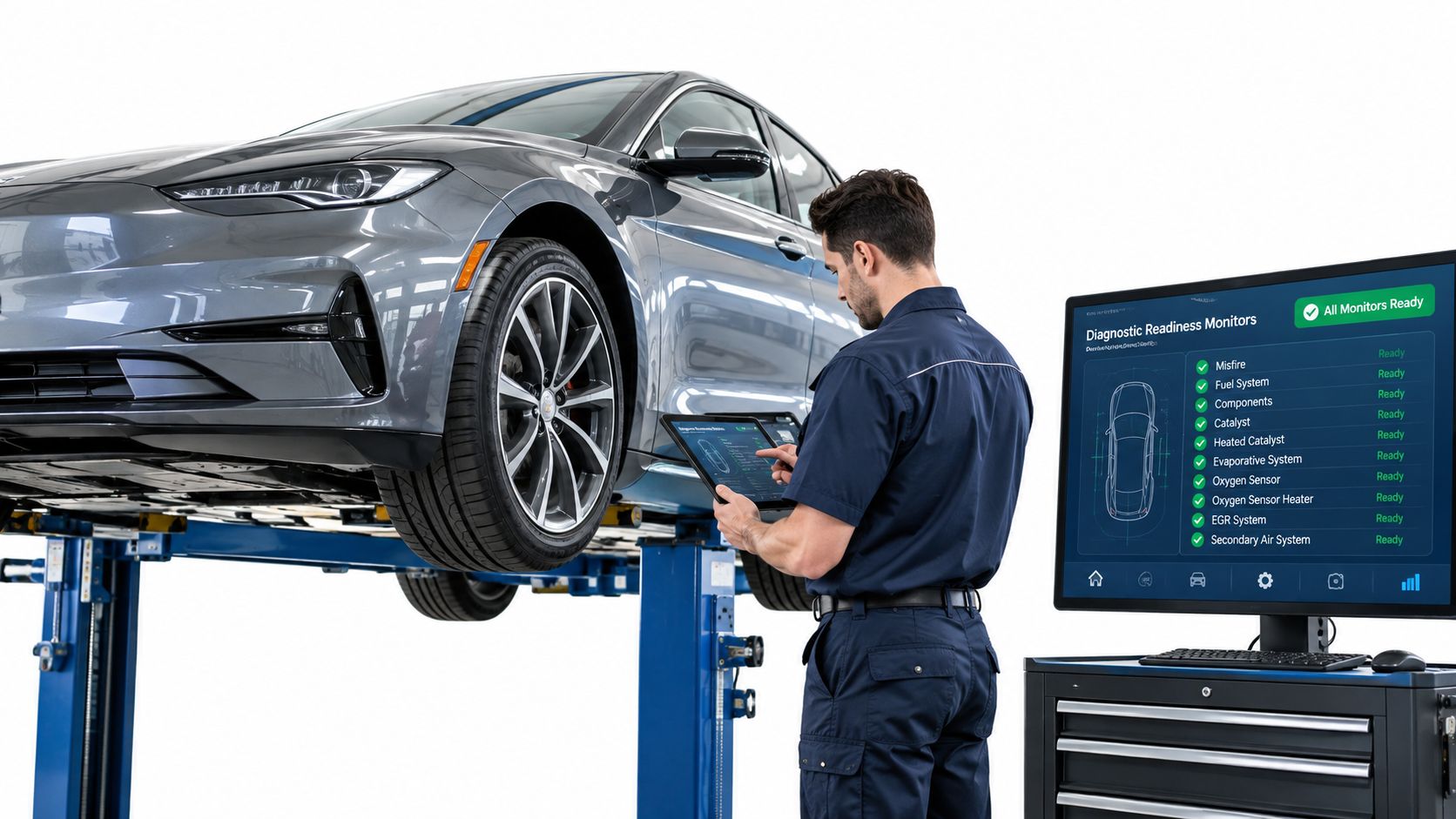
Readiness monitors are self-tests inside the OBD-II system. They evaluate systems such as the catalyst, oxygen sensors, evaporative emissions controls, and EGR-related components. The computer marks each monitor complete only after the car experiences the right operating conditions, which can include cold starts, steady cruising, acceleration, deceleration, and normal stop-and-go driving.
Disconnecting the battery or using a scan tool to erase diagnostic trouble codes wipes out that completion history. The dashboard may show no active warning light, but the inspection computer can still see that required tests haven't finished.
Why the timing matters
Beginning October 1, 2025, California rules require all applicable readiness monitors to be set for a vehicle to pass, according to BAR's explanation of the new OBD readiness monitor regulations. That makes a pre-test scan a smart move after battery work, code clearing, engine repairs, or emissions-system service.
Don't erase a code just to make the dashboard look clean. Diagnose the cause, repair it properly, and then drive the vehicle through an appropriate mixed-use cycle so the monitors can complete. Depending on the repair and the vehicle, allow roughly a week or two when necessary for the monitors to set.
Clearing the light is not a repair. It only removes information, and it can leave the vehicle unready for testing.
A better pre-test sequence
- Scan before the appointment. Check active codes, stored codes, and monitor status with a suitable diagnostic scanner.
- Repair the cause. A warning light connected to an EVAP leak, oxygen-sensor problem, catalyst fault, or another emissions issue needs diagnosis rather than cosmetic code clearing.
- Drive normally after repair. Use a mixed-use cycle that gives the vehicle's monitors the conditions they need.
- Scan again. Confirm the applicable monitors are ready before paying for the inspection.
- Test only when the vehicle is prepared. This avoids wasting an appointment on a car that was never eligible to pass.
For drivers who want help understanding what the test measures, an OBD-II car emissions test can provide useful context before the appointment.
Why STAR Certification Matters
A STAR requirement on your DMV notice isn't a suggestion to shop around casually. It means you need a station authorized to perform the required STAR inspection for that vehicle and transaction.
STAR stations operate under Bureau of Automotive Repair performance requirements that address equipment, testing procedures, and station performance. The practical benefit is straightforward: the station uses approved equipment and follows a monitored process when testing vehicles that need that level of certification.
Older vehicles deserve careful testing
California's statewide program records substantial inspection activity. The 2025 BAR executive summary recorded 11,275,981 initial tests and 12,200,718 total tests, including retests. Initial failures totaled 959,667, an 8.51% initial failure rate, while all-test failures totaled 1,102,337, a 9.04% overall failure rate.
Age changes the risk. In the cited reporting, model-year 1998 vehicles had a 20.42% failure rate, while model-year 2024 vehicles had a 4.39% failure rate, as reported in the BAR inspection summary. Older cars bring more accumulated wear, more repair history, and a greater chance of emissions-system faults. Accurate equipment and correct data entry matter more when the vehicle is already close to the line.
Choose the station based on the notice
A STAR station can be the right choice when:
- The DMV directs you to STAR: Follow the notice instead of booking a standard station.
- The vehicle has failed before: Accurate retesting helps separate a real repair issue from a process or data-entry problem.
- The vehicle is older or unusual: Confirm that the station handles older vehicles, hybrids, diesels, or the relevant inspection protocol.
- The transaction has special requirements: Ask whether the station can electronically transmit the result for the DMV purpose you need.
Read the notice first, then ask the station a direct question: “Is this vehicle and transaction eligible for the STAR test I need?” For a plain-language explanation of the program, review what a STAR smog station is.
Don't select a station only because it advertises a low price. The correct certification and protocol are more important than saving a small amount on a test that won't satisfy the DMV.
Recovering From a Failed Inspection
A failed inspection gives you information. It doesn't authorize random parts replacement, and it doesn't mean the vehicle is permanently barred from registration. Start by keeping every document from the appointment, including the failed inspection report and any diagnostic information the station provides.
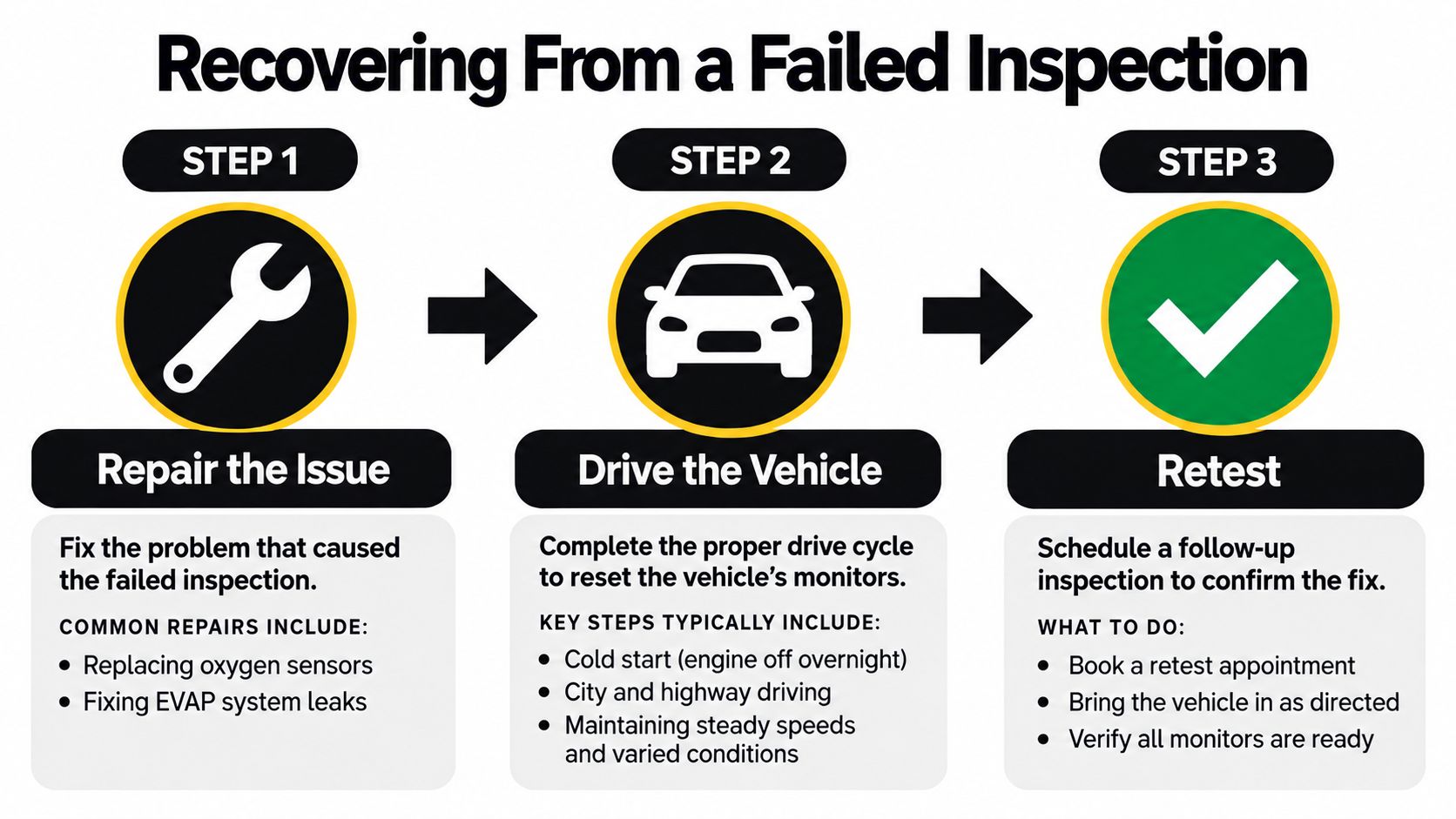
Follow the repair sequence
First, identify the failure category. The report should show whether the problem involved a malfunction indicator, emissions readings, readiness monitors, missing equipment, or another compliance issue. Don't approve repairs based only on a vague statement that the car “needs a tune-up.”
Second, diagnose before replacing parts. A check-engine code identifies a monitored fault, not automatically the failed component. A technician should test the wiring, vacuum system, fuel control, exhaust system, and related components before installing expensive parts.
Third, complete the drive cycle. If repairs or battery disconnection reset monitors, the vehicle may need mixed-use driving before retesting. Returning immediately can produce another failure even after the mechanical issue has been fixed.
Protect your legal driving options
California DMV guidance allows owners whose vehicles fail a biennial smog inspection to seek a Temporary Operating Permit, or TOP. The permit is valid for 60 days and requires registration renewal fees, the failed inspection report, proof of insurance, and a nonrefundable $50 fee, according to the California vehicle inspection information published by BAR.
The TOP matters because a failed inspection can block renewal while you still need to drive to a repair shop, retest location, or referee appointment. Confirm the permit's terms with the DMV and carry the required paperwork rather than assuming the failed report alone gives you unrestricted driving authority.
Keep the failed report, receipts, repair orders, scan results, and retest paperwork together. The paper trail makes the next conversation with a station, DMV office, or referee much easier.
Escalate when the result doesn't make sense
If you believe the inspection process was incorrect, or the vehicle has unusual equipment or modification issues, contact the Bureau of Automotive Repair Referee Program for direction. Don't pay for repeated tests without understanding the failure.
For a practical explanation of repair, permit, and retest steps, review this guide to a failed smog check in California. The right response is controlled diagnosis, not repeated guessing.
What to Expect at the Station
You pull into the bay, hand over the registration information, and answer a few basic questions about the vehicle. The technician confirms the identifying details, checks which inspection protocol applies, and connects the approved equipment if the vehicle uses OBD-II.
At a local East Bay station such as Speedy Smog, the experience is built around a short, focused inspection rather than a general mechanical service appointment. Speedy Smog is located at 15275 Washington Ave in San Leandro and handles newer vehicles, older vehicles, diesels, hybrids, and DMV-directed inspections. The shop also electronically transmits results to the DMV for registration purposes.
Bring the information that prevents delays
Have your DMV renewal notice available if you're renewing registration. Bring the vehicle, its current registration information, and any paperwork connected to a prior failure or special DMV direction.
Tell the technician about recent battery replacement, diagnostic-code clearing, emissions repairs, engine changes, or unusual fuel and weight classifications. Hiding recent work doesn't help. It can lead to a failed readiness check or an incorrect assumption about the test the vehicle needs.
The visit is an inspection, not a repair estimate
For most 2000 and newer vehicles, Speedy Smog states that typical testing is completed in about 10 to 15 minutes, though the actual time depends on the vehicle and inspection requirements. A station may need more time for an older vehicle, a diesel, a heavy vehicle, a DMV-directed test, or a problem with the vehicle's identification or computer connection.
Ask for the total price before the test begins. Transparent stations should explain whether the appointment is a standard inspection, STAR inspection, diesel inspection, or another required service. A clean waiting area and clear communication matter, but the central question remains whether the test is valid for your DMV transaction.
Don't confuse a smog inspection with a complete vehicle safety inspection. The smog test focuses on emissions compliance. If you also need brake, tire, suspension, or general reliability work, arrange that separately so you know exactly what you're paying for.
Your Pre-Inspection Compliance Checklist
The best time to prevent a failed test is before you arrive. Use this checklist based on the transaction, vehicle, and computer status.
Confirm the administrative requirement
- Read the DMV notice: Determine whether you need renewal certification, STAR certification, a transfer-related inspection, or first-registration certification.
- Confirm the vehicle category: Check model year, fuel type, hybrid status, and GVWR.
- Check exemptions and fee options: Electric vehicles and other qualifying vehicles may be exempt, while newer vehicles may qualify for the smog-abatement fee instead of testing.
- Bring supporting paperwork: Keep the renewal notice, registration information, prior failed report, repair records, and proof of insurance available when relevant.
Check the vehicle's readiness
- Look at the dashboard: A check-engine light that stays on needs diagnosis before testing.
- Avoid recent code clearing: Clearing codes can reset readiness monitors and leave the vehicle unable to pass.
- Scan monitor status: Confirm applicable monitors are complete after repairs or battery work.
- Complete normal mixed-use driving: Give the computer enough time and operating conditions to finish its self-tests.
- Check visible basics: Make sure the gas cap is secure and report obvious exhaust or emissions-system damage before the test.
Choose the correct station
- Follow STAR instructions: If the DMV requires STAR, use a station authorized for that requirement.
- Confirm capability: Ask whether the station handles your vehicle's age, fuel type, inspection protocol, and transaction.
- Explain recent work: Battery replacement, code clearing, emissions repairs, and modifications can change the advice you need.
- Plan for failure intelligently: If the vehicle fails, retain the report, diagnose the cause, complete repairs, reset monitors correctly, and retest.
California vehicle inspection is easier when you treat it as a compliance process instead of a quick lottery ticket. Identify the transaction first, verify the inspection path second, and check readiness before you spend money on the test.
Speedy Smog provides STAR Certified smog checks in San Leandro for newer and older vehicles, including hybrids and eligible diesel vehicles, with DMV electronic result transmission. If you're preparing for renewal, a transfer, or first California registration, visit Speedy Smog and confirm the correct inspection before you arrive.
You're probably reading this because your DMV renewal notice is sitting on the counter, your registration deadline is getting close, and you're not sure whether you need a regular smog station or a STAR station. Maybe you already paid the renewal fees and expected the process to be finished, only to see that DMV still shows a smog requirement.
That confusion is common in the East Bay because the inspection and registration systems are connected, but they aren't the same step. The station performs the inspection and sends the result electronically. DMV then uses that result to clear the registration requirement. If either side has the wrong vehicle record, missing information, or an unresolved hold, your renewal can remain incomplete.
Table of Contents
- What Car Registration Inspection Actually Covers
- Decide Whether Your Vehicle Needs a Test
- Prepare Your Documents and Pick the Right Station
- What Happens During the Inspection Itself
- Move From Certificate to Completed Renewal
- Handle a Failed Inspection the Right Way
- Quick Checklist Before You Book and After You Pass
What Car Registration Inspection Actually Covers
A car registration inspection is more than a tailpipe check. It's a compliance workflow that connects your vehicle identity, the applicable emissions inspection, and the electronic record DMV needs before it can finalize registration.
Start with the paperwork. The technician needs to identify the correct vehicle and match the inspection to the record on your renewal notice. In California, the station scans the notice barcode so the vehicle information can be transmitted accurately to DMV. That step matters because a passed test attached to the wrong record won't clear the right registration hold.
The inspection itself depends on the vehicle's profile. Fuel type, model year, weight, and registration situation determine which requirements apply. Routine testing generally occurs every two years for covered vehicles, but a first California registration, an out-of-state vehicle, or a change of ownership can create a testing requirement even when the vehicle doesn't need a routine renewal inspection. The California Bureau of Automotive Repair performance report describes the program as one of the largest inspection-and-maintenance networks in the country, with more than 8,000 active stations during calendar years 2024 and 2025.
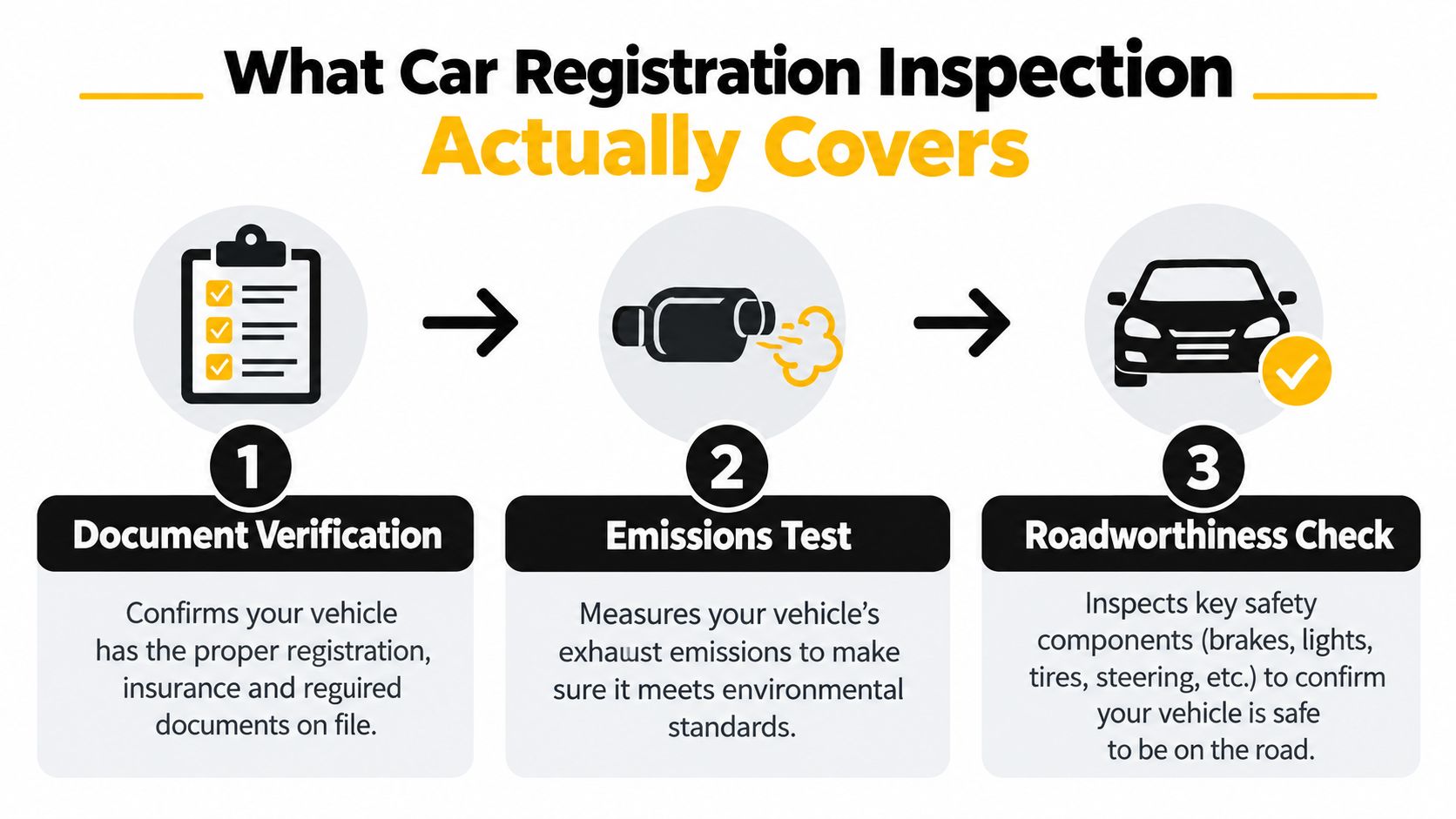
The three parts that matter
- Vehicle and document verification: The station confirms the notice, VIN, and vehicle record before submitting the result.
- Applicable emissions inspection: The technician performs the test required for that vehicle and registration context.
- Electronic certification: The station issues a Vehicle Inspection Report and transmits the result to DMV.
Practical rule: Treat the inspection report as proof of the station visit, not as proof that your registration is already renewed.
The program has a clear environmental purpose as well. A Lawrence Berkeley National Laboratory analysis of California's Enhanced Smog Check program estimated that inspections in 1999 reduced daily tailpipe emissions by approximately 97 tons of hydrocarbons, 1,690 tons of carbon monoxide, and 81 tons of nitrogen oxides. The analysis found that vehicles more than 10 years old produced most of the program's emissions benefits, even though they represented about half of inspected vehicles.
For you, the takeaway is simple. First identify the requirement, then choose the correct station, confirm the vehicle record, and verify that DMV received the certification. That sequence prevents most registration delays.
Decide Whether Your Vehicle Needs a Test
Don't book an appointment based only on the vehicle's age or the fact that your neighbor needed a smog check. California uses several filters, and the registration context can override a routine exemption.
The first filter is propulsion. Electric vehicles are exempt from Smog Check. Gasoline vehicles from model year 1975 or older are also exempt, while gasoline vehicles from model year 1976 onward generally fall within the program. Diesel vehicles from model year 1997 or older generally qualify for an exemption, and diesel vehicles over 14,000 pounds are also listed among the exemptions. The California DMV smog inspection guidance provides the official category rules.
Gasoline vehicles that are eight model years old or newer are generally exempt from the routine biennial inspection. That doesn't mean they're exempt from every smog requirement. A newer vehicle may still need testing during its first California registration or a change-of-ownership transaction. Some newer gasoline vehicles may instead be subject to a smog-abatement fee.
Use the notice, not guesswork
Pull out the DMV renewal notice before calling a station. Look for language that says “Smog Certification Required at a STAR station.” If the notice directs you to STAR, a regular station won't satisfy that requirement.
Hybrids deserve special attention. California generally treats gasoline, hybrid, and alternative-fuel vehicles from model year 1976 onward as vehicles that can fall within the Smog Check program. An electric vehicle is different because it has no gasoline engine emissions system to inspect. Diesel rules also differ from gasoline rules, so don't use a gasoline exemption to decide what applies to a diesel truck.
| Vehicle type | Model year or age | Inspection required? |
|---|---|---|
| Gasoline vehicle | Model year 1975 or older | Generally exempt |
| Gasoline vehicle | Model year 1976 onward | Generally within the program, subject to exemptions |
| Gasoline vehicle | Eight model years old or newer | Generally exempt from routine biennial testing, but registration or ownership events can still trigger testing |
| Hybrid vehicle | Model year 1976 onward | Generally within the program |
| Diesel vehicle | Model year 1997 or older | Generally exempt |
| Diesel vehicle | Over 14,000 pounds | Generally exempt under the listed DMV category |
| Electric vehicle | Any model year | Exempt |
The Bureau of Automotive Repair's Smog Check overview reports that about 19 million model-year-2000-and-newer vehicles were tested during calendar years 2024 and 2025, with approximately 1.3 million failures, an overall failure rate of about 7%. That's why classification matters. A test requirement isn't determined by one simple age rule.
Prepare Your Documents and Pick the Right Station
Bring the DMV renewal notice whenever you can. Its barcode helps the technician send the inspection to the correct vehicle record. Check the plate number and VIN on the notice before leaving home, especially if you have more than one vehicle or recently changed ownership.
Your preparation should answer two questions before the car enters the bay:
- What does DMV require? Read the renewal notice and identify whether it calls for any authorized station or a STAR station.
- Does the vehicle match the notice? Confirm the plate, VIN, fuel type, and registration situation.
- Is the car ready to test? Resolve a check engine light or known emissions problem instead of hoping the inspection won't detect it.
- Can the station handle this vehicle? Confirm that the station works with your vehicle's fuel type, model year, and inspection category.
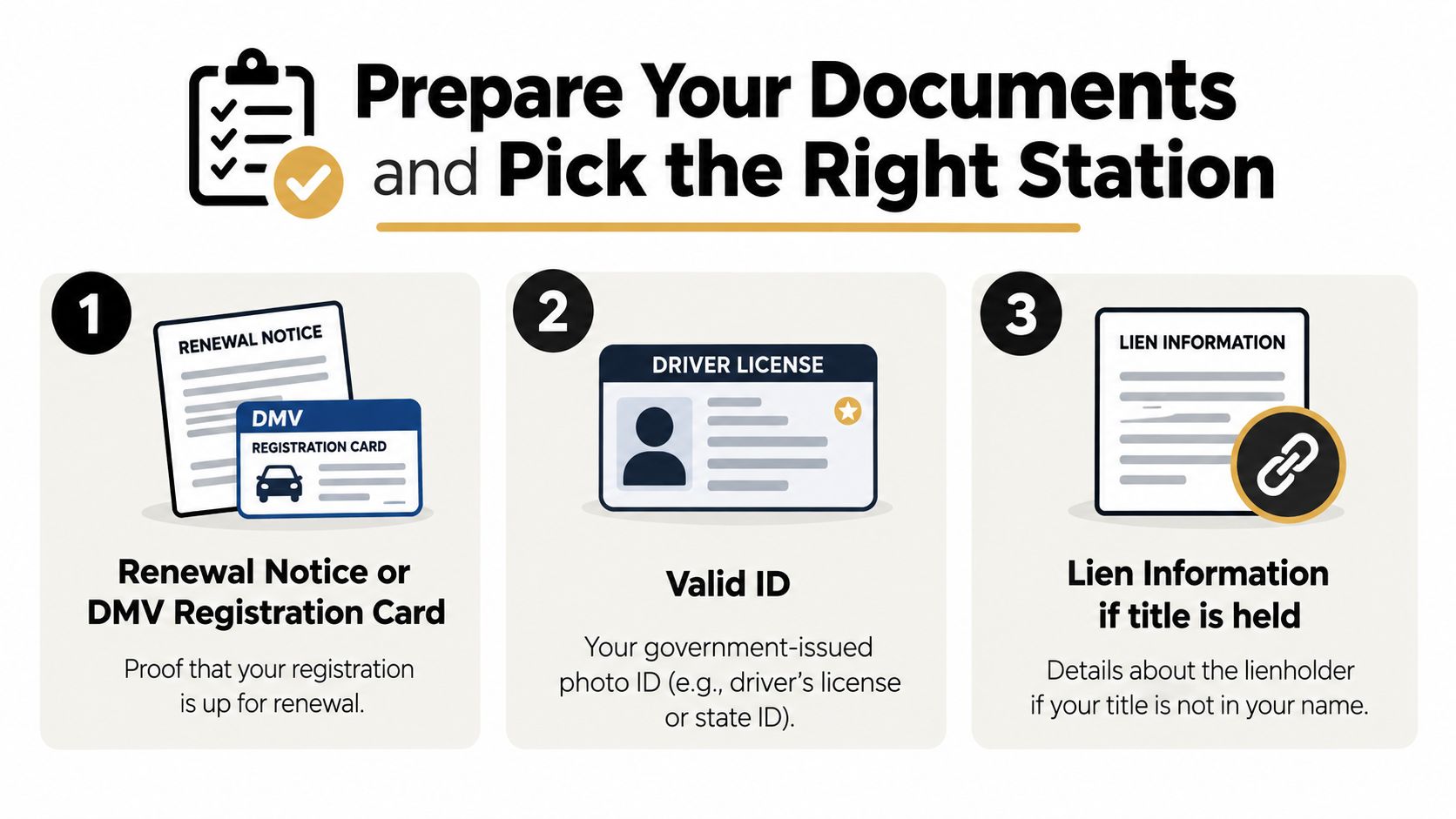
STAR or regular station
A regular authorized station may be appropriate when the notice doesn't specify STAR. A STAR station is required when DMV directs you there. That direction can apply to certain renewal records, vehicles sent there after a previous failure, and other categories established by the state program.
Don't make the station choice based on the shortest drive alone. A cheap or convenient appointment becomes expensive if the station can't submit the result your renewal requires. Read the notice first, then call if the wording is unclear.
For East Bay drivers, California smog check station information can help you confirm the type of service offered before you arrive. The important point isn't the shop name. It's whether the location is authorized for the exact inspection your DMV record requires.
The renewal notice is the key document. Keep it available on your phone or bring the paper copy, but don't rely on a plate number alone if the station needs the barcode to transmit the correct record.
What Happens During the Inspection Itself
At the station, hand over the renewal notice and let the technician establish the vehicle record before the test begins. The technician scans the barcode, confirms the vehicle information, performs the applicable inspection, and creates the Vehicle Inspection Report. That electronic handoff is what connects the station visit to DMV.
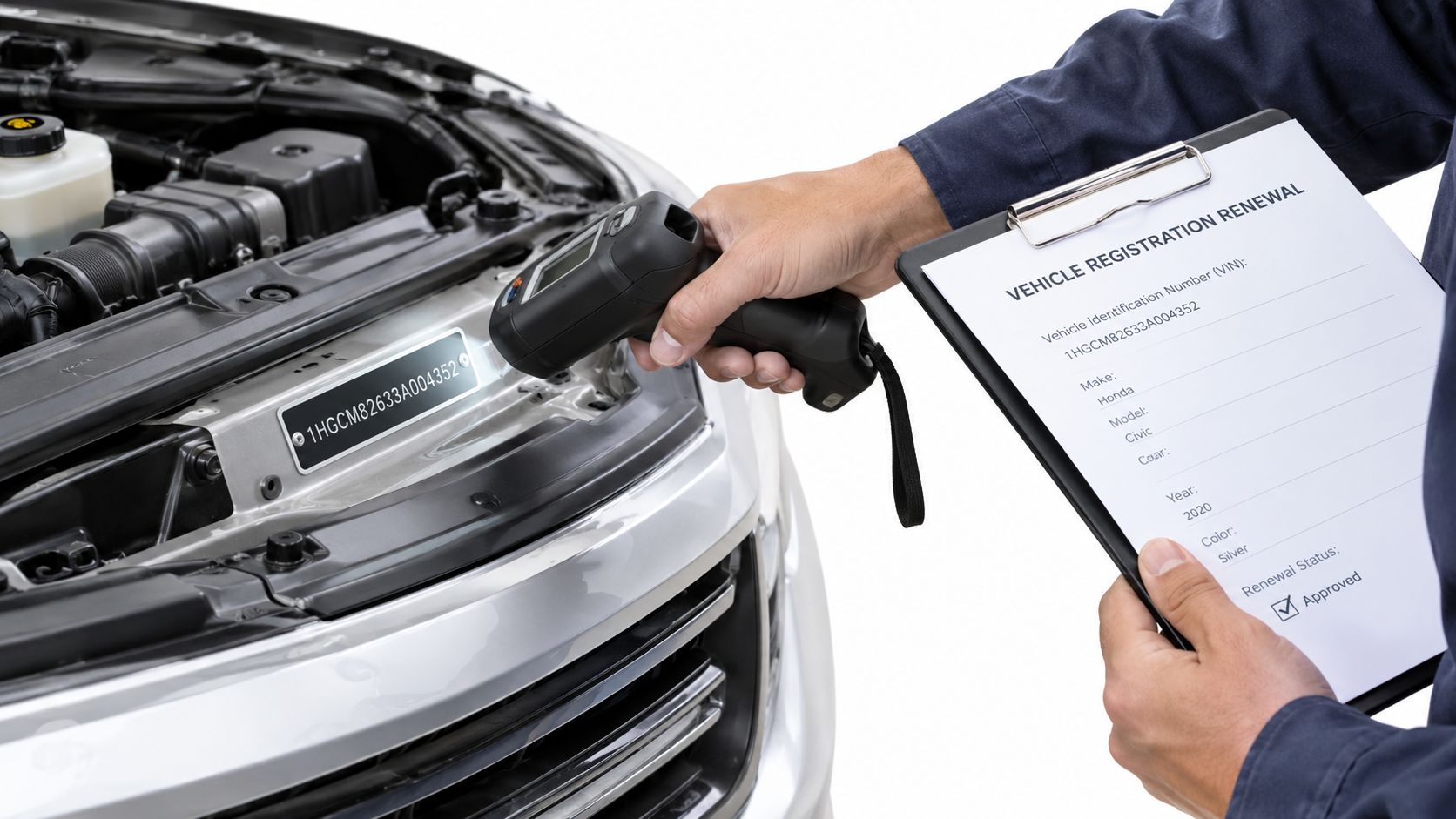
Don't treat the printed report as a form you must personally mail to DMV. The station submits the certification electronically. You should still check every identifying detail before leaving. A wrong plate, VIN, or vehicle record can create a problem even when the vehicle itself passed.
The technician may ask you to leave the car while the inspection is performed. That's normal. What you should expect at the end is a clear result, a Vehicle Inspection Report, and an explanation of anything that prevented a pass. Ask for an itemized receipt and keep the report in the vehicle records.
What STAR changes
STAR doesn't mean your vehicle receives a completely different registration process. It means you must use a station authorized for a STAR-directed inspection. The station still verifies the record, performs the applicable inspection, and submits the result electronically.
If the vehicle fails, don't approve repairs based on a vague statement such as “it needs emissions work.” Read the report and ask which test element failed. You need that information before deciding whether to use the same shop, another repair facility, or the BAR Referee pathway.
This short video shows the general relationship between an inspection visit and vehicle emissions compliance:
The station visit ends when the result is recorded and the report is in your hands. Registration renewal is a separate task. Passing is necessary, but it doesn't replace the DMV transaction.
Move From Certificate to Completed Renewal
A passing result clears the smog requirement electronically, but DMV still has to process the registration renewal. California DMV says online renewal requires the electronic smog certification to be on file. Paying registration fees alone doesn't finalize the renewal if the certification or another requirement is still outstanding, as explained in the DMV vehicle registration renewal guidance.
The certificate remains valid for 90 days, according to the Bureau of Automotive Repair. Use that period to complete the renewal instead of assuming the pass will remain available indefinitely.
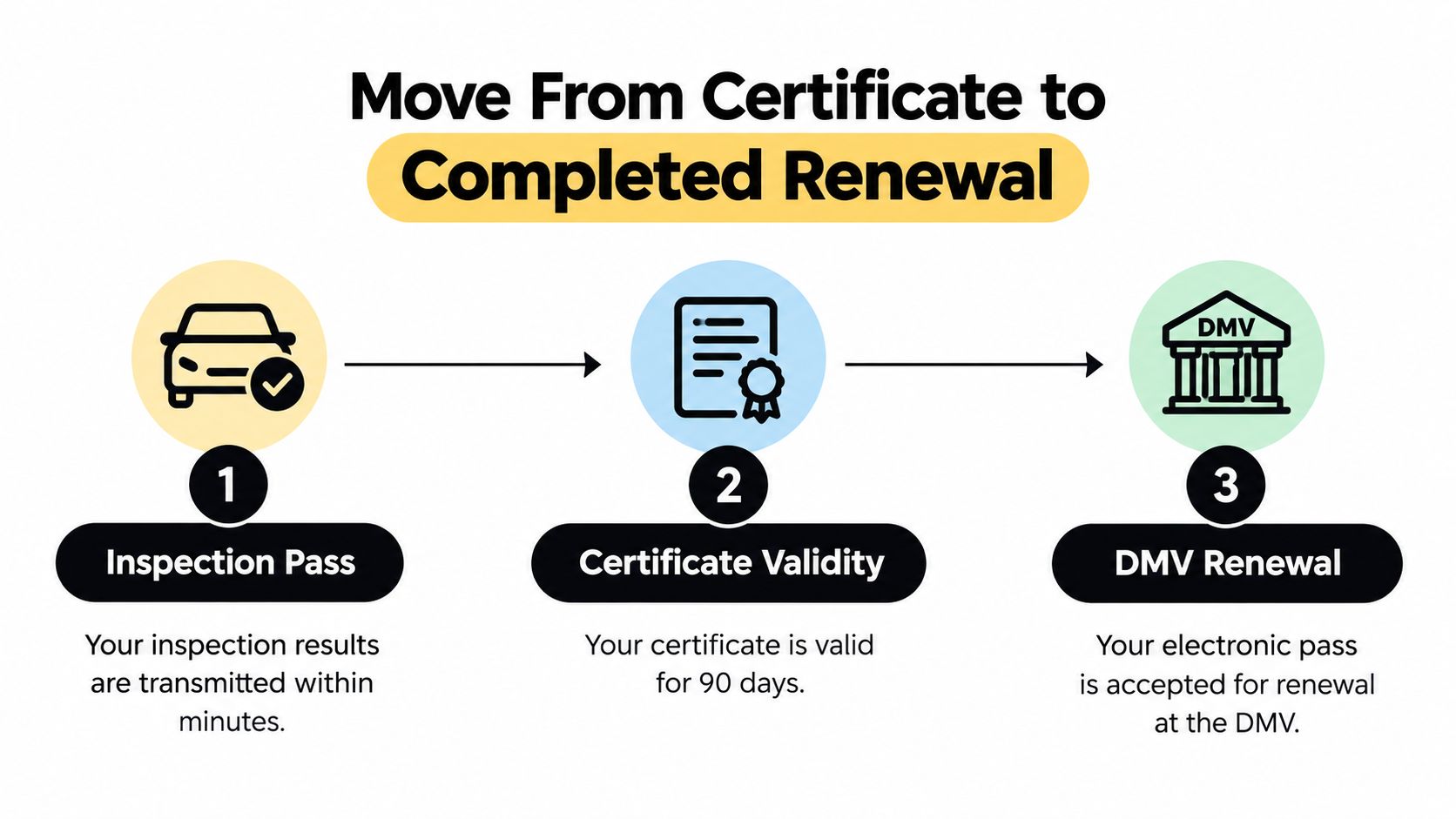
Check the electronic handoff
Before you pay again, verify the status of the vehicle in the DMV system. If the portal still shows a smog requirement, compare the plate and VIN on your report with the vehicle information in the renewal record. Call the station first if the information doesn't match. The station can confirm what it submitted and whether the record was accepted.
Don't assume a delay means you need another inspection. DMV guidance says some assisted processing can take up to 30 days, so allow time for the record to update when the submission is correct. If another hold appears, such as an unpaid parking matter, the smog certification won't resolve that separate issue.
The pass removes one obstacle. It doesn't complete the transaction.
Complete the renewal through the method DMV offers for your record, whether online, by mail, in person, or through another authorized channel. Save the receipt, the Vehicle Inspection Report, and the confirmation that registration was completed. If DMV asks for proof later, you'll have the station document and the renewal record together.
For a practical overview of the station-to-DMV process, smog check registration renewal information can help you identify the steps that remain after the test.
Handle a Failed Inspection the Right Way
A failed inspection gives you a diagnostic starting point. It doesn't tell you to replace every part associated with the emissions system, and it doesn't automatically mean the vehicle can't be driven home. Read the Vehicle Inspection Report and identify the exact reason for the failure before authorizing repairs.
Ask a repair shop for a written estimate. A qualified technician should explain whether the problem involves a gas cap, emissions-control component, readiness issue, sensor, exhaust system, or another test element. Don't accept a large repair recommendation without seeing how it connects to the failed result.
| Failure cause shown on the report | Likely next step | Typical cost range |
|---|---|---|
| Gas cap or evaporative-emissions issue | Inspect, diagnose, and repair the leak or cap problem | Varies by diagnosis |
| Sensor or emissions-control fault | Confirm the code and test the related system before replacement | Varies by diagnosis |
| Catalytic-converter or exhaust-related failure | Obtain a written diagnosis and verify the required component | Varies substantially |
| Readiness or testing issue | Ask the technician what condition prevented certification | Varies by cause |
| Unresolved failure after repairs | Keep reports and receipts, then ask about the next official step | Determined by the case |
California DMV says an owner whose vehicle failed the biennial inspection may qualify for a Temporary Operating Permit valid for 60 days. The owner must provide the failed report, registration fees, proof of insurance, and the required fee, and DMV generally allows only one such permit for the same vehicle within a two-year period. Review the DMV vehicle information guidance before applying because the permit doesn't erase the failed result or guarantee a later pass.
Know when to use the BAR Referee
The BAR Referee Program is the state's next-step resource for difficult inspection situations. DMV directs owners toward the Referee Program when a vehicle fails and needs additional assistance. Use that route when the failure involves an unusual configuration, disputed emissions equipment, special circumstances, or a problem that ordinary repairs haven't resolved.
Keep the failed report, repair orders, parts information, and receipts. Those records establish what the station found and what the repair facility attempted. They also give the Referee a clear history instead of forcing you to explain the entire case from memory.
The right response to a failure is controlled diagnosis. Don't clear the warning light and immediately return unless the technician confirms the vehicle is ready for a valid retest. A reset can erase useful information and leave the underlying problem untouched.
For drivers who want a retest after an eligible repair, smog check free retest information explains the station's available process. Confirm the terms directly before scheduling.
Quick Checklist Before You Book and After You Pass
Use the DMV notice as your control document. It tells you more than a generic online checklist because it reflects the registration record attached to your vehicle.
Before booking
- Find the renewal notice: Keep the notice available so the station can scan the barcode and match the inspection to the right vehicle.
- Confirm the plate and VIN: Compare the notice with the vehicle before you schedule.
- Identify the fuel type: Gasoline, diesel, hybrid, alternative-fuel, and electric vehicles can follow different rules.
- Check the model year and weight: These details can determine whether an exemption or special category applies.
- Choose the station type: Use a STAR station if the notice specifically requires STAR. Otherwise, confirm that the selected station is authorized for your vehicle.
Before arriving
- Resolve warning lights: A check engine light or known emissions fault deserves diagnosis before testing.
- Bring the vehicle record: Take the renewal notice or the relevant DMV document.
- Ask about special circumstances: Mention an out-of-state transfer, ownership change, diesel configuration, or other unusual registration situation.
- Plan for the report: Leave with the Vehicle Inspection Report and a receipt, whether the result is a pass or failure.
At the station
- Verify the vehicle identity: Check the plate and VIN before the technician submits the inspection.
- Confirm the result: Ask what the report says, not just whether someone verbally says “pass.”
- Keep the paperwork: Store the printed report with your registration records.
- Ask about the electronic submission: Confirm that the result was transmitted to DMV.
After a pass
- Check DMV status: Look for the electronic certification before assuming the renewal is complete.
- Finish the payment: The certificate clears the smog requirement, but DMV still needs the registration transaction completed.
- Resolve separate holds: Parking matters or other outstanding requirements can keep renewal from processing.
- Save the record: Keep the report and renewal confirmation together for future questions.
The mistakes to avoid are straightforward. Don't use a non-STAR station when DMV directs you to STAR. Don't ignore a warning light and hope the test misses it. Don't pay registration fees and assume the vehicle is renewed before DMV confirms completion. A clean inspection result is only one part of the process.
If you need a STAR inspection in San Leandro, Speedy Smog can perform the applicable smog check, transmit the result electronically to DMV, and provide the Vehicle Inspection Report for your records. Visit Speedy Smog with your renewal notice and confirm the correct station requirement before you arrive.