
DMV Smog Check Registration: A Complete How-To Guide
You're staring at the renewal notice on the kitchen counter, wondering whether you need a smog test, which station to use, and whether the whole thing will clear DMV before the tags expire. That's the core task here. DMV smog check registration isn't just a tailpipe test, it's a paperwork gate that decides whether your renewal moves or sits stuck.
In California, the smart move is to treat smog as part of the registration transaction from the start. Bring the notice, read the station instructions, and test at the right place the first time. Miss that, and you can end up with a passing inspection that still doesn't clear the hold.
Table of Contents
- What DMV Smog Check Registration Means in California
- Reading Your DMV Renewal Notice Before You Book
- Booking the Test and What to Bring on the Day
- STAR Stations Test Only Versus Test and Repair Explained
- Readiness Monitors and Pre-Test Preparation
- What to Do When the Test Fails
- Closing the DMV Registration Once the Certificate Posts
What DMV Smog Check Registration Means in California
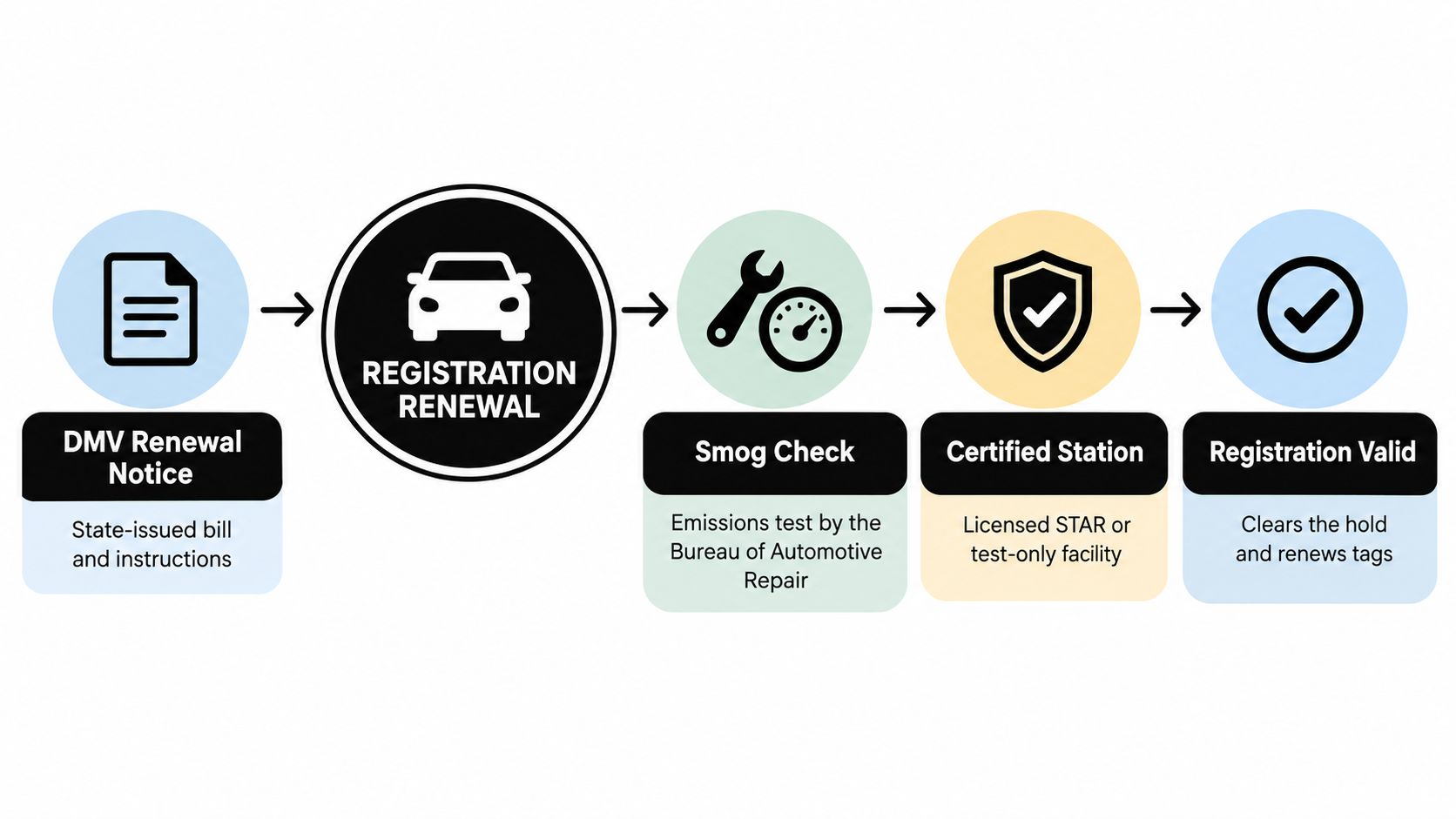
A driver pulls up for a smog test and thinks the job is done once the tailpipe numbers look good. In California, the key job is getting the result attached to vehicle registration so DMV can clear the renewal. The state cares about the test, the station, and the record that gets transmitted.
What triggers the requirement
For most gasoline-powered, hybrid, and alternative-fuel vehicles, California requires a Smog Check for model year 1976 and newer. For diesels, the general cutoff starts with the 1998 model year. Vehicles eight model years old or newer generally pay a smog abatement fee instead of getting inspected for renewal since January 1, 2019. The DMV also excludes several categories, including electric vehicles, motorcycles, trailers, gasoline vehicles from 1975 and older, diesel vehicles from 1997 and older, and certain heavy natural-gas or diesel vehicles. The question is always the same, what vehicle is on the record, and what registration event is happening? California DMV smog inspection rules
Practical rule: if the registration event needs a smog certification, the DMV uses the exact vehicle record, not your memory of the car's last test.
Why the registration frame matters
In California, smog is tied to vehicle registration and renewal, so the DMV and the Bureau of Automotive Repair care about the result and the station that produced it.
Bring a vehicle into California for the first time, and the state usually wants a smog certification before registration goes through. The same holds on renewal when the notice calls for a test. The inspection is the checkpoint that clears the DMV hold and lets the renewal move.
For East Bay drivers, the cleanest way to handle it is simple. Read the renewal notice as the controlling document. If it calls for a test, a fee, or a specific station type, follow that instruction and get the transaction lined up correctly the first time.
Reading Your DMV Renewal Notice Before You Book
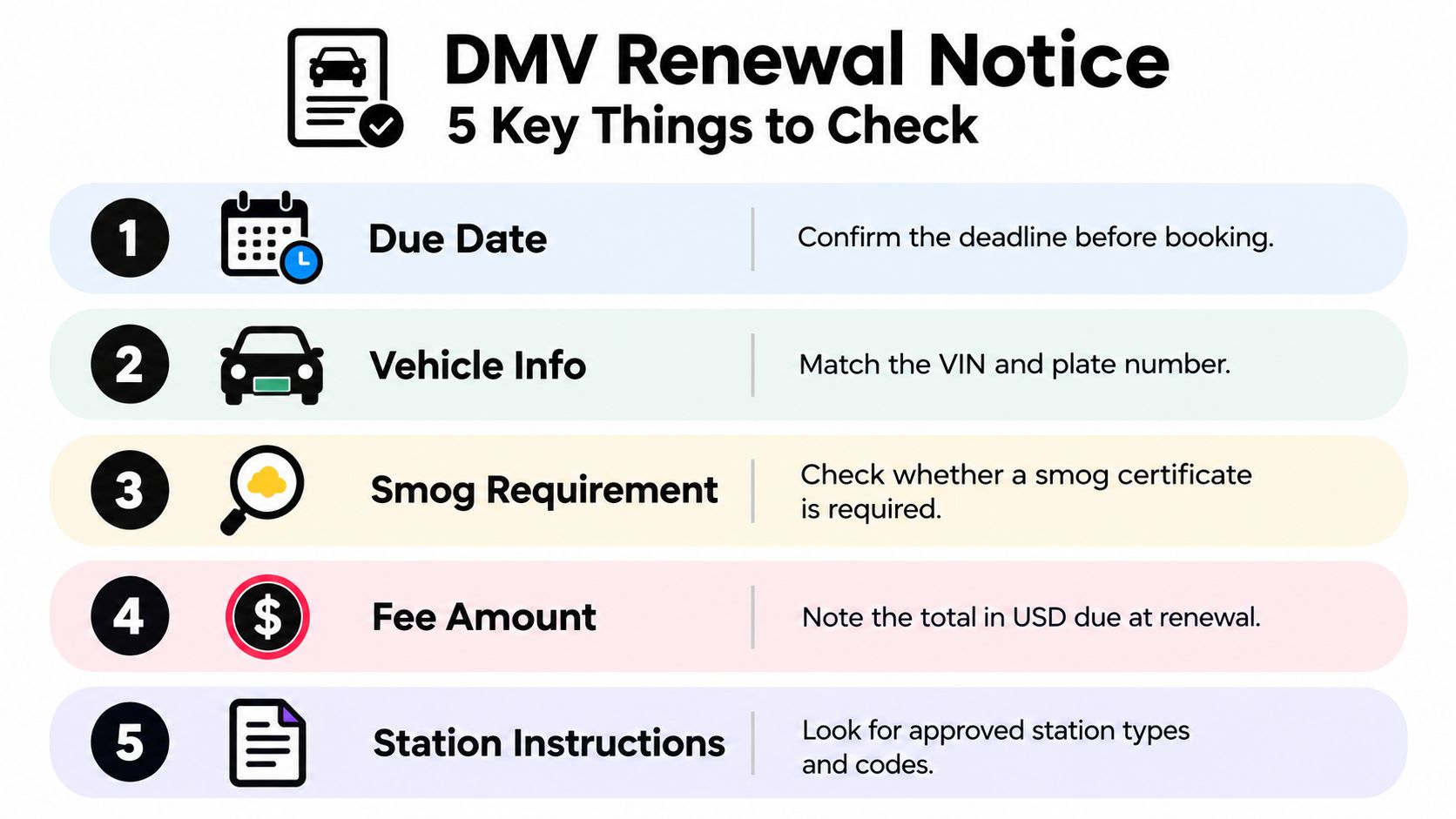
The renewal notice is the piece of paper many drivers skim and regret later. Don't skim it. Read it like a bill with instructions, because that's exactly what it is.
The lines that matter
Look for whether the notice says Smog Check Required or shows that the smog certificate is already submitted. Then check the station instruction line. Some notices point you to any authorized Smog Check station, while others require a STAR station or another specific category. If you ignore that line, you can get a perfectly good test at the wrong shop and still have a registration problem. California DMV renewal workflow
The barcode matters too. The station scans it and transmits the certification electronically to DMV, so bring the notice in person. If you leave it in the glovebox at home, the station may be able to test the car, but you've made the actual registration step harder than it needs to be.
Transaction type changes the answer
Change-of-ownership cases work differently from renewals. Out-of-state vehicles coming into California usually need inspection for first-time registration, while family transfers are usually exempt from the transfer smog check. Vehicles four model years old or newer generally use a smog-transfer fee, not a standard transfer test. That's why you don't want a generic answer, you want the answer that matches your exact transaction.
Keep the notice with your registration paperwork until the certificate posts. If the DMV record and the car record don't line up, you're the one who has to sort it out.
If you want a local walk-through of the renewal flow, use this guide on the registration renewal process as a companion while you check your notice.
Booking the Test and What to Bring on the Day
Book the test like a grown-up, not like someone gambling on luck. A quick call ahead saves a dead trip, especially if your notice calls for a station category you don't use every day. Most shops can tell you right away whether they can handle the job.
The bare minimum to bring is the renewal notice, your payment method, and the vehicle itself. I'd also bring the registration card if you have it, because matching the car to the record is what keeps the DMV side clean. If you're in a hurry, don't make the shop guess which vehicle is yours.
What the visit actually looks like
For modern cars, the process is usually straightforward. The technician plugs into the OBD-II port on 2000-and-newer vehicles, checks the vehicle's emissions readiness, and verifies the system status. Older vehicles may need a different inspection path, and diesels and hybrids can bring their own visual and functional checks depending on the vehicle. The point is the same either way, the station verifies that the car meets the state's requirement and sends that result forward.
Here's the part drivers care about most, the inspection should end with a Vehicle Inspection Report and an electronic certificate transmission to DMV if the vehicle passes. Keep the report. If anything looks off later, that paper trail helps.
The station doesn't have to be a mystery. If the process is set up right, you hand over the notice, the tech scans the barcode, the car gets checked, and the result moves into the DMV system. That's the job.
Later, when you're waiting for the car, this embedded walkthrough is useful:
What to expect from the paperwork side
Once the station submits the result, DMV can finalize the renewal after the certificate posts. Until then, the test alone isn't the finish line. You're not done when the exhaust probe comes out, you're done when the registration side is clear.
STAR Stations Test Only Versus Test and Repair Explained
Not every station can solve every registration problem. That's where people waste time. The station categories exist for a reason, and the renewal notice tells you which lane you're supposed to be in.
The three categories
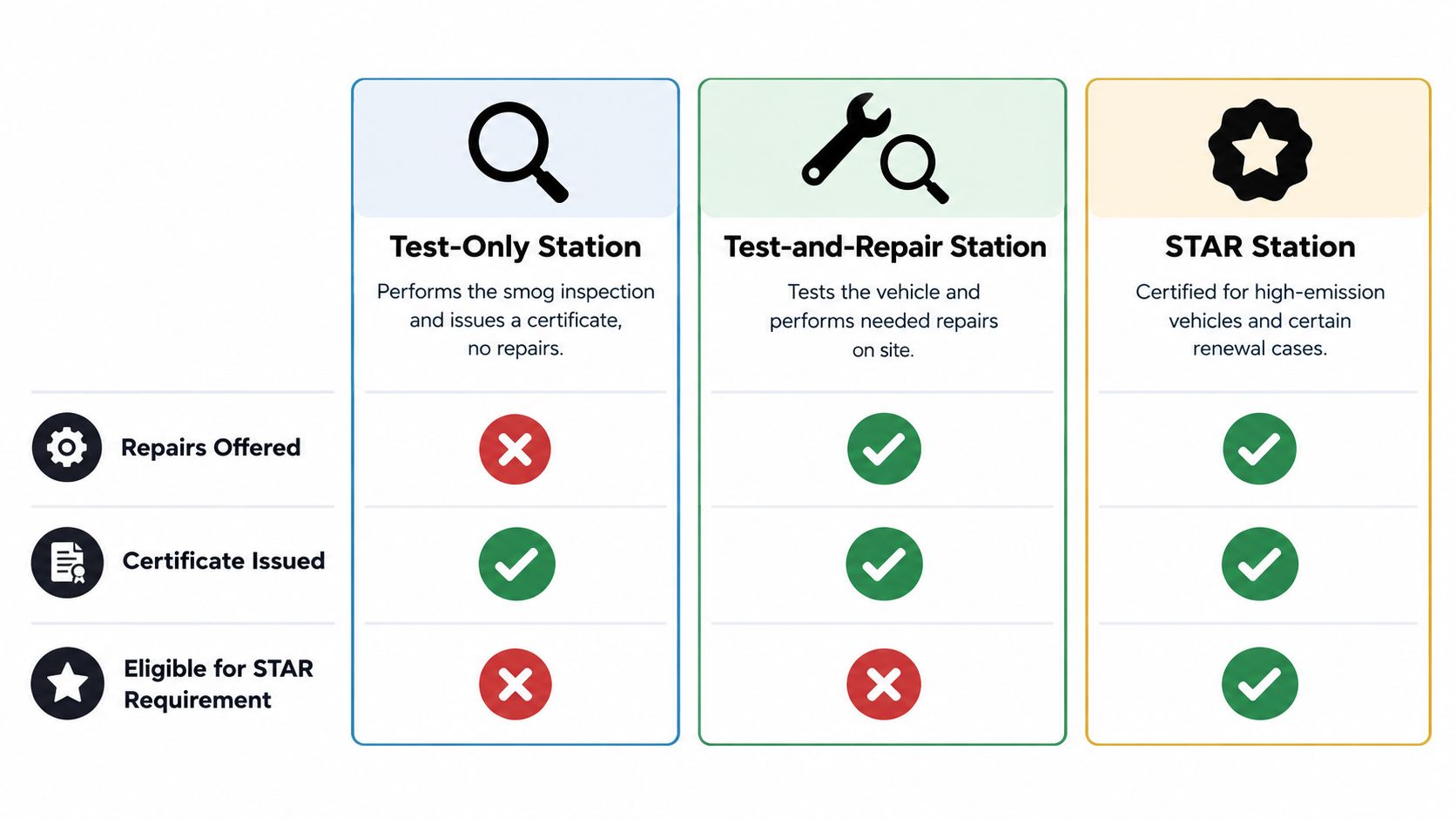
A test-only station inspects the vehicle and issues the certificate if it passes. A test-and-repair station can inspect and fix the vehicle on site. A STAR station is a state-certified station used for certain renewal cases, especially where DMV wants a higher-compliance path. If your notice says STAR, you go to STAR. Don't freelance this part.
California's station system is broad enough that different drivers end up in different lanes. In the Bureau of Automotive Repair's April 2026 executive summary, 223,221 certificates came from test-and-repair stations and 488,032 certificates came from test-only stations in the reported categories. That's a good reminder that the DMV routes a lot of vehicles to specific station types, not just “any place with a smog sign.” BAR April 2026 executive summary
Why STAR status matters
STAR certification isn't just branding. It's part of California's compliance structure. If your renewal notice calls for STAR, a passing test somewhere else may not remove the hold. That's the mistake people make when they think any certificate is enough.
If you want a local explainer on why some vehicles get routed to STAR, this STAR station guide helps keep the categories straight. Use that when you're choosing where to go, not after you've already burned a trip.
Bottom line: the wrong station type can waste a day and still leave your registration incomplete.
Readiness Monitors and Pre-Test Preparation
A car can run fine and still get turned away because the computer is not ready. That is the trap. An off check-engine light does not mean the vehicle is ready for a smog test.
A common mistake is clearing codes right before the appointment, disconnecting the battery, or rushing in after emissions work. Any of those can reset the readiness monitors to incomplete, which can trigger a rejection or failure even if the car drives normally. BAR inspector performance data puts the statewide average for inspections involving the maximum permitted incomplete readiness monitors at roughly 2.1% to 2.2%, so this comes up often enough to matter. BAR readiness monitor benchmark
The night-before checklist
- Do not clear codes: Erasing a stored issue can create a bigger problem at the test lane.
- Confirm the light is off: A lit check-engine lamp means stop and fix it first.
- Drive normally: Give the car time to finish its monitors under ordinary driving.
- Check status with a scan tool: If you have one, look before you leave.
- Use a pre-scan if needed: A quick check beats a wasted trip.
If you want a full pre-test walkthrough, see this guide on what to do before a smog check.
I'd rather see a driver wait an extra day than roll in with incomplete monitors and start over. The DMV deadline does not change how the car's readiness logic works, and the station cannot override it.
If the monitors are still incomplete, follow the manufacturer drive cycle under safe conditions and return only after they are ready. That is the cleanest move, and it saves time at the counter.
What to Do When the Test Fails
Failure isn't the end of the process. It's a fork. You either repair it, dispute it, or use the state programs that exist for exactly this situation.
California recorded 1,019,416 initial tests and 85,135 initial failures in July 2025, an 8.35% initial failure rate. BAR July 2025 executive summary That's not a fringe event. Plenty of drivers run into this, which is why you need a plan before you leave the house.
Your four moves after a failure
- Get the repair conversation started. Ask the shop what failed and what they'd fix first. Don't assume the whole car needs to be torn apart.
- Use the BAR Referee if the result looks wrong. If the vehicle has unusual emissions equipment or the result doesn't make sense, a referee can help sort out the dispute.
- Check Consumer Assistance Program eligibility. BAR identifies this program for consumers who may qualify for repair or retirement help.
- Protect the registration deadline. If you're running out of time, DMV allows a 60-day Temporary Operating Permit when you submit the failed inspection report, proof of insurance, registration fees, and the $50 nonrefundable fee. Only one such permit may be issued in a two-year period.
A failure should push you into action, not panic. The wrong move is to keep paying fees and hoping the certificate magically shows up. Get the cause, pick the right path, and move.
If the car failed for something obvious, fix that first. If the result doesn't fit the vehicle, stop guessing and get a referee involved.
Closing the DMV Registration Once the Certificate Posts
Once the smog certificate posts, the job is to close the DMV transaction cleanly. The station sends the result electronically, DMV picks it up, and you finish the renewal online if your record is clear. That is the part people miss when they assume a paid fee means everything is done.
The fee helps, but it does not finish registration if DMV still shows a missing smog record. Check your renewal status and wait for the certificate to appear before you call it closed. Read how the DMV finalizes renewal after the smog certificate posts.
Use this order:
- Notice in hand
- Correct station chosen
- Inspection completed
- Certificate posted electronically
- Fees paid
- Online renewal finished
- Sticker arrives in the mail
That is the dmv smog check registration workflow. It works when you read the notice, match the station to the job, and keep the paperwork straight.
If you want a local station that handles the registration side the way California expects, Speedy Smog can take your renewal notice, complete the inspection, and electronically send the result so your DMV transaction can move forward. Visit Speedy Smog to book your smog check in San Leandro and get the registration piece handled without extra back-and-forth.