
How Often Do You Need Smog Check California?
Most California vehicles need a Smog Check every 2 years, usually when registration is renewed, if the DMV notice says certification is required. Newer cars and certain sale situations can change that timing, so the date on your renewal notice matters more than a guess.
You open the DMV envelope, look at the renewal date, and wonder if this is the year you need to get the car tested. For a lot of East Bay drivers, that's the whole question in one moment, and the good news is the normal answer is simple once you know what to check.
Table of Contents
- How Often Most California Drivers Need a Smog Check
- How Biennial Renewal Testing Actually Works
- Newer Cars and the Model Year Countdown
- When Selling or Transferring Changes Your Smog Timing
- Exemptions and Special Vehicles Made Simple
- Why County and Air Quality Rules Can Affect Timing
- Staying on Schedule Without Stress
How Often Most California Drivers Need a Smog Check
A first-time car owner in San Leandro often assumes smog testing works like an annual tune-up. For most California vehicles subject to the program, it follows a different rhythm, once every two years, and it lines up with registration renewal rather than routine maintenance, according to the California Bureau of Automotive Repair's Smog Check guidance (BAR Smog Check overview).
The renewal notice is the signal that matters
If your DMV renewal notice says the vehicle needs certification, that notice controls your next step. BAR says the notice identifies whether a particular vehicle requires certification, and registration cannot be finalized when the required smog certificate is missing.
Paying the fee does not always finish the job. If the car still needs a passing certificate, the DMV side of renewal stays open until the smog requirement is satisfied.
Practical rule: treat the renewal notice like a green light or red light. If it asks for certification, get the test done before the deadline.
A simple way to think about the timing
For a normal vehicle in the program, smog testing works like a repeating checkpoint at renewal, not like a yearly oil change. One renewal cycle may need it, the next may not, and then it comes back again on the following cycle.
That pattern is why drivers get tripped up. They remember testing the car recently, then assume they are covered for another year, but the renewal schedule does not follow that logic. It follows the DMV record for that specific vehicle and whether the notice says certification is required.
The safest habit is straightforward. Open the renewal notice, look for the smog requirement, and plan the inspection before the registration deadline if it is listed. That keeps the process calm instead of last-minute.
How Biennial Renewal Testing Actually Works
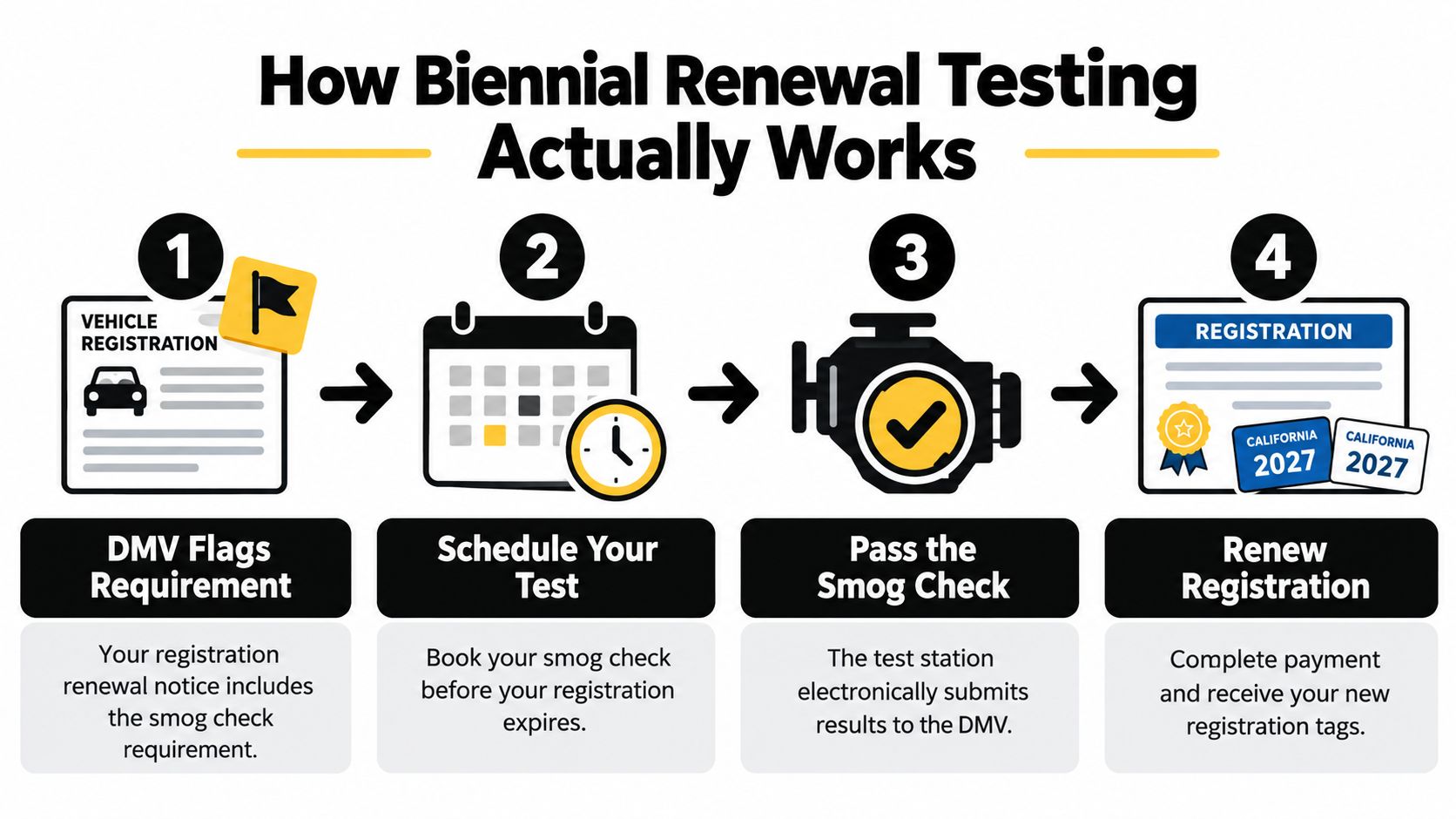
A biennial smog check works like a relay between the DMV, the inspection station, and your registration renewal. One office starts the process, the station reports the result, and the DMV closes the loop once the record shows a passing certificate, as outlined in the BAR brochure (BAR brochure).
Four steps that keep the process moving
- DMV flags the requirement. Your renewal notice shows whether certification is needed for that specific vehicle.
- You schedule the test. Book it before the registration expires, so you are not racing the deadline.
- The station submits the result. The test station electronically sends the outcome to the DMV.
- You renew registration. Once the certificate is on file, payment and tags can be completed.
The notice matters more than a general calendar rule. For a normal vehicle in the program, the test usually comes back at renewal time, then drops out on the next cycle, then returns again later. A simple way to keep that pattern straight is to follow the renewal paper in front of you, not memory or the last time you visited a station.
If the notice asks for smog certification, do not wait until the last week. A little lead time gives you room if the car needs attention before it passes.
What happens if the certificate is missing
If the required smog result is not on file, registration cannot be completed. That is the part that catches people off guard, because the renewal letter may look routine even though the DMV side is still waiting for a passing result.
If you want a plain-English refresher on how a result fits into the renewal window, this guide on smog test validity in California breaks down the timing in a simple way. A retest window is usually the part that saves the day. If the first inspection does not pass, the driver can use the extra time to fix the problem, return for another check, and then finish renewal after the certificate clears.
Newer Cars and the Model Year Countdown
A car can still feel new and already be on a different Smog Check schedule. The key is model year, not how long you have owned it, and newer vehicles stay in a separate category for a while (BAR executive summary report).
The first years are exempt
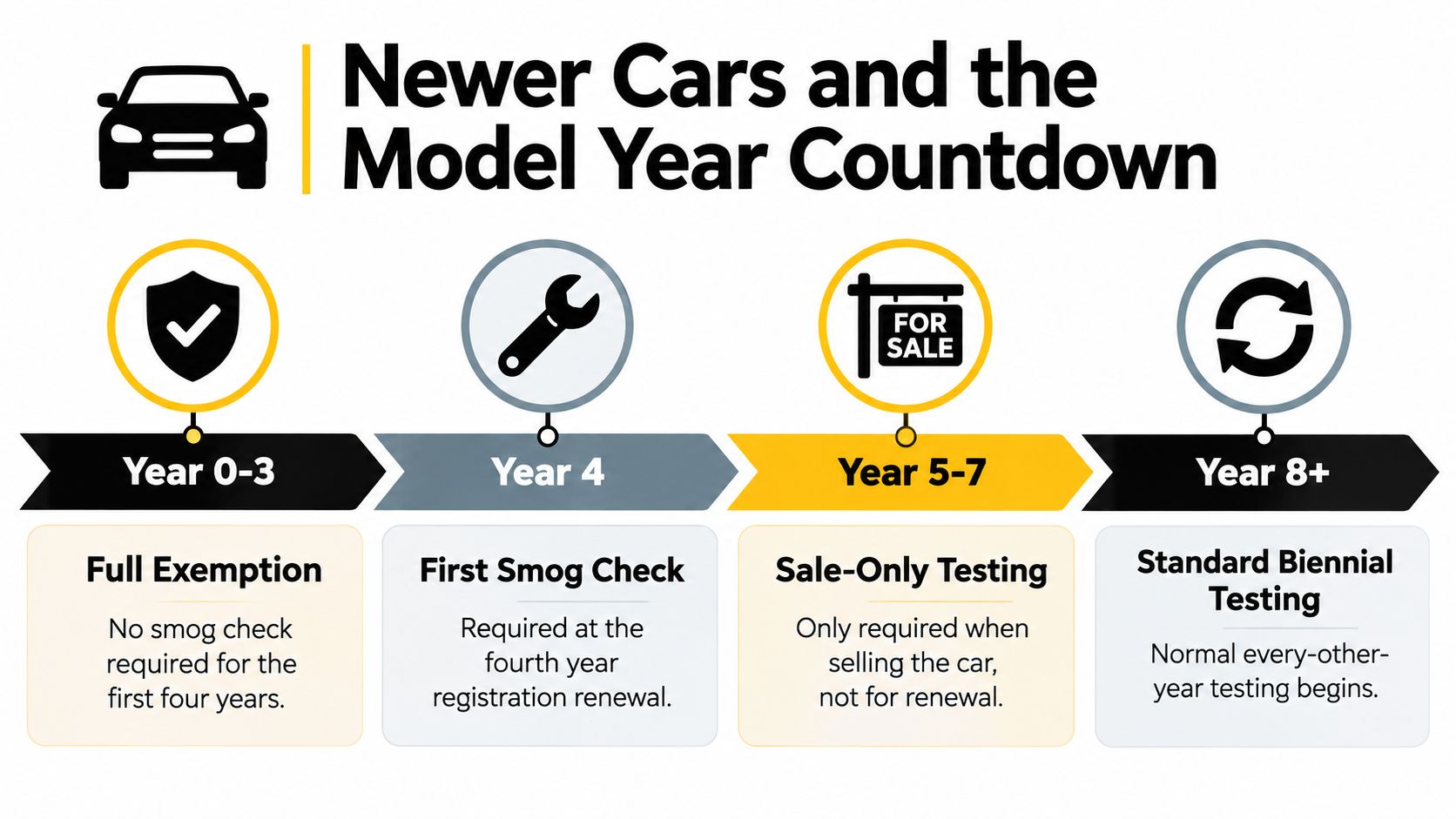
Vehicles four model-years old or newer are exempt from both biennial and change-of-ownership Smog Checks. That means a recent purchase does not automatically need a test (BAR executive summary report).
BAR's example makes the timing easier to follow. A 2020 vehicle first becomes subject to change-of-ownership testing in 2024 and biennial testing in 2028. Model years work like birthdays: nothing is due at first, one milestone arrives at the sale window, and the every-other-year cycle starts later.
Why the sale window is different from the renewal window
Vehicles in their fifth through eighth model years generally need a Smog Check when ownership changes, but they are not yet in the normal biennial renewal cycle. That is the point that catches many owners, because the car can still be off the renewal schedule and still need a certificate for a sale (BAR executive summary report).
For San Leandro drivers comparing that timing with a real station option, the page on California smog check for newer cars is a useful reference.
The practical move is simple. Count the model year before you assume the car is due. If the vehicle is newer than you thought, you may avoid an unnecessary trip. If it is older than you thought, you do not want to miss the first required certificate.
When Selling or Transferring Changes Your Smog Timing
A sale can change the timing even when a registration renewal would not. That is where many first-time owners get caught, because the DMV cares about the transaction itself, not just the normal renewal cycle.
| Situation | Usual Timing | What To Check |
|---|---|---|
| Registration renewal | Every other year for most subject vehicles | Read the DMV renewal notice |
| Sale or transfer | Can be required even when renewal testing isn't due yet | Check the vehicle's model year and ownership-change status |
| Recent purchase | Depends on age and registration circumstances | Confirm whether the car is still in the exempt range |
For a seller, the right question is simple. What proof needs to be ready before the title changes hands? A buyer should ask the same thing from the other side: is the car clear for transfer, or will a passing certificate be needed before the paperwork moves ahead?
If you want a plain-language walkthrough of the renewal side, the guide on smog check registration renewal is a useful companion.
A car can also shift into the sale-testing window before it reaches the normal renewal schedule. That is why an owner who has never needed a renewal test can still be asked for a certificate during a transfer. The model-year cutoff is the part to verify first, then the title status, then the DMV paperwork.
The cleanest habit is to separate the two triggers. Renewal timing tells you whether the DMV wants a certificate for the current registration cycle. Sale timing tells you whether the ownership change itself needs one. Keep those apart, and the process is much easier to follow.
Exemptions and Special Vehicles Made Simple
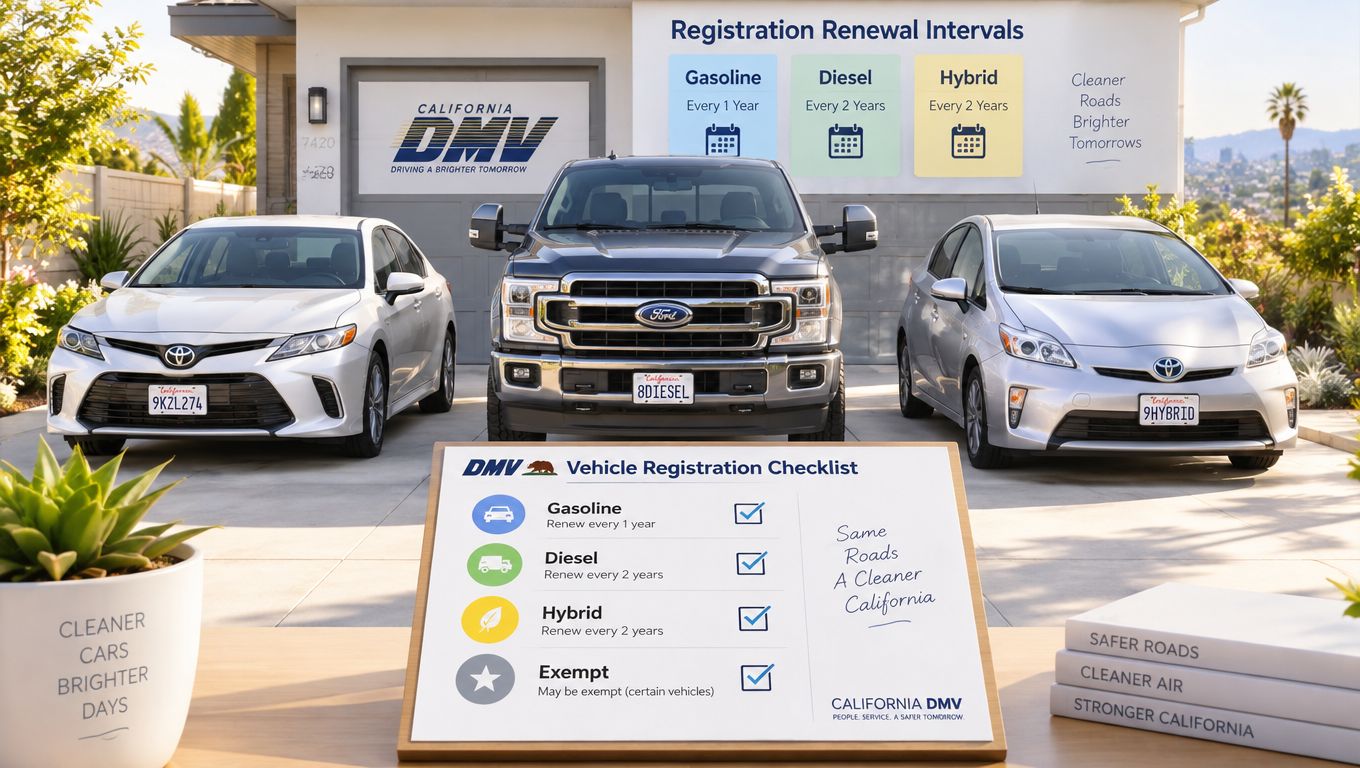
A car's smog schedule can change with its fuel type, model year, and registration situation, so two vehicles in the same driveway may not follow the same rule.
Who usually stays out of the normal cycle
Older and newer vehicles do not all sit in the same lane. Passenger cars in the newer age range can be outside the usual testing rhythm, while other vehicles may only come up for testing during a change of ownership.
Diesel owners should pause here and check the official vehicle category rather than guess from the body style. California does not use the same simple model-year rule for every diesel vehicle, and some older or heavier diesels fall under separate criteria.
Hybrids can also cause confusion. The safest move is to read the DMV notice and confirm the vehicle type on the paperwork, because the notice often tells you more than appearance ever will. A clean, quiet car can still have a testing step attached to it, while a vehicle that looks older may still be outside the current cycle.
Not every vehicle uses the same lane. Fuel type, model year, and the DMV notice all matter together.
How to sort yourself fast
Start with the renewal notice if you drive a standard passenger car. Start with the vehicle category if you own a diesel. For hybrids, check the notice and the registration record together so you do not assume the car follows the same path as a regular gas model.
That same habit helps with older cars and vehicles that have unusual registration histories. Appearance is a poor guide. The paperwork and the official vehicle class decide the timing, and that is usually the part drivers miss.
A simple rule keeps it clear. Age explains a lot, but it does not explain everything.
Why County and Air Quality Rules Can Affect Timing
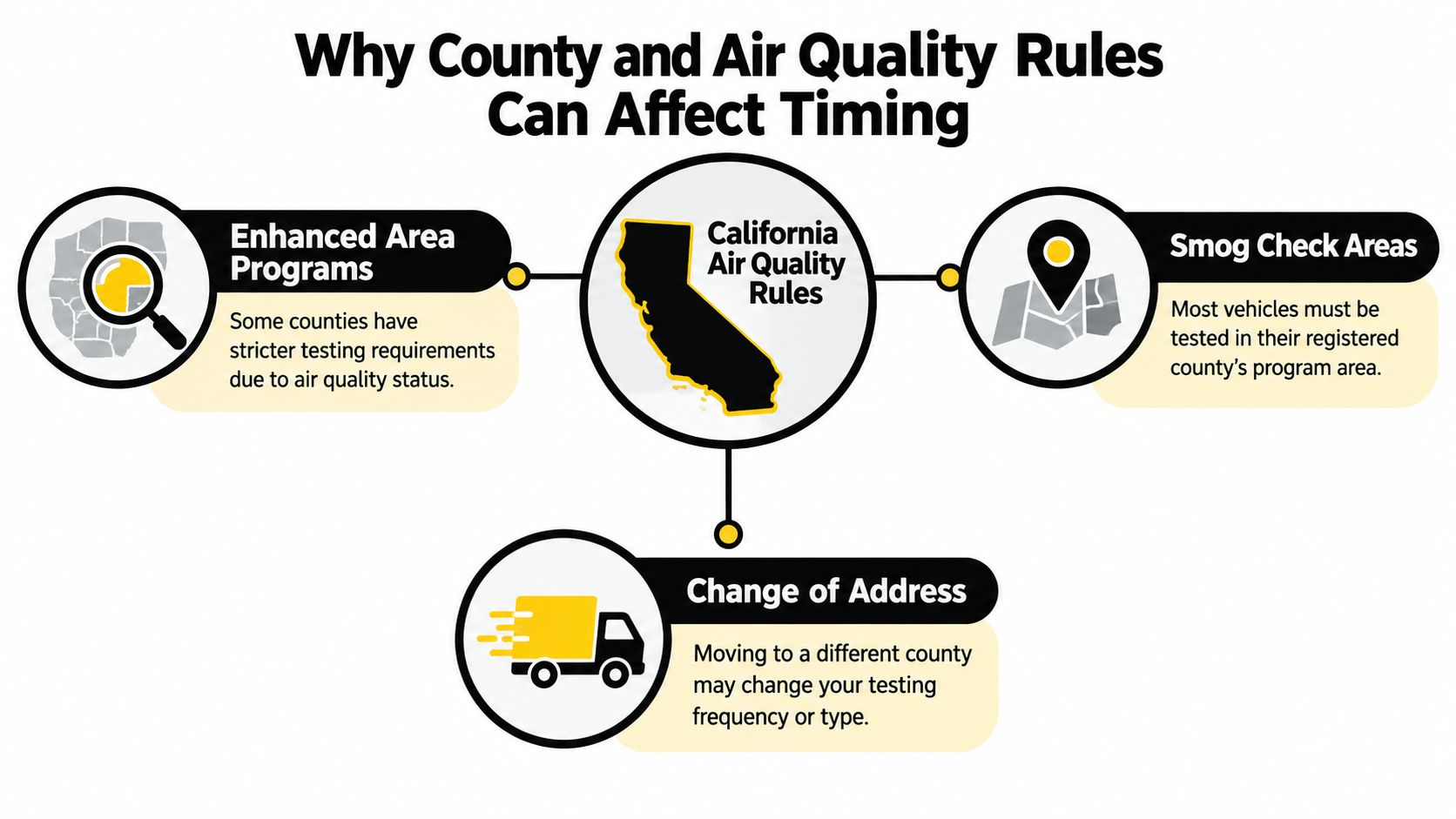
A smog check can feel like a statewide rule, then a county rule changes the timing. California uses a baseline schedule, but some air-quality programs create local exceptions for specific areas.
The San Joaquin Valley is the exception, not the template
The San Joaquin Valley is the clearest example. After the U.S. EPA found in October 2025 that the area failed to attain the 80-ppb ozone standard, California triggered a contingency measure that would reduce the new-vehicle renewal exemption there from eight model years to seven, with a possible reduction to six if another trigger occurs (San Joaquin Valley contingency measure).
That rule is described as applying only to the San Joaquin Valley, not statewide. A driver in Oakland or San Leandro should not assume the same timing applies just because the car is the same age.
Why this matters if you move
A move can change the answer. If you shift counties or enter a different program area, the local timing rules may be different from the ones on your old registration. A vehicle can look exempt in one place and fall back into the testing cycle in another.
The safest check is simple. Read the DMV renewal notice first, then confirm whether your current location has a special air-quality rule in force. A model-year rule works like a road map, but local rules can add a detour.
Practical reminder: do not guess from the county name alone. Use the renewal notice, then verify local guidance if the vehicle is tied to a special air-quality area.
That is why county-based timing deserves careful attention. Most California drivers still follow the standard biennial rhythm, but local air-quality action can move the first testing point for some vehicles in some places.
Staying on Schedule Without Stress
The least stressful way to handle smog timing is to make it a habit tied to the DMV envelope. Open the notice, look for the certification requirement, and set your test date early enough that you're not trying to finish registration on the last day.
A simple checklist for East Bay drivers
- Check the renewal notice first. It tells you whether the vehicle needs certification for that cycle.
- Count the model year if the car is newer. Newer vehicles may be exempt for a while, and that changes the answer.
- Separate renewal from sale timing. A car can be fine for renewal and still need a certificate for a transfer.
- Confirm special categories carefully. Diesel and other special vehicles can follow different criteria.
- Book early if the deadline is close. That leaves room if the vehicle needs attention before it passes.
If you want a nearby station that handles STAR-certified smog inspections in San Leandro, Speedy Smog is one option to check when your renewal notice says it's time. The shop focuses on inspections for many vehicle types, including newer vehicles, older vehicles, diesels, and hybrids.
The calmest rule is the one you can repeat. Read the notice, confirm the vehicle's age and category, then get the inspection done before renewal closes. That's how you stay compliant without turning registration season into a scramble.
If your renewal notice is coming up, bring it to Speedy Smog and get the timing sorted before the deadline. The shop handles smog inspections in San Leandro with a STAR Certified process, so you can check the requirement, complete the test, and move on with registration.