
In California, gasoline and hybrid vehicles from model year 1976 and newer generally need a smog check, while 1975 and older vehicles are generally exempt. The DMV renewal notice controls what's required for your vehicle in any given year.
You're holding the renewal notice at the kitchen counter, or you've just bought a used car and the seller says, “It probably doesn't need smog.” That's where confusion starts. The model year gives you the starting point, but the transaction determines the test requirement.
For East Bay drivers, the three situations that matter are registration renewal, ownership transfer, and first California registration. A newer vehicle may skip a routine renewal inspection but still need a test when it comes from another state. An older vehicle may fall inside the program but be treated differently depending on whether you're renewing, selling, or registering it for the first time in California.
Table of Contents
- The Quick Answer Every East Bay Driver Wants
- The 1976 Cutoff and the Big Exceptions
- How the Eight-Year Renewal Exemption Works
- OBD-II Versus the Older Tailpipe Test
- Real Situations That Change the Answer
- What to Do Before You Head to a Smog Shop
- Putting It All Together for Your Next Renewal
The Quick Answer Every East Bay Driver Wants
If you're asking what year cars need smog in California, start with model year 1976. Gasoline, flex-fuel, hybrid, and other qualifying alternative-fuel vehicles from 1976 and newer generally fall under California's Smog Check program. Vehicles from 1975 and older are generally exempt, according to the California Bureau of Automotive Repair's vehicle coverage guidance.
That answer is useful, but it isn't the final answer for your DMV paperwork. Your DMV renewal notice is the authority for what you must do now. It will tell you whether the state wants a smog certificate, a fee during the newer-vehicle exemption period, or another form of compliance.
A 2020 hybrid, for example, is inside the general program because it's newer than the 1976 cutoff. That doesn't mean it needs a smog inspection every time the owner renews registration. Newer vehicles receive an age-based exemption for routine renewal, and the relevant transaction can change the result.
Use this three-question check at the counter:
- Is this a registration renewal? The vehicle's model year and age-based exemption determine when recurring inspections begin.
- Is ownership changing? The change-of-ownership exemption is shorter than the renewal exemption.
- Is this the vehicle's first California registration? An out-of-state vehicle from model year 1976 or newer generally needs a Smog Check for that initial California registration event.
Practical rule: Don't schedule a test based only on the year printed on the title. Read the DMV notice first, then match the test to the transaction.
The rest of the rules make sense once you separate those three situations. The 1976 cutoff tells you whether the vehicle is generally in the program. The renewal and transfer exemptions tell you when a test starts. The registration history tells you whether an exception applies.
The 1976 Cutoff and the Big Exceptions
California's foundational line is simple: 1976 and newer generally means Smog Check territory, while 1975 and older generally means exemption. BAR specifically identifies gasoline and flex-fuel vehicles from model years 1976 through 1999 as generally requiring a Smog Check, with 1975 and older gasoline and flex-fuel vehicles generally exempt. Hybrids and other qualifying fuel types can also fall within the program, so “hybrid” doesn't automatically mean “no smog.”
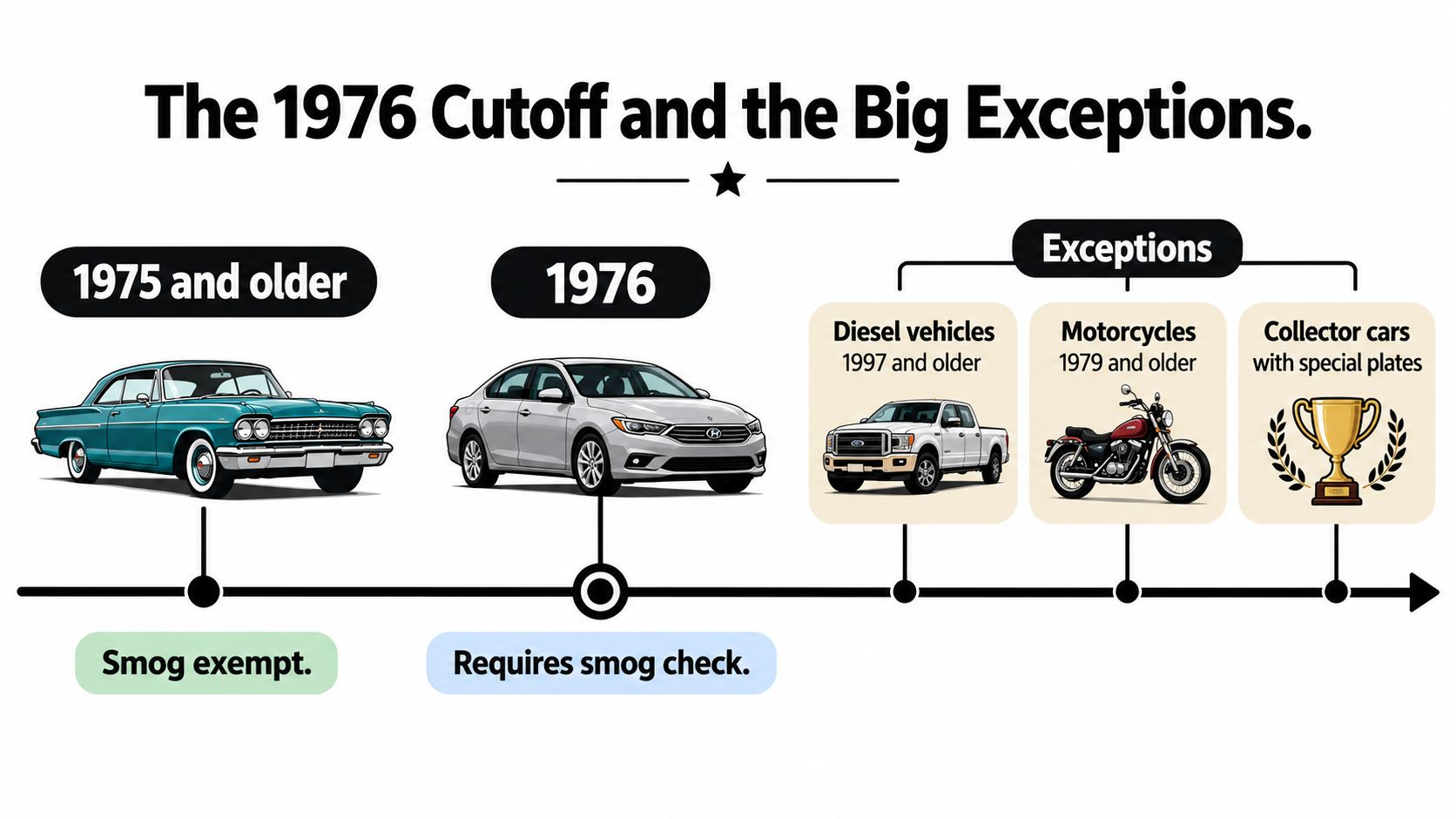
A 1972 Mustang is generally outside the program because it predates the cutoff. An 1985 gasoline sedan is generally inside it, even if it's well maintained and driven only occasionally. The age of the car doesn't move the legal line. Its model year does.
Weight and inspection equipment matter
The standard answer changes when the vehicle falls outside the usual passenger-vehicle category. For 2000-and-newer vehicles with a gross vehicle weight rating of 14,000 pounds or less, California generally uses an OBD-II-based inspection. Vehicles above that weight, or vehicles without the applicable onboard diagnostic system, may follow a different testing path.
That's why I don't give a blanket answer based on the year alone. A heavy vehicle, unusual fuel type, missing diagnostic system, or special registration status can change how the inspection is performed.
The out-of-state exception catches people
BAR states that all out-of-state 1976-and-newer vehicles need a Smog Check for first-time California registration. That requirement can apply even when the vehicle is still within the normal exemption period for a recurring California renewal.
If you've brought a vehicle to San Leandro from Nevada, Oregon, Arizona, or anywhere else, don't assume its previous state inspection carries over. California's first-registration event is its own trigger. For older vehicles, the guidance for smog checks on older cars can help you identify which inspection path may apply.
How the Eight-Year Renewal Exemption Works
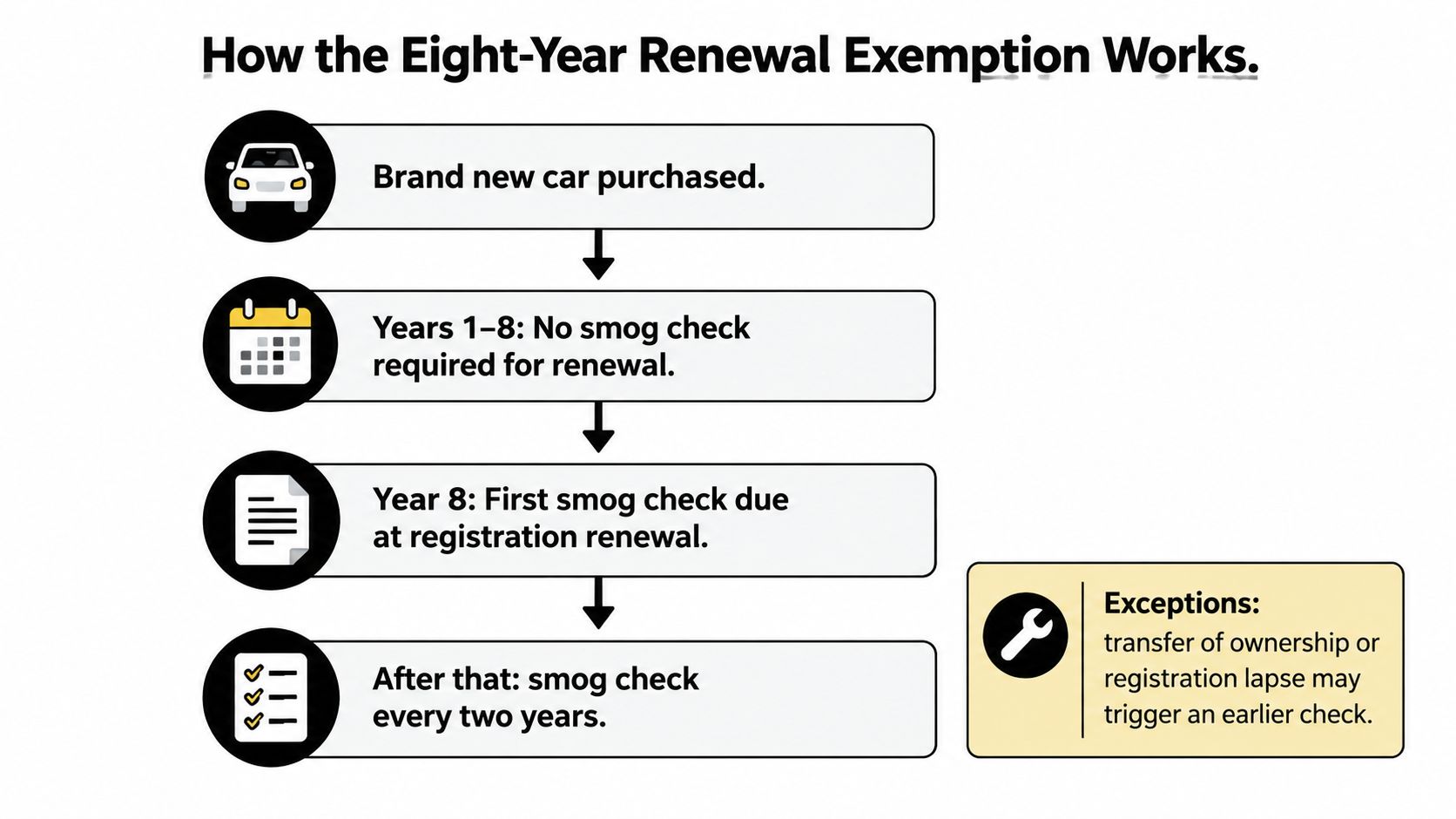
A newer car can be inside California's Smog Check program without needing an inspection at every renewal. For regular registration renewal, BAR says gasoline vehicles eight or fewer model years old are generally exempt from the biennial inspection. During that period, the owner generally pays a smog-abatement fee instead. The BAR renewal exemption guidance explains the practical calculation, add eight to the model year to find the first year a renewal inspection is generally required.
Take a 2020 model-year vehicle. Add eight to the model year, and the first recurring renewal inspection generally arrives in 2028. That's a model-year calculation, not a calculation based on the day you bought the car. The DMV notice still decides what you must complete for the specific renewal.
A 2018 model-year vehicle is already beyond that eight-model-year window. If its registration renewal calls for certification, the owner should plan for a smog inspection rather than assuming the car is still covered by the newer-vehicle exemption.
Renewal and ownership transfer use different clocks
The ownership-transfer rule is shorter. Vehicles four or fewer model years old are generally exempt from the change-of-ownership Smog Check, but the buyer pays a smog-transfer fee instead. BAR's practical method is to add four to the vehicle's model year to identify when that transfer exemption ends.
| Transaction | General age rule | What usually happens |
|---|---|---|
| Registration renewal | Eight or fewer model years old | Smog-abatement fee instead of the routine inspection |
| Ownership transfer | Four or fewer model years old | Smog-transfer fee instead of the transfer inspection |
| Older qualifying vehicle | Beyond the applicable exemption | Certification is generally required for the transaction |
A 2022 vehicle reaches the change-of-ownership threshold in 2026, while a 2018 vehicle is already beyond the four-model-year exemption. Those examples show why a car can avoid a renewal inspection yet still face a different requirement when sold.
For a practical explanation of the newer-car rule, see this guide to a California smog check for new cars. Then look at the paperwork, not just the calendar. An out-of-state vehicle, a registration event, or a transfer can override the assumption that the car is too new to test.
OBD-II Versus the Older Tailpipe Test
The inspection your car receives depends largely on its model year and equipment. California generally uses an OBD-II-based inspection for 2000-and-newer vehicles with a gross vehicle weight rating of 14,000 pounds or less. A technician connects to the vehicle's diagnostic port and checks the emissions computer rather than measuring the exhaust at the tailpipe.
A 1976–1999 gasoline vehicle generally receives the older BAR-97-style tailpipe inspection. That process evaluates emissions coming out of the exhaust, so it measures a different part of the vehicle's emissions system than an OBD-II inspection.
| Model year | Typical test type | What it measures |
|---|---|---|
| 1976–1999 gasoline | BAR-97-style tailpipe test | Exhaust emissions at the tailpipe |
| 2000 and newer, up to 14,000 pounds GVWR | OBD-II-based test | Diagnostic data and emissions-system status |
| Outside the standard category | Different test path may apply | Vehicle-specific emissions requirements |
The failure patterns aren't the same. With an OBD-II test, a lit check-engine light, stored emissions fault, or incomplete readiness information can stop the vehicle from passing. Clearing the battery or a trouble code immediately before testing can also leave the computer without the information it needs to show that its self-checks are complete.
The older test focuses more directly on measured exhaust output. A clean dashboard doesn't guarantee a 1985 vehicle will pass if its actual emissions exceed the applicable limits.
The connector tells the technician what the computer sees. The tailpipe test tells the technician what the engine is actually producing.
Hybrids, diesels, vehicles above 14,000 pounds GVWR, and vehicles without the applicable onboard system can follow different testing rules. Don't choose a shop based only on the assumption that every car receives the same inspection. If you want the technical distinction in one place, review the explanation of OBD versus tailpipe testing.
Real Situations That Change the Answer
An Oakland resident moves back to California with a 2019 SUV purchased and registered in another state. The vehicle may still be within the regular renewal exemption period, but this isn't a routine California renewal. It's the vehicle's first California registration, and an out-of-state 1976-and-newer vehicle generally needs a Smog Check for that event.
That driver should read the DMV registration instructions and schedule the appropriate inspection before assuming the newer vehicle can skip testing. The previous state's inspection history doesn't erase California's first-registration requirement.
A San Leandro driver sells a 2016 sedan to a private buyer. The car is beyond the four-model-year ownership-transfer exemption, so the seller should expect a smog certification requirement for the transfer unless the paperwork or transaction falls under a separate rule. The fact that the vehicle may have passed a previous renewal test doesn't settle the transfer requirement.
That's the distinction people miss at the DMV. The model year sets the default, but the transaction type decides which rule applies.
Three quick counter examples
- A 1972 Mustang: Generally exempt because it's 1975 or older. The owner should still follow the DMV instructions for registration and title paperwork.
- A 2019 out-of-state SUV: Generally requires a Smog Check for first California registration, despite being a newer vehicle.
- A 2016 private-party sedan: Generally beyond the transfer exemption, so certification is generally needed for the ownership change.
The same vehicle can have different requirements at different points in its life. Ask whether you're renewing, transferring, or registering from out of state before asking only what year the vehicle is.
What to Do Before You Head to a Smog Shop
Run through this checklist before driving across the East Bay. It prevents wasted trips and helps the technician identify the right inspection quickly.
- Read the DMV notice. Confirm whether the state wants a renewal inspection, transfer certification, or first-registration test.
- Check the dashboard. A lit check-engine light is a warning sign for an OBD-II vehicle. Have the cause diagnosed before you pay for an inspection.
- Bring the paperwork. Take the renewal notice, registration, title or transfer documents, and any instructions from the DMV.
- Confirm the station type. Some DMV-directed vehicles must use a STAR Certified station. If your notice or vehicle record directs you to STAR, don't use a non-STAR location.
- Ask about preparation. The technician can tell you whether the vehicle needs a particular warm-up or readiness procedure before testing.
Speedy Smog is one San Leandro option for drivers who need a STAR Certified station and inspections for newer vehicles, older vehicles, diesels, or hybrids. Its site also publishes periodic $25-off coupons for most smogs on newer vehicles, so check the current offer before scheduling if your vehicle qualifies.
The practical point is simple: bring the notice and let the paperwork drive the appointment. A shop can inspect the vehicle, but the DMV decides which compliance event you're completing.
Putting It All Together for Your Next Renewal
Remember three anchors. 1976 generally defines which gasoline and qualifying alternative-fuel vehicles are in the Smog Check program. The eight-year renewal exemption and four-model-year transfer exemption determine when newer vehicles generally start needing certification. The transaction, renewal, transfer, or first California registration, determines which rule applies.
Before you book anything, read the DMV renewal notice. That one habit prevents most confusion and keeps you from paying for the wrong type of appointment.
For an East Bay inspection, visit a STAR Certified station such as Speedy Smog in San Leandro, where staff can check the requirement against your paperwork and handle many 2000-and-newer tests efficiently.
Bring your DMV notice to Speedy Smog in San Leandro for a STAR Certified inspection matched to your renewal, transfer, or California registration requirement. The shop handles newer vehicles, older cars, diesels, and hybrids, so you can confirm the correct test before getting back on the road.