
You're probably reading this because your DMV renewal notice is sitting on the counter, your registration deadline is getting close, and you're not sure whether you need a regular smog station or a STAR station. Maybe you already paid the renewal fees and expected the process to be finished, only to see that DMV still shows a smog requirement.
That confusion is common in the East Bay because the inspection and registration systems are connected, but they aren't the same step. The station performs the inspection and sends the result electronically. DMV then uses that result to clear the registration requirement. If either side has the wrong vehicle record, missing information, or an unresolved hold, your renewal can remain incomplete.
Table of Contents
- What Car Registration Inspection Actually Covers
- Decide Whether Your Vehicle Needs a Test
- Prepare Your Documents and Pick the Right Station
- What Happens During the Inspection Itself
- Move From Certificate to Completed Renewal
- Handle a Failed Inspection the Right Way
- Quick Checklist Before You Book and After You Pass
What Car Registration Inspection Actually Covers
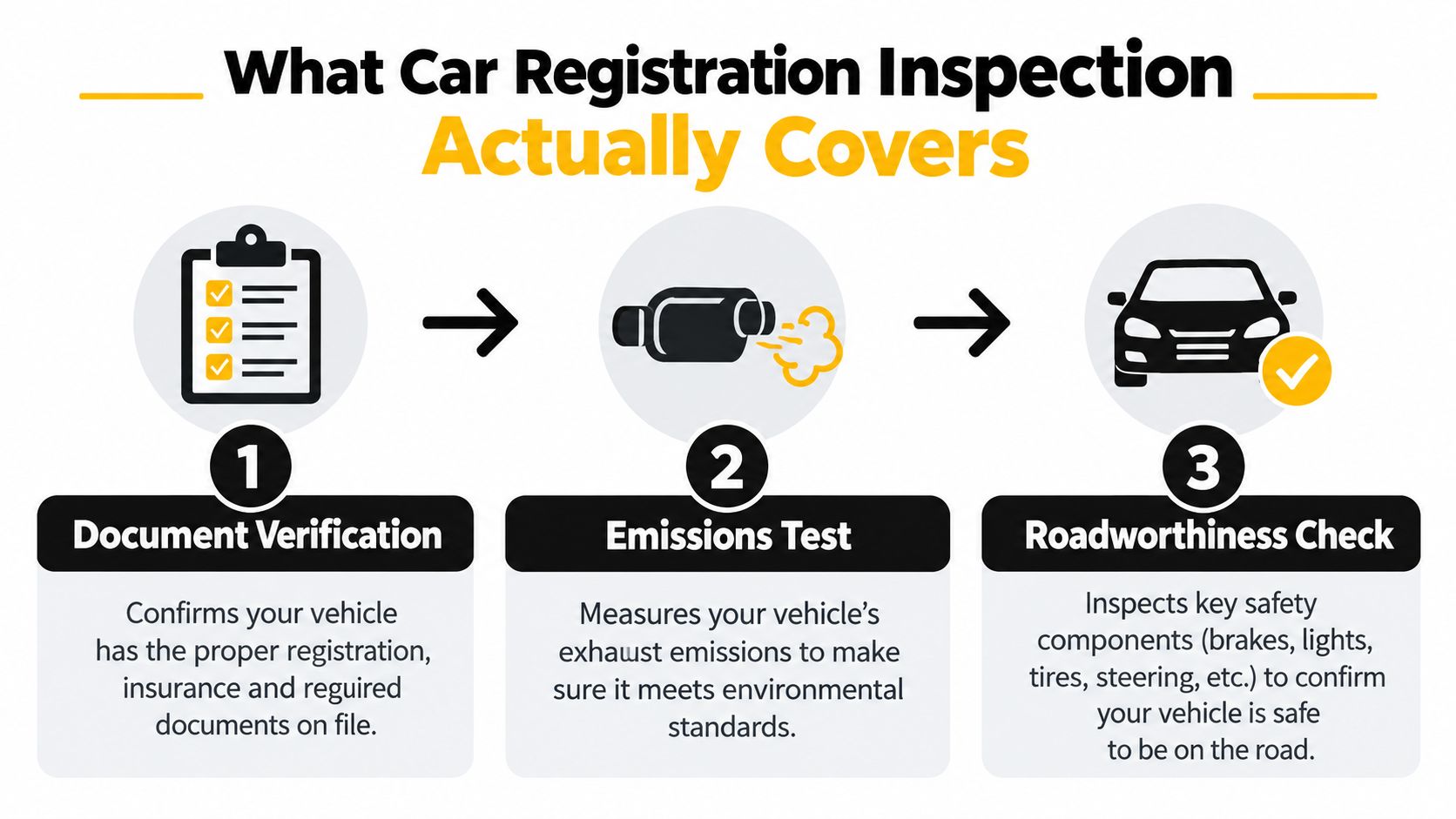
A car registration inspection is more than a tailpipe check. It's a compliance workflow that connects your vehicle identity, the applicable emissions inspection, and the electronic record DMV needs before it can finalize registration.
Start with the paperwork. The technician needs to identify the correct vehicle and match the inspection to the record on your renewal notice. In California, the station scans the notice barcode so the vehicle information can be transmitted accurately to DMV. That step matters because a passed test attached to the wrong record won't clear the right registration hold.
The inspection itself depends on the vehicle's profile. Fuel type, model year, weight, and registration situation determine which requirements apply. Routine testing generally occurs every two years for covered vehicles, but a first California registration, an out-of-state vehicle, or a change of ownership can create a testing requirement even when the vehicle doesn't need a routine renewal inspection. The California Bureau of Automotive Repair performance report describes the program as one of the largest inspection-and-maintenance networks in the country, with more than 8,000 active stations during calendar years 2024 and 2025.
The three parts that matter
- Vehicle and document verification: The station confirms the notice, VIN, and vehicle record before submitting the result.
- Applicable emissions inspection: The technician performs the test required for that vehicle and registration context.
- Electronic certification: The station issues a Vehicle Inspection Report and transmits the result to DMV.
Practical rule: Treat the inspection report as proof of the station visit, not as proof that your registration is already renewed.
The program has a clear environmental purpose as well. A Lawrence Berkeley National Laboratory analysis of California's Enhanced Smog Check program estimated that inspections in 1999 reduced daily tailpipe emissions by approximately 97 tons of hydrocarbons, 1,690 tons of carbon monoxide, and 81 tons of nitrogen oxides. The analysis found that vehicles more than 10 years old produced most of the program's emissions benefits, even though they represented about half of inspected vehicles.
For you, the takeaway is simple. First identify the requirement, then choose the correct station, confirm the vehicle record, and verify that DMV received the certification. That sequence prevents most registration delays.
Decide Whether Your Vehicle Needs a Test
Don't book an appointment based only on the vehicle's age or the fact that your neighbor needed a smog check. California uses several filters, and the registration context can override a routine exemption.
The first filter is propulsion. Electric vehicles are exempt from Smog Check. Gasoline vehicles from model year 1975 or older are also exempt, while gasoline vehicles from model year 1976 onward generally fall within the program. Diesel vehicles from model year 1997 or older generally qualify for an exemption, and diesel vehicles over 14,000 pounds are also listed among the exemptions. The California DMV smog inspection guidance provides the official category rules.
Gasoline vehicles that are eight model years old or newer are generally exempt from the routine biennial inspection. That doesn't mean they're exempt from every smog requirement. A newer vehicle may still need testing during its first California registration or a change-of-ownership transaction. Some newer gasoline vehicles may instead be subject to a smog-abatement fee.
Use the notice, not guesswork
Pull out the DMV renewal notice before calling a station. Look for language that says “Smog Certification Required at a STAR station.” If the notice directs you to STAR, a regular station won't satisfy that requirement.
Hybrids deserve special attention. California generally treats gasoline, hybrid, and alternative-fuel vehicles from model year 1976 onward as vehicles that can fall within the Smog Check program. An electric vehicle is different because it has no gasoline engine emissions system to inspect. Diesel rules also differ from gasoline rules, so don't use a gasoline exemption to decide what applies to a diesel truck.
| Vehicle type | Model year or age | Inspection required? |
|---|---|---|
| Gasoline vehicle | Model year 1975 or older | Generally exempt |
| Gasoline vehicle | Model year 1976 onward | Generally within the program, subject to exemptions |
| Gasoline vehicle | Eight model years old or newer | Generally exempt from routine biennial testing, but registration or ownership events can still trigger testing |
| Hybrid vehicle | Model year 1976 onward | Generally within the program |
| Diesel vehicle | Model year 1997 or older | Generally exempt |
| Diesel vehicle | Over 14,000 pounds | Generally exempt under the listed DMV category |
| Electric vehicle | Any model year | Exempt |
The Bureau of Automotive Repair's Smog Check overview reports that about 19 million model-year-2000-and-newer vehicles were tested during calendar years 2024 and 2025, with approximately 1.3 million failures, an overall failure rate of about 7%. That's why classification matters. A test requirement isn't determined by one simple age rule.
Prepare Your Documents and Pick the Right Station
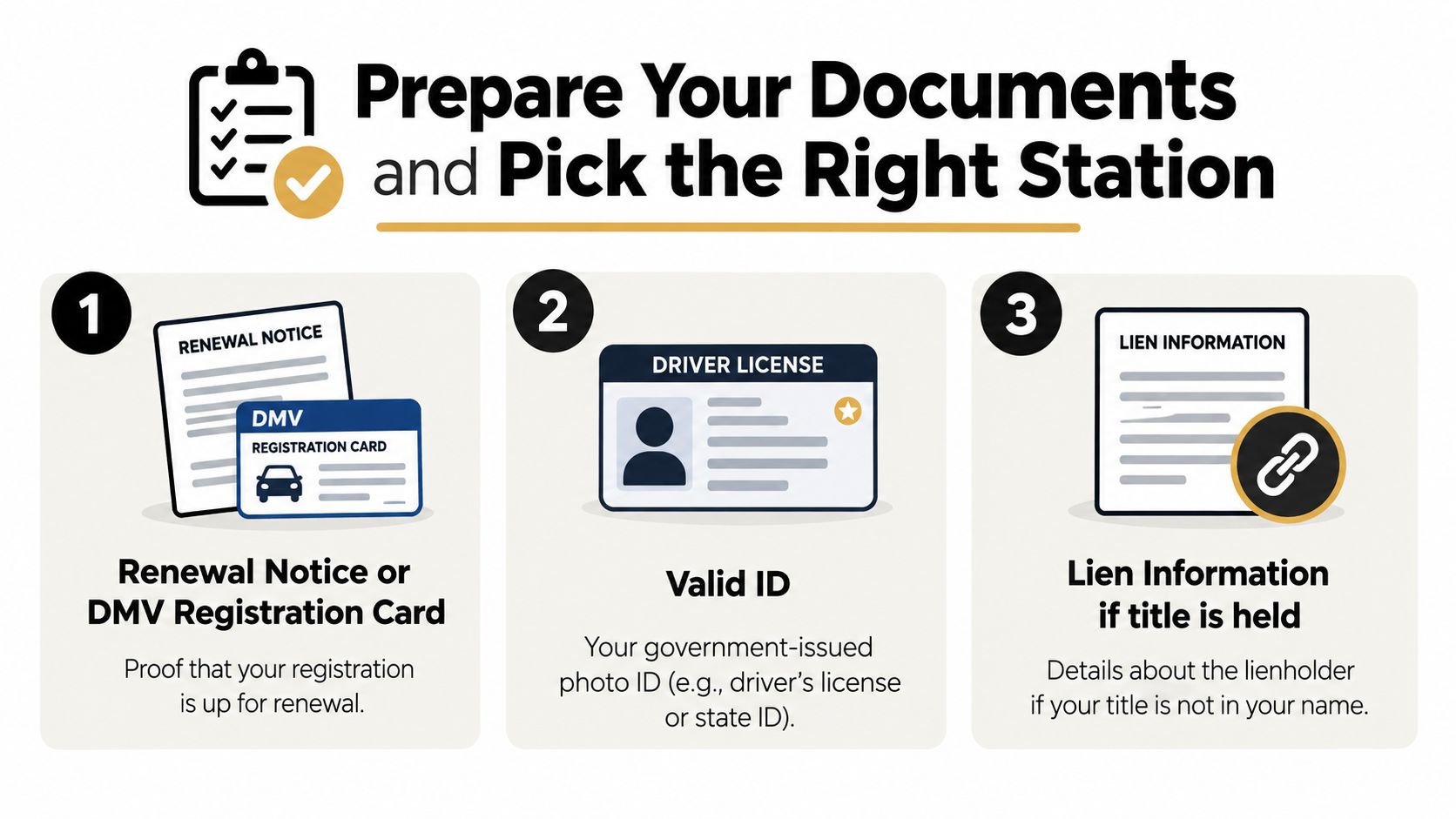
Bring the DMV renewal notice whenever you can. Its barcode helps the technician send the inspection to the correct vehicle record. Check the plate number and VIN on the notice before leaving home, especially if you have more than one vehicle or recently changed ownership.
Your preparation should answer two questions before the car enters the bay:
- What does DMV require? Read the renewal notice and identify whether it calls for any authorized station or a STAR station.
- Does the vehicle match the notice? Confirm the plate, VIN, fuel type, and registration situation.
- Is the car ready to test? Resolve a check engine light or known emissions problem instead of hoping the inspection won't detect it.
- Can the station handle this vehicle? Confirm that the station works with your vehicle's fuel type, model year, and inspection category.
STAR or regular station
A regular authorized station may be appropriate when the notice doesn't specify STAR. A STAR station is required when DMV directs you there. That direction can apply to certain renewal records, vehicles sent there after a previous failure, and other categories established by the state program.
Don't make the station choice based on the shortest drive alone. A cheap or convenient appointment becomes expensive if the station can't submit the result your renewal requires. Read the notice first, then call if the wording is unclear.
For East Bay drivers, California smog check station information can help you confirm the type of service offered before you arrive. The important point isn't the shop name. It's whether the location is authorized for the exact inspection your DMV record requires.
The renewal notice is the key document. Keep it available on your phone or bring the paper copy, but don't rely on a plate number alone if the station needs the barcode to transmit the correct record.
What Happens During the Inspection Itself
At the station, hand over the renewal notice and let the technician establish the vehicle record before the test begins. The technician scans the barcode, confirms the vehicle information, performs the applicable inspection, and creates the Vehicle Inspection Report. That electronic handoff is what connects the station visit to DMV.
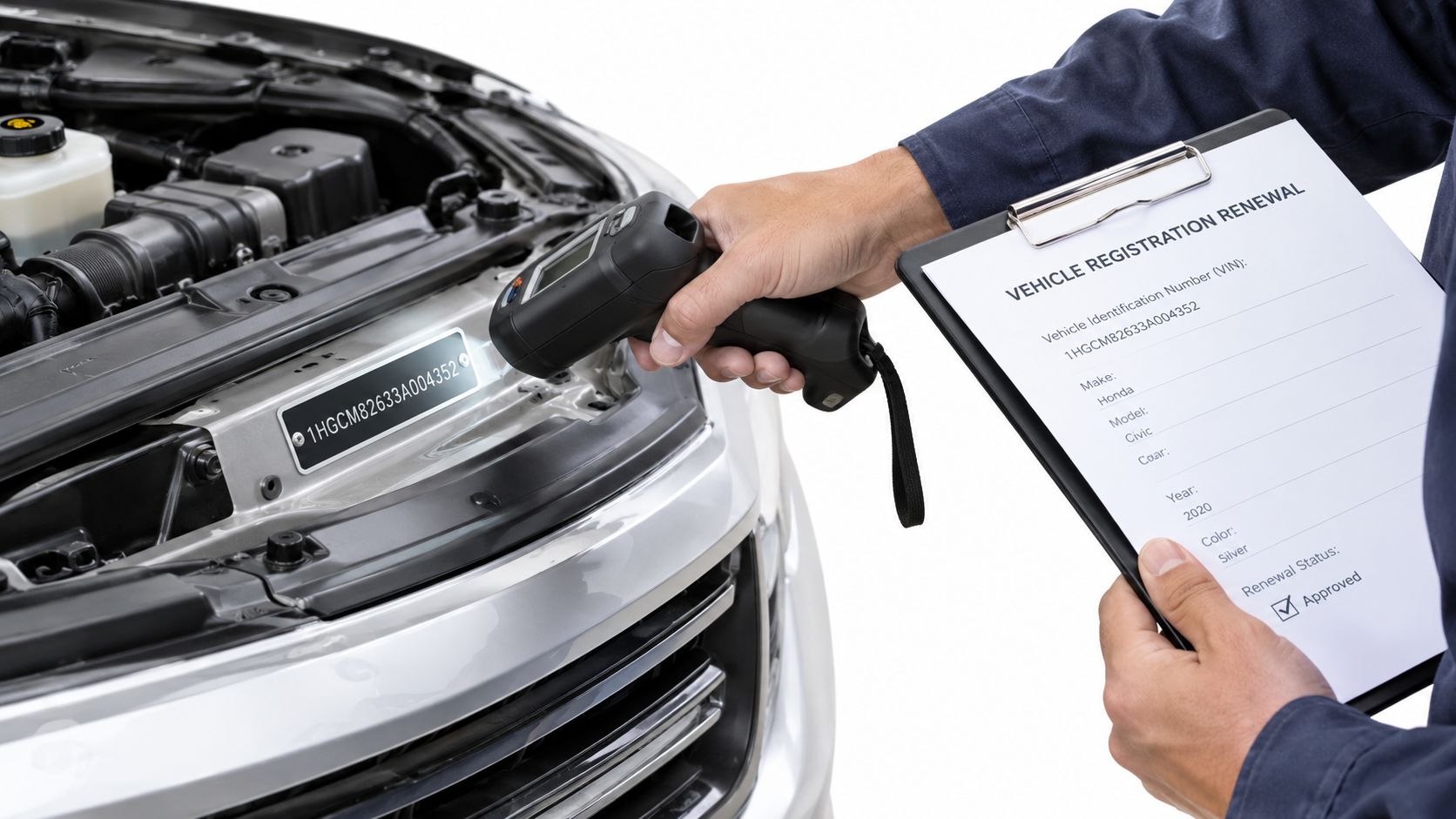
Don't treat the printed report as a form you must personally mail to DMV. The station submits the certification electronically. You should still check every identifying detail before leaving. A wrong plate, VIN, or vehicle record can create a problem even when the vehicle itself passed.
The technician may ask you to leave the car while the inspection is performed. That's normal. What you should expect at the end is a clear result, a Vehicle Inspection Report, and an explanation of anything that prevented a pass. Ask for an itemized receipt and keep the report in the vehicle records.
What STAR changes
STAR doesn't mean your vehicle receives a completely different registration process. It means you must use a station authorized for a STAR-directed inspection. The station still verifies the record, performs the applicable inspection, and submits the result electronically.
If the vehicle fails, don't approve repairs based on a vague statement such as “it needs emissions work.” Read the report and ask which test element failed. You need that information before deciding whether to use the same shop, another repair facility, or the BAR Referee pathway.
This short video shows the general relationship between an inspection visit and vehicle emissions compliance:
The station visit ends when the result is recorded and the report is in your hands. Registration renewal is a separate task. Passing is necessary, but it doesn't replace the DMV transaction.
Move From Certificate to Completed Renewal
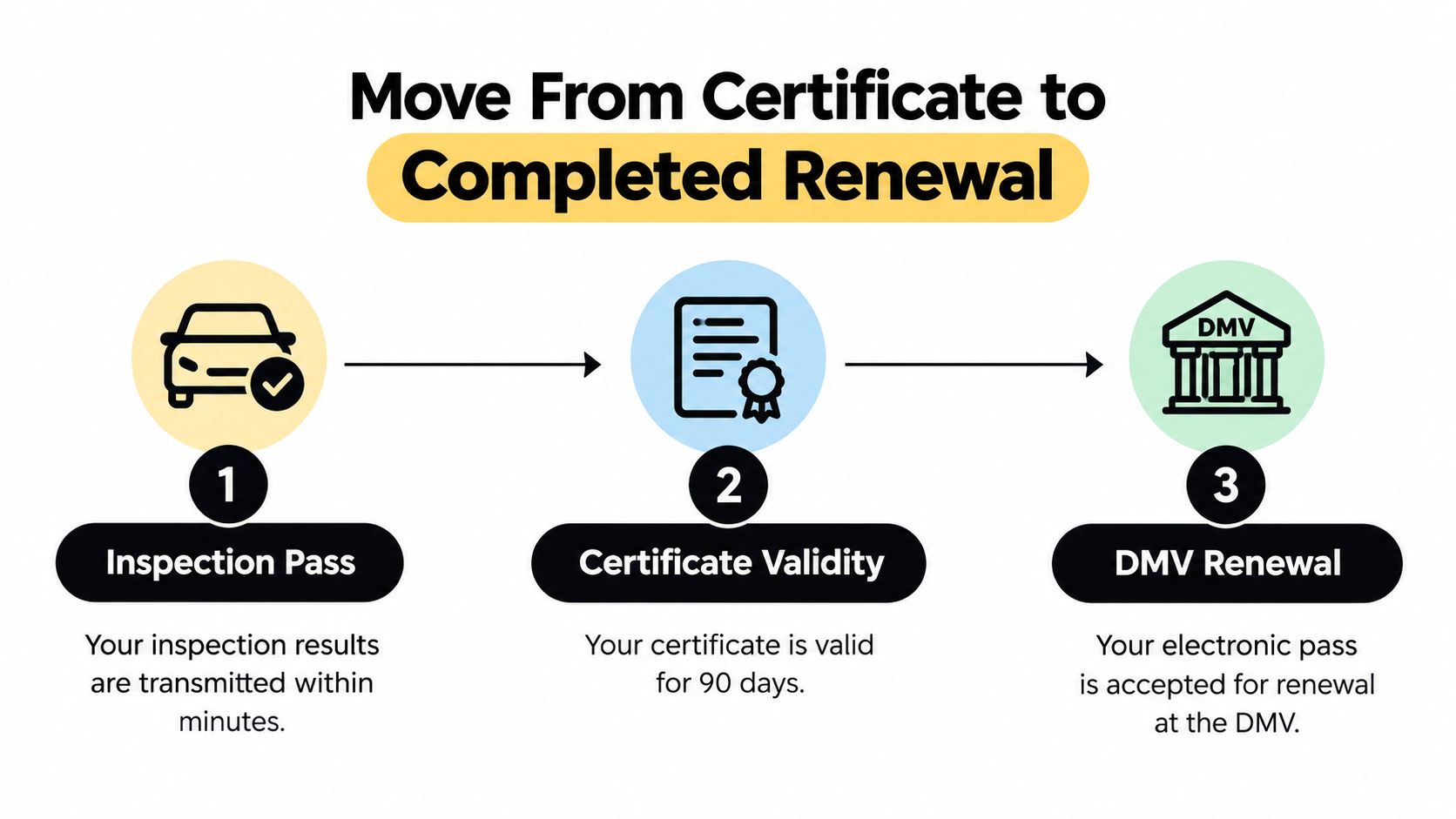
A passing result clears the smog requirement electronically, but DMV still has to process the registration renewal. California DMV says online renewal requires the electronic smog certification to be on file. Paying registration fees alone doesn't finalize the renewal if the certification or another requirement is still outstanding, as explained in the DMV vehicle registration renewal guidance.
The certificate remains valid for 90 days, according to the Bureau of Automotive Repair. Use that period to complete the renewal instead of assuming the pass will remain available indefinitely.
Check the electronic handoff
Before you pay again, verify the status of the vehicle in the DMV system. If the portal still shows a smog requirement, compare the plate and VIN on your report with the vehicle information in the renewal record. Call the station first if the information doesn't match. The station can confirm what it submitted and whether the record was accepted.
Don't assume a delay means you need another inspection. DMV guidance says some assisted processing can take up to 30 days, so allow time for the record to update when the submission is correct. If another hold appears, such as an unpaid parking matter, the smog certification won't resolve that separate issue.
The pass removes one obstacle. It doesn't complete the transaction.
Complete the renewal through the method DMV offers for your record, whether online, by mail, in person, or through another authorized channel. Save the receipt, the Vehicle Inspection Report, and the confirmation that registration was completed. If DMV asks for proof later, you'll have the station document and the renewal record together.
For a practical overview of the station-to-DMV process, smog check registration renewal information can help you identify the steps that remain after the test.
Handle a Failed Inspection the Right Way
A failed inspection gives you a diagnostic starting point. It doesn't tell you to replace every part associated with the emissions system, and it doesn't automatically mean the vehicle can't be driven home. Read the Vehicle Inspection Report and identify the exact reason for the failure before authorizing repairs.
Ask a repair shop for a written estimate. A qualified technician should explain whether the problem involves a gas cap, emissions-control component, readiness issue, sensor, exhaust system, or another test element. Don't accept a large repair recommendation without seeing how it connects to the failed result.
| Failure cause shown on the report | Likely next step | Typical cost range |
|---|---|---|
| Gas cap or evaporative-emissions issue | Inspect, diagnose, and repair the leak or cap problem | Varies by diagnosis |
| Sensor or emissions-control fault | Confirm the code and test the related system before replacement | Varies by diagnosis |
| Catalytic-converter or exhaust-related failure | Obtain a written diagnosis and verify the required component | Varies substantially |
| Readiness or testing issue | Ask the technician what condition prevented certification | Varies by cause |
| Unresolved failure after repairs | Keep reports and receipts, then ask about the next official step | Determined by the case |
California DMV says an owner whose vehicle failed the biennial inspection may qualify for a Temporary Operating Permit valid for 60 days. The owner must provide the failed report, registration fees, proof of insurance, and the required fee, and DMV generally allows only one such permit for the same vehicle within a two-year period. Review the DMV vehicle information guidance before applying because the permit doesn't erase the failed result or guarantee a later pass.
Know when to use the BAR Referee
The BAR Referee Program is the state's next-step resource for difficult inspection situations. DMV directs owners toward the Referee Program when a vehicle fails and needs additional assistance. Use that route when the failure involves an unusual configuration, disputed emissions equipment, special circumstances, or a problem that ordinary repairs haven't resolved.
Keep the failed report, repair orders, parts information, and receipts. Those records establish what the station found and what the repair facility attempted. They also give the Referee a clear history instead of forcing you to explain the entire case from memory.
The right response to a failure is controlled diagnosis. Don't clear the warning light and immediately return unless the technician confirms the vehicle is ready for a valid retest. A reset can erase useful information and leave the underlying problem untouched.
For drivers who want a retest after an eligible repair, smog check free retest information explains the station's available process. Confirm the terms directly before scheduling.
Quick Checklist Before You Book and After You Pass
Use the DMV notice as your control document. It tells you more than a generic online checklist because it reflects the registration record attached to your vehicle.
Before booking
- Find the renewal notice: Keep the notice available so the station can scan the barcode and match the inspection to the right vehicle.
- Confirm the plate and VIN: Compare the notice with the vehicle before you schedule.
- Identify the fuel type: Gasoline, diesel, hybrid, alternative-fuel, and electric vehicles can follow different rules.
- Check the model year and weight: These details can determine whether an exemption or special category applies.
- Choose the station type: Use a STAR station if the notice specifically requires STAR. Otherwise, confirm that the selected station is authorized for your vehicle.
Before arriving
- Resolve warning lights: A check engine light or known emissions fault deserves diagnosis before testing.
- Bring the vehicle record: Take the renewal notice or the relevant DMV document.
- Ask about special circumstances: Mention an out-of-state transfer, ownership change, diesel configuration, or other unusual registration situation.
- Plan for the report: Leave with the Vehicle Inspection Report and a receipt, whether the result is a pass or failure.
At the station
- Verify the vehicle identity: Check the plate and VIN before the technician submits the inspection.
- Confirm the result: Ask what the report says, not just whether someone verbally says “pass.”
- Keep the paperwork: Store the printed report with your registration records.
- Ask about the electronic submission: Confirm that the result was transmitted to DMV.
After a pass
- Check DMV status: Look for the electronic certification before assuming the renewal is complete.
- Finish the payment: The certificate clears the smog requirement, but DMV still needs the registration transaction completed.
- Resolve separate holds: Parking matters or other outstanding requirements can keep renewal from processing.
- Save the record: Keep the report and renewal confirmation together for future questions.
The mistakes to avoid are straightforward. Don't use a non-STAR station when DMV directs you to STAR. Don't ignore a warning light and hope the test misses it. Don't pay registration fees and assume the vehicle is renewed before DMV confirms completion. A clean inspection result is only one part of the process.
If you need a STAR inspection in San Leandro, Speedy Smog can perform the applicable smog check, transmit the result electronically to DMV, and provide the Vehicle Inspection Report for your records. Visit Speedy Smog with your renewal notice and confirm the correct station requirement before you arrive.
A standard smog check for a 2000 or newer vehicle takes about 10 to 15 minutes at a STAR station and runs roughly $60 to $90, plus California's $8.25 state certificate fee. That makes it one of the faster DMV-required steps, but preparation matters because a vehicle with unresolved emissions problems or incomplete readiness monitors can still fail.
You may be searching for smog test Rocklin CA after discovering that registration renewal is waiting on an emissions certificate. The good news is that the appointment itself is usually simple. The stressful part comes when a driver arrives with a recently disconnected battery, an illuminated check engine light, the wrong station, or a vehicle that falls under a rule they didn't know existed.
This guide breaks down the process in plain language, from vehicle exemptions and testing equipment to readiness monitors, failed inspections, and financial assistance. You'll know what to check before booking and what to do if the result isn't what you expected.
Table of Contents
- Why Your Rocklin Smog Check Matters More Than You Think
- How California Smog Checks Actually Work
- Which Vehicles Need a Smog Check and Which Do Not
- Finding a Smog Check Station Near Rocklin
- What to Expect During Your Smog Check Appointment
- When Your Vehicle Fails the Smog Check
- How to Prepare for a Fast and Hassle-Free Smog Check
Why Your Rocklin Smog Check Matters More Than You Think
Maria's car runs smoothly, yet her registration renewal stops at the smog check requirement. At the station, the technician asks whether she recently replaced the battery. Maria is unsure why that matters. Disconnecting power can erase the vehicle's emissions-monitor results, so the car may need time and driving conditions to complete its self-tests before inspection.
That small detail shows why a smog check is more than a quick formality. California connects the inspection to registration compliance, and a passing result gives the state a current record that the vehicle meets applicable emissions requirements. A car can feel normal while its emissions system still has an unresolved fault or incomplete diagnostic information.
California's program has operated for decades. The state adopted its vehicle emissions inspection and maintenance program in 1982 and assigned administration to the Bureau of Automotive Repair in 1984, according to BAR's consumer protection and program history resources. Rocklin drivers are following an established statewide system, not a rule created only for local motorists.
Practical rule: The fastest appointment is the one you prepare for before arriving.
Three questions usually come first: Do I need a test, where should I go, and what happens if I fail? The answers depend on the vehicle's model year, fuel type, registration status, and diagnostic readiness. California's tightened 2025 readiness-monitor rules make that last item especially important. A recently disconnected battery may leave monitors incomplete, even if the check engine light is off.
A station such as Speedy Smog's California smog check resource can explain the general process. Confirm your vehicle's exact requirements before booking, because station eligibility and testing rules can differ by vehicle.
BAR also offers digital tools, including Vehicle Inspection History Lookup. Reviewing prior records can confirm whether a recent test was reported and show whether an earlier failure may still affect your registration. Drivers who cannot afford needed emissions repairs should also look into California's statewide assistance programs before assuming the only option is paying the full repair bill.
How California Smog Checks Actually Work
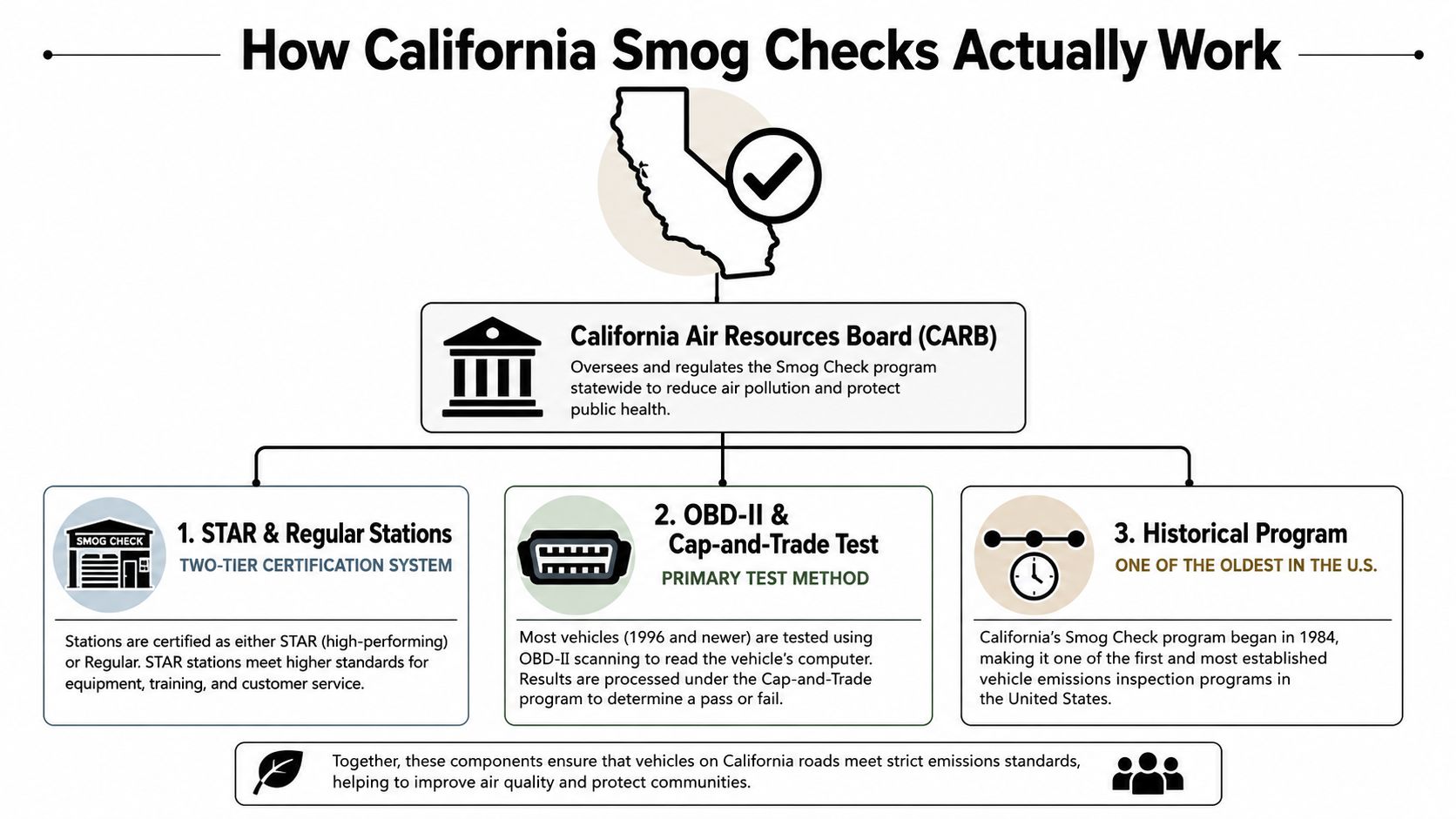
California's inspection method changes with the vehicle. That design matters because an older car may be evaluated through direct tailpipe measurements, while a newer vehicle is generally checked through its onboard diagnostic system.
The state uses the BAR-97 Emissions Inspection System for vehicles from 1999 and older. This equipment measures tailpipe emissions directly. A technician uses the station's approved testing equipment and evaluates the gases leaving the exhaust rather than relying only on electronic information from the vehicle.
Vehicles from 2000 and newer are handled through the BAR-OIS process, which uses the car's onboard diagnostic information. The inspector connects approved equipment to the vehicle's diagnostic port and checks emissions-related data, trouble codes, and readiness status. BAR describes these procedures through its official Smog Check program information.
Why the station type matters
A STAR station is authorized to inspect vehicles under California's Smog Check framework and meets higher performance standards established by BAR. Drivers often look for STAR certification because some vehicles and registration situations require a STAR inspection, while others can use a regular licensed station.
The label doesn't mean every vehicle will pass. It means the station operates within a recognized inspection program and uses approved procedures. You'll still want to confirm that the shop handles your fuel type, model year, and any unusual configuration.
The testing split also explains why appointment times and equipment differ. A technician inspecting a 1999 vehicle may need to perform a tailpipe emissions test, while an inspector working on a 2000 vehicle may focus on OBD data and the vehicle's electronic self-checks. For a broader explanation of California procedures, review this guide to how smog checks work in California.
Which Vehicles Need a Smog Check and Which Do Not
A driver registering a car in Rocklin may ask, “Do I need a smog check?” The answer depends on the vehicle's model year, fuel type, registration situation, and ownership change. Use California's Smog Check requirements as the governing reference, and see our emissions testing requirements guide for a fuller breakdown.
Gasoline and flex-fuel vehicles from 2000 and newer generally receive an OBD II-based inspection. Older gasoline vehicles may require a direct tailpipe test. Diesel vehicles follow separate rules, so applying gasoline assumptions to a diesel can lead to an unexpected result.
| Vehicle Type | Testing Method | Key Rule |
|---|---|---|
| Gasoline or flex-fuel, 2000 and newer | OBD II-based inspection | Evaluated through onboard emissions data and readiness monitors |
| Gasoline vehicles, 1999 and older | BAR-97 tailpipe inspection | Tailpipe emissions are measured directly |
| Diesel, model year 1998 and newer, GVWR 14,000 pounds or less | Diesel Smog Check with OBD-related checks | These vehicles require inspection under BAR rules |
| Diesel, 1998 through 2006 | OBD-related monitor review | Zero incomplete monitors are allowed for the OBD portion |
| Diesel, 2007 and newer | OBD-related monitor review | Up to two incomplete monitors may still pass the OBD portion |
| Vehicles four model years and newer | Exempt from biennial and change-of-ownership Smog Checks | The exemption is based on vehicle age under the applicable rule |
| Out-of-state vehicles, 1976 and newer, registering in California | California inspection when first registered | A Smog Check is required during initial California registration |
The model-year details matter because the same dashboard warning or recent repair can affect vehicles differently. For example, a diesel vehicle with incomplete monitors may not receive the same result as a gasoline vehicle with the same condition.
The readiness-monitor change
Starting October 1, 2025, California's updated rule requires all readiness monitors to be set for a pass, with limited exceptions when a vehicle cannot feasibly meet the requirement. BAR explains the change in its 2025 Smog Check executive summary.
A readiness monitor works like a self-check stored by the vehicle's computer. Disconnecting the battery or completing a recent emissions repair can erase that status, leaving the system unfinished even when the car drives normally. Check readiness before the appointment so you can address an incomplete monitor before the inspection.
Finding a Smog Check Station Near Rocklin
A search for smog test Rocklin CA can return stations across Rocklin and the surrounding Sacramento region. Distance matters, but it shouldn't be your only filter. Start by confirming whether the shop is a STAR station, then ask whether it handles your vehicle's model year and fuel type.
Call before driving over if your vehicle is diesel, hybrid, modified, recently repaired, or being registered in California for the first time. A short conversation can prevent a wasted trip if the station doesn't perform the inspection your vehicle needs.
Questions to ask before booking
- Certification: Is the station STAR certified, and is STAR testing required for your registration situation?
- Vehicle coverage: Does the shop inspect your model year, diesel or hybrid system, and vehicle class?
- Price: Does the quoted price include the state certificate fee, or will that fee be added separately?
- Timing: Is an appointment available, and how does the station handle walk-ins?
- Retest policy: If the vehicle fails, what paperwork and retest options does the station provide?
Look for pricing that's clear before the inspection begins. A reputable station should explain what the test includes without promising a pass in advance. No technician can guarantee a passing result before checking the vehicle.
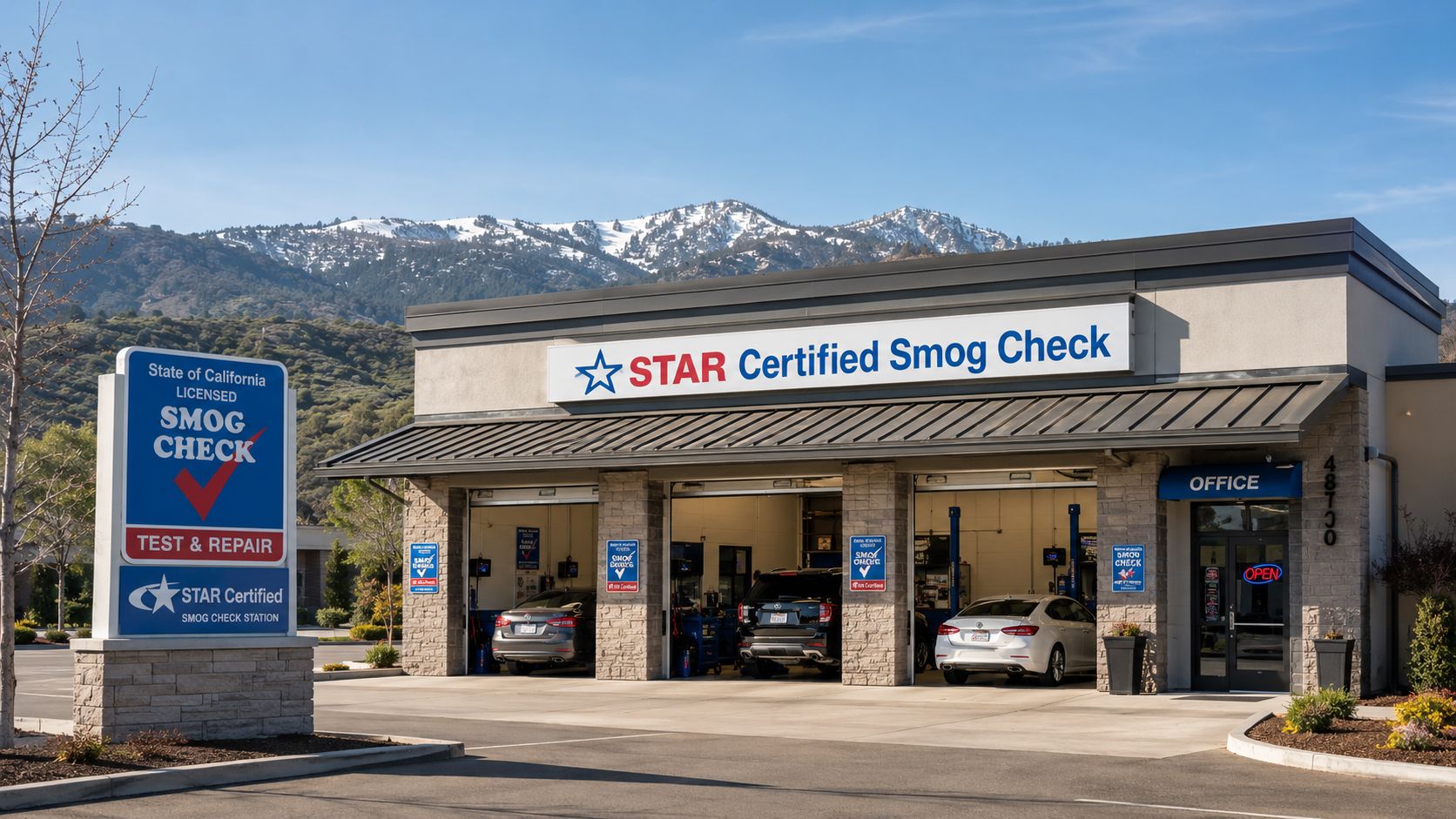
Speedy Smog is one option for drivers who need a STAR Certified inspection in the San Leandro area. The shop handles most vehicles, including 2000 and newer cars, older vehicles, diesels, and hybrids, and offers appointments as well as information about current pricing. Rocklin drivers should weigh the location against other nearby choices and select a station that matches their vehicle and deadline.
What to Expect During Your Smog Check Appointment
If this is your first appointment, the process is more organized than it may seem. Bring the vehicle, keys, registration or renewal notice, and a valid photo ID. For a change-of-ownership transfer, also have the name and address information required for that transaction.
At check-in, the inspector confirms the vehicle and transaction details. On a newer vehicle, the technician connects an approved scanner to the OBD port under the dashboard. The scan reviews diagnostic information and readiness monitors, which show whether the vehicle has completed its built-in emissions self-tests. Those monitors matter because recent battery work, erased codes, or unfinished drive cycles can leave the inspection incomplete even when the car feels normal.
Older vehicles may use BAR-97 equipment with a tailpipe probe. Instead of reading the vehicle's computer, the equipment measures exhaust emissions while the vehicle runs under the conditions required by the inspection procedure. In both cases, the test follows a defined sequence rather than serving as a general repair appointment.
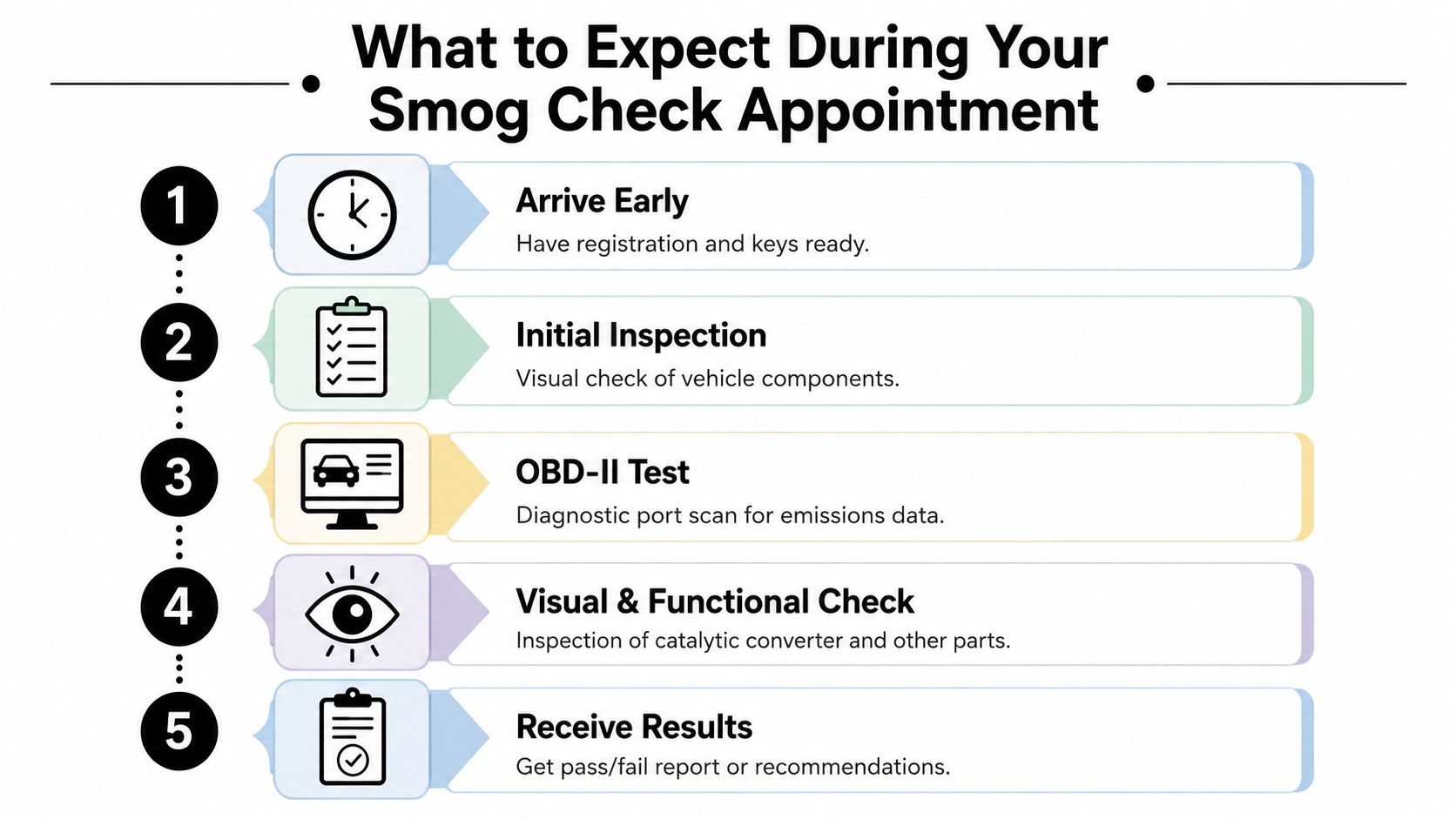
The appointment sequence
- Paperwork review: The station confirms the vehicle and transaction details.
- Visual inspection: The technician checks required emissions components and looks for obvious problems.
- Diagnostic or tailpipe testing: The equipment evaluates electronic emissions data or measures exhaust output, depending on the vehicle.
- Result entry: The inspector records the result in the state system.
- Certificate and report: You receive the result documentation, while the station submits the certificate electronically to the DMV when applicable.
A typical 2000 or newer vehicle takes about 10 to 15 minutes. The final price includes California's $8.25 Smog Check certificate fee, according to BAR's consumer protection information. Ask for the report even after a passing result. It documents the inspection and can clarify future registration questions.
The appointment resembles a structured vehicle scan more than a repair visit. If the result is incomplete or failing, ask which system, component, or readiness monitor caused it. The station may identify the issue, but repair work is a separate decision.
When Your Vehicle Fails the Smog Check
A failed result doesn't automatically mean the vehicle needs a major repair. The report should identify the reason for failure, such as an emissions fault, an illuminated malfunction indicator light, an inspection issue, or incomplete readiness monitors. Read the report before authorizing work.
California BAR's 2026 performance report states that about 1.3 million, or 7%, of 19 million 2000-and-newer vehicles tested during the 2024 through 2025 period failed Smog Check. That statewide result shows why a careful response matters. A failure is not unusual, but the next repair decision should come from the test results rather than guesswork. Review the BAR 2026 Smog Check performance report for the published program data.
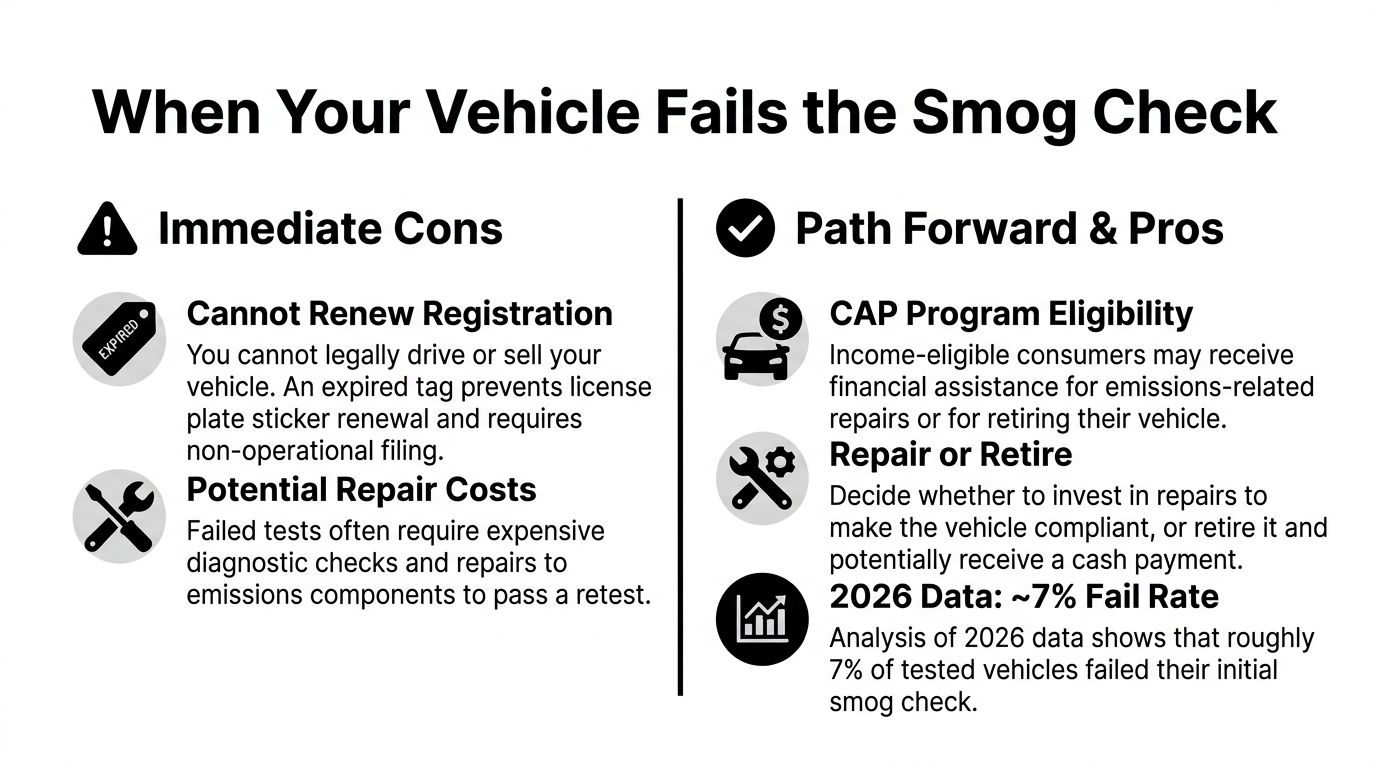
What to do after a failure
- Read the failure report: Identify the exact diagnostic code, monitor status, or component problem.
- Ask for diagnosis before parts: An oxygen sensor, catalytic converter, fuel system, or wiring problem can produce related symptoms, so testing should come before replacement.
- Repair the cause: A battery reset may require additional driving before monitors become ready, but driving alone won't fix an active emissions fault.
- Retest after the repair: Bring the vehicle back when the repair is complete and the applicable monitors are ready.
- Check assistance eligibility: California's Consumer Assistance Program may help qualifying owners with emissions-related repairs.
The program can provide up to $1,450 for emissions-related repairs on 1996 and newer vehicles that fail a biennial Smog Check. Vehicles from 1976 through 1995 may qualify for up to $1,100. BAR's Smog Check and Consumer Assistance information states that applicants must meet an income threshold of 225% of the federal poverty level and have a failed biennial inspection.
CAP assistance isn't automatic, and it doesn't apply to every registration situation. Review the eligibility requirements before committing to repairs. If the vehicle can't reasonably be repaired, ask the DMV or BAR about the applicable options for your circumstances rather than ignoring the failed result.
How to Prepare for a Fast and Hassle-Free Smog Check
Preparation starts with the dashboard. If the check engine light is on, have the vehicle diagnosed before scheduling the inspection. Clearing the light without fixing the underlying issue can leave the monitors incomplete, creating another failure rather than solving the problem.
A recently disconnected battery deserves special attention. The vehicle's computer may have lost its stored readiness status, and the monitors need appropriate driving conditions to complete their checks. Don't assume a short trip around the neighborhood is enough. Ask a qualified technician or the station what drive cycle applies to your vehicle, especially after emissions repairs.
A practical pre-visit checklist
- Confirm the requirement: Check your registration notice and vehicle details before choosing a station.
- Verify station coverage: Ask whether the shop inspects your model year, fuel type, hybrid system, or diesel configuration.
- Check warning lights: Resolve an illuminated emissions warning before the official test.
- Review readiness: Have the vehicle's OBD readiness status checked after a battery replacement, jump-start, or emissions repair.
- Bring documents: Take your registration or renewal notice, identification, keys, and any ownership-transfer information.
- Ask about the total price: Confirm whether the quoted amount includes California's certificate fee.
- Schedule intelligently: An appointment can reduce waiting, particularly when many drivers are approaching registration deadlines.
- Avoid last-minute repairs: Don't install parts or clear codes immediately before testing without allowing the vehicle's systems to complete their checks.
Before you leave home: A passing smog check depends on the vehicle's actual emissions condition and computer readiness, not on a quick reset of the dashboard light.
Keep the failure report, repair invoices, and passing certificate copy. Those records make a later DMV question easier to resolve and help the next technician understand what has already been tested.
Speedy Smog provides STAR Certified Smog Check services for newer vehicles, older vehicles, diesels, and hybrids, with typical 2000-and-newer inspections completed in about 10 to 15 minutes. Visit Speedy Smog to review the San Leandro location, confirm your vehicle's testing needs, and schedule an appointment before your registration deadline.