
You open the DMV renewal notice expecting a routine deadline. Instead, it asks for a smog certification, and suddenly the questions start: Does your diesel truck follow federal EPA rules, California Air Resources Board requirements, or both? Will the inspection check only the check-engine light, or will a technician examine the exhaust system itself? And what happens if the vehicle passes on paper but still has a damaged diesel particulate filter?
For California diesel owners, diesel emissions standards aren't just environmental policy. They affect registration, repairs, equipment modifications, and whether you can legally keep driving the vehicle. The rules have tightened in stages, and the correct path depends heavily on the vehicle's model year, class, emissions equipment, and actual condition.
Table of Contents
- Why Diesel Emissions Standards Matter for Your Registration
- What Diesel Emissions Standards Measure
- EPA vs CARB and How California Goes Further
- How Diesel Emissions Limits Have Tightened Over Time
- What Happens During a Diesel Smog Check in California
- The Gap Between Lab Certification and Real-World Performance
- How to Prepare Your Diesel Vehicle for a Smog Test
Why Diesel Emissions Standards Matter for Your Registration
A registration renewal can turn an emissions question into an immediate transportation problem. If the DMV requires a smog certification and your diesel fails, you may not be able to complete the renewal until the reported defects are repaired and the vehicle passes a follow-up inspection.
That doesn't mean every diesel vehicle faces identical testing. California requirements vary by vehicle type, model year, and applicable emissions program. A newer diesel may rely heavily on an OBD inspection and visual verification of its emissions equipment, while an older truck may receive closer attention for visible smoke, tampering, and equipment condition.
The registration connection
The practical sequence is straightforward:
- The DMV identifies a smog requirement. Your renewal notice or registration transaction tells you whether certification is needed.
- A licensed station performs the inspection. The technician checks the systems and components required for your vehicle.
- The result is transmitted for registration purposes. A passing certificate supports the DMV transaction. A failure means you need diagnosis and repair before certification.
- You resolve any failure items. That might involve an emissions fault code, a missing component, excessive smoke, or a malfunctioning aftertreatment system.
California's approach is stricter than a simple visual glance at the tailpipe because modern diesel controls work as a connected system. A truck can run normally from the driver's seat while a failed sensor, exhaust leak, or disabled control module allows excess pollutants to escape.
Practical rule: Don't wait until the registration deadline to discover that an emissions component has been removed or that the dashboard warning light has returned.
A failed inspection can create more than an inconvenient second visit. You may face delayed registration, repair costs, and the risk of continuing to drive without resolving a defect that can damage other parts of the emissions system. The safest approach is to treat the smog check as a maintenance checkpoint, not as a last-minute formality.
For an East Bay owner, the useful question isn't whether a diesel is generally “clean.” It's whether that specific vehicle still has the equipment and operating condition required for its California inspection. The following sections explain what technicians measure and why each part matters.
What Diesel Emissions Standards Measure
Your diesel truck can look clean at a station such as Speedy Smog and still exceed an emissions limit. A diesel engine produces several pollutants, while sensors, catalysts, and filters control them before exhaust reaches the tailpipe. The system works like a home air purifier: the engine creates untreated exhaust, monitoring components track conditions, and treatment devices remove specific contaminants.
The main pollutants
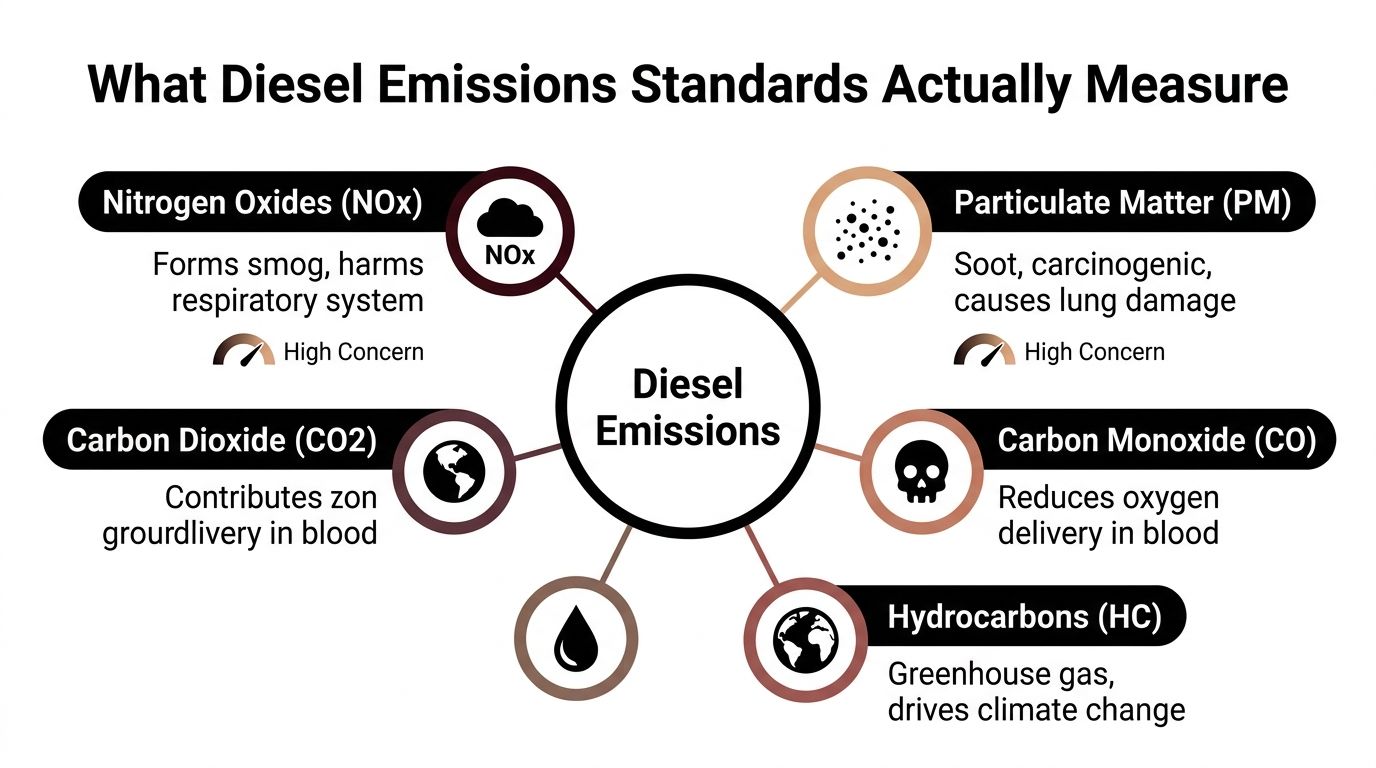
Nitrogen oxides, or NOx, form during high-temperature combustion. Regulators limit NOx because it contributes to air-quality problems and can harm the respiratory system. Visible smoke is not a reliable NOx indicator. A truck can produce little smoke while still exceeding its limit.
Particulate matter, or PM, consists of soot and other fine material in diesel exhaust. Larger soot may be visible, while smaller particles can pass unnoticed from behind the vehicle. A diesel particulate filter, commonly called a DPF, traps this material and periodically burns the stored soot during regeneration.
Carbon monoxide, or CO, is a poisonous gas that interferes with the blood's oxygen delivery. Hydrocarbons, or HC, are unburned fuel compounds that contribute to ground-level ozone formation. Carbon dioxide, or CO2, is a greenhouse gas associated with climate change. The inspection limits and aftertreatment equipment discussed here focus mainly on regulated tailpipe pollutants such as NOx, PM, CO, and hydrocarbons.
Why the units look unfamiliar
Regulators use different measurement systems. Heavy-duty engine limits may appear in grams per brake horsepower-hour, or g/bhp-hr, which relates emissions to engine work. Light-duty European limits are often stated in milligrams per kilometer, or mg/km, which relates emissions to distance traveled.
Those units describe different testing frameworks. A value in g/bhp-hr cannot be compared directly with one in mg/km without the correct test context and conversion method. The unit explains how the regulator designed the measurement, not how much smoke a driver can see.
The equipment that controls each pollutant
A diesel oxidation catalyst treats hydrocarbons and carbon monoxide. The DPF captures particulate matter. Selective catalytic reduction, or SCR, uses diesel exhaust fluid, commonly called DEF, to reduce NOx in the exhaust stream.
These components operate as a connected system. A blocked DPF can restrict exhaust flow and disrupt regeneration. A failed NOx sensor can cause the control system to manage SCR operation incorrectly. A DEF fault can trigger warnings or an inducement strategy. For that reason, a technician checks the related components and their operating condition rather than replacing one part based only on a symptom.
EPA vs CARB and How California Goes Further
The Environmental Protection Agency, or EPA, establishes federal emissions requirements. California's California Air Resources Board, or CARB, operates under a unique authority that allows the state to adopt its own, often more stringent, emissions rules. California's requirements can therefore affect whether a diesel vehicle may be sold, registered, modified, or operated in the state.
For an owner, “it meets EPA standards” doesn't automatically answer the California question. The vehicle must comply with the rules that apply to its configuration and model year in California. A truck imported from another state, modified after purchase, or fitted with non-approved emissions equipment may require closer review.
The California Air Resources Board overview can help owners understand how the state agency fits into the broader regulatory picture.
The two systems side by side
| Aspect | EPA, Federal | CARB, California |
|---|---|---|
| Basic role | Establishes a nationwide emissions baseline | Creates California requirements under its state authority |
| Geographic reach | Applies across the United States | Applies to vehicles and equipment subject to California rules |
| Owner concern | Federal certification and engine standards | California registration, inspection, equipment, and enforcement requirements |
| Testing emphasis | Certification standards and applicable federal compliance programs | State inspection procedures, visual checks, and California-specific requirements |
| Practical risk | A vehicle may satisfy the federal baseline | A vehicle can still face California problems if its configuration or equipment doesn't meet state requirements |
Why smoke opacity still matters
California heavy-duty diesel smoke rules use opacity, which measures how much light the exhaust plume blocks. Under the California rule, 1991 and newer model-year diesel heavy-duty vehicles may not exceed 40% opacity, while pre-1991 vehicles may not exceed 55% opacity during the state procedure, as documented in the California heavy-duty smoke regulation.
Visible smoke can point to several mechanical problems, including poor air-fuel control, turbocharger failure, injector wear, or a DPF fault. The smoke rule also requires a 1974-or-newer diesel-powered heavy-duty commercial vehicle to have evidence that its engine met emissions standards at least as stringent as the applicable federal standards when manufactured.
That combination of federal certification and California enforcement is why deleting a DPF, disabling an SCR system, or installing an unapproved tuner can create a registration problem even if the truck still starts and drives.
How Diesel Emissions Limits Have Tightened Over Time
A truck that passes under an older rule may fail under a newer one, even if its engine still runs well. Model year matters because regulators tightened diesel limits in stages, and manufacturers responded with improved combustion controls, catalysts, particulate filters, sensors, and SCR systems. For a California owner, that history affects which equipment must remain installed when registration renewal or a smog check is due.
The U.S. progression
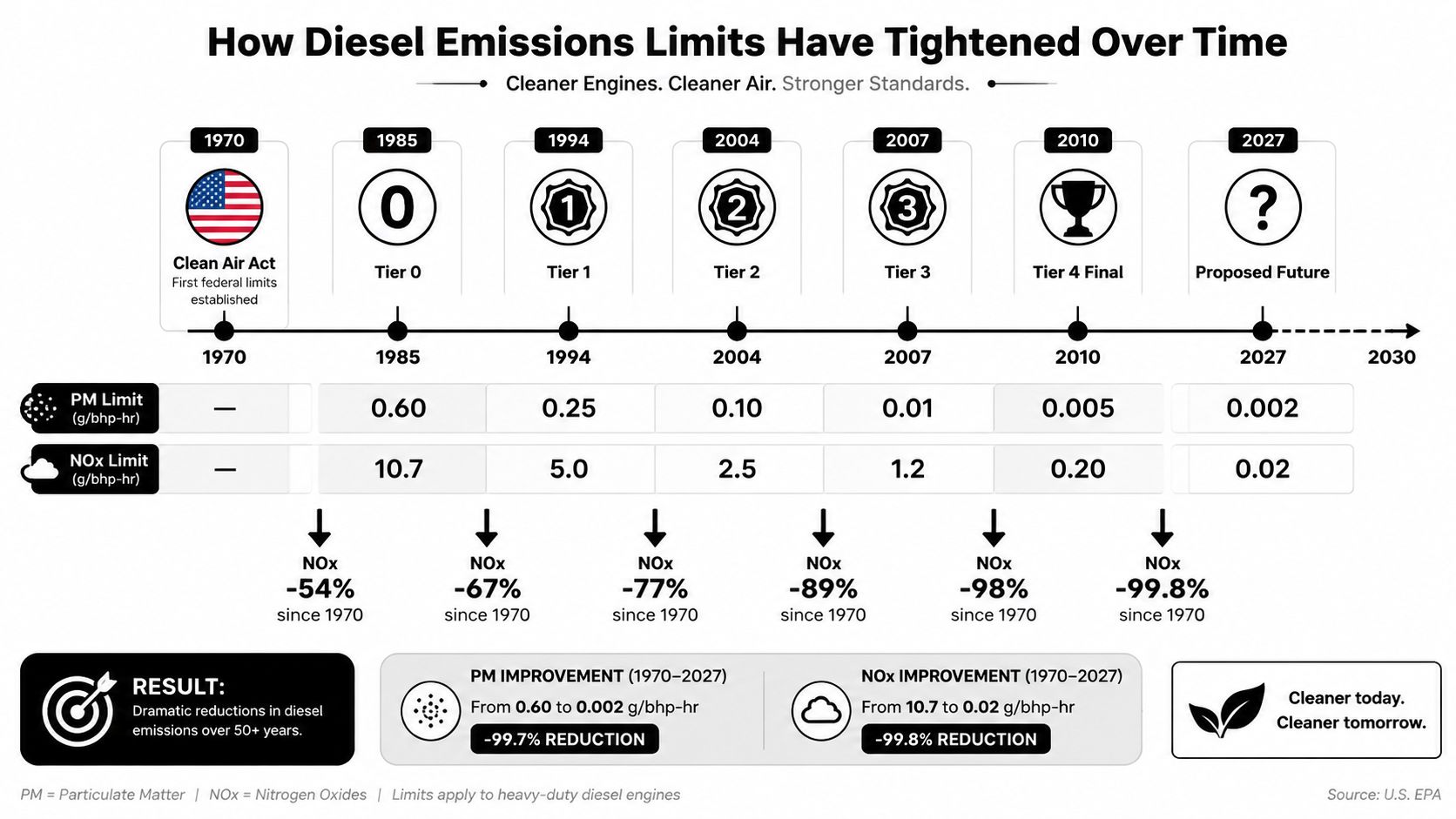
A major change for highway diesels began in 2007, as EPA standards phased in across model years 2007 to 2010. The requirements were designed to produce about a 90% emissions reduction through aftertreatment controls, according to the EPA regulatory record. EPA had already adopted another staged set of requirements in October 1997 for model year 2004 and later heavy-duty engines.
The 2010-era heavy-duty limits were:
- NOx at 0.20 g/bhp-hr
- PM at 0.01 g/bhp-hr
- Non-methane hydrocarbons at 0.14 g/bhp-hr
- Carbon monoxide at 15.5 g/bhp-hr
These figures and their applicability are documented in the EPA regulatory record. They also explain why later trucks depend on DPFs and other exhaust controls. A DPF is not optional trim. Its job is to capture particulate matter, so removing it can leave the truck without equipment required by its emissions design.
The European path shows the same pattern
European diesel standards tightened through successive generations as well. The diesel emissions compliance reference records Euro 2 NOx at 730 mg/km in 1997, followed by 500 mg/km under Euro 3 in 2001, 250 mg/km under Euro 4 in 2006, and 180 mg/km under Euro 5 in 2011.
Euro 6 became mandatory for new type approvals in September 2014 and for all new cars in September 2015. Its diesel NOx limit was 80 mg/km, a 56% reduction from Euro 5's 180 mg/km limit.
For heavy-duty engines, Euro VI WHTC testing sets NOx at 0.4 g/kWh, PM at 0.01 g/kWh, and particle number at 6.0 × 10^11 #/kWh, according to Euro VI heavy-duty standards data. The accompanying real-driving table lists an NH3 limit of 10 ppm and a NOx limit of 0.46 g/kWh for certain diesel applications.
The practical result is clear: newer diesel systems leave less room for uncontrolled combustion. Sensors, filters, catalysts, and maintenance now work together as part of staying compliant, not merely as ways to improve performance.
What Happens During a Diesel Smog Check in California
A California diesel inspection isn't a mechanic looking for smoke. The technician identifies the vehicle, checks required emissions equipment, communicates with the onboard diagnostic system when applicable, and evaluates whether the vehicle presents evidence of tampering or a malfunction.
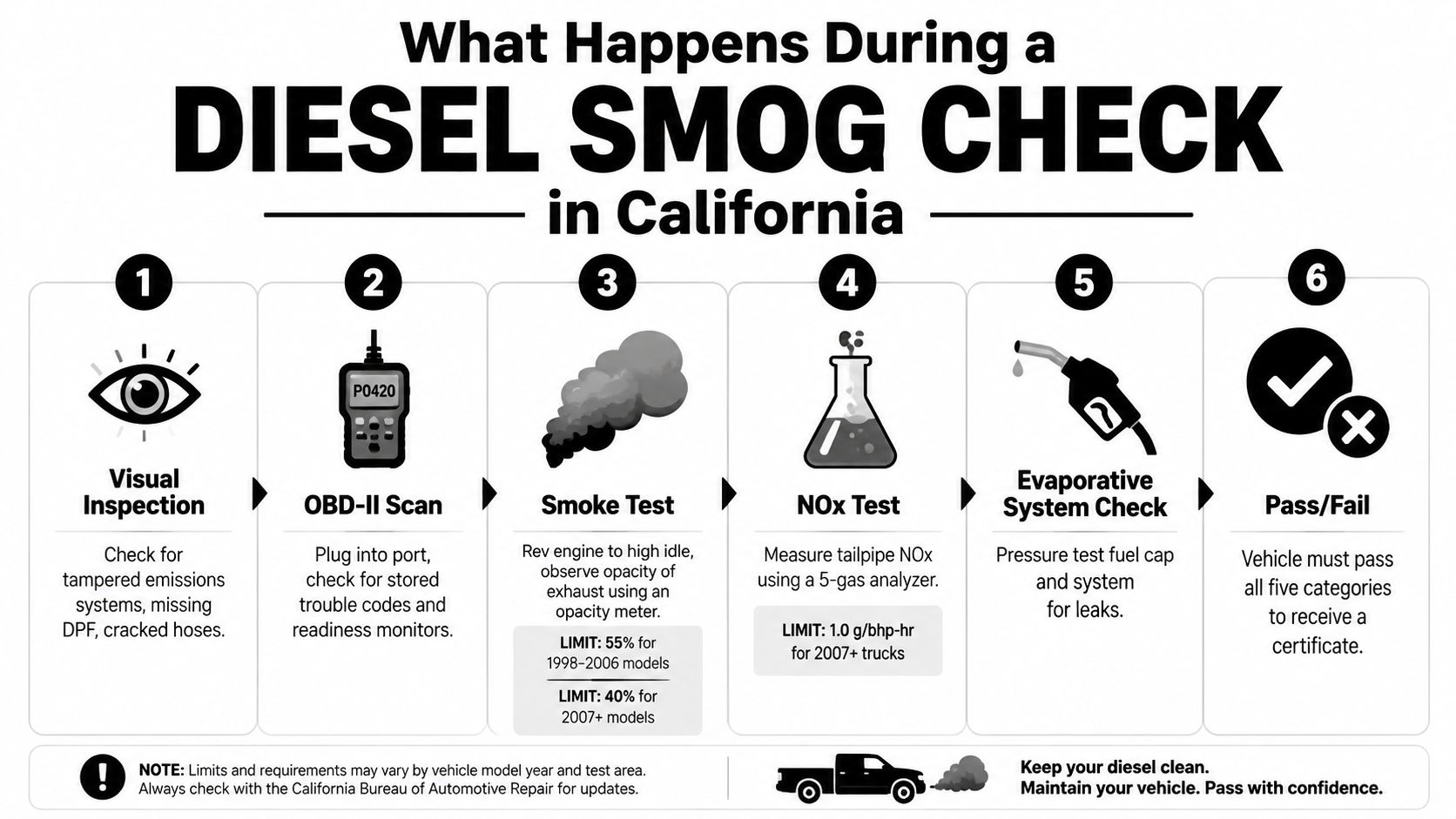
For 2000 and newer vehicles, the OBD system is an important part of the inspection. The technician connects a scan tool to check diagnostic information and system readiness. A warning light, stored emissions fault, or incomplete monitor can affect the result, depending on the vehicle and the applicable inspection rules.
What the technician looks for
At a diesel-capable station such as Speedy Smog's California diesel inspection service, the inspection may involve several distinct checks:
- Visual condition: The technician looks for missing, disconnected, modified, or visibly damaged emissions equipment.
- Diagnostic information: The OBD scan checks for emissions-related faults and readiness information on vehicles equipped for that procedure.
- Smoke behavior: Heavy-duty diesel vehicles may be evaluated under California opacity requirements. The applicable thresholds depend on model year and vehicle category.
- System integrity: The technician may identify signs of DPF, EGR, SCR, DEF, sensor, or exhaust-system problems.
- Final certification: The station records the result for the registration transaction.
The most common owner mistakes happen before the vehicle reaches the testing lane. A deleted DPF, an aftermarket tuner that disables emissions controls, a persistent check-engine light, a cracked exhaust component, or a DEF fault can all turn a routine appointment into a repair visit.
Older diesels need a different mindset
Older vehicles may not provide the same OBD information as newer models. That shifts attention toward the physical condition of the vehicle, visible smoke, installed equipment, and compliance with the standards applicable to its age and class.
Bring the vehicle's registration information and any repair records that identify recent emissions work. If the dashboard warning light is on, don't clear the code immediately before testing. Clearing codes can erase useful diagnostic information and may leave monitors unready, which doesn't repair the underlying problem.
A technician should explain the failure reason in practical terms. “Emissions failure” is too broad to guide a repair. You need to know whether the issue involves a sensor, filter, catalyst, exhaust leak, diagnostic monitor, visible smoke condition, or missing equipment.
The Gap Between Lab Certification and Real-World Performance
A diesel truck can pass its laboratory certification and still produce different emissions on an actual California route. Traffic, temperature, cargo weight, hills, maintenance, and aftertreatment operation all change what happens outside the controlled test cycle. The certificate describes performance under a defined procedure, not every condition the truck will face between registration renewals.
Independent testing summarized in real-world diesel emissions findings from Brussels found that pre-real-driving-emissions Euro 4, Euro 5, and Euro 6 diesels produced NOx at three to five times their laboratory limits in the referenced dataset. Euro 6d-TEMP and Euro 6d vehicles reduced NOx substantially after real-driving requirements were introduced. Regulators expanded testing because laboratory results alone could miss those operating differences.
Why a clean certificate isn't the whole story
A smog certificate confirms that the vehicle met the applicable inspection procedure at that appointment. It does not promise that every emissions component will keep working afterward, or that emissions will remain identical under another load or temperature.
For a California owner who hauls or commutes daily, that difference affects both compliance and repair costs. A truck may pass inspection and later develop a DPF regeneration problem, failed NOx sensor, SCR fault, or exhaust leak. Those symptoms deserve prompt diagnosis because continued operation can raise emissions and turn a limited repair into a larger one.
The Brussels data also identified a minority of DPF-equipped diesels with particulate numbers substantially above the output expected from properly functioning aftertreatment. That finding widens the maintenance picture. Real-world compliance includes particulate control, not only NOx. A DPF may still be installed yet perform poorly if it is damaged, overloaded, bypassed, or neglected.
DEF systems and current guidance
DEF-equipped vehicles use SCR to control NOx. The system must also detect low fluid, poor fluid quality, dosing faults, and sensor failures. EPA's 2025 guidance for model year 2026 and older diesel engines allows manufacturers to revise DEF-system software to adjust SCR-related inducements, as described in the 2025 DEF-system guidance summary.
The guidance does not make DEF maintenance optional. Owners should read warning messages, use the specified fluid, and repair faults before the truck enters a restricted operating strategy. At Speedy Smog, suitable diesel emissions testing equipment can help distinguish a visible problem from an electronic fault or an aftertreatment issue, giving the owner a clearer repair path before the next inspection.
How to Prepare Your Diesel Vehicle for a Smog Test
Preparation starts with the equipment already installed on the truck. Don't remove, bypass, or electronically disable a DPF, EGR system, SCR system, NOx sensor, or other emissions component. A vehicle that has been modified may fail the visual portion even if it seems to run well.
A week-before checklist
- Read the dashboard: Repair an illuminated check-engine or emissions warning light before the appointment.
- Check DEF: Confirm that the tank contains the correct diesel exhaust fluid and that no DEF warning or inducement message is active.
- Inspect for leaks: Look for damaged hoses, loose connections, cracked exhaust tubing, or signs of soot around joints.
- Review diagnostic history: Ask a qualified technician to scan for stored emissions codes rather than clearing them without diagnosis.
- Protect DPF operation: If the vehicle requires regeneration, follow the manufacturer's procedure and allow the cycle to complete safely.
- Confirm readiness: For vehicles using OBD testing, make sure monitors have had time to run after repairs or battery disconnection.
- Bring documents: Have registration information and relevant repair records available.
Older diesels deserve extra attention to visible smoke and physical equipment. Newer diesels need the same visual care, but their sensor and aftertreatment networks make diagnostic information just as important. Hybrid owners should tell the station about the vehicle's powertrain so the inspection can follow the correct procedure.
If the vehicle fails, keep the printed failure information and repair the listed cause instead of replacing unrelated parts. Depending on eligibility, California consumer assistance, retrofit projects, and rebate programs may help some owners address emissions repairs or upgrade older diesel equipment. Ask the relevant state program or repair professional about current requirements before assuming assistance is available.
For a convenient local appointment, Speedy Smog is located at 15275 Washington Ave in San Leandro, operates Monday through Saturday, and offers diesel inspections for qualifying vehicles. The shop states that many tests for 2000 and newer vehicles take about 10 to 15 minutes, and periodic $25-off coupons may apply to most smogs on newer vehicles. Verify current availability, eligibility, and pricing before visiting.
Visit Speedy Smog in San Leandro for a California diesel smog check, emissions-system inspection, and registration-focused certification appointment. Bring your renewal information, address any warning lights or DEF concerns first, and let the trained staff help identify what your diesel needs to stay compliant.
You pull your DMV renewal notice from the mailbox in San Leandro, see “smog check required,” and immediately wonder whether your vehicle needs a test. Maybe it's a newer hybrid. Maybe you recently bought it. Maybe the car passed last time and you assume the same result carries over. Those assumptions can send you to the wrong station or leave your registration unfinished.
California's smog check requirements depend on more than the fact that you own a vehicle. Model year, fuel type, registration location, and the transaction you're completing all matter. The rules also changed in a meaningful way for OBD-equipped vehicles on October 1, 2025, so a car with recently cleared trouble codes may no longer have the tolerance it once had.
This guide gives you the practical framework. Check the transaction first, confirm whether the vehicle is exempt, verify whether a STAR station is required, and scan the OBD readiness monitors before paying for an official inspection. That sequence prevents most avoidable surprises.
Table of Contents
- Why Smog Check Requirements Matter for California Drivers
- Which Vehicles Need a Smog Check and Which Are Exempt
- Understanding STAR Certified Smog Check Stations
- OBD Readiness Monitor Rules and the 2025 Changes
- Special Requirements for Diesel Hybrid and Older Vehicles
- How to Prepare Your Vehicle and What to Expect During Testing
- Getting Certified Quickly at Speedy Smog in San Leandro
Why Smog Check Requirements Matter for California Drivers
A San Leandro driver might receive a renewal notice, check the registration date, and assume the next step is finding the nearest inspection shop. Then the vehicle's model year, fuel type, or registration record changes the answer. A newer vehicle may qualify for a registration exemption but still involve a smog abatement fee, while a recently purchased vehicle may need testing because the transaction is a title transfer rather than a routine renewal.
California's system has never been a single rule applied to every car. The state's modern mandatory program took shape in March 1984, after SB 33 was passed in 1982, with biennial inspections in participating counties and visual, functional, and emissions checks. The program later shifted toward onboard diagnostics, and California adopted an OBD II-focused inspection in 2010 for 2000 model-year and newer vehicles. The California Air Resources Board background helps explain why vehicle emissions compliance has continued to evolve.
The transaction changes the answer
A renewal, an initial California registration, and a change of ownership aren't interchangeable. The same vehicle can be exempt during one DMV transaction and require a certificate during another. Registration location matters too, because California's program applies differently depending on the county and the vehicle's registration circumstances.
That's why a driver who recently bought a car shouldn't rely on the purchase date alone. The vehicle's model year and the type of DMV transaction control the requirement.
Practical rule: Read the DMV notice, identify the transaction, then confirm the vehicle's fuel type and model year before booking a test.
Misunderstanding the rule can block registration, create late-payment problems, or send you to a non-STAR station when the DMV requires a STAR inspection. A failed or invalid visit costs more than the inspection fee. It costs time, and it can force a second trip before the DMV accepts the paperwork.
The safest approach is simple: determine eligibility first, choose the required test type second, and prepare the vehicle before arriving. That process is especially important now that readiness-monitor rules have become stricter.
Which Vehicles Need a Smog Check and Which Are Exempt
Start with the DMV transaction, not the age of the vehicle. California uses different thresholds for renewal, ownership transfer, and initial registration, and a recent purchase doesn't automatically eliminate the need for a smog certificate.
Biennial registration renewal
For ordinary gasoline-powered vehicles, the rolling exemption generally covers vehicles that are eight model years old or newer for registration renewal. Once the vehicle reaches the testing threshold, a smog check is generally required on the state's two-year renewal cycle in covered areas.
For 2026 registrations, the practical cutoff described in current guidance exempts 2018 and newer gasoline vehicles from biennial testing. That exemption is based on model year, not the date you bought the car. A vehicle purchased recently can still require a test if its model year falls outside the exemption.
Gasoline, hybrid, and alternative-fuel vehicles may qualify for the newer-vehicle registration exemption, but owners should check whether the DMV applies a smog abatement fee instead. An electric vehicle doesn't produce tailpipe emissions and is generally exempt from a conventional smog check.
Change of ownership
A title transfer follows a different rule. A vehicle sold or transferred in California generally needs a smog certificate unless it falls within the newer-vehicle exemption for that transaction. Current guidance treats vehicles that are four or fewer model years old differently from older vehicles during a transfer.
The key mistake is assuming that a car's current registration status settles the question. It doesn't. A vehicle that didn't need a test for the seller's renewal may still require documentation when ownership changes, depending on its model year and the transfer details. Check the California DMV smog exemption form when the transaction involves an exemption claim rather than a standard certificate.
Initial California registration
An out-of-state vehicle being registered in California for the first time generally requires a smog check regardless of age. The fact that the car passed inspection in another state doesn't replace California certification. California evaluates the vehicle under its own emissions program and registration rules.
Use this table as a first filter:
| Transaction Type | Smog Check Required? | Key Exemption Rule |
|---|---|---|
| Biennial registration renewal | Usually required after the newer-vehicle exemption ends | Gasoline, hybrid, and alternative-fuel vehicles may be exempt while eight model years old or newer, subject to DMV rules and possible abatement fees |
| Change of ownership | Generally required | Vehicles four or fewer model years old may qualify for the transfer exemption |
| Initial California registration for an out-of-state vehicle | Generally required regardless of age | An out-of-state inspection doesn't replace California certification |
| Electric vehicle registration | Conventional smog check generally not required | Electric vehicles are exempt from conventional emissions testing |
Before making an appointment, write down the vehicle's model year, fuel type, county of registration, and transaction type. Those four details usually reveal whether you need a test, an exemption form, or a different DMV step.
Understanding STAR Certified Smog Check Stations
A STAR station isn't just a shop with a different sign. It's a station authorized under California's enhanced inspection program, and the distinction matters when the DMV notice directs you to STAR.
California launched the STAR program on January 1, 2013, replacing the earlier Gold Shield and Test Only structure with higher smog-check standards. The EPA's inspection and maintenance overview places these programs in the broader framework of federal Clean Air Act inspection and maintenance requirements. Federal rules have also evolved, including amendments made in 2015 as part of implementation of the 2008 ozone standards.
When STAR status is mandatory
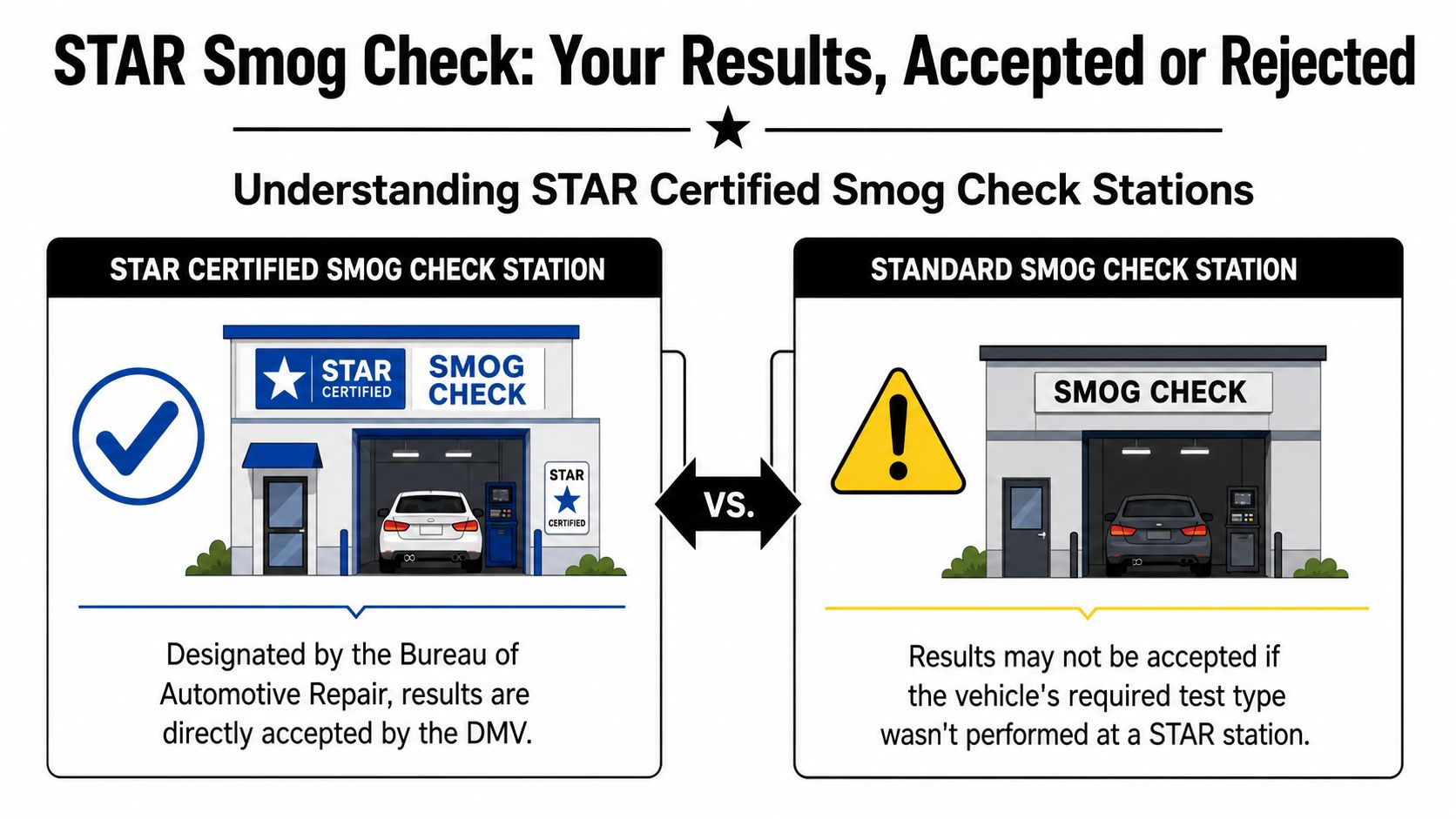
Some renewal notices require a STAR-certified test. If that instruction appears on your notice, a passing result from a standard non-STAR station may not satisfy the DMV requirement. The problem isn't necessarily that the vehicle was tested incorrectly. The problem is that the station type didn't match the required transaction.
STAR designation reflects performance controls established by the Bureau of Automotive Repair, including station and inspector compliance, equipment standards, and tighter oversight of test accuracy. The designation is useful because it connects the test to the state's required inspection pathway, rather than leaving the driver to interpret whether a result will be accepted.
What East Bay drivers should do
Look at the DMV notice before choosing a location. If it says STAR, use a STAR station. If it doesn't, confirm the required inspection type anyway, especially for an out-of-state registration, ownership transfer, older vehicle, diesel, or vehicle with an emissions-related repair history.
A station such as Speedy Smog's STAR-certified location in San Leandro can submit an eligible result through the correct channel. That doesn't guarantee the vehicle will pass, but it removes one preventable risk: paying for a test that the DMV won't accept because the station designation was wrong.
STAR status also matters when a vehicle is close to the pass threshold. Proper equipment, compliant procedures, and trained inspectors help ensure the recorded result reflects the vehicle's actual condition. Don't treat STAR as a marketing label. Treat it as a requirement when the DMV assigns that test type.
OBD Readiness Monitor Rules and the 2025 Changes
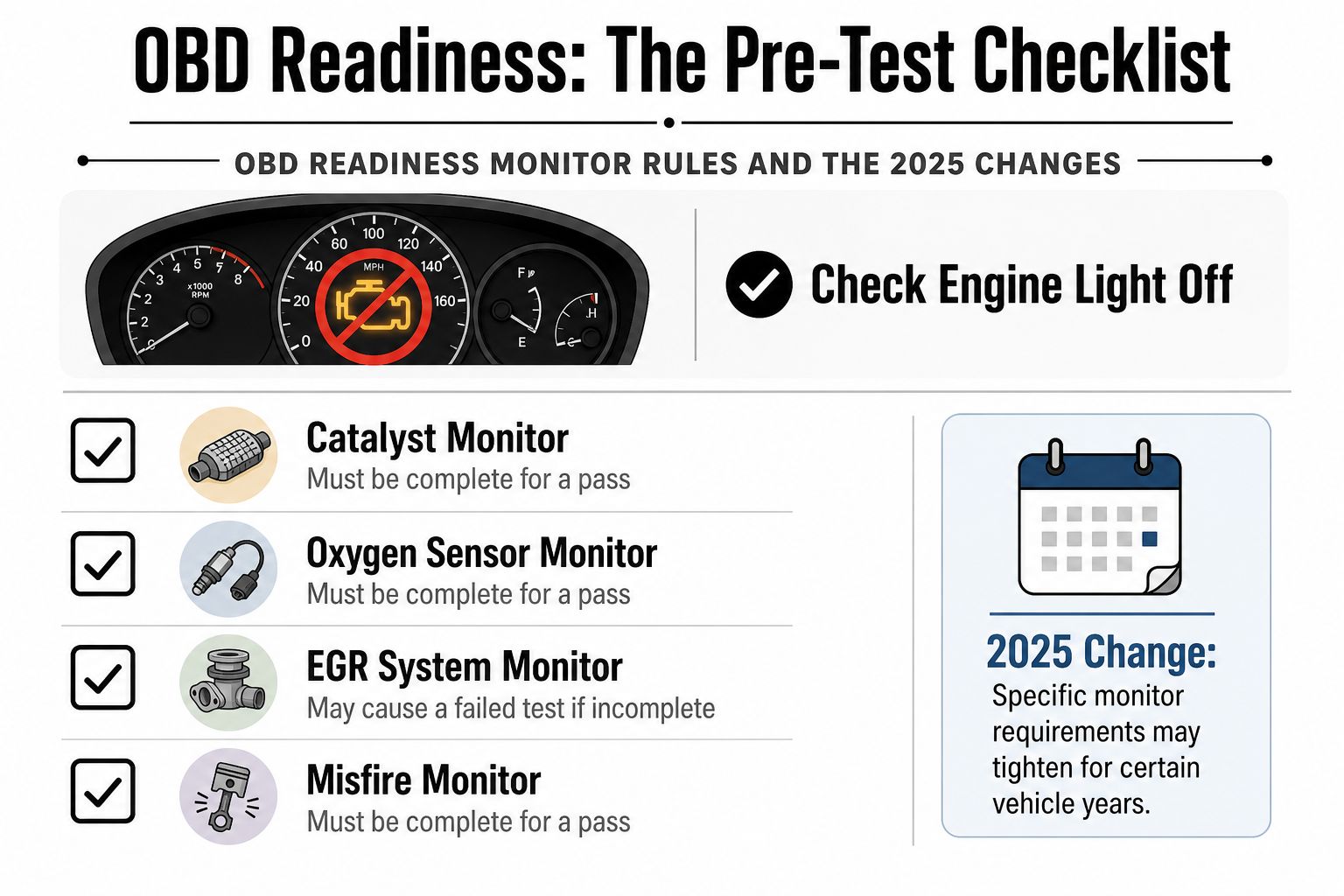
Many modern smog failures happen before the technician performs any tailpipe measurement. The OBD inspection checks the malfunction indicator lamp, readiness indicators, and the vehicle's ability to retrieve fault codes. A vehicle can have no illuminated warning light and still fail because its emissions monitors aren't complete.
For 1996 through 2000 model-year vehicles, more than two incomplete emissions-related readiness monitors causes an OBD II failure. For 2001 and newer vehicles, more than one incomplete monitor causes failure under the earlier rule. These thresholds are defined in California's OBD inspection regulation.
That distinction catches owners who disconnect the battery or clear diagnostic trouble codes just before an appointment. Clearing codes resets monitor status. The check engine light may remain off while the vehicle runs its self-tests, but the monitor screen can still show incomplete.
The October 2025 standard
Effective October 1, 2025, California requires all readiness monitors to be set for a vehicle to pass Smog Check unless the Bureau of Automotive Repair grants an exception for a design-limited case. BAR also states that an OBD-equipped vehicle fails if the MIL doesn't illuminate with the key on and engine off, or if it stays illuminated while the engine runs. The BAR explanation of the new OBD readiness monitor regulations should be your reference for the current standard.
This change makes battery disconnections and recent code clearing more serious. A vehicle that once passed with an incomplete monitor may now fail because the full-readiness requirement applies.
How to prepare the monitors
Don't guess at a drive cycle. The vehicle manufacturer determines the exact conditions, and different monitors may require different combinations of cold starts, steady cruising, acceleration, deceleration, and stop-and-go operation.
Use a practical sequence:
- Don't clear codes before testing. Code clearing or battery disconnection erases useful readiness history.
- Drive normally after repairs. Combine cold-start operation, highway cruising, and city driving rather than idling in the driveway.
- Check the monitor screen. Scan the vehicle before the official inspection and confirm every required monitor shows ready.
- Verify the MIL behavior. The warning lamp must illuminate during the key-on bulb check and turn off when the engine runs, assuming no active fault exists.
- Delay the appointment if monitors remain incomplete. Paying for an official test while the vehicle is visibly not ready is avoidable.
A commute that combines I-880 cruising with local San Leandro stop-and-go driving can help create varied operating conditions, but it isn't a guaranteed manufacturer drive cycle. Have the readiness status scanned before the test.
Special Requirements for Diesel Hybrid and Older Vehicles
Vehicle category determines the inspection path. A newer gasoline sedan, an older gasoline truck, a hybrid, and a diesel pickup don't all receive the same evaluation, so the technician needs accurate vehicle information before starting.
| Vehicle Type | Model Years Tested | Test Method | Key Exemptions |
|---|---|---|---|
| Gasoline vehicles | 1976 and newer when covered by the program | OBD II for later models, tailpipe and visual testing for older models | Gasoline vehicles from 1975 and older are exempt |
| Diesel vehicles | 1998 and newer in applicable categories | OBD or diesel emissions testing based on vehicle configuration, including opacity testing for heavier diesels | Diesel vehicles from 1997 and older are exempt; weight and program category also matter |
| Hybrid vehicles | When they fall outside the applicable newer-vehicle exemption | OBD II and functional emissions inspection | Newer hybrids may qualify for the registration exemption |
| Older gasoline vehicles | 1976 through 1999 when testing is required | ASM or TSI tailpipe testing on a dynamometer, plus visual and functional checks | The newer-vehicle rolling exemption doesn't apply in the same way to these older cars |
Gasoline and older vehicles
Gasoline vehicles from 1976 onward can fall under the program when they aren't exempt by transaction or model year. Later vehicles generally use OBD II, while older gasoline vehicles may require a dynamometer-based tailpipe test, such as ASM or TSI, instead of a simple diagnostic connection.
The state's model-year exemptions shouldn't be confused with a blanket classic-car exemption. California exempts gasoline-powered vehicles that are 1975 model year or older, but a 1980s or 1990s vehicle can still require testing when the transaction and registration conditions call for it. Age alone doesn't create a universal exemption.
Diesel vehicles
Diesel rules depend on model year, vehicle weight, and the applicable emissions program. Diesel-powered vehicles from 1997 model year or older are exempt under the DMV guidance, while newer diesel vehicles can require testing. Heavy diesels may receive a different inspection, including an opacity test, rather than the same procedure used for a light-duty gasoline vehicle.
Bring the vehicle's registration information so the station can identify the applicable weight and fuel category. Don't assume that all diesels are exempt, and don't assume that every diesel receives a standard OBD plug-in test.
Hybrids
Hybrids aren't automatically exempt because they use electric assistance. Once a hybrid falls outside the applicable newer-vehicle exemption, it generally undergoes an OBD and emissions-system inspection. The technician must work around the vehicle's high-voltage systems while checking the emissions controls and diagnostic data.
The right question isn't “Is it a hybrid?” Ask whether its model year and transaction qualify for an exemption, then confirm the station can perform the required inspection.
How to Prepare Your Vehicle and What to Expect During Testing
Preparation starts before you drive to the station. A smog check measures emissions-system operation, not general vehicle quality, so focus on the items that can create a direct inspection failure.
The pre-test checklist
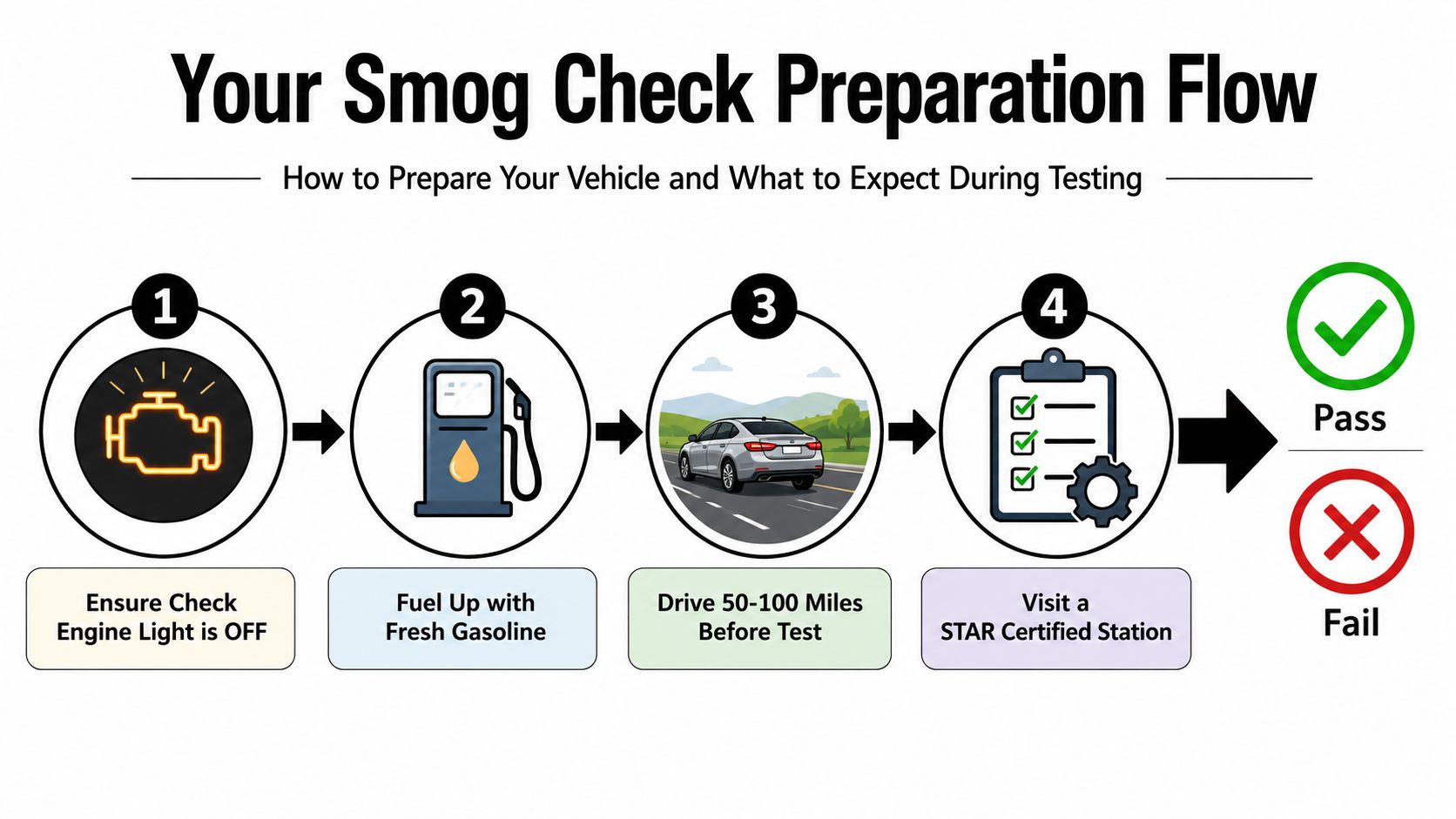
- Check the warning light: The check engine light should be off while the engine runs. If it's illuminated, diagnose the fault before booking the official inspection.
- Protect monitor history: Don't disconnect the battery or clear codes shortly before testing. The vehicle needs time and normal driving to complete its self-checks.
- Bring usable fuel: Arrive with enough fuel for the vehicle to run safely during the inspection. A low fuel level can prevent testing on some vehicles.
- Remove questionable modifications: Non-approved emissions parts, altered exhaust equipment, missing components, or an incorrect gas cap can trigger a visual failure.
- Carry the paperwork: Bring the DMV renewal notice or registration card, payment, and any repair or test documentation relevant to the vehicle.
The exact driving distance needed to complete monitors varies by vehicle, weather, fuel level, and the manufacturer's conditions. Follow the vehicle's drive-cycle guidance rather than relying on a generic mileage promise. A scan showing every monitor ready is more useful than an arbitrary number of miles.
What happens at the station
The technician begins by confirming the vehicle and required test type. The inspection may include a visual review of emissions components and the fuel cap, an OBD II scan for applicable vehicles, or a dynamometer and tailpipe procedure for older models. The station records the result and submits the certification electronically when the inspection passes.
Watch the warning-light behavior carefully. BAR requires the MIL to illuminate during the key-on, engine-off check and remain off once the engine runs. A missing bulb or warning light that stays on isn't a minor dashboard issue. It can produce a direct failure.
Use this short video as a visual overview of the preparation process:
If the vehicle fails
A failure should identify the affected emissions system, monitor, visual component, or diagnostic condition. Don't replace random parts based only on a failed result. Have the report interpreted, repair the confirmed cause, then complete the required retest.
Qualifying owners may be eligible for repair assistance through California's Consumer Assistance Program, but eligibility depends on the program's requirements. Ask the station or review current state guidance before assuming assistance applies.
The most useful service after a failure is a clear explanation of what failed and what needs to happen next. A quick diagnostic scan before the official test can prevent a readiness-related failure and save a second appointment.
Getting Certified Quickly at Speedy Smog in San Leandro
For an East Bay driver, the efficient path is to match the transaction to the correct test, verify readiness, and use a station that can submit the result through the required DMV process. That matters more than selecting the closest location.
Speedy Smog in San Leandro is a STAR-certified station that handles gasoline, diesel, hybrid, older-vehicle, and change-of-ownership inspections. The shop says it can transmit eligible results electronically to the DMV, which reduces paperwork after a passing inspection. Its stated service information also describes typical testing for 2000 and newer vehicles in about 10 to 15 minutes, though the actual time depends on the vehicle and inspection type.
Bring the right information
Take your DMV renewal notice or registration card, the vehicle, and payment. Tell the technician whether you're completing a renewal, an ownership transfer, or an initial California registration. That context helps the station identify the correct test rather than treating every visit as a standard renewal inspection.
If the vehicle has recently had codes cleared, a battery replacement, or emissions repairs, request an OBD readiness check first. A quick scan can reveal incomplete monitors before the official test starts. If the vehicle isn't ready, you can complete the required driving and avoid recording a preventable failure.
Speedy Smog accepts walk-ins according to its published service information and operates Monday through Saturday at its San Leandro location. Confirm current hours and requirements before leaving, especially if your DMV notice specifies STAR testing or a special inspection category.
The recommendation is direct. Don't wait until registration is nearly expired, don't assume a recent purchase means exemption, and don't choose a station without checking whether STAR status is required. Use the rules above to identify the transaction, verify the model year and fuel type, then have the vehicle scanned before certification.
Speedy Smog provides STAR-certified inspections for gasoline, diesel, hybrid, older, and change-of-ownership vehicles in San Leandro, with electronic DMV submission for eligible results. Bring your renewal notice or registration card and ask for a readiness check if the vehicle recently had codes cleared, then visit Speedy Smog to get the correct smog check handled without an avoidable second trip.
You pull into the smog station confident. The car starts easily, idles smoothly, gets decent fuel economy, and hasn't shown any obvious warning signs. Then the technician plugs in the scanner, checks the inspection results, and hands you a failure report. You're left wondering what makes a car fail smog when it seems to run perfectly.
The answer is usually hidden in the emissions-control system, not the parts you feel from the driver's seat. Modern inspections check diagnostic data, monitor status, warning-lamp behavior, emissions equipment, and sometimes tailpipe output. A vehicle can drive normally while its computer reports that an emissions system hasn't completed testing or isn't operating within required limits.
Table of Contents
- Why Perfectly Running Cars Still Fail Smog Checks
- The Real Numbers Behind California Smog Failures
- The Most Common Reasons Cars Fail Smog Inspections
- How Smog Test Requirements Differ by Vehicle Type
- Pre-Test Diagnostics You Can Do Before Your Smog Check
- Repair Options Costs and What to Expect at a STAR Station
- Your Action Plan for Passing Your Next Smog Check
Why Perfectly Running Cars Still Fail Smog Checks
A smooth-running engine only proves that the car can move, idle, accelerate, and start. It doesn't prove that the emissions system is complete, functional, and compliant. That distinction catches drivers off guard because many emissions problems don't create rough running, hard starts, poor mileage, or unusual exhaust odor.
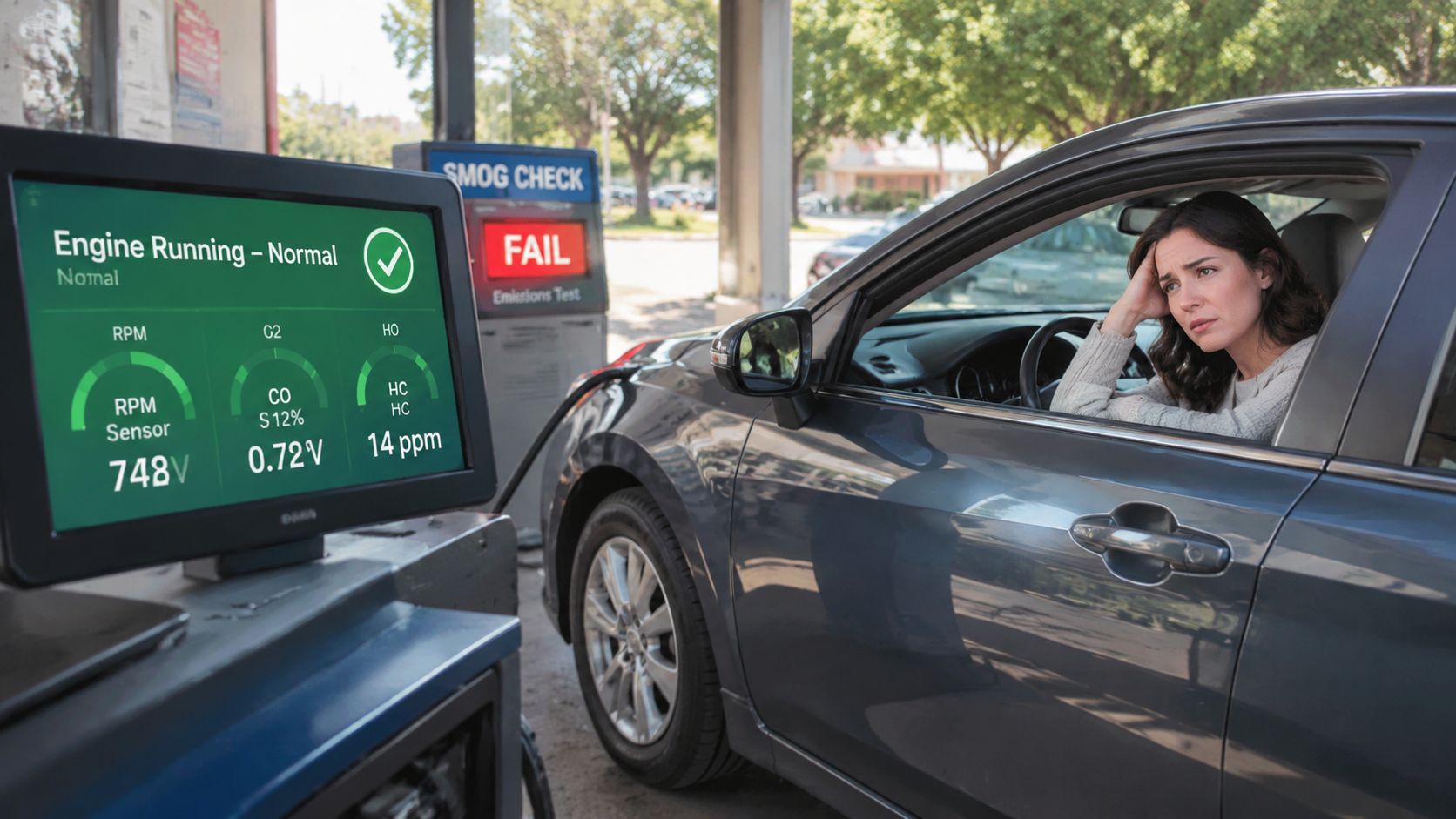
A modern car constantly checks systems such as the catalytic converter, oxygen sensors, fuel control, misfire detection, and evaporative emissions equipment. Those checks run through software called the onboard diagnostics system, or OBD. If the computer detects an emissions-related fault, stores a trouble code, or hasn't completed the required checks, the car may fail even though you'd never notice a problem during an ordinary commute.
Drivability and compliance are different tests
Drivers often make the same mistake after a battery replacement or repair. The check engine light goes off, the car feels fine, and they schedule a smog check immediately. That repair may have erased the vehicle's stored diagnostic information, leaving the readiness monitors incomplete. The car hasn't necessarily become worse, but it also hasn't finished proving that its emissions equipment works.
A malfunction indicator lamp that stays on or flashes can cause failure, as can an inoperative warning lamp, a missing or unusable diagnostic connector, or emissions-related diagnostic trouble codes. Some inspection programs also check the fuel cap system. A gas cap that can't maintain pressure can expose an evaporative emissions leak even when the engine runs normally, as described in this OBD-II smog inspection guide.
Technician's rule: A car that feels fine can still fail. The computer doesn't grade the drive. It grades the emissions evidence.
The causes generally fall into two groups. Hardware failures include a weak catalytic converter, faulty oxygen sensor, leaking EVAP component, damaged exhaust, or missing emissions equipment. Diagnostic and software-related failures include incomplete monitors, active codes, incorrect warning-lamp behavior, and non-approved or modified software calibration.
Most failures are diagnosable. Don't guess at expensive parts based only on the failure label. Start with the Vehicle Inspection Report, scan the car properly, and identify whether the problem is a real component failure or a system that hasn't completed its checks.
The Real Numbers Behind California Smog Failures
California's statewide results show that failed smog checks are common enough to deserve a methodical response, not panic. The state's 2026 Smog Check Performance Report says about 19 million 2000-and-newer vehicles were tested during calendar years 2024 and 2025, and roughly 1.3 million failed, producing an overall failure rate of about 7%. The same report shows roadside failures at about 14%, which indicates that real-world emissions performance can be worse than test-station results suggest. See the California Smog Check Performance Report.
| Metric | Rate | What It Means |
|---|---|---|
| 2000-and-newer vehicles tested in California during CY 2024-2025 | About 19 million vehicles | The inspection program covers a very large modern-vehicle population. |
| Those vehicles that failed | Roughly 1.3 million vehicles | A failed result is a routine emissions-compliance outcome, not proof that an engine is about to stop running. |
| Overall test-station failure rate | About 7% | Most tested vehicles passed, but a meaningful group did not. |
| Roadside failure rate | About 14% | Vehicles may perform worse under real-world conditions than at a test station. |
The numbers also explain why a clean-running car can fail. Historical EPA analysis found that 33% of vehicles had inconsistent tailpipe results when a screening facility's result was compared with the first Smog Check station. The analysis identified inaccurate underhood inspection results as the principal reason for many discrepancies. It also found that about 84.6% of vehicles passing both Smog Check stations still had at least one visual or functional defect at the laboratory level, showing how easily hidden problems can escape ordinary driving observation. The underlying EPA inspection analysis is useful background for understanding why inspection programs look beyond drivability.
What the data means for your diagnosis
These figures don't tell you which part failed on your car. They do tell you that smog compliance has never depended only on whether the engine feels healthy. Inspection methods are built to identify faults that a driver may not feel, including underhood defects, control-system faults, and inconsistent emissions behavior.
California reporting also describes a growing role for diagnostic and functional outcomes, including software and OBD-related issues. Modified or non-approved software can affect compliance, so replacing a sensor isn't always the correct answer. A technician needs to determine whether the car has excessive emissions, a missing or altered component, an incomplete monitor, or a computer-calibration problem.
The Most Common Reasons Cars Fail Smog Inspections
The fastest way to waste money after a failed inspection is to replace parts without reading the failure details. Start with the Vehicle Inspection Report, then match the result to the system that controls the failure.
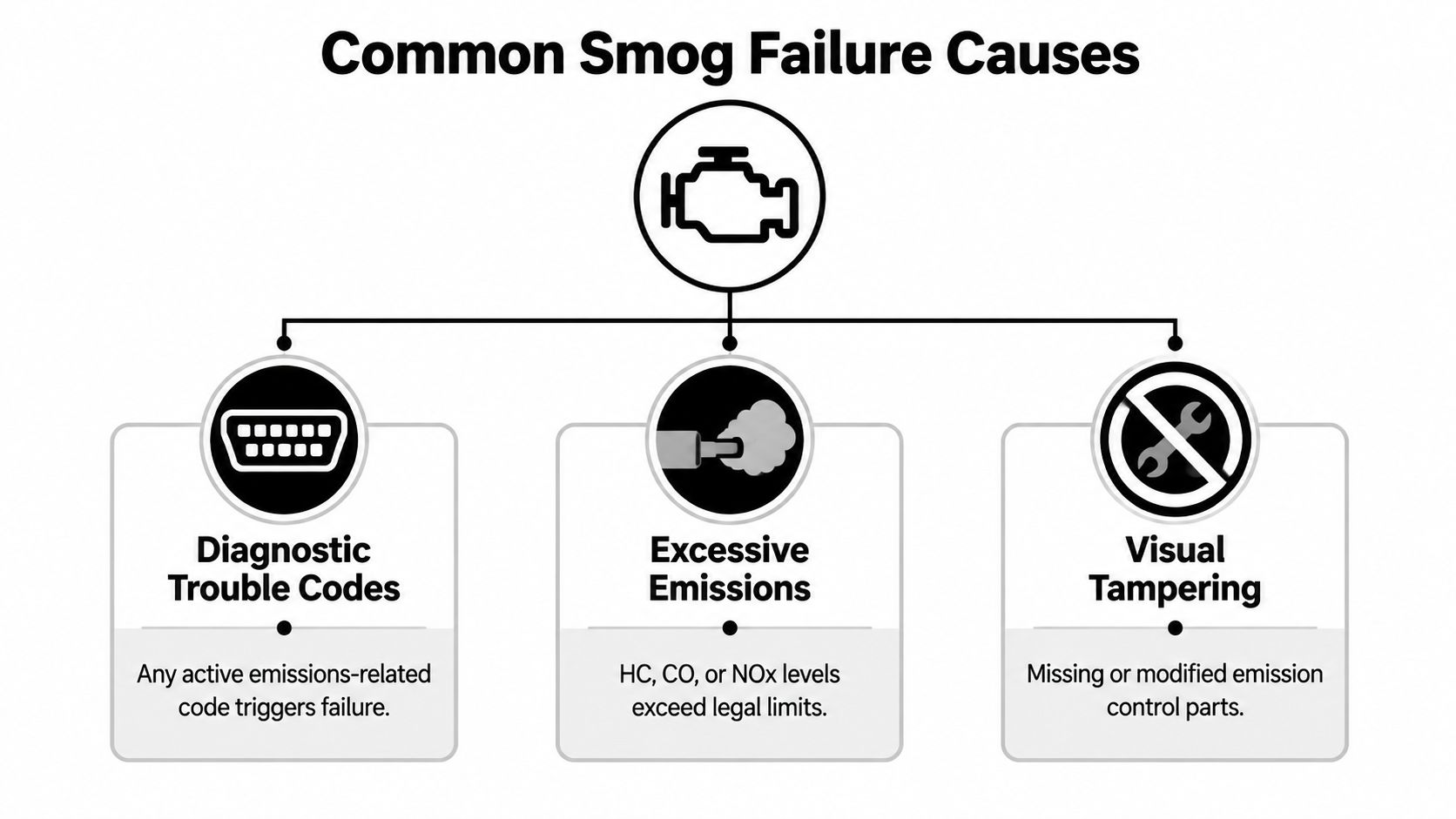
Active warning lights and diagnostic trouble codes
An illuminated check engine light is the clearest warning that the emissions computer has found a problem. The light may relate to an oxygen sensor, catalyst efficiency, fuel mixture, misfire, evaporative leak, exhaust leak, or another emissions-controlled function. The light itself is only the symptom. The stored code tells the technician where to begin.
A flashing light deserves immediate attention because it can indicate an active misfire that may damage the catalytic converter. A steady light still needs diagnosis before testing. Clearing the code without repairing the cause is not a fix, and it can create a second failure if the readiness monitors haven't returned to ready status.
Incomplete readiness monitors
Readiness monitors are self-tests that verify systems under specific operating conditions. Battery disconnection, code clearing, module replacement, or recent repairs can erase their status. The car may have no current warning light and still fail because the computer hasn't completed the required checks.
The EPA testing requirements identify monitors that can include misfire, fuel trim, evaporative emissions, oxygen sensor, and catalyst efficiency. Catalyst and EVAP checks often need particular temperature, speed, and load conditions, so random short trips may not complete them.
Catalytic converter and oxygen sensor problems
The catalytic converter changes pollutants in the exhaust into less harmful compounds. A worn, contaminated, physically damaged, or inefficient converter may not clean the exhaust sufficiently. The car can still accelerate normally, but the inspection computer or tailpipe test can detect the difference.
Oxygen sensors help the engine control fuel mixture and monitor catalyst performance. A sensor can become slow or inaccurate without making the vehicle feel obviously defective. Replacing a sensor without confirming the code, wiring, exhaust leaks, fuel-trim data, and sensor behavior is poor diagnosis. A converter problem may be the result of an unresolved misfire or fuel-control fault, so repair the cause rather than repeatedly installing expensive parts.
Don't condemn the converter from one code alone. Check the sensor signals, exhaust condition, fuel control, ignition performance, and wiring before approving a major repair.
EVAP leaks and gas cap faults
The evaporative emissions system keeps fuel vapors from escaping. It includes the fuel cap, vapor lines, charcoal canister, purge valve, vent valve, and tank-side components. A loose, cracked, or poorly sealing gas cap can trigger a leak code. Deeper leaks may require a smoke test to locate.
Tighten the cap until it clicks if the design requires it, then inspect the seal for damage. If the warning light remains on, don't assume the cap was the only problem. A leak in a hose or valve can be too small to see and still large enough for the vehicle's pressure test to detect.
Fuel, ignition, exhaust, and visual defects
A rich or lean fuel mixture can raise emissions without producing dramatic drivability symptoms. Worn ignition components, intake leaks, fuel-pressure problems, incorrect air measurement, or a thermostat that prevents normal operating temperature can all affect emissions behavior. An exhaust leak ahead of an oxygen sensor can also distort readings and lead the computer toward the wrong diagnosis.
Visual inspection matters too. Missing, modified, disconnected, or non-approved emissions equipment can cause failure even if the tailpipe output appears acceptable. That includes altered software calibration on vehicles where the inspection system can identify non-approved programming. If the car has aftermarket intake, exhaust, programming, or emissions-related modifications, confirm compliance before testing.
A helpful visual explanation of these failure categories appears in this guide to smog check failure reasons.
Here's a practical video overview of common inspection problems:
How Smog Test Requirements Differ by Vehicle Type
Your vehicle's age and fuel type determine what the inspector can test and which failures matter most. Don't prepare a diesel truck the same way you prepare a late-model gasoline car, and don't assume a hybrid behaves exactly like a conventional vehicle.
2000-and-newer OBD vehicles
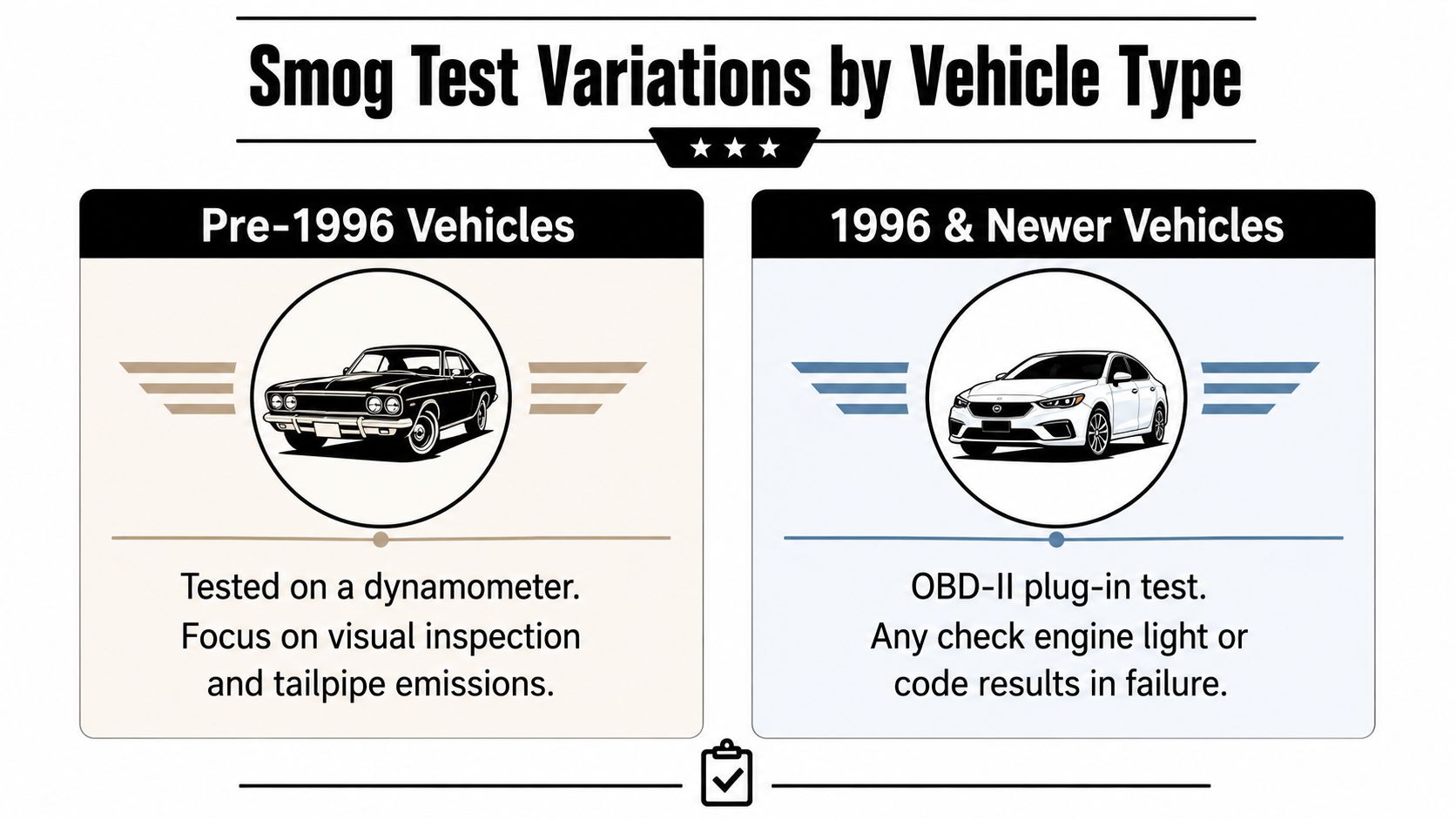
Modern gasoline vehicles generally rely heavily on the OBD inspection. The technician connects to the diagnostic link connector and checks warning-lamp behavior, stored emissions-related codes, and readiness status. The inspection is therefore a computer compliance check as much as a mechanical one.
Prioritize the check engine light, monitor status, software modifications, and the condition of emissions components. A recent battery replacement is especially relevant because it can erase monitor history. A scan before the appointment is more useful than a quick visual glance under the hood.
Older gasoline vehicles
Older vehicles may rely more heavily on visual inspection and tailpipe emissions testing. The inspector can evaluate emissions equipment, exhaust condition, and measured pollutants rather than relying only on computer data. Vehicles with older fuel systems, vacuum controls, exhaust gas recirculation components, or carburetion-related equipment need a different diagnostic approach.
For these cars, visible tampering and missing equipment can matter as much as the measured exhaust. Poor tune, vacuum leaks, ignition faults, oil consumption, and a weak converter can also push tailpipe readings beyond the allowable limits.
Diesels and hybrids
Diesel vehicles have their own inspection considerations, including diesel-specific emissions controls and particulate-related concerns. Smoke, altered emissions equipment, incorrect software, and faults in electronic controls deserve attention before testing. A diesel that has been modified for performance may have a compliance issue even if it drives strongly.
Hybrids can be deceptive because the gasoline engine may shut off during portions of the inspection or operate under a different load pattern. Their emissions systems still depend on working sensors, catalyst monitoring, EVAP control, and completed diagnostic checks. Hybrid owners should use a scan tool that can communicate correctly with the vehicle's systems rather than relying on a basic reader that shows limited information.
Match the diagnosis to the vehicle. The same failure label can point to different tests and different repair paths on an older gasoline car, a diesel, a hybrid, or a modern OBD-equipped vehicle.
Pre-Test Diagnostics You Can Do Before Your Smog Check
A short inspection before the appointment can prevent an avoidable failure. It won't diagnose every fault, but it can reveal the problems most likely to waste a trip.
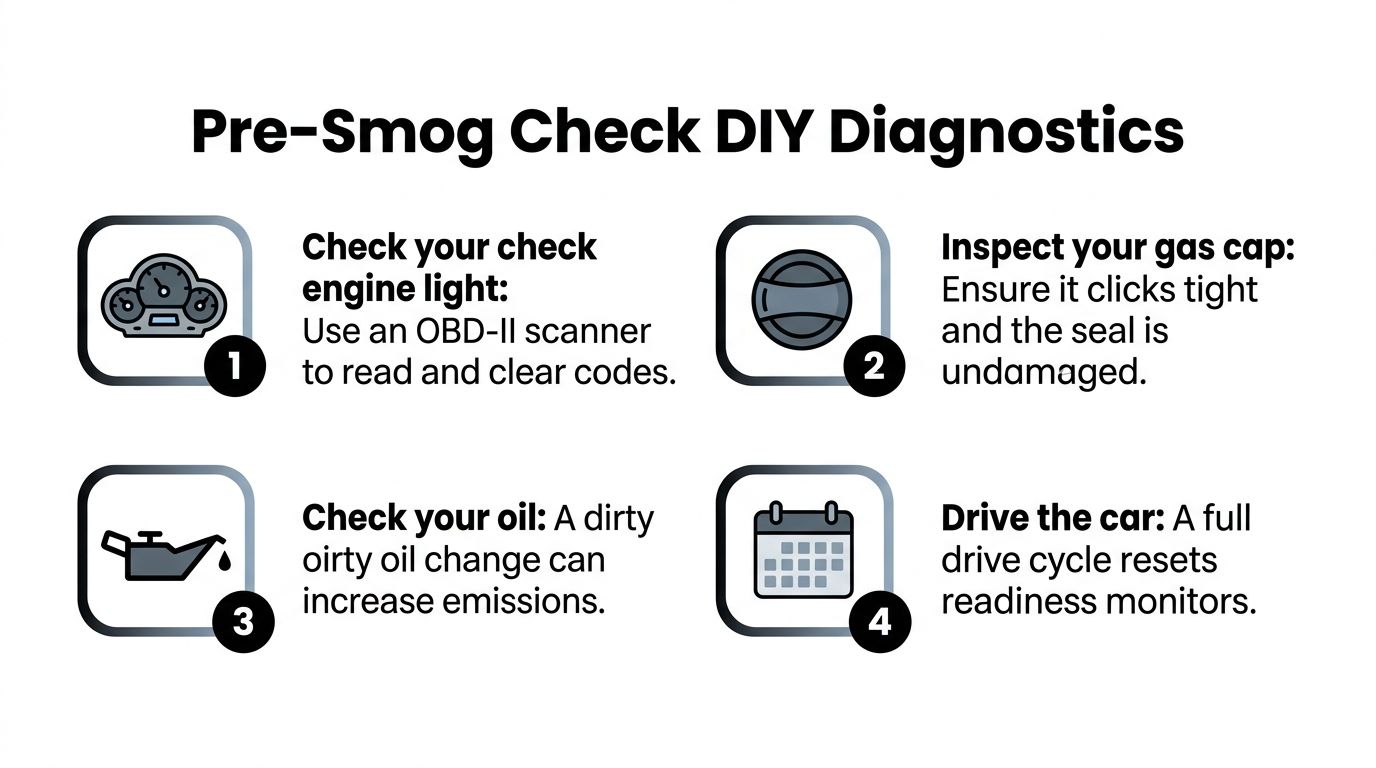
Start with the dashboard
Turn the ignition on without starting the engine and confirm that the malfunction indicator lamp illuminates as part of the normal bulb check. Start the engine and verify that it goes out. If it stays on or flashes, scan the vehicle before scheduling the inspection.
Use a compatible OBD-II scanner to read stored and pending codes. Don't clear codes just to make the dashboard look clean. Code clearing can erase readiness information and leave the vehicle unprepared for the test. A useful OBD code reading guide can help you understand what the scanner is showing, but code interpretation still requires proper diagnosis.
Confirm readiness before you test
Many parts stores and repair shops can check readiness status with a scan tool. Ask specifically whether the required monitors are ready, not merely whether the car has codes. If the battery was disconnected or a repair cleared the computer, the vehicle may need a complete drive cycle.
Drive normally through varied conditions, including a cold start, steady cruising, moderate acceleration, and periods of deceleration. Catalyst and EVAP monitors may require specific temperature, speed, and load conditions, so repeated short errands may not be enough. Follow the manufacturer's drive-cycle guidance when available.
Inspect the simple items
Check the gas cap for a damaged seal, cracked plastic, or a cap that won't tighten correctly. Look under the hood for disconnected vacuum hoses, loose electrical connectors, obvious air leaks, and missing emissions components. Listen for an exhaust leak, especially near the engine and oxygen sensors.
An overdue oil change won't explain every failure, but maintaining the engine before testing is sensible. If the engine runs poorly, consumes oil, overheats, or never reaches normal operating temperature, get those symptoms diagnosed rather than trying to mask them with a last-minute tune-up.
Repair Options Costs and What to Expect at a STAR Station
A car can run smoothly and still fail because its emissions software has not completed required checks. Repair cost depends on the failed system. Correcting a loose gas cap or allowing an incomplete monitor to finish may cost little, while a damaged catalytic converter, wiring fault, failed control module, or major EVAP leak requires diagnosis and more extensive work.
Do not approve a converter, oxygen sensor, or computer replacement just because a generic code points there. Ask which tests confirmed the fault, whether another problem caused it, and whether the repair will restore the readiness monitors. A reputable shop should explain the Vehicle Inspection Report in plain language and connect its repair recommendation to evidence.
A STAR station meets California's additional program requirements and may be required for vehicles directed to STAR testing. Learn more about what a STAR station is and why it matters. Check your registration renewal notice before choosing a location. If it requires STAR certification, a non-STAR station may not meet the testing requirement.
At a station such as Speedy Smog, the inspection documents the vehicle's compliance result. For many 2000-and-newer vehicles, the test is typically completed in about 10 to 15 minutes, according to the publisher's service information. The station also tests older vehicles, diesels, and hybrids, though the procedure varies by vehicle.
Bring your registration paperwork and any previous Vehicle Inspection Report. If another station failed the car, show that report instead of starting over. It gives the technician useful evidence and can prevent duplicate testing. Ask about current coupons before authorizing the inspection, then keep the result paperwork for the repair shop or retest.
Your Action Plan for Passing Your Next Smog Check
Use this order before booking the appointment:
- Check the warning lamp. If it stays on or flashes, scan the car first.
- Read the diagnostic codes. Don't clear them without fixing the cause.
- Verify readiness monitors. Pay particular attention after a battery disconnect or repair.
- Inspect the gas cap and emissions hardware. Look for leaks, missing parts, and obvious modifications.
- Complete the correct drive cycle. Random short trips may not finish catalyst or EVAP checks.
- Bring the Vehicle Inspection Report to a qualified repair shop if the car has already failed.
- Confirm whether your registration notice requires a STAR station before scheduling the retest.
The biggest warning signs are an illuminated check engine light, incomplete monitors, recent code clearing, visible emissions tampering, poor operating temperature, and unexplained exhaust or fuel-system symptoms. Fix the evidence-backed problem first. Don't buy parts based on guesswork.
For a clear inspection result and practical guidance after a failure, visit Speedy Smog in San Leandro. The STAR Certified station tests newer and older vehicles, diesels, and hybrids, and can identify the failed area on the inspection report so you know what to address next.
You've just arrived for a smog check, and the technician mentions a catalytic converter code. The check engine light may be on, the car may still drive normally, and you're left wondering whether you're facing an immediate replacement or a smaller engine-control problem.
That confusion is common because a catalytic converter isn't a simple filter. Its performance depends on exhaust temperature, air-fuel control, oxygen sensors, fuel quality, and the condition of the engine sending gases into it. Understanding catalytic converter function helps you make a better repair decision and avoid replacing an expensive component before anyone has confirmed the cause.
Table of Contents
- Why Your Catalytic Converter Matters More Than You Think
- How a Catalytic Converter Reduces Harmful Emissions
- The Hidden Chemistry That Keeps It Working
- Why Converters Degrade and Replacement Costs Are Rising
- When a Converter Code Is Not Really a Converter Problem
- What This Means for Your Smog Check and Vehicle Maintenance
- Key Takeaways for East Bay Drivers
Why Your Catalytic Converter Matters More Than You Think
A car can arrive at a smog check with normal power, smooth acceleration, and no unusual noise, yet still fail its emissions test. The onboard diagnostic system may detect that the converter is reducing pollutants less effectively than expected, even when the driver notices no change.
That result calls for testing rather than an automatic replacement. The converter processes combustion byproducts in the exhaust, but its performance depends on the engine, fuel control, oxygen sensors, exhaust temperature, and a sealed exhaust path. A misfire, incorrect fuel mixture, or exhaust leak can make a functioning converter appear weak.
The converter is part of an active system
Catalytic converters became a major emissions-control milestone in the mid-1970s. The first converters were installed in cars for the 1975 model year. The three-way catalyst introduced in 1976 later enabled vehicles to address hydrocarbons, carbon monoxide, and nitrogen oxides together, as documented in this history of Carl D. Keith and catalytic converter development.
“Three-way” describes three separate pollution-control tasks:
- Hydrocarbons: Unburned fuel compounds.
- Carbon monoxide: A product of incomplete combustion.
- Nitrogen oxides: Compounds formed during high-temperature combustion.
A mature three-way system has achieved reported removal of about 97% of tailpipe hydrocarbons, 96% of carbon monoxide, and 90% of nitrogen oxides in light-duty vehicles and sport utility vehicles. Those figures describe suitable operating conditions, not a guarantee for every vehicle, fault, or driving situation.
For a smog check technician, the diagnostic code is a starting point. It identifies a measured emissions problem, while further tests determine whether the catalyst is damaged or an upstream fault is disrupting its operation.
Practical rule: A converter code does not, by itself, prove that the converter is the root cause.
For East Bay drivers preparing for DMV registration renewal, this distinction can prevent an unnecessary repair. Confirming the engine and exhaust conditions first helps separate a failed catalyst from a problem that is keeping a healthy catalyst from working efficiently.
How a Catalytic Converter Reduces Harmful Emissions
During a smog check, a converter code can make the component look guilty immediately. The converter may be reacting to an upstream engine problem. Understanding its job helps you see why diagnosis must follow the exhaust chemistry, not stop at the code.
Think of the converter as a chemical sorting facility in the exhaust pipe. Hot exhaust passes through a honeycomb substrate coated with catalytic materials. Those materials encourage reactions that rearrange harmful compounds instead of trapping pollutants in a container.
Step one is exposing the exhaust to a large reaction surface
Inside the metal housing, the substrate contains many narrow passages. This honeycomb design gives exhaust gases broad contact with the coated surface while keeping the stream moving. The coating contains precious-metal catalysts, including platinum, palladium, and rhodium. These metals speed reactions without being consumed like fuel or a filter medium.
Several parts must work together:
| Component | Function |
|---|---|
| Heat-resistant housing | Protects the internal catalyst assembly and contains exhaust flow |
| Honeycomb substrate | Provides extensive surface area for reactions |
| Washcoat | Distributes catalytic materials and supports oxygen storage |
| Precious-metal catalysts | Encourage oxidation and reduction reactions |
The exhaust carries three main regulated pollutants. The converter addresses them through two broad chemical processes.
Reduction removes oxygen from nitrogen oxides
The reduction side targets nitrogen oxides. The catalyst helps separate these compounds so nitrogen can leave mainly as nitrogen gas, a far less troublesome part of normal air. The term “reduction” refers to removing oxygen from the nitrogen-oxide compounds.
Oxidation adds oxygen to carbon monoxide and hydrocarbons
The oxidation side handles carbon monoxide and unburned hydrocarbons. The catalyst promotes reactions that add oxygen, converting carbon monoxide into carbon dioxide and helping turn hydrocarbons into carbon dioxide and water vapor.
The U.S. Department of Energy reports that catalytic converters reduce carbon monoxide and hydrocarbon emissions by more than 90% and nitrogen oxides by up to 70%. Its historical summary also says that in 1998, the technology cut emissions by 20 million tons of CO, 2 million tons of HC, and converted 1 million tons of NOx into less harmful by-products. These figures appear in the U.S. Department of Energy catalytic converter summary.
For diagnosis, the practical point is simple: the converter creates the reaction site, while the engine-control system must deliver exhaust that the catalyst can process. A converter code may therefore indicate damaged catalyst material, or it may reflect an upstream fault that is sending the wrong mixture, excess fuel, or other abnormal exhaust into a still-functioning converter.
The Hidden Chemistry That Keeps It Working
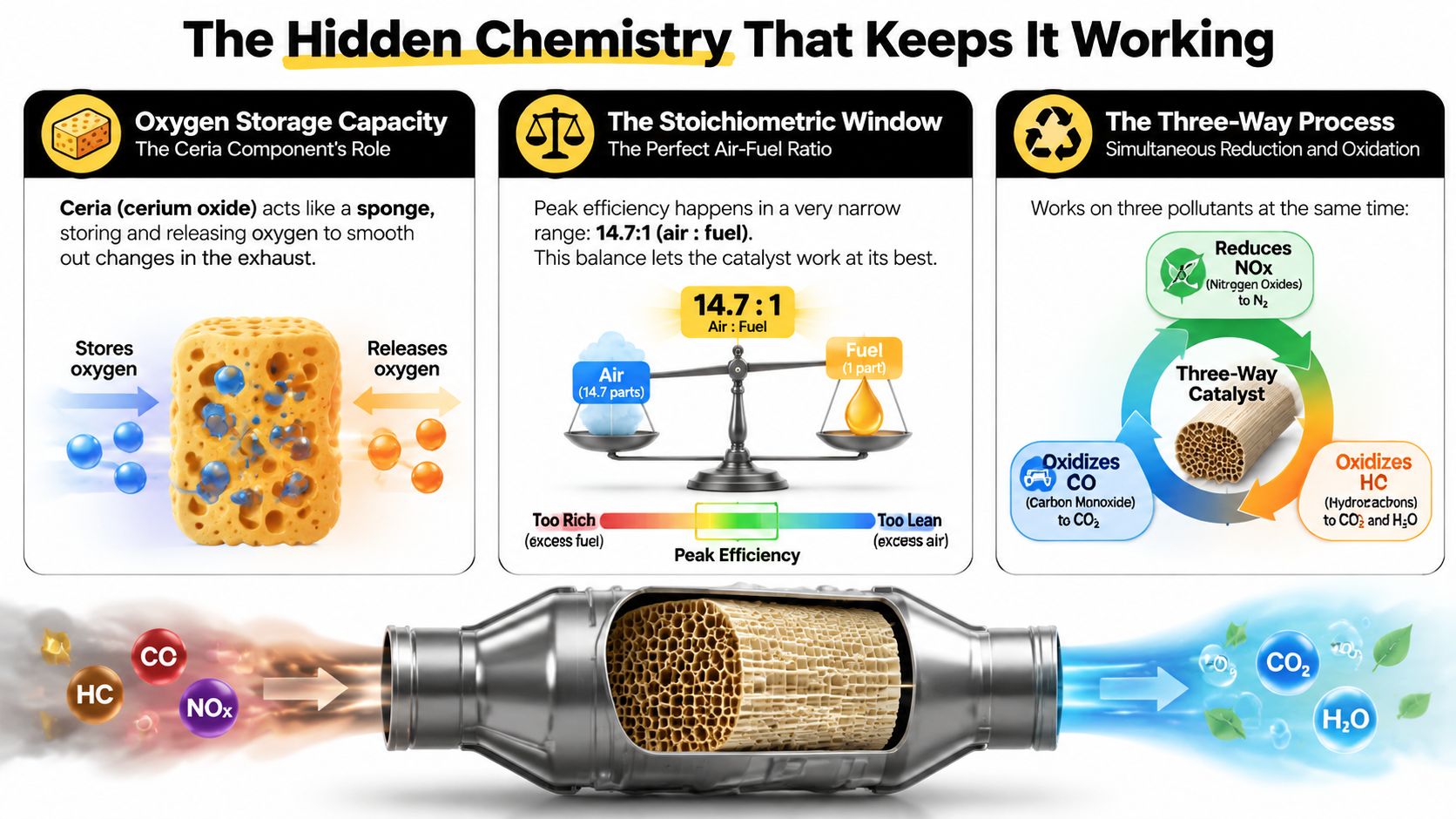
A three-way converter works most effectively near the stoichiometric air-fuel ratio, the narrow balance point where the exhaust contains the right conditions for reducing nitrogen oxides while oxidizing carbon monoxide and hydrocarbons. The engine computer constantly adjusts fuel delivery around that target because real driving never holds the mixture perfectly still.
During a lean moment, the engine receives relatively more air. During a rich moment, it receives relatively more fuel. Throttle changes, acceleration, deceleration, and sensor corrections can move the exhaust back and forth between those conditions.
Ceria acts like a chemical battery
The converter uses a ceria-based washcoat to buffer those swings. Ceria can store oxygen during lean excursions and release oxygen during rich excursions. That stored oxygen gives the oxidation reactions access to what they need even when the immediate exhaust mixture has changed.
The process resembles a rechargeable chemical sponge:
- Lean exhaust arrives, carrying excess oxygen.
- The ceria component stores some of that oxygen.
- Rich exhaust arrives, carrying more carbon monoxide and unburned hydrocarbons.
- The washcoat releases stored oxygen, helping the converter oxidize those pollutants.
This buffering is why a modern converter is better understood as an active chemical reactor than as a passive filter. Technical analysis of three-way catalysts explains that oxygen storage is controlled by exhaust composition, temperature, and catalyst condition. It can therefore change during rapid throttle transitions and as the converter ages, as described in this technical review of oxygen storage behavior.
Why oxygen sensors matter during a smog diagnosis
The oxygen sensors before and after the converter give the vehicle computer information about exhaust conditions and catalyst behavior. The upstream sensor helps the engine computer control the mixture, while the downstream sensor helps it evaluate whether the converter is changing the exhaust as expected.
If the upstream sensor responds incorrectly, the engine may run too rich or too lean. If the exhaust contains an outside-air leak, the downstream sensor may report oxygen that didn't come from the combustion process. In either case, the computer may identify poor converter performance even when the converter itself isn't the first component that needs replacement.
That's why technicians look at sensor data, fuel-control information, misfire history, and exhaust integrity rather than treating one diagnostic code as a complete answer.
Why Converters Degrade and Replacement Costs Are Rising
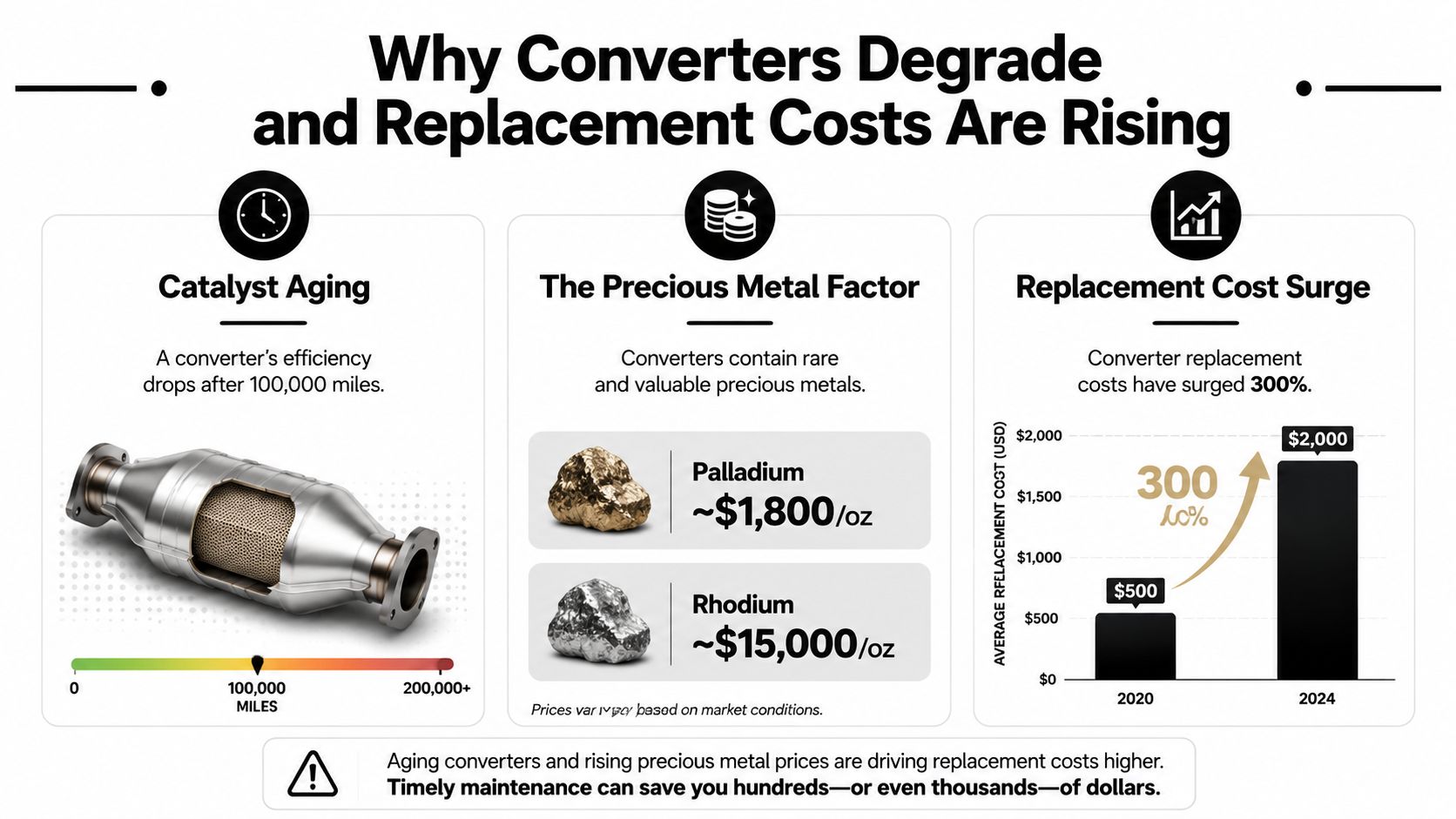
Catalysts age because they operate in a harsh environment. Exhaust heat, repeated mixture changes, contaminants, and physical vibration gradually reduce the converter's ability to store oxygen and promote reactions. As that chemical reserve weakens, the system has less margin when the engine briefly runs rich or lean.
SAE testing found that oxygen storage capacity fell by about a factor of two from 4,000 to 50,000 miles, then declined by another 30% from 50,000 to 150,000 miles. The same SAE technical paper on catalyst aging and sulfur effects reports that each 150 ppm increase in fuel sulfur reduced oxygen storage capacity by about 10%.
Aging changes the diagnostic picture
When oxygen storage becomes weaker, the converter can't smooth out rich and lean swings as effectively. Once the storage material becomes saturated under the wrong conditions, nitrogen-oxide reduction can stop, and oxidation of carbon monoxide and hydrocarbons during rich operation becomes less reliable.
That doesn't mean mileage alone condemns a converter. A well-maintained vehicle and a poorly maintained vehicle can age very differently because the catalyst's history matters. Repeated misfires, incorrect fueling, and contamination can expose the converter to conditions that accelerate damage.
For owners researching possible inspection failures, this guide to catalytic converter smog check failure reasons can provide additional diagnostic context.
Precious metals connect performance to replacement economics
Platinum, palladium, and rhodium perform different catalytic roles, and the exact metal mix varies by converter design, engine, emissions requirements, and manufacturer calibration. That means two converters that look similar from underneath may not provide identical emissions performance or replacement value.
Industry reporting on 2025 precious-metals markets describes palladium as up more than 15% year to date and platinum as up more than 10% in one market report, while rhodium remains expensive and unstable, as discussed in this 2025 platinum-group-metals market report. These market conditions can affect manufacturing, replacement economics, recycling interest, and theft risk.
Manufacturers and researchers are responding by exploring designs that use lower precious-metal loadings, including single-atom approaches. The aim is to preserve emissions control while reducing dependence on scarce and volatile materials, especially during cold starts when the catalyst has not yet reached efficient operating conditions.
A replacement decision should therefore consider more than the price of a metal canister. The correct part must match the vehicle's emissions requirements and operating system, and the underlying engine fault must be repaired first.
When a Converter Code Is Not Really a Converter Problem
A P0420 or P0430 code can mean the converter isn't meeting the expected efficiency threshold. It doesn't automatically mean the catalyst has failed internally. Independent technical guidance emphasizes that converters work efficiently only when the engine operates properly and the exhaust system remains leak-free, which is why a converter code can be a symptom rather than the root cause.
Start upstream of the converter
A cylinder misfire sends unburned fuel into the exhaust. That fuel can burn inside the converter, raising temperatures and damaging the catalyst material. If the check engine light is flashing, continued driving can turn an engine-control problem into an expensive emissions-component problem.
A fuel-control fault creates a different pathway. If an injector leaks, fuel pressure is incorrect, or an airflow measurement is wrong, the engine may deliver a mixture outside the converter's effective operating window. The converter may still be physically intact, but it can't clean exhaust correctly when the incoming chemistry is continually wrong.
An exhaust leak can mislead the sensors in another way. Outside air entering near the manifold or before a sensor adds oxygen to the exhaust stream, causing sensor readings that don't represent what left the cylinders.
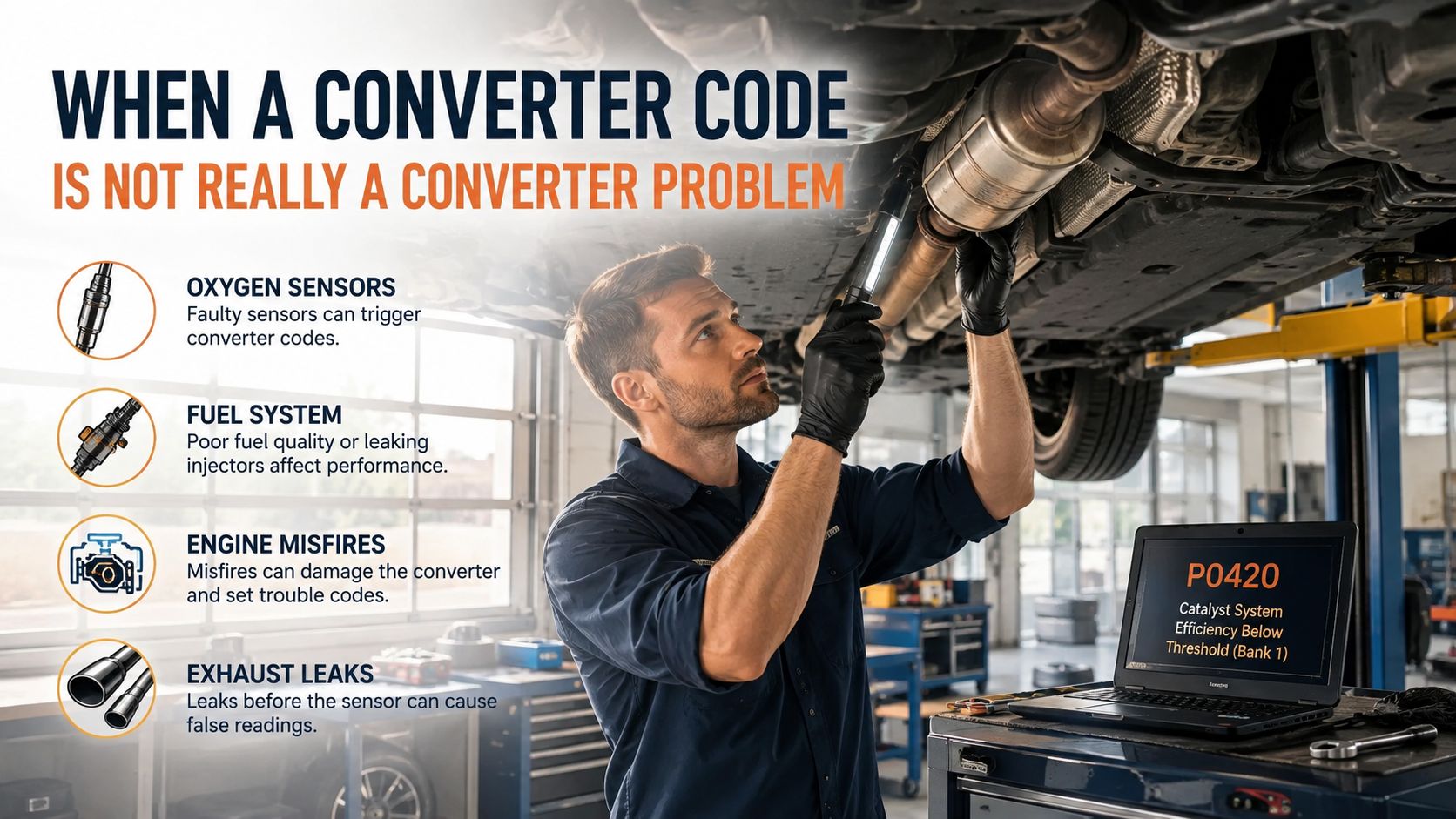
Use a decision sequence instead of a parts cannon
Before approving converter replacement, a technician should work through the conditions that can produce the code:
- Check misfire data: Look for current, pending, or stored misfire information and address ignition, injector, compression, or timing concerns.
- Inspect fuel control: Review oxygen-sensor and fuel-trim behavior for evidence of a persistent rich or lean condition.
- Test for exhaust leaks: Inspect the manifold, gaskets, flex pipe, welds, and sensor fittings for leaks that can introduce outside air.
- Confirm sensor operation: Compare upstream and downstream sensor behavior rather than replacing a sensor solely because a converter code is present.
- Evaluate converter condition: Only after the supporting systems pass inspection should the catalyst itself become the primary suspect.
For owners who want a basic explanation of stored and pending faults, this guide to reading OBD diagnostic codes is a useful starting point.
Vehicles from 2000 and newer can still fail smog checks when upstream misfires, fuel-control problems, or exhaust leaks keep the catalyst from reaching or maintaining proper operating conditions, as noted in this technical guidance on converter diagnosis and evolving catalyst designs. The sensible question isn't “How quickly can I replace the converter?” It's “What caused the emissions system to report low efficiency?”
What This Means for Your Smog Check and Vehicle Maintenance
A smog check examines more than whether the car feels normal on the road. For many modern vehicles, the inspection includes the onboard diagnostic system, emissions readiness information, sensor-related data, and a visual review of emissions equipment and the exhaust system.
The practical preparation is straightforward, but timing matters. Clearing a check engine light immediately before testing can erase readiness information, leaving the vehicle not ready for inspection even if the light stays off.
Prepare the vehicle before the appointment
Use this checklist as a starting point:
- Keep the check engine light off: Diagnose the reason for any active warning instead of disconnecting the battery or clearing codes.
- Complete the required drive pattern: After repairs or battery loss, drive the vehicle through the conditions needed for its readiness monitors to set.
- Repair misfires first: Ignition faults and fueling problems can damage the converter and cause an emissions failure.
- Check the exhaust for leaks: Small leaks can alter oxygen-sensor readings and undermine the test result.
- Bring repair information: If a technician has already diagnosed a fault, provide the codes and completed work so the inspection team has useful context.
Technicians also watch for obvious converter or exhaust damage during the visual portion of an inspection. A missing, modified, damaged, or visibly leaking emissions component can create a problem even when the car's computer has no active converter code.
Habits that protect the catalyst
The converter depends on the engine, so maintenance that keeps combustion stable protects the exhaust system too. Use the fuel specified for the vehicle, avoid questionable additives, and repair rough running promptly. Prolonged idling, repeated short trips, and unresolved warning lights can keep the converter from operating under favorable conditions.
A converter that becomes restricted may produce sluggish acceleration, unusual heat, or rattling from a damaged substrate. Those symptoms require mechanical diagnosis because similar complaints can also come from ignition, fuel, transmission, or exhaust problems.
For a broader preparation list, review these common smog check failure reasons before scheduling the inspection.
Testing time depends on the vehicle and the inspection requirements. At a properly equipped station, tests for 2000 and newer vehicles typically take about 10 to 15 minutes, according to Speedy Smog's service information. Older vehicles, diesels, and hybrids may require additional inspection steps or different procedures.
Key Takeaways for East Bay Drivers
The converter's job is chemical, not mechanical filtering. It uses a coated substrate and precious-metal catalysts to reduce hydrocarbons, carbon monoxide, and nitrogen oxides, while oxygen storage helps the system handle ordinary changes in engine mixture.
Three practical lessons matter most:
- Engine condition comes first: A converter needs properly controlled exhaust and a leak-free system.
- A converter code needs context: P0420 or P0430 can result from misfires, fuel-control faults, sensor problems, or exhaust leaks.
- Maintenance protects the expensive parts: Promptly repairing rough running and warning lights gives the catalyst a better chance of lasting.
A smog check is also a diagnostic opportunity. Instead of treating an emissions failure as a parts-shopping exercise, ask the technician to verify readiness status, inspect the exhaust, review sensor behavior, and identify whether the converter is failing or reacting to an upstream fault.
If your check engine light is on or your California registration renewal requires testing, schedule an inspection with a STAR Certified station that can evaluate the emissions system accurately. Speedy Smog in San Leandro offers smog testing for most vehicles, including newer cars, older vehicles, diesels, and hybrids, with a convenient location at 15275 Washington Ave and Monday-through-Saturday hours.
Visit Speedy Smog in San Leandro for a STAR Certified smog check and practical emissions guidance. If a catalytic converter code appears, ask the team to help determine whether the catalyst itself has failed or whether an upstream engine or exhaust problem is causing the reading.
Most diesel cars and light-duty diesel trucks in California from model year 1998 and newer do need a smog check every two years for registration renewal. The test is different from a traditional gasoline tailpipe test, and diesel vehicles from 1997 and older are generally exempt from that standard program.
You may be asking this while looking at a DMV renewal notice, standing beside a diesel pickup, or trying to decide whether a trip to a San Leandro smog station is necessary. The confusion is understandable. California doesn't decide the answer by fuel type alone. Model year, gross vehicle weight rating, registration category, and the inspection program that applies to the vehicle all matter.
A newer diesel may need an emissions-related inspection even though the technician doesn't place the familiar gasoline-style probe into the tailpipe. A heavier truck may avoid the ordinary biennial smog program yet still face separate California Air Resources Board compliance requirements. The useful question isn't, “Is it diesel?” It's, “Which California testing pathway applies to this vehicle?”
Table of Contents
- The Short Answer on Diesel Emissions Testing
- Which Diesel Vehicles Need a Smog Check
- How a Diesel Test Differs From a Gasoline Smog Check
- What Happens During a Diesel Smog Inspection
- The Heavy-Diesel Rule Most Owners Overlook
- How to Prepare Your Diesel Before the Appointment
- Common Reasons Diesels Fail and How to Fix Them
- What East Bay Drivers Can Expect at Speedy Smog
The Short Answer on Diesel Emissions Testing
A diesel owner in California can reach the registration-renewal counter expecting a routine answer, then discover that the result depends on the vehicle's age, size, and inspection pathway. For most diesel cars and light-duty trucks, a 1998 or newer model with a gross vehicle weight rating of 14,000 pounds or less generally falls under the state Smog Check program when renewal requires an inspection. The California Bureau of Automotive Repair Smog Check program explains why diesel vehicles in this group are not automatically exempt.
The inspection can look different from the gasoline test many drivers know. Instead of relying on the familiar gasoline dynamometer and tailpipe measurement, California's diesel process may use on-board diagnostics, visual verification of emissions equipment, and smoke-related compliance. The technician checks for emissions faults reported by the vehicle computer, confirms that required components are still installed, and looks for an unacceptable smoke condition.
The key point is:
A diesel can need a smog check without receiving a traditional gasoline tailpipe test.
Model year helps determine which technology the station uses. Newer qualifying vehicles generally follow OBD inspection procedures, while older vehicles use another inspection path. The rules also include specific readiness-monitor requirements for 2007-and-newer light-duty diesel vehicles, with updated requirements beginning in July 2023. Drivers should review the California Bureau of Automotive Repair Smog Check program before scheduling an appointment.
Why the answer isn't just yes or no
A 2005 diesel passenger car and a 1996 diesel sedan can receive different results. A light-duty diesel pickup also may follow a different route from a commercial truck above the heavy-vehicle threshold. Fuel type starts the conversation, but it does not finish the decision.
Your DMV renewal notice provides a useful clue. Confirm the vehicle's model year and GVWR as well, because those details determine whether the ordinary biennial program applies. If the vehicle qualifies, the station electronically reports the outcome so registration can proceed. If it falls outside that program, another emissions rule may still apply, particularly for commercial use or heavy-duty operation.
Which Diesel Vehicles Need a Smog Check
Two figures usually settle the first part of the question: model year and GVWR. GVWR means gross vehicle weight rating, the maximum loaded weight assigned by the manufacturer. It isn't the vehicle's current scale weight, and it isn't the same as curb weight.
A qualifying 1998-and-newer diesel car or light-duty truck at 14,000 pounds GVWR or less generally needs a biennial California Smog Check for registration renewal. A 2005 diesel pickup used as a personal vehicle is the familiar example. Its diesel engine doesn't create an automatic exemption.
A 1997-and-older diesel vehicle is exempt from the standard biennial diesel Smog Check program described by California BAR. A 1996 diesel sedan may therefore fall outside that ordinary renewal inspection, even though it remains subject to other vehicle-maintenance and emissions laws.
Vehicles above the light-duty GVWR boundary need more careful handling. They generally don't follow the ordinary passenger-car Smog Check route, but “not subject to the standard smog inspection” doesn't mean “free from emissions compliance.” Heavy-duty vehicles can fall under CARB's separate Clean Truck Check system, discussed later.
| Vehicle Category | Model Year | GVWR | Smog Check Required? | Notes |
|---|---|---|---|---|
| Diesel passenger car or light-duty truck | 1998 and newer | 14,000 pounds or less | Generally yes | Biennial inspection for registration renewal, using diesel-specific procedures |
| Diesel passenger car or light-duty truck | 1997 and older | 14,000 pounds or less | Generally no | Exempt from the standard biennial diesel Smog Check program |
| Diesel vehicle above the light-duty threshold | Any applicable model year | Over 14,000 pounds | Not through the ordinary light-duty program | Separate heavy-duty compliance rules may apply |
| Diesel vehicle with a special registration or operating role | Varies | Varies | Depends | Commercial, fleet, agricultural, and government classifications can change the pathway |
For a vehicle-specific explanation, compare the state's rule with the diesel smog check requirements for California vehicles. Check the door-jamb label or registration paperwork for GVWR rather than guessing from the truck's appearance.
The practical decision sequence
Use this order:
- Read the model year. If the diesel is 1997 or older, it generally falls outside the standard biennial diesel program.
- Find the GVWR. Use the manufacturer's label, not the vehicle's present load.
- Identify the vehicle's use. Personal-use and commercial operation can lead to different obligations.
- Read the DMV notice. It often tells you whether a smog certificate is needed for renewal.
- Ask which program applies. A heavy-duty exemption from one inspection doesn't rule out another compliance system.
This approach prevents the common mistake of treating every diesel as either automatically tested or automatically exempt.
How a Diesel Test Differs From a Gasoline Smog Check
A gasoline inspection often makes the process visible. The technician may place a probe in the tailpipe and measure exhaust gases during an idle or dynamometer procedure. The familiar pollutants include hydrocarbons, carbon monoxide, and oxides of nitrogen.
A qualifying diesel inspection follows a different logic. Instead of relying primarily on a tailpipe gas sample, the technician connects to the vehicle's diagnostic system, checks readiness information and emissions-related fault data, inspects required hardware, and evaluates smoke-related compliance. The California diesel and gasoline smog comparison shows why a diesel test can look less dramatic while still being a formal emissions inspection.
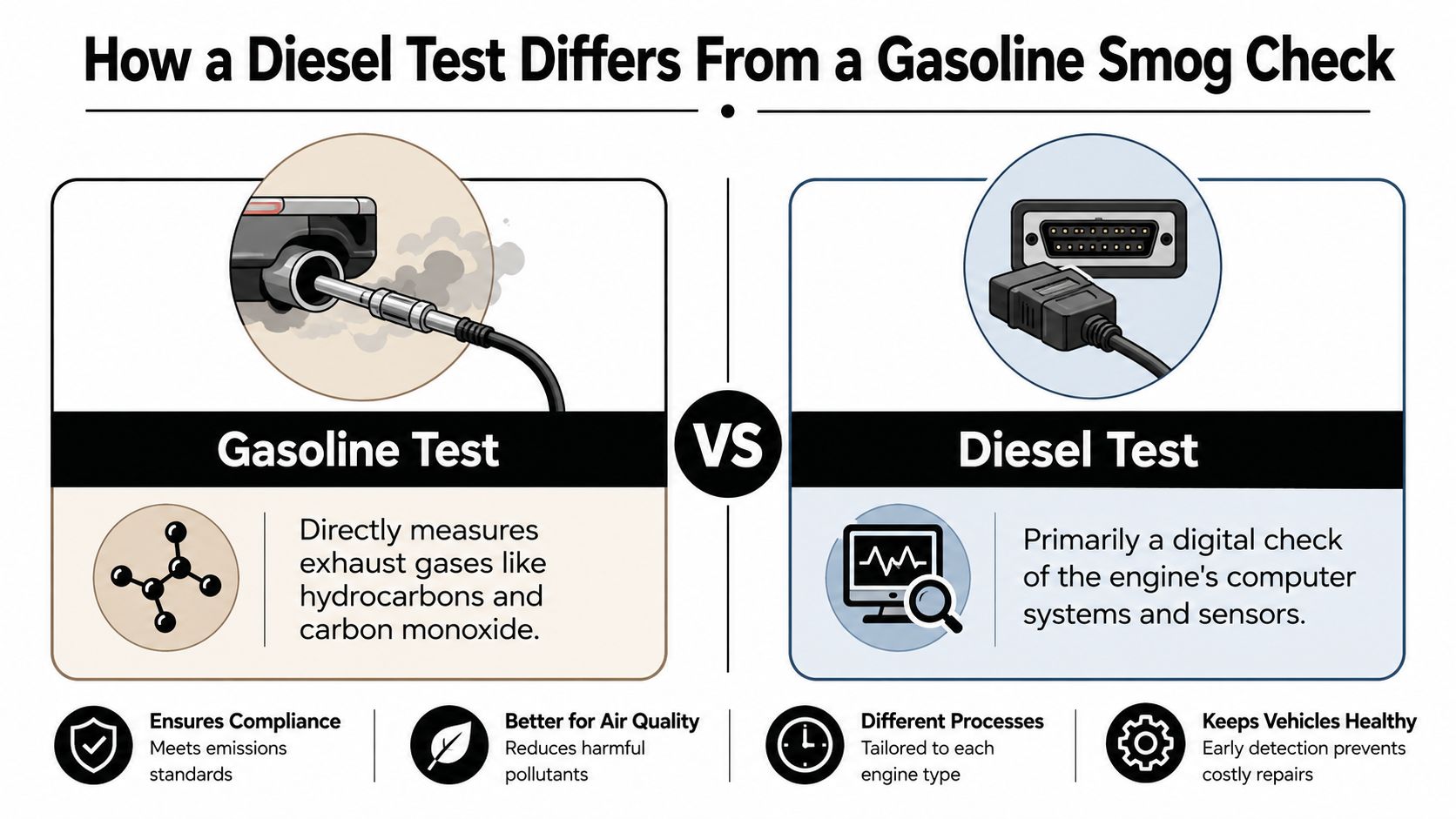
What the technician is checking
OBD readiness tells the inspector whether the vehicle's emissions monitors have completed their self-tests. A recently disconnected battery or cleared diagnostic codes can leave those monitors incomplete.
The malfunction indicator lamp matters because the engine computer may identify an emissions fault even when the vehicle drives normally. A diesel doesn't need to produce obvious smoke to have a computer-detected problem.
The visual inspection confirms that emissions-control equipment remains present and connected. Depending on the vehicle, that may include exhaust-gas recirculation hardware, particulate-filter equipment, sensors, and related components.
Smoke compliance addresses visible exhaust. Diesel testing has historically focused more on opacity and visible particulate output than on the gasoline-style measurement of several tailpipe gases. California's current approach therefore combines digital information with physical inspection rather than depending on one reading alone.
The result is a test designed around how a diesel controls emissions. Don't assume that no tailpipe probe means no emissions test.
What Happens During a Diesel Smog Inspection
At a STAR station, the visit begins with identification and paperwork. Bring the DMV renewal notice if you have it, along with current registration and any repair records that could help explain recent emissions work.
The technician then confirms the vehicle information and looks over the emissions system. The inspection isn't a search for cosmetic flaws. It focuses on whether required diesel equipment is installed, connected, and unaltered. Missing sensors, disconnected wiring, or removed aftertreatment parts can create a problem before the scan is complete.
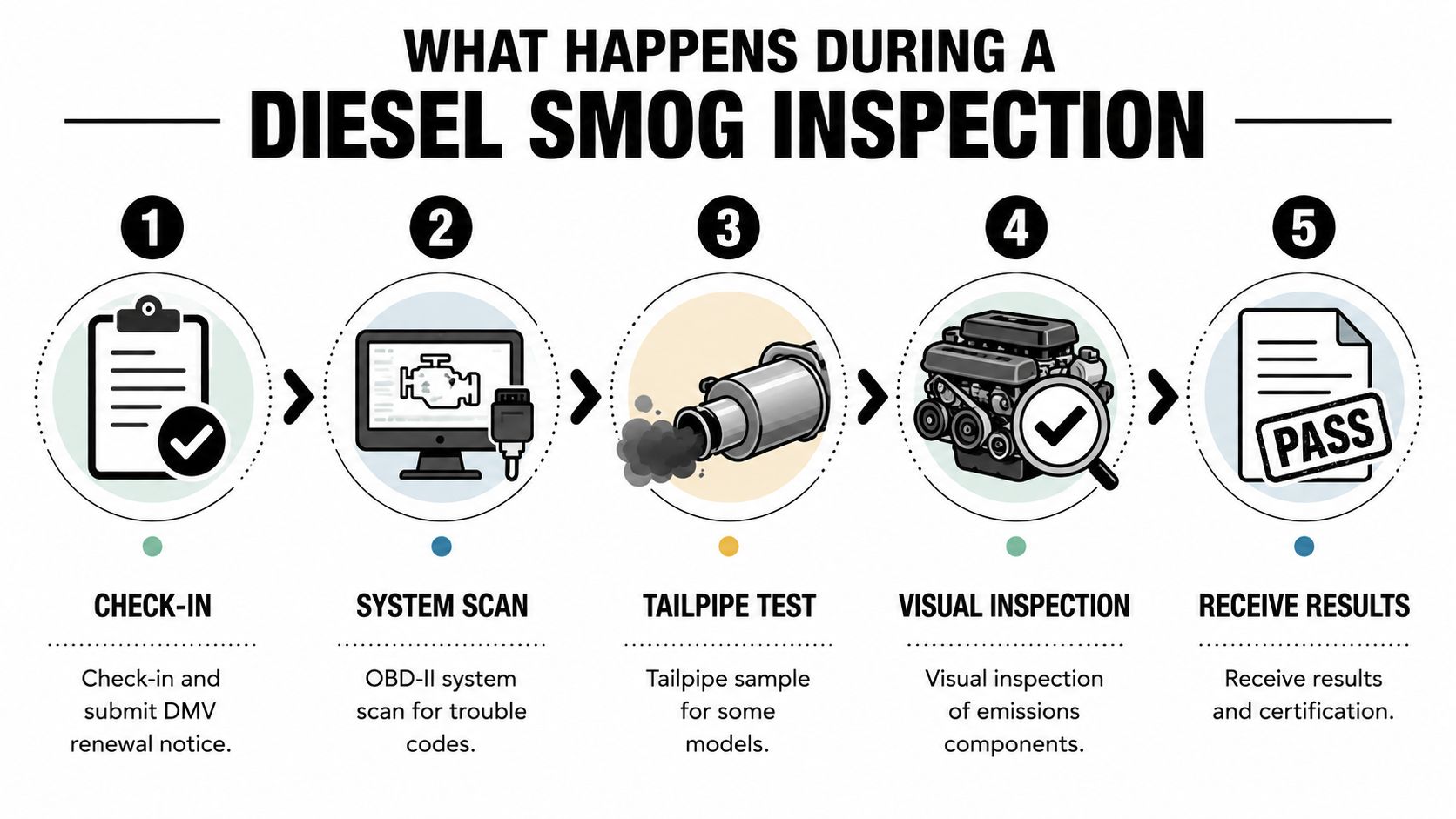
The inspection sequence
- Check-in and vehicle review. The station records the vehicle details and confirms why the certificate is needed.
- Visual emissions inspection. The technician checks components such as EGR equipment, turbo-related plumbing, and aftertreatment hardware for presence and apparent tampering.
- OBD connection. A scan tool connects to the standard diagnostic connector to read readiness monitors, the MIL status, and emissions-related trouble information.
- Smoke-related evaluation. The applicable procedure may include an opacity or acceleration-related check. Most qualifying newer diesels don't receive the gasoline-style tailpipe sniffer test.
- Electronic reporting. The station submits the result electronically for the registration process and provides the customer with the inspection outcome.
The exact procedure depends on the vehicle's model year and the applicable California inspection rules. The diesel emissions testing equipment used during inspection is intended to gather the information required by that procedure, not to force every diesel through the same gasoline test.
A vehicle with completed monitors and no active emissions fault usually moves through the process more smoothly than one with recently cleared codes. Allow enough time for the station to check the vehicle and complete the electronic paperwork, and ask about the expected appointment length when scheduling.
For a visual walkthrough of the process, the following video provides additional context:
The Heavy-Diesel Rule Most Owners Overlook
A heavy diesel truck isn't automatically outside California emissions oversight. It may be outside the ordinary light-duty biennial Smog Check program while still being covered by Clean Truck Check, CARB's separate heavy-duty compliance system.
CARB says nearly all diesel and alternative-fuel heavy-duty vehicles operating on California roads above 14,000 pounds GVWR must report into the Vehicle Inspection System, pay an annual compliance fee, and pass periodic emissions compliance testing. OBD-equipped vehicles are scanned electronically. Non-OBD diesels use smoke-opacity testing and a visual emissions-control inspection under the applicable procedure. See the CARB Clean Truck Check requirements before assuming a weight-based exemption ends every obligation.
The pathway depends on more than weight
Fleet owners and owner-operators commonly encounter this system, but the operating category matters too. Agricultural, government, and other vehicles may have limited exemptions or special treatment, so the owner needs to verify the exact classification rather than rely on a general rule.
| GVWR Class | Biennial Smog Check | Clean Truck Check Required | Reporting System |
|---|---|---|---|
| 14,000 pounds or less | Generally applies when the vehicle qualifies by model year and registration | Usually not the ordinary pathway | Standard California registration and Smog Check reporting |
| Over 14,000 pounds, heavy-duty diesel | Not the ordinary light-duty pathway | Generally applies to covered vehicles operating on California roads | CARB Vehicle Inspection System |
| Covered fleet or commercial vehicle | Depends on vehicle details | May apply even when the owner doesn't expect a passenger-car test | CARB compliance reporting |
| Vehicle with a specific exemption | May be exempt from one program | Must be verified against the separate rule | Applicable CARB or registration system |
The testing schedule is also distinct. CARB describes testing as semiannual for most covered vehicles, with testing increasing to quarterly for many OBD-equipped vehicles in October 2027. The future cadence is a scheduled rule, not a reason to wait. A truck can fail because its emissions hardware or OBD data shows a fault even when the driver sees little or no smoke.
For an East Bay commercial driver, the key question is whether the truck needs a light-duty smog certificate, Clean Truck Check compliance, or both under the vehicle's actual use and classification.
How to Prepare Your Diesel Before the Appointment
Preparation starts with the dashboard. An illuminated check-engine or emissions warning light signals that the vehicle's computer has identified a problem. A glow-plug light may indicate a diesel-system issue, although its meaning varies by vehicle, so don't ignore it because the engine still starts.
Don't clear codes just before the appointment. Disconnecting the battery or erasing diagnostic information can reset readiness monitors, leaving the vehicle unable to demonstrate that its emissions systems have completed their self-checks.
A practical pre-appointment checklist
- Scan before scheduling: Use a compatible OBD scanner to check for stored codes and monitor status. A parts store scan can identify clues, but a diesel technician may need manufacturer-level equipment for deeper diagnosis.
- Drive normally after repairs: A mixed city-and-highway drive helps the vehicle complete its required self-tests. The exact drive cycle depends on the make, engine, and emissions system.
- Inspect visible hardware: Look for loose sensor wiring, disconnected hoses, damaged intake plumbing, and missing EGR or aftertreatment components. Don't modify or remove emissions equipment.
- Check basic condition: Confirm that the fuel cap seals, the battery is charged, and the tires are in usable condition. These simple details can prevent avoidable delays.
- Bring paperwork: Take the DMV renewal notice, registration, prior certificates, and repair invoices if available.
- Arrive with the engine warm: A normal drive before the appointment can help the vehicle reach operating temperature, but don't use aggressive driving as a substitute for diagnosis.
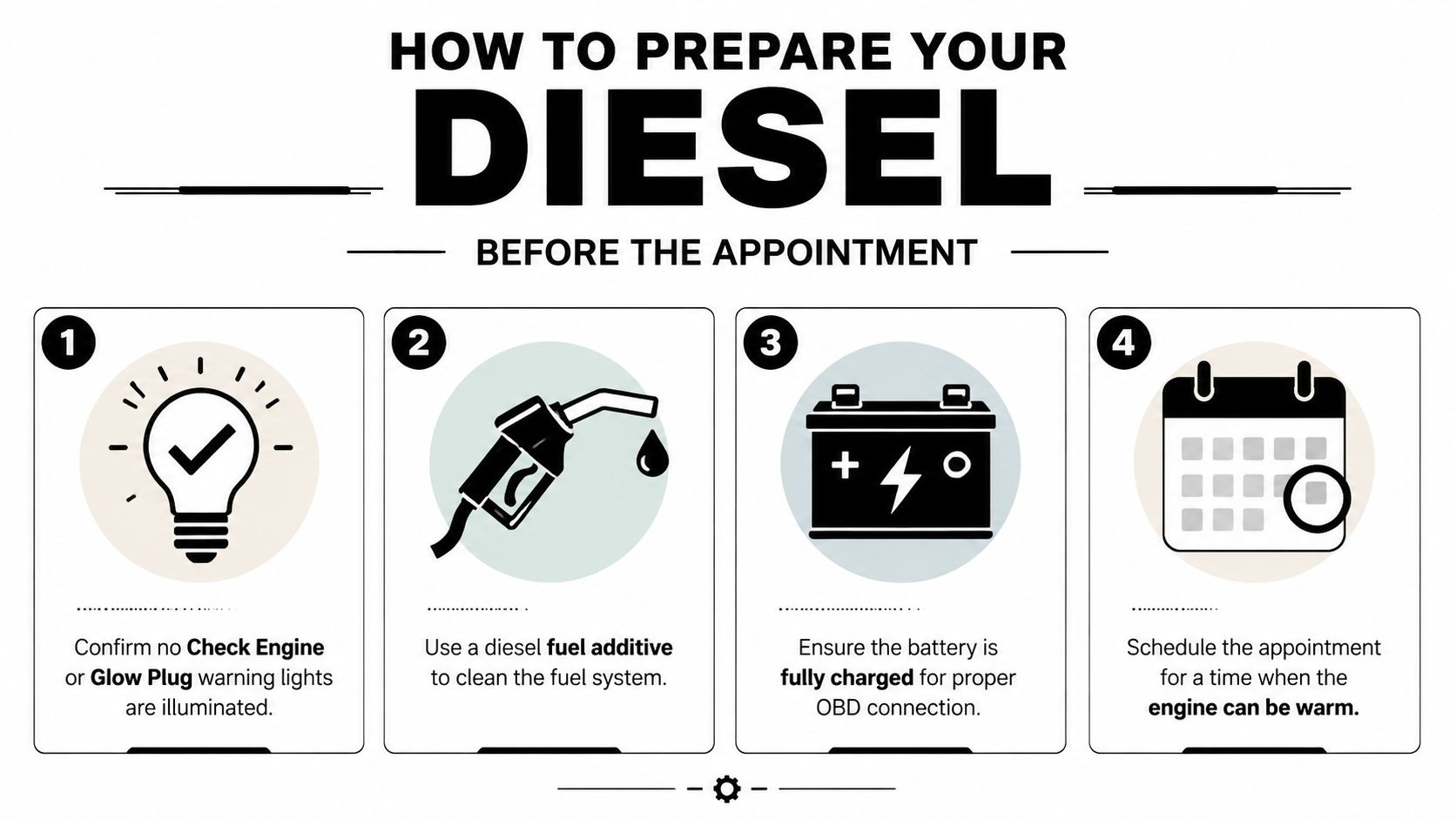
A warning light that returns after clearing is useful information, not a minor nuisance. Have the underlying fault repaired first, then allow the monitors to complete before paying for another inspection.
Common Reasons Diesels Fail and How to Fix Them
Diesel failures often point to a specific system rather than a mysterious overall problem. The inspection result and diagnostic code should guide the repair. Guessing, repeatedly clearing codes, or replacing unrelated parts can make the process longer and more expensive.
Readiness monitors remain incomplete
A battery disconnect or code-clearing event can reset the monitors. The driver may notice no change in performance, yet the inspection computer still sees incomplete self-tests. The next step is to identify which monitor remains incomplete, repair any underlying problem, and complete the vehicle-specific drive cycle.
An emissions warning light is active
A check-engine or aftertreatment warning can result from a sensor fault, DPF issue, EGR problem, or another emissions-system condition. Read the code with a suitable scanner before replacing parts. If a regeneration is required, a qualified technician should determine whether the vehicle can complete a normal regeneration or needs a service procedure.
Smoke is visibly excessive
Heavy black or blue smoke can direct attention toward air delivery, fuel injection, turbocharger seals, or related engine faults. The repair may involve testing injectors, checking boost plumbing, or inspecting turbo components. Don't treat smoke as something an additive alone will solve.
Hardware is missing or tampered with
A deleted DPF, disconnected sensor, altered exhaust, or removed EGR component can create a visual or compliance failure. Restoring the original emissions configuration is the proper remedy, followed by code checks and monitor completion.
A fuel-system fault appears
Worn injectors and fuel-control problems can affect combustion and trigger emissions-related codes. A diesel specialist can test the fuel system and match the repair to the stored fault rather than relying on a general tune-up.
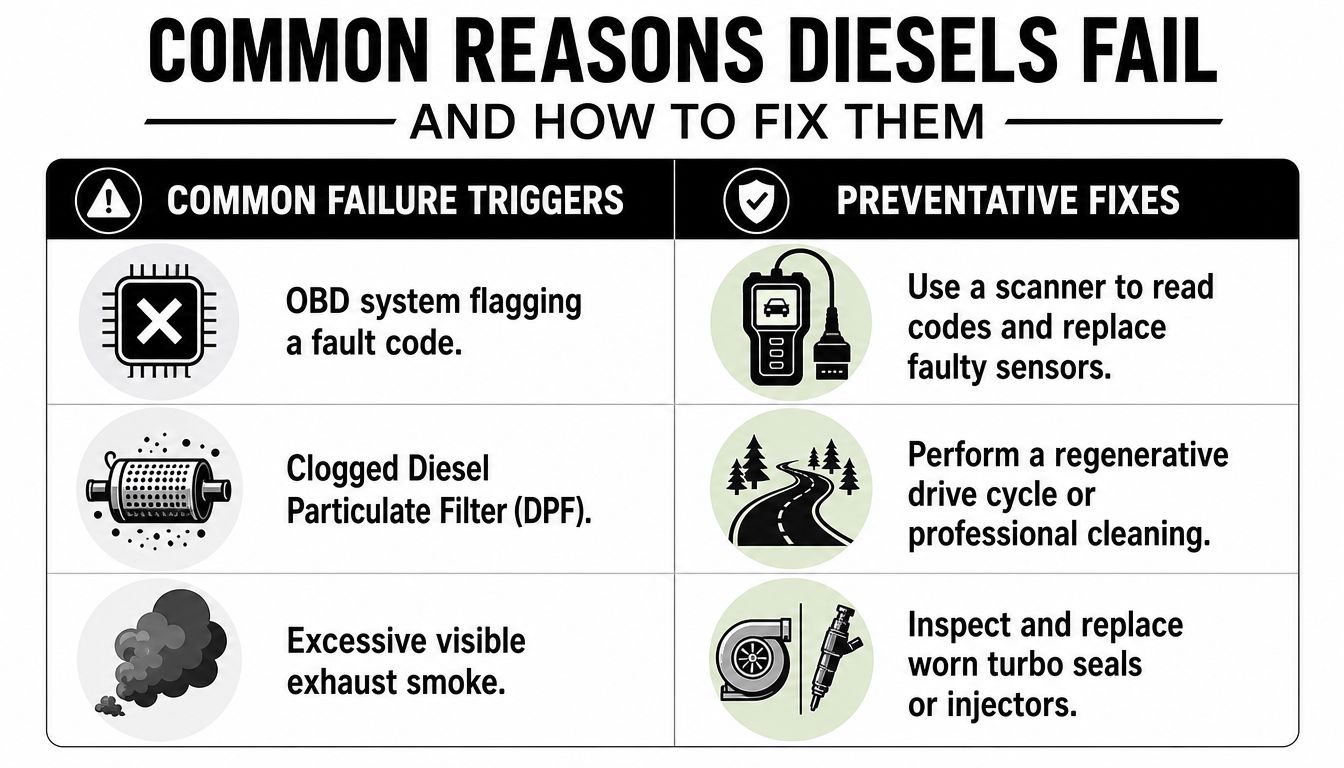
Keep the inspection failure report and repair invoice. Those documents help the technician understand what failed originally and whether the repair addressed the same condition.
What East Bay Drivers Can Expect at Speedy Smog
An East Bay diesel owner should arrive with the DMV renewal notice, current registration, payment, and any paperwork from recent emissions repairs. If the vehicle is a newer light-duty diesel, the technician will generally focus on the applicable OBD information, visual emissions equipment, and smoke-related requirements rather than treating it like a gasoline car.
A STAR-certified station is important when the DMV directs you to a station with that certification. The station's role is to perform the approved inspection and transmit the result through California's reporting system. Ask about diesel capability when booking, especially if the vehicle has unusual equipment or a higher GVWR.
Make the visit easier
Call before arriving if the vehicle is a diesel pickup, commercial truck, modified work vehicle, or anything near the GVWR boundary. Ask which location and inspection pathway fit the vehicle, whether appointments are available, and what documents the technician wants to see.
Speedy Smog in San Leandro states that it performs diesel smog checks for qualifying diesel vehicles from 1998 to the present and serves drivers who need California registration certification. The station is located at 15275 Washington Avenue in San Leandro, and its service information describes support for newer vehicles, older vehicles, diesels, and hybrids. Confirm current availability and pricing directly with the station before visiting.
The clearest answer to “do diesel cars need emissions test” is therefore conditional but manageable. Check the model year, read the GVWR label, identify personal or commercial use, and ask whether the vehicle belongs in the regular Smog Check program or a separate heavy-duty system. That four-part check prevents most surprises at the counter.
Bring your DMV renewal notice and vehicle details to Speedy Smog in San Leandro for help identifying the correct diesel inspection pathway. Call ahead if you're bringing a heavier truck or a vehicle with recent emissions repairs, so the team can confirm the appropriate service before you arrive.
A same-day smog check at a STAR-certified station like Speedy Smog in San Leandro can take roughly 20 to 30 minutes including paperwork for a 2000-and-newer vehicle, but the bottleneck is usually vehicle readiness, not station speed. If your DMV notice is due, your vehicle needs the correct monitors ready, no active check-engine light, and the right station type before you leave home.
You're staring at a renewal notice, the deadline is close, and your calendar already has school pickup, commuting, errands, and a meeting packed into it. Searching “same day smog check near me” sounds like a search for the fastest test, but that's only half the problem. The wrong station, an unready vehicle, or missing paperwork can turn a short inspection into a second or third trip.
California generally ties smog checks to a recurring registration cycle. The DMV requires a Smog Check every other year for registration renewal, while vehicles less than four model years old can pay a smog abatement fee instead of receiving an inspection for the first eight years they're registered, as explained in the California DMV smog inspection requirements. Your notice, vehicle history, and station eligibility should guide the decision before you start driving.
Table of Contents
- Why Same Day Smog Is Really About Total Errand Time
- Understanding the Smog Test Process for Your Vehicle
- Booking, Calling Ahead, and What to Bring
- Why STAR Certification Determines Whether Your Visit Is a One-Stop Errand
- Preparing Your Car the Day Before the Test
- Pricing, Coupons, and What a Smooth Visit Looks Like
- Your One-Trip Smog Checklist
Why Same Day Smog Is Really About Total Errand Time
A Hayward commuter might try to squeeze a smog stop between school pickup and a 4 p.m. meeting. The inspection may be brief, but the actual errand includes checking whether the station is open, confirming that it's STAR certified, driving to San Leandro, completing paperwork, waiting for the bay, paying, and making sure the result reaches the DMV system.
That's why I tell East Bay drivers to stop measuring the job only by test duration. A station that saves a few inspection minutes can still cost you the afternoon if it can't handle your vehicle's eligibility or if you arrive without the information needed to complete the certificate.
Practical rule: Choose the station before you leave home, then confirm that it can perform the exact test your DMV notice requires.
The California DMV also lets drivers check prior smog history by VIN or license plate through its online lookup. That's useful when you're unsure whether a test is due, especially before ownership transfer, first-time California registration, or a renewal deadline. Checking the record first can prevent an unnecessary stop.
Build the visit around the whole route
A reliable same-day plan has four parts:
- Verify the requirement: Read the DMV notice and check the vehicle's prior test history.
- Confirm the station type: Ask whether the station is STAR certified and whether it can inspect directed or gross-polluting vehicles.
- Prepare the paperwork: Keep the notice, registration information, payment method, and vehicle details together.
- Ask about electronic submission: Confirm that the station will transmit the passing result to the DMV system while you're there.
The inspection itself is only one event inside the registration workflow. California DMV field-office pages illustrate why the total errand matters, since even routine DMV visits can involve substantial no-appointment waits, including 40 minutes at Oakland Coliseum and 46 minutes at Poway, while appointments have shorter waits, according to the Oakland Coliseum DMV field-office page. Avoiding a separate DMV stop is often more valuable than shaving a few minutes off the test.
For a practical estimate of inspection duration and preparation, review this guide to how long a smog check takes. The best same-day choice is the station that can test the vehicle, process the paperwork, and transmit the result without sending you across town.
Understanding the Smog Test Process for Your Vehicle
The test bay does more than plug in a scanner. Your vehicle's year, fuel type, and the wording on the DMV notice determine which inspection the station can perform, so provide the year, make, model, and fuel type before you drive over. A nearby station that cannot handle your vehicle or certification requirement turns a same-day errand into another trip.
For most gasoline vehicles from 2000 onward, the technician connects to the OBDII port and reviews the vehicle's emissions data. The scan checks whether required readiness monitors report complete, looks for stored or active emissions fault codes, and confirms that the check-engine light operates correctly. An active check-engine light or a qualifying emissions fault code causes an immediate failure. The technician then completes the required visual and functional checks, rather than relying on the scan alone.
California's BAR Smog Check guidance explains the standard inspection framework. A straightforward OBD-based test generally takes about 30 minutes, though the total visit also depends on the queue, paperwork, and whether the station is authorized for your vehicle and DMV requirement.
Older gasoline vehicles may require tailpipe measurement alongside visual and functional inspection. The technician checks required emissions equipment and verifies that the systems operate as required for that model year. An older vehicle may therefore need different equipment and bay setup from a newer OBDII vehicle.
Match your vehicle to the station
| Vehicle Type | Year Range | Test Procedure | Typical Time |
|---|---|---|---|
| Gasoline vehicle | 2000 and newer | OBD-based inspection, visual checks, and required functional checks | About 30 minutes according to BAR |
| Older gasoline vehicle | 1999 and older | Tailpipe emissions testing with visual and functional inspection | Depends on vehicle and station procedure |
| Diesel vehicle | Varies by vehicle type and year | Diesel-specific inspection, including smoke and emissions checks | Depends on inspection path |
| Hybrid vehicle | Varies by vehicle type and year | Applicable emissions and visual procedures for the hybrid system | Confirm with station before arrival |
Diesel testing follows its own sequence. The BAR procedure includes a crankcase test, idle smoke observation, and final snap tests. Visible smoke during the idle or crankcase checks can fail the vehicle. A smoke plume that remains visible beyond the permitted condition during a final snap test can fail it as well.
Hybrids may use reduced or specialized procedures, but the station still must identify the vehicle correctly. A shop that handles common passenger cars may not have the right process for a diesel pickup or hybrid.
The DMV notice decides whether the vehicle requires STAR handling. Confirm that before choosing a station. Eligibility comes first, test speed second.
Booking, Calling Ahead, and What to Bring
A same-day visit fails when the station can test the car but cannot complete the required certification, accept the vehicle type, or honor the expected coupon. Call before leaving, and make the conversation specific. Ask for same-day capacity, then say, “My DMV notice says STAR is required. Is your station currently STAR certified, and can you complete this certification today?”
Give the vehicle's year, fuel type, and model. If the station cannot handle a diesel, hybrid, older vehicle, or another less common configuration, ask directly: “Can you inspect this vehicle, or should I call a different station?” A clear answer prevents a second trip.
Confirm the money before reserving the arrival window: “Do you have a coupon for this vehicle, and can I use it for a same-day appointment?” Ask whether the coupon has vehicle, payment, or appointment restrictions. Then ask how early to arrive, whether walk-ins are accepted, and whether the result is transmitted electronically after a pass.
A useful call also covers recent work. Tell the technician if you replaced the battery, cleared diagnostic codes, repaired the emissions system, or performed engine work. Ask, “Could that affect the readiness monitors or prevent a valid test today?” Hiding recent work only creates a surprise at the bay.
Bring the documents that support the conversation:
- DMV notice: Use it to confirm whether STAR handling is required.
- Registration information: Keep the vehicle and owner details available for verification.
- Payment method: Bring the form you confirmed by phone.
- Prior certificates: Include them after a recent sale or transfer.
- Repair records: Use them to explain recent battery, engine, or emissions work.
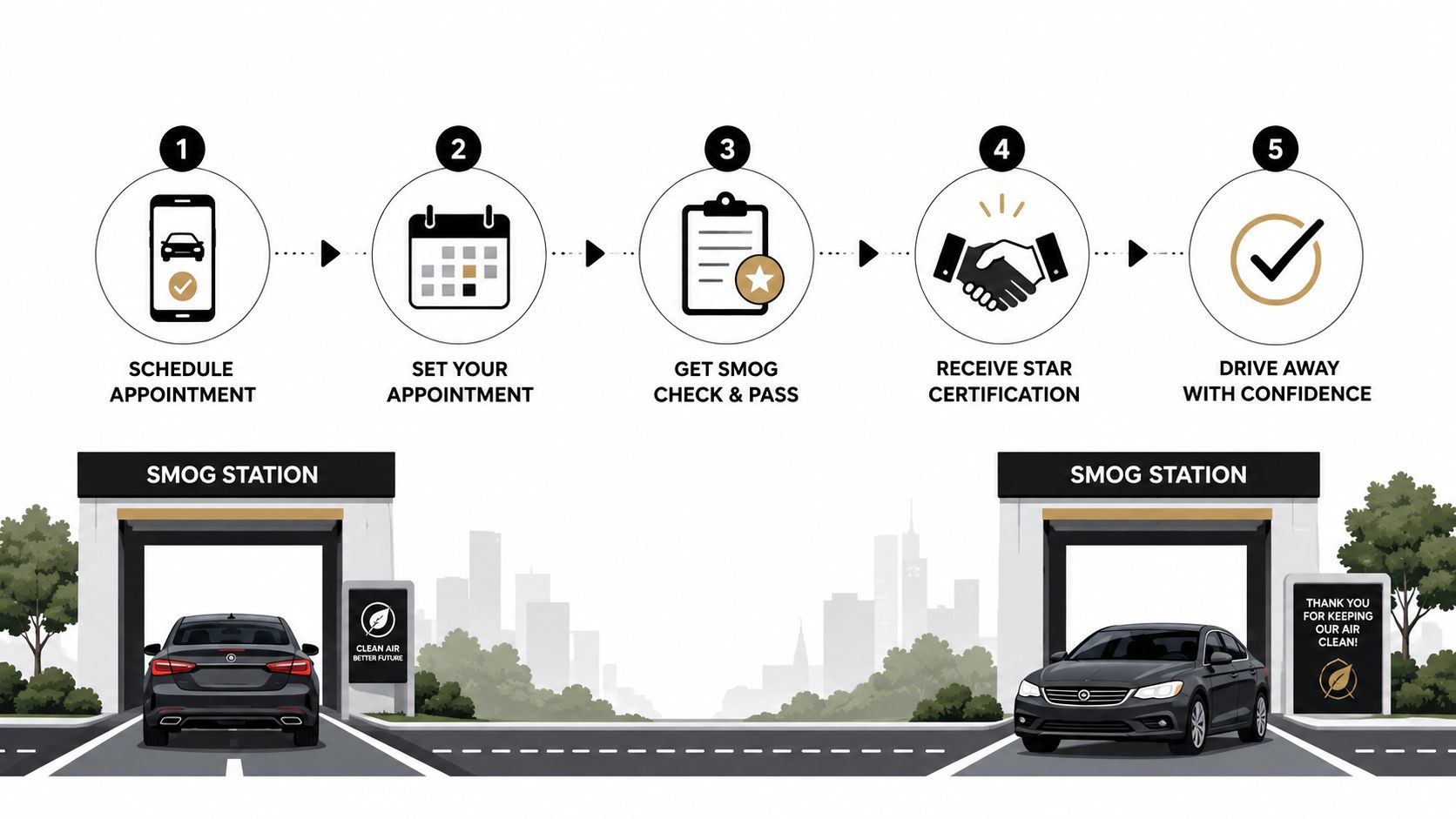
Before handing over the keys, ask, “If it passes, when will the result be uploaded to the DMV?” The answer tells you whether registration can proceed without another paperwork stop.
Use the station's smog check appointment page to set the visit. Booked or walking in, arrive with the confirmed station, the right vehicle information, and the coupon terms already settled. That is how you turn a same-day test into one completed errand.
Why STAR Certification Determines Whether Your Visit Is a One-Stop Errand
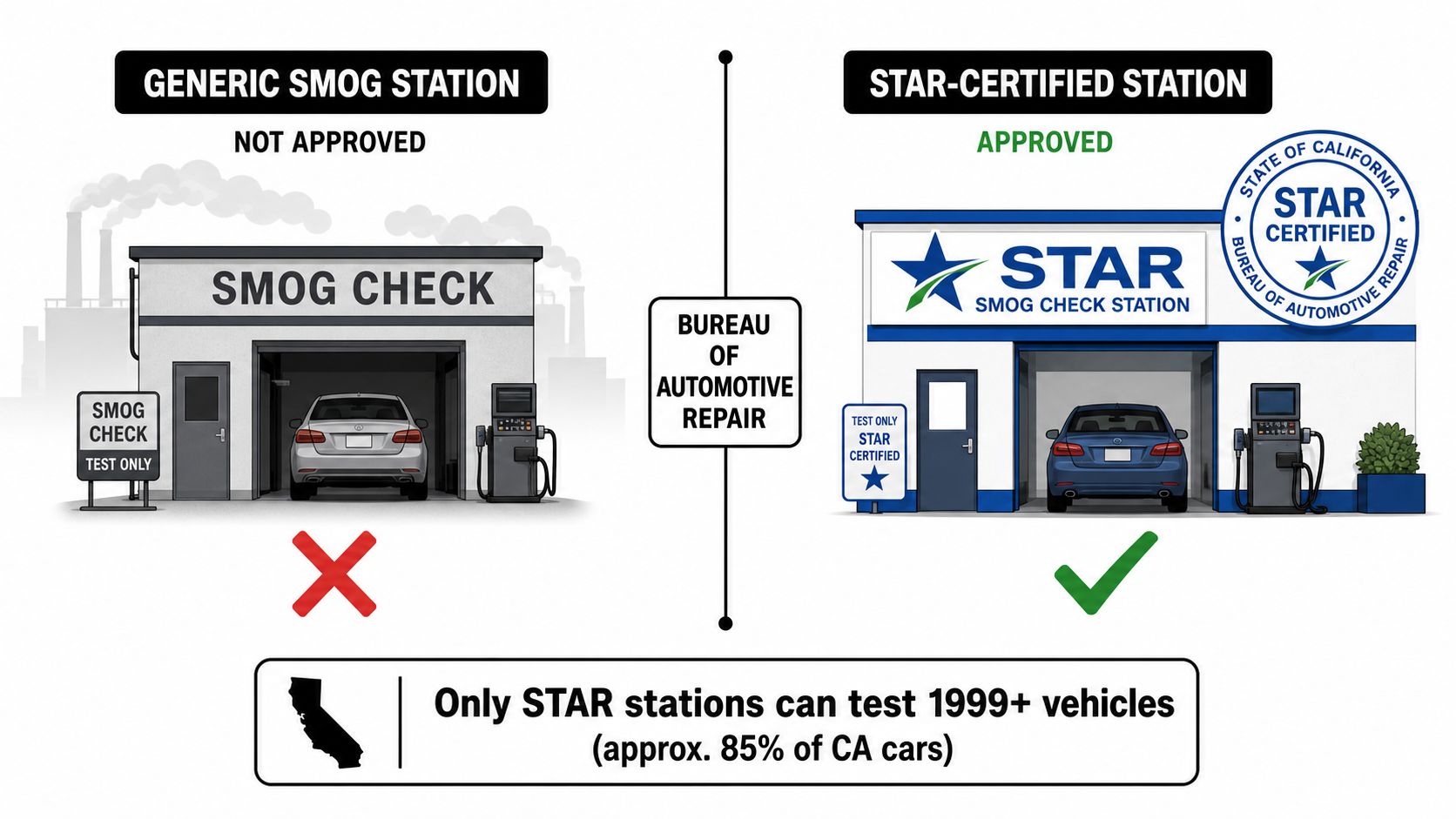
The nearest licensed smog station may not be able to complete your vehicle's required certification. STAR certification is a Bureau of Automotive Repair designation that determines which vehicles a station may inspect. Choosing the wrong station can turn a same-day errand into extra driving, another appointment, and a second wait.
California established the STAR program under Assembly Bill 2289 in 2010, and it began on January 1, 2013, replacing the earlier Gold Shield Program. STAR stations are voluntary BAR-certified test-only or test-and-repair stations that meet higher inspection-based standards. The BAR STAR program information explains the program and its station requirements.
Your DMV renewal notice decides whether STAR service is required. Only STAR stations may inspect directed and gross-polluting vehicles. These can include vehicles that previously failed for high emissions and vehicles California identifies as statistically likely to fail the next test.
The closest station is not necessarily the correct station. Read the notice before you choose the map result.
Read the notice before booking
Look for instructions stating that the vehicle must be tested at a STAR station. If that language appears, a non-STAR shop cannot complete the required certification, even if it has an open bay and advertises same-day service. Call before leaving home and confirm that the station accepts your vehicle and handles the required procedure.
STAR status does not create a different emissions test for the driver. It confirms that the station meets the program's requirements and can inspect vehicles directed into the STAR network. A STAR test-only station performs inspections. A STAR test-and-repair station may also repair vehicles, subject to its licensing and operating scope.
The label “STAR Test-Only” matters after a failure. If you want diagnosis or repairs at the same location, ask what the station performs. A test-only shop may require a second stop, while a test-and-repair shop may keep the work in one visit. Read what a Smog STAR station is before choosing based only on distance.
Speedy Smog in San Leandro is identified by the publisher as a STAR Certified station serving newer vehicles, older vehicles, diesels, and hybrids. Confirm the exact vehicle procedure and current availability by phone. Use this diagram comparing a generic smog station with a STAR-certified station to see why the station's certification can determine whether your errand ends in one stop or stretches into three.
Preparing Your Car the Day Before the Test
If you replaced the battery or cleared a code recently, postpone the test when possible. That work can leave readiness monitors incomplete, and the vehicle may not produce a valid result. Drive it through normal conditions before the appointment so the monitors can reset. Check the BAR inspection guidance for the applicable preparation requirements.
A check-engine light must be off before you arrive. Do not disconnect the battery or erase codes to hide it. Clearing codes also erases inspection data and can leave monitors not ready. The technician can identify that condition, but the station cannot create a passing result.
Use the morning drive wisely
Start the day with enough driving to bring the engine and emissions system to operating temperature. A short trip from a cold start is poor preparation when you can plan a longer drive first. Warm-up driving helps a properly functioning vehicle arrive ready, but it will not repair a failed sensor, persistent warning light, visible smoke, or unauthorized software.
Older vehicles deserve a closer check. Look for exhaust leaks, loose emissions equipment, and obvious vacuum problems. A visual inspection can find missing, disconnected, or altered components even when the car drives normally.
Tape this checklist to the steering wheel:
- Battery history: Do not test immediately after battery replacement or code clearing.
- Warning lights: The check-engine light must be off before arrival.
- Monitor readiness: Drive the vehicle sufficiently after emissions-related work.
- Smoke and exhaust: Address visible smoke or an obviously damaged exhaust.
- Software and equipment: Keep emissions controls and approved software intact.
- Vehicle information: Have the DMV notice and registration details ready.
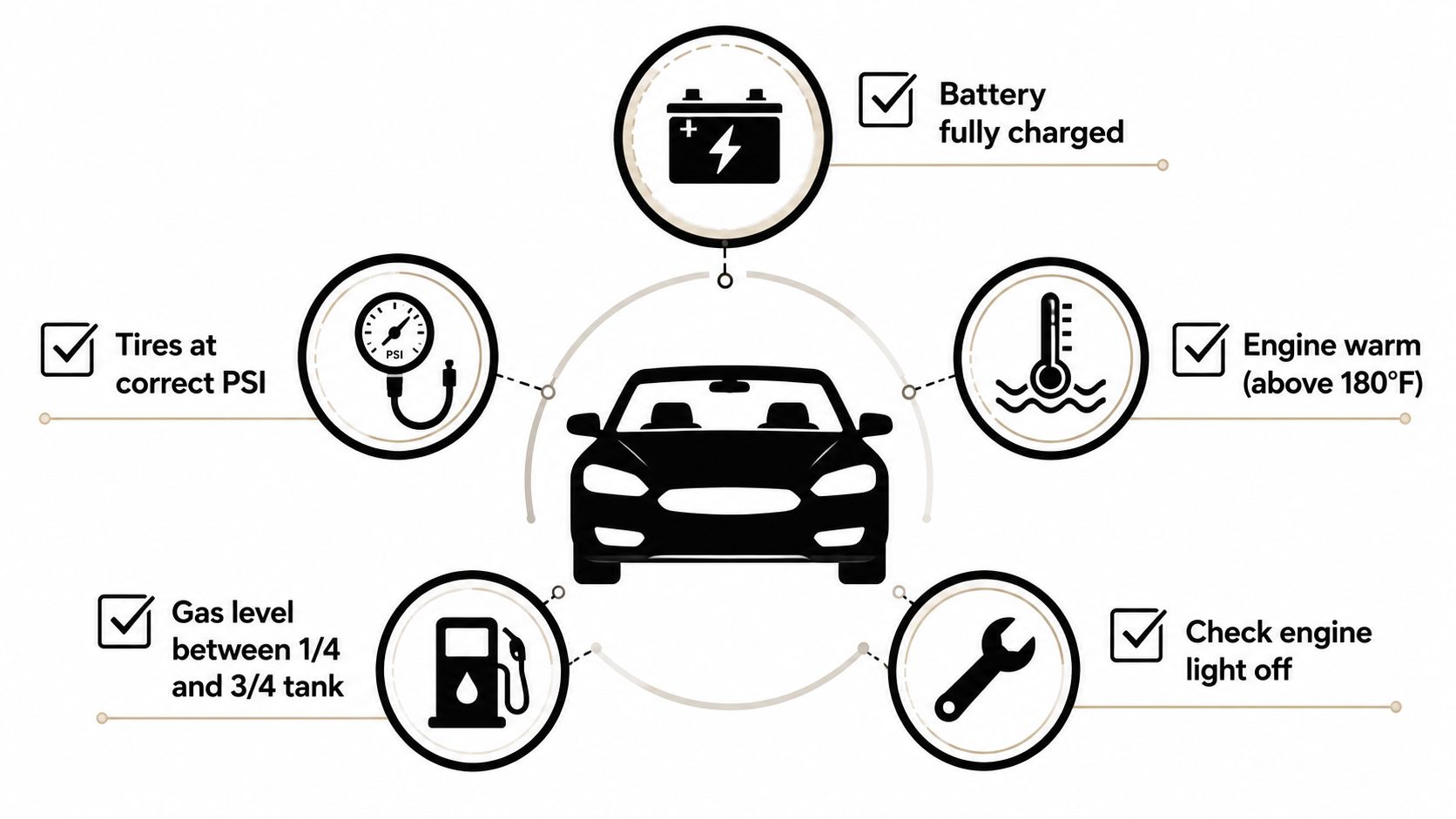
For a visual walkthrough of preparation and inspection considerations, watch the video below.
Do this preparation the day before, not in the station's parking lot. A warm engine can support a ready vehicle, but it cannot turn an unresolved emissions fault into a pass.
Pricing, Coupons, and What a Smooth Visit Looks Like
The quoted test price can hide the items that change your final bill. Ask whether it includes the inspection, required state charges, the OBD or dynamometer portion, certificate processing, and any facility fee. Also ask about re-test charges. A cheap headline price is useful only when the station states the complete out-the-door total.
Use a direct phone script: “For my vehicle, what is the total price today, including all fees, and what would I pay if it fails?” Give the year, fuel type, and notice language. If the answer is vague, call another station. Unclear pricing often creates the same wasted errand as choosing the wrong test location.
Coupons can lower the bill, but verify the offer before driving over. Confirm the expiration terms, eligible vehicle types, and whether the discount applies to a test-only visit or a repair-and-retest situation. Search results can display outdated offers, so have the station confirm the coupon and the final price.
What the visit should feel like
A well-run visit follows a predictable rhythm. You provide the vehicle information, complete the paperwork, hand over the keys, and wait while the technician performs the required visual and emissions checks. For a 2000-and-newer vehicle, the OBD connection is central to the inspection.
The vehicle may need a dynamometer procedure depending on its test path. After the inspection, the result is recorded and the certificate or electronic submission is handled. Ask when the DMV record will update before leaving, especially if registration timing depends on that submission.
A clean waiting room, Wi-Fi, restrooms, and a clear view of the service area make a short lunch-break visit easier to manage. They do not replace correct station certification or vehicle eligibility, but they improve the time spent waiting.
| Vehicle Type | Typical Price Range | Includes Re-Test? | Typical Visit Time |
|---|---|---|---|
| Newer passenger vehicle | Ask station for current quote | Confirm before testing | About 20 to 30 minutes for a straightforward visit |
| Older passenger vehicle | Ask station for current quote | Confirm before testing | Depends on the required tailpipe and visual procedures |
| Diesel vehicle | Ask station for current quote | Confirm before testing | Depends on the diesel inspection sequence |
| Hybrid vehicle | Ask station for current quote | Confirm before testing | Confirm the applicable procedure with the station |
I won't invent a price range for your vehicle. California fees, station pricing, vehicle type, and any coupon can change the final amount. Call with the year, fuel type, and notice language, then confirm the complete out-the-door price before authorizing the test.
Your One-Trip Smog Checklist
Does your renewal notice say STAR required or identify a directed vehicle? If yes, a non-STAR station can waste the entire visit. Confirm that requirement before searching for a same-day appointment. If the notice is unclear, check the vehicle's DMV history by VIN or license plate before you leave home.
Use the result you need to choose the station:
- STAR required: book only with a STAR-certified station.
- No STAR direction: confirm whether the station can test your vehicle and submit the result.
- Uncertain vehicle eligibility: provide the exact year, fuel type, and notice wording by phone.
- Recent battery disconnection or code clearing: ask whether the readiness monitors are likely to be complete before testing.
- Check-engine light on: arrange diagnosis first rather than spending the test fee on a predictable failure.
A call should answer more than “Are you open today?” Ask whether the station accepts your vehicle, has the required STAR status, can take you within your arrival window, charges for a re-test, and submits the result electronically. A vague answer about eligibility, an unclear total price, or no confirmation of the upload process is a reason to call another station.
Pack the DMV notice, registration information, payment method, and any prior test or repair records. Bring a vehicle that has been driven enough after recent work for its readiness monitors to reset. Keep the route simple, leave time for traffic, and arrive during the window the station confirmed. The goal is one complete errand, not merely a short inspection followed by another drive across town.
The 2025 BAR Smog Check Executive Summary Report records different initial failure rates for STAR Test-Only and STAR Test-and-Repair stations. Those figures do not predict your result, but they support a practical rule: if the DMV directs your vehicle to STAR, preparation and correct station selection matter. Review the 2025 BAR Smog Check Executive Summary Report for the reported program figures.
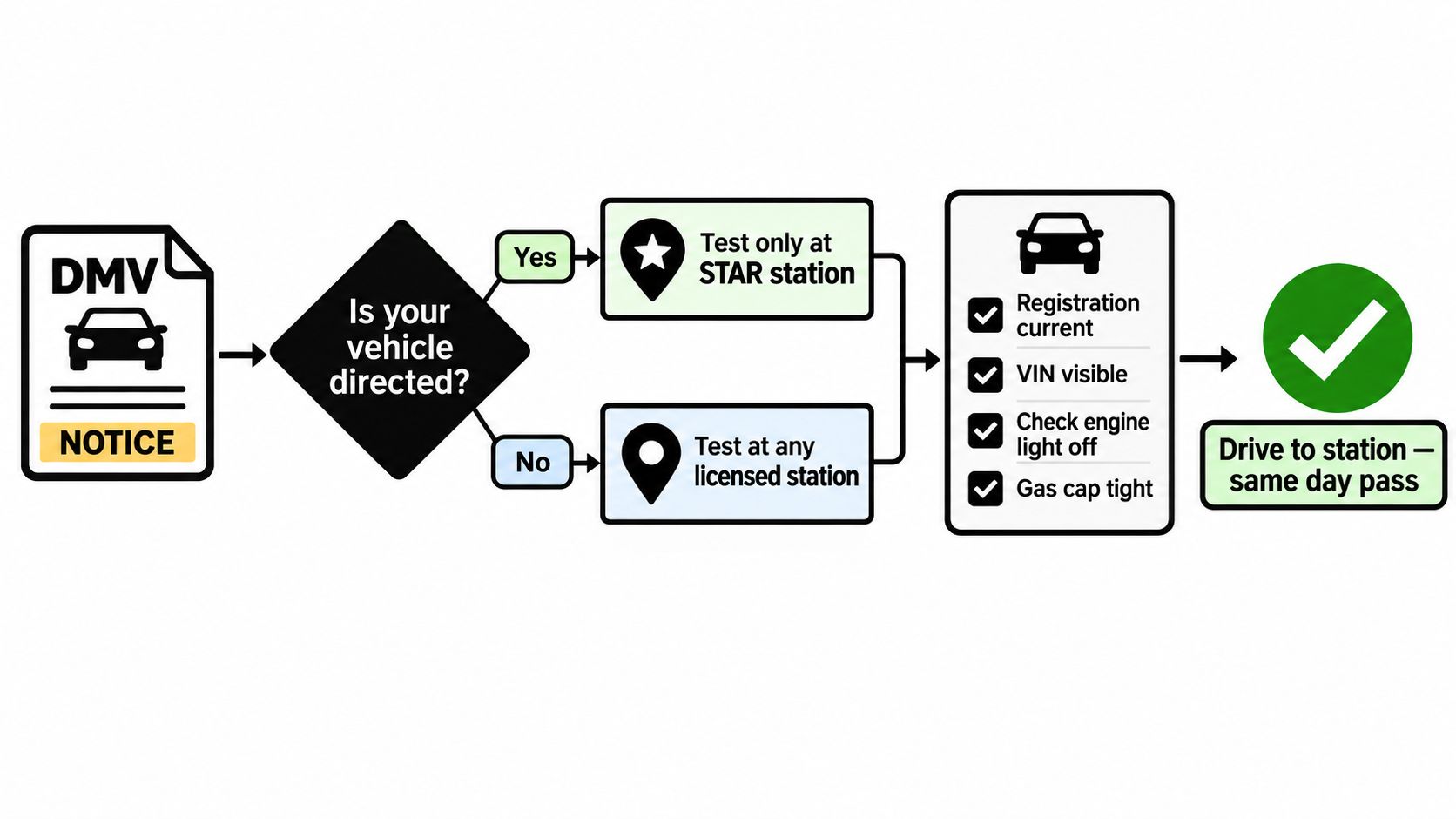
For East Bay drivers, call Speedy Smog at (510) 555-0188 with the vehicle year, fuel type, and notice language. Confirm STAR status, eligibility, arrival time, current price, and result-upload timing before driving over. That conversation prevents the most expensive delay, a visit to a station that cannot complete your test.
Speedy Smog provides STAR-certified smog inspections in San Leandro for qualifying newer and older vehicles, diesels, and hybrids, with same-day planning during operating hours. Call (510) 555-0188 to confirm the applicable procedure and availability, then visit Speedy Smog with the paperwork and a prepared vehicle.
Maria in Hayward has a renewal notice in hand, but registration can't move forward until she visits a test-only smog check station. If you're in the same position, the phrase can sound more complicated than it is. You need an official emissions inspection, but the station you've been directed to may be allowed to test your vehicle and nothing more.
The important part is knowing what happens before, during, and after the inspection. California's system connects smog certification with registration compliance, and the right next step after a failure depends on the result, your DMV instructions, and whether the vehicle must return to a STAR-certified station.
Table of Contents
- What a Test Only Smog Check Actually Means
- Test Only vs Repair Stations vs Star Certified
- What Happens During a Test Only Visit
- How to Prepare Before You Go
- Fees and Timelines You Can Expect
- Common Failure Reasons and What to Do Next
- Choosing a Fast Star Certified Station in San Leandro
- Key Takeaways for a Smooth Smog Check
What a Test Only Smog Check Actually Means
A DMV smog check test only visit is an emissions inspection performed by a licensed California smog station authorized by the Bureau of Automotive Repair, or BAR. The technician measures whether your vehicle meets the applicable emissions requirements, records the result, and sends the certification information electronically for DMV processing. The station's job is to inspect, not repair.
That division is intentional. Think of a test-only station as an examination room. A doctor checks your condition and records the findings, while a separate operating room handles treatment. In the same way, a test-only technician evaluates the emissions system, while a repair facility diagnoses and fixes problems.
California's modern statewide inspection and maintenance program began as a major policy milestone in 1982, when California became the 20th state to adopt a vehicle emissions inspection and maintenance program. BAR began administering the system in 1984, the same year the first Smog Check program was implemented. You can review the DMV's description of the program and its registration connection on the California DMV smog inspection page.
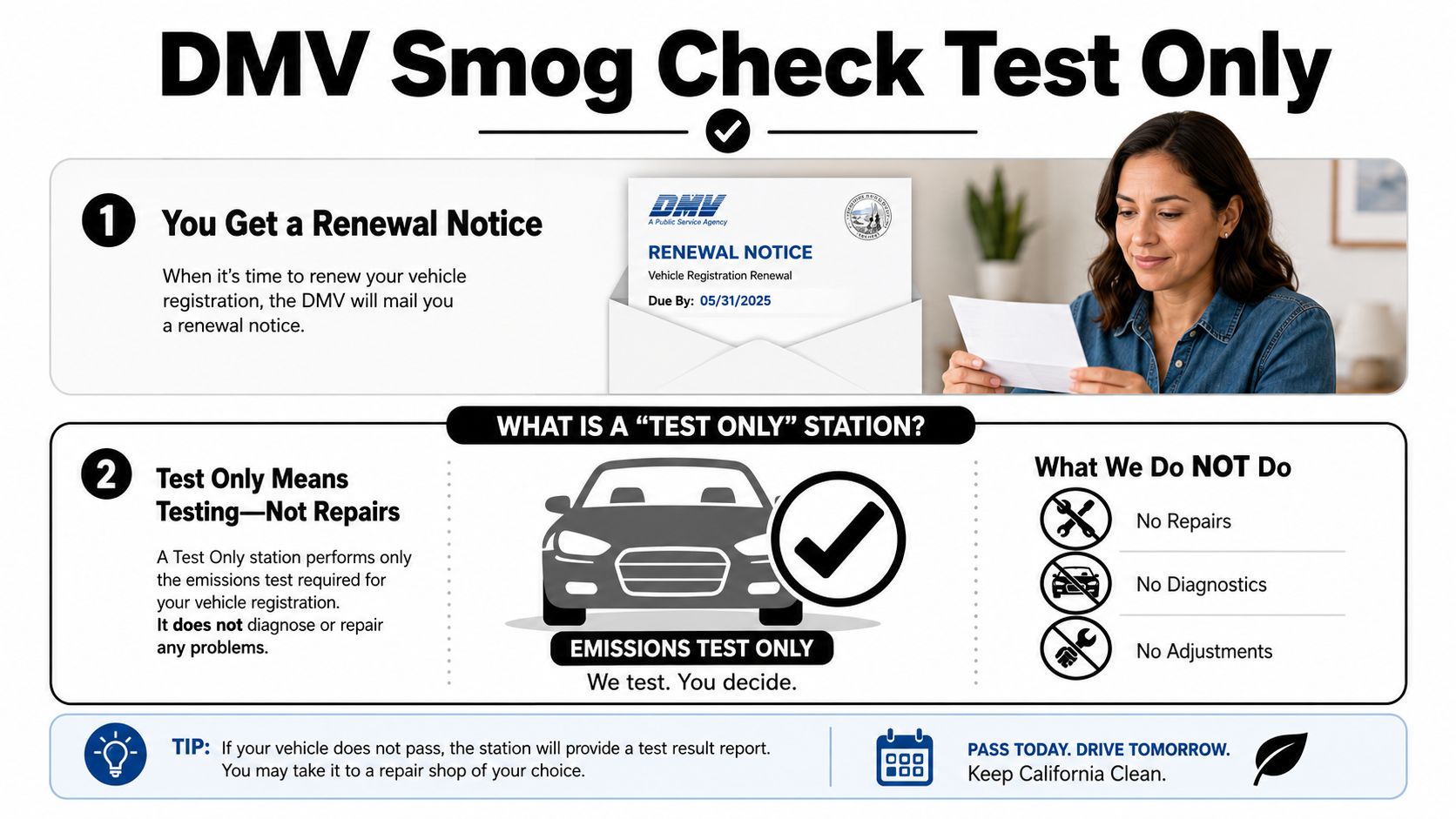
What the technician actually does
For a newer vehicle, the technician generally connects equipment to the vehicle's OBD-II diagnostic port. The inspection also includes visual and functional checks, such as looking for emissions-system tampering and confirming that required warning indicators and components meet the applicable standard.
Older vehicles use a different inspection method. California uses the BAR On-Board Diagnostic Inspection System for 2000-and-newer vehicles, while the BAR-97 Emissions Inspection System measures tailpipe emissions for 1999-and-older vehicles. That technology split affects whether a station can properly serve your vehicle. BAR outlines these inspection systems on its Smog Check program page.
The result is then recorded as a pass or fail. If you pass, the certification can be transmitted to the DMV, allowing the registration process to continue. If you fail, the station should provide documentation showing the inspection result and the information needed for the next step.
Practical rule: A test-only station can tell you whether the vehicle passed. It isn't the place to diagnose the cause or perform the emissions repair.
Test Only vs Repair Stations vs Star Certified
A regular repair station can inspect the vehicle and repair emissions problems, so it may suit a driver who already suspects a fault and wants one business to handle both jobs. A test-only station performs the official inspection but does not repair the vehicle. That separation gives you a test result before you approve any repair work.
STAR certification is a state designation for qualifying test-only and repair stations. It covers added program requirements for equipment, maintenance, and inspection performance. STAR stations must keep BAR-certified equipment in working order and complete required calibrations at least once every 10 calendar days, as specified in California regulation 16 CCR 3392.1.
Match the station to your DMV instruction
| Station type | Can perform the test | Can diagnose or repair emissions problems | May be required for a directed vehicle |
|---|---|---|---|
| Regular repair station | Yes, if properly authorized | Yes | Sometimes, if it has STAR certification |
| Test-only station | Yes | No | Yes, when it is STAR certified and your notice requires it |
| STAR-certified test-only station | Yes | No | Yes, for vehicles directed to a STAR test-only inspection |
The practical decision is simple: follow the station category named on your DMV notice. If the notice directs you to a STAR station, an ordinary station may not satisfy the requirement, even if it is closer.
STAR certification also involves inspection performance. The regulation uses quarterly measures such as Similar Vehicle Failure Rate and requires performance at or above 50% of the industry-wide failure rate for similar vehicles. This standard evaluates the station against program criteria. It does not predict whether your individual vehicle will pass or fail.
Some drivers choose test-only because the DMV sends them there. Others want an independent result before paying for diagnosis or repairs. For a notice requiring a STAR test-only inspection, a location such as this STAR-certified smog check test-only center can match that instruction.
After a failed test, the station type matters. A test-only station documents the failure, but you generally take the vehicle to a repair facility for diagnosis and emissions work. Then check the paperwork and DMV direction before selecting the return station. If STAR certification is required, schedule the re-test at a qualifying STAR location rather than assuming any repair station can complete it.
What Happens During a Test Only Visit
The visit usually feels straightforward when you know the order of events. Start by checking whether the station accepts walk-ins, but calling or booking online can reduce waiting, especially if the shop schedules inspections tightly.
Before the vehicle enters the lane
Bring the document that sent you to the station, such as a renewal notice or DMV letter. Have your registration information available, along with identification and a payment method. If you're returning after repairs, bring the paperwork from the previous inspection or repair visit.
At intake, the technician confirms the vehicle identity, including the VIN, and checks the vehicle's basic inspection condition. They'll look for signs of emissions tampering and review the dashboard. A lit check-engine light is an important warning because it can indicate an emissions-related malfunction that prevents a passing result.
During the inspection
For a qualifying newer vehicle, the technician connects the inspection equipment to the OBD-II port and checks the vehicle's electronic emissions information. The system can show diagnostic trouble codes, communication problems, and readiness information.
For older vehicles, the station uses the BAR-97 equipment to measure tailpipe emissions. The technician may also perform the applicable visual and functional checks, so the inspection isn't just a single reading from the exhaust.
The technician is gathering evidence, not guessing at a repair. A test-only result tells you what the inspection found, but it doesn't replace a diagnosis.
Receiving the result
The technician explains whether the vehicle passed or failed and provides the inspection paperwork. A passing result is transmitted electronically to the DMV, but you should still keep your records until the registration matter is fully resolved.
A failed result should identify the inspection outcome and give you a basis for speaking with a qualified repair shop. Don't approve parts based only on a general failure label. Ask the repair technician to identify the underlying fault and explain what must be corrected before the vehicle returns for another inspection.
How to Prepare Before You Go
A short pre-visit check can prevent a needless trip. You're not trying to repair the emissions system in your driveway. You're making sure the vehicle arrives in a normal operating condition and that you have the documents needed for the inspection.
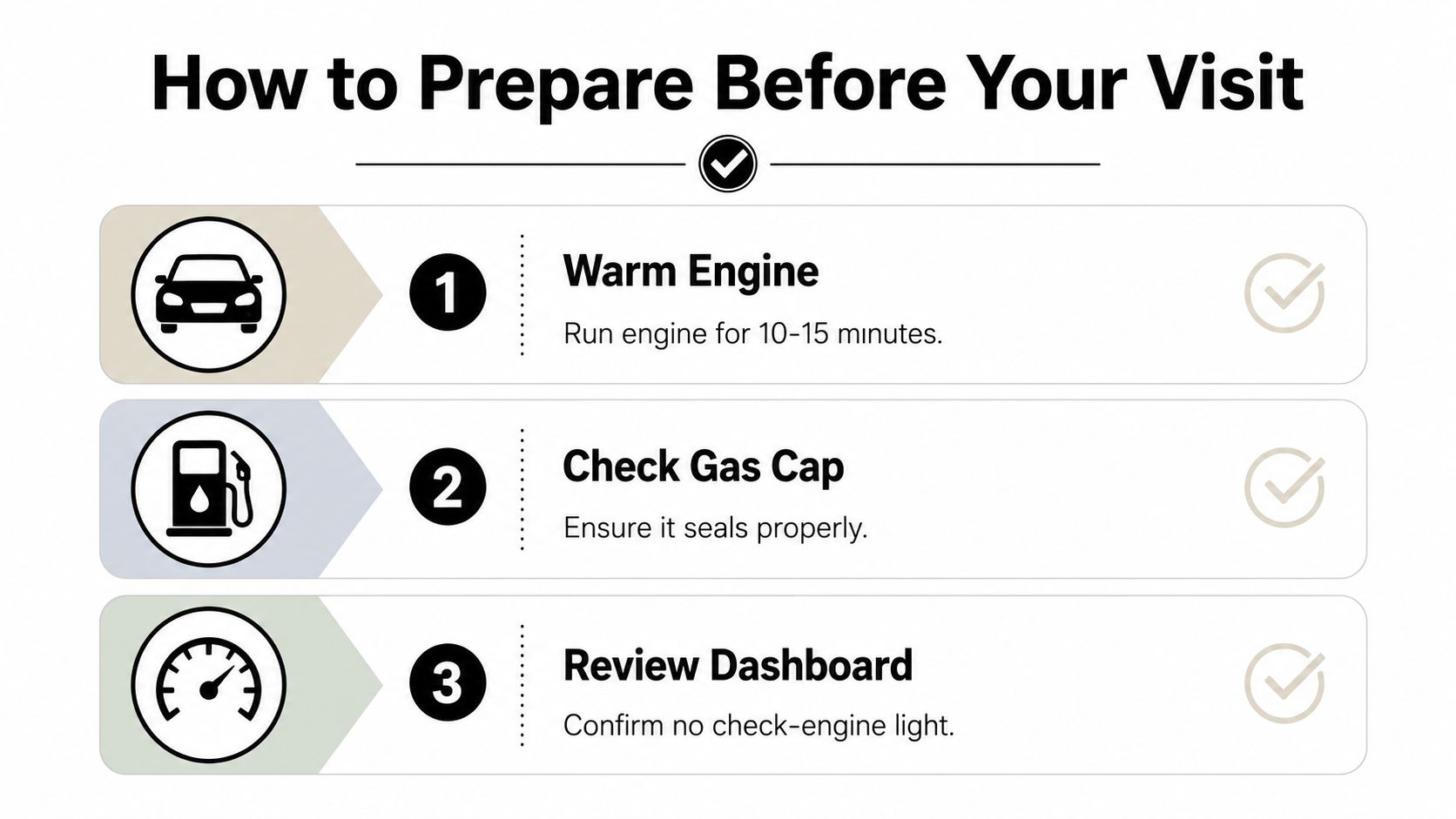
Use this arrival checklist
- Warm the engine: Drive normally before the appointment so the engine and emissions components reach operating temperature. Don't arrive with a cold vehicle if you can avoid it.
- Inspect the gas cap: Remove and reinstall it firmly. A cap that doesn't seal can contribute to an evaporative-emissions problem.
- Review the dashboard: The check-engine light should be off. If it's illuminated, don't assume clearing the light will solve the issue.
- Avoid last-minute code clearing: Disconnecting the battery or erasing diagnostic codes can leave the vehicle's readiness monitors incomplete. The vehicle may need normal driving before the system can complete its checks.
- Gather paperwork: Bring the renewal notice or DMV letter, registration information, identification, payment, and any earlier smog or repair documents.
The OBD system doesn't only look for a light on the dashboard. It also checks whether the vehicle's emissions self-tests have completed. After repairs or a battery disconnect, those monitors may show as “not ready,” so a repair shop should tell you what driving process is needed before the re-test.
Use the video below as a visual reminder of the basic preparation process.
Fees and Timelines You Can Expect
California doesn't use one universal retail price for every station and vehicle. Your total can include the station's inspection charge and state-related charges, while a directed inspection or a vehicle requiring a specialized procedure may be priced differently. Ask for the complete amount before authorizing the test.
The most useful budgeting step is to separate inspection costs from repair costs. A test-only station's charge covers the inspection. If the car fails, diagnosis, parts, labor, and any later inspection are separate decisions. The station shouldn't blur those categories by presenting an inspection as though it includes repair work.
Plan your time realistically
The test itself may be quick when the vehicle is ready and the station has the correct equipment. Waiting time depends on appointments, walk-in traffic, paperwork, and whether the vehicle needs an inspection method for an older model.
Electronic transmission can make the DMV side easier because the certificate information doesn't depend on you carrying a paper certificate to a DMV counter. Still, a successful transmission doesn't always mean every registration issue disappears instantly. If your renewal includes another requirement, you'll need to satisfy that requirement too.
For a closer look at the sequence and timing of a California inspection, review this guide to how long a smog check takes. Before booking, ask three direct questions: What is the full inspection price, how long should I expect to wait, and will the result be transmitted electronically?
Ask before you arrive: Confirm the station can inspect your exact vehicle type and can handle the station designation printed on your DMV notice.
Common Failure Reasons and What to Do Next
A failed test is not a repair diagnosis. It's a signal that the vehicle didn't meet one or more inspection requirements. The next step is to read the Vehicle Inspection Report, identify the failure category, and take that information to a qualified repair facility.
Common causes include:
- Check-engine light: A malfunction indicator can point to an emissions-related diagnostic code. The repair shop needs to retrieve and interpret the code rather than just switch off the light.
- Catalytic converter performance: The converter may not be processing exhaust gases as required, but other faults can sometimes affect related readings.
- Evaporative-emissions leaks: The fuel system may not hold vapors correctly. A gas cap, hose, valve, or other component can be involved.
- Oxygen-sensor problems: Sensor faults can affect the engine computer's emissions controls and trigger diagnostic codes.
- Loose or worn gas cap: A small sealing problem can create a larger inspection issue, particularly when the evaporative system detects a leak.
You can find a broader explanation of common smog check failure reasons before deciding what to authorize.
Follow the decision tree
First, check the paperwork. If the report shows a failed inspection, ask whether the original station offers a qualifying re-test arrangement and what conditions apply. California's consumer guidance explains the limits on what test-only stations may do and addresses the process in its Smog Check consumer FAQ.
Next, determine whether repairs are needed. Take the report to a licensed repair shop that can diagnose emissions faults. Don't replace a catalytic converter, oxygen sensor, or other expensive component solely because its name appears near the failure. Proper testing can identify whether the component itself failed or whether another fault caused the result.
Then, verify the return station. If the DMV directed the vehicle to a STAR station, the follow-up inspection must use the required STAR pathway. A repair shop may perform the repairs, but it won't automatically satisfy a STAR testing requirement unless it has the appropriate certification and authorization.
Finally, ask about special assistance. If reasonable repair efforts don't bring the vehicle into compliance, ask the repairer or BAR about the Smog Check Referee process. The Referee can help address unusual testing problems and cases where the standard process doesn't resolve the inspection issue.
After a failure, don't erase the evidence. Keep the report, diagnostic information, invoices, and repair records. They help the next technician understand what has already been tested.
Choosing a Fast Star Certified Station in San Leandro
A DMV-directed inspection calls for more than choosing the nearest sign that says “smog.” Confirm the station's current STAR certification before you book, particularly if your notice names STAR or directs you to a test-only location.
Ask whether the technicians are licensed through BAR, whether the shop handles your vehicle's inspection technology, and whether results are transmitted electronically. This matters for owners of older vehicles, diesels, hybrids, and vehicles with special DMV instructions because the equipment and process may differ.
Questions worth asking by phone
- Certification: Is the station currently STAR certified, and does that certification apply to the inspection I need?
- Vehicle coverage: Can the station inspect my model, fuel type, and emissions system?
- Turnaround: Is an appointment available, and how long should I plan to wait?
- Paperwork: Will the result be submitted electronically to the DMV?
- Payment: What's included in the quoted inspection price, and are additional charges possible?
- Follow-up: If the vehicle fails, can the staff explain the report and identify the correct re-test path?
A fast appointment shouldn't mean a rushed inspection. STAR requirements include equipment maintenance, calibration, and performance evaluation, so accuracy and speed should work together rather than compete. The station should also explain what it can and can't do. A test-only business that promises to repair the failure on the same visit may not be describing its role clearly.
San Leandro drivers can compare local availability, location, vehicle coverage, and appointment options before choosing a station. The right choice is the one that matches the DMV instruction, has the required certification, uses suitable equipment, and gives you a clear answer about what happens if the result isn't a pass.
Key Takeaways for a Smooth Smog Check
A successful test-only visit starts with the paperwork, not the waiting room. Read the renewal notice or DMV letter carefully and identify whether it requires a standard inspection, a test-only station, or a STAR-certified location. The DMV's registration process depends on receiving the correct certification, so a pass at the wrong station may not solve the original problem.
Prepare the vehicle without trying to disguise a fault. Warm it through ordinary driving, confirm the gas cap seals, and check that the dashboard has no active check-engine warning. If the battery was recently disconnected or diagnostic codes were erased, ask a repair professional whether the readiness monitors have completed before booking the inspection.
Bring your renewal notice, registration information, identification, payment, and any earlier inspection or repair records. Keep the Vehicle Inspection Report if the vehicle fails. It gives the repair shop the starting information it needs and helps you avoid paying for an uninformed parts swap.
The most important post-failure question is simple: Where must the vehicle go next? Some drivers need repairs before returning. Others must return to a STAR-certified station because the DMV directed the vehicle there. Ask the inspecting station to explain the report and confirm the retest conditions before leaving.
For East Bay drivers, Speedy Smog is a STAR-certified station at 15275 Washington Ave, San Leandro, California 94579. It handles emissions inspections for many newer and older vehicles, including diesels and hybrids, and offers Monday-through-Saturday service with electronic DMV submission described by the business.
Speedy Smog provides STAR-certified test-only smog inspections in San Leandro, including electronic transmission of results for DMV registration needs. Check vehicle eligibility, appointment options, and current pricing, then visit Speedy Smog to arrange the inspection.
You're in Rocklin, your DMV renewal notice is on the counter, and the registration deadline is getting close. The first question isn't “Which shop is closest?” It's whether your vehicle needs a Smog Check and whether the DMV requires a STAR station. Get that decision wrong, and you can waste a trip even if the vehicle runs perfectly.
California's program is broad, recurring, and tightly connected to registration. A successful visit starts with reading the notice, checking your vehicle's eligibility, and preparing the emissions system before the technician begins. Use the steps below to approach a Smog Check in Rocklin with the right paperwork, the right station, and a much better chance of finishing the process without a second visit.
Table of Contents
- What a Rocklin Driver Needs Before Booking
- STAR vs Non-STAR Stations and Why It Matters
- Finding a Rocklin Shop, Booking, and What to Bring
- Pre-Test Prep That Improves Your Odds
- What Happens During the Test and How Long It Takes
- If You Fail, Here's Exactly What Comes Next
- Rocklin Smog Check Checklist and Trusted Resources
What a Rocklin Driver Needs Before Booking
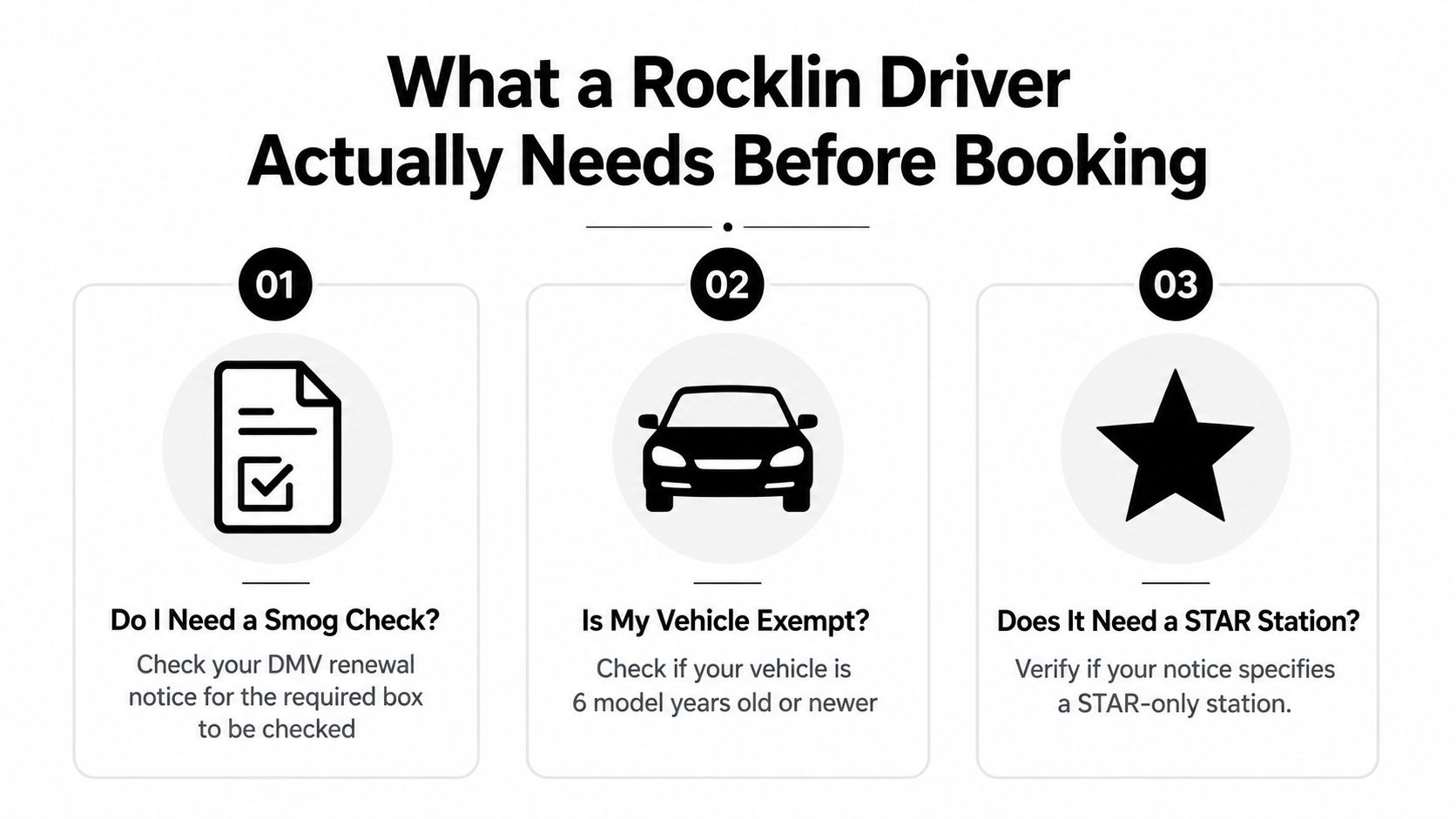
Your Rocklin renewal notice is the starting point. Before calling a shop, confirm the vehicle's fuel type, model year, and the reason for the DMV transaction. California generally requires Smog Check for gasoline-powered, hybrid, and alternative-fuel vehicles from model year 1976 onward. Diesel vehicles from model year 1998 onward generally require testing when their gross vehicle weight rating is 14,000 pounds or less. The California Bureau of Automotive Repair outlines these rules in its official Smog Check brochure.
The notice controls your current registration task. It states whether a Smog Check is required and may specify a STAR station. Read its exact wording instead of relying on an old receipt, a shop advertisement, or someone else's experience. Requirements can vary by vehicle, county, registration event, and notice language, including the instructions on a Placer County renewal notice.
Make the two decisions before you call
First ask, “Do I need a test?”
- Biennial renewal: Gasoline, hybrid, and alternative-fuel vehicles that are 8 model years and newer are exempt from the biennial Smog Check requirement under BAR's general rules.
- Change of ownership: Vehicles that are 4 model years and newer are generally exempt from the change-of-ownership test, although other registration requirements can still apply.
- Diesel vehicles: Eligible diesel vehicles remain covered without the same model-year exceptions that apply to gasoline-powered vehicles.
- California registration: A test can be required when a vehicle is first registered in California or changes ownership, not only during routine renewal.
Then ask, “Does it have to be STAR?” Look for wording that directs you to a STAR-certified station. If the notice requires STAR, select that station type before booking. If it calls for a Smog Check without that instruction, a licensed non-STAR station may be able to complete the inspection.
Practical rule: Read the DMV notice first, then choose the station. Searching by location alone can send you to the wrong type of shop.
STAR vs Non-STAR Stations and Why It Matters
The right Rocklin station depends on one line in your renewal notice. A licensed Smog Check station and a STAR-certified station can perform different assignments, so choosing by location or advertising alone can waste your trip.
STAR is California's higher-standard inspection network, established under Assembly Bill 2289 in 2010 to improve inspection quality and support required emissions reductions. BAR's statewide report lists STAR stations as representing 49% of licensed stations while performing 83% of all Smog Check tests in 2025. Those figures appear in BAR's Smog Check performance report, which documents the network's statewide role.
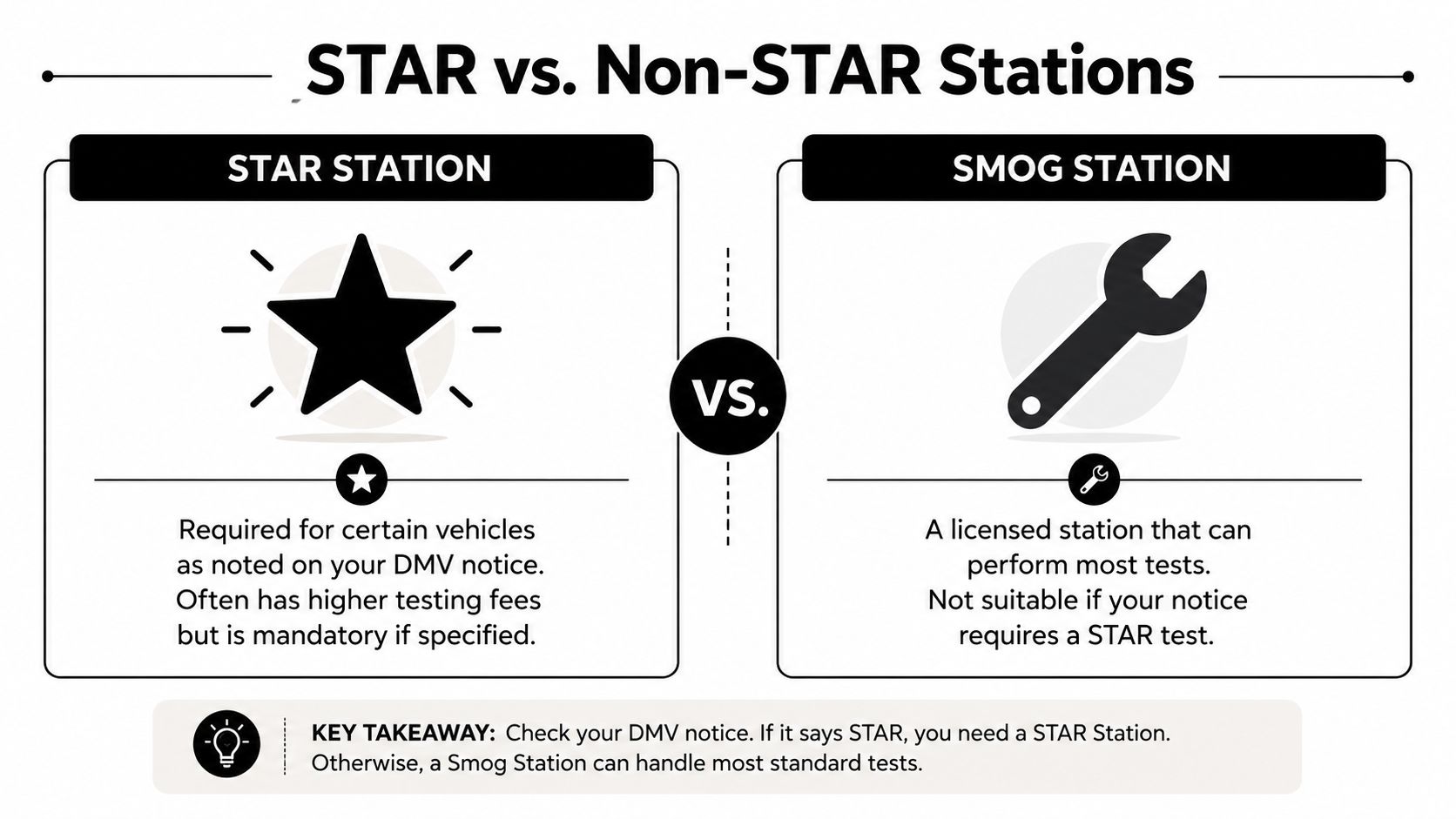
STAR certification does not make STAR mandatory for every vehicle. Your DMV notice controls the requirement for your transaction, including renewal instructions issued in Placer County.
Match the station to the notice
If the notice requests a Smog Check without naming STAR, a regular licensed station may be able to complete the inspection. If it directs you to a STAR facility, book with a STAR-certified station. STAR facilities also inspect certain enforcement-related vehicles, including directed vehicles and vehicles designated as gross polluters, under program rules. BAR's Smog Check consumer guidance explains how station selection works.
Read the notice to the service adviser before booking. Ask: “Does my notice require a STAR-certified station?” A shop displaying Smog Check signage may not handle a STAR-only assignment.
For a clearer explanation, review what a Smog STAR station is. Use this decision rule:
- Notice requires STAR: Book a STAR-certified station.
- Notice does not require STAR: A licensed station may be enough.
- Notice is unclear: Confirm with the DMV or a station listed through BAR's official station search.
STAR is common around Rocklin, so finding an authorized location should be practical. Certification still does not replace checking the notice, your vehicle's assignment, and the station's appointment details. Choose the authorization first, then compare convenience and availability.
Finding a Rocklin Shop, Booking, and What to Bring
Start with the service you need, then choose the shop. Use BAR's official station locator to compare Rocklin locations and confirm the station's license and STAR status. The notice determines the authorization. Convenience comes second.
Before booking, check reviews for practical details: clear pricing, accurate paperwork, short waits, and explanations after a failure. Vague praise is less useful than comments describing the inspection itself. For a straightforward comparison of local options, read this Rocklin smog test service guide before calling.
Book the appointment around your vehicle
Reserve a time when your renewal deadline is close, your notice requires STAR, or you are bringing a diesel, hybrid, older, or imported vehicle. Those vehicles may require questions before the test. A walk-in can suit a routine inspection, but call first and confirm the shop can take you.
Ask these questions before leaving:
- Vehicle coverage: Does the shop test your fuel type, model year, and vehicle class?
- STAR status: Is the location STAR-certified if the notice requires STAR?
- Price transparency: What does the inspection include, and can additional fees apply?
- Electronic reporting: Will the result be submitted electronically to the DMV?
- Paperwork requirements: Should you bring the renewal notice, transfer documents, or a previous certificate?
Bring the DMV renewal notice or transfer paperwork, valid identification, and your payment method. If you recently bought the vehicle, bring any prior Smog Check certificate or transaction paperwork available. The technician may not need every document, but missing paperwork can delay the transaction.
Confirm the arrival time, expected wait, and payment options while booking. Then keep the appointment details with your documents, so the station can verify the vehicle and report the result without avoidable back-and-forth.
Pre-Test Prep That Improves Your Odds
Before booking, check OBD-II readiness on 2000 and newer vehicles. BAR's 2025 executive summary reports OBD-II-related failure rates of 6.84% for OIS stations and 9.36% for BAR-97 stations, as shown in the BAR 2025 Smog Check executive summary. Those figures make a readiness check a better use of your time than relying on how smoothly the car drives.
The check-engine light must be off, and the readiness monitors must have completed their self-tests. A recent battery replacement, battery disconnection, erased trouble codes, or emissions repair can leave monitors incomplete after the warning light goes out. Use an OBD-II scan tool, or ask a repair shop to check the status before you schedule the final inspection.
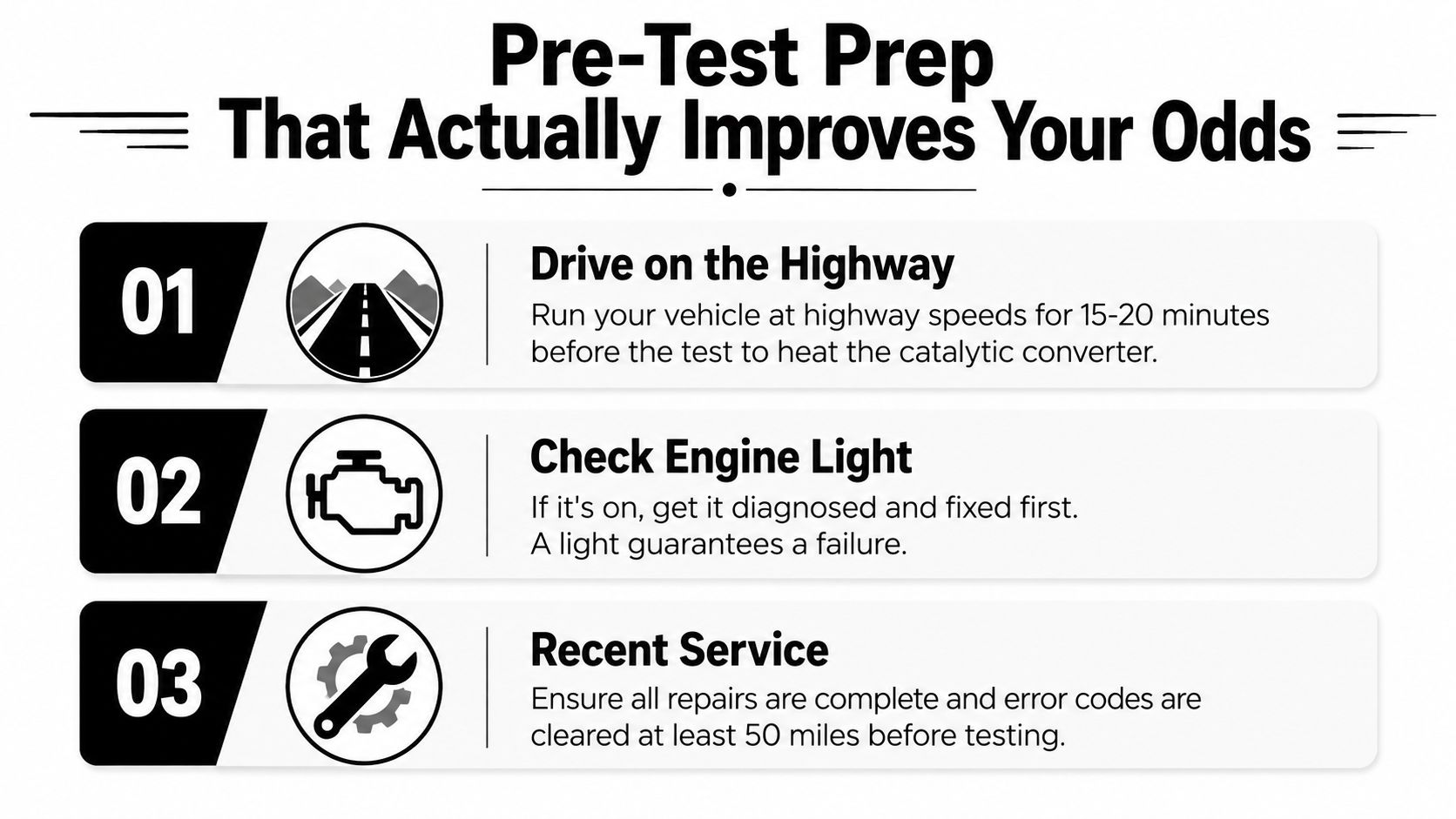
Do not clear codes just before the appointment. Clearing them resets the monitors, and the vehicle may need normal driving in varied conditions before it reports “ready.” If the light is on, book diagnosis and repair first, not certification.
On test day, drive normally long enough to warm the engine and catalytic converter. Steady cruising mixed with ordinary stop-and-go driving helps more than idling in the driveway. Check these items before leaving:
- Repair status: Finish emissions repairs, and confirm the repair worked instead of treating code clearing as proof.
- Battery history: Tell the technician about a recent disconnection or replacement.
- Exhaust condition: Repair a damaged or visibly leaking exhaust system before inspection.
- Tires and fuel: Keep the vehicle safe to operate and follow the technician's fuel-level instructions.
- Service records: Bring invoices or diagnostic notes from recent emissions work.
For more preparation guidance, review this guide to passing a STAR Smog Test. Verify readiness, keep the warning light off through a real repair, and arrive with the vehicle warmed up.
What Happens During the Test and How Long It Takes
The technician begins by confirming the vehicle and paperwork, then selects the correct inspection procedure. For 2000 and newer vehicles, the central task is usually an OBD-II inspection. The technician connects a scan interface to the vehicle's diagnostic port, checks stored emissions-related information, reviews readiness monitors, and verifies the malfunction indicator light status.
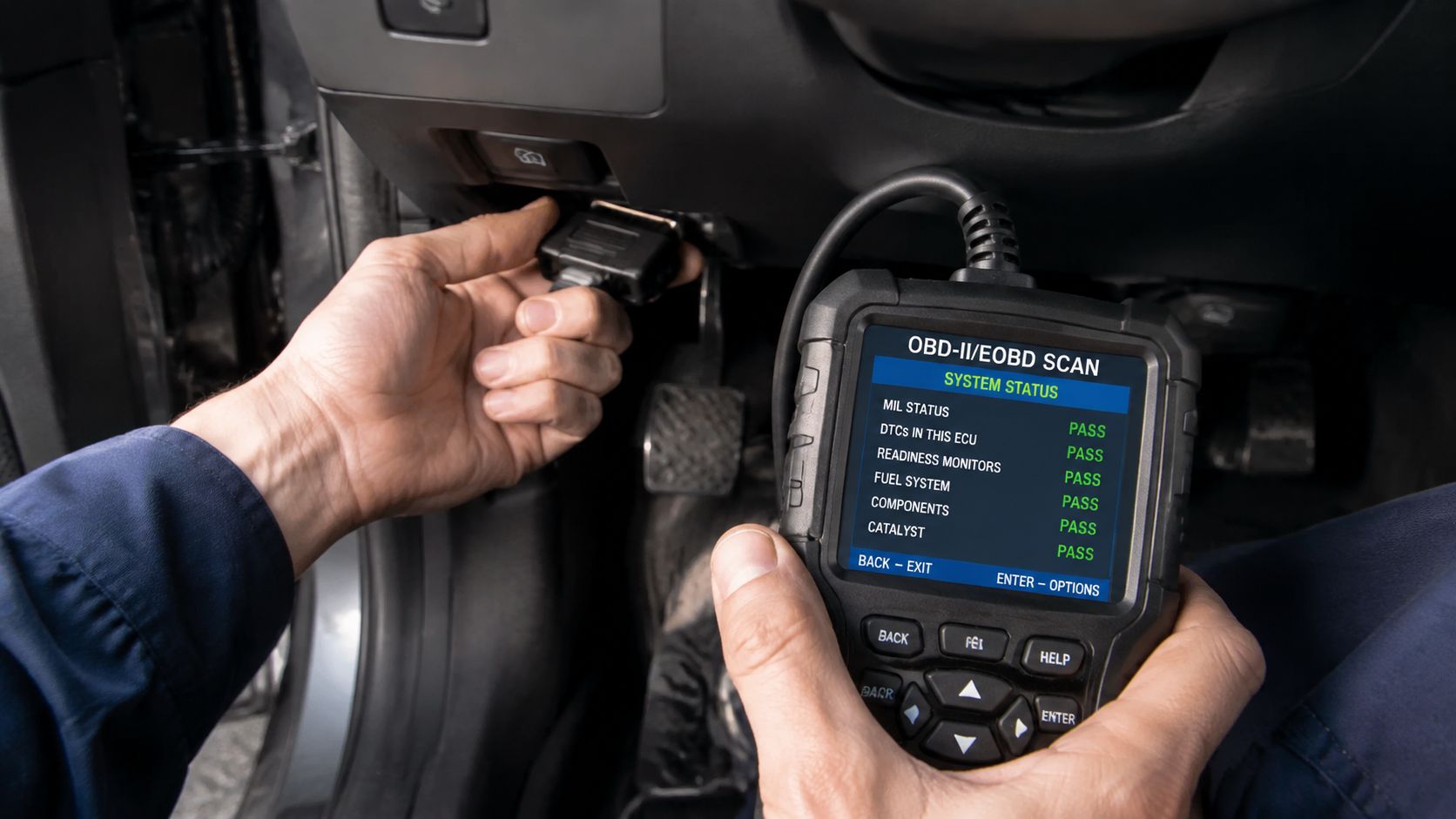
The technician also checks required emissions equipment and confirms that the vehicle identification information matches the record. A car that drives smoothly can still fail if the computer reports an emissions fault or the monitors aren't ready. That's why preparation matters more than a quick visual impression of how the engine sounds.
Older and diesel vehicles follow a different path
Vehicles from 1999 and older may receive a tailpipe emissions inspection using a dynamometer or loaded-mode procedure, along with visual and functional checks of emissions components. Many diesel inspections also involve equipment and procedures that differ from a modern gasoline OBD-II test. Tell the station the exact vehicle details before you arrive so the shop can confirm it has the proper equipment and authorization.
A modern inspection at an efficient shop can move quickly once the vehicle enters the testing area. Older, diesel, directed, or problem vehicles may take longer because the technician has more equipment checks and documentation to complete. Don't book an appointment with only the assumption that every Smog Check follows the same sequence.
This short OBD-II Smog Check video gives drivers a visual reference for the diagnostic connection and inspection process.
After a passing result, the station submits the Smog Check outcome electronically to DMV. You should still keep your paperwork and follow the renewal instructions, but you generally won't need to carry a paper certificate from office to office when the result has been transmitted correctly.
If You Fail, Here's Exactly What Comes Next
A failed result isn't a diagnosis by itself. It's a compliance result that tells you the vehicle didn't meet one or more inspection requirements. The report should identify the failure category, diagnostic information, and the next practical direction. Ask the technician to explain the report in plain English before authorizing repairs.
A “not ready” result differs from a confirmed emissions failure. The vehicle may have an incomplete monitor after a battery disconnect, code clearing, or recent repair. In that situation, the correct next step may be a prescribed drive cycle and another inspection, not an expensive parts replacement. A confirmed failure, by contrast, requires diagnosis of the system identified on the report.
BAR's 2025 executive summary recorded an overall initial-test failure rate of 8.51% across 11,275,981 initial tests, showing that failure is a routine part of a large enforcement program, not proof that your vehicle is beyond repair. The same report states that about 1.3 million of 19 million 2000-and-newer vehicles tested in the 2024 to 2025 cycle failed, or roughly 7%. Use those figures as context, not as a prediction for your specific car.
Match the failure to the repair conversation
| Failure Category | Typical Cause | What a Shop Will Likely Check |
|---|---|---|
| Check-engine light or stored code | An active emissions-related fault | Diagnostic trouble codes, sensors, wiring, vacuum leaks, and the affected emissions system |
| Not-ready monitors | Battery disconnection, code clearing, or incomplete drive cycle | Monitor status, recent repairs, manufacturer drive-cycle conditions, and additional diagnostic results |
| Excess emissions | Catalytic-converter, fuel-control, ignition, or air-management problem | Emissions readings, fuel trims, misfires, oxygen sensors, and catalytic-converter performance |
| Missing or altered equipment | Removed, disconnected, or improperly installed emissions components | Required labels, hoses, controls, converters, and visible emissions hardware |
| Visual or functional failure | A component doesn't operate as required | Gas cap, warning indicators, emissions controls, and inspection-specific functions |
Keep every repair receipt. Ask the repair shop to document the diagnostic findings, replaced parts, and whether the monitors were allowed to reset properly afterward. Don't approve a catalytic converter or other high-cost repair based only on a generic code. A trouble code identifies a monitored problem, but the technician still needs to determine why the system set it.
If you qualify, California's consumer assistance options may help offset repair costs through the state's assistance program. Review eligibility through BAR before authorizing work, and ask the testing or repair facility whether it participates in the required process. After repairs, schedule the retest with the station and confirm its retest policy, because the cost and conditions can vary by shop.
Rocklin Smog Check Checklist and Trusted Resources
Use this phone-sized checklist before you book:
- Read the DMV notice. Confirm whether the renewal or transfer requires a Smog Check.
- Check exemptions. Review the vehicle's model year, fuel type, and transaction type.
- Confirm STAR status. Use the BAR Find a Station tool or call the station if the notice requires STAR.
- Prepare OBD-II vehicles. Make sure the warning light is off and monitors report ready before the appointment.
- Bring paperwork. Carry the notice, transfer documents, identification, payment method, and relevant service records.
- Ask for clear reporting. Confirm electronic DMV submission and request an explanation of any failed item.
- Keep repair records. Save invoices and diagnostic details in case a retest or assistance application is needed.
For DMV-specific renewal status and transaction instructions, use your California DMV renewal information. For repair-cost support, review BAR's consumer assistance program information. These official resources are more reliable than a generic local search result when eligibility or STAR direction is unclear.
A smooth Rocklin visit comes down to three choices: verify the notice, use the correct station, and prepare the vehicle's emissions computer before testing. Choose a shop that explains pricing, handles your vehicle type, submits results electronically, and treats a failure report as a diagnostic starting point rather than a sales opportunity.
Speedy Smog provides STAR Smog Checks and diesel inspections with electronic DMV result submission, including service for newer vehicles, older vehicles, hybrids, and qualifying diesel vehicles. Confirm your notice and vehicle details before booking, then visit Speedy Smog to arrange an inspection that fits your registration task.
A standard smog check for a 2000 or newer vehicle takes about 10 to 15 minutes at a STAR station and runs roughly $60 to $90, plus California's $8.25 state certificate fee. That makes it one of the faster DMV-required steps, but preparation matters because a vehicle with unresolved emissions problems or incomplete readiness monitors can still fail.
You may be searching for smog test Rocklin CA after discovering that registration renewal is waiting on an emissions certificate. The good news is that the appointment itself is usually simple. The stressful part comes when a driver arrives with a recently disconnected battery, an illuminated check engine light, the wrong station, or a vehicle that falls under a rule they didn't know existed.
This guide breaks down the process in plain language, from vehicle exemptions and testing equipment to readiness monitors, failed inspections, and financial assistance. You'll know what to check before booking and what to do if the result isn't what you expected.
Table of Contents
- Why Your Rocklin Smog Check Matters More Than You Think
- How California Smog Checks Actually Work
- Which Vehicles Need a Smog Check and Which Do Not
- Finding a Smog Check Station Near Rocklin
- What to Expect During Your Smog Check Appointment
- When Your Vehicle Fails the Smog Check
- How to Prepare for a Fast and Hassle-Free Smog Check
Why Your Rocklin Smog Check Matters More Than You Think
Maria's car runs smoothly, yet her registration renewal stops at the smog check requirement. At the station, the technician asks whether she recently replaced the battery. Maria is unsure why that matters. Disconnecting power can erase the vehicle's emissions-monitor results, so the car may need time and driving conditions to complete its self-tests before inspection.
That small detail shows why a smog check is more than a quick formality. California connects the inspection to registration compliance, and a passing result gives the state a current record that the vehicle meets applicable emissions requirements. A car can feel normal while its emissions system still has an unresolved fault or incomplete diagnostic information.
California's program has operated for decades. The state adopted its vehicle emissions inspection and maintenance program in 1982 and assigned administration to the Bureau of Automotive Repair in 1984, according to BAR's consumer protection and program history resources. Rocklin drivers are following an established statewide system, not a rule created only for local motorists.
Practical rule: The fastest appointment is the one you prepare for before arriving.
Three questions usually come first: Do I need a test, where should I go, and what happens if I fail? The answers depend on the vehicle's model year, fuel type, registration status, and diagnostic readiness. California's tightened 2025 readiness-monitor rules make that last item especially important. A recently disconnected battery may leave monitors incomplete, even if the check engine light is off.
A station such as Speedy Smog's California smog check resource can explain the general process. Confirm your vehicle's exact requirements before booking, because station eligibility and testing rules can differ by vehicle.
BAR also offers digital tools, including Vehicle Inspection History Lookup. Reviewing prior records can confirm whether a recent test was reported and show whether an earlier failure may still affect your registration. Drivers who cannot afford needed emissions repairs should also look into California's statewide assistance programs before assuming the only option is paying the full repair bill.
How California Smog Checks Actually Work
California's inspection method changes with the vehicle. That design matters because an older car may be evaluated through direct tailpipe measurements, while a newer vehicle is generally checked through its onboard diagnostic system.
The state uses the BAR-97 Emissions Inspection System for vehicles from 1999 and older. This equipment measures tailpipe emissions directly. A technician uses the station's approved testing equipment and evaluates the gases leaving the exhaust rather than relying only on electronic information from the vehicle.
Vehicles from 2000 and newer are handled through the BAR-OIS process, which uses the car's onboard diagnostic information. The inspector connects approved equipment to the vehicle's diagnostic port and checks emissions-related data, trouble codes, and readiness status. BAR describes these procedures through its official Smog Check program information.
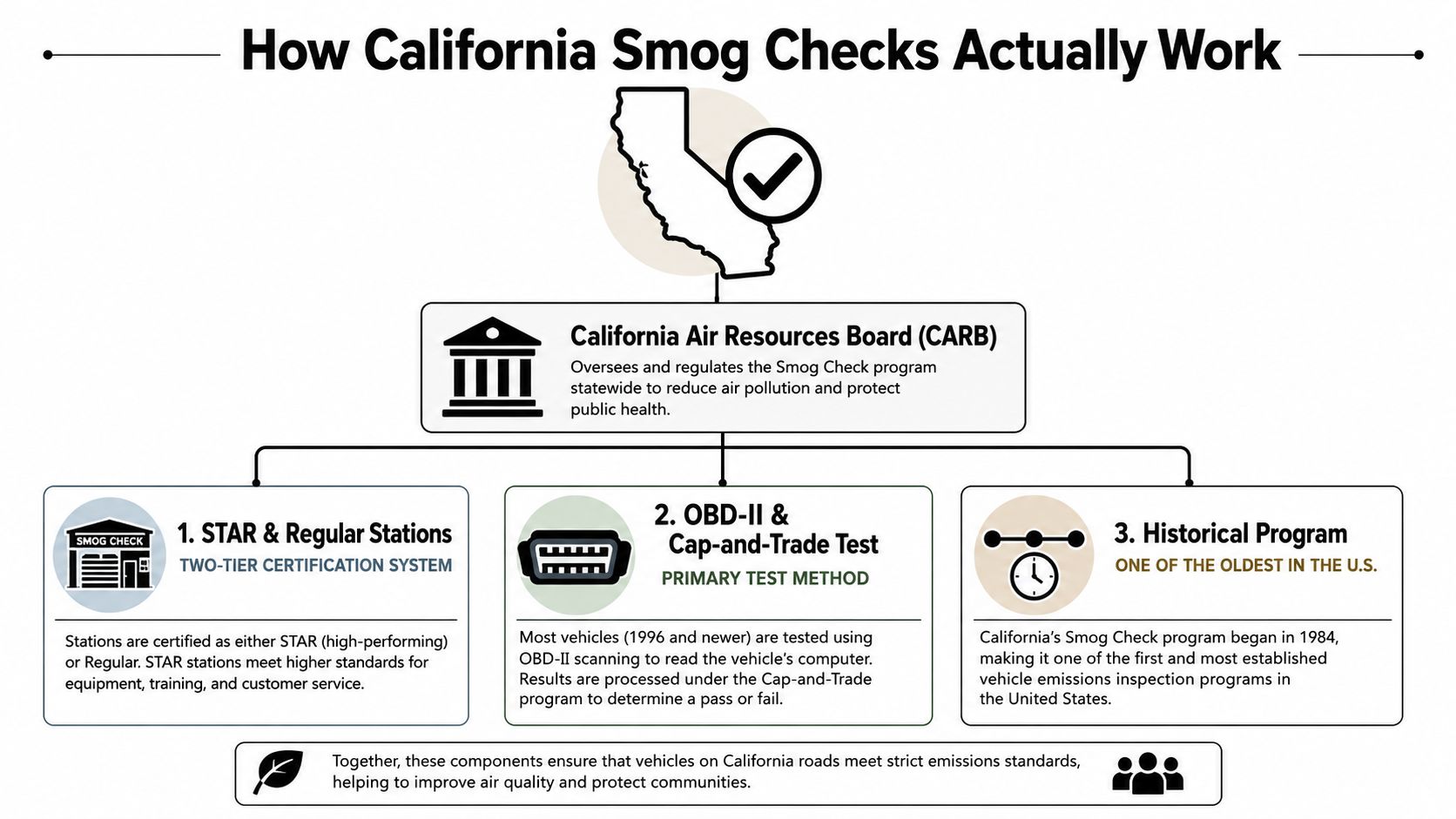
Why the station type matters
A STAR station is authorized to inspect vehicles under California's Smog Check framework and meets higher performance standards established by BAR. Drivers often look for STAR certification because some vehicles and registration situations require a STAR inspection, while others can use a regular licensed station.
The label doesn't mean every vehicle will pass. It means the station operates within a recognized inspection program and uses approved procedures. You'll still want to confirm that the shop handles your fuel type, model year, and any unusual configuration.
The testing split also explains why appointment times and equipment differ. A technician inspecting a 1999 vehicle may need to perform a tailpipe emissions test, while an inspector working on a 2000 vehicle may focus on OBD data and the vehicle's electronic self-checks. For a broader explanation of California procedures, review this guide to how smog checks work in California.
Which Vehicles Need a Smog Check and Which Do Not
A driver registering a car in Rocklin may ask, “Do I need a smog check?” The answer depends on the vehicle's model year, fuel type, registration situation, and ownership change. Use California's Smog Check requirements as the governing reference, and see our emissions testing requirements guide for a fuller breakdown.
Gasoline and flex-fuel vehicles from 2000 and newer generally receive an OBD II-based inspection. Older gasoline vehicles may require a direct tailpipe test. Diesel vehicles follow separate rules, so applying gasoline assumptions to a diesel can lead to an unexpected result.
| Vehicle Type | Testing Method | Key Rule |
|---|---|---|
| Gasoline or flex-fuel, 2000 and newer | OBD II-based inspection | Evaluated through onboard emissions data and readiness monitors |
| Gasoline vehicles, 1999 and older | BAR-97 tailpipe inspection | Tailpipe emissions are measured directly |
| Diesel, model year 1998 and newer, GVWR 14,000 pounds or less | Diesel Smog Check with OBD-related checks | These vehicles require inspection under BAR rules |
| Diesel, 1998 through 2006 | OBD-related monitor review | Zero incomplete monitors are allowed for the OBD portion |
| Diesel, 2007 and newer | OBD-related monitor review | Up to two incomplete monitors may still pass the OBD portion |
| Vehicles four model years and newer | Exempt from biennial and change-of-ownership Smog Checks | The exemption is based on vehicle age under the applicable rule |
| Out-of-state vehicles, 1976 and newer, registering in California | California inspection when first registered | A Smog Check is required during initial California registration |
The model-year details matter because the same dashboard warning or recent repair can affect vehicles differently. For example, a diesel vehicle with incomplete monitors may not receive the same result as a gasoline vehicle with the same condition.
The readiness-monitor change
Starting October 1, 2025, California's updated rule requires all readiness monitors to be set for a pass, with limited exceptions when a vehicle cannot feasibly meet the requirement. BAR explains the change in its 2025 Smog Check executive summary.
A readiness monitor works like a self-check stored by the vehicle's computer. Disconnecting the battery or completing a recent emissions repair can erase that status, leaving the system unfinished even when the car drives normally. Check readiness before the appointment so you can address an incomplete monitor before the inspection.
Finding a Smog Check Station Near Rocklin
A search for smog test Rocklin CA can return stations across Rocklin and the surrounding Sacramento region. Distance matters, but it shouldn't be your only filter. Start by confirming whether the shop is a STAR station, then ask whether it handles your vehicle's model year and fuel type.
Call before driving over if your vehicle is diesel, hybrid, modified, recently repaired, or being registered in California for the first time. A short conversation can prevent a wasted trip if the station doesn't perform the inspection your vehicle needs.
Questions to ask before booking
- Certification: Is the station STAR certified, and is STAR testing required for your registration situation?
- Vehicle coverage: Does the shop inspect your model year, diesel or hybrid system, and vehicle class?
- Price: Does the quoted price include the state certificate fee, or will that fee be added separately?
- Timing: Is an appointment available, and how does the station handle walk-ins?
- Retest policy: If the vehicle fails, what paperwork and retest options does the station provide?
Look for pricing that's clear before the inspection begins. A reputable station should explain what the test includes without promising a pass in advance. No technician can guarantee a passing result before checking the vehicle.
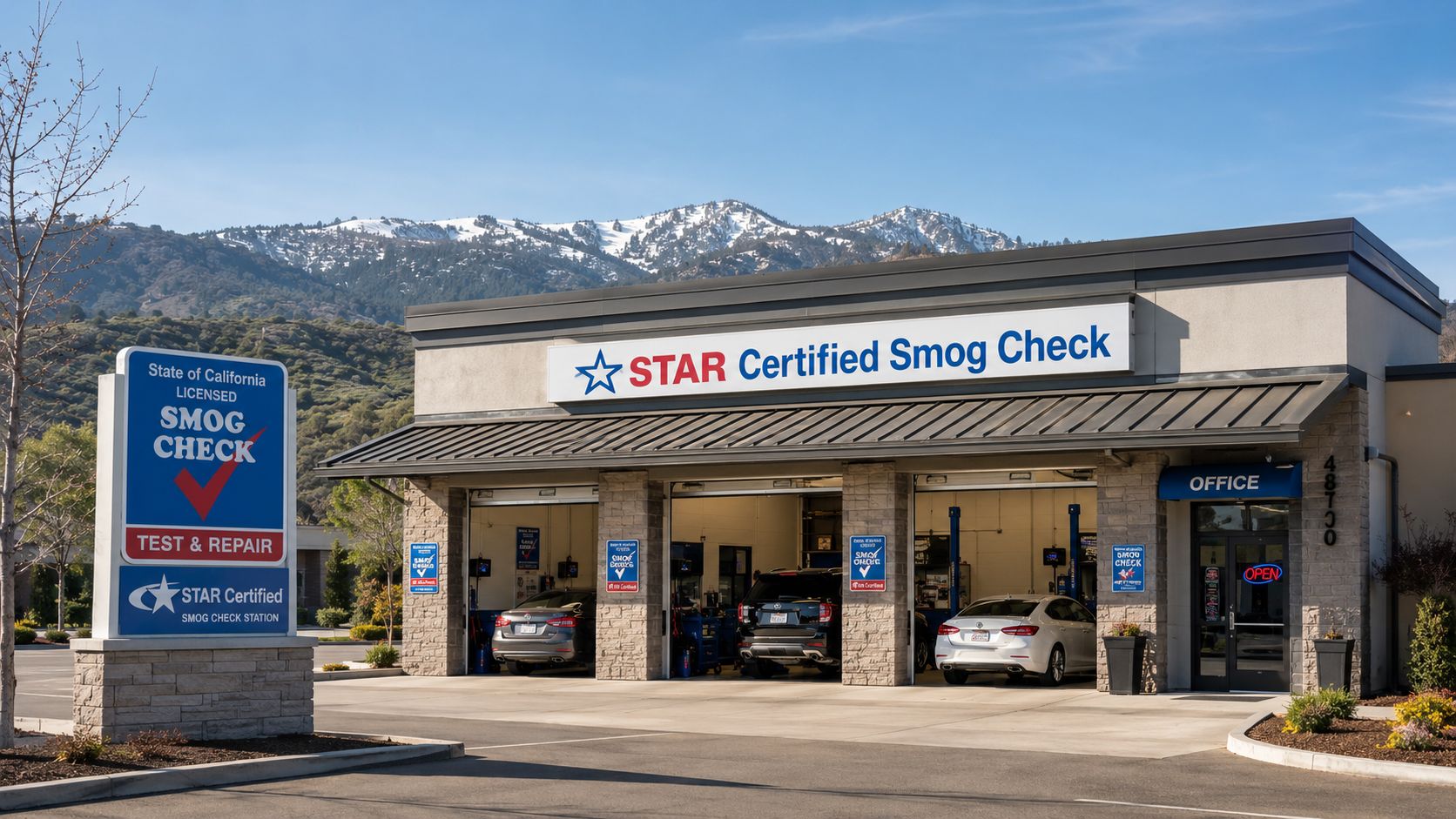
Speedy Smog is one option for drivers who need a STAR Certified inspection in the San Leandro area. The shop handles most vehicles, including 2000 and newer cars, older vehicles, diesels, and hybrids, and offers appointments as well as information about current pricing. Rocklin drivers should weigh the location against other nearby choices and select a station that matches their vehicle and deadline.
What to Expect During Your Smog Check Appointment
If this is your first appointment, the process is more organized than it may seem. Bring the vehicle, keys, registration or renewal notice, and a valid photo ID. For a change-of-ownership transfer, also have the name and address information required for that transaction.
At check-in, the inspector confirms the vehicle and transaction details. On a newer vehicle, the technician connects an approved scanner to the OBD port under the dashboard. The scan reviews diagnostic information and readiness monitors, which show whether the vehicle has completed its built-in emissions self-tests. Those monitors matter because recent battery work, erased codes, or unfinished drive cycles can leave the inspection incomplete even when the car feels normal.
Older vehicles may use BAR-97 equipment with a tailpipe probe. Instead of reading the vehicle's computer, the equipment measures exhaust emissions while the vehicle runs under the conditions required by the inspection procedure. In both cases, the test follows a defined sequence rather than serving as a general repair appointment.
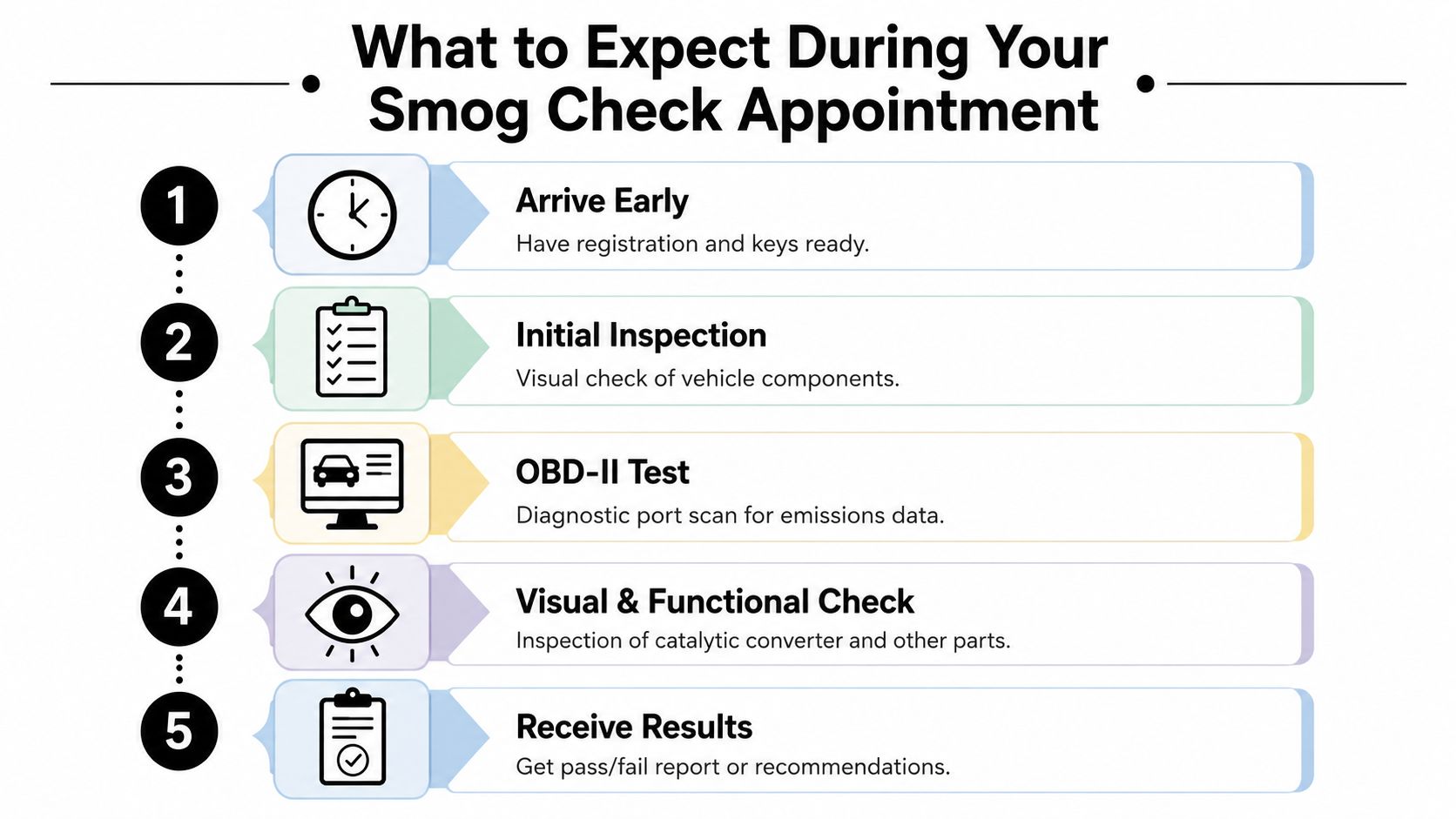
The appointment sequence
- Paperwork review: The station confirms the vehicle and transaction details.
- Visual inspection: The technician checks required emissions components and looks for obvious problems.
- Diagnostic or tailpipe testing: The equipment evaluates electronic emissions data or measures exhaust output, depending on the vehicle.
- Result entry: The inspector records the result in the state system.
- Certificate and report: You receive the result documentation, while the station submits the certificate electronically to the DMV when applicable.
A typical 2000 or newer vehicle takes about 10 to 15 minutes. The final price includes California's $8.25 Smog Check certificate fee, according to BAR's consumer protection information. Ask for the report even after a passing result. It documents the inspection and can clarify future registration questions.
The appointment resembles a structured vehicle scan more than a repair visit. If the result is incomplete or failing, ask which system, component, or readiness monitor caused it. The station may identify the issue, but repair work is a separate decision.
When Your Vehicle Fails the Smog Check
A failed result doesn't automatically mean the vehicle needs a major repair. The report should identify the reason for failure, such as an emissions fault, an illuminated malfunction indicator light, an inspection issue, or incomplete readiness monitors. Read the report before authorizing work.
California BAR's 2026 performance report states that about 1.3 million, or 7%, of 19 million 2000-and-newer vehicles tested during the 2024 through 2025 period failed Smog Check. That statewide result shows why a careful response matters. A failure is not unusual, but the next repair decision should come from the test results rather than guesswork. Review the BAR 2026 Smog Check performance report for the published program data.
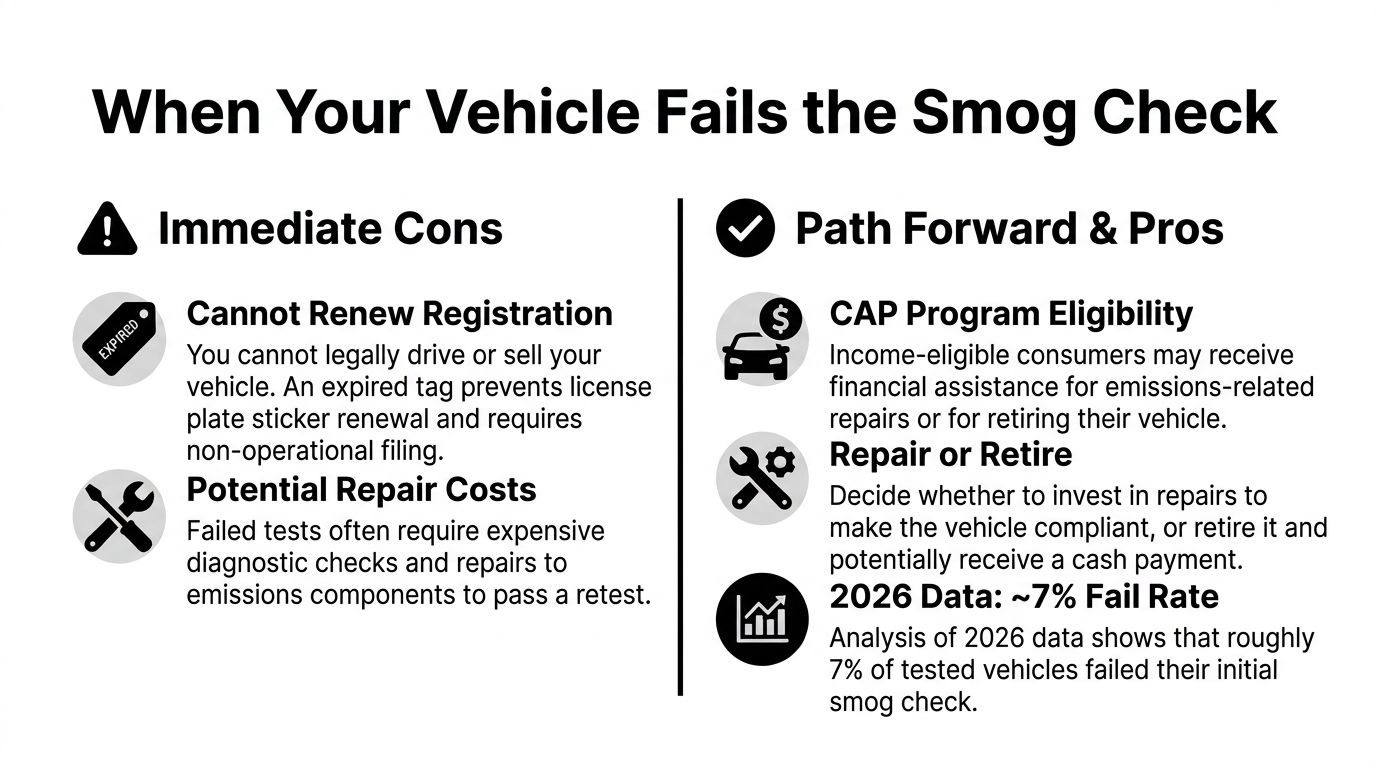
What to do after a failure
- Read the failure report: Identify the exact diagnostic code, monitor status, or component problem.
- Ask for diagnosis before parts: An oxygen sensor, catalytic converter, fuel system, or wiring problem can produce related symptoms, so testing should come before replacement.
- Repair the cause: A battery reset may require additional driving before monitors become ready, but driving alone won't fix an active emissions fault.
- Retest after the repair: Bring the vehicle back when the repair is complete and the applicable monitors are ready.
- Check assistance eligibility: California's Consumer Assistance Program may help qualifying owners with emissions-related repairs.
The program can provide up to $1,450 for emissions-related repairs on 1996 and newer vehicles that fail a biennial Smog Check. Vehicles from 1976 through 1995 may qualify for up to $1,100. BAR's Smog Check and Consumer Assistance information states that applicants must meet an income threshold of 225% of the federal poverty level and have a failed biennial inspection.
CAP assistance isn't automatic, and it doesn't apply to every registration situation. Review the eligibility requirements before committing to repairs. If the vehicle can't reasonably be repaired, ask the DMV or BAR about the applicable options for your circumstances rather than ignoring the failed result.
How to Prepare for a Fast and Hassle-Free Smog Check
Preparation starts with the dashboard. If the check engine light is on, have the vehicle diagnosed before scheduling the inspection. Clearing the light without fixing the underlying issue can leave the monitors incomplete, creating another failure rather than solving the problem.
A recently disconnected battery deserves special attention. The vehicle's computer may have lost its stored readiness status, and the monitors need appropriate driving conditions to complete their checks. Don't assume a short trip around the neighborhood is enough. Ask a qualified technician or the station what drive cycle applies to your vehicle, especially after emissions repairs.
A practical pre-visit checklist
- Confirm the requirement: Check your registration notice and vehicle details before choosing a station.
- Verify station coverage: Ask whether the shop inspects your model year, fuel type, hybrid system, or diesel configuration.
- Check warning lights: Resolve an illuminated emissions warning before the official test.
- Review readiness: Have the vehicle's OBD readiness status checked after a battery replacement, jump-start, or emissions repair.
- Bring documents: Take your registration or renewal notice, identification, keys, and any ownership-transfer information.
- Ask about the total price: Confirm whether the quoted amount includes California's certificate fee.
- Schedule intelligently: An appointment can reduce waiting, particularly when many drivers are approaching registration deadlines.
- Avoid last-minute repairs: Don't install parts or clear codes immediately before testing without allowing the vehicle's systems to complete their checks.
Before you leave home: A passing smog check depends on the vehicle's actual emissions condition and computer readiness, not on a quick reset of the dashboard light.
Keep the failure report, repair invoices, and passing certificate copy. Those records make a later DMV question easier to resolve and help the next technician understand what has already been tested.
Speedy Smog provides STAR Certified Smog Check services for newer vehicles, older vehicles, diesels, and hybrids, with typical 2000-and-newer inspections completed in about 10 to 15 minutes. Visit Speedy Smog to review the San Leandro location, confirm your vehicle's testing needs, and schedule an appointment before your registration deadline.
You're standing at the inspection station with a Vehicle Inspection Report in your hand. The top of the page says FAIL, but that word doesn't tell you whether the problem is a loose gas cap, an emissions component, an incomplete computer check, or a repair that needs deeper diagnosis. Before authorizing parts or paying for another test, read the report as a diagnostic document.
A California smog check report, formally called the Vehicle Inspection Report, or VIR, records what the technician inspected, what the vehicle's onboard system reported, and why the final result was issued. Once you know where to look, the report can help you speak clearly with a repair shop and choose the right next step.
Table of Contents
- What a Smog Check Report Actually Tells You
- Reading the Key Fields on Your Vehicle Inspection Report
- Understanding California Smog Check Failure Rates
- Most Common Reasons Vehicles Fail Smog Checks
- Why STAR Certification Matters for Your Smog Check
- What to Do After Receiving Your Smog Check Results
- How Speedy Smog Helps East Bay Drivers Get Certified Fast
What a Smog Check Report Actually Tells You
Most drivers look at the final result first. If the report says “PASS,” they put it in the glove box. If it says “FAIL,” they start searching for a repair shop. That reaction is understandable, but the result line is only the summary. The useful details appear in the fields underneath it.
The VIR identifies the vehicle, documents the inspection, and records special circumstances or failure notes. California's Bureau of Automotive Repair says the station must provide the customer with a copy of the VIR, while the smog certificate is sent electronically to the DMV. You therefore receive a paper or electronic report for your records, but the DMV receives the certificate through the state's electronic system. Read the BAR Smog Check FAQ if you need clarification about the report or certificate process.
The report is more than proof of payment
Suppose your vehicle fails because the OBD system shows an emissions fault. That result points toward diagnosis and repair. A visual failure, such as an emissions component that appears missing or modified, leads to a different conversation. A readiness failure may mean the vehicle's computer hasn't completed its checks, especially after a battery replacement, code clearing, or recent repair.
The report helps separate those possibilities. It can show whether the issue involved:
- Vehicle identification, confirming that the inspection belongs to your car.
- Inspection type, showing which testing method applied.
- OBD or emissions results, recording the system's response.
- Readiness monitors, showing whether required self-tests were complete.
- Visual and functional checks, identifying equipment or warning-light problems.
- Failure notes, documenting the condition that prevented a pass.
- Final status, stating whether the vehicle passed or failed.
Keep the VIR with your repair invoices and diagnostic paperwork. If you return for a retest, the document gives the repair technician a starting point and helps you verify that the retest addresses the original failure rather than creating a new guess-and-replace cycle.
Reading the Key Fields on Your Vehicle Inspection Report
Start at the top and work downward. Don't begin with the repair estimate. First confirm that the report describes the vehicle you brought in and the inspection that was performed.
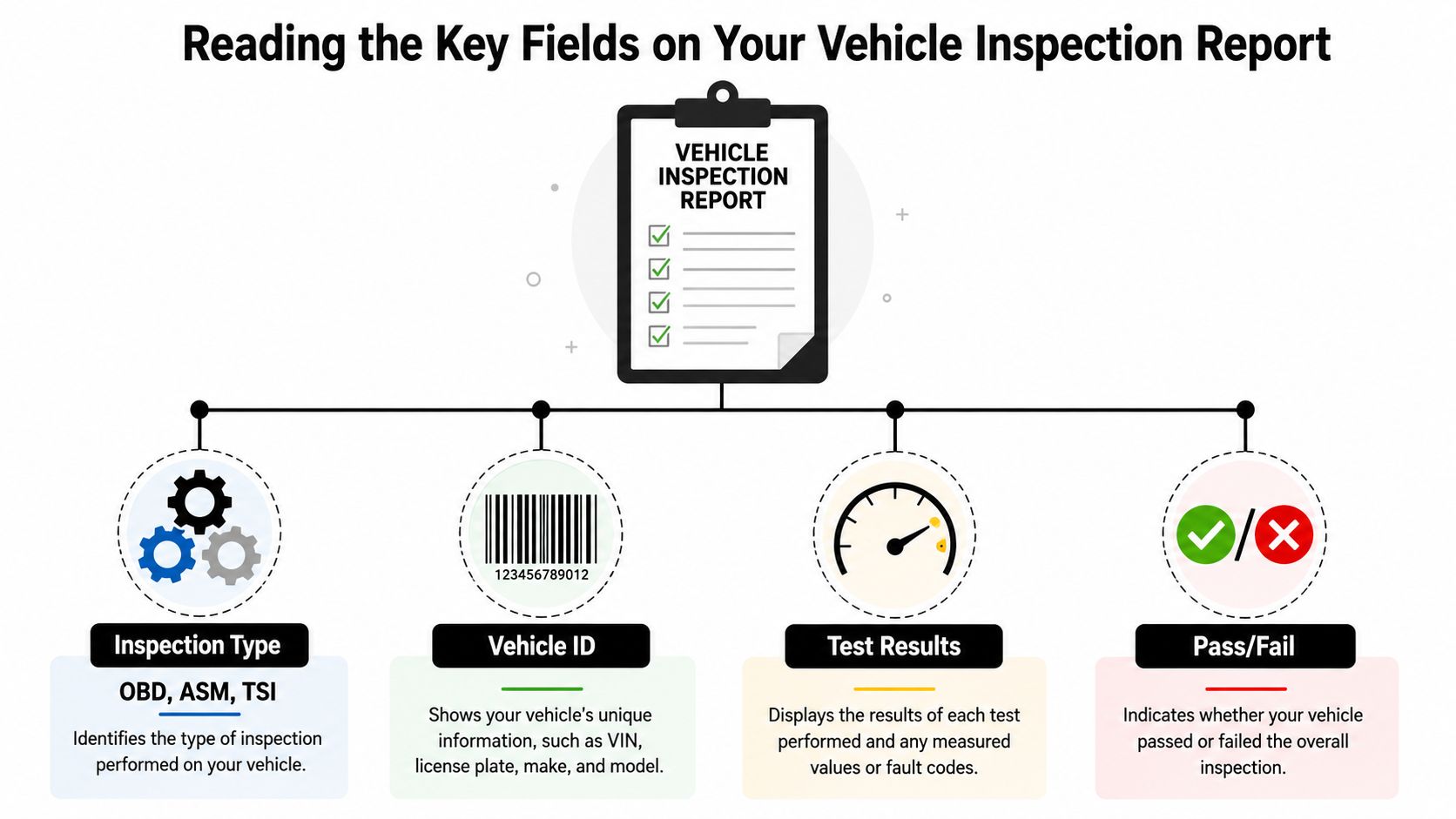
1. Confirm the vehicle information
Check the VIN, license plate information, model year, make, and other identifying details. A mismatch can create registration problems even if the mechanical inspection itself was completed correctly. Ask the station to correct an error before you leave, rather than assuming the DMV will fix it automatically.
The model year also helps explain the test method. BAR's OBD inspection data covers 2000-and-newer vehicles, making the 2000 model year an important technical breakpoint in California's modern inspection system. Older vehicles may be evaluated through a different procedure, depending on the vehicle and applicable requirements.
2. Identify the inspection type
Look for references to OBD, ASM, or TSI. An OBD inspection communicates with the vehicle's onboard diagnostic computer. ASM and TSI refer to testing approaches associated with emissions measurement and vehicle operation. The method matters because a report showing a computer fault should be interpreted differently from one showing measured emissions above an applicable limit.
If the report includes a diagnostic trouble code, don't treat the code as a complete diagnosis. A code identifies a monitored system or condition, but a technician still needs to test the underlying cause. This guide to reading OBD codes can help you understand why a code is a starting point, not automatically a parts order.
3. Read the result fields
Look for monitor status, warning-light information, emissions readings where applicable, and visual or functional inspection notes. A failed visual item means the technician observed a problem with required emissions equipment or configuration. A functional failure means a system did not operate as required. An emissions failure means the vehicle exceeded the applicable test standard or its OBD system detected a qualifying emissions issue.
The final pass or fail line combines those findings. Read the reason immediately above or beside it. That line usually tells you whether to seek diagnosis, restore equipment or approved software, complete the required drive conditions, or ask about a Referee review.
Practical rule: A diagnostic trouble code, an incomplete monitor, and a failed emissions measurement are different findings. Your repair plan should match the finding printed on the VIR.
Understanding California Smog Check Failure Rates
A failed result can feel unusual when you're the only driver in the waiting room dealing with one. Statewide data shows that failures are a normal part of the program, even though most inspected vehicles pass.
BAR reported that about 19 million 2000-and-newer vehicles were tested during calendar years 2024 to 2025, and about 1.3 million failed, an overall failure rate of roughly 7%. The same report says roadside inspection sampling found an overall fleet-weighted failure rate of about 14%, which indicates that real-world emissions problems can be higher than the rate observed during routine station testing. These figures come from the BAR Smog Check Performance Report.
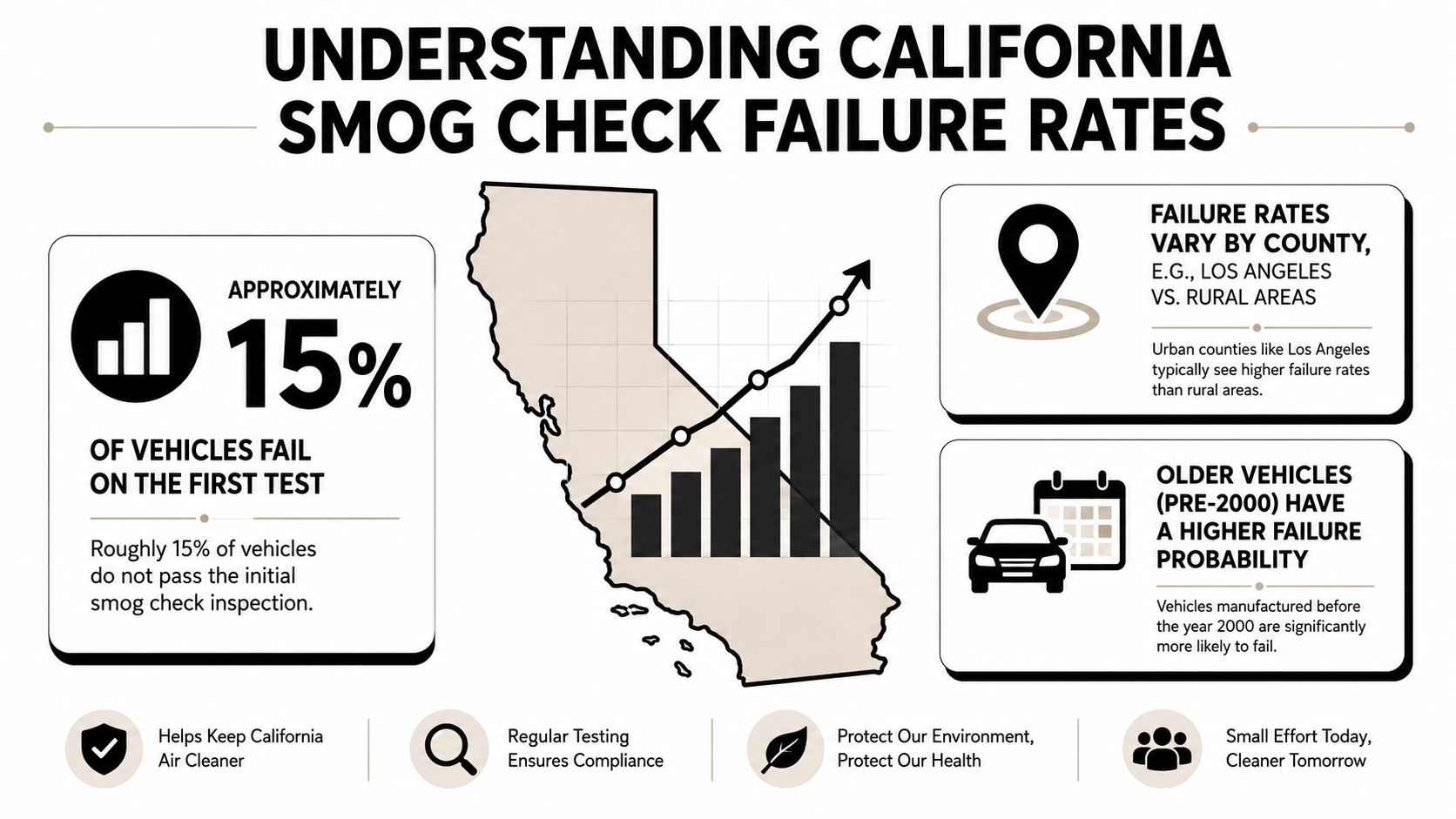
BAR's 2025 executive summary lists 11,275,981 initial tests and 959,667 failures, producing an initial-test failure rate of 8.51%. That report also tracks testing volume, failure rates, station data, and repair costs. The 2025 BAR Executive Summary Report places an individual failed inspection within the larger operation of California's compliance system.
Why the numbers differ
Station testing and roadside sampling answer different questions. A station inspection evaluates vehicles presented for testing under the applicable procedure. Roadside sampling examines vehicles in normal use, where maintenance condition, driving patterns, load, and operating temperature can vary.
The difference doesn't prove that a particular vehicle will fail at roadside or that a station test missed a defect. It shows why California uses more than a simple annual pass-or-fail event. OBD-era inspections collect information from vehicles at scale, allowing BAR to monitor fleet performance and identify compliance patterns.
For a driver, the practical lesson is straightforward. A failed report isn't a random administrative inconvenience. It identifies a condition that California's inspection process considers relevant to emissions compliance, and the repair should address the recorded cause rather than only erase the warning.
Most Common Reasons Vehicles Fail Smog Checks
The failure section of the VIR should answer the first question, “What prevented the pass?” It may not provide a complete mechanical diagnosis, but it narrows the problem into a category.
Incomplete readiness monitors
Readiness monitors are self-checks performed by the vehicle's OBD system. After a battery disconnect, computer reset, code clearing, or some repairs, the monitors may show “not ready.” The vehicle can run normally and still fail because the computer hasn't completed the required emissions checks.
California's rules set different limits by model year. For 1996 through 2000 vehicles, more than two incomplete emissions-related monitors causes a failure. For 2001-and-newer vehicles, more than one incomplete monitor causes a failure. BAR says that, effective October 1, 2025, all readiness monitors must be set for a vehicle to pass, as explained in its readiness-monitor regulation guidance.
Don't ask a technician to just clear the monitors again. That generally removes useful information and can leave the vehicle unready at the next inspection. Ask what drive conditions the manufacturer requires and whether the underlying fault has been repaired.
Warning-light and OBD faults
A commanded check-engine light, stored emissions fault, or failed OBD communication check can produce a failure. The repair could involve a sensor, wiring, an intake or exhaust leak, fuel control, catalytic-converter performance, or another monitored system. The code alone doesn't identify which component should be replaced.
Emissions readings above the limit
For test procedures that measure tailpipe output, the VIR can show readings that exceed the applicable standard. The technician may then need to evaluate combustion, fuel delivery, ignition, exhaust treatment, or other emissions-related systems. Avoid approving an expensive repair solely from the number on the report. A qualified repair shop should confirm the cause.
Visual and functional problems
A missing, disconnected, modified, or improperly configured emissions component can cause a visual failure even when the engine feels fine. Functional tests may identify a warning-light problem, a gas-cap issue, or another system that doesn't perform as required. Restoration to original equipment or approved software may be the correct path, rather than replacing unrelated parts.
Before authorizing work: Show the complete VIR to the repair shop and ask the technician to identify the exact failed field, the proposed diagnostic test, and the condition that will be verified before retesting.
For a category-by-category explanation, use this guide to common smog check failure reasons.
Why STAR Certification Matters for Your Smog Check
A STAR station is not a shop with a different sign. STAR certification is part of California's program for stations that meet specified performance and equipment requirements. Some vehicles are directed by the DMV to receive an inspection at a STAR station, so the first question is whether your registration notice or vehicle record includes that direction.
A non-STAR station may be appropriate when your vehicle isn't directed to STAR and the station performs the required test. A STAR station, however, may be the necessary choice for a directed inspection. The station's status should be confirmed before testing, because using the wrong station can mean paying for an inspection that doesn't satisfy the registration requirement.
Compare the practical differences
| Question | Non-STAR station | STAR station |
|---|---|---|
| Can it perform a required inspection? | Only when its license and your vehicle's requirements match | Designed for inspections covered by STAR requirements |
| Does the designation matter for every vehicle? | Not necessarily | It matters when DMV directs the vehicle to STAR |
| What should you verify first? | Test type and licensing | STAR status, test type, and DMV direction |
| What does the report still provide? | Inspection findings and final result | Inspection findings and final result under STAR procedures |
STAR status doesn't guarantee that a vehicle will pass. No station can legitimately promise a pass before inspecting the car. The value is procedural: when STAR is required, the station has the certification needed for that inspection, and drivers can avoid choosing a location that cannot complete the required transaction.
Ask the station to confirm its status before the test, especially if your renewal notice directs you to a STAR inspection. You can also review what a smog STAR station is before deciding where to go.
What to Do After Receiving Your Smog Check Results
Your next step depends on the final line and the notes that support it. Treat a pass and a fail as separate administrative paths.
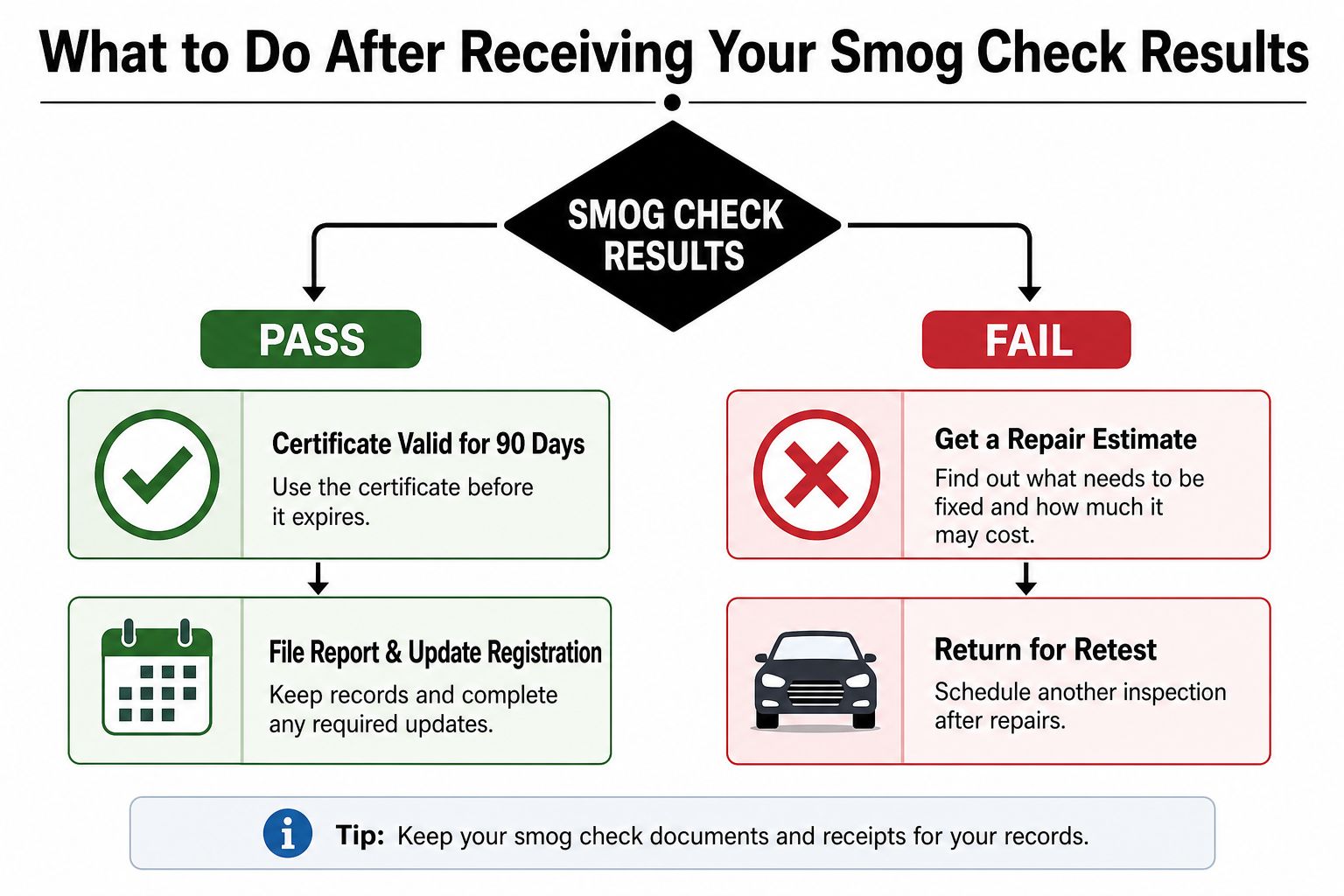
If the report says pass
Confirm that the vehicle information is correct and keep the VIR with your registration records. The station electronically sends the smog certificate to the DMV, so you generally shouldn't need to carry a paper certificate to the DMV for the electronic submission itself. Keep your copy anyway. It documents what was inspected and can help if a registration record needs review.
Complete your registration process promptly and follow any instructions on your renewal notice. If the vehicle is changing ownership or being registered in California for the first time after coming from another state, check the applicable DMV requirement before assuming an older inspection will satisfy the transaction. BAR states that a smog check is required for all out-of-state 1976 model-year and newer vehicles registering in California for the first time, along with other initial registration events.
If the report says fail
Use the failure notes to choose a repair path:
- Save the report and supporting records. Keep diagnostic printouts, invoices, and parts information.
- Ask for diagnosis before repairs. The repairer should connect the symptom or code to a confirmed cause.
- Address the listed failure. Do not rely on clearing codes or disconnecting the battery.
- Verify readiness and repairs. The vehicle must be ready for the applicable inspection procedure.
- Return for a retest. Bring the original VIR and repair documentation.
Some cases call for a licensed repair station. Others may require a Referee review, particularly when the report involves unusual equipment, configuration, or an unresolved dispute about compliance. If the likely repair cost creates financial difficulty, ask the appropriate California program office or repair professional about current waiver or assistance rules. Eligibility depends on the vehicle, failure, documentation, and applicable program requirements, so don't assume a waiver is automatic.
How Speedy Smog Helps East Bay Drivers Get Certified Fast
For San Leandro and nearby East Bay drivers, Speedy Smog offers smog inspections at its STAR-certified station at 15275 Washington Ave, San Leandro, California 94579. The shop handles many vehicle categories, including 2000-and-newer vehicles, 1999-and-older vehicles, diesels, and hybrids, so drivers can confirm the appropriate test before arriving.
Typical tests for 2000-and-newer vehicles take about 10 to 15 minutes, according to the supplied business information. Speedy Smog also provides electronic DMV submission after a passing inspection, explains the result fields, and offers an indoor waiting area, transparent pricing, and periodic coupons. It operates Monday through Saturday.
Bring your vehicle information and any renewal notice, and tell the technician if you've recently cleared a code, disconnected the battery, or completed emissions repairs. That context helps the station interpret readiness status correctly and keeps the report focused on what your vehicle needs.
If you want a clear explanation of your smog check report before handling DMV registration, visit Speedy Smog in San Leandro. Their STAR-certified team can inspect eligible vehicles, explain the VIR findings, and electronically submit passing results to the DMV.