A California resident must apply to register an out-of-state vehicle within 20 days after establishing residency or accepting California employment. The clock starts with that change in status, not with the day you bought the car.
You may still be unpacking in San Leandro, arranging insurance, and driving on valid plates from your previous state. Registration can feel like something to handle after the move settles down, but the important work starts before the DMV appointment: checking whether California will accept the vehicle and getting the right inspection.
A passing smog check isn't a guarantee of registration. Ownership documents, vehicle verification, and emissions certification each serve a different purpose. Getting them ready in the right order helps you avoid paying for a test or making a DMV trip that can't move your application forward.
Table of Contents
- Who Must Register and the 20-Day Deadline
- Vehicle Eligibility and Smog Check Rules
- Step-by-Step Registration Procedure and Documents
- Common Delays and How to Fix Them
- Book Your Visit Before the 20-Day Clock Runs Out
Who Must Register and the 20-Day Deadline
Start with the event that created your registration obligation. The California DMV vehicle registration requirements give new residents and people accepting California employment 20 days to register, and identify the special situations and deadlines below.
Registration requirements and deadlines by situation
| Situation | Registration required? | Deadline |
|---|---|---|
| New California resident bringing a vehicle from another state | Yes | 20 days after establishing residency |
| Person accepting California employment | Yes | 20 days after accepting the job |
| Nonresident with a California place of business who regularly uses the vehicle | Yes | Immediately upon entering California |
| California resident using a vehicle a nonresident owner provides for regular use | Yes | 20 days after the vehicle is first operated in California |
| Nonresident daily commuter from a contiguous state | Exempt only if every statutory condition is met | No registration under this narrow exemption for qualifying passenger vehicles or pickups under 8,001 pounds unladen, used principally for commuting |
Keeping an out-of-state title or insurance policy doesn't settle whether registration is required. Where you live, work, and regularly use the vehicle matters more than where you purchased it.
For a family moving to San Leandro, the useful planning date is the day residency begins, not the day the moving truck leaves or the existing registration expires. Book inspections early enough to leave room for a repair or a missing ownership document.
Practical rule: An appointment booking isn't the same as an application. If the packet won't be ready before your deadline, contact the DMV about submitting the application and paying fees while outstanding requirements are resolved.
Write down your residency or employment start date before arranging the remaining tasks. You can correct paperwork later, but you can't recover elapsed time.
Vehicle Eligibility and Smog Check Rules
Most vehicles coming from another state need a California Smog Check, and an out-of-state emissions result won't substitute for it. Before booking, identify the fuel type, model year, and weight rating so you arrange the appropriate inspection.
Emissions requirements by vehicle case
| Vehicle case | Smog check needed | What to watch |
|---|---|---|
| Gasoline vehicle, model year 1976 or newer | Yes, generally | Out-of-state emissions results aren't accepted |
| Diesel vehicle, model year 1998 or newer, under 14,001 pounds GVWR | Yes, generally | Confirm the gross vehicle weight rating on the manufacturer's label |
| Diesel vehicle over 14,001 pounds GVWR | Confirm the applicable inspection requirements with the DMV | Don't assume the light-duty diesel procedure applies |
| Nearly new, low-mileage vehicle that isn't California-certified | A test doesn't resolve eligibility | Only narrow certification exemptions may apply |
| Imported vehicle | Applicable smog inspection plus federal and emissions documentation | Customs clearance and federal safety paperwork are separate requirements |
The California DMV out-of-state vehicle guide warns that a non-California-certified vehicle with fewer than 7,500 miles may be ineligible for registration; it also flags vehicles less than two years old and under 7,500 miles unless they meet California standards or qualify for an exemption.
Certification comes before testing
A smog inspection evaluates the vehicle's emissions condition and equipment. California certification establishes whether that vehicle configuration is eligible for registration in the first place. A technician can't turn a federal-only certification into California certification by issuing a passing test result.
Read the under-hood emissions label before buying or transporting the vehicle. Look for the manufacturer's statement about California emissions compliance rather than relying on a seller's description of the car as emissions compliant.
Ask for the vehicle's origin and mileage history, especially with nearly new cars, diesels, and hybrids. A photograph of the label is more useful than an assurance that the car passed inspection in its previous state.
The exemptions are narrow. They include certain inheritance and divorce transfers, replacement of a stolen or irreparably damaged California vehicle, and qualifying military circumstances. Don't treat those examples as automatic approval; establish that your circumstances qualify before committing to the purchase.
A cheaper purchase isn't a saving if California won't register the vehicle. Resolve certification questions before paying transport costs.
For imports, gather customs clearance, federal safety documentation, and evidence of applicable federal and California emissions compliance before scheduling the registration visit. Our California smog check rules guide can help you prepare questions about the inspection your vehicle needs.
Step-by-Step Registration Procedure and Documents
Treat out-of-state car registration in California as a coordinated document-and-inspection process, not merely a counter transaction. The DMV guidance on out-of-state registration obligations identifies the signed REG 343 application, ownership evidence, registration, insurance, fees, and generally mandatory REG 31 vehicle verification; it also identifies the gasoline and diesel model-year and weight categories shown above.
Establish the date and identify the vehicle
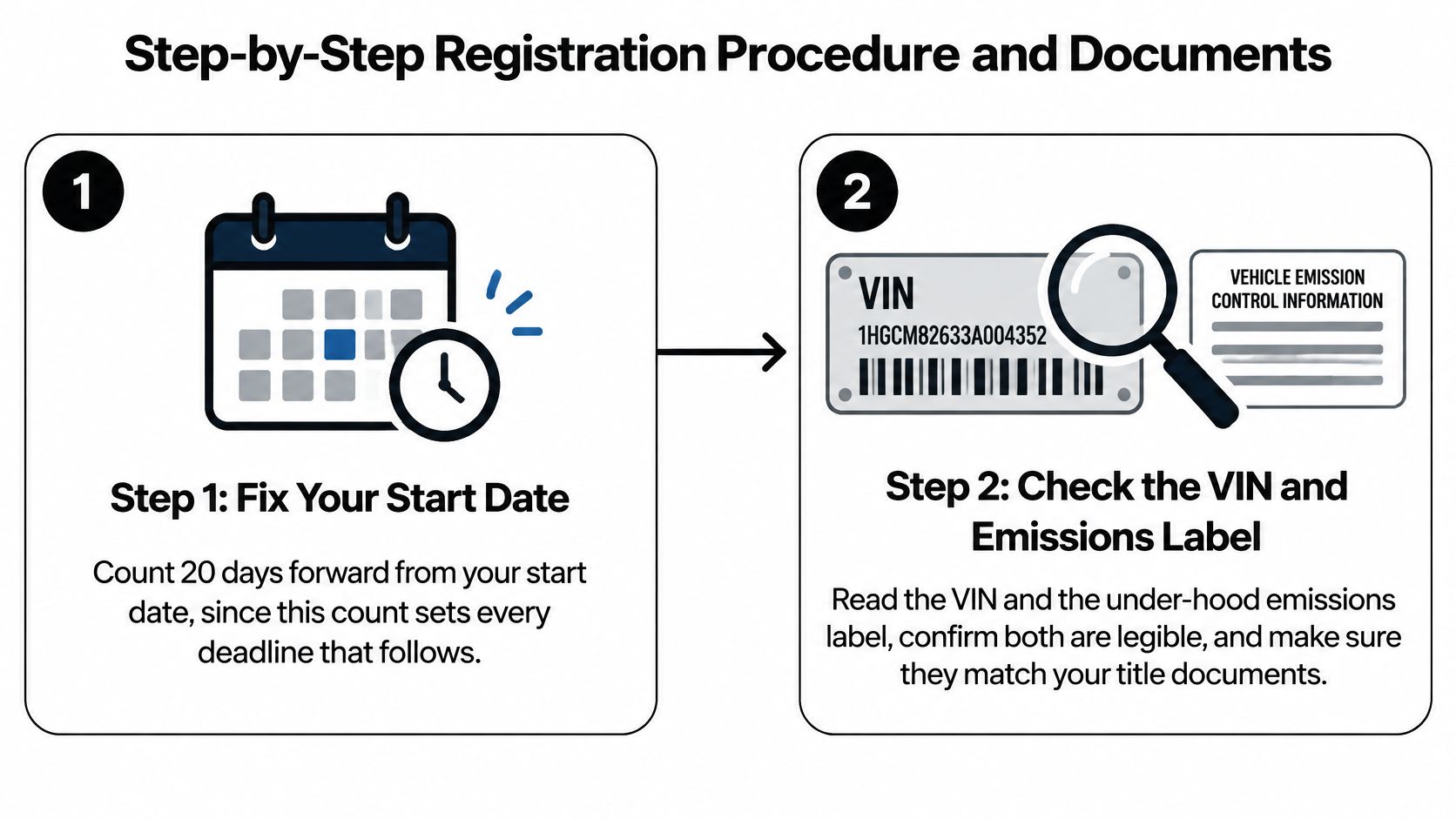
Fix your start date. Record the event that created your California registration obligation and put the application deadline on your calendar. Keep supporting move or employment records with your registration paperwork so you aren't trying to reconstruct the timeline at the counter.
Read the VIN and under-hood emissions label before making appointments. Compare the VIN with the title and registration, then photograph the identification plate and label so you can spot an unreadable character or inconsistent entry while there's still time to resolve it.
The VIN should match the ownership documents exactly. The emissions label provides different information, including the certified configuration, so don't expect its wording to duplicate the title.
Complete the physical checks
Obtain the applicable California Smog Check. Bring the vehicle and its existing registration information, and retain the inspection report or certificate after testing. At Speedy Smog, we electronically transmit smog check results directly to the DMV, but keeping your own record helps if an application needs follow-up.
Arrange the required vehicle verification and have the verification form completed by an authorized verifier. This physical check records vehicle-identification information, including the VIN, odometer reading, motive power, and applicable emissions-label details; it isn't a replacement for the emissions inspection.
Ask about verification arrangements when planning the DMV visit rather than assuming your smog appointment includes them. These are separate tasks, even when you can coordinate them closely.
A stock, clearly labeled vehicle with matching documents is straightforward to prepare. A missing label, engine change, or inconsistent VIN deserves attention before you commit to an appointment intended for final submission.
Build the application packet
- Assemble the ownership and application documents. Use the original out-of-state title or a qualifying ownership document, not an ordinary photocopy, and check the names and signatures before leaving home. If a lender holds the title, establish the required handling procedure in advance rather than arriving with only a loan statement.
Keep this checklist together in a folder:
- Signed application: Complete the Application for Title or Registration identified above, using consistent owner and vehicle information.
- Ownership evidence: Bring the original title or the qualifying ownership document the DMV accepts for your situation.
- Existing registration: Include the latest out-of-state registration, even if you also have the title.
- Insurance: Arrange California-compliant coverage and confirm your current address and vehicle details with your insurer.
- Lien information: Include the lienholder's name, address, and relevant loan information when a lien exists.
- Inspection records: Keep the smog paperwork and completed verification with the application.
- Payment preparation: Bring an accepted payment method for the charges applicable to your transaction.
Read every document side by side. A name variation, missing co-owner signature, or transposed VIN character is easier to fix at home than during a counter appointment.
Estimate payment and submit
Use the DMV fee calculator to estimate registration, title, use-tax, and applicable service charges. Enter the vehicle and transaction details carefully, and treat the result as a planning estimate rather than a promise of the final amount.
Submit the complete packet together when possible. Before the appointment, review our car registration inspection preparation guide and confirm that both the vehicle and original documents will be available. If a requirement is still outstanding, ask the DMV how to submit timely rather than waiting silently for every issue to disappear.
Check what the DMV issues before you leave. If registration is complete, confirm that the California registration documents and plates match your vehicle; if it isn't, get a clear explanation of the outstanding requirement and any operating authorization provided.
Don't assume submitting an application means every approval is finished. Keep receipts, inspection records, and any instructions together until the DMV completes the transaction.
Common Delays and How to Fix Them
| Problem | Likely cause | Fix |
|---|---|---|
| Smog check fails | Emissions-system fault or readiness problem | Diagnose the flagged area, repair as needed, and retest |
| VIN is hard to read or doesn't match the title | Obscured plate, worn stamping, or clerical mismatch | Photograph the VIN and resolve the discrepancy before submission |
| Emissions label is missing or nonconforming | Removed label or altered equipment | Establish the correct configuration and eligibility before inspection |
| Out-of-state smog result presented | The wrong state's inspection was obtained | Obtain the applicable California smog certificate |
| Lien shown on the title | Lienholder information or title-handling arrangements are incomplete | Bring lienholder details and establish how the title will be supplied |
| Application filed after the required window | Registration obligation wasn't addressed promptly | Apply as soon as possible and ask about applicable penalties |
Use the failed-test report to choose the next action
A failed smog inspection needs diagnosis, not repeated testing without a repair plan. At Speedy Smog, a customer whose vehicle fails receives a printout showing the area that needs work, and the vehicle must be repaired to pass the retest before registration can be completed.
A readiness problem and a defective emissions component aren't the same repair. Give the report to the repair technician and explain any recent battery disconnection, code clearing, or work on the vehicle. Don't clear diagnostic codes just to switch off a warning light; that doesn't establish that the underlying problem is fixed.
The Bureau of Automotive Repair's Smog Check guidance addresses the inspection process, while vehicle identification, ownership, and certification remain separate parts of registration. Resolve the actual blocker rather than booking another appointment that can't address it.
Prioritize issues that depend on someone else
Title and lien problems deserve early attention because you may need action from a lender, previous owner, or issuing agency. A phone call identifying who holds the original title can be more productive than preparing an otherwise complete packet.
For missing emissions labels or altered equipment, establish the vehicle's proper configuration before buying parts. A replacement component won't necessarily resolve a certification or identification discrepancy.
Before spending more: Ask whether the proposed fix addresses test performance, registration eligibility, or ownership evidence. Those are different problems with different decision-makers.
If the repair or document correction may run past your deadline, contact the DMV promptly about the application and fee requirements. A smog station can explain a test result, but it can't extend your registration deadline or decide a title dispute.
Book Your Visit Before the 20-Day Clock Runs Out
If your application deadline is close and you haven't arranged the inspections, book them now. Leave room between testing and submission so an unexpected repair doesn't consume all your remaining preparation time.
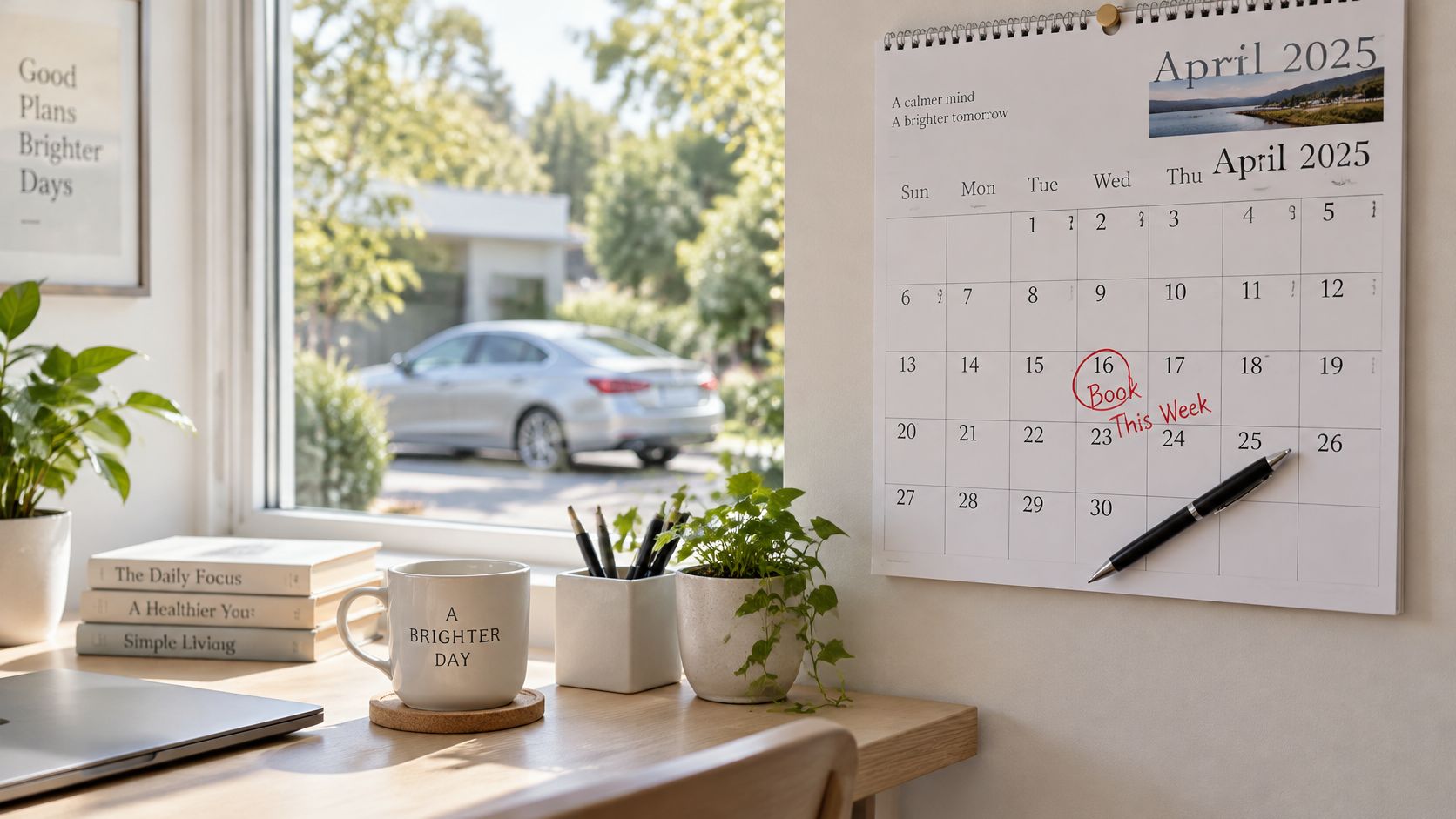
Use a calendar to coordinate the vehicle, the paperwork, and the people who need to sign.
Put the appointments in a workable order
- Confirm your application timing: Review the residency or employment event that triggered registration, then choose a submission date that leaves some flexibility.
- Arrange the physical checks: Schedule the applicable smog inspection and vehicle verification, making sure the vehicle can attend both.
- Reserve time for submission: Have the owners, original documents, insurance information, and payment ready together.
Don't book the final visit around an assumption that the seller will send the title soon. Confirm who has it and how it will reach you before choosing an appointment that depends on its arrival.
Likewise, tell the inspection station about a diesel engine, import status, missing label, or unresolved warning light when arranging the visit. That conversation helps establish whether testing is the right next action.
Ask practical questions before you arrive
At Speedy Smog, we serve drivers in San Leandro, Hayward, Alameda, and Oakland. Use our smog check appointment page to arrange your visit and ask what to bring for an out-of-state vehicle.
We electronically submit the test result, but that doesn't replace the ownership packet or authorize us to decide whether a certification exception applies. Keep questions about title acceptance, disputed VIN information, and eligibility decisions directed to the agency responsible for them.
When arranging any registration assistance, describe the transaction as an initial California registration of an out-of-state vehicle, not a routine renewal. We aren't a DMV branch, and our DMV registration authority covers a limited range of services, so confirm whether your particular transaction can be handled before planning around it.
Your best protection against a stalled registration is preparation before the appointment: readable vehicle identification, acceptable ownership evidence, and the correct inspection. Start early enough to act on a problem rather than merely discover it. A later repair can make the vehicle ready, but it can't give you back the days already used.
Speedy Smog offers California emissions testing and electronically sends results to the DMV, helping you prepare the inspection portion of your out-of-state registration. Visit Speedy Smog to arrange your smog check and confirm what to bring before your application deadline.
What if the station you choose isn't the decision at all? Most East Bay drivers start by searching for a shop. The smarter first step is smaller. Read one line on your DMV renewal notice. That wording decides whether any licensed station will work, or whether you need a California STAR smog station. Miss that word, and you can pay for a valid test at the wrong kind of station. Then you pay again.
Table of Contents
- What a STAR Smog Station Actually Is
- STAR and Regular Smog Stations Side by Side
- Which Vehicles Need a Smog Check and Which Are Exempt
- When Your DMV Notice Requires a STAR Station
- How to Find a Nearby STAR Station in the East Bay
- Prepare Your Car So the Smog Test Passes
What a STAR Smog Station Actually Is
Does your DMV notice require a STAR station, or will any licensed Smog Check station do? STAR is a certification held by the station, not a different test for your car. The notice's wording is what tells you whether that certification matters.
A California STAR smog station is a Smog Check station certified by the Bureau of Automotive Repair, or BAR, for meeting program performance standards. BAR can assign certain vehicles, called directed vehicles, to STAR stations. That assignment is about where the vehicle can be tested, not a separate kind of inspection.
A STAR station works like a restaurant that has earned a higher inspection grade. The food may be the same, but the kitchen is monitored against a stricter standard and must continue to meet it. For a driver, the practical difference is the station's certification and oversight.
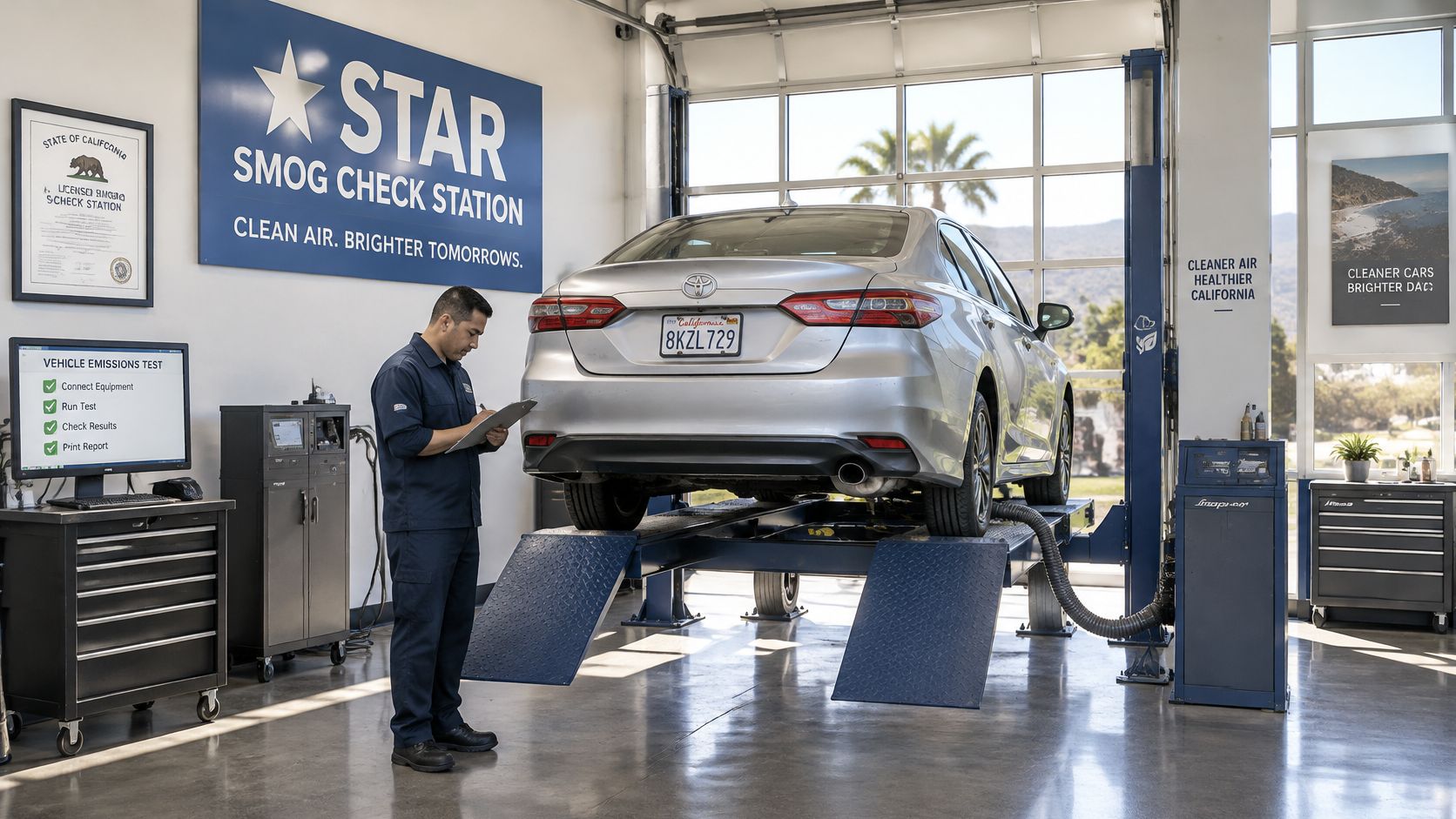
The Same Test at a More Closely Watched Station
The Smog Check procedure does not change because a station is STAR certified. BAR monitors station performance by comparing inspection results with those of other stations and inspectors in the program.
STAR began as a voluntary program in January 2013 for stations seeking authorization to inspect directed vehicles, according to BAR's 2019 Smog Check performance report. A station applies, then must continue meeting the program standard to keep its certification.
Plain rule: STAR describes the station's credential. It does not mean your car gets a different or faster test.
A regular Smog Check station is also licensed by BAR. If a station is not STAR certified, that does not mean it is unlicensed. It means the station does not hold the additional STAR certification.
STAR stations handle most initial Smog Checks, showing that the program is a significant part of California's inspection system. Still, a station's certification does not decide what your vehicle needs. The DMV notice does. Check whether it says your vehicle must go to a STAR station before choosing where to test.
STAR and Regular Smog Stations Side by Side
Start with the table. It shows what separates the two station types, and what doesn't.
| Feature | STAR station | Regular Smog Check station |
|---|---|---|
| Basis of certification | Voluntary BAR designation tied to measured performance | Standard BAR licence to perform Smog Checks |
| Directed vehicles | Eligible to test vehicles BAR assigns to STAR stations | Not eligible for directed tests |
| Performance monitoring | Benchmarked on failure rate, gear-shift incidents, test deviation and follow-up pass rate | Standard station oversight |
| Licensed stations, December 2020 | 3,893 (51%) | 3,715 |
| Initial Smog Check tests, 2020 | About 8.4 million (82%) | About 1.9 million (18%) |
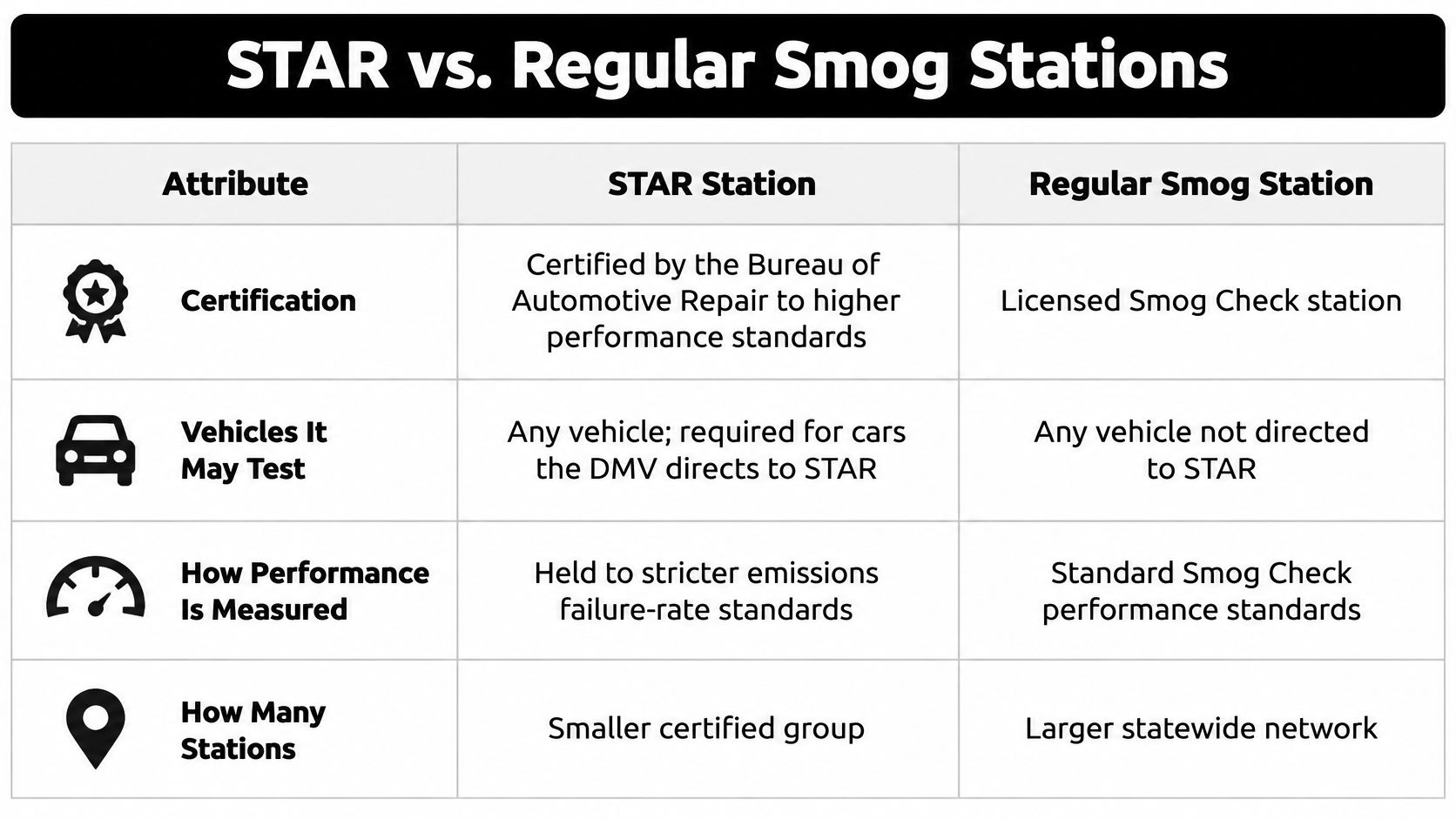
How to Read the Two Share Rows
The station count and the test count tell different stories. In December 2020 there were 7,608 licensed stations statewide, and 3,893, or 51%, were STAR certified, according to BAR's 2020 Smog Check performance report. The regular station count above comes from that same total minus the STAR count.
Yet STAR stations performed about 8.4 million of roughly 10.3 million initial tests that year, or 82%, while non-STAR stations performed about 1.9 million, or 18%. Half the shops did the large majority of the work. So most California drivers end up at a STAR station anyway, even when their notice doesn't require one.
The One Hard Limit on a Regular Station
A regular station can perform a standard Smog Check. It can't take a vehicle BAR has directed to STAR. That's the whole practical difference for a driver choosing where to go.
Certification also isn't permanent. BAR grants it only after a station meets the applicable quarterly performance requirements. A station that slips can lose the credential you were counting on.
A regular station is usually fine for an ordinary renewal. Your DMV notice is the document that decides when it isn't.
Keep that rule in mind. First, though, check whether your vehicle needs a test at all.
Which Vehicles Need a Smog Check and Which Are Exempt
Start with the vehicle details on your registration: fuel type, model year, and weight. They determine whether California requires a Smog Check. Your DMV notice then tells you whether the test must be done at a STAR station.
| Vehicle group | Smog Check status | What the station does |
|---|---|---|
| Gasoline or alternative-fuel, model year 2000 or newer, 14,000 lb GVWR or less | Required | OBD-II check through BAR-OIS |
| Gasoline, model year 1996 to 1999 | Required | OBD and tailpipe testing |
| Gasoline, model year 1995 or older | Required | Test depends on the vehicle and applicable equipment |
| Hybrid vehicle | Required | Test follows its model year and fuel rules |
| Diesel, model year 1997 or older | Exempt | No test required |
| Diesel, model year 1998 or newer, 14,000 lb GVWR or less | Required | Diesel Smog Check |
| Diesel above 14,000 lb GVWR | Exempt | No test required |
What the Station Actually Reads
For most gasoline and alternative-fuel vehicles from model year 2000 onward at 14,000 pounds or less, the test is mainly an OBD-II inspection through the BAR-OIS system. As the California Air Resources Board OBD-II fact sheet explains, the equipment connects to the engine computer and checks trouble codes, check-engine light behavior, and emissions monitor readiness.
Older gasoline vehicles use different testing. Vehicles from 1996 through 1999 typically receive both OBD and tailpipe tests. Gasoline vehicles from 1995 or earlier may require testing based on their equipment and applicable rules. Certain 2000 to 2007 medium-duty or non-OBD-II vehicles can also need tailpipe analysis.
The Two Groups Drivers Get Backwards
- Hybrids aren't exempt: Hybrid vehicles are subject to Smog Check, according to the DMV smog inspections page. The fuel system does not remove the requirement.
- Diesel eligibility depends on year and weight: Diesels from model year 1997 or older are exempt. Diesels from model year 1998 onward require a test if they have a GVWR of 14,000 pounds or less. Diesels above that weight are exempt.
- Check both details: Match the fuel type with the model year and, for diesel vehicles, the weight. Assuming every diesel is exempt can mean an unexpected second trip.
If your vehicle is near one of these cutoffs, which cars need a smog check in California explains the categories in more detail. A vehicle's eligibility tells you whether it needs a test. The exact wording on your DMV notice determines whether that test must be at a STAR station.
When Your DMV Notice Requires a STAR Station
Does your renewal notice say a STAR station is required? Start with that line. The wording on the notice determines where you can test, so read it before choosing a shop.
| Notice wording | What it requires | Where you can test |
|---|---|---|
| Smog Certification Required | A Smog Check at an authorized station | Any licensed Smog Check station |
| Smog Certification Required at a STAR station | A Smog Check at a STAR-certified station | STAR stations only |
Two Notices That Look Almost Identical
A notice reading Smog Certification Required allows you to use any licensed station. A notice reading Smog Certification Required at a STAR station directs you to a STAR-certified station. BAR's Smog Check consumer page explains the distinction between these notice types.
The difference is just a few words. Read the whole smog line, including its ending, before you book or drive to a station.
Check the last words: If the line ends with "at a STAR station," a regular station's certificate will not meet that requirement.
For example, an Oakland driver whose notice specifies a STAR station might choose a regular shop nearby. The test could be performed correctly and the car could pass, but the certificate would not satisfy the STAR direction on the notice. The driver would need another test at a STAR station. The mistake is choosing a shop before checking the full wording.
Two Habits That Prevent the Second Trip
- Bring the notice if you have it: It helps the station confirm your vehicle information. Speedy Smog electronically transmits smog check results directly to the DMV. Bring your vehicle and your registration renewal notice if you have it.
- Handle out-of-state registration separately: Vehicles being registered in California from out of state require a Smog Check regardless of model year. Check the wording on your notice to see whether it also directs you to a STAR station.
STAR is a program with higher performance standards, intended to inspect higher-polluting vehicles. If your notice does not specify a STAR station, a regular licensed station can perform the Smog Check. Let the notice guide your choice rather than paying extra or driving farther without a STAR requirement.
How to Find a Nearby STAR Station in the East Bay
You can do this search on your phone in a few minutes. Follow the steps in order. Each one rules out a common wrong turn.
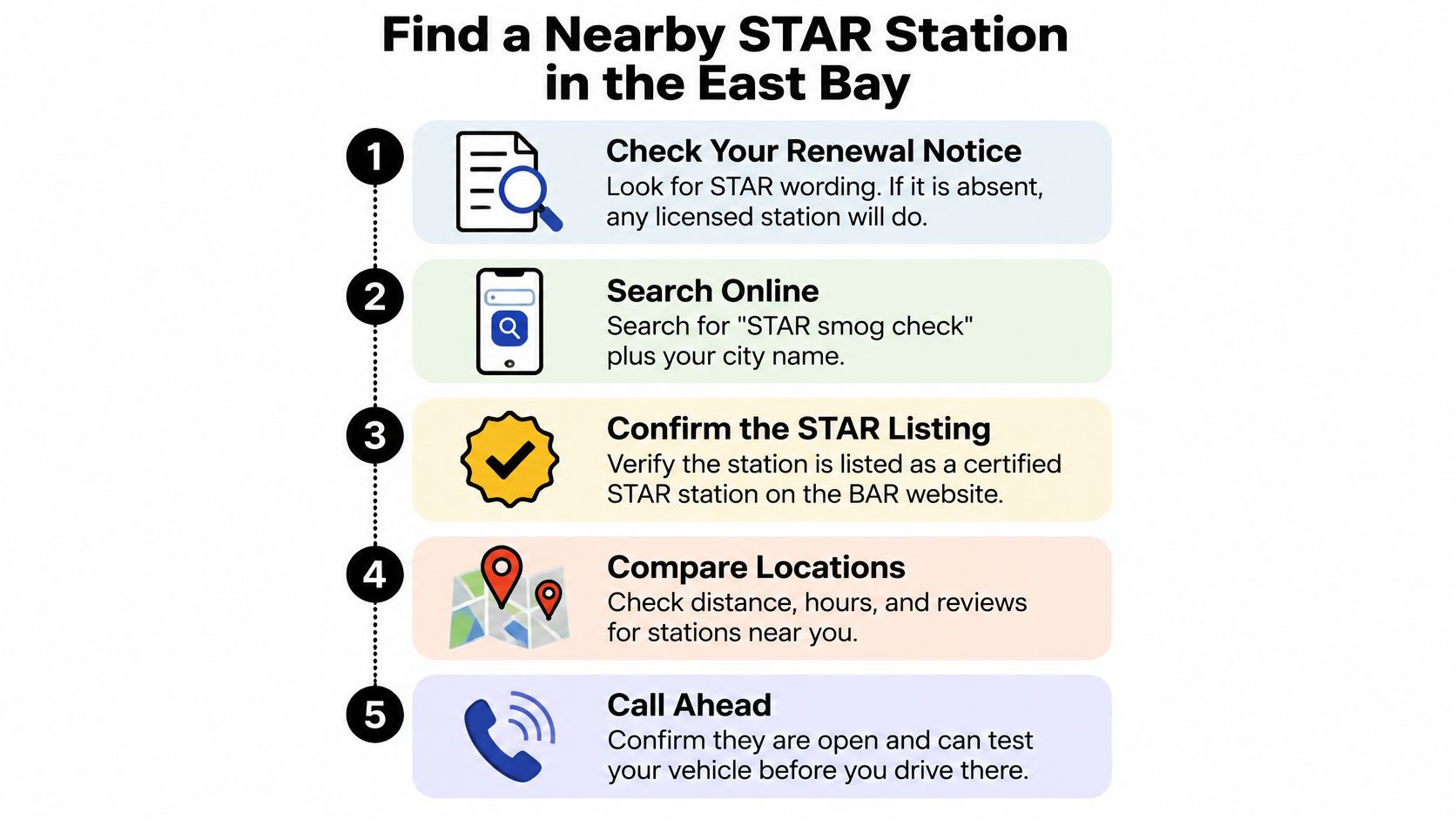
Five Steps Before You Get in the Car
- Read your notice first: Look for the STAR wording. If it's absent, any licensed station will do, and you can pick the closest one.
- Search by city: Search "STAR smog check" with your city name, such as Oakland, San Leandro, Hayward, Alameda, or Fremont. East Bay drivers search by neighborhood, and results follow that pattern.
- Confirm the credential: Look for STAR signage at the shop and check the station's listing. STAR stations must maintain required signage, licenses, records, and properly functioning BAR equipment under BAR's STAR certification requirements.
- Ask test-only or test-and-repair: Some STAR locations perform inspections only. Others also perform repairs. Verify before you arrive, especially if you suspect the car might fail.
- Call ahead: Confirm your vehicle type and the hours. A short call beats a wasted drive.
Step four deserves emphasis. Arriving at a test-only facility expecting repairs is the second most common mix-up we see, right after the notice wording itself. If your check-engine light is on, ask the repair question before you book anything. Our overview of where to get your car emissions tested covers the local search in more detail.
A Worked Example in San Leandro
We're a STAR Certified station at 15275 Washington Ave, San Leandro, CA 94579. You can call us at (510) 614-7664. We serve customers in San Leandro, Hayward, Alameda, and Oakland for smog checks and STAR smog checks.
Use any station you find the same way. Match the address to your route. Match the credential to your notice. Match the services to your car's condition.
One caveat. Certification status can change, because stations must keep meeting BAR's performance standards. Verify directly with the station before you drive over. Don't rely on an old listing or a faded sign.
Prepare Your Car So the Smog Test Passes
Run this checklist the week before your test. Not at the counter. Most avoidable failures are set in motion days earlier, often by a well-meant fix.
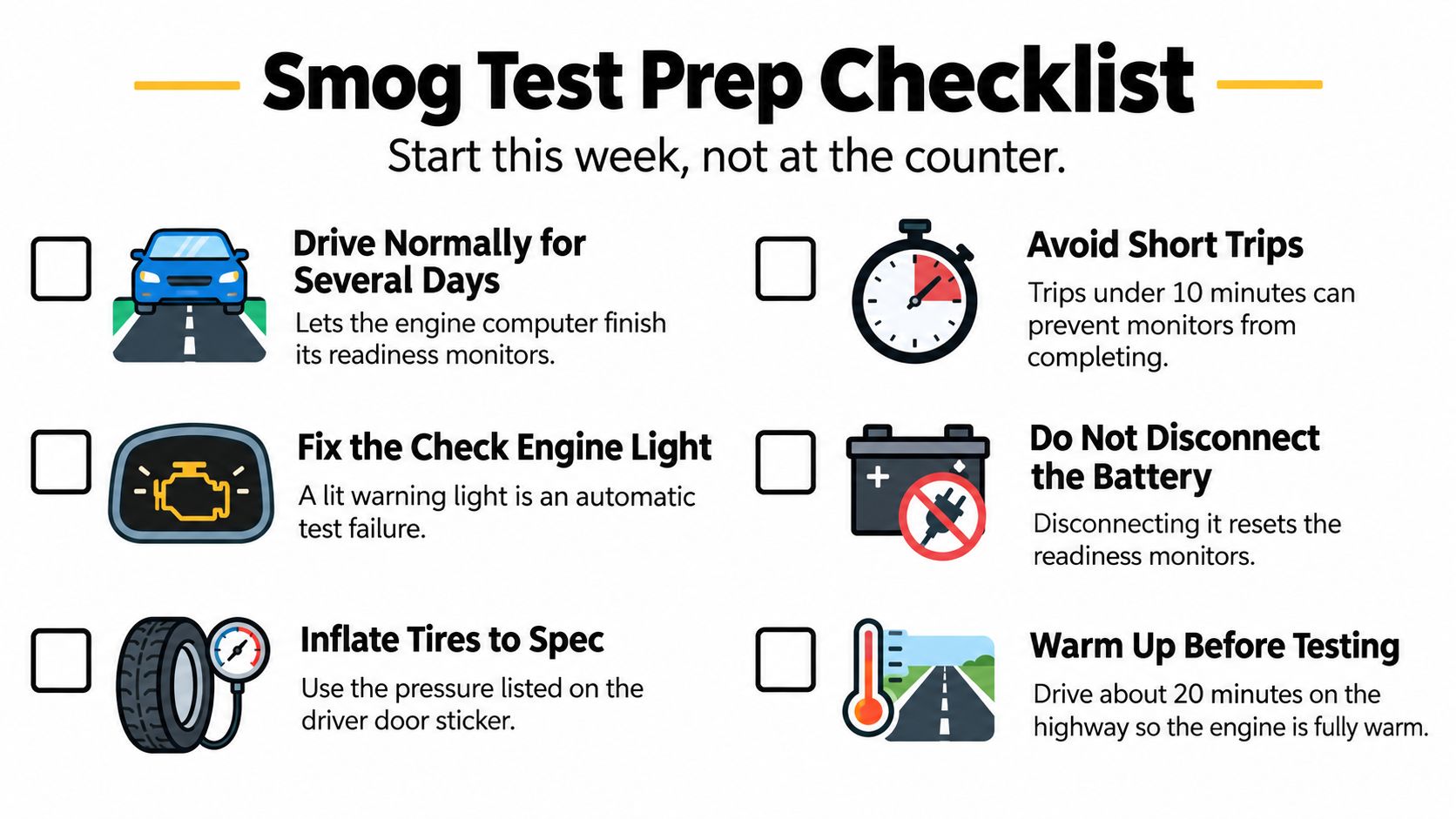
The Week-Before Checklist
- Drive normally for several days: Your engine computer needs completed drive cycles to finish its readiness monitors. Short, scattered trips may not finish them.
- Don't clear codes or disconnect the battery: Doing either right before testing wipes readiness data. That creates an avoidable failure or a required retest.
- Fix a lit check-engine light first: A vehicle can fail when the light is commanded on. Get the fault repaired before you visit, not after you fail.
- Don't erase the evidence: Clearing a code doesn't repair the fault. It only resets the monitors the station needs to read.
That second item is the mistake that costs people a second trip. A driver disconnects the battery to clear a warning, or a shop resets the computer after a repair. The light goes off. The monitors go blank too. The station reads incomplete data and can't pass the car, even if the repair itself was good. Drive first. Test second.
If you want the fuller routine, our page on what to do before a smog check lays out the preparation step by step.
Plan for the Failure Path Too
This short video walks through what happens during the inspection itself.
A failed test needs repair and a retest before registration can be completed. So set aside time for a possible second visit. Ask your station whether it repairs failed vehicles or refers you elsewhere. That answer changes your schedule, not just your bill.
Test early. A failure in the last week before your renewal deadline leaves almost no room for repair and retest.
Timing is the biggest risk for San Leandro and Oakland drivers. We're a fully licensed, state-certified smog inspection station in San Leandro, and we offer a STAR certified smog check in under 15 minutes, with a friendly smile and an indoor waiting room. The test is quick. Repairs aren't. Book while you still have slack.
After a passing test, keep the certificate the station gives you. The DMV needs it to complete your renewal.
If your notice says STAR, or you're not sure what it says, bring it to Speedy Smog and we'll read the wording with you before any test starts. We're a STAR Certified station in San Leandro, and we'll make sure you're at the right kind of shop the first time.
You've got the DMV renewal notice in one hand and a failed Vehicle Inspection Report in the other, and the car drove fine on the way in. That disconnect is normal in California. A smooth idle doesn't mean the emissions systems have proven themselves to the car's computer, and on most newer vehicles that proof is what the test measures.
California checks three things. There's a visual inspection for missing or modified emissions equipment, a functional check that includes the OBD II scan on newer vehicles, and for older vehicles a tailpipe or dynamometer test that measures gases directly. In an August 2025 statewide sample, the overall initial test failure rate was 8.45%, based on 975,369 initial tests and 82,389 failures, according to California BAR smog check performance reporting. Most of those failures aren't mysteries. They trace back to eight fixable causes, and knowing which one you're dealing with tells you whether you need a gas cap, a drive cycle, or a real repair before you pay for a retest.
Table of Contents
- 1. Illuminated Check Engine Light (Malfunction Indicator Lamp)
- 2. Incomplete OBD II Readiness Monitors
- 3. Failing Catalytic Converter
- 4. Faulty Oxygen (O2) Sensors
- 5. EVAP System Leaks
- 6. Engine Misfires and Ignition System Faults
- 7. Vacuum Leaks
- 8. Malfunctioning EGR (Exhaust Gas Recirculation) Valve
- 8 Common Smog Check Failures Compared
- Fix It Fast and Pass Your Retest
1. Illuminated Check Engine Light (Malfunction Indicator Lamp)
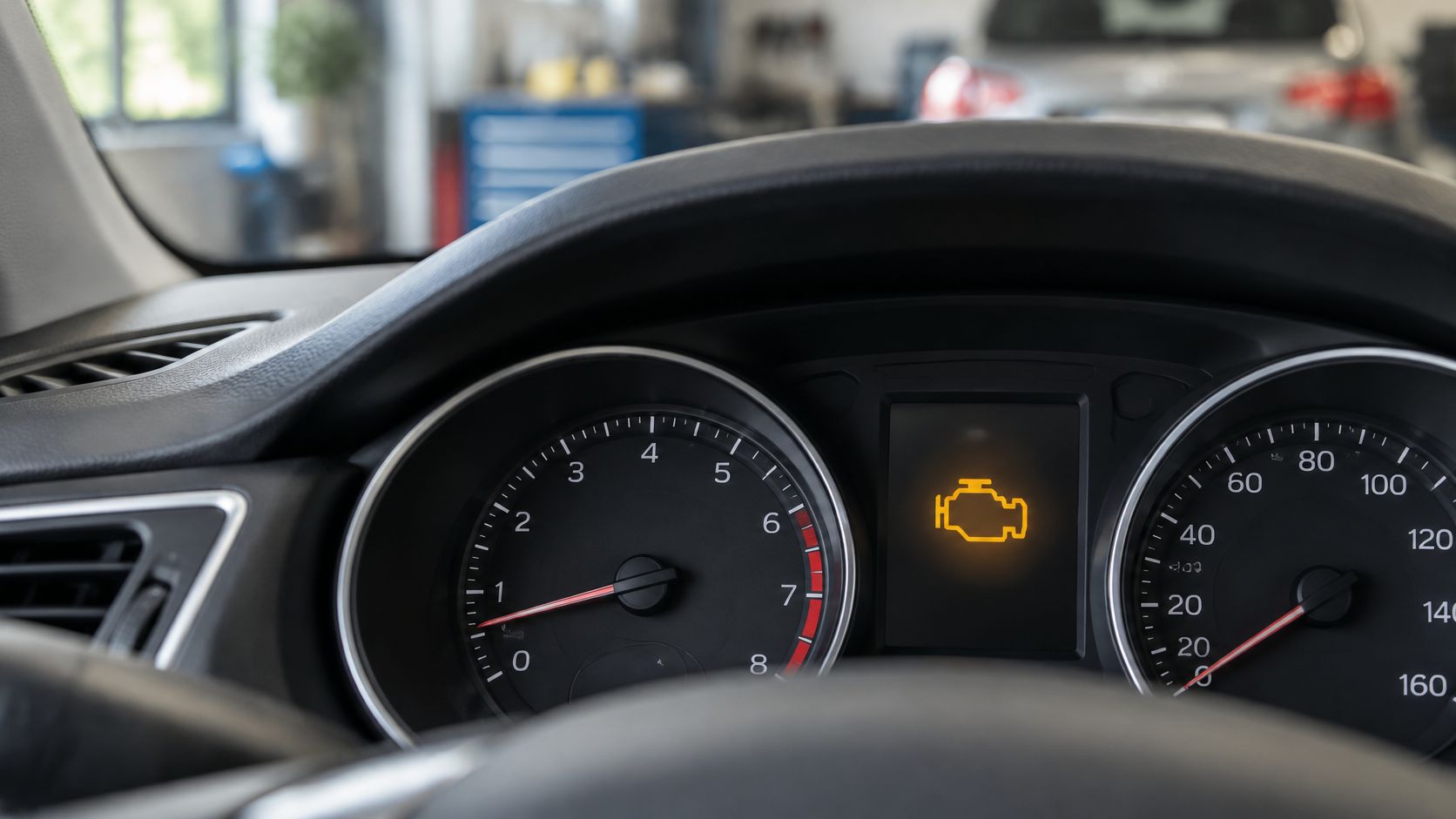
If the Malfunction Indicator Lamp, or MIL, is on with the engine running, you fail. There's no partial credit and no argument about how well the car drives. On 2000 and newer vehicles, the inspector plugs into the OBD II port and the car reports its own verdict. A commanded-on MIL or a stored emissions related diagnostic trouble code means the computer has already found a fault.
That's also why the bulb check matters. Turn the key to on without starting the engine and the light should illuminate briefly. If it doesn't, that fails too, because there's no way to prove the warning system works.
A quick diagnostic example
A driver comes in with the light on, gets the codes read first, and finds a faulty oxygen sensor code. The shop replaces the sensor, confirms the code doesn't return after driving, and the car passes on the next visit. The order matters. Reading the code before you test saves you a documented failure, and learning how to read OBD codes helps you tell a loose gas cap code from something that needs a shop.
- Scan before you test: Get the codes read so you know what repair you're facing.
- Don't clear and rush in: Erasing codes turns the light off but wipes readiness, which creates a different failure.
- Treat a flashing light as urgent: A flashing MIL usually signals a severe misfire that can overheat and destroy the catalytic converter.
Practical rule: The light is the test on a newer car. Fix the cause the code points to, then let the car prove the fix through normal driving.
2. Incomplete OBD II Readiness Monitors
A car can run normally and still fail because its emissions self-tests are incomplete. Readiness monitors check systems such as the catalytic converter, EVAP, oxygen sensors, and EGR. Disconnecting the battery or clearing diagnostic codes can reset monitors to “not ready.” After a repair, the vehicle also needs suitable driving conditions to run those tests again.
California's readiness requirements depend on the vehicle and the monitor. A smog technician can check the car's status against the applicable BAR rules; an incomplete monitor does not automatically mean every vehicle fails. The percentage reported in BAR's August 2025 smog check executive summary should not be read as a readiness-only failure rate without a clear definition of what the figure measures.
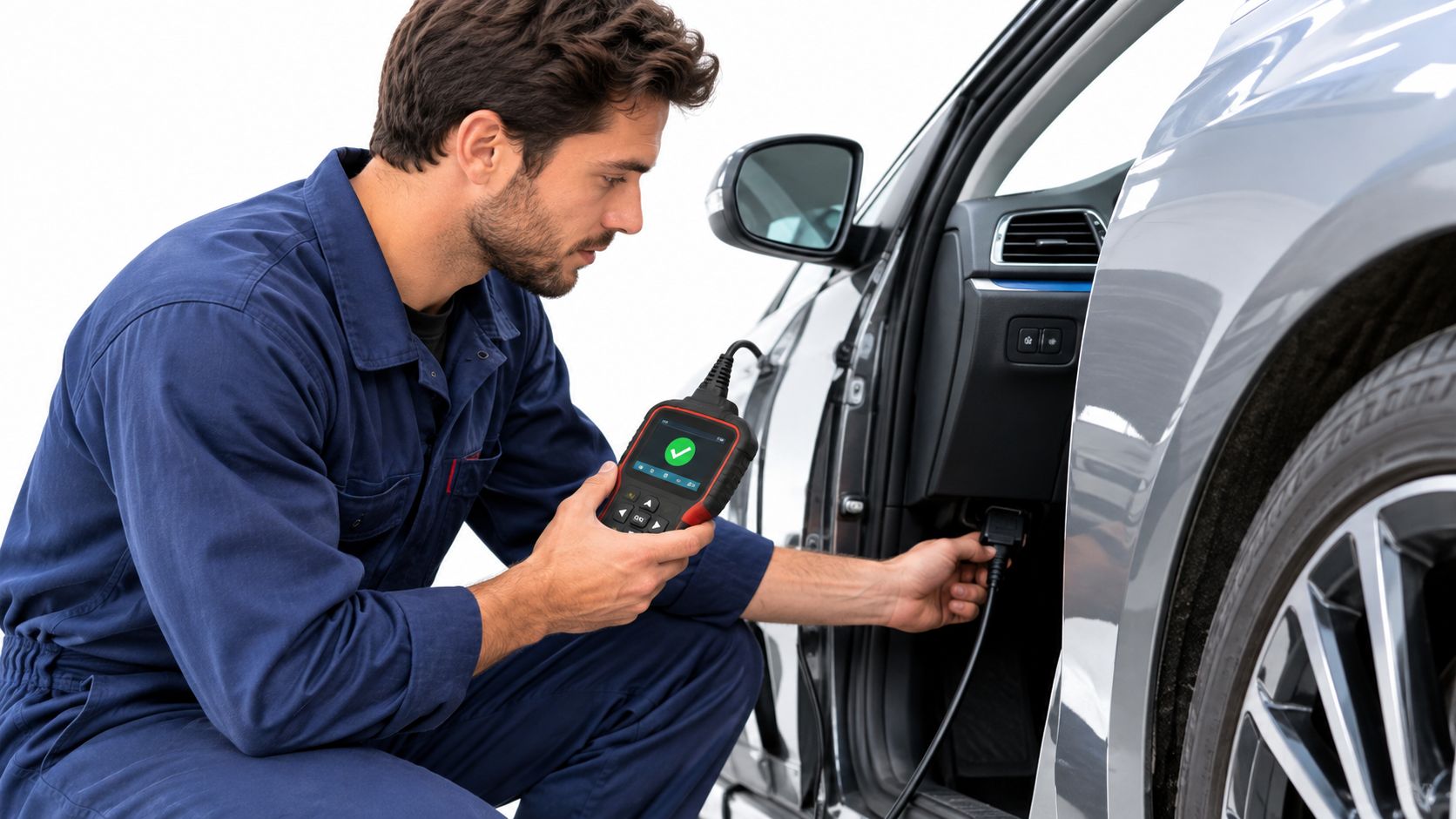
For example, an owner replaces a dead battery on Saturday and drives to the test station Monday. The engine runs well and the warning light is off, but one or more monitors may not have completed. A mix of city and freeway driving, with the engine cooling fully between trips, can help. There is no universal mileage target: fuel level, temperature, cold starts, and steady cruising affect monitor operation, and some vehicles require a manufacturer-specific drive cycle.
- Avoid resets before testing: Don't disconnect the battery or clear codes before an appointment. If a repair requires either, check readiness afterward.
- Vary your driving: Include stop-and-go trips, steady freeway cruising, and full cool-downs.
- Check before the test: Ask a technician to scan monitor status and identify any incomplete tests.
A basic scan tool can show whether monitors are ready before you pay for an inspection. If one remains incomplete, use the vehicle's specified drive cycle or have a technician diagnose why the test has not run.
3. Failing Catalytic Converter
The catalytic converter is where the expensive failures live. It uses platinum, palladium, and rhodium to convert hydrocarbons, carbon monoxide, and nitrogen oxides into less harmful gases. When it wears out, clogs, or gets contaminated by oil or unburned fuel, pollutants pass straight through. Newer cars get caught by a catalyst efficiency code, often P0420. Older cars get caught by the tailpipe numbers themselves.
Age works against you here. California data shows the failure rate rising from about 4% for eight year old vehicles to approximately 15% for 23 year old vehicles, a pattern tied to aging emissions equipment and converter wear in the Bureau of Automotive Repair performance report. Age alone doesn't doom a converter, but wear plus neglected upstream problems usually does.
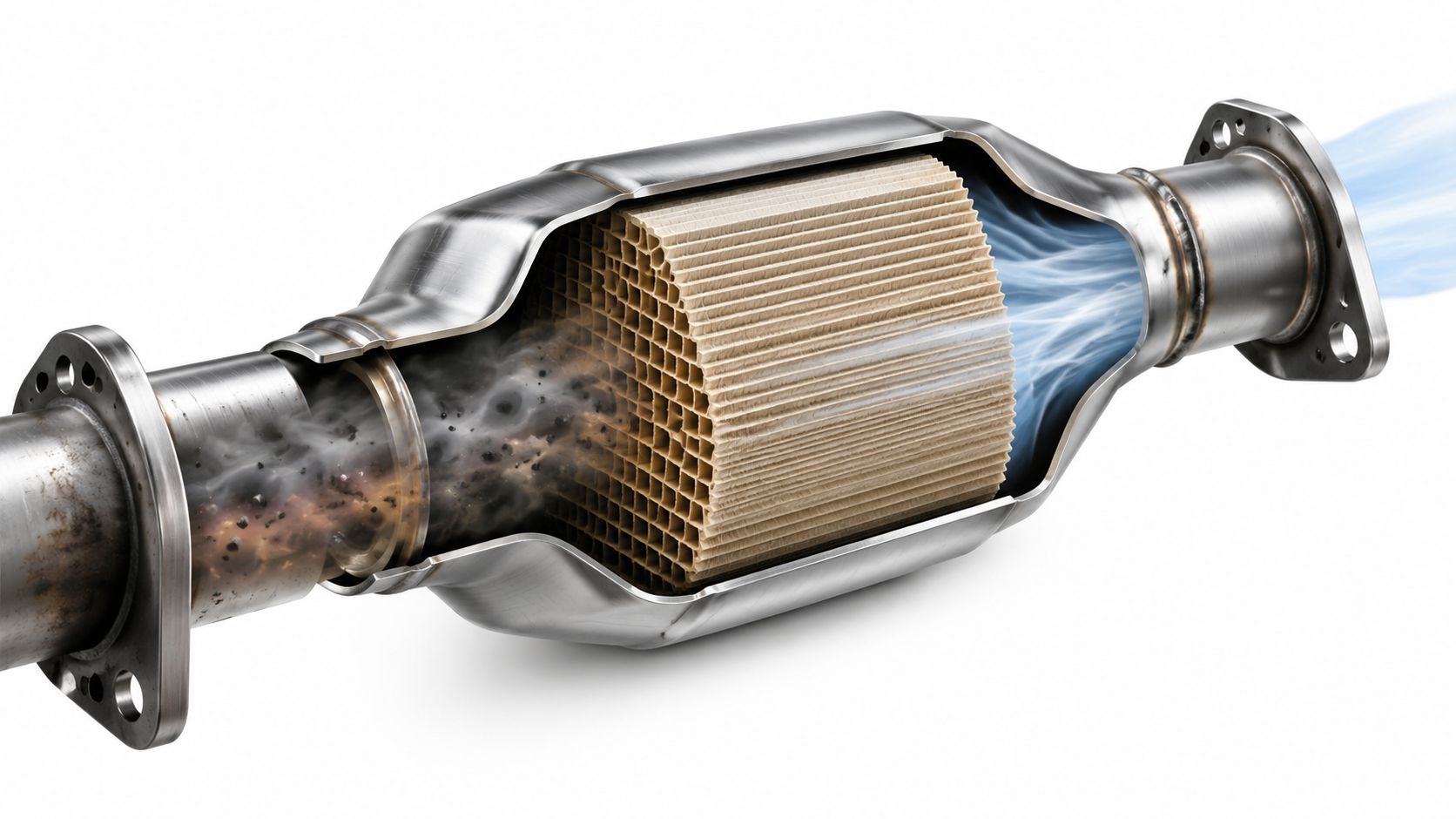
Take a 2005 sedan that fails with a catalyst efficiency code after months of ignored misfires. Replacing the converter alone would waste money, because raw fuel from the misfire is what killed it. The owner repairs the ignition fault first, then installs a California compliant converter, and passes. Understanding how a catalytic converter functions makes that sequence easier to follow when a shop explains the estimate.
Protecting a replacement converter
- Fix misfires and oil leaks first: Both poison or overheat a new converter quickly.
- Confirm CARB compliance: A cheap out of state converter that isn't approved for California can fail the visual inspection.
- Listen for rattles: A rattle at idle or a sudden loss of acceleration can mean the internal substrate has broken apart.
4. Faulty Oxygen (O2) Sensors
Oxygen sensors tell the computer how much unburned oxygen is left in the exhaust, and the computer trims fuel delivery based on that signal. Upstream sensors, mounted before the converter, control the air fuel mixture in real time. Downstream sensors sit after the converter and mostly watch whether it's doing its job. When a sensor gets lazy, responding slowly instead of switching crisply, the mixture drifts rich or lean and emissions climb before you feel anything wrong.
The tricky part is that a dying sensor and a dying converter can look similar. A downstream sensor that's lying can trigger a catalyst code on a healthy converter. A good technician watches live sensor data and compares upstream and downstream waveforms before condemning either part. That diagnostic step is the trade-off. Guessing is faster, but guessing wrong on a converter is an expensive lesson.
Here's a common scenario. A driver notices fuel economy slipping, then the check engine light appears. The scan shows a slow upstream sensor, and after replacement the fuel trims settle back to normal and the emissions reading drops. Reading up on how oxygen sensors affect your smog test helps you ask the right questions about which sensor failed and why.
- Match the position: Upstream and downstream sensors aren't interchangeable, so order by exact location and connector.
- Keep silicone away: Silicone based gasket makers near the exhaust can contaminate sensor elements.
- Respect service intervals: On high mileage vehicles, replacing worn sensors at the manufacturer's recommended interval protects the converter downstream.
A sensor is a wear item, not a lifetime part. Treating it that way prevents bigger bills.
5. EVAP System Leaks
Your gas tank constantly produces fuel vapor, and the EVAP system exists to keep that vapor out of the air. It stores vapor in a charcoal canister, then purges it into the engine to be burned when conditions are right. Any leak in the hoses, canister, purge valve, vent valve, or filler cap lets vapor escape, and the OBD II EVAP monitor is sensitive enough to catch very small leaks. Codes like P0442 for a small leak or P0455 for a large one are smog failures.
Start with the cheapest suspect. A vehicle fails with an EVAP code, the technician inspects the gas cap, and the rubber seal is cracked and flattened. A new cap, a few drive cycles, and the monitor passes. It doesn't always end that easily, but you'd be surprised how often it does.
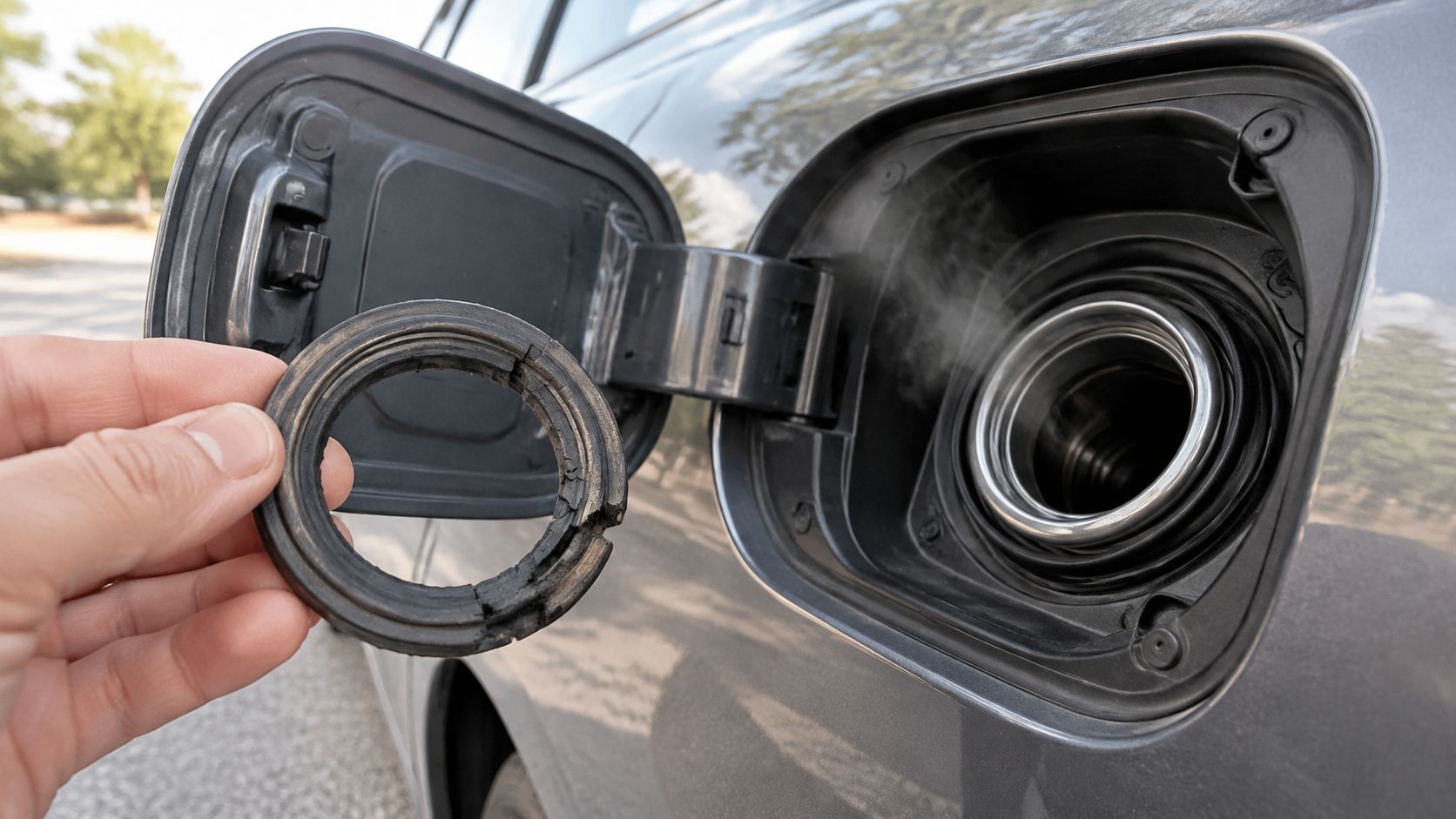
When the cap isn't the culprit, a smoke test is the honest way forward. The shop fills the system with visible smoke and watches where it escapes, which beats replacing valves one at a time on suspicion.
Simple checks before you book a repair
- Click the cap: Tighten it until it clicks and inspect the seal for cracks or a flattened edge.
- Stop at the first click at the pump: Overfilling pushes liquid fuel into the canister and can ruin it.
- Ask for a smoke test: If the leak isn't obvious, pinpointing it first is cheaper than swapping parts.
EVAP failures reward patience. Test, find the leak, fix that one thing, and confirm the monitor completes.
6. Engine Misfires and Ignition System Faults
A misfire means a cylinder didn't burn its fuel charge properly. Worn spark plugs, a failing ignition coil, damaged plug wires, or a fuel delivery problem are the usual causes. That unburned fuel travels into the exhaust, hydrocarbon emissions spike, and the extra fuel burning inside the catalytic converter can overheat it. Of everything on this list, an active misfire does collateral damage the fastest.
Codes help narrow it down. P0300 means random misfires across cylinders. P0303 points at cylinder three specifically, which tells the technician where to start swapping coils or inspecting plugs to see if the misfire follows the part.
Picture a car with a shaky idle that fails for a cylinder three misfire. The shop moves that cylinder's coil to another cylinder, the code follows the coil, and the diagnosis is confirmed. New coil, fresh plugs all around since they're the same age, and the car passes its retest with the converter still intact because the owner didn't keep driving on it.
- Replace plugs on schedule: Follow the interval in your owner's manual and use the exact plug type specified for your engine.
- Don't drive on a flashing light: A flashing MIL during a misfire is the car telling you the converter is at risk right now.
- Fix the whole pattern: If one plug is worn out, the rest aren't far behind, so replacing the set makes sense.
That last point is where people cut corners and end up back in the shop a month later with a different cylinder misfiring.
7. Vacuum Leaks
Engines measure incoming air carefully, and a vacuum leak sneaks in air the computer never counted. Cracked rubber hoses, a failed intake manifold gasket, or a leaking brake booster all create that unmetered air. The mixture goes lean, idle gets rough or hunts up and down, and the computer compensates by adding fuel until it runs out of adjustment range and sets lean or fuel trim codes like P0171. On tailpipe tested vehicles, that lean condition can push hydrocarbons and nitrogen oxides over the limit.
Your ears are a legitimate diagnostic tool here. A driver hears a faint hiss near the intake, follows it to a split PCV hose that's gone brittle with heat, and replaces a part that costs very little. Idle stabilizes, the lean code clears after driving, and the retest passes. Spanish speaking drivers and visual learners alike benefit from seeing the inspection process, and this walkthrough shows what a hose inspection looks like.
Not every leak announces itself. Small cracks that open only when the engine is hot, or leaks under the intake manifold, hide from a visual check. That's when a smoke machine earns its keep, pressurizing the intake so leaks reveal themselves as wisps of smoke.
- Inspect rubber closely: Squeeze hoses and look for brittleness, cracking, or loose clamps.
- Replace proactively on older cars: Aging hoses are cheap insurance on high mileage vehicles.
- Smoke test the stubborn ones: If inspection finds nothing, stop guessing and test.
8. Malfunctioning EGR (Exhaust Gas Recirculation) Valve
The EGR valve routes a measured amount of exhaust gas back into the intake. That dilutes the intake charge, lowers combustion temperatures, and cuts nitrogen oxides, or NOx, which form when combustion gets too hot. It's a simple idea with a dirty working environment, because exhaust deposits carbon everywhere it goes.
Failure cuts both ways. A valve stuck closed, or passages clogged with carbon, sends NOx climbing, which shows up clearly on dynamometer and tailpipe tests for older vehicles. A valve stuck open leaks exhaust into the intake at idle when it shouldn't, causing rough running, stalling, and lost power. Codes in the P0400 range point to flow problems, but the code alone doesn't tell you whether the valve, the passages, or the control solenoid is at fault.
A typical case involves a vehicle with a rough idle and a high NOx reading. The technician removes the EGR valve, finds the pintle and passages packed with carbon, cleans them, tests valve movement, and the next test comes in within limits. Cleaning works when the valve itself still functions. When the diaphragm is torn or the electronic actuator has failed, cleaning is wasted labor and replacement is the honest fix.
Before you authorize EGR work
- Confirm how you're tested: EGR's role in your inspection varies by model year and test type, so ask the technician.
- Clean first if it's sticking: Carbon removal is worthwhile when the valve tests functional.
- Watch the early signs: Rough idle, pinging under load, or a new check engine light often appear before a hard failure.
NOx failures on older vehicles point here more often than anywhere else.
8 Common Smog Check Failures Compared
| Item | 🔄 Complexity | ⚡ Typical resources or effort | 📊 Expected smog-check impact | 💡 Ideal next step | ⭐ Key advantage |
|---|---|---|---|---|---|
| Illuminated Check Engine Light (MIL) | Moderate; depends on the stored fault | OBD II scan and potentially targeted repairs | Lit MIL or emissions-related codes can cause automatic failure | Read and diagnose codes before testing; allow readiness monitors to complete after repairs | Provides an early warning and often points toward the affected system |
| Incomplete OBD II Readiness Monitors | Low; usually requires driving | Several days of varied driving; avoid clearing codes | Test may be rejected or fail if too many monitors are incomplete | Ask which monitors are incomplete and follow an appropriate drive cycle | Often resolves without repairs |
| Failing Catalytic Converter | High; diagnosis and replacement can be costly | Diagnostic testing and a California-compliant replacement if needed | Reduced conversion efficiency can raise emissions and cause failure | Fix misfires or fluid leaks first; verify replacement parts are CARB-compliant | A functioning converter substantially reduces tailpipe pollutants |
| Faulty Oxygen (O2) Sensors | Moderate; correct sensor and location must be identified | Code and sensor testing; replacement is often less costly than a converter | Incorrect fuel control or catalyst monitoring can lead to failure | Confirm the sensor fault before replacing parts | Repair may improve emissions, fuel economy, and drivability |
| EVAP System Leaks | Low to moderate; locating small leaks can take time | Gas cap inspection; smoke testing may be needed | Failed leak detection can cause an OBD II failure | Check the gas cap seal; request a smoke test if the leak is not obvious | Some causes are inexpensive and simple to fix |
| Engine Misfires and Ignition System Faults | Low to high; depends on the cause | Scan tool and ignition or fuel-system diagnosis | Unburned fuel raises emissions and may damage the converter | Address flashing Check Engine lights promptly and diagnose the misfire | Repair can restore smooth operation, fuel economy, and emissions |
| Vacuum Leaks | Low to moderate; locating hidden leaks may require tools | Hose inspection, fuel-trim checks, or smoke testing | Unmetered air can disrupt combustion and trigger failure-related codes | Inspect hoses and intake connections; use a smoke test if needed | Small hose repairs can improve idle and fuel economy |
| Malfunctioning EGR Valve | Moderate; deposits or related passages may need attention | Inspection, cleaning, or valve replacement | Excess NOx can cause failure, particularly on applicable tailpipe tests | Check whether EGR testing applies to the vehicle and inspect the valve and passages | Restoring EGR operation helps control NOx emissions |
Fix It Fast and Pass Your Retest
Knowing What Fails a Smog Check is only useful if it changes what you do before the test. Run through a short checklist a week out. Confirm the check engine light is off and has been off through several days of normal driving, not just since this morning. Make sure you haven't disconnected the battery or cleared codes recently, and if you have, drive a mix of city streets and freeway miles with full cool downs in between so the readiness monitors can complete. Click the gas cap tight, top up your maintenance, and arrive with the engine fully warmed up after a real drive rather than a two minute trip from home.
That preparation matters more than most drivers realize. California's newer readiness expectations mean a repaired car can still fail if its monitors haven't rerun, even with no active code present. The statewide failure rate for 2000 and newer vehicles was about 7% in calendar years 2024 to 2025, and the updated rule applies to gasoline vehicles model year 1996 and newer and diesel vehicles model year 1998 and newer, according to BAR's explanation of the new OBD readiness monitor regulations. In plain terms, repairing the fault and proving the repair are two separate steps, and the inspection checks both.
If you've already failed, don't guess. Read your Vehicle Inspection Report and identify the exact failure category, whether that's OBD codes, readiness, visual, functional, or tailpipe emissions. That category tells the repair shop where to start and keeps you from paying for parts the car doesn't need. After the repair, resist the urge to drive straight back. Complete the drive cycle, verify monitor status with a scanner if you can, and then retest. Drivers who skip that verification step are the ones who fail twice for two different reasons.
Shop advice: Bring your failed inspection report to the repair shop. It turns a vague conversation into a specific work order.
East Bay drivers who want the testing side handled efficiently can visit Speedy Smog in San Leandro, a STAR Certified station that tests 2000 and newer models, 1999 and older vehicles, diesels, and hybrids. Whether you're coming in for a first test or returning after a repair, going in with the light off, the monitors ready, and the gas cap clicked puts the odds firmly in your favor.
If your renewal deadline is coming up or you're returning after fixing a check engine light, incomplete monitor, or EVAP leak, bring your vehicle to Speedy Smog in San Leandro for STAR Certified testing for newer cars, older vehicles, diesels, and hybrids. The team will run your inspection efficiently, explain your Vehicle Inspection Report in plain English if anything doesn't pass, and help you understand what to fix before a retest. Stop by and get certified so you can finish your DMV registration without another wasted trip.
The Bureau of Automotive Repair puts a typical smog check at about 30 minutes, while many 2000-and-newer vehicles at efficient stations are completed in roughly 10 to 15 minutes. The exact time depends on the vehicle and the visit, so the quickest advertised test isn't necessarily the right estimate for your whole appointment.
The familiar advice to “just allow a few minutes” leaves out an important distinction: inspection time and total visit time aren't the same thing. A technician must complete the procedures that apply to your vehicle, and you may also need time for check-in or a queue. You can make a much better estimate by identifying your vehicle's testing pathway before you arrive.
Table of Contents
- The Short Answer for Most Drivers
- What Happens During Each Inspection Stage
- Factors That Stretch or Shorten Your Visit
- How Vehicle Age and Type Change the Timeline
- Choosing a Station That Keeps Your Visit Short
- Practical Steps to Avoid Delays on Test Day
- Planning Your Visit and Taking the Next Step
The Short Answer for Most Drivers
A smog check takes about 30 minutes by the Bureau of Automotive Repair's typical estimate; qualifying newer vehicles may take roughly 10 to 15 minutes to test, while your total visit also depends on eligibility and any wait.
Those figures describe different testing pathways, much like a short route and a longer one to the same destination. A qualifying newer vehicle may need a simpler set of checks. Other vehicles require additional procedures. The estimate for testing does not include time spent waiting for a technician or completing check-in.
Ask What the Estimate Includes
When you call a station, ask whether its estimate means hands-on testing time or arrival-to-departure time. An advertised completion window may not account for vehicles ahead of you. A short test estimate also does not mean required checks are skipped.
Ask these questions to match the estimate to your visit:
- Vehicle eligibility: Does the estimate apply to your model year and fuel type?
- Station availability: Can testing begin when you arrive, or is there a queue?
- Inspection scope: Does your vehicle need procedures beyond the station's usual test for newer vehicles?
- Unexpected findings: What happens if the technician identifies a problem?
Planning rule: Match the testing estimate to your vehicle, then allow separately for the station's current wait.
For an East Bay driver fitting an inspection between errands, that distinction helps set a realistic schedule. If you need to leave by a certain time, tell the station and ask whether it can meet that window. The answer depends on your vehicle's testing pathway and whether a technician is ready when you arrive.
What Happens During Each Inspection Stage
A smog check is a sequence of steps, not one reading. The exact route depends on the vehicle, so some drivers will not need every procedure shown in the diagram.
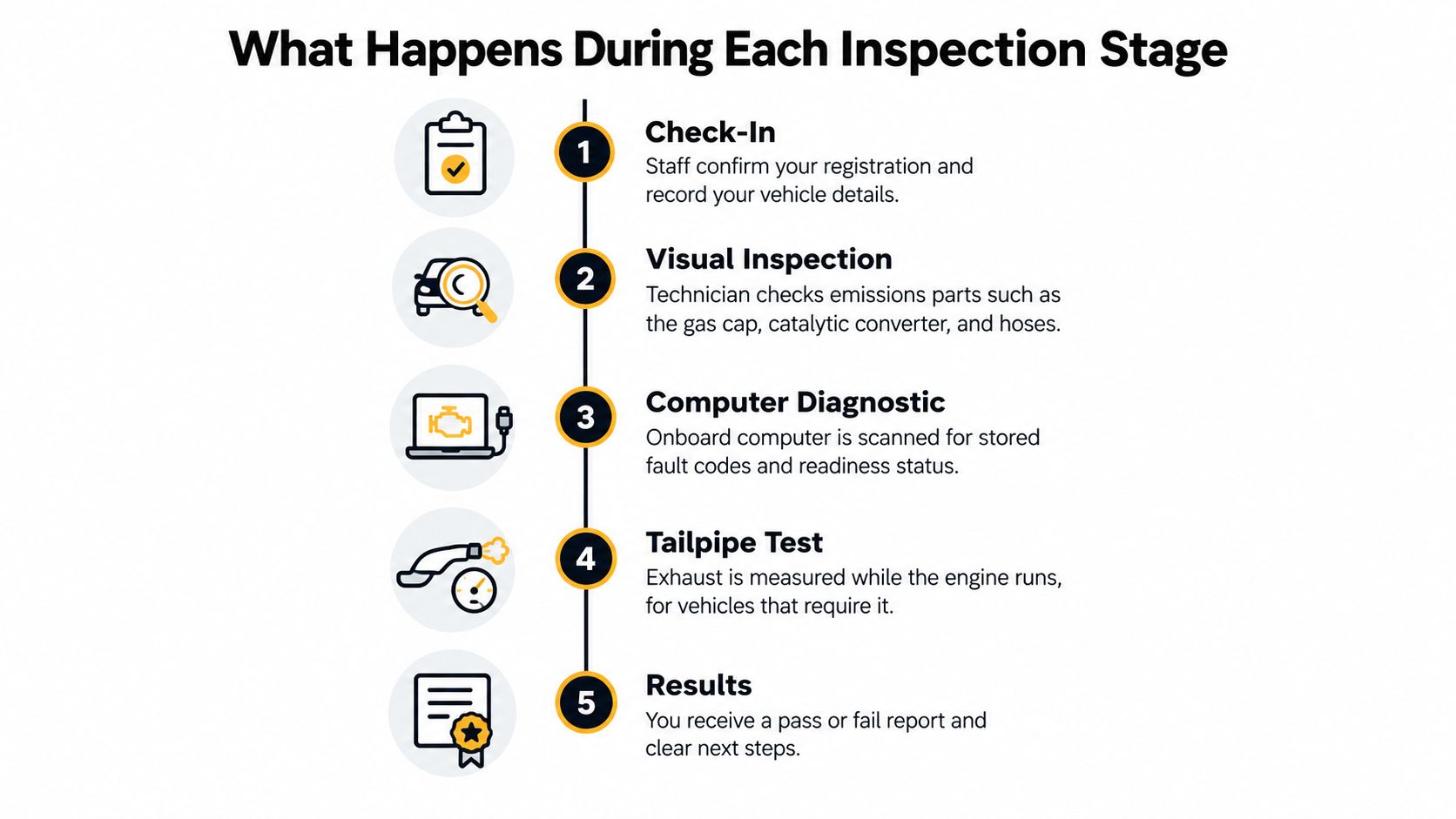
Check-In and Vehicle Review
First, staff confirm your vehicle details and identify the inspection that applies. Have your registration information ready, and mention recent repairs or concerns at check-in. This gives the technician context before testing begins.
Applicable Visual and Functional Checks
Next, the technician carries out the visual or functional checks required for your vehicle. These checks are separate from reading the vehicle's computer or measuring exhaust. The exact combination depends on the vehicle and applicable test pathway. For a plain-language overview, see what technicians check during a smog inspection.
Computer or Tailpipe Testing
For most gasoline vehicles from model year 2000 onward, the inspection includes an on-board diagnostic system check, or OBD check. The technician connects testing equipment to review emissions-related computer information, including readiness monitors. Other vehicles may follow a pathway that includes tailpipe testing. That can involve preparing the vehicle and observing its exhaust under the required conditions, so it is more than just inserting a probe.
California BAR outlines the smog inspection requirements, including procedures that apply to different vehicles (California BAR Smog Check information). Computer checks, visual and functional checks, and tailpipe procedures serve different purposes. A vehicle receives the checks required for its pathway, not necessarily every type of test.
California's statewide program began in 1984, and inspection methods have changed as vehicle technology has developed. Newer OBD-equipped vehicles can provide emissions information electronically, while older vehicles may require different equipment or procedures (Bay Area Air District history).
Results and Next Steps
At the end, the technician records the outcome and explains what it means. If the vehicle passes, you receive the inspection result. If it does not, ask which part of the test it did not meet and what the next step involves. That conversation is the final stage of the visit, and its length depends on whether you need an explanation or follow-up guidance.
Factors That Stretch or Shorten Your Visit
A car can have a straightforward test and still spend longer at the facility because the technician is finishing another vehicle. Conversely, an empty waiting room doesn't guarantee an immediate finish if your vehicle requires additional procedures. Queue time and technical time need separate allowances.
A useful planning formula is:
Total visit time = check-in + waiting + applicable inspection procedures + discussion of results.
Repairs belong outside that basic estimate. If the vehicle needs diagnosis, repair, and another inspection, you're planning a different process, not merely a slightly slower version of an ordinary passing test.
Factors That Change Smog Check Visit Length
| Factor | Effect on Visit Length | Driver Can Control It |
|---|---|---|
| Station workload | May add a wait before testing starts | Partly, by checking availability |
| Vehicle type | Determines which inspection procedures apply | No, but you can identify it beforehand |
| Required test method | May involve additional equipment and operating steps | No |
| Vehicle condition | Problems may require follow-up beyond the inspection | Partly, through advance diagnosis |
| Repairs and retesting | Add work and potentially another visit | Partly, by addressing known concerns |
| Check-in preparation | Missing information can interrupt intake | Usually |
| Questions about results | May require a longer conversation before departure | Partly, by allowing time for discussion |
The table separates predictable planning factors from things you can't fully control. You can bring the right paperwork and describe your vehicle accurately. You can't reasonably expect the station to shorten a mandated procedure because you have another appointment.
Consider two hypothetical drivers with similar cars. One arrives when a technician is available; the other arrives behind a queue. Even if their actual tests take comparable time, their departure times won't match.
The same distinction applies to a failure. A technician may finish the inspection and explain a failed result without having completed any repair. Ask what the estimate covers so you don't confuse “test finished” with “vehicle repaired and ready to pass.”
How Vehicle Age and Type Change the Timeline
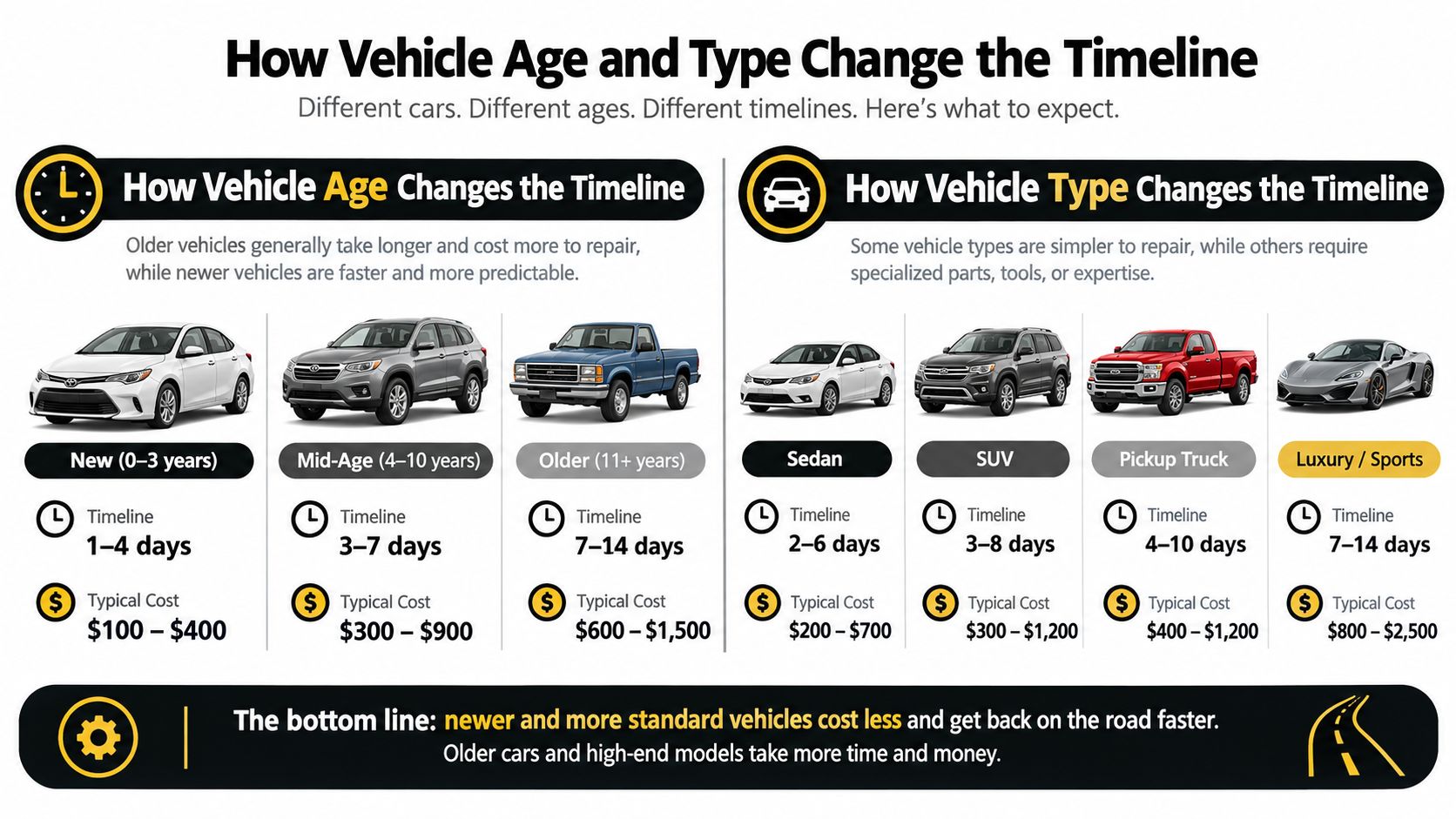
A single advertised average can hide different test procedures. The vehicle's age and powertrain help determine which steps apply, so use them to estimate your own visit rather than assuming every smog check follows the same path.
A Newer Gasoline Car Versus an Older Vehicle
A newer gasoline car that qualifies for the standard computer-based inspection is generally closer to the official benchmark than a vehicle requiring additional checks. It may follow a shorter testing pathway, though the exact visit time still depends on the station's process and wait.
An older gasoline vehicle may need added tailpipe or equipment checks, which can put its inspection beyond that benchmark. Ask the station which test applies to your model year and how much time to allow. An added step means a longer procedure, not necessarily a problem with the car.
Inspection time does not predict the result. A shorter test can still find an issue, and a longer one does not mean the vehicle will fail.
A Diesel Truck Versus a Hybrid
For diesel vehicles, first confirm whether a test is required. California DMV guidance exempts diesel vehicles from the Smog Check program if they are model year 1997 or older, or if their gross vehicle weight rating is over 14,000 pounds. Diesel vehicles outside those exemptions may be subject to testing. The DMV also confirms that hybrids are subject to Smog Check requirements (California DMV vehicle information).
A diesel truck's inspection time depends on the applicable test pathway, so ask the station to confirm the procedure before you book. Share the model year, fuel type, and gross vehicle weight rating. The guide to smog checks for diesel trucks explains what information to have ready.
A hybrid's electric operation does not by itself determine whether an emissions inspection is required. Tell the station it is a hybrid so staff can identify the right inspection and give you a relevant time estimate.
Before booking, gather the details that determine the pathway:
- Model year: Use the vehicle's model year, not the year you bought it.
- Fuel and powertrain type: Specify gasoline, diesel, or hybrid.
- Weight information: Have the gross vehicle weight rating ready if diesel eligibility is in question.
- Inspection request: Check your registration paperwork and describe what it asks you to complete.
Those details help the station match your vehicle to the required test, giving you a more useful estimate than a general average.
Choosing a Station That Keeps Your Visit Short
Compare stations by how clearly they explain the visit, not just how briefly they advertise it. A useful estimate identifies the eligible vehicle, the expected test duration, and any current wait.
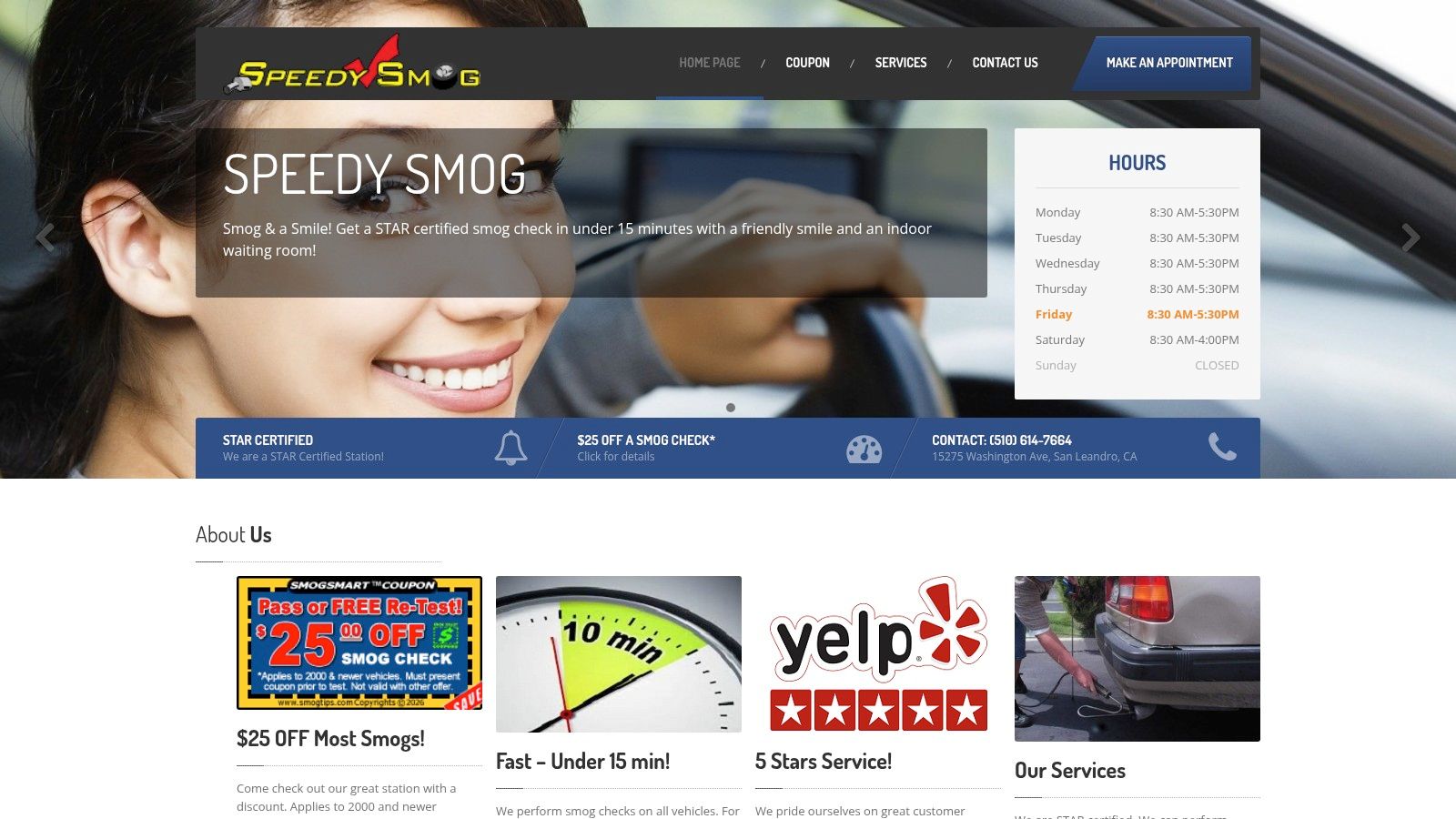
The station information shown below provides a starting point for checking services and visit details.
Compare the Details That Affect Your Appointment
STAR certification, suitable testing equipment, and clear pricing are more useful selection criteria than a speed claim alone. Ask whether the station can handle your particular vehicle and whether any stated price or promotion applies to it.
A comfortable waiting area is another practical consideration. It doesn't change the required test, but it gives you somewhere to wait if the technician is occupied or your vehicle needs a longer procedure.
| What to Compare | A Useful Question |
|---|---|
| Certification | Can you perform the inspection requested for my vehicle? |
| Vehicle coverage | Do you test my model year and powertrain type? |
| Timing | Is that the test duration or the whole visit? |
| Pricing | What does the quoted price include? |
| Promotions | Does the current offer apply to my vehicle? |
| Waiting arrangements | Is there an indoor area if testing can't begin immediately? |
Evaluate the Local Option Without Assuming a Guarantee
The publisher's San Leandro station describes its services as STAR-certified testing for newer and older vehicles, diesels, and hybrids, with transparent pricing and a clean indoor waiting room. Those are useful details to confirm when comparing it with other East Bay stations.
Treat advertised coupons and hours as items to verify before traveling. A promotion may have eligibility conditions, and a station's regular opening hours don't tell you its current workload. Ask for both the applicable price and the likely arrival-to-departure experience.
For another look at the service, the video below provides additional context.
A reliable timing conversation should end with a clear answer about your car, not an unsupported promise that every vehicle will leave equally quickly.
Practical Steps to Avoid Delays on Test Day
Preparation isn't about finding a trick to pass. It's about arriving with the right information and avoiding preventable uncertainty. Use this checklist before setting out, especially if the vehicle has known issues or recent repair work.
- Confirm the inspection pathway. Give the station your model year, fuel type, and any weight information needed to determine diesel eligibility. Ask whether it can perform the required inspection.
- Discuss an illuminated check engine light. If the light is on, arrange diagnosis rather than assuming a quick inspection will resolve the concern. Tell the station about it before requesting a routine appointment.
- Mention recent repairs or battery work. Readiness is part of the computer check described earlier. If you're unsure whether the vehicle is ready, ask for guidance before arriving rather than assuming the absence of a warning light answers everything.
- Allow for normal operating temperature. Where applicable, driving to the station can help the engine warm up. Don't assume that a short drive guarantees readiness or eliminates required testing procedures.
- Bring your documents. Have registration information and relevant repair records available. They give staff useful context without requiring you to remember every detail.
- Ask about a quieter arrival time. Contact the station before leaving if your schedule is tight. Current availability is more informative than guessing which part of the day will be quiet.
- Address known mechanical concerns. An older car with unresolved problems may benefit from diagnosis before inspection. Keep repair planning separate from the inspection appointment.
Arriving prepared won't guarantee a pass, but it helps the technician start with the right information.
For a convenient preparation reference, review what to do before a smog check. If something about your vehicle is unusual, explain it when you contact the station rather than waiting until check-in.
Planning Your Visit and Taking the Next Step
Build your estimate around the applicable inspection plus the conditions at the station. For a qualifying newer gasoline car, ask whether the shorter testing window discussed earlier applies. For an older vehicle, diesel, or hybrid, have staff confirm the pathway before using any advertised average.
Then add the parts that aren't testing: intake, any queue, and time to understand the result. You don't need to assign invented minute values to each item. You need to know whether they're likely to fit around your next commitment.
Leave Room for Uncertainty
Use the broader official benchmark when you don't yet know your vehicle's requirements. Even then, remember that an inspection estimate isn't a guarantee about waiting, diagnosis, or repairs. If you have a firm deadline, tell the station before you travel.
Your next step is simple: gather the vehicle details, confirm eligibility and availability, and ask for an estimate that includes the whole visit. That conversation gives you a more dependable plan than assuming the fastest advertised test applies to every car.
Speedy Smog offers STAR-certified emissions testing in San Leandro for newer and older vehicles, diesels, and hybrids. Visit Speedy Smog to confirm your vehicle's testing requirements, current availability, and expected visit length before heading in.
Your registration renewal is approaching, and you're trying to fit a smog inspection around work, errands, and the drive across Oakland. Before you choose a station, it helps to answer a more important question: what does your particular vehicle need to complete the inspection without an avoidable return trip?
Table of Contents
- Plan Your Oakland Smog Check Visit
- Understand California's Smog Certification System
- Determine Which Vehicles Require Testing
- Prepare Your Vehicle Before the Test
- Choose a STAR Certified Station Nearby
- Compare Prices Without Hidden Assumptions
- Prepare for a Possible Failed Inspection
- Explore Repair Assistance and Retirement Options
Plan Your Oakland Smog Check Visit
A search for a smog check in Oakland, California, can turn into a comparison of nearby addresses and advertised prices. But the closest station isn't necessarily the right starting point. Start with your renewal notice and your vehicle's information, then decide where to go.
Think of an Oakland driver whose car seems to run normally but recently had a battery disconnected. Another driver has a hybrid and isn't sure whether it needs testing at all. Neither should assume that a convenient appointment settles the underlying inspection questions.
Smog certification is a compliance requirement, not a routine tune-up. A maintenance visit addresses the car's service needs. A certification inspection determines whether it satisfies the applicable emissions inspection requirements.
Make the decisions in a useful order
Before committing to a visit, work through this sequence:
- Confirm the requirement. Read your renewal notice and verify your vehicle's current eligibility through state guidance.
- Identify the inspection. Have the model year, fuel type, and any special testing instructions available.
- Check preparation. Tell the station about recent emissions repairs or electrical work.
- Compare suitable stations. Confirm certification status, vehicle acceptance, and the complete price.
- Leave room for a problem. Understand what you'll do if the vehicle doesn't receive certification.
This approach doesn't replace DMV instructions or state eligibility tools. It helps you ask better questions before spending time and money.
Practical rule: Choose the inspection your vehicle requires before choosing the appointment that fits your calendar.
You don't need to become an emissions technician. You need enough information to distinguish a paperwork question, a readiness issue, and a repair decision.
Understand California's Smog Certification System
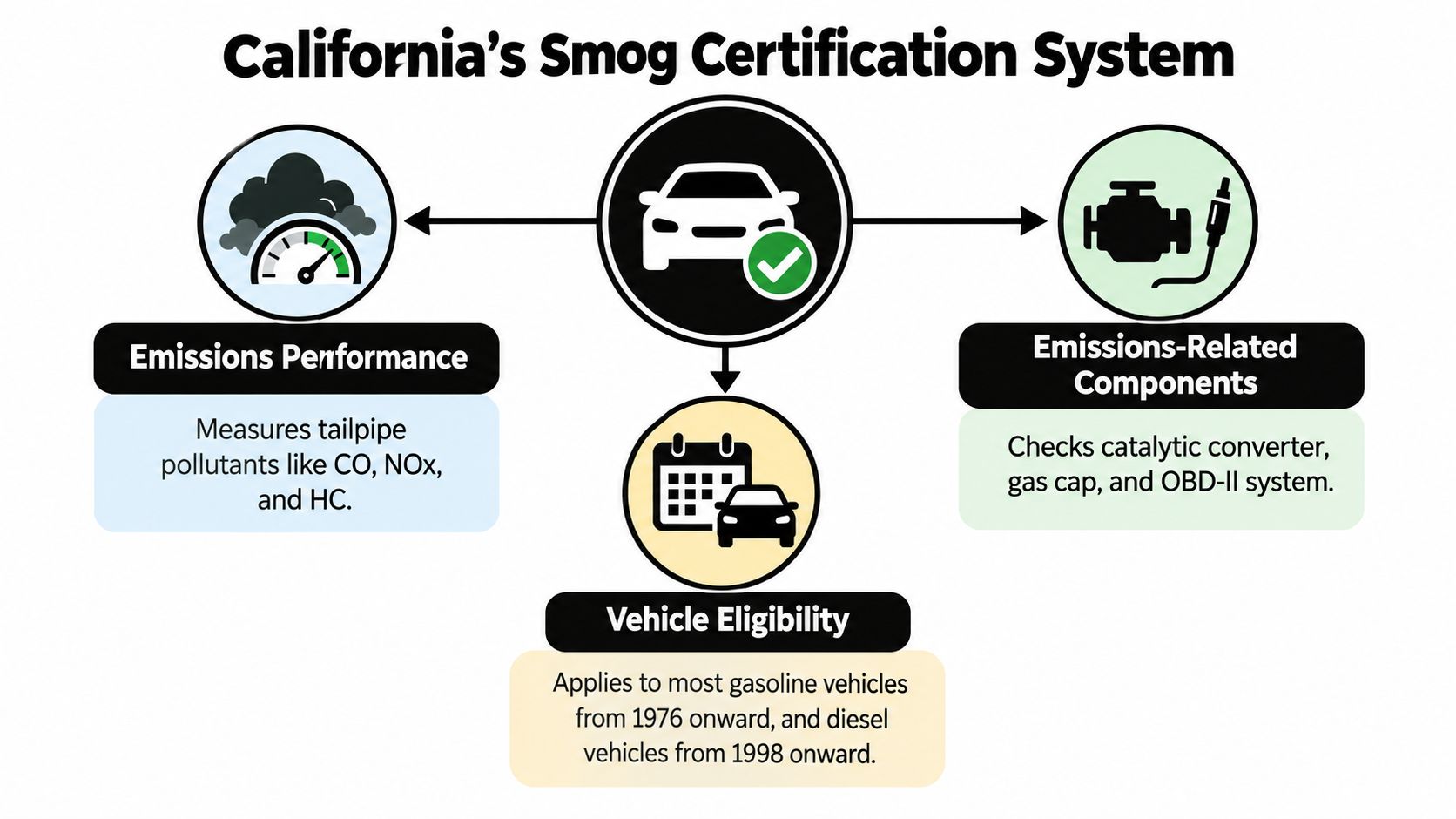
California's Smog Check program evaluates emissions performance and the condition of emissions-related components, requiring many vehicles to undergo inspection every other year. The state established the STAR program in January 2013 to identify stations meeting higher performance standards and authorize eligible locations to inspect vehicles with additional testing requirements, as explained in the Bureau of Automotive Repair's Smog Check performance report.
That structure explains why a smog appointment deserves different preparation from an oil change. The technician isn't deciding whether the engine sounds healthy or whether the exhaust looks clean. The vehicle must satisfy the inspection procedures that apply to it.
The diagram separates the main parts of the certification system.
Separate certification from registration
The Bureau of Automotive Repair, usually called BAR, oversees the inspection program described above. Your DMV registration transaction is the surrounding administrative task. Treating those as separate responsibilities helps prevent a common misunderstanding: completing an inspection isn't a substitute for checking the rest of your renewal instructions.
Ask the station what documentation you'll receive and how you can confirm the certification outcome. Separately, review what DMV still requires from you. Don't assume that a successful station visit answers every registration question.
| Question | Where to focus |
|---|---|
| Does my vehicle need an inspection for this transaction? | Current state eligibility guidance and DMV instructions |
| What inspection applies to my vehicle? | Vehicle details and the station's authorized testing capabilities |
| Did the vehicle receive certification? | The inspection result and station explanation |
| Is my registration transaction complete? | DMV renewal requirements |
A standardized inspection also means the technician needs to follow the applicable procedure rather than substitute an informal opinion. A car that feels dependable on the freeway may still need attention to an emissions-related condition.
The useful mindset is verification rather than reassurance. Ask what the inspection established, what remains unresolved, and which organization can answer the next question. That keeps a technical result from turning into confusion about your registration.
Determine Which Vehicles Require Testing
Model year and fuel type belong together. Knowing only that a vehicle is a sedan, pickup, or hybrid doesn't establish its inspection category.
According to BAR's vehicle coverage and inspection guidance, the program covers gasoline and hybrid vehicles from model year 1976 onward and diesel vehicles from 1998 onward; most gasoline, hybrid, and alternative-fuel vehicles from 2000 onward receive an OBD-II inspection, and BAR identifies hybrids in that newer group as subject to BAR-OIS testing. These broad categories are a starting point, not a substitute for checking the requirement for your exact vehicle and transaction.
Smog Inspection Categories at a Glance
| Vehicle group | Coverage stated in the brief | Inspection focus |
|---|---|---|
| Gasoline vehicles | Model-year coverage summarized above | Confirm the applicable method rather than assuming every gasoline vehicle receives the same test |
| Hybrids | Included in the program's stated coverage | Electric propulsion doesn't remove the need to verify inspection obligations |
| Alternative-fuel vehicles | Most vehicles in the newer diagnostic group described above | Confirm whether the OBD-II inspection applies |
| Diesel vehicles | Covered from the threshold identified above | Verify the vehicle's eligibility and the station's ability to inspect it |
Understand what OBD-II evaluates
On-board diagnostics, abbreviated OBD-II, concerns the vehicle's electronic monitoring of emissions-related operation. BAR's guidance describes an inspection that evaluates the malfunction-indicator lamp, stored diagnostic trouble codes, readiness monitors, and emissions-control functionality.
Those terms answer different questions:
- Warning-lamp status: Is the vehicle indicating an emissions-related malfunction?
- Diagnostic trouble codes: Has the computer recorded information about a detected problem?
- Readiness monitors: Has the vehicle completed the relevant self-checks?
- System functionality: Are emissions controls operating within the vehicle's certified design limits?
A dashboard without an illuminated warning lamp doesn't, by itself, answer all those questions. That distinction matters when a car has recently been repaired or had its diagnostic memory reset.
For a hybrid owner, the practical example is straightforward. Quiet electric operation on part of a trip doesn't establish that the combustion engine's emissions systems are outside the inspection program. Describe the vehicle accurately when calling, including that it's a hybrid.
For an older-vehicle owner, avoid requesting a particular testing method based on what a newer family car received. Give the station the actual vehicle details and ask which procedure applies. Vehicle classification comes before assumptions about testing equipment.
Prepare Your Vehicle Before the Test
A recently repaired car can be mechanically improved without yet being ready to demonstrate that improvement during an inspection. Readiness is evidence that the vehicle has completed its required self-checks, not an absence of dashboard warnings.
Under the BAR guidance cited above, clearing diagnostic codes or disconnecting the battery can leave readiness monitors incomplete. That can create a readiness-related failure even when the warning lamp is off. Trying to erase a problem immediately before testing can therefore create another obstacle instead of solving the original one.
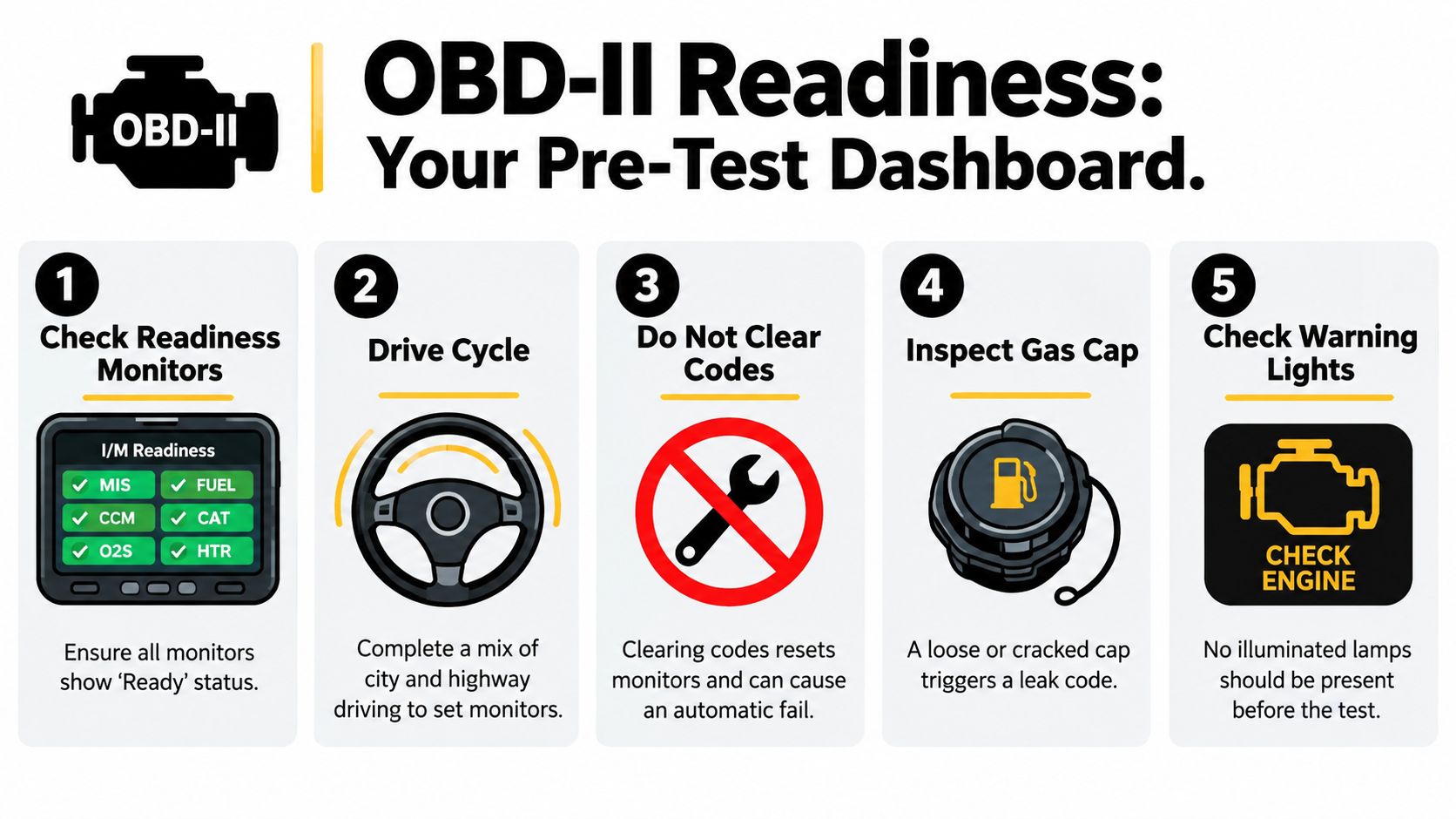
Use a readiness-focused checklist
- Discuss recent work. Tell your technician about repairs, code clearing, or a battery disconnection before booking the inspection.
- Address an active warning lamp. Ask for diagnosis of the underlying condition rather than a temporary reset.
- Follow the manufacturer's drive cycle. After repairs, use the prescribed procedure so the vehicle can complete its checks.
- Verify readiness. Ask whether monitor status has been checked, rather than assuming that ordinary driving has completed everything.
- Keep repair records. Bring enough information to explain what was repaired and whether the computer was reset.
The visual checklist is a useful reminder, but the manufacturer's procedure and the applicable inspection rules should guide your vehicle-specific preparation.
Don't substitute a driving guess for verification
A drive cycle isn't a universal instruction to take a quick freeway trip. Follow the procedure prescribed for your vehicle rather than relying on someone else's experience with a different model.
An extinguished warning lamp and completed readiness checks answer different questions. Ask about both.
No preparation checklist guarantees certification. The purpose is to avoid arriving with a known warning condition or unresolved readiness question that could have been discussed beforehand.
If you're uncertain, explain the situation when you call. “The repair is complete, but I don't know whether readiness was verified” gives the station a more useful starting point than “The car seems fine.”
Choose a STAR Certified Station Nearby
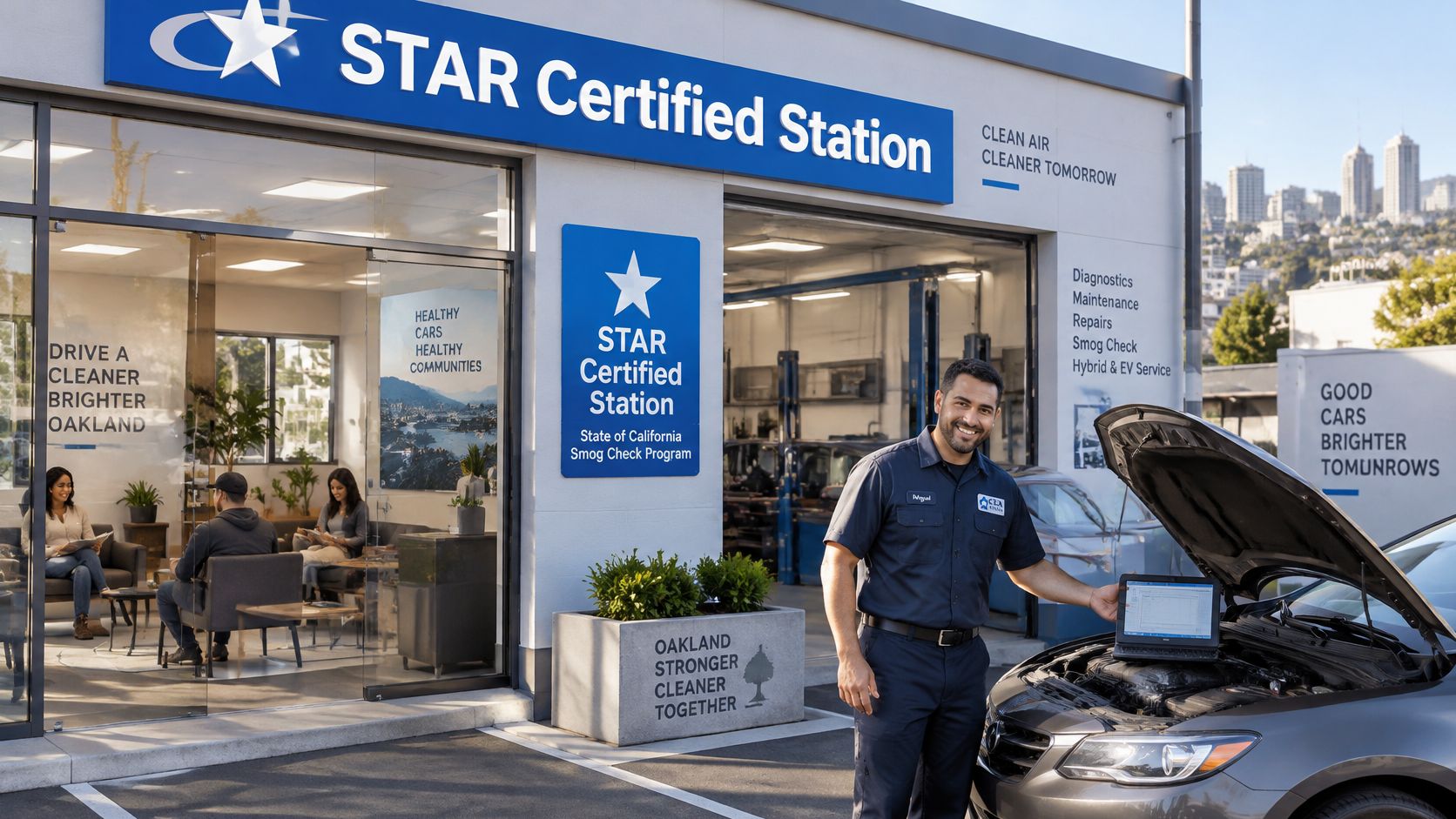
A suitable station should match the requirement on your paperwork and the vehicle you're bringing. If your renewal notice calls for a STAR inspection, make current STAR status a selection requirement rather than assuming that every smog business qualifies.
A technician's inspection involves more than a quick look under the hood.
Compare the service you actually need
Test-only and test-and-repair describe different service arrangements. Ask whether you're booking inspection alone or whether the facility can also provide diagnosis and repairs if needed. Don't infer that a particular location offers every service because it displays a smog sign.
| Selection question | Why it belongs in your comparison |
|---|---|
| Is the station currently STAR certified? | Your notice may specify that station category |
| Can it inspect this vehicle? | Fuel type and model year affect the appointment |
| Is the visit testing only? | You should know whether repair capability is available |
| What requires separate authorization? | Diagnosis and repairs shouldn't be confused with the inspection |
| What happens after the result? | You need a clear explanation of certification and documentation |
For a nearby business example, Speedy Smog identifies its San Leandro facility as a STAR-certified smog station serving East Bay drivers. Treat it as an option to compare with other suitable facilities, and confirm acceptance of your vehicle and the services you need before traveling.
This video provides another point of reference while you prepare questions for a station.
Ask about the complete visit
- Scheduling: Request an estimated completion time and ask whether waiting time is separate.
- Certification handling: Ask the station to explain its electronic certification process and the records you'll receive.
- Repair boundaries: Establish whether any additional work requires your approval.
- Result explanation: Confirm that someone can walk you through the report if certification isn't issued.
An Oakland address isn't the only practical option, and a nearby San Leandro location may fit your route. Still, convenience should follow suitability. A short drive to the wrong inspection appointment isn't a time saving.
Compare Prices Without Hidden Assumptions
An advertised inspection price doesn't answer every cost question. Before comparing offers, ask each station to describe the same service for the same vehicle, including any separately listed charges and the conditions attached to a discount.
No verified local fee schedule is established here, so assigning an Oakland-wide price range would be misleading. Use the local emissions-testing pricing information as a starting point for a direct quote, not as a substitute for confirming today's total.
Smog Price Questions to Confirm Before Testing
| Cost item | What the supplied information establishes | What the driver should confirm |
|---|---|---|
| Inspection price | No universal Oakland total is established | The complete quote for the exact vehicle |
| Certification-related charges | No amount is established here | Whether the quoted total includes applicable charges |
| Coupon | Availability must be checked directly | Current terms, vehicle restrictions, and exclusions |
| Diagnostic work | It shouldn't be assumed to be part of testing | Whether diagnosis is available and separately charged |
| Repairs | No repair estimate can be established before the problem is assessed | The proposed work and authorization process |
| Another inspection | No station-specific policy is established | Any conditions or charges for returning |
Use a precise pre-arrival request
Try this wording when you call:
Please quote the complete inspection cost for my vehicle, explain any separate charges, and tell me whether a current coupon applies. If it doesn't pass, what would I be paying for next?
Then provide the model year, fuel type, and any STAR instruction on your notice. If you've already received a quote elsewhere, compare inclusions rather than comparing headline amounts alone.
Time and price are separate questions. A station's estimate for performing the test doesn't necessarily describe your total visit, and a discount doesn't establish the final bill. Confirm payment timing and keep the quoted scope clear before testing begins.
Prepare for a Possible Failed Inspection
A failed inspection is a result to interpret, not an instruction to authorize unspecified repairs. In the 2025 reporting period, BAR recorded 959,667 failures among 11,275,981 initial tests, an 8.51% initial failure rate; including repeat and other testing activity, the overall failure rate was 9.04%, according to the statewide Smog Check executive summary.
Those statewide figures aren't a prediction for your particular car. They establish that failure is a real possibility worth planning for, while most initial tests didn't fail. The report also shows that vehicle age affected outcomes, which gives owners of aging vehicles a reason to budget time for diagnosis rather than assume immediate certification.
Read the result before buying a repair
Start by asking the station to identify the reported reason certification wasn't issued. A readiness issue calls for a different conversation from a diagnosed malfunction or an emissions-component concern.
- Keep the report. Preserve the inspection result alongside existing repair records.
- Ask for a plain-language explanation. Understand what the inspection found and what still needs diagnosis.
- Request a written estimate. Separate proposed diagnostic work from a repair recommendation.
- Check the next inspection step. Ask what must be resolved before returning.
The flowchart shows the conventional repair-and-reinspection route.
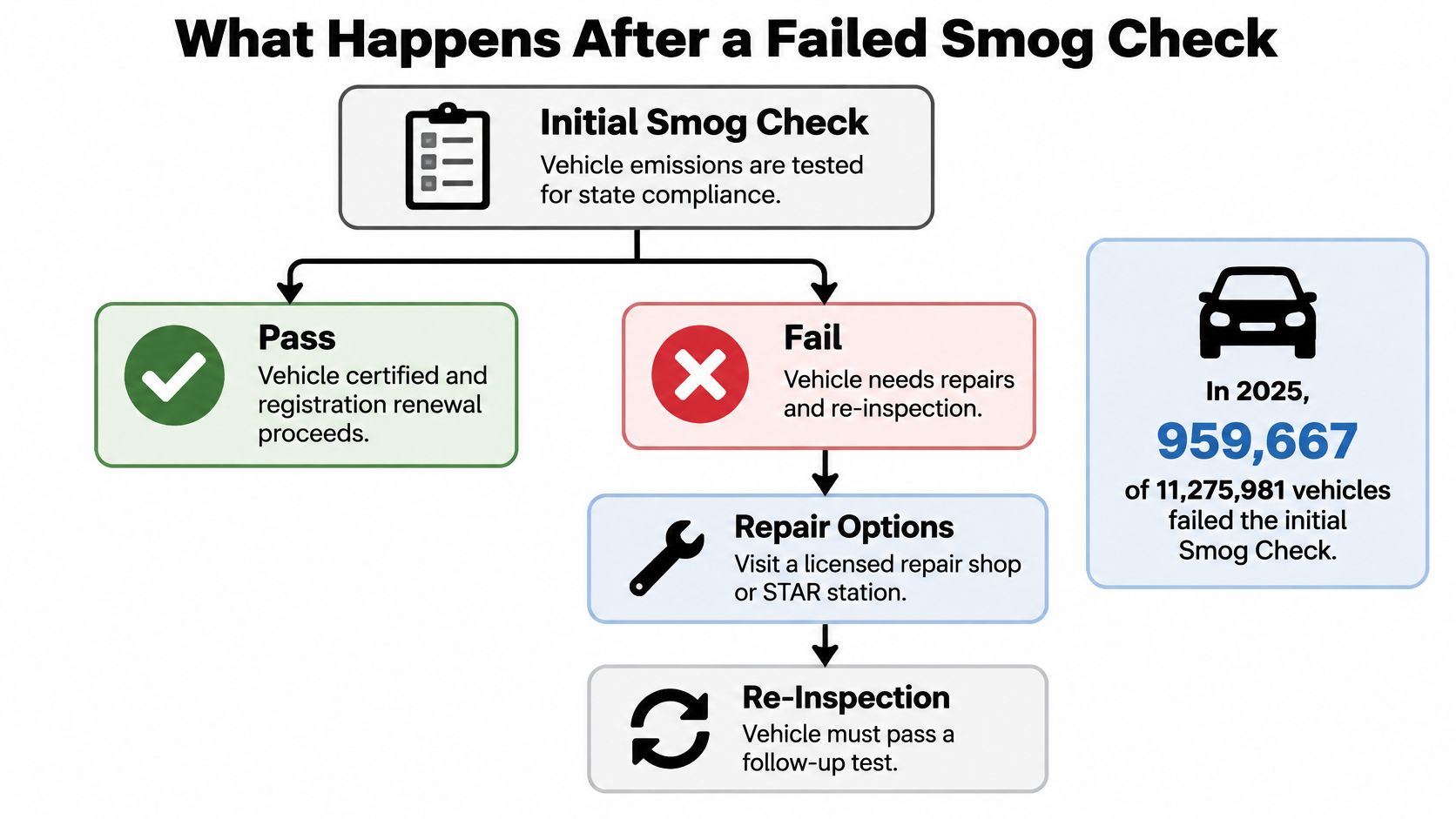
Pause when the financial decision changes
For an owner facing substantial repair costs, the next question isn't always “Which repair should I approve?” It may be “Should I check assistance eligibility before committing more money?”
Don't assume that a failure automatically qualifies you for help, either. Preserve the documentation and compare your options before treating any program as a guaranteed payment.
If the inspection result appears inconsistent or you don't understand the explanation, ask for clarification first. For an unresolved dispute, contact BAR or ask whether a Referee review is appropriate rather than paying for repeated tests without understanding the issue.
A clear explanation is part of making an informed decision. You should understand the reason for failure, the proposed next step, and the financial commitment before authorizing work.
Explore Repair Assistance and Retirement Options
For a financially constrained household, keeping an older vehicle on the road can involve a difficult trade-off. A repair may be worthwhile, but it shouldn't be treated as the only possible response to an expensive emissions problem.
California offers vehicle-retirement incentives of $1,500 or $2,000 in qualifying cases, while income-qualified applicants for broader Consumer Assistance Program options generally must be at or below 225% of the federal poverty level; published annual examples include $35,910 for a single-person household, $48,690 for a household of two, and $74,250 for a household of four, according to BAR's vehicle-retirement eligibility information. That guidance distinguishes pathways requiring a failed inspection from another requiring a completed inspection within 180 days before application, so the relevant route must be verified before you rely on it.
Compare eligibility before committing funds
Income is only part of the decision. BAR also distinguishes programs by vehicle operational status and inspection history. Don't read an income threshold as an approval, and don't assume that every assistance option follows the same application rules.
Use this compact decision sequence:
- Preserve documentation first. Keep the test report, repair estimate, and records that explain the vehicle's condition.
- Identify the relevant program. Ask whether your circumstances fit repair assistance, retirement, or neither.
- Verify current requirements. Confirm application timing and vehicle conditions directly with BAR.
- Compare your alternatives. Consider the repair quote alongside your transportation needs and any verified program eligibility.
- Resolve disputed questions. Ask BAR which office or Referee resource is appropriate for the issue.
Local smog-check repair-assistance guidance can help you organize questions, but BAR should confirm program requirements and eligibility.
Make the decision fit your household
Retirement assistance isn't automatically the better financial choice. You still need to consider how you'll travel after giving up the vehicle. Conversely, repeated repair spending isn't automatically sensible just because you've already invested money in the car.
Your most useful next step is the one supported by documentation: a verified inspection requirement, an appropriate station, an understood price, or a clearly assessed assistance application. You don't have to solve every uncertainty at the counter.
Speedy Smog offers STAR-certified emissions testing in San Leandro for Oakland and other East Bay drivers. Visit Speedy Smog to confirm your vehicle's inspection needs, ask for the complete price, and plan your visit before your registration deadline.
You've got the DMV renewal notice on the counter, a registration deadline getting closer, and one practical question. Do you need a Smog Check in Oakland, CA, what kind of station can test your vehicle, and is the car ready to pass when you get there? Answer those three questions in order and the visit stops feeling like a gamble. It becomes a short workflow you can control.
Table of Contents
- Start With Your Oakland Smog Check Decision
- Determine Whether Your Vehicle Needs Testing
- Choose the Right Smog Station in Oakland
- Prepare Documents and Your Vehicle
- What Happens During a Typical Smog Check
- Understand Common Smog Check Failures
- Choose Your Next Step After a Failure
- Use a Smog Check Visit Checklist
Start With Your Oakland Smog Check Decision
An Oakland driver finishing a commute opens that renewal envelope and sees smog certification requested. The car runs fine, so the first instinct is to search for the closest station and drive over. That's the wrong order. You need to decide whether a test is required, where your vehicle must be tested, and whether it's ready before you pick a shop.
Boarding a flight is a useful comparison. The destination doesn't matter if you've brought the wrong document or your bag can't clear the scanner. Your DMV notice is the boarding pass here. It controls the route for this transaction, and it tells you more than a generic search result can.
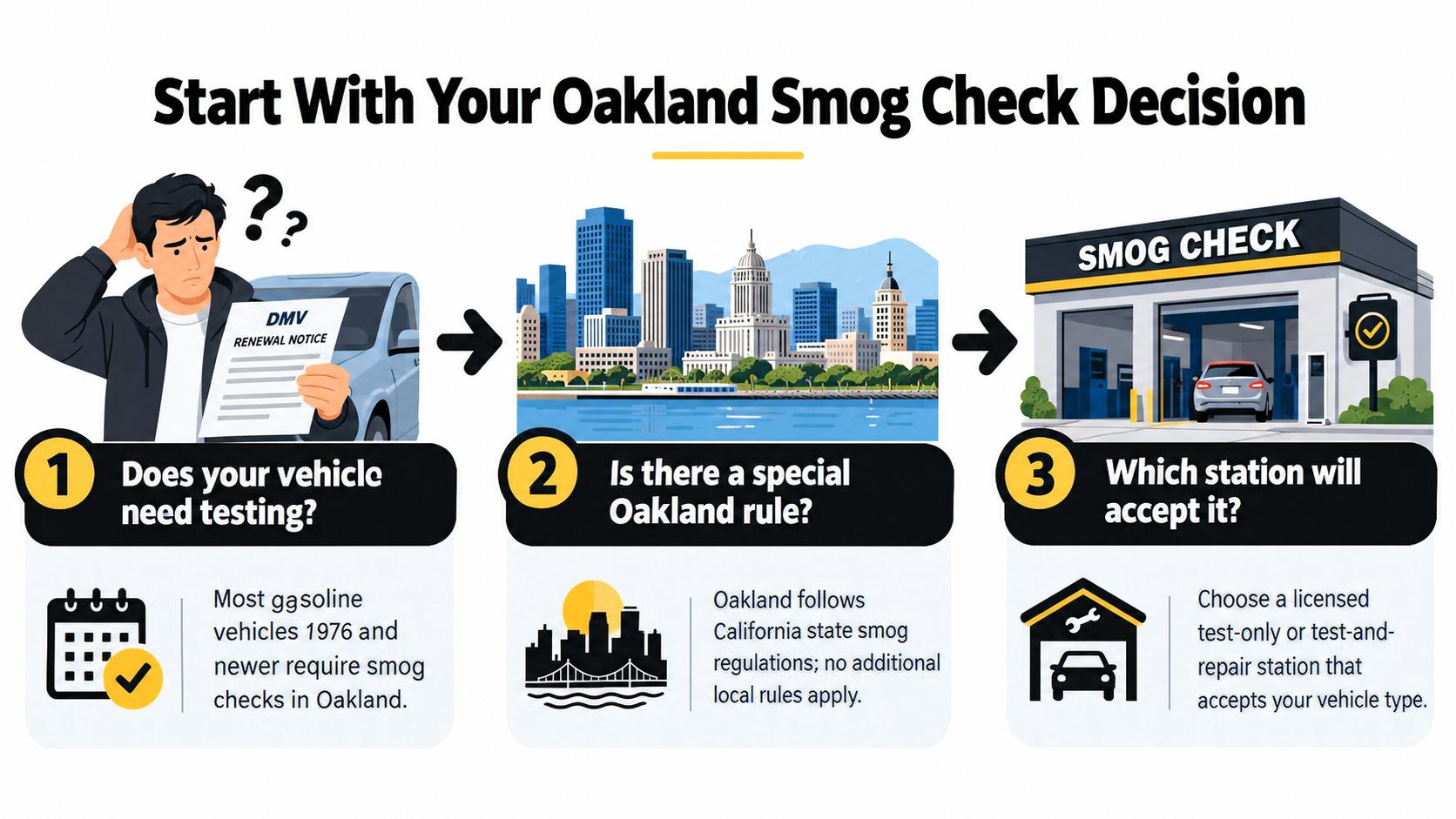
Why Oakland Follows a State System
Oakland doesn't run its own separate smog program. California established its Smog Check program as a statewide emissions-control system in the 1980s, and in its first year approximately 4 million vehicles were inspected under the mandatory biennial law, with about 70% passing without repairs. Vehicles that failed and were repaired showed an average 17% reduction in hydrocarbon and carbon-monoxide emissions right after repair, per that same early reporting.
That history explains the present workflow. A test isn't an optional maintenance add-on you can skip because the car feels fine. It's tied to specific registration transactions, and the result has to match the vehicle and transaction the DMV has on file.
There's also a difference between a routine renewal and other triggers. A biennial renewal is the familiar case, but a first California registration or a change of ownership can also put you in line for certification. Don't assume the rules from your last car carry over to this one.
Practical rule: Start with the paper in your hand, not the station map. If the notice, model year, and fuel type don't line up with your assumptions, resolve that first.
Expect the visit itself to vary. A newer gasoline car with complete diagnostic monitors is a different appointment from an older vehicle, a diesel, or a hybrid that follows another inspection path. Getting the decision right up front saves you a second trip, which is where most wasted time goes.
Determine Whether Your Vehicle Needs Testing
Don't classify your vehicle by age alone. That's the most common mistake East Bay drivers make, and it leads to the false idea that anything old is exempt. Age matters, but so do fuel type, model year, weight, and the type of registration transaction you're completing.
Match Model Year to Fuel Type First
Start with the broad categories, then check exemptions against them. Official California guidance places gasoline, hybrid, and alternative-fuel vehicles from model year 1976 onward generally within the program, while diesel vehicles from model year 1998 onward generally require testing. That same guidance identifies gasoline vehicles from 1975 or earlier, diesel vehicles from 1997 or earlier, electric vehicles, and certain heavy vehicles as exempt.
Read those two sentences together and the logic becomes clear. A 1999 diesel isn't exempt just because it feels old. A hybrid isn't automatically out of the program because it uses less gasoline. The category comes first, and the exemption, if one applies, has to override it clearly.
- Gasoline, hybrid, and alternative-fuel vehicles: Generally covered from 1976 onward, so a recently purchased older car in this group usually still needs attention.
- Diesel vehicles: Generally covered from 1998 onward, which catches many older trucks owners assume are grandfathered out.
- Electric vehicles: Listed as exempt, so don't book a test you don't need.
- Certain heavy vehicles: Treated as exempt under the DMV categories, but weight details matter, so don't guess from vehicle size alone.
Check the Transaction, Not Just the Calendar
Your vehicle can need certification even when it's not renewal time. Certification is also generally required when an affected vehicle is first registered in California or changes ownership. That covers a driver moving into Oakland with an out-of-state car, and it covers a private sale in San Leandro or Oakland where the buyer assumes the car is ready to register because the tags look current.
Imported and recently purchased vehicles trip people up. The relevant question isn't whether the previous owner tested it recently for their own renewal. It's whether your transaction triggers a requirement now. Those are different events, and the DMV treats them on their own terms.
If you're working through the broader rules before you call a station, the California smog check rules overview is a useful place to confirm how these categories fit together. Use it as a cross-check, not a replacement for your notice.
Let the Notice Resolve Conflicts
When your memory of the rules conflicts with the notice, the notice wins. Match the vehicle information on it to your actual model year and fuel type, then look for any instruction about station type. Some vehicles may use any licensed station, while others are directed to a STAR station.
If anything still doesn't add up, call the station before you travel and describe the vehicle and transaction. A two-minute verification beats arriving with the wrong expectation and being turned away. Bring the notice with you either way, so the station can transmit the correct vehicle information for your record.
Choose the Right Smog Station in Oakland
A STAR station isn't mandatory for everyone, and a regular station isn't a lesser choice if your notice doesn't direct you otherwise. What matters is matching the station to three things. Your DMV instructions, your vehicle type, and the transaction you're completing determine the right fit, in that order.
STAR certification is a performance distinction set through the Bureau of Automotive Repair. Some DMV notices direct specific vehicles to a STAR station, and when yours does, that instruction isn't optional. When it doesn't, you have more flexibility, and convenience, pricing clarity, and vehicle capability can carry more weight.
Compare the Two Routes Side by Side
| Consideration | Regular Station | STAR-Certified Station | Reader Action |
|---|---|---|---|
| DMV direction | Works when your notice doesn't specify STAR | Required when your notice directs you there | Read the notice before calling anyone |
| Certification recognition | Valid for transactions that accept any licensed station | Recognized for directed vehicles and general testing | Confirm the result will be transmitted for your transaction |
| Vehicle capability | Varies by station and equipment | Varies too, so don't assume every vehicle is accepted | Ask about your fuel type and model year in advance |
| Convenience trade-off | May be the closest option in Oakland | May mean a short drive elsewhere in the East Bay | Weigh travel time against a possible second trip |
| Pricing clarity | Ask for the full amount up front | Same standard applies | Don't compare stations on a partial quote |
That last trade-off deserves emphasis. The closest station to your house is only convenient if it can inspect your vehicle and its result counts for your transaction. A slightly longer drive to a station that handles your vehicle class correctly is faster than two short drives.
For a clearer explanation of what the designation means in practice, review the STAR certified smog station details before you decide. Then ask any station you're considering the same short set of questions. Can you test my fuel type and model year, does my notice require STAR, and will you transmit the certification electronically?
As one transparent East Bay example, Speedy Smog operates as a STAR Certified station at 15275 Washington Ave in San Leandro, 94579, not in Oakland itself. It serves Oakland-area drivers, handles 2000 and newer models, 1999 and older vehicles, diesels, and hybrids, and states that typical inspections for 2000-and-newer vehicles take about 10 to 15 minutes. Treat those specifics as a checklist for evaluating any station, not just this one. A good station should be able to state its status, its supported vehicle categories, and a realistic time window just as plainly.
Don't shop for a smog station the way you'd shop for a car wash. Proximity helps, but recognition for your specific transaction comes first.
Prepare Documents and Your Vehicle
Most avoidable failures and repeat trips happen before the technician touches your car. Preparation splits into two jobs. You need the right document in hand, and you need the vehicle's computer ready to report complete information.
Bring this checklist image to mind as you work through the steps below.
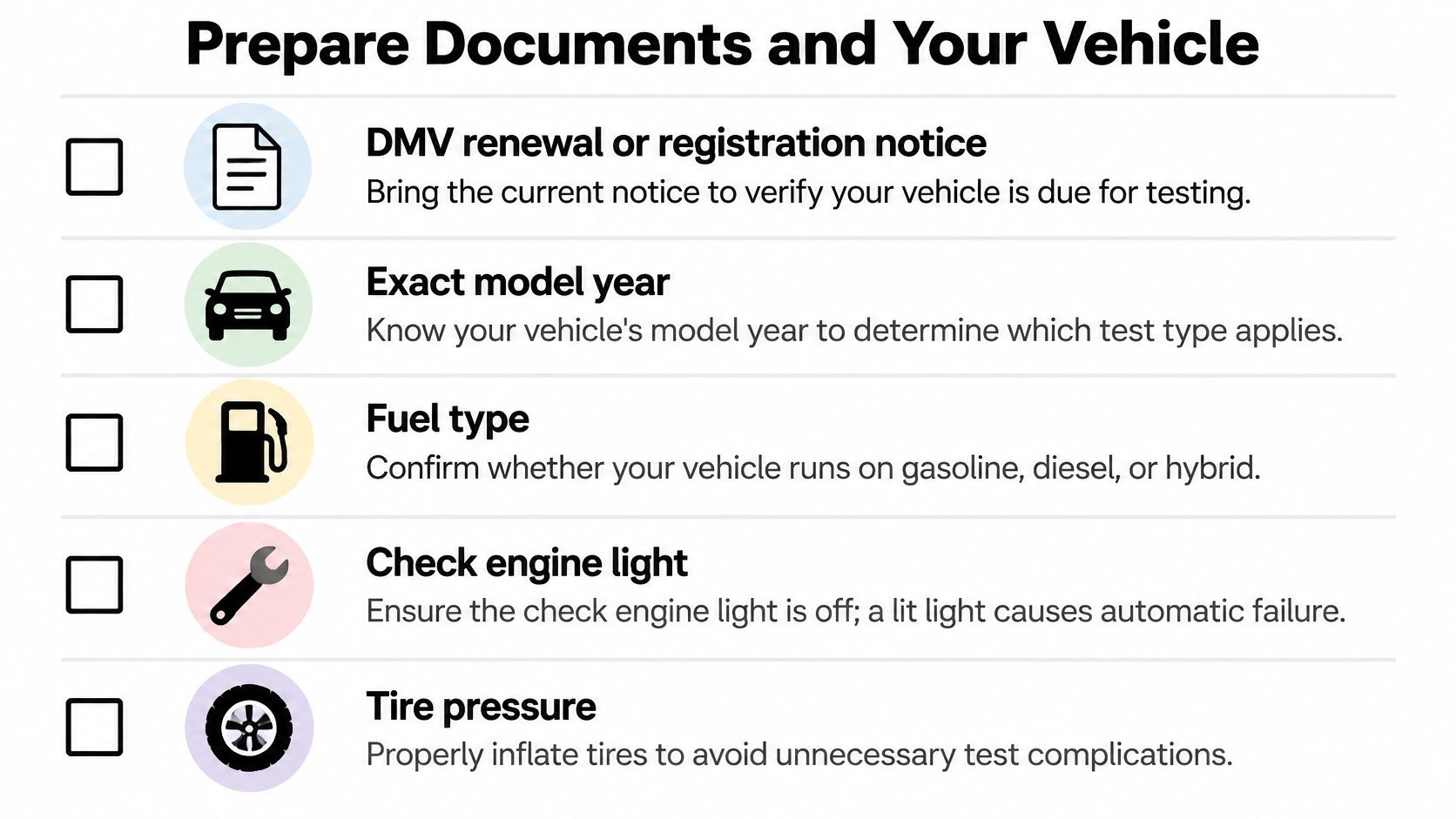
Assemble the Paperwork and Vehicle Facts
- DMV renewal or registration notice: Bring the current notice, since it's the document that defines your transaction and any STAR direction.
- Exact model year: Know it precisely, because a one-year difference can change which rule applies.
- Fuel type: Confirm gasoline, diesel, hybrid, or alternative fuel before you call, so the station can confirm it can test you.
- Registration status: Be ready to explain whether this is a renewal, a first California registration, or an ownership change.
For a fuller walkthrough of pretest steps, the guide on what to do before a smog check covers the preparation sequence in more detail. Read it before you schedule, not in the parking lot.
Get the Onboard Computer Ready
For gasoline vehicles from model year 1996 onward and diesel vehicles from model year 1998 onward, the inspection relies heavily on the On-Board Diagnostics system. That check verifies the malfunction indicator lamp works correctly, looks for diagnostic trouble codes, and evaluates whether required emissions monitors are complete. It's closer to a computer health report than a simple tailpipe sniff.
Don't clear codes or disconnect the battery right before your appointment hoping to erase a warning. That resets the readiness monitors and leaves the computer without enough operating data. You're trading a known fault for an incomplete report, and both can stop you from passing. Repair the underlying problem instead, then complete the manufacturer-specific drive cycle so the monitors rebuild their data through normal driving.
This short video walkthrough shows what readiness preparation looks like in practice.
If your check engine light is on, treat that as a stop sign. Get the fault diagnosed before you test, because showing up hoping it won't matter wastes the trip. Also allow time for the vehicle to cool after driving, and confirm the station can inspect your vehicle class before you head out. None of this guarantees a pass, and any station promising one in advance isn't being straight with you. That removes the preventable reasons for failure.
What Happens During a Typical Smog Check
Follow a representative 2000-and-newer sedan through a visit and the whole process looks manageable. The driver arrives with the renewal notice, the station verifies the vehicle record against that document, and only then does the inspection begin. That record check isn't bureaucracy for its own sake. It's what ensures the result attaches to the right vehicle and transaction.
From Check-In to Result
Here's the sequence most drivers of newer vehicles experience.
- Arrival and verification: You hand over the notice, the station confirms model year, fuel type, and any STAR requirement.
- Inspection: The technician runs the test path appropriate to your vehicle, which for a newer model centers on the diagnostics described in the section above.
- Result handling: On a pass, the certification is transmitted electronically, so you aren't carrying a paper certificate to the DMV yourself.
For planning purposes, a typical inspection for 2000-and-newer vehicles takes about 10 to 15 minutes at the East Bay example mentioned earlier. Read that as a typical window, not a guarantee. A station can be busy, a vehicle can need extra attention, and your own arrival paperwork can add time. Budget a buffer around the test itself rather than scheduling something tight immediately after.
Where the Experience Changes
Older gasoline vehicles, 1999-and-older vehicles, diesels, and hybrids may follow different inspection paths. If yours falls into one of those groups, don't assume the newer-car timeline applies to you. Ask the station when you book how your category is handled and how long you should allow.
The surroundings matter less than the process, but they aren't irrelevant on a workday. A clean indoor waiting room makes a short wait easier, and transparent pricing stated before the test starts prevents an awkward surprise at the counter. Limited promotional offers exist at some stations, but don't let a discount distract you from the basic questions. Is this station right for my vehicle, and will its result count for my transaction? Those answers matter more than a few dollars saved on a test you'd have to redo.
Before you leave after a pass, confirm the result has been sent. That's your final step at the station, and it closes the loop between the inspection and your registration.
Understand Common Smog Check Failures
A failure doesn't automatically mean your engine is falling apart. On a modern vehicle, it often means the computer reported a problem, or hadn't collected enough data to report at all. Reading the result correctly is the difference between a targeted repair and throwing parts at the car.
Read the Result Like a Traffic Light
Use a simple comparison. The dashboard warning light is the signal you can see. Stored diagnostic trouble codes are the reason the signal changed. Readiness monitors are whether the system has run long enough to trust its own report. You need all three pieces before you can interpret a failure, not just the light.
That structure also explains why a vehicle can fail even when its tailpipe emissions look acceptable. If the OBD system reports an emissions-related fault or shows insufficient monitor readiness, the inspection can't certify the vehicle on tailpipe behavior alone. The computer's evidence and the exhaust evidence are separate checks, and either one can stop a pass.
The scale here is worth knowing. In statewide 2024 to 2025 data, approximately 19 million model-year-2000-and-newer vehicles were tested and about 1.3 million, roughly 7%, failed, with OBD-related failures at approximately 6.8% of OBD inspections. You're not dealing with a rare edge case when diagnostics cause a failure. It's the central failure path for newer vehicles.
Know the Usual Technical Causes
Four causes come up repeatedly in diagnostic failures.
- Catalytic-converter inefficiency: The converter isn't cleaning exhaust to the expected level.
- Evaporative-emissions leaks: Fuel vapor escapes where it should stay contained.
- Oxygen-sensor faults: The sensor feeding the computer bad data throws off the whole emissions picture.
- Misfire detection: The engine isn't firing consistently, and the computer catches it.
These range from relatively contained repairs to expensive ones, which is exactly why you shouldn't guess. The failure information narrows the diagnosis, and a proper diagnosis narrows the parts list.
After a failure: Keep the inspection details, don't reset anything, and diagnose from the codes before you buy a single part.
Clearing codes on the drive home undoes that advantage. You erase evidence and reset monitors at the same time, leaving the next technician and the next test with less to work from. Preserve the data and let it guide the next step.
Choose Your Next Step After a Failure
Repair immediately is bad default advice. Sometimes it's right. Sometimes you're about to spend real money on a vehicle where repair isn't the sensible path, and California runs a program specifically because that situation is common. Lay out your three actual options before you commit.
Compare Repair, Assistance, and Retirement
Diagnose and repair on your own suits a vehicle you intend to keep, with a contained fault and no history of repeated failures. Program-supported repair suits an income-eligible driver whose needed work qualifies. Vehicle retirement suits an older vehicle where repair costs and repeat failures have started to outweigh the car's remaining value to you.
The financial structure is specific. California's Consumer Assistance Program can provide income-eligible drivers up to $1,450 toward emissions-related repairs, while qualifying owners may receive up to $2,000 to retire a vehicle. The retirement option generally requires household income at or below 225% of the federal poverty level and, for the higher incentive, a failed Smog Check. A vehicle that passes may still qualify under a separate retirement pathway if the inspection occurred within the required 180-day window.
Those numbers change the math for a lower-income East Bay driver. A repair that looks unavoidable on your own budget may be partly covered, or retiring the vehicle may return more value than one more repair cycle on a car that keeps failing.
Respect the Eligibility Limits
Don't assume every mechanic's bill qualifies. Assistance is limited to eligible emissions-related work, requires program approval, and depends on income rules and documentation. Apply and get approved through the proper channel before you authorize work expecting reimbursement. Work done outside those conditions is your expense, whatever the total comes to.
There's a reason older vehicles deserve extra scrutiny in this decision. Lawrence Berkeley National Laboratory research using 1999 data estimated that one inspection-and-repair cycle reduced daily emissions by approximately 97 tons of hydrocarbons, 1,690 tons of carbon monoxide, and 81 tons of nitrogen oxides, with automobiles more than 10 years old accounting for over 90% of the hydrocarbon and carbon-monoxide benefits despite being only about half of vehicles tested. Older vehicles carry the greatest emissions-control deterioration risk. That doesn't make yours unsalvageable, but it does mean a single repair may not be the last one.
Sequence your decision this way. Get the diagnosis, check whether you qualify for assistance, compare the realistic repair path against retirement, and watch your registration timing throughout. A failed test doesn't force the cheapest-looking choice. It forces an informed one.
Use a Smog Check Visit Checklist
Run this sequence once and you've covered the article's decisions in order.
- Confirm the trigger: Renewal, first California registration, or ownership change, and check whether your notice specifies STAR.
- Verify vehicle fit: Make sure your station handles your fuel type and age group.
- Assemble information: Bring the notice, exact model year, fuel type, and registration status.
- Protect readiness: Repair known faults, complete the drive cycle, and don't clear codes or disconnect the battery.
- Budget time: Allow extra room around the test, especially for older, diesel, or hybrid vehicles.
After a pass, confirm the result was transmitted electronically before you leave. After a failure, keep the details and don't commit to a quick repair until diagnosis and assistance options are clear. Verify anything specific to your vehicle with your chosen station before you travel.
If your notice calls for a STAR inspection or you're testing a diesel, hybrid, older vehicle, or 2000-and-newer model, Speedy Smog can confirm your vehicle fit, explain the process in plain language, and complete the inspection for your DMV transaction. Bring your renewal notice, verify your vehicle is diagnostically ready, and visit to get tested and back on the road without a second trip.
You're sorting through mail in an Oakland kitchen. Between a utility bill and a grocery flyer is your DMV renewal notice, and one line stops you cold. A smog check is required before your registration can be completed, and the notice may even name a STAR station.
If that moment feels confusing, you're not alone. Most drivers don't think about smog certification in Oakland until that notice arrives, then they have to figure out which station to use, what kind of test their vehicle gets, and what happens if it doesn't pass. This guide walks through that full lifecycle in plain language, from why the test exists to how your certificate reaches the DMV.
Table of Contents
- Why Oakland Drivers Need Smog Certification
- How California Decides Which Test Your Vehicle Gets
- What STAR Certification Actually Means
- What Happens During a Typical Smog Inspection
- Choosing Between STAR, Test-Only, and Regular Stations
- After a Failed Test, Repairs, Waivers, and CAP
- Getting Your Certificate to the DMV and Staying Compliant
Why Oakland Drivers Need Smog Certification
That renewal notice in your hand isn't random paperwork. For many Oakland drivers, it's the first sign that their vehicle is due under California's biennial Smog Check program, which means a covered vehicle needs an inspection of its emissions, engine, and emissions control components every two years. You can't finish the registration renewal until that requirement is satisfied.
The reason sits in Bay Area history. By the late 1960s, the region had recorded 65 days exceeding the national one-hour ozone standard of 12 parts per hundred million, the highest number in its history at that time, with roughly 1.75 million motor vehicles in a region of slightly more than 3 million residents, as the Bay Area Air District history of regional air pollution documents. Ozone is the main ingredient in smog, and vehicles were a major part of the problem even then.
How Vehicles Became the Main Focus
As pollution from factories and other stationary sources declined, motor vehicles became the Bay Area's leading air pollution source. Today, cars, trucks, buses, and construction equipment are grouped as mobile sources, and they produce more than 60% of the Bay Area's smog-forming emissions, per the same Air District history cited above. That shift explains why California puts so much weight on testing individual vehicles.
A single vehicle with a broken or removed emissions control part can contribute far more pollution than a properly maintained one. The inspection is designed to catch exactly that, a malfunctioning system, a missing component, or a warning sign that the vehicle's own self tests aren't passing.
Your smog certificate does two jobs at once. It clears a DMV registration step for you, and it confirms your vehicle's emissions controls are doing the work they're supposed to do.
So when you schedule smog certification for an Oakland vehicle, you're not just buying a piece of paper. You're completing one cycle of a regional program built in response to severe, measurable ozone problems, and the rest of this guide shows you how to get through it with confidence.
How California Decides Which Test Your Vehicle Gets
California doesn't give every vehicle the same test. The method is decided mainly by model year and fuel type, and knowing which path your vehicle falls on tells you how to prepare. Start by finding your model year on your registration, then match it to the categories below.
The flowchart below breaks the decision into its main branches so you can see where your vehicle lands.
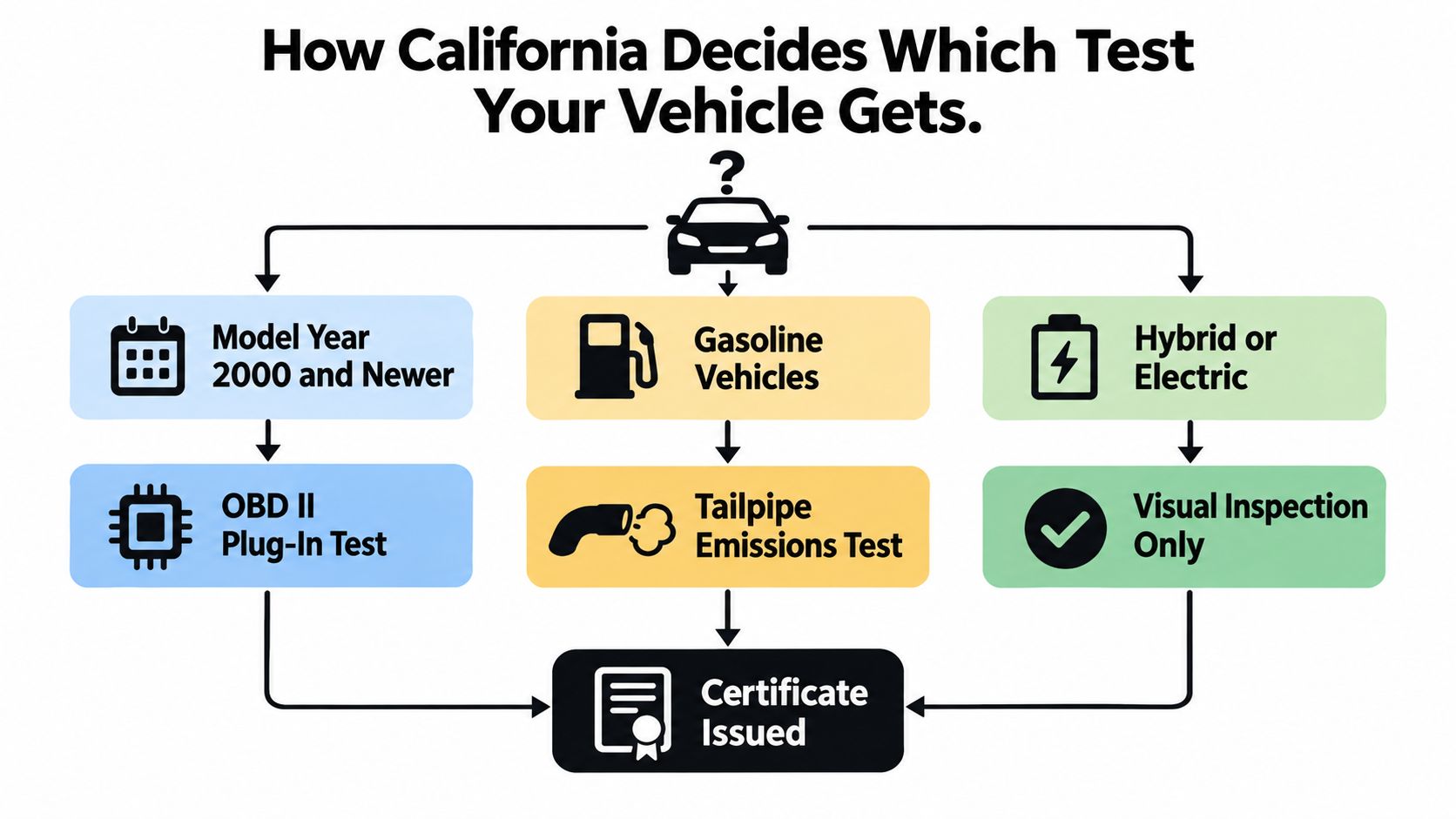
The Three Main Test Paths
- Gasoline, model year 2000 and newer: Your vehicle is evaluated through the On-Board Diagnostic Inspection System, called OIS, which plugs into your vehicle's computer and reads its OBD-II data instead of relying mainly on a tailpipe test.
- Gasoline, model year 1999 and older: Your vehicle generally receives an Acceleration Simulation Mode test, or ASM, which runs the vehicle on a dynamometer, a set of rollers that simulates driving while emissions are measured.
- Diesel, model year 1998 and newer: Your vehicle also uses OIS, according to the Bureau of Automotive Repair guidance on inspection methods by model year and fuel type.
There's one exception worth knowing. Certain four-wheel-drive and all-wheel-drive vehicles that can't safely run on the dynamometer may be allowed a Two-Speed Idle test instead of ASM. The station determines whether that applies, it's not a choice you make at the counter.
Why Your Path Changes How You Prepare
If your gasoline vehicle is 2000 or newer, your preparation is mostly electronic. A lit check engine light, stored emissions related trouble codes, or readiness monitors that haven't completed their self tests can all cause problems. Getting warning lights diagnosed before your appointment is the smart move.
If your vehicle is 1999 or older, preparation leans mechanical, because the dynamometer test measures what comes out of the tailpipe under load. Either way, there's no shortcut around the full procedure. California prohibits fast pass testing, and inspections must be complete and performed by BAR-licensed personnel. If you want the broader rules in one place, the overview of California smog check rules and requirements is a helpful companion before you book.
What STAR Certification Actually Means
Many drivers searching for smog certification in Oakland see the word STAR on shop signs and assume it's a marketing badge or a quality award voted on by customers. It's neither. STAR is a performance based oversight designation from the Bureau of Automotive Repair, and stations have to earn it with measurable results.
The diagram below shows how the designation is structured and what it signals to you as a customer.
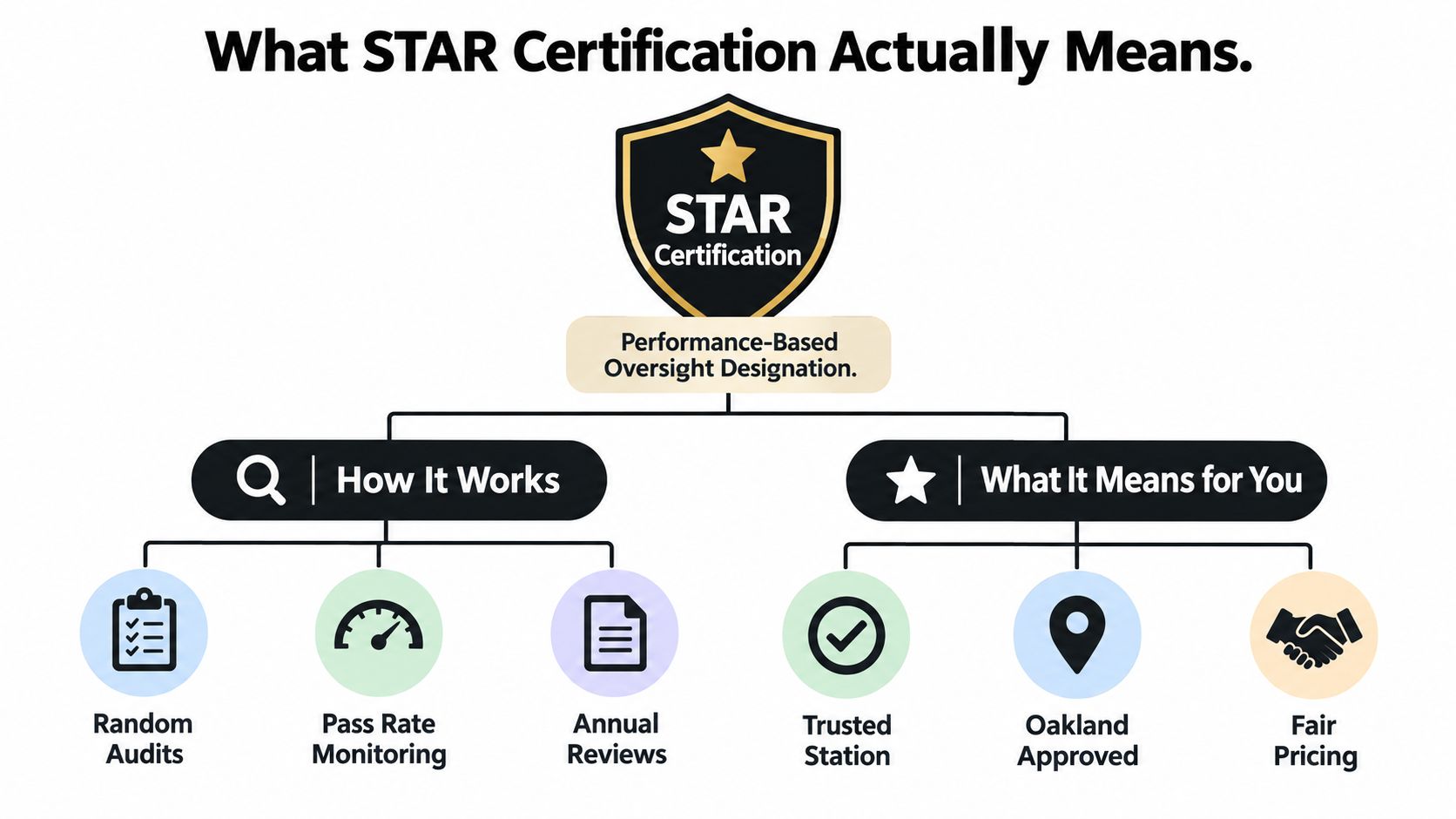
The Numbers a STAR Station Has to Meet
To qualify, a station must satisfy licensing, signage, record keeping, equipment, and publication access requirements, and perform enough inspections for BAR to calculate its performance. On top of that baseline, the BAR STAR certification criteria with published statistical thresholds require specific results, including these.
- Similar Vehicle Failure Rate: At least 50% of the industry-wide failure rate for comparable vehicles, which shows the station isn't passing cars that similar stations would fail.
- Incorrect Gear Selection rate: No higher than 2% of certified vehicles, a check on testing accuracy during dynamometer inspections.
- Excessive Test Deviation Rate: No greater than one, plus a Follow-up Pass Rate of at least 0.40 for the station or its inspectors under the applicable reporting rules.
STAR stations must also maintain equipment capable of testing all vehicles subject to the Smog Check Program. They may inspect directed vehicles, meaning vehicles the DMV has specifically sent to a STAR station, regardless of the station's program area location.
What STAR Does Not Promise
STAR comes in two forms, test-and-repair stations that can fix emissions problems and test-only stations that inspect but don't repair. Both are held to the same performance idea, accurate inspections that protect air quality.
Practical rule: STAR describes the station's track record, not your vehicle's outcome. It doesn't guarantee a pass, waive repairs, or override what your DMV notice requires.
Your vehicle still has to pass the emissions, visual, and functional requirements that apply to it. What STAR gives you is confidence that the station's inspection quality is being measured against published thresholds, not just its own advertising.
What Happens During a Typical Smog Inspection
Pulling into a station for the first time is less mysterious than most drivers expect. The technician verifies your vehicle information, performs the inspection that matches your model year and fuel type, and gives you a report explaining the result. Here's how that unfolds for a typical newer vehicle.
The photo below shows the kind of hands-on check a technician performs during a visit.
For a 2000-and-newer gasoline vehicle, the technician visually inspects emissions control components under the hood, then connects to the OBD-II system. That electronic check looks for emissions related diagnostic trouble codes, confirms whether the malfunction indicator lamp, your check engine light, works properly and isn't illuminated, and reviews readiness monitor status. Readiness monitors are self tests your vehicle runs on its own emissions systems as you drive, and they need to be complete for the inspection to finish properly.
Pass, Fail, and the Less Familiar Incomplete
Most vehicles either pass and receive certification, or fail with a report identifying what went wrong. There's a third outcome drivers find confusing. If readiness monitors haven't completed, often because a battery was recently disconnected or codes were cleared, the vehicle may not be ready to certify even though nothing is obviously broken. Driving normally for a period usually lets those self tests run, and the technician can advise you on that.
The short video below walks through what a technician is looking at during these checks.
Failures aren't rare, especially among older vehicles. In January 2025 alone, California stations performed 984,481 initial tests with an 8.72% initial-test failure rate, and including retests they performed 1,063,192 inspections and recorded 98,063 failures, or 9.22%, according to the BAR Smog Check performance report with statewide test data. That same data shows 1976 and 1977 model vehicles failing at around one in five initial tests, which is why older cars, diesels, and trucks often need more preparation time. Whatever the outcome, you leave with a Vehicle Inspection Report, and a passing result is transmitted electronically toward the DMV.
Choosing Between STAR, Test-Only, and Regular Stations
The right station for you depends on two things you already have in hand, your DMV renewal notice and your vehicle. Read the notice first. If it specifically requires a STAR station, that decision is made for you, because only a STAR station can certify a directed vehicle. If it doesn't, you have more flexibility.
Many Oakland drivers get tripped up here. They pick the closest shop, then discover their notice required STAR, or they choose a test-only station and then need repairs somewhere else. Matching the station type to your situation upfront saves a second trip.
Choosing the Right Station Type for Your Situation
| Station Type | Accepts Directed Notices | Performs Repairs | Best For |
|---|---|---|---|
| STAR test-and-repair | Yes | Yes | Directed notices, older vehicles, drivers who want testing and repairs in one place |
| STAR test-only | Yes | No | Directed notices where you want an inspection separate from any repair work |
| Regular test-and-repair | No | Yes | Standard notices on vehicles that may need work if they fail |
| Regular test-only | No | No | Standard notices on newer, well maintained vehicles with no warning lights |
Consider your vehicle's condition. If you have an unresolved check engine light or a history of emissions trouble, a test-and-repair station can diagnose and fix the problem without sending you across town. If your newer car runs cleanly and your notice is standard, a regular licensed station handles the job fine. For a deeper side-by-side, this breakdown of STAR station versus test-only station differences explains the trade-offs in more detail.
East Bay drivers often look just beyond Oakland for availability. Speedy Smog in San Leandro is one example of a STAR Certified station serving Oakland drivers, performing inspections for newer vehicles, 1999-and-older vehicles, diesels, and hybrids. Whichever station you choose, confirm it's BAR-licensed and matched to your notice before you drive over.
After a Failed Test, Repairs, Waivers, and CAP
A failed test feels like a dead end, but it's really a decision point. Your Vehicle Inspection Report tells you why the vehicle failed, and that reason shapes your options. The first step is confirming whether the failure is emissions related, involving trouble codes, readiness monitors, or emissions control components, because assistance programs are built around that distinction.
The flowchart below maps the three main routes forward after a failure.
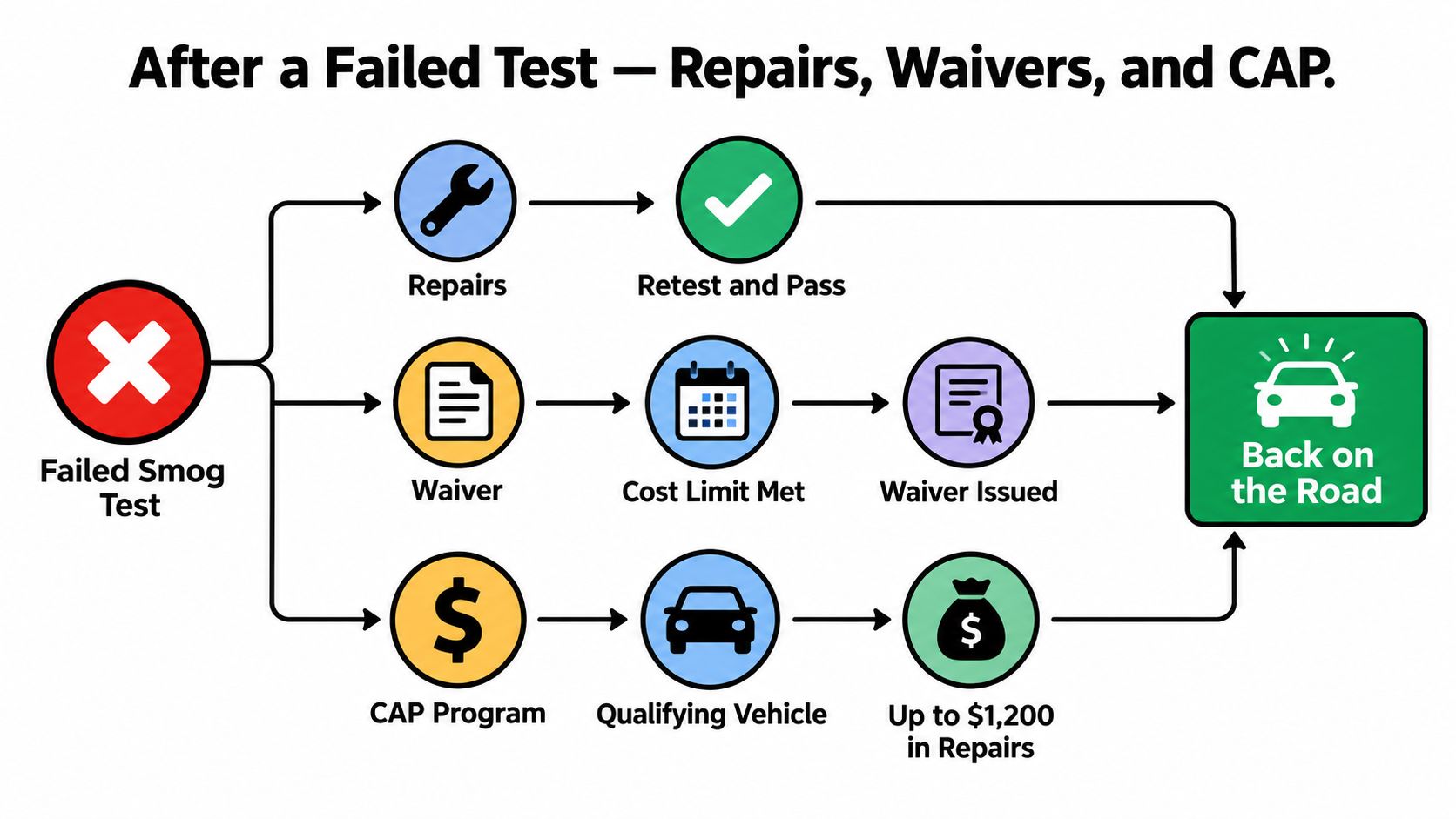
Repair Assistance Through CAP
Before you authorize expensive work, check the Consumer Assistance Program, known as CAP. Eligible owners of 1996-and-newer vehicles may receive up to $1,450 for emissions related repairs, while 1976 to 1995 vehicles may qualify for up to $1,100, under the BAR Consumer Assistance Program repair assistance rules. Eligibility matters and approval isn't automatic, so verify before spending. You can also review how smog check repair assistance options fit together before committing to a repair bill.
The Repair Cost Waiver and the Referee
If repairs get expensive, a repair cost waiver may be realistic, but it isn't a free pass. The vehicle generally must fail its biennial inspection, and you must spend at least $650 on qualifying repairs at a Smog Check station, per the CAP guidance cited above. The waiver postpones the certificate requirement for up to two years, and the vehicle must be fully repaired by the next biennial inspection or a title transfer.
A waiver buys you time, not permanent compliance, and paying the repair threshold by itself doesn't guarantee one will be granted.
If you dispute a failure or your repair history is complicated, the BAR Referee is the path for an independent review. Taken together, these options mean a failed test doesn't automatically mean replacing your vehicle. It means slowing down, confirming the failure type, checking assistance first, and choosing the route that matches your budget and timeline.
Getting Your Certificate to the DMV and Staying Compliant
When your vehicle passes, you usually don't carry a paper certificate to a DMV office. The station transmits the passing result electronically through the BAR system, and that record becomes available to the DMV for your registration. Your job is simpler, keep your paperwork and confirm the details match.
Hold onto your Vehicle Inspection Report until your renewal is fully complete. It shows the test date, station, vehicle information, and result, which is exactly what you'll need if the DMV record hasn't updated yet or a detail needs correcting. Electronic reporting and DMV processing are separate steps, so a short delay before an online renewal recognizes your certificate can be normal. Don't pay for a second test just because a screen hasn't refreshed.
A Simple Checklist for the Next Cycle
- Read your notice first: Check whether it requires a STAR station before choosing a shop.
- Know your test path: Match your model year and fuel type to OIS, ASM, or the diesel route, and prepare accordingly.
- Fix warning signs early: Diagnose a check engine light or incomplete readiness monitors before your appointment, not at the counter.
- Keep your records together: Save the inspection report, receipts, and any repair documentation until registration clears, and keep repair records for the next cycle.
One last distinction helps avoid frustration. A passing smog result satisfies the emissions part of renewal, but it doesn't pay your registration fees or clear unrelated DMV holds. Those are separate steps in the same transaction.
Handled this way, smog certification in Oakland becomes a rhythm you understand rather than a surprise every two years. You know why the test exists, which inspection your vehicle faces, how to pick a station, and what your options are if the first attempt doesn't pass.
If your renewal notice is already sitting on the counter, Speedy Smog in San Leandro offers STAR Certified inspections for Oakland and East Bay drivers, including newer vehicles, older vehicles, diesels, and hybrids, with passing results submitted electronically for DMV registration. Bring your renewal notice, get your vehicle tested, and leave with your inspection report in hand.
The DMV envelope usually arrives when you're focused on something else. You open it at the kitchen counter, see that your Oakland-registered car needs a smog certificate, and start wondering whether you can stop at a nearby shop on Broadway or need to drive elsewhere. Before booking, check what the notice requires, what kind of inspection fits your vehicle, and whether a recent battery change could make the test premature.
California's Smog Check program is more than a registration formality. More than 10 million vehicles are tested each year at over 5,000 independently owned stations, and the California Air Resources Board estimates the program removes roughly 400 tons of smog-forming pollutants from the air each day (California Smog Check performance report). Knowing the basic rules can save you an unnecessary trip and help you choose a station that can issue the certificate your DMV notice calls for.
Table of Contents
- When the Renewal Notice Lands on Your Counter
- How California Decides Which Test Your Car Gets
- What STAR Certification Really Means
- The Hidden Reason a Healthy Car Can Still Fail
- What to Bring and How to Time Your Visit
- If Your Car Fails, the Math Changes
- Where Broadway Drivers Usually End Up Going
- Your Two Next Steps Before You Book
When the Renewal Notice Lands on Your Counter
Start with the notice itself, not a map search. It tells you whether your renewal requires a Smog Check and may specify that the inspection must take place at a STAR station. That instruction matters: a vehicle directed to STAR testing can't be tested at any authorized shop, even if another location is closer to home or work.
Most California vehicles are required to pass an emissions inspection every two years, with additional inspections applying in certain registration and ownership situations. For example, an out-of-state vehicle from model year 1976 or newer generally needs a Smog Check when it's registered in California for the first time, subject to the DMV's rules for the specific registration circumstance. A valid certificate helps satisfy registration requirements, while the inspection checks whether the emissions system is functioning within applicable limits.
For a Broadway-area driver, choosing a station is about more than convenience. A test has to match the vehicle and the DMV's instructions. A shop without the necessary authorization or equipment may not be able to complete the inspection your vehicle needs.
Make three decisions before you book
First, identify the vehicle and likely inspection path: model year, fuel type, and whether it's a hybrid or diesel all matter. Second, check whether the notice specifically says STAR. Third, ask the station whether it can test your vehicle and when it can see you.
Practical rule: Treat the DMV notice as the instruction sheet. Confirm its requirements before choosing a station based on distance or advertised speed.
These checks turn a vague errand into a simple plan. Once you know the required station type and the vehicle's test path, you can call with useful details and avoid booking an appointment that can't satisfy the notice.
How California Decides Which Test Your Car Gets
The inspection method depends mostly on the car, not whether you bring it to Broadway, San Leandro, or another East Bay neighborhood. For most 2000-and-newer vehicles, California's Bureau of Automotive Repair generally uses the BAR On-Board Diagnostic Inspection System, or OIS. It checks information from the vehicle's onboard computer and emissions-related systems.
A 1998 gasoline sedan, by contrast, generally falls under the BAR-97 system for 1999-and-older vehicles. That system measures exhaust directly at the tailpipe. A 2017 hybrid generally follows the newer OIS path, but hybrids and diesels can have vehicle-specific requirements, so it's wise to confirm the test type with the station before arriving. The California Smog Check rules and inspection overview can help you understand what to ask.
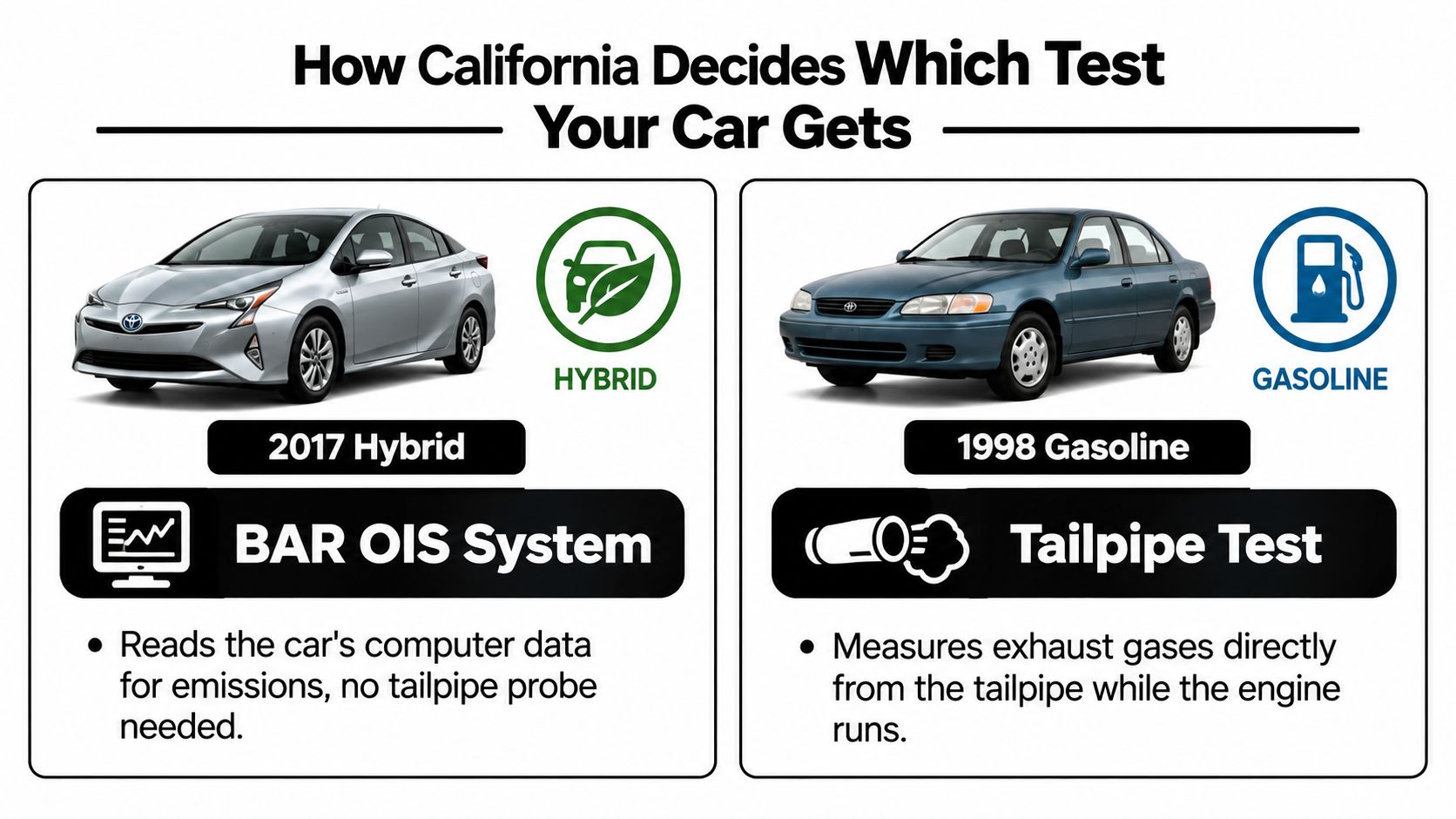
The tailpipe reading isn't the whole test
Both inspection paths can involve visual and functional checks of required emissions equipment. A car may have acceptable measured exhaust and still fail if the catalytic converter, evaporative-emissions system, or fuel cap doesn't pass the required checks. These components help control emissions, so the inspection isn't only asking whether the engine seems to run smoothly.
That distinction explains why a vehicle's neighborhood doesn't determine the procedure. The test equipment and station authorization must suit the car and the DMV's instructions. If a notice directs a vehicle to STAR, the station must also be authorized for that requirement.
Before booking, have the model year, fuel type, and DMV notice available. If the car is a hybrid or diesel, say so when you call rather than assuming that every shop handles every configuration. That small confirmation can prevent a trip to a station that can't complete the right inspection.
What STAR Certification Really Means
A STAR badge isn't just another way of saying a shop offers smog testing. California introduced the STAR program in January 2013, and the Bureau of Automotive Repair evaluates participating stations and inspectors against performance standards. The program also directs certain higher-risk vehicles, including some with prior excessive emissions or a higher predicted likelihood of failing, to qualifying STAR stations.
The share of stations and the share of inspections tell an important part of the story. In 2023, 48% of licensed Smog Check stations were STAR certified, while STAR stations performed 83% of all tests. California reported 3,550 STAR stations as of March 31, 2025 (California STAR program background and station data). These figures show that STAR stations handled a large portion of the inspection workload, even though they made up less than half of licensed stations.
How the oversight works
BAR reviews performance measures that look for inaccurate or improperly conducted tests. One measure, the Similar Vehicle Failure Rate, compares a station's results with outcomes for comparable vehicles. Another, the Follow-up Pass Rate, tracks whether vehicles that passed later show patterns suggesting that an inspection may not have been accurate.
The program also considers test deviations and procedures such as gear selection during dynamometer testing. That's why a STAR designation is best understood as participation in a performance-based oversight system, not a promise that a test will be faster or that every vehicle will pass.
Use the notice as your screening rule
If the DMV notice says STAR inspection is required, choose a STAR station. If it doesn't, STAR status may still be a useful factor when comparing stations, but the notice determines whether it's mandatory.
Before you set out, verify the station's STAR status and confirm that it can inspect your vehicle's model year and fuel type. That quick check is more useful than relying on a short advertised turnaround time alone.
The Hidden Reason a Healthy Car Can Still Fail
A car can feel normal on the road and still be unready for a Smog Check. The check-engine light is an obvious warning: BAR says a vehicle won't pass with the light illuminated. Less obvious is what happens after a battery is disconnected or replaced. The vehicle's emissions readiness monitors may need time to run their self-checks again.
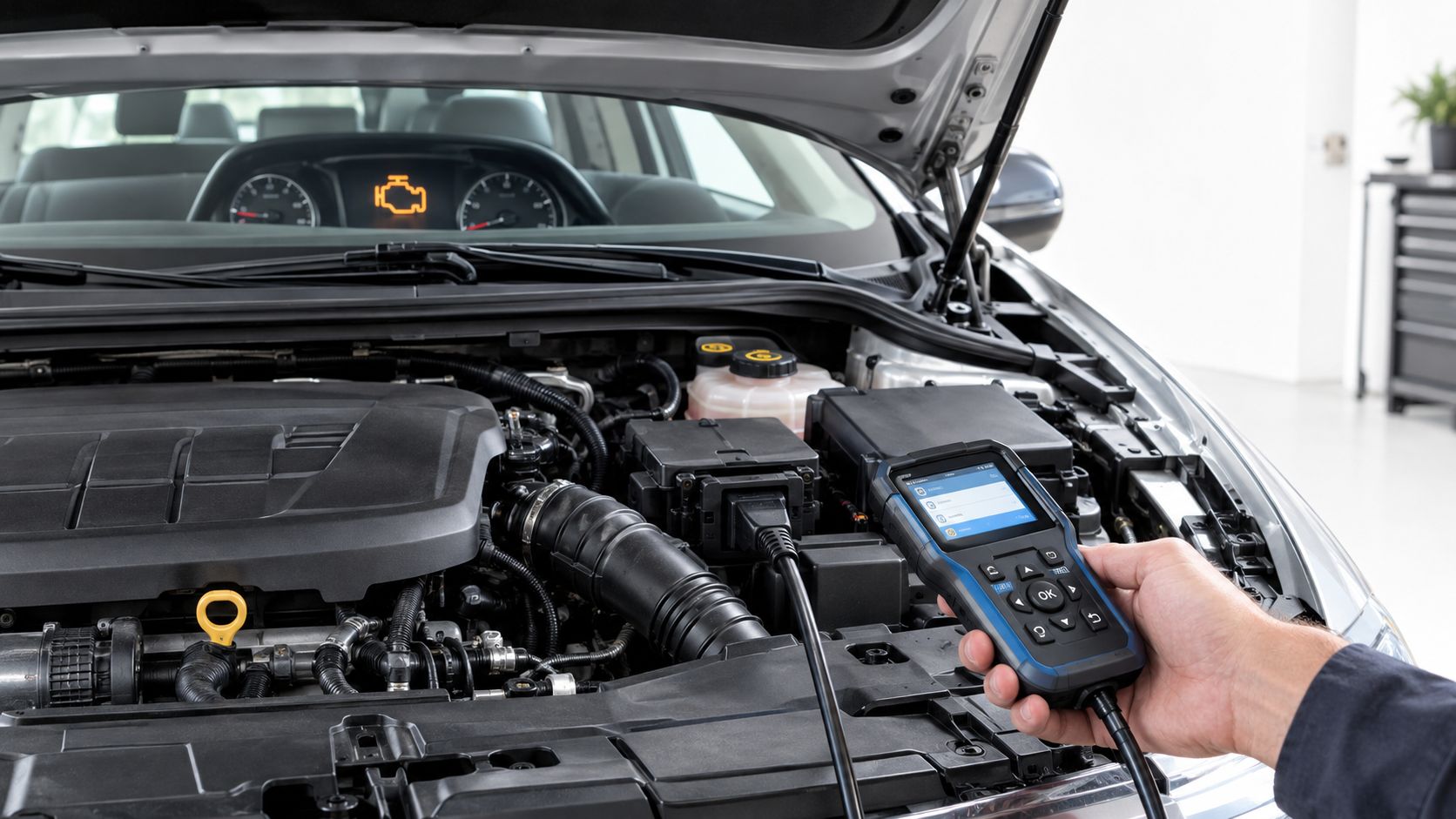
For instance, someone may buy a used car outside California or get a leased car back after service, only to discover that the battery was recently changed. The engine starts, the car drives normally, and there may be no warning light. But if the readiness monitors haven't completed their checks, the inspection may return an incomplete result rather than the pass the owner expected.
BAR advises drivers who recently disconnected or replaced a battery to drive normally for a week or two before testing so those monitors have time to reset (BAR guidance on Smog Check preparation). Clearing trouble codes just before an appointment can create the same problem: the warning might disappear temporarily, but the underlying issue may remain, and the monitors may still be incomplete.
Know the difference between incomplete and failed
An incomplete readiness result doesn't necessarily mean the car has failed because a component is defective. It means the system hasn't finished the checks needed for the inspection to determine readiness. A true failure can result from an emissions-system problem, including one indicated by the check-engine light.
If you're unsure, ask a repair professional to scan the vehicle before paying for a test. BAR's guidance on common reasons a vehicle can fail a Smog Check can also help you prepare questions. Don't assume turning off a warning light or clearing codes has fixed the issue.
A useful sequence is straightforward: check for warning lights, consider whether battery work or repairs happened recently, then book when the car is ready for testing. That's more reliable than using the appointment itself as a diagnostic step.
The following video offers another look at diagnostic checks and vehicle readiness.
What to Bring and How to Time Your Visit
Make the DMV notice your first stop when preparing for the appointment. Confirm whether the vehicle needs STAR testing and check that the notice's vehicle details match the car you'll bring. If someone else is taking the vehicle, make sure they know what the notice requires.
Bring the vehicle's registration and proof of insurance, and be ready to confirm its model year, fuel type, and configuration. Accurate vehicle information matters because the inspection system uses vehicle details to select the correct test parameters. If the recorded information is wrong, the station may need to correct it before the inspection can be completed properly.
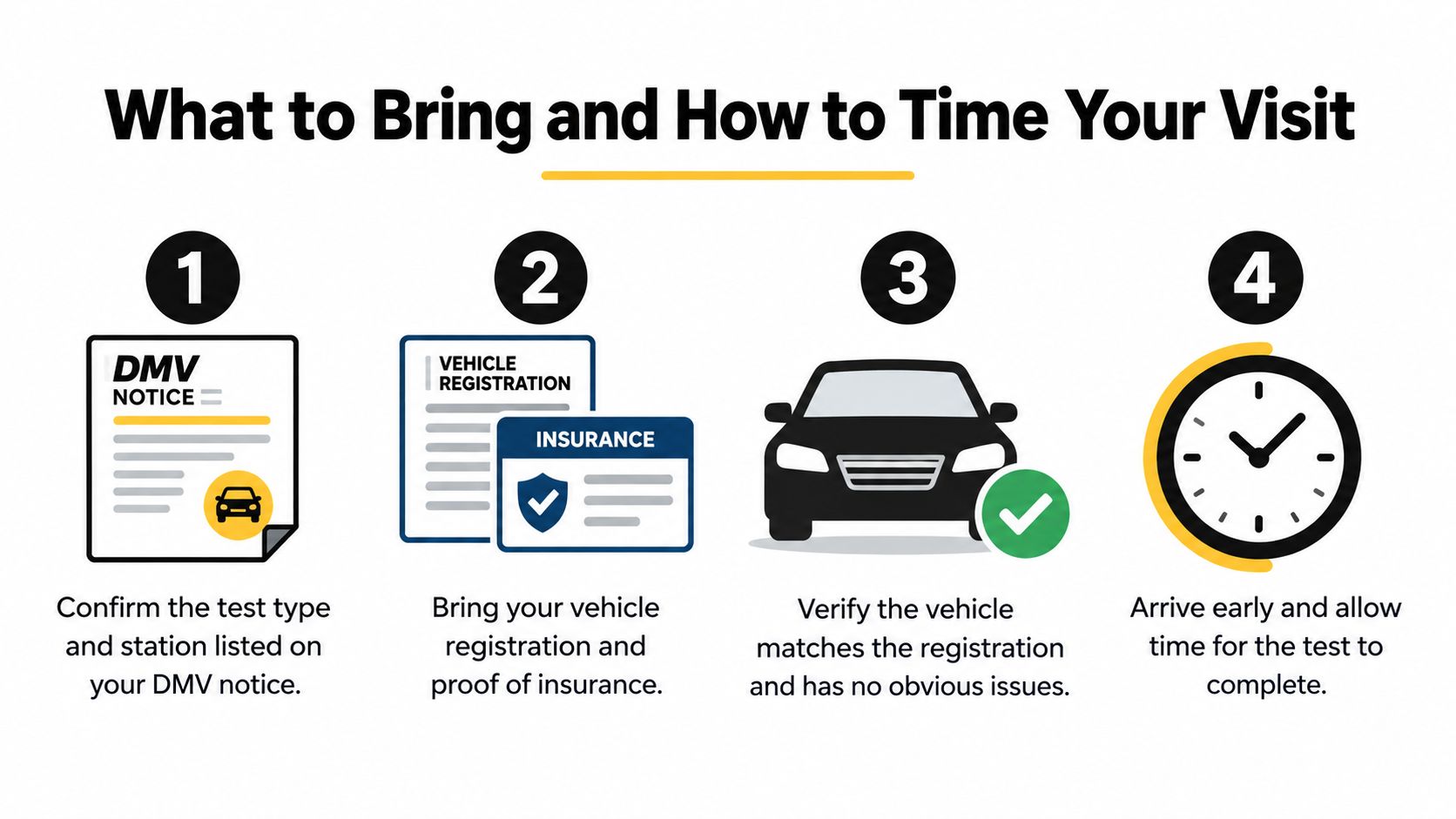
Choose a time that fits your day
If you're coming from Oakland Broadway, call ahead and ask about the likely wait for your particular test type. An early visit may suit a driver trying to avoid a busy period, but don't assume every station follows the same traffic pattern. Ask whether you need an appointment, whether the shop handles your vehicle, and how long you should allow.
Consider a 2017 hybrid whose owner sees a renewal notice requiring STAR testing. The owner should confirm STAR status, tell the station the vehicle is a hybrid, and avoid booking immediately after battery work. Those details matter more than choosing the shop that advertises the shortest visit.
The Smog Check preparation guide provides additional pre-visit guidance. If you're comparing costs, check whether a station currently offers a coupon for your vehicle type. Speedy Smog periodically advertises a $25-off coupon for most smogs on newer vehicles, so confirm the current terms before relying on it.
Before you leave, check:
- DMV instructions: Confirm whether the notice requires STAR.
- Vehicle details: Check that the car, fuel type, and model year are clear.
- Documents: Bring registration and proof of insurance.
- Readiness: Don't test immediately after battery work if monitors may need time to reset.
- Station fit: Confirm the shop can inspect your vehicle and the required test type.
If Your Car Fails, the Math Changes
If a vehicle fails, don't immediately pay for another test without understanding the result. First, keep the Vehicle Inspection Report. It records the inspection outcome and gives you and a repair shop a starting point for deciding what needs attention. Ask the station to explain whether the result was a failure or an incomplete test, and what the report says about the next step.
Your options may include a test-only station, which performs inspections but doesn't carry out repairs, or a test-and-repair station, which can diagnose and repair emissions-related issues as well as test the vehicle. The right choice depends on what the report shows, whether you have a mechanic you trust, and whether the vehicle may qualify for repair assistance.
Check assistance rules before paying for repairs
California's Consumer Assistance Program may provide qualified owners with up to $1,450 for emissions-related repairs on vehicles from model year 1996 onward, or up to $1,100 for vehicles from model years 1976 through 1995 (BAR Consumer Assistance Program repair assistance). The amounts are maximums, not automatic payments. Eligibility depends on program requirements, including a qualifying biennial inspection failure, and the vehicle can't have a tampered emissions system. A required STAR test-and-repair copayment also applies.
Some results, including aborted or manual-mode tests, don't qualify for assistance. That's another reason to preserve the report and check the program rules before authorizing work. The cheapest first test isn't always the least expensive route overall if you then need to arrange a separate diagnosis, repair, and retest.
Match the next step to the vehicle
For a newer gasoline car, use the inspection report to guide diagnosis, then ask whether assistance rules apply before approving emissions repairs. For a 1999-and-older vehicle, make sure the repair shop understands the tailpipe-testing path and the model-year requirements.
A diesel or hybrid owner should confirm that a prospective station and repair shop handle that vehicle type. If the DMV notice directs the vehicle to STAR, that requirement still governs where it can be tested. In each case, the sensible first move after a failure is the same: keep the report, clarify the result, and check eligibility before choosing between separate testing and repair services.
Where Broadway Drivers Usually End Up Going
A driver near Oakland Broadway usually has two workable paths: stay close to the corridor, or go a little farther for a station that matches the car. The better choice is the one that can legally run the exact inspection on the DMV notice. A shop can be five minutes away and still be the wrong stop if it lacks STAR authorization, cannot test a diesel, or uses the wrong method for an older gasoline vehicle.
Speedy Smog is a STAR Certified station at 15275 Washington Avenue in San Leandro. It tests newer and older vehicles, diesels, and hybrids, and typical tests for 2000-and-newer vehicles take about 10 to 15 minutes. The shop is open Monday through Saturday. Those details make it a practical option for drivers comparing a Broadway-area stop with a short trip to San Leandro, provided the station matches the vehicle and the DMV notice.
Compare the whole visit, not just the map
Distance is only the first filter. The question is whether the visit produces a result the DMV will accept. Ask three things before you go: Does the notice require STAR? Can the station inspect your model year, fuel type, and test method? If the car fails, will you need a separate repair shop anyway?
A fast advertised turnaround helps only when it applies to your vehicle and the lane is clear. A test-and-repair shop can save a second trip after a marginal result, while a test-only visit can keep the inspection independent if you already trust a mechanic. The cheapest coupon can also stop looking cheap if a failed result leads to a new diagnosis, a repair visit, and a retest at different addresses.
For an Oakland driver, the practical choice is the station that can legally inspect the vehicle and fits the day's needs. Verify authorization and vehicle fit first, then compare drive time and price.
Your Two Next Steps Before You Book
Start with the renewal deadline and count backward. If the date is still a few weeks out, a recently replaced or disconnected battery is a small problem: normal driving for a week or two lets the readiness monitors reset, as BAR advises. If the deadline is less than three weeks away and the battery was recently replaced, call the station today, describe the situation, and schedule the test for after the monitors reset.
When you call, give one complete sentence: model year, fuel type, and anything unusual such as a cleared check engine light. Then leave a buffer. A pass takes minutes, but a marginal result needs room for the Vehicle Inspection Report, a repair-assistance check, and a retest before the tags expire.
Speedy Smog offers STAR-certified smog testing in San Leandro for newer and older vehicles, diesels, and hybrids, with typical tests for 2000-and-newer vehicles completed in about 10 to 15 minutes. If you're comparing options for a Smog Check near Oakland Broadway, check your DMV requirements and vehicle details, then visit Speedy Smog.
If your DMV renewal notice says “Smog Certification Required at a STAR station,” only an inspection at a STAR-certified location will satisfy the requirement. An ordinary licensed smog shop won't count.
You're probably holding that notice, checking your calendar, and wondering whether the shop around the corner can handle it. Before you drive over, check something just as important as STAR certification: does the station only test vehicles, or can it also diagnose and repair them? That distinction won't matter much if your car passes, but it matters a lot if it doesn't.
Table of Contents
- What a STAR Smog Check Actually Means for Oakland Drivers
- Why STAR Stations Exist and How Big the Program Is
- Which Vehicles and Renewals Get Routed to STAR
- Inside STAR Certification, Equipment and Performance Controls
- STAR Test-Only Versus STAR Test-and-Repair in Oakland
- How to Prepare Your Vehicle Before the Inspection
- Choosing a STAR Station and Planning Your Next Move
What a STAR Smog Check Actually Means for Oakland Drivers
STAR is a station certification, not just another name for a smog check. It tells you that the business participates in California's higher-performance inspection framework. For your renewal, the important question is whether the station has the authorization your notice requires.
California's Bureau of Automotive Repair, or BAR, established the voluntary, performance-based STAR program in 2013, replacing the former Gold Shield and Test Only structure, as described in the DMV's smog inspection guidance. Don't confuse that historical program change with today's station categories. A STAR-certified business can still operate as a test-only station.
Translate the wording before choosing a shop
A directed vehicle is a vehicle the state routes to a STAR station, typically after risk-based screening identifies a need for additional oversight. Treat that direction as a requirement about where the inspection happens, not as a diagnosis of what's wrong with your car.
My recommendation is straightforward: start with the renewal notice, not a coupon or a search result. When you're comparing results for STAR smog check Oakland CA, confirm the station's certification before asking about price or availability.
- Read the inspection wording. Find the smog requirement on your renewal notice rather than relying on what you remember from your last renewal.
- Confirm the location's status. Ask whether the specific location you'll visit is currently STAR-certified.
- Explain what you need. Tell the shop you have a STAR-directed renewal and identify your vehicle before heading over.
The notice is the starting point for the decision.
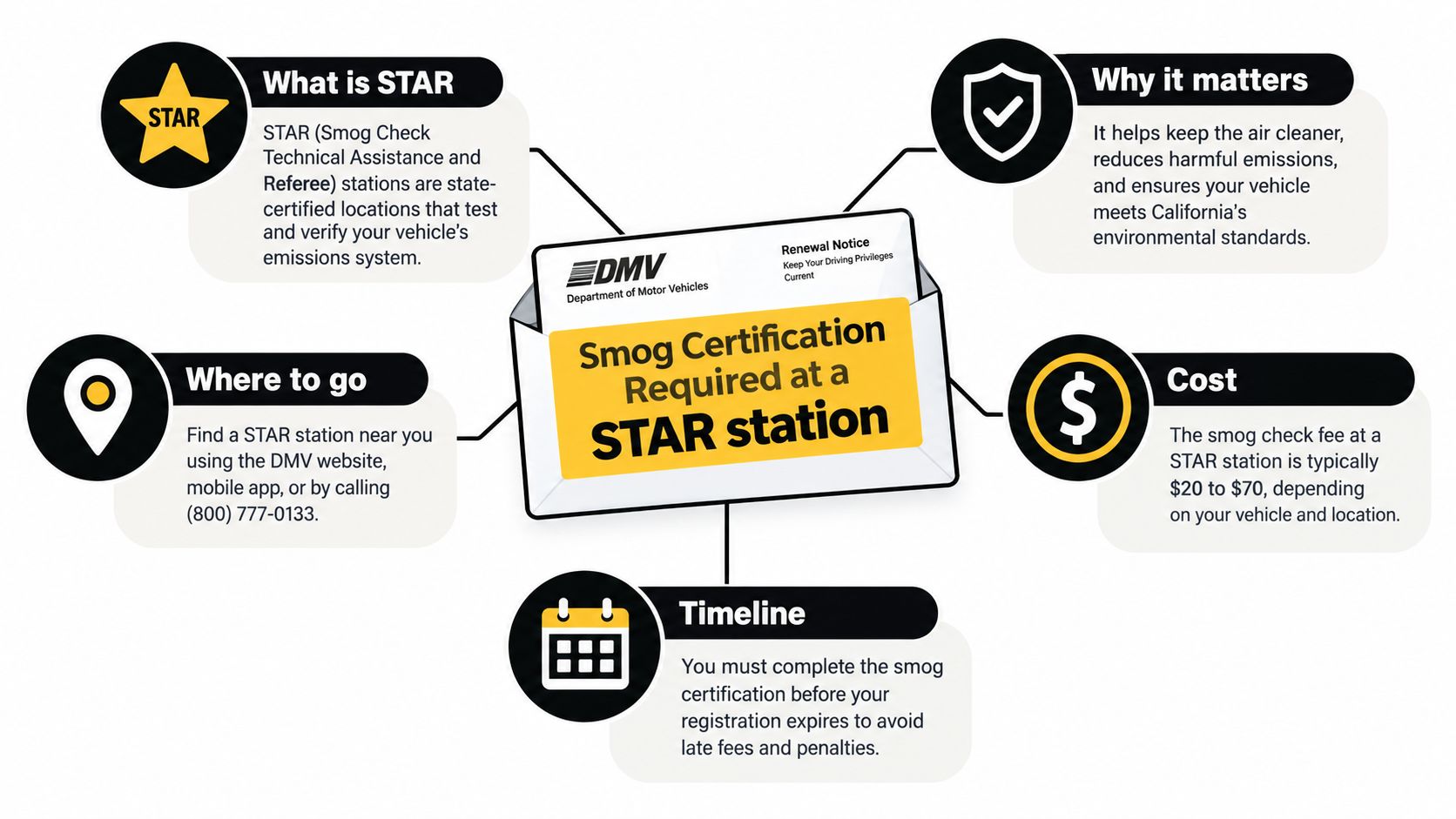
Don't read STAR as a promise that your car will pass. It describes the station's qualifications and authorization, not your vehicle's condition. A proper inspection gives you a result you can act on, even when that result isn't the one you wanted.
Why STAR Stations Exist and How Big the Program Is
STAR isn't a boutique designation used by a small corner of California's inspection industry. The program has handled a substantial share of statewide testing, which helps explain why the name appears so often in East Bay smog searches.
By December 2019, California had 7,902 licensed Smog Check stations, including 3,882 STAR-certified stations, or 49%; those STAR stations performed about 8.4 million of roughly 10.3 million initial inspections, approximately 82% of the statewide total, according to BAR's Smog Check performance report.
What that historical snapshot tells you
Fewer than half of the licensed stations handled more than four-fifths of the initial inspections in that reporting year. My reading is that STAR was already a central part of California's inspection infrastructure, not an unusual service drivers rarely needed.
That doesn't establish why every customer chose a particular station. The figures don't separate drivers following a DMV direction from drivers choosing STAR voluntarily. They also don't tell you how busy an Oakland shop is today or how long you'll wait.
Practical perspective: Use statewide figures to understand the program's importance, not to predict the queue at your neighborhood station.
The graphic provides a visual overview of the program. Use the dated BAR figures above, rather than illustrative totals in the graphic, for numerical comparisons.
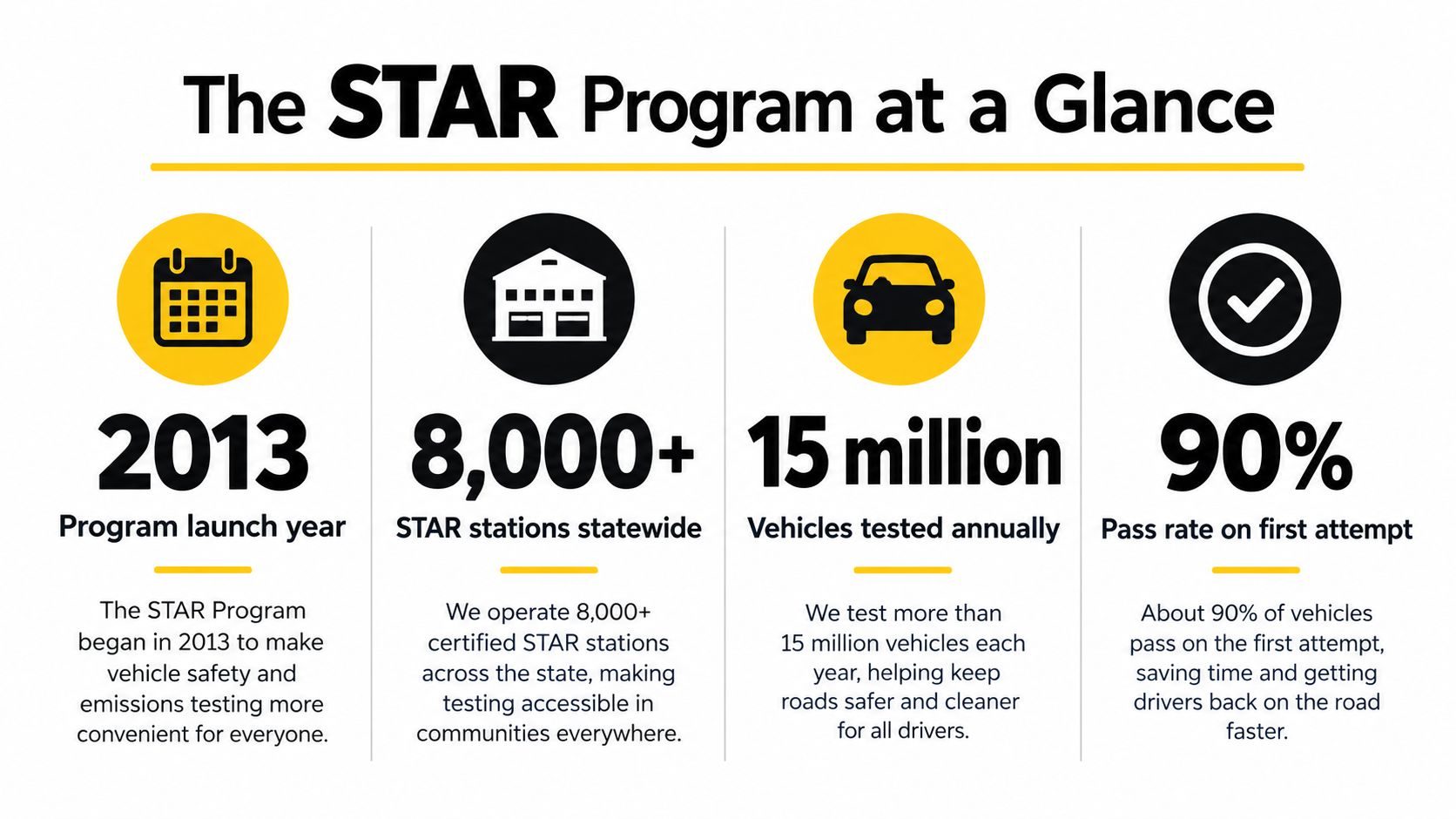
For an Oakland driver, the useful distinction is ordinary licensing versus additional performance monitoring. BAR uses STAR to identify stations within that monitored framework and authorize them to inspect directed vehicles.
Don't turn inspection volume into a claim that every STAR business offers the same experience. Certification doesn't answer whether a shop performs repairs, publishes a clear price, or has an appointment available when you need it. Those are separate questions, and you should ask them directly.
Which Vehicles and Renewals Get Routed to STAR
Your neighbor's renewal isn't a reliable guide to yours. Neither is the fact that your vehicle is older, newer, diesel-powered, or a hybrid. Read your own notice before deciding what inspection to book.
The state's directed-vehicle screening explains why some renewals carry a STAR instruction, but you shouldn't try to reconstruct that decision from your car's age alone. A direction to STAR tells you where to go. It doesn't tell you which component will fail or whether a repair is necessary.
Check the notice, then identify the vehicle
Use this pre-booking checklist to keep the conversation with the shop specific:
- Find the smog requirement. Read the actual renewal wording, including the area around the barcode. Don't substitute a generic reminder email for the notice.
- Separate STAR from other wording. If your paperwork doesn't specify STAR, don't assume the extra requirement applies. If the instructions are missing or unclear, confirm them with DMV before buying an inspection.
- Describe the vehicle accurately. Give the station the model year, make, and fuel type so it can confirm that it handles the appropriate inspection.
- Flag uncertainty early. Tell the shop if you're unsure which notice belongs to the vehicle or whether you're handling a renewal rather than another registration situation.
For broader context, review these California smog check rules, then use your vehicle-specific paperwork to make the booking decision.
Bring the notice and keep the report
During the inspection workflow, the inspector scans the renewal-notice barcode so the correct vehicle identification and inspection data are transmitted to DMV. You receive a Vehicle Inspection Report, commonly called a VIR, for your records.
Keep that report where you can find it. It's useful documentation whether you're finishing the renewal process or discussing an unsuccessful inspection with another provider.
Don't leave with only a verbal explanation. Keep the written inspection result.
For owners of older cars, the sensible approach is to discuss existing problems before testing. For diesel and hybrid owners, confirm the station handles the vehicle rather than assuming every shop has the same capabilities. Newer-vehicle owners should still follow their own paperwork, not a blanket statement that newer cars never need inspection.
Inside STAR Certification, Equipment and Performance Controls
A STAR badge reflects technical requirements, not just a business's decision to advertise emissions testing. BAR evaluates equipment readiness and inspection-performance measures, which is why the designation deserves more attention than a storefront sticker.
Under BAR's STAR certification requirements, a certified station must maintain at least one operational BAR-certified BAR-97 emissions inspection system and BAR On-Board Diagnostic Inspection System, or BAR-OIS, and equipment requiring calibration must pass calibration at least once every 10 calendar days. The performance thresholds in the table are part of those same requirements.
STAR Certification Performance Thresholds
| Metric | Required Threshold | What It Means |
|---|---|---|
| Similar Vehicle Failure Rate | At least 50% of the industry-wide failure rate for comparable vehicles | BAR compares the station's failure results with a comparable-vehicle baseline. |
| Gear-shift incidents | No more than 2% | The station must stay within the permitted incident limit. |
| Excessive Test Deviation Rate | No greater than one | BAR limits excessive deviations in testing performance. |
| Follow-up Pass Rate | At least 0.40 for the station or each applicable inspector | Follow-up inspection performance contributes to STAR eligibility. |
Don't mistake the Similar Vehicle Failure Rate for a quota requiring an inspector to fail your car. It's a comparative station-performance measure, not a prediction about an individual vehicle. Likewise, the Follow-up Pass Rate isn't your personal probability of passing.
What the controls mean for a customer
The equipment requirement matters because a station needs the appropriate operational systems, not an inspector willing to take the job. Calibration matters because applicable equipment must remain within BAR's required checks. Performance monitoring adds another layer beyond the fact that a business holds an ordinary license.
My advice is to judge STAR as evidence of regulated inspection controls, not as a guarantee of flawless customer service. You still need clear communication about the inspection price, the vehicle types accepted, and what the station will do if the result is unsuccessful.
- Ask about your vehicle. Confirm the station can inspect its model year and fuel type.
- Ask about its service category. Equipment and certification don't establish whether repairs are offered.
- Expect a documented result. The inspection should leave you with something concrete to review, not just reassurance.
You don't need to audit a shop's performance calculations yourself. You do need to understand that STAR is technical, and that choosing the right station involves more than spotting the word on a sign.
STAR Test-Only Versus STAR Test-and-Repair in Oakland
A STAR station is not automatically a repair facility. This is the distinction I'd settle before making an appointment, especially if the vehicle already has a warning light, a previous unsuccessful inspection, or an unresolved concern.
BAR distinguishes STAR test-only stations from STAR test-and-repair stations. Both categories can inspect directed vehicles, but test-only stations don't perform repairs, while test-and-repair stations combine inspection with repair services, as explained in BAR's Smog Check program guidance.
The practical difference is what happens after the result.
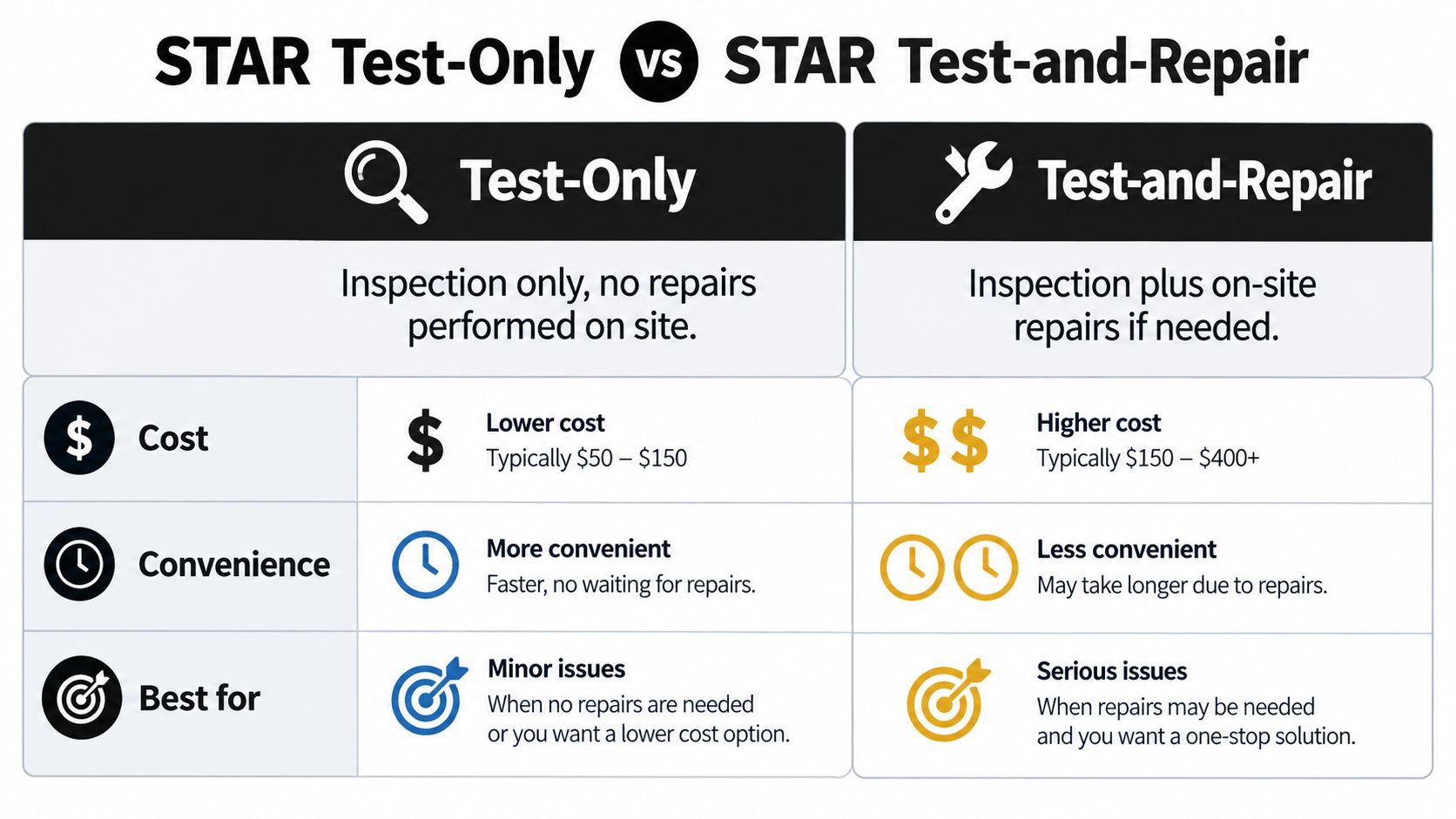
Choose based on the service you want
A test-only station makes sense when you want the inspection as a separate service and already have a repair provider you trust. If the vehicle fails, you'll need a separate repair plan. Don't expect the inspector to turn the visit into an on-site repair appointment.
A test-and-repair station makes sense when you want the possibility of diagnosis and repair at the same business. That can simplify coordination, but it doesn't mean you should authorize work without an explanation. Ask what diagnostic work is proposed, what it costs, and what the estimate includes.
| Your priority | Category to consider | Question to ask |
|---|---|---|
| Keep inspection separate from repairs | STAR test-only | What happens if the vehicle doesn't pass? |
| Seek inspection and repair at the same business | STAR test-and-repair | Can you diagnose this vehicle, and when is repair service available? |
| Avoid an unclear bill | Either category | What's included, and what would be charged separately? |
For a more focused comparison, use this explanation of STAR stations versus test-only stations. Don't choose by category alone, then forget to confirm the actual services available.
An unsuccessful test needs a plan
The equipment controls already discussed aren't optional. BAR warns that using the wrong inspection equipment can trigger a citation and order of abatement. A station shouldn't improvise a process just to accommodate the vehicle.
An unsuccessful result also doesn't mean the station can waive it or automatically repair the cause. Ask for an explanation tied to the written report before approving work.
Before authorizing repairs: Separate the inspection finding, the proposed diagnosis, and the repair estimate. They aren't interchangeable.
DMV identifies the BAR Referee Program as a next-step resource for failed-test customers and notes that eligible owners may receive repair help through the Consumer Assistance Program. Investigate those options when appropriate rather than assuming every unsuccessful inspection requires an immediate, open-ended repair authorization.
How to Prepare Your Vehicle Before the Inspection
Preparation starts with knowing whether you're bringing a vehicle for an inspection or bringing an unresolved problem that needs diagnosis first. Don't expect a quick visit to answer every maintenance question.
California recorded more than 11.2 million initial tests in 2025, with 959,667 initial failures, an 8.51% failure rate; STAR test-only stations performed 5,916,245 initial tests, with 481,639 failures, an 8.14% rate, according to BAR's statewide executive summary. Those figures establish that unsuccessful inspections occur, not that any particular preparation trick guarantees a pass.
A basic vehicle check is a sensible starting point.
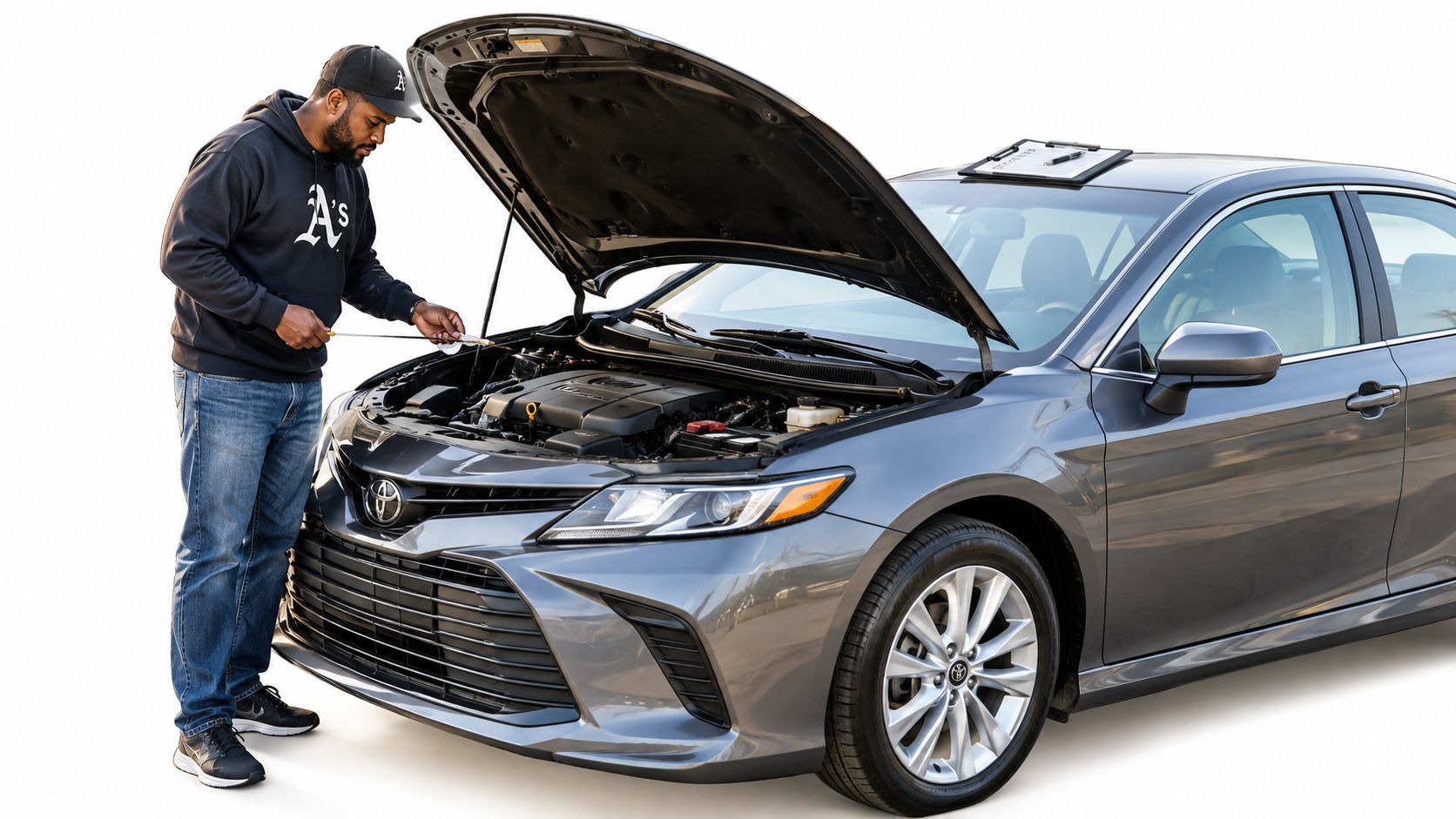
The day before your visit
- Discuss warning lights. If a dashboard warning is illuminated, tell the shop before booking. Ask whether diagnosis should come first rather than trying to hide the symptom.
- Review obvious maintenance concerns. Check for visible tire problems and, where applicable, a missing or damaged gas cap. Treat these as maintenance observations, not guaranteed explanations for a smog failure.
- Ask about arrival preparation. Get vehicle-specific advice on whether a normal drive before arrival is appropriate. Don't follow a universal warm-up routine copied from another vehicle.
- Gather your paperwork. Put the renewal notice somewhere you won't forget it, and bring relevant previous inspection or repair records.
For additional preparation guidance, consult this STAR smog test preparation guide before the appointment.
Use the video below as supplementary viewing, not a substitute for instructions specific to your car.
On the morning of the visit, ask about the current queue and total time you should allow. Inspection time and time at the shop aren't the same thing. Leave room in your schedule to hear the result and ask questions without rushing.
Choosing a STAR Station and Planning Your Next Move
Choose the station around the whole visit, not just the advertised inspection price. You need the correct authorization, the service category you want, and a clear explanation of what happens afterward.
An Oakland location may be convenient, while a nearby San Leandro station may fit your route better. Compare actual availability and services rather than assuming the closest search result is the right match.
Settle the practical details before driving over
- Get the complete price. Ask what's included, what's separate, and whether any advertised offer applies to your vehicle.
- Check the schedule. Confirm current weekday or Saturday availability and whether you need an appointment.
- Ask about waiting arrangements. If an indoor waiting area matters to you, verify it rather than relying on an old photograph.
- Establish the repair boundary. Know whether the business provides inspection only or can offer diagnosis and repairs.
After a passing result, keep your paperwork and confirm the remaining renewal steps. After an unsuccessful result, review the report and choose the next action deliberately: diagnosis, repair, or an appropriate state assistance resource.
A convenient inspection is useful. A clear plan for either result is better.
Don't leave this until the last moment if you can avoid it. Give yourself room to address a problem without making rushed decisions about repairs. The goal is a compliant renewal and a result you understand, not merely the shortest stop on your errands.
For Oakland drivers considering nearby San Leandro, Speedy Smog offers STAR-certified emissions testing with an indoor waiting area and service for older and newer vehicles, diesels, and hybrids. Visit its website to check current pricing and availability, then confirm your vehicle's inspection needs and the station's service scope before heading over with your DMV renewal notice.
The DMV envelope arrives, and the whole week suddenly has one extra errand attached to it. If you live in Oakland, that usually means figuring out whether your car needs a Smog Check, where to take it, and whether the notice is pointing you to a regular station or a STAR station. The easiest way to handle it is to treat the test like a small DMV project, not a mystery chore.
Table of Contents
- What Oakland Drivers Should Know Before Booking a Smog Check
- How California's Smog Check Program Works
- DMV Compliance and What Your Renewal Notice Means
- Vehicle Eligibility and How Model Year Changes the Test
- Preparing Your Vehicle the Week Before the Test
- What the Appointment Itself Looks Like
- Turnaround, Results, and What Happens If You Fail
- Putting It All Together for Oakland Drivers
What Oakland Drivers Should Know Before Booking a Smog Check
A smog check Oakland CA search usually starts the same way, with a renewal notice in hand and a deadline in front of you. That notice matters more than the shop sign outside, because it tells you what kind of inspection your vehicle needs and whether the state wants a higher-oversight station.
The fastest way to avoid a wasted trip is to answer five questions before you book. First, is the vehicle due for a Smog Check under California rules. Second, does the renewal notice call for a STAR station. Third, is your vehicle older, newer, diesel, or a hybrid, because that changes the test. Fourth, have you done the basic prep work in the days before the appointment. Fifth, do you know what the visit itself will look like.
Practical rule: the renewal notice is the real starting point, not the first shop result you find online.
That framing saves time because the state treats this as a registration step, not an optional maintenance add-on. For Oakland and East Bay drivers, the whole process is tied to DMV renewal, so the cleanest path is usually to read the notice, match the station type, and then book the right kind of inspection the first time.
How California's Smog Check Program Works
A smog check in California is part of the state's registration system, not a separate errand you handle on its own. The Bureau of Automotive Repair sets the rules for qualifying vehicles, and the inspection usually happens as part of renewal, so the DMV and the test move together. California Smog Check performance report
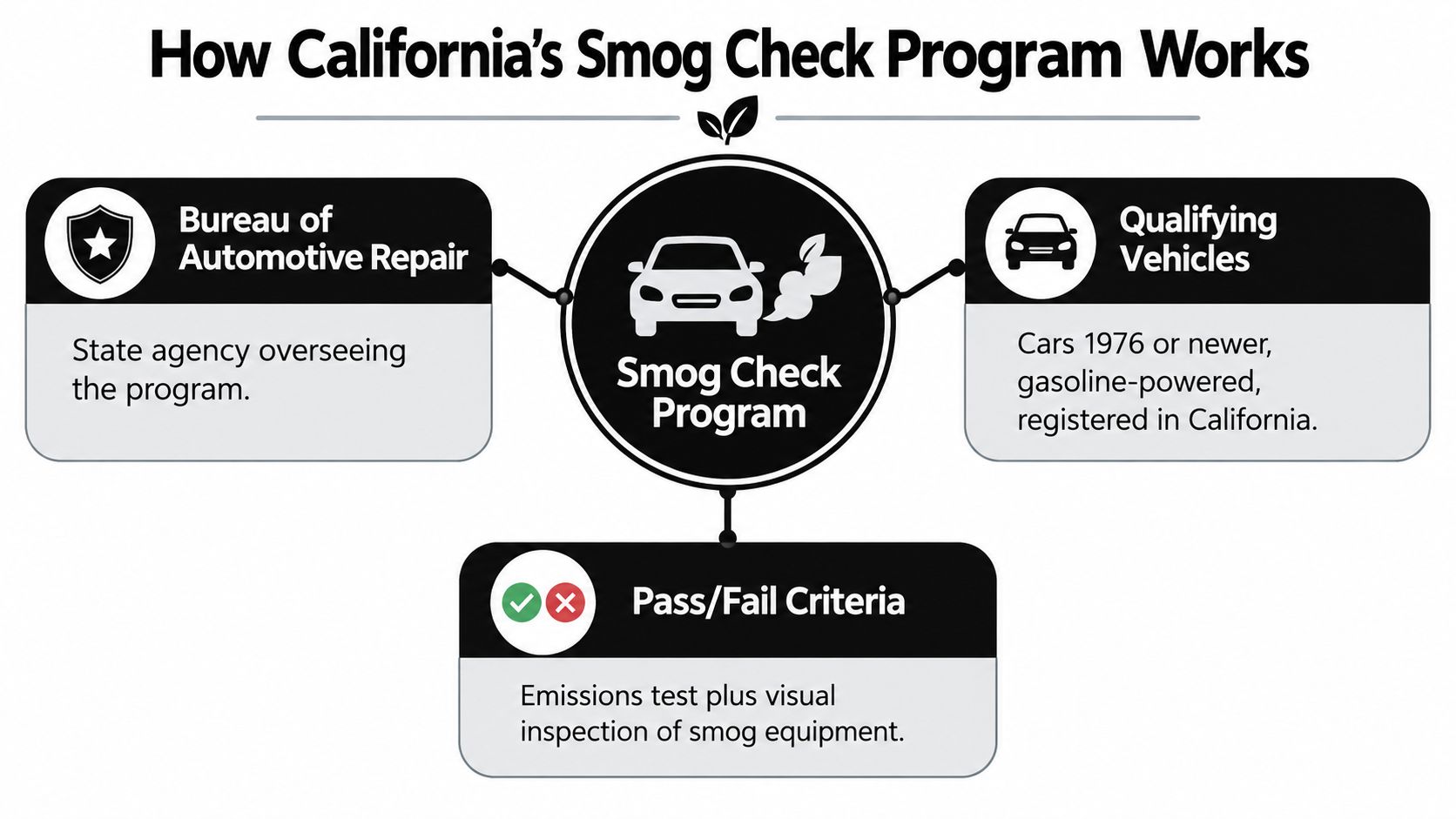
Why STAR exists
STAR certification creates a higher-oversight network for vehicles that need closer review. STAR stations are part of the state's testing framework, not just a marketing label, and California reported that by December 2019 there were 7,902 licensed Smog Check stations statewide, including 3,882 STAR stations, or 49% of the total. During calendar year 2019, roughly 10.3 million initial Smog Check tests were performed statewide, and about 8.4 million, or 82%, were completed by STAR stations, as reported in the same BAR performance report.
For an Oakland driver, the key point is simple. The rules do not change by neighborhood. Whether the car is tested in Oakland, San Leandro, or somewhere else in California, the result feeds into the same state reporting system and is sent to the DMV electronically. If the renewal notice calls for STAR service, the station must be authorized for that category or it cannot finish the certification.
DMV Compliance and What Your Renewal Notice Means
The renewal notice is where the DMV turns a general rule into a specific instruction. If it flags the vehicle for a Smog Check, the notice is telling you that registration renewal depends on a passing certificate, and if it identifies the car as directed or otherwise STAR-required, the wrong station can't complete the certification.
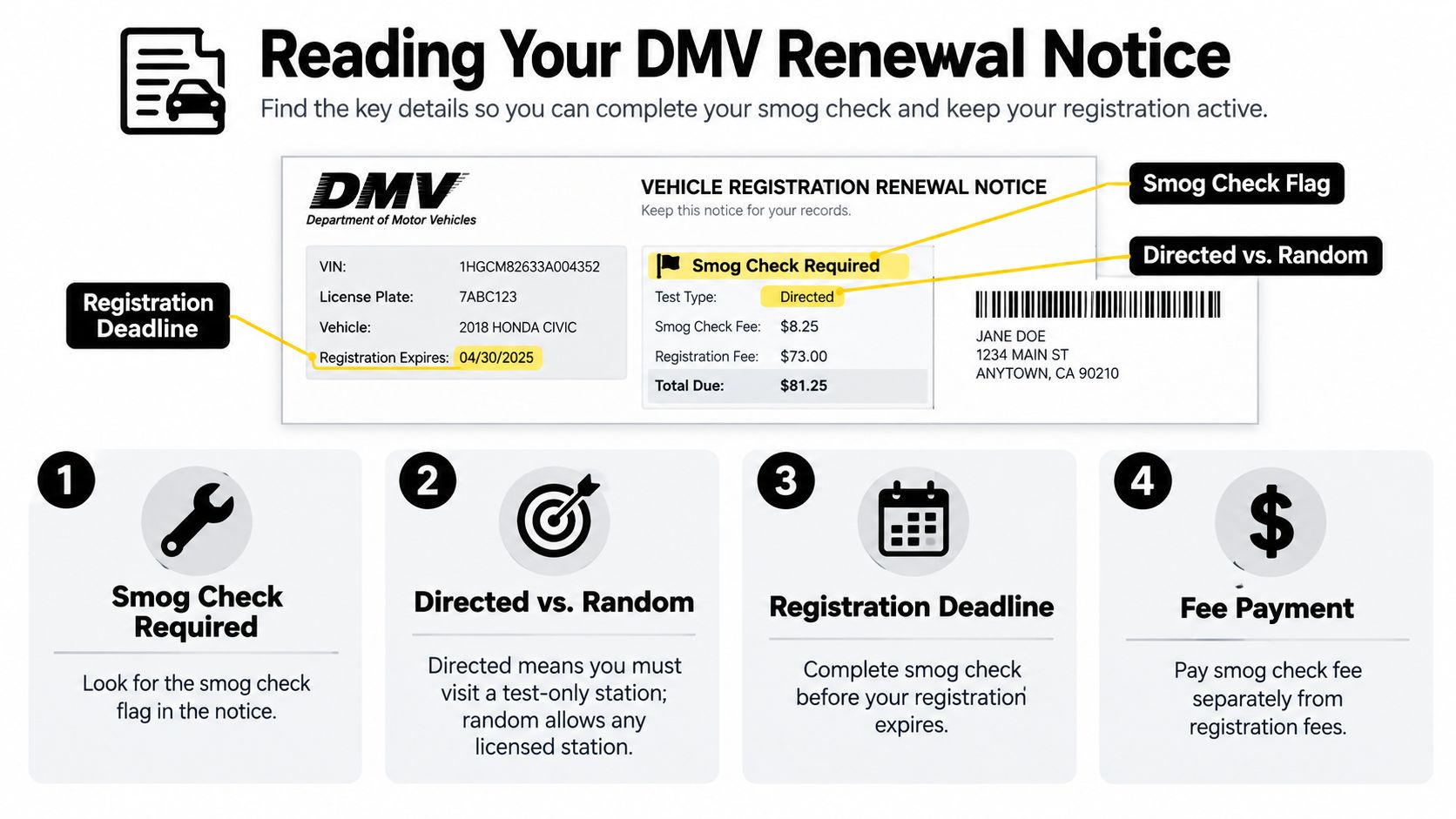
Regular station or STAR station
A STAR station is the one the state authorizes for vehicles that need enhanced oversight, much as a referral sends a patient to a specialist. A regular licensed station can handle many inspections, but STAR programs require these facilities to maintain compliant licenses, required inspection equipment, adequate inspection volume for statistical review, and specific performance measures, including a Similar Vehicle Failure Rate of at least 50% of the industry-wide failure rate for comparable vehicles and a gear-shift incident rate no higher than 2% of certified vehicles. STAR certification requirements
If your notice requires STAR service and you go to a station that isn't STAR-certified, you can lose time without moving the registration forward. That's why the notice deserves a close read before you book. If the wording is confusing, compare it with your registration status and, if needed, ask the station to confirm that the vehicle type on the notice matches its current authorization.
For Oakland-area drivers who want a plain-English walkthrough of renewal timing and station selection, this guide to registration renewal and smog check steps is a useful companion.
Practical rule: the renewal notice decides the station category first, and the appointment time second.
Payment usually follows the test result through DMV's electronic system, so the important thing is not to collect paperwork for its own sake. The important thing is to get the right certificate into the state system so registration can move ahead.
Vehicle Eligibility and How Model Year Changes the Test
Vehicle age changes the inspection path more than most drivers expect. California BAR says most 2000-and-newer gasoline and alternative-fuel vehicles get an OBD-based inspection, while pre-2000 vehicles generally receive a tailpipe emissions test instead. That's why two cars with the same renewal notice can end up going through very different checks.
What the model year tells the inspector
The state's 2025 executive summary shows why age matters. A 2024 vehicle recorded 100,305 initial tests and 4,538 failures, for an 4.52% overall failure rate. A 2010 vehicle recorded 314,125 initial tests and 28,718 failures, for 9.14%. A 2008 vehicle recorded 367,600 initial tests and 34,834 failures, for 9.48%. A 1998 vehicle had 100,885 initial tests and 19,185 failures, for 19.02%. 2025 Smog Check executive summary
| Model Year | Initial Tests | Overall Failures | Overall Failure Rate |
|---|---|---|---|
| 2024 | 100,305 | 4,538 | 4.52% |
| 2010 | 314,125 | 28,718 | 9.14% |
| 2008 | 367,600 | 34,834 | 9.48% |
| 1998 | 100,885 | 19,185 | 19.02% |
That table doesn't mean every older car will fail. It does show the pattern: as vehicles age, inspection risk rises. For drivers who want a practical breakdown of which cars fall into which testing path, this California smog check vehicle guide is a useful reference.
Why OBD readiness matters
For 2000-and-newer vehicles, the test isn't just a quick visual look. The inspector checks diagnostic trouble codes, emissions-system operation, and readiness monitors. BAR advises delaying the test after a battery disconnect or replacement because the monitors may still be incomplete, and it recommends driving the vehicle for roughly one to two weeks under varied conditions before retesting. California Smog Check guidance
A newer car can look fine and still be too early for the test if the monitors haven't set yet.
Preparing Your Vehicle the Week Before the Test
A passing result is often decided before the appointment day arrives. If the check-engine light is on, that's not a paperwork problem, it's a vehicle problem, and clearing the code right before the test doesn't fix the underlying fault. The car may still show incomplete monitors, which can still lead to failure.
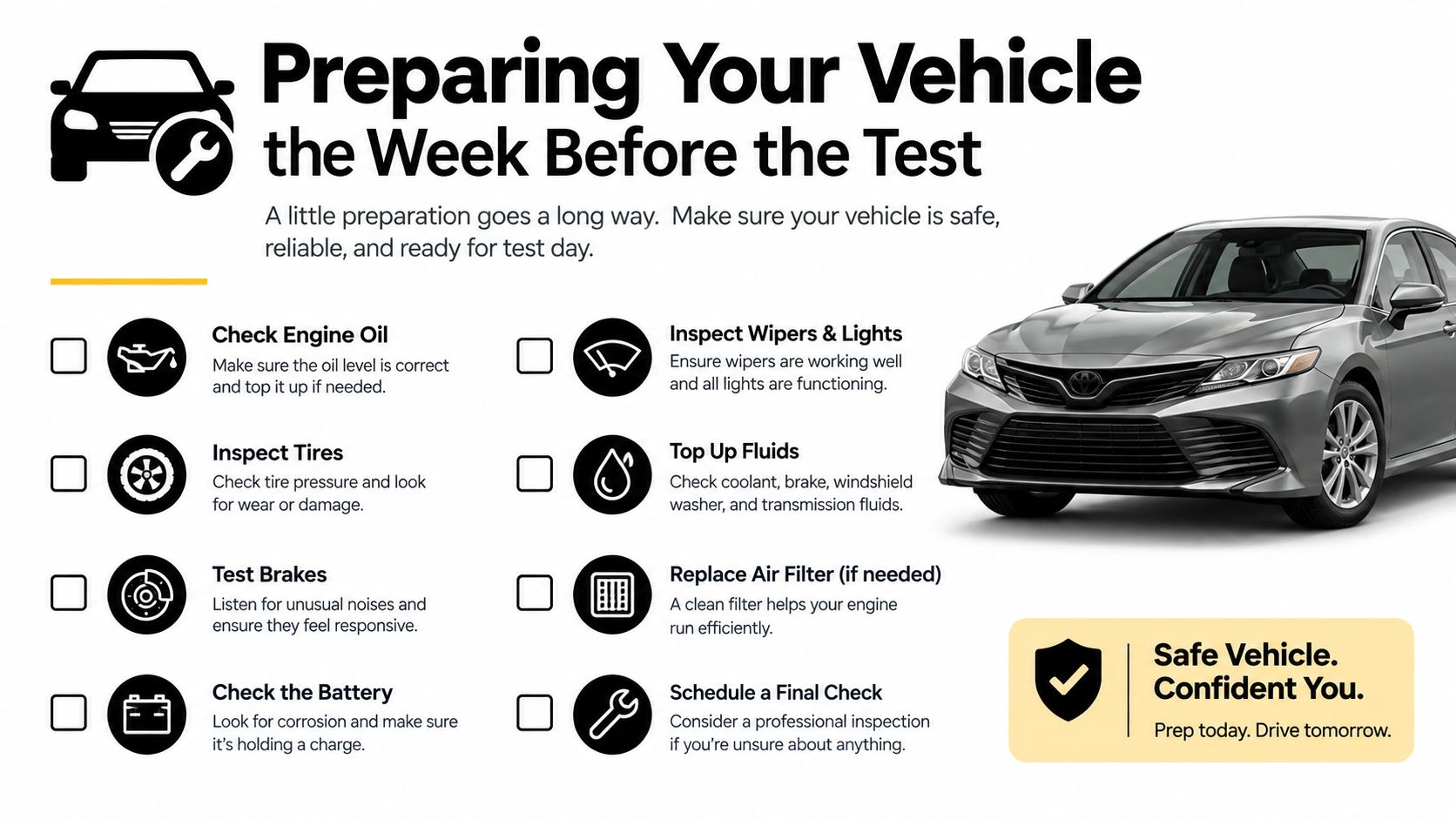
A simple prep routine
Think of readiness monitors like homework the car has to finish. You can't cram them into place five minutes before the test, and a battery disconnect is like erasing the assignment halfway through. The best preparation is boring in the right way.
- Watch the warning lights: If the check-engine light comes on during normal driving, fix the cause before you book the test.
- Drive normally: Mix city streets and steady-speed driving so the monitors can complete.
- Avoid last-minute battery work: A recent disconnect or replacement can leave the monitors incomplete.
- Warm the vehicle up: Arrive with the car at normal operating temperature, not just started a minute before.
- Bring the notice: Have the renewal notice and a payment method ready so nothing slows the check-in.
One more detail matters for Oakland drivers with older cars and diesels. If you've just had repairs, give the car enough time to settle into normal operation before the appointment. A clean run on paper doesn't help if the vehicle's diagnostic system hasn't had time to confirm that everything is working again.
Practical rule: repair first, drive second, test third.
What the Appointment Itself Looks Like
A typical visit feels more like a quick medical intake than a long repair appointment. You arrive, the station confirms the vehicle and paperwork, the inspector takes the car through the required test, and the result gets sent electronically to DMV. For 2000-and-newer vehicles, the test portion is commonly completed in about 10 to 15 minutes, which is why these visits often move faster than drivers expect.
What changes from one vehicle to another
The basic flow is the same, but the inspection time can stretch if the vehicle is older, if the test uses a tailpipe procedure, or if the station is busy. STAR status usually matters to the driver mainly in paperwork and eligibility, not in some dramatic visible difference at the counter. A STAR-certified shop such as Speedy Smog in San Leandro can handle the higher-oversight categories the state requires, including vehicles that need STAR authorization, while still testing many routine Oakland-area vehicles as part of the same DMV process.
The key point is that the station is not handing you a paper certificate to carry around. It's sending the result electronically, which is why the visit can feel short even though the compliance step is important. If the vehicle passes, you're done with the inspection piece. If it doesn't, the station should tell you what blocked approval so you can decide on repairs.
Turnaround, Results, and What Happens If You Fail
A passing result is useful because it clears the DMV hurdle right away. The station transmits the certificate electronically, and that certificate, not a paper receipt, is what helps unblock registration renewal. The old-style handoff of paperwork has mostly been replaced by instant digital reporting.
If the car fails
A failure doesn't end the registration process, it just means the car needs work before it can be certified. The inspection report is the starting point for diagnosis, and the next step is usually repair, then a retest once the vehicle is ready.
If you're trying to keep costs predictable after a repair visit, some stations offer discounts or coupons toward a return visit. One concrete example is the periodic $25-off coupons for newer vehicles mentioned by East Bay shops, which can soften the cost of a second trip after the underlying issue has been fixed. For a closer look at how stations present results and follow-up steps, see this smog test results guide.
The important thing is not to confuse a receipt with a certificate. The receipt shows you paid for the visit. The certificate is what the DMV cares about.
Putting It All Together for Oakland Drivers
The smartest move is to treat the renewal as three small jobs. First, read the DMV notice closely and confirm whether STAR service is required. Second, get the car ready by handling any warning lights, driving enough for monitors to set, and avoiding last-minute battery interruptions. Third, book a station that can legally handle your vehicle type and finish the certificate correctly.
That approach takes the uncertainty out of the process. The state rules decide the test type, the vehicle decides the inspection path, and the renewal notice decides the station category.
If you want a San Leandro station that handles Oakland-area renewals for routine inspections, STAR-required vehicles, diesels, hybrids, and older cars, Speedy Smog is set up for that workflow. Bring the notice, bring the car ready to test, and turn the smog check into one clean DMV task instead of a week of guesswork.
If you need a straightforward East Bay smog check with clear station guidance, Speedy Smog handles the inspection and electronic certificate process in one visit. Their team works with Oakland drivers, STAR-required renewals, and a range of vehicle types, so you can get the DMV step finished without extra back-and-forth.