You're in Rocklin, your DMV renewal notice is on the counter, and the registration deadline is getting close. The first question isn't “Which shop is closest?” It's whether your vehicle needs a Smog Check and whether the DMV requires a STAR station. Get that decision wrong, and you can waste a trip even if the vehicle runs perfectly.
California's program is broad, recurring, and tightly connected to registration. A successful visit starts with reading the notice, checking your vehicle's eligibility, and preparing the emissions system before the technician begins. Use the steps below to approach a Smog Check in Rocklin with the right paperwork, the right station, and a much better chance of finishing the process without a second visit.
Table of Contents
- What a Rocklin Driver Needs Before Booking
- STAR vs Non-STAR Stations and Why It Matters
- Finding a Rocklin Shop, Booking, and What to Bring
- Pre-Test Prep That Improves Your Odds
- What Happens During the Test and How Long It Takes
- If You Fail, Here's Exactly What Comes Next
- Rocklin Smog Check Checklist and Trusted Resources
What a Rocklin Driver Needs Before Booking
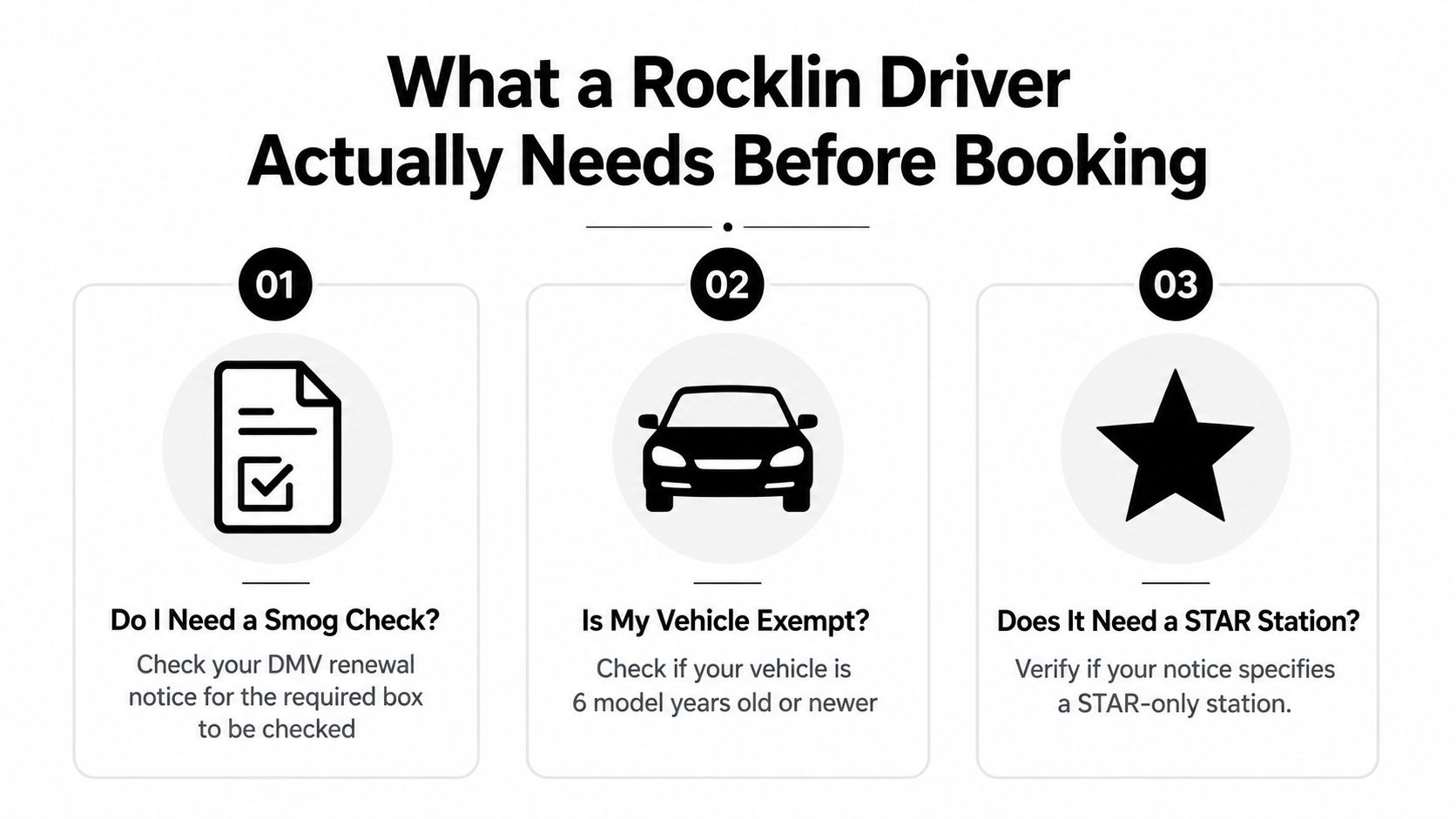
Your Rocklin renewal notice is the starting point. Before calling a shop, confirm the vehicle's fuel type, model year, and the reason for the DMV transaction. California generally requires Smog Check for gasoline-powered, hybrid, and alternative-fuel vehicles from model year 1976 onward. Diesel vehicles from model year 1998 onward generally require testing when their gross vehicle weight rating is 14,000 pounds or less. The California Bureau of Automotive Repair outlines these rules in its official Smog Check brochure.
The notice controls your current registration task. It states whether a Smog Check is required and may specify a STAR station. Read its exact wording instead of relying on an old receipt, a shop advertisement, or someone else's experience. Requirements can vary by vehicle, county, registration event, and notice language, including the instructions on a Placer County renewal notice.
Make the two decisions before you call
First ask, “Do I need a test?”
- Biennial renewal: Gasoline, hybrid, and alternative-fuel vehicles that are 8 model years and newer are exempt from the biennial Smog Check requirement under BAR's general rules.
- Change of ownership: Vehicles that are 4 model years and newer are generally exempt from the change-of-ownership test, although other registration requirements can still apply.
- Diesel vehicles: Eligible diesel vehicles remain covered without the same model-year exceptions that apply to gasoline-powered vehicles.
- California registration: A test can be required when a vehicle is first registered in California or changes ownership, not only during routine renewal.
Then ask, “Does it have to be STAR?” Look for wording that directs you to a STAR-certified station. If the notice requires STAR, select that station type before booking. If it calls for a Smog Check without that instruction, a licensed non-STAR station may be able to complete the inspection.
Practical rule: Read the DMV notice first, then choose the station. Searching by location alone can send you to the wrong type of shop.
STAR vs Non-STAR Stations and Why It Matters
The right Rocklin station depends on one line in your renewal notice. A licensed Smog Check station and a STAR-certified station can perform different assignments, so choosing by location or advertising alone can waste your trip.
STAR is California's higher-standard inspection network, established under Assembly Bill 2289 in 2010 to improve inspection quality and support required emissions reductions. BAR's statewide report lists STAR stations as representing 49% of licensed stations while performing 83% of all Smog Check tests in 2025. Those figures appear in BAR's Smog Check performance report, which documents the network's statewide role.
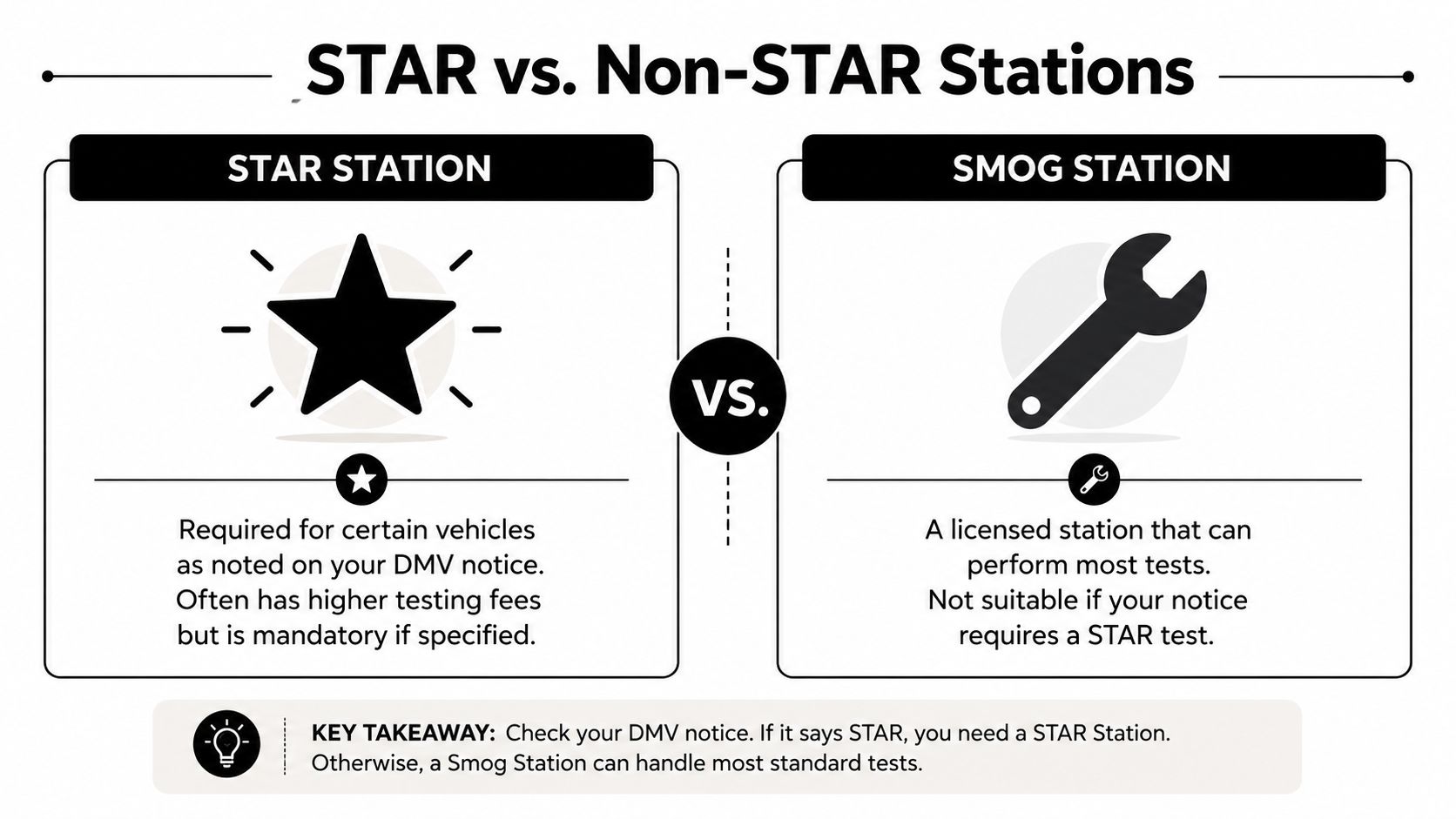
STAR certification does not make STAR mandatory for every vehicle. Your DMV notice controls the requirement for your transaction, including renewal instructions issued in Placer County.
Match the station to the notice
If the notice requests a Smog Check without naming STAR, a regular licensed station may be able to complete the inspection. If it directs you to a STAR facility, book with a STAR-certified station. STAR facilities also inspect certain enforcement-related vehicles, including directed vehicles and vehicles designated as gross polluters, under program rules. BAR's Smog Check consumer guidance explains how station selection works.
Read the notice to the service adviser before booking. Ask: “Does my notice require a STAR-certified station?” A shop displaying Smog Check signage may not handle a STAR-only assignment.
For a clearer explanation, review what a Smog STAR station is. Use this decision rule:
- Notice requires STAR: Book a STAR-certified station.
- Notice does not require STAR: A licensed station may be enough.
- Notice is unclear: Confirm with the DMV or a station listed through BAR's official station search.
STAR is common around Rocklin, so finding an authorized location should be practical. Certification still does not replace checking the notice, your vehicle's assignment, and the station's appointment details. Choose the authorization first, then compare convenience and availability.
Finding a Rocklin Shop, Booking, and What to Bring
Start with the service you need, then choose the shop. Use BAR's official station locator to compare Rocklin locations and confirm the station's license and STAR status. The notice determines the authorization. Convenience comes second.
Before booking, check reviews for practical details: clear pricing, accurate paperwork, short waits, and explanations after a failure. Vague praise is less useful than comments describing the inspection itself. For a straightforward comparison of local options, read this Rocklin smog test service guide before calling.
Book the appointment around your vehicle
Reserve a time when your renewal deadline is close, your notice requires STAR, or you are bringing a diesel, hybrid, older, or imported vehicle. Those vehicles may require questions before the test. A walk-in can suit a routine inspection, but call first and confirm the shop can take you.
Ask these questions before leaving:
- Vehicle coverage: Does the shop test your fuel type, model year, and vehicle class?
- STAR status: Is the location STAR-certified if the notice requires STAR?
- Price transparency: What does the inspection include, and can additional fees apply?
- Electronic reporting: Will the result be submitted electronically to the DMV?
- Paperwork requirements: Should you bring the renewal notice, transfer documents, or a previous certificate?
Bring the DMV renewal notice or transfer paperwork, valid identification, and your payment method. If you recently bought the vehicle, bring any prior Smog Check certificate or transaction paperwork available. The technician may not need every document, but missing paperwork can delay the transaction.
Confirm the arrival time, expected wait, and payment options while booking. Then keep the appointment details with your documents, so the station can verify the vehicle and report the result without avoidable back-and-forth.
Pre-Test Prep That Improves Your Odds
Before booking, check OBD-II readiness on 2000 and newer vehicles. BAR's 2025 executive summary reports OBD-II-related failure rates of 6.84% for OIS stations and 9.36% for BAR-97 stations, as shown in the BAR 2025 Smog Check executive summary. Those figures make a readiness check a better use of your time than relying on how smoothly the car drives.
The check-engine light must be off, and the readiness monitors must have completed their self-tests. A recent battery replacement, battery disconnection, erased trouble codes, or emissions repair can leave monitors incomplete after the warning light goes out. Use an OBD-II scan tool, or ask a repair shop to check the status before you schedule the final inspection.
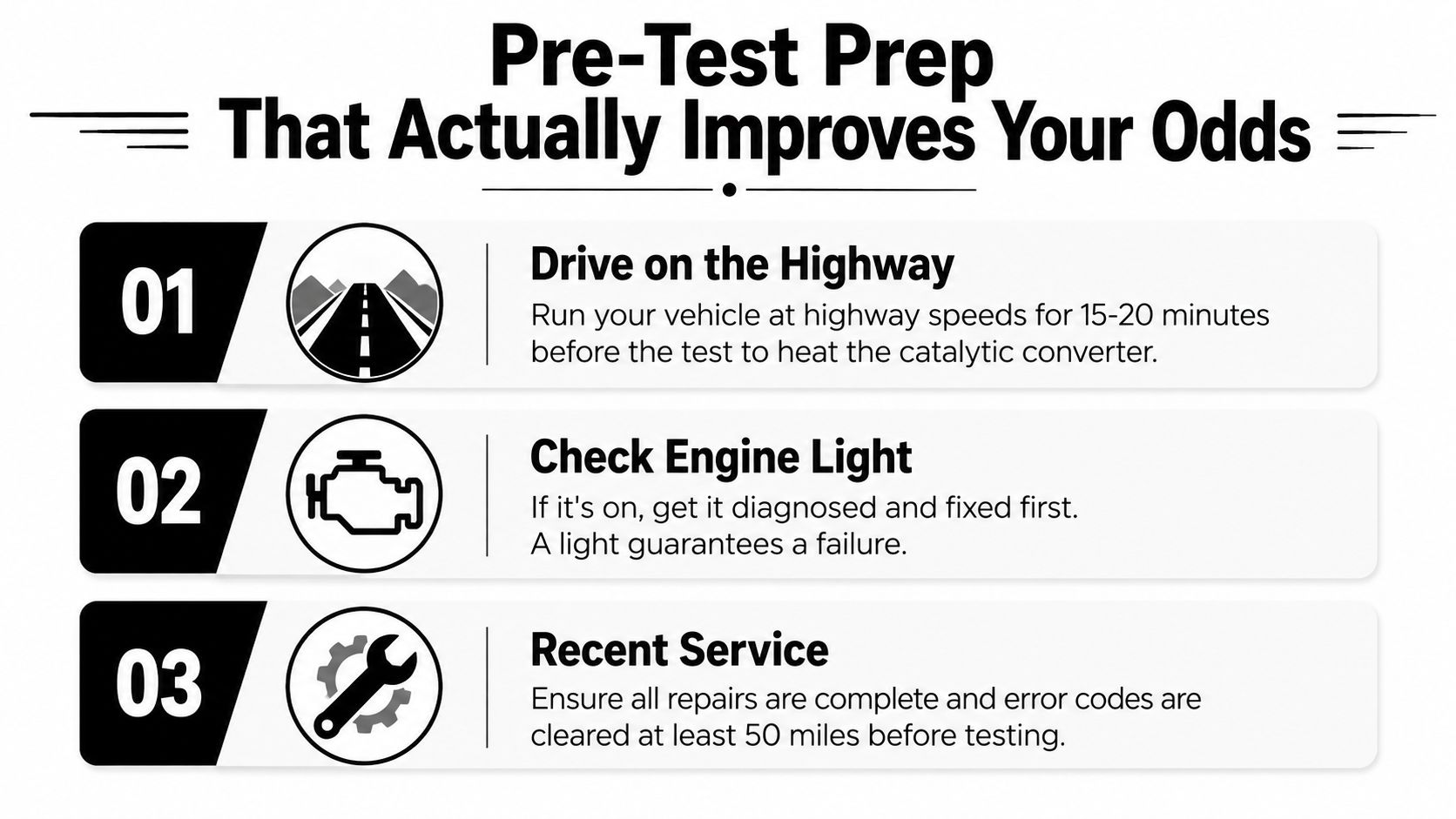
Do not clear codes just before the appointment. Clearing them resets the monitors, and the vehicle may need normal driving in varied conditions before it reports “ready.” If the light is on, book diagnosis and repair first, not certification.
On test day, drive normally long enough to warm the engine and catalytic converter. Steady cruising mixed with ordinary stop-and-go driving helps more than idling in the driveway. Check these items before leaving:
- Repair status: Finish emissions repairs, and confirm the repair worked instead of treating code clearing as proof.
- Battery history: Tell the technician about a recent disconnection or replacement.
- Exhaust condition: Repair a damaged or visibly leaking exhaust system before inspection.
- Tires and fuel: Keep the vehicle safe to operate and follow the technician's fuel-level instructions.
- Service records: Bring invoices or diagnostic notes from recent emissions work.
For more preparation guidance, review this guide to passing a STAR Smog Test. Verify readiness, keep the warning light off through a real repair, and arrive with the vehicle warmed up.
What Happens During the Test and How Long It Takes
The technician begins by confirming the vehicle and paperwork, then selects the correct inspection procedure. For 2000 and newer vehicles, the central task is usually an OBD-II inspection. The technician connects a scan interface to the vehicle's diagnostic port, checks stored emissions-related information, reviews readiness monitors, and verifies the malfunction indicator light status.
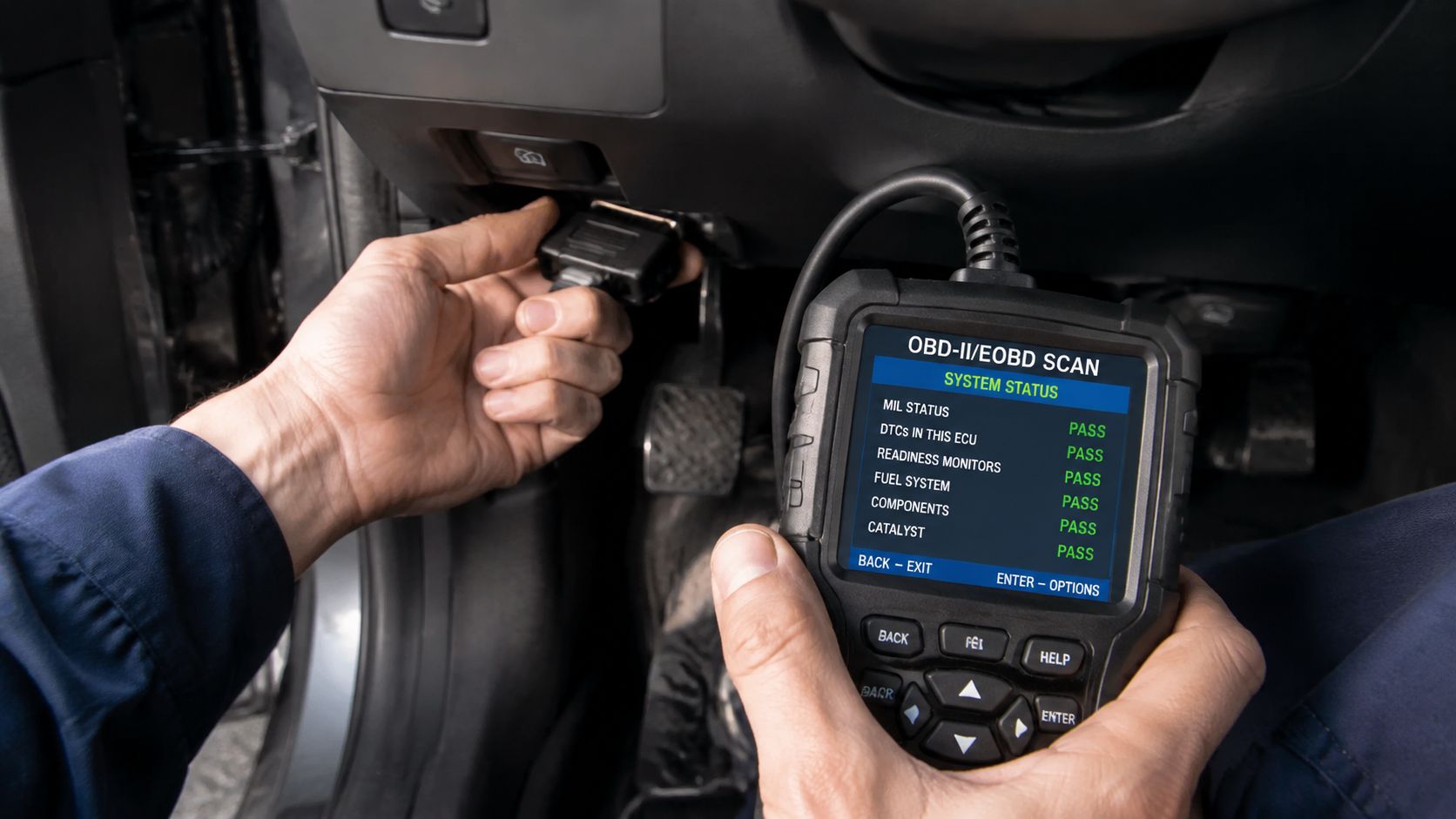
The technician also checks required emissions equipment and confirms that the vehicle identification information matches the record. A car that drives smoothly can still fail if the computer reports an emissions fault or the monitors aren't ready. That's why preparation matters more than a quick visual impression of how the engine sounds.
Older and diesel vehicles follow a different path
Vehicles from 1999 and older may receive a tailpipe emissions inspection using a dynamometer or loaded-mode procedure, along with visual and functional checks of emissions components. Many diesel inspections also involve equipment and procedures that differ from a modern gasoline OBD-II test. Tell the station the exact vehicle details before you arrive so the shop can confirm it has the proper equipment and authorization.
A modern inspection at an efficient shop can move quickly once the vehicle enters the testing area. Older, diesel, directed, or problem vehicles may take longer because the technician has more equipment checks and documentation to complete. Don't book an appointment with only the assumption that every Smog Check follows the same sequence.
This short OBD-II Smog Check video gives drivers a visual reference for the diagnostic connection and inspection process.
After a passing result, the station submits the Smog Check outcome electronically to DMV. You should still keep your paperwork and follow the renewal instructions, but you generally won't need to carry a paper certificate from office to office when the result has been transmitted correctly.
If You Fail, Here's Exactly What Comes Next
A failed result isn't a diagnosis by itself. It's a compliance result that tells you the vehicle didn't meet one or more inspection requirements. The report should identify the failure category, diagnostic information, and the next practical direction. Ask the technician to explain the report in plain English before authorizing repairs.
A “not ready” result differs from a confirmed emissions failure. The vehicle may have an incomplete monitor after a battery disconnect, code clearing, or recent repair. In that situation, the correct next step may be a prescribed drive cycle and another inspection, not an expensive parts replacement. A confirmed failure, by contrast, requires diagnosis of the system identified on the report.
BAR's 2025 executive summary recorded an overall initial-test failure rate of 8.51% across 11,275,981 initial tests, showing that failure is a routine part of a large enforcement program, not proof that your vehicle is beyond repair. The same report states that about 1.3 million of 19 million 2000-and-newer vehicles tested in the 2024 to 2025 cycle failed, or roughly 7%. Use those figures as context, not as a prediction for your specific car.
Match the failure to the repair conversation
| Failure Category | Typical Cause | What a Shop Will Likely Check |
|---|---|---|
| Check-engine light or stored code | An active emissions-related fault | Diagnostic trouble codes, sensors, wiring, vacuum leaks, and the affected emissions system |
| Not-ready monitors | Battery disconnection, code clearing, or incomplete drive cycle | Monitor status, recent repairs, manufacturer drive-cycle conditions, and additional diagnostic results |
| Excess emissions | Catalytic-converter, fuel-control, ignition, or air-management problem | Emissions readings, fuel trims, misfires, oxygen sensors, and catalytic-converter performance |
| Missing or altered equipment | Removed, disconnected, or improperly installed emissions components | Required labels, hoses, controls, converters, and visible emissions hardware |
| Visual or functional failure | A component doesn't operate as required | Gas cap, warning indicators, emissions controls, and inspection-specific functions |
Keep every repair receipt. Ask the repair shop to document the diagnostic findings, replaced parts, and whether the monitors were allowed to reset properly afterward. Don't approve a catalytic converter or other high-cost repair based only on a generic code. A trouble code identifies a monitored problem, but the technician still needs to determine why the system set it.
If you qualify, California's consumer assistance options may help offset repair costs through the state's assistance program. Review eligibility through BAR before authorizing work, and ask the testing or repair facility whether it participates in the required process. After repairs, schedule the retest with the station and confirm its retest policy, because the cost and conditions can vary by shop.
Rocklin Smog Check Checklist and Trusted Resources
Use this phone-sized checklist before you book:
- Read the DMV notice. Confirm whether the renewal or transfer requires a Smog Check.
- Check exemptions. Review the vehicle's model year, fuel type, and transaction type.
- Confirm STAR status. Use the BAR Find a Station tool or call the station if the notice requires STAR.
- Prepare OBD-II vehicles. Make sure the warning light is off and monitors report ready before the appointment.
- Bring paperwork. Carry the notice, transfer documents, identification, payment method, and relevant service records.
- Ask for clear reporting. Confirm electronic DMV submission and request an explanation of any failed item.
- Keep repair records. Save invoices and diagnostic details in case a retest or assistance application is needed.
For DMV-specific renewal status and transaction instructions, use your California DMV renewal information. For repair-cost support, review BAR's consumer assistance program information. These official resources are more reliable than a generic local search result when eligibility or STAR direction is unclear.
A smooth Rocklin visit comes down to three choices: verify the notice, use the correct station, and prepare the vehicle's emissions computer before testing. Choose a shop that explains pricing, handles your vehicle type, submits results electronically, and treats a failure report as a diagnostic starting point rather than a sales opportunity.
Speedy Smog provides STAR Smog Checks and diesel inspections with electronic DMV result submission, including service for newer vehicles, older vehicles, hybrids, and qualifying diesel vehicles. Confirm your notice and vehicle details before booking, then visit Speedy Smog to arrange an inspection that fits your registration task.