
You open the DMV renewal notice expecting a routine deadline. Instead, it asks for a smog certification, and suddenly the questions start: Does your diesel truck follow federal EPA rules, California Air Resources Board requirements, or both? Will the inspection check only the check-engine light, or will a technician examine the exhaust system itself? And what happens if the vehicle passes on paper but still has a damaged diesel particulate filter?
For California diesel owners, diesel emissions standards aren't just environmental policy. They affect registration, repairs, equipment modifications, and whether you can legally keep driving the vehicle. The rules have tightened in stages, and the correct path depends heavily on the vehicle's model year, class, emissions equipment, and actual condition.
Table of Contents
- Why Diesel Emissions Standards Matter for Your Registration
- What Diesel Emissions Standards Measure
- EPA vs CARB and How California Goes Further
- How Diesel Emissions Limits Have Tightened Over Time
- What Happens During a Diesel Smog Check in California
- The Gap Between Lab Certification and Real-World Performance
- How to Prepare Your Diesel Vehicle for a Smog Test
Why Diesel Emissions Standards Matter for Your Registration
A registration renewal can turn an emissions question into an immediate transportation problem. If the DMV requires a smog certification and your diesel fails, you may not be able to complete the renewal until the reported defects are repaired and the vehicle passes a follow-up inspection.
That doesn't mean every diesel vehicle faces identical testing. California requirements vary by vehicle type, model year, and applicable emissions program. A newer diesel may rely heavily on an OBD inspection and visual verification of its emissions equipment, while an older truck may receive closer attention for visible smoke, tampering, and equipment condition.
The registration connection
The practical sequence is straightforward:
- The DMV identifies a smog requirement. Your renewal notice or registration transaction tells you whether certification is needed.
- A licensed station performs the inspection. The technician checks the systems and components required for your vehicle.
- The result is transmitted for registration purposes. A passing certificate supports the DMV transaction. A failure means you need diagnosis and repair before certification.
- You resolve any failure items. That might involve an emissions fault code, a missing component, excessive smoke, or a malfunctioning aftertreatment system.
California's approach is stricter than a simple visual glance at the tailpipe because modern diesel controls work as a connected system. A truck can run normally from the driver's seat while a failed sensor, exhaust leak, or disabled control module allows excess pollutants to escape.
Practical rule: Don't wait until the registration deadline to discover that an emissions component has been removed or that the dashboard warning light has returned.
A failed inspection can create more than an inconvenient second visit. You may face delayed registration, repair costs, and the risk of continuing to drive without resolving a defect that can damage other parts of the emissions system. The safest approach is to treat the smog check as a maintenance checkpoint, not as a last-minute formality.
For an East Bay owner, the useful question isn't whether a diesel is generally “clean.” It's whether that specific vehicle still has the equipment and operating condition required for its California inspection. The following sections explain what technicians measure and why each part matters.
What Diesel Emissions Standards Measure
Your diesel truck can look clean at a station such as Speedy Smog and still exceed an emissions limit. A diesel engine produces several pollutants, while sensors, catalysts, and filters control them before exhaust reaches the tailpipe. The system works like a home air purifier: the engine creates untreated exhaust, monitoring components track conditions, and treatment devices remove specific contaminants.
The main pollutants
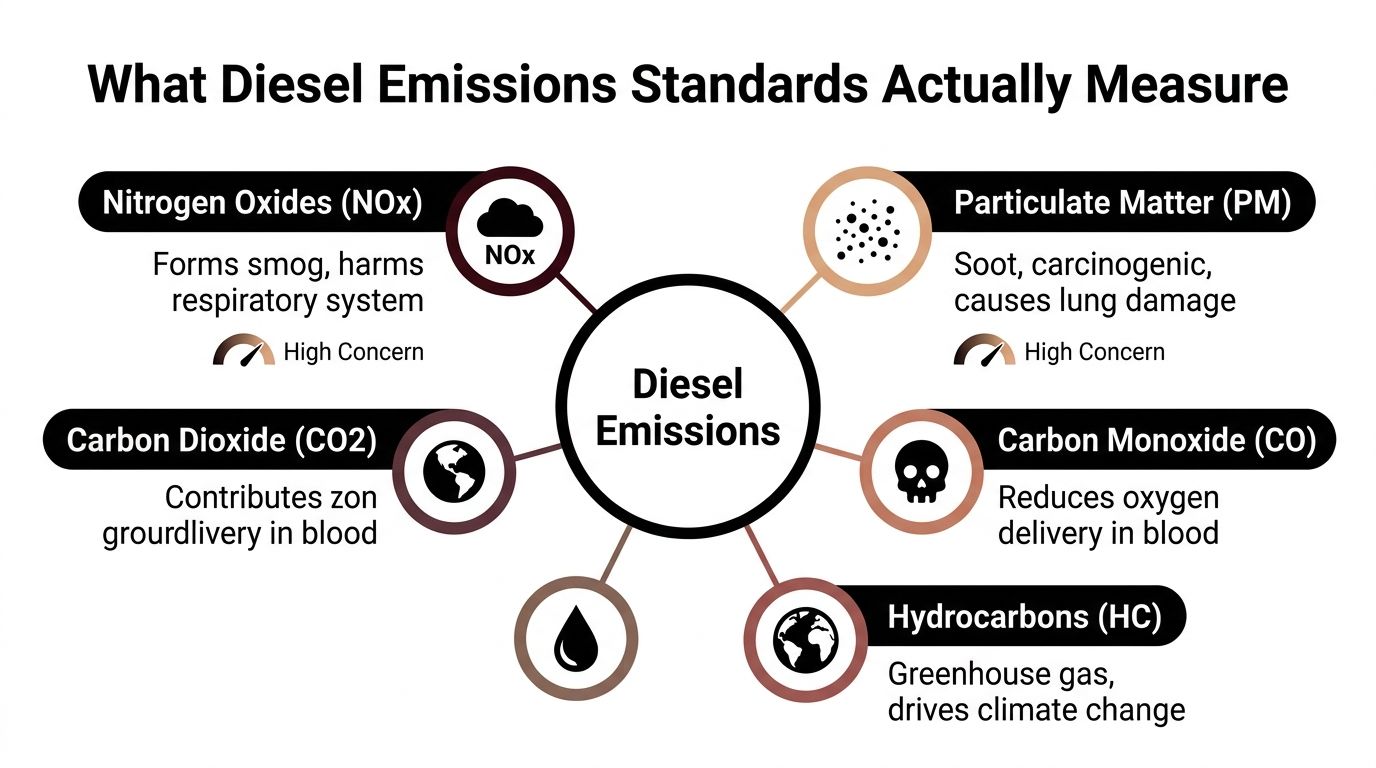
Nitrogen oxides, or NOx, form during high-temperature combustion. Regulators limit NOx because it contributes to air-quality problems and can harm the respiratory system. Visible smoke is not a reliable NOx indicator. A truck can produce little smoke while still exceeding its limit.
Particulate matter, or PM, consists of soot and other fine material in diesel exhaust. Larger soot may be visible, while smaller particles can pass unnoticed from behind the vehicle. A diesel particulate filter, commonly called a DPF, traps this material and periodically burns the stored soot during regeneration.
Carbon monoxide, or CO, is a poisonous gas that interferes with the blood's oxygen delivery. Hydrocarbons, or HC, are unburned fuel compounds that contribute to ground-level ozone formation. Carbon dioxide, or CO2, is a greenhouse gas associated with climate change. The inspection limits and aftertreatment equipment discussed here focus mainly on regulated tailpipe pollutants such as NOx, PM, CO, and hydrocarbons.
Why the units look unfamiliar
Regulators use different measurement systems. Heavy-duty engine limits may appear in grams per brake horsepower-hour, or g/bhp-hr, which relates emissions to engine work. Light-duty European limits are often stated in milligrams per kilometer, or mg/km, which relates emissions to distance traveled.
Those units describe different testing frameworks. A value in g/bhp-hr cannot be compared directly with one in mg/km without the correct test context and conversion method. The unit explains how the regulator designed the measurement, not how much smoke a driver can see.
The equipment that controls each pollutant
A diesel oxidation catalyst treats hydrocarbons and carbon monoxide. The DPF captures particulate matter. Selective catalytic reduction, or SCR, uses diesel exhaust fluid, commonly called DEF, to reduce NOx in the exhaust stream.
These components operate as a connected system. A blocked DPF can restrict exhaust flow and disrupt regeneration. A failed NOx sensor can cause the control system to manage SCR operation incorrectly. A DEF fault can trigger warnings or an inducement strategy. For that reason, a technician checks the related components and their operating condition rather than replacing one part based only on a symptom.
EPA vs CARB and How California Goes Further
The Environmental Protection Agency, or EPA, establishes federal emissions requirements. California's California Air Resources Board, or CARB, operates under a unique authority that allows the state to adopt its own, often more stringent, emissions rules. California's requirements can therefore affect whether a diesel vehicle may be sold, registered, modified, or operated in the state.
For an owner, “it meets EPA standards” doesn't automatically answer the California question. The vehicle must comply with the rules that apply to its configuration and model year in California. A truck imported from another state, modified after purchase, or fitted with non-approved emissions equipment may require closer review.
The California Air Resources Board overview can help owners understand how the state agency fits into the broader regulatory picture.
The two systems side by side
| Aspect | EPA, Federal | CARB, California |
|---|---|---|
| Basic role | Establishes a nationwide emissions baseline | Creates California requirements under its state authority |
| Geographic reach | Applies across the United States | Applies to vehicles and equipment subject to California rules |
| Owner concern | Federal certification and engine standards | California registration, inspection, equipment, and enforcement requirements |
| Testing emphasis | Certification standards and applicable federal compliance programs | State inspection procedures, visual checks, and California-specific requirements |
| Practical risk | A vehicle may satisfy the federal baseline | A vehicle can still face California problems if its configuration or equipment doesn't meet state requirements |
Why smoke opacity still matters
California heavy-duty diesel smoke rules use opacity, which measures how much light the exhaust plume blocks. Under the California rule, 1991 and newer model-year diesel heavy-duty vehicles may not exceed 40% opacity, while pre-1991 vehicles may not exceed 55% opacity during the state procedure, as documented in the California heavy-duty smoke regulation.
Visible smoke can point to several mechanical problems, including poor air-fuel control, turbocharger failure, injector wear, or a DPF fault. The smoke rule also requires a 1974-or-newer diesel-powered heavy-duty commercial vehicle to have evidence that its engine met emissions standards at least as stringent as the applicable federal standards when manufactured.
That combination of federal certification and California enforcement is why deleting a DPF, disabling an SCR system, or installing an unapproved tuner can create a registration problem even if the truck still starts and drives.
How Diesel Emissions Limits Have Tightened Over Time
A truck that passes under an older rule may fail under a newer one, even if its engine still runs well. Model year matters because regulators tightened diesel limits in stages, and manufacturers responded with improved combustion controls, catalysts, particulate filters, sensors, and SCR systems. For a California owner, that history affects which equipment must remain installed when registration renewal or a smog check is due.
The U.S. progression
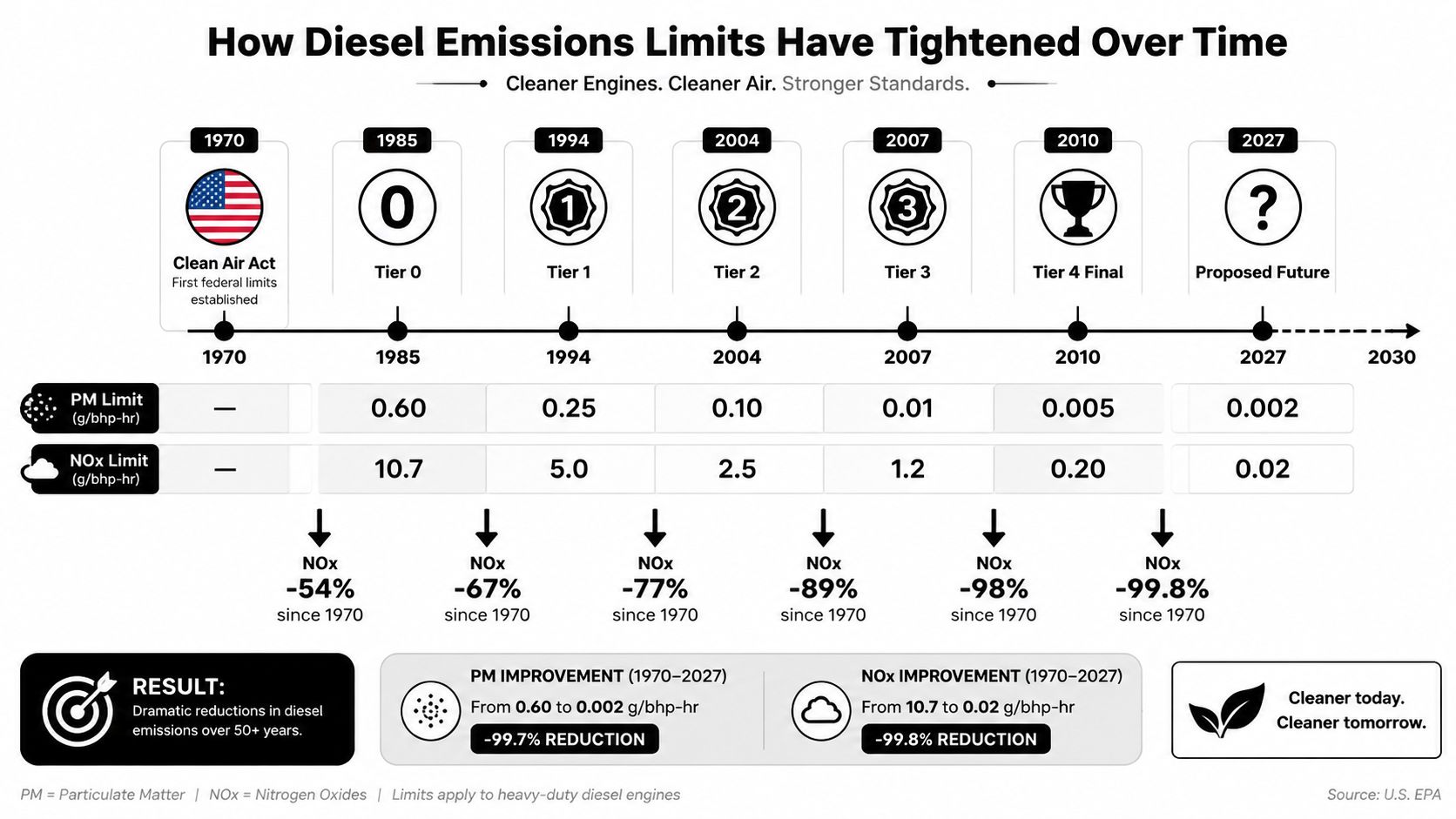
A major change for highway diesels began in 2007, as EPA standards phased in across model years 2007 to 2010. The requirements were designed to produce about a 90% emissions reduction through aftertreatment controls, according to the EPA regulatory record. EPA had already adopted another staged set of requirements in October 1997 for model year 2004 and later heavy-duty engines.
The 2010-era heavy-duty limits were:
- NOx at 0.20 g/bhp-hr
- PM at 0.01 g/bhp-hr
- Non-methane hydrocarbons at 0.14 g/bhp-hr
- Carbon monoxide at 15.5 g/bhp-hr
These figures and their applicability are documented in the EPA regulatory record. They also explain why later trucks depend on DPFs and other exhaust controls. A DPF is not optional trim. Its job is to capture particulate matter, so removing it can leave the truck without equipment required by its emissions design.
The European path shows the same pattern
European diesel standards tightened through successive generations as well. The diesel emissions compliance reference records Euro 2 NOx at 730 mg/km in 1997, followed by 500 mg/km under Euro 3 in 2001, 250 mg/km under Euro 4 in 2006, and 180 mg/km under Euro 5 in 2011.
Euro 6 became mandatory for new type approvals in September 2014 and for all new cars in September 2015. Its diesel NOx limit was 80 mg/km, a 56% reduction from Euro 5's 180 mg/km limit.
For heavy-duty engines, Euro VI WHTC testing sets NOx at 0.4 g/kWh, PM at 0.01 g/kWh, and particle number at 6.0 × 10^11 #/kWh, according to Euro VI heavy-duty standards data. The accompanying real-driving table lists an NH3 limit of 10 ppm and a NOx limit of 0.46 g/kWh for certain diesel applications.
The practical result is clear: newer diesel systems leave less room for uncontrolled combustion. Sensors, filters, catalysts, and maintenance now work together as part of staying compliant, not merely as ways to improve performance.
What Happens During a Diesel Smog Check in California
A California diesel inspection isn't a mechanic looking for smoke. The technician identifies the vehicle, checks required emissions equipment, communicates with the onboard diagnostic system when applicable, and evaluates whether the vehicle presents evidence of tampering or a malfunction.
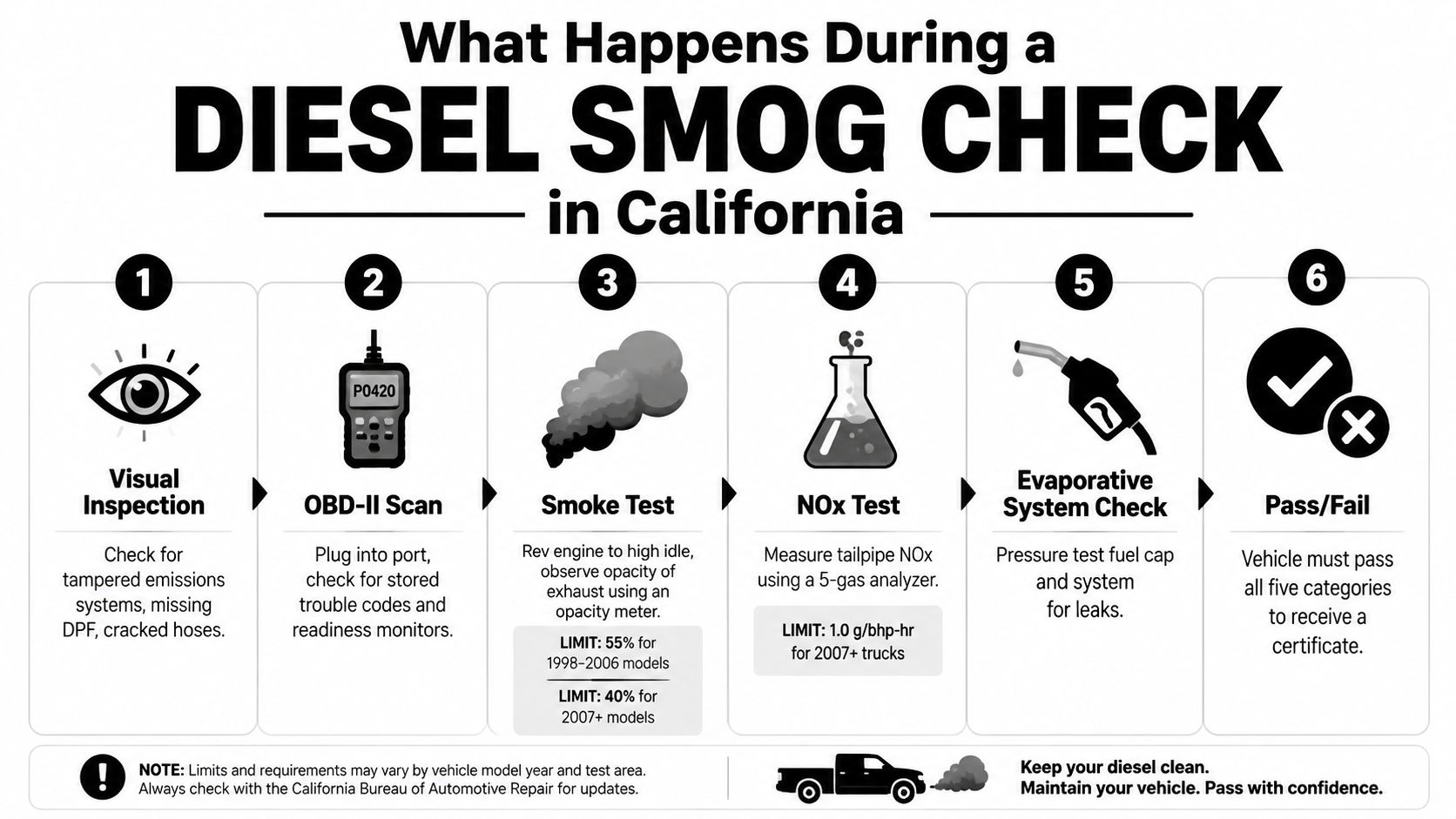
For 2000 and newer vehicles, the OBD system is an important part of the inspection. The technician connects a scan tool to check diagnostic information and system readiness. A warning light, stored emissions fault, or incomplete monitor can affect the result, depending on the vehicle and the applicable inspection rules.
What the technician looks for
At a diesel-capable station such as Speedy Smog's California diesel inspection service, the inspection may involve several distinct checks:
- Visual condition: The technician looks for missing, disconnected, modified, or visibly damaged emissions equipment.
- Diagnostic information: The OBD scan checks for emissions-related faults and readiness information on vehicles equipped for that procedure.
- Smoke behavior: Heavy-duty diesel vehicles may be evaluated under California opacity requirements. The applicable thresholds depend on model year and vehicle category.
- System integrity: The technician may identify signs of DPF, EGR, SCR, DEF, sensor, or exhaust-system problems.
- Final certification: The station records the result for the registration transaction.
The most common owner mistakes happen before the vehicle reaches the testing lane. A deleted DPF, an aftermarket tuner that disables emissions controls, a persistent check-engine light, a cracked exhaust component, or a DEF fault can all turn a routine appointment into a repair visit.
Older diesels need a different mindset
Older vehicles may not provide the same OBD information as newer models. That shifts attention toward the physical condition of the vehicle, visible smoke, installed equipment, and compliance with the standards applicable to its age and class.
Bring the vehicle's registration information and any repair records that identify recent emissions work. If the dashboard warning light is on, don't clear the code immediately before testing. Clearing codes can erase useful diagnostic information and may leave monitors unready, which doesn't repair the underlying problem.
A technician should explain the failure reason in practical terms. “Emissions failure” is too broad to guide a repair. You need to know whether the issue involves a sensor, filter, catalyst, exhaust leak, diagnostic monitor, visible smoke condition, or missing equipment.
The Gap Between Lab Certification and Real-World Performance
A diesel truck can pass its laboratory certification and still produce different emissions on an actual California route. Traffic, temperature, cargo weight, hills, maintenance, and aftertreatment operation all change what happens outside the controlled test cycle. The certificate describes performance under a defined procedure, not every condition the truck will face between registration renewals.
Independent testing summarized in real-world diesel emissions findings from Brussels found that pre-real-driving-emissions Euro 4, Euro 5, and Euro 6 diesels produced NOx at three to five times their laboratory limits in the referenced dataset. Euro 6d-TEMP and Euro 6d vehicles reduced NOx substantially after real-driving requirements were introduced. Regulators expanded testing because laboratory results alone could miss those operating differences.
Why a clean certificate isn't the whole story
A smog certificate confirms that the vehicle met the applicable inspection procedure at that appointment. It does not promise that every emissions component will keep working afterward, or that emissions will remain identical under another load or temperature.
For a California owner who hauls or commutes daily, that difference affects both compliance and repair costs. A truck may pass inspection and later develop a DPF regeneration problem, failed NOx sensor, SCR fault, or exhaust leak. Those symptoms deserve prompt diagnosis because continued operation can raise emissions and turn a limited repair into a larger one.
The Brussels data also identified a minority of DPF-equipped diesels with particulate numbers substantially above the output expected from properly functioning aftertreatment. That finding widens the maintenance picture. Real-world compliance includes particulate control, not only NOx. A DPF may still be installed yet perform poorly if it is damaged, overloaded, bypassed, or neglected.
DEF systems and current guidance
DEF-equipped vehicles use SCR to control NOx. The system must also detect low fluid, poor fluid quality, dosing faults, and sensor failures. EPA's 2025 guidance for model year 2026 and older diesel engines allows manufacturers to revise DEF-system software to adjust SCR-related inducements, as described in the 2025 DEF-system guidance summary.
The guidance does not make DEF maintenance optional. Owners should read warning messages, use the specified fluid, and repair faults before the truck enters a restricted operating strategy. At Speedy Smog, suitable diesel emissions testing equipment can help distinguish a visible problem from an electronic fault or an aftertreatment issue, giving the owner a clearer repair path before the next inspection.
How to Prepare Your Diesel Vehicle for a Smog Test
Preparation starts with the equipment already installed on the truck. Don't remove, bypass, or electronically disable a DPF, EGR system, SCR system, NOx sensor, or other emissions component. A vehicle that has been modified may fail the visual portion even if it seems to run well.
A week-before checklist
- Read the dashboard: Repair an illuminated check-engine or emissions warning light before the appointment.
- Check DEF: Confirm that the tank contains the correct diesel exhaust fluid and that no DEF warning or inducement message is active.
- Inspect for leaks: Look for damaged hoses, loose connections, cracked exhaust tubing, or signs of soot around joints.
- Review diagnostic history: Ask a qualified technician to scan for stored emissions codes rather than clearing them without diagnosis.
- Protect DPF operation: If the vehicle requires regeneration, follow the manufacturer's procedure and allow the cycle to complete safely.
- Confirm readiness: For vehicles using OBD testing, make sure monitors have had time to run after repairs or battery disconnection.
- Bring documents: Have registration information and relevant repair records available.
Older diesels deserve extra attention to visible smoke and physical equipment. Newer diesels need the same visual care, but their sensor and aftertreatment networks make diagnostic information just as important. Hybrid owners should tell the station about the vehicle's powertrain so the inspection can follow the correct procedure.
If the vehicle fails, keep the printed failure information and repair the listed cause instead of replacing unrelated parts. Depending on eligibility, California consumer assistance, retrofit projects, and rebate programs may help some owners address emissions repairs or upgrade older diesel equipment. Ask the relevant state program or repair professional about current requirements before assuming assistance is available.
For a convenient local appointment, Speedy Smog is located at 15275 Washington Ave in San Leandro, operates Monday through Saturday, and offers diesel inspections for qualifying vehicles. The shop states that many tests for 2000 and newer vehicles take about 10 to 15 minutes, and periodic $25-off coupons may apply to most smogs on newer vehicles. Verify current availability, eligibility, and pricing before visiting.
Visit Speedy Smog in San Leandro for a California diesel smog check, emissions-system inspection, and registration-focused certification appointment. Bring your renewal information, address any warning lights or DEF concerns first, and let the trained staff help identify what your diesel needs to stay compliant.