You're looking at a California registration renewal notice, wondering whether your car needs an OBD scan, a tailpipe test, a STAR inspection, or no test at all. The answer isn't based on how many miles you've driven. It starts with fuel type and model year, then shifts to why the DMV is requesting certification, such as renewal, a transfer, or a sale.
I advise drivers to identify the vehicle's test category before booking an appointment. That simple check prevents the most common mistake I see at a busy smog station: arriving with the right paperwork but the wrong assumption about what the car needs.
Table of Contents
- Figure Out What Smog Check You Need Right Now
- How California Decides Your Smog Check by Year and Fuel Type
- OBD Inspection vs BAR-97 Tailpipe Test and What to Expect
- When Renewal Transfer or Sale Changes the Test You Need
- Get Ready to Pass and Avoid the Most Common Fail Reasons
- Book the Right Test Near You and Get Certified Quickly
Figure Out What Smog Check You Need Right Now
A driver in San Leandro may bring in a 2012 sedan for renewal, an Oakland owner may be selling a hybrid, and another customer may have received a DMV notice directing them to a STAR station. Those situations can involve different requirements even when the vehicles appear similar.
Start with the vehicle itself. Find the model year, confirm whether it runs on gasoline, diesel, hybrid, or another approved fuel, and check whether the DMV request is for registration renewal, ownership transfer, sale, or an out-of-state registration change. Mileage helps describe how much the vehicle has been used, but it doesn't determine the basic California inspection pathway.
Practical rule: Don't book a test based only on the renewal notice. Match the vehicle's year and fuel type first.
The second question is whether the vehicle is subject to testing at all. Newer vehicles generally fall under California's smog abatement period, while older gasoline and diesel vehicles can qualify for specific exemptions. If testing applies, the model year usually determines whether the station performs an OBD inspection or a BAR-97 tailpipe inspection.
A STAR requirement adds another layer. If the DMV specifically directs the vehicle to a STAR station, use a station with STAR certification rather than assuming any licensed station will satisfy the request. The technology used during the test still depends mainly on the vehicle's year and fuel type.
For East Bay drivers, Speedy Smog's California eligibility guide can help you check the basic requirement before you arrive. Bring the registration renewal notice if you have it, but let the vehicle details drive the decision.
How California Decides Your Smog Check by Year and Fuel Type
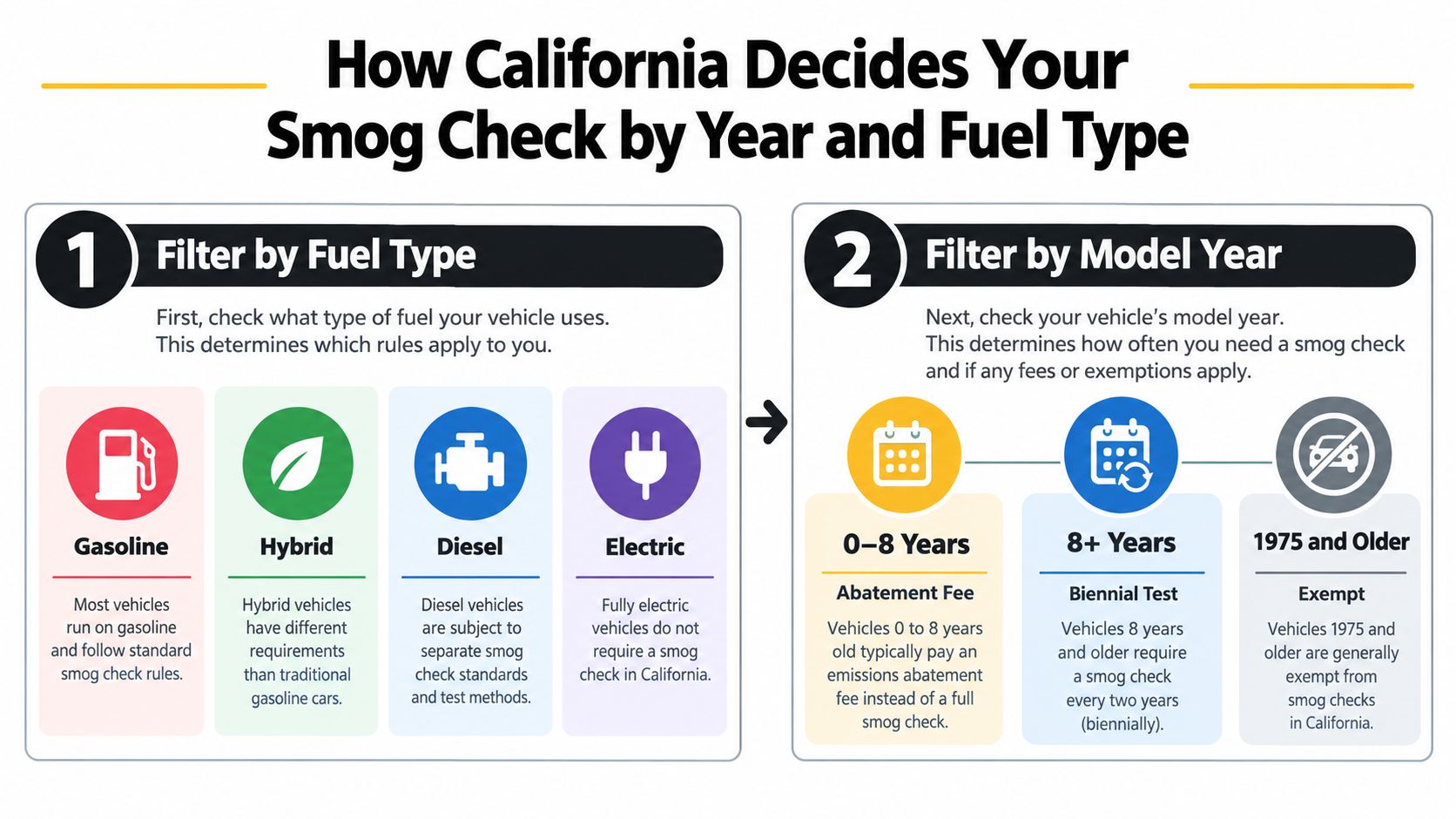
California uses a clear age and powertrain filter. The state's Smog Check Program guidance explains that gasoline, hybrid, and alternative-fuel vehicles generally enter the testing requirement after they are more than eight model years old. Vehicles within that newer period generally pay a smog abatement fee instead of receiving a smog inspection for registration renewal.
The model-year clock matters more than the date you bought the car. A 2020 model-year vehicle first needs a smog check for renewal in 2028, according to the California Bureau of Automotive Repair. You don't move the deadline by purchasing the car later, and driving fewer miles doesn't create a separate testing category.
Use this decision filter:
- Identify the fuel type. Gasoline, hybrid, and alternative-fuel vehicles generally follow the newer-vehicle abatement period before entering the regular testing cycle. Diesel vehicles require separate attention because California applies different age rules.
- Check the model year. If a covered gasoline, hybrid, or alternative-fuel vehicle is eight model years old or newer, it generally pays the abatement fee instead of taking the test. Once it is more than eight model years old, it generally needs certification for registration renewal.
- Look for an older-vehicle exemption. Gasoline-powered vehicles from model year 1975 or older are exempt, while diesel vehicles from model year 1997 or older are exempt under the state program guidance.
- Confirm the DMV reason. Renewal, ownership transfer, sale, and a directed STAR inspection can change what paperwork or station type applies after you determine whether the vehicle is subject to testing.
This is why the question “what smog check do I need” can't be answered from mileage alone. A newer hybrid may not need an inspection for renewal, while an older gasoline sedan may need one. An older diesel may fall outside the standard program entirely.
Write down the year and fuel type before you call a station. That two-item check usually tells you whether to ask about an abatement fee, an OBD test, a BAR-97 test, or an exemption review.
OBD Inspection vs BAR-97 Tailpipe Test and What to Expect
The main technical split is straightforward. Most 2000-and-newer vehicles receive an onboard diagnostic inspection, while 1999-and-older vehicles are generally routed to a BAR-97 tailpipe-based inspection, as described in the California Smog Check manual. California can also require visual and functional checks of emissions equipment in addition to the electronic or tailpipe portion.
| Vehicle Group | Test Type | What Is Checked | Typical Time at Station |
|---|---|---|---|
| 2000-and-newer eligible vehicles | OBD inspection | Diagnostic data, warning-lamp status, readiness information, and emissions equipment checks | Usually a short computer-based visit, depending on vehicle condition |
| 1999-and-older vehicles | BAR-97 tailpipe inspection | Tailpipe emissions, visible emissions equipment, and required functional checks | Depends on the vehicle and inspection process |
| Vehicles directed to STAR | Required test pathway at a STAR station | The applicable inspection method for the vehicle, plus required station and program checks | Depends on vehicle type and readiness |
What happens during an OBD inspection
The technician connects approved equipment to the vehicle's diagnostic system and reviews information stored by the car's computers. The inspection isn't a scan for one trouble code. The technician also looks at malfunction indicator lamp behavior, readiness monitors, and emissions-related equipment.
For late-model gasoline vehicles, California replaced the traditional loaded dynamometer tailpipe portion with an OBD-based check. The BAR Smog Check reference guide identifies 2000-and-newer vehicles at 14,000 pounds GVWR and under as using the OBD pathway.
What happens during a BAR-97 inspection
A qualifying older vehicle is evaluated through the BAR-97 tailpipe method rather than the standard late-model OBD route. The technician still checks required emissions components and their function. A vehicle can fail because of a visible emissions problem, not only because of the measured tailpipe result.
If your vehicle is 2000 or newer, read Speedy Smog's STAR Smog Check information before booking when the DMV notice mentions STAR. The station requirement and the vehicle's technical test method are related, but they aren't the same question.
When Renewal Transfer or Sale Changes the Test You Need
The vehicle's year and fuel type identify the likely inspection technology. The transaction reason determines why certification is being requested and whether a particular station designation matters.
For a routine registration renewal, the DMV may require a passing smog result once the vehicle is beyond California's newer-vehicle abatement period. A 2012 gasoline sedan in San Leandro will normally be evaluated through the late-model OBD pathway, provided it falls within the applicable vehicle category. The important point is that renewal is a registration trigger, not a different engine test.
A private sale creates a different situation. If someone in Oakland sells a 2015 hybrid, the buyer and seller shouldn't assume the vehicle's hybrid system makes it exempt forever. California's age-based rules generally bring covered hybrids into testing after the newer-vehicle period, and the sale paperwork can require current smog certification.
The same car can need a different administrative action depending on why the DMV is asking for certification.
Ownership transfers also deserve a careful look. If you're transferring a diesel truck, don't classify it from appearance or engine size alone. Confirm the fuel type, model year, and any applicable vehicle details before deciding whether a standard Smog Check applies.
Out-of-state registration changes can also prompt a California inspection. In that case, the reason for testing is the registration change, but the technical pathway still follows the vehicle's California classification. For 2000-and-newer gasoline vehicles at 14,000 pounds GVWR and under, the BAR reference guide identifies the OBD route instead of a loaded dynamometer tailpipe test.
If the DMV directs you to a STAR station, follow that instruction exactly. A STAR-directed test should be performed at a STAR Certified location, even when the vehicle itself receives an OBD inspection rather than a separate “STAR technology” test.
Get Ready to Pass and Avoid the Most Common Fail Reasons
Most avoidable failures begin before the car enters the bay. A warning lamp, incomplete readiness monitor, recently cleared diagnostic memory, or missing emissions equipment can stop an otherwise well-maintained vehicle from passing.
California's BAR OBD guidance highlights MIL behavior and readiness criteria as central failure conditions. The state's rules also tightened on October 1, 2025, when all readiness monitors must be set for a vehicle to pass, with 2000-and-newer gasoline vehicles allowed only the evaporative monitor to remain unset. Check the current status before you pay for an inspection.
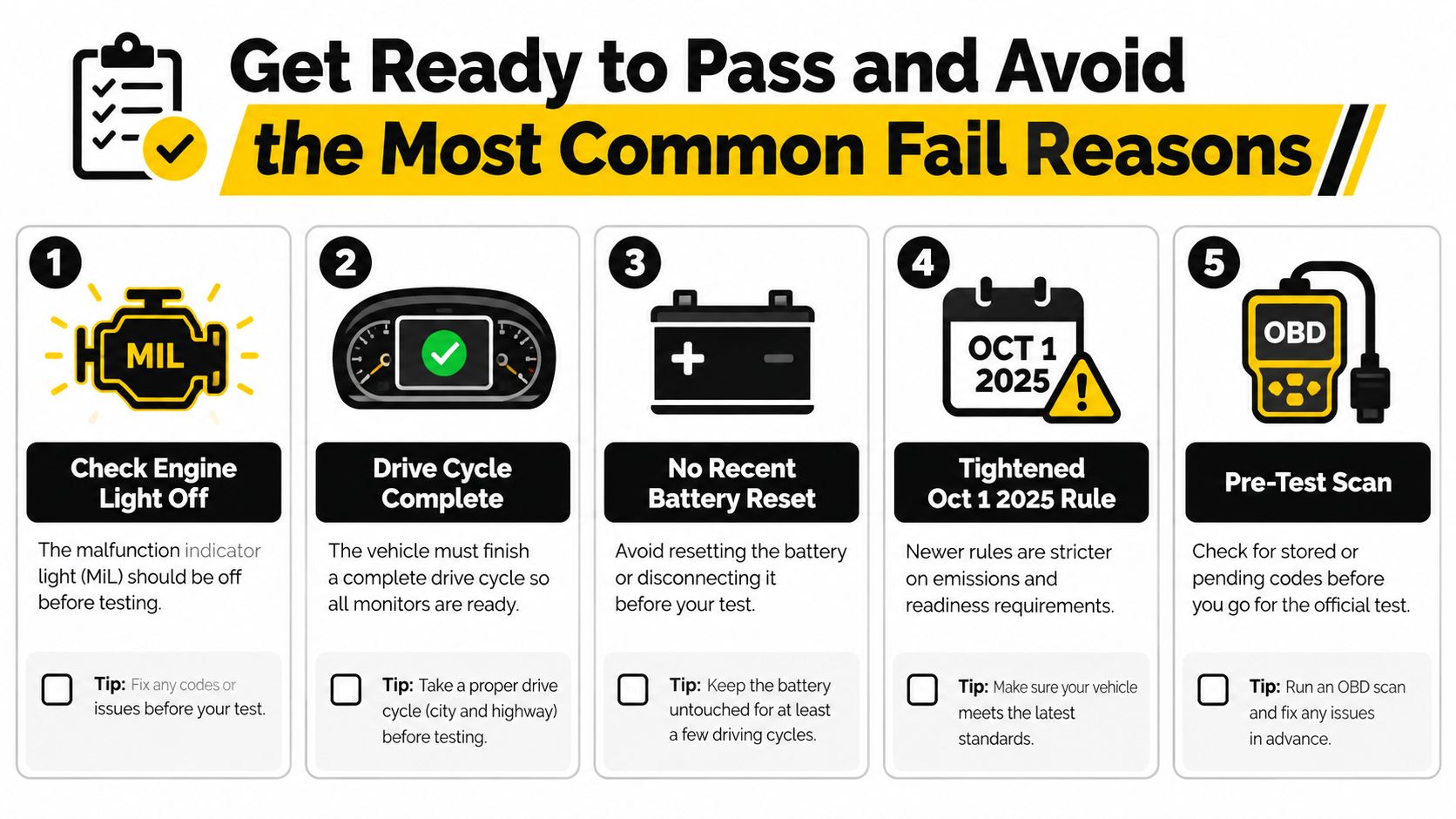
Use this pre-test checklist:
- Check the MIL: The check engine light should not be illuminated. If it came on recently, diagnose the cause instead of just clearing the code.
- Confirm readiness: Have the vehicle scanned for monitor status before the official test. “No codes” doesn't always mean “ready.”
- Avoid a recent battery reset: Disconnecting the battery or clearing codes can erase readiness information and create an automatic failure risk.
- Inspect visible equipment: Make sure the gas cap, catalytic converter, vacuum lines, and other emissions components are present and intact.
- Warm the vehicle normally: Arrive with the engine at normal operating temperature, but don't try to hide a warning light or unresolved fault.
The most common practical mistake is assuming the computer will be ready because the car drives normally. It may not. The BAR OBD test reference explains why warning-lamp behavior and monitor status deserve attention before testing.
For a focused breakdown of preventable problems, review common California smog check fail reasons.
Don't clear a code just before the appointment. That can make the dashboard look better while leaving the vehicle's readiness monitors incomplete. A proper scan gives you a clearer answer and saves a wasted trip.
Book the Right Test Near You and Get Certified Quickly
You can identify the correct starting point with four checks: model year, fuel type, DMV reason, and STAR direction. If the vehicle is covered and 2000 or newer, expect an OBD-based inspection in the applicable category. If it's 1999 or older, ask about the BAR-97 pathway. If the DMV names STAR, choose a STAR Certified station.
Bring your registration renewal notice if available, the vehicle, and any information about recent repairs or battery replacement. If the check engine light has been on, don't book first and diagnose later. Scan the vehicle, address the fault, and verify readiness before the official inspection.
Speedy Smog in San Leandro performs California smog inspections for newer vehicles, older vehicles, diesels, and hybrids, with a typical 10 to 15 minute OBD test for 2000-and-newer vehicles according to the station information provided for this article. The shop is located at 15275 Washington Ave, offers an indoor waiting room, transparent pricing, coupon options, and Monday-through-Saturday service.
Booking advice: Tell the station your model year, fuel type, and whether the DMV requires STAR before you arrive.
That information lets the advisor prepare for the correct inspection rather than making you repeat the visit. It also helps separate a true testing issue from a readiness problem that should be handled before certification.
Visit Speedy Smog with your model year, fuel type, and DMV notice ready, and the team can help match your vehicle to the correct California test. Check readiness before you arrive, then book the appropriate inspection in San Leandro for a faster path to certification.
A California emissions test costs the station's inspection price plus a flat $8.25 state certificate fee on every passing test, so there isn't one statewide sticker price. The station controls the inspection charge, while the state controls the certificate fee and collects separate DMV-related fees in different transactions.
You're probably looking at a renewal notice, calling shops, and seeing prices that don't seem comparable. One ad shows a low inspection price, another quotes a total, and a third mentions STAR certification without explaining whether it changes the fee or the testing requirement. The confusion comes from combining three different charges: the station's labor and equipment fee, the state certificate fee, and DMV registration-related fees.
I've written this the way I'd explain the bill before putting your car on the test lane. Ask for the station inspection price first, confirm whether your vehicle must use a STAR station, and then add the fixed state charge only if the vehicle passes.
Table of Contents
- What You Will Pay for a California Emissions Test
- Station Fee Versus State Fee and How They Combine
- How Vehicle Type Changes the Price
- What STAR Certification Means for Your Bill
- Add-On Charges That Push the Total Higher
- Smart Ways to Lower Your Emissions Test Cost
- Putting It All Together for East Bay Drivers
What You Will Pay for a California Emissions Test
You call two Bay Area shops for a 2015 gasoline sedan and receive two different totals. That is normal. A non-STAR station often quotes $50-$60 for an OIS inspection, while BAR's 2025 average for a STAR Test-and-Repair OIS was $75.82. Add the required state certificate fee only when the vehicle passes.
The bill has three separate parts:
- Inspection: The station's charge for running the test.
- Certificate: $8.25, set by the state and added to every passing test.
- Total: The station inspection charge plus the certificate fee.
The station controls the first number. The state controls the second. Confirm the vehicle's STAR requirement before comparing quotes, because a cheaper non-STAR price does not help if DMV directs your vehicle to a STAR station. The California DMV's smog inspection guidance verifies the $8.25 passing-test certificate fee and explains the inspection requirement.
Historical figures need context. A 2005 Legislature report cited an average enhanced inspection cost of $54 and an average total test cost of $76 after including the certificate fee. Those figures are useful benchmarks, not current retail quotes. The California Air Resources Board report shows the long-standing separation between the station's price and the state-controlled charge.
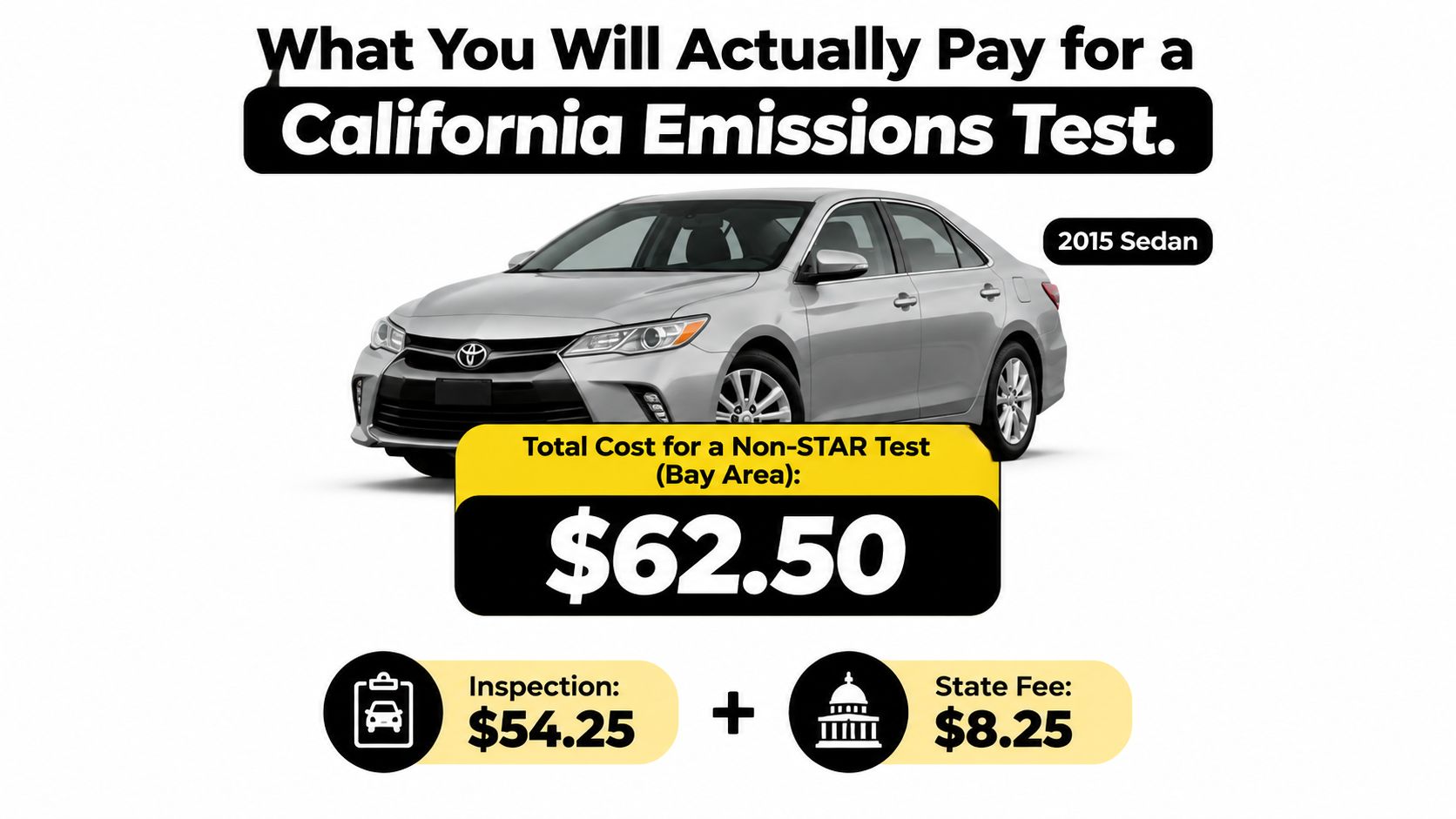
The three numbers to keep in mind
The station inspection fee is where comparison shopping works. Ask for that amount before authorizing the test, and ask whether it includes the complete inspection or only a promotional starting price. The $8.25 certificate fee is fixed and applies to a passing test, so there is no bargaining room there.
The smog abatement fee belongs to DMV registration, not the station's inspection bill. Current DMV materials list it at $20 for newer vehicles exempt from inspection for a period of years. Check the renewal notice to see whether DMV charged it.
Keep the registration line items separate from the smog-test total. If a shop gives you one figure, ask: “How much is the inspection, and is the $8.25 certificate fee included?”
Station Fee Versus State Fee and How They Combine
You can receive two separate charges for one passing test. The licensed station sets the inspection price, while the Bureau of Automotive Repair requires the $8.25 certificate fee. BAR explains this split in its official Smog Check program guidance.
The station fee pays for the inspection work. Depending on the vehicle and test system, it may cover the visual emissions inspection, OBD-II scan, tailpipe measurement, technician time, equipment use, documentation, and shop overhead. A low advertised price may cover the complete test, or it may be only a promotional starting price. Ask before authorizing the inspection.
The certificate fee follows a different rule. It is a state-controlled charge processed through the station's testing system and applies when the vehicle passes. A failed test does not produce a passing certificate, so ask the station how it handles any separate retest or diagnostic charges before work begins.
What belongs on which bill
| Line Item | Amount | Set By | When Charged |
|---|---|---|---|
| Station inspection | Varies by station | Licensed station | When the inspection is performed |
| Smog certificate | $8.25 | State through BAR | On a passing test |
| Smog abatement | $20 in the cited DMV framework | DMV | On qualifying registration transactions |
| Certificate transfer | Verify with DMV before relying on it | DMV | When applicable to a transfer or reissue |
California has run Smog Check through private stations since 1982, which is why no single statewide retail price exists. The station's inspection charge can vary by location, equipment, labor, and business costs. The certificate fee remains fixed, so a shop cannot legitimately remove it to win your business.
The smog abatement line belongs to DMV registration, not the station's inspection bill. Keep it separate from the test total and check your renewal notice for that charge. If a shop quotes one combined figure, ask: “How much is the inspection, and does that include the $8.25 certificate fee?”
That question exposes padded quotes quickly. Compare posted prices at San Leandro smog check stations and confirm whether each quote covers only the inspection or also includes the passing certificate. You can compare the station fee. You cannot bargain away the state-controlled charge.
How Vehicle Type Changes the Price
Your vehicle determines the equipment, procedure, and technician time involved. That's why comparing a quick OBD-II inspection for a newer gasoline car with a tailpipe test for an older vehicle can produce an apples-to-oranges price comparison.
Newer gasoline vehicles commonly use the On-Board Inspection System, or OIS. The technician connects to the vehicle's diagnostic system, checks readiness and emissions-related data, and completes the required visual inspection. A straightforward OIS inspection is usually less demanding than a test requiring a dynamometer and tailpipe equipment.
Older gasoline vehicles can require a BAR-97 procedure. That system uses a tailpipe probe and dynamometer-based testing, which takes more equipment and lane time. The price difference reflects the station's operating cost, not a separate state certificate charge.
Compare the test categories
| Vehicle Type | Test Program | Typical Station Fee | Notes |
|---|---|---|---|
| Newer gasoline vehicle | OIS | Varies by station | OBD-II and visual inspection requirements apply |
| Older gasoline vehicle | BAR-97 where applicable | Varies by station | Tailpipe and dynamometer equipment can affect labor time |
| Diesel vehicle | Applicable diesel inspection procedure | Varies by station | Equipment and vehicle configuration affect the quote |
| Hybrid | OIS or applicable procedure | Varies by station | Diagnostic readiness and hybrid system considerations can affect service time |
| Battery-electric vehicle | No standard smog inspection | No inspection fee | Electric vehicles don't produce tailpipe emissions requiring this test |
BAR's published executive summaries provide a more useful benchmark than bargain advertisements because they separate station types and test platforms. The 2024 report lists a STAR Test-and-Repair OIS average of $72.87, the 2025 report lists $75.82, and the January 2026 report lists $77.55, all before adding the $8.25 certificate fee where the vehicle passes. See the 2024 BAR Smog Check executive summary for the earlier benchmark.
Those averages aren't promises for your neighborhood. A small test-only shop may quote less, while a STAR facility with higher equipment and staffing costs may quote more. Your useful comparison is the same test type at several licensed stations, with the certificate fee identified separately.
What STAR Certification Means for Your Bill
STAR certification is a station designation, not a state-imposed surcharge. It matters because some vehicles must be inspected at STAR stations, and a STAR facility has to meet additional performance and equipment requirements under the BAR program.
The DMV can direct certain vehicles to STAR stations. That can include vehicles identified on a renewal notice, vehicles with prior emissions-related failures, and vehicles that fall within directed or high-emitter categories. Don't choose a shop only because its ad has the lowest number. First confirm whether your renewal notice says STAR is required.
Where the price difference comes from
A STAR station may charge more because it carries additional compliance responsibilities, equipment requirements, documentation duties, and testing procedures. The state certificate charge doesn't change because the vehicle visits a STAR station. The variable amount remains the station's inspection price.
| Factor | Non-STAR Station | STAR-Certified Station |
|---|---|---|
| Station designation | Licensed for eligible inspections | Meets STAR program requirements |
| Vehicle eligibility | Only vehicles allowed by the DMV direction | Can inspect vehicles directed to STAR |
| Inspection price | Set by the station | Set by the station |
| State certificate | $8.25 on a passing test | $8.25 on a passing test |
| Main pricing variable | Labor, equipment, and local competition | Labor, equipment, compliance, and local competition |
The STAR-certified smog station information can help you identify the right station type before you pay for a test. This check is especially important if your renewal paperwork directs you to STAR.
Avoidable expense: If the DMV requires STAR and you use an ineligible station, the test may not satisfy the registration requirement. Verify the station type first, because paying for the wrong inspection can mean paying again.
STAR isn't automatically a bad deal. For a directed vehicle, it's the correct facility. For a vehicle that can use either station type, compare the complete inspection quote, location, service process, and whether the shop clearly explains what happens if the vehicle fails.
Add-On Charges That Push the Total Higher
A failed inspection, a diagnostic check, or a second visit can change the bill quickly. Some added charges pay for real work. Others cover products or services the shop is trying to sell. Ask what each fee covers before approving it.
The $8.25 certificate fee applies to a passing test. It is a state charge, not an optional processing fee created by the station. The inspection price, retest policy, diagnostic work, repairs, and shop-side fees are separate items and should appear clearly in the quote.
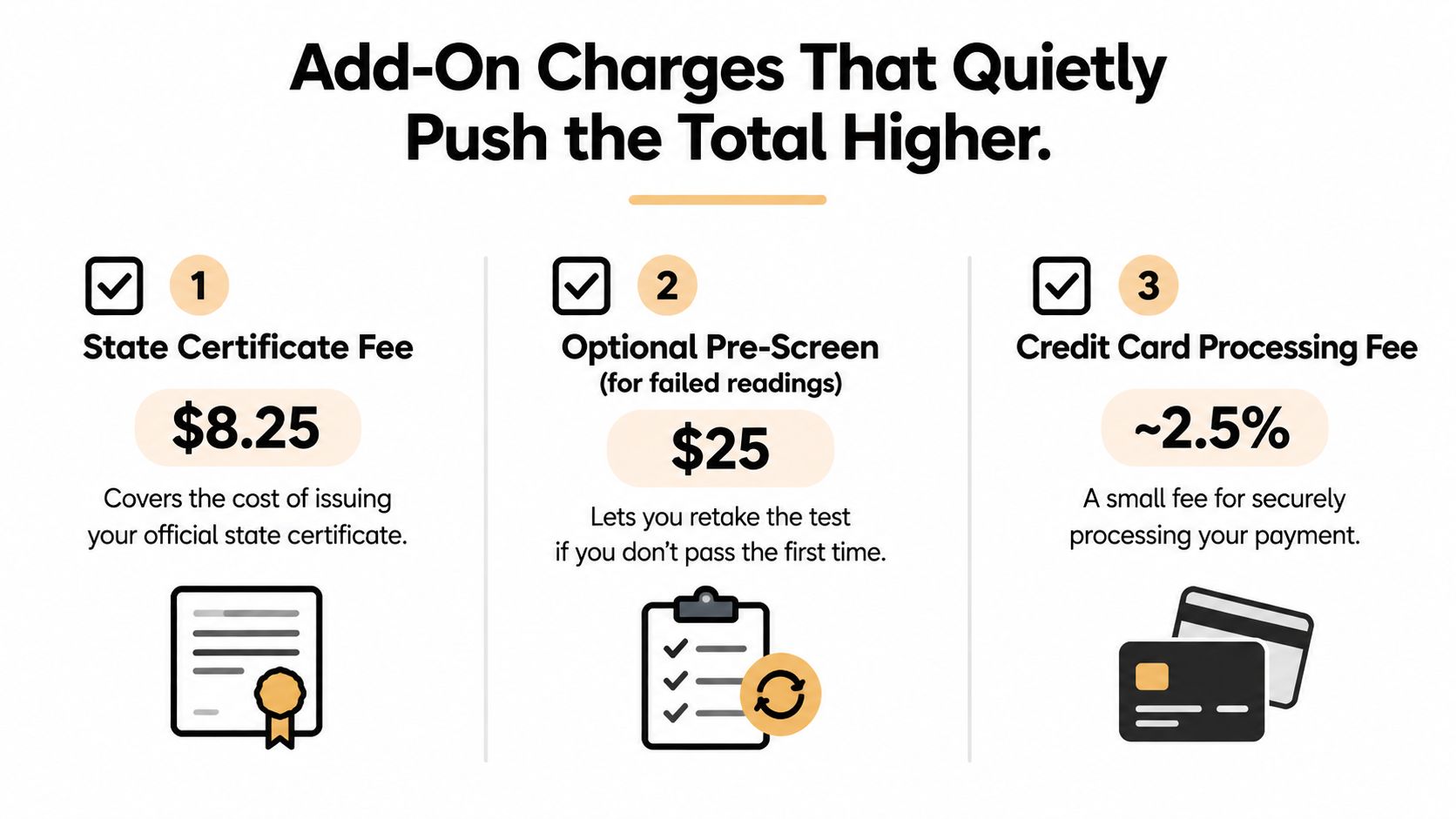
Separate required charges from optional services
- Certificate fee: A fixed state charge applied to a passing result.
- Retest: A second inspection after repairs. The station decides whether its policy makes that free, discounted, or fully chargeable.
- Pre-test or diagnostic: A separate service for checking codes, investigating a warning light, or testing beyond the required inspection.
- Repair work: Work approved by you before it begins. The vehicle may need repairs to pass registration requirements, but the repair price remains a separate decision.
- Convenience or processing charge: A shop-side fee that must be disclosed before payment.
The largest pricing gap often appears after a failure. Ask for the retest policy before authorizing the first inspection. One station may offer a reduced or no-cost retest under stated conditions, while another may charge its normal inspection price after repairs performed elsewhere.
Do not accept a fuel-system cleaner, oil change, or engine-light diagnostic as a condition of a routine test unless the technician explains the vehicle-specific reason. These services can have a maintenance purpose, but they are not automatically part of the emissions inspection.
Use the same caution with a certificate transfer or DMV transaction. If ownership or registration details change, confirm the required charge with the DMV before treating a station-side fee as mandatory. State-controlled requirements are outlined on the California DMV smog inspection page.
Smart Ways to Lower Your Emissions Test Cost
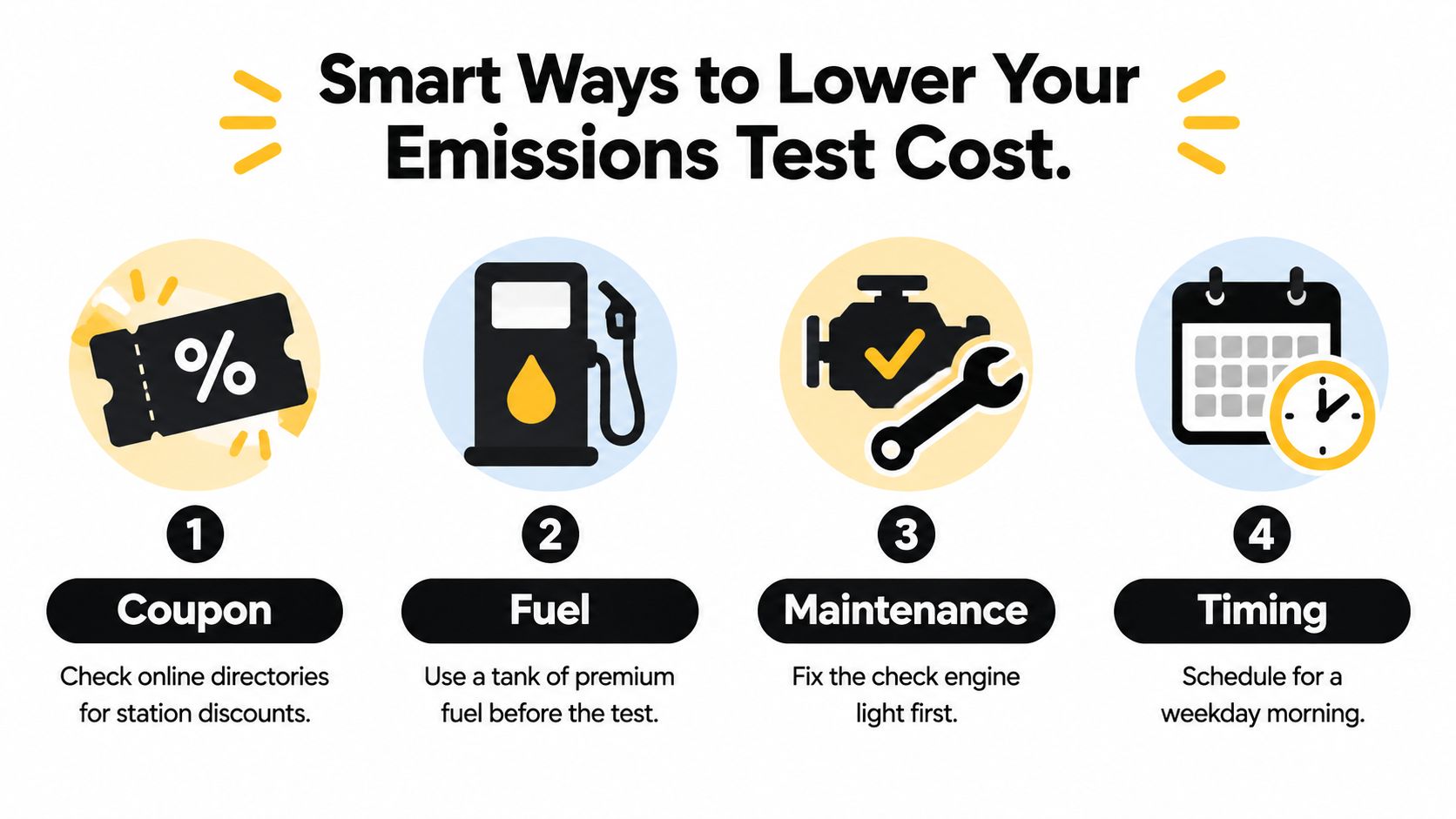
You can reduce the bill without choosing an inferior test. Start by comparing the station inspection fee, then check for a current coupon before booking. A discount applies to the negotiable part of the transaction, not to the fixed state charge.
Use a simple checklist:
- Check the complete quote: Ask for the inspection price, certificate treatment, retest policy, and any payment surcharge before arriving.
- Verify STAR eligibility: Read the DMV renewal notice. If STAR is required, don't waste money at a station that cannot complete the required inspection.
- Look for a current offer: Station websites, coupon pages, and member programs may publish discounts. The Speedy Smog coupon page is one local example to check before scheduling.
- Choose a quieter appointment: Some stations price weekday or off-peak appointments differently. Ask rather than assuming the online price is the only price.
- Fix warning lights first: A lit check-engine light can lead to a failed inspection, and a diagnostic service afterward is more expensive than identifying the problem before the test.
- Arrive with the vehicle ready: Bring the car in normal operating condition, avoid clearing codes immediately before testing, and follow any preparation instructions from the station.
Vehicle preparation can prevent an avoidable aborted test, but don't rely on internet shortcuts such as premium fuel or improvised repairs to make a defective emissions system pass. The best preparation is a functioning vehicle with no unresolved emissions warning.
The registration abatement fee is a separate DMV charge for qualifying newer vehicles, not a discount you can negotiate at the station. If your vehicle requires a test, passing on the first attempt avoids the cost and disruption of a failure and retest, but it doesn't erase a DMV fee that applies under the registration rules.
A short explainer can also help you understand the inspection process before you book:
Putting It All Together for East Bay Drivers
An East Bay driver should price the inspection in two stages. First, identify the correct station and test platform. Second, add the fixed $8.25 certificate fee if the vehicle passes.
For example, a STAR station may quote an inspection price for a newer hybrid and then add the certificate fee to the passing total. The hybrid's diagnostic procedure can require careful readiness verification, so the shop should explain what its inspection price includes before testing begins. Ask whether the quote covers the complete inspection or only the station's base labor.
A practical pricing recap
| Vehicle Type | Test Type | Inspection Fee | Certificate Fee | Estimated Total |
|---|---|---|---|---|
| Newer gasoline vehicle | OIS | Station-set | $8.25 if passed | Inspection plus certificate |
| Older gasoline vehicle | BAR-97 where applicable | Station-set | $8.25 if passed | Inspection plus certificate |
| Hybrid | Applicable OIS procedure | Station-set | $8.25 if passed | Inspection plus certificate |
| Diesel | Applicable diesel procedure | Station-set | $8.25 if passed when required | Inspection plus certificate |
STAR shouldn't be treated as a mysterious surcharge. It identifies a station qualified for vehicles that the DMV directs into that program. The price difference, when one exists, comes from the station's labor, equipment, compliance workload, and local operating costs.
For East Bay drivers, the useful memory aid is simple: the station inspection fee is variable, the passing certificate fee is $8.25, and the DMV's cited smog abatement fee is $20 for qualifying newer vehicles. Keep those charges separate, and a confusing quote becomes easy to evaluate.
Speedy Smog provides STAR-certified inspections in San Leandro, including service for newer vehicles, older vehicles, diesels, and hybrids, with transparent station pricing and a comfortable indoor waiting area. Check the current inspection quote and available offer, then visit Speedy Smog with your DMV renewal information before testing.
Your registration deadline is close, but you're not sure whether your notice requires a STAR station. Maybe your last test failed, and you need a shop that can explain the repair path instead of sending you away. Searching vehicle emissions test near me brings up plenty of East Bay choices, but they aren't interchangeable.
This guide compares seven stations by the details that matter at checkout: STAR certification, vehicle eligibility, expected turnaround, hours, pricing or coupons, contact and location information, waiting comfort, and access to DMV services or repairs. Speedy test-only locations can be ideal for a routine renewal, while a repair shop may be the smarter choice after a failed inspection. Call before leaving to confirm current hours, prices, STAR eligibility, appointment availability, vehicle coverage, and coupon terms.
Table of Contents
- 1. Speedy Smog
- 2. KS Smog in San Leandro
- 3. EZ Star Smog Oakland
- 4. High St Smog and Repair
- 5. Official Smog Check Test Only
- 6. Xpress Star Smog
- 7. Smog Car Care and Lube
- 7 Nearby Smog Check Comparison
- Choose by Your Actual Smog Check Need
1. Speedy Smog
Speedy Smog is the strongest all-around choice for San Leandro drivers who want a STAR Certified smog check with a quick, comfortable visit. The station is at 15275 Washington Ave, San Leandro, California 94579, and you can reach it at (510) 614-7664. It focuses on efficient service for routine DMV compliance, with typical tests for 2000-and-newer vehicles taking about 10 to 15 minutes, according to the business's service information.
The shop accepts most vehicle categories, including hybrids, diesels, 2000-and-newer vehicles, and 1999-and-older vehicles. Its STAR status matters if your DMV renewal notice specifically directs you to a STAR station. California's STAR program uses higher performance standards administered through the Bureau of Automotive Repair, so drivers who need a recognized STAR inspection should confirm that requirement before booking elsewhere.
Best fit: Choose Speedy Smog when you want STAR certification, broad vehicle coverage, a short visit, and an indoor waiting room in San Leandro.
Speedy Smog lists transparent on-site pricing and frequently offers a $25-off coupon for most smog checks on 2000-and-newer vehicles. The coupon has eligibility limits, and the website doesn't publish one universal base price for every vehicle, so review the offer and call for a quote when your car falls outside the common newer-vehicle category. You can also review the station's San Leandro smog check information before visiting.
Hours and convenience
Posted hours are Monday through Friday, 8:30 AM to 5:30 PM, and Saturday, 8:30 AM to 4:00 PM. The website also contains an inconsistent reference to seven-day availability, while the posted schedule shows Sunday closure. Call (510) 614-7664 to confirm the current schedule and whether an appointment is available.
The clean indoor waiting room and friendly service make this a better choice than a bare-bones location if you're bringing a child, waiting for a driver, or don't want to stand outside. Results can be electronically transmitted for DMV processing, helping keep a routine renewal moving.
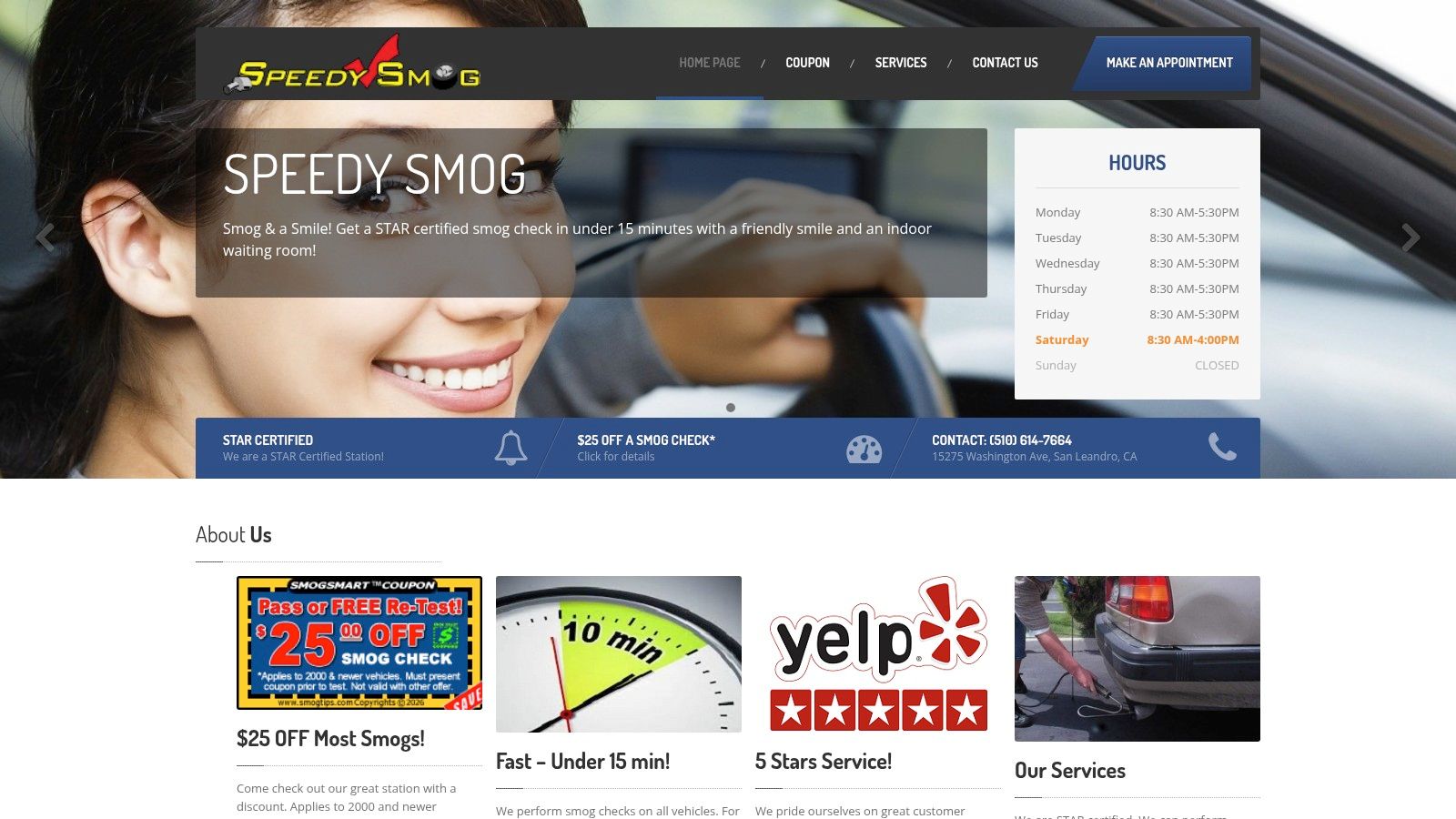
Visit Speedy Smog's official website to check the current coupon, vehicle eligibility, and posted hours.
2. KS Smog in San Leandro
KS Smog is a practical option for drivers who want a test-only station serving San Leandro and Castro Valley. It handles common DMV-related inspections, including renewals, change-of-ownership testing, out-of-state inspections, and hybrid vehicles. Because the business concentrates on testing rather than repairs, it can suit customers who already know their vehicle is ready to pass.
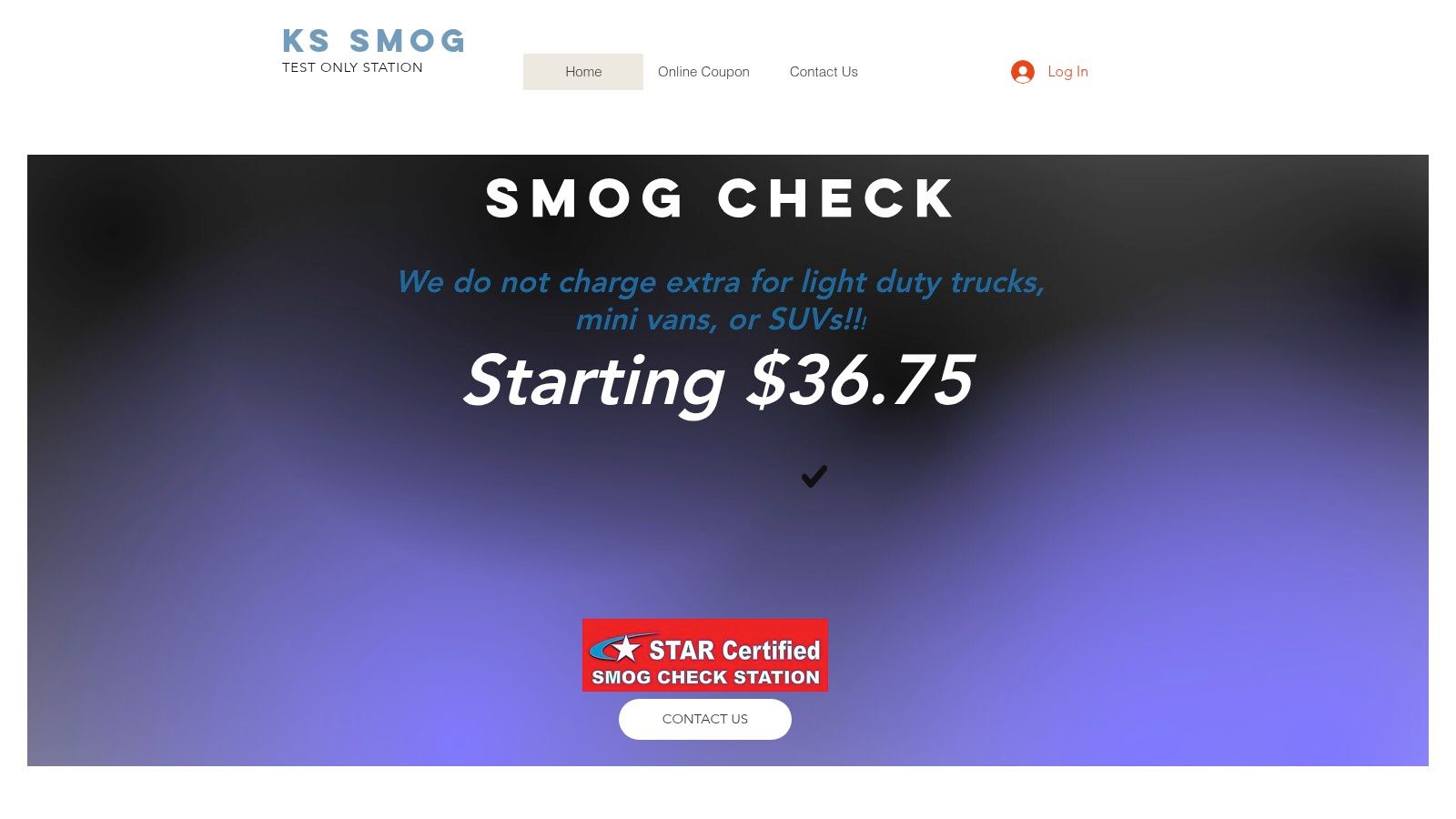
The station advertises a starting price of $36.75 on its website. Since the final amount can depend on vehicle type and applicable terms, confirm the out-the-door price before authorizing the inspection. A published starting price gives budget-focused drivers a useful point of comparison, but it shouldn't replace a direct quote.
What to confirm first
KS Smog accepts walk-ins during its posted hours, which helps if your registration deadline is approaching and you don't want to wait for an online booking slot. It doesn't provide an online appointment tool, so calling is the best way to check current availability and expected wait time.
The main drawback is certification clarity. The website doesn't clearly state whether the station is STAR certified. If your DMV notice requires STAR testing, ask specifically about that requirement before driving over. This is especially important for owners who search by proximity first and check eligibility later.
A low advertised starting price helps only when the station can test your vehicle and satisfy the DMV requirement.
KS Smog is best for a straightforward inspection, a test-only environment, and drivers near the San Leandro or Castro Valley area. It's less suitable if you expect a failure and want diagnostics or repairs at the same location. Review the station's official KS Smog website for the current address, hours, vehicle policies, and price details.
3. EZ Star Smog Oakland
EZ Star Smog Oakland is a strong pick when you want STAR testing and DMV registration services in one stop. Located near the Oakland and Emeryville border, it serves drivers seeking a routine inspection for most 2000-and-newer vehicles, with a high-volume operating model and walk-in service. The station also provides on-site DMV tag and registration services, which can save a separate trip after a passing result.
The website publishes coupon pricing, terms, and exclusions instead of presenting a vague discount with no conditions. That transparency is useful, but read the exclusions closely. The coupon doesn't apply to some diesels, certain SUVs and trucks, and some luxury brands. A retest isn't included under the coupon terms either.
Best for DMV convenience
Choose EZ Star Smog when the main problem isn't just testing, but finishing the registration task. Having DMV-related services available on-site can be valuable if you need a tag or registration transaction after the inspection. The station also publishes its address and ARD information, giving customers more detail to verify before arrival.
This location doesn't require an appointment, which supports last-minute visits. The trade-off is that high-volume, walk-in service can create variable waits, particularly when many drivers arrive around registration deadlines. Call before leaving if timing matters more than convenience.
For drivers comparing nearby options, this guide to STAR smog checks in Oakland explains why certification and vehicle eligibility should be confirmed together. Then review the EZ Star Smog Oakland website for current coupon terms, hours, and DMV service details.
4. High St Smog and Repair
High St Smog and Repair is the right choice when a smog test might expose a mechanical or emissions problem. This Oakland shop combines STAR-certified inspections with diagnostics, smog-related repairs, general automotive service, and Clean Truck Program support. It performs both regular smog inspections and test-only services, so it can accommodate drivers who need testing as well as those who may need follow-up work.
That combination changes the decision. A test-only station may finish a passing inspection efficiently, but it won't repair a check-engine issue or emissions component. High St Smog and Repair can keep the diagnostic conversation in one place, which is useful when you're already concerned that the car may fail.
A better fit for repair risk
The shop supports a broad range of vehicles, including diesel and heavy-duty needs. It also advertises a website special of at least $10 off for 2000-and-newer vehicles when you mention the site. Confirm the current offer and exclusions before authorizing service, since promotional terms can change.
Choose repair capability first: If your vehicle has a warning light, recent failed test, or known emissions issue, a test-and-repair shop may be more practical than the lowest advertised test price.
The trade-off is convenience during busy periods. Repair facilities can have more variable workflow than dedicated test-only stations, and the location has short Saturday hours and is closed Sunday. Call ahead to discuss the vehicle, likely service, and expected wait.
You can confirm the shop's current specials, hours, and service coverage through the High St Smog and Repair website.
5. Official Smog Check Test Only
Official Smog Check Test Only is built for drivers who want a STAR-certified inspection near the Coliseum, Oakland Airport, and Coliseum DMV area. Its location is especially useful when you want to combine a passing smog result with DMV registration or tag services. The facility offers on-site registration and tag issuance, so you may be able to handle related paperwork without traveling to another location.
The station handles diesel smog checks and out-of-state inspections, making it more flexible than a location focused only on standard gasoline passenger vehicles. It also publishes a price range, offers an online coupon, and promotes price matching. Confirm the current quote for your exact vehicle before arrival because a displayed range isn't the same as a guaranteed final price.
The retest policy matters
Official Smog Check advertises a free retest under certain conditions if the vehicle fails and you return after repairs. Read the site's terms carefully. The policy can reduce the cost of a second inspection, but it doesn't eliminate the need to pay for diagnosis or repairs at another facility.
That limitation comes from the test-only format. If the vehicle fails, you'll need a separate repair shop, then return for the retest. Drivers who already expect a failure may prefer High St Smog and Repair, while drivers who want a fast compliance stop and nearby DMV access may prefer Official Smog Check.
Before you go: Ask about Saturday availability. The website suggests calling to confirm the Saturday schedule.
For certification, services, location details, and current offers, use the official Official Smog Check test-only center information and then check the Official Smog Check website.
6. Xpress Star Smog
Xpress Star Smog stands out for Sunday access and mobile truck service. The STAR-certified test-only station is on Fruitvale and International Boulevard in Oakland, and its seven-day schedule makes it a useful choice for drivers who can't visit during a conventional weekday or Saturday window. It also accepts walk-ins and offers discount coupons.
The mobile Clean Truck Check service is the differentiator. If you operate a truck or heavy-duty vehicle and need on-site compliance support, a mobile option can save the trouble of moving the vehicle to a standard station. Confirm service area, vehicle eligibility, scheduling, and current pricing directly with the business before relying on mobile availability.
When weekend access beats proximity
A Sunday opening can matter more than a slightly shorter drive. Registration deadlines, work schedules, and family obligations often leave the weekend as the only practical opportunity. Xpress Star Smog is the clearest choice in this list for drivers who specifically need Sunday testing.
The trade-off is repair support. This is a test-only station, so a failed vehicle must go elsewhere for diagnosis or repair. The street-front location can also become busy on weekends, and walk-in customers may face a wait without an appointment.
If you're comparing stations by schedule rather than distance, check the Xpress Star Smog website for current Sunday hours, coupon requirements, mobile Clean Truck Check details, and walk-in policies.
7. Smog Car Care and Lube
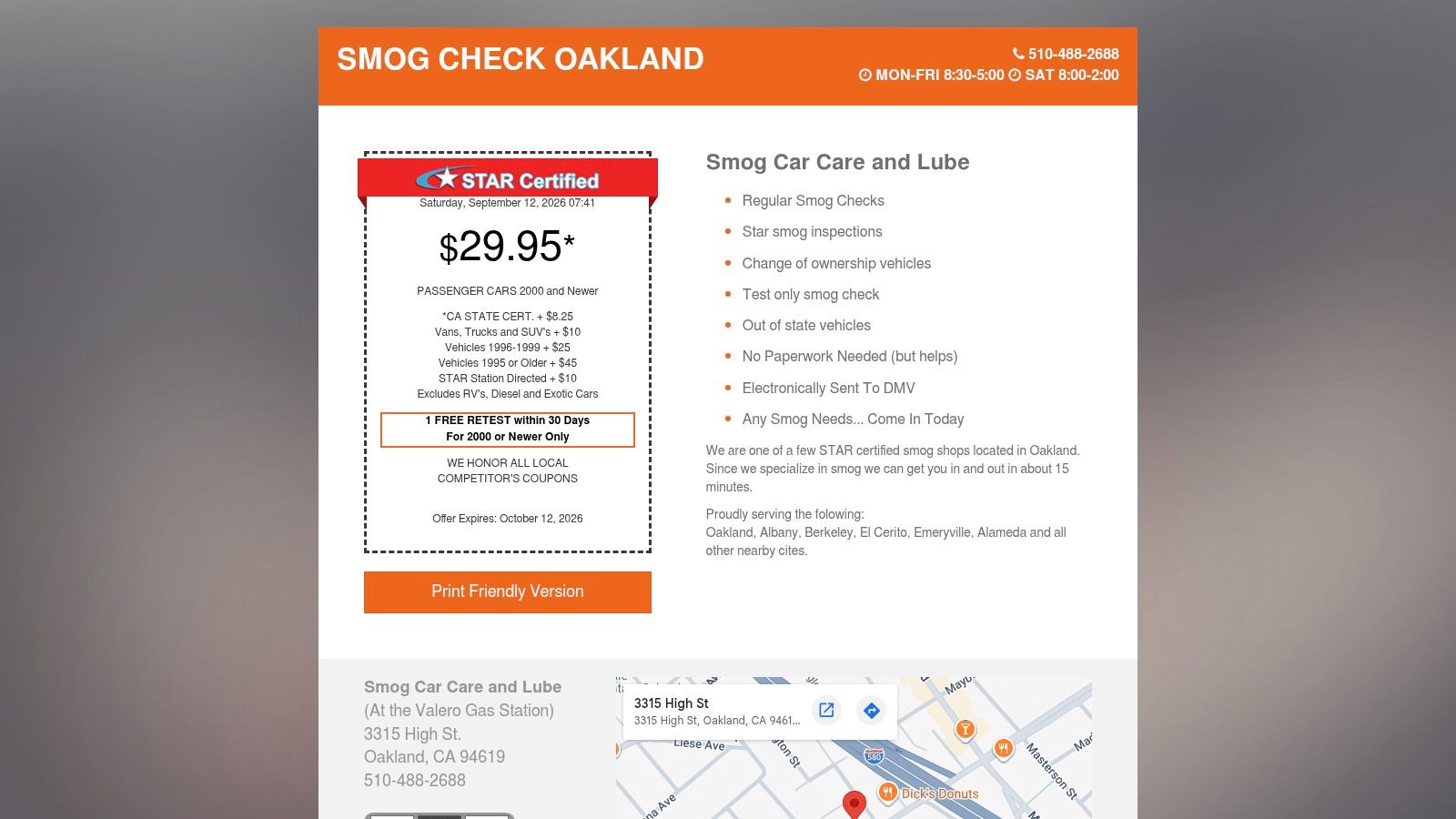
Smog Car Care and Lube is a convenient option for East Oakland and San Leandro drivers who want freeway access and a quick walk-in visit. The STAR-certified station operates at a Valero location on High Street near I-580, making it easy to combine a smog check with a route you're already driving.
The business advertises quick service for routine inspections and promotes a low coupon rate. It also electronically submits results to the DMV, which supports a straightforward renewal process after a passing test. Weekday and Saturday hours provide useful access for drivers who don't need Sunday service.
Check the final price
The website is relatively minimal, so confirm the final out-the-door price for your vehicle's year and type before the inspection begins. Coupon pricing may not apply equally to every vehicle, and the amount can change based on eligibility or required service.
The Valero setting also means the waiting experience is more functional than comfortable. If you're prioritizing a fast stop, freeway access, and walk-in convenience, that may be a fair trade. If you want a dedicated indoor waiting room, Speedy Smog offers a more comfortable environment.
For current coupons, hours, and station information, visit the Smog Car Care and Lube website.
7 Nearby Smog Check Comparison
| Station | 🔄 Process Complexity | ⚡ Speed & Resource Requirements | ⭐ Expected Outcomes | 📊 Ideal Use Cases | 💡 Key Advantages / Tips |
|---|---|---|---|---|---|
| Speedy Smog (San Leandro) | Low, STAR check, quick workflow; call to confirm hours | Very fast: ~10–15 min for 2000+; clean waiting room; handles hybrids/diesel | High, STAR-certified, DMV-accepted inspections | Fast renewals for 2000+ vehicles; comfortable visit | $25 off coupon for many 2000+ vehicles; transparent on-site pricing; call ahead |
| KS Smog (San Leandro) | Low, test-only, walk-ins; no online booking | Budget-friendly; advertises starting price $36.75 | Standard, reliable test-only results (STAR status unclear) | Cost-conscious renewals, change-of-ownership, out-of-state inspections | Confirm STAR eligibility if required; no online appointments |
| EZ Star Smog Oakland | Low, STAR-certified, high-volume; no appointment needed | High throughput; publishes coupon pricing; on-site DMV services | High, clear pricing, DMV submission available | Quick STAR inspections with immediate DMV tag processing | Check coupon exclusions (diesel/SUVs/luxury); closed Sundays |
| High St Smog & Repair (Oakland) | Moderate, offers diagnostics and repairs in addition to smog | Repair facilities and Clean Truck Program support; may take longer | High, inspection + repair capability improves pass likelihood | Vehicles needing diagnostics/repairs after smog; diesel/HD fleets | Visible site discount; call for availability due to repair volume |
| Official Smog Check Test Only (Coliseum area) | Low, STAR test-only, large facility near DMV | Fast access to Coliseum DMV; price matching and online coupon | High, STAR-certified with free-retest policy (per terms) | Drivers wanting same-day tag pickup after passing smog | Test-only: repairs must be off-site; confirm Saturday hours |
| Xpress Star Smog (Fruitvale) | Low, STAR test-only; offers mobile truck checks | Seven-day hours including Sunday; mobile Clean Truck Check | High, STAR inspections with weekend availability | Weekend smogs, HD truck compliance, Sunday service | Mobile truck service and coupons; expect weekend waits |
| Smog Car Care & Lube (High St.) | Low, STAR-certified at a gas-station location; walk-ins | Quick ~15 min checks; low coupon rate; easy freeway access | Good, fast DMV submission for routine renewals | Fast DMV renewals for East Oakland / San Leandro drivers | Low coupon pricing; limited amenities, confirm final price on arrival |
Choose by Your Actual Smog Check Need
There isn't one best station for every East Bay driver. The right choice depends on whether your priority is STAR certification, low advertised pricing, Sunday access, DMV paperwork, repair support, or a short and comfortable visit.
For San Leandro drivers who want the strongest overall combination, choose Speedy Smog. It offers STAR certification, broad coverage for newer and older vehicles as well as diesels and hybrids, a typical 10-to-15-minute test for many 2000-and-newer vehicles, and a clean indoor waiting room. Its friendly service and periodic $25-off coupon for most newer-vehicle smogs make it especially attractive for a routine inspection, but call to confirm current coupon terms and Sunday availability.
Choose KS Smog when an advertised starting price and a test-only format matter most. Confirm STAR eligibility first if your DMV notice requires it. Choose EZ Star Smog Oakland or Official Smog Check when DMV tag, registration, or submission services could save you a second trip. Official Smog Check is also worth considering if its conditional free-retest policy fits your situation.
If you're worried the vehicle may fail, choose High St Smog and Repair because diagnostics and repairs are available at the same shop. Choose Xpress Star Smog when Sunday access is essential or you need mobile Clean Truck Check support for a truck. Choose Smog Car Care and Lube when you want a quick walk-in stop near I-580 and don't need a substantial waiting area.
Before leaving home, confirm five details:
- Vehicle type: Ask whether the station handles your hybrid, diesel, older vehicle, truck, or out-of-state inspection.
- STAR requirement: Check your DMV notice and verify the station's certification directly.
- Current price: Confirm the base quote, coupon eligibility, exclusions, and retest terms.
- Timing: Ask about current hours, appointment availability, and likely wait.
- Follow-up service: Find out whether the shop provides repairs, diagnostics, DMV services, or only testing.
That quick call can prevent a wasted trip, an unexpected charge, or a failed inspection with no clear next step.
Speedy Smog provides STAR Certified emissions testing in San Leandro for most vehicles, including newer cars, older vehicles, diesels, and hybrids, with many 2000-and-newer tests completed in about 10 to 15 minutes. Visit Speedy Smog to check current hours, coupons, vehicle eligibility, and plan a convenient smog check.
The Smog Check certificate fee itself is only $8.25, but the actual cost is the repair work that follows. California Bureau of Automotive Repair data shows average repairs of about $665.59 at STAR test-and-repair stations and $703.74 at non-STAR test-and-repair stations.
You're probably holding a Vehicle Inspection Report, wondering whether your registration is now in trouble and whether a shop will sell you repairs you don't need. Take a breath. A failed smog check is a compliance problem, not an automatic loss of registration, and the smartest next move is to understand the failure before authorizing work.
California's 2025 BAR report recorded 959,667 failures among 11,275,981 initial tests, an overall failure rate of 8.51%. STAR Test-Only stations recorded 481,639 failures from 5,916,245 initial tests, an 8.14% rate. The report also recorded 83,034 BAR-97 emissions failures and 43,518 OBDII failures, so this is a recurring statewide issue, not an unusual event. Read the California BAR 2025 executive summary for the published breakdown.
Table of Contents
- You Just Failed a Smog Check in California
- Why Smog Checks Fail and What Your Report Tells You
- Quick Fixes You Can Try Before Paying a Mechanic
- Choosing the Right Station After a Failure
- Repair Costs, Assistance Programs, and Waivers
- Retesting and Clearing Your DMV Registration
- Your Post-Fail Action Checklist
You Just Failed a Smog Check in California
Your first job isn't finding the cheapest repair quote. It's preserving the evidence.
Start with the inspection report
The Vehicle Inspection Report, or VIR, tells you what failed. Read every line, not just the large “Fail” result. Separate monitors marked “not ready” from measured emissions that exceeded their limits. Those are different problems and require different decisions.
A not-ready monitor often means the vehicle's computer hasn't completed its required checks. An emissions exceedance points toward a running, fuel, ignition, exhaust, or catalytic-converter problem. Take clear photos of every page, including the station information and test date, then keep the original with your registration paperwork.
Ask the station whether the vehicle was identified as a gross polluter, directed vehicle, or high emitter. That label affects where you can go next. Don't book a generic retest until you know whether BAR has placed a testing restriction on the vehicle.
Check your registration timeline
A failed test doesn't instantly cancel your current registration. You still need to plan around the expiration date, and you shouldn't ignore DMV renewal notices while the repair is pending. Write down the expiration date and the retest deadline shown on your paperwork.
Practical rule: Never authorize a repair based only on the word “failed.” Authorize work after you know the exact code, monitor, visual defect, or measured pollutant involved.
If you want help interpreting the paperwork before visiting a repair shop, compare the terminology in this guide to common smog test results. Bring the VIR, any diagnostic printout, repair receipts, and registration documents to the next technician.
Why Smog Checks Fail and What Your Report Tells You
California failures generally fall into OBDII, emissions, visual, and functional categories. BAR's 2026 performance report recorded about 1.3 million failures among roughly 19 million 2000-and-newer vehicles tested during CY 2024–2025, an overall rate near 7%. It also reports a January 2026 all-model-year snapshot with 11,167 failures from 62,132 initial tests, or 17.97%. The categories overlap, so one defective part can trigger more than one result. See the BAR 2026 Smog Check Performance Report for the report details.
Match the failure to the likely system
OBDII failure usually means a fault code is active, a required monitor is incomplete, or the check-engine light is on. Common systems include the catalytic converter, EVAP controls, and oxygen sensors. Don't replace a catalytic converter just because the scanner mentions one. A technician needs to determine whether the converter failed or another issue caused the code.
Tailpipe emissions failure applies primarily to vehicles tested through measured exhaust emissions. High hydrocarbons can point to incomplete combustion, while carbon monoxide and nitrogen oxide readings can indicate fuel-control, combustion-temperature, or exhaust-treatment problems. The VIR's measured values matter more than a generic parts list.
Visual failures involve missing, modified, damaged, or tampered emissions equipment, including an emissions component that isn't properly installed. A warning lamp can also matter if the inspection requires it to operate correctly.
Functional failures involve systems such as air injection or other required emissions controls. These problems can look minor but still prevent certification.
| Failure Category | Typical Components | Avg. Repair Cost |
|---|---|---|
| OBDII | Catalytic converter, EVAP system, oxygen sensors, fault-code causes | Depends on diagnosis |
| Tailpipe emissions | Ignition, fuel control, exhaust treatment, catalytic converter | Depends on measured pollutant |
| Visual | Gas cap, catalytic converter, emissions plumbing, approved equipment | Depends on missing or damaged part |
| Functional | Air injection and related emissions controls | Depends on failed function |
For a component-by-component explanation, use this guide to smog check fail reasons. The report tells you the category. Proper testing tells you the repair.
Quick Fixes You Can Try Before Paying a Mechanic
Some checks cost nothing and take minutes. They won't solve every failure, but they can prevent you from paying diagnostic labor for an obvious issue.
Inspect the gas cap and warning light
Remove the gas cap and inspect the seal. If it's cracked, hardened, or doesn't tighten securely, replace it with the correct emissions-approved cap for your vehicle. A loose cap can create an EVAP leak, and an EVAP fault can illuminate the check-engine light.
Then turn the ignition on without starting the engine. Confirm that the check-engine light illuminates during the bulb check and goes out after the engine starts. If it stays on, don't schedule a retest yet. The underlying fault still needs attention.
Scan before clearing
A basic OBD-II scanner can show stored and pending codes. Scan first and save the code information. Clearing the code before you understand it destroys useful diagnostic context and may reset the readiness monitors.
If you've already repaired the problem and need to clear a confirmed code, check readiness afterward. Disconnecting the battery also resets monitors, so the vehicle needs a complete drive cycle before the inspection computer can evaluate it. The exact distance varies by vehicle and driving conditions, so use the manufacturer's procedure or let a technician verify readiness with a scan tool. This guide to reading OBD codes can help you understand the scan without confusing a code with a confirmed parts failure.
Look for basic engine issues
With the engine cool, inspect accessible vacuum hoses for splits or disconnected ends. Check whether the air filter is visibly restricted and whether the vehicle has overdue spark-plug service. These checks don't replace diagnosis, but they can reveal maintenance problems that affect combustion and emissions.
Don't erase codes repeatedly to chase a pass. A retest with monitors not ready can create another failure and delay the repair decision.
Choosing the Right Station After a Failure
A failed inspection does not automatically mean you need the cheapest retest. First read the VIR. If it identifies a testing restriction, the wrong station can cost you another inspection fee and delay repairs. The repair bill is usually the larger financial risk, so choose a location that can handle the failure and explain the next step clearly.
Match the station to the VIR
A regular smog station handles ordinary inspections and many standard retests. Call before driving over and ask whether it can retest your specific vehicle after reviewing the VIR.
A STAR Test-Only station performs inspections under BAR's STAR requirements. Use one when the paperwork requires enhanced testing or directs you to a STAR location. It will not perform repairs, so arrange diagnosis and repair separately.
A STAR Test-and-Repair station can diagnose and repair qualifying emissions problems, then complete the certification process when the vehicle is ready. This may reduce extra trips between a mechanic and testing station. Still, request the diagnosis, proposed repair, parts, labor, and retest costs in writing before approving work.
The BAR Referee handles disputes, unusual inspection situations, and certain vehicle-specific problems. The DMV directs drivers who fail to contact the BAR Referee Program through its smog inspection guidance. A referee is not a bargain retest. It is a state-run review for cases requiring independent handling.
| Station Type | Authorization | Typical Cost | Best For |
|---|---|---|---|
| Regular station | Standard inspections and eligible retests | Station's posted market price | Ordinary failures |
| STAR Test-Only | STAR testing and required enhanced retests | Test-only fee | Directed or enhanced testing |
| STAR Test-and-Repair | Diagnosis, repair, and qualifying certification | Repair plus testing | Drivers who want one repair location |
| BAR Referee | Independent state review and specialized cases | Ask BAR about applicable charges | Disputed or unusual failures |
Use BAR's station locator, confirm authorization, and ask what the VIR requires before booking. Speedy Smog, a STAR-certified station in San Leandro, publishes its current smog testing service details online so you can confirm pricing before visiting. Bring the VIR and ask whether the station can test, repair, or only perform the retest your vehicle needs.
Repair Costs, Assistance Programs, and Waivers
The inspection fee isn't the financial threat. BAR says the Smog Check certificate fee is $8.25, while its 2025 data puts average repair costs at about $665.59 for STAR test-and-repair cases and $703.74 for non-STAR test-and-repair cases. Those figures explain why you should treat the VIR as a diagnostic starting point, not a permission slip for unlimited parts replacement.
Get an estimate before approving work
Ask for three things in writing:
- The exact diagnostic finding and related trouble code.
- The repair that addresses that finding.
- The estimated parts, labor, and retest costs.
If the quote approaches the state's repair threshold, pause before authorizing the work and check whether you qualify for the California Consumer Assistance Program repair option. CAP may help eligible drivers with emissions-related repairs, but application timing and eligibility matter. Don't assume reimbursement will apply to work you already paid for.
Understand the waiver paths
BAR's repair-assistance rules use a $650 minimum repair-spend threshold, with eligibility depending on the vehicle, repair type, and program requirements. A cost waiver may be available when qualifying emissions repairs reach that threshold and the vehicle still fails. It isn't automatic, and the repair work must meet the program's documentation rules.
A parts waiver is different. It addresses situations where a required certified replacement part isn't available, often involving older vehicles. That isn't the same as failing to afford a repair or choosing not to replace a worn component.
Keep invoices, parts information, diagnostic results, and every retest report. If the vehicle remains noncompliant after documented qualifying work, ask BAR whether a waiver, CAP support, or referee review fits your case.
Retesting and Clearing Your DMV Registration
Once the actual fault is repaired, return to an authorized station with the original VIR and repair paperwork. The technician should check that the check-engine light is off, the required monitors are ready, and the vehicle is eligible for that station's testing authority before starting another inspection.
Don't waste the retest
A retest isn't a guess. Have the shop scan readiness first and verify that the repair addressed the failure category. If the battery was disconnected or codes were cleared, the vehicle may need its prescribed drive cycle before the computer can complete its checks.
BAR reports that roadside inspection samples in the relevant performance reports failed at a fleet-weighted average of about 14%, while routine testing outcomes differ. The point for a driver is simple: the vehicle's real emissions condition matters, and a temporary code reset won't create a durable pass. The BAR 2024 performance report provides the historical roadside comparison.
A STAR Test-Only location may charge the $8.25 certificate fee for the certificate portion of an eligible retest, while other stations set market prices that can include diagnosis, repair, and testing. Ask for the complete price before work begins.
Confirm DMV transmission
Passing results are transmitted electronically to the DMV, so you generally won't mail a paper certificate for an ordinary renewal. Keep the printed VIR anyway. It proves what happened, helps resolve transmission questions, and preserves your repair history.
If registration has already been suspended, contact the DMV and ask what it needs for reinstatement. Have your passing VIR, proof of insurance, registration-fee payment, and CAP documentation if applicable ready. Don't drive as though the registration is cleared until the DMV record confirms it.
Your Post-Fail Action Checklist
Use this sequence instead of calling several shops and repeating the same inspection.
First 24 hours
- Keep the failure report. Photograph every page of the VIR and store the original with your registration documents.
- Review emissions data. Mark each failed category, every “not ready” monitor, and any gross-polluter or directed-vehicle designation.
- Check the calendar. Record your registration expiration date and the retest deadline shown on the paperwork.
- Pull diagnostic codes. Use an OBD-II scanner, save the results, and don't clear codes before a technician reviews them.
- Inspect simple items. Check the gas-cap seal, warning light, visible vacuum hoses, air filter, and obvious emissions-component damage.
First week
- Choose the correct station type. Call a regular station, STAR Test-Only station, STAR Test-and-Repair station, or BAR Referee based on the VIR designation.
- Get a real diagnosis. Ask the technician to verify the code, test the suspected system, and check readiness before recommending parts.
- Request a written estimate. Separate diagnostic labor, parts, installation, and retest charges.
- Check assistance before repairs. If the estimate reaches $650, review CAP and waiver eligibility before authorizing qualifying work.
- Schedule the repair. Keep the invoice, parts details, test results, and every document the shop provides.
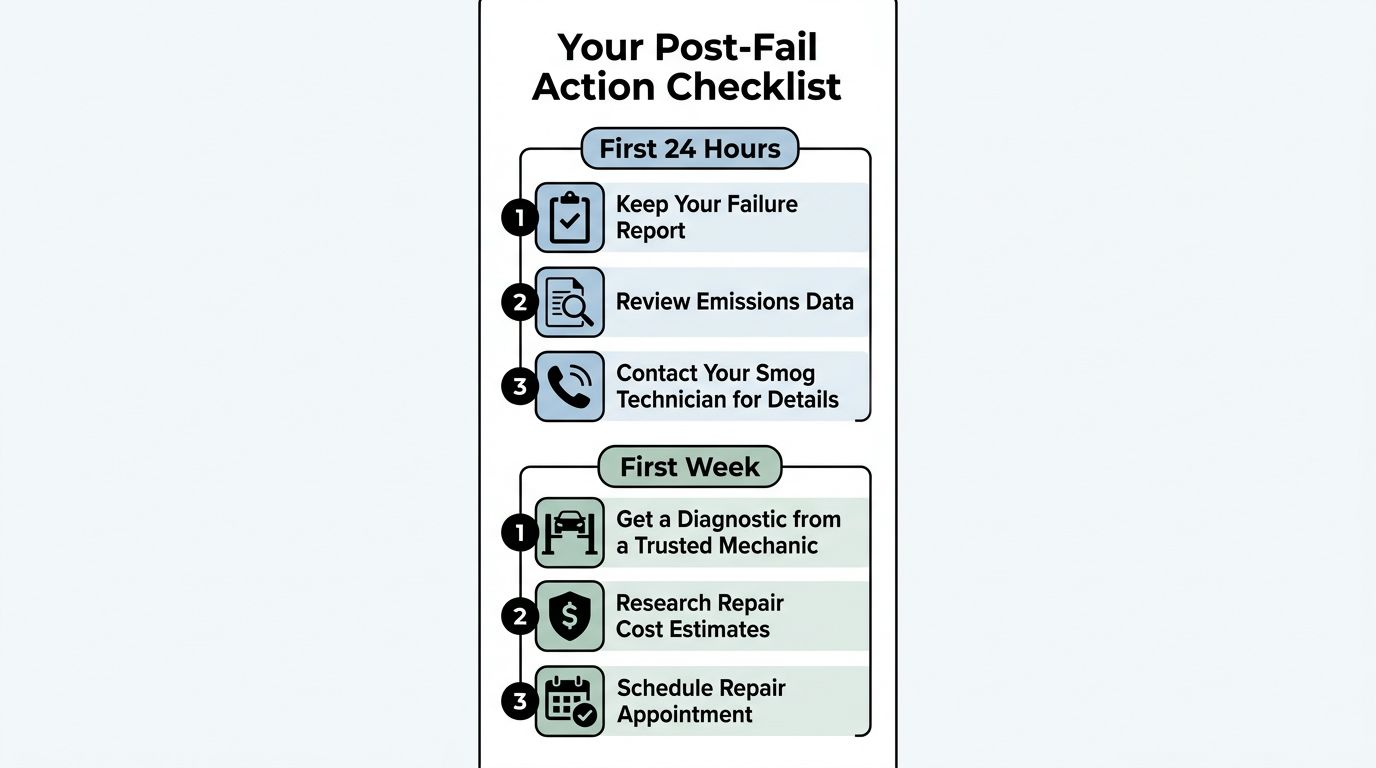
Within the next 30 days
- Verify readiness after repair. Have the technician scan the monitors before sending the vehicle to retest.
- Retest at an authorized location. Bring the VIR and repair receipts, and confirm that the station can handle any directed or enhanced requirement.
- Confirm DMV receipt. Check that the passing result appears in the DMV record, especially if renewal is pending.
- Protect the paper trail. Keep the passing VIR, invoices, CAP approval, and waiver documents together.
- Escalate intelligently. If the vehicle still fails after repeated repair and testing, stop buying guesses and request BAR Referee guidance. If the repair remains unaffordable or the vehicle cannot meet requirements, ask BAR whether a waiver or assistance route applies.
The fastest path is usually the most documented one. A clear VIR, verified diagnosis, correct station, and complete receipts keep you from paying twice for the same uncertainty.
If your failed smog check is in the San Leandro or East Bay area, bring your VIR and registration paperwork to Speedy Smog for guidance on the appropriate retest path. The STAR-certified station can inspect eligible vehicles and help you understand what needs to happen before you spend money on repairs.
The renewal notice is on the kitchen counter, your coffee is getting cold, and one line keeps pulling your attention back: smog certification required. If the check-engine light is off, the car drives normally, and nothing looks wrong, it's easy to wonder why the DMV needs another inspection.
A California car smog test is less mysterious once you separate the paperwork, the emissions equipment, and the onboard computer checks. The most important detail for many drivers now isn't visible smoke or even the dashboard light. It's whether the vehicle's readiness monitors have finished their self-tests.
Table of Contents
- Why Your Renewal Notice Just Mentioned a Smog Test
- What a Car Smog Test Actually Is
- The Two Test Types California Drivers Face
- How to Prepare So You Pass the First Time
- What Happens at a Smog Station
- Exemptions, Penalties, and Why Rules Differ by Region
- Common Reasons Cars Fail and How to Fix Them
- Picking the Right Station and Passing with Confidence
Why Your Renewal Notice Just Mentioned a Smog Test
California's Smog Check Program has been tied to vehicle registration for decades. The state became the 20th U.S. state to adopt a vehicle inspection and maintenance program in 1982, and the Bureau of Automotive Repair began administering the statewide program in 1984 under SB 33. The original program combined biennial testing, change-of-ownership testing, and inspection of emission-control components. California's Smog Check history and registration connection
That means a renewal notice mentioning a smog certificate usually isn't a sign that the DMV has discovered a new problem. It's often a routine part of the vehicle's registration cycle. Most qualifying vehicles need a Smog Check every other year, and the state transmits passing certificates to the DMV for registration purposes. A change of ownership or first registration in California can create another testing requirement.
Read the notice as a checklist
Start by checking the vehicle identification number, license plate, renewal deadline, and any instruction about where to complete the inspection. If the notice asks for a smog certification, the next step is to schedule or visit an authorized station, not to order a general mechanical inspection.
A smog requirement also doesn't mean California is checking every part of the car. The appointment focuses on emissions-related equipment and data. Brakes, tire tread, suspension, lights, and other safety items may deserve attention, but they aren't the purpose of a Smog Check appointment.
Practical rule: Treat the renewal notice as an action item, not a diagnosis. Confirm eligibility, prepare the emissions system, complete the test, and allow the result to reach the DMV.
Clean-air goals sit behind the program, but drivers experience the rule through a practical registration process. If the vehicle passes, the certificate is sent electronically for registration purposes. If you skip the test or receive a failing result, renewal can't move forward until the requirement is resolved.
What a Car Smog Test Actually Is
A car smog test is a standardized emissions inspection. Depending on the vehicle, the technician checks either the onboard diagnostic system, the exhaust coming from the tailpipe, or both. The inspection looks for evidence that the engine and emissions controls are operating within California's requirements.
California's program developed in stages. The state adopted its vehicle inspection and maintenance program in 1982, then implemented the first statewide Smog Check program in March 1984 under SB 33. California Smog Check program background
The result is connected directly to registration. A passing certificate is transmitted to the DMV, so you generally don't need to carry a paper certificate to a DMV office to prove the test occurred. The station records the inspection result, and the state uses that information during the registration process.
It isn't a safety inspection
A smog appointment isn't a full evaluation of whether the car is safe to drive. The technician isn't performing a brake inspection, measuring tire condition, or certifying the suspension. You can pass the emissions test and still need repairs that have nothing to do with emissions.
The reverse can happen too. A car that feels smooth and looks clean can fail because its diagnostic system reports an emissions fault or hasn't completed the required self-tests. That's why a visual impression isn't enough.
Which vehicles usually fall under the program
California generally requires testing for gasoline-powered vehicles from model year 1976 and newer and diesel vehicles from model year 1998 and newer, with additional rules based on fuel type, vehicle category, age, first registration, and ownership transfer. Some newer vehicles receive an initial exemption period, and hybrid requirements differ by category. California BAR Smog Check requirements
The technician chooses the inspection path based on the vehicle's model year and equipment. Newer qualifying vehicles usually communicate through an OBD II diagnostic connector. Older vehicles may need a loaded-mode test on a chassis dynamometer, where the station measures pollutants directly from the exhaust.
The Two Test Types California Drivers Face
California uses two main inspection approaches. OBD II testing reads information from the vehicle's computer, while the dynamometer test measures emissions from the exhaust while the vehicle runs under load.
For qualifying 1996-and-newer spark-ignition passenger vehicles and trucks under 14,001 GVWR, the OBD II inspection evaluates three technical gates:
- MIL status, meaning whether the malfunction indicator light, commonly called the check-engine light, is operating as required.
- Readiness monitors, which show whether the vehicle's emissions self-tests have completed.
- Fault-code retrieval, which checks for stored emissions-related trouble information.
The state's regulatory framework describes these elements and the readiness requirements for the OBD II portion. California OBD II inspection requirements
California Smog Test Types at a Glance
| Feature | OBD II Test | Dynamometer (Tailpipe) Test |
|---|---|---|
| Main evidence | Vehicle computer data | Direct exhaust measurement |
| Vehicle operation | Usually stationary while connected to the diagnostic port | Vehicle runs on chassis rollers |
| What gets checked | MIL, readiness monitors, and fault codes | Hydrocarbons, carbon monoxide, carbon dioxide, and oxides of nitrogen |
| Smoke inspection | May apply as part of the broader inspection | Visible tailpipe smoke check follows the emissions phase |
| Typical application | Newer vehicles equipped with OBD II | Older vehicles or vehicles directed to a loaded-mode procedure |
In a loaded-mode inspection, the vehicle runs at a stabilized cruise condition on a chassis dynamometer. The station samples hydrocarbons, carbon monoxide, carbon dioxide, and oxides of nitrogen, then performs a visible tailpipe-smoke check at idle with an unobstructed observation period of at least 10 seconds. California loaded-mode and visible-smoke testing requirements
Vehicles equipped with OBD II are evaluated through that computer-based pathway rather than treated like older tailpipe-only vehicles. The key preparation issue for these drivers is monitor status, especially after electrical work or emissions repairs.
How to Prepare So You Pass the First Time
You arrive for renewal with the check-engine light off, expecting an easy pass. The overlooked problem may be hidden in the vehicle's readiness data. Effective October 1, 2025, California's new readiness rule requires all readiness monitors to be set for a vehicle to pass a Smog Check, subject to limited exceptions for unique design issues. BAR's explanation of the October 2025 OBD readiness-monitor regulations
Readiness monitors are internal self-tests. They examine systems such as fuel control, oxygen sensors, catalytic-converter performance, and evaporative emissions equipment. A monitor marked ready has completed its check. Incomplete means the check has not finished. Not supported means the vehicle does not use that monitor, so it is different from an incomplete result.
Check readiness before booking
A basic OBD scanner can show monitor status. Some vehicles also display inspection information through a dashboard test mode, though the procedure varies by manufacturer. Check before visiting a station if you recently disconnected the battery, cleared trouble codes, replaced a battery, or completed emissions repairs.
Clearing codes only to turn off the warning light can reset the monitors. The vehicle may then need normal driving under specific conditions before the diagnostic system completes its checks. Follow this order: diagnose the problem, make the repair, drive normally as needed, verify that the monitors are ready, and schedule the test.
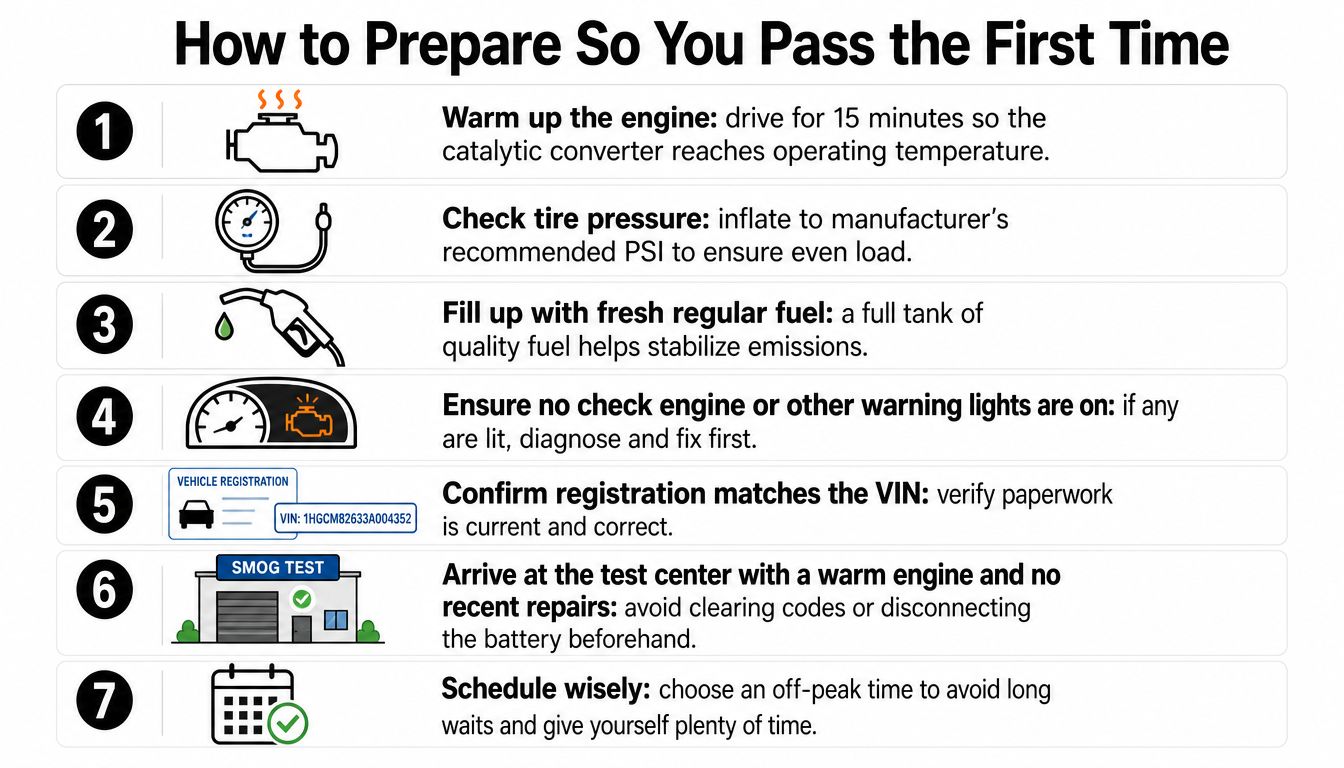
Use a sensible pre-test routine
A short routine can prevent avoidable complications:
- Warm the engine: Drive long enough for the engine and emissions equipment to reach normal operating temperature.
- Check tire pressure: Use the manufacturer's recommended pressure, particularly if the vehicle will run on a dynamometer.
- Use normal fuel: Fresh, appropriate fuel supports normal engine operation.
- Inspect the dashboard: Do not arrive with an illuminated emissions warning light.
- Verify the paperwork: Confirm that the registration information matches the vehicle identification number.
- Avoid last-minute resets: Do not disconnect the battery or erase codes immediately before testing.
For a practical walkthrough, review this guide to passing a California emissions test.
A vehicle that fails after a legitimate repair attempt may qualify for California's repair-cost waiver option. Eligibility depends on the program's conditions, so ask the station or BAR before assuming every failure requires unlimited repairs.
What Happens at a Smog Station
You pull into a station, provide the registration information, and tell the technician whether the test is for renewal, a transfer, or another DMV requirement. A STAR-certified station, such as Speedy Smog in San Leandro, can inspect vehicles that need the STAR pathway, although the correct station depends on the vehicle's DMV direction and local program requirements.
The technician begins by confirming the vehicle information and checking the equipment relevant to the inspection. The appointment may include a visual inspection of emissions components, a connection to the OBD II port, or a dynamometer procedure for a vehicle that requires loaded-mode testing.
The inspection itself
For an OBD II vehicle, the technician connects a test device and retrieves the MIL status, readiness information, and trouble-code data. For an older vehicle subject to loaded-mode testing, the technician places it on a chassis dynamometer and measures exhaust pollutants while the car runs through the required operating condition.
A visible-smoke inspection can also be part of the procedure. California's regulation requires the observation immediately after the emissions phase, with the engine at idle and an unobstructed view for at least 10 seconds. California emissions and smoke inspection procedure
The visit can feel routine, but ask questions if the result isn't what you expected. A useful technician should be able to tell you whether the vehicle passed, which monitor or code caused a failure, and whether the result was transmitted electronically for DMV registration purposes.
A test result is more useful when you leave knowing what the vehicle reported, not just whether the paper says pass or fail.
The final certificate is not a general guarantee of mechanical health. It confirms the outcome of the required emissions inspection. Keep any repair documentation and ask about the retest process before you leave if the result is unsuccessful.
Exemptions, Penalties, and Why Rules Differ by Region
California's Smog Check rules aren't perfectly uniform across every vehicle and air basin. Eligibility depends on model year, fuel type, vehicle category, registration events, and the region where the vehicle is registered.
The state's current requirements cover gasoline vehicles from model year 1976 and newer and diesel vehicles from model year 1998 and newer, while some newer vehicles receive an initial exemption period and hybrid rules differ by category. California BAR eligibility guidance
Why the San Joaquin Valley deserves attention
The San Joaquin Valley illustrates why older online guides can become misleading. BAR's 2026 update says a contingency measure could move the new-vehicle exemption in that area from eight model years to seven, which would bring more vehicles into the inspection cycle if the measure takes effect under the stated conditions. BAR's San Joaquin Valley contingency update
That change matters even if a statewide summary still lists the older exemption language. Local air-quality requirements can affect eligibility differently, so owners should rely on the current DMV notice and BAR guidance for the vehicle's registration location.
Don't assume an exemption from memory
Owners often remember an exemption that applied to an older vehicle, a different fuel type, or another county. First registration in California and a change of ownership can also trigger testing, even when the vehicle's usual renewal pattern looks different.
| Region | STAR Required? | Typical Fee Range | Key Exemptions |
|---|---|---|---|
| East Bay and other Bay Area locations | Depends on DMV direction and vehicle status | Varies by station and inspection type | Vehicle age, fuel type, and qualifying categories |
| San Joaquin Valley | May change under regional contingency requirements | Varies by station and inspection type | Local exemption rules can be affected by air-quality measures |
| Other California areas | Depends on county, vehicle, and DMV instruction | Varies by station and inspection type | Some newer vehicles and specific vehicle categories |
The table is a decision aid, not a substitute for the notice attached to your vehicle record. If the DMV directs you to a specific type of station, follow that instruction rather than relying on a general internet checklist.
Common Reasons Cars Fail and How to Fix Them
A failure usually points to a specific emissions issue or incomplete diagnostic process. The most avoidable problem is testing before the vehicle's readiness monitors have finished after a battery disconnect or code clear.
Use this repair checklist as a starting point, not a substitute for diagnosis:
- Readiness monitors are incomplete: Drive the vehicle normally through varied conditions after repairs or electrical work, then verify monitor status with an OBD scanner before testing. Don't assume a short trip has completed every self-test.
- The gas cap doesn't seal: Tighten it until it seats correctly. If the seal is worn or the cap is damaged, replace it with a suitable replacement, preferably an OEM part, because an evaporative leak can trigger a fault.
- The oxygen sensor is faulty: Have the diagnostic code and sensor data checked before replacing parts. A sensor that reports incorrectly can disturb fuel control and increase emissions.
- The catalytic converter isn't working properly: A converter that's damaged, clogged, or no longer converting pollutants may require replacement after the underlying cause is identified.
- The engine is producing excess emissions: Misfires, fuel-mixture problems, vacuum leaks, a failing mass-airflow sensor, or an emissions-control fault can all require attention before the test.
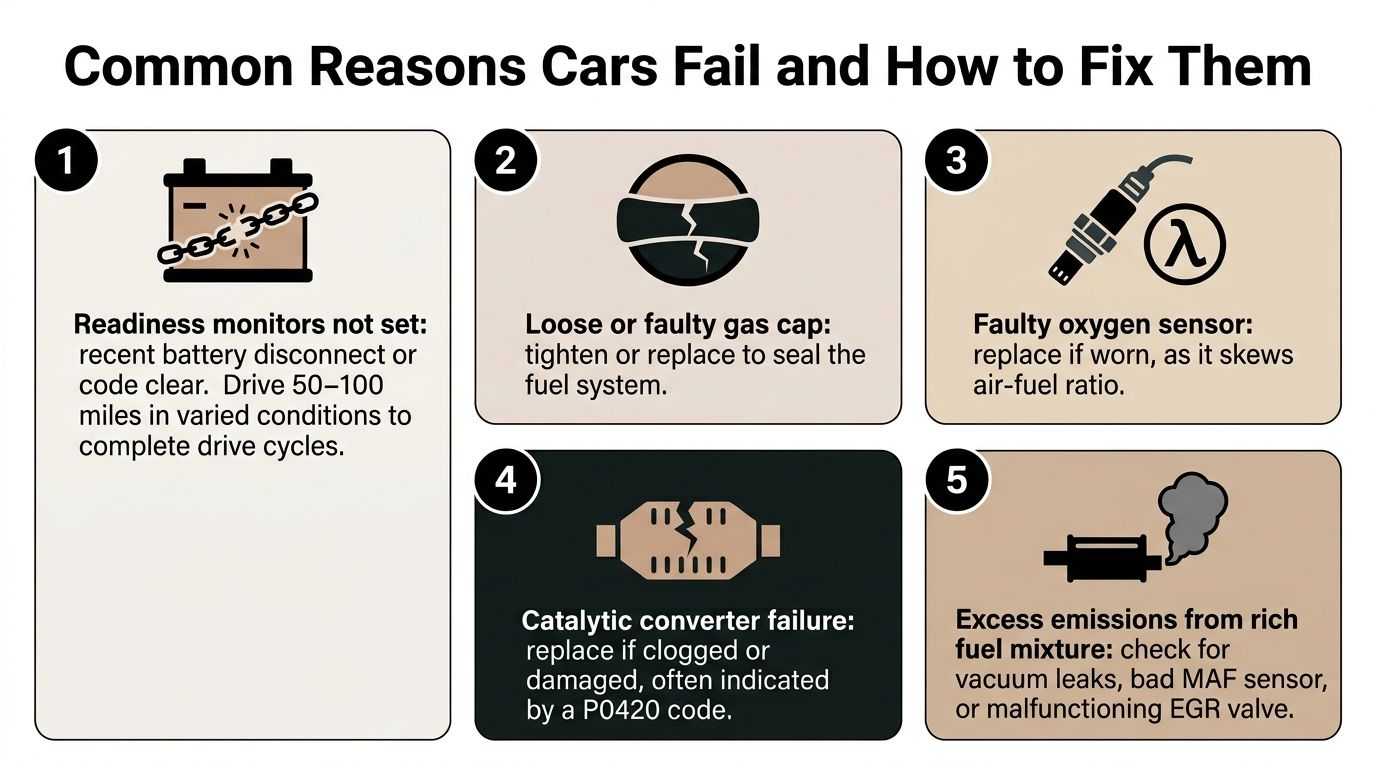
Start with the evidence
A glowing check-engine light is a strong warning that the vehicle's OBD II inspection may fail. Stored fault codes matter too, even when the car feels normal. Ask a repair shop to scan the system and explain the code before authorizing a catalytic converter, oxygen sensor, or other expensive replacement.
Older vehicles may fail because of measured tailpipe emissions, visible smoke, altered emissions equipment, or engine problems that affect the loaded-mode result. California's dynamometer procedure measures hydrocarbons, carbon monoxide, carbon dioxide, and oxides of nitrogen, so clean-looking exhaust doesn't prove the readings will be acceptable. California loaded-mode testing rules
For a more detailed repair-oriented checklist, review these common Smog Check failure reasons. Repair the cause, let the vehicle complete its self-tests where applicable, and retest only after the system is ready.
Picking the Right Station and Passing with Confidence
The right station can prevent confusion, but it can't make an unready vehicle pass. Choose a facility that can explain the vehicle's inspection path, confirm readiness-monitor status, and tell you what the result means before you leave.
A Test Only station performs inspections without selling repairs. A STAR station meets additional program requirements and handles vehicles that BAR or the DMV directs through the STAR pathway. If your notice names STAR or Test Only, follow the notice rather than choosing a station based only on distance.
What to ask before the test
Call or check the station's posted information and ask:
- Which station type applies: Can the facility test your vehicle under the DMV's instruction?
- What the price includes: Does the quoted amount cover the inspection, certificate transmission, and any required retest terms?
- Whether readiness can be checked first: Will the technician show you which monitors are ready, incomplete, or unsupported?
- What happens after a failure: Will you receive the trouble code or failure reason in writing?
- Whether the result is transmitted electronically: Confirm how the passing certificate reaches the DMV.
For a plain-language explanation of station categories, read what a STAR Smog station is.
The most dependable habit is simple: book with a station that explains the result before you leave. That matters more under the readiness-monitor rule because a vehicle can have no visible smoke and no obvious driving complaint, yet still fail when its diagnostic self-tests remain incomplete.
Speedy Smog in San Leandro offers STAR-certified smog inspections, accepts walk-ins, and transmits passing results electronically to the DMV. If you're an East Bay driver preparing for renewal, visit Speedy Smog to confirm the appropriate test and have the vehicle's readiness status reviewed before inspection.
Your registration deadline is approaching, and you're trying to find the best smog test near me before another errand turns into a full afternoon. The closest listing isn't automatically the right choice. Your vehicle may need a STAR station, a test-only facility, repair support, walk-in service, diesel coverage, or a coupon that changes the final price.
This guide compares seven supplied East Bay stations by STAR certification, test-only versus test-and-repair service, turnaround expectations, pricing transparency, coupons, hours, appointment requirements, vehicle coverage, customer-service signals, and route convenience. Confirm current hours, rates, coupon terms, and directions before leaving because station details can change.
For San Leandro drivers who want a quick, DMV-recognized inspection, Speedy Smog is the featured choice. The recommendations below match each station to a practical priority, then explain what to do if the vehicle passes, fails, or needs a different type of inspection.
Table of Contents
- 1. Speedy Smog for the fastest San Leandro service
- 2. KS SMOG for transparent pricing
- 3. 76 Oakland Smog for Grand Lake and Broadway Terrace access
- 4. Broadway Smog and Auto Repair for repair backup
- 5. EZ Star Smog Oakland for North Oakland and Emeryville
- 6. Alameda Smog Dog for walk-ins and larger vehicles
- 7. Alameda Smog for coupon-focused value
- Top 7 Nearby Smog Test Stations Comparison
- Choose the Station That Fits Your Next Move
1. Speedy Smog for the fastest San Leandro service
Speedy Smog is the clearest fit for San Leandro drivers who want a fast STAR Certified smog check without traveling across the East Bay. The station is at 15275 Washington Ave, San Leandro, and most tests for 2000-and-newer vehicles take about 10–15 minutes, according to the business information supplied for this guide.
That speed matters when you're trying to finish a registration task before work, during a lunch break, or between errands. Speedy Smog is a test-only station, so it's designed for efficient inspections rather than on-site repair. Its STAR certification means the inspection operates within California's regulated Smog Check system and is recognized for DMV registration purposes.
California's STAR network handles a major share of statewide testing. The Bureau of Automotive Repair's 2025 summary recorded 8,302,296 tests and 8,532,845 certificates issued by STAR stations across test-only and test-and-repair facilities combined (California BAR 2025 summary). Choosing a STAR station is especially important if your renewal notice directs your vehicle to a STAR facility.
Why San Leandro drivers choose it
Speedy Smog covers 2000-and-newer vehicles, 1999-and-older cars, diesels, and hybrids. The station also emphasizes transparent pricing, courteous service, and a clean indoor waiting room, useful advantages when you're waiting for the test to finish.
- Fast turnaround: Most newer-vehicle tests are completed in about 10–15 minutes.
- Broad coverage: Call ahead for older vehicles, diesels, hybrids, or unusual inspection requirements.
- Potential savings: A $25-off coupon is commonly available for most 2000-and-newer smog checks, but confirm the current terms before testing.
- Convenient schedule: It's open Monday through Friday from 8:30 AM to 5:30 PM and Saturday from 8:30 AM to 4:00 PM. It isn't open Sundays.
- Customer comfort: The indoor waiting room and “Smog & a Smile” service approach make the visit less stressful.
Practical rule: If your car is likely to pass and you want the quickest compliant test in San Leandro, start with Speedy Smog. If it fails, plan to use a separate repair shop before arranging a retest.
The site doesn't publish a fixed baseline price in the supplied information, so call (510) 614-7664 for the current total and ask whether the coupon applies. You can also verify Speedy Smog's current hours before driving over.
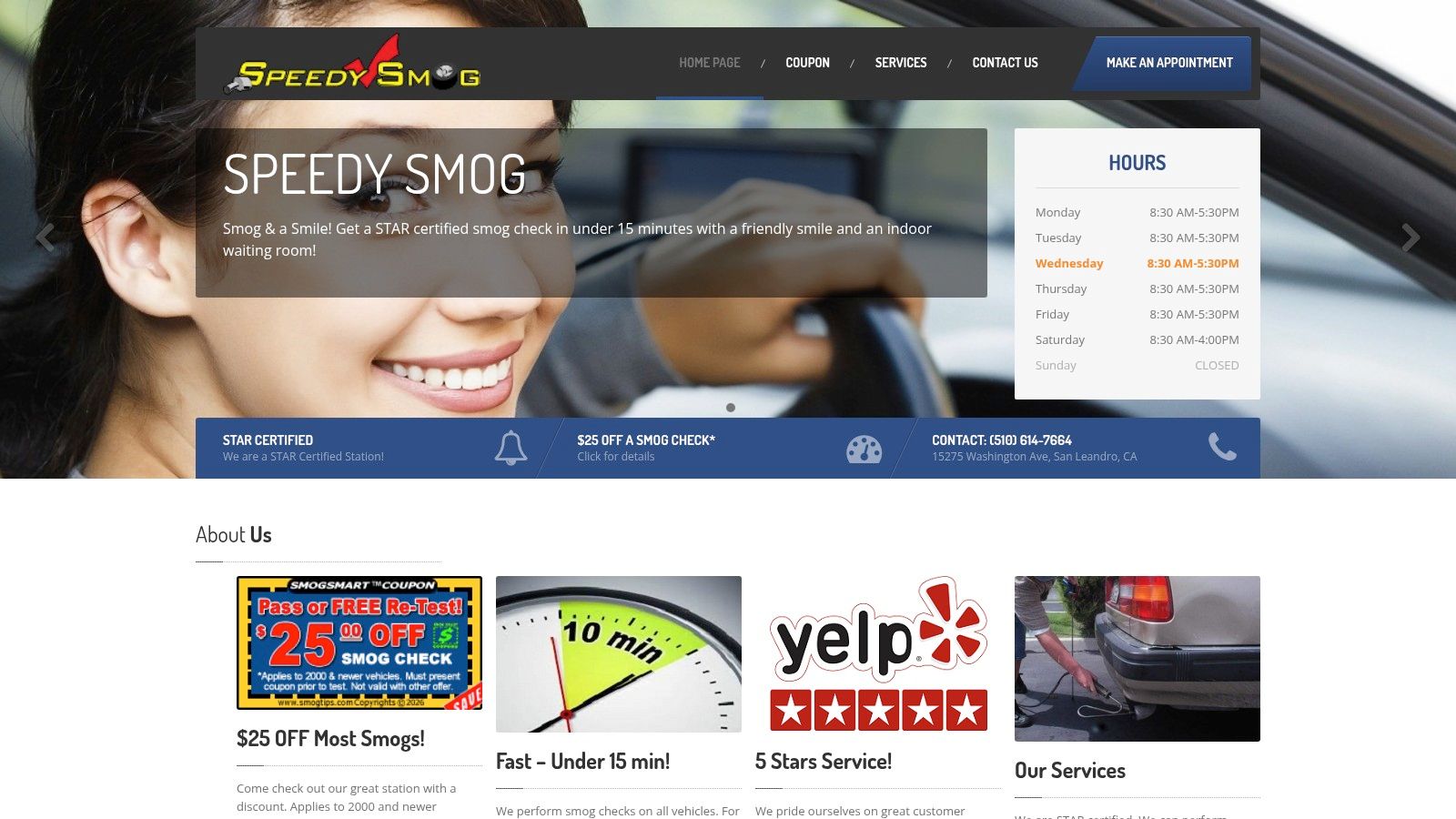
2. KS SMOG for transparent pricing
KS SMOG on Foothill Boulevard is the practical pick when posted pricing matters more than repair support. The station is a STAR-certified, test-only facility near the East Oakland and San Leandro border, making it convenient for drivers who already know their vehicle is ready for inspection.
The website lists pricing starting at $36.75, along with coupons and information about vehicle categories. Because stations set their own testing fees, published pricing gives you a useful starting point, but you should still confirm the complete current price for your specific vehicle before the test.
KS SMOG handles renewals, STAR-directed vehicles, out-of-state vehicles, change-of-ownership inspections, and hybrids. The site also states that it doesn't add an extra fee for light-duty trucks, minivans, or SUVs, which can make the quote easier to understand for common larger vehicles.
The main trade-off
This is a test-only station. If the vehicle fails, KS SMOG won't be your repair destination, so you'll need to take the failure report to a separate mechanic and then return for a retest. That setup works well for newer cars, recently serviced vehicles, and drivers who already have a trusted repair shop.
- Best fit: Drivers who want a STAR test and clear online pricing.
- Location advantage: The East Oakland and San Leandro border offers straightforward access from I-580.
- Scheduling: The station operates Monday through Saturday, with phone or walk-in service rather than an online booking portal.
- Vehicle questions: Ask about your exact model before arriving, especially for out-of-state, hybrid, or directed vehicles.
The station's STAR status fits California's broader inspection framework. The Bureau of Automotive Repair reported that STAR stations performed 83% of all Smog Check tests in 2023, showing how central the program has become to California's inspection network (California BAR program summary).
Visit the KS SMOG website to check current specials, then call before leaving if you need an exact quote or want to confirm wait times.
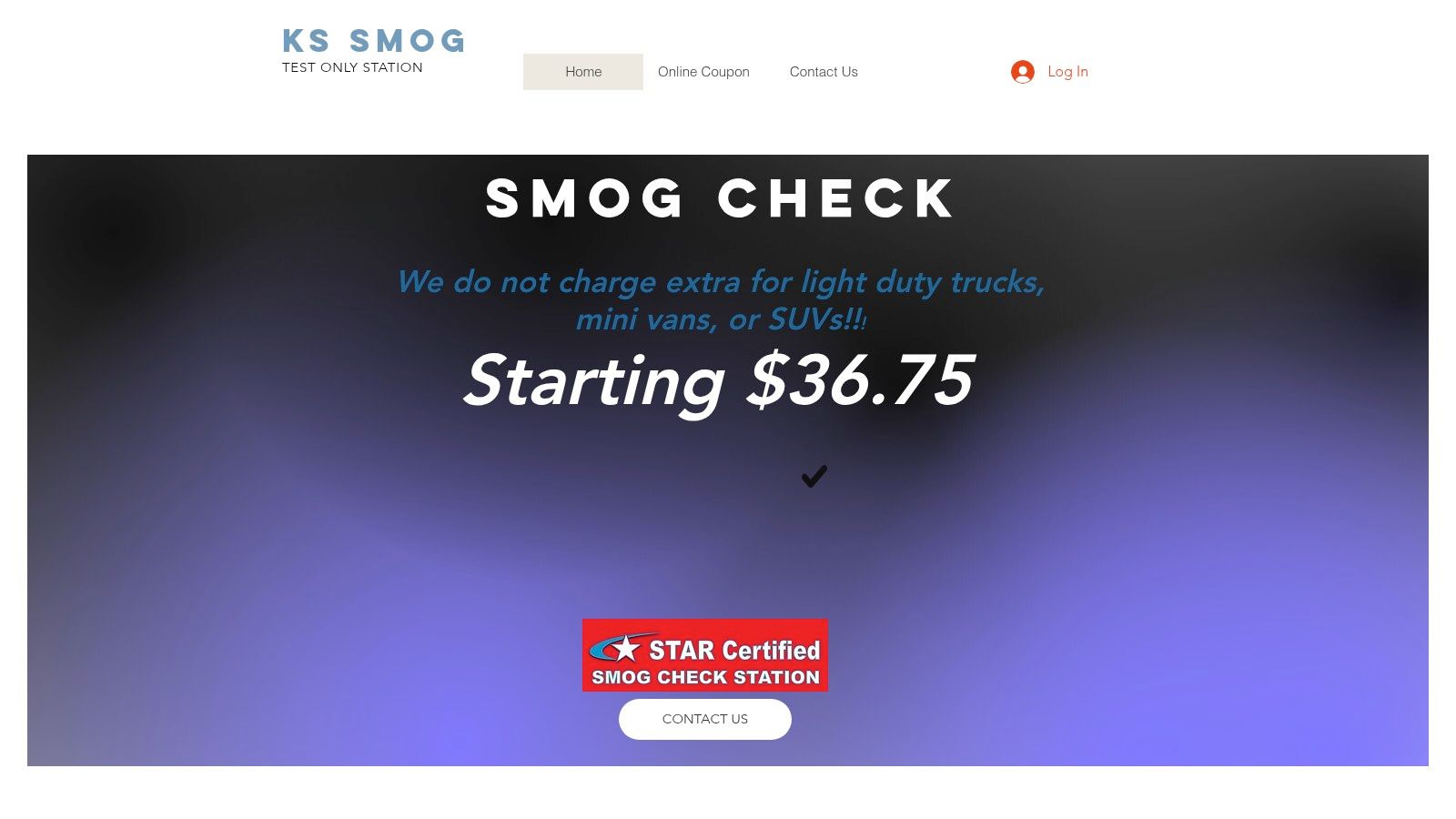
3. 76 Oakland Smog for Grand Lake and Broadway Terrace access
76 Oakland Smog is the strongest location-first option for drivers in Grand Lake, Lakeshore, and Broadway Terrace. It operates two Oakland sites, one near Lakeshore and Trader Joe's and another on Broadway Terrace, so you can choose the route that fits your errands or commute.
Both locations focus on test-only smog checks and quick in-and-out service. That makes 76 Oakland Smog a good match for a vehicle that's already running properly and has no obvious emissions warning signs. It's less suitable if you expect to need diagnostics or repairs after the inspection.
The Lakeshore location has a useful practical advantage. You can combine the visit with nearby errands rather than waiting in an isolated commercial area. That convenience can matter as much as a small price difference when you're already heading through the Grand Lake area.
What to verify before visiting
The website has separate pages for the two locations, which helps you confirm the correct address, phone details, and current hours. It also maintains a web-specials page, but fixed site-wide pricing isn't supplied, so ask for the current total and coupon conditions.
- Choose Lakeshore: Best for Grand Lake errands and the Trader Joe's area.
- Choose Broadway Terrace: Better for drivers already traveling through the hills or northern Oakland route.
- Expect test-only service: Arrange repairs elsewhere if the vehicle fails.
- Check the special: Web discounts may have vehicle, payment, or expiration conditions.
Drivers comparing Oakland options can also review this guide to a STAR smog check in Oakland before deciding whether a different STAR station better matches the vehicle's inspection requirement.
A nearby test-only station is efficient when the car is ready. It becomes less convenient after a failure because diagnosis, repair, and retesting happen at separate locations.
Review the 76 Oakland Smog locations and specials before you go. Don't rely on an old search listing for hours or assume both Oakland sites follow identical schedules.
4. Broadway Smog and Auto Repair for repair backup
Broadway Smog and Auto Repair is the best choice when your main concern is what happens if the vehicle fails. Located in central Uptown Oakland near MLK Jr Way, it combines STAR-certified smog testing with diagnostics and emissions-related repairs.
That test-and-repair model costs you some spontaneity because the shop operates by appointment and doesn't offer Saturday hours. In return, you have a single place to discuss the failure report, investigate the emissions issue, complete repairs, and work toward a retest.
The distinction between test-only and test-and-repair stations is important. A test-only shop can provide an independent inspection, which many drivers prefer when they want a neutral test result. A test-and-repair shop can be more convenient for older vehicles, cars with a check-engine-light history, or vehicles that recently experienced emissions problems.
Choose repair support over maximum flexibility
Broadway Smog and Auto Repair is the better match if you'd rather schedule deliberately than gamble on a walk-in visit. Call first, provide the vehicle details, and explain whether you're completing a renewal, transfer, out-of-state registration, or STAR-directed inspection.
- Repair after failure: On-site diagnostics and emissions-related repairs reduce the number of separate stops.
- STAR capability: The shop is listed as STAR-certified in the supplied station information.
- Appointment model: Book ahead for a predictable visit.
- Weekend limitation: No Saturday hours means weekday planning is necessary.
California uses performance standards as part of STAR oversight. The Bureau of Automotive Repair includes an aborted-test threshold that must not exceed 125% of the statewide average for similar vehicles on the same inspection system (California BAR 2025 program report). For a consumer, that reinforces the value of choosing a regulated station with disciplined inspection processes, not the closest garage.
Go to Broadway Smog and Auto Repair to review contact information and arrange an appointment. If your priority is a one-stop path from failed test to repair, this is the strongest option in the roundup.
5. EZ Star Smog Oakland for North Oakland and Emeryville
EZ Star Smog Oakland is the direct recommendation for drivers in North Oakland, Emeryville, and the Berkeley corridor. Its San Pablo Avenue location sits near the Emeryville border, making it more convenient than a San Leandro or central Oakland station for that part of the East Bay.
The station focuses on STAR-directed vehicle testing and publishes hours that include Saturday availability. It also accepts after-hours appointments by request, which gives it an important scheduling advantage for drivers who can't make a standard daytime visit.
Pricing isn't publicly posted in the supplied station information. That's the main drawback for comparison shoppers. Call or use the station's contact options to request the current rate, explain the vehicle type, and ask whether your situation requires a STAR inspection or another inspection category.
Best for a nonstandard schedule
EZ Star Smog makes sense when route convenience and scheduling flexibility outweigh online price transparency. It's particularly useful if you're traveling from Emeryville or North Oakland and want to avoid crossing the full East Bay for a directed inspection.
- North Oakland access: San Pablo Avenue is convenient for the Emeryville and Berkeley side of the area.
- After-hours option: Request an appointment outside posted hours instead of assuming it's available.
- Saturday service: Confirm the current Saturday schedule before departing.
- Vehicle details: Ask about equipment and coverage for older or unusual vehicles because the supplied website information doesn't list every capability.
California's official DMV guidance separates requirements by vehicle type, including gasoline, diesel, hybrid, natural gas, and electric vehicles. That means the closest station isn't always the right station for your car. Check the EZ Star Smog Oakland website and contact the shop with the year, fuel type, and registration situation.
Best scheduling use: Choose EZ Star Smog when North Oakland or Emeryville is your natural route, especially if a requested after-hours appointment would save a longer trip.
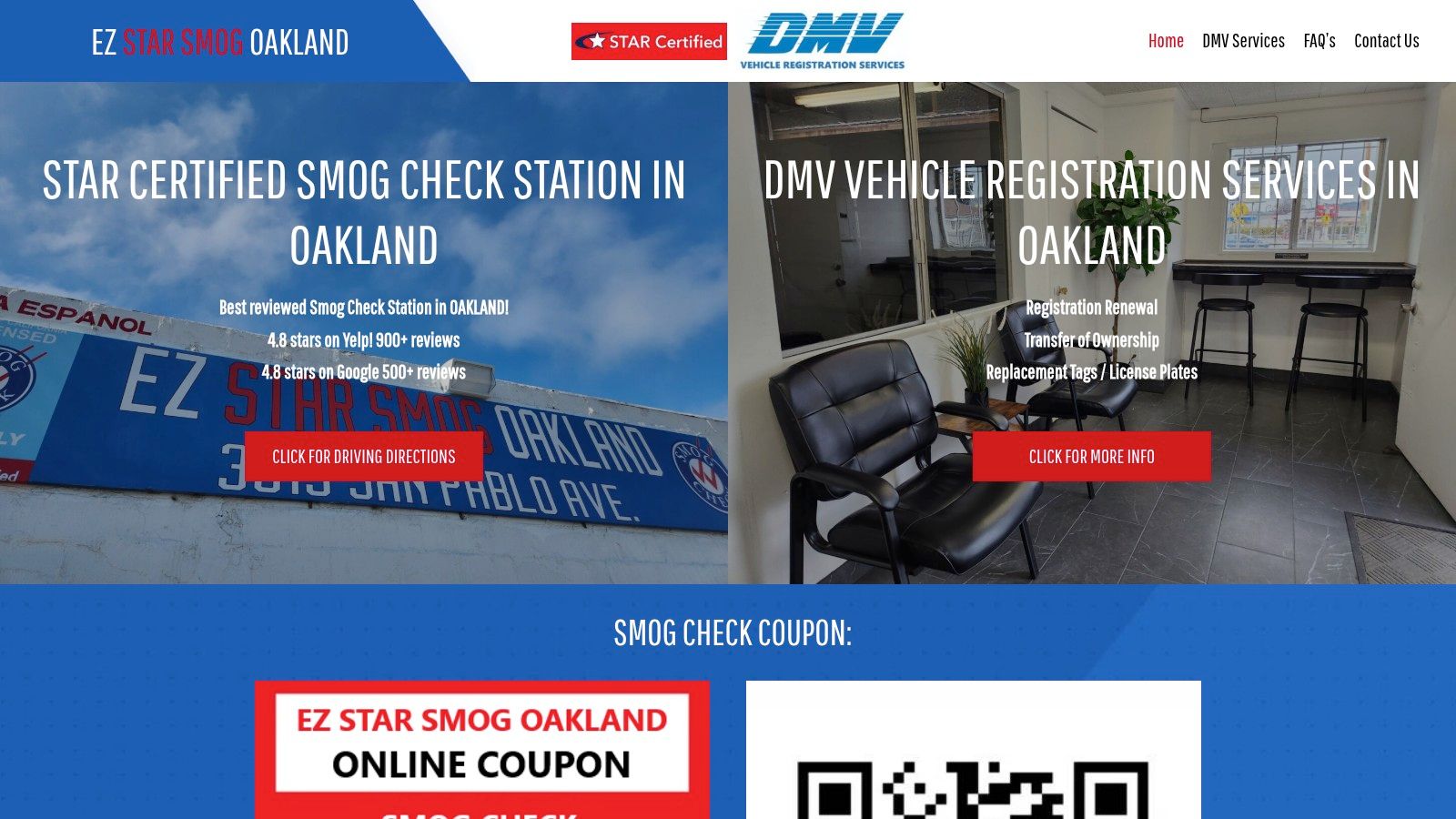
6. Alameda Smog Dog for walk-ins and larger vehicles
Alameda Smog Dog is the most flexible choice for drivers who don't want to schedule ahead. This STAR-certified, test-only station on Park Street welcomes walk-ins and serves a broad range of vehicles, including cars, trucks, diesels, hybrids, RVs, and motorhomes.
That coverage makes it stand out for owners of larger or less typical vehicles. Before you leave, call with the vehicle's year, fuel type, and size so the station can confirm it's equipped for the inspection you need. The site publishes station information and a coupon, giving you a starting point for both logistics and savings.
The trade-off is the same one found with other test-only facilities. If the vehicle fails, you'll need a separate repair shop, then another visit for the retest. For a vehicle with a clean maintenance history, that may be a reasonable exchange for walk-in convenience.
Match the station to your vehicle
Alameda Smog Dog is especially useful when your vehicle doesn't fit the standard newer-car profile or when your schedule changes during the day.
- Walk-in service: No appointment is needed according to the supplied station information.
- Larger vehicles: Ask about trucks, RVs, and motorhomes before driving over.
- Fuel types: Confirm diesel and hybrid coverage for your specific vehicle.
- Route planning: Park Street can be busy, so allow extra time for street parking.
- Coupon check: Review the current offer and its conditions before payment.
The Alameda Smog Dog station details provide the contact and service information you'll need before departing. If you're crossing from San Leandro, compare bridge traffic and parking conditions with the convenience of a closer station.
This is the right pick when walk-ins and unusual vehicle coverage matter more than having repairs completed at the same location.
7. Alameda Smog for coupon-focused value
Alameda Smog on High Street near Fernside is the strongest Alameda choice for drivers who actively compare web coupons and advertised specials. It's a STAR-certified, test-only facility with extended weekday hours and Saturday availability, plus clear location and contact information published online.
The website maintains a dedicated coupon page, and the supplied station information describes quick in-and-out service and acceptance of web coupons. That makes it a useful option for drivers willing to check the offer before leaving rather than choosing a station solely by proximity.
Read the coupon conditions carefully. Some offers reference a cash price, which may mean card payments cost more. Ask the station to confirm the total, payment method, vehicle eligibility, and whether any required state charge is included or handled separately.
The best fit for planned savings
Alameda Smog is a sensible option for drivers coming from San Leandro via the High Street bridge, particularly when the coupon offsets the extra route. It's less suitable if you expect the vehicle to need immediate repair because it's test-only.
- Value priority: Check the dedicated coupon page before visiting.
- Hours: Extended weekday and Saturday availability help with scheduling.
- Payment: Confirm whether the advertised cash price differs from the card price.
- Failure plan: Arrange a separate repair shop before the test if the vehicle has known emissions issues.
- Route: Review bridge traffic and parking before committing to the trip.
You can compare current offers and contact details on the Alameda Smog website. For San Leandro drivers, this option is most compelling when the coupon and hours outweigh the convenience of staying local.
The station's test-only setup keeps the inspection focused and efficient, but it also means your next move after a failure will happen somewhere else. Choose it when you're comfortable with that trade-off and want a coupon-led decision.
Top 7 Nearby Smog Test Stations Comparison
| Service | 🔄 Process / Complexity | ⚡ Speed / Efficiency | 📊 Expected Outcomes | 💡 Ideal Use Cases | ⭐ Key Advantages |
|---|---|---|---|---|---|
| Speedy Smog | STAR‑certified test station; straightforward walk‑in workflow; test‑only focus | ⚡ Very fast (most 2000+ tests 10–15 min) | DMV‑accepted smog certificates; high compliance | Quick DMV smog for 2000+ vehicles and commuters | STAR certification, rapid turnaround, comfortable waiting area |
| KS SMOG (Foothill Blvd) | STAR test‑only; posted pricing; no online booking (phone/walk‑in) | ⚡ Quick in/out service | STAR‑recognized results; clear pricing aids budgeting | Budget‑minded drivers wanting transparent fees | Posted pricing, convenient I‑580 access, coupons |
| 76 Oakland Smog (Lakeshore & Broadway) | Two test‑only locations; simple OBD/visual inspections; web specials | ⚡ Fast OBD/visual checks at neighborhood sites | Quick, DMV‑accepted inspections; discounts via web specials | Drivers near Grand Lake/Broadway needing quick stops | Multiple locations, easy local access, web discounts |
| Broadway Smog and Auto Repair | STAR test‑and‑repair shop; appointment model; diagnostic capability | ⚡ Moderate (diagnostics add time) | Can repair on‑site to enable passing retests | Vehicles likely to fail or needing emissions repairs | One‑stop testing + repairs; STAR certified diagnostics |
| EZ Star Smog Oakland | STAR‑focused testing; posted hours incl. Saturday; after‑hours by request | ⚡ Generally quick; flexible scheduling options | STAR test results; accommodates STAR‑directed vehicles | North Oakland/Emeryville drivers needing off‑hour options | Saturday/after‑hours availability, responsive contact |
| Alameda Smog Dog (Park St) | STAR test‑only; walk‑ins welcome; wide vehicle acceptance (RVs, diesels) | ⚡ Efficient for walk‑ins; no appointment needed | DMV‑accepted for broad vehicle types | Owners of larger/unique vehicles wanting no‑appt service | Accepts RVs/motorhomes, published coupons and details |
| Alameda Smog (High St / Fernside) | STAR test‑only; extended weekday + Saturday hours; coupon page | ⚡ Fast in‑and‑out service with frequent web coupons | Quick DMV‑accepted checks; often honors web discounts | Local drivers seeking quick service and online coupons | Clear online info, frequent coupons, reliable hours |
Choose the Station That Fits Your Next Move
Start with the outcome you need, not the station name. If you're in San Leandro, your vehicle is ready, and you want a fast STAR inspection with broad coverage, choose Speedy Smog. It offers a clean indoor waiting room, transparent pricing, service for newer and older vehicles, diesels, and hybrids, and a possible $25-off coupon for most 2000-and-newer smogs. Confirm the current offer and price before testing.
Choose KS SMOG when posted pricing and the East Oakland or San Leandro border location matter most. It's a STAR-certified test-only station with coupons and coverage for renewals, directed vehicles, out-of-state vehicles, and hybrids. Choose Broadway Smog and Auto Repair when a failed test could require diagnosis and emissions-related repair. Its appointment-based model is less spontaneous, but the one-stop repair path can save a second shop search.
For Oakland location convenience, choose 76 Oakland Smog, especially if you're already near Lakeshore, Grand Lake, or Broadway Terrace. For North Oakland or Emeryville, choose EZ Star Smog Oakland, particularly when Saturday service or an after-hours appointment by request fits your schedule. Choose Alameda Smog Dog when you need walk-ins or coverage for trucks, diesels, RVs, and motorhomes. Choose Alameda Smog when website coupons and extended hours drive the decision.
California DMV rules can change based on the vehicle and transaction. The DMV states that gasoline-powered vehicles are generally exempt when they're less than eight model-years old, but change-of-ownership and first-time California registration situations can still require a smog check (California DMV smog inspection guidance). Confirm your exact requirement before paying for an inspection.
Before departing, complete this quick check:
- Confirm STAR eligibility: Verify whether your renewal notice directs you to a STAR station.
- Verify current details: Call to confirm hours, pricing, wait time, and directions.
- Check coupon terms: Ask about expiration dates, vehicle limits, cash pricing, and payment surcharges.
- Ask about appointments: Confirm whether walk-ins are accepted or booking is required.
- Confirm vehicle coverage: Provide the year, fuel type, and vehicle class, especially for diesels, hybrids, trucks, RVs, and older cars.
- Plan for failure: Know which repair shop you'll use if the inspection doesn't pass.
If you're ready for a quick San Leandro inspection, visit Speedy Smog, confirm the current details, and bring your registration or renewal information.
Visit Speedy Smog in San Leandro for a STAR-certified smog check with broad vehicle coverage, a comfortable indoor waiting room, and a fast process for most newer vehicles. Call ahead to confirm current pricing, coupon eligibility, hours, and the right inspection path for your car before you drive over.
You pull into a smog station certain your car will pass. The check-engine light is off, the engine runs smoothly, and you recently replaced the battery. Then the technician plugs into the OBD-II port and tells you the vehicle is not ready. You haven't failed because the car necessarily has an active emissions fault. You may have erased the computer's self-test history and arrived before it finished checking itself again.
That readiness-monitor problem causes a surprising number of unnecessary repeat visits. A successful car emissions test depends on more than a dark dashboard warning light. In California, the vehicle must meet the inspection requirements that apply to its model year and technology, and the result can affect registration when the DMV requires a Smog Check.
Table of Contents
- Why Your Car Emissions Test Matters More Than You Think
- How California Smog Tests Work by Vehicle Type
- The Readiness Monitor Trap That Causes Unexpected Failures
- How to Prepare Your Vehicle Before the Smog Check
- STAR Certified Stations and DMV Requirements
- What Happens After You Pass or Fail
- Getting Your Smog Check Done at Speedy Smog in San Leandro
Why Your Car Emissions Test Matters More Than You Think
A smog check isn't a formality you can safely leave until the last day of registration renewal. The station is checking whether the vehicle's emissions-control systems have reported enough information to support a pass. If the computer shows incomplete self-tests, the technician may be unable to certify the car even when it appears to drive normally.
California's newer gasoline vehicles are evaluated primarily through OBD-II, which means the vehicle's own diagnostic system plays a central role in the inspection. The California Bureau of Automotive Repair's explanation of OBD readiness rules makes the practical issue clear. A car can have no active malfunction indicator light and still fail because required monitors haven't completed.
The appointment you didn't need to repeat
Consider a driver who had a repair performed, cleared the stored trouble code, or disconnected the battery while replacing it. The warning light goes out, so the driver books the test immediately. At the station, the scan shows that the emissions monitors are not ready. The driver now has to leave, complete the required driving conditions, and return for another inspection.
That failed trip can create a registration problem if the renewal deadline is close. It can also mean another appointment, more time away from work, and a second inspection charge depending on the station's policy. The avoidable mistake isn't always a bad catalytic converter or a serious engine problem. Often, it's testing before the vehicle has finished its post-repair drive cycle.
Practical rule: An off check-engine light doesn't prove that your vehicle is ready for inspection.
Treat preparation as part of the test
Read the DMV renewal notice before choosing a station. It tells you whether a smog certification is required and may identify station requirements that affect where you can go. If you've recently had battery work or emissions repairs, ask a technician to check monitor status before scheduling the official inspection.
The right approach is simple. Diagnose first, repair properly, allow the vehicle's monitors to complete, then test. You can't reliably shortcut the computer's self-checks by clearing the light again, and doing so can make the readiness problem worse.
How California Smog Tests Work by Vehicle Type
California doesn't use one identical procedure for every vehicle. The test depends on model year, fuel type, and the vehicle's emissions technology. The old assumption that every car sits on a dynamometer while a probe measures the tailpipe is wrong for many modern vehicles.
For gasoline vehicles from model-year 2000 and newer, the inspection is generally centered on the onboard diagnostic system. California's BAR states that tailpipe testing is no longer required for most of these vehicles. The technician connects a scan tool to the OBD-II port and checks the required emissions information, including warning-light status and readiness.
Gasoline vehicles from 1996 through 1999 receive both an OBD inspection and a tailpipe test under the verified California rules. That combination gives the station two different views of the vehicle, the computer's stored emissions information and the gases measured directly from the exhaust.
The main categories
| Vehicle Category | Test Method | Tailpipe Test Required |
|---|---|---|
| Gasoline, model-year 2000 and newer | Primarily OBD-II inspection | Generally no |
| Gasoline, model-years 1996 through 1999 | OBD inspection plus tailpipe testing | Yes |
| Diesel vehicles | Procedure depends on vehicle details and applicable California requirements | Varies |
| Hybrid vehicles | Vehicle-specific emissions inspection, with OBD-related checks where applicable | Varies |
| Older vehicles | Requirements depend on model year and California program rules | Varies |
Diesel and hybrid inspections deserve special attention because their systems don't fit the simple gasoline-tailpipe model. Diesel vehicles can involve different emissions controls and compliance rules, while hybrids may run their gasoline engine intermittently and use a high-voltage system that changes how the vehicle operates during testing.
Recent program changes reinforce that point. Colorado's 2025 vehicle emissions program update describes self-service kiosks for gasoline-powered and hybrid vehicles along with tighter diesel compliance rules. The European Union also proposed targeted inspection methods for ultrafine particles and NOx in 2025, as reported in the European Commission's vehicle inspection policy materials. These developments show why modern inspections increasingly focus on the vehicle's specific technology rather than applying one universal test.
If you're unsure which category applies, use the California guide to vehicles that need a smog check and confirm the requirement on your DMV notice. Bring the vehicle information and renewal paperwork to the station so the technician can verify the correct inspection path before starting.
The Readiness Monitor Trap That Causes Unexpected Failures
Readiness monitors are emissions-system self-tests stored in the vehicle's computer. Each monitor evaluates a particular operation, such as catalyst performance, oxygen-sensor operation, exhaust-gas recirculation, or evaporative-emissions control. The vehicle must experience the right operating conditions before those tests can run and report a completed result.
Disconnecting the battery or clearing diagnostic trouble codes can reset the monitors to not ready. The same thing can happen after certain repairs when the technician clears the code as part of the repair process. The dashboard may look clean, but the computer's inspection record has been wiped and must be rebuilt through normal driving.
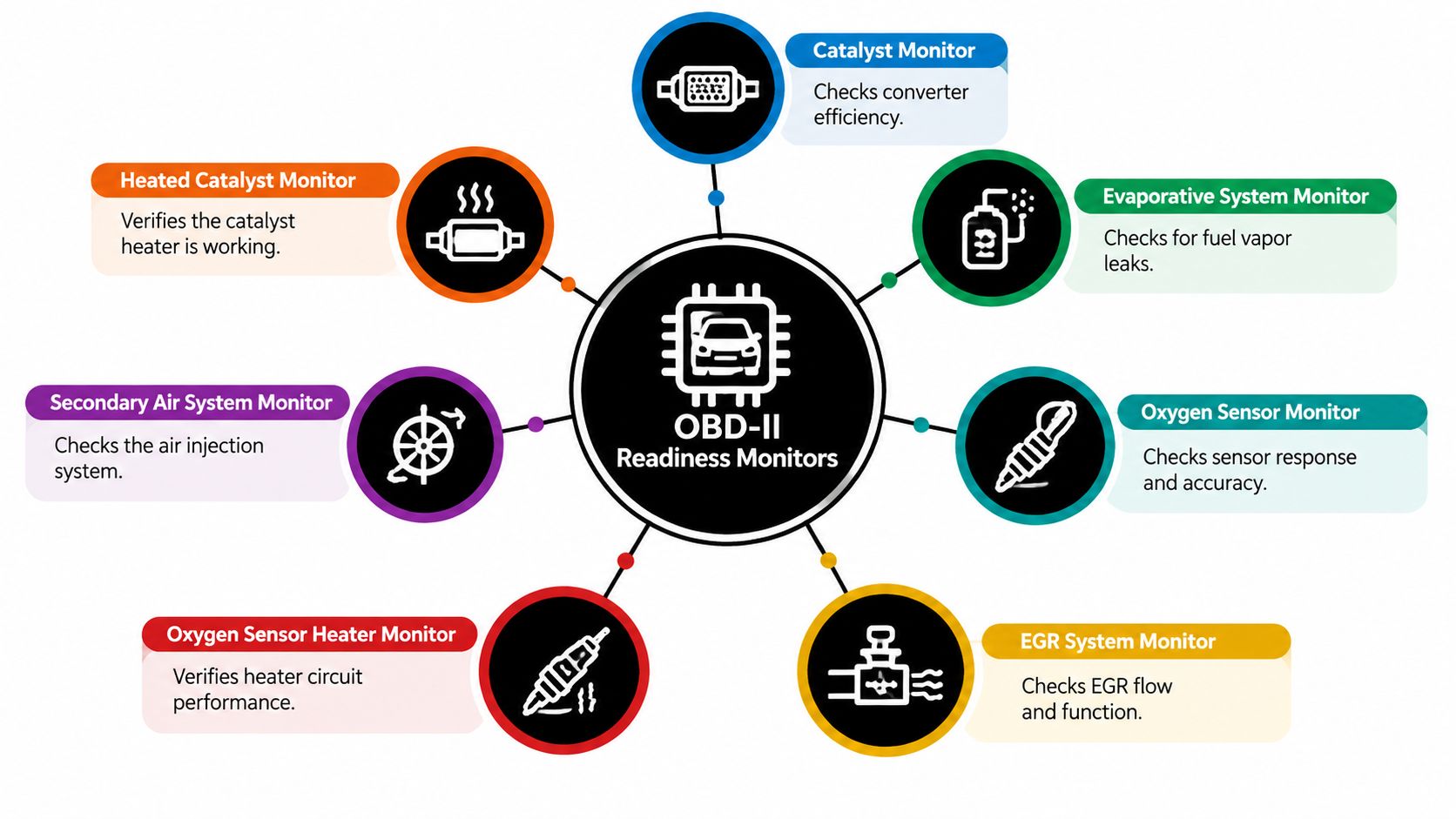
Why a clean dashboard can still fail
Think of the monitors as homework completed by the car's computer. Clearing the codes is like erasing the answers. The warning light may disappear because the computer no longer has a confirmed fault to display, but the inspection still sees unfinished work.
California's BAR explains that some 2000-and-newer gasoline vehicles may have only the evaporative monitor unset under newer readiness rules. Other required monitors must be set. That distinction matters because the allowed status depends on the vehicle and the applicable rule, not on what a driver sees on the dashboard.
The California BAR readiness-monitor regulation guidance should be treated as the controlling reference for the current California requirement. Don't rely on a generic scanner message that says “ready” without understanding which monitors are complete and which remain unset.
Drive time is part of the repair process
The car needs suitable conditions to run its tests. Short trips, unusual driving patterns, or insufficient warm-up may leave a monitor incomplete. CARB's Clean Truck Check OBD testing background notes that some vehicles may require dozens of warm-up cycles, thousands of miles, and hundreds of engine hours before every monitor becomes ready. Those figures apply to the background discussed by CARB and shouldn't be treated as a universal drive-cycle prescription for every passenger vehicle.
If the vehicle refuses to set a monitor after normal driving, stop guessing. A persistent incomplete monitor can point to an underlying emissions-system problem that hasn't triggered a full warning yet. Have a qualified technician check the monitor status and diagnose the system instead of repeatedly clearing codes.
For a practical explanation of the warning-light relationship, review this guide to passing a smog test with a check-engine light issue. The key decision is whether the vehicle needs more drive time or actual diagnosis.
How to Prepare Your Vehicle Before the Smog Check
Preparation starts before the appointment, especially if the car recently had electrical or emissions work. Don't clear codes just to make the dashboard look better. That action can reset readiness and leave the station with no usable inspection result.
Use this checklist as a practical filter:
- Check monitor status: Have a shop or compatible OBD-II scanner verify that the required monitors are ready before the official test.
- Drive normally after repairs: Give the vehicle a mix of city and highway operation so the emissions systems can encounter different conditions. A generic 50 to 100 mile drive may help some vehicles, but it isn't a guaranteed manufacturer-specific cycle, so don't treat that range as a universal rule.
- Avoid a last-minute battery disconnect: Battery work can erase readiness information. Schedule the smog check only after the vehicle has completed the needed self-tests.
- Inspect the gas cap: A loose or damaged cap can allow an evaporative-emissions leak. Tighten it correctly and replace it if the seal is visibly damaged.
- Address warning lights: A lit check-engine light is a direct reason to stop and diagnose before testing. Don't assume an additive or quick reset fixes the underlying problem.
- Arrive with the engine warm: Normal operating temperature helps the inspection proceed smoothly, although warming the car won't repair a fault or complete every monitor by itself.
Be careful with quick fixes
Fuel additives aren't a substitute for diagnosis. Use one only when the product is appropriate for the vehicle and a technician has identified a reason to use it. Random parts replacement is just as wasteful. A dirty air filter, overdue oil service, poor tire pressure, or stale fuel may deserve maintenance, but none of those items should distract you from an incomplete monitor or an active emissions fault.
The best pre-test check is an honest scan. Ask for the exact monitor status, any pending codes, and an explanation of whether the vehicle is ready to test. If the technician tells you to keep driving, ask what condition the monitor needs, such as highway cruising, steady warm-up, or a cold start after the vehicle sits.
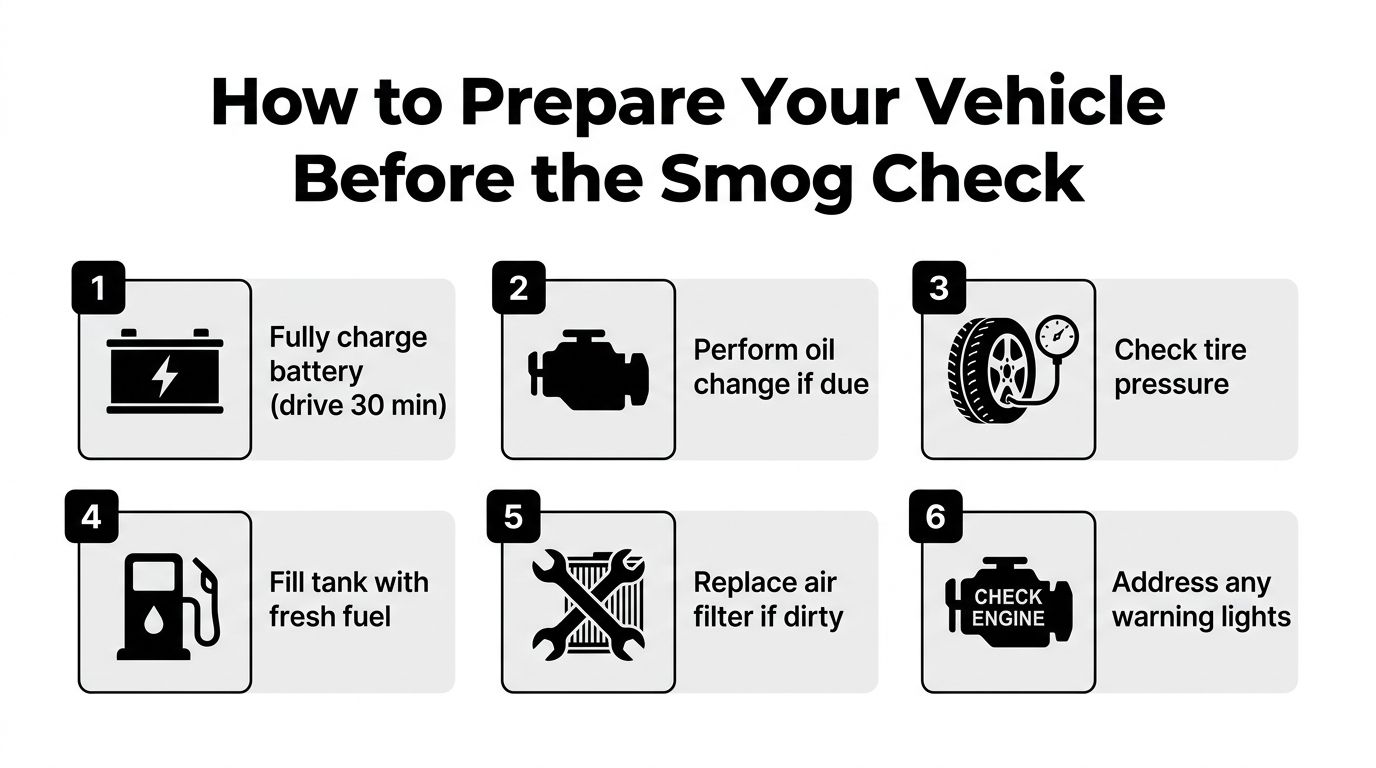
A visual checklist can help you avoid the most common oversights. Keep the appointment flexible enough to allow diagnosis and drive time rather than booking it immediately after a repair.
STAR Certified Stations and DMV Requirements
A STAR-certified station meets additional performance requirements established by California's Bureau of Automotive Repair. That designation matters when the DMV directs you to a STAR facility or when your notice specifies a STAR inspection. In that situation, a non-STAR station may not be able to complete the certification you need.
The station types can be confusing because they don't all provide the same service. A test-only station performs the inspection but doesn't repair the vehicle. A test-and-repair station can inspect and repair vehicles, subject to the program rules that apply to that station. A non-STAR station may perform ordinary inspections when the DMV notice doesn't require STAR certification.
Read the renewal notice before choosing
Don't select a shop solely because it appears first in an online search. Look for wording that identifies a directed vehicle, STAR requirement, or specific inspection condition. If the notice requires STAR, confirm the station's current certification before you arrive.
| Station Type | What It Generally Does | When It Fits |
|---|---|---|
| STAR test-only | Performs qualifying inspections without repair service | When the notice requires STAR and you already have a repair plan |
| STAR test-and-repair | Performs qualifying inspections and may handle repairs | When you want diagnosis and repair at the same facility |
| Non-STAR station | Performs inspections allowed under its certification | When your notice doesn't direct you to STAR |
A station's ability to test a vehicle doesn't automatically mean it can satisfy every DMV instruction. Bring the renewal notice, registration information, and any prior failure report. That paperwork prevents an avoidable mismatch between the required inspection and the service you request.
For East Bay drivers, Speedy Smog's STAR-certified station information explains the certification and location details. The useful question isn't whether STAR sounds better. It's whether your DMV notice requires it and whether the station can perform the exact test assigned to your vehicle.
What Happens After You Pass or Fail
After a pass, the station records the result electronically for the DMV. Keep your receipt or certificate paperwork, then check your registration status if the DMV system doesn't update as expected. If the result doesn't appear, contact the station first and ask them to verify the transmission details before repeating a test.
A failure report is more useful than the word “fail.” It should identify the reason, such as incomplete readiness, an emissions-related code, a warning-light problem, a tailpipe result, or a visible equipment issue. Read that report before authorizing repairs.
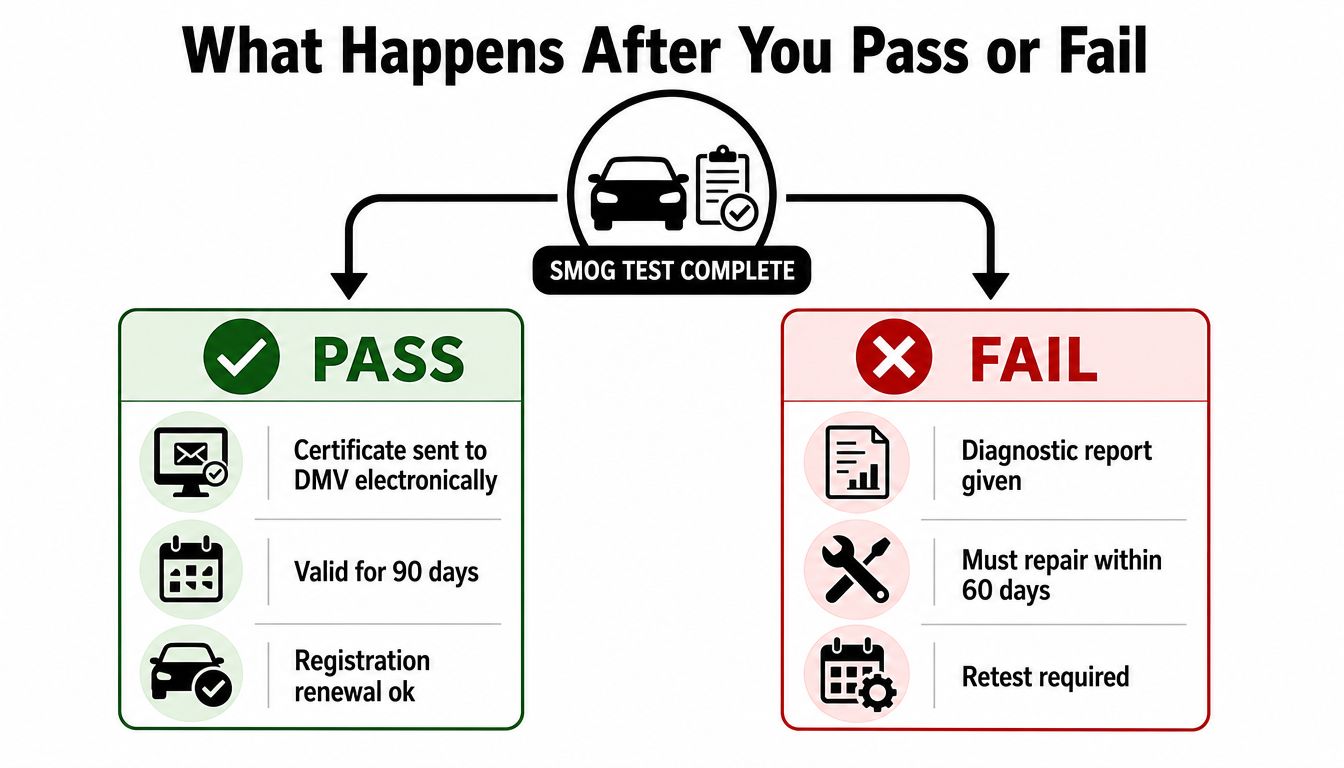
Separate readiness from a real fault
If the only issue is incomplete readiness, the next step may be continued normal driving followed by another readiness check. If the report lists a code or measured emissions problem, you need diagnosis and repair. Don't let anyone sell you a random oxygen sensor, catalytic converter, or fuel-system part without identifying the cause.
Ask the repair facility to answer three questions:
- What exactly caused the failure?
- Was the problem repaired, or was the code merely cleared?
- Are the required monitors ready for retest?
Clearing the code after a genuine repair may be appropriate, but it resets the clock on readiness. The vehicle must then complete its self-tests before returning to the inspection lane.
A failed inspection is a diagnostic starting point, not a parts-shopping list.
Once the repair is complete and the monitors are ready, schedule a retest according to the station's policy and the instructions on your failure paperwork. You may not need to use the original station, but the replacement station must be authorized to perform the required inspection. Ask about retest terms before approving the first test, and check California's Consumer Assistance Program rules if repair costs create a hardship. Eligibility and assistance conditions can change, so use the current official program information rather than relying on informal advice.
Getting Your Smog Check Done at Speedy Smog in San Leandro
East Bay drivers can choose a station based on the vehicle's actual requirements, not just convenience. Speedy Smog is a STAR Certified station at 15275 Washington Ave in San Leandro, and it handles inspections for newer gasoline vehicles, older models, diesels, and hybrids. The shop also transmits smog results electronically to the DMV.
For many 2000-and-newer vehicles, the typical inspection takes about 10 to 15 minutes, as stated in the publisher information. That timing assumes the vehicle is ready to test and no diagnostic issue interrupts the process. If you've recently cleared codes or disconnected the battery, check readiness before you arrive so a quick appointment doesn't turn into a return trip.
The shop offers a clean indoor waiting room and transparent pricing. Periodic $25-off coupons may apply to most smogs on newer vehicles, so check the current offer before scheduling. Its “Smog & a Smile” approach is straightforward, inspect the vehicle correctly, explain the result, and help you understand what to do next.
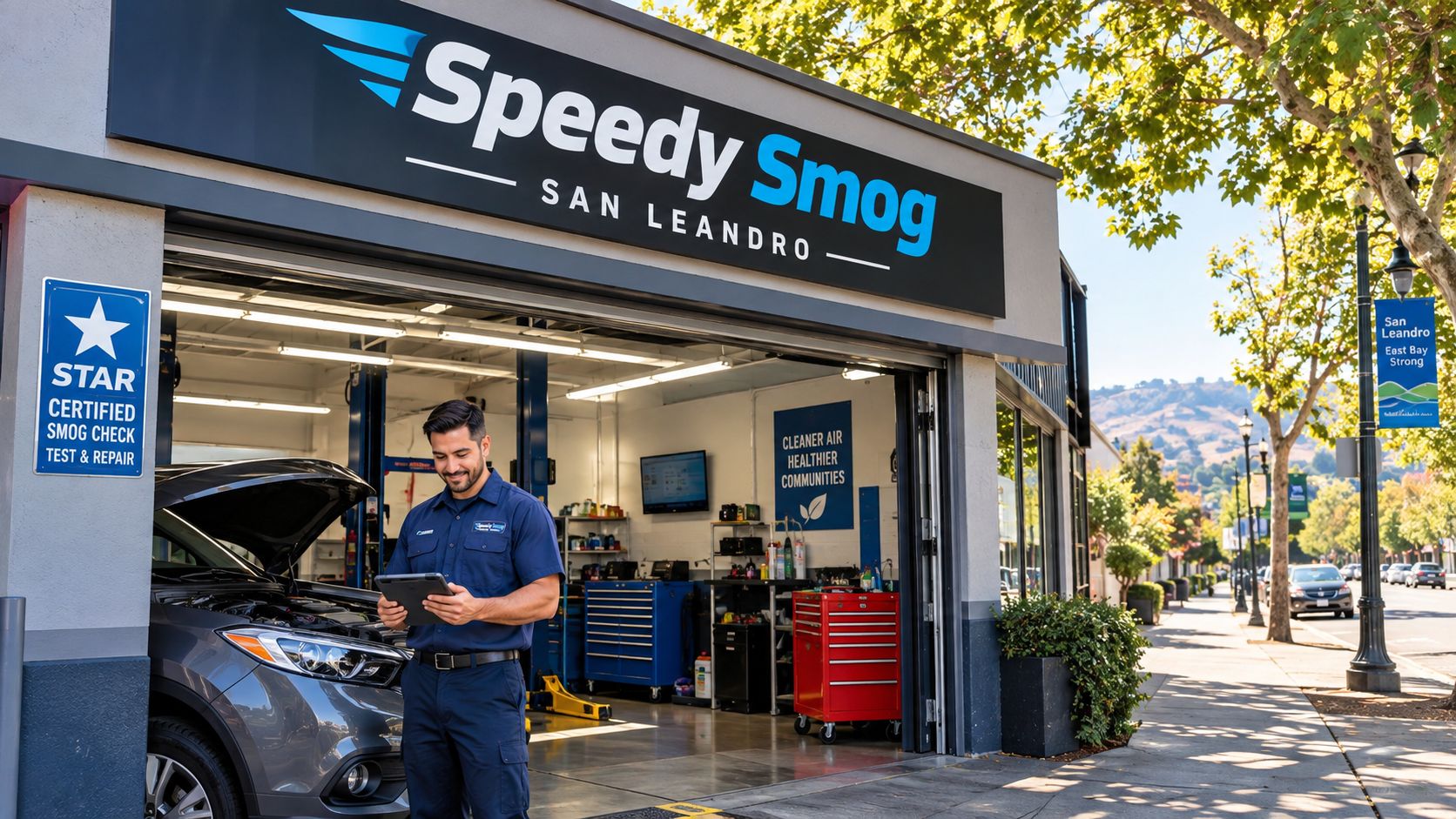
Speedy Smog is open Monday through Saturday at its Washington Avenue location, serving drivers from San Leandro and Oakland who need DMV smog certification or renewal. Bring your DMV notice and mention any recent battery replacement, code clear, or emissions repair before testing.
Speedy Smog provides STAR-certified smog checks for gasoline vehicles, older cars, diesels, and hybrids, with electronic DMV reporting and practical guidance about readiness monitors. Visit Speedy Smog at 15275 Washington Ave in San Leandro, Monday through Saturday, and call or schedule before your appointment if your vehicle recently had repairs or a battery disconnect.
You're halfway through your morning in San Leandro when the DMV renewal notice arrives. It says your registration renewal requires a smog check, and suddenly a routine errand has a deadline attached to it. The good news is that most problems happen before the vehicle reaches the bay, not because the inspection itself is mysterious.
A little preparation helps you choose the right California smog check station, understand what the technician is checking, and avoid an unnecessary second visit. This guide is written for East Bay drivers who want a clear explanation of the rules, the newer OBD readiness requirements, and the practical steps that make the appointment easier.
Table of Contents
- Why That DMV Notice Just Arrived in Your Mailbox
- Decoding the California Smog Check Program
- What Happens During Your Smog Inspection
- Your Pre-Smog Check Preparation Checklist
- How to Choose the Right Station in the East Bay
- Your Path to a Quick and Easy Smog Certificate
Why That DMV Notice Just Arrived in Your Mailbox
California's Smog Check program is part of the state's vehicle-registration process and air-quality strategy. The modern program began after lawmakers approved a decentralized inspection system in 1982, with the first extensive version implemented in March 1984. California later expanded it into an enhanced model on June 8, 1998, to address areas with more severe air-quality problems, as documented in the California Air Resources Board program history.
For a driver, the practical meaning is simpler. If your DMV notice says a smog check is required, you need a passing result transmitted to the state before you can complete registration renewal. In many cases, California requires the inspection every other year, so the station network becomes a recurring part of vehicle ownership rather than a one-time event.
Read the notice before choosing a shop
Your renewal notice can tell you more than the due date. Look for language indicating whether the vehicle must visit a STAR station. That detail affects which locations can complete the inspection for your registration.
Before leaving home, confirm:
- The registration deadline: Give yourself time for a diagnostic visit or repair if the vehicle doesn't pass.
- The station requirement: A STAR designation may be mandatory for directed vehicles.
- The vehicle information: Make sure the year, make, and model on your paperwork match the vehicle you're bringing.
- Your ownership details: A change of ownership or a new California registration can trigger a different testing situation.
You can also review the California registration renewal process if you're unsure how the smog result connects to DMV requirements.
Practical rule: Treat the DMV notice as an instruction sheet. Check the station type before you drive across the East Bay.
A smog inspection doesn't guarantee that a vehicle has no mechanical problems. It checks whether the vehicle's emissions controls meet the applicable California requirements at the time of testing. That makes the visit both a compliance step and a useful warning if the vehicle's emissions system needs attention.
Decoding the California Smog Check Program
The rules depend on the vehicle, its model year, fuel type, and the reason for testing. Most gasoline-powered vehicles from 1976 onward fall within the program, while diesel vehicles from 1998 onward and under 14,000 pounds are handled under applicable diesel testing rules. Electric vehicles don't produce tailpipe emissions and are generally exempt from Smog Check.
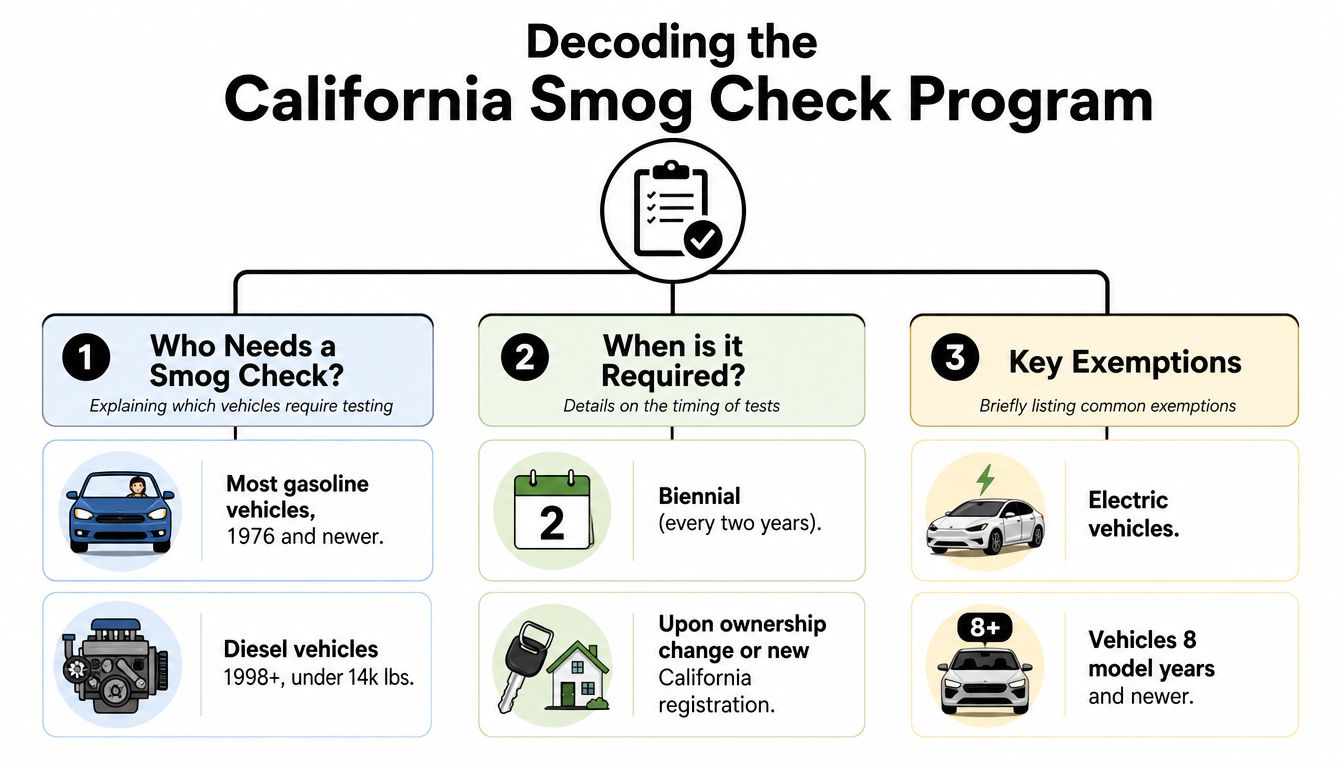
When the test is usually required
For ordinary registration renewal, the inspection is generally biennial, meaning every other year. A vehicle may also need a test when ownership changes or when it receives a new California registration, depending on the circumstances and the vehicle's existing record.
Common exemptions include:
- Electric vehicles: Fully electric vehicles don't use an exhaust system that requires this type of emissions test.
- Newer vehicles: Vehicles within the applicable newer-model exemption period may not need a biennial inspection.
- Certain special vehicles: Some vehicles fall under separate state rules based on fuel, weight, age, or registration status.
Don't rely on a general online list if your situation is unusual. Imported vehicles, diesel trucks, hybrids, modified vehicles, and vehicles being registered after an out-of-state move can require more careful review.
Standard stations and STAR stations
A regular test-only or test-and-repair station performs authorized inspections, but a STAR station must meet higher performance standards established by the Bureau of Automotive Repair. STAR certification isn't based only on having the right equipment. BAR evaluates inspection-quality measures such as Similar Vehicle Failure Rate, Follow-up Pass Rate, gear-shift incidents, and excessive test deviation.
BAR says STAR applicants must meet measurable thresholds, including an SVFR of at least half the industry-wide failure rate for comparable vehicles and gear-shift incidents on no more than 2% of certified vehicles. The applicable Follow-up Pass Rate threshold depends on the reporting period. You can review the BAR explanation of STAR station requirements for the current certification framework.
A STAR station can inspect directed vehicles, including high-polluting vehicles. Your DMV renewal notice should indicate when that certification is required. For a broader explanation of applicable California smog check rules, check the station requirement before booking or driving in.
The simplest decision is this: if the notice requires STAR, choose STAR. If it doesn't, compare location, repair capability, availability, and pricing based on what your vehicle may need.
What Happens During Your Smog Inspection
You pull into the bay, provide the registration information, and answer basic questions about the vehicle. A technician confirms the vehicle identity, checks its condition for testing, and begins the inspection procedure that matches the vehicle's equipment and model year.
The technician first performs a visual inspection of emissions-related components. Missing, disconnected, or visibly altered equipment can create a problem even if the engine feels smooth. If you've installed aftermarket emissions parts, keep any California approval documentation with the vehicle and ask the station about compatibility before testing.
The vehicle's computer is part of the inspection
For many modern vehicles, the technician connects the BAR-approved inspection equipment to the vehicle's diagnostic connector. California's Smog Check Manual describes an OBD-II inspection that includes checking the malfunction indicator lamp, reviewing readiness monitors, and retrieving diagnostic trouble codes.
That means a vehicle can feel perfectly normal and still fail. The computer may record an emissions fault, or one or more monitors may remain incomplete after a battery disconnect, computer reset, recent repair, or failed drive cycle.
Older vehicles without an OBD-II system don't receive an OBD-II functional test. Their procedures use the equipment and test method appropriate to the vehicle, which can involve a tailpipe measurement and, for some vehicles, a dynamometer. The station follows the BAR test prompt rather than allowing the driver to choose the procedure.
A typical inspection for a newer car may be completed quickly, but the exact time depends on the vehicle, station workload, test type, and whether the technician finds an issue that needs clarification.
You can watch a visual overview of the process here:
Once the inspection is complete, the station submits the result electronically. If the vehicle passes, the result supports the registration process. If it fails, the report should identify the reason, such as a diagnostic code, incomplete readiness monitor, emissions reading, or visual equipment concern. Ask the technician to explain the result in plain language before deciding what to repair.
For drivers comparing station types, this guide to what a STAR station is can help you understand why the designation matters.
Your Pre-Smog Check Preparation Checklist
The best preparation starts before you make the trip. A station can test the vehicle, but it can't turn off a genuine emissions fault or complete a repair that hasn't been diagnosed. Your job is to arrive with the vehicle warmed up, the dashboard information understood, and recent repair work properly verified.
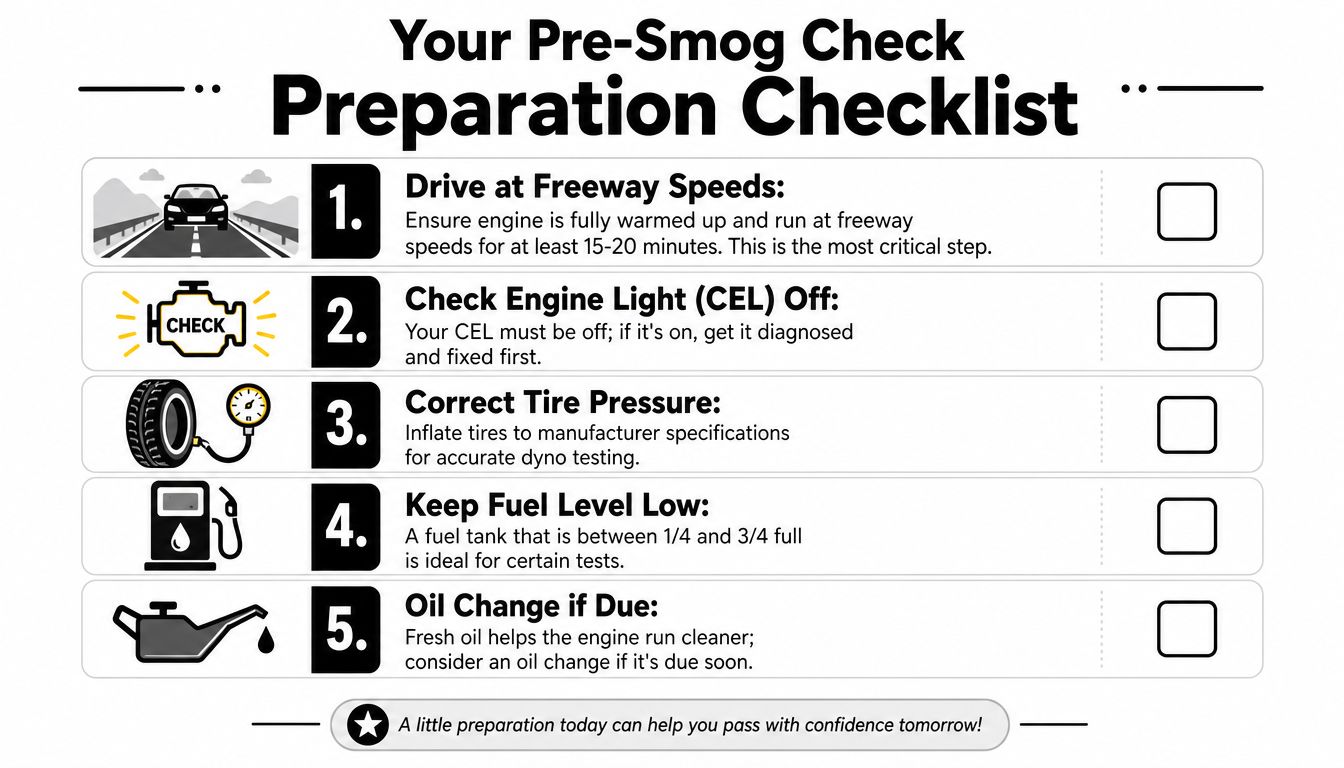
A practical inspection-day check
- Look at the malfunction indicator lamp: If the Check Engine light is on, don't erase the code and hope for a pass. Have the cause diagnosed first. Clearing the light can also reset the readiness monitors.
- Warm the vehicle normally: A drive that brings the engine and emissions system to operating temperature can help the vehicle complete its normal self-checks. Follow the vehicle manufacturer's operating guidance rather than aggressively revving a cold engine.
- Confirm tire condition: If the vehicle will use a dynamometer, properly inflated tires help the technician perform the test safely and consistently. Use the manufacturer's specified pressure.
- Bring useful paperwork: Take the DMV notice, registration information, and documentation for any emissions-related replacement part or recent repair.
- Ask before testing if something changed: Tell the technician about a recent battery replacement, computer reset, engine repair, hybrid-system warning, or aftermarket emissions component.
The readiness rule that changed the conversation
Effective October 1, 2025, all readiness monitors must be set for a vehicle to pass, except when BAR grants an exception for a unique design issue in consultation with CARB. The current BAR explanation of the OBD readiness monitor regulations is especially important for hybrid and diesel owners because their testing matrix follows vehicle-specific rules.
A readiness monitor is an internal self-test. It checks systems such as fuel control, oxygen sensors, catalytic-converter performance, or other emissions functions. A dashboard without a warning light doesn't prove that every monitor has completed.
Before you retest: Ask whether the incomplete monitor can finish through the manufacturer's normal drive cycle or whether a diagnostic problem is preventing completion.
“Just drive it more” is no longer a complete answer. Driving may help only when the vehicle is operating correctly and the monitor conditions are being met. If the monitor remains incomplete, a technician needs to determine whether the cause is a repair issue, a recent reset, an unusual design limitation, or a situation that may qualify for a documented exception. Don't pay for repeated tests until you understand why the monitor hasn't completed.
How to Choose the Right Station in the East Bay
Choosing a station is more than finding the closest sign. Start with the DMV notice, then match the station to the vehicle and the likely service you need. A driver with a straightforward newer vehicle may prioritize a short visit, while someone with an older car, diesel, hybrid, or failed test may prefer a location that can explain diagnostic results and perform repairs.
| Your situation | What to prioritize |
|---|---|
| The notice requires STAR | A current STAR-certified station |
| You suspect a failure | Test-and-repair capability and clear explanations |
| You need a certificate quickly | Appointment or walk-in availability and an appropriate test lane |
| The vehicle is older, diesel, or hybrid | Experience with the vehicle's testing procedure |
| You're trying to control the cost | Posted pricing, current coupons, and whether repairs are separate |
BAR's 2026 performance report records about 1,500 inspections per station in calendar year 2025, compared with 1,100 in 2020, indicating that individual locations may handle more workload. The same report describes a statewide network that includes roughly 4,057 test-and-repair stations and 1,991 test-only stations in spring 2025 licensing data. See the BAR 2026 Smog Check Performance Report for those program benchmarks.
Convenience isn't the only consideration
A test-only station may suit a vehicle you expect to pass and can keep the transaction focused on inspection. A test-and-repair station may be more useful when you want one location to diagnose an emissions fault, although you should still ask for the inspection result and repair recommendation separately.
STAR status can matter even when your vehicle seems ordinary. If DMV directs you to STAR, visiting a non-STAR shop first won't satisfy that requirement. Confirm the certification before you leave home, especially when nearby stations have different capabilities.
For East Bay drivers, Speedy Smog in San Leandro offers STAR inspections for newer and older vehicles, diesels, and hybrids. The shop lists typical testing for 2000-and-newer vehicles at about 10 to 15 minutes, along with transparent pricing, a waiting room, and occasional coupons. Verify current availability and pricing before visiting.
Call ahead if your vehicle has four-wheel drive, a modified emissions system, a recent computer reset, or an unresolved warning. That short conversation can tell you whether the station can perform the correct inspection and whether you should schedule diagnosis before the certification test.
Your Path to a Quick and Easy Smog Certificate
A smooth smog visit follows three decisions. First, read the DMV notice so you know whether you need a regular station or a STAR-certified location. Second, prepare the vehicle by checking the warning light, allowing normal warm-up, gathering paperwork, and confirming that readiness monitors have completed under the current rules.
Third, choose a station that fits the vehicle rather than selecting only by distance. Older vehicles can need a different inspection workflow, while hybrids and diesels may require careful attention to their applicable OBD rules. If your car recently had its battery disconnected or its emissions system repaired, explain that before the technician starts.
California's statewide program handled 12,200,718 total tests in its 2025 Executive Summary Report, with an overall failure rate of 9.04%, according to BAR's 2025 statewide report. Older vehicles can present a greater preparation challenge, with 1994 model-year vehicles showing a 20.73% initial failure rate in that report. Those figures don't predict your individual result, but they do reinforce a useful habit: diagnose warning lights and incomplete monitors before paying for a formal inspection.
Don't reset the computer solely to make the dashboard look clear. Don't assume a normal-feeling car is ready. And don't wait until the registration deadline to discover that your notice requires STAR or that a recent repair reset the monitors.
For East Bay drivers, Speedy Smog offers STAR-certified smog inspections in San Leandro for newer and older vehicles, diesels, and hybrids. Bring your DMV notice and vehicle information, confirm that your readiness monitors are set, and visit the shop for a clear, efficient inspection that helps you complete registration with less uncertainty.
You're in San Leandro or Oakland, your registration deadline is close, and the search results are full of smog coupons that look cheaper than they may be at checkout. The advertised inspection price may not include California's mandatory $8.25 Smog Check certificate fee, and the final amount can also depend on your vehicle, station type, coupon restrictions, and any electronic-payment fee. California's Bureau of Automotive Repair reports statewide average initial-test prices in 2025 of about $60.85 at STAR test-only stations and $69.22 at STAR test-and-repair stations, before you compare every local promotion.
This roundup ranks seven East Bay stations by the way they reduce total hassle or cost. The comparison focuses on price signals, STAR status, vehicle coverage, likely turnaround, hours, promotion limits, and the verification step that can prevent an unpleasant surprise. Details change, so call before driving over.
Speedy Smog is the strongest overall choice for a fast San Leandro visit, broad vehicle coverage, and a local indoor waiting room. The ranking also includes the best headline coupon, the clearest online base pricing, Sunday access, diesel service, Alameda convenience, and a low starting price. Read the list, use the savings guidance, then match the station to your vehicle and deadline.
Table of Contents
- 1. Speedy Smog
- 2. EZ Star Smog Oakland
- 3. Smog Check Oakland at Smog Car Care and Lube
- 4. 4 Less Smog Check Oakland
- 5. Xpress Star Smog
- 6. Alameda Smog
- 7. KS Smog
- 7 Cheap Smog Stations Compared
- Choose the Station That Matches Your Vehicle and Deadline
1. Speedy Smog
Speedy Smog earns the top spot for drivers who want fast service without narrowing their vehicle options. The STAR Certified station is at 15275 Washington Ave, San Leandro, and its core advantage is a practical combination of quick testing, recognized certification, and a comfortable place to wait. The shop says many tests for vehicles from 2000 and newer take about 10 to 15 minutes, but confirm the expected wait when you call.
STAR status matters if your DMV notice requires a STAR station. California's BAR reported that STAR stations represented 49% of licensed smog check stations in 2025 but performed 83% of all smog checks, which shows how important this station category is to actual testing volume. Review the BAR performance report before assuming the lowest coupon price is suitable for your vehicle or registration requirement.
Best fit for broad vehicle coverage
Speedy Smog handles 2000 and newer vehicles, 1999 and older vehicles, diesels, and hybrids. That range makes it a strong first call for owners who don't want to discover at arrival that a station's promotion excludes their vehicle. The shop also advertises periodic $25-off promotions for most smogs on 2000 and newer vehicles, but the exact offer, expiration, and eligibility should be confirmed before you leave home.
The clean indoor waiting room and customer-focused service add value when you're comparing stations on more than the sticker price. A quick test is useful, but a clear process and a comfortable wait can matter just as much when you're dealing with registration paperwork.
Money-saving rule: Ask for the complete amount, including the certificate fee, before accepting a coupon price.
Speedy Smog lists Monday through Friday hours of 8:30 a.m. to 5:30 p.m. and Saturday hours of 8:30 a.m. to 4 p.m. Its website also contains inconsistent wording about Sunday availability, so verify the schedule directly. Check the current Speedy Smog hours and call (510) 614-7664 with your vehicle year, fuel type, and inspection purpose.
Pros
- Fast local testing: Many newer-vehicle inspections are advertised at about 10 to 15 minutes.
- STAR Certified service: Suitable for drivers who need a STAR-capable provider.
- Broad coverage: The shop lists newer cars, older vehicles, diesels, and hybrids.
- Practical promotion: A periodic $25-off offer may reduce the visit cost for eligible newer vehicles.
- Comfortable stop: The indoor waiting room is more convenient than a bare-bones testing area.
Cons
- Exact standard prices: The website doesn't publish a complete standard rate list.
- Promotion limits: Coupon eligibility and current terms require confirmation.
- Hours: Verify Sunday availability because the site wording and listed hours don't fully match.
2. EZ Star Smog Oakland
Drivers near the Oakland and Emeryville border can reduce travel time at EZ Star Smog Oakland, where STAR-certified walk-in testing and online coupon redemption are available. The location suits motorists who want a qualifying inspection without crossing the East Bay for a discount. The promotion can be shown on a phone or by QR code and is scheduled to run through December 31, 2026, though you should confirm that it remains active before visiting.
The station advertises fast service and does not require an appointment. Walk-in access helps when a registration deadline is close, but it does not guarantee an immediate bay. Call ahead with your vehicle year, make, fuel type, and inspection purpose. Ask for the complete price and confirm that the coupon applies to that vehicle and test.
Read the exclusions before you drive
The promotion has clear limits. Published restrictions exclude some brands and body types, including Land Rover and Porsche, and the offer does not include a retest. Those terms can eliminate the advertised savings if your vehicle is excluded or needs another inspection after repairs.
EZ Star Smog Oakland also provides DMV registration services, which may remove a separate trip after a successful test. Confirm the required paperwork and any service fees before relying on that convenience.
Review this STAR Certified smog station guide to understand why certification matters for drivers whose vehicles require a STAR inspection. Then check the EZ Star Smog Oakland website for the current coupon, accepted vehicle types, retest policy, hours, and expected wait. Online terms can change.
Best money-saving step: Show the QR code before testing starts. Ask whether the quoted total includes the state certificate fee and any vehicle-specific charge. Treat the online discount as an advertised reduction, not the final out-the-door price, until the station confirms the full amount.
3. Smog Check Oakland at Smog Car Care and Lube
Drivers comparing total hassle and cost should place Smog Check Oakland at Smog Car Care & Lube at Valero on High Street near the top for a low advertised price and short stated turnaround. Its $29.95 coupon price is a promotional base figure, not the guaranteed amount for every vehicle. California's $8.25 certificate fee applies to a passing test, so ask the station to include it in the quote and explain any vehicle-specific charge before approving the inspection.
The station is STAR Certified and test-only, making it suitable for vehicles that require a STAR inspection and for owners who want testing rather than repairs. It also performs change-of-ownership and out-of-state inspections, then sends results electronically to the DMV. That process can reduce paperwork and eliminate a separate submission step.
Best fit for speed and test-only service
The station states that testing takes roughly 15 minutes, which helps drivers balancing a deadline with a tight budget. The offer requires phone or phone-coupon redemption, so mention the promotion before arriving and keep proof available. Because the site operates at a Valero location, expect a practical test-focused setup rather than extensive waiting-room amenities.
Published hours are Monday through Friday from 8:30 a.m. to 5 p.m., and Saturday from 8 a.m. to 2 p.m. Confirm the schedule before leaving, particularly when planning a Saturday visit. Check the Smog Check Oakland station website for current terms, then call with your vehicle year, body type, fuel type, and inspection purpose.
Ask specifically whether the Valero location handles your vehicle under its test-only process, whether STAR eligibility applies, and whether the quoted total includes the certificate fee. The BAR confirms the certificate fee, but the station must confirm the complete amount for your inspection.
4. 4 Less Smog Check Oakland
4 Less Smog Check Oakland is the clearest pick for drivers who prioritize online base-price transparency. The Broadway Auto Row shop posts smog test rates on its website instead of relying only on a rotating coupon headline. That makes it easier to build a realistic comparison before calling, although the posted rate still needs confirmation because the final cost can depend on the vehicle and mandatory state fee.
The station is test-only and sends results directly to the DMV. It serves drivers who want a focused inspection rather than a repair appointment, and its central Broadway location can work well for Oakland motorists already traveling along the Auto Row corridor. Monday through Saturday availability adds flexibility, but confirm the current daily schedule before visiting.
Watch the older-vehicle surcharge
The site identifies an additional fee for vehicles from 1999 and older. That detail is exactly the kind of condition that separates a useful price page from a misleading bargain search. If you own an older car, state the model year during the first phone call and ask for the full amount, including the certificate fee and any applicable surcharge.
The station also allows customers to request promotional pricing through its website. Don't assume a request form creates an automatic discount. Ask whether the offer is available for your inspection type and whether you must receive confirmation before arrival.
Use the 4 Less Smog Check Oakland website to review the posted rates, then compare the offer against other smog check deals. That two-step approach gives you a visible base price and a chance to find a current promotion without confusing either figure with the final total.
Best verification question: “What will I pay out the door for my exact year and vehicle type, including the certificate fee and the older-vehicle charge if applicable?”
5. Xpress Star Smog
Xpress Star Smog is the strongest fit for drivers whose schedule matters more than a single posted price. The STAR Certified station advertises seven-day hours, including Sundays, which makes it useful for a last-minute registration deadline or a driver who can't visit during a conventional workweek. Confirm the current Sunday schedule and expected wait before setting out, because extended hours don't guarantee immediate service.
Its online offer advertises $20 off Smog Check, but the site doesn't present one universal flat rate. The final amount depends on the vehicle and service, so treat the coupon as a discount against a quote rather than as the quote itself. Ask whether the promotion applies to your inspection and whether it can be combined with any other offer.
The best vehicle-fit option for specialized testing
Xpress Star Smog lists services for diesel vehicles, out-of-state inspections, renewal inspections, and gross-polluter testing. That broad service menu makes it a better first call than a generic discount station when your vehicle has a less routine inspection need. California guidance distinguishes diesel rules from gasoline and hybrid rules, and the BAR reference guide explains that newer lighter diesel vehicles can still require testing while older or heavier diesels may fall outside the standard program.
The mobile-friendly website makes the coupon easy to present from a phone. Still, call with the vehicle year, fuel type, and service category before assuming the $20 discount applies.
Visit the Xpress Star Smog website and confirm the full price, Sunday hours, coupon requirements, and whether gross-polluter or diesel testing carries a different charge.
6. Alameda Smog
Alameda Smog ranks highest for reducing travel and waiting hassle. It suits drivers near High Street and Fernside who want a quick neighborhood drop-in rather than a trip to Oakland or San Leandro. The STAR-certified station advertises no-appointment service and inspections in about 10 to 15 minutes. Because the entrance faces Fernside, confirm that approach before leaving, especially if you are unfamiliar with the surrounding streets.
The station also advertises a “Website Special,” but it does not post a fixed discount amount. That makes the offer harder to compare than a stated coupon, yet it may lower the quoted base price when the promotion covers your vehicle and service. Open the Alameda Smog services page, save the offer on your phone, and check its current terms before visiting.
Convenience depends on the final quote
A drop-in option helps when your schedule is tight, but the advertised turnaround is not a guaranteed wait time. Call before driving over during busy periods, and provide the vehicle year, model type, and inspection purpose. Hybrid owners and drivers with less common vehicles should confirm that Alameda Smog handles the test and that the promotion applies.
Use the Website Special as a quote-checking tool, not a final price. Ask the station to apply the offer to your vehicle, then compare the discounted total with the amount quoted without it. Confirm whether the promotion has an expiration date, requires the webpage, or excludes a service category. This verification shows whether the special lowers your bill.
Alameda Smog is the strongest fit when location and fast drop-in service outweigh fully posted pricing. Choose another station if you need a final online price before making a call, because this offer and the completed total require confirmation.
7. KS Smog
KS Smog is the best budget lead for drivers who want a clearly advertised starting price and favorable treatment for common light-duty vehicles. The San Leandro test-only STAR station lists pricing starting at $36.75, while stating that many light-duty trucks, minivans, and SUVs don't incur an added charge. The word “starting” matters. Your final amount can change with the model year, vehicle type, inspection purpose, certificate fee, and current promotion.
That pricing structure may work especially well for owners of larger everyday vehicles who often expect a body-type surcharge elsewhere. Ask the station to confirm that your exact truck, minivan, or SUV qualifies for the no-extra-charge policy before you rely on the advertised figure.
Useful coverage for several DMV situations
KS Smog lists STAR and test-only services for renewals, change-of-ownership inspections, out-of-state vehicles, salvage vehicles, and hybrids. Saturday hours add a weekend option for drivers along the East 14th Street and Foothill corridor, but confirm the current Saturday schedule and arrival cutoff.
Use the KS Smog website to review the current offer, then call with your year, make, vehicle type, and service need. Ask whether the $36.75 starting price is available for your vehicle and whether the certificate fee is included or added separately.
Best verification step: Have the station repeat the complete total for your vehicle, not just confirm that it “starts at” the advertised price.
KS Smog ranks seventh because the entry price is compelling but not universal. For the right light-duty truck, minivan, or SUV, its pricing policy may beat a larger headline discount. For another vehicle, the final total may be closer to the local market range, so the phone quote decides the value.
7 Cheap Smog Stations Compared
| Station | Speed & Efficiency ⚡ | Certification / Quality ⭐ | Process & Complexity 🔄 | Expected Outcome / Impact 📊 | Ideal Use Case & Tip 💡 |
|---|---|---|---|---|---|
| Speedy Smog | Very fast (most 10–15 min); comfortable indoor waiting | STAR‑certified; DMV‑recognized | Walk‑in & appointments; call to confirm hours/pricing | Quick, accurate smog results accepted for registration | Great for fast turnaround and comfort, call ahead to confirm coupon eligibility |
| EZ Star Smog Oakland | Fast, walk‑in testing; online coupon redemption | STAR‑certified; consistently strong reviews | No appointment needed; QR/coupon workflow; on‑site DMV services | Efficient testing plus on‑site registration | Ideal for walk‑ins using online promos, check coupon exclusions |
| Smog Check Oakland (Valero) | Quick ~15 min test‑only turnaround | STAR‑certified; electronic DMV submission | Test‑only at gas station; phone/phone‑coupon accepted | Low headline coupon price; fast electronic filing | Budget option with fast service, limited waiting amenities, confirm final fees |
| 4 Less Smog Check Oakland | Standard quick testing (Mon–Sat) | Test‑only; direct DMV submission | Published base pricing; request promos via web form | Transparent base rates; potential promotional savings | Good for price‑conscious customers, watch for extra fees on older vehicles |
| Xpress Star Smog | Fast service; open 7 days (includes Sunday) | STAR‑certified; handles diesel & gross‑polluter tests | Mobile coupons; coupon‑based pricing (final varies by vehicle) | Broad service coverage and weekend availability | Best for last‑minute or weekend needs, verify final out‑the‑door price |
| Alameda Smog | Advertised 10–15 min inspections; no appointment | STAR‑certified; website special promoted | Drop‑in focus; clear local access notes | Quick neighborhood smogs for local commuters | Convenient for Alameda/bridge drivers, confirm discount amount and fees |
| KS Smog | Quick service with Saturday hours | STAR test‑only; "Starting $36.75" pricing listed | Starting price varies by model/year; no extra for many light trucks/SUVs | Low entry cost for many light‑duty vehicles | Good for budget drivers with light‑duty trucks/minivans/SUVs, confirm final total |
Choose the Station That Matches Your Vehicle and Deadline
The cheapest smog check isn't always the ad with the lowest starting number. California's program is high volume and tightly regulated. A federal and OECD presentation described the mature program as covering about 22 million vehicles in the mid-2010s, with roughly 11 million initial inspections each year, an overall 12.06% failure rate in 2015, and an average inspection cost of $48 at that time. Review the program presentation for the historical context. Today, the useful comparison is the complete cost and the likelihood that you choose the correct station the first time.
Choose Speedy Smog for a fast San Leandro visit, broad coverage across newer and older vehicles, diesels, and hybrids, plus the possibility of a $25-off promotion for eligible newer-vehicle smogs. Choose Smog Check Oakland when the $29.95 headline coupon and roughly 15-minute testing are your main priorities, but confirm the certificate fee and vehicle-specific total. Choose 4 Less Smog Check Oakland when you want online base-price visibility before calling.
Xpress Star Smog is the strongest fit for Sunday access and specialized diesel or gross-polluter services. Alameda Smog makes sense for a quick neighborhood drop-in near High Street and Fernside. KS Smog deserves attention if your vehicle fits its $36.75 starting-price offer and no-added-charge policy for qualifying light-duty trucks, minivans, or SUVs. EZ Star Smog Oakland is the better choice when online coupon and QR redemption or on-site DMV registration services reduce your errands.
Before you visit any of these cheap smog check stations, make one call and provide:
- Vehicle details: Give the year, make, fuel type, and whether it's a car, truck, minivan, SUV, diesel, or hybrid.
- Service purpose: Say whether you need a renewal, change-of-ownership, out-of-state, salvage, or another inspection.
- Complete total: Ask for the inspection price plus the mandatory $8.25 certificate fee, and ask about any electronic-payment charge.
- STAR requirement: Confirm that the station and inspection type satisfy your DMV notice.
- Promotion restrictions: Check expiration, brand or body-type exclusions, QR requirements, and whether a retest is included.
- Timing and hours: Ask about the current wait, appointment or walk-in rules, weekend availability, and arrival cutoff.
The station that gives you a clear total and matches your vehicle is usually the true low-cost option. California's 2026 BAR executive summary reports a statewide average of about $71.35 overall, reinforcing why the certificate fee, station category, and vehicle fit deserve attention before you compare coupons.
Speedy Smog offers STAR Certified testing, broad vehicle coverage, a clean indoor waiting room, and fast service for many 2000 and newer vehicles, with periodic $25-off promotions for eligible smogs. Visit Speedy Smog to check the current offer and contact the San Leandro shop before your registration deadline.
A typical California smog check total lands in the low-to-mid $70s after the $8.25 state certificate fee is added to the station's inspection charge. Statewide averages are about $70.00 for BAR-97 tests and $62.04 for OIS tests, before that certificate fee is included.
Your DMV renewal notice is probably sitting on the counter, and the deadline is getting close. You call a station, hear an advertised price, and assume that number is the whole bill. In California, it often isn't.
The CA smog check price has two parts. The station chooses the inspection fee, while the state adds its certificate charge only when the vehicle passes. Vehicle age, test method, station designation, and whether the station performs repairs can all change the amount you pay. The California Bureau of Automotive Repair's smog check guidance confirms that inspection prices vary by station, while the certificate fee is the universal state add-on.
Table of Contents
- What a California Smog Check Actually Costs
- Breaking Down the Two-Part Price Structure
- STAR vs Non-STAR Station Pricing Compared
- How Your Vehicle Type Changes the Price
- Why a STAR Station Is Often the Smarter Choice
- Practical Ways to Lower Your Smog Check Bill
- Your Pre-Visit Smog Check Checklist
What a California Smog Check Actually Costs
A San Leandro driver renewing registration might see a station advertise a low inspection price, then discover that the final receipt is higher after certification. That doesn't automatically mean the station added an improper charge. It usually means the advertised price covered the station's inspection only.
For a normal compliant vehicle, plan on a final bill in the low-to-mid $70s, depending on the inspection method and the station's posted fee. BAR's 2025 Executive Summary lists statewide average inspection costs of $70.00 for BAR-97 tests and $62.04 for OIS tests (California BAR 2025 Executive Summary Report). Adding the $8.25 certificate fee brings those averages into roughly the low-to-upper $70s for a passing vehicle.
What the advertised price leaves out
The inspection fee pays the station for the test itself. It can reflect the vehicle's emissions system, the equipment required, labor, and the station's operating costs. California doesn't set one statewide retail inspection price, so two licensed stations in the East Bay can post different prices for what appears to be the same service.
The state certificate fee is separate and applies only after a pass. If the vehicle fails, the certificate isn't issued, so that fee isn't charged at that stage. Repairs and a later retest are separate costs.
Practical rule: When you call, ask for the total price for your exact vehicle, including the certificate fee if it passes.
Have the station confirm the model year, fuel type, and whether your DMV notice requires STAR. For a more detailed explanation of the smog inspection cost, compare the inspection charge with the final out-the-door amount, not just the number on a coupon.
Breaking Down the Two-Part Price Structure
Most confusion starts with the phrase “smog check price.” Drivers use it to mean the inspection, certification, repairs, and retest together. The invoice is simpler than that, but only if you separate the charges.
The first line is the station inspection fee. That amount is set by the business and can vary according to location, station category, equipment, and vehicle. A station may quote one price for a newer OBD-based inspection and another for an older BAR-97 test.
The second line is the $8.25 California smog certificate fee. It's mandatory when the vehicle passes, and the amount is statewide rather than negotiated between the customer and the station. The California DMV's smog certification fee guidance explains the state fee and related certification rules.
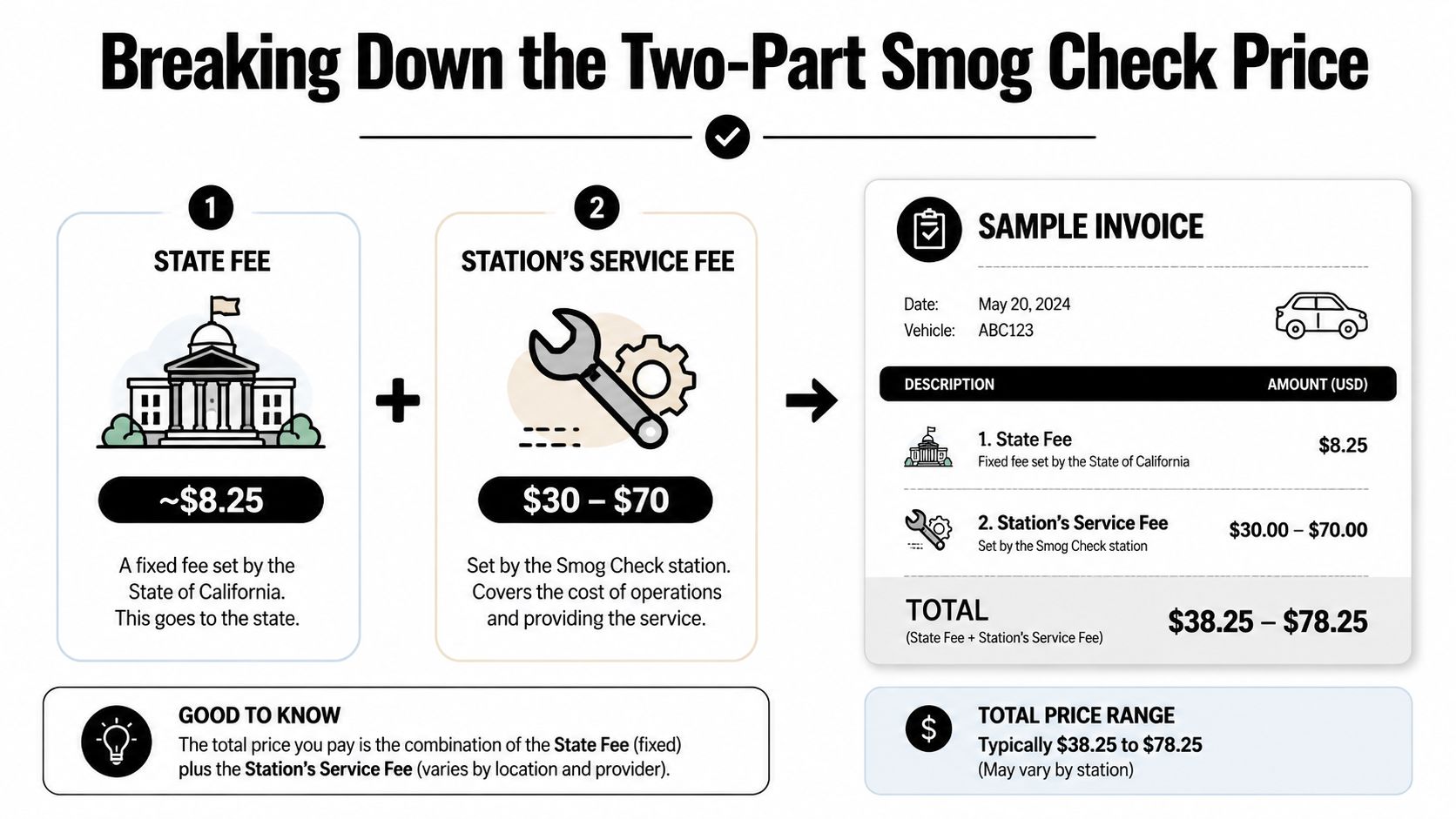
What happens after a pass or failure
A passing test creates the certification transaction needed for the DMV process, and the state certificate fee appears on the bill. A failed test doesn't create that certificate, so the certificate charge isn't the part that drives the next bill.
The expensive surprise usually comes afterward. Diagnosis, emissions repairs, parts, labor, and a retest aren't automatically included in the original inspection fee. Ask whether the quoted amount covers only the initial test or also includes a retest policy.
| Invoice component | Who sets it | When it applies |
|---|---|---|
| Station inspection fee | The smog station | For the inspection |
| State certificate fee | California | Only when the vehicle passes |
| Repairs and diagnosis | The repair provider | When the vehicle needs corrective work |
| Retest charge | The station's policy | After repairs, if another test is required |
Before booking, use the station's smog check station information to find a licensed location, then ask one direct question: “What will I pay if the vehicle passes today?” That answer is more useful than a low headline price with no explanation.
STAR vs Non-STAR Station Pricing Compared
A STAR station is not automatically the expensive option. STAR is a Bureau of Automotive Repair performance designation. The station's business model still matters: it may be Test-Only or Test-and-Repair, and each sets its own inspection price.
The inspection fee is only one part of your out-the-door cost. Add the state certificate fee when the vehicle passes. Compare the complete total, not a coupon headline or a station label.
Average inspection costs by station type
| Station type | Average inspection cost |
|---|---|
| STAR Test-and-Repair | $66.90 |
| STAR Test-Only | $58.90 |
| Non-STAR Test-and-Repair | $70.77 |
| Non-STAR Test-Only | $56.40 |
The BAR 2024 Smog Check Executive Summary Report lists these as inspection averages, not final passing totals. The state certificate fee remains separate. The figures also show that STAR Test-Only averaged less than STAR Test-and-Repair, while Non-STAR Test-Only averaged less than Non-STAR Test-and-Repair. STAR status alone does not determine the bill.
The equipment path changes the quote too. STAR Test-and-Repair stations averaged $72.87 for BAR-97 inspections and $60.99 for OIS inspections. STAR Test-Only stations averaged $52.44 for OIS inspections. Ask which test method applies to your vehicle before accepting a price.
Choose based on the DMV requirement
Read the registration notice first. If the DMV requires a STAR inspection, a cheaper non-STAR quote will not complete the job. You may pay once, then pay again at an approved station.
Test-Only stations perform inspections. Test-and-Repair stations can diagnose and repair emissions problems, which can save a second trip if the vehicle fails. Review this guide to what a STAR station is before choosing from a coupon alone.
Call with one question: “What is the full price, including the certificate fee if I pass?” Confirm the test method and whether a retest has a separate charge. Choose STAR or non-STAR based on the DMV requirement, vehicle, and complete quoted total.
How Your Vehicle Type Changes the Price
Your vehicle determines the test path, and the test path affects the inspection charge. A newer gasoline car with a functioning diagnostic system generally follows a different process from an older vehicle that requires more involved emissions equipment.
California commonly uses OIS testing for many 2000-and-newer vehicles, while older vehicles may require BAR-97 testing. The BAR averages above show that OIS inspections generally carry a lower average than BAR-97 inspections, but the exact charge still belongs to the station.
Start with the model year
Check the model year before calling. The DMV states that most vehicles need certification every two years after the initial smog-abatement period, while newer vehicles may qualify for an abatement fee instead of an immediate inspection. The California DMV vehicle registration guidance is the right place to confirm your vehicle's requirement.
A newer vehicle can often communicate emissions information through its onboard diagnostic system. Older vehicles may need a more labor-intensive inspection using BAR-97 equipment. That difference can explain why one vehicle receives a lower quote than another at the same station.
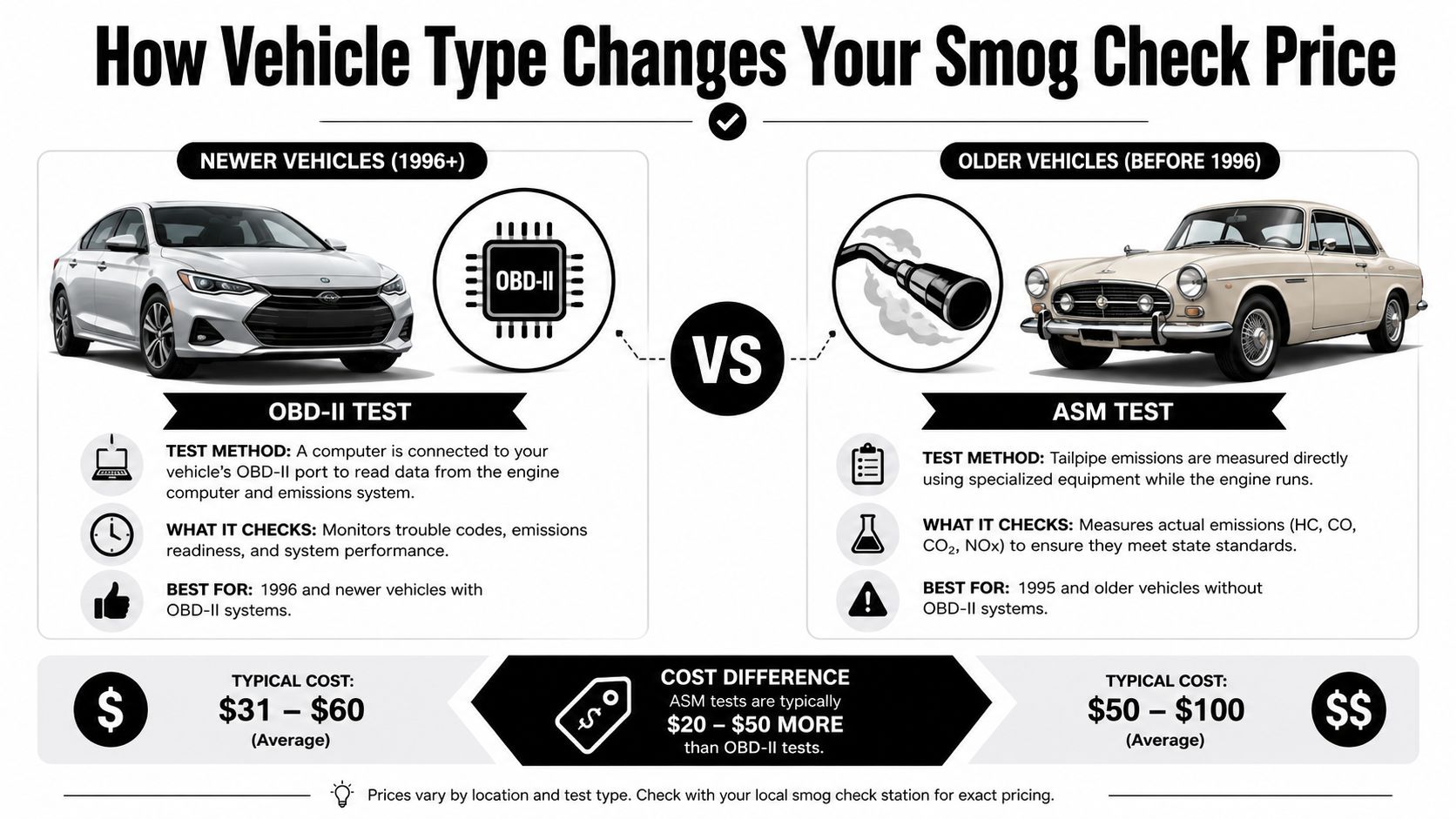
Fuel type and drivetrain still matter
Diesel vehicles don't follow the same pricing assumptions as ordinary gasoline cars. Older diesels, commercial vehicles, and vehicles with specialized emissions systems may require different equipment or procedures, so give the station the exact fuel type before accepting a quote.
Hybrids can also require certification once they are no longer within the applicable exemption period. Electric vehicles don't use the same tailpipe emissions process, but registration rules still depend on the vehicle category and DMV instructions.
Bring the vehicle identification details when you call:
- Model year: This helps the technician identify the likely test method.
- Fuel type: Gasoline, diesel, hybrid, and electric vehicles can follow different rules.
- Registration notice: The notice may identify whether STAR certification is required.
- Modification history: Emissions-related modifications can change what the station needs to inspect.
Don't guess based on the car's appearance or age alone. A precise quote requires the vehicle information and the registration requirement.
Why a STAR Station Is Often the Smarter Choice
Drivers often assume STAR means higher cost. The BAR averages show that assumption doesn't hold consistently, because STAR Test-Only inspection averages can be lower than STAR Test-and-Repair averages and can also compare favorably with non-STAR categories.
STAR is a performance designation, not a luxury service tier. The station has to meet the program's standards, but its retail inspection fee remains its own business decision. Your first question should be whether STAR is required, not whether STAR sounds expensive.
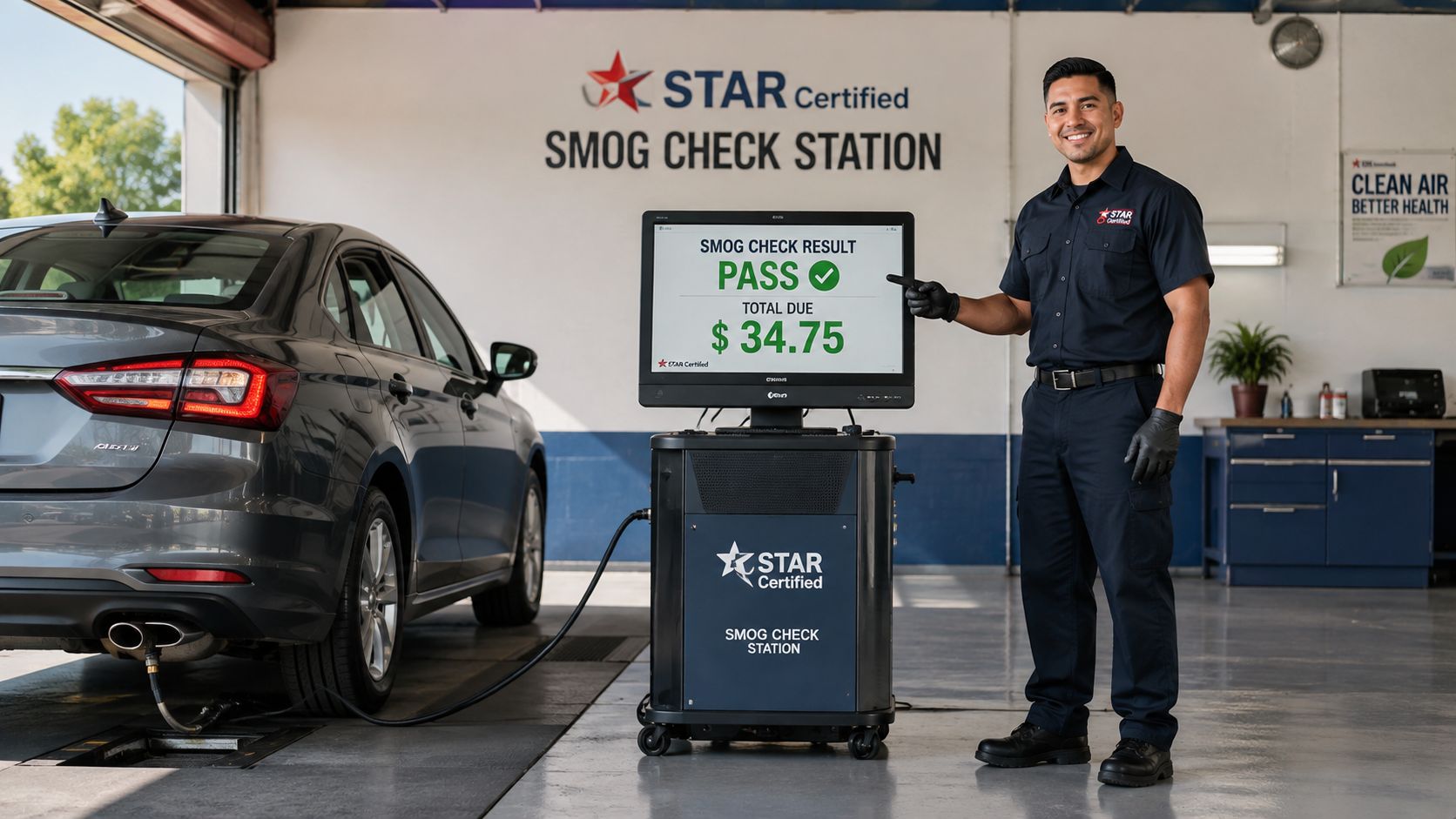
Avoid the wrong-station expense
If your DMV notice calls for a STAR inspection, going elsewhere can create a compliance problem. You may leave with a test result but still need a STAR certification before the registration process is complete. That means another appointment, another inspection charge, and more lost time.
A STAR Test-Only station makes sense when the vehicle is straightforward and you only need the inspection. A STAR Test-and-Repair station is more practical when the vehicle has an emissions warning light, previous failure, or an uncertain repair history. The ability to diagnose the issue at the same location can reduce unnecessary handoffs.
Choose the station that matches the DMV instruction and the vehicle's risk, then compare its complete passing price.
For East Bay drivers, Speedy Smog is one local option. It operates as a STAR Certified station in San Leandro and handles inspections for newer vehicles, older vehicles, diesels, and hybrids. The right choice still depends on your registration notice and the quote you receive.
Practical Ways to Lower Your Smog Check Bill
The cleanest way to reduce the bill is to avoid paying for the wrong service. Confirm the DMV requirement, identify the likely test method, and ask for the passing total before you authorize the inspection.
Use discounts carefully
Coupons can lower the station's inspection portion, but read the fine print. A discount may apply only to certain model years or standard inspections, and it may not remove the separate state certificate fee after a pass. Ask whether the coupon changes the inspection fee only or the final amount.
Speedy Smog publishes a $25-off offer for most smogs on newer vehicles, so East Bay drivers should check the current terms before relying on it. Treat any coupon as a price tool, not proof that the station's final total is lowest.
Time the appointment instead of rushing
Last-minute registration pressure limits your choices. Schedule early enough to call several stations, compare the passing total, and confirm whether STAR is required. If the vehicle fails, early scheduling also leaves room for diagnosis and repair without turning the renewal deadline into an emergency.
A basic pre-visit check can prevent avoidable complications:
- Inspect warning lights: An illuminated emissions warning light can lead to a failed inspection.
- Check the registration notice: Confirm the due date and station designation requirement.
- Ask about retests: Learn whether the station offers a retest policy and what conditions apply.
- Bring recent repair information: Service records can help the technician understand prior emissions work.
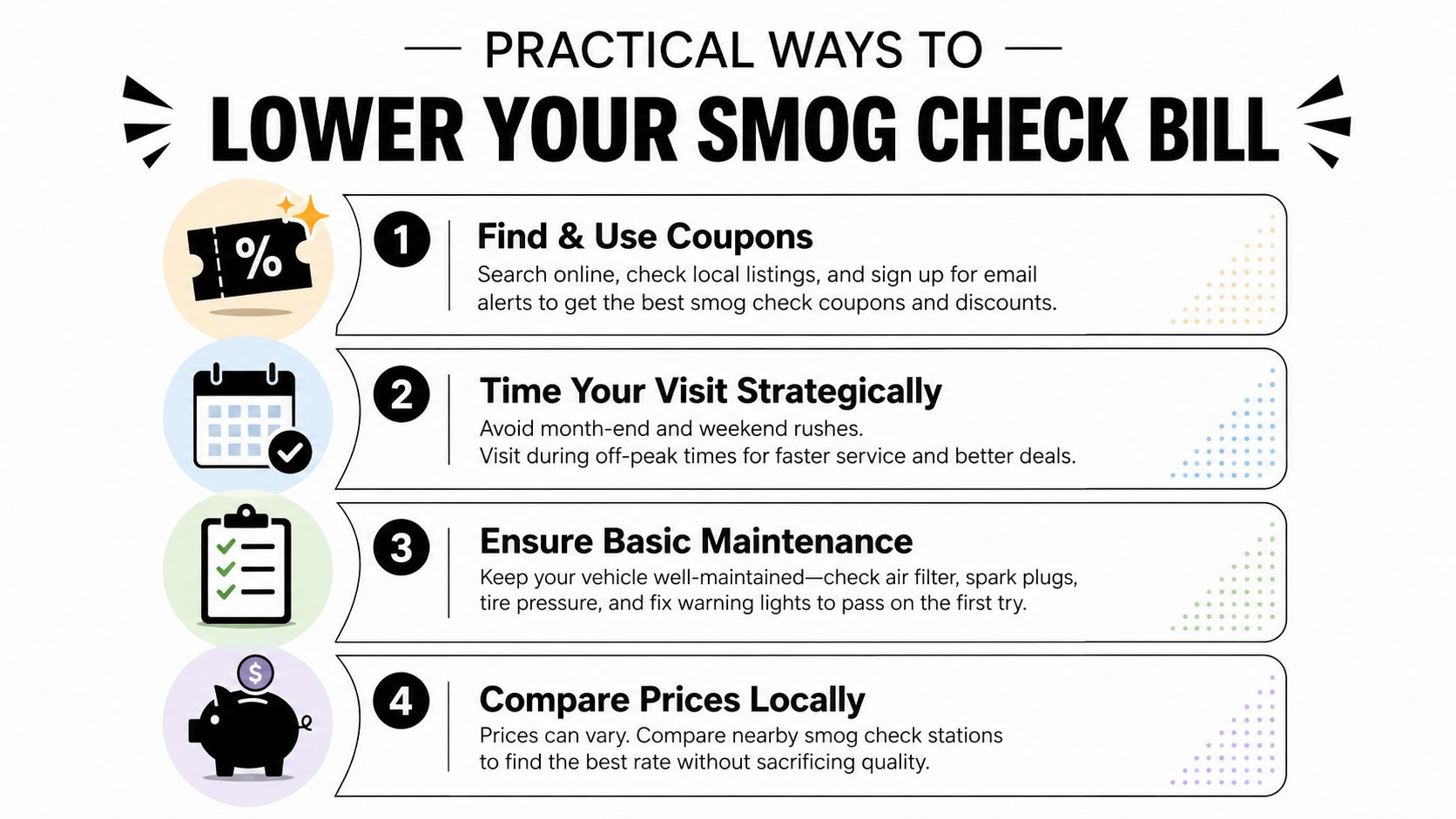
Check whether testing is required
Some newer vehicles may use a smog abatement fee during registration instead of receiving a smog inspection. Don't pay for a test because the renewal process mentions emissions. Verify the requirement through the DMV notice or the DMV's official guidance first.
If the vehicle fails, don't approve every repair offered without understanding the failure reason. Ask for the failure report, separate diagnosis from repairs, and check whether you qualify for assistance through California's Consumer Assistance Program. The cheapest legitimate repair is the one that addresses the documented emissions problem, not a parts swap based on guesswork.
Your Pre-Visit Smog Check Checklist
Before driving to the station, run through this short list:
- Read the DMV notice: Confirm whether certification is required and whether STAR is specified.
- Identify the vehicle: Have the model year, fuel type, and vehicle details ready.
- Ask for the passing total: Confirm the station inspection fee plus the $8.25 certificate fee if the vehicle passes.
- Clarify the test method: Ask whether the vehicle receives OIS or BAR-97 testing.
- Check the failure policy: Find out what a retest costs and whether repairs must be completed at that station.
- Verify discounts: Make sure a coupon applies to your vehicle and understand which charge it reduces.
- Bring documents: Take the registration notice and any relevant repair records.
The number that matters is the out-the-door passing price, not the largest discount in the window. A clear quote, the correct station designation, and the right test method will prevent most billing surprises.
For a transparent quote and California-compliant testing in San Leandro, visit Speedy Smog with your DMV notice and vehicle details ready. Ask the team to confirm the inspection method, STAR requirement, certificate fee, and any applicable discount before the test begins.