Car Smog Test in California: What to Expect and How to Pass
The renewal notice is on the kitchen counter, your coffee is getting cold, and one line keeps pulling your attention back: smog certification required. If the check-engine light is off, the car drives normally, and nothing looks wrong, it's easy to wonder why the DMV needs another inspection.
A California car smog test is less mysterious once you separate the paperwork, the emissions equipment, and the onboard computer checks. The most important detail for many drivers now isn't visible smoke or even the dashboard light. It's whether the vehicle's readiness monitors have finished their self-tests.
Table of Contents
- Why Your Renewal Notice Just Mentioned a Smog Test
- What a Car Smog Test Actually Is
- The Two Test Types California Drivers Face
- How to Prepare So You Pass the First Time
- What Happens at a Smog Station
- Exemptions, Penalties, and Why Rules Differ by Region
- Common Reasons Cars Fail and How to Fix Them
- Picking the Right Station and Passing with Confidence
Why Your Renewal Notice Just Mentioned a Smog Test
California's Smog Check Program has been tied to vehicle registration for decades. The state became the 20th U.S. state to adopt a vehicle inspection and maintenance program in 1982, and the Bureau of Automotive Repair began administering the statewide program in 1984 under SB 33. The original program combined biennial testing, change-of-ownership testing, and inspection of emission-control components. California's Smog Check history and registration connection
That means a renewal notice mentioning a smog certificate usually isn't a sign that the DMV has discovered a new problem. It's often a routine part of the vehicle's registration cycle. Most qualifying vehicles need a Smog Check every other year, and the state transmits passing certificates to the DMV for registration purposes. A change of ownership or first registration in California can create another testing requirement.
Read the notice as a checklist
Start by checking the vehicle identification number, license plate, renewal deadline, and any instruction about where to complete the inspection. If the notice asks for a smog certification, the next step is to schedule or visit an authorized station, not to order a general mechanical inspection.
A smog requirement also doesn't mean California is checking every part of the car. The appointment focuses on emissions-related equipment and data. Brakes, tire tread, suspension, lights, and other safety items may deserve attention, but they aren't the purpose of a Smog Check appointment.
Practical rule: Treat the renewal notice as an action item, not a diagnosis. Confirm eligibility, prepare the emissions system, complete the test, and allow the result to reach the DMV.
Clean-air goals sit behind the program, but drivers experience the rule through a practical registration process. If the vehicle passes, the certificate is sent electronically for registration purposes. If you skip the test or receive a failing result, renewal can't move forward until the requirement is resolved.
What a Car Smog Test Actually Is
A car smog test is a standardized emissions inspection. Depending on the vehicle, the technician checks either the onboard diagnostic system, the exhaust coming from the tailpipe, or both. The inspection looks for evidence that the engine and emissions controls are operating within California's requirements.
California's program developed in stages. The state adopted its vehicle inspection and maintenance program in 1982, then implemented the first statewide Smog Check program in March 1984 under SB 33. California Smog Check program background
The result is connected directly to registration. A passing certificate is transmitted to the DMV, so you generally don't need to carry a paper certificate to a DMV office to prove the test occurred. The station records the inspection result, and the state uses that information during the registration process.
It isn't a safety inspection
A smog appointment isn't a full evaluation of whether the car is safe to drive. The technician isn't performing a brake inspection, measuring tire condition, or certifying the suspension. You can pass the emissions test and still need repairs that have nothing to do with emissions.
The reverse can happen too. A car that feels smooth and looks clean can fail because its diagnostic system reports an emissions fault or hasn't completed the required self-tests. That's why a visual impression isn't enough.
Which vehicles usually fall under the program
California generally requires testing for gasoline-powered vehicles from model year 1976 and newer and diesel vehicles from model year 1998 and newer, with additional rules based on fuel type, vehicle category, age, first registration, and ownership transfer. Some newer vehicles receive an initial exemption period, and hybrid requirements differ by category. California BAR Smog Check requirements
The technician chooses the inspection path based on the vehicle's model year and equipment. Newer qualifying vehicles usually communicate through an OBD II diagnostic connector. Older vehicles may need a loaded-mode test on a chassis dynamometer, where the station measures pollutants directly from the exhaust.
The Two Test Types California Drivers Face
California uses two main inspection approaches. OBD II testing reads information from the vehicle's computer, while the dynamometer test measures emissions from the exhaust while the vehicle runs under load.
For qualifying 1996-and-newer spark-ignition passenger vehicles and trucks under 14,001 GVWR, the OBD II inspection evaluates three technical gates:
- MIL status, meaning whether the malfunction indicator light, commonly called the check-engine light, is operating as required.
- Readiness monitors, which show whether the vehicle's emissions self-tests have completed.
- Fault-code retrieval, which checks for stored emissions-related trouble information.
The state's regulatory framework describes these elements and the readiness requirements for the OBD II portion. California OBD II inspection requirements
California Smog Test Types at a Glance
| Feature | OBD II Test | Dynamometer (Tailpipe) Test |
|---|---|---|
| Main evidence | Vehicle computer data | Direct exhaust measurement |
| Vehicle operation | Usually stationary while connected to the diagnostic port | Vehicle runs on chassis rollers |
| What gets checked | MIL, readiness monitors, and fault codes | Hydrocarbons, carbon monoxide, carbon dioxide, and oxides of nitrogen |
| Smoke inspection | May apply as part of the broader inspection | Visible tailpipe smoke check follows the emissions phase |
| Typical application | Newer vehicles equipped with OBD II | Older vehicles or vehicles directed to a loaded-mode procedure |
In a loaded-mode inspection, the vehicle runs at a stabilized cruise condition on a chassis dynamometer. The station samples hydrocarbons, carbon monoxide, carbon dioxide, and oxides of nitrogen, then performs a visible tailpipe-smoke check at idle with an unobstructed observation period of at least 10 seconds. California loaded-mode and visible-smoke testing requirements
Vehicles equipped with OBD II are evaluated through that computer-based pathway rather than treated like older tailpipe-only vehicles. The key preparation issue for these drivers is monitor status, especially after electrical work or emissions repairs.
How to Prepare So You Pass the First Time
You arrive for renewal with the check-engine light off, expecting an easy pass. The overlooked problem may be hidden in the vehicle's readiness data. Effective October 1, 2025, California's new readiness rule requires all readiness monitors to be set for a vehicle to pass a Smog Check, subject to limited exceptions for unique design issues. BAR's explanation of the October 2025 OBD readiness-monitor regulations
Readiness monitors are internal self-tests. They examine systems such as fuel control, oxygen sensors, catalytic-converter performance, and evaporative emissions equipment. A monitor marked ready has completed its check. Incomplete means the check has not finished. Not supported means the vehicle does not use that monitor, so it is different from an incomplete result.
Check readiness before booking
A basic OBD scanner can show monitor status. Some vehicles also display inspection information through a dashboard test mode, though the procedure varies by manufacturer. Check before visiting a station if you recently disconnected the battery, cleared trouble codes, replaced a battery, or completed emissions repairs.
Clearing codes only to turn off the warning light can reset the monitors. The vehicle may then need normal driving under specific conditions before the diagnostic system completes its checks. Follow this order: diagnose the problem, make the repair, drive normally as needed, verify that the monitors are ready, and schedule the test.
Use a sensible pre-test routine
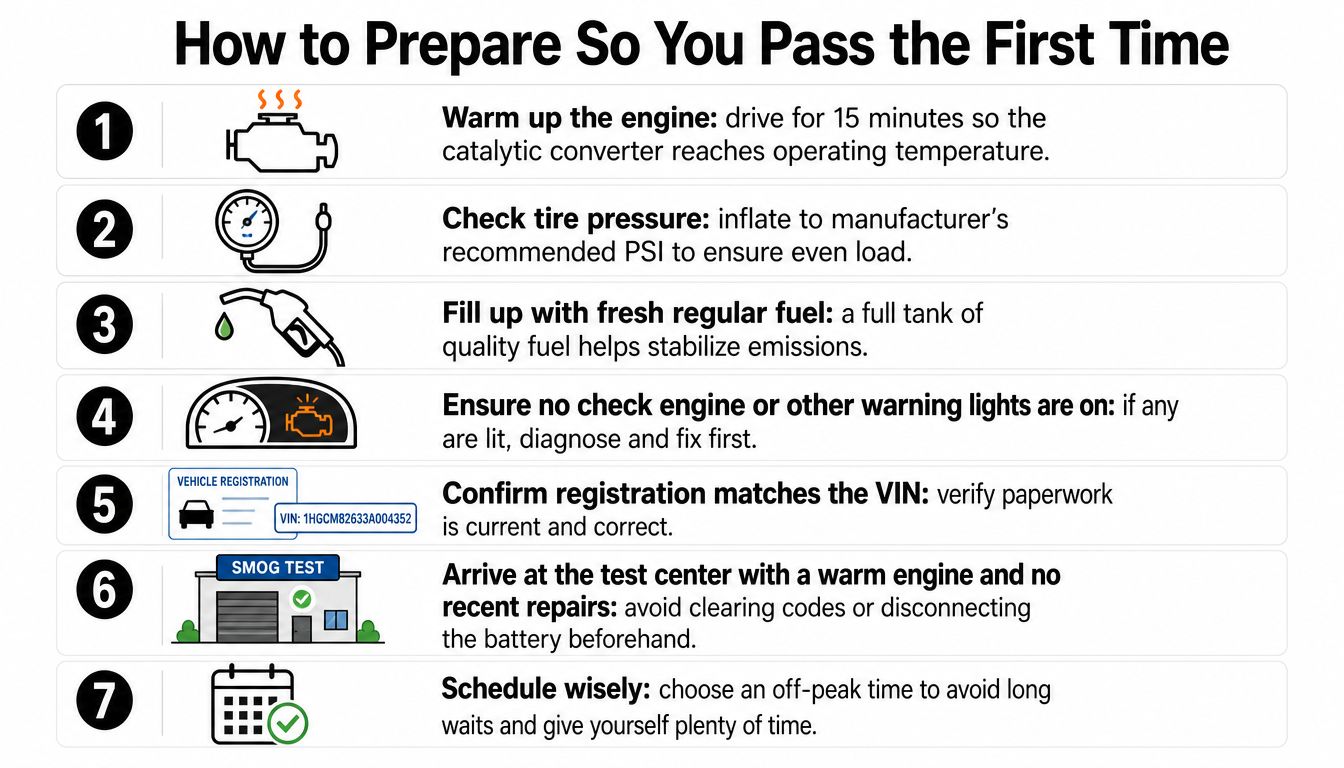
A short routine can prevent avoidable complications:
- Warm the engine: Drive long enough for the engine and emissions equipment to reach normal operating temperature.
- Check tire pressure: Use the manufacturer's recommended pressure, particularly if the vehicle will run on a dynamometer.
- Use normal fuel: Fresh, appropriate fuel supports normal engine operation.
- Inspect the dashboard: Do not arrive with an illuminated emissions warning light.
- Verify the paperwork: Confirm that the registration information matches the vehicle identification number.
- Avoid last-minute resets: Do not disconnect the battery or erase codes immediately before testing.
For a practical walkthrough, review this guide to passing a California emissions test.
A vehicle that fails after a legitimate repair attempt may qualify for California's repair-cost waiver option. Eligibility depends on the program's conditions, so ask the station or BAR before assuming every failure requires unlimited repairs.
What Happens at a Smog Station
You pull into a station, provide the registration information, and tell the technician whether the test is for renewal, a transfer, or another DMV requirement. A STAR-certified station, such as Speedy Smog in San Leandro, can inspect vehicles that need the STAR pathway, although the correct station depends on the vehicle's DMV direction and local program requirements.
The technician begins by confirming the vehicle information and checking the equipment relevant to the inspection. The appointment may include a visual inspection of emissions components, a connection to the OBD II port, or a dynamometer procedure for a vehicle that requires loaded-mode testing.
The inspection itself
For an OBD II vehicle, the technician connects a test device and retrieves the MIL status, readiness information, and trouble-code data. For an older vehicle subject to loaded-mode testing, the technician places it on a chassis dynamometer and measures exhaust pollutants while the car runs through the required operating condition.
A visible-smoke inspection can also be part of the procedure. California's regulation requires the observation immediately after the emissions phase, with the engine at idle and an unobstructed view for at least 10 seconds. California emissions and smoke inspection procedure
The visit can feel routine, but ask questions if the result isn't what you expected. A useful technician should be able to tell you whether the vehicle passed, which monitor or code caused a failure, and whether the result was transmitted electronically for DMV registration purposes.
A test result is more useful when you leave knowing what the vehicle reported, not just whether the paper says pass or fail.
The final certificate is not a general guarantee of mechanical health. It confirms the outcome of the required emissions inspection. Keep any repair documentation and ask about the retest process before you leave if the result is unsuccessful.
Exemptions, Penalties, and Why Rules Differ by Region
California's Smog Check rules aren't perfectly uniform across every vehicle and air basin. Eligibility depends on model year, fuel type, vehicle category, registration events, and the region where the vehicle is registered.
The state's current requirements cover gasoline vehicles from model year 1976 and newer and diesel vehicles from model year 1998 and newer, while some newer vehicles receive an initial exemption period and hybrid rules differ by category. California BAR eligibility guidance
Why the San Joaquin Valley deserves attention
The San Joaquin Valley illustrates why older online guides can become misleading. BAR's 2026 update says a contingency measure could move the new-vehicle exemption in that area from eight model years to seven, which would bring more vehicles into the inspection cycle if the measure takes effect under the stated conditions. BAR's San Joaquin Valley contingency update
That change matters even if a statewide summary still lists the older exemption language. Local air-quality requirements can affect eligibility differently, so owners should rely on the current DMV notice and BAR guidance for the vehicle's registration location.
Don't assume an exemption from memory
Owners often remember an exemption that applied to an older vehicle, a different fuel type, or another county. First registration in California and a change of ownership can also trigger testing, even when the vehicle's usual renewal pattern looks different.
| Region | STAR Required? | Typical Fee Range | Key Exemptions |
|---|---|---|---|
| East Bay and other Bay Area locations | Depends on DMV direction and vehicle status | Varies by station and inspection type | Vehicle age, fuel type, and qualifying categories |
| San Joaquin Valley | May change under regional contingency requirements | Varies by station and inspection type | Local exemption rules can be affected by air-quality measures |
| Other California areas | Depends on county, vehicle, and DMV instruction | Varies by station and inspection type | Some newer vehicles and specific vehicle categories |
The table is a decision aid, not a substitute for the notice attached to your vehicle record. If the DMV directs you to a specific type of station, follow that instruction rather than relying on a general internet checklist.
Common Reasons Cars Fail and How to Fix Them
A failure usually points to a specific emissions issue or incomplete diagnostic process. The most avoidable problem is testing before the vehicle's readiness monitors have finished after a battery disconnect or code clear.
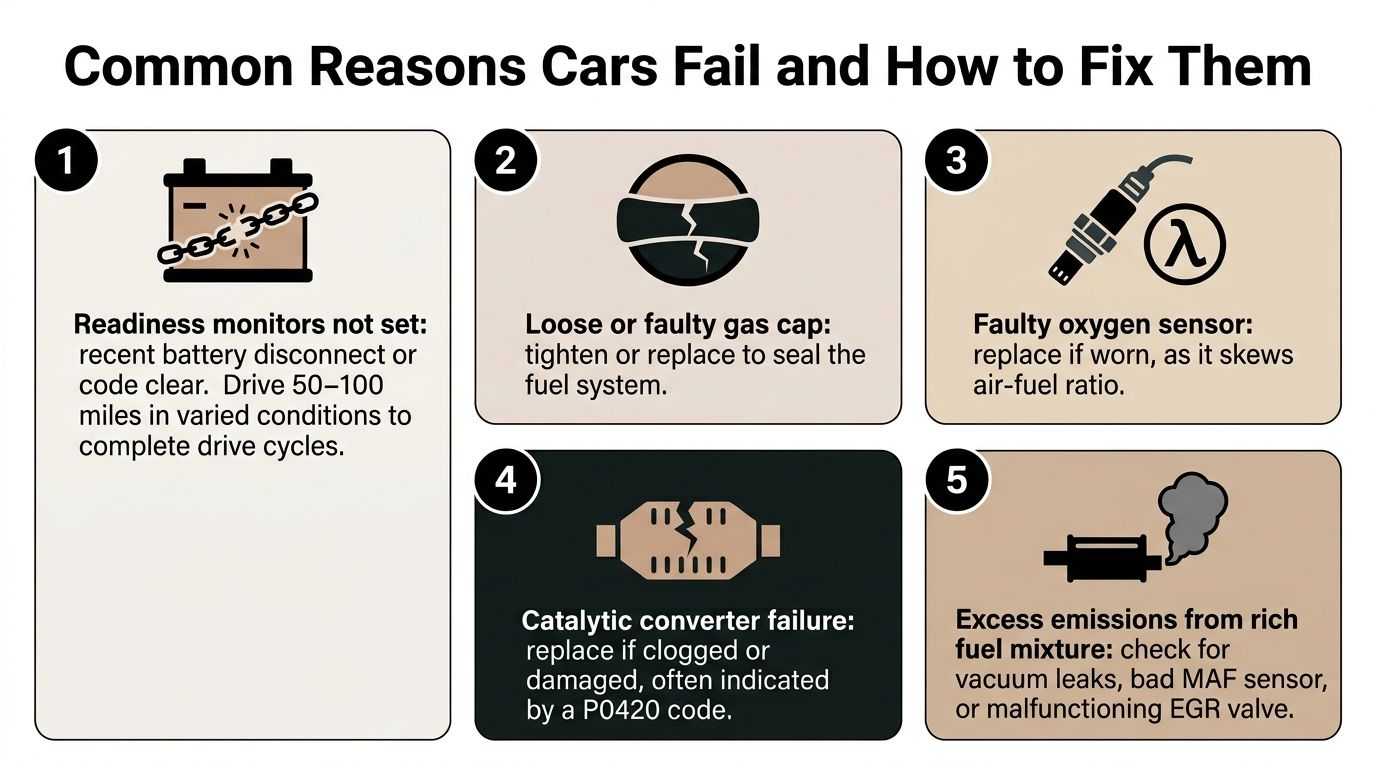
Use this repair checklist as a starting point, not a substitute for diagnosis:
- Readiness monitors are incomplete: Drive the vehicle normally through varied conditions after repairs or electrical work, then verify monitor status with an OBD scanner before testing. Don't assume a short trip has completed every self-test.
- The gas cap doesn't seal: Tighten it until it seats correctly. If the seal is worn or the cap is damaged, replace it with a suitable replacement, preferably an OEM part, because an evaporative leak can trigger a fault.
- The oxygen sensor is faulty: Have the diagnostic code and sensor data checked before replacing parts. A sensor that reports incorrectly can disturb fuel control and increase emissions.
- The catalytic converter isn't working properly: A converter that's damaged, clogged, or no longer converting pollutants may require replacement after the underlying cause is identified.
- The engine is producing excess emissions: Misfires, fuel-mixture problems, vacuum leaks, a failing mass-airflow sensor, or an emissions-control fault can all require attention before the test.
Start with the evidence
A glowing check-engine light is a strong warning that the vehicle's OBD II inspection may fail. Stored fault codes matter too, even when the car feels normal. Ask a repair shop to scan the system and explain the code before authorizing a catalytic converter, oxygen sensor, or other expensive replacement.
Older vehicles may fail because of measured tailpipe emissions, visible smoke, altered emissions equipment, or engine problems that affect the loaded-mode result. California's dynamometer procedure measures hydrocarbons, carbon monoxide, carbon dioxide, and oxides of nitrogen, so clean-looking exhaust doesn't prove the readings will be acceptable. California loaded-mode testing rules
For a more detailed repair-oriented checklist, review these common Smog Check failure reasons. Repair the cause, let the vehicle complete its self-tests where applicable, and retest only after the system is ready.
Picking the Right Station and Passing with Confidence
The right station can prevent confusion, but it can't make an unready vehicle pass. Choose a facility that can explain the vehicle's inspection path, confirm readiness-monitor status, and tell you what the result means before you leave.
A Test Only station performs inspections without selling repairs. A STAR station meets additional program requirements and handles vehicles that BAR or the DMV directs through the STAR pathway. If your notice names STAR or Test Only, follow the notice rather than choosing a station based only on distance.
What to ask before the test
Call or check the station's posted information and ask:
- Which station type applies: Can the facility test your vehicle under the DMV's instruction?
- What the price includes: Does the quoted amount cover the inspection, certificate transmission, and any required retest terms?
- Whether readiness can be checked first: Will the technician show you which monitors are ready, incomplete, or unsupported?
- What happens after a failure: Will you receive the trouble code or failure reason in writing?
- Whether the result is transmitted electronically: Confirm how the passing certificate reaches the DMV.
For a plain-language explanation of station categories, read what a STAR Smog station is.
The most dependable habit is simple: book with a station that explains the result before you leave. That matters more under the readiness-monitor rule because a vehicle can have no visible smoke and no obvious driving complaint, yet still fail when its diagnostic self-tests remain incomplete.
Speedy Smog in San Leandro offers STAR-certified smog inspections, accepts walk-ins, and transmits passing results electronically to the DMV. If you're an East Bay driver preparing for renewal, visit Speedy Smog to confirm the appropriate test and have the vehicle's readiness status reviewed before inspection.