
You're sorting through mail in an Oakland kitchen. Between a utility bill and a grocery flyer is your DMV renewal notice, and one line stops you cold. A smog check is required before your registration can be completed, and the notice may even name a STAR station.
If that moment feels confusing, you're not alone. Most drivers don't think about smog certification in Oakland until that notice arrives, then they have to figure out which station to use, what kind of test their vehicle gets, and what happens if it doesn't pass. This guide walks through that full lifecycle in plain language, from why the test exists to how your certificate reaches the DMV.
Table of Contents
- Why Oakland Drivers Need Smog Certification
- How California Decides Which Test Your Vehicle Gets
- What STAR Certification Actually Means
- What Happens During a Typical Smog Inspection
- Choosing Between STAR, Test-Only, and Regular Stations
- After a Failed Test, Repairs, Waivers, and CAP
- Getting Your Certificate to the DMV and Staying Compliant
Why Oakland Drivers Need Smog Certification
That renewal notice in your hand isn't random paperwork. For many Oakland drivers, it's the first sign that their vehicle is due under California's biennial Smog Check program, which means a covered vehicle needs an inspection of its emissions, engine, and emissions control components every two years. You can't finish the registration renewal until that requirement is satisfied.
The reason sits in Bay Area history. By the late 1960s, the region had recorded 65 days exceeding the national one-hour ozone standard of 12 parts per hundred million, the highest number in its history at that time, with roughly 1.75 million motor vehicles in a region of slightly more than 3 million residents, as the Bay Area Air District history of regional air pollution documents. Ozone is the main ingredient in smog, and vehicles were a major part of the problem even then.
How Vehicles Became the Main Focus
As pollution from factories and other stationary sources declined, motor vehicles became the Bay Area's leading air pollution source. Today, cars, trucks, buses, and construction equipment are grouped as mobile sources, and they produce more than 60% of the Bay Area's smog-forming emissions, per the same Air District history cited above. That shift explains why California puts so much weight on testing individual vehicles.
A single vehicle with a broken or removed emissions control part can contribute far more pollution than a properly maintained one. The inspection is designed to catch exactly that, a malfunctioning system, a missing component, or a warning sign that the vehicle's own self tests aren't passing.
Your smog certificate does two jobs at once. It clears a DMV registration step for you, and it confirms your vehicle's emissions controls are doing the work they're supposed to do.
So when you schedule smog certification for an Oakland vehicle, you're not just buying a piece of paper. You're completing one cycle of a regional program built in response to severe, measurable ozone problems, and the rest of this guide shows you how to get through it with confidence.
How California Decides Which Test Your Vehicle Gets
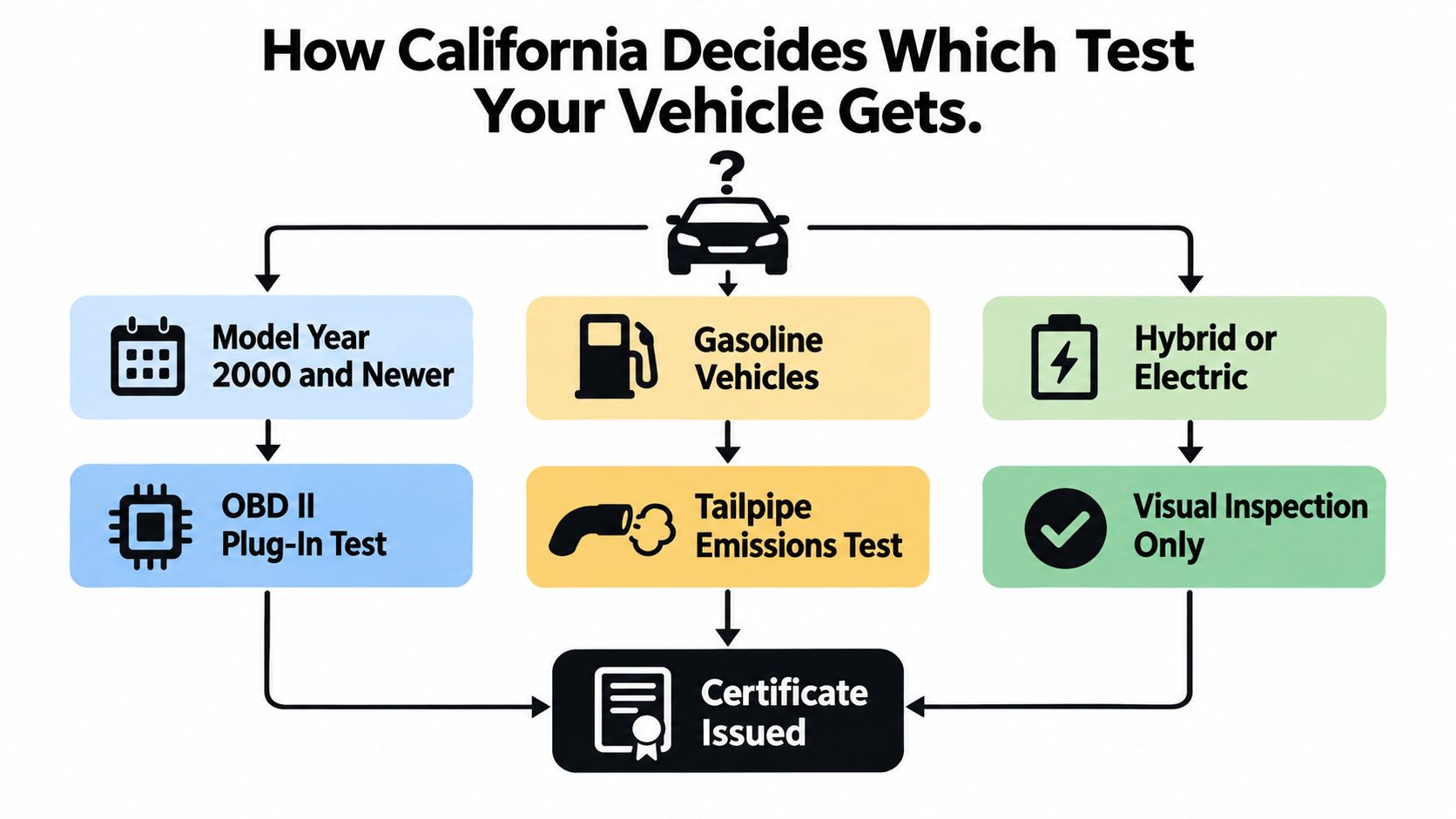
California doesn't give every vehicle the same test. The method is decided mainly by model year and fuel type, and knowing which path your vehicle falls on tells you how to prepare. Start by finding your model year on your registration, then match it to the categories below.
The flowchart below breaks the decision into its main branches so you can see where your vehicle lands.
The Three Main Test Paths
- Gasoline, model year 2000 and newer: Your vehicle is evaluated through the On-Board Diagnostic Inspection System, called OIS, which plugs into your vehicle's computer and reads its OBD-II data instead of relying mainly on a tailpipe test.
- Gasoline, model year 1999 and older: Your vehicle generally receives an Acceleration Simulation Mode test, or ASM, which runs the vehicle on a dynamometer, a set of rollers that simulates driving while emissions are measured.
- Diesel, model year 1998 and newer: Your vehicle also uses OIS, according to the Bureau of Automotive Repair guidance on inspection methods by model year and fuel type.
There's one exception worth knowing. Certain four-wheel-drive and all-wheel-drive vehicles that can't safely run on the dynamometer may be allowed a Two-Speed Idle test instead of ASM. The station determines whether that applies, it's not a choice you make at the counter.
Why Your Path Changes How You Prepare
If your gasoline vehicle is 2000 or newer, your preparation is mostly electronic. A lit check engine light, stored emissions related trouble codes, or readiness monitors that haven't completed their self tests can all cause problems. Getting warning lights diagnosed before your appointment is the smart move.
If your vehicle is 1999 or older, preparation leans mechanical, because the dynamometer test measures what comes out of the tailpipe under load. Either way, there's no shortcut around the full procedure. California prohibits fast pass testing, and inspections must be complete and performed by BAR-licensed personnel. If you want the broader rules in one place, the overview of California smog check rules and requirements is a helpful companion before you book.
What STAR Certification Actually Means
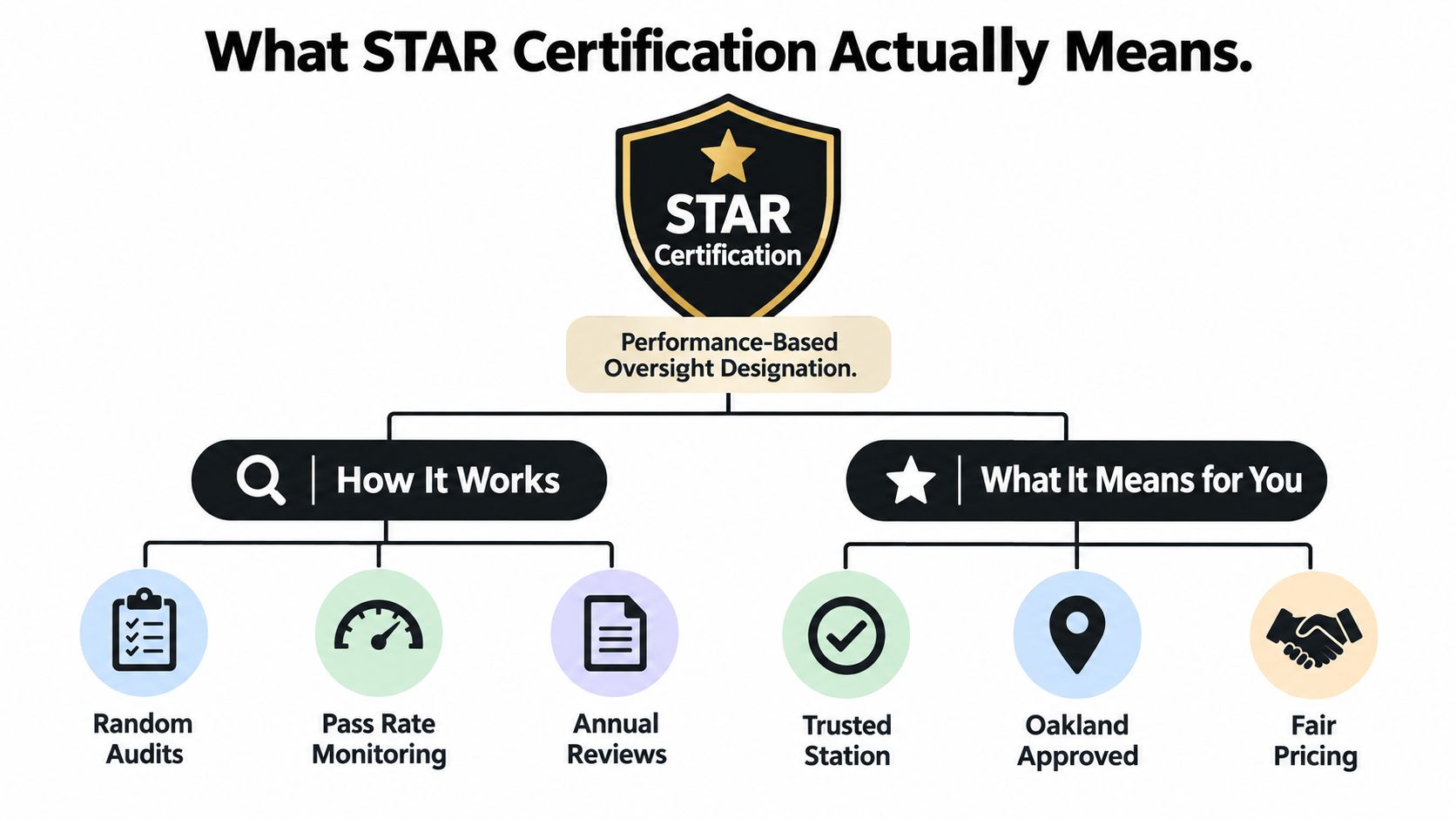
Many drivers searching for smog certification in Oakland see the word STAR on shop signs and assume it's a marketing badge or a quality award voted on by customers. It's neither. STAR is a performance based oversight designation from the Bureau of Automotive Repair, and stations have to earn it with measurable results.
The diagram below shows how the designation is structured and what it signals to you as a customer.
The Numbers a STAR Station Has to Meet
To qualify, a station must satisfy licensing, signage, record keeping, equipment, and publication access requirements, and perform enough inspections for BAR to calculate its performance. On top of that baseline, the BAR STAR certification criteria with published statistical thresholds require specific results, including these.
- Similar Vehicle Failure Rate: At least 50% of the industry-wide failure rate for comparable vehicles, which shows the station isn't passing cars that similar stations would fail.
- Incorrect Gear Selection rate: No higher than 2% of certified vehicles, a check on testing accuracy during dynamometer inspections.
- Excessive Test Deviation Rate: No greater than one, plus a Follow-up Pass Rate of at least 0.40 for the station or its inspectors under the applicable reporting rules.
STAR stations must also maintain equipment capable of testing all vehicles subject to the Smog Check Program. They may inspect directed vehicles, meaning vehicles the DMV has specifically sent to a STAR station, regardless of the station's program area location.
What STAR Does Not Promise
STAR comes in two forms, test-and-repair stations that can fix emissions problems and test-only stations that inspect but don't repair. Both are held to the same performance idea, accurate inspections that protect air quality.
Practical rule: STAR describes the station's track record, not your vehicle's outcome. It doesn't guarantee a pass, waive repairs, or override what your DMV notice requires.
Your vehicle still has to pass the emissions, visual, and functional requirements that apply to it. What STAR gives you is confidence that the station's inspection quality is being measured against published thresholds, not just its own advertising.
What Happens During a Typical Smog Inspection
Pulling into a station for the first time is less mysterious than most drivers expect. The technician verifies your vehicle information, performs the inspection that matches your model year and fuel type, and gives you a report explaining the result. Here's how that unfolds for a typical newer vehicle.
The photo below shows the kind of hands-on check a technician performs during a visit.
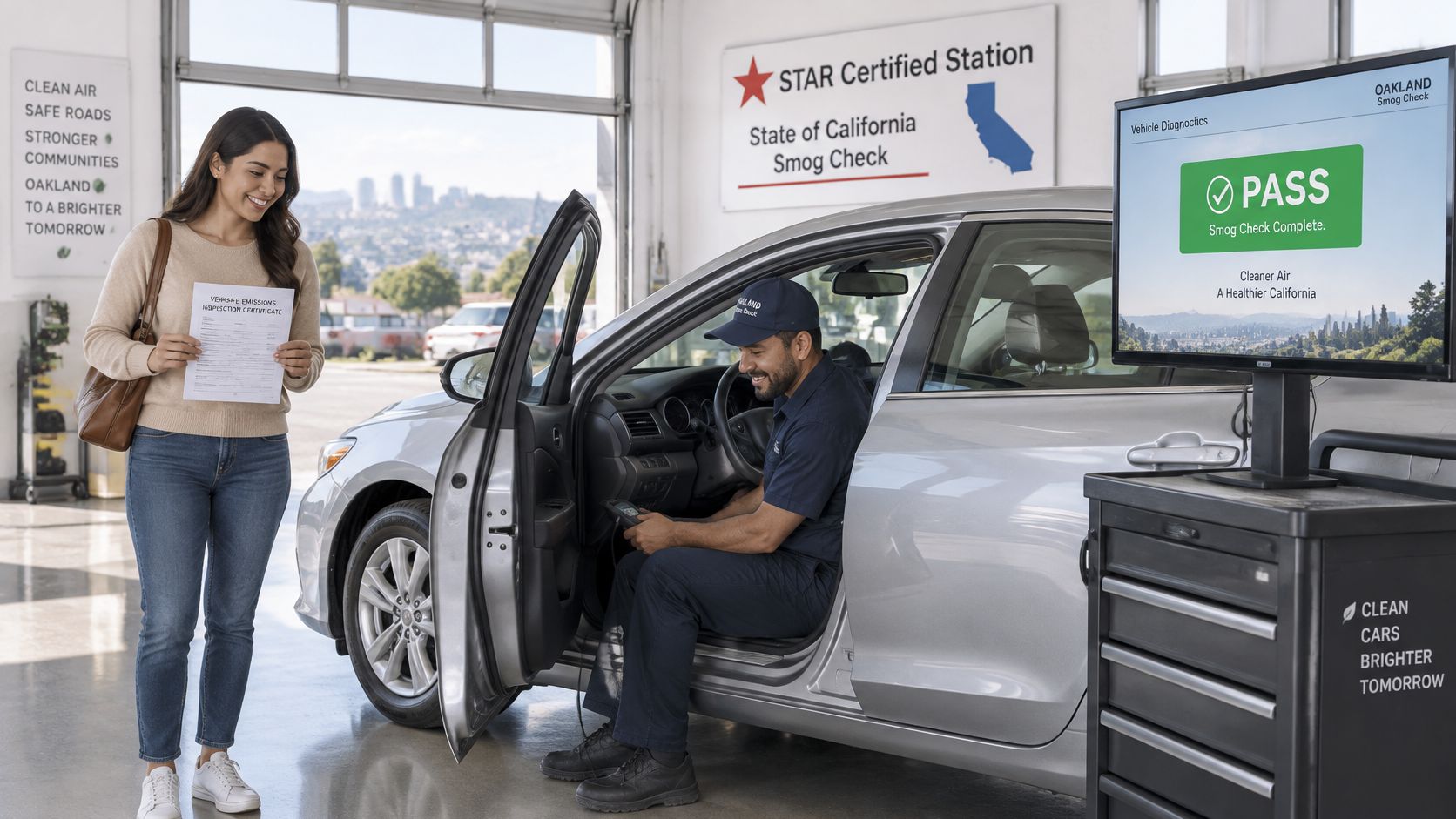
For a 2000-and-newer gasoline vehicle, the technician visually inspects emissions control components under the hood, then connects to the OBD-II system. That electronic check looks for emissions related diagnostic trouble codes, confirms whether the malfunction indicator lamp, your check engine light, works properly and isn't illuminated, and reviews readiness monitor status. Readiness monitors are self tests your vehicle runs on its own emissions systems as you drive, and they need to be complete for the inspection to finish properly.
Pass, Fail, and the Less Familiar Incomplete
Most vehicles either pass and receive certification, or fail with a report identifying what went wrong. There's a third outcome drivers find confusing. If readiness monitors haven't completed, often because a battery was recently disconnected or codes were cleared, the vehicle may not be ready to certify even though nothing is obviously broken. Driving normally for a period usually lets those self tests run, and the technician can advise you on that.
The short video below walks through what a technician is looking at during these checks.
Failures aren't rare, especially among older vehicles. In January 2025 alone, California stations performed 984,481 initial tests with an 8.72% initial-test failure rate, and including retests they performed 1,063,192 inspections and recorded 98,063 failures, or 9.22%, according to the BAR Smog Check performance report with statewide test data. That same data shows 1976 and 1977 model vehicles failing at around one in five initial tests, which is why older cars, diesels, and trucks often need more preparation time. Whatever the outcome, you leave with a Vehicle Inspection Report, and a passing result is transmitted electronically toward the DMV.
Choosing Between STAR, Test-Only, and Regular Stations
The right station for you depends on two things you already have in hand, your DMV renewal notice and your vehicle. Read the notice first. If it specifically requires a STAR station, that decision is made for you, because only a STAR station can certify a directed vehicle. If it doesn't, you have more flexibility.
Many Oakland drivers get tripped up here. They pick the closest shop, then discover their notice required STAR, or they choose a test-only station and then need repairs somewhere else. Matching the station type to your situation upfront saves a second trip.
Choosing the Right Station Type for Your Situation
| Station Type | Accepts Directed Notices | Performs Repairs | Best For |
|---|---|---|---|
| STAR test-and-repair | Yes | Yes | Directed notices, older vehicles, drivers who want testing and repairs in one place |
| STAR test-only | Yes | No | Directed notices where you want an inspection separate from any repair work |
| Regular test-and-repair | No | Yes | Standard notices on vehicles that may need work if they fail |
| Regular test-only | No | No | Standard notices on newer, well maintained vehicles with no warning lights |
Consider your vehicle's condition. If you have an unresolved check engine light or a history of emissions trouble, a test-and-repair station can diagnose and fix the problem without sending you across town. If your newer car runs cleanly and your notice is standard, a regular licensed station handles the job fine. For a deeper side-by-side, this breakdown of STAR station versus test-only station differences explains the trade-offs in more detail.
East Bay drivers often look just beyond Oakland for availability. Speedy Smog in San Leandro is one example of a STAR Certified station serving Oakland drivers, performing inspections for newer vehicles, 1999-and-older vehicles, diesels, and hybrids. Whichever station you choose, confirm it's BAR-licensed and matched to your notice before you drive over.
After a Failed Test, Repairs, Waivers, and CAP
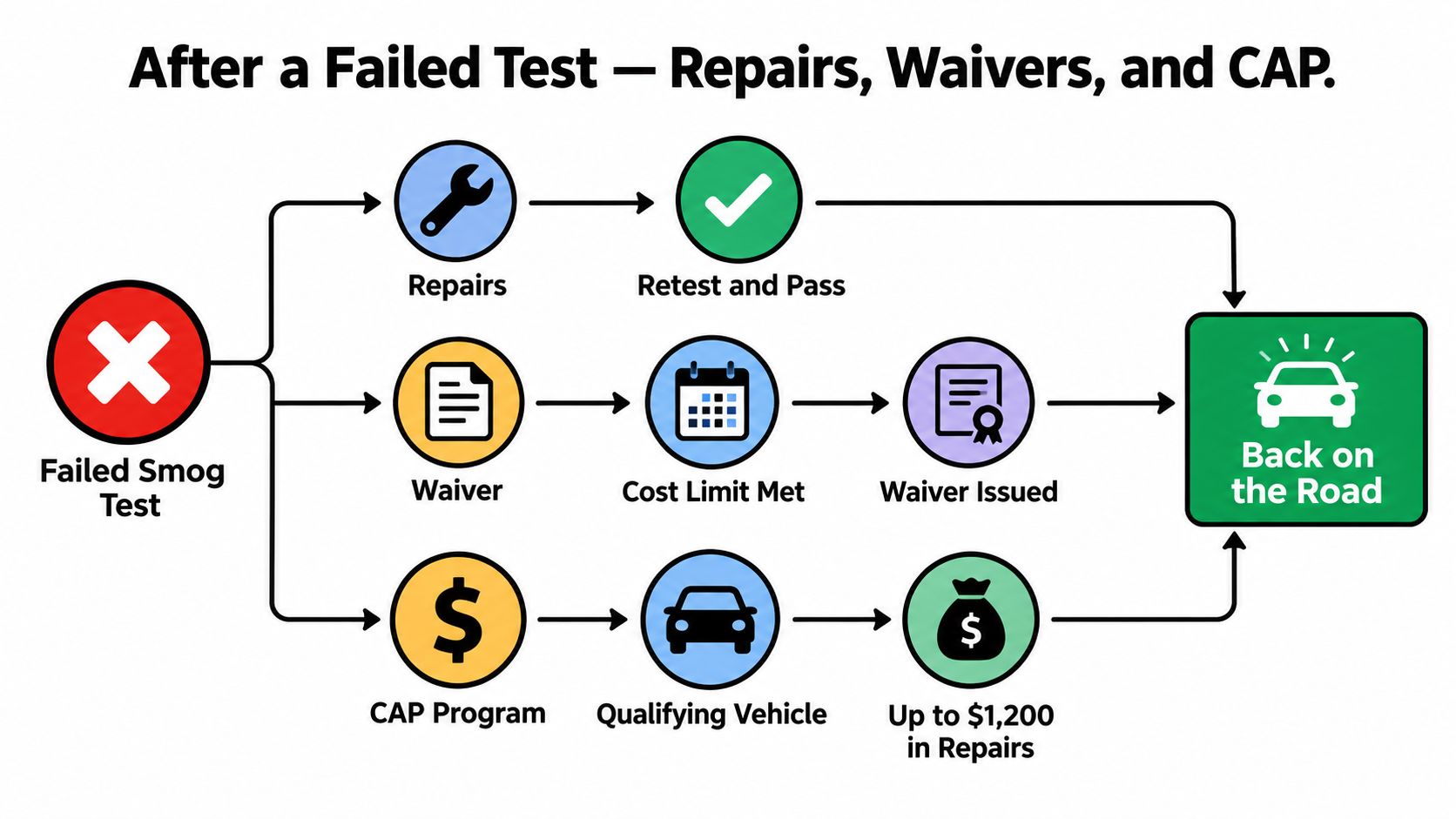
A failed test feels like a dead end, but it's really a decision point. Your Vehicle Inspection Report tells you why the vehicle failed, and that reason shapes your options. The first step is confirming whether the failure is emissions related, involving trouble codes, readiness monitors, or emissions control components, because assistance programs are built around that distinction.
The flowchart below maps the three main routes forward after a failure.
Repair Assistance Through CAP
Before you authorize expensive work, check the Consumer Assistance Program, known as CAP. Eligible owners of 1996-and-newer vehicles may receive up to $1,450 for emissions related repairs, while 1976 to 1995 vehicles may qualify for up to $1,100, under the BAR Consumer Assistance Program repair assistance rules. Eligibility matters and approval isn't automatic, so verify before spending. You can also review how smog check repair assistance options fit together before committing to a repair bill.
The Repair Cost Waiver and the Referee
If repairs get expensive, a repair cost waiver may be realistic, but it isn't a free pass. The vehicle generally must fail its biennial inspection, and you must spend at least $650 on qualifying repairs at a Smog Check station, per the CAP guidance cited above. The waiver postpones the certificate requirement for up to two years, and the vehicle must be fully repaired by the next biennial inspection or a title transfer.
A waiver buys you time, not permanent compliance, and paying the repair threshold by itself doesn't guarantee one will be granted.
If you dispute a failure or your repair history is complicated, the BAR Referee is the path for an independent review. Taken together, these options mean a failed test doesn't automatically mean replacing your vehicle. It means slowing down, confirming the failure type, checking assistance first, and choosing the route that matches your budget and timeline.
Getting Your Certificate to the DMV and Staying Compliant
When your vehicle passes, you usually don't carry a paper certificate to a DMV office. The station transmits the passing result electronically through the BAR system, and that record becomes available to the DMV for your registration. Your job is simpler, keep your paperwork and confirm the details match.
Hold onto your Vehicle Inspection Report until your renewal is fully complete. It shows the test date, station, vehicle information, and result, which is exactly what you'll need if the DMV record hasn't updated yet or a detail needs correcting. Electronic reporting and DMV processing are separate steps, so a short delay before an online renewal recognizes your certificate can be normal. Don't pay for a second test just because a screen hasn't refreshed.
A Simple Checklist for the Next Cycle
- Read your notice first: Check whether it requires a STAR station before choosing a shop.
- Know your test path: Match your model year and fuel type to OIS, ASM, or the diesel route, and prepare accordingly.
- Fix warning signs early: Diagnose a check engine light or incomplete readiness monitors before your appointment, not at the counter.
- Keep your records together: Save the inspection report, receipts, and any repair documentation until registration clears, and keep repair records for the next cycle.
One last distinction helps avoid frustration. A passing smog result satisfies the emissions part of renewal, but it doesn't pay your registration fees or clear unrelated DMV holds. Those are separate steps in the same transaction.
Handled this way, smog certification in Oakland becomes a rhythm you understand rather than a surprise every two years. You know why the test exists, which inspection your vehicle faces, how to pick a station, and what your options are if the first attempt doesn't pass.
If your renewal notice is already sitting on the counter, Speedy Smog in San Leandro offers STAR Certified inspections for Oakland and East Bay drivers, including newer vehicles, older vehicles, diesels, and hybrids, with passing results submitted electronically for DMV registration. Bring your renewal notice, get your vehicle tested, and leave with your inspection report in hand.
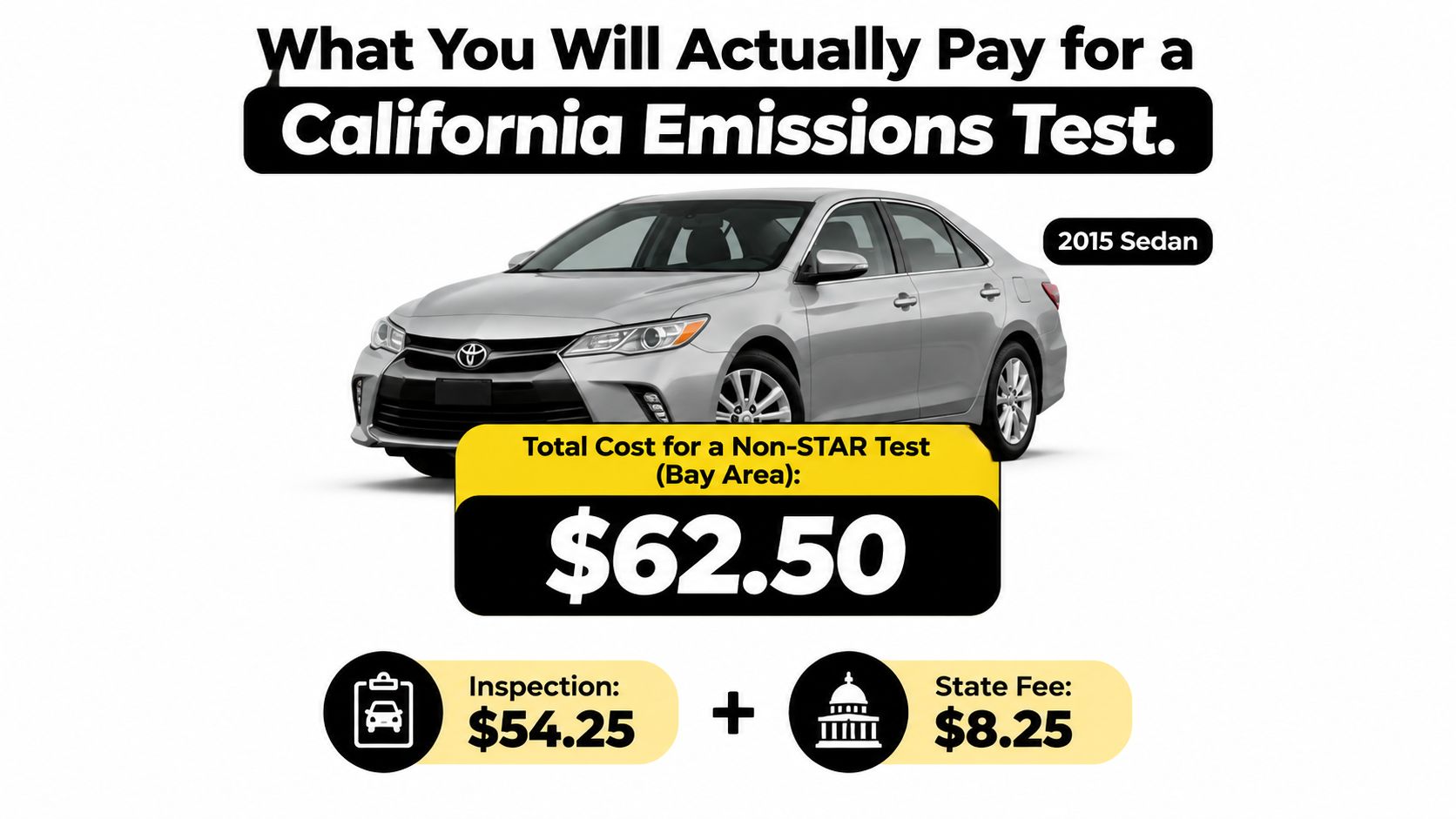
A California emissions test costs the station's inspection price plus a flat $8.25 state certificate fee on every passing test, so there isn't one statewide sticker price. The station controls the inspection charge, while the state controls the certificate fee and collects separate DMV-related fees in different transactions.
You're probably looking at a renewal notice, calling shops, and seeing prices that don't seem comparable. One ad shows a low inspection price, another quotes a total, and a third mentions STAR certification without explaining whether it changes the fee or the testing requirement. The confusion comes from combining three different charges: the station's labor and equipment fee, the state certificate fee, and DMV registration-related fees.
I've written this the way I'd explain the bill before putting your car on the test lane. Ask for the station inspection price first, confirm whether your vehicle must use a STAR station, and then add the fixed state charge only if the vehicle passes.
Table of Contents
- What You Will Pay for a California Emissions Test
- Station Fee Versus State Fee and How They Combine
- How Vehicle Type Changes the Price
- What STAR Certification Means for Your Bill
- Add-On Charges That Push the Total Higher
- Smart Ways to Lower Your Emissions Test Cost
- Putting It All Together for East Bay Drivers
What You Will Pay for a California Emissions Test
You call two Bay Area shops for a 2015 gasoline sedan and receive two different totals. That is normal. A non-STAR station often quotes $50-$60 for an OIS inspection, while BAR's 2025 average for a STAR Test-and-Repair OIS was $75.82. Add the required state certificate fee only when the vehicle passes.
The bill has three separate parts:
- Inspection: The station's charge for running the test.
- Certificate: $8.25, set by the state and added to every passing test.
- Total: The station inspection charge plus the certificate fee.
The station controls the first number. The state controls the second. Confirm the vehicle's STAR requirement before comparing quotes, because a cheaper non-STAR price does not help if DMV directs your vehicle to a STAR station. The California DMV's smog inspection guidance verifies the $8.25 passing-test certificate fee and explains the inspection requirement.
Historical figures need context. A 2005 Legislature report cited an average enhanced inspection cost of $54 and an average total test cost of $76 after including the certificate fee. Those figures are useful benchmarks, not current retail quotes. The California Air Resources Board report shows the long-standing separation between the station's price and the state-controlled charge.
The three numbers to keep in mind
The station inspection fee is where comparison shopping works. Ask for that amount before authorizing the test, and ask whether it includes the complete inspection or only a promotional starting price. The $8.25 certificate fee is fixed and applies to a passing test, so there is no bargaining room there.
The smog abatement fee belongs to DMV registration, not the station's inspection bill. Current DMV materials list it at $20 for newer vehicles exempt from inspection for a period of years. Check the renewal notice to see whether DMV charged it.
Keep the registration line items separate from the smog-test total. If a shop gives you one figure, ask: “How much is the inspection, and is the $8.25 certificate fee included?”
Station Fee Versus State Fee and How They Combine
You can receive two separate charges for one passing test. The licensed station sets the inspection price, while the Bureau of Automotive Repair requires the $8.25 certificate fee. BAR explains this split in its official Smog Check program guidance.
The station fee pays for the inspection work. Depending on the vehicle and test system, it may cover the visual emissions inspection, OBD-II scan, tailpipe measurement, technician time, equipment use, documentation, and shop overhead. A low advertised price may cover the complete test, or it may be only a promotional starting price. Ask before authorizing the inspection.
The certificate fee follows a different rule. It is a state-controlled charge processed through the station's testing system and applies when the vehicle passes. A failed test does not produce a passing certificate, so ask the station how it handles any separate retest or diagnostic charges before work begins.
What belongs on which bill
| Line Item | Amount | Set By | When Charged |
|---|---|---|---|
| Station inspection | Varies by station | Licensed station | When the inspection is performed |
| Smog certificate | $8.25 | State through BAR | On a passing test |
| Smog abatement | $20 in the cited DMV framework | DMV | On qualifying registration transactions |
| Certificate transfer | Verify with DMV before relying on it | DMV | When applicable to a transfer or reissue |
California has run Smog Check through private stations since 1982, which is why no single statewide retail price exists. The station's inspection charge can vary by location, equipment, labor, and business costs. The certificate fee remains fixed, so a shop cannot legitimately remove it to win your business.
The smog abatement line belongs to DMV registration, not the station's inspection bill. Keep it separate from the test total and check your renewal notice for that charge. If a shop quotes one combined figure, ask: “How much is the inspection, and does that include the $8.25 certificate fee?”
That question exposes padded quotes quickly. Compare posted prices at San Leandro smog check stations and confirm whether each quote covers only the inspection or also includes the passing certificate. You can compare the station fee. You cannot bargain away the state-controlled charge.
How Vehicle Type Changes the Price
Your vehicle determines the equipment, procedure, and technician time involved. That's why comparing a quick OBD-II inspection for a newer gasoline car with a tailpipe test for an older vehicle can produce an apples-to-oranges price comparison.
Newer gasoline vehicles commonly use the On-Board Inspection System, or OIS. The technician connects to the vehicle's diagnostic system, checks readiness and emissions-related data, and completes the required visual inspection. A straightforward OIS inspection is usually less demanding than a test requiring a dynamometer and tailpipe equipment.
Older gasoline vehicles can require a BAR-97 procedure. That system uses a tailpipe probe and dynamometer-based testing, which takes more equipment and lane time. The price difference reflects the station's operating cost, not a separate state certificate charge.
Compare the test categories
| Vehicle Type | Test Program | Typical Station Fee | Notes |
|---|---|---|---|
| Newer gasoline vehicle | OIS | Varies by station | OBD-II and visual inspection requirements apply |
| Older gasoline vehicle | BAR-97 where applicable | Varies by station | Tailpipe and dynamometer equipment can affect labor time |
| Diesel vehicle | Applicable diesel inspection procedure | Varies by station | Equipment and vehicle configuration affect the quote |
| Hybrid | OIS or applicable procedure | Varies by station | Diagnostic readiness and hybrid system considerations can affect service time |
| Battery-electric vehicle | No standard smog inspection | No inspection fee | Electric vehicles don't produce tailpipe emissions requiring this test |
BAR's published executive summaries provide a more useful benchmark than bargain advertisements because they separate station types and test platforms. The 2024 report lists a STAR Test-and-Repair OIS average of $72.87, the 2025 report lists $75.82, and the January 2026 report lists $77.55, all before adding the $8.25 certificate fee where the vehicle passes. See the 2024 BAR Smog Check executive summary for the earlier benchmark.
Those averages aren't promises for your neighborhood. A small test-only shop may quote less, while a STAR facility with higher equipment and staffing costs may quote more. Your useful comparison is the same test type at several licensed stations, with the certificate fee identified separately.
What STAR Certification Means for Your Bill
STAR certification is a station designation, not a state-imposed surcharge. It matters because some vehicles must be inspected at STAR stations, and a STAR facility has to meet additional performance and equipment requirements under the BAR program.
The DMV can direct certain vehicles to STAR stations. That can include vehicles identified on a renewal notice, vehicles with prior emissions-related failures, and vehicles that fall within directed or high-emitter categories. Don't choose a shop only because its ad has the lowest number. First confirm whether your renewal notice says STAR is required.
Where the price difference comes from
A STAR station may charge more because it carries additional compliance responsibilities, equipment requirements, documentation duties, and testing procedures. The state certificate charge doesn't change because the vehicle visits a STAR station. The variable amount remains the station's inspection price.
| Factor | Non-STAR Station | STAR-Certified Station |
|---|---|---|
| Station designation | Licensed for eligible inspections | Meets STAR program requirements |
| Vehicle eligibility | Only vehicles allowed by the DMV direction | Can inspect vehicles directed to STAR |
| Inspection price | Set by the station | Set by the station |
| State certificate | $8.25 on a passing test | $8.25 on a passing test |
| Main pricing variable | Labor, equipment, and local competition | Labor, equipment, compliance, and local competition |
The STAR-certified smog station information can help you identify the right station type before you pay for a test. This check is especially important if your renewal paperwork directs you to STAR.
Avoidable expense: If the DMV requires STAR and you use an ineligible station, the test may not satisfy the registration requirement. Verify the station type first, because paying for the wrong inspection can mean paying again.
STAR isn't automatically a bad deal. For a directed vehicle, it's the correct facility. For a vehicle that can use either station type, compare the complete inspection quote, location, service process, and whether the shop clearly explains what happens if the vehicle fails.
Add-On Charges That Push the Total Higher
A failed inspection, a diagnostic check, or a second visit can change the bill quickly. Some added charges pay for real work. Others cover products or services the shop is trying to sell. Ask what each fee covers before approving it.
The $8.25 certificate fee applies to a passing test. It is a state charge, not an optional processing fee created by the station. The inspection price, retest policy, diagnostic work, repairs, and shop-side fees are separate items and should appear clearly in the quote.
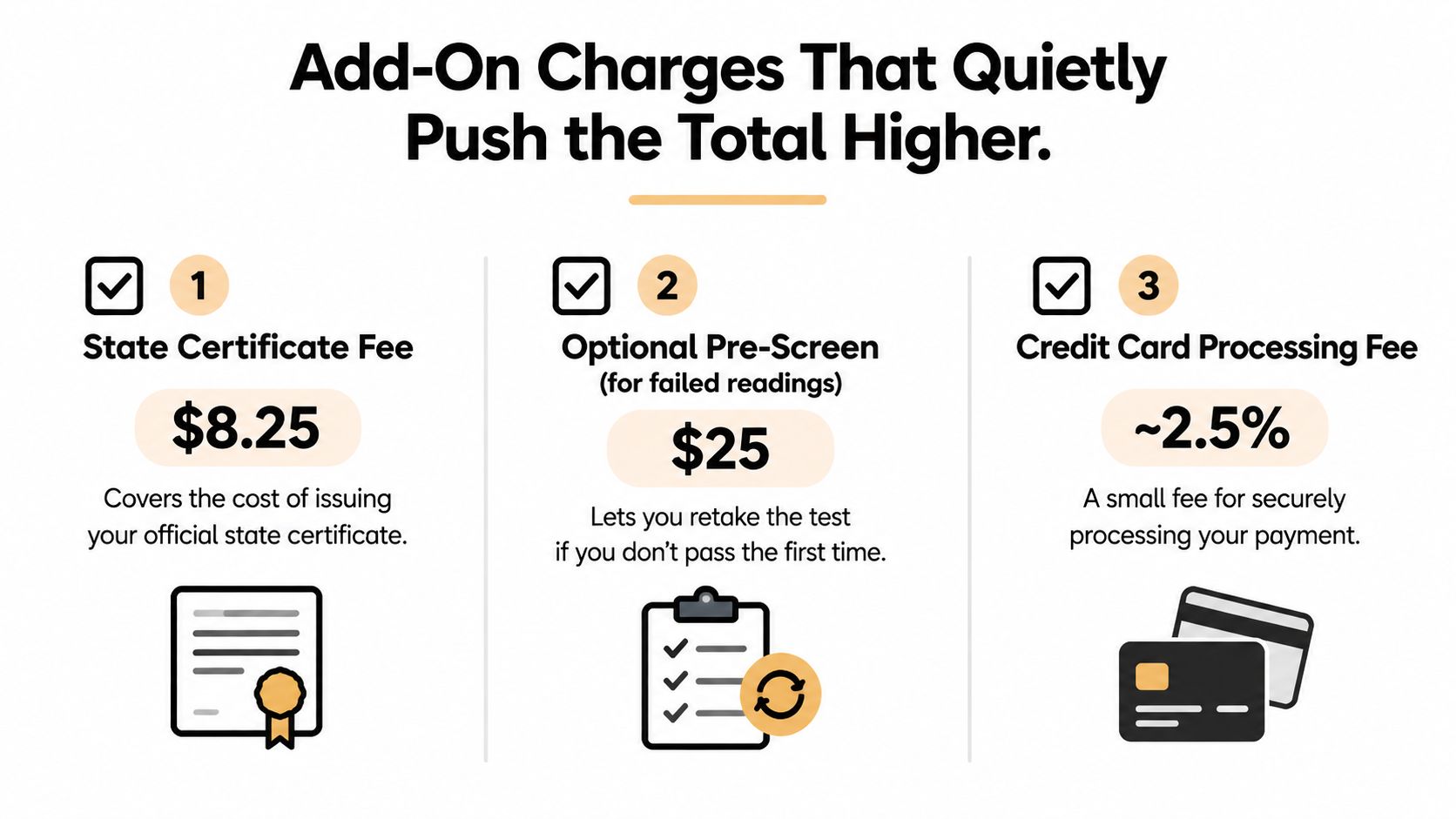
Separate required charges from optional services
- Certificate fee: A fixed state charge applied to a passing result.
- Retest: A second inspection after repairs. The station decides whether its policy makes that free, discounted, or fully chargeable.
- Pre-test or diagnostic: A separate service for checking codes, investigating a warning light, or testing beyond the required inspection.
- Repair work: Work approved by you before it begins. The vehicle may need repairs to pass registration requirements, but the repair price remains a separate decision.
- Convenience or processing charge: A shop-side fee that must be disclosed before payment.
The largest pricing gap often appears after a failure. Ask for the retest policy before authorizing the first inspection. One station may offer a reduced or no-cost retest under stated conditions, while another may charge its normal inspection price after repairs performed elsewhere.
Do not accept a fuel-system cleaner, oil change, or engine-light diagnostic as a condition of a routine test unless the technician explains the vehicle-specific reason. These services can have a maintenance purpose, but they are not automatically part of the emissions inspection.
Use the same caution with a certificate transfer or DMV transaction. If ownership or registration details change, confirm the required charge with the DMV before treating a station-side fee as mandatory. State-controlled requirements are outlined on the California DMV smog inspection page.
Smart Ways to Lower Your Emissions Test Cost
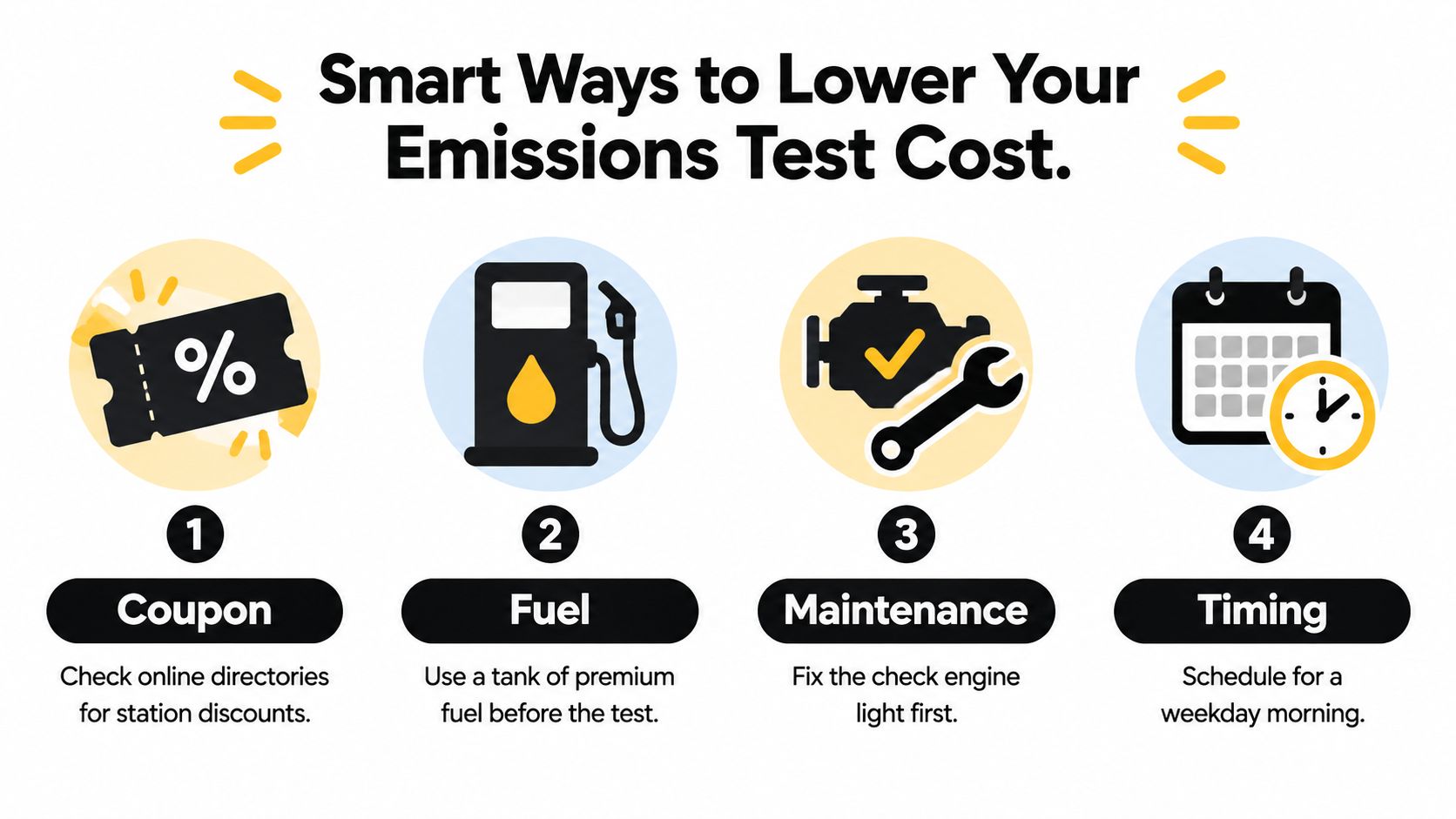
You can reduce the bill without choosing an inferior test. Start by comparing the station inspection fee, then check for a current coupon before booking. A discount applies to the negotiable part of the transaction, not to the fixed state charge.
Use a simple checklist:
- Check the complete quote: Ask for the inspection price, certificate treatment, retest policy, and any payment surcharge before arriving.
- Verify STAR eligibility: Read the DMV renewal notice. If STAR is required, don't waste money at a station that cannot complete the required inspection.
- Look for a current offer: Station websites, coupon pages, and member programs may publish discounts. The Speedy Smog coupon page is one local example to check before scheduling.
- Choose a quieter appointment: Some stations price weekday or off-peak appointments differently. Ask rather than assuming the online price is the only price.
- Fix warning lights first: A lit check-engine light can lead to a failed inspection, and a diagnostic service afterward is more expensive than identifying the problem before the test.
- Arrive with the vehicle ready: Bring the car in normal operating condition, avoid clearing codes immediately before testing, and follow any preparation instructions from the station.
Vehicle preparation can prevent an avoidable aborted test, but don't rely on internet shortcuts such as premium fuel or improvised repairs to make a defective emissions system pass. The best preparation is a functioning vehicle with no unresolved emissions warning.
The registration abatement fee is a separate DMV charge for qualifying newer vehicles, not a discount you can negotiate at the station. If your vehicle requires a test, passing on the first attempt avoids the cost and disruption of a failure and retest, but it doesn't erase a DMV fee that applies under the registration rules.
A short explainer can also help you understand the inspection process before you book:
Putting It All Together for East Bay Drivers
An East Bay driver should price the inspection in two stages. First, identify the correct station and test platform. Second, add the fixed $8.25 certificate fee if the vehicle passes.
For example, a STAR station may quote an inspection price for a newer hybrid and then add the certificate fee to the passing total. The hybrid's diagnostic procedure can require careful readiness verification, so the shop should explain what its inspection price includes before testing begins. Ask whether the quote covers the complete inspection or only the station's base labor.
A practical pricing recap
| Vehicle Type | Test Type | Inspection Fee | Certificate Fee | Estimated Total |
|---|---|---|---|---|
| Newer gasoline vehicle | OIS | Station-set | $8.25 if passed | Inspection plus certificate |
| Older gasoline vehicle | BAR-97 where applicable | Station-set | $8.25 if passed | Inspection plus certificate |
| Hybrid | Applicable OIS procedure | Station-set | $8.25 if passed | Inspection plus certificate |
| Diesel | Applicable diesel procedure | Station-set | $8.25 if passed when required | Inspection plus certificate |
STAR shouldn't be treated as a mysterious surcharge. It identifies a station qualified for vehicles that the DMV directs into that program. The price difference, when one exists, comes from the station's labor, equipment, compliance workload, and local operating costs.
For East Bay drivers, the useful memory aid is simple: the station inspection fee is variable, the passing certificate fee is $8.25, and the DMV's cited smog abatement fee is $20 for qualifying newer vehicles. Keep those charges separate, and a confusing quote becomes easy to evaluate.
Speedy Smog provides STAR-certified inspections in San Leandro, including service for newer vehicles, older vehicles, diesels, and hybrids, with transparent station pricing and a comfortable indoor waiting area. Check the current inspection quote and available offer, then visit Speedy Smog with your DMV renewal information before testing.