
Your registration renewal notice shows up, you open it, and there it is: Smog Check Required. For a lot of California drivers, that one line creates more stress than it should. People wonder if they need the test before they pay DMV fees, whether the shop sends the results in for them, and why the DMV website sometimes still says incomplete even after a pass.
The good news is the process is usually straightforward once you handle it in the right order. Most problems come from timing mistakes, not from the smog test itself. Drivers wait too long, test too early, or assume a paid renewal means the registration is finished when it isn't.
This guide is built around what works for a smooth smog check registration renewal. It focuses on sequence, deadlines, and the practical details that keep you legal and keep the DMV from kicking your renewal into limbo.
Table of Contents
- Your DMV Renewal Notice Arrived Now What
- Decoding Your DMV Notice When a Smog Check Is Required
- Finding a Great Smog Station and Preparing Your Vehicle
- The Smog Test Process What to Expect at the Station
- After the Test Navigating Pass or Fail Scenarios
- FAQ Smog Checks for Special Situations
Your DMV Renewal Notice Arrived Now What
The envelope shows up, you spot the word “smog,” and the stress usually starts right there. The part that trips drivers up is not the test itself. It is the order of the steps. Get that right, and smog check registration renewal is usually routine.
Start with the notice. Read every line before you pay anything, book anything, or assume you already know what DMV wants. If the notice calls for a smog check, build your plan around the due date and leave yourself a little room for the DMV system to catch up after the test.
Handle timing before you handle the test
Here's the shop-floor version. If your registration deadline is close, pay the DMV renewal fee on time to avoid late penalties, then finish the smog requirement as soon as possible. A lot of drivers assume the payment alone finishes the renewal. It does not. DMV still needs a passing smog result sent electronically before it will complete registration and issue the sticker.
That timing detail matters more than people expect.
A passing result does not always show up in DMV records the minute you leave the station. In real cases, the electronic update can take 24 to 48 hours. That is why waiting until the last day creates avoidable panic, even if the car passes.
Use this order
- Read the renewal notice fully. Confirm whether a smog check is being requested.
- Check the due date right away. That date controls every other decision.
- Pay the renewal fee on time if the deadline is close. That helps you avoid penalties while you finish the smog portion.
- Schedule the test with a little cushion. Give yourself time in case the car needs a retest or the DMV update is not immediate.
- Confirm DMV received the result. If you passed today, give the system a day or two before assuming something went wrong.
If you are not sure whether the notice requirement makes sense for your vehicle, this plain-English guide to California smog check rules can help you sort that out fast.
Treat it as a sequence, not one errand. That is the easiest way to avoid late fees, last-minute surprises, and the “I passed, so why don't I have my sticker yet?” phone call.
Decoding Your DMV Notice When a Smog Check Is Required
The first question isn't where to test. It's whether your vehicle needs a test at all.
California's basic rule is that the biennial smog check requirement applies to gas-powered vehicles that are 8 model years or older and diesel vehicles from 1998 onward weighing 14,000 pounds or less, and the smog certificate is valid for exactly 90 days from the test date according to this California smog requirement summary.
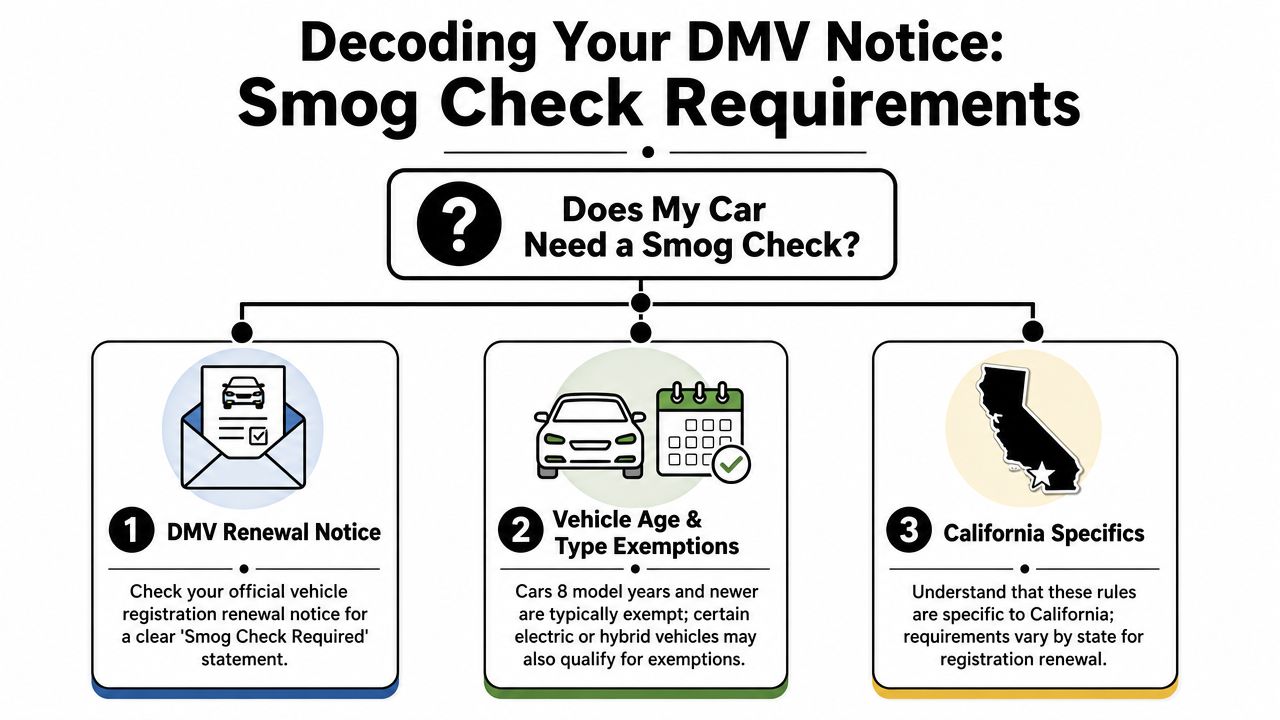
Vehicles that usually need a smog check
If your renewal notice says smog is required, it usually lines up with one of these situations:
- Older gasoline vehicle: Your car has aged into the biennial testing cycle.
- Eligible diesel vehicle: Certain diesel vehicles also fall under California testing rules.
- Ownership transfer: A sale can trigger a smog requirement even when a driver is used to thinking only about renewal cycles.
If you want a plain-English breakdown of eligibility categories, this guide to California smog check rules is a useful reference.
Common exemptions that confuse drivers
A lot of drivers get tripped up because they hear half a rule from a friend and assume it applies to them. California has exemptions, but they're specific.
- Newer gasoline vehicles: Gasoline vehicles less than 8 years old are generally exempt from the biennial smog cycle, though they must pay a smog abatement fee.
- Electric vehicles: These are exempt.
- Motorcycles: These are exempt.
- Pre-1976 classics: Older collector vehicles in that category are exempt from the standard smog program.
The easiest mistake is assuming “newer car” means no smog issue at all. It may mean no biennial inspection, but not that every registration detail disappears.
What a STAR notice means
Some renewal notices specify a STAR station. Drivers often read that like it means their car is in trouble. Usually it just means the DMV requires the inspection to be performed at a station that meets STAR program standards.
That's an administrative requirement, not an accusation. If your notice says STAR, go to a STAR-certified shop and you've handled that part correctly.
If your notice says STAR required, don't overthink it. The important part is choosing the right kind of station the first time.
Finding a Great Smog Station and Preparing Your Vehicle
A smooth smog visit starts before you pull into the bay. The best shops make the process easier, but drivers still help themselves by arriving with a vehicle that's ready to be tested and with the basics already in hand.
The wrong approach is rushing in with a glowing warning light, a cold engine, and no clue whether the shop can perform the kind of inspection your notice requires. That's where a quick checklist pays off.
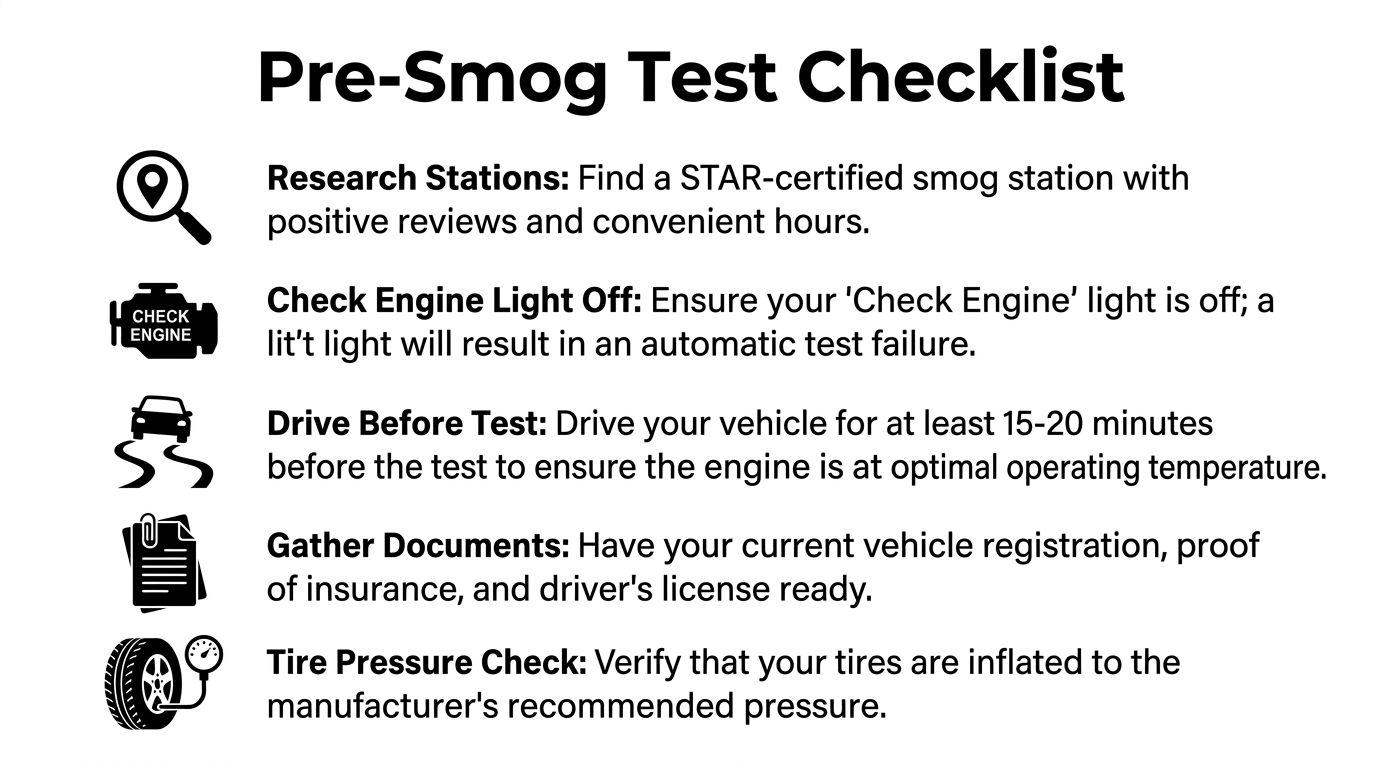
A practical pre-test checklist
Before heading to the station, do these simple things:
- Check the dashboard first. If the Check Engine light is on, don't assume it will “probably pass anyway.” That light usually means you need diagnosis before testing.
- Drive the car first. A warmed-up vehicle tends to make the visit smoother than one that's been sitting all day.
- Bring your paperwork. Having your registration and driver details handy saves time at check-in.
- Choose the right station type. If your notice says STAR required, the station must be able to perform that inspection.
- Look for transparent pricing. Honest shops explain their testing fee clearly instead of surprising you at the counter.
For drivers who want a clear explanation of what makes a station different, this overview of what a smog STAR station is helps separate marketing talk from actual program requirements.
What to look for in the shop itself
Not every station runs the same way. A good shop usually shows it in small details:
| What to check | Why it matters |
|---|---|
| Clean check-in process | Less confusion and fewer delays |
| Clear answers about STAR testing | Helps you avoid a wasted trip |
| Comfortable waiting area | Makes the errand less miserable |
| Straight pricing | Reduces last-minute surprises |
| Efficient workflow | Gets you in and out without chaos |
A fast shop isn't just one that works quickly under the hood. It's one that knows how to move drivers through the paperwork, inspection, and reporting process without creating confusion.
What does not help
Drivers sometimes try shortcuts that don't improve their odds. Showing up at a random station because it's nearby, ignoring a warning light, or waiting until the registration is nearly expired all make the process harder.
The best results usually come from basic discipline. Pick a qualified station, arrive prepared, and leave yourself enough time to solve a problem if the vehicle doesn't pass on the first attempt.
The Smog Test Process What to Expect at the Station
For many people, the most stressful part is the unknown. In reality, the visit is usually routine. You arrive, check in, hand over the vehicle details, and the technician takes it from there.
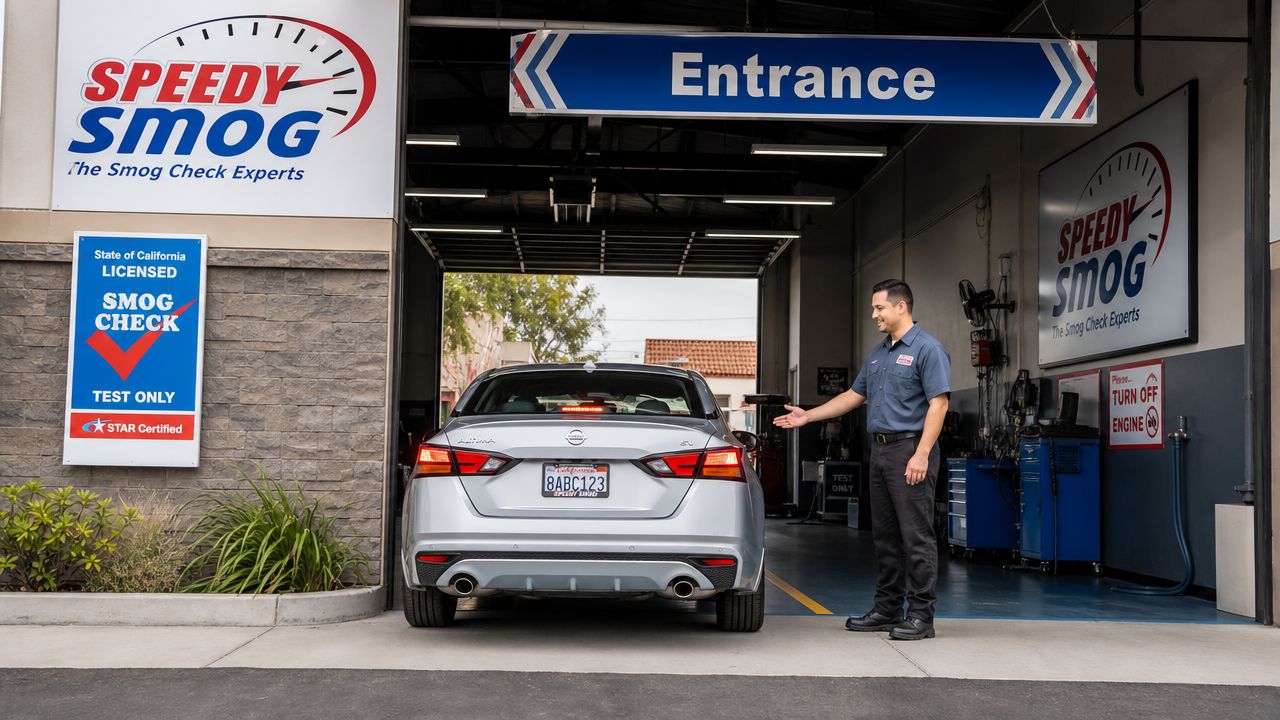
The station then performs the inspection required for your vehicle. Depending on the car, that can include a visual check, functional checks, and emissions-related data review. For most drivers, the experience feels a lot less dramatic than they expected.
What the appointment usually feels like
A well-run station keeps things simple. The technician confirms the vehicle information, explains anything unusual if your notice has special requirements, and gets the test moving. You wait while the inspection is completed.
Some drivers like knowing approximately how long they'll be there before they go. If that's you, this page on how long a smog check takes gives a practical sense of timing.
A smog appointment should feel organized, not mysterious. If the shop can't explain the process clearly, that's usually a bad sign.
What happens after a pass
One of the most important pieces of the smog check registration renewal process happens after the test bay work is done. At a STAR Certified station, the passing result is transmitted electronically to the DMV immediately, and the $8.25 certificate fee is a fixed pass-through charge that shops cannot mark up, as explained in these STAR station FAQ details.
That matters because you do not need to carry a paper certificate from office to office to finish the process. The result goes into the system electronically.
Here's a quick visual overview of the inspection experience:
One shortcut that never works
Some drivers ask if they can get tested outside California when renewal time is tight. For California registration renewal, that doesn't work. An out-of-state smog inspection is not accepted for this purpose.
That's one of those details people often learn the hard way. If California requires a California-recognized result, save yourself the wasted trip and handle it through the proper channel.
After the Test Navigating Pass or Fail Scenarios
You leave the station, the test is over, and the next step depends on one thing. Did the car pass, or did it fail? That sounds straightforward, but timing mistakes in this phase cost drivers the most time and stress.
A pass means you are close. A fail means you need a repair plan. In both cases, the smartest move is to handle the DMV side in the right order instead of assuming everything updates the same day.
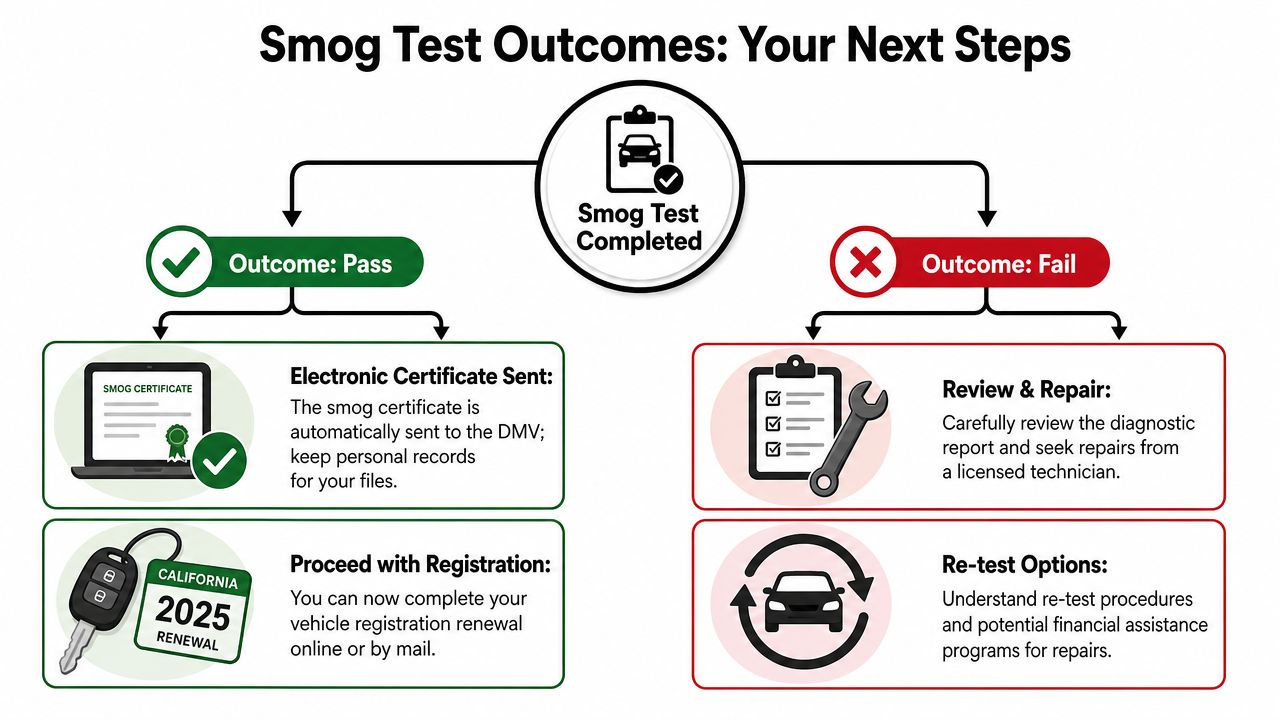
If your vehicle passes
A passing test result gets you through the emissions requirement, but your renewal is not finished until DMV records catch up and your fees are handled. Drivers get tripped up here all the time because the shop sends the result electronically, but the DMV side may not show complete right away.
Use this pass checklist:
- Pay the DMV renewal fee by the due date if you have not already. That helps you avoid late penalties, even if the registration record has not updated yet.
- Wait before assuming there is a problem. A passing smog result often takes about 24 to 48 hours to appear correctly in DMV systems on the customer side.
- Keep the receipt and test paperwork. If there is a delay, that paperwork gives you the test date, station information, and proof that the inspection was completed.
- Check your renewal status after the sync window. If the DMV still does not show the pass after that, then it makes sense to call and ask questions.
That timing matters. I have seen drivers pay attention to the test result but forget the fee deadline, and I have seen the opposite too. They pay DMV right away, then panic a few hours later because the smog still shows as missing. In many cases, the system just has not caught up yet.
If your vehicle fails
A failed test is a repair problem, not a personal failure. The report tells you where to start, and the worst approach is guessing.
Start with the inspection report. Then make decisions in this order:
- Read the failure details carefully. Look at the actual reason for failure before approving repairs.
- Choose a shop that can diagnose emissions faults, not just replace parts. Misfires, monitor issues, EVAP leaks, and catalyst faults can overlap. Random part swapping burns money fast.
- Finish the repair before retesting. If the car needs a drive cycle or monitor reset procedure, make sure that is done too.
- Keep an eye on your registration due date. Even while you sort out repairs, the DMV clock keeps running.
The expensive mistake is rushing into repairs without a diagnosis, then rushing back for a retest before the car is ready.
California also has a Consumer Assistance Program for some motorists dealing with smog-related repair costs. If the repair estimate is getting painful, ask about that option early rather than after you have already spent money.
The timing rule people miss
The practical order is what saves headaches. Pay your DMV renewal fee on time if the deadline is coming up, even if the car has not passed yet. Then finish the smog side. The DMV will not issue the sticker until it receives a passing result, but paying on time can keep you from stacking late penalties on top of repair costs.
There is another timing issue many guides skip. Smog results are not always visible in DMV records the instant you leave the shop. A short delay is normal, and that is why same-day panic calls happen.
The certificate validity window still matters too, as noted earlier. Testing too early can box you in if other renewal steps drag out. Testing too late can leave no room for repairs, monitor resets, or a DMV sync delay. The sweet spot is close enough to your renewal date that the result stays useful, but early enough to fix a problem without a last-minute scramble.
When you still need to drive
If the registration date is closing in and the smog issue is still unresolved, ask the DMV whether you qualify for a Temporary Operating Permit. For some drivers, that buys enough legal driving time to finish repairs, retest properly, and avoid making rushed decisions just to keep the car on the road.
FAQ Smog Checks for Special Situations
My car is out of state during renewal
This catches people by surprise all the time. If the car is outside California when your renewal comes up, an out-of-state emissions test usually does not satisfy California's smog requirement for registration renewal.
The fix is paperwork, and paperwork takes time. Depending on your situation, the DMV may want a statement of facts or another form tied to a temporary exemption. Start that process early, especially if your registration deadline is close. Waiting until the last few days is how a routine exception turns into late fees, extra calls, and a parked car.
My notice says STAR Station Required
A STAR requirement sounds more serious than it usually is. In practice, it means the DMV wants the inspection done at a STAR-certified station.
It does not mean the car already failed in the system. It means you need to choose the right shop the first time.
Call ahead and ask one direct question: "Are you currently licensed as a STAR station, and can you perform my test today?" That 30-second check saves a wasted trip.
I passed, so why does the DMV still show incomplete
This is one of the biggest stress points in renewal season. You pass, you pay, you check your DMV status that night, and it still shows incomplete.
A passing result is sent electronically from the station, but the DMV side does not always update right away. California's Bureau of Automotive Repair explains the 90-day validity window on a passing certificate at California's Bureau of Automotive Repair smog check page. In real shop-to-DMV timing, a short delay before the DMV record catches up is normal.
If you passed today and the DMV website has not updated yet, give it a little time before assuming something went wrong. I tell customers to avoid same-day panic unless the registration deadline is immediate and there is another problem in play, like a name mismatch or unpaid renewal fees.
This is also why timing matters. Test early enough to leave room for a DMV sync delay, but not so early that you burn too much of that 90-day window.
What if I'm selling the car
Sales catch owners off guard more often than renewals do. A car can be fine on its regular registration cycle and still need a smog inspection for transfer.
In California, vehicles 4 years old or older generally need a smog test for a title transfer. Sellers who wait until a buyer is ready to sign often end up scrambling for an appointment, especially if the notice also points them to a STAR station.
Check the requirement before you list the car. It is much easier to sell a car when the smog side is already handled.
If you're in the East Bay and want a clean, straightforward smog visit, Speedy Smog in San Leandro is a practical choice. They're a STAR Certified station with fast service, transparent pricing, and a comfortable waiting area, which makes smog check registration renewal a lot less painful when you just want to get certified and get back on the road.
You open your registration renewal, scan for the amount due, and then see the line that changes your whole errand list: smog certification required. For a lot of Pleasanton drivers, that's the moment the questions start. Is this a routine test? Do you need a STAR station? Will the check engine light sink the whole visit? Can you knock it out fast without bouncing between shops?
That's where most local guides fall short. They list addresses, maybe mention coupons, and leave out the part that matters: how the inspection works, what causes avoidable failures, and why the right station choice can save a wasted trip. If you're searching for smog check Pleasanton CA, the smart move isn't always the closest shop. Sometimes it's the one that handles your vehicle type correctly the first time.
Table of Contents
- Your DMV Notice Says Smog Check Required Now What
- California Smog Rules for Pleasanton Drivers
- STAR Certified Or Regular Smog Station Which Do You Need
- How to Prepare for and Pass Your Smog Check
- Smog Check Options Near Pleasanton And Why We Recommend Speedy Smog
- Get Your Smog Certificate And Get Back On The Road
Your DMV Notice Says Smog Check Required Now What
A common Pleasanton scenario goes like this. Your tags are due soon, you've got work, school pickup, and errands stacked up, and now the DMV wants a smog check before registration can move forward. Most drivers aren't worried about the test itself. They're worried about wasting half a day on something that should've been simple.
The good news is that a smog check usually becomes stressful for predictable reasons. People go in with the check engine light on, they show up right after a battery replacement, or they don't realize their vehicle needs a different type of station than the one down the street. Those are the mistakes that turn a short visit into a repeat visit.
Practical rule: Treat your smog check like a compliance inspection, not a casual oil change stop. A little prep matters.
If you're looking up smog check Pleasanton CA, you probably need answers to three things right away:
- What the state is asking for
- How to avoid an automatic fail
- Where to go so the result counts the first time
For most drivers, the process is manageable once the jargon gets translated into plain English. You don't need to become an emissions expert. You just need to know whether your car is routine or STAR-directed, whether your onboard system is ready, and whether the shop you choose handles your vehicle type well.
That's especially important for newer vehicles, hybrids, and cars with any recent repair history. Those are the vehicles that often look fine to the owner but still trigger issues at inspection time.
California Smog Rules for Pleasanton Drivers
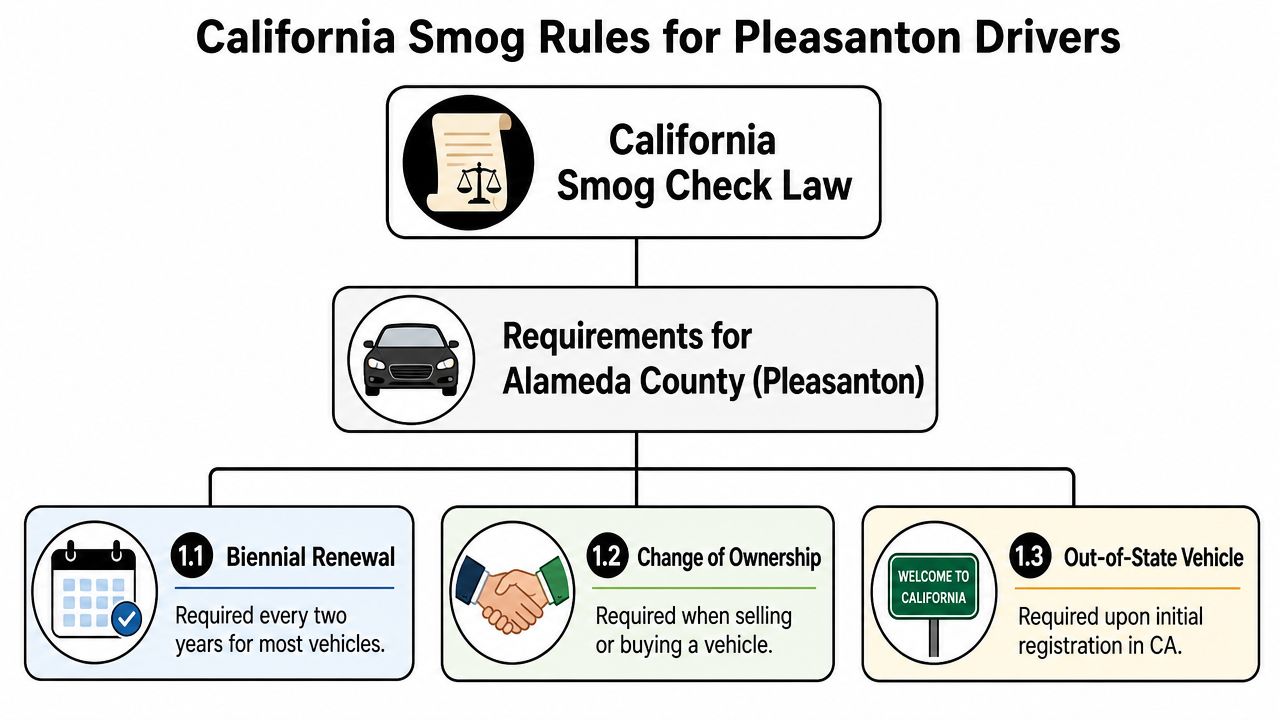
Pleasanton drivers are dealing with California rules, not a special city program. That matters because the test isn't just a local shop preference. It's part of a statewide emissions compliance system tied to registration and certain ownership events.
The program was adopted in 1984 to address significant smog sources from vehicle emissions, and it requires identification and repair of vehicles emitting excess smog-forming pollution, particularly during registration renewal or transfer events, as explained by AAA's overview of California smog requirements.
Why California takes this seriously
Pleasanton sits in the East Bay, where air quality rules aren't abstract policy. Vehicle emissions are one of the things the state actively regulates to keep pollution below required limits. That's why the notice from DMV isn't optional paperwork. It's a compliance step tied directly to whether your registration can move forward.
If you want a plain-English breakdown of the framework, this guide to California smog check rules is a useful companion.
When drivers usually get flagged
In real life, Pleasanton drivers most often run into smog requirements in a few familiar situations:
- Registration renewal: The renewal notice tells you a smog check is required before the DMV completes the process.
- Vehicle transfer: A change in ownership often triggers the need for a valid inspection.
- California entry: If a vehicle is being registered in California, emissions compliance becomes part of that first-state process.
What works is checking the DMV notice early and handling the inspection before the deadline gets close. What doesn't work is assuming every vehicle follows the same path. Some cars move through a standard inspection smoothly. Others are flagged for stricter station requirements, and that distinction catches people off guard.
Drivers usually get into trouble when they treat smog as a last-minute errand instead of a registration requirement with technical rules attached.
That's why a simple search for smog check Pleasanton CA should lead to more than a list of nearby addresses. The smarter question is whether the station you choose matches what your vehicle needs.
STAR Certified Or Regular Smog Station Which Do You Need
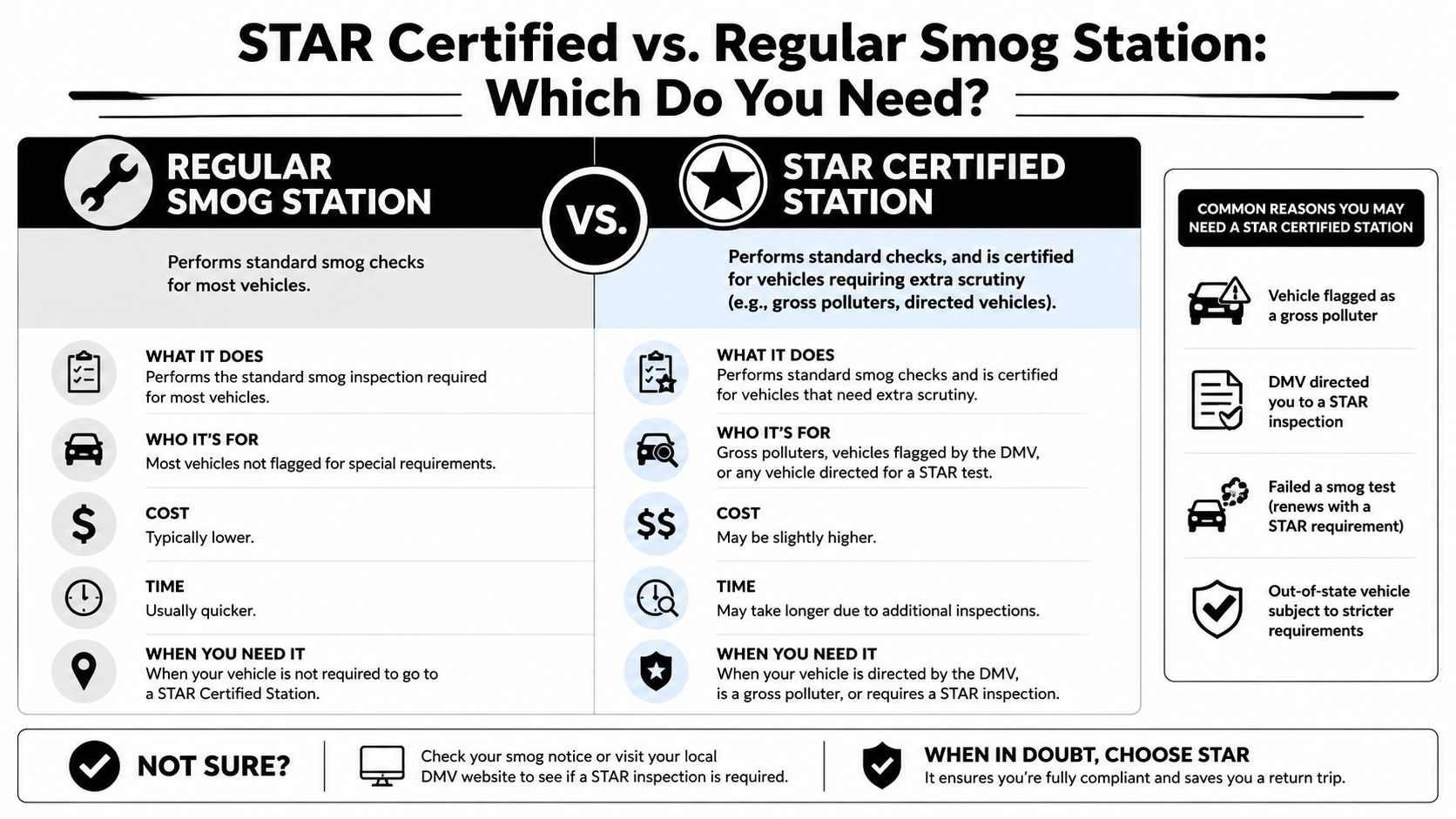
Many drivers lose time assuming a smog station is a smog station. It isn't. California separates standard testing from STAR Certified testing, and that difference matters if your DMV paperwork directs you to a STAR location.
The STAR Certified designation identifies facilities audited by the Bureau of Automotive Repair that demonstrate superior accuracy in detecting emissions failures, and STAR stations are specifically required for vehicles identified by the DMV as high emitters or those with a history of failed inspections, according to this California STAR station guide. That same source notes the cost for this inspection in California ranges from $30 to $70.
What STAR actually means
A STAR station isn't just using a nicer sign. It's a facility held to a higher performance standard. That's the practical takeaway for drivers. If your DMV notice directs you to STAR and you go somewhere else, you haven't saved time. You've started over.
Here's the simplest comparison:
| Station type | Best for | Risk if you choose wrong |
|---|---|---|
| Regular smog station | Vehicles not specifically directed to STAR | You may still need to retest elsewhere if your vehicle requires STAR |
| STAR Certified station | Standard vehicles and vehicles specifically directed by DMV to STAR | Lower risk of choosing a station your paperwork won't accept |
A useful explainer on what a smog STAR station is can help if that notice language feels vague.
A quick way to decide
Use this decision logic:
- Your DMV notice says STAR required: Go to a STAR station. No debate.
- Your vehicle has a history of emissions trouble: A STAR station is usually the smarter call.
- You own a newer model or hybrid and want fewer surprises: Specialized testing experience helps.
- You just want the broadest compliance option: Choosing STAR removes one common point of failure.
The trade-off is straightforward. A regular station may be convenient if your vehicle clearly qualifies for routine testing and you know that for sure. A STAR station is often the safer choice when the notice is unclear, the car has prior issues, or you don't want to gamble on whether the inspection will count.
That's why experienced drivers don't just ask who's closest. They ask who can complete the right inspection for their specific vehicle the first time.
How to Prepare for and Pass Your Smog Check
You get the DMV notice, book a test, drive over from Pleasanton, and expect to be in and out. Then the car fails for a reason that had nothing to do with how it felt on the road. That is the part that frustrates drivers most. Smog failures often come from readiness status, warning lights, or emissions equipment issues that show up only during inspection.
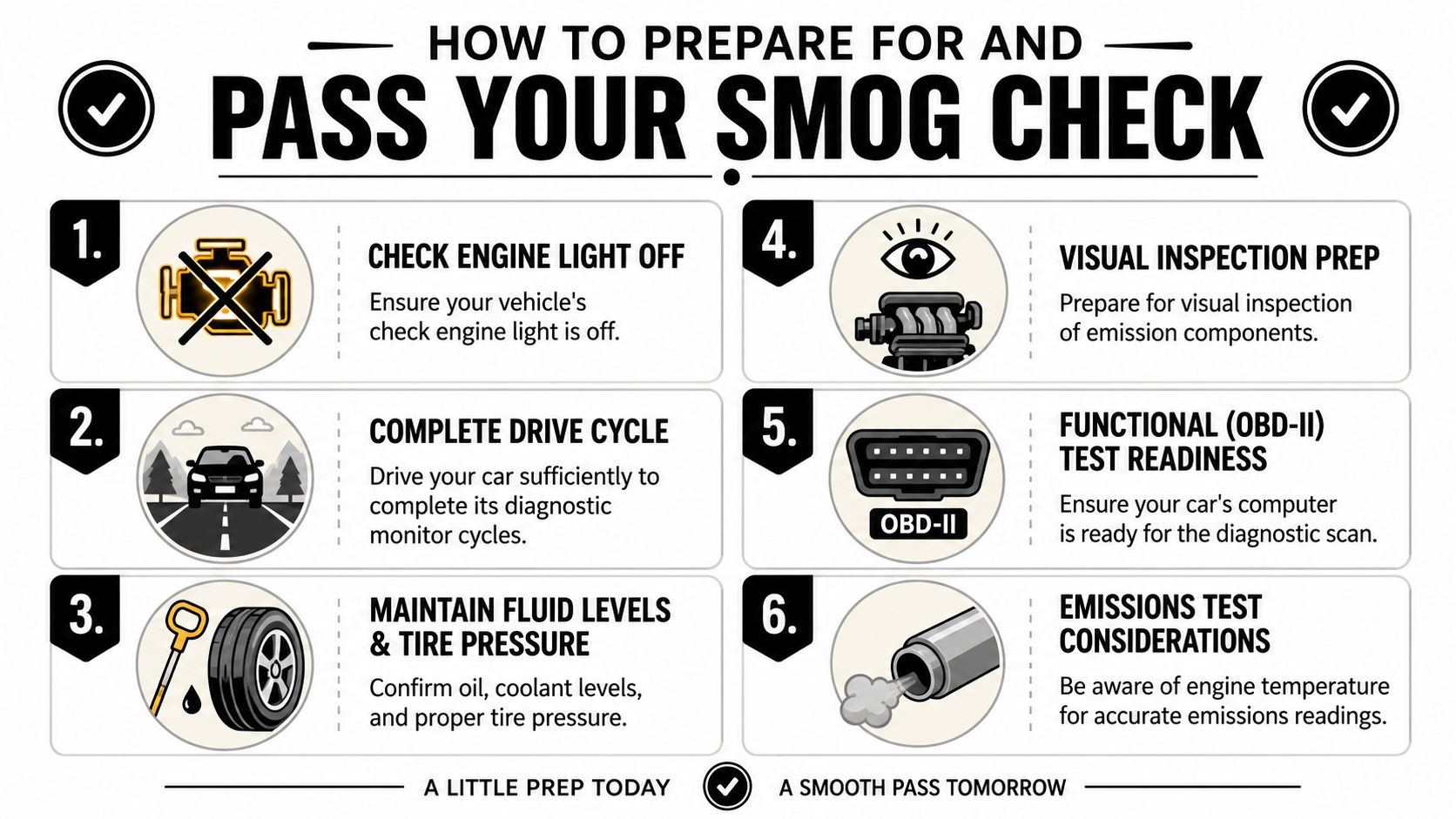
A California smog check usually includes three parts: a visual inspection of emissions-related components, a functional inspection of the OBD-II system, and an emissions measurement. If the check engine light is on or an OBD-II readiness monitor is not set, the vehicle fails, as explained in Geotab's California smog check guide.
What the inspector is looking for
The visual check covers parts such as the catalytic converter, EGR valve, and fuel cap. The functional check confirms the onboard computer is ready to report valid emissions data. The emissions portion measures pollutants such as Hydrocarbons (HC), Carbon Monoxide (CO), and Nitrogen Oxides (NOx), according to that same source.
This catches a lot of people off guard. A car can drive fine and still fail.
I see this all the time with newer vehicles and cars that recently had battery work. The owner fixed one problem, cleared a code, or disconnected power, then shows up before the readiness monitors have completed their drive cycle. Geotab notes that after battery replacement, vehicles may need normal driving time before all monitors reset.
What helps before the appointment
A little prep saves a lot of hassle, especially if you want one trip instead of two.
- Drive the car long enough to fully warm it up: A cold engine is not ideal for testing.
- Check for warning lights before you leave home: If the check engine light is on, deal with that first.
- Do not disconnect the battery right before the test: That often resets monitors and creates an automatic problem.
- Ask whether the shop offers a pre-inspection: If something looks questionable, it is better to catch it before the official test starts.
- If the vehicle has tuned or modified software: Put it back to manufacturer settings or a CARB-approved version before testing, because BAR states modified software can trigger a failure.
If you want a practical list of common smog check fail reasons, review that before booking the test.
For Pleasanton drivers, this is one reason a short drive to a specialized STAR station can make sense. Shops that handle these inspections all day are usually better at spotting readiness issues, recent-repair problems, and equipment concerns before you waste time on an official fail.
Later in the process, it helps to see the inspection flow in action:
What does not work
These are the mistakes that cause avoidable failures and repeat visits:
- Clearing codes the day of the test: That often leaves monitors unset.
- Ignoring recent repairs: Battery, alternator, or module work can affect readiness.
- Assuming a newer car will pass automatically: On many late-model vehicles, OBD-II status is the whole story.
- Picking a shop based only on price or distance: If the station is not the right fit for your vehicle, the cheap test gets expensive fast.
The fastest smog check is the one you only have to do once.
Smog Check Options Near Pleasanton And Why We Recommend Speedy Smog
Pleasanton has smog check options, and for some drivers a nearby location will work fine. But convenience on a map isn't the same as the best choice for compliance, speed, or technical fit.
That matters more than many drivers realize. Local listings often blur the line between standard testing and STAR-directed testing, and that creates bad recommendations. The source material provided here notes that Bureau of Automotive Repair data shows STAR stations are held to higher performance standards and are the only authorized sites for STAR-directed vehicles, while many local listings fail to explain that going to a non-STAR station when STAR is required leads to an automatic fail and a retest, as discussed in this Pleasanton smog listing analysis.
The local shop problem most drivers don't spot
A lot of shop pages sound interchangeable. They say they do smog checks, mention a special, and leave out the operational detail that protects the customer. If your vehicle is STAR-directed, a non-STAR stop doesn't just slow you down. It sends you back out for another inspection.
Hybrid owners and owners of newer vehicles should be especially careful. Those vehicles often need a shop that pays attention to the inspection steps rather than rushing the process or oversimplifying what's required.
Why a short drive can be the better move
For East Bay drivers, making a short drive to a specialized STAR station can be the smarter option when you want accuracy, a smoother visit, and fewer compliance surprises. That's especially true if your vehicle is newer, hybrid, diesel, or anything with a recent emissions-related issue in its history.
There's also a practical value issue. A fast, properly handled visit at a specialized station beats a “closer” visit that turns into a retest. Drivers who search smog check Pleasanton CA are usually trying to solve a time problem, not just a distance problem. The best answer is the station that gets the test done correctly and gets your DMV record updated without drama.
If a shop doesn't clearly explain whether it handles STAR-directed vehicles, that's already a warning sign.
Get Your Smog Certificate And Get Back On The Road
You get the test done, the station submits the result electronically, and you can finish your registration without chasing paper forms around town. That is the part Pleasanton drivers want. A clean, one-visit smog check that does not turn into a second errand.
The easiest path is usually simple. Show up with the right station for your vehicle, bring a car that is ready to test, and confirm your DMV notice before the inspection starts. That small bit of prep prevents the problems I see all the time, especially after recent battery disconnects, check engine light repairs, or visits to a shop that was not set up for the vehicle in front of them.
If your car passes, the certificate goes straight into the system and remains usable for your registration for a limited window, as noted earlier. You do not need to babysit the paperwork.
That is one reason a short drive from Pleasanton to a specialized STAR station can make sense. The goal is not just finding the closest shop. The goal is getting the right test, done correctly, once. For drivers with newer vehicles, hybrids, diesels, or STAR-directed notices, that can save time compared with rolling the dice on a generic local option.
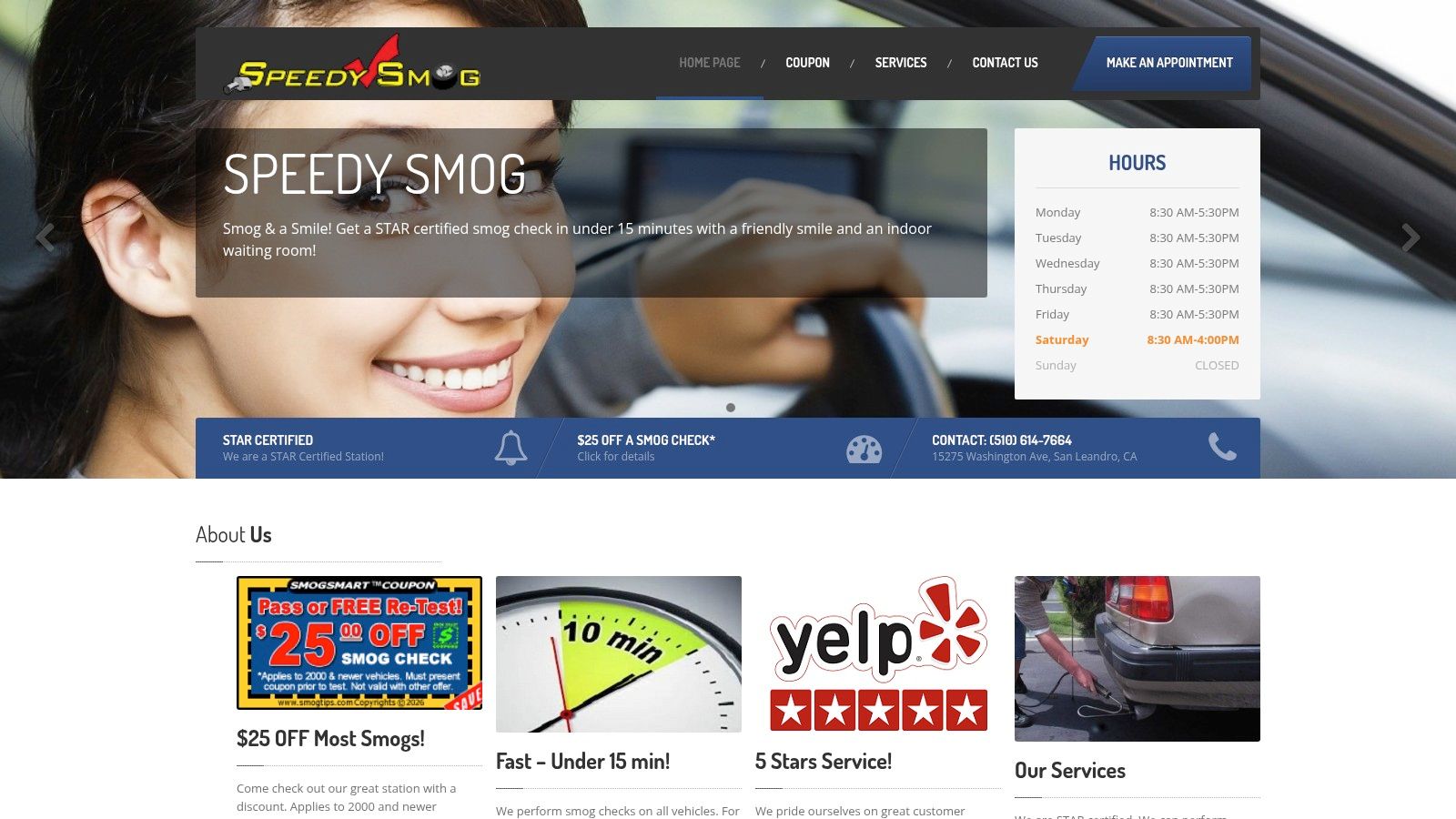
If you want a fast, accurate inspection from a STAR-certified team, book with Speedy Smog. They're located at 15275 Washington Ave, San Leandro, CA 94579, open Monday through Saturday, and they specialize in efficient testing for most vehicles, including newer models, older cars, diesels, and hybrids. Many 2000+ vehicles are completed in about 10–15 minutes, and the clean waiting area, transparent pricing, and periodic coupon offers make the short drive worthwhile for East Bay drivers who want to get certified and move on with their day.
You open a DMV notice, see “brake and light inspection”, and assume you need the same old certificate everyone talks about. Then you call a shop, hear a different term, and wonder whether you're about to book the wrong service and lose a day chasing paperwork around Oakland.
That confusion is real. The official term for revived salvage vehicles is now Vehicle Safety Systems Inspection (VSSI), and California's Bureau of Automotive Repair says the old Brake & Lamp Inspection wording is legally outdated even though some paperwork still uses it. If you ask for the wrong thing, you can end up with the wrong appointment and a registration problem instead of a solution. You can review that terminology change on the California BAR safety systems page.
This guide on brake and light inspection Oakland is meant to save you time, money, and repeat trips. It uses the common phrase people still search for, but keeps the official jargon straight so you know what to request, what gets checked, and how to show up prepared.
Table of Contents
- Introduction Navigating Oakland's Brake and Light Inspection
- What Is a California Vehicle Safety Systems Inspection
- Common Reasons for a Brake and Light Inspection Failure
- Your DIY Pre-Inspection Checklist Before You Go
- What to Expect at an Oakland Inspection Station
- Finding a Certified VSSI Station in the East Bay
- Conclusion Pass Your Inspection with Confidence
Introduction Navigating Oakland's Brake and Light Inspection
Most drivers don't start this process because they want to. They start because the DMV, a rebuilder, or a title issue puts the inspection on the to-do list and the wording is inconsistent from the first phone call.
The first thing to know is simple. In everyday conversation, people still say brake and light inspection. In official California use for revived salvage vehicles, you should be asking about a Vehicle Safety Systems Inspection, or VSSI.
That distinction matters because the certificate has to match what the DMV expects. A shop may understand what you mean when you say brake and lamp, but you still want to confirm they perform the current inspection required for your vehicle category and paperwork.
Practical rule: When you call a station, say, “I need a Vehicle Safety Systems Inspection for a revived salvage or rebuilt vehicle. My paperwork may still say brake and lamp.”
That one sentence clears up most of the confusion before it becomes a wasted trip.
What Is a California Vehicle Safety Systems Inspection
A California Vehicle Safety Systems Inspection is a state-required safety inspection tied to putting certain repaired vehicles back on the road. California requires reconstructed vehicles or vehicles involved in a significant accident to pass this inspection before they can be legally registered with the DMV, and technicians must hold the proper certification to sign off on it, as explained in this California brake and lamp certification overview video.
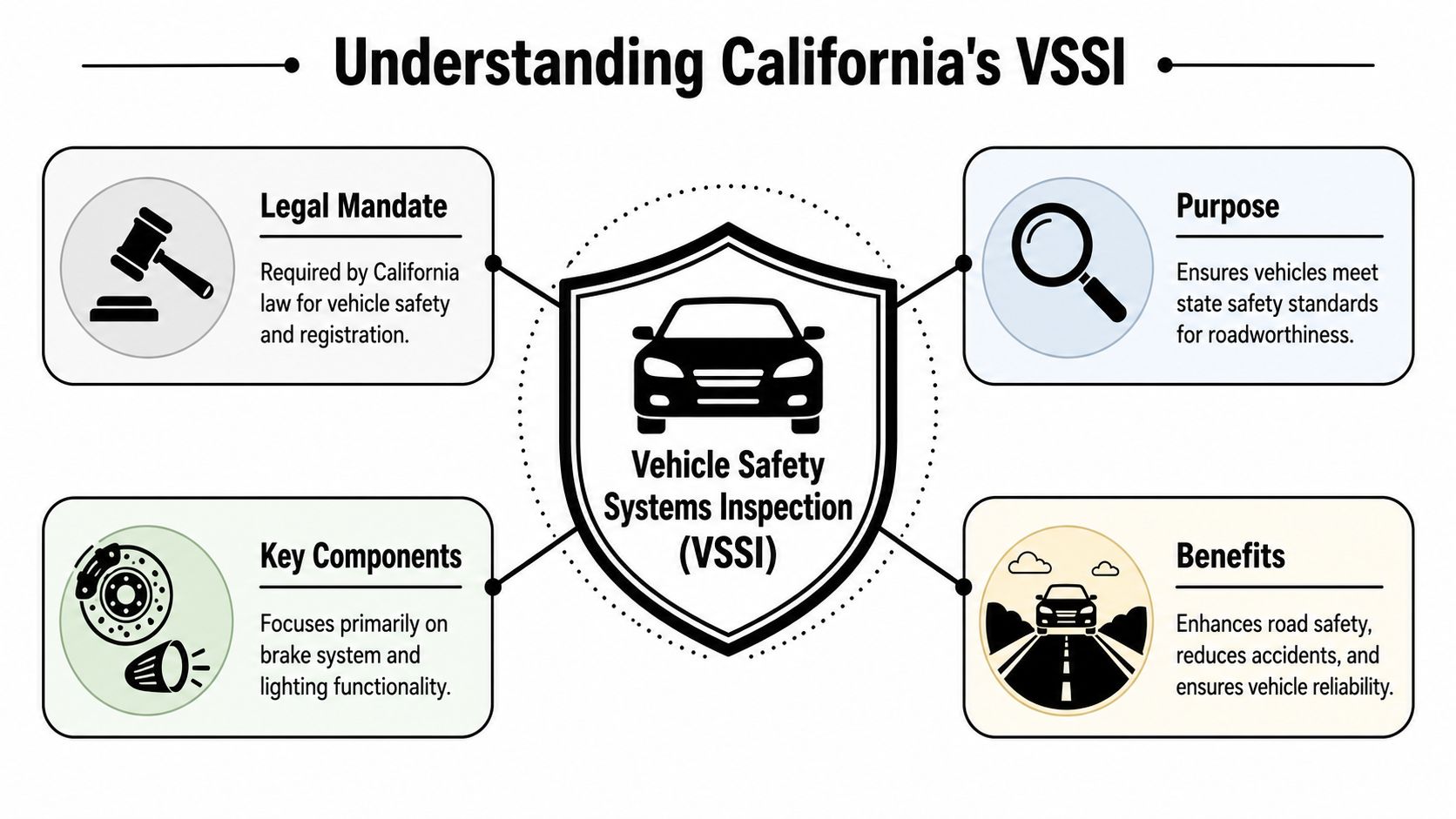
This inspection functions as a post-repair safety signoff, not a routine annual check. The state isn't asking whether the car merely starts and drives around the block. The state wants confirmation that the critical systems tied to stopping and visibility were restored to a roadworthy condition after major damage or reconstruction.
Who actually needs one
This inspection is typically part of the path back to registration for vehicles that have been salvaged, rebuilt, or heavily repaired after a serious incident. If you're dealing with title revival, reconstructed status, or DMV follow-up after major repairs, this is the lane you're probably in.
Regular maintenance customers often confuse VSSI with a smog test or a quick safety look-over. It isn't the same thing. It sits in a different bucket, with different paperwork and different legal consequences.
For a broad overview of how inspection services fit into vehicle compliance, this vehicle inspection service guide gives helpful general context.
Why the state treats it differently
The reason is public safety. When a vehicle has had major structural or collision-related work, the state needs more than verbal assurance that “everything was fixed.” Brakes and lighting are basic survival systems on the road. If either one was repaired poorly, the risk doesn't stay with the owner alone. It affects everyone around that vehicle.
A proper VSSI is also narrower than many drivers expect. It focuses on the systems that determine whether the vehicle can stop correctly and communicate correctly to other drivers. That's why the inspection can feel strict. It should.
A revived vehicle doesn't get the benefit of the doubt. It has to earn its way back onto the road with documentation.
Common Reasons for a Brake and Light Inspection Failure
Most failed inspections come down to things that are mechanical, visible, or both. The inspector isn't grading style or making a guess. They're checking whether specific parts work the way the standard requires.
For brakes, the inspection has to verify the performance of the pads, rotors, and hydraulic system. A functioning brake warning lamp is also required unless the vehicle has ABS, and failure can result from problems such as brake pad thickness under 3mm, according to this VSSI brake and lamp inspection reference.
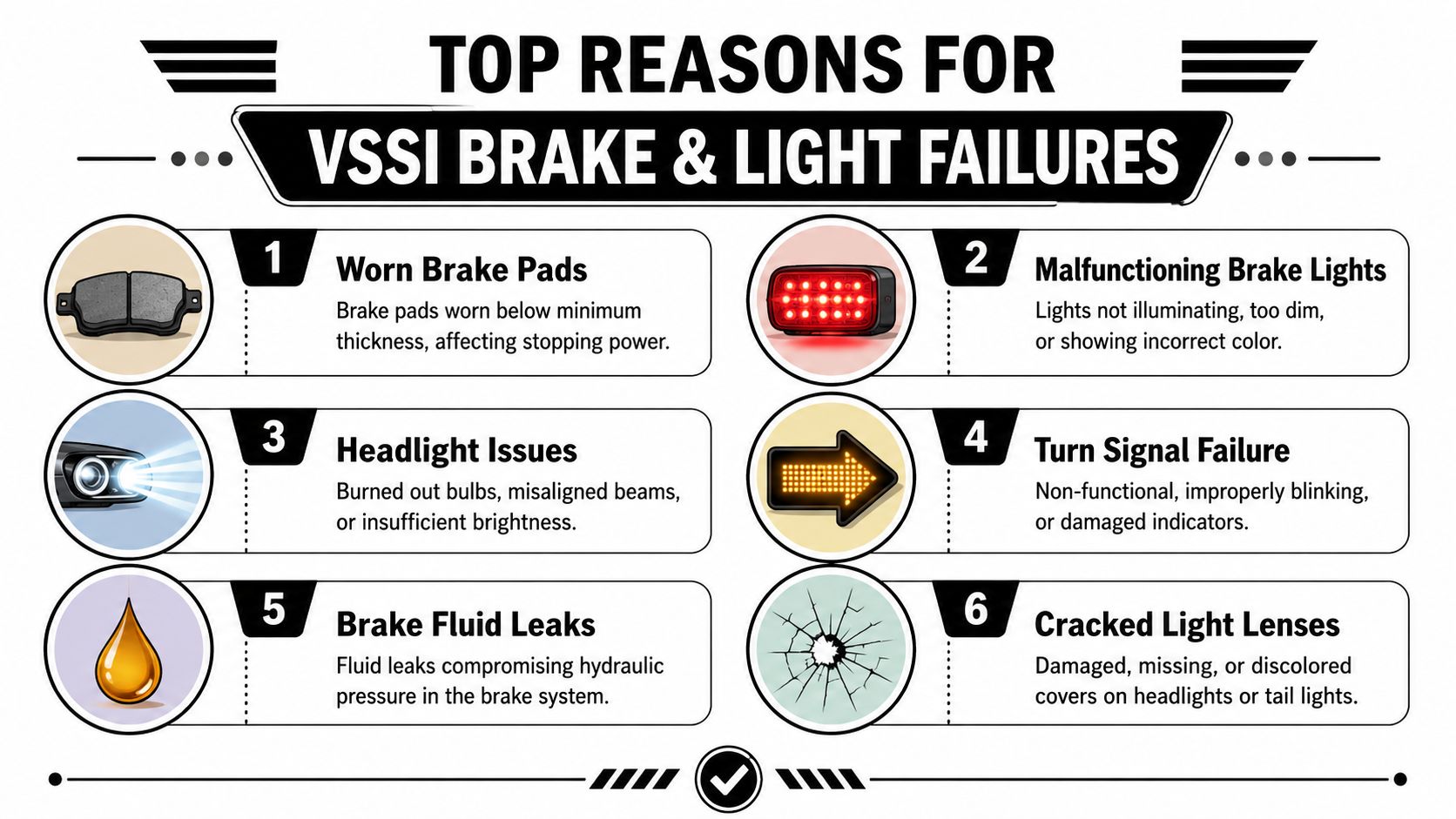
Brake system failures
Here's what tends to knock a car out on the brake side:
- Pads worn too thin. If friction material is below the standard, the vehicle won't pass.
- Rotor condition issues. Rotors that are excessively damaged or inconsistent in operation can raise a red flag.
- Hydraulic leaks or weakness. If the system can't maintain pressure correctly, the inspection stops there.
- Brake warning lamp problems. On vehicles where that lamp is required, it must function because it alerts the driver to hydraulic pressure loss or master cylinder trouble.
Balanced braking matters too. If one side grabs harder than the other and the vehicle pulls during a hard stop, that points to a real safety defect rather than a minor annoyance.
Lighting issues that stop the process
Lighting failures often look small until paperwork is involved. A cracked lens, dim output, wrong color, or a signal that works only sometimes can be enough to send you back for repairs.
Common light-related problems include:
- Brake lamps that don't activate consistently
- Turn signals with erratic blinking or no output
- Headlights that are burned out or visibly compromised
- Damaged lamp covers or lenses
- Rear lighting that doesn't present clearly to traffic behind you
If a light only fails once in a while, assume the inspector will find it on the appointment day.
What doesn't work is treating a flickering bulb or a soft brake pedal like a cosmetic issue. On a VSSI, those are exactly the kinds of faults the process is built to catch.
Your DIY Pre-Inspection Checklist Before You Go
The best way to lower your chance of a failed appointment is to catch the obvious stuff in your driveway first. You don't need a scan tool or a lift to spot many of the issues that derail a brake and light inspection in Oakland.
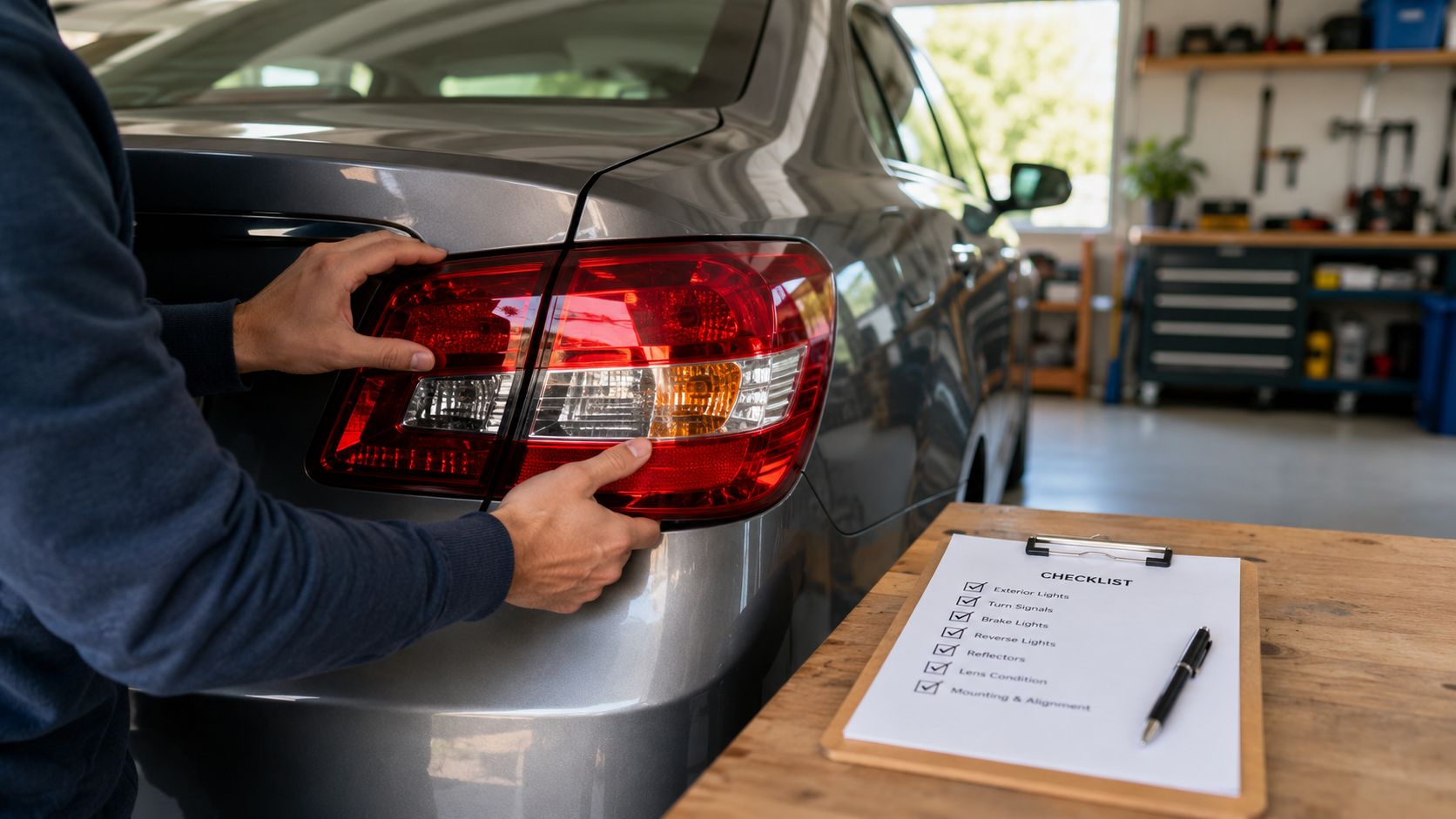
A good pre-check is basic, but it works. If you're methodical for ten minutes at home, you can avoid paying for a professional inspection only to fail on something simple.
A simple check you can do at home
Use this quick sequence:
- Walk around the car with the lights on. Check headlights, tail lights, turn signals, and brake lights. If possible, have another person step on the brake pedal while you watch.
- Look at every visible lens. Cracks, heavy discoloration, moisture inside the housing, or a loose lamp assembly deserve attention.
- Check the brake fluid reservoir. You're not diagnosing the whole hydraulic system here. You're looking for an obviously low level or signs that something isn't right.
- Pay attention to pedal feel. A brake pedal that feels unusually soft, sinks, or behaves inconsistently should be inspected before your VSSI appointment.
- Notice how the car behaves when stopping. Pulling to one side, shuddering, or unusually weak braking is not something to “see if it passes.”
For more practical prep habits before an inspection appointment, these essential vehicle inspection tips for every driver are worth reviewing.
When to fix it before booking
Some problems are easy yes-or-no items. Burned-out bulb. Broken lens. Brake light out. Handle those before you book.
Other problems need a shop first:
- Soft pedal feel
- Visible fluid leak
- Brake warning light concerns
- Uneven stopping
- Recent salvage repair with unfinished electrical work
This walkthrough can also help you think through common inspection-ready checks before your visit:
Don't use the official inspection as your diagnostic appointment. Use it as your certification appointment.
That mindset saves both money and frustration.
What to Expect at an Oakland Inspection Station
The biggest surprise for many drivers is cost. A California Vehicle Safety Systems Inspection in Oakland typically ranges between $250 and $300, and it's separate from a smog check, according to this discussion of California VSSI pricing in the Oakland market. It usually costs more than a standard emissions test because the inspection requires specialized certification.
That doesn't mean every station feels the same to deal with. Some are organized and clear about paperwork. Others are vague on what they provide. Before you drive over, confirm that the station performs the current VSSI required for your DMV situation.
Cost and paperwork
Bring more paperwork than you think you'll need. The exact documents can vary by vehicle history, but drivers usually save themselves trouble by bringing ownership-related paperwork, DMV forms, and records tied to the repairs or rebuild.
Here's a practical snapshot:
| Item | Typical Expectation |
|---|---|
| Inspection type requested | Ask for Vehicle Safety Systems Inspection (VSSI) |
| Price expectation | $250 to $300 in Oakland for VSSI |
| Smog included | No, it's a separate requirement |
| Technician qualification | The station should have properly certified personnel |
| Documents to bring | DMV paperwork, ownership documents, and repair-related records |
| Best phone question | Confirm they perform VSSI for revived salvage or rebuilt vehicles |
How the appointment usually feels
At the counter, the useful conversation is straightforward. What vehicle is it, what's the title status, what paperwork do you have, and what inspection are you requesting. If the staff has to “figure out what you mean” after you say brake and lamp, slow down and confirm they can issue the right certificate.
A smooth appointment usually comes from doing three things first:
- Use the current term. Say VSSI, even if your paperwork says brake and lamp.
- Show up organized. Loose forms and missing receipts create delays.
- Fix obvious defects first. Inspection stations certify condition. They don't erase problems.
Finding a Certified VSSI Station in the East Bay
Many drivers often lose time at this point. Not every general repair shop, smog station, or quick-service garage is authorized and prepared to handle this kind of inspection correctly.
If you're shopping only on price, you can end up with a station that isn't the right fit for a rebuilt vehicle, especially if the car is older or has more complicated systems. That's a poor place to save money.
Not every shop can do this inspection
The right question isn't just “How much do you charge?” Ask these instead:
- Do you perform VSSI for revived salvage vehicles?
- Do you have the proper certified personnel for this inspection?
- What documents should I bring for my specific registration situation?
Those questions tell you very quickly whether the station does this work regularly or whether you're about to become their practice run.
If you're also comparing East Bay stations for regulated vehicle testing more broadly, this STAR-certified emissions testing station overview helps show what a compliance-focused shop looks like.
Why certification matters more on difficult vehicles
For older, diesel, or hybrid vehicles, thoroughness matters more than bargain advertising. Data from 2025 indicates that STAR-certified stations detect 40% more latent defects in advanced braking systems than non-certified shops, according to this report on brake and lamp inspection value and certification differences.
That doesn't mean every non-certified shop does poor work. It does mean certification is a meaningful signal when you're dealing with a vehicle that already has higher risk, more complex systems, or a rebuilt history.
Cheap is only cheap if you pass once, register cleanly, and don't uncover missed problems later.
For a brake and light inspection in Oakland, the smart move is to choose a station that understands the paperwork, the terminology, and the inspection standard well enough to get it right the first time.
Conclusion Pass Your Inspection with Confidence
The hardest part of this process is usually the confusion before the appointment, not the inspection itself. Once you know the official name, the purpose, and the common failure points, the path gets much simpler.
Keep the essentials straight. Ask for a Vehicle Safety Systems Inspection if your vehicle falls into the revived salvage or rebuilt category. Do a quick home check before you book. Bring organized paperwork. Choose a properly qualified station instead of chasing the lowest number you hear over the phone.
That approach saves headaches because it matches how the DMV process works. It also protects you from the two most common problems. Booking the wrong service and showing up with a vehicle that still has obvious defects.
A brake and light inspection in Oakland can feel like one more bureaucratic hurdle. In practice, it's the final confirmation that a repaired vehicle can return to the road safely and legally. If you treat it that way, you'll walk into the appointment far more prepared than most drivers.
If you need a compliance-focused East Bay shop, Speedy Smog is a practical place to start. As a STAR Certified station in San Leandro, it's known for fast, friendly testing and clear communication, which is exactly what drivers want when DMV requirements already feel complicated.
Your DMV renewal notice is sitting on the counter. You know a smog check is next. Then someone tells you, “Get an oil change first.” Someone else says that's old advice and doesn't matter anymore.
Both can be right.
The answer depends on what kind of smog test your vehicle gets. For some older cars, an oil change before a smog check can help. For many 2000 and newer vehicles in California, it usually won't change the outcome much at all. What matters more is whether the car's computer is ready, whether the Check Engine Light is off, and whether you drove it properly before the test.
If you want a quick refresher on how California testing works, this simple guide to how a smog check works lays out the basics in plain English. For East Bay drivers, that distinction matters because wasting money on the wrong prep is common, especially when registration deadlines are close.
Table of Contents
- Do I Really Need an Oil Change Before My Smog Check
- When an Oil Change Is Your Secret Weapon
- The Modern Car Myth Why Oil Changes Rarely Matter Now
- Your Complete Pre-Smog Checklist to Pass the First Time
- Expert Tips for Passing at Speedy Smog in San Leandro
- Frequently Asked Smog Check Questions
Do I Really Need an Oil Change Before My Smog Check
You pull into the station with a 2012 Camry, fresh oil sticker on the windshield, and the check engine light turned off last week. Then the car fails because the monitors are not ready. We see that all the time in the East Bay.
The short answer is no, not for every car.
A lot of the old advice came from an earlier smog world, where tailpipe numbers played a bigger role and a worn engine could sometimes benefit from clean oil right before the test. On many 2000 and newer vehicles, the test is far more about what the car's computer reports. If the OBD-II system shows a stored fault, a recent battery disconnect, or incomplete readiness monitors, fresh oil will not fix that. If you want a quick overview of how that process works, our guide to how a California smog check works for modern vehicles lays it out clearly.
That is why drivers get mixed advice. One customer with an older, high-mileage car may see lower emissions after basic maintenance. Another with a newer Honda or Toyota spends money on an oil change and still fails for an EVAP monitor, catalyst issue, or hidden code.
Bottom line: An oil change can help in specific cases, but it is not the reason most modern cars pass.
California smog rules cover a wide range of vehicles, and the test method is not the same across all of them. The California Bureau of Automotive Repair Smog Check Program explains the program scope and inspection framework. For local drivers, the practical takeaway is simple. If the oil is overdue on an older vehicle, changing it is reasonable maintenance and may help at the margins. If your car is 2000 or newer, put your attention on check engine lights, readiness monitors, recent repairs, and whether the car has been driven enough since the battery was disconnected.
When an Oil Change Is Your Secret Weapon
For the right car, this advice still holds up.
Older vehicles, especially ones that are a little worn and still get a tailpipe-oriented emissions evaluation, can benefit from an oil change before a smog check. Old oil doesn't just lubricate less effectively. It also collects combustion byproducts and unburned fuel. It's akin to a sponge that's already soaked up everything it can hold. Once it's saturated, it stops helping and starts contributing to the mess.
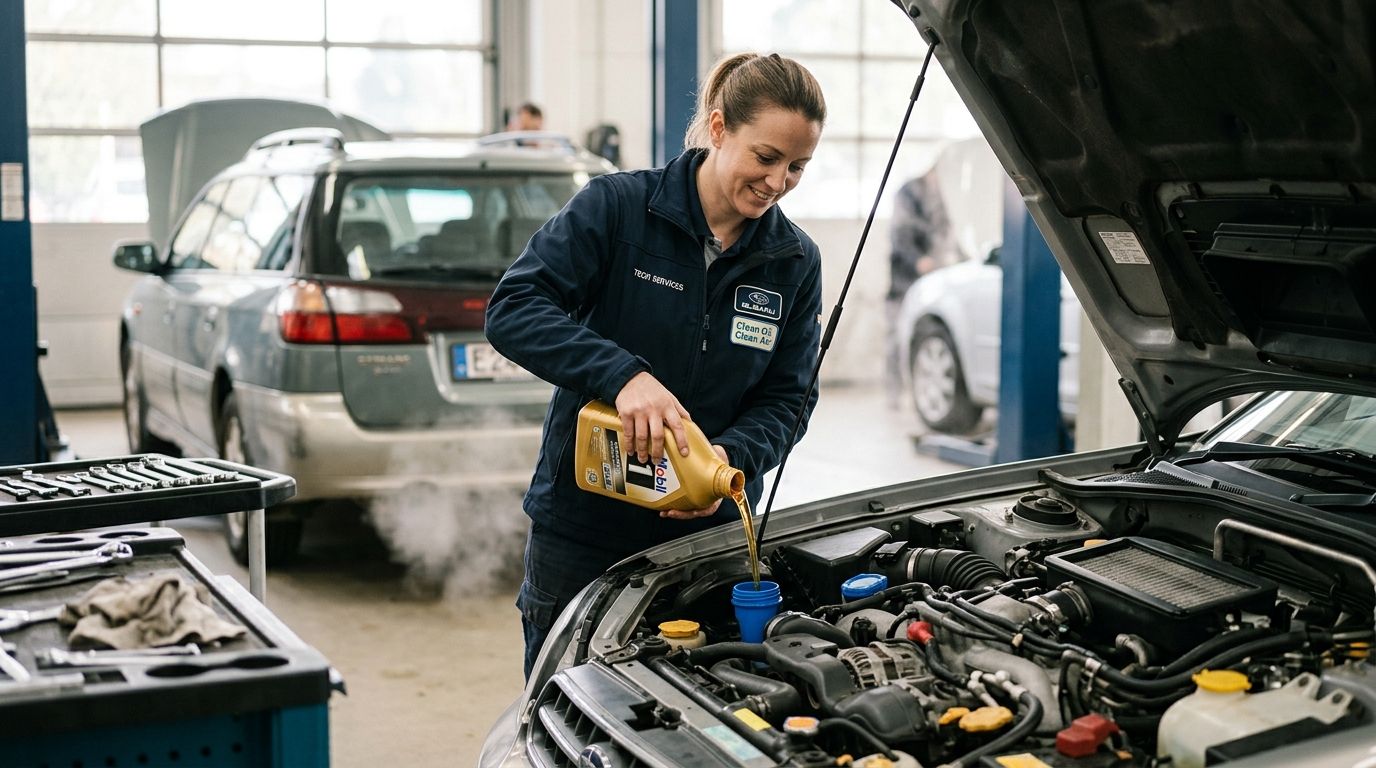
Why dirty oil can raise emissions
The key pollutant here is hydrocarbons, or HC. According to a discussion cited by Car Talk, fresh oil can create a better seal between piston rings and cylinder walls and may lower HC output by about 10 to 15% in marginal engines, with results varying from 5% to 30% depending on engine age and contamination in this oil change and HC explanation.
That fits what technicians see in the bay. Dirty oil can feed extra fumes into the PCV system, and those fumes get burned in the engine. If the oil is badly contaminated, that can push HC emissions higher than you want right before a test.
Road Runner Auto Repair also notes that if oil hasn't been changed for the last 5,000 miles, poor oil quality can contribute to smog trouble for California vehicles, especially when that old oil is loaded with pollutants and unburned fuel in this article on passing a California smog check with a 2000 or newer car.
Who should actually do it
In this situation, the advice needs to be selective, not automatic.
- Older vehicle owners: If you drive a pre-2000 car, or a vehicle with higher mileage that tends to run dirtier, an oil change before a smog check can be a smart move.
- Overdue maintenance cases: If the oil is clearly overdue, don't overthink it. Fresh oil helps the engine operate cleaner.
- Borderline emitters: If the car has failed before on hydrocarbon numbers, this is one of the lower-cost maintenance steps worth doing.
If you're trying to narrow down the likely cause of a failed inspection, this page on common smog check fail reasons is useful because it puts oil in context with the other usual culprits.
Fresh oil can help an older car that's close to the line. It won't fix a bad sensor, a missing catalyst, or a fault code.
The Modern Car Myth Why Oil Changes Rarely Matter Now
For most East Bay drivers in newer cars, this is the part that saves time and money.
A lot of people still treat smog prep like it's 1998. They hear “dirty oil raises emissions” and assume that means every car needs an oil change before test day. That's not how most modern California smog checks work.

What the computer is checking
For 2000 and newer vehicles, the important issue is usually the car's onboard diagnostics. A widely shared technician discussion makes the core point clearly: the belief that an oil change is a guaranteed pass fix is a misconception because modern OBD smog checks for 2000+ vehicles focus on system readiness, not tailpipe hydrocarbons, as described in this post about the difference between OBD checks and older testing.
That means the machine is looking for things like:
| What matters on a modern test | Why it matters |
|---|---|
| Check Engine Light status | If the system sees an emissions fault, that's a problem immediately |
| Readiness monitors | The car has to show it completed its self-checks |
| Stored or recent fault history | Clearing codes right before the test often backfires |
It does not mean fresh oil is useless maintenance. It means fresh oil usually isn't the deciding factor on pass or fail for a modern car whose smog result depends on computer status.
Where people waste money
The expensive mistake is doing maintenance that doesn't address the underlying issue.
If your 2012 Camry, 2016 Accord, or 2021 RAV4 has a Check Engine Light on, an oil change won't solve the reason the computer is unhappy. If you disconnected the battery, recently cleared codes, or had work done and then drove straight to the station, the car may not be ready even though it runs fine.
The modern smog check is mostly a conversation with your car's computer. If that computer says “not ready,” clean oil won't change the answer.
This is also why blanket advice from older drivers can steer newer-car owners wrong. The old logic was based on reducing tailpipe pollutants directly. The newer logic is based on proving that the vehicle's emissions systems have run their tests and passed them internally.
For a modern car, spend your attention on readiness, fault codes, and proper warm-up. Treat the oil change as maintenance, not magic.
Your Complete Pre-Smog Checklist to Pass the First Time
You pull in for a smog, the car seems fine, and then it fails for something that started days earlier. That is the pattern I see more than anything in the East Bay. The miss usually is not dirty oil. It is poor timing, incomplete monitors, or a simple issue nobody checked before the appointment.

Start with the fastest pass or fail item
If the Check Engine Light is on, stop there and sort that out first. Clearing codes right before the test can make things worse because the car may show up with incomplete readiness monitors.
A practical prep guide from Jiffy Lube notes that California BAR requires driving 100 to 200 miles after battery replacement or major maintenance to reset readiness monitors, and it also says 30% of smog failures for 2002+ vehicles are due to incomplete monitor readiness in this piece on passing emissions tests.
That catches a lot of drivers. They handle a repair, swap a battery, or disconnect power in the driveway, then head straight to the station. On older tailpipe-test advice, that might sound fine. On a modern OBD-II test, it can set you up for a fail even if the car feels normal.
Shop rule: If the battery was disconnected or codes were cleared recently, give the car time to complete its drive cycle before testing.
If you want a quick last-minute review, this California smog checklist covers the common items to check before you head out.
Drive it long enough to be fully warmed up
Show up with the engine at full operating temperature. A cold start and a five-minute errand run are not ideal prep.
For many cars, a solid mixed drive does more good than any last-minute maintenance. Highway time helps the engine and emissions system settle into normal operation, and it gives monitors a better chance to complete if they are close. That matters far more on most 2000+ vehicles than changing oil the night before.
A quick video can also help if you want a visual refresher before heading out:
Simple checks people skip
These are basic, but they save trips back to the station.
- Check the gas cap. Make sure it is tight and not cracked or obviously worn.
- Look under the hood. Loose hoses, unplugged sensors, and obvious vacuum line issues are worth catching before the test.
- Check fluid and maintenance basics. If the oil is badly overdue, change it. If it was changed recently, do not expect that alone to fix a smog problem.
- Inspect the air filter if drivability has felt off. A badly clogged filter can contribute to poor running.
- Do not wait until the registration deadline. If the car needs more driving or diagnosis, a little margin saves a lot of stress.
The practical trade-off is simple. Spend money on maintenance the car needs. Do not spend it on rituals that do not address why a modern smog test fails.
Expert Tips for Passing at Speedy Smog in San Leandro
You pull in on a lunch break, registration notice in hand, and the first question is simple. Will this test go through cleanly, or are you about to lose an hour over something avoidable?
Around San Leandro, the smoothest smog visit usually comes down to two things. Go to the right kind of station for your vehicle, and tell the technician anything that could affect readiness or the inspection result.
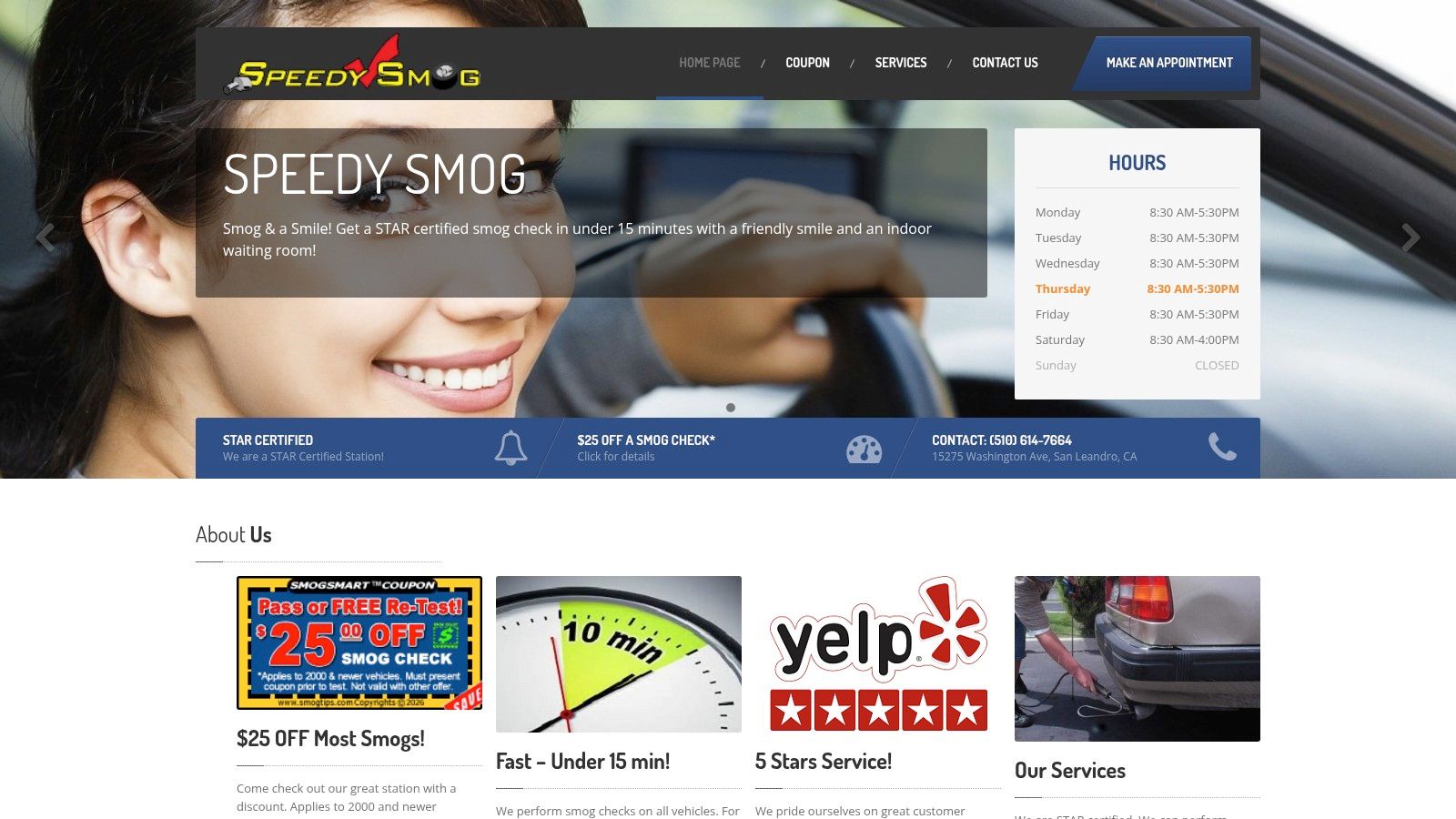
Why a STAR station matters
Some vehicles must be tested at a STAR Certified station. If your registration notice says STAR, follow it. Otherwise, you can end up paying for time and still need to redo the inspection at the proper station.
That catches East Bay drivers all the time. They focus on the car, which makes sense, but the station requirement matters too. Getting that part right is one of the easiest ways to avoid a repeat trip.
What to tell the technician when you arrive
A good check-in saves headaches. Before the test starts, mention anything that changes how ready the car is for inspection.
- Say if the battery was disconnected recently. That often means monitors may not be set yet.
- Mention recent repairs or maintenance. Catalyst work, EVAP repairs, sensor replacement, and battery service can all matter.
- Bring up a recent failed test. The last report gives useful clues fast.
- Be honest about warning lights. Even if the light turned off, the history can still matter.
For many 2000 and newer vehicles, the process is pretty quick when the car is ready. That is the main advantage for modern OBD-II smog checks. If the computer status is right and there are no emissions-related faults, the visit is usually straightforward. If the monitors are incomplete or a code is lurking, an oil change coupon will not save the test.
If you are not sure whether your car is ready, say so before the test starts. A good technician would rather hear that upfront than after a preventable fail.
Frequently Asked Smog Check Questions
Does this apply to hybrids and diesels
Yes, but the test procedure depends on the vehicle.
California smog rules cover gasoline cars and hybrids model year 1976 and newer, plus diesel vehicles model year 1998 and newer. The advice in this article fits hybrids pretty well because many of them still go through the same modern computer-based readiness check. Diesels are different enough that it helps to confirm the station handles diesel inspections before you make the trip.
That matters in the East Bay. A hybrid owner with a 2008 Prius usually does not need to treat an oil change like a last-minute smog strategy. A diesel owner may be dealing with a different inspection process altogether.
What if I fail
Start with the failure report. It usually points you in the right direction fast.
A readiness failure often means the car is not done with its drive cycle yet. A fault-code failure means something in the emissions system still needs diagnosis and repair. On older vehicles that still struggle with tailpipe numbers, routine maintenance, including an oil change, can help if it lines up with the reason the car is running dirty.
Guessing gets expensive. One repair aimed at the wrong problem can cost more than the smog check itself.
Should I get a pre-test mindset before I show up
Yes. That saves a lot of repeat visits.
Ask yourself three questions:
- Is the Check Engine Light off?
- Has the car been driven enough after any recent battery disconnect or repair?
- Am I arriving with the engine fully warmed up?
For 2000 and newer vehicles, that short checklist matters more than fresh oil in most cases. Modern smog inspections usually come down to what the car's computer sees: stored faults, pending problems, and whether the monitors are set. If you drive an older car that is overdue for service, an oil change may still be worth doing. If you drive a newer car with an unset monitor or an emissions code, oil is usually not the issue.
Can fresh oil help me pass
Sometimes.
I have seen it help on older, poorly maintained cars that were close to the line on emissions output. Dirty oil can contribute to higher hydrocarbons if the engine is already worn or burning oil. On a newer OBD-II car, though, the computer check is the bigger gatekeeper. If the monitors are incomplete or the Check Engine Light is on, an oil change will not fix the reason for the failure.
Should I clear codes right before the test
No. That usually creates a different problem.
Clearing codes often resets the readiness monitors to "not ready." Then the vehicle shows up for smog before it has completed the required drive cycle, and it fails for that reason instead. Fix the cause first, then drive the car enough for the monitors to reset properly.
Most Alameda drivers do need a smog check, but for many cars it's a quick 10 to 15 minute stop and the usual local price runs about $39 to $70 before coupons. If you're holding a DMV renewal notice right now, the good news is this is usually a simple errand, not an all-day project.
That moment is familiar. You open the renewal notice, spot the smog requirement, and immediately wonder three things: Do I really need it, how long will it take, and how do I avoid paying twice because something small went wrong? Around Alameda and the East Bay, those are the questions that matter most.
The practical answer is that an Alameda smog check is straightforward once you know the few details that affect your visit. The biggest time-wasters usually aren't the inspection itself. They're showing up at the wrong type of station, coming in too soon after a battery disconnect, or not realizing your DMV notice calls for a STAR station.
This guide is written the way a technician would explain it across the counter. Clear rules, no jargon, and actual trade-offs that help you save time and money.
Table of Contents
- Your Fast Pass to an Alameda Smog Check
- Smog Check Requirements for Alameda Drivers
- Understanding STAR Certified Smog Stations
- What to Expect During Your 15-Minute Smog Test
- How to Avoid a Failed Smog Check
- Choosing a Fast and Affordable Smog Station
Your Fast Pass to an Alameda Smog Check
You open the renewal notice after work, glance at the deadline, and assume half your day is gone. In Alameda, it usually does not work that way. At a busy local shop like Speedy Smog, a straightforward test on a newer, healthy vehicle is often a quick stop if you arrive prepared.
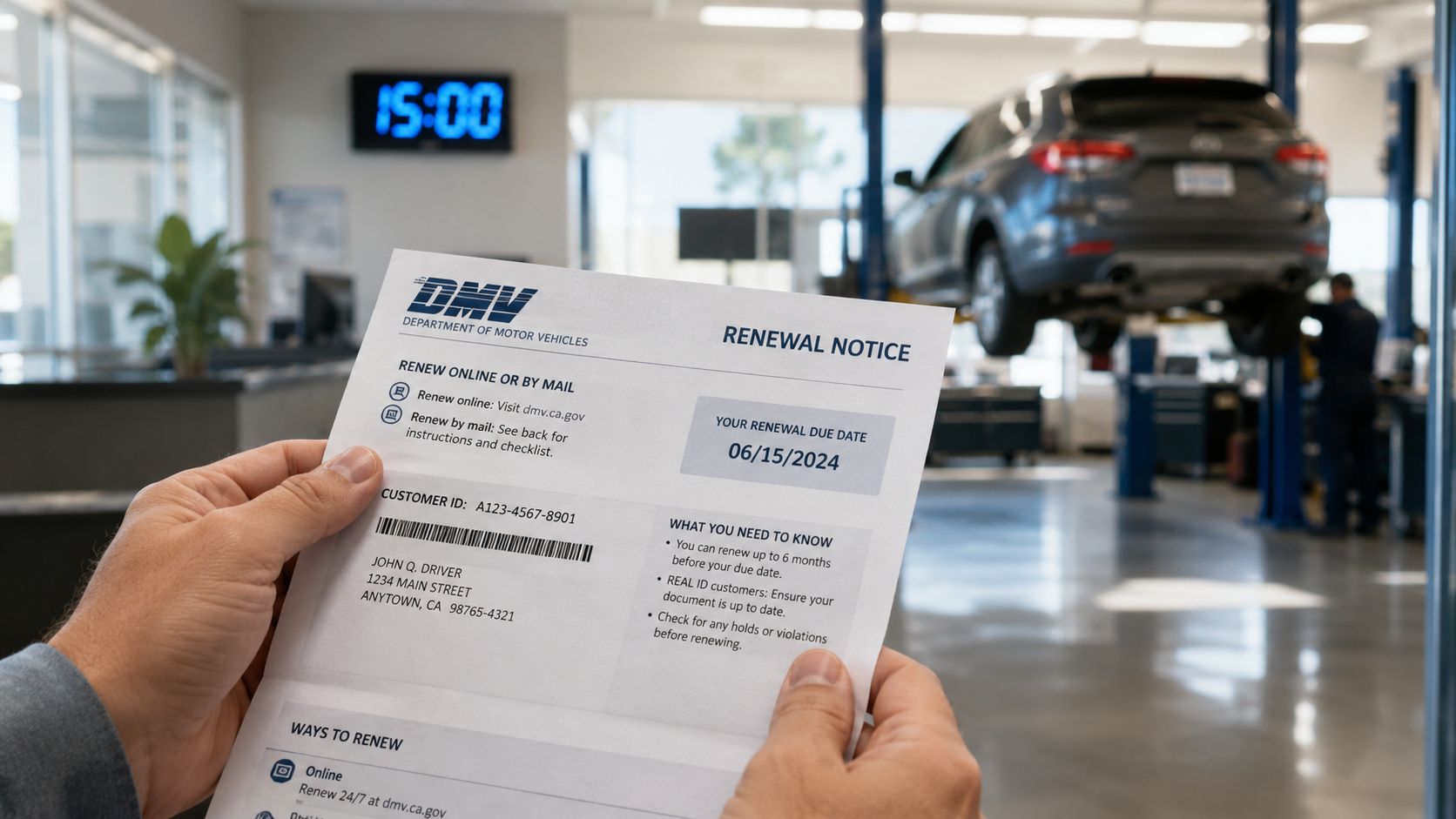
The inspection itself is rarely the part that slows people down. What causes delays is coming in with the wrong station type, a cold engine, missing paperwork, or a car that recently had the battery disconnected. Around Alameda, Oakland, and San Leandro, I see the same pattern all the time. Drivers expect the test to be complicated, but the expensive mistakes usually happen before the car even reaches the bay.
A smoother visit starts with a little prep. Drive the car normally before you come in so it is fully warmed up. Bring your registration or DMV notice. Check whether the notice calls for a standard test or a STAR station, because showing up at the wrong place wastes more time than the inspection ever will.
Practical rule: If your car is running well and no warning lights are on, your best time-saver is simple preparation before you arrive.
The local advantage matters here. A station that knows Alameda traffic patterns, DMV timing, and the common failure points on East Bay commuter cars can usually spot problems early and keep a routine smog check from turning into a second trip.
Smog Check Requirements for Alameda Drivers
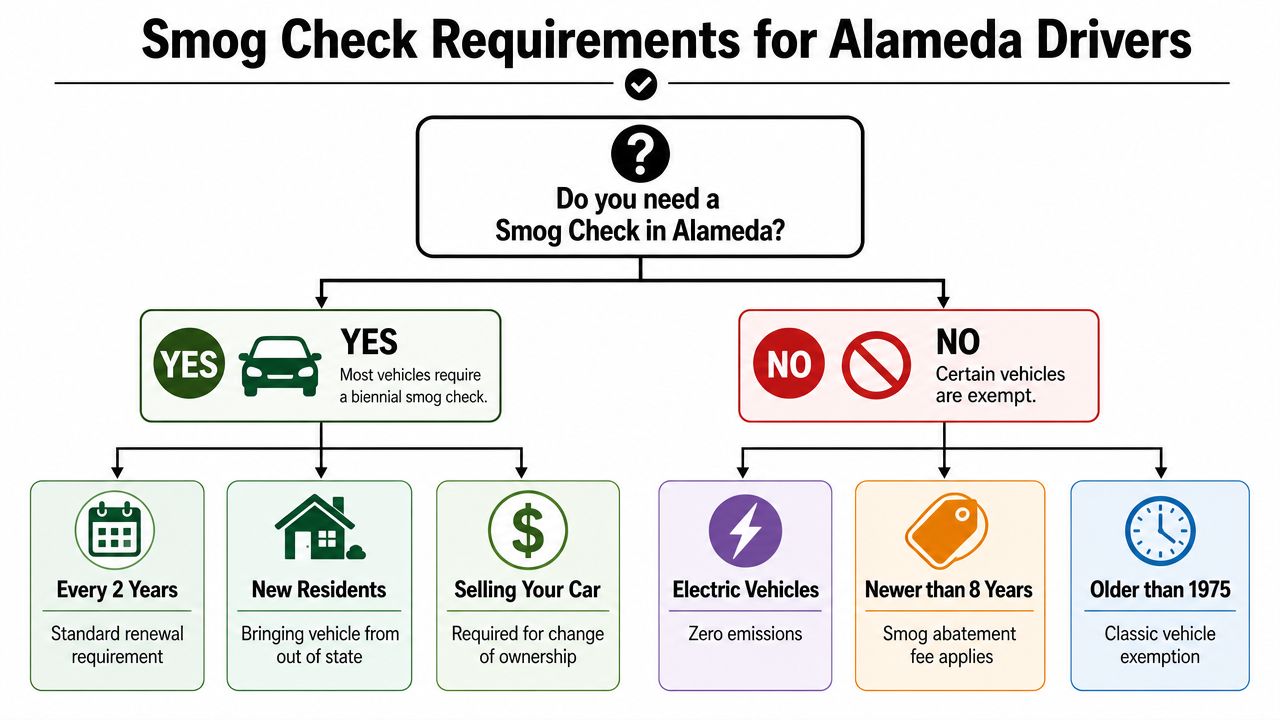
If you're trying to figure out whether you need an Alameda smog check, start with the basic rule. In Alameda County, the California Smog Check Program requires biennial emissions testing for vehicles manufactured in 1976 or later according to the California Smog Check Program overview.
That same program description notes two points many drivers overlook. First, the program removes about 400 tons of smog-forming pollutants from California's air daily. Second, if your renewal requires a test, you must complete it within 90 days of receiving your DMV registration renewal notice.
Who usually needs a test
Most gasoline vehicles from 1976 and newer fall into the program in Alameda County. Hybrid vehicles were added to these requirements starting in April 2015, which caught some owners off guard when that change took effect.
If your renewal notice says a smog certificate is required, assume the clock is running. Waiting until the last minute is where people create their own headaches, especially if the car has a check engine light issue or readiness monitor problem that needs time to resolve.
Who's exempt
Several vehicle types are exempt from the testing requirement listed above:
- Electric vehicles are exempt.
- Trailers are exempt.
- Motorcycles are exempt.
- Gasoline-powered vehicles from 1975 or older are exempt.
- Diesel-powered vehicles manufactured before 1998 are exempt.
Even when a vehicle is exempt from testing, owners still need to keep emissions equipment intact.
The cleanest visit is the one where you confirm your status before you leave home. A two-minute check beats a wasted trip every time.
What the renewal notice really means
A DMV renewal notice isn't just a reminder. It's the instruction that tells you whether your registration can move forward. If your vehicle is flagged for testing and you don't complete the requirement, registration renewal can be blocked.
That's why I always tell neighbors not to treat the notice like junk mail. Read the line that mentions smog certification, then match that requirement to your vehicle type and model year. Once you know that, the rest gets much easier.
Understanding STAR Certified Smog Stations
“STAR Certified” is one of the most confusing phrases on a DMV notice because drivers assume any smog shop can handle any car. That isn't always true.
A STAR Certified station meets a higher performance standard set by the Bureau of Automotive Repair, and that matters because some vehicles are specifically directed to STAR stations. If your notice says STAR, don't improvise. Go to a STAR station.
The reason this has become more important is the expanded High Emitter program. According to this explanation of STAR-only inspection issues and recent BAR data, CARB has expanded the program for specific model years, and 15 to 20% of failed inspections in 2025-2026 were tied to stations attempting to test vehicles that were flagged for STAR-only inspection.
Why drivers get tripped up
The mistake usually looks harmless. A driver picks the closest shop, assumes a smog check is a smog check, and only finds out afterward that the vehicle should have been inspected at a STAR station. That can cost time, another trip, and extra frustration.
If your DMV paperwork mentions STAR, that's the instruction to follow. If you're not sure what that label means, this short guide on what a smog STAR station is gives a simple breakdown.
The practical trade-off
A regular station may seem more convenient if it's nearby. But convenience disappears fast if the inspection doesn't match the vehicle's requirement. For a lot of East Bay drivers, the smartest move is checking the notice first and choosing the right station once, rather than chasing the fastest option and sorting it out later.
If your notice says STAR, the cheapest visit is the one done correctly the first time.
What to Expect During Your 15-Minute Smog Test
You pull up on a lunch break, hand over your registration, and want one answer. How long is this going to take?
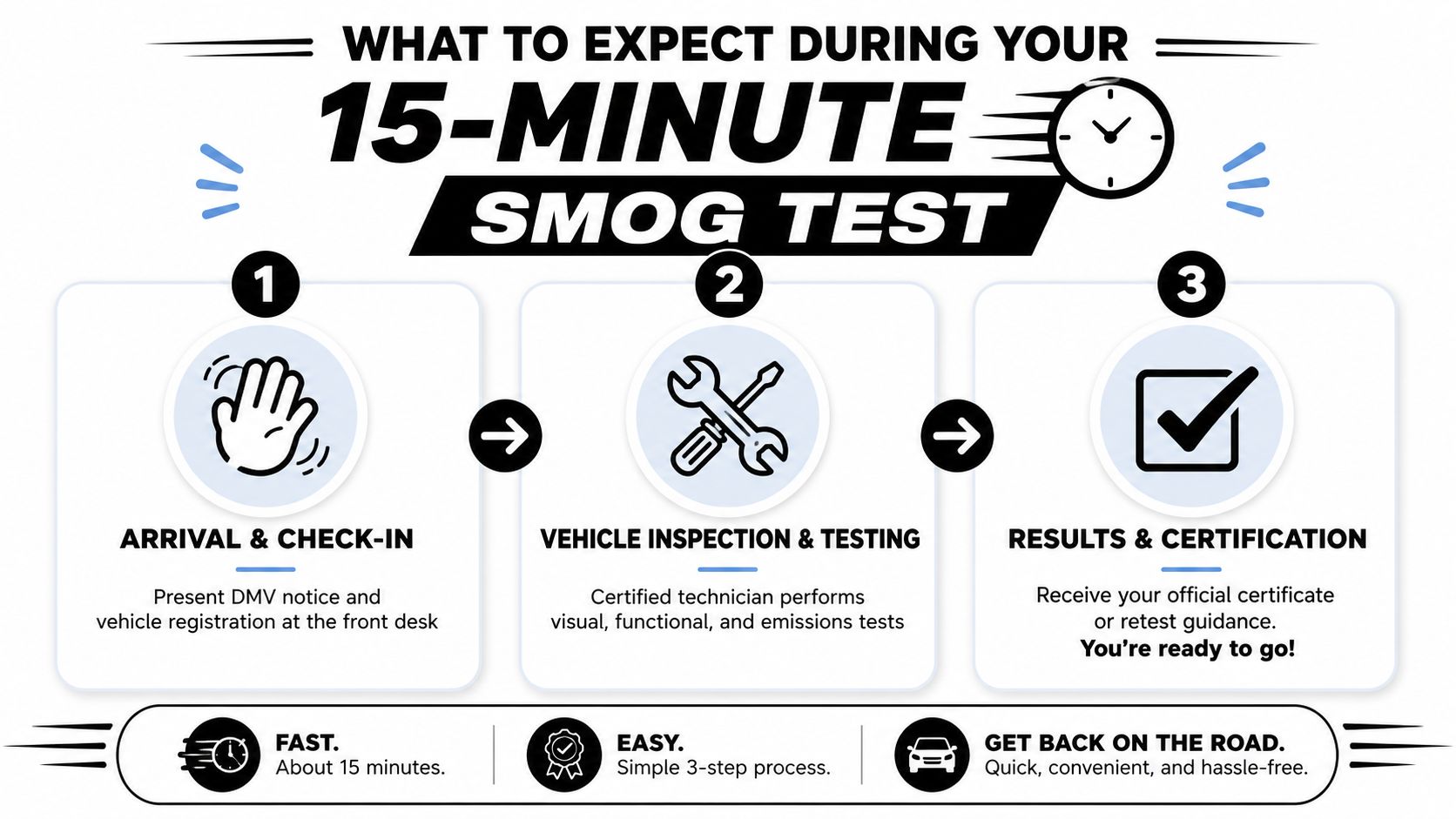
For most 2000-and-newer vehicles in Alameda, the visit is quick if the car is already test-ready. At Speedy Smog, the process is usually simple: verify the vehicle, run the required inspection steps, transmit the result, and get you back on the road. If you want a little more detail before you head in, this guide on how long a smog check takes lays out the timing.
Before you pull in
Bring your DMV renewal notice or current registration if you have it handy. That helps the technician match the car to the right record and avoid small check-in delays.
One practical tip locals appreciate: don't bring the car in cold after it has been parked for days if you can avoid it. A vehicle that has been driven normally is less likely to surprise you with monitor or battery-reset problems. In the East Bay, that simple choice saves people a lot of repeat trips.
During the inspection
The test itself is routine. The technician confirms the VIN and vehicle details, performs the required visual and functional checks, and connects to the onboard diagnostic system for vehicles that use OBD-based testing.
From the customer side, there usually is not much to watch. You check in, the car goes into the bay, and the technician works through the required steps in order. If there is no check engine light issue and the onboard monitors are ready, the appointment often feels uneventful, which is exactly what you want.
This short video gives a helpful visual sense of the process from a customer's point of view.
After the test
If your car passes, the result is usually sent electronically to the DMV. In most cases, you do not need to carry paperwork back and forth.
If it does not pass, the next step depends on the reason. Some failures point to an active repair problem. Others come from timing issues, especially after a battery replacement or a loss of power that reset the system. That is one of the most common trade-offs I explain to East Bay drivers. The fastest appointment is the one you only have to do once.
A smog check should feel straightforward. When you show up with the right paperwork and a car that has been driven normally, it usually is.
How to Avoid a Failed Smog Check
Most preventable failures happen before the car ever enters the bay. That's why a little preparation pays off.
The big one in Alameda is not always what drivers expect. It's not just the check engine light. It's the car that had battery power interrupted, then got tested too soon.
The battery disconnect problem
When a battery is disconnected or power is lost, the vehicle's readiness monitors can reset. According to the BAR smog check guidance, a disconnected battery can require 1 to 2 week of driving to reset monitors, and testing too soon can lead to a failure that triggers a re-test fee.
That's one of the most frustrating smog problems because the car may feel perfectly fine. It starts, runs, and drives normally. But the onboard system still isn't ready for inspection.
Don't rush in for a test right after a battery replacement, jump-start problem, or any repair that interrupted power. Give the car time to complete normal driving cycles.
That trade-off is worth thinking about. A quick appointment sounds efficient, but it isn't efficient if it becomes two appointments.
If you want a broader look at common causes, this page on why vehicles fail smog checks covers the usual trouble spots drivers run into.
Your pre-smog routine
Before any Alameda smog check, I'd keep the prep simple and practical:
- Drive the car normally first: If there was a recent battery disconnect, don't assume the system is ready.
- Watch the check engine light: If it's on, deal with that issue before testing.
- Bring the right paperwork: The station can process the visit more smoothly when your vehicle information is easy to verify.
- Choose the correct station type: If your notice says STAR, go to a STAR station.
- Don't wait until the deadline: A little time cushion helps if the car needs follow-up.
Here's a quick checklist you can use.
| Check Item | Action Required | Why It Matters |
|---|---|---|
| Check engine light | Address the cause before the test | An active warning light can lead to a failed inspection |
| Battery recently disconnected | Drive the vehicle for 1 to 2 week before testing | Readiness monitors may not be set yet |
| DMV notice | Read whether a smog certificate is required and whether STAR is listed | It tells you what type of station you need |
| Registration paperwork | Bring it with you if available | It speeds up check-in and reduces confusion |
| Timing | Don't wait until the last part of your renewal window | You leave room for fixes if something comes up |
A lot of drivers spend more money fixing the consequences of bad timing than they would have spent preparing first.
Choosing a Fast and Affordable Smog Station
You have your renewal notice, you carved out part of your lunch break, and now the main question is simple. Which station gets you in and out without surprise costs or a wasted trip?
Around Alameda and the East Bay, the cheapest posted price is not always the best value. I've seen drivers lose more time by picking the nearest shop without checking whether it handles their vehicle, whether STAR is required, or how the station manages wait times. A low coupon does not help if you show up at the wrong place and have to start over somewhere else.
A good station choice usually comes down to four practical checks:
- Match the station to your DMV notice: If your notice says STAR, use a STAR station.
- Make sure they test your vehicle type: Some shops handle newer gasoline cars quickly but are limited with diesels, hybrids, or older models.
- Ask for the full price before you go: Confirm the test fee, certificate cost if applicable, and whether a coupon applies to your vehicle.
- Ask how the visit works: Walk-ins can be fast at a well-run shop, but a busy station with poor flow can turn a short test into a long wait.
Air quality is one reason California keeps the program strict, especially in dense parts of the East Bay. That is why I tell drivers to focus less on flashy ads and more on whether a station is organized, licensed for the job you need, and honest about pricing.
Here's a look at the kind of station setup many drivers prefer when they want speed and convenience.
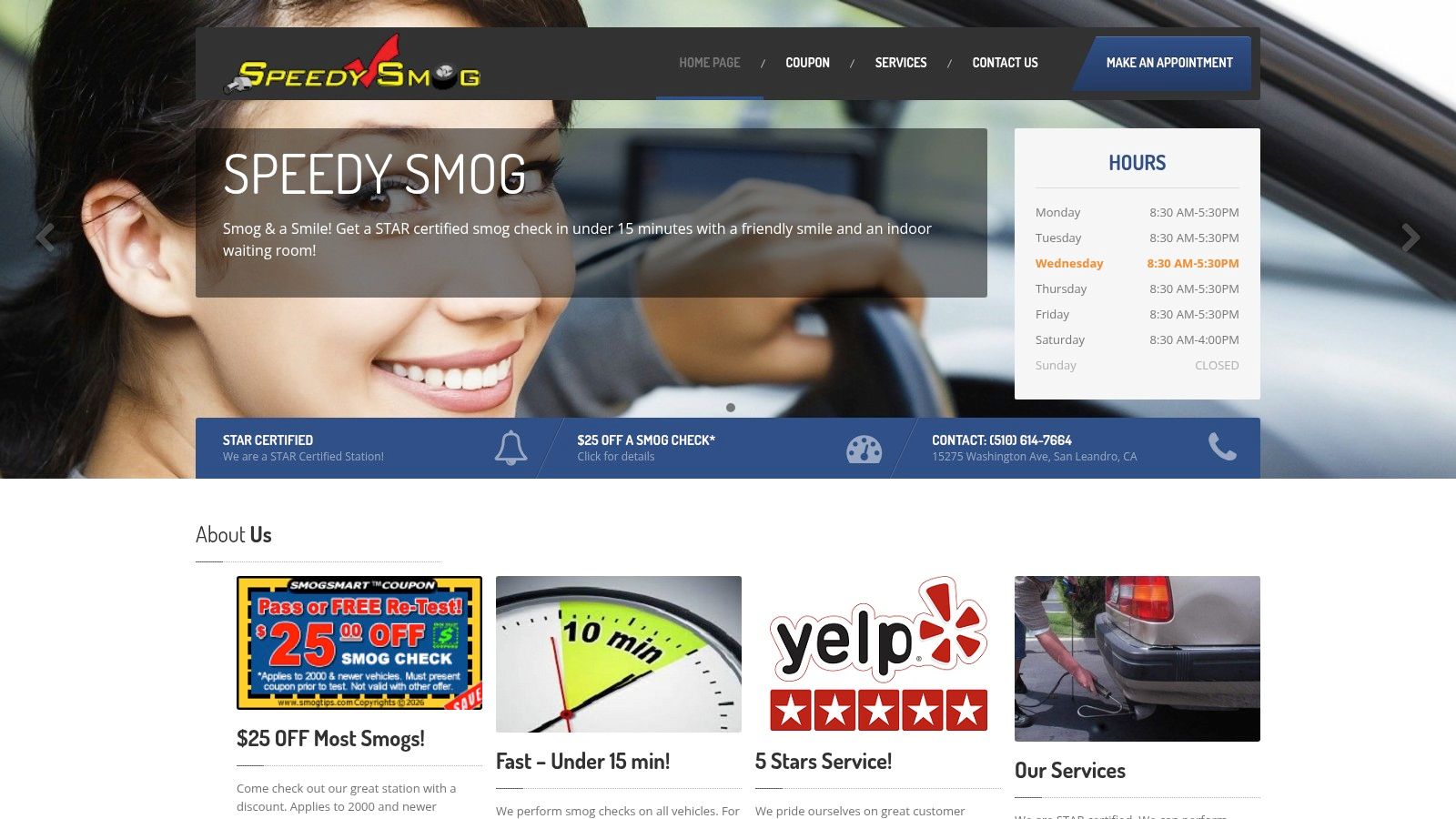
For many Alameda drivers, the best fit is a STAR Certified shop that posts clear pricing, moves cars through efficiently, and has a decent waiting area. That combination usually saves more hassle than chasing the absolute lowest advertised number.
If you need a nearby STAR station, Speedy Smog in San Leandro is built for exactly this kind of visit. They're located at 15275 Washington Ave, San Leandro, CA 94579, open Monday through Saturday, and handle most vehicles including 2000 and newer models, older vehicles, diesels, and hybrids. Typical tests for newer vehicles take about 10 to 15 minutes, and they offer a clean indoor waiting area, straightforward service, and periodic $25-off coupons for most smogs on newer vehicles. Check their website before you go so you can grab the current offer and keep your Alameda smog check quick and affordable.
You open your registration notice, skim past the usual DMV language, and then see the line that makes a lot of California drivers stop cold: Smog Certification Required at a STAR Station.
If you're new to this, that wording feels more confusing than helpful. You might be wondering if your car has a problem, whether a regular smog shop can still help, or why the state suddenly cares which station you use.
The good news is that this is manageable once the jargon gets translated into normal language. A STAR station is a smog shop that meets a higher BAR standard for certain vehicles. What matters to you is knowing whether your car needs one, what the visit will look like, what you'll pay for, and how to avoid wasting a trip.
Table of Contents
- That DMV Notice Just Arrived What Now
- What Is a STAR Certified Smog Station
- STAR Station vs Regular Smog Check What Is Different
- Do You Need a STAR Smog Check in 2026
- The Process at a STAR Station Time Price and Tips
- Your Local STAR Station Speedy Smog in San Leandro
- How to Prepare Your Vehicle for a Smog Check
- STAR Smog Checks and the DMV Your Questions Answered
That DMV Notice Just Arrived What Now
Start with the exact wording on your notice. If it says your vehicle needs a STAR station, follow that instruction exactly. A regular smog station may not be able to complete the certification the DMV wants for that vehicle.
This doesn't automatically mean your car is failing or that something is seriously wrong. California sends some vehicles to STAR stations because the state wants a more closely controlled inspection for cars that are directed, higher-emission, or considered higher risk.
Practical rule: If your DMV paperwork says STAR, don't guess. Book with a STAR-certified shop and bring the vehicle in warm and ready.
A lot of first-time drivers get tripped up because they think “smog check” is one single category. It isn't. There's the general smog requirement, and then there's the separate question of which kind of station the DMV will accept for your vehicle.
Once you separate those two ideas, the process gets much easier.
What Is a STAR Certified Smog Station
A STAR-certified smog station is a smog shop that has to meet stricter performance standards set by California's Bureau of Automotive Repair. The easiest way to understand it is to picture two licensed shops doing the same kind of test, but one is held to tighter accuracy rules and closer monitoring.
A regular station can handle many routine smog checks. A STAR station is the type the state relies on for certain vehicles that need a more closely controlled inspection.
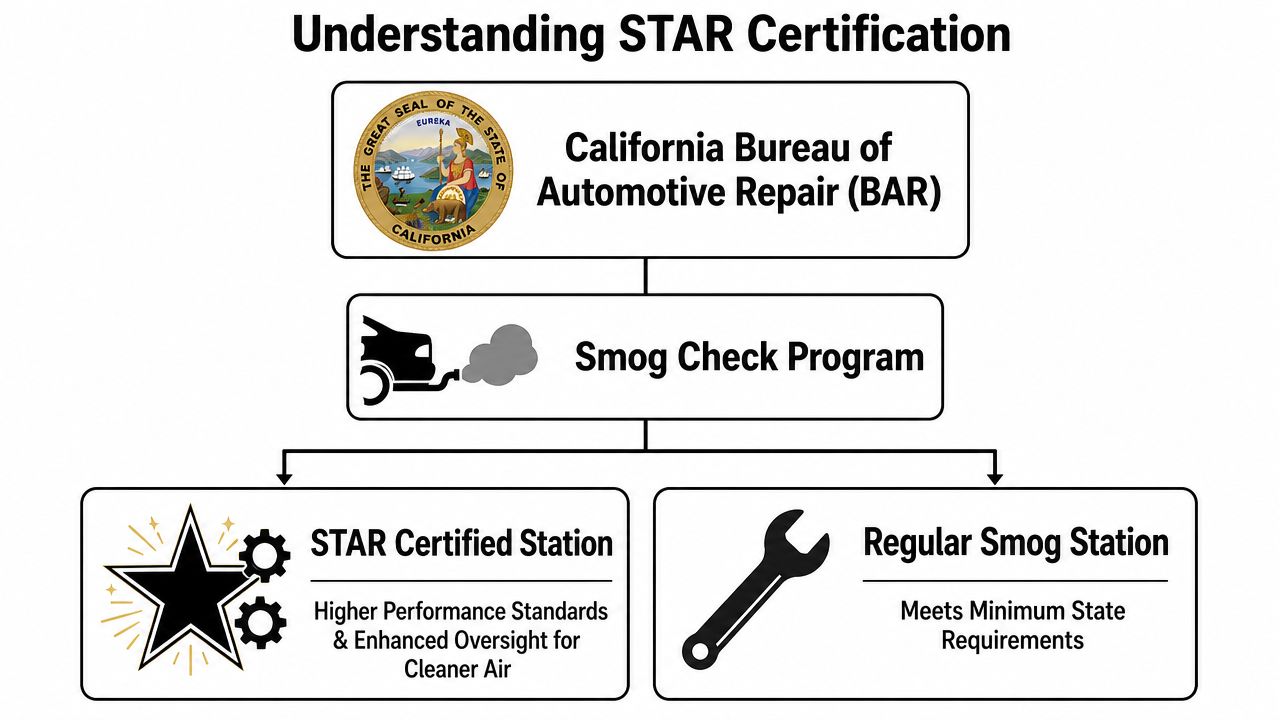
Why California uses STAR stations
California uses STAR stations to improve inspection accuracy for directed vehicles and other cars the state considers higher risk in the smog check system. The STAR label means the shop is being measured against higher BAR performance standards, not just that it offers smog checks.
That part confuses a lot of drivers. They see the word "certified" and assume every smog shop is basically the same with different branding. In practice, STAR is a separate classification. If your DMV notice asks for STAR, the state is asking for the inspection to come from that higher-standard category of station.
What this means when you walk into a shop
For you, the practical issue is acceptance. The DMV wants the result from the right kind of station, submitted the right way, so your registration can move forward without extra hassle.
The cost also has two parts, and DMV sites do not always explain that clearly. There is the shop's testing charge, which can vary by location, vehicle type, and whether your car is unusually difficult to test. Then there is the state certificate fee on a passing test, which is a fixed pass-through amount. A local STAR shop like Speedy Smog can explain that split up front, which helps you compare prices without mixing the shop fee and the state fee together.
Here is the plain-English version:
- STAR is a station classification: It tells you the shop meets stricter BAR performance requirements.
- Your DMV notice controls what you need: If it says STAR, use a STAR-certified station.
- The total price is not one single number: Part is the shop's fee, and part is the state's certificate charge on a passing inspection.
A good way to look at it is this. The smog check is the test, and the STAR label is the state's way of approving who can give that test for certain vehicles. That is why choosing the right station matters before anyone even plugs into your car.
STAR Station vs Regular Smog Check What Is Different
Drivers often ask the most important question in the bluntest possible way: “Isn't it just the same smog test?” In day-to-day experience, some parts feel similar. But the state treats STAR stations differently because of the added controls around accuracy and fraud prevention.
Side by side comparison
| Feature | STAR Certified Station | Regular Smog Station |
|---|---|---|
| Certification level | Meets higher BAR performance standards | Meets standard state requirements |
| Who it can test | Can inspect vehicles directed to STAR and other eligible vehicles | Can test non-directed vehicles |
| DMV-directed vehicles | Accepted when the notice specifically requires STAR | Often not accepted for STAR-directed vehicles |
| Oversight focus | Higher-performance inspection program | Standard program requirements |
| Fraud prevention | Includes added verification steps | Does not include the same added anti-fraud layer |
The anti-fraud difference matters
One of the biggest practical differences is behind the scenes. STAR inspections include anti-fraud measures such as photographing the vehicle and verifying the Engine Control Unit VIN against the paperwork. The referenced discussion also notes BAR enforcement data from 2025 showing 12% of flagged emission fraud cases involved spoofed vehicles at non-STAR stations, which supports why the state leans on STAR inspections for stronger fraud prevention, as described in this California smog discussion.
That may sound technical, but the reason is simple. The state wants to make sure the car being tested is the same car tied to the registration and emissions data.
What drivers usually notice
You may not see a dramatic difference while you wait. The shop still checks the vehicle, runs the required inspection steps, and submits the result. But if your vehicle has been singled out by the DMV, the STAR station is the one built for that level of verification.
That's why a regular station and a STAR-certified smog station are not interchangeable for every driver.
Do You Need a STAR Smog Check in 2026
Your renewal notice shows up, you open it at the kitchen counter, and one question jumps out right away. Do you need a regular smog check, or does the DMV want a STAR station?
Start with the notice in your hand. That is usually the fastest and most reliable answer.
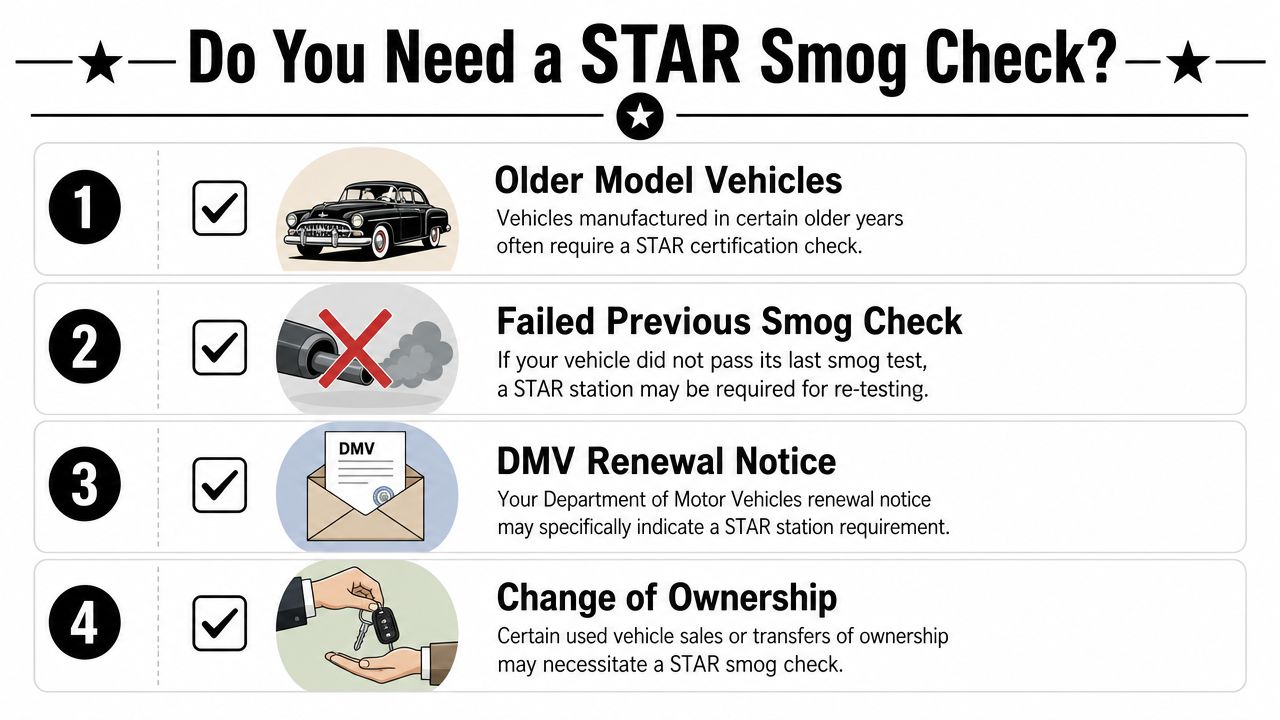
If your DMV renewal paperwork says STAR, go to a STAR-certified station. Treat that line like a prescription on a work order. If the paperwork calls for a specific type of inspection, using the wrong shop first usually just costs you time.
A lot of California drivers get hung up on two separate questions that sound similar:
- Do I need a smog check at all?
- If I do, does it have to be done at a STAR station?
Those are connected, but they are not the same thing.
The quickest way to tell
You likely need a STAR smog check in 2026 if one of these applies:
- Your DMV notice specifically says STAR. This is the clearest sign.
- Your vehicle was directed into the STAR program. The state does this for some vehicles it wants inspected under tighter program rules.
- You had trouble on a previous smog inspection. A past failure can lead to a STAR requirement on a later test cycle.
- You want to avoid a registration holdup. If the DMV asked for STAR, a regular station may not be able to give you the result your renewal needs.
Here is the practical version. If your notice is silent about STAR, a regular licensed smog station may be fine if your vehicle otherwise needs testing. If your notice calls out STAR, do not guess.
The part the DMV notice does not explain well
Many drivers assume STAR means their car is in terrible shape. That is not always true. Sometimes it means the vehicle was selected for a stricter inspection path.
It works a lot like being sent to a specialist instead of a general shop. The car may be perfectly fine. The state just wants that inspection handled at a station that meets STAR program standards.
That distinction helps calm a lot of unnecessary worry.
General smog rules still matter
Separate from the STAR question, California has regular smog-check timing rules based on the vehicle and the situation. Renewal, ownership transfer, and some registration changes can all trigger testing requirements. If you want a plain-English breakdown of those basics, Speedy Smog's guide to California smog check rules is easier to read than most DMV paperwork.
That is where San Leandro drivers often save themselves a second trip. At a local station like Speedy Smog, the staff can usually tell from your notice whether you need a standard test or a STAR inspection before they get too far into the process. They can also flag simple issues, like bringing the wrong paperwork or showing up right after disconnecting the battery, that DMV sites rarely spell out clearly.
A couple of common mix-ups
Ownership transfers catch drivers off guard all the time. You may not be due for your usual renewal smog yet, but a sale or transfer can still require one.
Another common mistake is assuming every smog shop can handle every DMV instruction. They cannot. If your paperwork says STAR, trust the notice and book with a STAR-certified station the first time.
The Process at a STAR Station Time Price and Tips
You pull into a STAR station with your DMV notice in hand, and the main question is usually simple: how long is this going to take, and what will they do?
For many newer vehicles, the visit is fairly quick if the car is ready and there are no problems to sort out. A STAR inspection still follows a set process, though, so it helps to know what happens before you get to the counter.
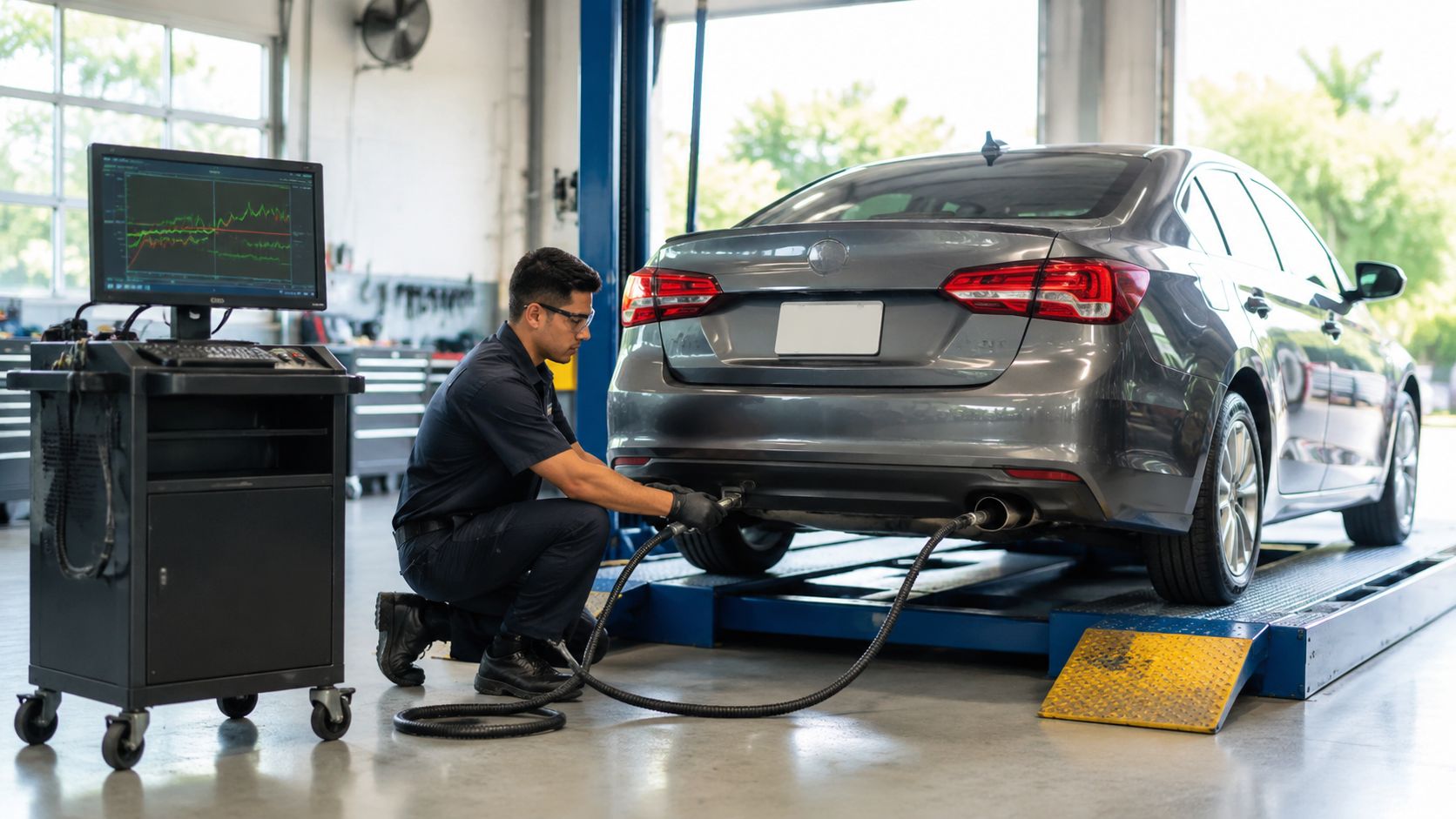
A smog check works a lot like a routine checkpoint. The technician is not guessing. They are confirming that your car's emissions system is present, working as expected, and reporting properly for that vehicle's year and type. At a local STAR station such as Speedy Smog, that usually means a check-in, a review of the vehicle information, the inspection itself, and electronic submission if the vehicle passes.
What happens during the visit
The exact steps depend on the car, but the driver's side of the process is usually straightforward:
- Check in with your registration or DMV notice if you have it: That helps the station pull up the right vehicle record faster.
- Make sure the vehicle information matches: Plate, VIN, and vehicle record all need to line up.
- Let the technician complete the required inspection steps: That can include a visual check of emissions components and a system check based on the vehicle category.
- Wait for the result to be submitted if you pass: In many cases, the station sends it to the state electronically, so you do not have to carry paperwork back to the DMV.
One practical tip catches new drivers by surprise. Try not to show up with a stone-cold engine right after the car has been sitting all night. A warmed-up car often makes for a smoother visit, the same way a phone works better after it has fully booted up instead of freezing during startup.
If you want a realistic sense of wait time for different vehicle types, how long a smog check usually takes is worth checking before you plan the stop between work, school pickup, or errands.
How pricing usually works
This is the part DMV instructions rarely explain in plain English.
Your total usually has two parts. First is the station's testing fee. Second is the certificate fee that gets added if the vehicle passes. Shops set their own testing prices, so one STAR station may quote a different amount than another even for the same type of car.
That matters because drivers sometimes assume STAR automatically means one fixed statewide price. It does not. In day-to-day practice, a local shop may price differently based on the vehicle year, fuel type, or whether the test is a regular smog check or a STAR-directed visit. Speedy Smog's local pricing and coupon offers can make a noticeable difference, which is why it helps to ask for the full out-the-door amount before the test starts.
A good question at the counter is: “What will I pay if the car passes, including the certificate?”
That wording clears up confusion fast. It also helps you compare shops fairly instead of comparing only the base test fee and getting surprised later.
Tips that save time and headaches
A few small steps can prevent the most common repeat-trip problems:
- Bring the car listed on the notice: It sounds basic, but the wrong vehicle record stops the process quickly.
- Do not disconnect the battery right before the test: That can reset monitors and cause delays.
- If your check engine light is on, deal with that first: A STAR station can test the car, but a known problem light usually means the visit will not end the way you want.
- Ask about price before they begin: Local stations vary more than DMV pages suggest.
- Go when you have a small buffer in your schedule: Even a quick visit feels stressful if you are trying to squeeze it into the last ten minutes of lunch.
Before you book, this quick walkthrough is worth a look:
Your Local STAR Station Speedy Smog in San Leandro
If you're in the East Bay and need a local option, Speedy Smog's hours and availability are useful to check before you head over. The shop is located at 15275 Washington Ave, San Leandro, CA 94579, and the publisher information states it's open Monday through Saturday.
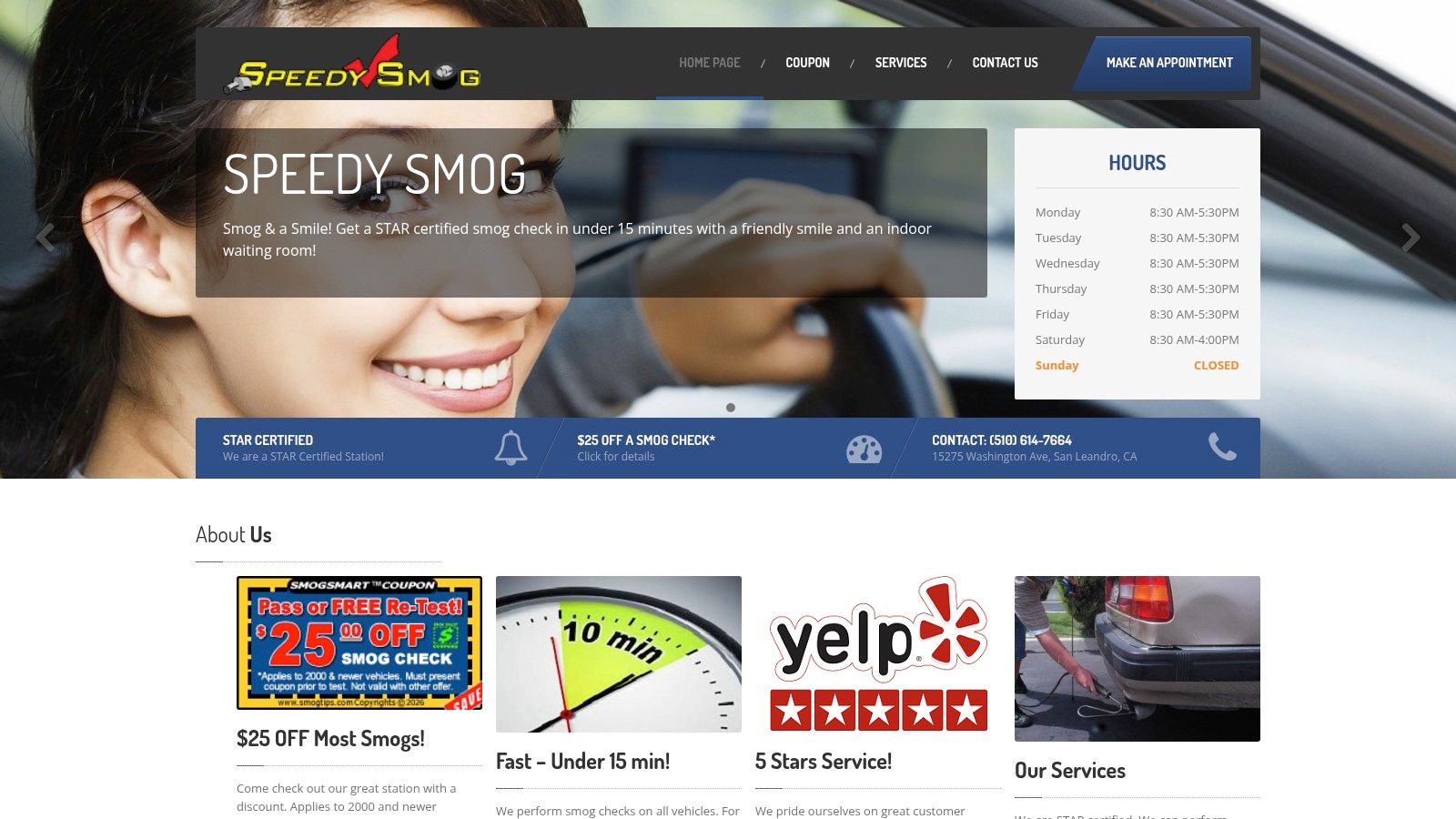
What local drivers usually care about most
Most drivers aren't looking for a history lesson when registration is due. They want to know four things:
- Can the shop handle my vehicle type: The publisher information says the station works with many vehicle categories, including 2000 and newer models, 1999 and older vehicles, diesels, and hybrids.
- Will the visit take all day: Typical tests for 2000+ vehicles are described by the publisher as taking about 10–15 minutes.
- Is there somewhere decent to wait: The shop notes a clean indoor waiting room.
- Will the pricing be explained clearly: The publisher information mentions transparent pricing and periodic $25-off coupons for many newer-vehicle smogs.
For a driver who has just learned what a STAR-certified smog station is, that combination is what makes a local shop practical. You need the certification, but you also need a place that runs the process efficiently and explains the cost plainly.
A good smog visit feels organized. You check in, the car gets tested, and you leave knowing exactly what happened.
How to Prepare Your Vehicle for a Smog Check
A little prep can make the visit smoother and lower the chance of a failed trip.
Start with the basics. Drive the car long enough beforehand to get it fully warmed up. A short freeway or city drive helps more than starting the engine and idling for a minute in the parking lot.
Then check the obvious warning signs:
- Make sure the Check Engine light isn't on: If it's lit, don't ignore it and hope for the best.
- Look for recent battery disconnects: If the battery was just disconnected or replaced, the vehicle may not be ready for testing yet.
- Confirm the car runs normally: Rough idle, stalling, or obvious exhaust issues are signs to handle repairs first.
- Bring the paperwork you were told to bring: That avoids a useless second trip.
If you're selling the car or handling a registration deadline, don't wait until the final day. Give yourself enough time to test, deal with any problem, and return if needed.
STAR Smog Checks and the DMV Your Questions Answered
What if the vehicle fails
A failed smog check doesn't mean your car is permanently stuck. It means the vehicle didn't meet the emissions requirements on that visit. The next step is usually repair, then a retest based on what the station tells you.
Is the passing certificate sent to the DMV automatically
In normal practice, passing results are submitted electronically. That means you usually don't need to carry a paper certificate over to the DMV counter yourself. Still, keep your receipt and any test paperwork until your registration is fully processed.
Is a STAR inspection valid statewide
Yes. If the vehicle is tested properly at a California STAR station and the result is accepted, it isn't limited to one city. The important part is that the inspection was done at the correct kind of station for your vehicle.
Can I shop around on price
Yes, and you should. Just make sure you're comparing the same kind of test. Ask whether the quote changes for a STAR-directed vehicle and whether the certificate fee is included in the number you're hearing.
What if I'm still unsure whether my notice requires STAR
Call the station before you leave home and read the wording directly from your DMV notice. That's the fastest way to avoid guessing.
If you need a STAR inspection in the East Bay, Speedy Smog is a practical place to start. Check the shop hours, confirm your vehicle type, ask for the total out-the-door price for a STAR-directed or non-directed test, and bring the car in warmed up so the visit goes as smoothly as possible.
A STAR station is a smog check station that meets higher performance standards, and if your DMV renewal notice says STAR is required, you must use one. In California's Enhanced Areas, exactly two percent of vehicles are directed by DMV to STAR-certified stations, so if that language appears on your renewal, it's a normal requirement, not a mistake.
You open your registration notice, skim for the due date, and then see the line that throws everything off: smog check required at a STAR station. A lot of drivers read that and immediately wonder if there's something wrong with the car, if the test is different, or if the whole process is going to take longer and cost more.
Usually, the answer is much simpler than people expect. The notice is mainly telling you where your inspection must be done. If you understand that one point first, the rest gets a lot less stressful.
Table of Contents
- Your DMV Notice Says STAR Station Required Now What
- What Is a STAR Certified Smog Station
- STAR Station vs Regular Smog Check What Is the Difference
- What to Expect During Your Smog Check at Speedy Smog
- How to Prepare Your Vehicle for a Smog Check
- Speedy Smog Hours Pricing and Location in San Leandro
- Frequently Asked Questions About Smog Checks
Your DMV Notice Says STAR Station Required Now What
You open your renewal notice, spot the words “STAR station required,” and the whole thing suddenly feels more complicated than it should. In practice, the message is simple. DMV is telling you where the inspection must be done, not telling you your car is in trouble.
That distinction saves a lot of stress. A STAR requirement is a routing instruction. It works a lot like a specialist referral on the medical side. You still need the same basic service, but you need to get it from the type of shop the state named on your notice.
What that line on the notice actually means
Start with the one question that matters. Does your renewal paperwork say STAR is required?
If the answer is yes, use a STAR-certified station. A regular smog shop may not be able to complete the inspection DMV is asking for, which can waste a trip and put you closer to your registration deadline.
Here is the practical version:
- Go to a STAR-certified shop: Follow the notice exactly.
- Bring the DMV notice if you have it handy: It helps the station confirm the request quickly.
- Leave yourself a little time: If your car needs repairs or a retest, you will not be scrambling at the end.
Simple rule: “STAR required” tells you where to go for the test.
The wording on DMV paperwork can make this sound more serious than it is. Terms like “directed vehicle,” “certified station,” and “Enhanced Area” are just program labels. For the driver, the takeaway is straightforward. Your vehicle needs its smog check done at the right kind of station so the result can be accepted for registration.
If you want a plain-English refresher before you book, this guide to California smog check rules breaks down the state terms without the DMV wording.
The fastest path from notice to certificate
At Speedy Smog, the goal is to make this easy from the moment you get that letter to the moment you drive away. Read the notice, confirm it says STAR, bring the car in, and let the station handle the inspection and electronic certificate if your vehicle passes.
A few small choices can make the visit faster. Bring your paperwork, avoid waiting until the registration due date, and drive the car long enough to warm it up before you arrive. That last step matters because a cold engine is a little like trying to grade a student before the test starts. The car needs to be at normal operating temperature for the system checks to behave the way they should.
The process is usually simpler than drivers expect. The notice tells you the lane to get in. Your job is mostly to show up at the right shop, prepared, and let the test move forward.
What Is a STAR Certified Smog Station
A STAR-certified smog station is a smog check shop that has approval to inspect and certify certain vehicles under tighter state performance standards. A simple way to read that label is this: the state trusts these stations to deliver consistently accurate inspections for cars that are directed into the STAR program.
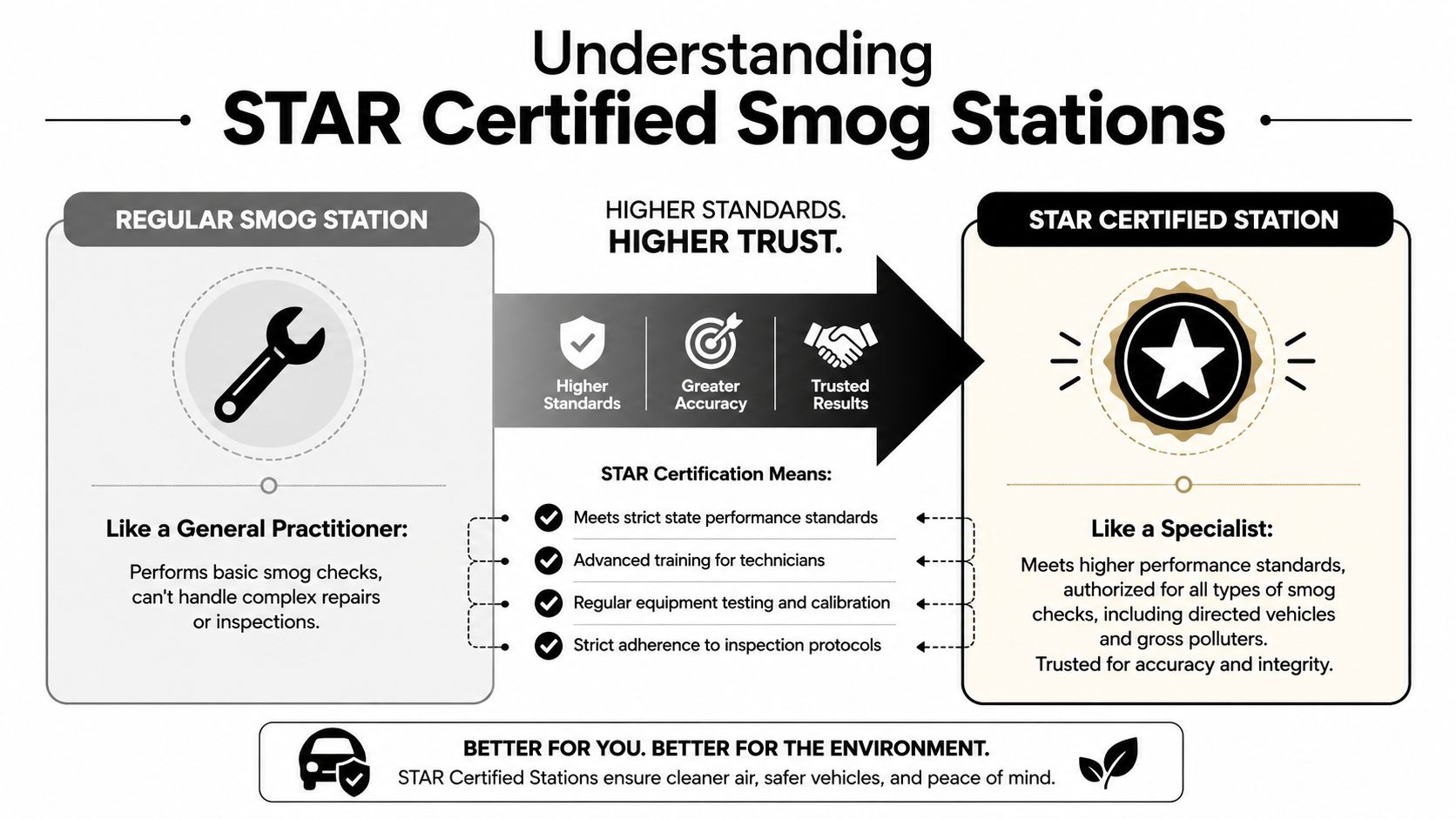
For a driver, the key point is practical. STAR describes the station's approval status, not a different kind of smog test. Many customers hear the word and expect a harsher inspection, special equipment, or a long extra procedure. What usually changes first is the specific testing location required for DMV acceptance.
That can feel confusing because the DMV notice focuses on program labels, not plain language. A better translation is: your car needs to be checked at a shop with current STAR approval. The shop has to qualify for that status and keep meeting the state's standards over time.
What the STAR label means during a real visit
At Speedy Smog, this matters in a very customer-facing way. If your renewal notice says STAR, the shop must be authorized to complete that inspection and send the certificate electronically if your vehicle passes. If you stop at the wrong type of station first, you can lose time, make an extra trip, and still need the same test done again at a STAR location.
Choosing the right station first makes the whole process faster.
Drivers searching for an action smog check STAR station are usually trying to solve three problems at once:
- Meet the DMV requirement without guesswork
- Get in and out quickly
- Leave knowing exactly what happened, whether the car passed or needs follow-up
That is why the customer experience matters as much as the label. A good STAR station does more than run the inspection. It helps you confirm the requirement, explains what the technician is checking in plain English, and keeps the visit moving so you can get back on the road.
For a closer local explanation of the certification itself, see this guide on what a Smog STAR station is.
STAR Station vs Regular Smog Check What Is the Difference
Here's the part most drivers want settled quickly. The physical smog inspection is technically identical at a regular station and a STAR station. The difference is the station's approval status, its performance requirements, and whether it can certify a STAR-directed vehicle.
According to the Sunnyvale STAR facts page, STAR-certified smog stations operate under more stringent BAR standards, the physical test is identical, the station must maintain a high state score to certify STAR-designated vehicles, and some failing vehicle owners may qualify for up to $500 in state-funded repair assistance.
The side by side comparison
| Feature | Regular Smog Station | STAR Certified Station |
|---|---|---|
| Physical inspection procedure | Same basic smog inspection steps | Same basic smog inspection steps |
| BAR performance standard | Standard licensing requirements | More stringent BAR standards |
| Can certify STAR-directed vehicles | Not always | Yes, if the station holds current STAR approval |
| State score requirement | Not the same STAR approval standard | Must maintain a high state score |
| Best use case | Routine vehicles not directed to STAR | Vehicles specifically told by DMV to use STAR |
What this means for you as a customer
If your car was directed to a STAR station, the test itself isn't automatically harsher. The main issue is authorization. You need a shop that can submit the right certification for your renewal requirement.
That's why a regular station and a STAR station may both look similar from the lobby, the bay, and the equipment side. What changes behind the scenes is the station's compliance status with BAR and whether DMV accepts that shop for directed vehicles.
If your notice says STAR, going to a regular station can waste a trip even if the staff is helpful and the shop is fully licensed.
Common misunderstandings
Drivers often mix up three different questions:
- Is my car in trouble? Not necessarily.
- Is the inspection different? The test procedure itself is not the key difference.
- Will I automatically fail at a STAR station? No. A STAR requirement does not equal an automatic failure.
The cleaner way to think about it is this: STAR is a filter on who can certify the test, not proof that your vehicle has already failed something.
If a vehicle doesn't pass, that result can feel frustrating, but the process is still structured. The same Sunnyvale reference notes that some owners may qualify for up to $500 in state-funded repair assistance after a failure, which can help when repairs are needed before retesting.
What to Expect During Your Smog Check at Speedy Smog
For most drivers, the biggest relief comes from knowing what will happen once they pull in. The visit is usually much more routine than people expect, especially if the vehicle is already running normally and there are no warning lights on.
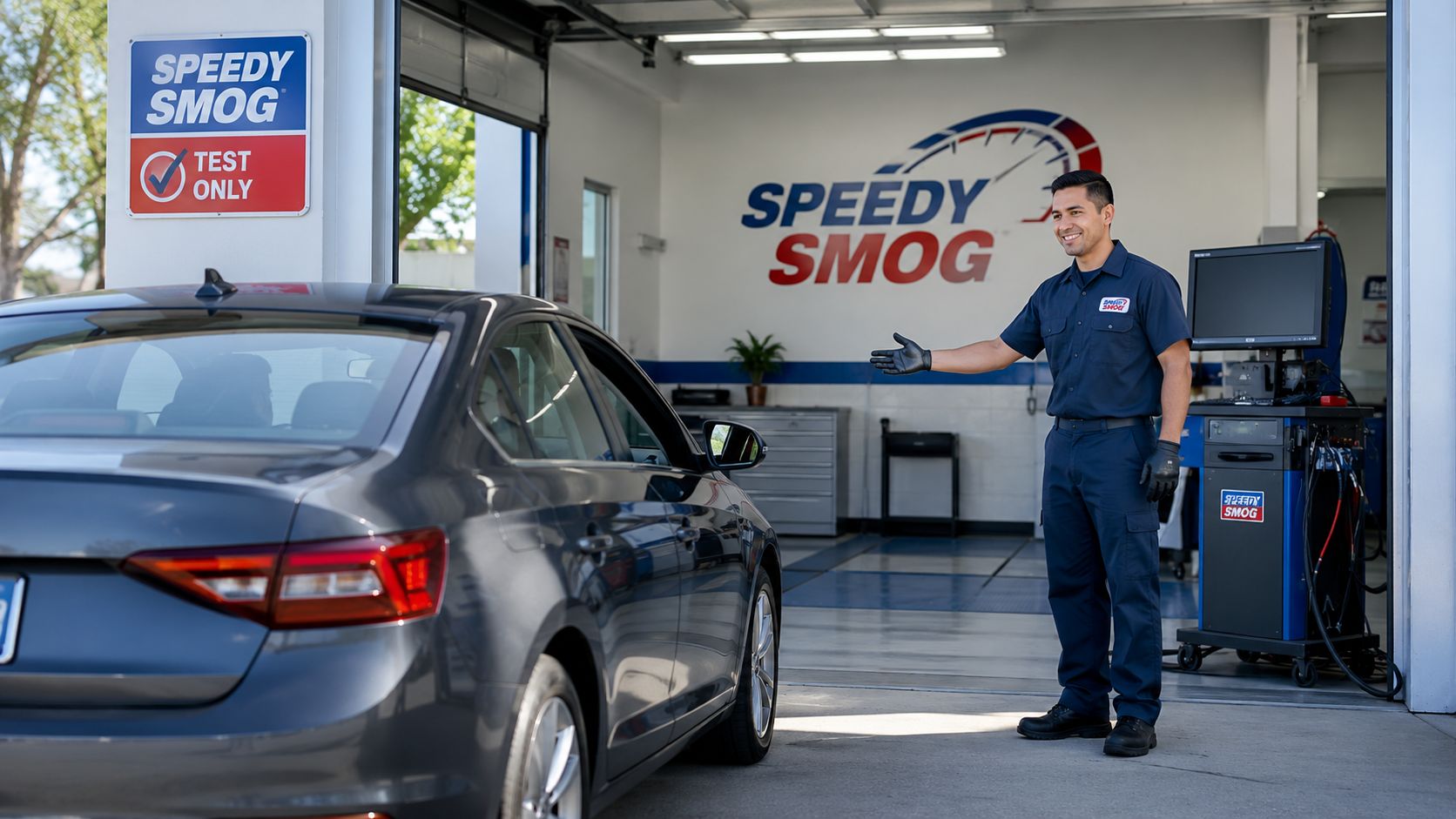
For many 2000 and newer vehicles, the inspection is typically completed in about 10 to 15 minutes, based on the business details provided by the publisher. That quick turnaround is one reason many East Bay drivers look for an action smog check STAR station that keeps the process simple.
When you arrive
Check-in usually starts with the basics. Bring your renewal notice if you have it, and let the staff know whether the DMV specified a STAR station. The technician will confirm the vehicle information and get the inspection started.
While the car is being checked, many customers wait in the indoor lobby. A clean waiting room, straightforward paperwork, and clear communication make a big difference because customers do not want a technical lecture. They just want to know what's happening and whether anything is holding up the certificate.
What the technician checks
A smog inspection isn't one single action. It's a series of checks that work together.
Typical items include:
- Visual inspection: The technician looks for required emissions-related components and obvious issues.
- Functional checks: Items like the gas cap and warning light behavior may be reviewed.
- Computer scan for newer vehicles: On many newer cars, the inspection includes reading the vehicle's onboard diagnostic information.
If you've never seen the process up close, this short video gives a helpful look at what a smog inspection visit can feel like in real life.
How you get your result
If the vehicle passes, the certificate is handled electronically for DMV purposes, and you can move on with registration. That's the outcome everyone wants because it keeps the trip short and uneventful.
If the vehicle doesn't pass, the next step is usually a plain-language explanation of what needs attention. In practice, customers appreciate a station that tells them the issue directly instead of burying it in jargon.
A good smog visit feels organized. You check in, the technician tests the car, you get a clear result, and you know what to do next.
How to Prepare Your Vehicle for a Smog Check
The best prep is simple, and most of it takes only a few minutes. You don't need to be a mechanic to improve your odds of a smooth visit. A little preparation helps the inspection start with the car in normal operating condition.
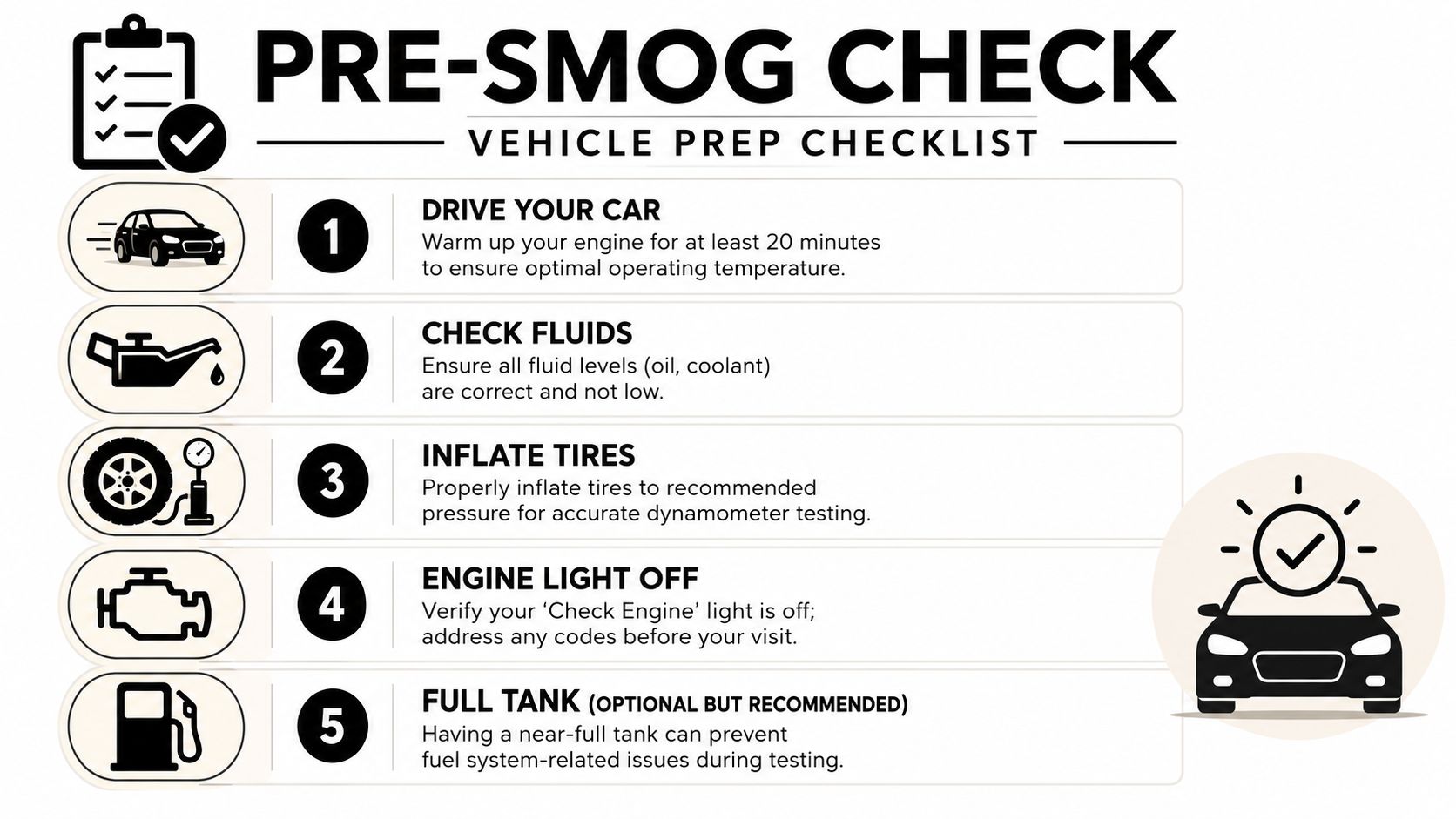
Easy checks before you leave home
Start with the obvious stuff people overlook when they're rushing out the door.
- Drive the car first: Don't bring it in stone cold if you can avoid it. A normal drive before the test helps the vehicle reach operating temperature.
- Make sure the Check Engine light is off: If it's on, don't hope for the best. Get the problem diagnosed first.
- Tighten the gas cap: A loose or damaged cap can create avoidable trouble.
- Look at the tires: Proper inflation helps if the vehicle type requires testing conditions where that matters.
- Avoid a dead battery situation: If the battery was recently disconnected, the car may need normal driving before it's ready for inspection.
What to bring with you
Customers sometimes prepare the vehicle and then forget the paperwork. Keep it easy:
- DMV renewal notice
- Driver's license
- Payment method
That small checklist prevents the most common front-counter delays.
One easy habit: Put your renewal notice in the passenger seat the night before. That way you won't leave it on the kitchen counter.
If you're worried your car has a specific issue, reviewing common smog check fail reasons can help you catch problems before the visit.
Older vehicles, diesels, hybrids, and newer gasoline cars don't all go through the exact same path, but these preparation habits are useful across the board. Warm the car up. Bring the documents. Don't ignore warning lights.
Speedy Smog Hours Pricing and Location in San Leandro
If you're ready to stop searching for an action smog check STAR station and just get it done, the practical details matter most. Speedy Smog is a STAR Certified station located at 15275 Washington Ave, San Leandro, CA 94579.
The shop is open Monday through Saturday, offers transparent pricing, and regularly features a $25-off coupon for most newer vehicle smogs, based on the publisher information provided for this article. For many drivers, that combination of location, straightforward pricing, and quicker service is what makes the trip feel manageable.
Before you go, it's still smart to call ahead or check the business website for current hours, coupon details, and any vehicle-specific questions.
Frequently Asked Questions About Smog Checks
What happens if my car fails the smog check
You'll be told what part of the inspection caused the failure, and then the car will need repairs before it can pass. Some California motorists may qualify for up to $500 in state-funded financial assistance for repairs, as noted in the earlier STAR comparison section's cited source.
How long is my smog certificate valid
A smog certificate for DMV purposes is generally used within your registration window. If you're close to your deadline, don't wait around after passing. Finish the renewal while everything is current.
Do I need a smog check every year
Many California drivers are used to periodic renewal-related smog requirements, but the exact timing depends on the vehicle and registration situation. Your DMV renewal notice is the document to trust because it tells you whether a smog inspection is required for that cycle.
If my notice says STAR, can I still go to any smog shop
No. If the notice specifically says STAR is required, use a STAR-certified station. That requirement is about using a shop authorized to certify your inspection for DMV under the STAR program.
If you need a fast, straightforward visit in San Leandro, Speedy Smog is a STAR Certified station that helps drivers handle DMV smog requirements without the usual confusion. Bring your renewal notice, arrive with the car warmed up, and the team can help you get tested, certified, and back on the road with less hassle.
For most 2000 and newer vehicles in the East Bay, smog check prices usually land between $40 and $90 out the door once the test, certificate, and small transmission fees are included. If you find a coupon deal, you might see the base test around $29.95, but your final total commonly ends up around $40 to $42 after the required add-ons.
Drivers looking for emissions testing prices near them often do so with a DMV renewal notice sitting on the counter and a deadline they don't want to mess with. I get it. Most drivers aren't confused about whether they need the test. They're confused because one shop advertises a cheap base price, another says STAR, another says certificate extra, and suddenly a simple smog check feels like a pricing game.
It doesn't have to be complicated. The easiest way to avoid overpaying is to understand what you're being charged for, which vehicles cost more, and which questions to ask before you pull into the bay.
Table of Contents
- How Much Is a Smog Check in the East Bay Really
- Decoding Your Smog Check Bill Component by Component
- Why Smog Check Prices Vary So Much
- What STAR Certification Means For You
- Finding the Best Value in the East Bay A Speedy Smog Spotlight
- FAQ Your Next Steps for DMV Compliance
How Much Is a Smog Check in the East Bay Really
That registration notice shows up, and the first question is always the same. What am I going to pay today?
For a standard California smog check on a 2000 and newer vehicle, expect the total in the East Bay to fall somewhere between $40 and $90. That's the practical number most drivers care about. Not the teaser ad. Not the base fee by itself. It's the total after the state-required pieces get added in.
A big reason people get annoyed is simple. Shops often advertise the base test, but your DMV paperwork doesn't care about the base test. You need the complete certification submitted properly, and that means your final bill matters more than the headline price.
Practical rule: Always ask for the out-the-door price, not the advertised smog price.
If you want to compare offers quickly, start with current smog check deals in San Leandro and then confirm whether the posted special already includes the certificate and transmission charge. If it doesn't, the bargain may not be much of a bargain.
A fair price isn't just about the lowest number. It's about clear pricing, correct testing, and getting in and out without wasting half your day. That's the part a lot of generic emissions testing prices near me pages miss. They give you a range, but they don't tell you why your final total changes from one vehicle to the next.
Decoding Your Smog Check Bill Component by Component
You pull into a smog shop because the ad says $29.95. Ten minutes later, the bill is higher than you expected. That usually happens because the sign out front shows only one part of the charge.
A smog bill is usually made up of three pieces, and if you know those pieces ahead of time, you can spot a real deal fast.
Base fee
The base fee is the shop's charge to run the test. For 2000 and newer vehicles in California, private test stations commonly fall in the $30 to $90 range, according to California smog cost data compiled by CostHelper.
This is the part shops use to compete on price. It is also where a cheap-looking ad can fool you.
State certificate and transmission charges
The state certificate fee is fixed. The electronic transmission charge is usually small. You do not have much control over either one, but they still affect your final total.
That is why the only number that matters is the out-the-door price. If a shop gives you only the base fee, you still do not know what you are really paying.
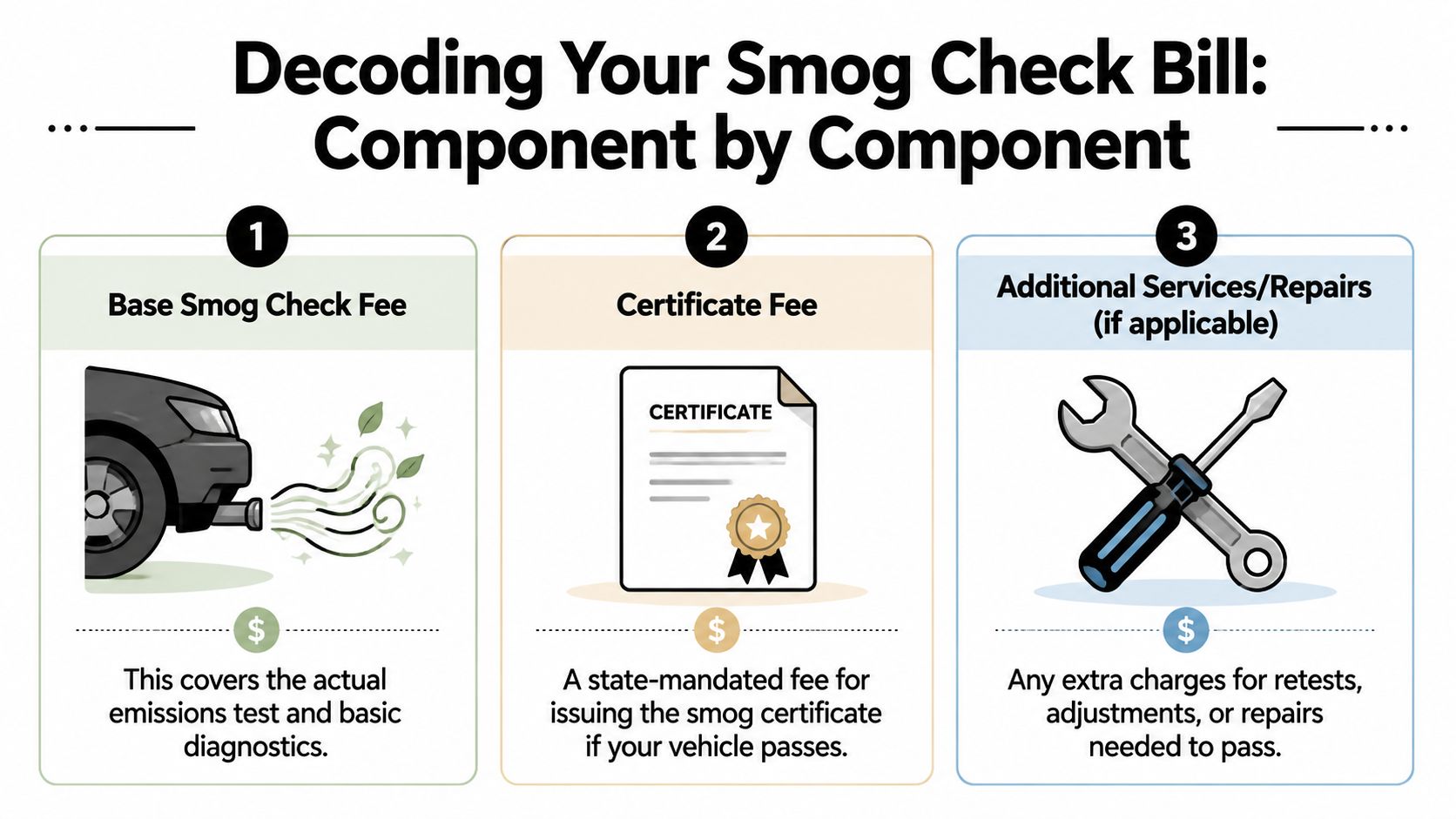
Repairs or retest-related costs
If your car passes, your cost stays simple. If it fails, the bill can jump quickly because now you are paying for diagnosis, repair work, and sometimes a retest.
As noted earlier from the same source, repair costs after a failed smog check can range widely, and even coupon tests often end up higher out the door once the standard add-ons are included. That is exactly why East Bay drivers should ask one direct question before handing over the keys: What is my total if the car passes today?
That question saves time. It also helps you avoid the shops that lead with a teaser price and explain the rest later.
Here is the plain-English breakdown:
- Base fee: The main shop charge, and the only part that usually varies a lot.
- Certificate fee: Set by the state.
- Transmission charge: Small, but still part of the bill.
- Failure-related costs: The expensive part if your vehicle has a problem.
My advice is simple. Compare shops by the full pass price, not the ad price. In the East Bay, a good STAR station should be able to tell you the total clearly, explain any extra charge before the test starts, and get you through the process without surprises.
Why Smog Check Prices Vary So Much
You call one shop and hear a bargain price. Then you call another shop five miles away and the number is much higher. In the East Bay, that usually comes down to your vehicle, the test method, and how honest the shop is about the full bill.
The biggest price drivers
Older vehicles usually cost more to test because the inspection takes more time and can involve a more involved procedure. As noted earlier, pre-2000 vehicles often land near the top of the normal price range for that reason alone.
Vehicle type matters too. Trucks and SUVs often cost more than a basic sedan. Diesel vehicles and oversized vehicles are their own category, and the price jump is real because the testing process is different.
Shop type also changes the quote. Some stations price aggressively to get the phone call, then add the certificate fee and other standard charges later. Others give you the pass price up front. That is the number you should care about.
Estimated Smog Check Costs in the East Bay 2026
| Vehicle Type | Test Requirement | Estimated Total Price |
|---|---|---|
| 2000+ gasoline vehicle | Standard smog test with certificate and typical transmission fee | $40 to $90 |
| 1999 and older vehicle | More complex test process | Often near $100 |
| Truck or SUV | Standard test, often with added vehicle-type charge | Usually above a comparable passenger car |
| Diesel vehicle | Diesel-specific emissions protocol | Higher than a standard gasoline car |
| RV or large vehicle | Large-vehicle testing | Much higher than a standard passenger vehicle |
A cheap quote is not always a cheap smog check.
Another reason prices for emissions testing can feel inconsistent is that many ads lead with the base test fee, not the out-the-door total. If the shop does not clearly tell you whether the certificate and other standard charges are included, you are not comparing real prices.
If your DMV notice requires STAR, that narrows your options and can affect cost. If you are not sure what that requirement means, read this plain-English guide to a STAR smog station in California. It will help you compare the right shops instead of wasting time calling stations that cannot legally complete your test.
My recommendation is simple. Ask three questions before you book. What kind of test does my vehicle need? Is this quote the full pass price? Are there any added charges for my vehicle type? A good East Bay smog shop will answer all three fast and clearly.
What STAR Certification Means For You
If your DMV notice says STAR, don't panic. It doesn't mean your car is being singled out for punishment. It means the inspection has to be done at a station that meets higher performance standards.
Why some STAR stations charge more
California pricing references show that STAR Certified stations often charge slightly higher base fees, with one example listing $59.75 at a STAR station versus $45 at a non-STAR station, while both still provide legally valid certification for DMV registration. That comparison appears in this California emissions testing overview.
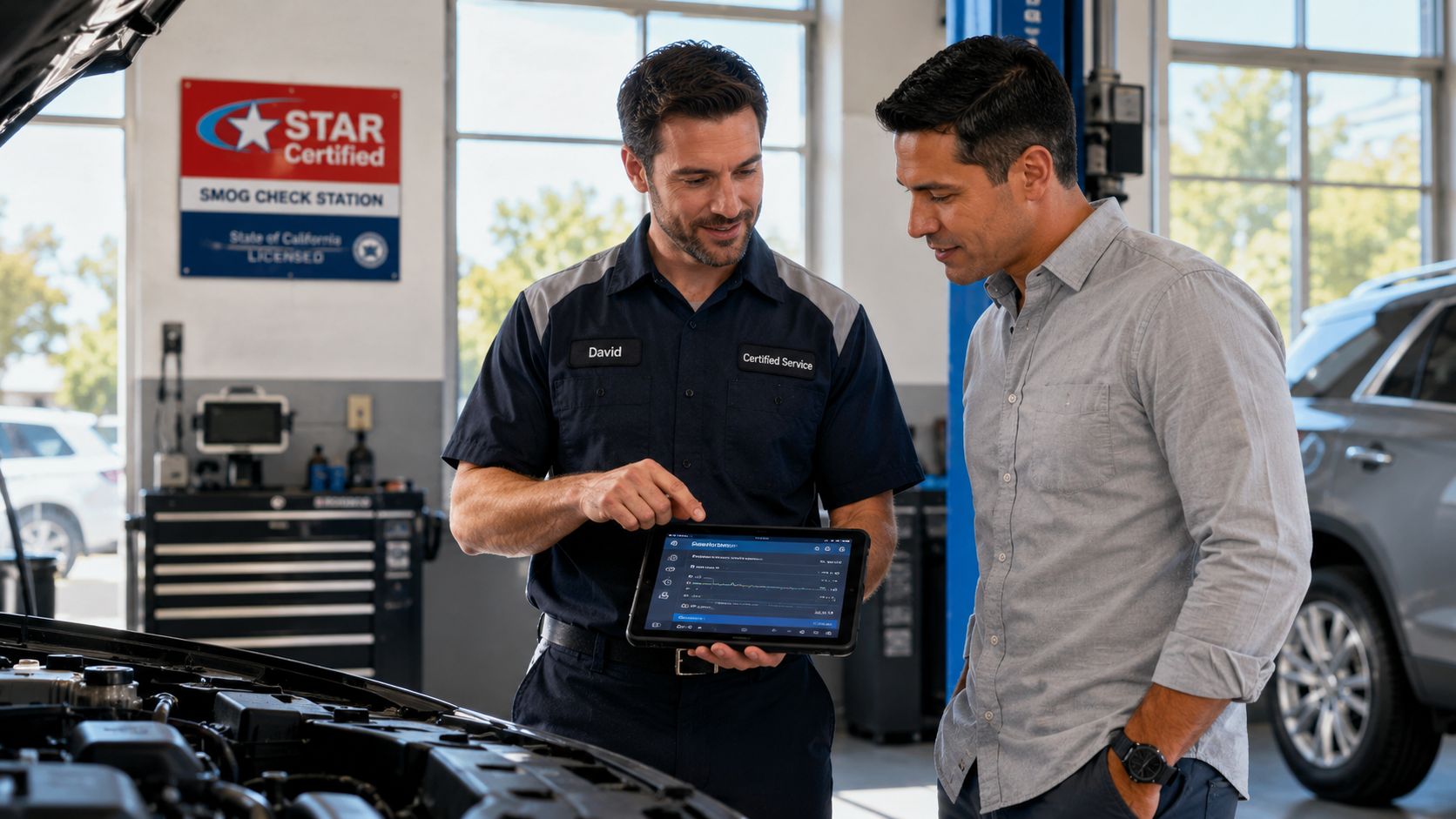
That extra cost isn't magic. It's tied to the station meeting tougher operating standards. In plain English, you're paying for better consistency, better equipment performance, and a shop that stays in line with BAR requirements.
When STAR is the smart choice even if DMV doesn't require it
Even if your renewal notice doesn't require STAR, a STAR station can still be the better move. If a shop keeps its equipment sharp and follows tighter standards, you're less likely to deal with sloppy testing or confusion at the DMV.
If you want a plain-English explanation of how that works, this guide on what a California STAR smog station is lays it out clearly.
My opinion is simple. If the price difference is reasonable, I'd rather test at a shop that takes accuracy seriously. A smog check is cheap compared with chasing a bad result, redoing paperwork, or paying for repairs you may not have needed.
Finding the Best Value in the East Bay A Speedy Smog Spotlight
You pull into a shop because the ad price looks great. Ten minutes later, the total is higher than expected, the certificate fee was extra, and now you're stuck because registration is due. That's the mistake I want you to avoid.
In the East Bay, the best value is the shop that gives you the total up front, gets you in and out fast, and submits everything correctly the first time. Cheap on paper is meaningless if the final bill climbs at checkout.
How to shop smarter before you go
Ask one question before you leave home or book online. What is the out-the-door price for my exact vehicle?
That one question saves time and cuts out the usual nonsense. It tells you right away whether the quoted price includes the certificate, any electronic transmission charge, and whether your car, truck, SUV, or diesel changes the total. A lot of confusion when searching for local emissions testing prices comes from missing those details.
You should also confirm the rules for your vehicle before you show up. If you need a quick refresher on California smog check requirements by vehicle and registration situation, check that first so you book the right station and avoid a wasted trip.
Use this checklist before you head out:
- Confirm your vehicle type: Gas, diesel, hybrid, truck, SUV, or older model.
- Ask for the final total: Get the full price, not the teaser number.
- Check coupon terms: Make sure the discount applies to your vehicle and includes the standard fees.
- Verify your DMV notice: If it says STAR, go to a STAR station.
What a transparent local shop looks like
A good East Bay smog shop is easy to read before you ever arrive. The website shows clear pricing. The coupon terms are straightforward. The person answering the phone gives you a direct answer instead of dancing around the total.
That matters.
Here's an example of the kind of local shop experience drivers look for:
A shop like Speedy Smog stands out because the value is in the full visit, not just the headline price. You want fast service, a clean process, clear answers, and no surprise add-ons at the counter. That is what saves money in real life, because it saves you from repeat trips, checkout arguments, and last-minute DMV stress.
Good value means a correct test, a fair out-the-door price, and no nonsense at checkout.
FAQ Your Next Steps for DMV Compliance
A few questions always come up right before a smog check. Here are the ones that matter most.
What if my car fails
If your car fails, don't start authorizing random repairs. Get a clear diagnosis first. Smog failures can come from several different issues, and the smart move is to fix the actual cause, not guess.
Failure can get expensive. California cost references note repair costs can range widely depending on the issue, and that wide range is exactly why you want a straightforward explanation before any work starts.
One more thing. Don't assume waivers are easy or automatic just because you've heard that from a friend. A New York waiver explanation from SSDGNY says a vehicle can qualify for an emissions waiver there only after at least $450 of emissions-specific repairs have been made and the car still fails. Different states handle waivers differently, but the lesson is universal. Always ask about the actual rules before you count on a waiver saving you.
Do I need a smog check right now
Check your DMV renewal notice first. That's the document that tells you whether your registration cycle requires a smog inspection and whether you need a STAR station.
California also has special rules for newer vehicles. A California smog overview from SuperStation Concord notes that vehicles six or fewer years old may pay an annual $20 abatement fee instead of getting the biennial smog check, though that exemption doesn't apply to certain diesel and special-built vehicles.
If you want the California rules in one place, this page on California smog check rules is a useful starting point.
Your next move
Keep it simple:
- Read your DMV notice carefully. Check whether the vehicle needs a smog this cycle and whether STAR is required.
- Call one local station with your vehicle details. Ask for the total out-the-door price.
- Get it done before the deadline. Smog is annoying when you delay it. It's manageable when you handle it early.
The process isn't nearly as bad as people make it out to be. Most of the frustration comes from unclear pricing and poor communication. Fix those two things, and the whole errand gets easier.
If you want a fast, straightforward smog check in San Leandro, Speedy Smog is a solid local option. They're a STAR Certified station, they work on most vehicle types, and they're known for clear pricing, quick service, and a comfortable waiting area, which is exactly what most East Bay drivers want when DMV time rolls around.
Your registration notice shows up, and suddenly this becomes today's problem. You don't want a lecture on emissions rules. You want a shop that won't waste your lunch break, won't surprise you on price, and won't create a DMV headache after the test.
If you're looking at 4 Less Smog Check Oakland, that instinct makes sense. It's a familiar Oakland option with a strong public review history, straightforward newer-car pricing, and a location that's easy for a lot of East Bay drivers to reach. But the advertised price is only part of the decision. The smarter question is simpler: Will this shop be fast when you arrive, and is it the right fit for your car?
Use this quick comparison first.
| Shop | Best for | What stands out | Watch for |
|---|---|---|---|
| 4 Less Smog Check Oakland | Oakland drivers with 2000+ vehicles who want a familiar local option | Strong Yelp reputation, Broadway location, coupon on labor for eligible newer vehicles | Older vehicles need separate pricing, peak walk-in surges can change your real wait |
| Other STAR stations nearby | Drivers who need options based on location, older vehicles, diesel, or timing | You may find a better fit for your exact vehicle or route | Not every nearby shop offers the same convenience or workflow |
Table of Contents
- That DMV Notice Just Arrived What Now
- Why STAR Certification Matters for Your Smog Check
- A Close Look at 4 Less Smog Check Oakland
- Comparing 4 Less Smog Check vs Speedy Smog
- Which Smog Station Should You Choose in 2026
- Quick Tips for a First-Time Pass
That DMV Notice Just Arrived What Now
The usual pattern is predictable. You open the DMV notice, see that smog certification is required, and immediately start searching for the closest place with decent reviews and a coupon. That's exactly how many find 4 Less Smog Check Oakland.
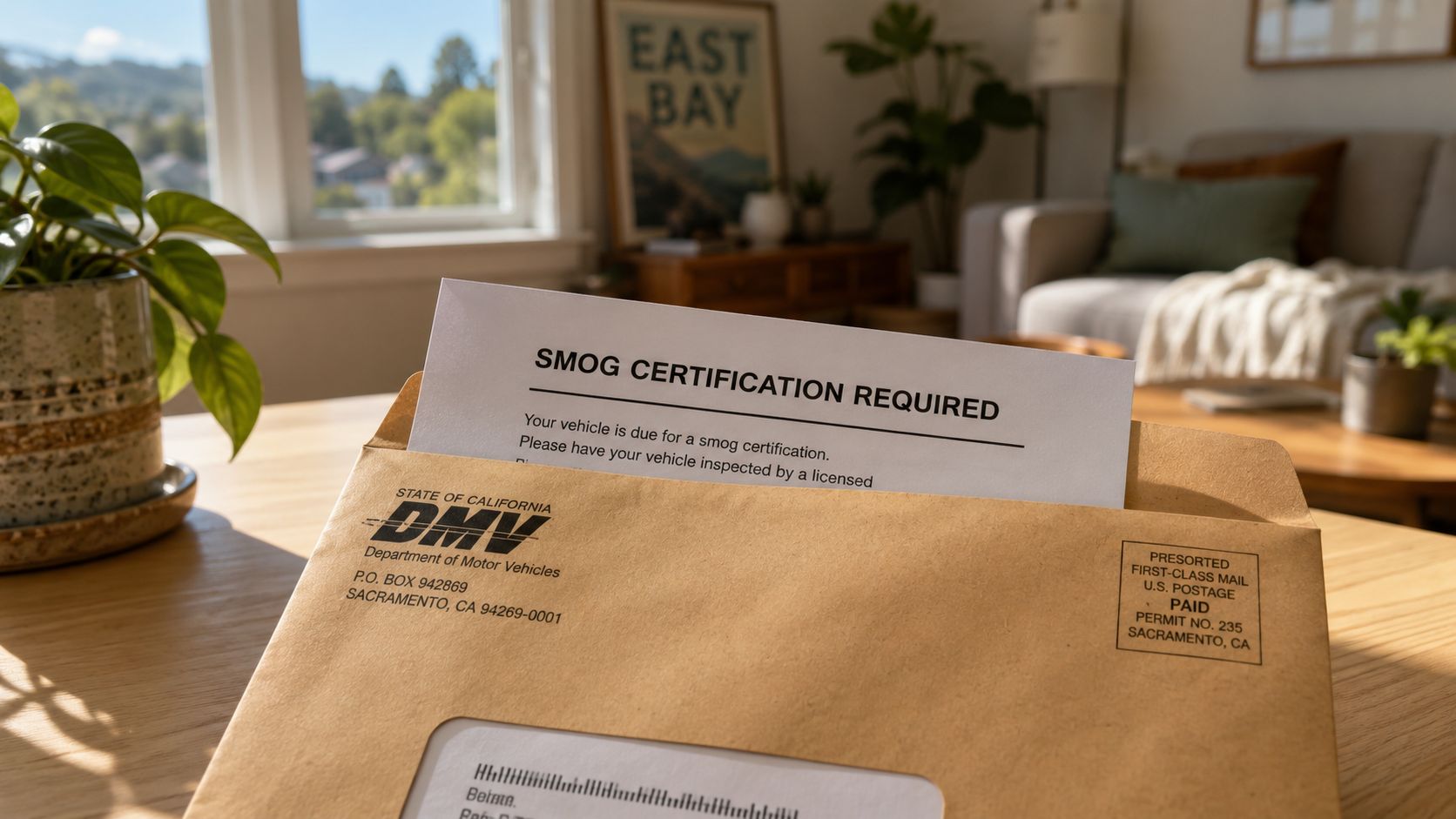
If your car is normal, your timeline is tight, and you just want the paperwork handled, that's a reasonable starting point. If you still need to figure out where to go nearby, this local guide to a DMV smog check near me in the East Bay is a useful shortcut.
What matters most right now is not finding the cheapest number in the biggest font. It's finding a station that fits your car, your location, and your deadline. Those aren't always the same thing.
The three questions that matter first
Before you drive anywhere, answer these:
- What year is your vehicle: If it's 2000 or newer, 4 Less has clearly posted standard pricing for that group. If it's older, you need to ask first.
- Do you need this done today: Same-day convenience matters more than a small advertised discount if your registration deadline is breathing down your neck.
- Are you trying to avoid DMV drama: A fast test means nothing if you end up with confusion about station type or timing.
Go to the right shop once. That beats going to the cheapest shop twice.
A lot of East Bay drivers make the same mistake. They focus on the headline labor price, ignore the certificate fee, ignore cutoff times, and forget that walk-in volume changes by day and by deadline pressure. Then the “quick errand” turns into a schedule problem.
That's why 4 Less gets attention. It checks the basic boxes for a lot of Oakland drivers. But if you want to choose well, you need to look past the sign out front.
Why STAR Certification Matters for Your Smog Check
STAR certification is not decoration. It's the practical difference between a shop that meets a higher compliance bar and one that may not be the right stop for your vehicle or DMV notice.
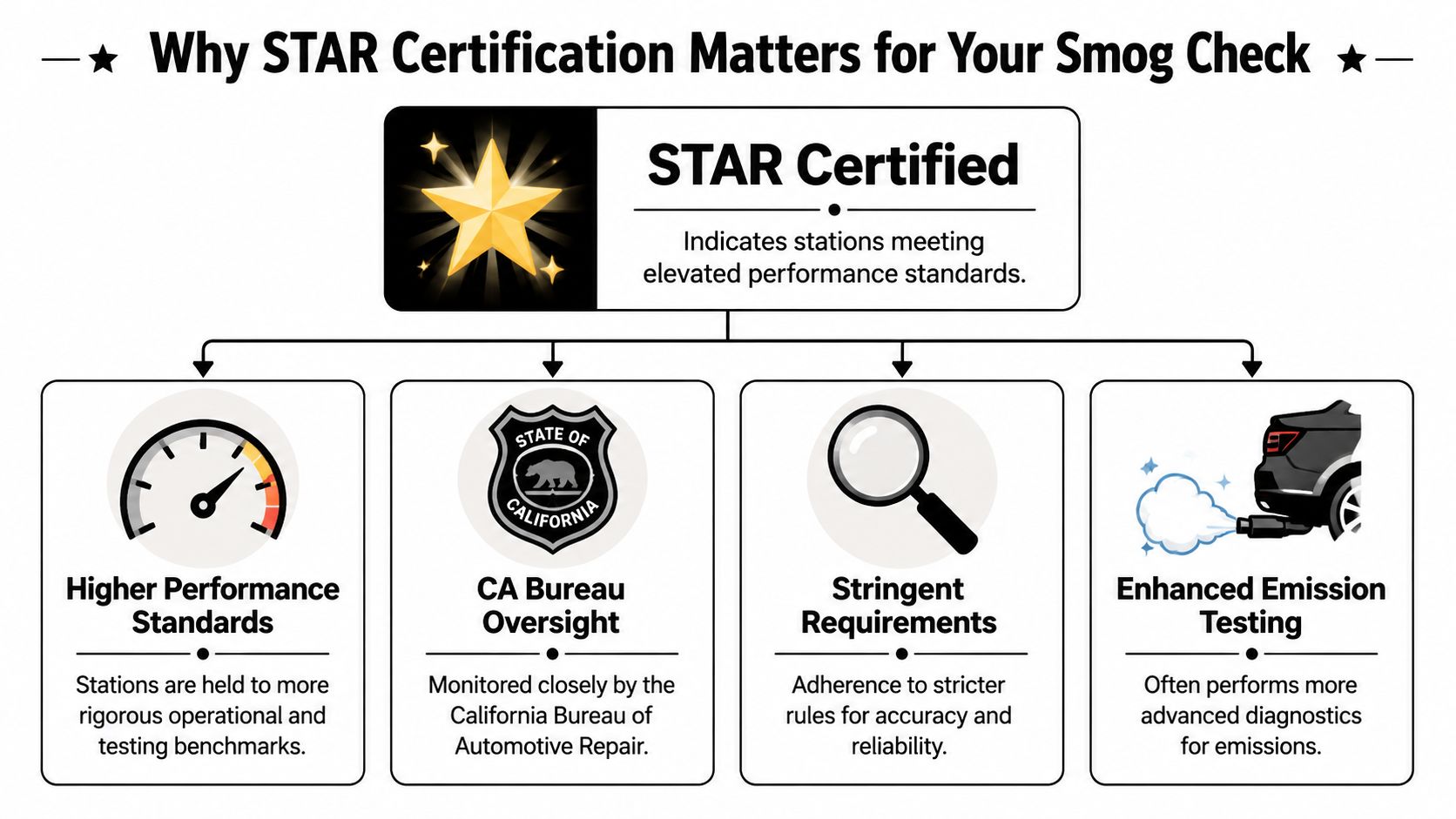
For local drivers who want the short version, this explainer on what a smog STAR station is gives the basic framework. The key takeaway is simple: if your notice points you toward a STAR station, don't get clever and try to work around it.
What STAR changes for you
A STAR station has to meet higher pass-rate thresholds, at or above 90% for vehicles tested at or above 90% of the time, which helps support DMV-recognized accuracy. That matters because the inspection isn't just about getting a sticker or a printout. It's about getting a result that fits the state's compliance system.
That higher bar is one reason many drivers prefer a STAR station even when they aren't strictly thinking about certification categories. They want the cleanest path to registration, not a side quest.
Here's the infographic version in motion if you want a quick visual explanation:
Which vehicles need more caution
Some cars are easy. Some cars are not.
- Older vehicles: Shops explicitly charge an additional fee for model-year 1999 and older vehicles because those tests are more complex.
- Vehicles with prior emissions trouble: If your car has had smog issues before, accuracy matters more than bargain hunting.
- Diesels and specialty cases: Don't assume every station handles every category the same way. Call first.
Practical rule: If your car is older, unusual, or has a history, choose for station fit first and price second.
That's where a lot of drivers lose time. They assume all smog shops are interchangeable. They aren't. For a newer daily driver, the difference may be small. For a pre-2000 vehicle or a more complicated emissions case, the wrong stop can cost you an extra trip.
A Close Look at 4 Less Smog Check Oakland
Your registration notice is due, you have 40 minutes before work, and you do not need a smog shop that turns a quick errand into half your morning. That is the test for 4 Less Smog Check Oakland. Price gets people in the door. Speed, cutoff times, and vehicle fit decide whether the stop was worth it.
4 Less has one clear advantage. It is built for routine smog work in central Oakland, not general repair. For a standard 2000-and-newer gas vehicle, that usually means a faster, more predictable visit than a shop juggling oil changes, brake jobs, and walk-in diagnostics.
What matters before you drive over
The shop sits at 2857 Broadway, Oakland, CA 94611, and the official 4 Less Smog Check Oakland website lists hours of Monday through Saturday, 9:00 AM to 5:00 PM, with a 4:30 PM cutoff for same-day completion.
That cutoff matters more than the headline price. If you show up late, or you hit the lunchtime rush, the cheap coupon stops looking cheap fast.
Public customer feedback is also strong. As noted earlier, the Yelp listing shows a high rating with a large review count. That gives this shop more credibility than a place with one low teaser price and thin customer history.
If you are comparing options by total cost, not just the ad, check current East Bay smog check deals and coupons before you leave home.
The advertised price is only part of the story
For 2000 and newer vehicles, 4 Less publicly posts $49.00 labor plus the $8.25 certificate fee. The listing also mentions a 10% coupon on labor for eligible vehicles when presented at check-in, as noted earlier.
That means your comparison should be based on the actual total, not the labor number by itself. Plenty of drivers glance at the coupon, miss the certificate fee, and assume one shop is cheaper than it really is.
Here is the practical breakdown:
- Best fit: Newer gas vehicles that usually pass without drama
- Less clear fit: 1999 and older vehicles, since pricing requires a separate quote
- Time risk: Late afternoon arrivals, especially if you need same-day completion
- Big advantage: Oakland location is convenient if Broadway is already on your route
4 Less is a good pick if your car is straightforward and you want a known Oakland STAR station with clear posted pricing for newer vehicles. I would not treat it as the automatic best choice for every car. If you drive an older vehicle, a diesel, or anything with past emissions trouble, call first and ask direct questions about price, test type, and expected wait. That two-minute call can save you a wasted trip.
Comparing 4 Less Smog Check vs Speedy Smog
The decision is often made too quickly. Customers compare one coupon to another and stop there. That's not how you should choose a smog station.
The smarter comparison is price, vehicle fit, probable wait, and the likelihood of a smooth DMV-facing result.
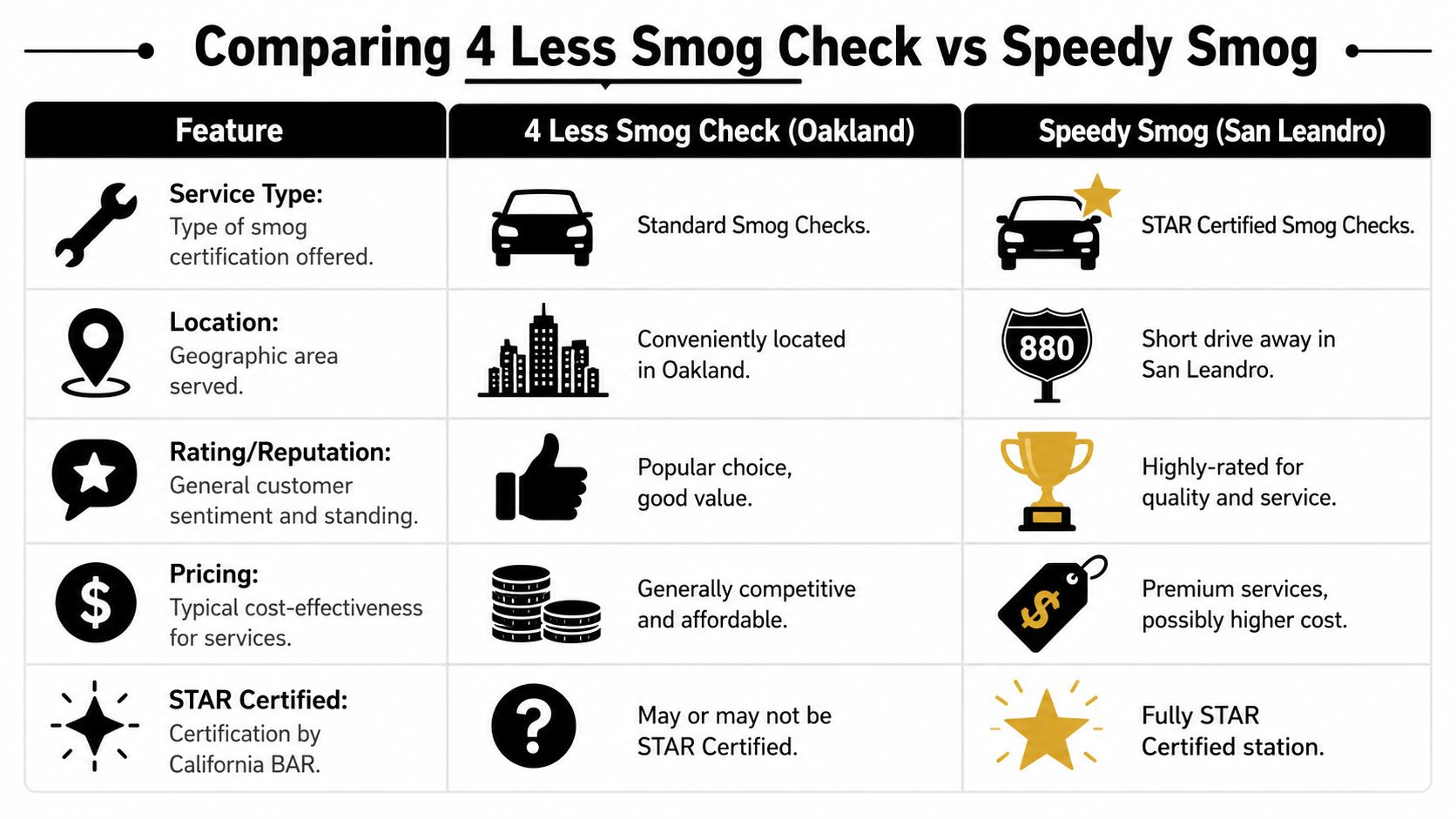
Side by side decision table
| Decision factor | 4 Less Smog Check Oakland | Speedy Smog |
|---|---|---|
| Certification | STAR-certified based on published business information | STAR-certified based on publisher information |
| Best-known fit | Clear standard pricing for 2000+ vehicles | Broad fit for newer vehicles, plus older cars, diesels, and hybrids based on publisher information |
| Location strength | Better for Oakland, Piedmont, and nearby drivers | Better if San Leandro is easier for your route |
| Published speed | Performance data shows a 15-minute average inspection duration for standard vehicles, and that aligns with efficient East Bay STAR-shop timing | Benchmark for efficient STAR shops in the East Bay is 10 to 15 minutes, as noted in the verified performance summary |
| Pricing clarity | Publicly posted newer-car labor price and certificate fee, plus coupon on labor | Coupon-oriented positioning based on publisher information |
| Main caution | Older vehicles require separate price inquiry | Check availability and exact vehicle fit before you go |
The verified performance summary says 4 Less Smog Check Oakland averages 15 minutes for standard vehicles, which aligns with the 10 to 15 minute benchmark for efficient STAR shops in the East Bay. That puts it in the right range for a fast stop when conditions are normal.
My practical take
If your vehicle is a 2000 or newer standard car, this becomes a location and timing decision more than anything else. Pick the station that's easiest to reach without fighting unnecessary traffic, and go when walk-in demand is less likely to pile up.
If your car is older, diesel, hybrid, or more specialized, I wouldn't default to the closest sign on the street. I'd choose the station whose public service positioning makes it clear they routinely handle those categories. That usually saves hassle.
A few decision rules help:
- Choose 4 Less if convenience is local: Oakland drivers often value not having to leave their immediate area.
- Don't overrate the posted coupon: A cheaper labor line means less if the shop isn't the best fit for your car.
- Think in total effort: Drive time, waiting time, and certainty matter as much as the listed price.
There are other East Bay smog stations, of course. But for most drivers, the main decision isn't between ten shops. It's between the familiar nearby option and the station that better matches their car and route.
Which Smog Station Should You Choose in 2026
The best answer depends on your car, your neighborhood, and whether you're solving a routine renewal or a deadline problem.
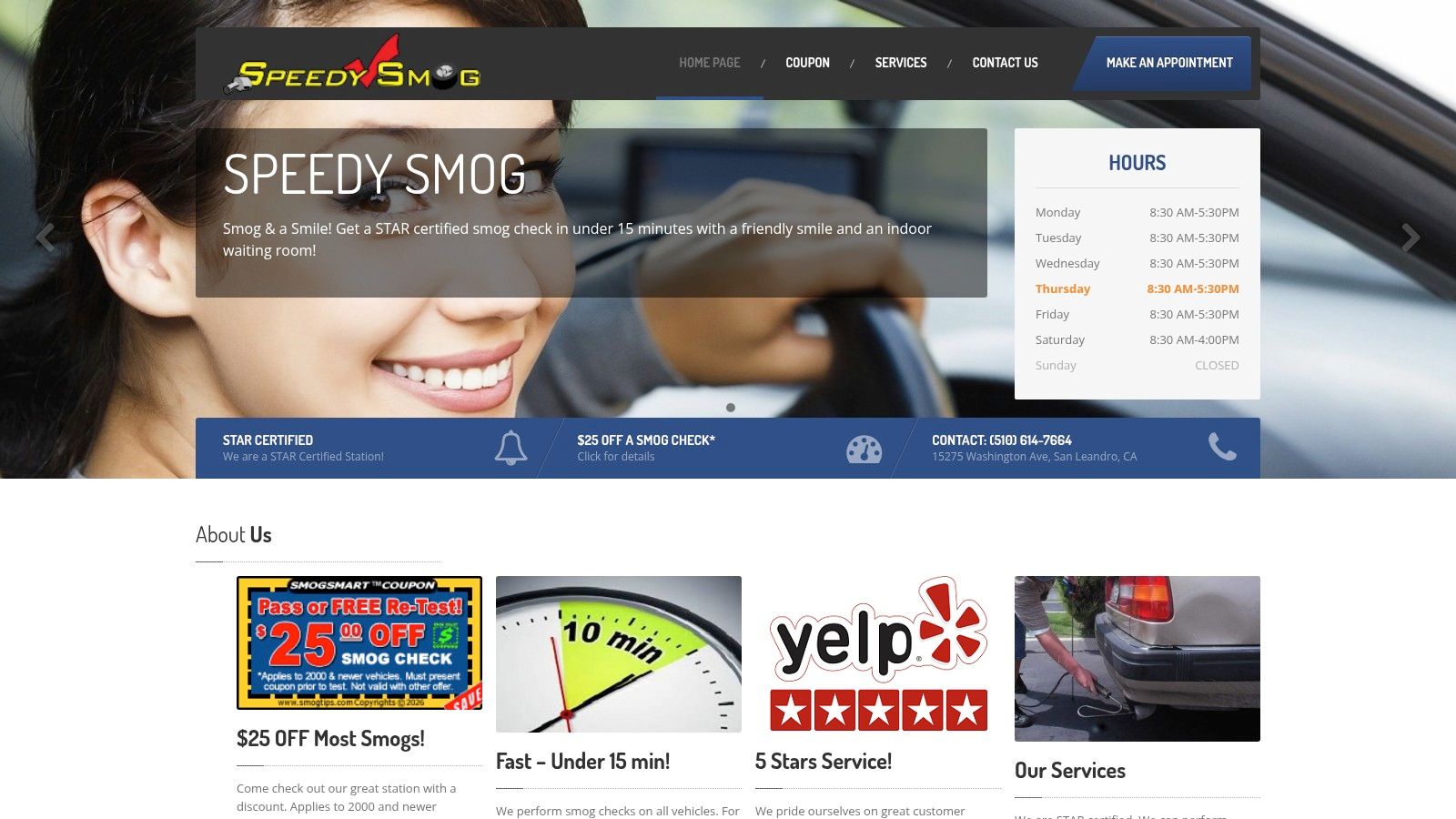
Best choice by situation
If you drive a 2000+ vehicle and you're near Broadway, 4 Less Smog Check Oakland is the practical local pick. The public pricing is clear for that vehicle group, the reputation is established, and the shop is built for routine smog traffic.
If you drive an older vehicle, don't choose based on the headline newer-car pricing because it doesn't apply to you. Call first, ask about your model year, and make sure the shop's workflow matches the extra complexity.
If your vehicle is diesel or another non-basic case, station fit matters even more. You want a shop that openly handles those vehicles, not one that leaves the details vague until you arrive.
The cheapest advertised option is only the best option when it fits your exact car.
For budget-focused drivers, the right move is to compare the real bill structure. At 4 Less, the labor and certificate fee are separate, and the coupon affects labor only. That's not bad. It's just something to understand before you decide you've found the lowest price.
For people choosing on geography, I'd keep it simple:
- Near Oakland or Piedmont: 4 Less is the obvious first look.
- Closer to San Leandro, Hayward, or along that corridor: A station on your side of the route may be the better use of time.
- On a registration deadline: Choose the place with the best chance of smooth same-day handling, not the place with the flashiest ad.
The wrong way to choose
Don't choose based on one review, one coupon image, or one assumption about wait time. Smog checks are routine until they're not. A cutoff time, an older vehicle, or a crowded walk-in window can change the whole experience.
My opinion is direct. 4 Less Smog Check Oakland is a strong everyday choice for standard newer vehicles in Oakland. It is not automatically the best answer for every car. If your situation is even slightly complicated, verify fit before you leave.
Quick Tips for a First-Time Pass
You do not want to learn this in the parking lot with a registration deadline hanging over you. The easiest way to pass on the first trip is to handle the few things that cause avoidable failures, then show up at a time that does not waste your afternoon.
Start with the car, not the coupon.
- Make sure the Check Engine light is off. If it is on, do not test yet.
- Drive the car first. A warmed-up engine usually gives you a better shot than rolling in after the car has been sitting.
- Bring your registration notice if you have it. It speeds up the counter process.
- If the battery was recently disconnected, wait until the car is ready. Fresh battery work or emissions repairs can reset monitors and turn a quick smog check into a failed trip.
Timing matters more than first-time drivers expect. The official 4 Less Smog Check Oakland website promotes fast service, but the key issue is total time, not just test time. A station can finish the inspection quickly and still cost you an hour if you walk in during a busy registration rush. Then you still have to wait for the DMV side to catch up.
That is why I would not treat a smog check like an errand to squeeze in at the last minute.
A better plan is simple:
- Go earlier in the day if you can. Walk-in traffic is easier to handle before the heavy rush.
- Do not wait until your final registration day. Leave room for the certificate to post and the DMV record to update.
- If your car is older, diesel, or recently repaired, call first. You want to confirm the shop handles your vehicle type and avoid a wasted drive.
The hidden cost is usually time, not the posted price. Ten dollars saved on a coupon means nothing if you lose an hour in line or end up making a second trip because your car was not ready.
If you want the best odds of a one-and-done visit, pick a STAR-certified station, bring a warmed-up car, and avoid peak walk-in hours. That is the practical formula.
If you want a STAR-certified option with fast East Bay service, straightforward help for common vehicle types, and a clean process from arrival to certificate, take a look at Speedy Smog. It's a smart choice for drivers who care about quick turnaround, clear pricing, and getting the job done without a second trip.
Your registration renewal notice shows up, you open it, and there it is: smog check required. For a lot of drivers in San Leandro, Oakland, and the rest of the East Bay, that line creates the same reaction. You wonder how long it will take, whether your car will pass, and whether you're about to lose half a day just to keep your tags current.
The good news is that a smog check is usually much simpler than people expect. If your car is running normally, your check engine light is off, and you go to the right emissions testing station, the process is often quick and routine. The stress usually comes from not knowing the rules, not from the test itself.
A good station doesn't just plug into your car and print paperwork. It helps you avoid delays, explains what the DMV needs, and makes sure your certification goes through correctly. If you need a local starting point, this guide to a DMV smog check near me in San Leandro is a practical place to begin.
Table of Contents
- That DMV Notice Arrived What Now
- What an Emissions Testing Station Actually Does
- Navigating California Smog Check Rules
- Why STAR Certification Matters for Your Smog Check
- Your Fast and Easy Test at Speedy Smog
- Smog Check FAQ for DMV Compliance
That DMV Notice Arrived What Now
Most drivers don't start thinking about an emissions testing station until the DMV tells them to. The common pattern is simple. You're handling regular life, the renewal notice lands in the mail, and now smog becomes today's problem.
A lot of the worry comes from old stories. Someone tells you they waited forever. Someone else says their older car failed twice. Another person says the rules changed and they're not sure what kind of station you need. By the time you search online, the task feels bigger than it is.
What works is staying practical. Check the notice, confirm that a smog certification is required, and choose a station that handles your vehicle type. If your car is newer, the visit is often straightforward. If it's older, diesel, hybrid, or flagged for a specific station type, the key is going somewhere that knows how to process it correctly the first time.
Practical rule: Don't wait until the last day on your renewal. If there's a problem like an active check engine light or incomplete readiness monitors, you'll want time to fix it without rushing.
Customers usually have the smoothest experience when they do three simple things first:
- Read the DMV notice carefully so you know whether a smog check is part of renewal.
- Make sure the check engine light isn't on before you head in.
- Bring basic registration information so the station can match the vehicle correctly.
The station's job is to test, report, and help you stay compliant. Your job is mostly to arrive with the right vehicle information and enough time to handle any surprises calmly.
What an Emissions Testing Station Actually Does
An emissions testing station checks whether your car's pollution control system is doing its job. The easiest way to think about it is this: your engine can run fine and still produce more pollution than it should. A smog check catches that gap.
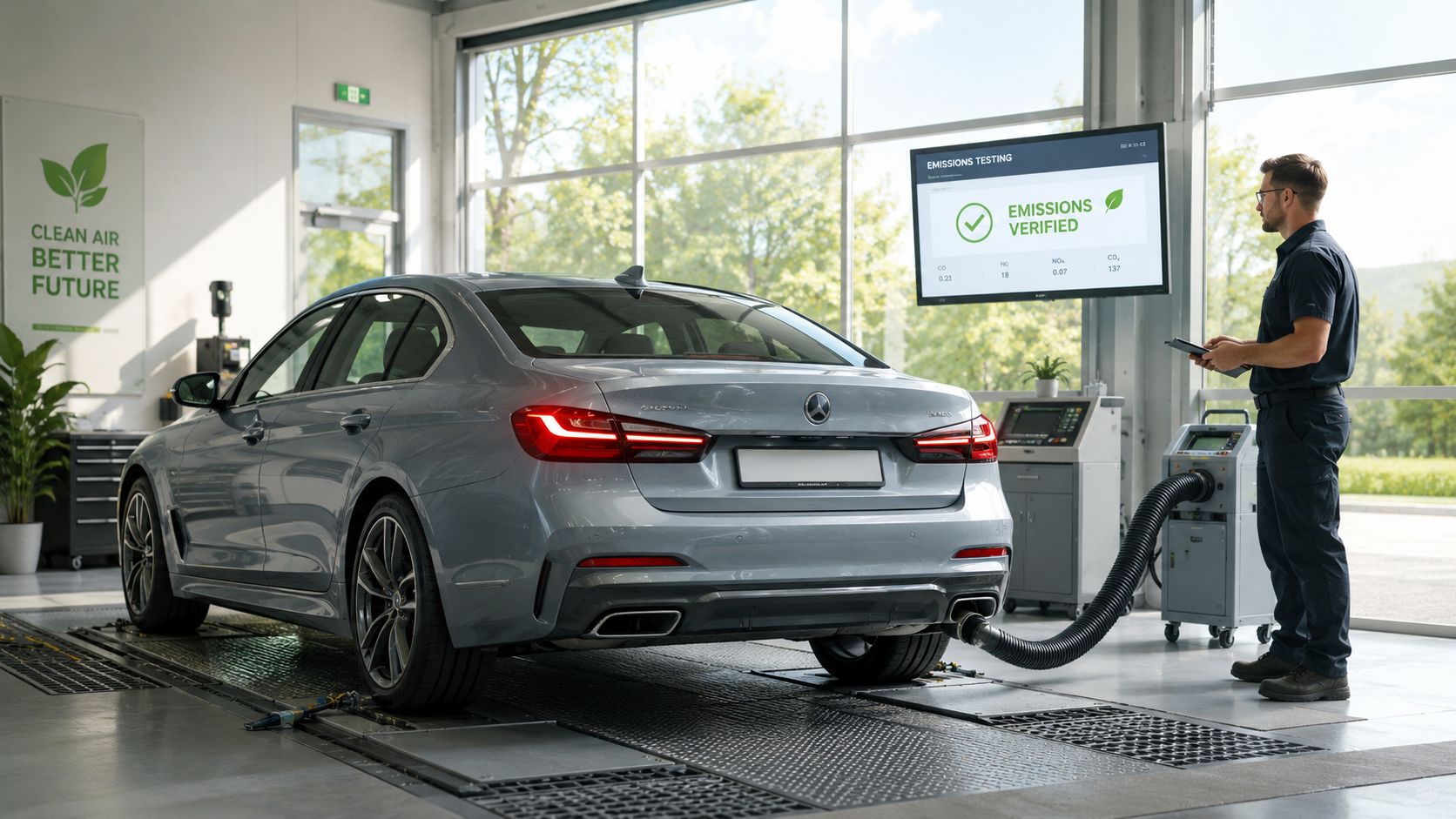
If you want a broader walkthrough before your visit, this page on what you need to know about an emission testing station covers the basics in plain language.
It's a health check for your car's emissions system
Modern vehicles rely on a group of components to keep emissions in check. That includes sensors, computer controls, the catalytic converter, and other related hardware. When those parts work together properly, the vehicle stays within legal standards. When one part starts to fail, the vehicle may still drive, but it may not comply.
The emissions test is more than just paperwork. It's part of how states keep higher-polluting vehicles from remaining on the road for years without correction. Connecticut's emissions program, for example, tests approximately 1.3 million vehicles annually through over 200 privately owned automotive service stations, with testing required every two years according to the Connecticut Emissions Program.
What technicians are looking for
At the station level, accuracy depends on equipment and setup. One technical issue many drivers never see is airflow. In a properly designed test cell, controlled airflow helps prevent eddy currents that can skew gas and particulate readings. Industry guidance commonly places the test cell at about 10 to 12 feet in width to balance equipment space with stable airflow conditions. When that environment is off, readings can become less reliable.
Technicians are looking for signs that the car's emissions controls are functioning the way the manufacturer intended. Depending on the vehicle, that may involve an OBD system check, direct exhaust measurement, or other inspection steps.
A few common reasons cars run into trouble include:
- Stored fault information that points to an emissions-related problem.
- A malfunction indicator light that tells the system something isn't right.
- Component issues such as sensor faults or catalyst-related problems.
- Tampering or missing equipment that prevents a legal inspection result.
A smog check isn't about whether your car feels fine on the freeway. It's about whether the emissions system can prove it's working correctly.
Good stations don't guess. They use approved analyzers, follow the proper test mode, and make sure the result the DMV receives is based on an actual compliant inspection, not a shortcut.
Navigating California Smog Check Rules
California drivers usually don't struggle with the idea of smog testing. They struggle with the details. The biggest questions are usually who needs the test, which kind of test applies, and why one vehicle is in and out quickly while another takes longer.
To make the process easier to visualize, here's a simple flow of how the California smog process works.
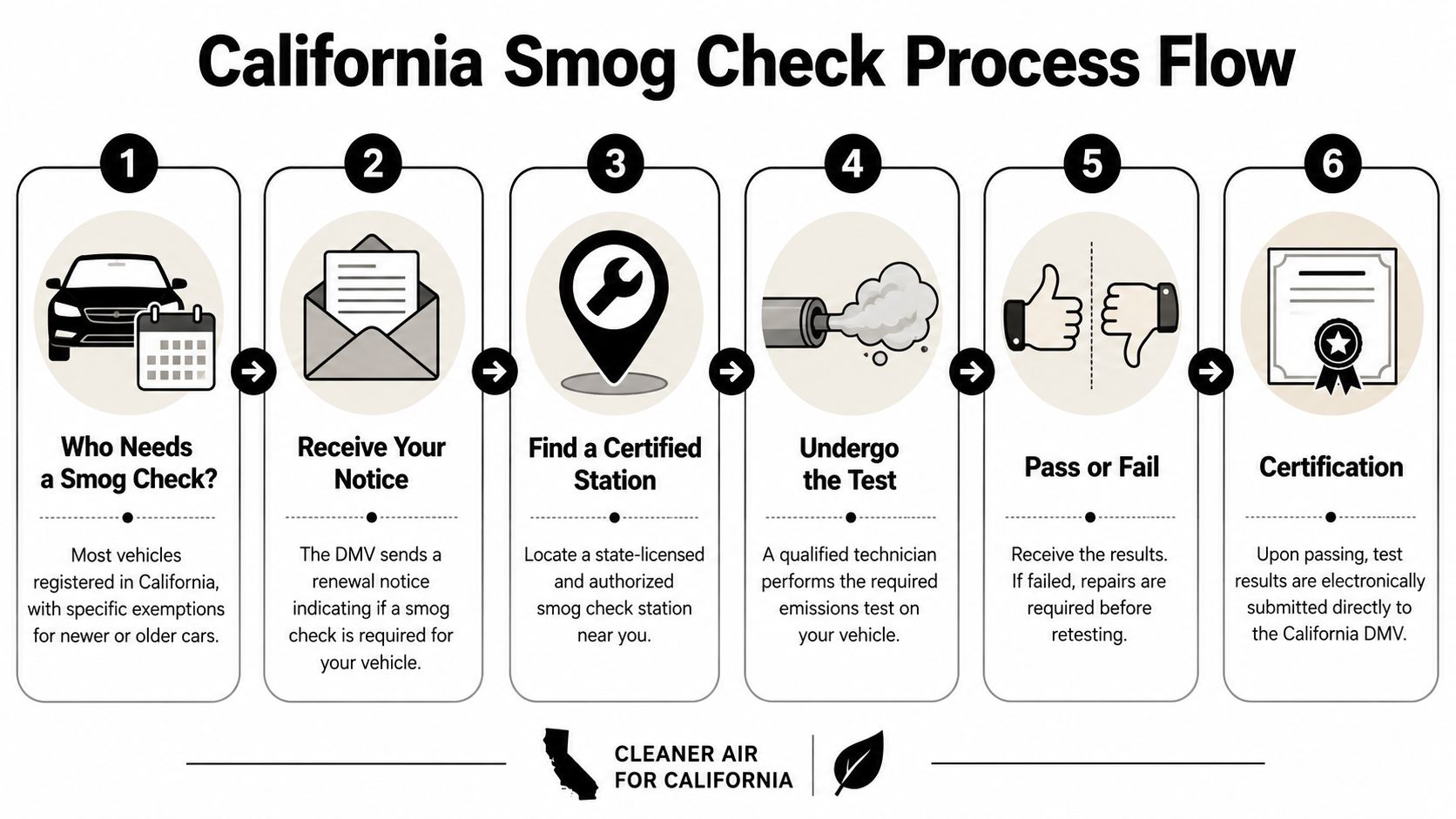
California's process often feels complicated until you break it into the actual steps a driver follows. After you receive notice, the main task is choosing a certified station that can perform the right inspection for your vehicle.
The test your car gets depends on its model year
For vehicles model year 2000 and newer, the test primarily relies on an On-Board Diagnostic (OBD) system check. Approved analyzers must evaluate the vehicle's emission control system to ensure it operates per the manufacturer's specifications. This method is much faster and is typically completed in 10 to 15 minutes.
That's why a newer Toyota, Honda, Ford, or Chevy often moves through an emissions testing station quickly if there are no warning lights and the monitors are ready. The station connects approved equipment, checks the system status, and verifies compliance.
Older vehicles can be a different story. They may require a different testing method and more hands-on time. That doesn't mean there's automatically a problem. It just means the process is less plug-and-go than it is for newer cars.
Later in the visit, many drivers find this video helpful because it shows the process in a more familiar format:
What usually triggers a smog check
In practical terms, California drivers most often deal with smog checks during registration renewal or ownership transfer. Your DMV notice usually tells you whether certification is required for that cycle. That notice matters more than guesswork or what happened with a different car last year.
Here's the part drivers should keep in mind before heading in:
- Newer cars are usually faster to test because the inspection is largely OBD-based.
- Older vehicles may need more time because the inspection method can differ.
- The right station matters if your vehicle has a special designation or category.
- A recently cleared code can create delay because the system may not be ready for testing.
Delaware offers a good reminder that inspection schedules vary widely by state. There, safety and emissions inspections are mandatory every two years for automobiles and trucks with a GVWR of 8,500 pounds or less, and over 90% of vehicles registered in the state are subject to that biennial requirement according to this state inspection overview from Kelley Blue Book. California drivers should avoid assuming another state's rule applies locally.
Why STAR Certification Matters for Your Smog Check
A lot of drivers see the STAR sign and assume it's just branding. It isn't. STAR certification tells you the station meets higher performance standards under California's smog program.
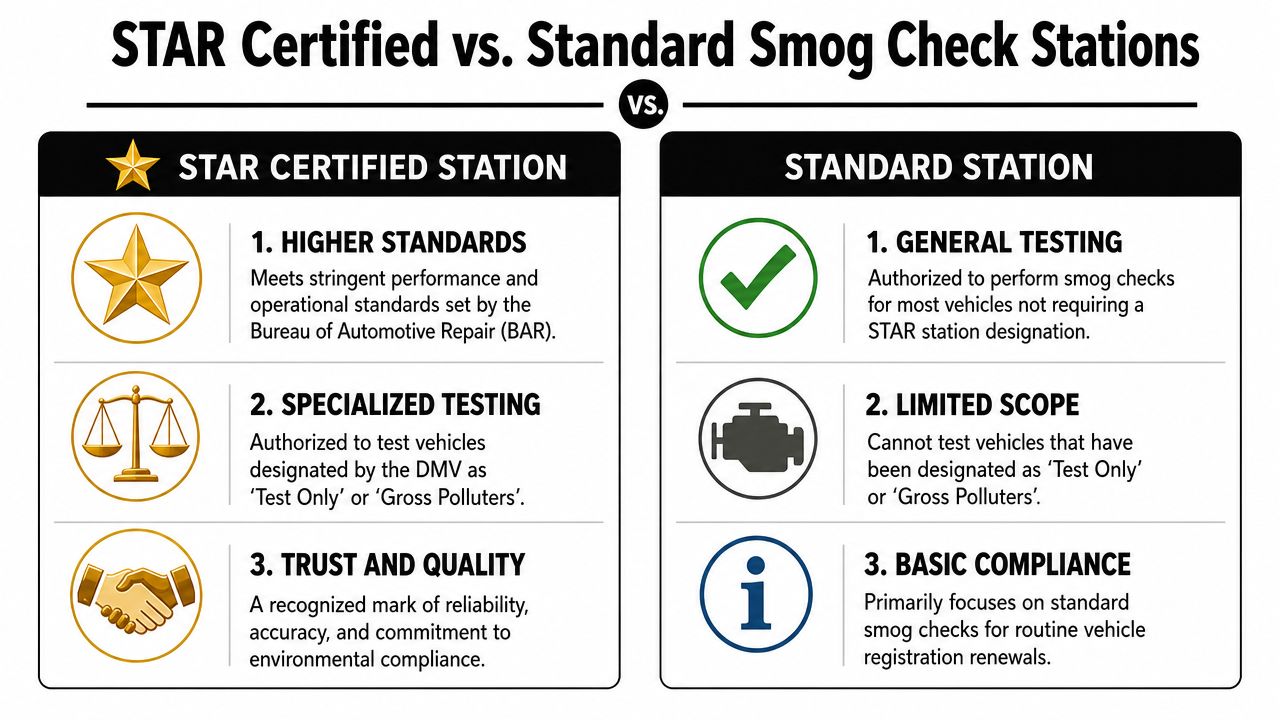
If you've never had to deal with this before, this explainer on what a smog STAR station is gives a useful overview.
Standard station versus STAR station
A standard station can handle many routine smog checks. For plenty of drivers, that's enough. But STAR stations operate under tighter expectations, and that matters when your vehicle's test status requires that higher level of authorization.
The practical difference looks like this:
| Station Type | What It Usually Means for the Driver |
|---|---|
| Standard smog station | Suitable for many routine inspections when the DMV doesn't require STAR designation |
| STAR certified station | Meets higher program standards and can handle vehicles that are specifically directed to a STAR location |
That second category is where many people get tripped up. They show up at the wrong place, only to find out their notice requires a STAR-certified emissions testing station.
When STAR is the safer choice
If your DMV paperwork directs you to a STAR station, that isn't optional. You need the inspection done at an authorized location that can submit a valid result the DMV will accept.
Even when STAR isn't specifically required, some drivers prefer it because it removes uncertainty. A STAR-certified station can handle regular smog checks and also covers the cases where the DMV has stricter routing for the vehicle.
Go by what the DMV notice says, not by what worked for a neighbor's car. Two vehicles parked in the same driveway may not have the same station requirement.
In practice, choosing a STAR station can save a repeat trip. That matters more than any small difference in convenience because the main time-waster is having the wrong test done at the wrong facility.
Your Fast and Easy Test at Speedy Smog
For East Bay drivers who want a local STAR-certified option, Speedy Smog operates at 15275 Washington Ave, San Leandro, CA 94579 and handles inspections for many common vehicle categories, including newer vehicles, older vehicles, diesels, and hybrids. The ideal experience is simple: show up, confirm the vehicle information, complete the inspection, and have the result sent correctly for DMV purposes.
What to bring and what to expect
Bring your DMV renewal notice if you have it. If you don't, bring your registration information so the vehicle can be identified correctly. The goal is to avoid any mismatch in records that could slow down certification.
For many modern vehicles, the process is straightforward. The technician checks the vehicle information, connects the approved analyzer, runs the required test, and submits the result electronically if the vehicle passes. For 2000 and newer vehicles, OBD-based testing typically takes about 10 to 15 minutes, which is one reason newer cars move through quickly.
A few habits make the visit smoother:
- Drive the car before the test so it isn't arriving stone cold.
- Don't disconnect the battery right before inspection because that can interfere with readiness status.
- Handle check engine light issues first instead of hoping they won't matter.
- Keep your paperwork handy so the front counter can get you checked in quickly.
The fastest smog check is the one where the car arrives with no warning lights, no recent code clearing, and complete vehicle information.
The shop is also set up for the part drivers care about once the car is in line: waiting without hassle. A clean indoor waiting room makes a routine stop feel more manageable, especially when you're squeezing the visit between work, school pickup, or other errands.
Vehicle types commonly tested
Not every station handles the same mix of vehicles with the same confidence. That matters if you drive something outside the most common late-model gas sedan.
Typical categories include:
- 2000 and newer gasoline vehicles that use OBD-based testing.
- 1999 and older vehicles that may require a different inspection process.
- Diesel vehicles that need the proper test path and station capability.
- Hybrids that still require compliant inspection when applicable.
The trade-off is simple. Newer vehicles tend to be quicker when the onboard systems are healthy. Older or more specialized vehicles may need more technician time and a little more patience from the owner.
Speedy Smog San Leandro Services and Pricing 2026
The shop describes its pricing as transparent and notes periodic coupons for many newer-vehicle smog checks. Because coupon availability can change, it's smart to confirm current pricing before you go.
| Vehicle Type | Typical Price | Notes |
|---|---|---|
| 2000 and newer vehicles | Varies | Periodic $25-off coupon may apply for most smogs on newer vehicles |
| 1999 and older vehicles | Varies | May take longer depending on vehicle and required test method |
| Diesel vehicles | Varies | Confirm applicability and testing requirements before arrival |
| Hybrid vehicles | Varies | Subject to California testing rules for that vehicle category |
The big practical advantage is knowing what kind of visit you're walking into. If your vehicle is newer and in good shape, expect a short stop. If it's older or has a known issue, expect a little more discussion and possibly a next-step plan if the vehicle doesn't pass on the first attempt.
Smog Check FAQ for DMV Compliance
The part that worries drivers most usually starts after the test, especially if the vehicle doesn't pass. Here are the questions that come up most often at the counter.
What happens if my car fails
First, don't panic. A failed smog check doesn't automatically mean the car is done for or that you can't ever register it. It means the vehicle didn't meet the required standard on that visit.
The next step is to look at the test result and identify the reason for failure. In practical terms, that could point toward an onboard fault, readiness issue, or another emissions-related problem that needs repair. Once the cause is corrected, the vehicle can be retested.
What doesn't work is guessing. Swapping random parts gets expensive fast. The better approach is diagnosis first, repair second, then return when the vehicle is ready.
What is a repair waiver
Many drivers don't realize there may be a legal path forward even after a failed emissions result. In states like California, a repair waiver may be available if the vehicle fails the emissions test but passes the safety inspection, and if documented repair costs exceed a specific dollar threshold.
One specific threshold appears in North Carolina guidance, where a waiver is issued only if the vehicle fails the onboard diagnostic analysis, passes the safety inspection, and has documented repair costs of at least $200. That's the nuance drivers often miss. A waiver is not the same thing as a passing test, and it usually depends on meeting narrow program requirements.
If your car fails, ask about your actual options before authorizing major work. A waiver, retest path, or repair documentation requirement may apply differently depending on the program rules involved.
The practical lesson is this: don't assume failure ends the process. It may start a different compliance path.
How long does the process usually take
For a newer vehicle, the test itself is often quick if everything is in order. As noted earlier, OBD-based testing for 2000 and newer vehicles is typically finished in 10 to 15 minutes.
Older vehicles, special cases, and problem vehicles can take longer. The difference in time usually comes from vehicle condition, not from the act of plugging in the test equipment.
If you want the shortest possible visit, do these before you leave home:
- Check for a warning light. If it's on, deal with that first.
- Drive the vehicle normally beforehand. Don't arrive right after clearing codes or disconnecting power.
- Bring your registration paperwork. It prevents simple front-desk slowdowns.
If your DMV renewal is due and you want a straightforward local option, Speedy Smog provides STAR-certified smog checks in San Leandro for many common vehicle types, including newer cars, older vehicles, diesels, and hybrids. It's a practical choice when you need accurate testing, a quick visit for many 2000-and-newer vehicles, and proper DMV submission without extra guesswork.