
Your registration renewal notice shows up, you open it, and there it is: smog check required. For a lot of drivers in San Leandro, Oakland, and the rest of the East Bay, that line creates the same reaction. You wonder how long it will take, whether your car will pass, and whether you're about to lose half a day just to keep your tags current.
The good news is that a smog check is usually much simpler than people expect. If your car is running normally, your check engine light is off, and you go to the right emissions testing station, the process is often quick and routine. The stress usually comes from not knowing the rules, not from the test itself.
A good station doesn't just plug into your car and print paperwork. It helps you avoid delays, explains what the DMV needs, and makes sure your certification goes through correctly. If you need a local starting point, this guide to a DMV smog check near me in San Leandro is a practical place to begin.
Table of Contents
- That DMV Notice Arrived What Now
- What an Emissions Testing Station Actually Does
- Navigating California Smog Check Rules
- Why STAR Certification Matters for Your Smog Check
- Your Fast and Easy Test at Speedy Smog
- Smog Check FAQ for DMV Compliance
That DMV Notice Arrived What Now
Most drivers don't start thinking about an emissions testing station until the DMV tells them to. The common pattern is simple. You're handling regular life, the renewal notice lands in the mail, and now smog becomes today's problem.
A lot of the worry comes from old stories. Someone tells you they waited forever. Someone else says their older car failed twice. Another person says the rules changed and they're not sure what kind of station you need. By the time you search online, the task feels bigger than it is.
What works is staying practical. Check the notice, confirm that a smog certification is required, and choose a station that handles your vehicle type. If your car is newer, the visit is often straightforward. If it's older, diesel, hybrid, or flagged for a specific station type, the key is going somewhere that knows how to process it correctly the first time.
Practical rule: Don't wait until the last day on your renewal. If there's a problem like an active check engine light or incomplete readiness monitors, you'll want time to fix it without rushing.
Customers usually have the smoothest experience when they do three simple things first:
- Read the DMV notice carefully so you know whether a smog check is part of renewal.
- Make sure the check engine light isn't on before you head in.
- Bring basic registration information so the station can match the vehicle correctly.
The station's job is to test, report, and help you stay compliant. Your job is mostly to arrive with the right vehicle information and enough time to handle any surprises calmly.
What an Emissions Testing Station Actually Does
An emissions testing station checks whether your car's pollution control system is doing its job. The easiest way to think about it is this: your engine can run fine and still produce more pollution than it should. A smog check catches that gap.
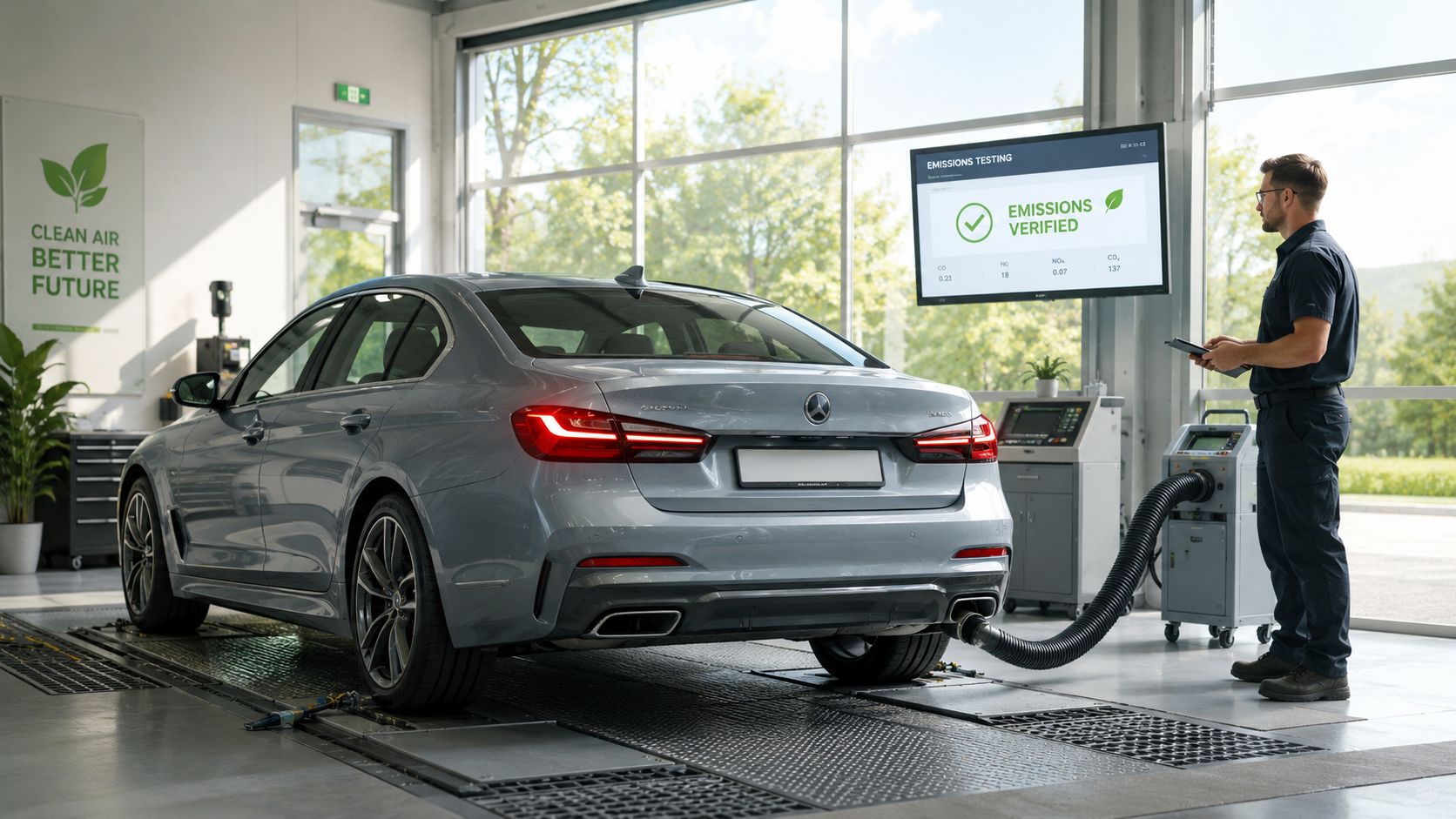
If you want a broader walkthrough before your visit, this page on what you need to know about an emission testing station covers the basics in plain language.
It's a health check for your car's emissions system
Modern vehicles rely on a group of components to keep emissions in check. That includes sensors, computer controls, the catalytic converter, and other related hardware. When those parts work together properly, the vehicle stays within legal standards. When one part starts to fail, the vehicle may still drive, but it may not comply.
The emissions test is more than just paperwork. It's part of how states keep higher-polluting vehicles from remaining on the road for years without correction. Connecticut's emissions program, for example, tests approximately 1.3 million vehicles annually through over 200 privately owned automotive service stations, with testing required every two years according to the Connecticut Emissions Program.
What technicians are looking for
At the station level, accuracy depends on equipment and setup. One technical issue many drivers never see is airflow. In a properly designed test cell, controlled airflow helps prevent eddy currents that can skew gas and particulate readings. Industry guidance commonly places the test cell at about 10 to 12 feet in width to balance equipment space with stable airflow conditions. When that environment is off, readings can become less reliable.
Technicians are looking for signs that the car's emissions controls are functioning the way the manufacturer intended. Depending on the vehicle, that may involve an OBD system check, direct exhaust measurement, or other inspection steps.
A few common reasons cars run into trouble include:
- Stored fault information that points to an emissions-related problem.
- A malfunction indicator light that tells the system something isn't right.
- Component issues such as sensor faults or catalyst-related problems.
- Tampering or missing equipment that prevents a legal inspection result.
A smog check isn't about whether your car feels fine on the freeway. It's about whether the emissions system can prove it's working correctly.
Good stations don't guess. They use approved analyzers, follow the proper test mode, and make sure the result the DMV receives is based on an actual compliant inspection, not a shortcut.
Navigating California Smog Check Rules
California drivers usually don't struggle with the idea of smog testing. They struggle with the details. The biggest questions are usually who needs the test, which kind of test applies, and why one vehicle is in and out quickly while another takes longer.
To make the process easier to visualize, here's a simple flow of how the California smog process works.
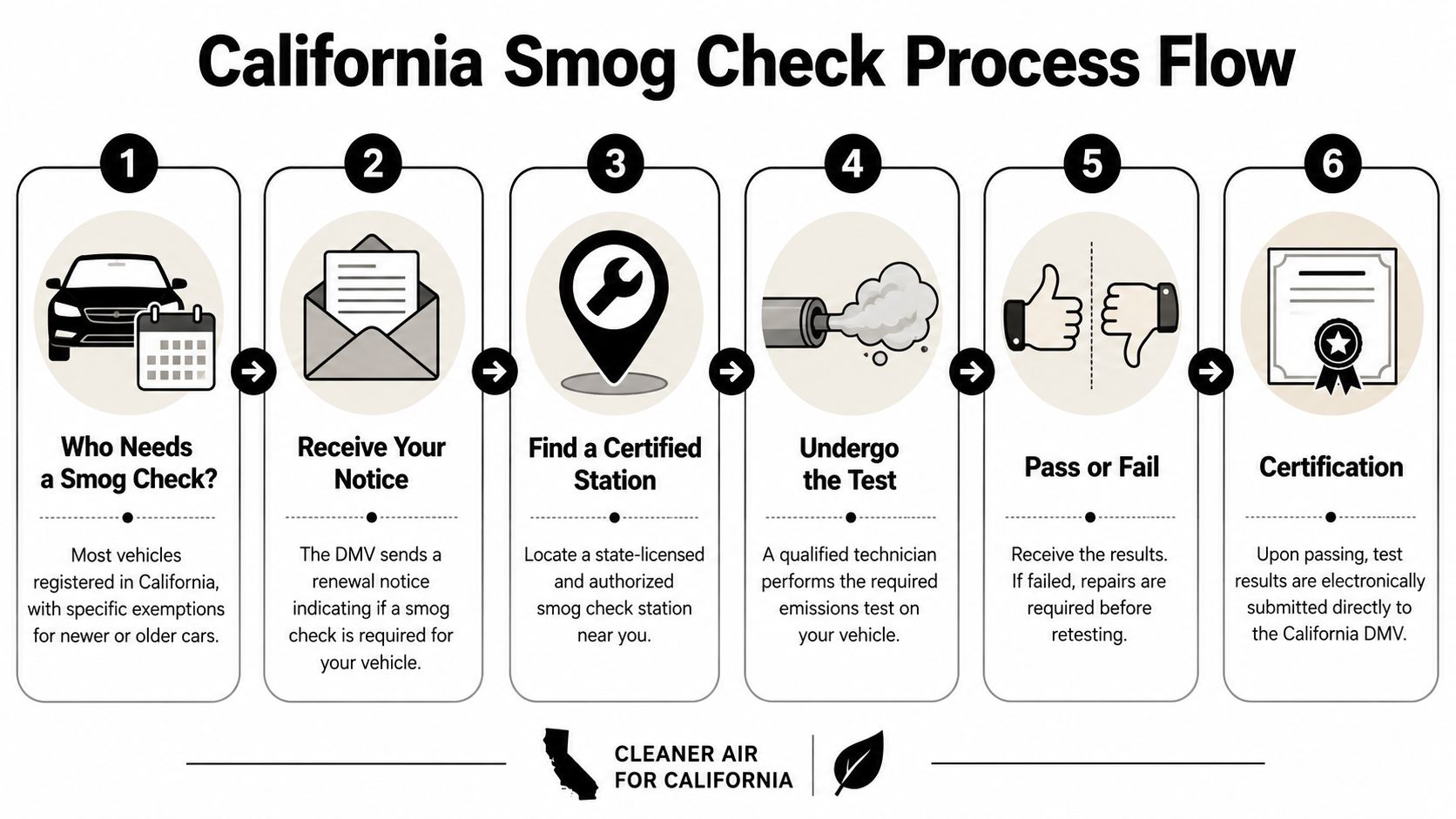
California's process often feels complicated until you break it into the actual steps a driver follows. After you receive notice, the main task is choosing a certified station that can perform the right inspection for your vehicle.
The test your car gets depends on its model year
For vehicles model year 2000 and newer, the test primarily relies on an On-Board Diagnostic (OBD) system check. Approved analyzers must evaluate the vehicle's emission control system to ensure it operates per the manufacturer's specifications. This method is much faster and is typically completed in 10 to 15 minutes.
That's why a newer Toyota, Honda, Ford, or Chevy often moves through an emissions testing station quickly if there are no warning lights and the monitors are ready. The station connects approved equipment, checks the system status, and verifies compliance.
Older vehicles can be a different story. They may require a different testing method and more hands-on time. That doesn't mean there's automatically a problem. It just means the process is less plug-and-go than it is for newer cars.
Later in the visit, many drivers find this video helpful because it shows the process in a more familiar format:
What usually triggers a smog check
In practical terms, California drivers most often deal with smog checks during registration renewal or ownership transfer. Your DMV notice usually tells you whether certification is required for that cycle. That notice matters more than guesswork or what happened with a different car last year.
Here's the part drivers should keep in mind before heading in:
- Newer cars are usually faster to test because the inspection is largely OBD-based.
- Older vehicles may need more time because the inspection method can differ.
- The right station matters if your vehicle has a special designation or category.
- A recently cleared code can create delay because the system may not be ready for testing.
Delaware offers a good reminder that inspection schedules vary widely by state. There, safety and emissions inspections are mandatory every two years for automobiles and trucks with a GVWR of 8,500 pounds or less, and over 90% of vehicles registered in the state are subject to that biennial requirement according to this state inspection overview from Kelley Blue Book. California drivers should avoid assuming another state's rule applies locally.
Why STAR Certification Matters for Your Smog Check
A lot of drivers see the STAR sign and assume it's just branding. It isn't. STAR certification tells you the station meets higher performance standards under California's smog program.
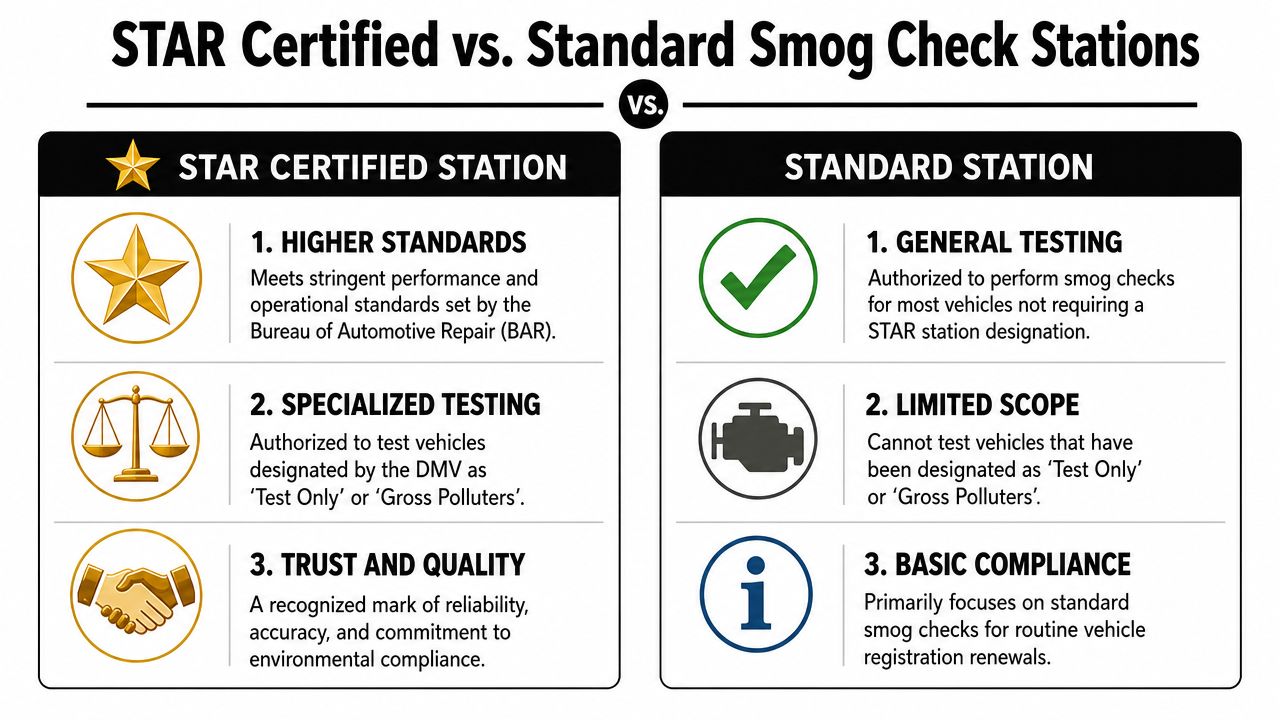
If you've never had to deal with this before, this explainer on what a smog STAR station is gives a useful overview.
Standard station versus STAR station
A standard station can handle many routine smog checks. For plenty of drivers, that's enough. But STAR stations operate under tighter expectations, and that matters when your vehicle's test status requires that higher level of authorization.
The practical difference looks like this:
| Station Type | What It Usually Means for the Driver |
|---|---|
| Standard smog station | Suitable for many routine inspections when the DMV doesn't require STAR designation |
| STAR certified station | Meets higher program standards and can handle vehicles that are specifically directed to a STAR location |
That second category is where many people get tripped up. They show up at the wrong place, only to find out their notice requires a STAR-certified emissions testing station.
When STAR is the safer choice
If your DMV paperwork directs you to a STAR station, that isn't optional. You need the inspection done at an authorized location that can submit a valid result the DMV will accept.
Even when STAR isn't specifically required, some drivers prefer it because it removes uncertainty. A STAR-certified station can handle regular smog checks and also covers the cases where the DMV has stricter routing for the vehicle.
Go by what the DMV notice says, not by what worked for a neighbor's car. Two vehicles parked in the same driveway may not have the same station requirement.
In practice, choosing a STAR station can save a repeat trip. That matters more than any small difference in convenience because the main time-waster is having the wrong test done at the wrong facility.
Your Fast and Easy Test at Speedy Smog
For East Bay drivers who want a local STAR-certified option, Speedy Smog operates at 15275 Washington Ave, San Leandro, CA 94579 and handles inspections for many common vehicle categories, including newer vehicles, older vehicles, diesels, and hybrids. The ideal experience is simple: show up, confirm the vehicle information, complete the inspection, and have the result sent correctly for DMV purposes.
What to bring and what to expect
Bring your DMV renewal notice if you have it. If you don't, bring your registration information so the vehicle can be identified correctly. The goal is to avoid any mismatch in records that could slow down certification.
For many modern vehicles, the process is straightforward. The technician checks the vehicle information, connects the approved analyzer, runs the required test, and submits the result electronically if the vehicle passes. For 2000 and newer vehicles, OBD-based testing typically takes about 10 to 15 minutes, which is one reason newer cars move through quickly.
A few habits make the visit smoother:
- Drive the car before the test so it isn't arriving stone cold.
- Don't disconnect the battery right before inspection because that can interfere with readiness status.
- Handle check engine light issues first instead of hoping they won't matter.
- Keep your paperwork handy so the front counter can get you checked in quickly.
The fastest smog check is the one where the car arrives with no warning lights, no recent code clearing, and complete vehicle information.
The shop is also set up for the part drivers care about once the car is in line: waiting without hassle. A clean indoor waiting room makes a routine stop feel more manageable, especially when you're squeezing the visit between work, school pickup, or other errands.
Vehicle types commonly tested
Not every station handles the same mix of vehicles with the same confidence. That matters if you drive something outside the most common late-model gas sedan.
Typical categories include:
- 2000 and newer gasoline vehicles that use OBD-based testing.
- 1999 and older vehicles that may require a different inspection process.
- Diesel vehicles that need the proper test path and station capability.
- Hybrids that still require compliant inspection when applicable.
The trade-off is simple. Newer vehicles tend to be quicker when the onboard systems are healthy. Older or more specialized vehicles may need more technician time and a little more patience from the owner.
Speedy Smog San Leandro Services and Pricing 2026
The shop describes its pricing as transparent and notes periodic coupons for many newer-vehicle smog checks. Because coupon availability can change, it's smart to confirm current pricing before you go.
| Vehicle Type | Typical Price | Notes |
|---|---|---|
| 2000 and newer vehicles | Varies | Periodic $25-off coupon may apply for most smogs on newer vehicles |
| 1999 and older vehicles | Varies | May take longer depending on vehicle and required test method |
| Diesel vehicles | Varies | Confirm applicability and testing requirements before arrival |
| Hybrid vehicles | Varies | Subject to California testing rules for that vehicle category |
The big practical advantage is knowing what kind of visit you're walking into. If your vehicle is newer and in good shape, expect a short stop. If it's older or has a known issue, expect a little more discussion and possibly a next-step plan if the vehicle doesn't pass on the first attempt.
Smog Check FAQ for DMV Compliance
The part that worries drivers most usually starts after the test, especially if the vehicle doesn't pass. Here are the questions that come up most often at the counter.
What happens if my car fails
First, don't panic. A failed smog check doesn't automatically mean the car is done for or that you can't ever register it. It means the vehicle didn't meet the required standard on that visit.
The next step is to look at the test result and identify the reason for failure. In practical terms, that could point toward an onboard fault, readiness issue, or another emissions-related problem that needs repair. Once the cause is corrected, the vehicle can be retested.
What doesn't work is guessing. Swapping random parts gets expensive fast. The better approach is diagnosis first, repair second, then return when the vehicle is ready.
What is a repair waiver
Many drivers don't realize there may be a legal path forward even after a failed emissions result. In states like California, a repair waiver may be available if the vehicle fails the emissions test but passes the safety inspection, and if documented repair costs exceed a specific dollar threshold.
One specific threshold appears in North Carolina guidance, where a waiver is issued only if the vehicle fails the onboard diagnostic analysis, passes the safety inspection, and has documented repair costs of at least $200. That's the nuance drivers often miss. A waiver is not the same thing as a passing test, and it usually depends on meeting narrow program requirements.
If your car fails, ask about your actual options before authorizing major work. A waiver, retest path, or repair documentation requirement may apply differently depending on the program rules involved.
The practical lesson is this: don't assume failure ends the process. It may start a different compliance path.
How long does the process usually take
For a newer vehicle, the test itself is often quick if everything is in order. As noted earlier, OBD-based testing for 2000 and newer vehicles is typically finished in 10 to 15 minutes.
Older vehicles, special cases, and problem vehicles can take longer. The difference in time usually comes from vehicle condition, not from the act of plugging in the test equipment.
If you want the shortest possible visit, do these before you leave home:
- Check for a warning light. If it's on, deal with that first.
- Drive the vehicle normally beforehand. Don't arrive right after clearing codes or disconnecting power.
- Bring your registration paperwork. It prevents simple front-desk slowdowns.
If your DMV renewal is due and you want a straightforward local option, Speedy Smog provides STAR-certified smog checks in San Leandro for many common vehicle types, including newer cars, older vehicles, diesels, and hybrids. It's a practical choice when you need accurate testing, a quick visit for many 2000-and-newer vehicles, and proper DMV submission without extra guesswork.