
Smog Check Pleasanton CA: Pass Your 2026 Inspection
You open your registration renewal, scan for the amount due, and then see the line that changes your whole errand list: smog certification required. For a lot of Pleasanton drivers, that's the moment the questions start. Is this a routine test? Do you need a STAR station? Will the check engine light sink the whole visit? Can you knock it out fast without bouncing between shops?
That's where most local guides fall short. They list addresses, maybe mention coupons, and leave out the part that matters: how the inspection works, what causes avoidable failures, and why the right station choice can save a wasted trip. If you're searching for smog check Pleasanton CA, the smart move isn't always the closest shop. Sometimes it's the one that handles your vehicle type correctly the first time.
Table of Contents
- Your DMV Notice Says Smog Check Required Now What
- California Smog Rules for Pleasanton Drivers
- STAR Certified Or Regular Smog Station Which Do You Need
- How to Prepare for and Pass Your Smog Check
- Smog Check Options Near Pleasanton And Why We Recommend Speedy Smog
- Get Your Smog Certificate And Get Back On The Road
Your DMV Notice Says Smog Check Required Now What
A common Pleasanton scenario goes like this. Your tags are due soon, you've got work, school pickup, and errands stacked up, and now the DMV wants a smog check before registration can move forward. Most drivers aren't worried about the test itself. They're worried about wasting half a day on something that should've been simple.
The good news is that a smog check usually becomes stressful for predictable reasons. People go in with the check engine light on, they show up right after a battery replacement, or they don't realize their vehicle needs a different type of station than the one down the street. Those are the mistakes that turn a short visit into a repeat visit.
Practical rule: Treat your smog check like a compliance inspection, not a casual oil change stop. A little prep matters.
If you're looking up smog check Pleasanton CA, you probably need answers to three things right away:
- What the state is asking for
- How to avoid an automatic fail
- Where to go so the result counts the first time
For most drivers, the process is manageable once the jargon gets translated into plain English. You don't need to become an emissions expert. You just need to know whether your car is routine or STAR-directed, whether your onboard system is ready, and whether the shop you choose handles your vehicle type well.
That's especially important for newer vehicles, hybrids, and cars with any recent repair history. Those are the vehicles that often look fine to the owner but still trigger issues at inspection time.
California Smog Rules for Pleasanton Drivers
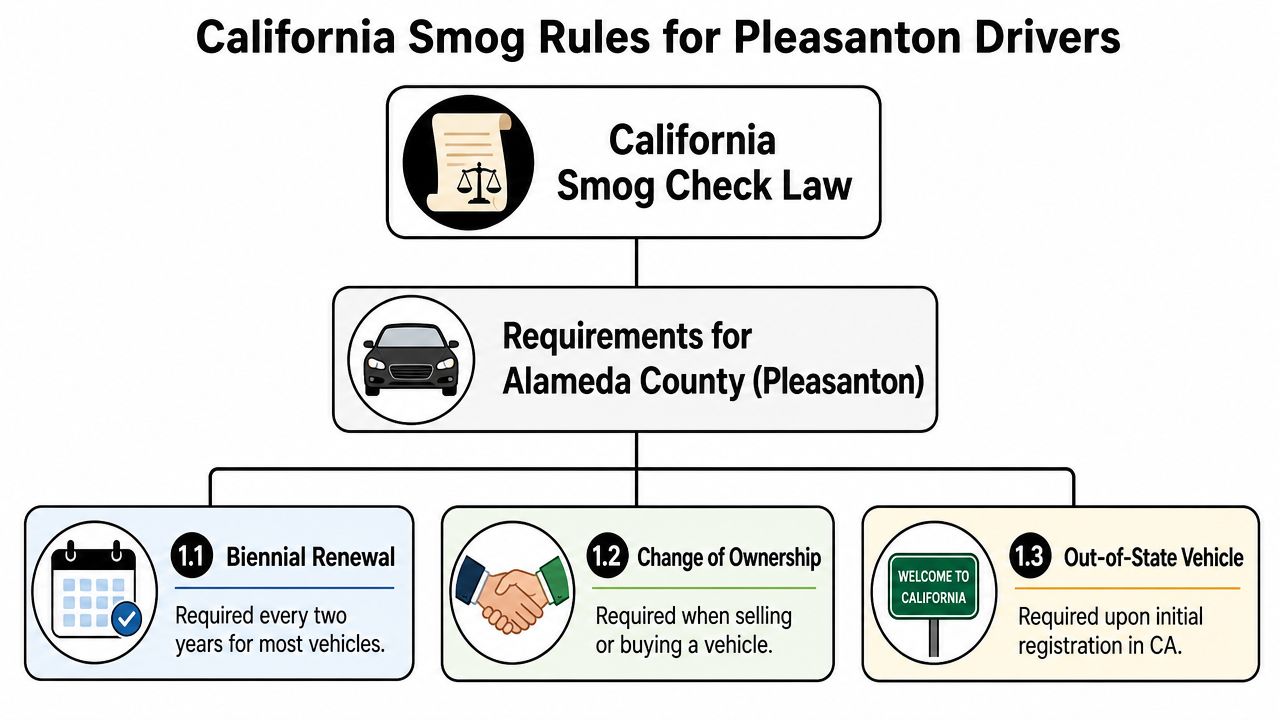
Pleasanton drivers are dealing with California rules, not a special city program. That matters because the test isn't just a local shop preference. It's part of a statewide emissions compliance system tied to registration and certain ownership events.
The program was adopted in 1984 to address significant smog sources from vehicle emissions, and it requires identification and repair of vehicles emitting excess smog-forming pollution, particularly during registration renewal or transfer events, as explained by AAA's overview of California smog requirements.
Why California takes this seriously
Pleasanton sits in the East Bay, where air quality rules aren't abstract policy. Vehicle emissions are one of the things the state actively regulates to keep pollution below required limits. That's why the notice from DMV isn't optional paperwork. It's a compliance step tied directly to whether your registration can move forward.
If you want a plain-English breakdown of the framework, this guide to California smog check rules is a useful companion.
When drivers usually get flagged
In real life, Pleasanton drivers most often run into smog requirements in a few familiar situations:
- Registration renewal: The renewal notice tells you a smog check is required before the DMV completes the process.
- Vehicle transfer: A change in ownership often triggers the need for a valid inspection.
- California entry: If a vehicle is being registered in California, emissions compliance becomes part of that first-state process.
What works is checking the DMV notice early and handling the inspection before the deadline gets close. What doesn't work is assuming every vehicle follows the same path. Some cars move through a standard inspection smoothly. Others are flagged for stricter station requirements, and that distinction catches people off guard.
Drivers usually get into trouble when they treat smog as a last-minute errand instead of a registration requirement with technical rules attached.
That's why a simple search for smog check Pleasanton CA should lead to more than a list of nearby addresses. The smarter question is whether the station you choose matches what your vehicle needs.
STAR Certified Or Regular Smog Station Which Do You Need
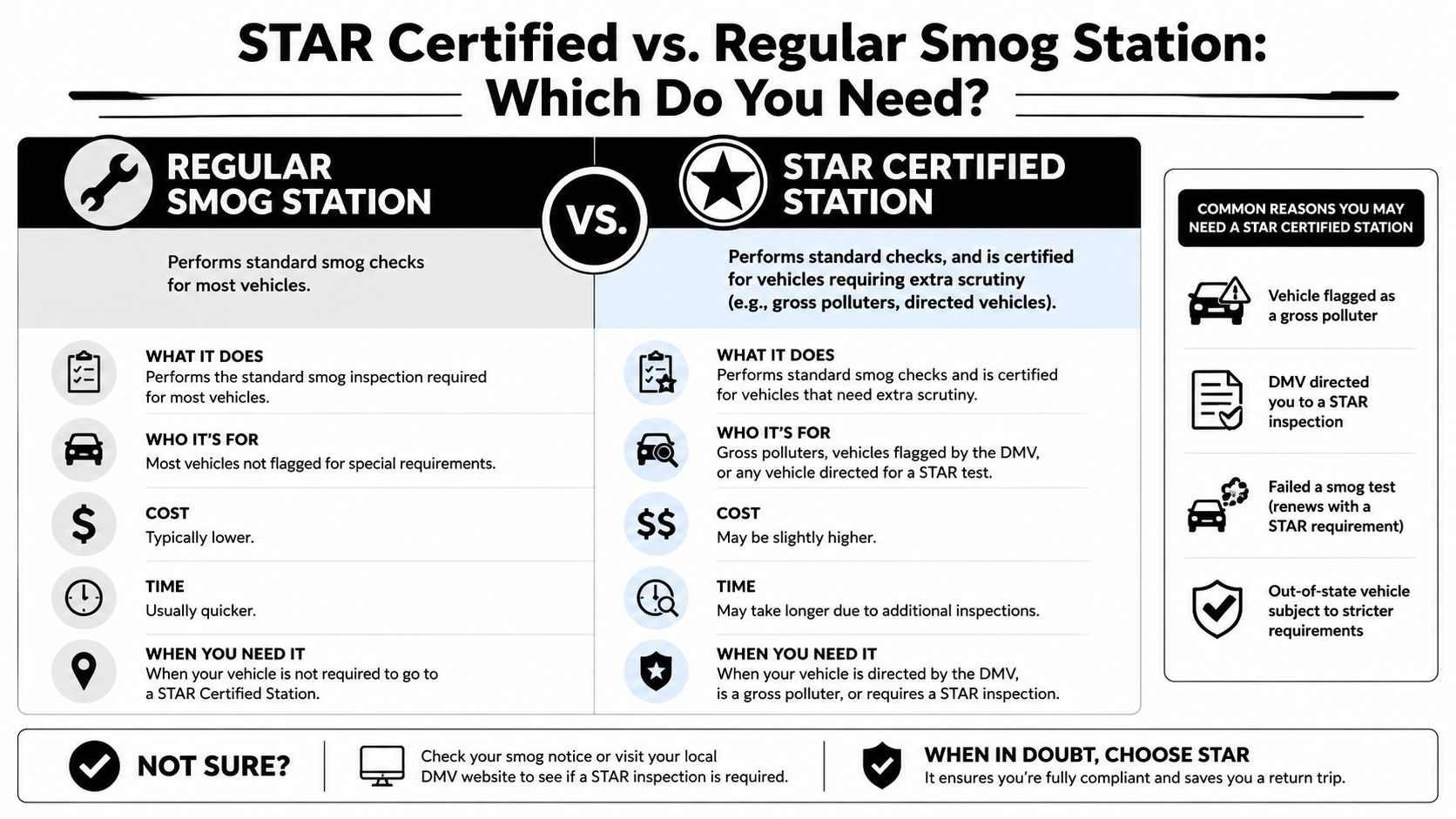
Many drivers lose time assuming a smog station is a smog station. It isn't. California separates standard testing from STAR Certified testing, and that difference matters if your DMV paperwork directs you to a STAR location.
The STAR Certified designation identifies facilities audited by the Bureau of Automotive Repair that demonstrate superior accuracy in detecting emissions failures, and STAR stations are specifically required for vehicles identified by the DMV as high emitters or those with a history of failed inspections, according to this California STAR station guide. That same source notes the cost for this inspection in California ranges from $30 to $70.
What STAR actually means
A STAR station isn't just using a nicer sign. It's a facility held to a higher performance standard. That's the practical takeaway for drivers. If your DMV notice directs you to STAR and you go somewhere else, you haven't saved time. You've started over.
Here's the simplest comparison:
| Station type | Best for | Risk if you choose wrong |
|---|---|---|
| Regular smog station | Vehicles not specifically directed to STAR | You may still need to retest elsewhere if your vehicle requires STAR |
| STAR Certified station | Standard vehicles and vehicles specifically directed by DMV to STAR | Lower risk of choosing a station your paperwork won't accept |
A useful explainer on what a smog STAR station is can help if that notice language feels vague.
A quick way to decide
Use this decision logic:
- Your DMV notice says STAR required: Go to a STAR station. No debate.
- Your vehicle has a history of emissions trouble: A STAR station is usually the smarter call.
- You own a newer model or hybrid and want fewer surprises: Specialized testing experience helps.
- You just want the broadest compliance option: Choosing STAR removes one common point of failure.
The trade-off is straightforward. A regular station may be convenient if your vehicle clearly qualifies for routine testing and you know that for sure. A STAR station is often the safer choice when the notice is unclear, the car has prior issues, or you don't want to gamble on whether the inspection will count.
That's why experienced drivers don't just ask who's closest. They ask who can complete the right inspection for their specific vehicle the first time.
How to Prepare for and Pass Your Smog Check
You get the DMV notice, book a test, drive over from Pleasanton, and expect to be in and out. Then the car fails for a reason that had nothing to do with how it felt on the road. That is the part that frustrates drivers most. Smog failures often come from readiness status, warning lights, or emissions equipment issues that show up only during inspection.
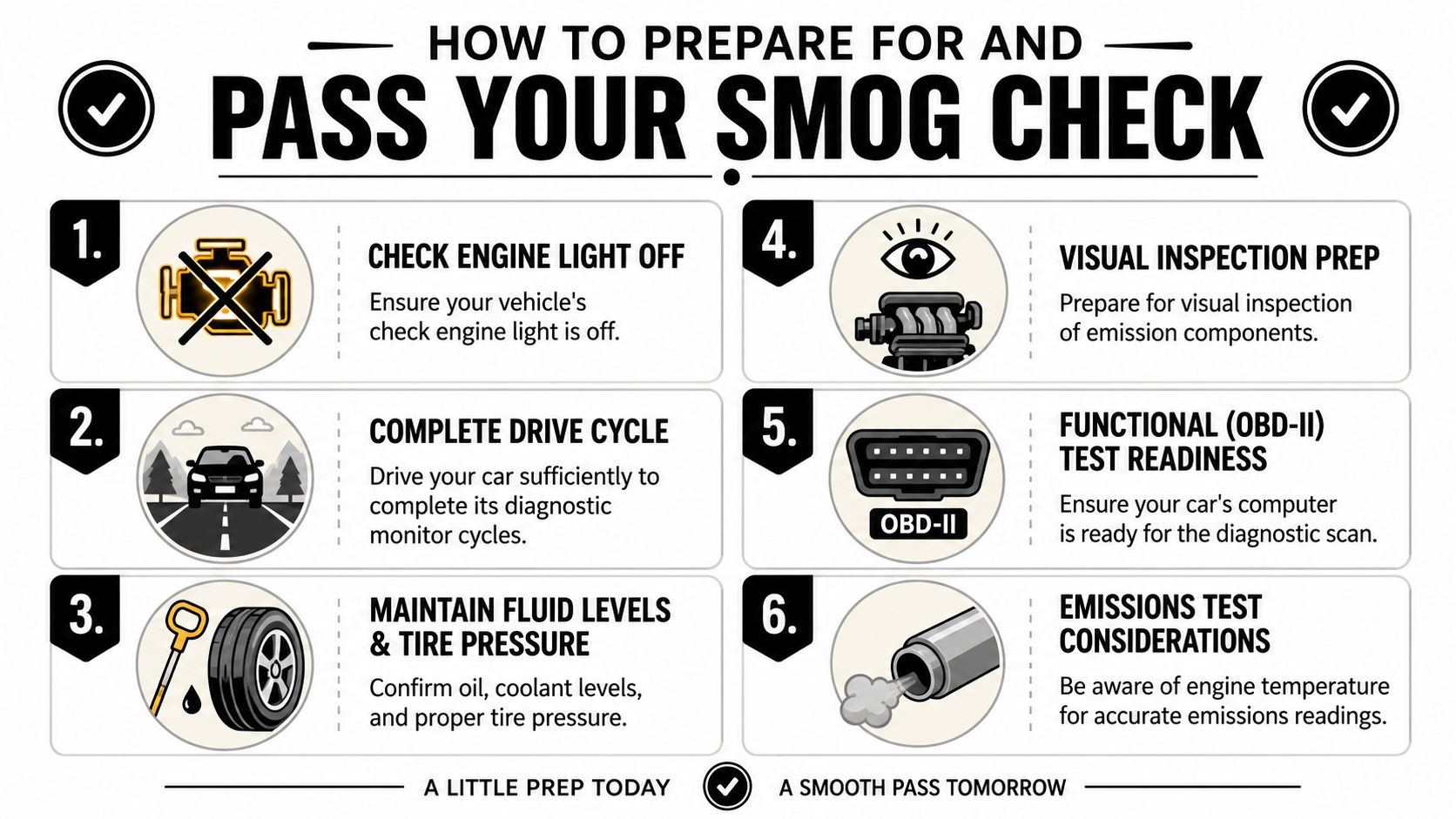
A California smog check usually includes three parts: a visual inspection of emissions-related components, a functional inspection of the OBD-II system, and an emissions measurement. If the check engine light is on or an OBD-II readiness monitor is not set, the vehicle fails, as explained in Geotab's California smog check guide.
What the inspector is looking for
The visual check covers parts such as the catalytic converter, EGR valve, and fuel cap. The functional check confirms the onboard computer is ready to report valid emissions data. The emissions portion measures pollutants such as Hydrocarbons (HC), Carbon Monoxide (CO), and Nitrogen Oxides (NOx), according to that same source.
This catches a lot of people off guard. A car can drive fine and still fail.
I see this all the time with newer vehicles and cars that recently had battery work. The owner fixed one problem, cleared a code, or disconnected power, then shows up before the readiness monitors have completed their drive cycle. Geotab notes that after battery replacement, vehicles may need normal driving time before all monitors reset.
What helps before the appointment
A little prep saves a lot of hassle, especially if you want one trip instead of two.
- Drive the car long enough to fully warm it up: A cold engine is not ideal for testing.
- Check for warning lights before you leave home: If the check engine light is on, deal with that first.
- Do not disconnect the battery right before the test: That often resets monitors and creates an automatic problem.
- Ask whether the shop offers a pre-inspection: If something looks questionable, it is better to catch it before the official test starts.
- If the vehicle has tuned or modified software: Put it back to manufacturer settings or a CARB-approved version before testing, because BAR states modified software can trigger a failure.
If you want a practical list of common smog check fail reasons, review that before booking the test.
For Pleasanton drivers, this is one reason a short drive to a specialized STAR station can make sense. Shops that handle these inspections all day are usually better at spotting readiness issues, recent-repair problems, and equipment concerns before you waste time on an official fail.
Later in the process, it helps to see the inspection flow in action:
What does not work
These are the mistakes that cause avoidable failures and repeat visits:
- Clearing codes the day of the test: That often leaves monitors unset.
- Ignoring recent repairs: Battery, alternator, or module work can affect readiness.
- Assuming a newer car will pass automatically: On many late-model vehicles, OBD-II status is the whole story.
- Picking a shop based only on price or distance: If the station is not the right fit for your vehicle, the cheap test gets expensive fast.
The fastest smog check is the one you only have to do once.
Smog Check Options Near Pleasanton And Why We Recommend Speedy Smog
Pleasanton has smog check options, and for some drivers a nearby location will work fine. But convenience on a map isn't the same as the best choice for compliance, speed, or technical fit.
That matters more than many drivers realize. Local listings often blur the line between standard testing and STAR-directed testing, and that creates bad recommendations. The source material provided here notes that Bureau of Automotive Repair data shows STAR stations are held to higher performance standards and are the only authorized sites for STAR-directed vehicles, while many local listings fail to explain that going to a non-STAR station when STAR is required leads to an automatic fail and a retest, as discussed in this Pleasanton smog listing analysis.
The local shop problem most drivers don't spot
A lot of shop pages sound interchangeable. They say they do smog checks, mention a special, and leave out the operational detail that protects the customer. If your vehicle is STAR-directed, a non-STAR stop doesn't just slow you down. It sends you back out for another inspection.
Hybrid owners and owners of newer vehicles should be especially careful. Those vehicles often need a shop that pays attention to the inspection steps rather than rushing the process or oversimplifying what's required.
Why a short drive can be the better move
For East Bay drivers, making a short drive to a specialized STAR station can be the smarter option when you want accuracy, a smoother visit, and fewer compliance surprises. That's especially true if your vehicle is newer, hybrid, diesel, or anything with a recent emissions-related issue in its history.
There's also a practical value issue. A fast, properly handled visit at a specialized station beats a “closer” visit that turns into a retest. Drivers who search smog check Pleasanton CA are usually trying to solve a time problem, not just a distance problem. The best answer is the station that gets the test done correctly and gets your DMV record updated without drama.
If a shop doesn't clearly explain whether it handles STAR-directed vehicles, that's already a warning sign.
Get Your Smog Certificate And Get Back On The Road
You get the test done, the station submits the result electronically, and you can finish your registration without chasing paper forms around town. That is the part Pleasanton drivers want. A clean, one-visit smog check that does not turn into a second errand.
The easiest path is usually simple. Show up with the right station for your vehicle, bring a car that is ready to test, and confirm your DMV notice before the inspection starts. That small bit of prep prevents the problems I see all the time, especially after recent battery disconnects, check engine light repairs, or visits to a shop that was not set up for the vehicle in front of them.
If your car passes, the certificate goes straight into the system and remains usable for your registration for a limited window, as noted earlier. You do not need to babysit the paperwork.
That is one reason a short drive from Pleasanton to a specialized STAR station can make sense. The goal is not just finding the closest shop. The goal is getting the right test, done correctly, once. For drivers with newer vehicles, hybrids, diesels, or STAR-directed notices, that can save time compared with rolling the dice on a generic local option.
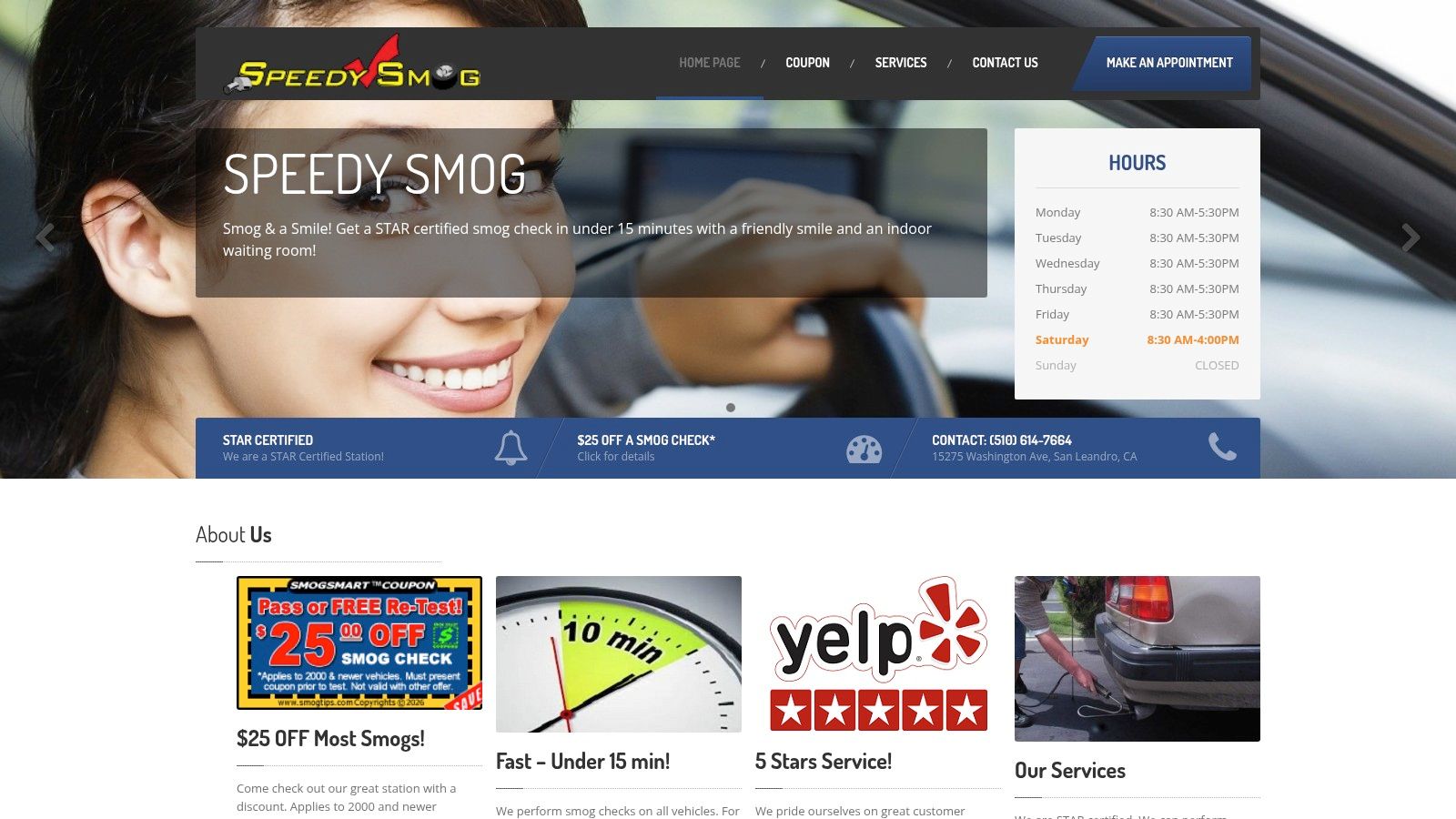
If you want a fast, accurate inspection from a STAR-certified team, book with Speedy Smog. They're located at 15275 Washington Ave, San Leandro, CA 94579, open Monday through Saturday, and they specialize in efficient testing for most vehicles, including newer models, older cars, diesels, and hybrids. Many 2000+ vehicles are completed in about 10–15 minutes, and the clean waiting area, transparent pricing, and periodic coupon offers make the short drive worthwhile for East Bay drivers who want to get certified and move on with their day.