
For most East Bay drivers, a required DMV smog check can be finished in about 10 to 15 minutes at a certified station like Speedy Smog if you're driving a model-year 2000 or newer vehicle. If your car falls into the regular California renewal cycle, that visit usually comes around every 2 years once a gas-powered vehicle is 8 model years old or older.
That's why so many people end up searching for DMV smog check near me at the exact same moment. The registration notice shows up, the deadline feels closer than it should, and suddenly you need a nearby shop that can handle the inspection without turning a simple errand into half your day.
In the East Bay, the easiest path is usually not finding the cheapest listing or the closest pin on a map. It's finding a certified station that can handle the right type of inspection, tell you whether your car is ready, and get the result to the DMV without extra back-and-forth. That's where a little preparation saves a lot of annoyance.
Table of Contents
- That DMV Smog Notice Is Here What Now
- Is a STAR Certified Station Required for You
- How to Prepare Your Car for a Fast Pass
- The Speedy Smog Experience in San Leandro
- Decoding Your Smog Check Results
- Frequently Asked Smog Check Questions
That DMV Smog Notice Is Here What Now
When that renewal notice lands in your hand, the first move is simple. Check whether smog certification is required, then handle it before the registration deadline starts crowding everything else on your calendar.
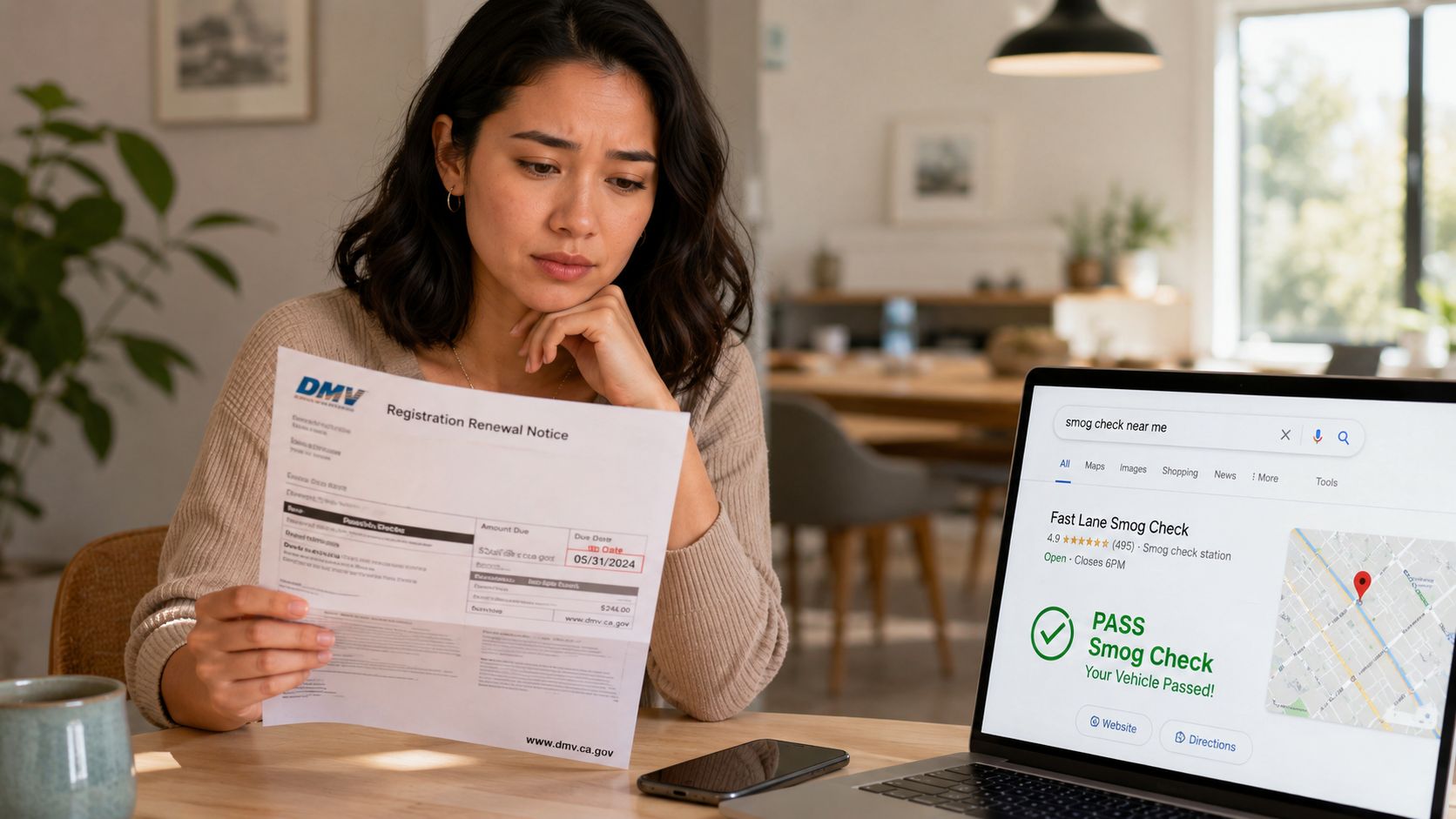
Why this keeps coming up
California ties the Smog Check program directly to registration. According to California's overview of state services and smog program access, gas-powered vehicles that are 8 model years old or older and 1976 or newer generally need a Smog Check every 2 years. That repeating cycle is the reason this search shows up again and again for East Bay drivers.
That matters because individuals seeking a DMV smog check near me aren't shopping for an optional maintenance item. They're clearing a registration requirement. Once you look at it that way, the job becomes more straightforward. You need the right station, the right timing, and a car that's ready for the test.
Practical rule: Treat the smog check like part of registration paperwork, not like a separate repair visit.
What to do first
A clean, low-stress smog visit usually starts with three checks:
- Read the notice carefully: Look for whether smog is required at renewal and whether the notice says STAR.
- Think about your car's recent history: If the battery was disconnected, the check engine light came on recently, or repairs were just done, timing matters.
- Choose a nearby certified station: In the East Bay, convenience matters because this is usually a quick compliance stop, not an all-day appointment.
The biggest mistake is waiting until the last minute, then rushing into the first station you see online. A little planning turns this from “another DMV headache” into a short stop on the way home or during a lunch break.
Is a STAR Certified Station Required for You
Not every smog check is the same. One detail changes where you should go, and whether a regular station will work at all. That detail is STAR certification.
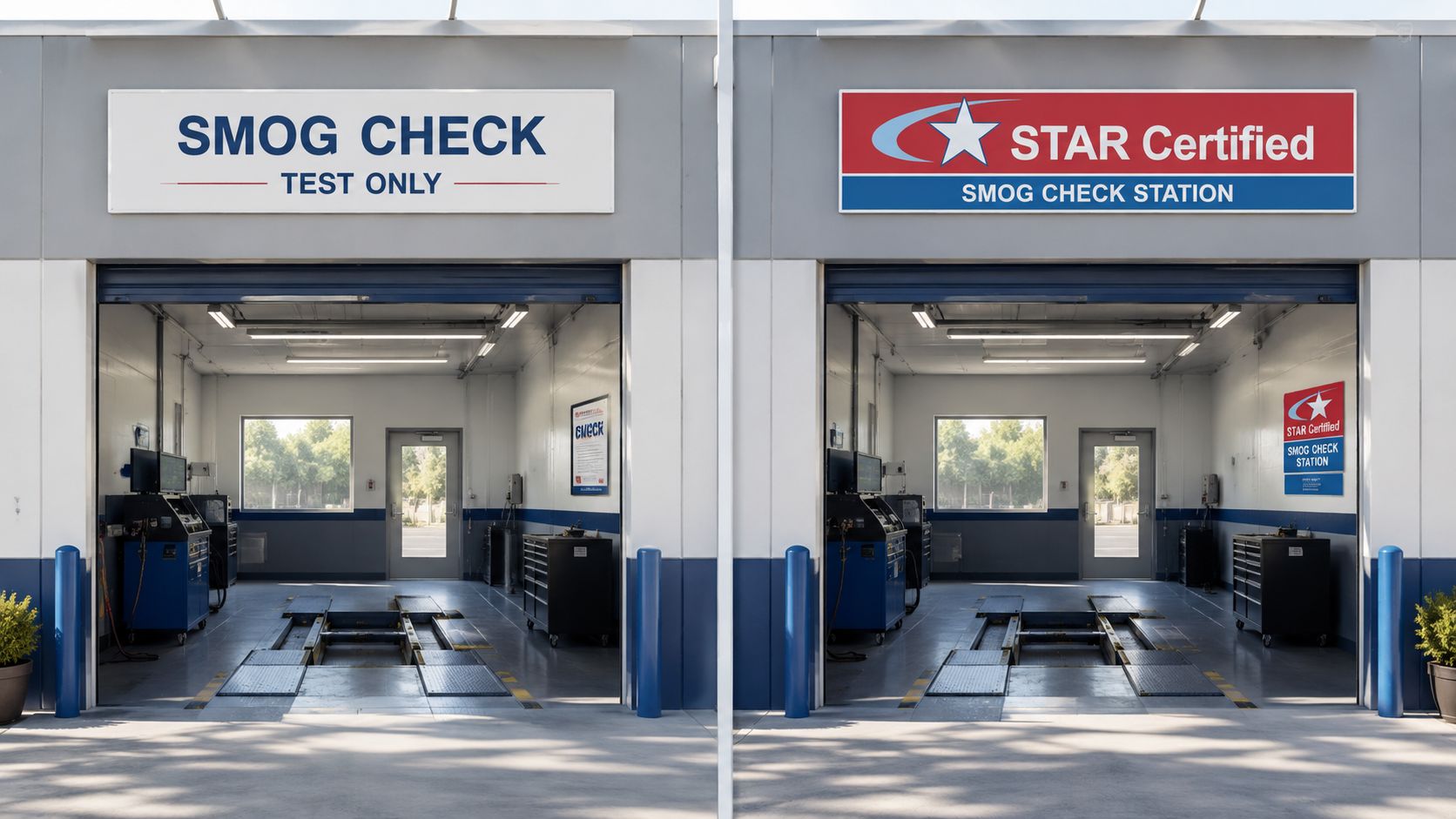
Where to look on your renewal notice
If your DMV paperwork says STAR is required, don't ignore it. A standard station won't help if the notice directs you to a STAR location.
California's smog framework relies on licensed stations as part of the compliance path, and STAR stations matter because they meet additional performance standards within that system. If you want a plain-language breakdown of what that means in practice, this explanation of what a Smog STAR station is is useful.
Why drivers get tripped up here
A lot of people search for DMV smog check near me and assume the nearest result can handle any inspection. Sometimes that's true. Sometimes it wastes a trip.
Here's the decision test that works:
| Notice says | What you need |
|---|---|
| Smog required | A licensed smog check station |
| STAR required | A STAR Certified station |
| You're unsure | Call first and read the notice exactly as written |
This is one of those trade-offs that matters more than price shopping. Saving a few minutes on the drive doesn't help if you show up at the wrong kind of facility and still need to go somewhere else.
If your renewal notice says STAR, believe the notice and choose accordingly.
Why local matters in the East Bay
A nearby STAR station is useful for a simple reason. Smog checks are often a same-day errand squeezed between work, school pickup, or another stop. Drivers in San Leandro, Oakland, Hayward, and the surrounding East Bay usually want one visit, one inspection, and no guesswork.
When you're choosing a station, ask practical questions instead of marketing questions:
- Can they handle the exact inspection listed on your notice?
- Do they work on the vehicle type you're bringing in?
- Can you get in and out without turning this into a half-day task?
That's what separates a useful local option from a random search result.
How to Prepare Your Car for a Fast Pass
A smog check usually goes quickly when the car is ready for inspection. The drivers who lose time are usually dealing with one of two problems. A check engine light is on, or the vehicle computer was recently reset and has not finished its self-checks.
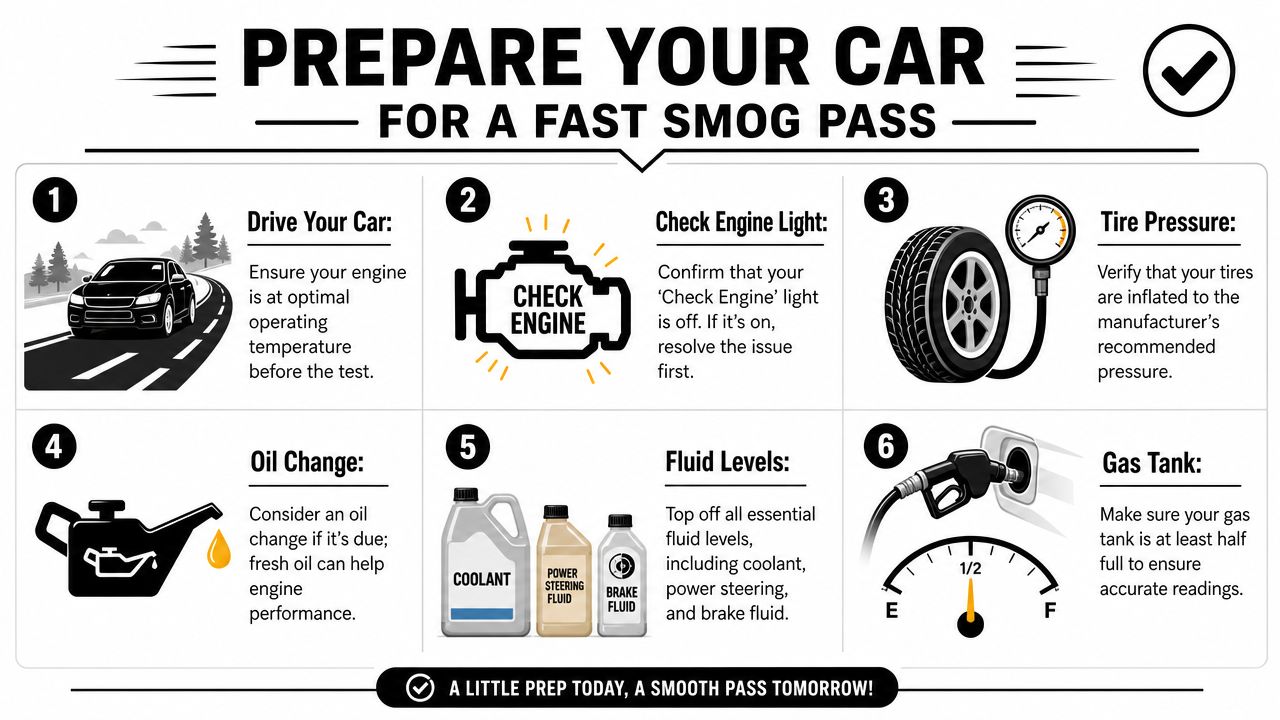
The two issues that cause avoidable trouble
In the shop, this is what catches East Bay drivers most often. The car seems fine, it starts, it drives normally, and there is no obvious symptom. But if the check engine light is on, or if codes were just cleared after a repair or battery disconnect, the inspection can still fail or come back as not ready.
That second issue frustrates people because it does not always feel like a real problem. It is still a real smog problem.
A quick warm-up helps too. Bring the car in after normal driving, not after it has been sitting cold in the driveway all morning. If you want a realistic sense of timing once you arrive, this guide on how long a smog check usually takes in San Leandro sets expectations well.
What works before you arrive
- Look at the dash before you leave: If the check engine light is on, deal with that first.
- Drive the car long enough to fully warm it up: A short errand with a cold engine is not the ideal setup.
- Do not clear codes right before testing: Turning the light off is not the same as making the car ready.
- Wait after battery replacement or disconnect: Many vehicles need regular driving before the monitors reset and report properly.
- Bring the car after everyday use: Highway and city driving are usually better prep than idling for a few minutes.
A car can drive perfectly and still be unready for an OBD-based smog inspection.
That is why the cheapest option is often waiting one more day and testing once, instead of rushing in and paying again.
To see the basic process visually, this walkthrough helps:
How to avoid paying twice
The practical sequence is simple:
- Fix the warning-light issue first.
- Drive the vehicle enough for readiness monitors to complete.
- Test the car only after it is ready.
I have seen plenty of drivers clear a code, see the light disappear, and head straight to a station. That move saves nothing. It often leads to a second trip, another fee, and more irritation than the original repair.
If you want the fastest visit at a place like Speedy Smog, show up with a warmed-up car, no warning lights, and no recent reset unless you know the monitors are ready. That is the closest thing to a first-time pass formula.
The Speedy Smog Experience in San Leandro
A good local smog visit feels boring in the best way. You pull in, the technician confirms what your vehicle needs, the inspection happens, and you're on your way.
What the visit usually looks like
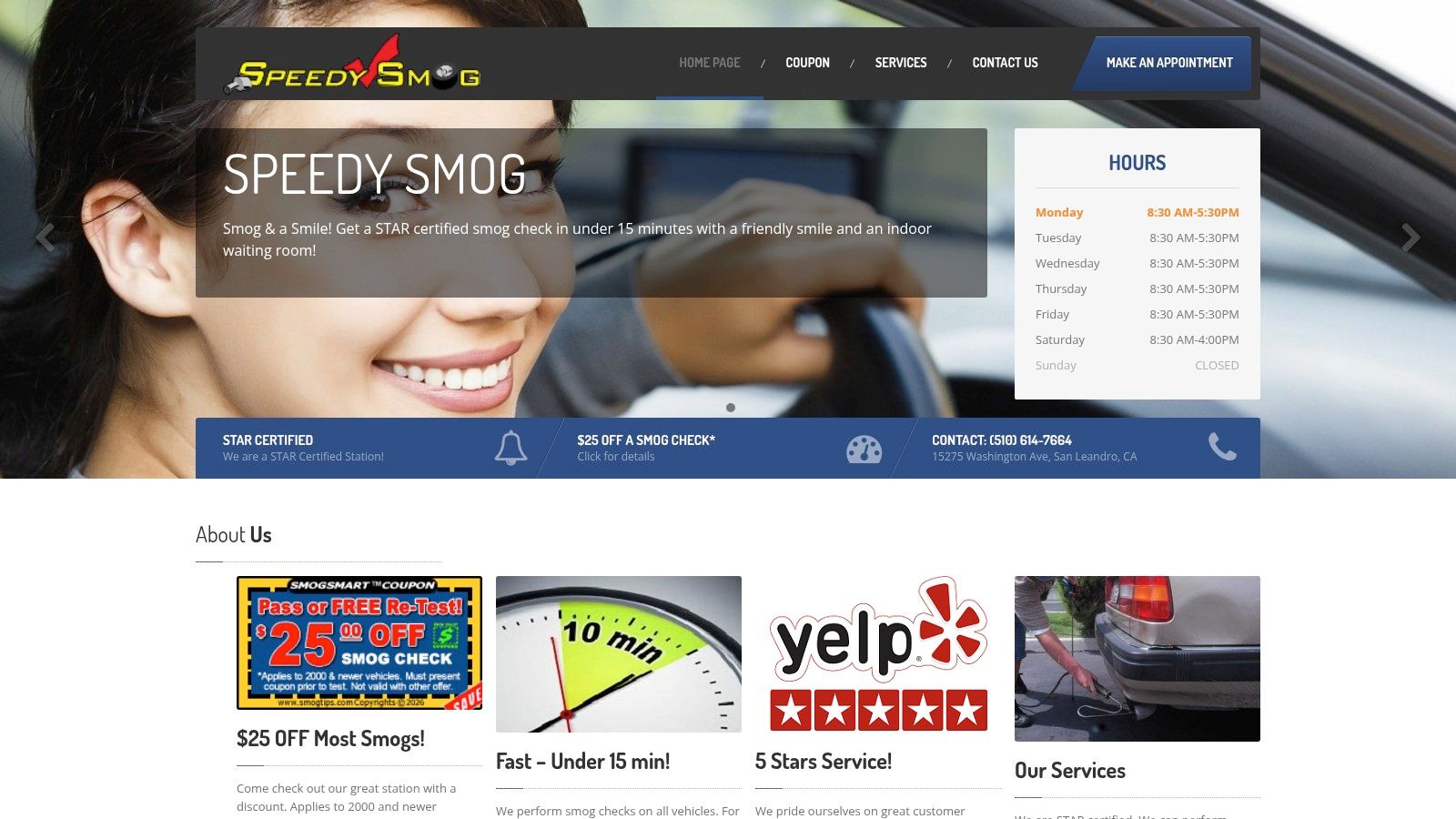
At a San Leandro station like Speedy Smog, the process is built around fast DMV compliance for local drivers. The shop is located at 15275 Washington Ave, San Leandro, CA 94579, and it handles inspections for many common vehicle types, including newer cars, older vehicles, diesels, and hybrids.
For timing expectations, this page on how long a smog check takes matches what many drivers want to know before they leave the house. For many 2000 and newer vehicles, the visit is commonly a short stop rather than a drawn-out appointment.
Cost, comfort, and trade-offs
In California markets, this California smog FAQ says smog checks for model-year 2000 and newer vehicles typically cost between $45 and $70, inclusive of the certificate. That's why speed, location, and getting it done correctly matter more than turning the search into an hour of comparison shopping.
The practical trade-off is simple:
- Cheaper isn't always faster
- Closer isn't always the right certification
- A quick, clean visit usually depends on showing up prepared
A nearby station with a comfortable indoor waiting area also changes the experience more than people expect. If you're handling this between errands, comfort matters.
Estimated test times by vehicle type
Here's a practical way to think about turnaround:
| Vehicle Type | Estimated Test Time | Notes |
|---|---|---|
| 2000 and newer | About 10 to 15 minutes | Common quick-turn inspection for many everyday vehicles |
| 1996 to 1999 | About 25 minutes | Often takes longer than newer OBD-focused tests |
| 1995 and older | About 35 minutes | Older vehicles usually need more time |
| Diesel or hybrid | Varies | Call ahead to confirm the exact process for your vehicle |
That range helps set expectations. If you drive a newer car and it's ready, this can be one of the easier tasks on your registration list.
Decoding Your Smog Check Results
Once the inspection is done, you only have two outcomes that matter. You passed, or you didn't. Either way, the next step is straightforward when the station explains it clearly.
If your vehicle passes
When a car passes, the useful part is convenience. The station handles the certification process electronically, so you don't need to turn a successful inspection into another paperwork chase.
That's one reason drivers prefer established DMV-focused stations. The pass result moves directly into the registration workflow instead of leaving you wondering what to upload, print, or mail.
A passing smog check should feel like a box checked, not the start of another task.
If you want a clearer breakdown of what the paperwork and status usually mean, this explanation of smog test results gives a simple reference point.
If your vehicle doesn't pass
A failed inspection is annoying, but it isn't mysterious. You'll typically get a Vehicle Inspection Report, often called a VIR, that shows why the car didn't pass.
From there, focus on the reason listed on the report. Don't guess. Don't approve random parts replacement without diagnosis. If the issue is a warning light, unresolved code, or readiness problem, the fix path is different from an actual emissions hardware problem.
A calm next-step checklist looks like this:
- Read the VIR carefully
- Repair the actual cause
- Make sure the vehicle is ready before returning
- Retest after the underlying issue is addressed
California also offers repair-assistance pathways in some cases through its Consumer Assistance Program, which can be worth checking if the repair burden is larger than expected.
Frequently Asked Smog Check Questions
What should I bring to a smog check
Bring the car, and bring your renewal notice if you have it. That notice helps the station confirm whether DMV is asking for a regular test or a STAR inspection. If you have current registration paperwork in the glove box, keep that handy too. It can speed up check-in and clear up name, plate, or VIN questions fast.
Do I need an appointment
Not always.
A lot of East Bay drivers want a walk-in because smog checks usually land in the middle of a workweek, right when you are already juggling enough. Calling first is still smart, especially if the vehicle is older, diesel, hybrid, or tied to an unusual registration issue. A quick phone check can save you a wasted trip.
What if my car recently had the battery disconnected
Wait until the car is ready to test. A recent battery disconnect or code clear can reset the vehicle's emissions monitors, and that can stop a pass even if the car feels fine.
This catches people all the time. The car runs normally, no obvious problem shows up, then the test gets delayed because the system has not finished its self-checks. If that happened recently, say so before the inspection starts.
What if my car fails
Start with the VIR. That report tells you what failed.
Do not guess, and do not approve random parts replacement just because someone says it is probably a sensor. A check engine light, an incomplete monitor, and an actual emissions component failure all point to different repair paths. Fix the specific problem, then return once the car is ready for retest.
Are some vehicles exempt from smog inspection
Yes. Some vehicles are exempt based on age, fuel type, weight, or model year rules. Electric vehicles are generally exempt, and older specialty categories may be exempt as well. If you want the current California rule set for your exact vehicle, check the California DMV smog inspections page.
How do I make this as fast as possible
The fastest smog check usually starts before you leave home:
- Confirm you need the test
- Check whether your notice says STAR
- Make sure no warning lights are on
- Do not show up right after a battery reset or code clear
- Drive the car long enough to get fully warmed up
That routine saves time, cuts down on repeat visits, and gives you the best shot at getting it done right the first time.
If you want a local station that handles California smog compliance without a lot of hassle, Speedy Smog is a practical East Bay option for drivers who want a certified inspection, a short visit, and a straightforward path to getting registration moving again.
Your registration renewal is sitting open on the counter, and somewhere on that notice you spotted the words that send a lot of East Bay drivers into the same spiral: smog check required. Usually the first questions are practical, not technical. Do you need a smog check appointment, or can you just show up? How long is this going to take? What happens if the notice says STAR station required?
The good news is that the process is a lot more routine than it feels the first time. Once you know what the DMV is asking for, what the station checks, and how to show up prepared, the whole visit becomes simple.
Table of Contents
- Why You Received That DMV Smog Check Notice
- Booking Your Appointment Or Just Walking In
- How to Prepare Your Vehicle for a Fast Pass
- Your 15 Minute Smog Check Experience at Speedy Smog
- Passed Or Failed What Happens Next
- Answers to Your Top East Bay Smog Questions
Why You Received That DMV Smog Check Notice
You open your registration notice, see “smog check required,” and the first question is usually the practical one. Do you need this now, or can it wait?
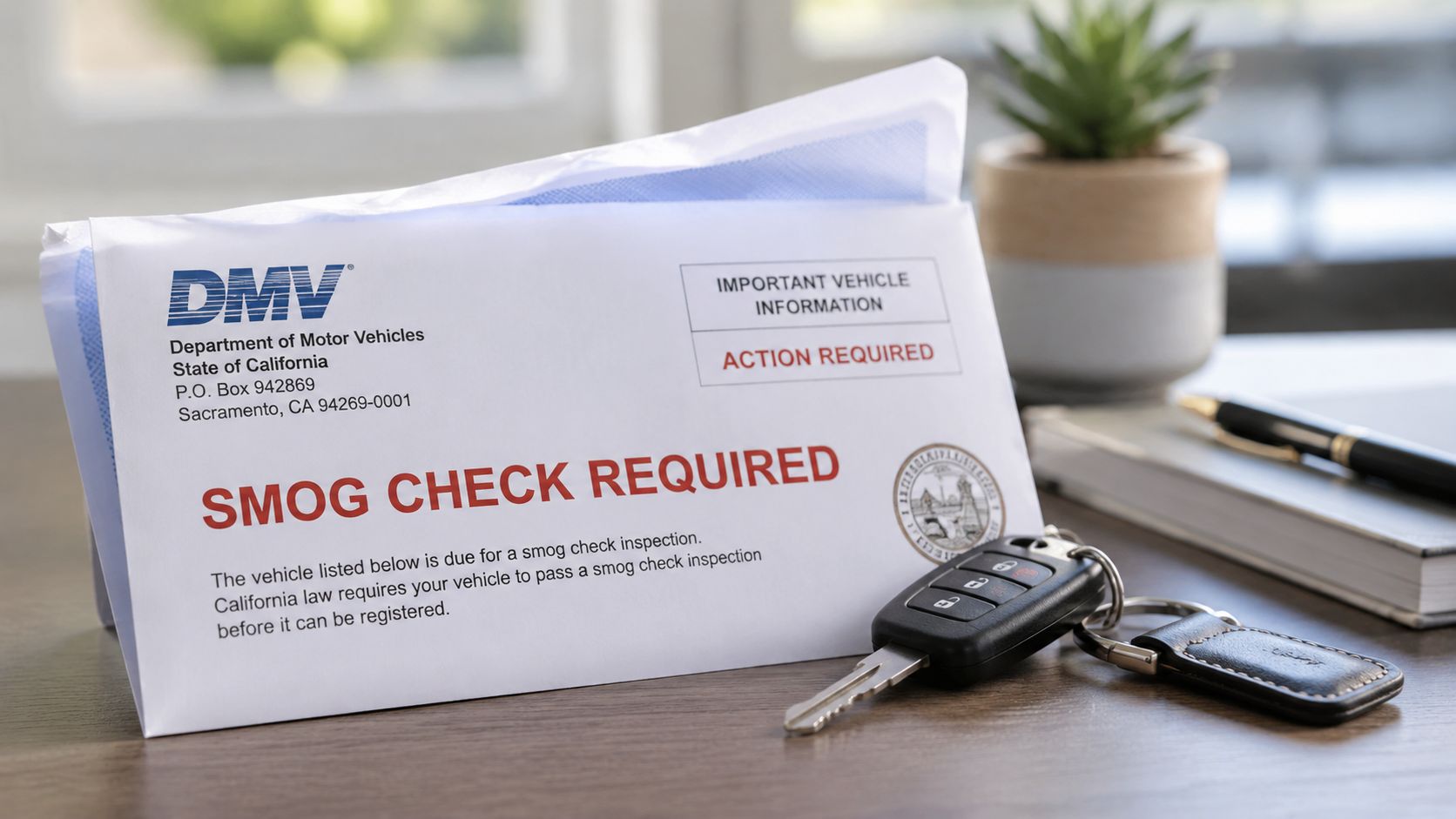
That notice means your registration hit one of the situations where California requires an emissions inspection. For most drivers, it comes up during renewal on the state's regular testing schedule. It can also come up during a vehicle sale or transfer, especially when the transaction is outside the immediate family.
Who usually needs a smog check
For registration renewal, California generally requires testing every other year once the vehicle reaches the point where it enters the smog program. A newer vehicle may go years without needing one, then the notice shows up and the timing feels sudden.
A change of ownership is another common trigger. If you are buying or selling a car, the smog certificate is often part of closing out the paperwork correctly.
Read the notice closely. That is the fastest way to avoid wasting time at the wrong station. In the shop, I tell customers to check one line first: whether the DMV is asking for a routine smog check or a STAR-certified station.
What the State Requires
The process is more routine than it sounds. The inspection is designed to confirm that the vehicle's emissions systems are functioning as required, and the test method depends on the vehicle. Newer cars usually go through an on-board diagnostics check. Older vehicles may need a different inspection method.
The price has two parts, and that is where confusion starts. The certificate fee on a passing test is set by the state. The shop's testing charge varies by vehicle and location. At Speedy Smog, East Bay drivers usually care less about the pricing breakdown than the total time to get compliant, which is fair. The trade-off is simple. A low advertised test price does not help much if you end up waiting, or if your notice requires STAR service and the station cannot complete it.
If your DMV notice is in hand, treat it like a registration task with a deadline. Bring the vehicle to a station that can perform the correct test the first time. In the East Bay, that usually means choosing a shop that handles walk-ins quickly, knows STAR requirements, and can get your result submitted without extra back-and-forth.
Booking Your Appointment Or Just Walking In
You get the DMV notice on a Tuesday, check your calendar, and realize you have one open window before the registration deadline. That is usually when the main question comes up. Should you lock in a smog check appointment, or just stop by and get it handled?
Around the East Bay, both options are common. The better choice comes down to time pressure, your vehicle requirement, and how much uncertainty you can tolerate that day. If the notice says STAR, that narrows the field right away. If your schedule is flexible and the car is ready, a walk-in can be the fastest path.
Why drivers get mixed messages
A lot of the confusion comes from how shops operate. Some run almost entirely on appointments. Others are built to move walk-ins through quickly. Drivers end up hearing both answers and assume there must be one rule for everyone.
There is not.
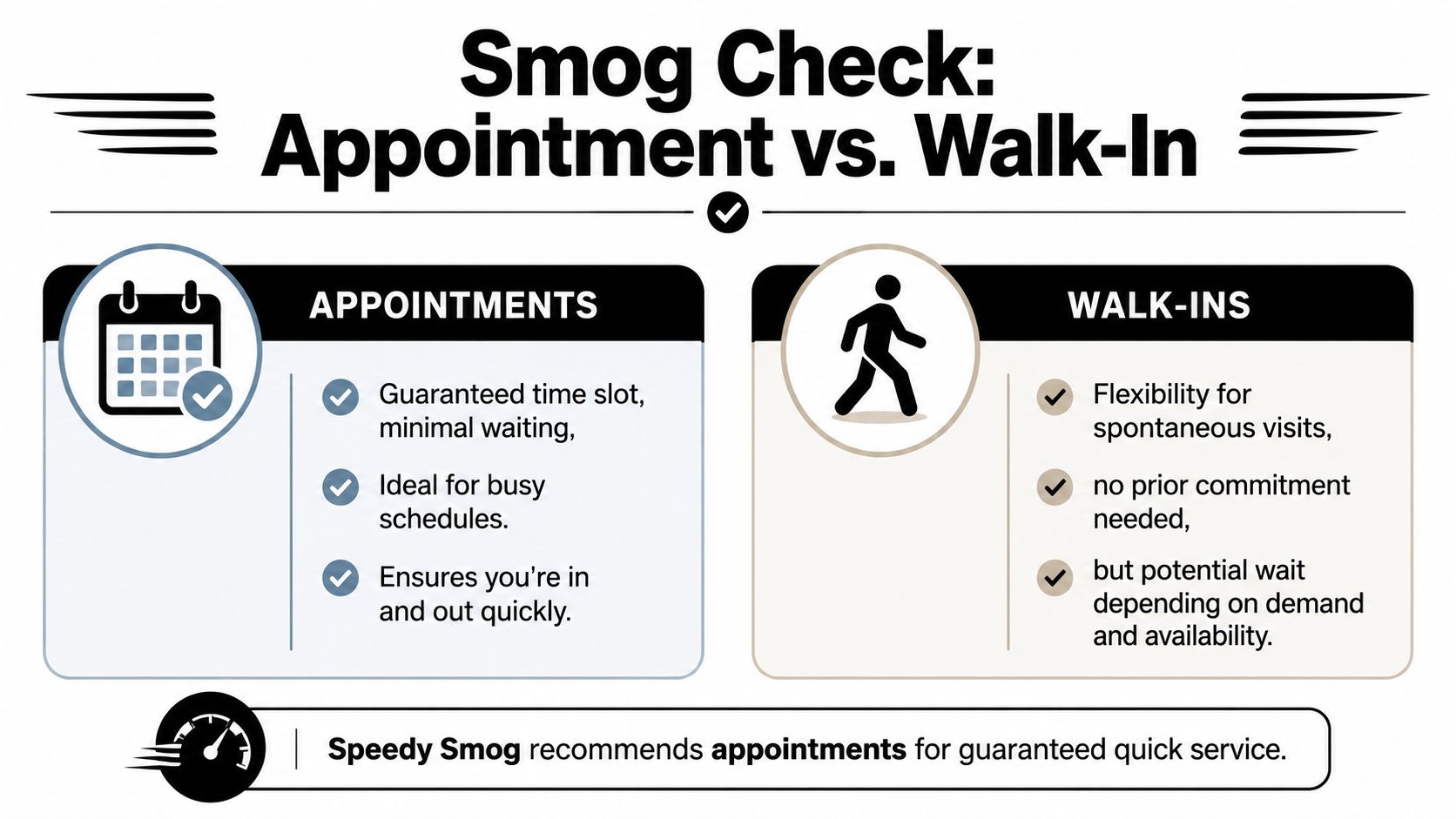
What matters is getting to a station that can perform the test your notice requires, within the time you have available. For East Bay drivers, that usually means choosing based on speed and fit, not habit. A shop that handles STAR inspections, answers the phone, and keeps walk-ins moving will save more time than chasing the lowest posted price.
When an appointment makes sense
Book a time if you need control over the day.
That is the practical answer I give customers with a tight lunch break, school pickup, or a registration deadline that is close enough to matter. An appointment reduces guesswork. You know when to arrive, and you are less likely to spend the morning calling around.
An appointment is the better move when:
- Your deadline is coming up soon
- Your notice requires a STAR-certified station
- You need the visit to fit into a narrow time block
- You want to confirm pricing or ask about a coupon before you leave
If you are the kind of driver who wants the errand done in one shot, booking ahead is usually worth it.
When a walk-in works well
Walk-ins make sense when your day opens up and the car is ready to go. That is a big part of how many East Bay drivers handle smog. They are already out running errands, they have the notice in the glove box, and they want the shortest path to compliance.
A walk-in works well if:
- You are nearby already
- Your schedule can absorb a brief wait
- You have confirmed the station can perform your required test
- You want to use an open part of the day instead of planning around a set time
At Speedy Smog in San Leandro, many customers choose this route because the shop is set up for quick walk-in service, while still handling STAR-certified inspections for drivers who need them. That combination matters. It lets you keep the process simple without gambling on whether the station can complete the job.
If your goal is speed, start with the station type your notice requires. Then pick the option that gets you in and out with the least friction that day.
My rule of thumb is simple. If the clock is tight, book it. If the car is ready and you are already in the area, walking in can be the faster choice.
How to Prepare Your Vehicle for a Fast Pass
Most smog delays don't happen in the bay. They start before the driver leaves home. A little prep makes the visit smoother and lowers the chance of wasting a trip.
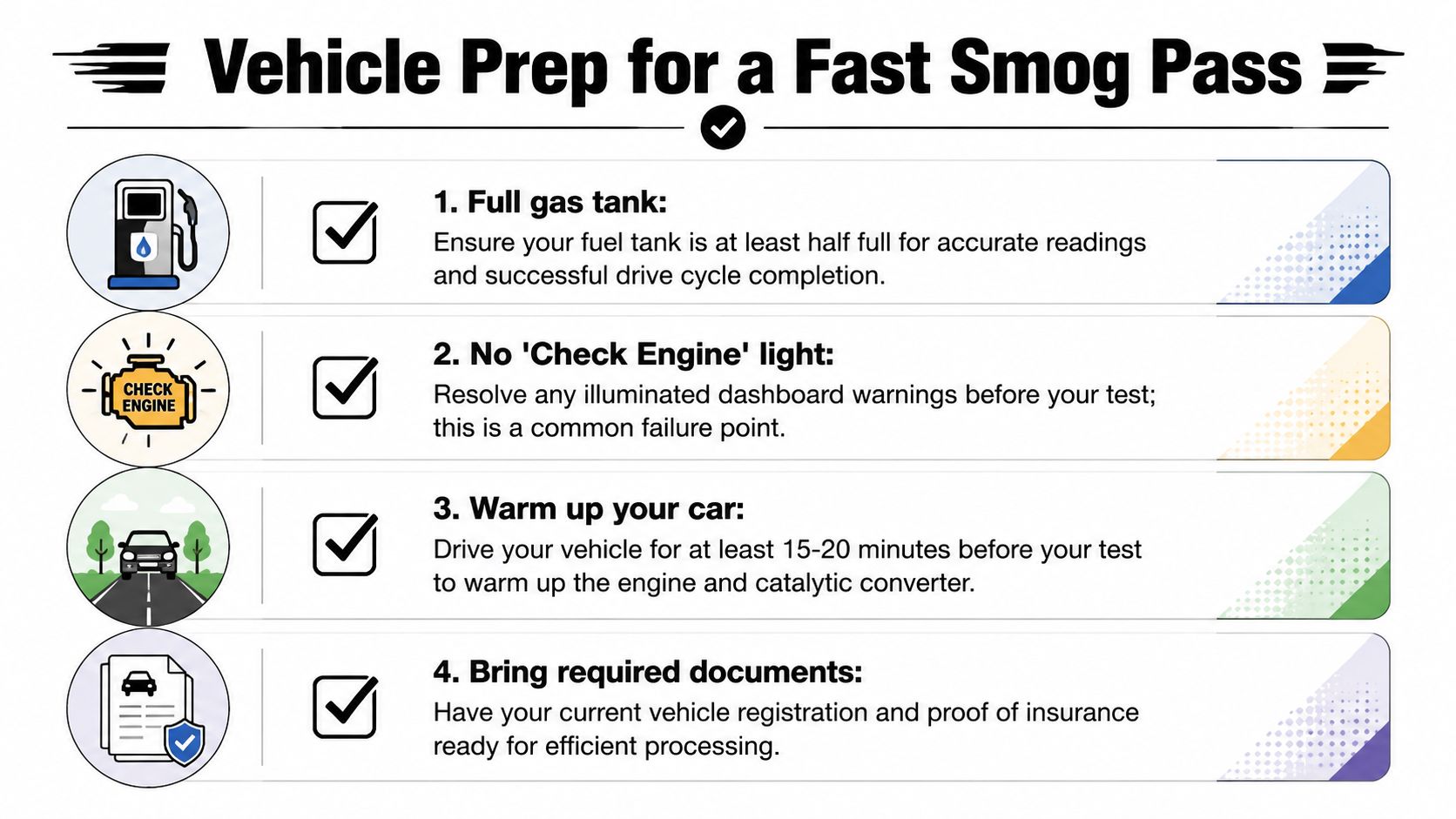
Do these checks before you leave home
Start with the obvious dashboard issue. If the Check Engine light is on, deal with that first. An active warning light is one of the most common reasons a vehicle doesn't clear inspection.
Then focus on simple readiness:
- Warm up the car: Drive it for a bit before you arrive so the engine and emissions components are at normal operating condition.
- Don't arrive right after a dead battery situation: If the battery was recently disconnected or replaced, some vehicles need normal driving before all monitor systems are ready again.
- Check basic fluid and maintenance items: You're not trying to tune the whole car in the parking lot. You're just avoiding preventable problems.
- Make sure the gas level isn't extremely low: It helps to arrive with a normal fuel level instead of running on fumes.
A prepared car usually moves through the inspection without surprises. An unprepared one turns a quick errand into a second trip.
Bring the right paperwork
Don't rely on memory at the counter. Have your documents with you.
Bring these items if you have them available:
- DMV renewal notice: This helps confirm what kind of test the state is asking for.
- Current registration: Useful for verifying vehicle information quickly.
- Driver's license: Always a smart thing to have with you for any registration-related task.
- Insurance information if you keep it handy: Some drivers like having all vehicle paperwork together in one place.
The practical goal is simple. Show up with a warmed-up vehicle, no active warning lights, and the paperwork already in your hand. That's what makes a smog check appointment feel fast instead of annoying.
Your 15 Minute Smog Check Experience at Speedy Smog
A lot of drivers expect a smog visit to drag. Most of the time, it doesn't.
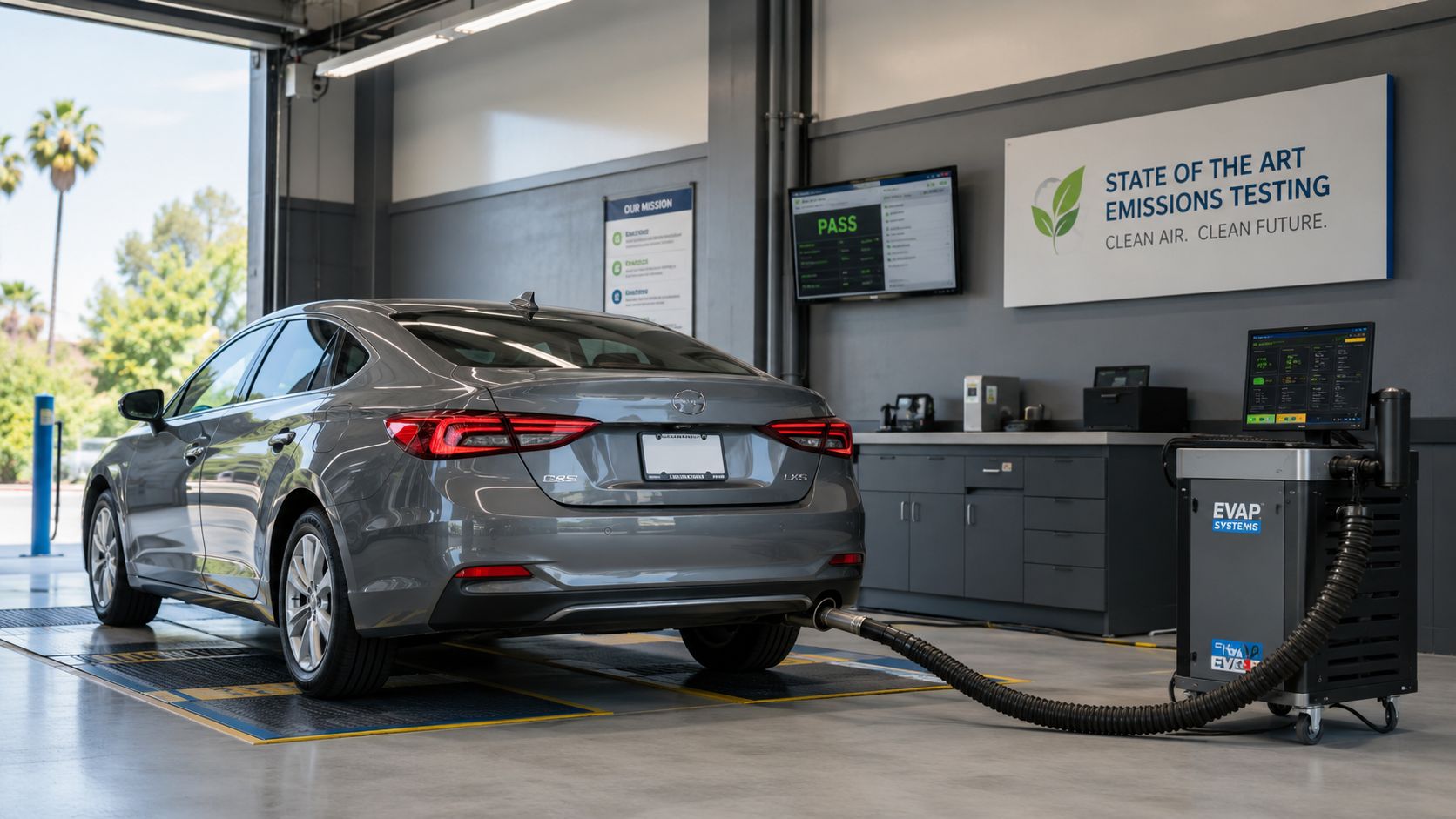
California smog inspections are fairly standardized. Most are completed within 20 to 30 minutes, and some STAR-certified stations advertise faster service for 2000 and newer vehicles in as little as 10 to 15 minutes. The same source notes that over 80% of vehicles pass on the first attempt at qualified stations, which is why the process is usually predictable rather than dramatic, according to the California smog testing FAQ from a STAR station.
What happens when you pull in
The check-in part should be brief. The technician confirms the vehicle information, reviews any DMV requirement tied to your visit, and gets the car into position for testing.
After that, the inspection follows the state process. For newer vehicles, that usually means plugging into the car's onboard diagnostic system and confirming emissions-related readiness and fault status. For older vehicles, the procedure can involve different testing steps based on the model year and setup.
Inside the shop, the experience is usually a lot calmer than people expect. You're not sitting through a repair consultation or waiting for a sales pitch. You're waiting for a test result.
Here's a look at the process in action:
Why STAR certification matters
If your notice says STAR station required, that part isn't optional. You need a station that meets the state's higher performance standard for certain inspections.
For East Bay drivers trying to keep the visit short, that detail matters because choosing the wrong shop creates the most frustrating delay of all. You drive there, wait, and then find out the station can't process the test you need.
A smoother visit usually comes down to a few practical choices:
| Situation | What works | What doesn't |
|---|---|---|
| Routine renewal | Arrive with paperwork ready and the car warmed up | Showing up with no notice and guessing about requirements |
| STAR notice | Confirm STAR capability before the visit | Assuming every station can handle it |
| Tight schedule | Use a reserved time or come during an open window in your day | Waiting until the registration deadline is already on top of you |
One detail customers appreciate at this shop is that the visit stays focused. For many 2000 and newer vehicles, the test is handled in about 10 to 15 minutes, there's an indoor waiting room, and newer-vehicle smog coupons may be available, including periodic $25-off offers described in the publisher information for this article.
Passed Or Failed What Happens Next
Once the test is done, the report tells you what to do next. There are only two paths, and neither one needs to feel mysterious.
If your vehicle passes
A passing result is the easy outcome. The certificate is transmitted electronically to the DMV, so you usually don't need to carry extra paperwork across town to prove compliance.
From there, you finish your registration using the DMV method you prefer. Most drivers just move on with the renewal and don't need any additional action related to the smog portion.
When a car passes, the smog check is basically a completed box on your registration list.
Keep your copy of the report for your records. Even when everything posts correctly, it's useful to have the document if you need to double-check timing or vehicle details later.
If your vehicle doesn't pass
A failed test feels frustrating, but it isn't a punishment. It means the vehicle showed an issue that needs correction before the state can accept the certification.
The next step is diagnosis. That may involve a repair shop identifying why the emissions system, readiness status, or a monitored component didn't meet the standard. Once the underlying problem is fixed, you return for a retest.
A calm approach works better than guessing:
- Read the report first: It points you toward the area that needs attention.
- Fix the cause, not just the symptom: Clearing codes without repairing the issue usually leads to another failed visit.
- Ask about the retest process before leaving: Policies can vary by shop, so it's worth knowing what the return visit looks like.
Most smog failures become manageable once the car gets the right repair. The expensive mistake is rushing into a second test before the vehicle is ready.
Answers to Your Top East Bay Smog Questions
A few questions come up over and over, especially when drivers are juggling commute time, registration dates, and old DMV paperwork.
My registration expires this week. Should I book or walk in
If the deadline is close, choose the option that gets you to a compliant station fastest. If you can reserve a time the same day or next day, that's usually cleaner. If you've suddenly got a free window and the car is ready, a walk-in can make sense.
Don't spend two days comparing shops if the registration clock is already ticking. Pick a station that matches your notice and go.
Do hybrids need a smog check
Some hybrids do require smog testing because the requirement depends on California registration rules, not just whether the vehicle uses gas and electricity together. The mistake is assuming "hybrid" automatically means exempt.
Check the DMV notice first. If the notice says the car needs testing, follow the notice.
What if my notice says STAR station required
Then use a STAR station. That's the whole rule.
Drivers lose time when they focus on convenience first and compliance second. For a STAR notice, reverse that order. Confirm STAR capability before you leave home, then decide whether to make a smog check appointment or walk in.
What if I'm selling the car
Smog can come up during a sale even when the registration renewal isn't due yet. California requires attention to certification in ownership transfers outside the family, and the certification window after a sale is limited. Handle that early so it doesn't slow down the transaction at the last minute.
If you're the seller, don't assume the buyer will figure it out for you. If you're the buyer, don't assume the seller already handled it correctly. Ask directly and verify what's needed before money changes hands.
If you need a straightforward path to compliance in the East Bay, Speedy Smog is a practical place to start. You can check hours, confirm STAR service, look for current coupon details, and decide whether a quick call or a walk-in makes more sense for your schedule.
For many modern vehicles, the actual smog test can be done in 10 to 15 minutes. But if you're asking smog check how long in real life, the total time depends more on wait time, vehicle readiness, and how efficiently the station runs the process.
You've probably got the DMV renewal notice in your hand, glanced at the smog requirement, and immediately wondered how much of your day this is going to eat up. That's the right question. Most drivers focus on the machine test itself, but the primary time drain usually comes from standing in line, showing up with a car that isn't ready, or picking a station that treats every smog check like an all-day event.
If you want the fastest path to a DMV-accepted certificate, think bigger than test time. You want to minimize the whole visit from arrival to departure, and avoid the kind of problems that force you to come back again.
Table of Contents
- That DMV Notice Just Arrived Now What
- Anatomy of a Smog Check What Happens During the Test
- Smog Check Time Breakdown by Vehicle Type
- Common Delays That Turn a Quick Test into a Long Wait
- Tips for Your Fastest Smog Check Ever
- Your Fast Pass to DMV Compliance in San Leandro
That DMV Notice Just Arrived Now What
That renewal notice always lands at the wrong time. You're busy, the registration deadline is coming, and now you need to figure out when to squeeze in a smog check without losing half a day.
Start with one move. Read the notice carefully and confirm you need the inspection now. In California, eligible vehicles generally follow a 2-year smog-check cycle, and gasoline, hybrid, and alternative-fuel vehicles commonly have a major exemption for the first 8 model years, as explained in this overview of California smog-check frequency and exemptions.
What matters most is total visit time
A lot of drivers search smog check how long and expect one clean answer. There isn't one universal answer because your full time investment includes several moving parts:
- Arrival timing: Walk into a busy station and your “quick test” stops being quick.
- Vehicle condition: A car with warning lights, incomplete monitors, or obvious issues can turn into a fail and a second trip.
- Paperwork flow: If the station is disorganized, even a simple inspection feels slow.
- Technician focus: Dedicated smog-only shops usually move more efficiently than places that split attention across multiple services.
Practical rule: Don't judge speed by the testing equipment alone. Judge it by how likely the station is to get you in, test you correctly, and submit the result without delay.
Don't wait until the deadline
Leaving it to the last minute is the most common self-inflicted mistake. If your vehicle passes, great. If it doesn't, you'll want breathing room to deal with repairs or readiness issues without scrambling over your registration date.
A smarter approach is to handle the test early enough that a hiccup won't ruin your week. The goal isn't just to pass. It's to avoid rework, repeat visits, and DMV stress.
That's the definitive answer to smog check how long. The fastest smog check is the one you only have to do once.
Anatomy of a Smog Check What Happens During the Test
A smog check feels mysterious until you break it into pieces. In practice, it's a short sequence of checks that tells the state whether your emissions system is present, functioning, and reporting correctly.
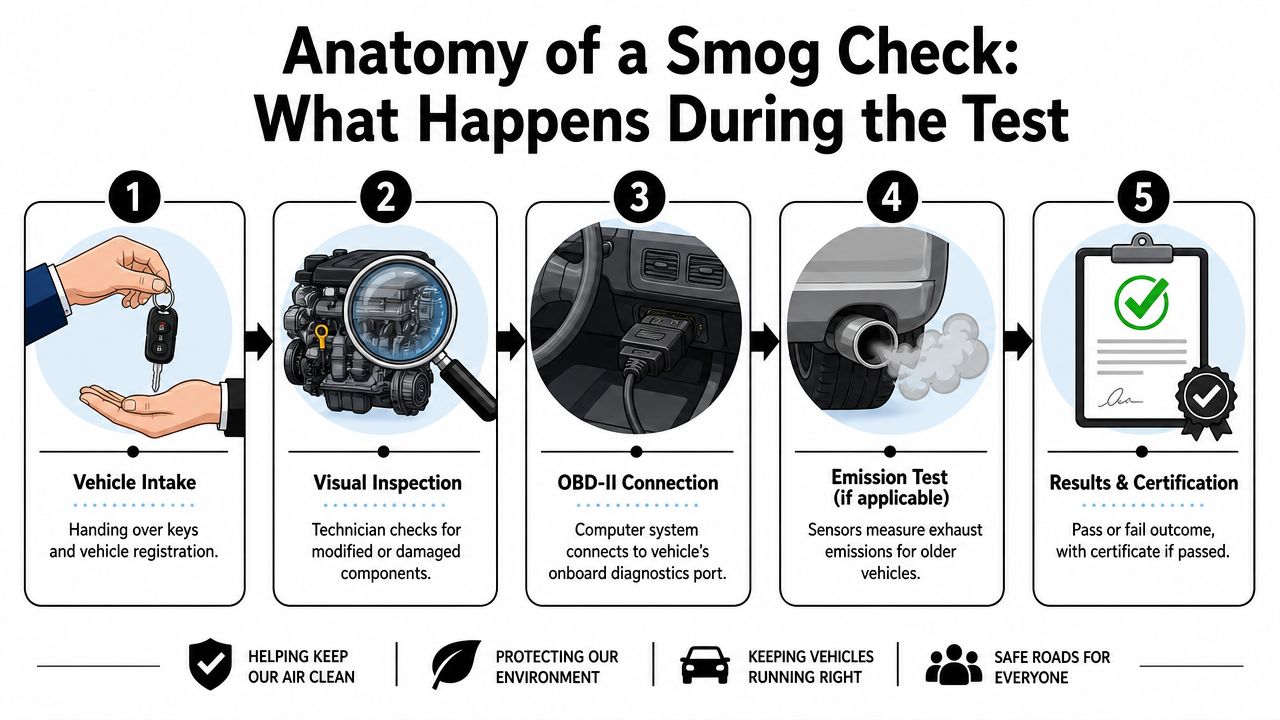
Intake and visual inspection
First comes the basic intake. The technician checks your vehicle information and gets the car into position for inspection.
Then comes the visual part. Think of this like a quick compliance walk-around under the hood and around the emissions-related components. The technician is looking for missing, disconnected, damaged, or clearly modified parts that affect emissions compliance.
If a car has been altered in a way that conflicts with emissions requirements, that issue can stop the process before the car ever gets to the electronic or exhaust portion of the test.
Computer check or tailpipe test
For many newer vehicles, the key step is the OBD-II scan. That means the technician connects to your car's onboard computer and checks whether the emissions system reports normal status and readiness. It's basically the car answering, “Are my emissions controls working, and have I completed the self-checks I'm supposed to complete?”
Older vehicles may require a more traditional exhaust analysis. That's the part many people think of as the “sniffer” test. It takes more setup and more technician handling than a simple plug-in scan, which is one reason older vehicles usually take longer.
A newer car often moves faster because the technician can read a lot through the diagnostic port instead of running a more involved exhaust procedure.
Final result and certificate handling
Once the inspection steps are complete, the result is finalized and transmitted. If the vehicle passes, the smog certificate is what clears the emissions requirement for registration.
The important thing for you is this: a quick result depends on a car that's ready and a station that knows how to keep the workflow moving. The technology matters, but process matters just as much.
Smog Check Time Breakdown by Vehicle Type
Your total time depends less on the word "smog" and more on what you drive.
For a late-model gasoline car with no warning lights and monitors set, the test portion is often quick. An older vehicle, diesel, or specialty setup usually takes longer because the inspection path is less uniform and needs more technician time. That is why smart scheduling starts with vehicle type, not wishful thinking.
Estimated Smog Check Test Duration by Vehicle Type
| Vehicle Type | Typical Test Time | What's Involved |
|---|---|---|
| 2000 and newer gasoline vehicles | 10 to 15 minutes | Usually a faster OBD-II based inspection when the vehicle is ready and accessible |
| Older vehicles | Often closer to 30 minutes | More hands-on testing, more setup, and a less streamlined process |
| Diesel vehicles | Varies | Inspection steps depend on configuration and compliance condition |
| Hybrid vehicles | Often on the quicker side when eligible and ready | Modern systems can make the inspection more straightforward |
Newer gasoline vehicles
These are usually the fastest appointments. If the car is ready for testing, the shop can move through the process with fewer slowdowns.
That said, do not plan your day around the shortest possible test time. Plan around total visit time. A fast station with an organized intake process matters more than shaving a minute off the machine portion. Speedy Smog stands out here because efficient workflow is what keeps a short test from turning into a long errand.
Older vehicles, trucks, and diesels
A 1990s vehicle or an older truck usually doesn't have that same straightforward path. There is often more setup, more manual checking, and more room for the inspection to take longer.
Diesels can also stretch the timeline depending on condition and configuration. Hybrid vehicles are often quicker, but only if everything is ready when you arrive.
Budget for the full visit, not just the test itself. Check-in time, the line in front of you, and your vehicle's inspection path are what decide whether this takes 15 minutes or most of your morning.
One practical tip. If your certificate timing matters for registration or a vehicle sale, do not test too early. Good timing saves you from doing the same errand twice.
Common Delays That Turn a Quick Test into a Long Wait
A smog check usually goes sideways in predictable ways. Not dramatic ways. Just ordinary, frustrating ones that turn a short errand into a half-day headache.
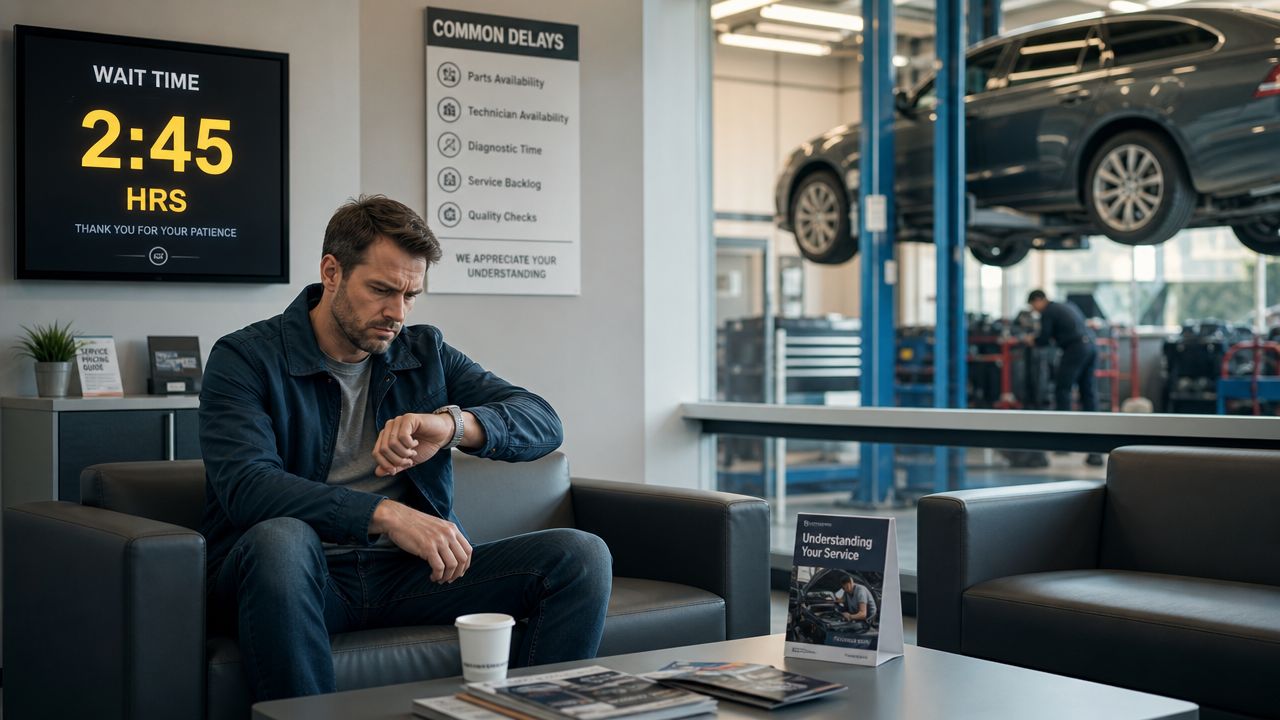
The crowded-station problem
You pick a station that looks close and convenient. Then you pull in and see a line of cars, one distracted staff member, and no clear intake process. Your car may only need a short test, but now you're stuck waiting behind everyone else.
This is the biggest reason people get the wrong idea about smog check how long. They blame the test, when the underlying issue is station flow.
The check engine light issue
That glowing light on the dash is a time killer. If it's on, don't expect a smooth in-and-out visit. You need to deal with the underlying issue first.
A lot of drivers hope the station will “just test it anyway.” That's not a plan. That's a wasted trip.
Show up with a check engine light on, and you're not saving time. You're volunteering for a second visit.
The not-ready computer problem
This one catches people all the time after a battery disconnect or recent repair. The car may feel fine, but the onboard system hasn't finished its internal readiness checks yet.
When that happens, the technician can't just guess or push it through. You may need additional driving before the car is ready for inspection. That means another trip, more waiting, and more schedule juggling.
The hidden-failure scenario
Some cars don't show obvious symptoms, but they still fail the emissions process because something in the system isn't working correctly. Maybe the engine runs a little rough. Maybe a component was modified. Maybe the gas cap or another emissions-related part isn't doing its job.
The result is the same. The test stops being a quick compliance errand and turns into diagnosis, repair, and retest.
Here's the pattern I see most often:
- Rush decision: Driver picks the nearest station without checking how they handle traffic.
- Dash warning ignored: Vehicle arrives with a known issue.
- Recent repair overlooked: Battery was disconnected, but no one checked monitor readiness.
- Deadline pressure: Driver waits until registration is almost due, so any delay feels worse.
The fix is straightforward. Prepare the car, choose the station carefully, and leave yourself time to recover if something pops up.
Tips for Your Fastest Smog Check Ever
You can lose more time in the parking lot and on a return visit than you ever will during the actual inspection. If your goal is to get this done once and get on with your day, focus on total time. That means choosing the right station, showing up with the car ready, and avoiding easy mistakes that force a retest.
Use a short checklist before you leave
Keep it simple. A few smart checks save the most time:
- Bring your registration or DMV notice: Intake goes faster when the technician has what they need right away.
- Drive the car first: A warmed-up vehicle is usually easier to process than one that has been sitting cold.
- Look at the dash before you go: Warning lights are a stop sign, not a maybe.
- Make sure the car is ready: If the battery was disconnected or repairs were done recently, confirm the monitors have completed.
- Call before heading over: A quick phone call can save a long wait.
Adjust your plan based on the vehicle you drive
Late-model cars are usually straightforward. The primary time saver is picking a shop that handles OBD-II testing efficiently and keeps cars moving instead of stacking up delays at check-in.
Older vehicles need more margin. If it has a rough idle, an exhaust issue, or recent repair history, do not squeeze the test into a tight schedule. Give yourself room to fix a problem without turning one errand into two or three trips.
Diesel and hybrid owners should be just as selective. Go to a station that regularly tests those vehicle types and knows the process cold. Familiarity saves time.
Best time-saving rule: The station you choose has a bigger effect on total time than the test itself.
For East Bay drivers, Speedy Smog in San Leandro is a practical choice because it is STAR-certified and set up for focused smog testing across newer cars, older vehicles, diesels, and hybrids. That matters. A shop built around this work is usually faster than a general repair location trying to fit smog checks between other jobs.
A quick look at the process helps set expectations:
Choose the shop that saves the whole afternoon
Plenty of drivers pick the closest station and hope for the best. That is how a short test turns into a drawn-out errand. You want a place with an organized check-in flow, technicians who do this all day, and a process that does not waste your time.
Here's the approach I recommend:
- Pick a dedicated STAR-certified smog station
- Show up with a warmed-up, test-ready vehicle
- Book enough time before your DMV deadline to handle surprises
Do those three things, and you give yourself the best chance of one visit, one pass, and no repeat trip.
Your Fast Pass to DMV Compliance in San Leandro
The short answer to smog check how long is easy. For many modern cars, the test itself is brief. The actual time depends on whether you show up prepared and whether the station runs an efficient process.
That's why smart drivers don't obsess over the machine. They focus on the full experience. No warning lights, no readiness problems, no last-minute panic, and no wasting time at a slow shop.
If you're in San Leandro or nearby, make the decision that saves the most time overall. Use a STAR-certified station, bring your paperwork, arrive with a warmed-up and ready vehicle, and leave enough room before your registration deadline in case anything needs attention.
For local drivers, that means you don't need to keep wondering how long this will take. You need a smooth visit, accurate inspection, and DMV-accepted result without the usual hassle. Speed, organization, and a straightforward process beat guesswork every time.
Need a fast, low-hassle smog check in San Leandro? Visit Speedy Smog at 15275 Washington Ave. They're open Monday through Saturday, and they focus on efficient STAR-certified testing so you can get certified and move on with your day.
You open your DMV renewal notice, see that you need a smog check, and immediately have questions. Where do you go, how long will it take, what does it cost, and what happens if your car doesn't pass?
That's normal. A lot of first-time drivers think smog check stations work like repair shops, or that the process will take half the day. In California, it's usually much simpler than that. Once you know what the station does, what type of station you need, and how the appointment works, the whole thing feels a lot more manageable.
Table of Contents
- What Are Smog Check Stations and Why Do You Need One
- STAR Certified vs Regular Smog Check Stations Explained
- Your Smog Check Appointment What to Expect
- Common Smog Check Failures and How to Avoid Them
- How to Choose the Right Smog Station for You
- Get Your Smog Check Done Fast at Speedy Smog
What Are Smog Check Stations and Why Do You Need One
A smog check station is a place where your vehicle's emissions system gets inspected for California registration compliance. The easiest way to think about it is this: it's a routine checkup for the parts of your car that affect what comes out of the tailpipe and how the emissions system is working.
California uses smog checks to help keep vehicles within state emissions rules. For many drivers, this comes up during registration renewal. If your notice says a smog check is required, the state wants proof that the car passed before registration can be completed.
Why the process feels fast
Many people expect a long mechanical inspection, but that's usually not what happens at smog check stations. Geotab's California smog check guide says a typical smog check takes about 20 to 30 minutes per vehicle and is usually required every two years, and Diamond Certified notes that many California vehicles need testing every other year once they are more than four years old.
That short appointment time shaped how these stations operate. They're built for consistent, repeatable inspections, not for all-day repair work.
A smog check station is usually a compliance stop first, not a full diagnostic shop.
When drivers usually need one
You'll most often deal with a smog check when:
- Your DMV renewal notice requires it: This is the most common reason.
- Your vehicle falls into the regular testing cycle: Many California vehicles are tested every other year once they're older than the initial exempt period.
- You need proof of compliance: Passing the test allows the certificate to be used for registration.
Here's where people get tripped up. They assume every car gets tested the same way, every time. In reality, the station follows California rules for your vehicle type and model year, and the inspection is standardized around that.
What the station is really doing
A technician isn't judging whether your whole car is “good” or “bad.” They're checking whether it meets emissions-related requirements under the state's system. That's why a car can run fine and still have a smog issue, or feel rough but still pass if the emissions system is working properly.
If you're going in for the first time, the main thing to know is simple. A smog check is a normal part of owning a vehicle in California. It's usually quick, it follows a set process, and once you understand that, it stops feeling mysterious.
STAR Certified vs Regular Smog Check Stations Explained
One of the most confusing parts of the process is the word STAR. Drivers see it on the DMV notice or on shop signs and wonder if it's optional, more expensive, or only for problem cars.
The simple answer is that both regular and STAR smog check stations are licensed, but STAR stations are held to a stricter performance standard.
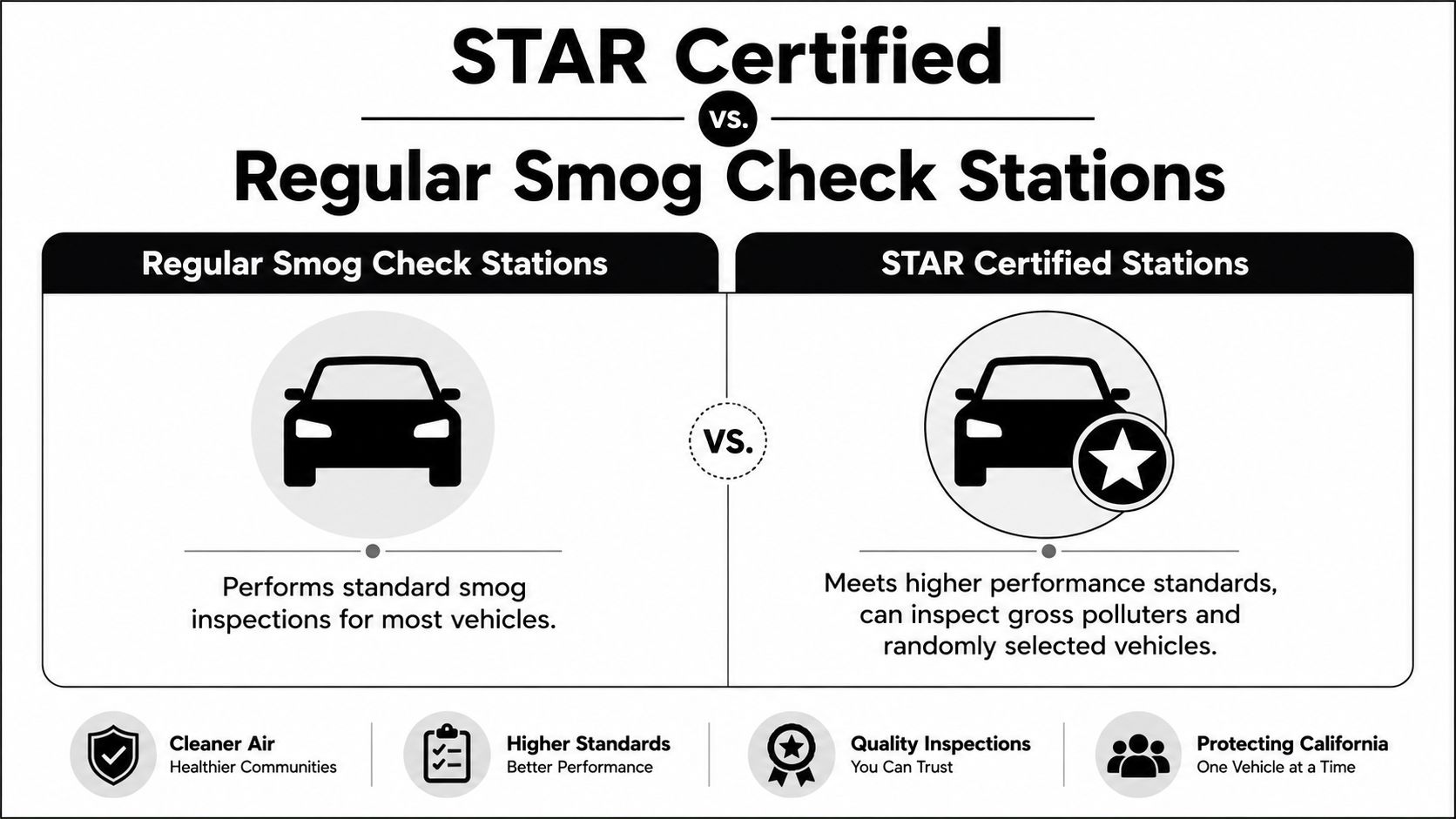
Regular stations and STAR stations side by side
| Station type | What it means for you |
|---|---|
| Regular smog check station | Handles standard inspections for many vehicles |
| STAR certified station | A higher-compliance subset of licensed stations intended for higher-risk vehicles and closer oversight |
According to this explanation of STAR vs regular smog checks in California, STAR smog check stations are intended to test higher-risk vehicles with greater rigor.
Why the DMV may require STAR
Some vehicles are directed to a STAR station because the state wants that inspection handled under tighter oversight. That doesn't mean you did anything wrong. It also doesn't automatically mean your vehicle is failing. It just means the vehicle falls into a category where California wants a more closely monitored inspection.
That's why your renewal paperwork matters. If it says STAR, don't waste time going to a regular station first.
Practical rule: If your DMV notice says STAR, go straight to a STAR-certified station. It saves a second trip.
Why some drivers choose STAR even when they don't have to
A STAR station can also be a smart choice for drivers who aren't specifically required to use one. The same California STAR guidance notes that choosing a STAR-certified station can reduce the risk of a repeat visit caused by a borderline result or a station that lacks the required oversight level for certain vehicles.
That matters if your car is older, has had emissions work in the past, or you just want the inspection done under the highest compliance standard available for this type of test.
A regular station isn't “bad,” and a STAR station isn't magic. The difference is oversight, consistency, and suitability for vehicles that need that extra layer of scrutiny. If you're unsure which type you need, checking the DMV notice first is the quickest way to avoid confusion.
Your Smog Check Appointment What to Expect
The appointment itself is usually straightforward. Most of the stress comes from not knowing the order of events. Once you've seen it once, it feels routine.
Start by bringing the basics you're likely to need, such as your DMV notice and a payment method. If you've never been to a smog check station before, it also helps to arrive a few minutes early so you're not rushing.
Here's a simple visual walkthrough of the visit:
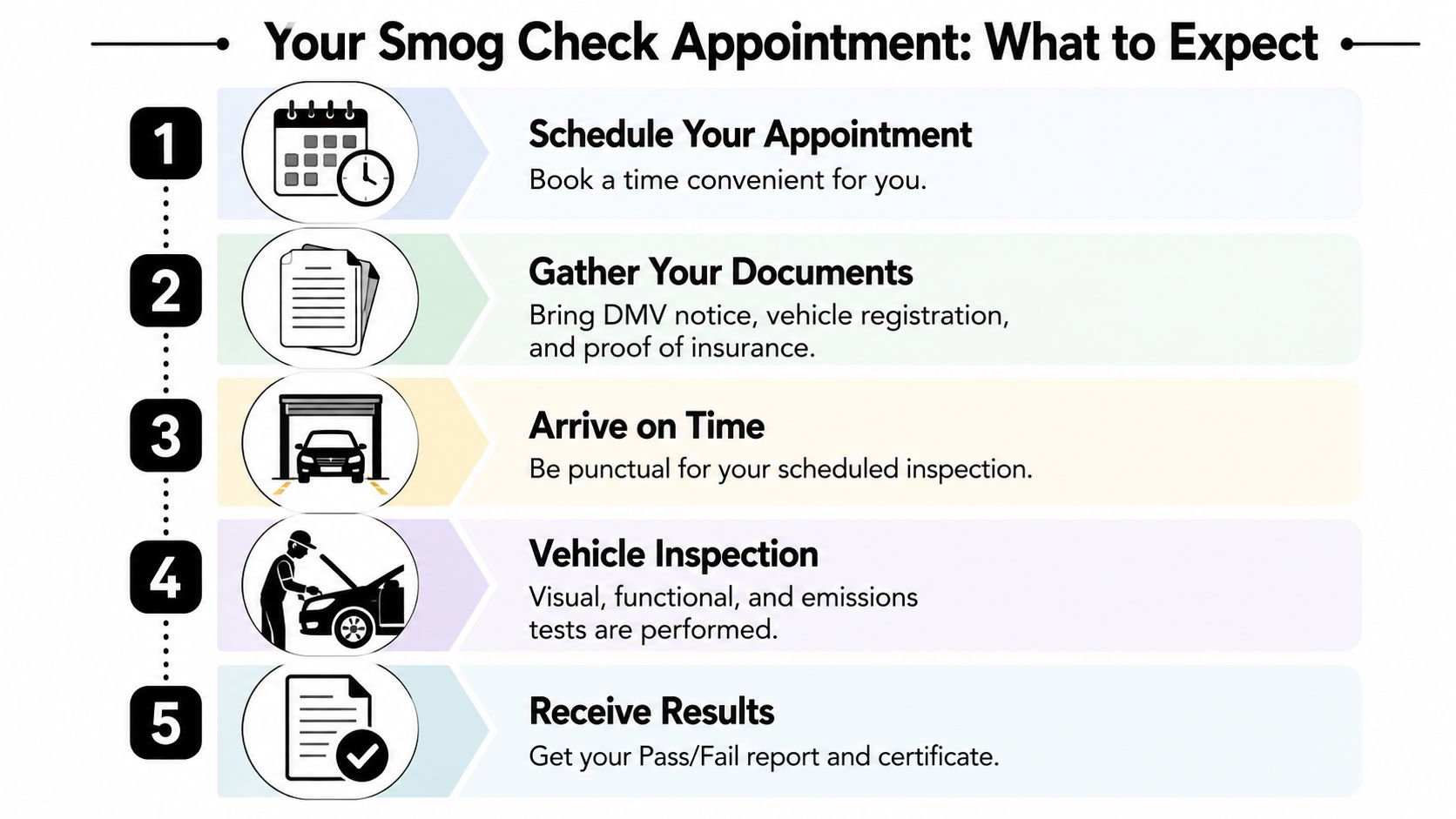
What happens after you pull in
A technician checks your vehicle information and starts the inspection under California's testing rules. Depending on the vehicle, that can include emissions-related checks tied to the car's system and required inspection procedure.
You don't need to coach the technician or explain how the car runs unless there's something unusual they need to know. For most drivers, the easiest move is to hand over the paperwork, answer questions clearly, and let the process happen in order.
How pricing usually works
This part confuses a lot of people because there are really two charges involved. The station sets its own inspection price, but the state certificate fee is separate.
The Diamond Certified California smog FAQ says the Bureau of Automotive Repair requires stations to post inspection prices, and consumer guidance cited there says drivers should typically expect to pay about $29.95 to $59.95 plus tax and the fixed $8.25 state certificate fee.
That means two nearby smog check stations might charge differently for the inspection itself, while the certificate fee stays the same.
Look at the posted pricing before the test starts. You should be able to see the inspection price and understand what's separate from the state fee.
A quick pricing snapshot looks like this:
| Cost part | Who sets it |
|---|---|
| Inspection price | The smog station |
| Certificate-of-compliance fee | The state, fixed at $8.25 |
What happens at the end
If the vehicle passes, the certificate is handled through the state process so your DMV registration can move forward. If it doesn't pass, you'll get paperwork showing the result, and that gives you a starting point for repairs.
For a quick visual explanation of how the visit works, this short video helps first-timers see the flow before they arrive.
The key thing to remember is that the appointment isn't supposed to feel dramatic. It's a set procedure with posted pricing, a pass-or-fail result, and a clear next step either way.
Common Smog Check Failures and How to Avoid Them
Most failed smog checks come down to a small number of issues. Some are obvious, like a warning light on the dash. Others are the kind of thing drivers ignore because the car still seems to run fine.
The good news is that you can lower the odds of a surprise by doing a little prep before the appointment.
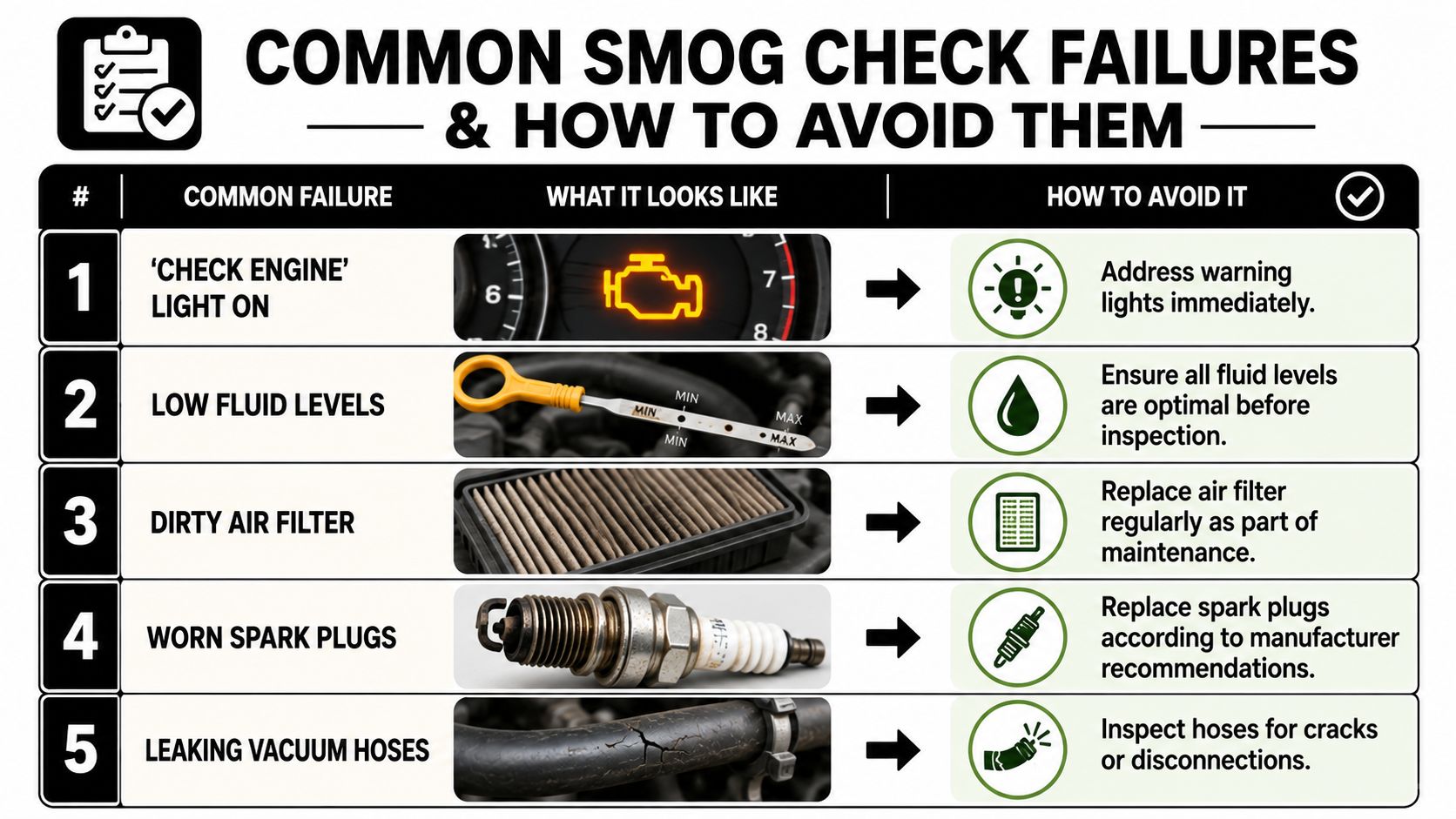
Problems that catch drivers off guard
These are common trouble spots to think about before you head in:
- Check engine light on: If that light is illuminated, don't assume it's minor. Even if the car feels normal, emissions-related faults can trigger a failure.
- Loose gas cap or sealing issue: A cap that isn't tight or isn't sealing correctly can create emissions-system problems.
- Recently disconnected battery: If battery power was interrupted, the car may need normal driving time before its systems are ready again.
- Neglected basic maintenance: Dirty filters, worn spark plugs, or vacuum-related issues can affect how cleanly the engine runs.
- Visible problems under the hood: Hoses, leaks, or obvious missing emissions-related parts can create inspection trouble.
Simple things you can do before the test
You don't need to be a mechanic to improve your odds. A few simple checks help:
- Drive the car before the appointment. Don't bring it in cold if you can avoid it.
- Make sure the gas cap is snug. It sounds small because it is, but small issues matter here.
- Handle warning lights first. Don't pay for a test if you already know something is wrong.
- Stay current on maintenance. A car that's overdue for tune-up basics is more likely to cause problems.
- Don't clear codes right before a test. If a problem was recently reset instead of repaired, the car may not be ready.
If your dashboard is warning you about something, treat that as the first job. The smog check comes after that.
If your car doesn't pass
A failed test isn't the end of the story. It means the station found an emissions-related issue that needs attention before the vehicle can complete the process.
Bring the failure paperwork to a qualified repair shop and have the underlying problem diagnosed. Don't guess, and don't throw random parts at the car. One accurate repair is usually cheaper and less frustrating than several hopeful ones.
A calm approach works best here. Read the report, fix the actual issue, and then return for the next step. That's much easier than treating a failure like a disaster.
How to Choose the Right Smog Station for You
You pull out your renewal notice, look up a nearby smog shop, and then wonder, “How do I know if this is the right place?” That question trips up a lot of California drivers, especially the first time. Choosing a station is less about finding any shop with a smog sign and more about finding one that fits your car, your paperwork, and your day.
A good smog station should make the process feel simple.
Start with the part California cares about first. Your station has to match your vehicle's requirement. If your DMV paperwork says STAR, you need a STAR Certified station. If it does not, you may have more options. Either way, checking this before you leave home saves you from the most frustrating kind of delay: showing up at the wrong place and having to start over.
After that, look at how the shop runs.
A smog check is a short visit, but a disorganized station can make it feel much longer. The best choice usually has:
- Clear pricing: You should know the fee before the test starts.
- A convenient location: A nearby shop is easier to fit into work, school pickup, or errands.
- An organized check-in process: Walk-ins and appointments should both feel easy to understand.
- A decent waiting setup: Even a quick stop is less stressful when the space is clean and straightforward.
Reviews can help, but use them as a final check, not the first one. A friendly review does not fix the wrong certification or confusing pricing. Start with the basics, then see whether other local drivers describe the experience as quick, clear, and professional.
For East Bay drivers, Speedy Smog in San Leandro is a useful example of what to look for in a local station. Based on the business information provided for this article, it is STAR Certified and serves a wide range of vehicles, including newer models, older cars, diesels, and hybrids. That tells you what matters most in real life: the station meets California requirements and is set up to handle the kinds of vehicles East Bay drivers bring in.
The goal is not to find the fanciest shop. It is to find one that removes uncertainty. The right station tells you what it does, what it charges, and whether it can inspect your car before you waste time in line.
Get Your Smog Check Done Fast at Speedy Smog
If you live in San Leandro, Oakland, or elsewhere in the East Bay, the easiest smog check is usually the one that fits your day without turning into a project. That means a station with the right certification, a quick workflow, and staff who keep things moving.
According to the publisher information provided for this article, Speedy Smog is located at 15275 Washington Ave, San Leandro, CA 94579, is STAR Certified, and handles inspections for 2000 and newer models, 1999 and older vehicles, diesels, and hybrids. The same business information says most tests for 2000+ vehicles are completed in about 10 to 15 minutes, and that the shop offers a clean indoor waiting room, transparent pricing, and periodic $25-off coupons for most smogs on newer vehicles.
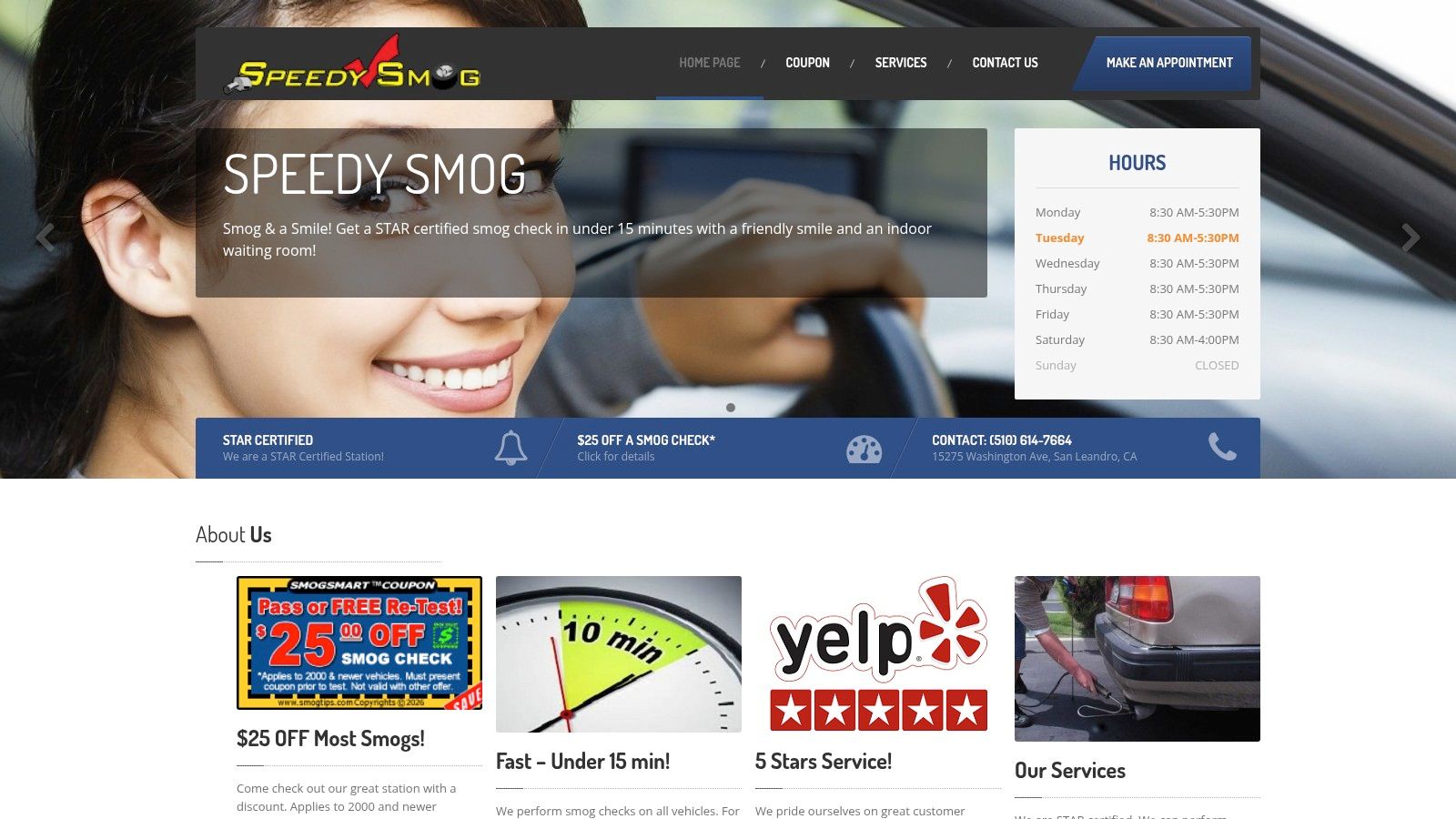
Why that setup works for busy drivers
A station like this fits the problems people have with smog checks:
- You need the right station type: STAR certification covers that requirement.
- You don't want a long interruption: Short inspection times help.
- You want the price to be understandable: Transparent pricing makes that easier.
- You need basic comfort while waiting: A clean indoor space matters more than people expect.
The simple takeaway
Smog checks in California aren't complicated once you know the system. You check your DMV notice, confirm whether you need a regular or STAR station, show up prepared, and let the station run the inspection. If the car passes, you move on with registration. If it doesn't, you repair the issue and return with a clear direction.
That's the whole job. No mystery, no need to overthink it.
If you're due for a California emissions inspection in the East Bay, Speedy Smog is a practical place to start. You can check location details, hours, and current offers, then book the smog check that fits your schedule.
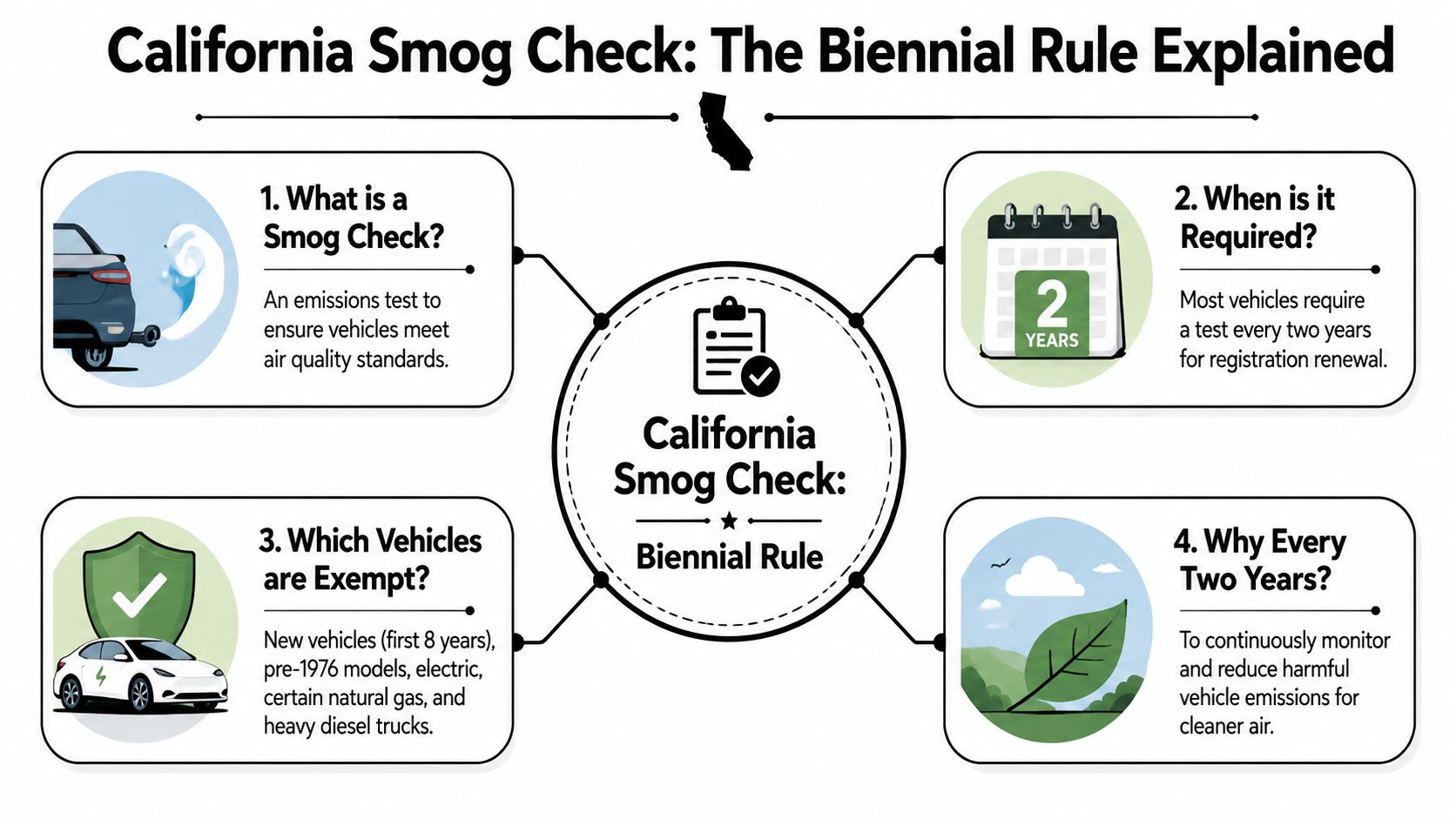
California doesn't require a smog check every year for most vehicles. For most eligible vehicles, the rule is every two years, and newer vehicles under 8 model years old are generally exempt from the biennial inspection while still paying a smog abatement fee.
A lot of drivers search for “smog check every year” because they've had a test in back-to-back years and assume that must be the statewide rule. It's a reasonable mix-up. In real life, people sell a car, move into California, renew registration, clear a check engine light, or get sent to a specific station, and all of that can make the schedule feel annual even when the baseline rule is not.
If you're trying to figure out what applies to your car, the simplest way to think about it is this: California has a regular schedule, plus a few situations that trigger an extra test. Once you separate those two things, the rules get much easier to follow.
Table of Contents
- Do You Really Need a Smog Check Every Year
- California's Biennial Smog Check Rule Explained
- When You DO Need an Extra Smog Check
- How to Prepare Your Vehicle for a Smog Test
- Get a Fast STAR Certified Test at Speedy Smog
- California Smog Check FAQ
Do You Really Need a Smog Check Every Year
No. For most California drivers, the answer to “Do I need a smog check every year?” is no.
The confusion sticks around because people remember the exception, not the routine. If your registration renewal asked for a smog check one year, and then you needed another test the next year because you sold the car or handled a title change, it feels like an annual rule. But it isn't the standard schedule.
There's another reason this myth hangs on. Modern smog checks don't always look like old-school emissions tests, so drivers assume the rules must be getting tougher and more frequent. In reality, the EPA says cars and trucks are now 98–99% cleaner than late-1960s vehicles for smog-related pollutants. That's why today's inspections often focus on malfunction indicator lights, readiness monitors, and software compliance instead of only tailpipe output.
Why the old advice sounds wrong now
Years ago, many people pictured a smog test as a machine measuring dirty exhaust. That still matters for some vehicles, but many newer cars go through an OBD-II system check instead. The state is often verifying that the emissions system is working as designed and that the car isn't reporting a fault.
Practical rule: If you hear “smog check every year,” treat that as a red flag and verify the actual trigger. It may be a sale, a first-time California registration, or a one-off DMV requirement.
What matters most to drivers
You don't need to memorize every program detail. You need to know three things:
- The normal rule: Most eligible California vehicles are tested on a two-year cycle.
- The common exception: Certain life events with the car can trigger an extra inspection outside that cycle.
- The practical reality: Newer vehicles often fail for electronic compliance issues, not because they “look old” or have high mileage.
That's the part many “smog check every year” pages miss. The schedule is one question. The actual reason a car passes or fails is often a different question entirely.
California's Biennial Smog Check Rule Explained
Here's the part that clears up a lot of confusion. California does not put most drivers on a yearly smog schedule. The standard rule is a biennial inspection, which means a test every two years for many vehicles 1976 and newer under the state's Smog Check Program, as outlined in the California Smog Check Program overview.
The easiest way to read that rule is to separate the normal schedule from the special triggers. This section covers the normal schedule only. If you have ever felt like your car got tested sooner than expected, the reason is often a separate event tied to the vehicle, not an annual requirement.
The smog check serves as a recurring check on your car's emissions system. A car can drive fine and still have a problem that raises emissions, especially if a sensor, monitor, or emissions component stops working the way it should.
Who usually needs testing
For most drivers, the practical rule is simple. If your vehicle is old enough to be in the program and no exemption applies, the smog check usually comes up at registration renewal every other year.
The inspection method can vary by vehicle age and design. Many 2000-and-newer vehicles are checked through the OBD-II system, while older vehicles may go through added visual and tailpipe steps. A common question is why the state uses different inspection methods for older versus newer cars. The short answer is that newer vehicles report far more emissions information electronically, while older vehicles often need more direct testing.
That difference can make two cars on the same two-year cycle feel very different at the station. One may be mostly an electronic compliance check. Another may involve more hands-on inspection steps.
The exemption that confuses people
A newer vehicle can make the schedule feel inconsistent if you do not know where the exemption starts and ends. In general, if your car is less than 8 model years old, it is usually exempt from the biennial smog inspection, although registration still includes a smog abatement fee.
That timing trips people up for a simple reason. You can go several renewal periods without needing a test, then suddenly get a notice once the car ages into the program. It feels abrupt, but the rule did not change. Your vehicle just moved from the exempt group into the regular two-year schedule.
Here is the quick version:
| Vehicle situation | Typical smog check expectation |
|---|---|
| Newer vehicle under 8 model years | No biennial test yet, but registration still includes the related state fee |
| Vehicle old enough for the program | Smog check usually required every other year for renewal |
| Older and newer vehicles compared | Newer vehicles often use OBD-II checks, older ones may have added visual or tailpipe steps |
Once you separate the regular two-year cycle from one-off situations, the “every year” idea usually stops being confusing.
When You DO Need an Extra Smog Check
The “smog check every year” myth often arises because, while the normal schedule may be every two years, certain situations can trigger a test in an off year.
If that happened to you, you weren't imagining things. You just ran into a special case instead of the regular cycle.
Selling a vehicle
This is one of the most common reasons people think California requires annual testing. You renew registration and handle a smog inspection. Then not long after, you decide to sell the car. The transfer can create another smog-related requirement tied to that transaction.
That sequence feels like “I had to smog it again the very next year.” From the driver's point of view, that's understandable. From the state's point of view, those were two different events.
Bringing a car into California
Drivers who move from another state often get caught here. You may have been on one testing schedule before, or no testing schedule at all, and then California requires a smog inspection for the initial registration process.
That doesn't mean California put you on a yearly plan. It means your first California registration created its own compliance step.
DMV or station-specific requirements
Sometimes a DMV notice or registration paperwork sends a vehicle owner to a particular type of station, including a STAR station. That can make the process feel more serious or more frequent than usual, especially if the owner already had a test in the recent past.
Here's the practical way to understand it:
- Registration renewal follows the normal every-other-year pattern for most eligible vehicles.
- Ownership change can create its own smog requirement.
- First-time California registration can create another out-of-cycle requirement.
- Station direction from DMV changes where you test, not necessarily the statewide frequency rule.
Why this matters at the counter
When a customer says, “I just did this last year,” that may be true. The missing piece is usually that the earlier test was tied to a different event.
If you had two smog checks close together, don't assume the law changed. Check what each test was for.
That one habit saves a lot of frustration. It also keeps you from delaying your paperwork because you're waiting for a date on the calendar instead of responding to the actual DMV trigger in front of you.
How to Prepare Your Vehicle for a Smog Test
Most preventable smog headaches come down to a short list of issues. If you handle those before you pull into the station, the process usually feels much more routine.
A good starting point is knowing what the state cares about on test day. The Bureau of Automotive Repair smog check guidance is very clear that a vehicle will not pass if the check engine light is on, and a recently disconnected battery can leave OBD readiness monitors unset until the car has been driven long enough for them to reset.
The short pre-test checklist
Before your appointment, check these items:
- Check engine light off: If the light is on, don't waste your time testing yet. The car needs diagnosis and repair first.
- Recent battery work: If the battery was disconnected, replaced, or the codes were cleared, drive the vehicle enough for the monitors to reset before testing.
- Avoid last-minute code clearing: Clearing codes may turn the light off for the moment, but the readiness monitors may still show incomplete.
- Bring the right mindset: A smog check is a pass or fail snapshot of the vehicle's emissions status that day.
A lot of drivers get tripped up by that third point. They think, “The light is off now, so I'm good.” But if the computer hasn't completed its self-checks, the test can still stop right there.
Why readiness monitors matter
Modern vehicles constantly monitor their own emissions systems. When everything is working and the car has been driven through enough normal conditions, those monitors report ready. If power was recently disconnected, the system may need time to run those checks again.
That's why someone can leave a repair shop, head straight to a smog station, and still have trouble. The repair may be finished, but the onboard system isn't finished verifying itself.
Here's a helpful visual explanation of how that process works in practice:
Simple habits that reduce surprises
You don't need to be a technician to improve your odds of a smooth visit.
- Drive the car normally after battery work. Don't schedule a test the same day if you can avoid it.
- Pay attention to dashboard warnings. If the check engine light is on, treat that as a stop sign for smog testing.
- Don't wait until the last possible day. If the car needs repairs or a retest, extra time helps.
A smog test doesn't reward guesswork. It rewards showing up with a vehicle that has no active emissions fault and fully reset monitors.
Get a Fast STAR Certified Test at Speedy Smog
A lot of drivers get tripped up here. They hear “smog check” and assume every station does the same thing, the same way. In California, station type can matter.
A STAR-certified station is approved under stricter state performance rules. If your registration notice says STAR, you need that specific kind of station. If it does not, some drivers still choose STAR because they want a station that follows tighter testing standards. According to California smog test statistics by year, California's 2024 failure rate was 8.45% for BAR-97 systems and 4.60% for OBD systems.
What STAR means to a customer
For a customer, STAR mainly means matching the station to the requirement on your notice. It does not automatically mean your car is more likely to fail. It means the inspection is being done at a station held to closer oversight.
That distinction matters because the “every year” myth often starts with mixed-up memories. A driver gets a biennial test for registration, then later needs another one for a sale or a title transfer, and it starts to feel annual even when it is not. The station requirement can add to that confusion if the DMV notice specifically calls for STAR.
A practical local option
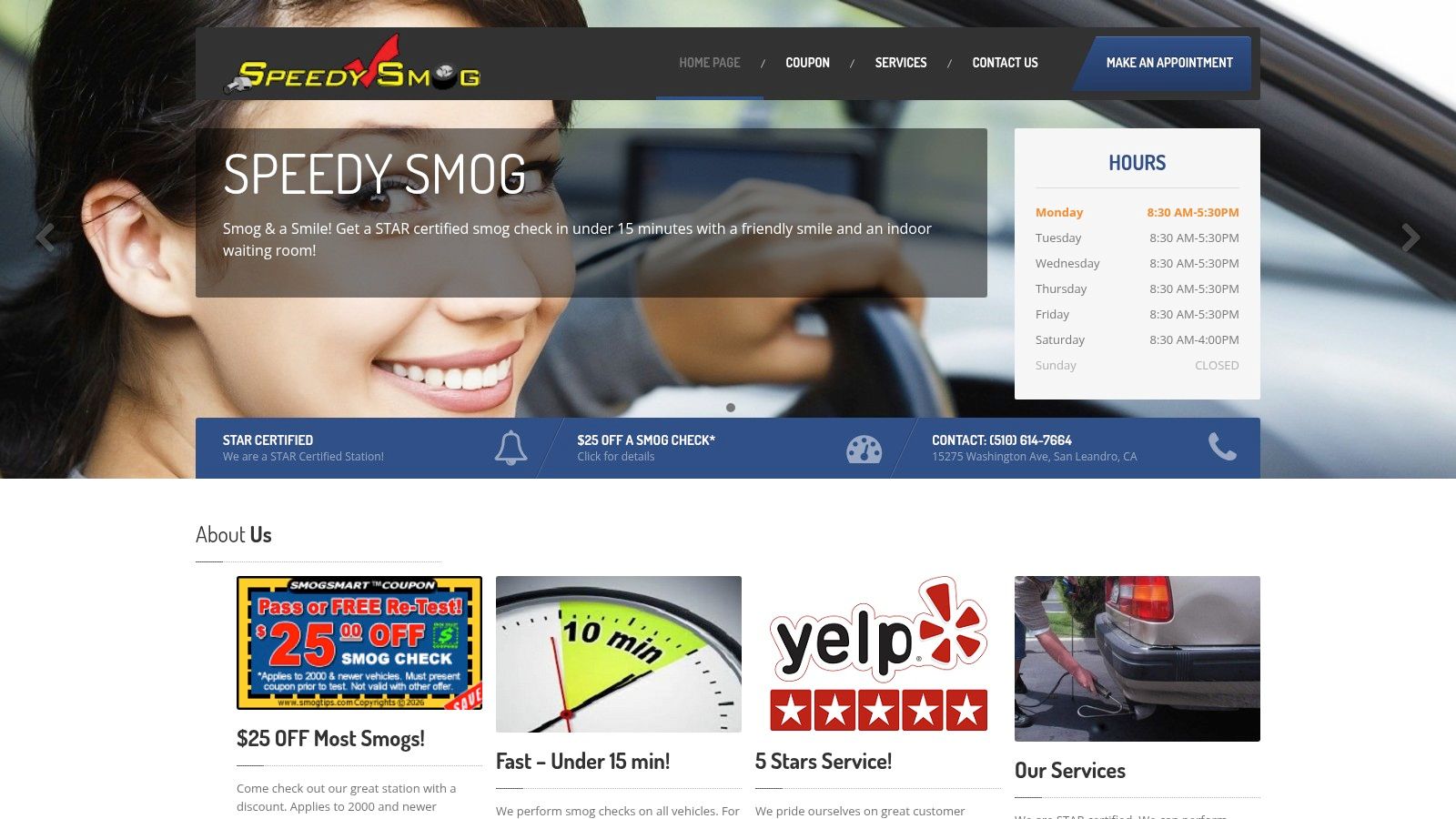
If you're in the East Bay, Speedy Smog in San Leandro performs STAR smog checks for many vehicle types, including 2000 and newer models, 1999 and older vehicles, diesels, and hybrids. For many 2000+ vehicles, the shop's typical test time is about 10 to 15 minutes, which helps if you are trying to finish a registration task without turning it into an all-day errand.
This means:
- If your notice says STAR: use a station that can perform that inspection type.
- If your car is newer: the visit is often straightforward if the onboard system is ready and there is no check engine light.
- If your vehicle is older, diesel, or hybrid: it helps to go to a shop that regularly tests those categories.
Don't treat the certificate like it lasts forever
A passed certificate is sent to DMV electronically, but it does not sit there indefinitely waiting for you. The timing still matters.
That is another reason drivers end up believing they need a smog check every year. Sometimes they tested earlier than needed, sometimes they needed an extra test for a specific transaction, and sometimes the certificate timing did not line up with when they finished their DMV paperwork. The pattern feels annual. The rule usually is not.
California Smog Check FAQ
What happens if my car fails?
You'll need to address the reason for the failure and then return for the next required step. In plain language, a failed smog check usually means registration can't move forward until the vehicle meets the requirement.
If the issue is a check engine light, unresolved diagnostic trouble code, or incomplete readiness monitor, the smartest move is to fix the underlying problem instead of trying to force the car through a retest.
How long is a passed smog certificate good for?
A passed certificate is electronically sent to DMV and is valid for 90 days, according to the California DMV smog inspection rules. If you don't complete registration within that window, you may need another test.
That's a big reason not to test too early “just to get it done.”
Do hybrids need smog checks?
Some drivers assume hybrids never need one. That isn't a safe assumption. California's rules vary by vehicle age and type, so hybrid owners should check their registration notice and current DMV requirements.
Do diesel vehicles need smog checks?
Some do, some don't. Diesel rules depend on the vehicle and how it fits into the program. If you drive a diesel, don't rely on garage talk or old advice. Check the current registration requirement tied to your vehicle.
Why did I need a smog check again so soon?
Usually because the earlier test and the later test were tied to different events. A renewal, sale, transfer, or first-time California registration can create that feeling that you're doing a smog check every year, even though the standard cycle for most eligible vehicles is still every two years.
If your registration notice says it's time, or you want help figuring out whether you're due now or later, Speedy Smog is a straightforward local option for San Leandro and East Bay drivers who need a California smog inspection without the usual confusion.
Speedy Smog is located at 15275 Washington Ave, San Leandro, CA 94579, and its standard hours are Monday through Friday 8:30 AM to 5:00 PM, Saturday 8:30 AM to 3:30 PM, and Sunday closed. If you're looking up smog check hours because your registration notice just landed and you need this done without burning half your day, the key question isn't only when a station is open. It's when you should go.
That's the part most drivers miss. A posted schedule tells you when the doors open. It doesn't tell you when the line is shortest, when a lane is moving cleanly, or when your car is most likely to get in and out without turning a basic errand into a chore.
Table of Contents
- Your Guide to a Fast Smog Check in San Leandro
- Navigating Typical Smog Station Schedules
- The Best and Worst Times for Your Smog Check
- Appointments vs Walk Ins Which Is Faster
- Tips for a Faster Smog Check Visit
- Smog Check Timing FAQ
Your Guide to a Fast Smog Check in San Leandro
You get home, toss the DMV renewal notice on the counter, and realize you still need a smog check this week. Now the main question hits. What time gives you the best chance of getting in and out without wasting half your day?
If you're in San Leandro, start with the basics. Speedy Smog is at 15275 Washington Ave, San Leandro, CA 94579, and the posted hours are Monday to Friday 8:30 AM to 5:00 PM, Saturday 8:30 AM to 3:30 PM, and Sunday closed. Good to know. Better to know how to use those hours to your advantage.
Why timing matters more than drivers expect
A smog check is tied to your registration calendar, so timing affects more than convenience. Wait too long and you create deadline stress. Go in at the wrong moment and you can end up sitting behind a pile of cars from the lunch rush, after-work rush, or Saturday crowd.
Here's the part drivers miss. A station being open does not mean every open hour is equally fast.
Practical rule: Treat smog check hours like traffic patterns. The lane is open all day, but a few windows move a lot faster than others.
The inside scoop
If your goal is a quick visit, focus on three things:
- Choose a calmer window: Midweek usually moves better than the start or end of the workweek.
- Skip the obvious rush periods: Lunch, the last stretch before closing, and Saturday spikes tend to slow everything down.
- Bring a test-ready car: A vehicle with readiness issues or recent battery problems can turn a short stop into a wasted trip.
Instead of asking, “What time do you close?” ask, “What time gives me the best shot at a fast pass through the bay?” That question gets you to the finish line a lot quicker.
Navigating Typical Smog Station Schedules
Smog station hours follow demand, not magic. Shops open when drivers are most likely to show up, and that creates predictable traffic patterns inside the bay.
Why so many stations keep similar hours
Most smog shops stick to daytime business hours and add at least part of Saturday. That schedule matches real customer behavior. Drivers try to squeeze a test in before work, on lunch, after work, or on the weekend. Station owners know that, but they also have to balance technician coverage, equipment uptime, and how many cars they can move without stacking the parking lot.
A Smog Check in California is commonly tied to registration renewal on a regular cycle, and the test itself is usually fairly quick if the car is ready. The problem is that station hours only show when the doors are open. They do not show when the line is short, when a technician is free, or when a not-ready vehicle is slowing everyone else down.
That last part matters more than drivers expect.
A station gets backed up for two reasons. Too many cars show up at once, or too many cars show up unprepared. From a smog tech's point of view, the second one is what wrecks the schedule.
Why some areas stretch their hours
When testing demand piles up, longer hours are one of the first fixes. Illinois did exactly that during a busy period, expanding hours at state emissions testing locations to absorb more volume, as reported by ABC7 Chicago on expanded Illinois emissions testing hours.
That is the takeaway. Extended hours usually mean the same thing. Demand is bunching up around deadlines, work schedules, and limited free time.
If you want a fast visit, read posted hours as a clue, not the full answer.
| Schedule reality | What it means for you |
|---|---|
| Standard daytime hours | The busiest waves usually hit around the workday edges and lunch |
| Saturday availability | Convenient for your calendar, often slower at the station |
| Expanded hours in busy markets | Testing demand is concentrated, and crowds are normal |
Posted smog check hours tell you when a station is open. They do not tell you which hour gives you the quickest path in and out.
What to assume before you go
Use a simple rule. If a time feels convenient to almost every driver in San Leandro, expect more waiting.
The better play is to aim for a window that is still reasonable for you but less obvious to everybody else. That is how you use station hours like an insider instead of just reading them off a sign.
The Best and Worst Times for Your Smog Check
If your goal is speed, stop chasing the first available minute and start chasing the least congested one. That's how you cut hassle.
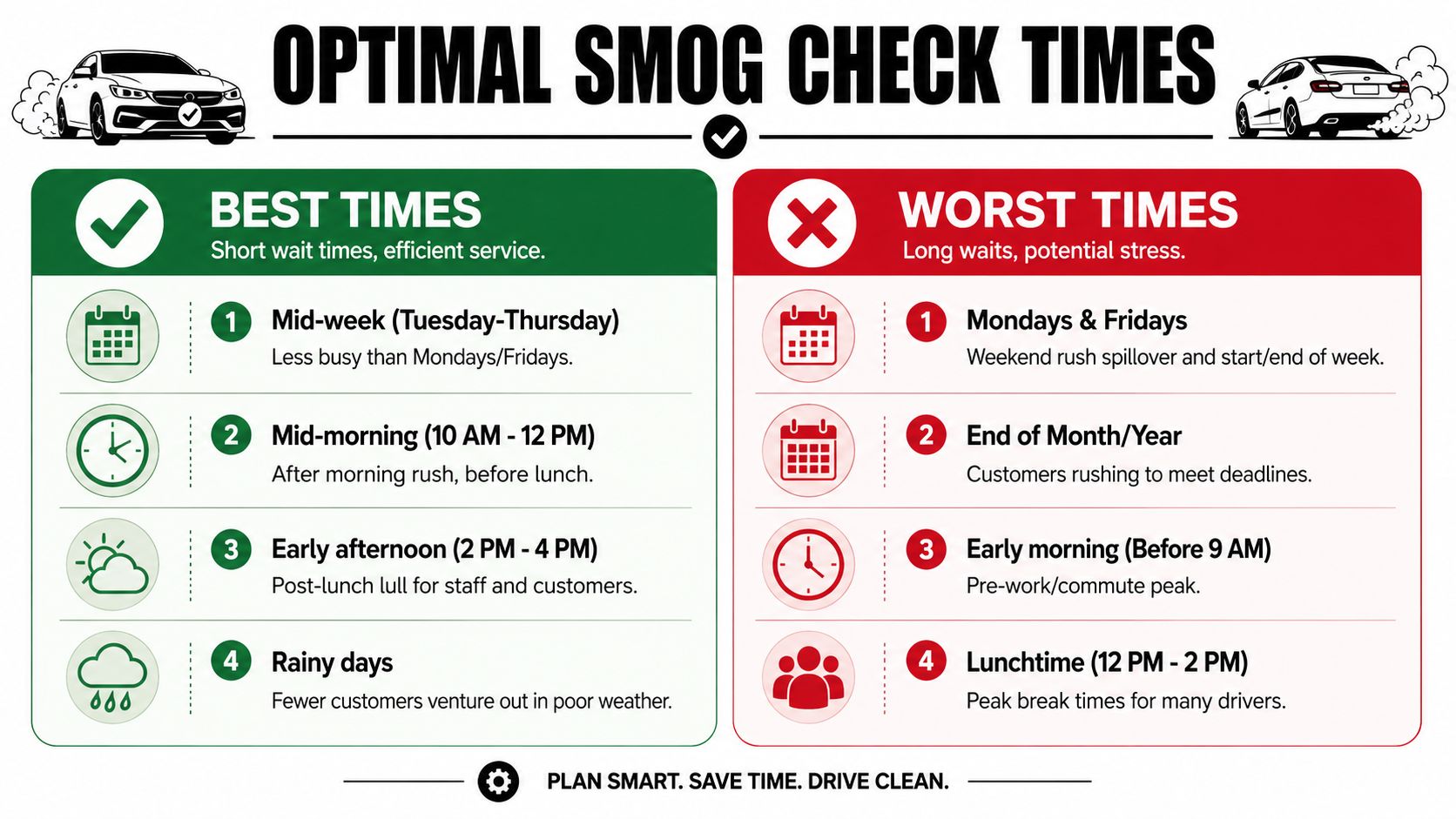
The green-zone hours
The strongest bet is usually midweek, especially late morning or early afternoon. By then, the first wave of drivers trying to handle it before work has usually passed, and you're still ahead of the lunch crowd or end-of-day push.
Here's the practical version:
- Tuesday through Thursday: These days usually avoid the Monday cleanup rush and Friday procrastination traffic.
- Mid-morning: A good sweet spot when the opening surge has already cleared.
- Early afternoon: Often steadier than lunch and less cramped than late afternoon.
- Bad weather days: Some drivers postpone errands, which can work in your favor.
Why those windows move faster
Throughput drives everything. Industry guidance says 2000-and-newer vehicles can often be finished in about 15 minutes, 1996 to 1999 vehicles may take around 25 minutes, and 1995-and-older vehicles around 35 minutes. A neutral fleet-industry source also places typical smog inspections at 20 to 30 minutes depending on vehicle condition. Under ideal conditions, a single lane can process roughly 4 newer cars per hour, as described in Geotab's smog check guide.
That's why bad timing hurts so much. It doesn't take many longer inspections ahead of you to change the pace of the entire line.
A lane can feel empty and still move slowly if the cars ahead need longer testing steps.
The red-zone hours
Some windows attract delays almost automatically.
- Mondays: People who put it off over the weekend show up.
- Fridays: A lot of drivers try to squeeze it in before the weekend.
- Lunch hours: Everyone thinks they can “just run out real quick.”
- Right before closing: This is the most stressful time to gamble on a smooth visit.
- End of the month: Deadline behavior stacks up fast.
- Saturdays: Convenient, yes. Efficient, usually not.
My blunt recommendation
If your car is newer and healthy, walk in during a midweek off-peak window and you've got a solid shot at a quick stop. If your car is older, has been sitting, or has any warning-light history, don't choose the busiest part of the day and hope for the best. That's how simple jobs turn into drawn-out ones.
Appointments vs Walk Ins Which Is Faster
You pull up expecting a quick smog check, then lose time before the test even starts. That usually happens because the driver picked the wrong lane strategy, not because the inspection itself is slow.
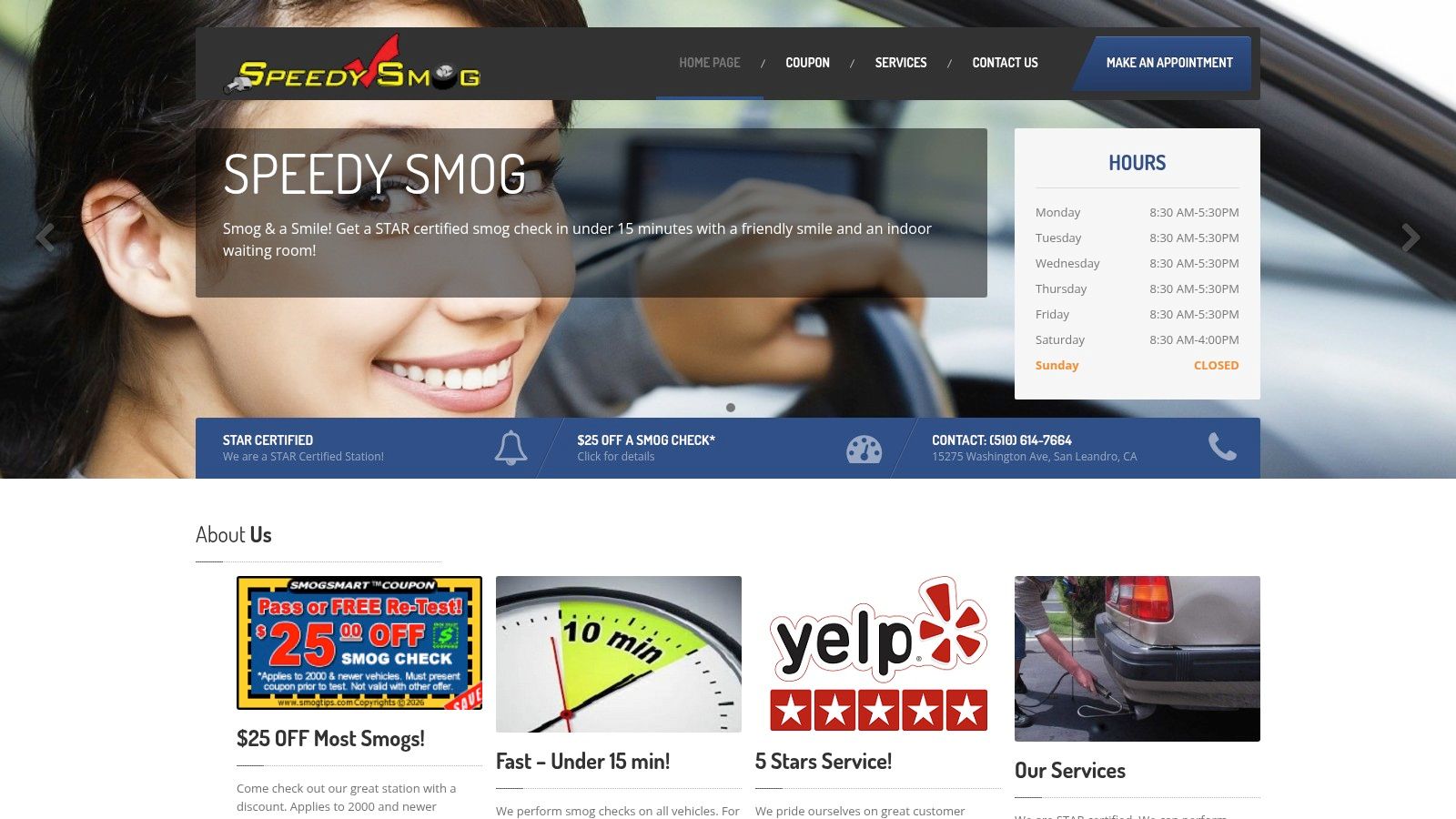
When a walk-in is the faster move
A walk-in is the better play if your car is straightforward and your timing is flexible. Newer vehicles usually move through with fewer surprises, so showing up during a quiet window can beat waiting for a packed appointment block.
Speedy Smog is a STAR-certified station in San Leandro that handles standard California smog checks for newer vehicles, older vehicles, diesels, and hybrids. If you can choose your time carefully, a walk-in can be the fastest option with the least fuss.
When an appointment makes more sense
An appointment is the smarter choice if your day is tight or your vehicle may need more attention. Older cars, diesels, and vehicles with a more involved test path are exactly the ones that benefit from a reserved spot.
Here's the simple version:
| If this sounds like you | Better choice |
|---|---|
| Newer car, flexible schedule | Walk-in |
| Older car, tighter calendar | Appointment |
| You can visit midweek off-peak | Walk-in |
| You need a predictable arrival window | Appointment |
My advice: Book the appointment if a delay would throw off your whole day. Choose a targeted walk-in if you have flexibility and can avoid the obvious rush periods.
A short explainer can help if you want to see how the process works in practice.
The mistake people make
Drivers hear “walk-in” and treat it like “show up whenever.” That is how quick visits turn into annoying ones.
A smart walk-in is deliberate. You pick a calm window, arrive with a ready vehicle, and get in before the lane backs up. An appointment helps with timing, but it does not rescue bad prep or bad timing choices.
Tips for a Faster Smog Check Visit
You save the most time before you pull into the lot.
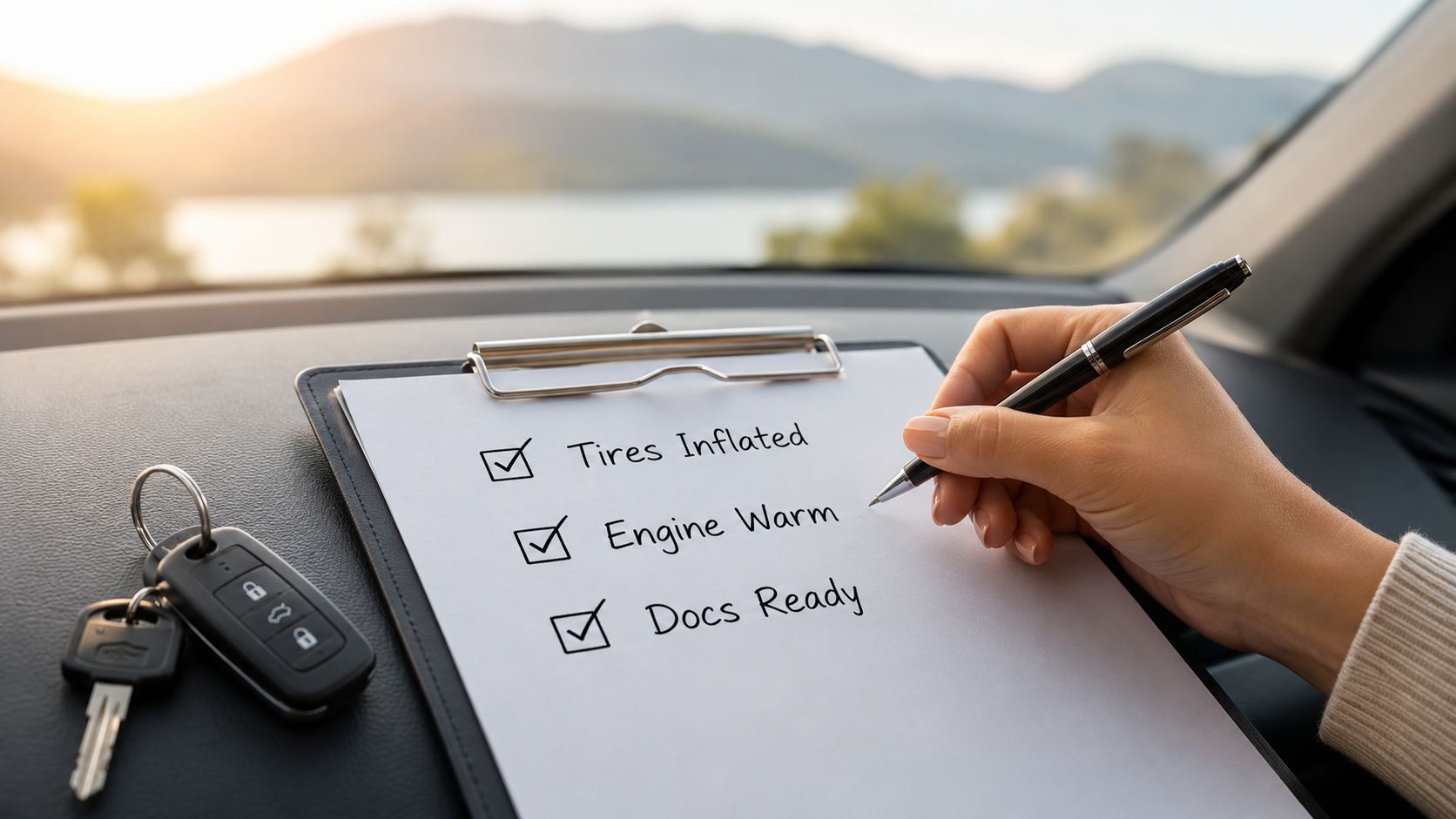
The pre-visit checklist that matters
Focus first on the things that change the outcome.
A fast visit usually comes down to one question: is the car ready to test? Drivers get hung up on the clock, then lose far more time to avoidable problems in the lane.
- Do not show up right after a battery disconnect or replacement: Readiness monitors often reset after battery power is lost. If that just happened, give the car time and normal driving before the test, as noted earlier.
- Make sure the check engine light is off: If the light is on, deal with the repair first. No shop can make that part go away with better timing.
- Bring the registration or renewal notice if you have it: Front counter delays are small, but they are still delays.
- Drive the car before the test: A car that has been running and is fully warmed up is usually easier to process than one that has been sitting cold.
What actually speeds things up
At Speedy Smog, the quickest visits usually look very similar. The car has been driven recently. The dashboard is clear. The driver already knows whether a STAR station is required. Nobody is figuring out basic paperwork or vehicle issues after arrival.
That is the inside scoop. Fast smog checks are usually won in the driveway, not at the counter.
Here is the simple version:
- Drive the car enough beforehand to avoid monitor problems.
- Check the dash before you leave.
- Bring what you need.
- Show up ready for the test, not ready to troubleshoot.
My advice: If the battery was just replaced or disconnected, wait and put some normal driving on the car first. Rushing in with incomplete monitors is one of the easiest ways to turn one visit into two.
What to avoid
A few mistakes waste time over and over:
- Do not clear codes and head straight to the station. That can reset the same monitors you need to have ready.
- Do not wait until the last few days if you already suspect a problem. Repairs and a retest can wreck your timeline fast.
- Do not assume every short line means a quick pass. Vehicle condition still decides how smoothly the visit goes.
If you want the fastest possible stop, prepare the car like you expect it to pass on the first try. That is the move that saves the most time.
Smog Check Timing FAQ
You do not want to be asking these questions three days before your registration is due. That is when a routine smog check turns into a scramble.
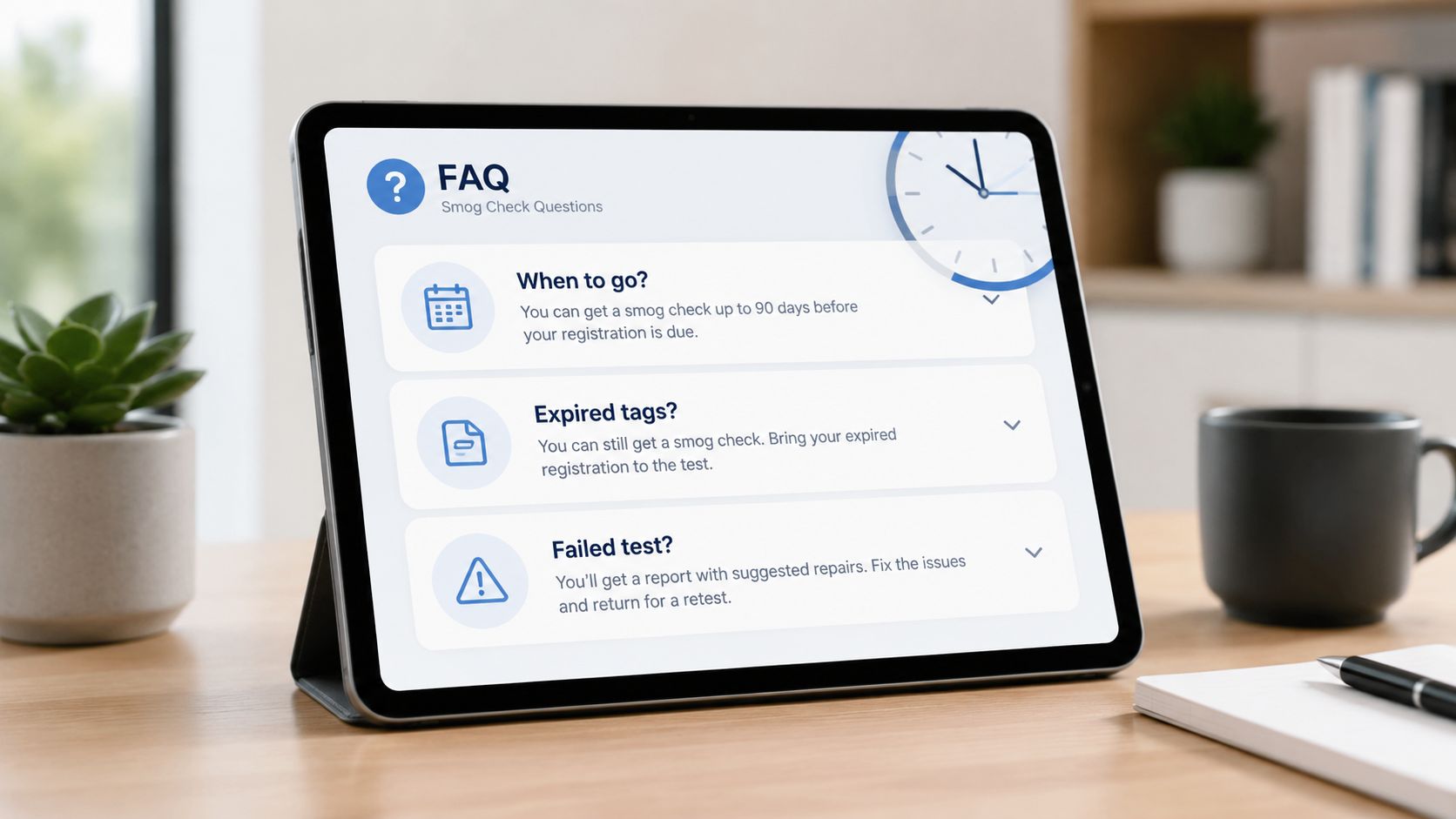
How close to my registration deadline should I get my smog check
Go early enough to leave room for a problem. A smog certificate gives you a decent registration window after the test, so waiting until the final week is a bad bet.
My advice is simple. If your notice is already in hand and the car is running normally, get the test done soon. You want time for repairs, a retest, or a paperwork hiccup without turning your deadline into a stress test.
Do smog stations have different hours on holidays
Yes, and holiday weeks trip people up all the time. Some stations shorten the day, some close entirely, and some keep normal hours except on the actual holiday.
Call first or check the posted schedule before you head out. Around long weekends, that one step can save you a wasted drive and another day lost.
What happens to my timeline if my car fails
A failure resets the whole plan. Now you are dealing with diagnosis, repair scheduling, and a return visit.
That is why smart drivers do not wait until the deadline is staring at them. If the check engine light has been on, the idle feels rough, or the car has been sitting, build in extra time and assume one visit may turn into two.
Is Saturday a good time if I work during the week
Saturday works for convenience. It usually loses on speed.
A lot of drivers who cannot get away on Tuesday or Wednesday show up on Saturday, which means more stacking at the counter and more waiting your turn. If Saturday is your only option, go right when the station opens and show up fully ready. If you can carve out a weekday late morning or early afternoon, that is usually the faster move.
Should I get tested as soon as my notice arrives
Usually, yes. One exception matters. If the battery was recently disconnected, replaced, or drained, give the car time to complete normal driving before the test.
Coming in too soon after a reset is one of the easiest ways to waste a trip. Get the car ready first, then get the test done before the calendar starts boxing you in.
Need a practical option in San Leandro? Speedy Smog is a STAR-certified station at 15275 Washington Ave where drivers can handle DMV-required emissions testing during standard weekly business hours. If you want the fastest visit, stop treating smog check hours like a basic schedule question. Pick a low-traffic time, bring a test-ready car, and leave yourself room before the deadline.
A STAR station is a California smog check facility that meets higher performance standards set by the Bureau of Automotive Repair, and some vehicles are specifically required by the DMV to go to one. The program was launched in 2013 after Assembly Bill 2289 created it, and for many drivers the only practical difference is that your renewal notice may say you need a STAR-certified shop instead of just any smog station.
If you're reading this, there's a good chance your DMV renewal notice mentioned a STAR station and immediately made a routine smog check feel more complicated. That reaction is normal. Most drivers don't spend time thinking about BAR rules, station categories, or which shops can test versus repair until the DMV puts that word in front of them.
The good news is that STAR isn't a different test you have to study for, and it doesn't mean your car is in trouble by default. It mostly tells you where you need to go, what kind of station the state wants handling your inspection, and how to avoid wasting time at the wrong shop.
Table of Contents
- Your DMV Renewal and the STAR Mandate
- The STAR Program Explained
- STAR Station vs Regular Smog Check What's the Difference
- How to Find a STAR Station and What to Expect
- Your Local STAR Station in the East Bay Speedy Smog
- East Bay Driver FAQs About STAR Smog Checks
Your DMV Renewal and the STAR Mandate
Your registration notice shows up, you scan the page, and one line jumps out: your vehicle must be tested at a STAR station. For many East Bay drivers, that sounds like extra hassle right away. The practical meaning is simpler. The DMV is telling you where to get the smog check so your renewal stays on track.
That detail matters because it affects your time, your appointment choice, and sometimes your total cost. If you go to a shop that is not STAR-certified when your notice requires STAR, you may end up paying for a test that does not satisfy the DMV requirement.
What your notice is really telling you
Read the notice as a location instruction. If STAR is required, book your smog check at a station with current STAR certification.
For the driver, that means one clear action step. Choose the right shop first, then show up for the inspection with your vehicle and payment, just as you would for a regular renewal-related smog visit.
A lot of confusion starts with the word "STAR." It sounds like a special test category with extra steps. In day-to-day terms, your notice is pointing you to a qualified type of station. The practical question is not "What new test do I need?" The practical question is "Am I booking with the right station so I do not waste a trip?"
Practical rule: If your renewal notice says STAR, confirm the shop's STAR status before you book.
Why the DMV sends some vehicles to STAR stations
California uses STAR stations for vehicles the system wants inspected under closer performance oversight. From the driver's seat, that translates into a straightforward requirement on your renewal paperwork.
The visit itself usually feels familiar. You make an appointment or walk in, the car gets inspected, and the result is reported for your registration. What changes for you is the shop selection.
That is where the primary driver decision comes in, especially in the East Bay. A nearby STAR station with fast scheduling can save you half a day. A station that is clear about pricing can save you frustration. And if your car might need follow-up emissions work, it helps to know whether you are choosing a test-only shop or a test-and-repair shop before you arrive.
Keep these takeaways in mind:
- Follow the notice exactly: STAR on the renewal means pick a STAR-certified station.
- Plan around convenience: Hours, wait time, and location matter just as much as the inspection itself.
- Ask about the shop type: Test-only and test-and-repair stations serve different needs.
For many drivers, the smartest move is simple. Find a local STAR station that explains the process clearly, gives you a realistic wait time, and helps you get the renewal done without extra back-and-forth.
The STAR Program Explained
If your renewal notice says STAR, the part that matters to you is simple: California wants your smog check done at a shop that the Bureau of Automotive Repair watches more closely.
That program did not appear out of nowhere. California replaced the older Gold Shield label with STAR, so drivers who have been doing smog checks for years may recognize the old name and wonder what changed. The practical answer is mostly about oversight. The state wanted a clearer way to identify stations that consistently perform inspections to BAR's standards.
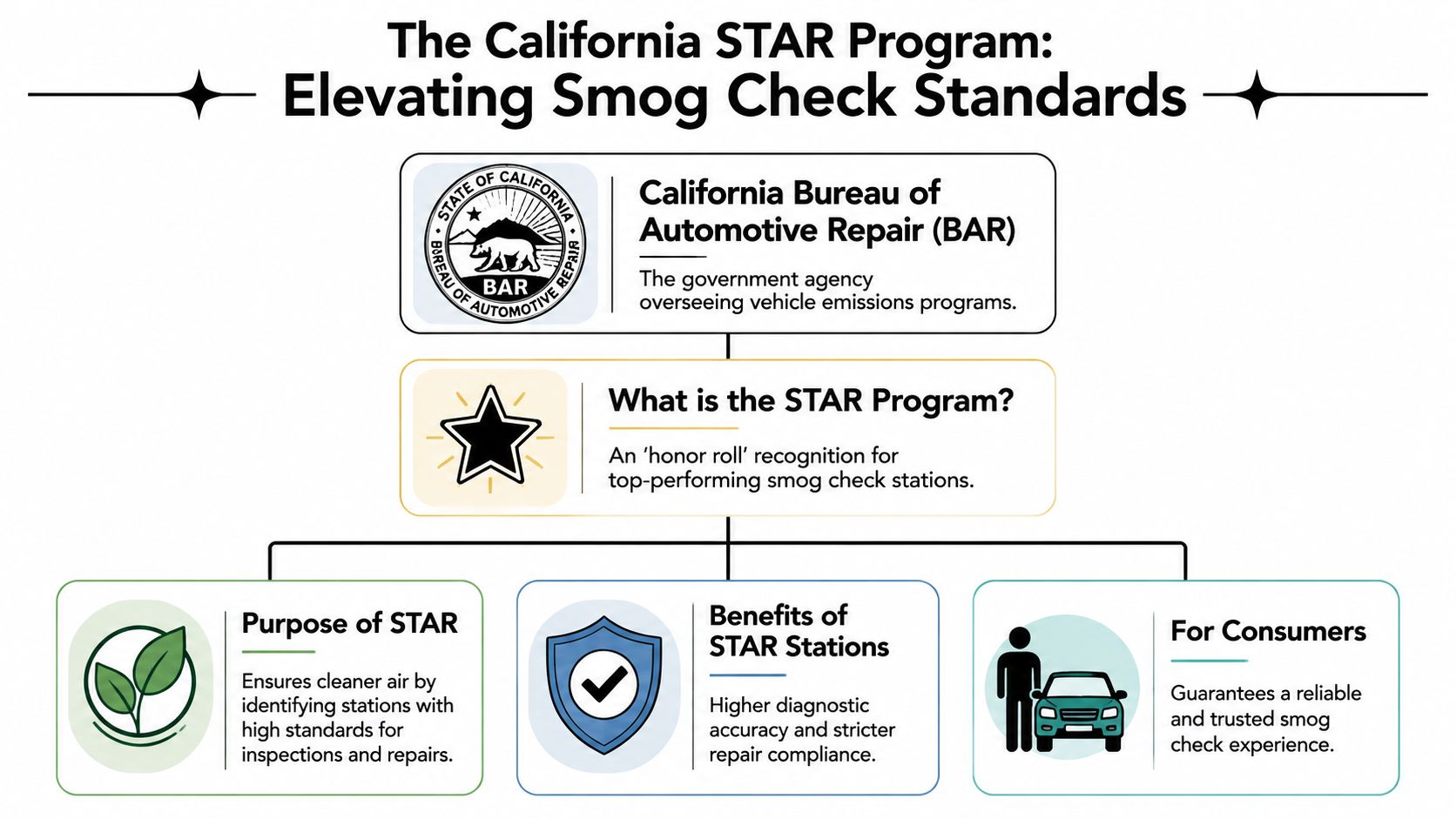
What the program is trying to do
Smog checks only help if the inspection process is dependable from shop to shop. The STAR program is BAR's way of keeping a closer eye on station performance so the results drivers receive are more consistent and trustworthy.
A good way to read the official jargon is this: BAR is grading the shop's inspection habits, recordkeeping, and overall performance. It is not adding a new layer of paperwork for you as the customer.
Why that matters to a driver
From the counter at a smog shop, STAR affects your choice of location more than anything else. You still need to book the visit, bring the car, and complete the inspection. But if your notice requires STAR, picking the wrong station can cost you time because you may have to leave and start over somewhere else.
That is the practical point many articles skip. For you, the STAR program is about avoiding wasted trips, controlling the day's schedule, and choosing a station that can get the job done without confusion.
Here is the plain-English version:
- BAR monitors these stations more closely.
- The program is meant to improve inspection reliability.
- Your main job is choosing a qualified shop if your notice calls for STAR.
If you are in the East Bay, that practical angle matters a lot. A nearby STAR station with clear pricing and realistic wait times can make the renewal process feel routine instead of annoying.
STAR is a state quality-control program for smog stations. For drivers, it mainly changes where you need to go and how carefully you should choose the shop.
STAR Station vs Regular Smog Check What's the Difference
Much confusion arises when drivers often hear "STAR" and assume the machine, the inspection steps, or the standards for the vehicle itself must be completely different.
Usually, the biggest difference is the station category, not the customer experience. A STAR station is not a separate emissions test type. It's a California smog-check station category that BAR monitors more closely, and the DMV may direct potentially higher-emitting vehicles there for inspection, as explained on the BAR Smog Check program page.
Side by side comparison
| Feature | Regular Smog Station | STAR Certified Station |
|---|---|---|
| Station status | Standard smog check station | BAR-monitored station category with higher performance standards |
| Type of test | Standard California smog check | Not a separate test type |
| DMV requirement | Fine if your notice doesn't require STAR | Required when the DMV directs your vehicle to STAR |
| Oversight | Standard program oversight | Closer BAR monitoring |
| Who can use it | Drivers whose vehicles qualify for a regular station | Any driver can generally use one, and some drivers must use one |
The table clears up the biggest myth. Your car isn't taking a "STAR test." You're taking the same basic smog-check path through a station that has a different certification status.
Test-only and test-and-repair
Another place drivers get tripped up is assuming every STAR station does the same kind of work. They don't.
The SmogTips explanation of the STAR station program notes that STAR-certified stations are split into test-only and test-and-repair models. Test-only stations can inspect and certify but can't perform emissions repairs. Test-and-repair stations can inspect, repair, and certify once the vehicle passes.
That distinction matters more than many people realize.
- If you want separation of duties: A test-only station keeps inspection separate from repair work.
- If you want one-stop convenience: A test-and-repair shop can handle the issue and the certification process in the same place.
- If you drive a diesel: The same source notes that diesel vehicles model year 1998 and newer are part of the Smog Check program.
If your notice says STAR, the smartest question isn't just "Which shop is nearby?" It's also "Do I need test-only or test-and-repair?"
So who actually needs a STAR station
There are two broad situations.
First, some drivers are directed by the DMV to a STAR station. If that's you, your notice should make it clear. In that case, a regular station isn't the safe choice.
Second, some drivers choose a STAR station even when they aren't required to. They do that because they want a shop operating under the stricter STAR category, or because a nearby STAR station is the most convenient option.
For the average East Bay driver, the practical decision tree looks like this:
- Read the renewal notice.
- If it says STAR, book STAR.
- If it doesn't, you can still use a STAR station if that location works for you.
How to Find a STAR Station and What to Expect
Finding the right station is easier once you stop treating STAR like a mystery label. It's mainly a matter of verifying that the shop has the certification your renewal notice requires.

How to check before you drive over
Use the state's official station lookup and confirm the shop is currently listed as STAR-certified. That's the fastest way to avoid showing up at a location that can't handle your DMV requirement.
A simple process works well:
- Start with your notice: Check whether it says STAR is required.
- Verify the station category: Use BAR's public tools to confirm the shop's certification before booking.
- Ask one direct question: When you call, ask whether they are a current STAR station and whether they are test-only or test-and-repair.
As covered earlier, STAR is about the station's status, not a separate test for you to prepare for.
What the visit usually feels like
From the customer side, a STAR appointment is usually familiar. You arrive, provide the needed vehicle information, and the station completes the inspection process according to California smog-check rules.
You don't need to show up expecting a tougher front-desk experience just because the shop is in the STAR category. The point of the program is better oversight of the station, not making drivers jump through extra hoops.
A short explainer can help if you want to see the process visually:
What to bring and what to ask
Bring the basics you would for any smog appointment, especially your renewal notice if the DMV directed you to STAR. That notice helps the station confirm what category your vehicle needs.
A few practical questions can save time:
- Can you test my vehicle type? Helpful if you drive a diesel, hybrid, or older vehicle.
- Are you test-only or test-and-repair? Important if repairs may become part of the process.
- Do you take appointments or walk-ins? This can affect your wait more than the STAR label itself.
For most drivers, the hardest part isn't the inspection. It's choosing the right station before leaving home.
Your Local STAR Station in the East Bay Speedy Smog
You open your DMV renewal notice, see that STAR is required, and the key question hits fast. Where can you get this done without burning a lunch break or losing a Saturday?
For East Bay drivers, that is what this decision usually comes down to. You need a station that meets the DMV requirement, works with your vehicle type, and keeps the visit practical. In San Leandro, Speedy Smog is one local STAR-certified option at 15275 Washington Ave. Based on the business details provided by the publisher, the shop serves a wide mix of vehicles, including 2000 and newer models, 1999 and older vehicles, diesels, and hybrids.
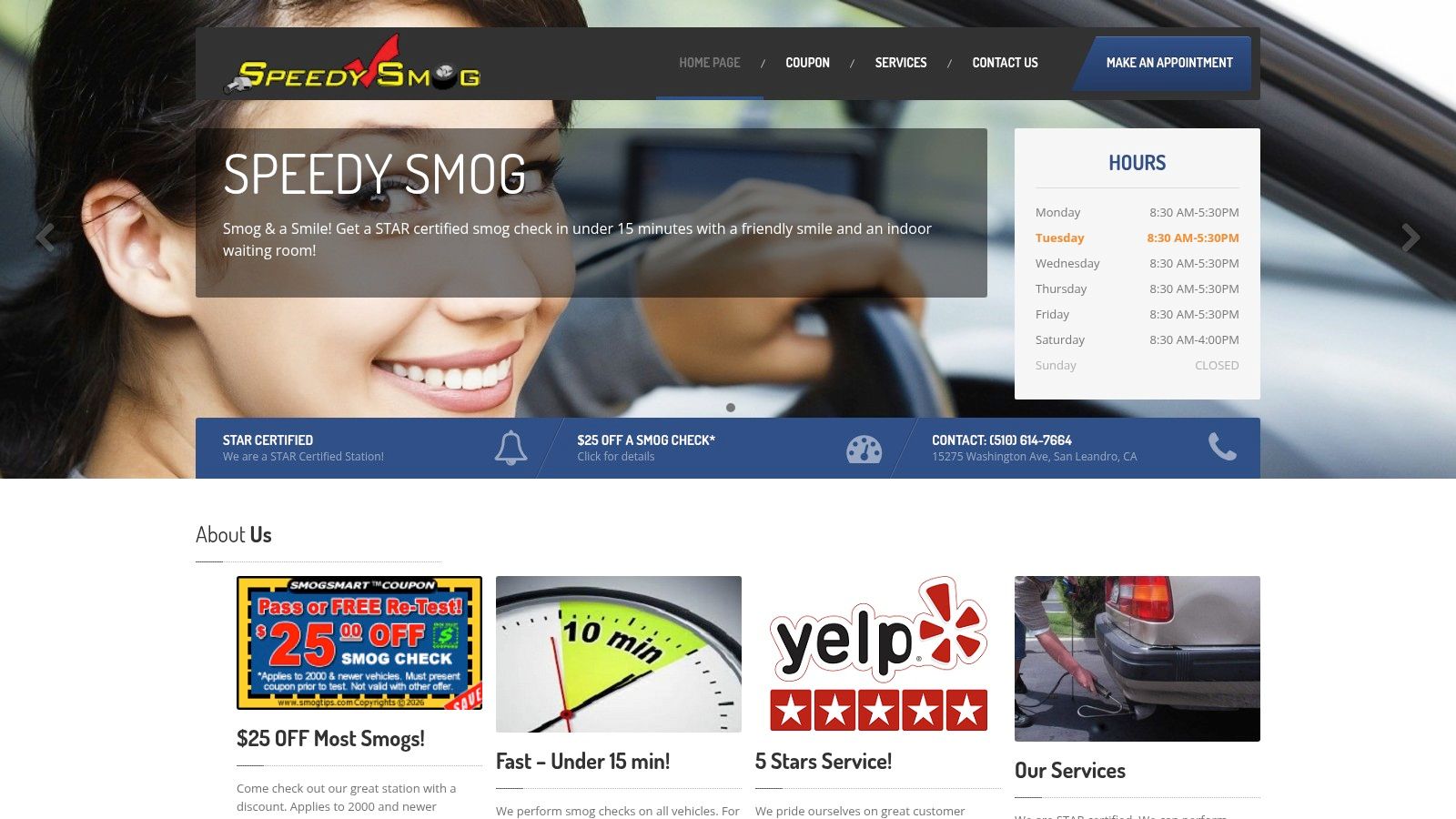
What matters to a busy driver
Drivers rarely compare smog shops the way the state describes them. They compare them the way a busy weekday feels.
Will the shop handle an older car without hesitation? Can it test a diesel or hybrid? If you need to wait a bit, will you be standing outside or sitting somewhere decent? Those are the practical details that shape the experience more than the STAR label by itself.
Based on the publisher details, Speedy Smog focuses on those day-to-day concerns:
- Fast service for many newer cars: Typical tests for 2000+ vehicles are completed in about 10 to 15 minutes.
- Useful vehicle coverage: The shop serves newer vehicles, older vehicles, diesels, and hybrids.
- A basic waiting area: Customers have access to a clean indoor waiting room.
Matching the Station to Your Needs
A STAR station is a category. The right shop is a fit.
That distinction helps if you are choosing between East Bay options. One driver just wants a quick pass-and-go visit near work. Another has an older vehicle and wants a station that regularly handles that kind of car. A diesel owner has a different checklist again. The smart move is to match the station to your car and your schedule, not just to the DMV label.
For many East Bay drivers, the best choice is the station that checks three boxes: STAR-certified, equipped for the vehicle you drive, and organized enough to keep the visit moving.
Cost and coupon mindset
Many drivers see the word STAR and assume the price automatically goes up. Usually, the bigger factors are the shop's location, local competition, and whether the business is built around quick inspections or a broader repair workflow.
The publisher notes that Speedy Smog periodically offers a $25-off coupon for most smogs on newer vehicles and aims for clear pricing. For a driver comparing East Bay stations, that kind of detail affects the actual decision more than the acronym on the building.
The shop also describes its service approach as "Smog & a Smile." In plain English, that suggests a place trying to keep the process efficient and friendly, which is exactly what many drivers want from a required DMV errand.
East Bay Driver FAQs About STAR Smog Checks
Will a STAR smog check cost more
Not necessarily. The most accurate answer is that shops set their own prices, and STAR certification itself is mainly a quality-control layer rather than a premium consumer add-on, as explained in Diamond Certified's smog check FAQ guide.
That means price differences usually have more to do with the shop's location and business model than the STAR label alone.
Does a STAR station take longer
It can, but not because the word STAR automatically means a slower inspection. In practice, timing often depends on appointment availability, walk-in traffic, staffing, and whether your vehicle needs anything beyond a straightforward inspection.
If your DMV notice requires STAR, your main timing issue may be that your list of eligible stations is narrower.
What happens if my car fails at a STAR station
The next step depends on the kind of station you visited. A test-only station can't perform emissions repairs, while a test-and-repair station can handle both functions if your vehicle qualifies for that workflow.
Your inspection result tells you what needs attention. From there, the repair path depends on the station type and the condition of the vehicle.
Can I go to a STAR station even if my notice doesn't require it
In many cases, yes. A STAR station isn't reserved only for DMV-directed cars. The key is making sure the shop handles your vehicle type and offers the service model you want.
What's the simplest way to avoid mistakes
Use this checklist:
- Read the DMV notice closely: Look for any STAR requirement before booking.
- Confirm current certification: Verify the station is listed as STAR-certified.
- Match the station to your needs: Decide whether test-only or test-and-repair makes more sense for your situation.
If your renewal notice says STAR and you want a local option in San Leandro, Speedy Smog offers STAR-certified smog check service for many East Bay drivers, including newer cars, older vehicles, diesels, and hybrids. It's a straightforward place to start if you want a shop that matches the DMV requirement and keeps the process simple.
You drive over for a smog check on your lunch break, the car feels normal, and you expect to be in and out. Then the test ends with a fail, your DMV renewal stalls, and now you are chasing a problem that could have been spotted before you left home.
We see that every day at Speedy Smog in San Leandro.
The usual smog check fail reasons are predictable. Newer vehicles are checked through the OBD inspection system. Older vehicles may still face BAR-97 tailpipe testing. The failure pattern changes with the car's age, condition, and maintenance history, but the same trouble spots show up again and again. Check engine lights, incomplete monitors, weak catalysts, EVAP faults, and simple visual issues account for a big share of the surprise failures drivers deal with.
This guide works like a pre-flight checklist for your car before you head to the station. Run through these seven checks first, and you have a better shot at passing on the first visit. That matters because the wrong move, like disconnecting the battery the night before or ignoring a loose gas cap, can turn a routine test into a repeat trip.
A little prep saves time, money, and guesswork.
Table of Contents
- 1. The Check Engine Light Is On
- 2. High Emissions HC CO NOx
- 3. Evaporative Emission Control EVAP System Failure
- 4. Faulty Catalytic Converter
- 5. Incomplete OBD-II Readiness Monitors
- 6. Failed Visual Inspection
- 7. Poor State of Tune Old Plugs Filters Oil
- 7 Smog Check Failure Causes Compared
- Pass with Confidence at Speedy Smog
1. The Check Engine Light Is On
A check engine light is the fastest way to turn a routine smog visit into a failed one. In California, if that light is on, the vehicle fails the inspection. It doesn't matter if it idles smoothly, starts every morning, or feels normal on the freeway.
That catches people off guard because modern cars can hide emissions problems well. The engine may still drive fine while the computer has already flagged an oxygen sensor issue, a loose gas cap, a vacuum leak, worn spark plugs, or catalytic converter trouble. Those are all common triggers tied to smog-related fault codes, as explained in California smog failure guidance from Owens Auto Repair.
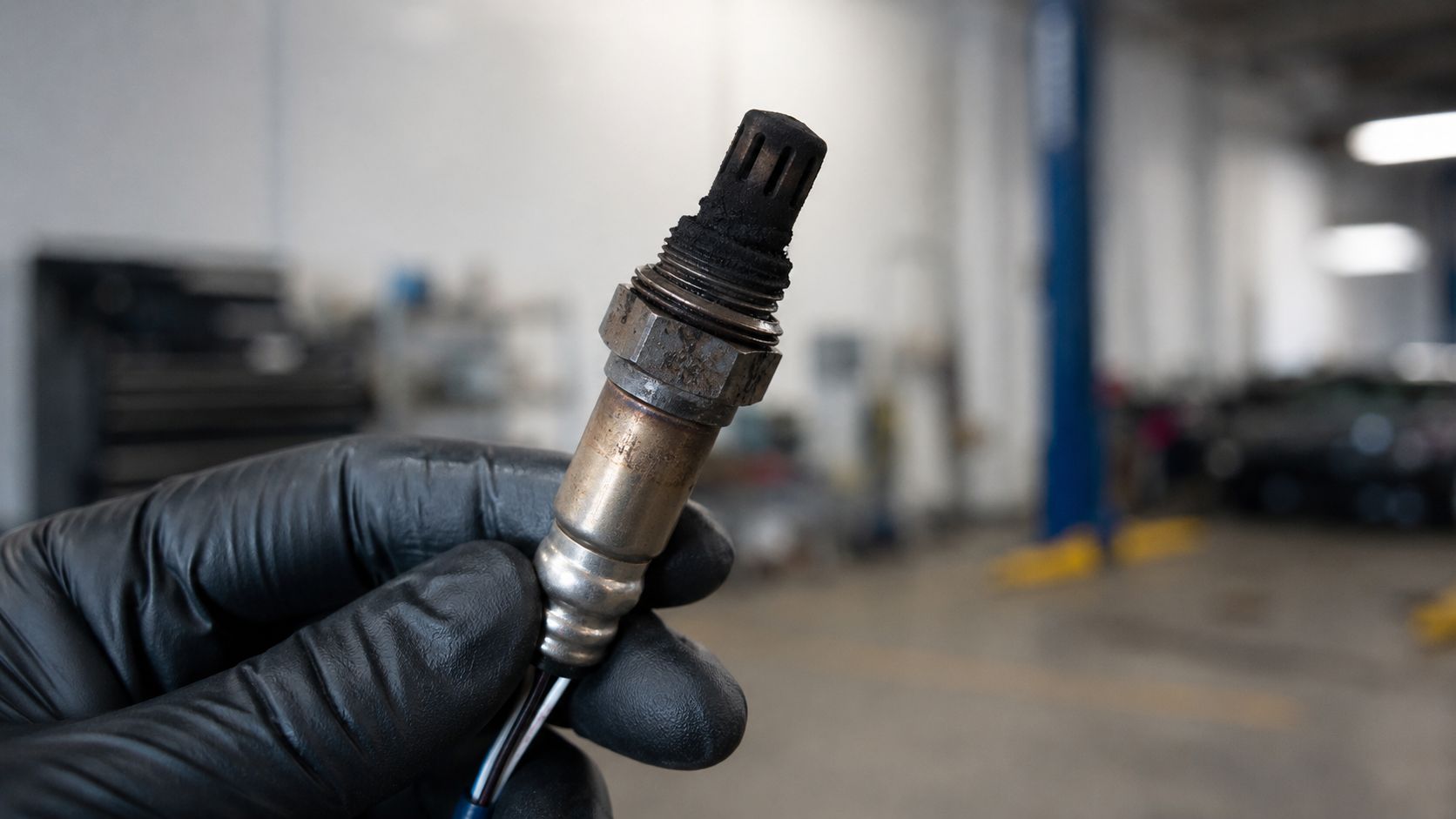
Why it fails instantly
The practical move is simple. If the light is on, scan the car before the test. Don't waste time hoping the issue is minor.
In the shop, this is one of the biggest first-time-pass killers because drivers confuse "runs okay" with "will pass." California's smog process for newer vehicles is a computerized compliance test, not just a quick look under the hood. If the onboard system reports a fault, that fault has to be addressed first.
Practical rule: Never clear the light on the way to a smog check and assume you solved the problem. You probably just traded one fail reason for another.
What works:
- Scan the codes first: A pre-test diagnostic scan usually tells you whether you're dealing with a sensor fault, EVAP issue, catalyst efficiency problem, or something else.
- Fix the cause, not the symptom: Replacing parts blindly gets expensive fast.
- Drive it afterward: Once repaired, the car may still need time to complete its self-checks.
What doesn't work:
- Disconnecting the battery: That often resets monitors and creates a readiness problem.
- Ignoring an intermittent light: If it comes back on, the car still has a stored issue to deal with.
2. High Emissions HC CO NOx
You drive over for a smog check, the car feels normal, and then the printout shows HC, CO, or NOx over the limit. That surprise happens a lot on older vehicles. Especially BAR-97 cars, where the test measures what the tailpipe emits.
High emissions usually come from a system that has been drifting out of spec for a while. One bad reading does not point to one guaranteed failed part. HC usually means unburned fuel is getting through. CO often shows up with a rich air-fuel mixture. NOx tends to climb when combustion temperatures run too hot.
What the readings usually point to
For this part of the pre-flight checklist, pay attention to patterns before you head to the station. In the shop, I look at how the car starts, idles, accelerates, and smells. A weak ignition system, vacuum leak, tired oxygen sensor, fuel-control problem, or exhaust leak can all raise tailpipe numbers.
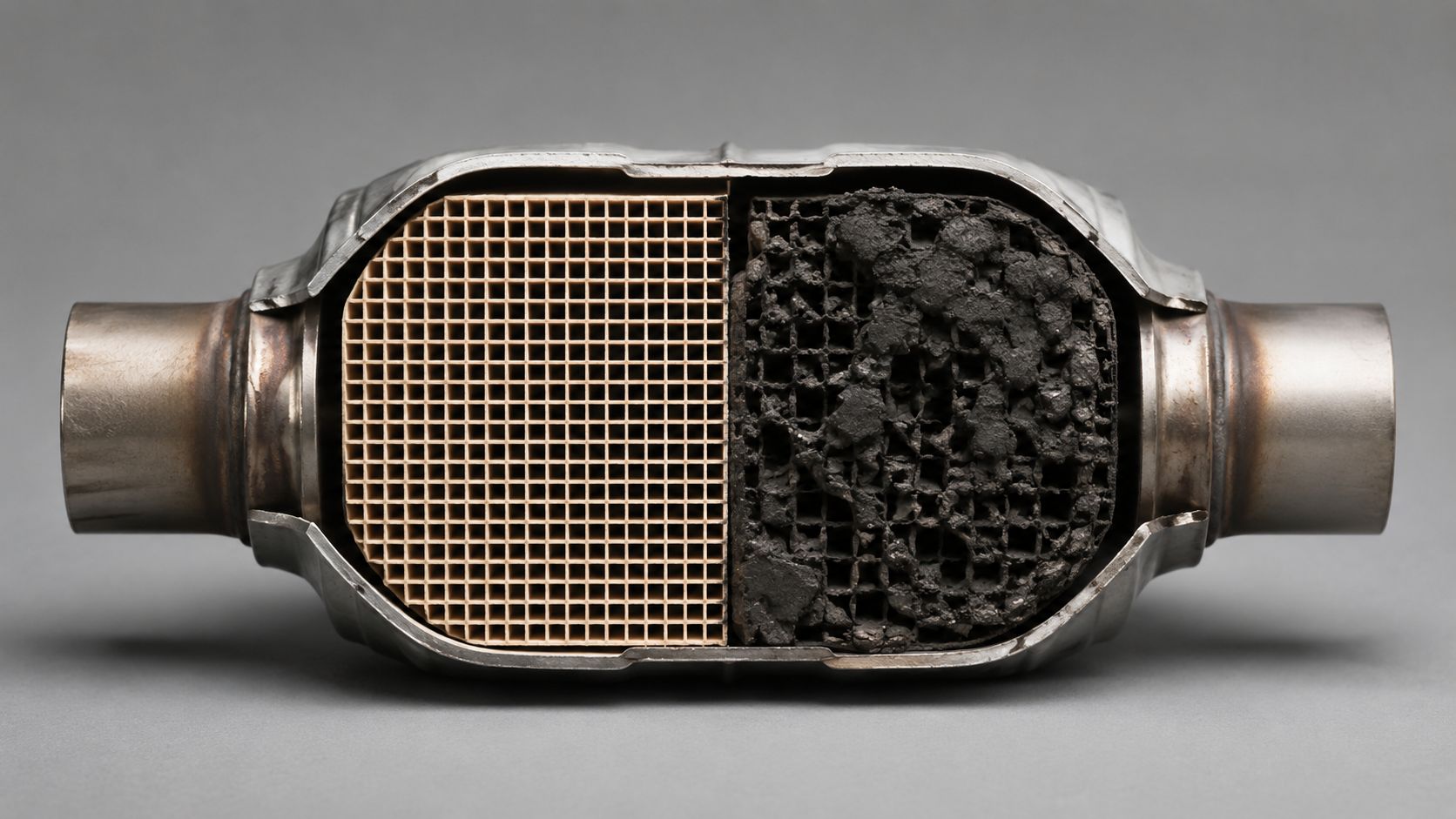
The expensive mistake is guessing. I see Bay Area drivers replace a sensor because a friend suggested it, then replace another part, and still fail. A proper diagnosis usually costs less than stacking parts on the car and hoping one of them fixes the numbers.
High HC, CO, or NOx is a direction, not a diagnosis.
Before testing, check for clues you may have been living with for months:
- Rough idle: Often tied to misfires, vacuum leaks, or weak fuel control.
- Poor fuel economy: Can point to a rich-running condition or sensor trouble.
- Sulfur or rotten-egg smell: Often suggests the mixture is off or the exhaust aftertreatment is struggling.
- Ping under load or running hot: Often lines up with high NOx on older engines.
If your car barely passed last time, treat that as a warning. Emissions parts usually wear down gradually, and the failure often shows up before the driver notices a major performance problem. That is why a quick pre-check matters. Catch the symptom early, fix the cause once, and you have a much better shot at passing the first time.
3. Evaporative Emission Control EVAP System Failure
The EVAP system doesn't deal with what comes out of the tailpipe. It controls fuel vapors from the tank and fuel system, keeping gasoline fumes from escaping into the air. That's why a car can seem to run perfectly and still fail because of an EVAP-related problem.
This is one of the most common "I had no idea" failures. A loose gas cap after a fill-up, a cracked cap seal, a split hose, or a sticky purge valve can all trigger a fault. In everyday shop work, the gas cap is still the first thing worth checking because it's easy, cheap, and often overlooked.
The gas cap mistake drivers make all the time
A lot of drivers tighten the cap until it feels snug and move on. If the seal is worn or the cap isn't the correct one for the car, the system may still detect a leak. Then the check engine light comes on, and now the EVAP issue turns into an automatic smog failure too.
A realistic example is the commuter car that gets serviced, fueled, and driven daily with no drivability complaints at all. The owner comes in expecting a quick certificate. Instead, the computer reports an EVAP code tied to a tiny vapor leak, usually discovered only because the smog test brought attention to it.
What helps before you leave for the station:
- Check the gas cap seal: If it's cracked, hardened, or torn, replace it with the correct cap.
- Make sure the cap clicks fully: After fueling, tighten it completely.
- Don't top off repeatedly: Overfilling can contribute to EVAP problems on some vehicles.
- Handle recent warning lights seriously: Even if the light went off, the system may still have a pending issue.
In practice, EVAP faults are a good example of why smog check fail reasons aren't always dramatic mechanical failures. Sometimes the car needs a smoke test and a targeted repair. Sometimes it just needs the obvious problem caught before inspection.
4. Faulty Catalytic Converter
When the catalytic converter stops doing its job, passing gets difficult fast. The converter is the main cleanup device in the exhaust. It reduces harmful pollutants after combustion, so if it's clogged, contaminated, damaged, or worn out, the numbers usually show it.
Drivers often blame the converter first because it's expensive and widely discussed. In reality, a converter can be the victim as much as the cause. Long-term misfires, oil burning, rich running, or bad oxygen sensor feedback can overwork it and shorten its life.
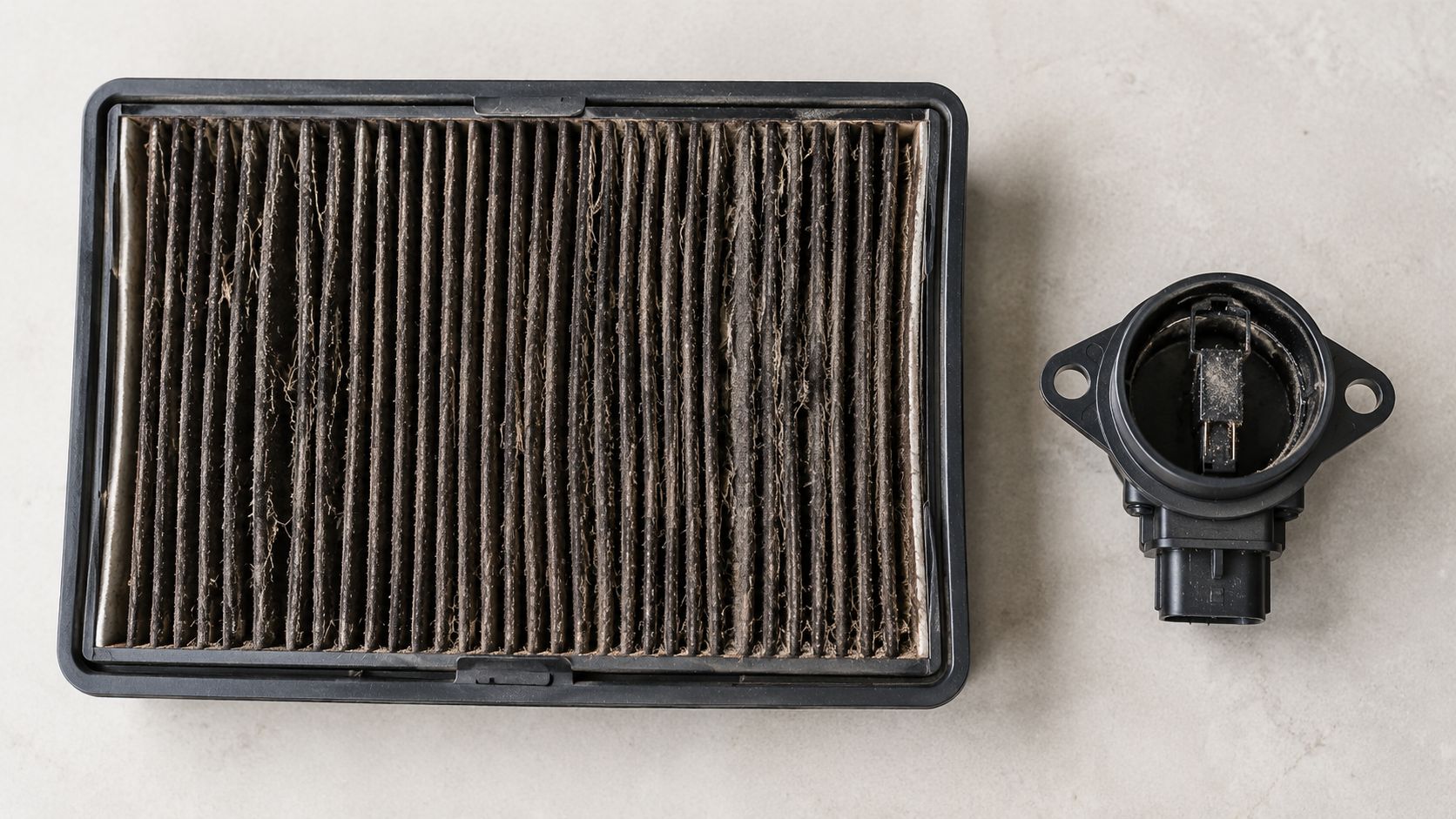
When the converter is the real problem
A true converter problem usually shows up after simpler causes have been checked. If the engine has good ignition, no major vacuum leaks, no obvious fuel-control problems, and the emissions still stay high, the converter moves higher on the suspect list.
Rushing causes people to lose money. Installing a converter without fixing the upstream problem can ruin the replacement too. That's why any honest technician should ask why the old one failed.
Shop insight: If the converter failed because the engine was running badly for too long, the new converter won't save you unless the engine issue is fixed first.
California also cares about more than function here. The Bureau of Automotive Repair notes that modified non-approved parts or computer programming can cause failure, which matters for exhaust repairs and aftermarket parts. A vehicle with the wrong emissions parts can have a problem even before tailpipe numbers enter the conversation.
Common clues that make us look harder at the converter:
- Persistent catalyst-related codes
- High emissions with no obvious tune issue
- Rattling from inside the converter
- A car that feels choked or weak under load
This is one of the more expensive smog check fail reasons, so diagnosis matters more than ever.
5. Incomplete OBD-II Readiness Monitors
This one frustrates drivers because nothing may be broken. The car can have no check engine light, run perfectly, and still not be ready for inspection. If the readiness monitors haven't completed, the test can't be properly completed for many newer vehicles.
This usually happens after the battery was disconnected, codes were cleared, or repairs were just finished. The onboard system has to run its own self-checks again. Until it does, the car may show "not ready" even though the repair itself was successful.
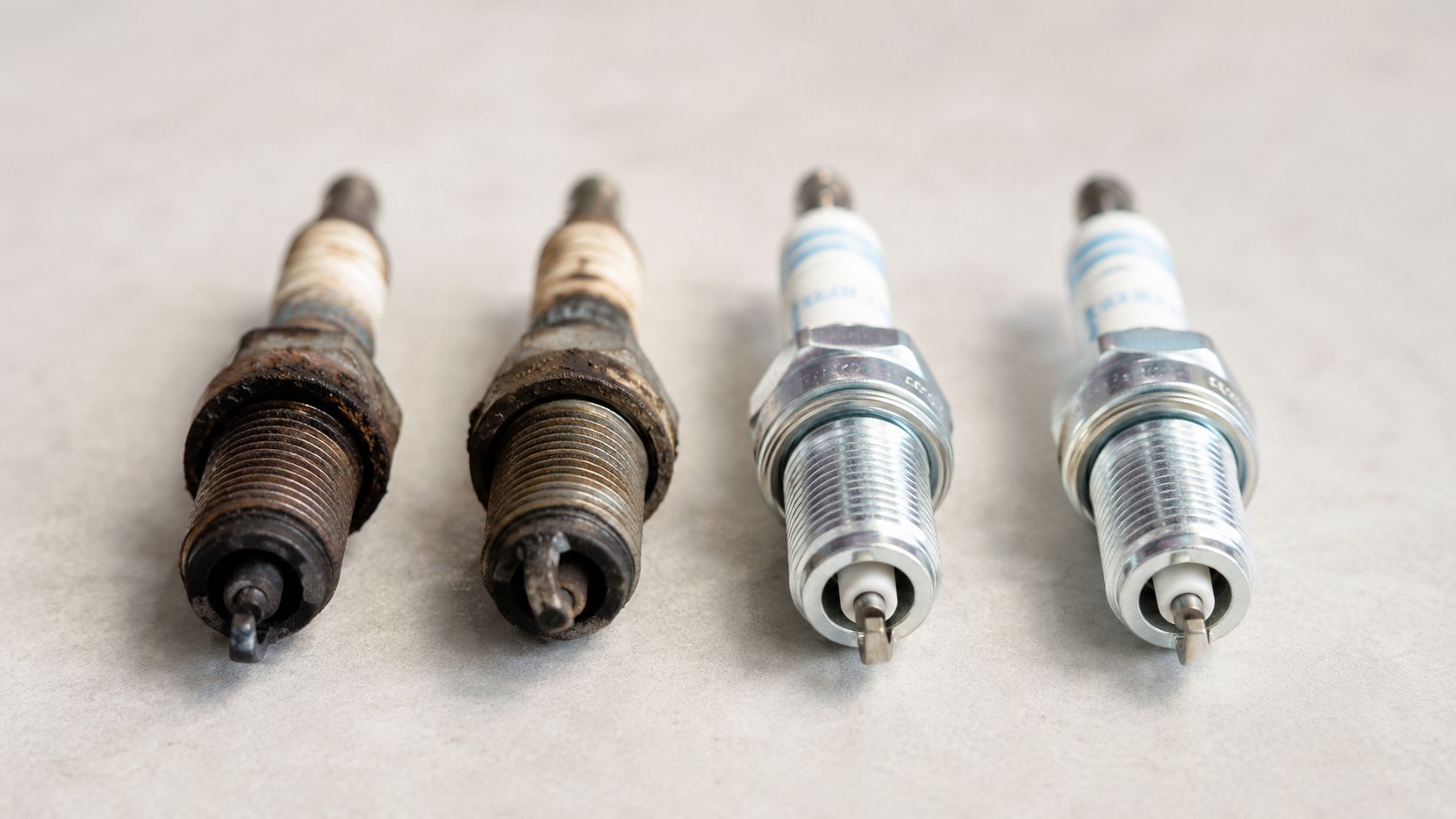
A soft failure that catches drivers off guard
Timing matters significantly. Independent guidance notes that 1996-and-newer vehicles can fail readiness-flag tests, and that a proper drive cycle may take multiple trips, mixed city and highway driving, and sometimes 50 to 100 miles before monitors reset. That's why clearing codes the night before a smog check is such a bad move.
The state manual also matters here. The BAR's Smog Check Manual explains that a vehicle can fail any portion of the inspection and then be repaired and retested at a Test and Repair station, and it also notes some tests can be aborted because of equipment or power-loss issues. In plain language, not every failed visit means high emissions. Sometimes the inspection couldn't be completed properly.
A common real-world scenario is the driver who replaces a battery, sees no warning lights, and comes straight in for smog. The monitors aren't set yet, so the visit ends without the pass they expected.
If you've recently had repairs or battery work, don't guess. Check monitor status with a scan tool before you test.
What works best is boring but effective:
- Drive normally for several trips
- Include city and highway driving
- Avoid clearing codes again
- Confirm readiness before the smog visit
6. Failed Visual Inspection
Some vehicles never get far enough for emissions numbers to matter. The visual inspection can stop them first. Technicians are required to check that the emissions equipment your car is supposed to have is there, connected properly, and not obviously modified in a way that violates the rules.
Do-it-yourself repairs and aftermarket modifications can create problems. A missing vacuum hose, disconnected intake component, non-approved engine calibration, or incorrect emissions part can trigger a fail even if the car seems to drive fine.
What technicians are actually looking for
The visual portion matters because California doesn't treat emissions compliance as just a tailpipe issue. The Bureau of Automotive Repair notes common fail reasons include modified non-approved parts or computer programming, along with faulty sensors, computer controls, and other emissions-related problems. For owners, that means "it runs better now" isn't the same as "it's legal for smog."
A realistic Bay Area example is the driver who bought a used car with prior modifications and doesn't realize anything was changed. Another is the owner who replaced a part with the cheapest available option online, only to learn it doesn't meet California requirements.
Things that commonly create visual-inspection trouble:
- Missing emissions labels or routed hoses that don't match
- Aftermarket intake or exhaust parts without proper approval
- Disconnected or damaged vacuum lines
- Obvious wiring changes around emissions components
A visual failure often starts long before the test day. It starts when the wrong part gets installed.
If you've had recent engine work, it's smart to do a quick under-hood once-over before coming in. Catching a disconnected hose or loose connector in your driveway is much better than finding out at the station.
7. Poor State of Tune Old Plugs Filters Oil
Not every failure comes from one dramatic broken part. A neglected vehicle can build enough small problems to push emissions over the line. Old spark plugs, a dirty air filter, contaminated oil, weak ignition performance, and general deferred maintenance often show up in borderline smog failures.
This is especially common on cars that are driven daily and "still seem okay." They start, they move, and they don't leave the owner stranded, so maintenance gets pushed back. Then smog day exposes the accumulated wear.
Small maintenance issues that add up
Worn spark plugs can contribute to incomplete combustion. Restricted airflow can upset the air-fuel balance. Old oil can add contamination and make an already tired engine work harder. None of that guarantees a fail by itself, but together they can stack the deck against you.
For practical prep, this is the easiest category to improve because basic maintenance is cheaper than chasing failures later. If your car is due for tune-up items and your smog date is coming, take care of those first.
A solid pre-flight check looks like this:
- Inspect spark plugs: If they're overdue or badly worn, replace them.
- Check the air filter: If it's dirty enough to restrict airflow, change it.
- Look for vacuum leaks: Brittle hoses and loose clamps matter.
- Stay current on oil service: Fresh oil won't fix a broken emissions component, but it can help a neglected engine present better.
This category also explains why older vehicles fail more often. As parts age, efficiency drops across the whole system. One weak component may not sink the test, but several tired ones often do.
7 Smog Check Failure Causes Compared
| Item | 🔄 Implementation Complexity | ⚡ Resource Requirements | 📊 Expected Outcomes | Ideal Use Cases | ⭐ Key Advantages / 💡 Tips |
|---|---|---|---|---|---|
| The Check Engine Light Is On | 🔄 Variable (low→high), depends on DTC | OBD-II scanner, tech diagnosis, possible parts/repairs | Automatic fail until diagnosed, repaired, and monitors reset | When CEL is illuminated before a smog test | ⭐ Direct fault codes guide repair. 💡 Read codes, don't just clear them. |
| High Emissions (HC, CO, NOx) | 🔄 High, targeted diagnostics to isolate pollutant source | Emissions analyzer, technician, potential sensor/cat repairs | Fail if readings exceed limits; may require component repair or replacement | When tailpipe readings are high or engine runs poorly | ⭐ Identifies combustion/aftertreatment failures. 💡 Warm freeway drive may help borderline cases. |
| EVAP System Failure | 🔄 Low–Medium, often simple leak but can be elusive | Gas cap, visual inspection tools, smoke tester at shop | Fail until leak is found and sealed; common EVAP DTCs present | If fuel smell, loose cap, or P0442/P0455 codes appear | ⭐ Often inexpensive to fix. 💡 Check/tighten/replace gas cap first; use smoke test if needed. |
| Faulty Catalytic Converter | 🔄 High, diagnosis must rule out sensors/misfires first | Technician labor, costly CARB-compliant converter (CA) | Certain smog failure if converter is clogged/contaminated; replacement usually required | When P0420/P0430 codes, rotten-egg smell, or high tailpipe pollutants | ⭐ Critical emissions control device. 💡 Fix misfires/sensors early to prevent converter damage. |
| Incomplete OBD-II Readiness Monitors | 🔄 Low, a data readiness issue, not mechanical | Time/driving (drive cycle), optional pre-scan at smog shop | Test halted as "Not Ready"; no certificate until monitors set | After battery disconnect, code clear, or recent major repairs | ⭐ Non-invasive to fix. 💡 Drive specified cycle or 100–200 miles; get a pre-scan to avoid wasted trips. |
| Failed Visual Inspection | 🔄 Medium, may be simple or require undoing mods | Replacement OEM/CARB-approved parts, technician inspection | Immediate fail for missing/modified emissions components until restored | Used/modified vehicles or after aftermarket installs | ⭐ Ensures legal emissions equipment. 💡 Keep CARB EO stickers and get a pre-inspection for used buys. |
| Poor State of Tune (Old Plugs, Filters, Oil) | 🔄 Low, routine maintenance fixes emissions | Basic parts (spark plugs, air filter, oil), low-cost service | Often reduces HC/CO and improves pass likelihood when addressed | Overdue maintenance or borderline emission results | ⭐ Most preventable cause of failure. 💡 Do a tune-up 1–2 weeks before the test. |
Pass with Confidence at Speedy Smog
Understanding the most common smog check fail reasons gives you a much better shot at passing on the first visit. Most failures come down to a handful of predictable issues: a check engine light, incomplete readiness monitors, excessive emissions, EVAP leaks, missing or modified parts, a weak catalytic converter, or a car that's overdue for basic maintenance. None of those should be a mystery by the time you pull into the station.
The smart move is to treat your smog appointment like a pre-flight check. If the check engine light is on, scan it first. If the battery was disconnected recently, verify the monitors are ready. If the car has old tune-up parts, rough idle, poor fuel economy, or obvious modifications, handle those before testing. That approach saves repeat trips and helps you avoid throwing money at the wrong repair.
It also helps to remember that not every failed visit means the same thing. Some vehicles fail because of true emissions output. Others fail because the onboard system isn't ready, the visual inspection finds a problem, or the inspection can't be completed properly. California issues a Vehicle Inspection Report after a failure, and practical guidance on what happens after a failed smog test in California notes there isn't an official limit on failures and that some drivers may qualify for repair assistance or a waiver depending on the situation. That's important because a first failure doesn't automatically mean you're facing a major overhaul.
At Speedy Smog in San Leandro, the goal is simple. Give drivers a clean, accurate inspection and help them avoid preventable mistakes. The shop is STAR Certified, handles a wide range of vehicles, and typical tests for many 2000-and-newer vehicles are completed in about 10 to 15 minutes based on Speedy Smog's published service information. If you're unsure whether your car is ready, a quick pre-check mindset goes a long way before the official test.
If you're prepared, the process is usually straightforward. If you're not sure, it's better to ask before you test than after you fail.
If you're due for a smog inspection in the East Bay, Speedy Smog in San Leandro is a practical place to start. You can stop by 15275 Washington Ave for a STAR-certified inspection, and if you're worried about common fail points like a check engine light or readiness monitors, it's worth checking in before you make the trip for your official certification.
Made with the Outrank app
Your registration notice is on the counter, and you're staring at the word smog wondering whether your diesel truck, SUV, or car needs special treatment in California. That's a common spot to be in, especially if you've owned gasoline vehicles before and assume the process works the same way.
It doesn't.
A California diesel smog check is its own thing. The rules turn on model year, weight, and whether your truck's emissions systems are intact and ready. If you live in the East Bay, that confusion gets even more practical because you're not just asking what the law says. You're asking where to go, what to expect, and how to avoid a wasted trip.
Table of Contents
- Understanding California's Diesel Smog Check Rules
- How a Diesel Smog Check Differs from a Gasoline Test
- How to Prepare Your Diesel for a Smog Check
- Common Diesel Smog Failures and What to Do Next
- Costs Time and Finding a Certified STAR Station
- Frequently Asked Questions About Diesel Smog Checks
- I just moved to California with a diesel vehicle
- Are aftermarket parts an automatic fail
- My truck is deleted. Can I make it legal again
- Do I need a smog check to sell my diesel vehicle
- Why did I fail when the truck runs fine
- Should I clear codes before the test
- What if I only use the truck occasionally
- How do I choose a good smog station
Understanding California's Diesel Smog Check Rules
You buy a used diesel truck in the East Bay, the registration renewal shows up, and the first question is simple: “Do I need a smog check?” California's rules get much easier once you sort them the same way a technician does. Start with three things: model year, gross vehicle weight rating, and whether the vehicle is registered in California.
For many drivers, that clears up the confusion fast.
The California DMV says diesel-powered vehicles model year 1998 and newer generally need inspection, while diesel vehicles model year 1997 and older or with a GVWR over 14,000 pounds are exempt from the standard smog requirement, according to the California DMV smog inspection guidance.
A simple way to read that rule is this: lighter diesel vehicles usually fall into the regular smog system, while heavier commercial-type vehicles are handled under different requirements. So if you drive a diesel sedan, SUV, or light-duty pickup around places like Oakland, Hayward, Fremont, or Concord, you are usually in the group that needs to pay attention to smog deadlines.
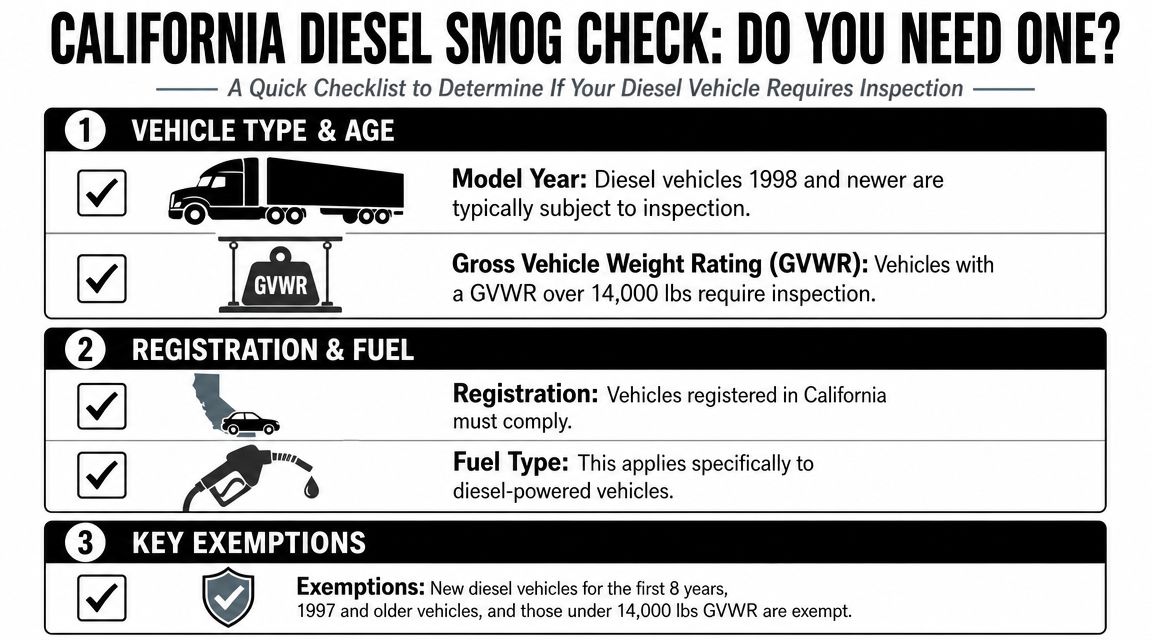
A good shortcut is to treat your truck like it has two labels that matter. One label is the model year on the registration. The other is the GVWR on the door jamb sticker. That weight label is where many owners get surprised, especially with diesel pickups that look similar but fall into different classes on paper.
Practical rule: If your diesel is California-registered, light-duty, and from the covered model years, check your smog status early instead of waiting until the registration deadline gets close.
Readiness is the other rule that catches people off guard. For 2007 and newer light-duty diesels, the DMV notes that only the Diesel Particulate Filter and Non-Methane Hydrocarbon Catalyst monitors may remain unset. If the battery was disconnected, codes were recently cleared, or repairs were just completed, the vehicle may drive normally and still not be ready for inspection.
That is one reason a careful station matters. In the East Bay, a STAR station should be able to explain your diesel's category in plain English before testing starts. If you call a shop like Speedy Smog, a useful question is: “Can you confirm whether my diesel falls under the standard California smog program based on model year and GVWR?” A clear answer there usually saves time and frustration later.
Quick reference table
| Vehicle Model Year | GVWR | Smog Check Required? |
|---|---|---|
| 1997 and older diesel | Any | Generally no under the standard diesel smog requirement |
| 1998 and newer diesel | 14,000 lbs GVWR and under | Generally yes |
| 1998 and newer diesel | Over 14,000 lbs GVWR | Generally exempt from the standard smog requirement |
Where people get tripped up
Weight is the first trouble spot. Diesel pickup owners often assume all trucks follow the same smog lane and the same rules. California does not sort them that way. The state looks at vehicle class, and GVWR is a big part of that classification.
Timing is the next point of confusion. Covered vehicles are commonly tested on a registration cycle, but some newer vehicles may be handled differently at first through an abatement-fee setup instead of immediate testing. That is why two diesel owners can have different registration experiences even if both vehicles are street driven.
Older assumptions also cause problems. California changed its diesel smog program years ago, so advice from a friend who owned a diesel truck a long time ago may no longer match the current rules. If you are unsure, check the DMV guidance first and confirm the vehicle details with a certified station before your due date.
How a Diesel Smog Check Differs from a Gasoline Test
You pull into a smog station expecting the same routine you had with your last gas car. Then the technician starts checking emissions parts, connects to the vehicle computer, and watches the exhaust instead of focusing on a tailpipe reading alone. That change catches a lot of diesel owners off guard.
A diesel smog check is more like a health check for the whole emissions system. A gasoline test also checks the computer and emissions equipment, but diesel inspections put more weight on three things: whether the required parts are installed, whether the computer shows the systems are working properly, and whether the truck produces excessive visible smoke.
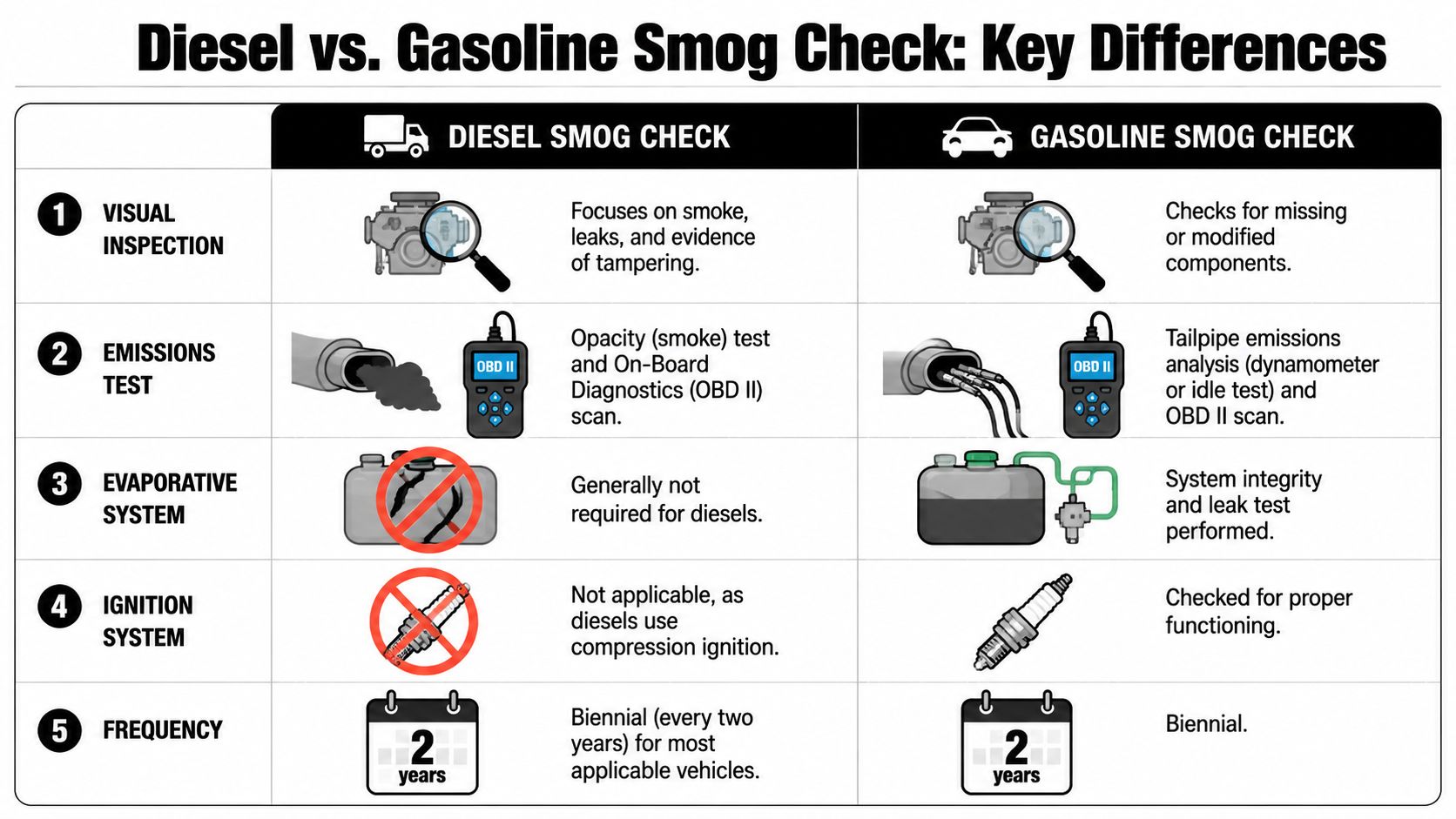
Here is the practical difference.
- Visual inspection: The technician checks for required emissions components and looks for missing, disconnected, or altered parts.
- OBD check: The vehicle's computer is scanned for trouble codes and monitor status.
- Visible-smoke check: The technician watches for smoke that stays visible longer than the allowed limit.
For diesel owners, the visual part matters more than many people expect. If emissions equipment has been removed, modified, or replaced with the wrong parts, the vehicle can fail even if it starts easily and drives fine on the freeway.
The smoke portion also worries people because it feels less familiar than a gasoline test. BAR technician training shows an idle observation for visible exhaust, followed by a BAR SNAP procedure using quick accelerator inputs while the vehicle is stationary, as shown in the BAR diesel smoke test training video. The point is simple. The technician is checking whether smoke clears normally or hangs around long enough to count as a failure.
That helps explain a common source of confusion. A diesel can fail without a check-engine light. Problems such as injector issues, turbo seal leaks, EGR faults, oil getting into the intake, or DPF trouble may show up first as smoke or as a problem with the emissions hardware itself.
If you are in the East Bay, this is one reason to choose a station that works with diesel vehicles regularly and can explain what they are seeing in plain language. At a local STAR station such as Speedy Smog, a good sign is a technician who can tell you whether they are checking readiness, missing components, or smoke behavior, instead of giving you a vague “it didn't pass.” That kind of explanation saves time because you know what to fix, not just that something went wrong.
How to Prepare Your Diesel for a Smog Check
You can't guarantee a pass by “warming it up” and hoping for the best. You can, however, avoid a lot of preventable failures by handling the basics before you book the appointment.
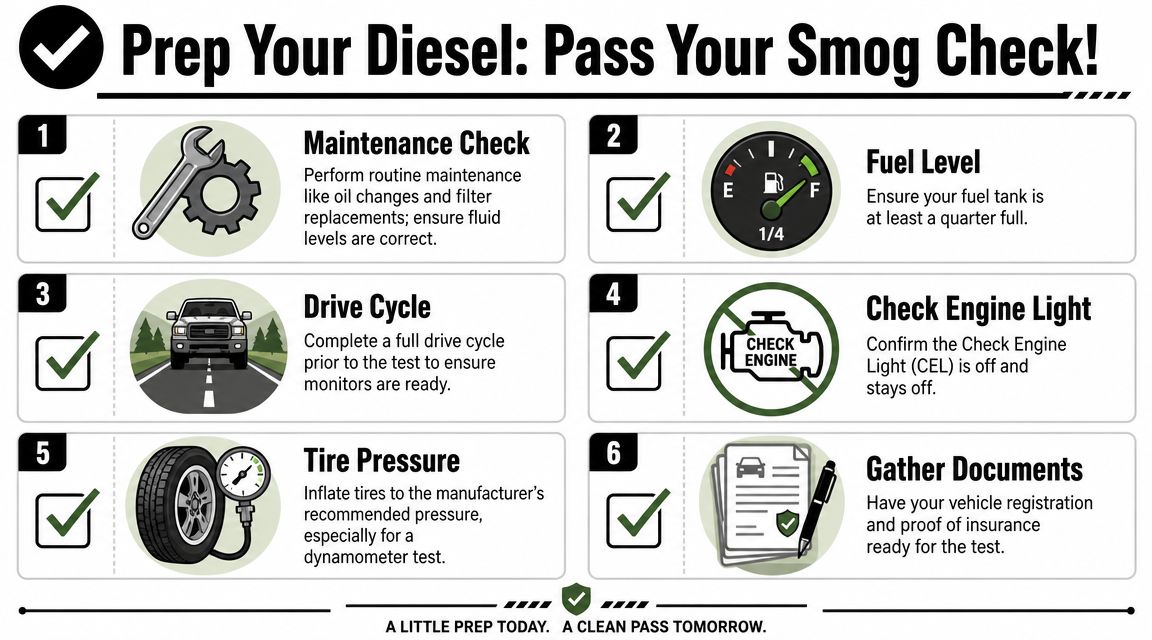
Start with the easy fail items
Begin with what you can confirm from the driver's seat and your recent repair history.
- Check the malfunction light: If the check-engine light is on, don't go in expecting a miracle.
- Think about recent battery work: If the battery was disconnected, replaced, or the codes were cleared, your monitors may not be ready yet.
- Don't test right after major repair work: Give the vehicle enough normal driving time to complete its self-checks.
For diesel owners, readiness matters more than people realize. A truck can feel normal, idle smoothly, and still not be electronically ready for inspection.
Do a real pre-test walkaround
Most customers don't need to be mechanics to catch obvious problems. You're just looking for signs that something is off before the state test does.
- Look for smoke: Have someone briefly observe the exhaust after startup and after the engine is warm.
- Check for leaks: Oil leaks, fuel leaks, and heavy grime around turbo plumbing can hint at a bigger issue.
- Notice missing hardware: If the truck has been modified in the past, verify that emissions components are still installed.
- Listen for unusual sounds: A whistle, hiss, or rough idle can point to intake, boost, or injector issues that may affect the smoke test.
After that, basic maintenance helps. Fresh oil, the right filters, and routine service won't hide an emissions defect, but they do remove avoidable variables.
Here's a useful walk-through if you want a visual checklist before your appointment:
Bring the basics and give yourself a buffer
Bring your registration paperwork and show up with enough time that you're not rushing. A rushed customer often misses the important detail, like mentioning a recent repair, a dead battery last week, or a tuner that was removed but not properly returned to stock.
If you've cleared codes recently, wait until the vehicle has completed a proper drive cycle and all applicable systems have had time to report ready. Guessing usually leads to a retest.
If your diesel is your daily work vehicle, it's smart to schedule the check before the last minute. That leaves room for repairs if the test uncovers something you didn't know was there.
Common Diesel Smog Failures and What to Do Next
You pull into a station, the truck sounds normal, and ten minutes later you're holding a failed smog report. That moment feels bigger than it is. In practice, diesel smog failures usually fall into three categories, and each one points you toward a different fix.
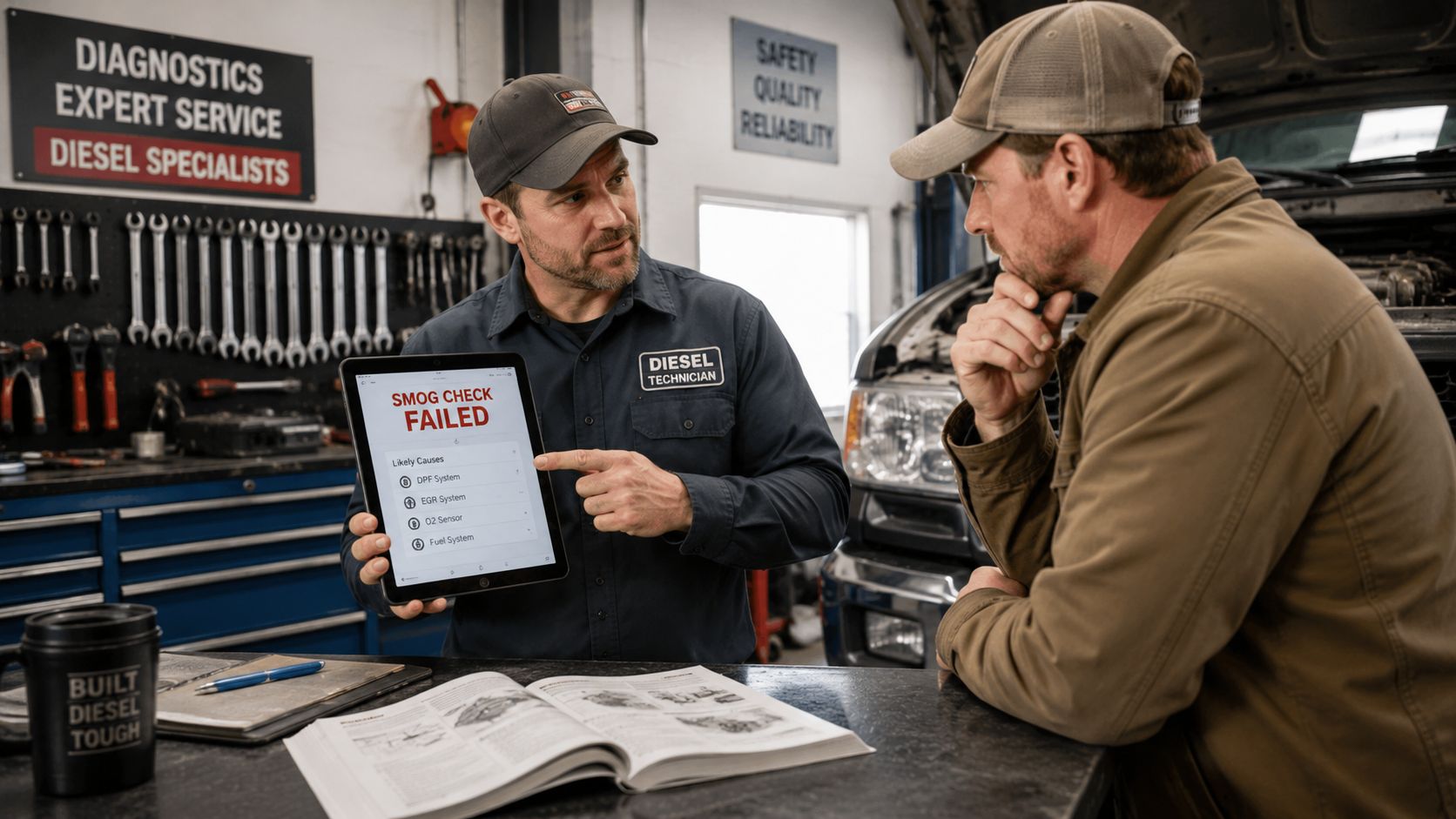
The helpful question is not just “Did it fail?” It's “Why did it fail?” Once you know that, the path gets much clearer.
Visual failures
A visual failure means the inspector found something missing, altered, or not approved for that vehicle's emissions setup. You can think of this as a parts-and-configuration problem. The truck might run well, pull hard, and still fail because the required emissions hardware is no longer there or no longer matches what the vehicle was certified with.
Common examples include deleted emissions equipment, straight-pipe replacements, or aftermarket parts that are not legal for that diesel application in California. This is one of the most frustrating results for owners because the issue is often obvious to the inspector but not obvious to the driver.
The next step is straightforward. Have a diesel repair shop compare the vehicle to the correct factory emissions configuration and identify what needs to be restored or replaced. If you're in the East Bay, this is also where station choice matters. A STAR station that sees diesel trucks regularly, such as Speedy Smog, should be able to explain the failure clearly so you know whether you need a repair shop, replacement parts, or documentation for a compliant component.
OBD failures
An OBD failure means the vehicle's computer system is not ready to certify. The check engine light may be on. There may be stored trouble codes. Or the monitors may be incomplete because the battery was disconnected, codes were recently cleared, or repairs were just made.
This confuses a lot of diesel owners because the truck can feel completely normal on the road. The smog machine is looking for proof that the onboard system has checked itself and found no active emissions problem. If that proof is missing, the vehicle cannot pass.
Your best move is diagnosis first, retest second. A good shop will figure out whether you have an active fault, a wiring or sensor issue, or a readiness problem that requires the correct drive cycle after repairs. Repeatedly going back for another test without fixing the root cause usually costs more time than it saves.
Smoke failures
Smoke failures are the most visible, and they usually point to a mechanical problem or an emissions control problem that shows up under load. Excessive smoke can come from injector faults, turbo seal issues, oil getting into the intake or exhaust, EGR problems, DPF trouble, or poor combustion.
Smoke works like a symptom, not a full diagnosis. It tells the technician where to start looking. Black smoke often suggests too much fuel or not enough air. Blue smoke can point to oil burning. White smoke can raise questions about incomplete combustion or other engine issues.
If your diesel fails for smoke, ask for the printed test results before you leave. Bring that paperwork to a diesel repair technician. It gives the shop a starting point and can shorten the diagnostic process. After repairs, return to a station that handles diesel testing regularly and can tell you, in plain language, whether the truck is ready to be retested.
Costs Time and Finding a Certified STAR Station
You open your renewal notice during lunch, see that a smog check is due, and the first questions are practical ones. How long will this take? Do you need a STAR station? And if you live in Oakland, San Leandro, Hayward, or nearby, where can you go without turning a simple test into half a day of extra driving?
For most drivers, the appointment itself is fairly quick if the vehicle is ready and the station handles diesel tests regularly. The easier way to plan is to allow extra cushion for check-in, paperwork, and any wait ahead of you. A smog visit works a lot like an airport security line. The actual screening may be short, but the total time depends on how organized the process is when you arrive.
The timing question also trips people up at registration. As noted earlier, diesel smog checks usually follow the state renewal cycle for covered vehicles, but not every renewal notice triggers the same requirement. Some owners will need a test this cycle. Others may see a fee in place of testing, especially on newer vehicles. The safest move is simple. Read the DMV notice closely and treat that document as your instructions for this round.
Why station choice matters in the East Bay
Station choice matters more with diesel than many drivers expect.
A diesel inspection is not just a quick plug-in and printout. The shop needs to know the rules, confirm whether your paperwork calls for a STAR station, and explain the result clearly if something blocks certification. That matters even more in the East Bay, where many drivers are fitting the appointment between work, school pickup, or a commute across town.
A STAR Certified station has met higher state performance standards. If your notice says STAR is required, go straight to a STAR location first. Starting at the wrong shop usually means a second appointment, more waiting, and more frustration.
For a concrete local example, Speedy Smog in San Leandro is a STAR Certified station that performs diesel smog checks along with tests for other vehicle types. That is a useful model for East Bay drivers. Look for a shop that is clearly certified, familiar with DMV paperwork, and used to seeing diesel vehicles often enough to answer questions in plain English.
Choose a station that can verify your STAR requirement, test diesel vehicles regularly, and explain the result without burying you in jargon.
What to look for before you book
A short phone call can save a long afternoon. Ask these questions before you head over:
- Do you currently have STAR certification? Ask this first if your DMV notice mentions STAR.
- How often do you test diesel vehicles? Regular diesel experience usually means fewer surprises.
- Do you take appointments, walk-ins, or both? That helps you judge your real time window.
- What should I bring? Your registration information and DMV notice are usually the starting point.
- Can you explain a failure report on-site? If the vehicle does not pass, you want clear next steps, not vague answers.
If your diesel recently had emissions-related repairs, mention that when you book. The station cannot promise a pass over the phone, but an experienced technician can tell you whether it makes sense to confirm readiness and paperwork before you come in.
Frequently Asked Questions About Diesel Smog Checks
I just moved to California with a diesel vehicle
You unpack the boxes, update your address, and then the registration paperwork reminds you that California plays by its own emissions rules. That catches a lot of new residents off guard.
Start with the same two checkpoints covered earlier: model year and weight. Those are the gates that determine whether your diesel falls into California's smog program. An inspection from another state usually does not transfer the way drivers hope, so plan on meeting California's requirements before registration is finalized.
Bring your registration paperwork, make sure the truck or car is running properly, and confirm the emissions equipment is still in place.
Are aftermarket parts an automatic fail
Aftermarket parts only become a smog problem when they affect emissions or replace required factory equipment with something that is not compliant.
Cosmetic parts and unrelated upgrades usually are not the issue. The trouble spots are the parts tied to how the engine breathes and controls pollution, such as intake components, exhaust parts, tuning, and emissions hardware. If you are unsure whether a modification crosses the line, ask a diesel-savvy smog technician before test day. It is much easier to sort that out in advance than to discover it during the inspection.
My truck is deleted. Can I make it legal again
Usually, yes, but the fix is restoration. A deleted diesel generally has to be returned to a compliant setup with the required emissions parts installed and working, along with software that matches that configuration.
That can take more than bolting parts back on. Many vehicles also need proper calibration and enough driving time afterward for readiness checks to complete. A diesel repair shop that handles emissions restoration can tell you what is missing and what has to be corrected before a retest.
Do I need a smog check to sell my diesel vehicle
That depends on the sale and the vehicle, so confirm the current DMV rules for your situation. Waiting until a buyer is ready to sign papers is how this turns into a last-minute headache.
Handling the smog question early gives you time to fix problems if something comes up. It also gives the buyer more confidence, which can make the sale easier to finish.
Why did I fail when the truck runs fine
Because drivability and emissions compliance are not the same test.
A diesel can feel strong on the road and still fail for incomplete monitors, missing emissions equipment, or excessive visible smoke. A good way to think about it is this: the truck may be doing the job you feel from the driver's seat while still missing the checks the state requires under the hood and through the exhaust.
The good news is that a failure report points to a category. Once you know the category, the next step is usually much clearer.
Should I clear codes before the test
No.
Clearing codes right before inspection often resets the system monitors. Then the warning light may be off, but the vehicle is still not ready to pass because the self-checks have not finished running. If a code appears, fix the cause first, then drive the vehicle enough for the monitors to set.
What if I only use the truck occasionally
Occasional-use diesels can be harder to pass on the first try. They sit longer, batteries weaken, and recent repairs may not have been followed by enough normal driving for the system to complete its checks.
If your truck is mainly for weekends, hauling, or towing, do not wait until the registration deadline. Drive it ahead of time, watch for warning lights, and pay attention to startup smoke or a sluggish battery.
How do I choose a good smog station
Choose a station the way you would choose a mechanic for a problem you do not want explained in riddles. You want clear answers, diesel experience, and staff who can tell you what to bring before you show up.
For East Bay drivers, a local STAR station such as Speedy Smog in San Leandro is the kind of example to look for. The name matters less than the traits behind it. The shop should handle diesel inspections regularly, understand California paperwork, and explain a pass or failure in plain English. If a station is vague on the phone, that is often a preview of how the visit will go in person.
If you are in San Leandro, Oakland, Hayward, or another nearby East Bay city, use that checklist before you book. A good station helps you get through the process with fewer surprises and a much better idea of what your diesel needs.
Created with the Outrank app