
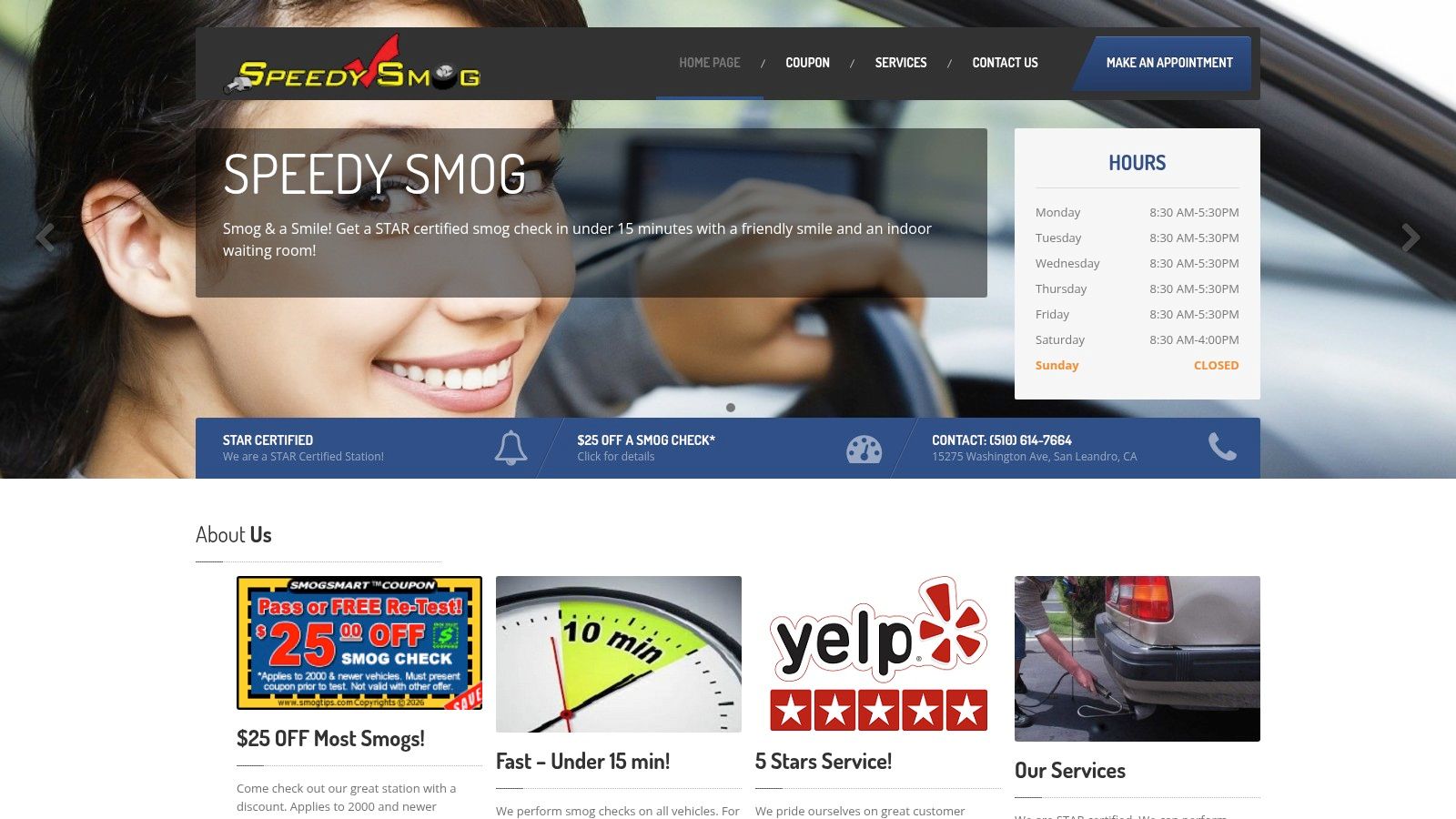
Speedy Smog is located at 15275 Washington Ave, San Leandro, CA 94579, and its standard hours are Monday through Friday 8:30 AM to 5:00 PM, Saturday 8:30 AM to 3:30 PM, and Sunday closed. If you're looking up smog check hours because your registration notice just landed and you need this done without burning half your day, the key question isn't only when a station is open. It's when you should go.
That's the part most drivers miss. A posted schedule tells you when the doors open. It doesn't tell you when the line is shortest, when a lane is moving cleanly, or when your car is most likely to get in and out without turning a basic errand into a chore.
Table of Contents
- Your Guide to a Fast Smog Check in San Leandro
- Navigating Typical Smog Station Schedules
- The Best and Worst Times for Your Smog Check
- Appointments vs Walk Ins Which Is Faster
- Tips for a Faster Smog Check Visit
- Smog Check Timing FAQ
Your Guide to a Fast Smog Check in San Leandro
You get home, toss the DMV renewal notice on the counter, and realize you still need a smog check this week. Now the main question hits. What time gives you the best chance of getting in and out without wasting half your day?
If you're in San Leandro, start with the basics. Speedy Smog is at 15275 Washington Ave, San Leandro, CA 94579, and the posted hours are Monday to Friday 8:30 AM to 5:00 PM, Saturday 8:30 AM to 3:30 PM, and Sunday closed. Good to know. Better to know how to use those hours to your advantage.
Why timing matters more than drivers expect
A smog check is tied to your registration calendar, so timing affects more than convenience. Wait too long and you create deadline stress. Go in at the wrong moment and you can end up sitting behind a pile of cars from the lunch rush, after-work rush, or Saturday crowd.
Here's the part drivers miss. A station being open does not mean every open hour is equally fast.
Practical rule: Treat smog check hours like traffic patterns. The lane is open all day, but a few windows move a lot faster than others.
The inside scoop
If your goal is a quick visit, focus on three things:
- Choose a calmer window: Midweek usually moves better than the start or end of the workweek.
- Skip the obvious rush periods: Lunch, the last stretch before closing, and Saturday spikes tend to slow everything down.
- Bring a test-ready car: A vehicle with readiness issues or recent battery problems can turn a short stop into a wasted trip.
Instead of asking, “What time do you close?” ask, “What time gives me the best shot at a fast pass through the bay?” That question gets you to the finish line a lot quicker.
Navigating Typical Smog Station Schedules
Smog station hours follow demand, not magic. Shops open when drivers are most likely to show up, and that creates predictable traffic patterns inside the bay.
Why so many stations keep similar hours
Most smog shops stick to daytime business hours and add at least part of Saturday. That schedule matches real customer behavior. Drivers try to squeeze a test in before work, on lunch, after work, or on the weekend. Station owners know that, but they also have to balance technician coverage, equipment uptime, and how many cars they can move without stacking the parking lot.
A Smog Check in California is commonly tied to registration renewal on a regular cycle, and the test itself is usually fairly quick if the car is ready. The problem is that station hours only show when the doors are open. They do not show when the line is short, when a technician is free, or when a not-ready vehicle is slowing everyone else down.
That last part matters more than drivers expect.
A station gets backed up for two reasons. Too many cars show up at once, or too many cars show up unprepared. From a smog tech's point of view, the second one is what wrecks the schedule.
Why some areas stretch their hours
When testing demand piles up, longer hours are one of the first fixes. Illinois did exactly that during a busy period, expanding hours at state emissions testing locations to absorb more volume, as reported by ABC7 Chicago on expanded Illinois emissions testing hours.
That is the takeaway. Extended hours usually mean the same thing. Demand is bunching up around deadlines, work schedules, and limited free time.
If you want a fast visit, read posted hours as a clue, not the full answer.
| Schedule reality | What it means for you |
|---|---|
| Standard daytime hours | The busiest waves usually hit around the workday edges and lunch |
| Saturday availability | Convenient for your calendar, often slower at the station |
| Expanded hours in busy markets | Testing demand is concentrated, and crowds are normal |
Posted smog check hours tell you when a station is open. They do not tell you which hour gives you the quickest path in and out.
What to assume before you go
Use a simple rule. If a time feels convenient to almost every driver in San Leandro, expect more waiting.
The better play is to aim for a window that is still reasonable for you but less obvious to everybody else. That is how you use station hours like an insider instead of just reading them off a sign.
The Best and Worst Times for Your Smog Check
If your goal is speed, stop chasing the first available minute and start chasing the least congested one. That's how you cut hassle.
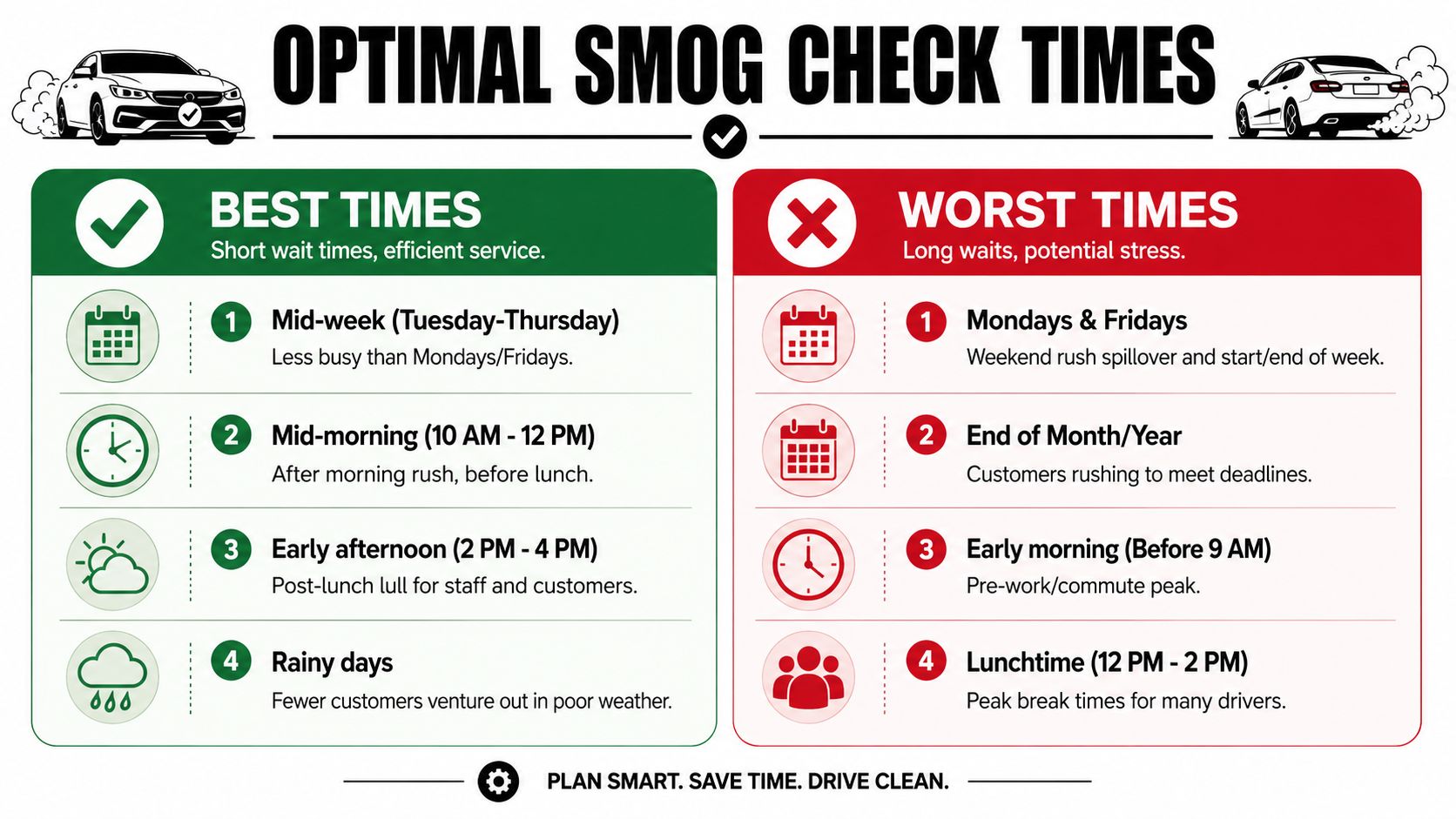
The green-zone hours
The strongest bet is usually midweek, especially late morning or early afternoon. By then, the first wave of drivers trying to handle it before work has usually passed, and you're still ahead of the lunch crowd or end-of-day push.
Here's the practical version:
- Tuesday through Thursday: These days usually avoid the Monday cleanup rush and Friday procrastination traffic.
- Mid-morning: A good sweet spot when the opening surge has already cleared.
- Early afternoon: Often steadier than lunch and less cramped than late afternoon.
- Bad weather days: Some drivers postpone errands, which can work in your favor.
Why those windows move faster
Throughput drives everything. Industry guidance says 2000-and-newer vehicles can often be finished in about 15 minutes, 1996 to 1999 vehicles may take around 25 minutes, and 1995-and-older vehicles around 35 minutes. A neutral fleet-industry source also places typical smog inspections at 20 to 30 minutes depending on vehicle condition. Under ideal conditions, a single lane can process roughly 4 newer cars per hour, as described in Geotab's smog check guide.
That's why bad timing hurts so much. It doesn't take many longer inspections ahead of you to change the pace of the entire line.
A lane can feel empty and still move slowly if the cars ahead need longer testing steps.
The red-zone hours
Some windows attract delays almost automatically.
- Mondays: People who put it off over the weekend show up.
- Fridays: A lot of drivers try to squeeze it in before the weekend.
- Lunch hours: Everyone thinks they can “just run out real quick.”
- Right before closing: This is the most stressful time to gamble on a smooth visit.
- End of the month: Deadline behavior stacks up fast.
- Saturdays: Convenient, yes. Efficient, usually not.
My blunt recommendation
If your car is newer and healthy, walk in during a midweek off-peak window and you've got a solid shot at a quick stop. If your car is older, has been sitting, or has any warning-light history, don't choose the busiest part of the day and hope for the best. That's how simple jobs turn into drawn-out ones.
Appointments vs Walk Ins Which Is Faster
You pull up expecting a quick smog check, then lose time before the test even starts. That usually happens because the driver picked the wrong lane strategy, not because the inspection itself is slow.
When a walk-in is the faster move
A walk-in is the better play if your car is straightforward and your timing is flexible. Newer vehicles usually move through with fewer surprises, so showing up during a quiet window can beat waiting for a packed appointment block.
Speedy Smog is a STAR-certified station in San Leandro that handles standard California smog checks for newer vehicles, older vehicles, diesels, and hybrids. If you can choose your time carefully, a walk-in can be the fastest option with the least fuss.
When an appointment makes more sense
An appointment is the smarter choice if your day is tight or your vehicle may need more attention. Older cars, diesels, and vehicles with a more involved test path are exactly the ones that benefit from a reserved spot.
Here's the simple version:
| If this sounds like you | Better choice |
|---|---|
| Newer car, flexible schedule | Walk-in |
| Older car, tighter calendar | Appointment |
| You can visit midweek off-peak | Walk-in |
| You need a predictable arrival window | Appointment |
My advice: Book the appointment if a delay would throw off your whole day. Choose a targeted walk-in if you have flexibility and can avoid the obvious rush periods.
A short explainer can help if you want to see how the process works in practice.
The mistake people make
Drivers hear “walk-in” and treat it like “show up whenever.” That is how quick visits turn into annoying ones.
A smart walk-in is deliberate. You pick a calm window, arrive with a ready vehicle, and get in before the lane backs up. An appointment helps with timing, but it does not rescue bad prep or bad timing choices.
Tips for a Faster Smog Check Visit
You save the most time before you pull into the lot.
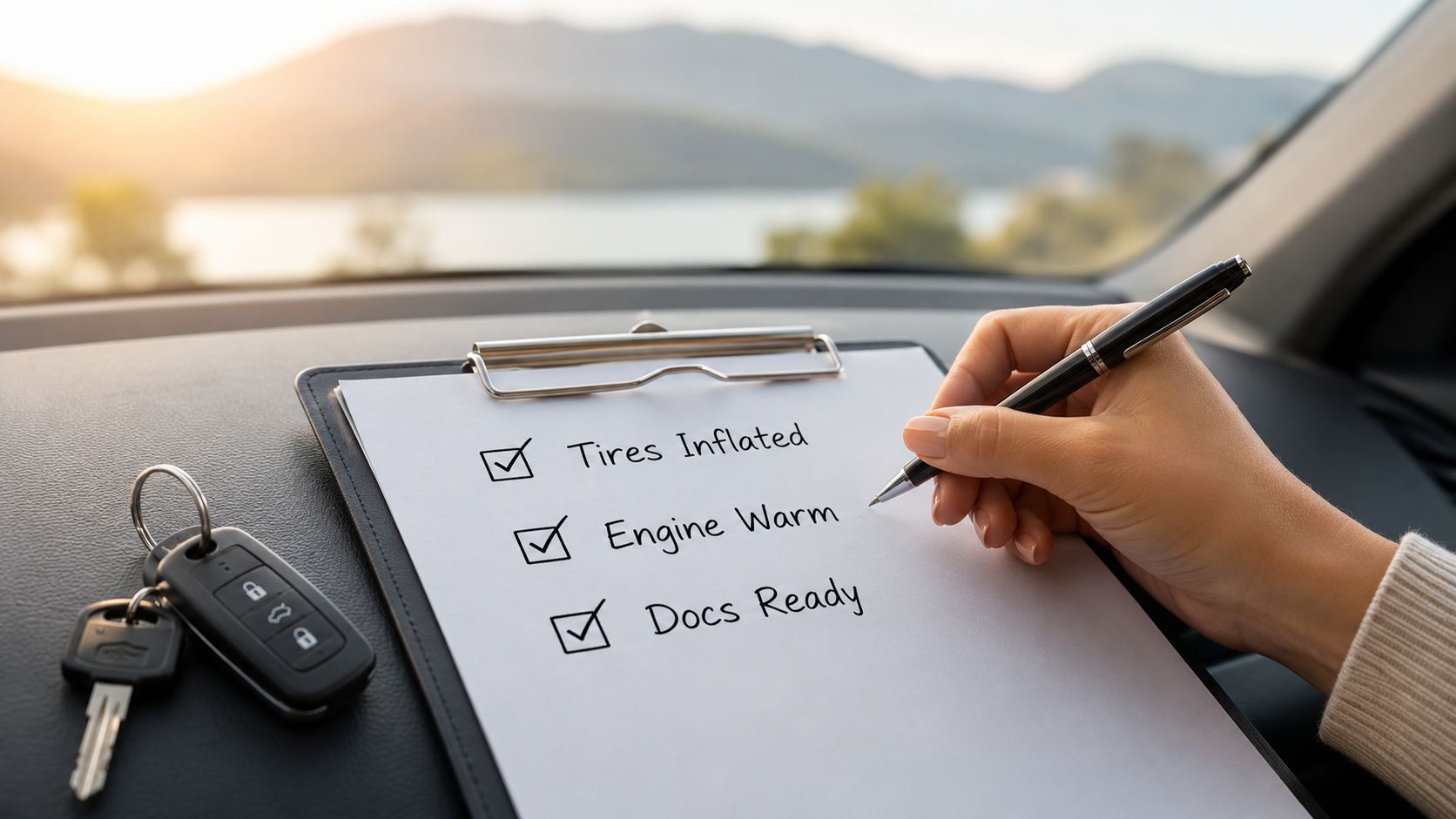
The pre-visit checklist that matters
Focus first on the things that change the outcome.
A fast visit usually comes down to one question: is the car ready to test? Drivers get hung up on the clock, then lose far more time to avoidable problems in the lane.
- Do not show up right after a battery disconnect or replacement: Readiness monitors often reset after battery power is lost. If that just happened, give the car time and normal driving before the test, as noted earlier.
- Make sure the check engine light is off: If the light is on, deal with the repair first. No shop can make that part go away with better timing.
- Bring the registration or renewal notice if you have it: Front counter delays are small, but they are still delays.
- Drive the car before the test: A car that has been running and is fully warmed up is usually easier to process than one that has been sitting cold.
What actually speeds things up
At Speedy Smog, the quickest visits usually look very similar. The car has been driven recently. The dashboard is clear. The driver already knows whether a STAR station is required. Nobody is figuring out basic paperwork or vehicle issues after arrival.
That is the inside scoop. Fast smog checks are usually won in the driveway, not at the counter.
Here is the simple version:
- Drive the car enough beforehand to avoid monitor problems.
- Check the dash before you leave.
- Bring what you need.
- Show up ready for the test, not ready to troubleshoot.
My advice: If the battery was just replaced or disconnected, wait and put some normal driving on the car first. Rushing in with incomplete monitors is one of the easiest ways to turn one visit into two.
What to avoid
A few mistakes waste time over and over:
- Do not clear codes and head straight to the station. That can reset the same monitors you need to have ready.
- Do not wait until the last few days if you already suspect a problem. Repairs and a retest can wreck your timeline fast.
- Do not assume every short line means a quick pass. Vehicle condition still decides how smoothly the visit goes.
If you want the fastest possible stop, prepare the car like you expect it to pass on the first try. That is the move that saves the most time.
Smog Check Timing FAQ
You do not want to be asking these questions three days before your registration is due. That is when a routine smog check turns into a scramble.
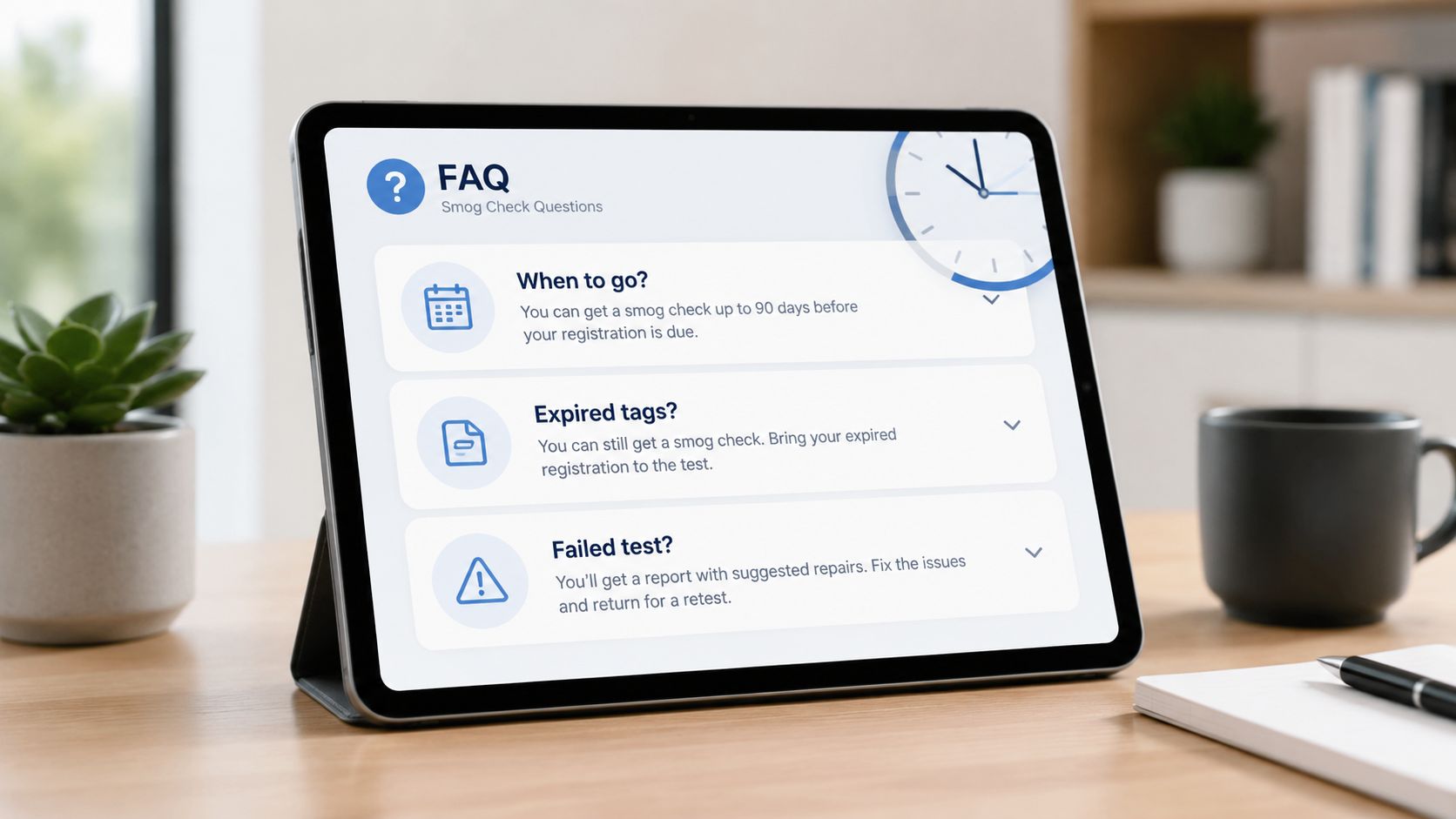
How close to my registration deadline should I get my smog check
Go early enough to leave room for a problem. A smog certificate gives you a decent registration window after the test, so waiting until the final week is a bad bet.
My advice is simple. If your notice is already in hand and the car is running normally, get the test done soon. You want time for repairs, a retest, or a paperwork hiccup without turning your deadline into a stress test.
Do smog stations have different hours on holidays
Yes, and holiday weeks trip people up all the time. Some stations shorten the day, some close entirely, and some keep normal hours except on the actual holiday.
Call first or check the posted schedule before you head out. Around long weekends, that one step can save you a wasted drive and another day lost.
What happens to my timeline if my car fails
A failure resets the whole plan. Now you are dealing with diagnosis, repair scheduling, and a return visit.
That is why smart drivers do not wait until the deadline is staring at them. If the check engine light has been on, the idle feels rough, or the car has been sitting, build in extra time and assume one visit may turn into two.
Is Saturday a good time if I work during the week
Saturday works for convenience. It usually loses on speed.
A lot of drivers who cannot get away on Tuesday or Wednesday show up on Saturday, which means more stacking at the counter and more waiting your turn. If Saturday is your only option, go right when the station opens and show up fully ready. If you can carve out a weekday late morning or early afternoon, that is usually the faster move.
Should I get tested as soon as my notice arrives
Usually, yes. One exception matters. If the battery was recently disconnected, replaced, or drained, give the car time to complete normal driving before the test.
Coming in too soon after a reset is one of the easiest ways to waste a trip. Get the car ready first, then get the test done before the calendar starts boxing you in.
Need a practical option in San Leandro? Speedy Smog is a STAR-certified station at 15275 Washington Ave where drivers can handle DMV-required emissions testing during standard weekly business hours. If you want the fastest visit, stop treating smog check hours like a basic schedule question. Pick a low-traffic time, bring a test-ready car, and leave yourself room before the deadline.