
Since January 1, 2013, California has required vehicles directed to STAR inspection or identified as gross polluters to use a STAR station; for ordinary renewals, either a STAR station or a regular Test-Only station can be acceptable. The important detail is that STAR is a certification tier, not a promise that the shop performs repairs.
You're standing in line at the DMV, checking your renewal notice, or searching “smog check near me” when two labels create unnecessary confusion: STAR station and Test-Only station. A driver may assume STAR means a full-service repair shop, or that Test-Only means an inferior facility. Neither assumption is reliable.
The practical question is simpler: Can this station legally certify your vehicle for the inspection your DMV notice requires? If your vehicle is directed to STAR, taking it to a regular Test-Only station is the wrong move, even if that station performs legitimate emissions inspections. If your renewal doesn't require STAR, a regular Test-Only station may be sufficient, provided it's authorized for your vehicle.
Table of Contents
- Understanding Your Smog Station Options
- The Regulatory Differences Between STAR and Test Only
- Vehicle Eligibility and Inspection Capabilities
- The High Cost of Choosing the Wrong Station
- How to Verify Your Smog Station Needs
- Why Speedy Smog is the Smart Choice for East Bay Drivers
Understanding Your Smog Station Options
An East Bay driver usually discovers the distinction at the worst possible time. The registration renewal is due, the DMV notice mentions a smog certification, and the driver wants the quickest appointment available. A search produces several nearby businesses, but the listings use different labels. One says STAR, another says Test-Only, and a third says Test-and-Repair.
The right choice depends on the vehicle's inspection status, not on which label sounds more complete.
California's STAR program began on January 1, 2013, replacing the former Gold Shield and Test Only system. The DMV says the program was created to improve Smog Check quality and support the state's emissions-reduction goals. California DMV's Smog Inspections guidance also explains that STAR stations are held to higher performance standards and are used for vehicles directed to STAR inspection.
The label that matters on your notice
Start with the DMV renewal notice. If it says your vehicle must receive a STAR certification, book a STAR station. Don't assume a non-STAR Test-Only facility can complete the requirement just because it performs emissions tests.
If the notice calls for an ordinary Smog Check and doesn't direct the vehicle to STAR, a regular Test-Only station may be appropriate. A STAR station can also handle many ordinary inspections, so choosing STAR is often the simpler way to avoid guessing, especially when you're unsure how the notice applies to your vehicle.
| Your situation | Station to choose | Why |
|---|---|---|
| DMV notice requires STAR | STAR station | The vehicle needs certification from a STAR-authorized facility |
| Vehicle is directed for inspection | STAR station | A regular Test-Only station may not certify it |
| Vehicle is a gross polluter | STAR station | STAR stations can inspect and certify this category |
| Ordinary Smog Check with no STAR direction | Regular Test-Only or STAR station | Both may be suitable, depending on the station's authorization |
| Vehicle fails and needs emissions repairs | Repair-capable shop, followed by the correct testing station | Testing authority and repair authority are separate |
STAR doesn't automatically mean repairs
This is the mistake I see most often. STAR doesn't necessarily mean Test-and-Repair. A STAR station may be licensed to perform tests only, or it may be licensed to perform both tests and repairs.
That means you need to ask two separate questions before booking:
- Is the station STAR-certified for my vehicle's required inspection?
- Can the station repair emissions problems if the vehicle fails?
If you only need a certification and the car passes, the first question is the critical one. If the vehicle has a history of emissions problems, the second question can save you a separate trip.
Practical rule: Match the station to the DMV requirement first. Treat repair capability as a separate convenience question.
The Regulatory Differences Between STAR and Test Only
The difference in STAR station vs Test Only isn't just a matter of reputation or shop quality. It comes from two different layers of California's regulatory framework.
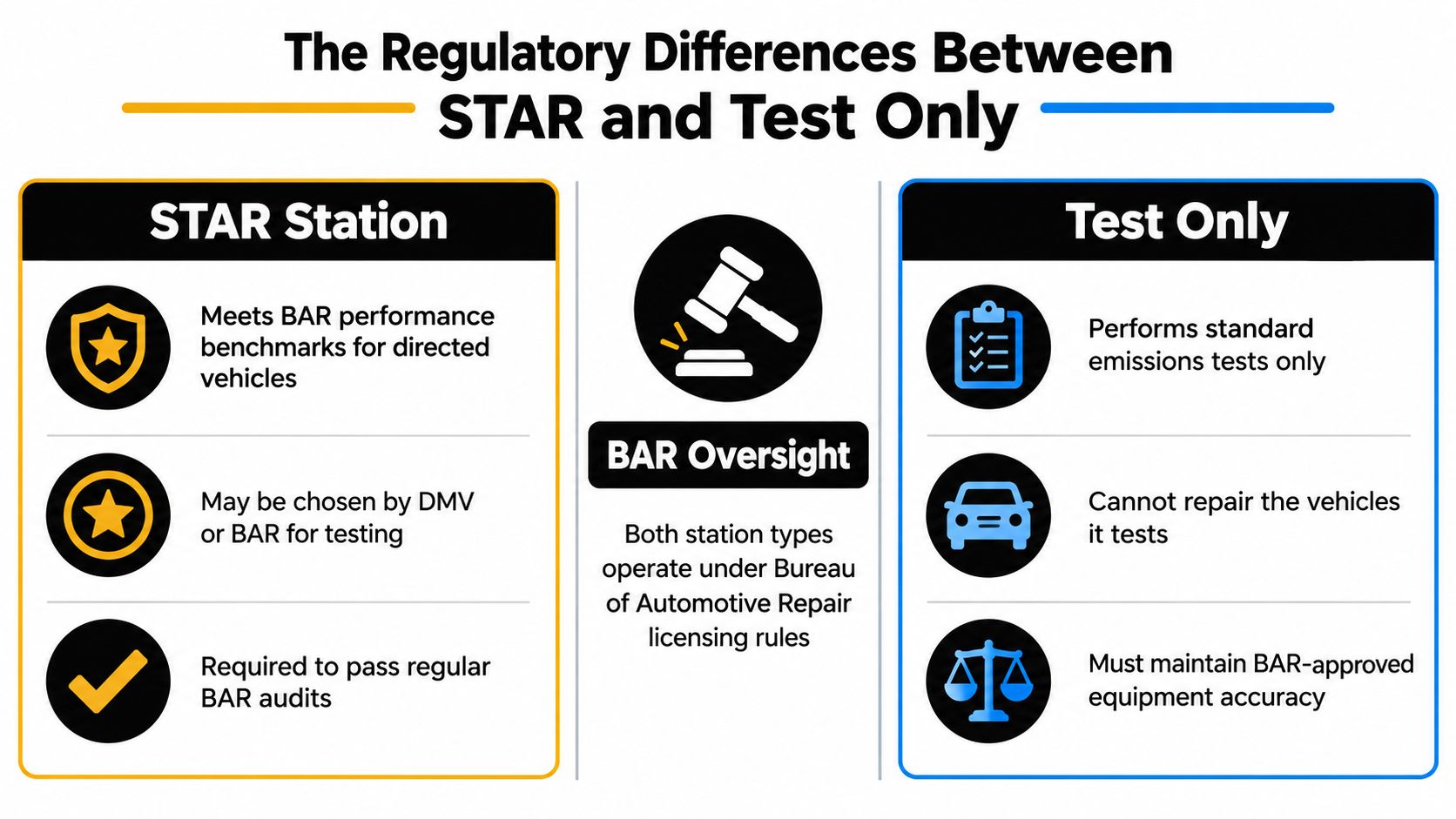
A standard Test-Only station is licensed to perform Smog Check inspections. It can test the vehicle, record the results, and transmit the certification outcome when the vehicle passes. It can't repair the vehicle it tests under that license.
A STAR station must meet higher inspection-based performance standards established through the Bureau of Automotive Repair. STAR is therefore a compliance and quality tier attached to the station's testing operation. It doesn't, by itself, tell you whether the business has technicians and licensing for repairs.
Licensing scope and performance standards
The Bureau of Automotive Repair's Smog Check explanation distinguishes between stations that test vehicles and stations that also perform repairs. BAR states that STAR stations can be either Test-Only or Test-and-Repair, while meeting the higher standards associated with STAR participation.
That creates an overlap that many quick online explainers miss:
- A regular Test-Only station can inspect vehicles but can't perform emissions repairs.
- A STAR Test-Only station can inspect vehicles under STAR standards but still can't perform repairs.
- A STAR Test-and-Repair station can inspect vehicles under STAR standards and repair emissions-related problems within its licensed scope.
- A regular Test-and-Repair station may perform repairs, but it isn't automatically authorized for every STAR-directed inspection.
The words “STAR” and “Test-Only” aren't opposites. One identifies a performance certification tier. The other identifies whether the station's license permits testing without repairs.
Why the distinction affects your appointment
BAR's STAR certification information explains that STAR stations must meet higher inspection-based performance standards and can inspect all vehicles subject to Smog Check, including gross polluters and directed vehicles. BAR also states that directed vehicles can receive certification only from STAR Test-Only or STAR Test-and-Repair stations.
That's why a STAR Test-Only station can be exactly the right choice. If your vehicle requires STAR and you only need a test, you don't need a repair shop. You need a station that holds the correct STAR authority.
For drivers who want a deeper explanation of the overlapping labels, this guide to what a Smog STAR station is breaks down the terminology without treating STAR and Test-Only as competing categories.
Vehicle Eligibility and Inspection Capabilities
The vehicle category determines how strict your station choice needs to be. A regular vehicle undergoing an ordinary renewal may be eligible for a standard Test-Only inspection. A directed vehicle or a gross polluter needs a STAR-capable station.
The word “directed” matters because it describes a vehicle that California requires to receive its inspection at a STAR station. The direction may appear on the DMV renewal notice or arise from the vehicle's inspection history and program requirements. Don't rely on a map listing or a low advertised price to determine eligibility.
The capability comparison
| Station Type | Standard Vehicles | Directed Vehicles | Gross Polluters |
|---|---|---|---|
| Regular Test-Only | Can inspect when the vehicle's requirements allow a standard test | Cannot provide the required STAR certification | Not the correct certification path |
| STAR Test-Only | Can inspect standard vehicles and vehicles subject to STAR requirements | Can inspect and certify directed vehicles | Can inspect and certify gross polluters |
| Regular Test-and-Repair | Can test and repair within its license scope | Not automatically authorized for STAR-directed certification | Not automatically the correct certification path |
| STAR Test-and-Repair | Can test and repair within its license scope | Can inspect, repair, and certify directed vehicles | Can inspect, repair, and certify gross polluters |
The table shows why “Test-Only” doesn't always mean the same thing. Regular Test-Only and STAR Test-Only both lack repair authority, but only the STAR version can handle directed vehicles and gross polluters under the applicable STAR requirements.
Three categories drivers need to recognize
Standard vehicles are the least complicated. If the DMV notice calls for a normal Smog Check and doesn't direct the vehicle to STAR, an authorized regular Test-Only station may be enough. A STAR station can also perform the inspection, but STAR may not be mandatory for that particular vehicle.
Directed vehicles must go to a STAR station. A regular Test-Only station can conduct an inspection within its authority, but it can't provide the STAR certification required for a directed vehicle. Booking the wrong station can turn a routine renewal into an avoidable second appointment.
Gross polluters require STAR capability as well. A vehicle in this category may need more attention after a failure, but the first step remains choosing a station authorized to perform the required inspection. Don't confuse the ability to test with the ability to repair.
A station can be legitimate, licensed, and perfectly capable of ordinary inspections while still being the wrong station for a directed vehicle.
The High Cost of Choosing the Wrong Station
Most drivers compare smog stations by the advertised test price. That's understandable, but it's incomplete. The financial risk appears when the station lacks the authority or repair capability your vehicle needs.
Suppose an East Bay driver takes a directed vehicle to a regular Test-Only station. The station may perform an inspection, but it can't provide the STAR certification required for that vehicle. The driver has paid for activity that doesn't complete the DMV requirement, then has to locate a STAR station and arrange another visit.
That's not just an inconvenience. It can mean another test charge, more fuel, time away from work, and a delayed registration renewal. The initial low price stops looking low once the driver adds the cost of correcting the decision.
A failure creates a separate decision
A regular Test-Only station can document a failed emissions inspection, but it can't repair the emissions problem. The vehicle may need to go to a separate repair shop for diagnosis and corrective work.
After repairs, the driver still needs the right station for the next certification attempt:
- If the vehicle is directed, the return inspection must be handled by a STAR Test-Only or STAR Test-and-Repair station.
- If the vehicle is a gross polluter, the driver needs a STAR-capable facility for the applicable certification.
- If the vehicle has no STAR requirement, the driver may have more flexibility, but the station still needs the proper authorization for the follow-up inspection.
- If the first station is also Test-and-Repair, the driver may be able to keep diagnosis and repair in one place, depending on the problem and the shop's licensed services.
The important point is that test authority and repair authority are different. A station that can test your car may not be able to fix it. A repair shop that can fix emissions components may not be authorized to complete the STAR certification your DMV notice requires.
The cheapest test can become the expensive route
Drivers often focus on the first transaction instead of the entire path to certification. That approach is risky when the vehicle has warning lights, a previous failure, or a STAR direction.
A better calculation includes:
- The first inspection.
- Diagnosis and emissions repairs if the vehicle fails.
- The follow-up inspection.
- Travel between separate businesses.
- Time spent scheduling and waiting.
- The risk of choosing another facility that also lacks the correct certification authority.
You can't know in advance whether a vehicle will pass, but you can avoid a preventable station mismatch. If STAR is mandatory, start with STAR. If repair work may be needed, ask whether the station is Test-Only or Test-and-Repair before you arrive.
The smart budget isn't the lowest first price. It's the lowest realistic cost from inspection to valid DMV certification.
How to Verify Your Smog Station Needs
You don't need to decode California's entire emissions program before making an appointment. You need to verify three things in the right order: the DMV instruction, the vehicle's status, and the station's current authorization.
Start with the DMV renewal notice
Read the notice carefully instead of searching by vehicle age or neighborhood alone. Look for language indicating that the vehicle must go to a STAR station, or that it has been directed for a specific type of inspection.
If the notice requires STAR, treat that instruction as decisive. Don't book a regular Test-Only station and hope the result will transfer. The station must be able to issue the certification your vehicle requires.
If the notice only requests a standard Smog Check, you may have a choice between a regular Test-Only station and a STAR station. When the notice is unclear, contact the station before driving over and describe the exact wording.
Ask the station direct questions
Use this short checklist when you call or book online:
- “Is your station currently STAR-certified?”
- “Are you STAR Test-Only or STAR Test-and-Repair?”
- “Can you certify a vehicle directed to STAR?”
- “Can you inspect gross polluters?”
- “If the vehicle fails, do you perform emissions repairs here?”
The first three questions establish whether the station can complete the required certification. The last two help you plan for a failure without assuming the shop offers repairs.
Confirm before you leave home
Station listings can be incomplete or outdated. Confirm the location, appointment availability, and station type directly. Keep the DMV notice with you, along with any prior inspection information that may explain a failure or direction.
For additional preparation, use this guide on how to check your smog status before booking. The goal is simple: arrive at a facility that can legally complete the inspection, not merely one that advertises smog checks.
Why Speedy Smog is the Smart Choice for East Bay Drivers
For an East Bay driver who wants to avoid station-label confusion, a STAR-certified Test-Only station offers a straightforward path when the vehicle requires STAR certification. It can handle the inspection without pretending that STAR automatically includes repairs. If the vehicle passes, the certification process stays focused. If it fails, the driver knows that repair work may need to happen elsewhere unless the chosen station also holds Test-and-Repair authority.
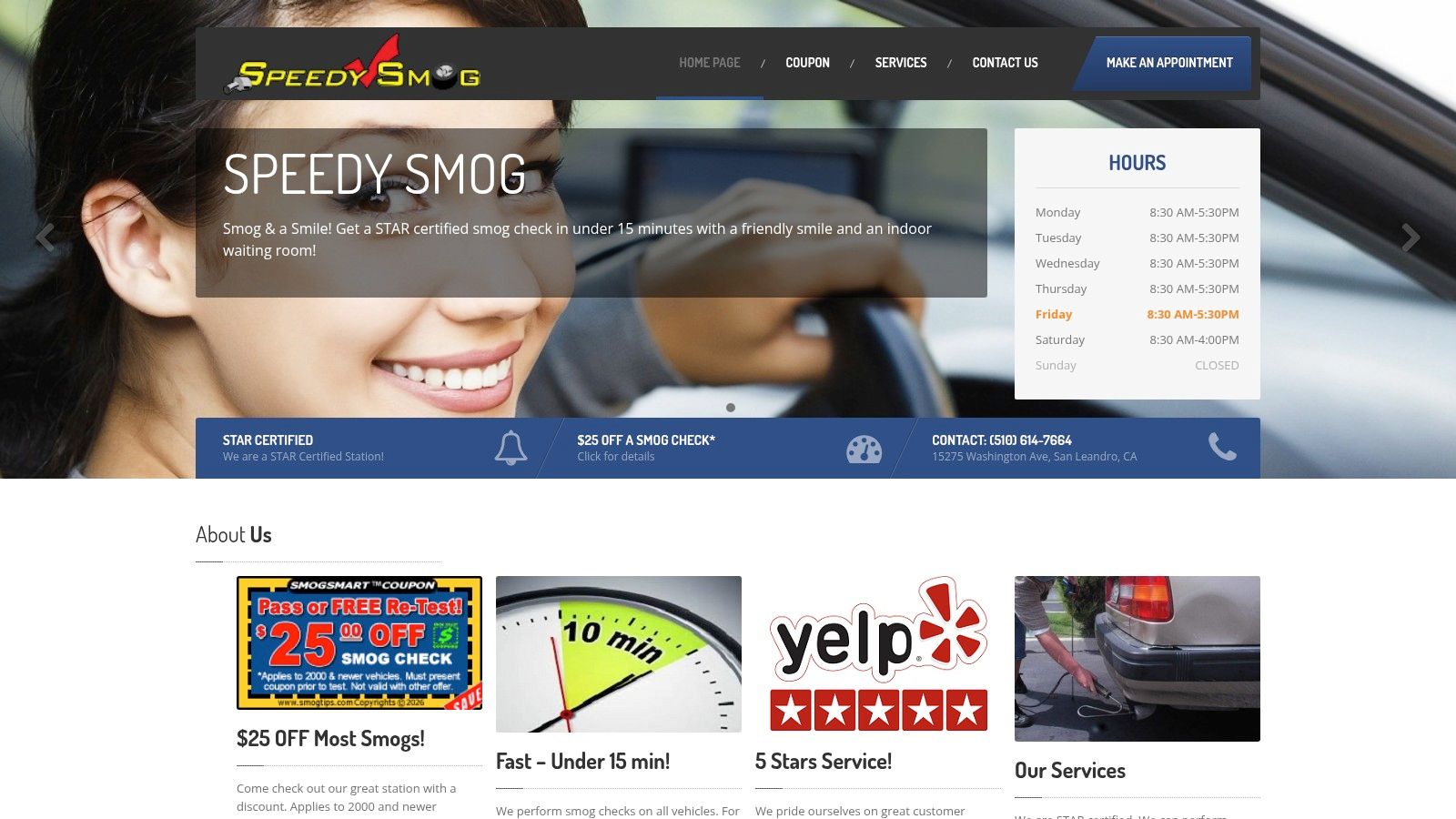
Speedy Smog in San Leandro is a STAR Certified station that provides STAR-certified Test-Only smog inspections and electronically transmits results for DMV registration needs. That makes it relevant for drivers whose vehicles need STAR testing, including directed vehicles and other vehicles that fall under STAR inspection requirements.
What to confirm before your appointment
A good appointment starts with accurate information. Bring the renewal notice and ask the station to confirm that its current license and STAR status fit your vehicle's requirement.
Speedy Smog's service is designed around emissions testing rather than assuming every customer needs repairs on-site. Drivers with older vehicles, diesels, hybrids, or cars with a previous failure should still explain the vehicle's situation before the inspection so the station can clarify the correct next step.
The broader lesson is more important than any individual shop: choose certification authority first, convenience second, and price third. A nearby regular Test-Only station may be perfectly suitable for an ordinary renewal. It's the wrong choice when the DMV requires STAR.
The practical recommendation
If your notice requires STAR, book a STAR station and verify whether it's Test-Only or Test-and-Repair. If your vehicle has already failed or you expect emissions repairs, ask about the repair pathway before the test.
For an ordinary renewal with no STAR direction, either an authorized regular Test-Only station or a STAR station may work. Drivers who want to reduce uncertainty can review this guide to the best smog check options and then call the station with the exact wording from the DMV notice.
Speedy Smog offers STAR-certified Test-Only inspections in San Leandro for East Bay drivers who need a compliant DMV smog certification. Visit Speedy Smog with your renewal notice, confirm your vehicle's requirement, and book the correct inspection before you make an unnecessary trip.
Car registration renewal in California isn't complete until the required smog certification is filed, and the DMV won't finalize the sticker just because you paid the fee. If your smog result is still missing, the renewal can stay stuck even after payment.
That's the part most drivers miss, especially when the notice looks simple and the online form seems to accept the payment. In practice, car registration renewal California is a compliance workflow, not just a checkout page, and the order matters if you want the renewal to clear on time.
Table of Contents
- The Two Parts of California Vehicle Renewal
- Do You Need a Smog Check
- Renewal Options and Timelines
- Finding a Reliable STAR Station
- Smog Check Failure Rates and Planning
- Common Issues and Final Steps
The Two Parts of California Vehicle Renewal
A common failure pattern goes like this. The driver pays online, assumes the job is done, then discovers the renewal is still blocked because the smog record never cleared, a citation is open, or insurance isn't verified.
Payment is not the same as completion
California's DMV says renewal is not finalized until required smog certification is completed, and it also says there's no grace period for annual registration fees, so the payment has to land on or before the expiration date or penalties apply. That makes timing important, but sequencing matters just as much. The right order is simple, confirm the notice calls for smog, finish the inspection, make sure the result is transmitted, then pay the renewal before the deadline. DMV registration fees and renewal processing
Practical rule: If the smog result hasn't cleared, the payment is only half the job.
What usually stalls a renewal
The DMV lists smog certification, unpaid citations, and insurance gaps as barriers to renewal. That means you should treat the notice as a checklist, not an invoice.
The workflow that avoids surprises is straightforward:
- Check the renewal notice first. If it calls for smog, don't pay and hope for the best.
- Complete the test at an authorized station. A passed inspection is what gives DMV the clearance it needs.
- Verify transmission or retention. The record has to be available for DMV processing, not sitting in your glove box.
- Pay before the expiration date. Missing the deadline creates avoidable penalties.
Drivers who handle the steps in that order usually avoid the worst bottleneck, the false sense that a receipt equals a finished renewal.
Do You Need a Smog Check
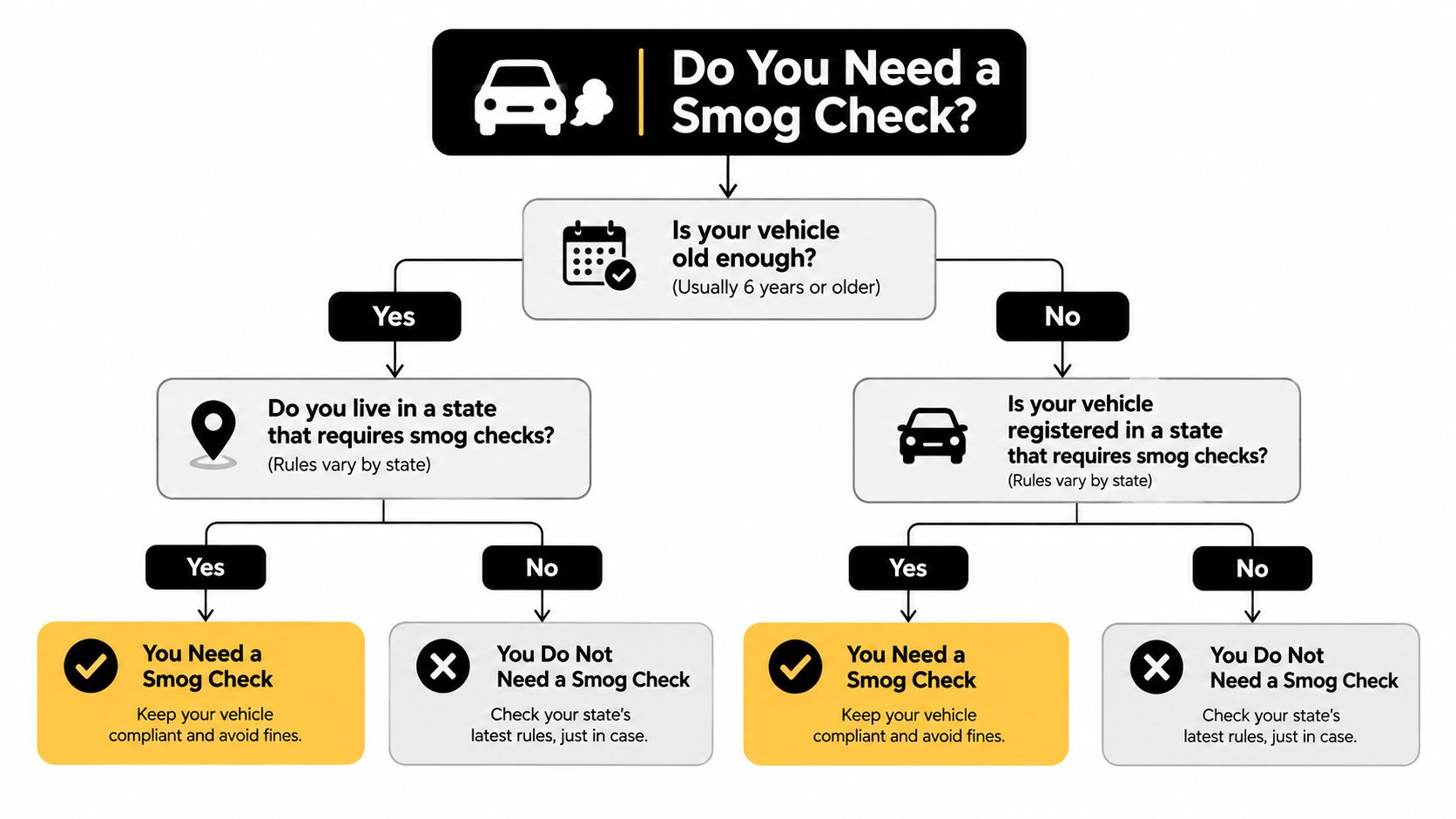
Not every vehicle sits in the same lane. California uses age-based rules, fuel-type rules, and registration timing to decide whether a car needs an inspection, so the fastest way to waste time is to assume everyone gets treated the same.
The exemption paths that matter
Gasoline-powered vehicles that are 1975 model year or older are exempt. Diesel vehicles that are 1997 and older are exempt, and electric vehicles are exempt as well. California also says gasoline-powered vehicles that are less than eight model years old do not need a smog inspection. California DMV smog inspections
That means a lot of newer drivers never need to book a test, while a lot of older daily drivers do. The middle of the fleet is where the compliance burden sits.
Where very new cars fit
California also notes that for vehicles less than four model years old, owners may pay a smog abatement fee instead of getting an inspection for the first 8 years the vehicle is registered. That's a niche path, but it matters if you bought a newer car and are trying to understand why your renewal notice doesn't look like your neighbor's.
If you're not sure which category you fall into, read the registration notice before booking anything. A clear notice saves a trip, and a wrong assumption can cost you a day.
For drivers comparing options, the key distinction is simple. Exempt vehicles can move toward renewal more directly, while inspection-required vehicles need the smog step cleared first. If you're checking a San Leandro or Oakland car, a local station that handles renewal-linked tests can remove some friction, including the process explained at Speedy Smog's registration renewal guide.
Renewal Options and Timelines
Once you know whether the smog requirement applies, choose the renewal method based on your deadline and the condition of your DMV record. Paying the fee starts the transaction, but it does not finish registration if a smog result, hold, or other requirement remains unresolved.
The channel you choose changes the clock
The DMV states that online and phone renewals take about one week, while mail takes about two weeks. A DMV kiosk can process the transaction instantly when every requirement is already satisfied. That timing makes the kiosk the fastest option, while online and phone renewal offer convenience with a short processing wait. California DMV vehicle registration renewal
Online renewal is practical when the record is clear and the expiration date is not pressing. It becomes a poor choice when you are still waiting for a smog result to post or for a hold to clear. The payment may go through while the registration remains incomplete.
The fastest path is the one that matches your actual renewal status.
How to pick the right method
Use the channel that fits both your record and your remaining time:
- Kiosk: Choose this when all requirements are satisfied and you need immediate processing.
- Online: Use it for a clean renewal when a short wait is acceptable.
- Phone: Expect timing similar to online renewal, with no office visit.
- Mail: Use it when convenience matters more than speed. It is a poor fit near expiration.
Check the renewal notice before submitting payment. If it indicates a smog requirement, confirm that the inspection has been completed and transmitted. If the account shows a hold, resolve that issue first. A kiosk cannot bypass a missing smog record or another unresolved requirement.
One practical East Bay habit
East Bay drivers often lose time by paying first and investigating the record afterward. The more reliable sequence is simple: read the notice, confirm the smog status, clear any hold, then submit through the method that fits the deadline.
For the inspection side of that workflow, Speedy Smog's STAR station overview explains how station selection connects with renewal planning. The practical point is to treat registration as a compliance workflow, not just an online payment.
Finding a Reliable STAR Station
A smog station is not just where a test gets plugged in. For renewal work, the station has to do more than inspect the car. The result must be valid, transmitted, and accepted without extra follow-up, or you can still end up stuck even after paying the fees.
Why STAR certification changes the experience
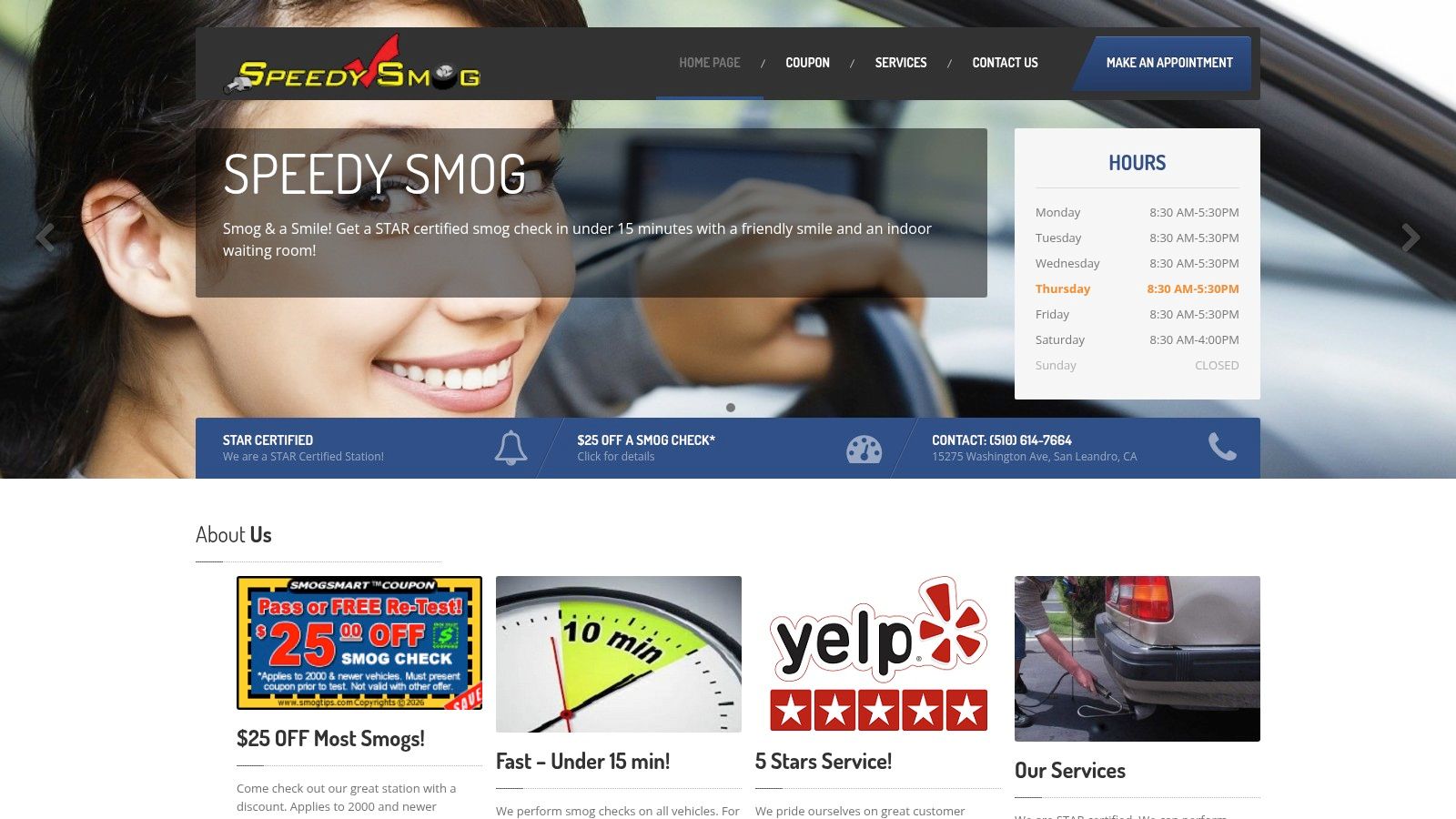
California's BAR sets higher performance standards for STAR Certified stations, which makes them the safer choice when a renewal cannot afford a bad inspection. In San Leandro, Speedy Smog operates as a STAR Certified station at 15275 Washington Ave, and it handles inspections for most vehicles, including 2000 and newer models, 1999 and older vehicles, diesels, and hybrids. Typical tests for newer vehicles are completed in about 10 to 15 minutes. Speedy Smog station information
That speed helps, but predictability matters more. A clean test and proper transmission keep the renewal moving instead of leaving you in DMV limbo with a paid fee and an unfinished record.
What to look for before you drive over
A reliable station should make the process boring in the best way. Clear intake, a clean waiting area, and staff who know which vehicles need which inspection path save time and avoid rework.
Before you go, check a few basics:
- Confirm STAR status. Use it if your renewal notice requires a STAR station.
- Ask about electronic transmission. The result should go to DMV without extra handling.
- Check vehicle fit. Diesel, hybrid, older, and newer cars can have different testing needs.
- Ask about pricing up front. You want the cost explained before the test starts.
The East Bay advantage is simple. You do not need a statewide scavenger hunt for a valid inspection. A nearby station that understands renewal timing can reduce the friction that turns a normal renewal into a delay.
For drivers who want to understand how station type affects the process, what a smog STAR station is gives the practical context.
Why nearby beats “good enough”
A station can be technically valid and still be the wrong choice if it adds delay. If you are trying to beat an expiration deadline, the key question is whether the station gets you through the compliance step fast enough to keep the renewal moving. A clean inspection, prompt transmission, and a simple checkout beat a longer drive to a place that complicates the process.
Smog Check Failure Rates and Planning
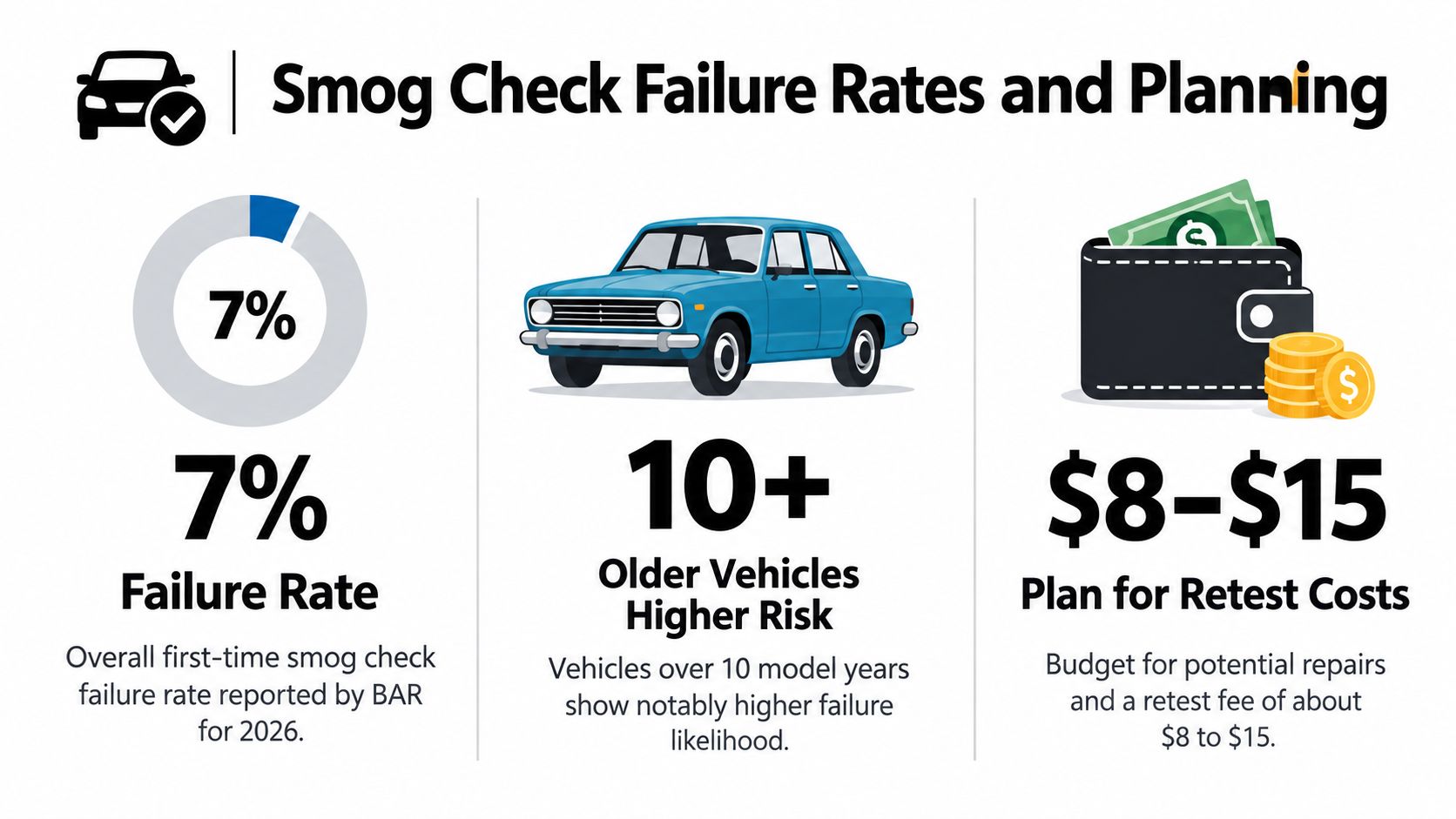
Older cars are not just more likely to need a smog check, they are more likely to slow down renewal. That is why planning before the inspection matters. A failed test can stall the whole compliance chain, and the risk rises as the vehicle ages. BAR smog check performance report
What the failure pattern tells you
BAR's 2026 performance report says about 1.3 million of 19 million 2000-and-newer vehicles tested in CY 2024-2025 failed Smog Check, roughly 7%, while roadside inspection failure averaged about 14% statewide in 2024-2025. Its 2024 report also shows failure rates rising sharply with age, from about 4% for 8-year-old vehicles to 15% for 23-year-old vehicles.
That age pattern matters. If your car is older, the odds of a delay go up, and your renewal plan should reflect that.
What to do before the test
Preparation will not fix a real emissions problem, but it can keep you from failing for avoidable reasons. Warm the vehicle before inspection, and treat a check engine light as a real fault until diagnostics prove otherwise. If you suspect a problem, verify the repair before you pay for the official test.
A practical pre-test checklist looks like this:
- Warm the car up properly. A cold car can give you a bad read.
- Inspect the dash. A check engine light usually means diagnostics first.
- Verify recent repairs. Do not assume a cleared code means the issue is gone.
- Use the right station. A station that understands your vehicle type reduces avoidable confusion.
For a local breakdown of common failure causes, Speedy Smog's smog fail guide is a useful starting point.
Planning beats panic
Older vehicles should be treated as a project, not a gamble. If you go in expecting a clean pass without checking the basics, you are betting your renewal on luck. If you confirm the obvious issues first, you give yourself a much better shot at getting through the compliance step in one visit.
Common Issues and Final Steps
A renewal can still stall after the smog step is done. The usual blockers are operational. An unpaid citation, an insurance gap, or a missing clearance can keep the file from moving even after you think everything is complete.
What to verify before you submit
If your renewal notice shows a smog requirement but you believe you qualify for an exception, check the vehicle's model year, fuel type, and registration status against the California DMV vehicle registration renewal page before you assume the notice is wrong.
Use this checklist before you submit:
- Smog status is correct. If a test is required, it has been completed and transmitted.
- Citations are clear. Any open violation can stop renewal.
- Insurance is active. A coverage gap can hold the file.
- Payment is on time. California does not give a fee grace period.
- The channel matches the deadline. If time is tight, do not choose a slow method.
California also allows a temporary operating permit for failed-smog cases for a $50 fee, which gives drivers a way to keep the vehicle legally usable while repairs are finished. It is not a free pass. It only buys time to complete the compliance work.
What a finished renewal actually looks like
A finished renewal means the record is clear, not just paid. The notice is satisfied, the smog result is accepted if required, and the DMV can complete the transaction without a hold. That is the standard to use before you assume the sticker is on the way.
For East Bay drivers, the practical move is to separate the payment step from the compliance step. If the account has a hold, or the smog data has not posted yet, paying online does not finish the job. Handle the missing piece first, then confirm the record has cleared.
If you want the inspection side handled without extra friction, Speedy Smog can handle official smog certification for renewal-linked cases and move the result through the process quickly. Visit Speedy Smog to get the smog step handled and keep your car registration renewal on track.