California STAR Smog Test: What Drivers Need to Know
A California STAR smog test is the same emissions inspection, but it's done at a STAR Certified station that the Bureau of Automotive Repair routes certain vehicles to under higher-performance controls. In California's STAR framework, stations have to meet measurable thresholds, including a Similar Vehicle Failure Rate of at least 50% of the industry-wide rate for similar vehicles, an Excessive Test Deviation Rate no greater than one, and each inspector must maintain a Follow-up Pass Rate of at least 0.40.
You're usually looking at that sticker on the station door because a renewal notice, a registration hold, or a previous test result pointed you there. That's where the confusion starts for a lot of drivers, because the test itself often feels familiar, but the routing rule behind it is what changes.
Table of Contents
- What a STAR Smog Test Really Is
- How STAR Fits Inside the California Smog Check Program
- Which Vehicles Get Routed to a STAR Station
- What Happens During a STAR Smog Test
- How to Prepare Before You Arrive
- Common Reasons Vehicles Fail and How to Recover
- Cost, Timing, and the DMV Renewal Connection
- Choosing a STAR Station in the East Bay
What a STAR Smog Test Really Is
A lot of drivers first see the word STAR when a DMV renewal notice says the vehicle needs a smog check. The next stop is usually a station window with a STAR sticker, and the immediate question is simple, “Is this a different kind of emissions test?”
The short answer is no. A California STAR smog test is the regular smog inspection performed at a station that has been selected for stronger performance controls, not a separate emissions standard for the car itself. California's STAR designation is built on measurable compliance and quality checks, not branding or convenience, and the state uses it to steer higher-risk inspections to stations that can handle them reliably California STAR certification rules.
Practical rule: the car isn't “STAR-approved,” the station is.
A regular smog station can inspect many vehicles, but a STAR station has to keep proving it can do the job with tighter oversight. California's BAR also says STAR stations must keep certified inspection equipment and stay within a 10-calendar-day calibration window for calibration-capable equipment, which helps reduce measurement drift BAR STAR certification.
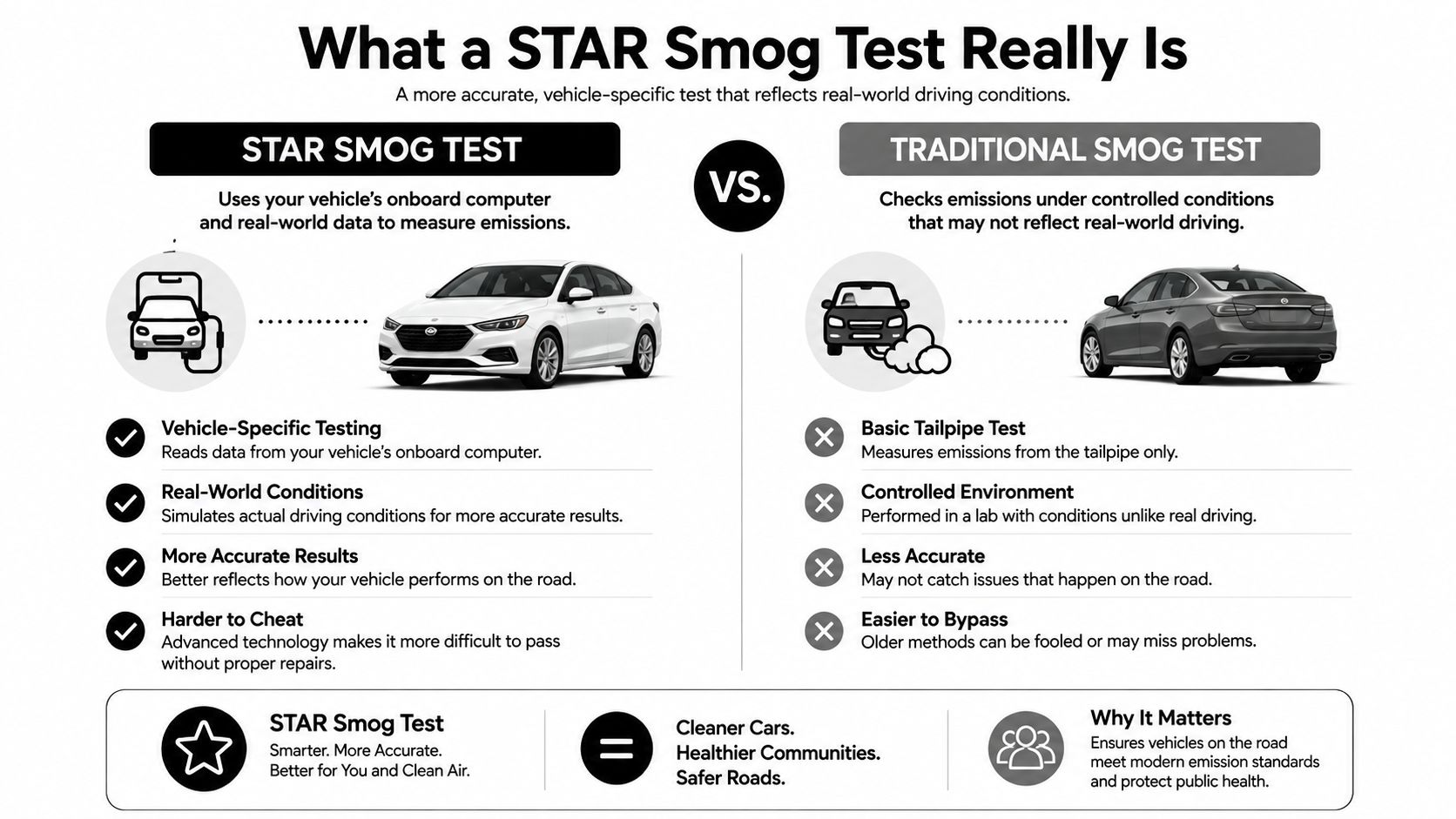
| Requirement | STAR Station | Regular Smog Station |
|---|---|---|
| Program role | Handles vehicles BAR routes for higher-performance oversight | Handles standard smog inspections |
| Station selection | Chosen through measurable compliance and quality controls | Approved as a smog station, but not held to STAR routing metrics |
| Equipment control | Certified equipment and calibration controls are closely monitored | Standard inspection equipment requirements apply |
| Driver experience | Same basic inspection, but at a station with tighter program oversight | Same basic inspection at a normal station |
For a plain-language explainer, see this STAR station overview.
If you need one sentence to keep in your head, use this: a STAR smog test is a California smog check performed at a higher-performance station that the state uses for targeted enforcement and quality control.
How STAR Fits Inside the California Smog Check Program
California's Smog Check program is broad, and the STAR layer sits inside it as a quality filter. State and federal materials describe a network of more than 5,000 independently owned stations and more than 10 million vehicles tested each year, while an OECD/ITF presentation summarizing the program described about 22 million vehicles, roughly 11 million initial inspections per year, about 7,000 smog check stations, and 21,000 inspectors/technicians California Smog Check program summary.
That scale matters because California is not running a small inspection lane. It is running a statewide system that has to separate ordinary, low-risk inspections from the ones where fraud, weak technique, or uneven quality control would cause more damage.
Why the state uses tiers
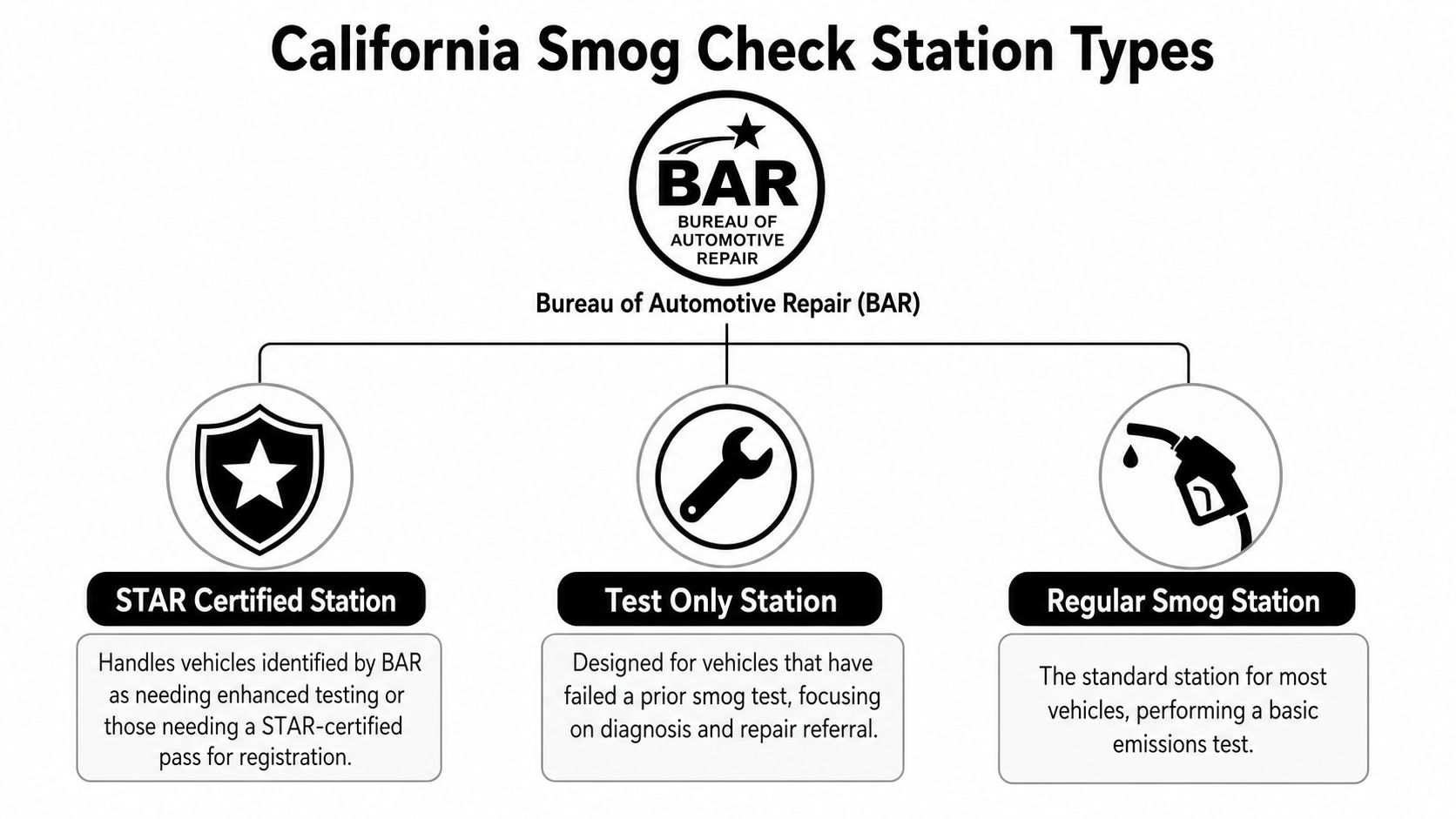
The structure works like a school system with different levels of oversight. Regular smog stations handle the general flow of inspections, Test Only stations handle vehicles that need a more focused inspection path, and STAR stations sit at the top of the oversight stack for the vehicles the state wants watched most closely. BAR's STAR framework is performance-based, so a station earns the designation by meeting measurable standards rather than by buying a badge BAR STAR certification.
The policy logic is straightforward. California wants the vehicles and inspection situations with the highest compliance risk to go through stations that show stronger consistency. BAR's FAQ also makes clear that STAR routing is tied to vehicle profile, not just owner preference, and that STAR is about program targeting rather than a separate vehicle emissions class BAR STAR FAQ.
Why calibration and fraud control matter
The STAR layer also works as a fraud-control tool. California's BAR materials point to schemes like clean plugging on 2000+ vehicles, which means the state has reason to scrutinize OBD-based inspections more closely BAR STAR FAQ. That is why the program looks at station performance over time, not just whether a shop can display a certificate on the wall.
For most drivers, the takeaway is simple. The STAR label means the station is part of a tighter enforcement layer inside the larger Smog Check program, and that layer exists to protect program integrity, not to make the car itself subject to a different pollution rule.
Which Vehicles Get Routed to a STAR Station
Most drivers don't choose STAR on purpose. BAR routes certain vehicles there because the system is trying to place more oversight where the program sees more risk. That means the question isn't “Is my car suspicious?” It's “Does my vehicle profile trigger a STAR designation?”
The important part is that routing is risk-based, not a judgment about whether your car is about to fail. A STAR requirement can show up because of the vehicle's profile, past compliance signals, or other program logic, and BAR says the vehicle can be directed to STAR based on profile rather than owner preference BAR STAR FAQ.
Common reasons a vehicle gets sent there
The state doesn't publish a simple one-size-fits-all consumer formula, but the practical triggers usually fit a few buckets:
- Vehicle profile signals. BAR can route a vehicle based on the profile it sees in the program, not just because it's old or because the driver assumes it looks problematic BAR STAR FAQ.
- History in the program. Vehicles with prior compliance issues, repeat testing friction, or other directed notices are more likely to be handled through the tighter lane.
- Testing risk factors. The state pays closer attention where cheating has historically been more common, especially around OBD-based inspections on newer vehicles BAR STAR FAQ.
- Owner-directed or renewal-driven routing. Sometimes the DMV notice itself is what tells you the vehicle must go to a STAR station.
A STAR requirement doesn't automatically mean the car is a high emitter. It can mean the state wants a stronger inspection path for that vehicle category.
That's the part many drivers miss. A STAR notice is not a diagnosis. It's a routing decision.
If your renewal notice mentions STAR, don't treat it like an optional upgrade or a shop recommendation. Treat it like a lane assignment. Choosing a non-STAR station when STAR is required can waste the trip, and the station may not be able to complete the certification you need for DMV processing.
What Happens During a STAR Smog Test
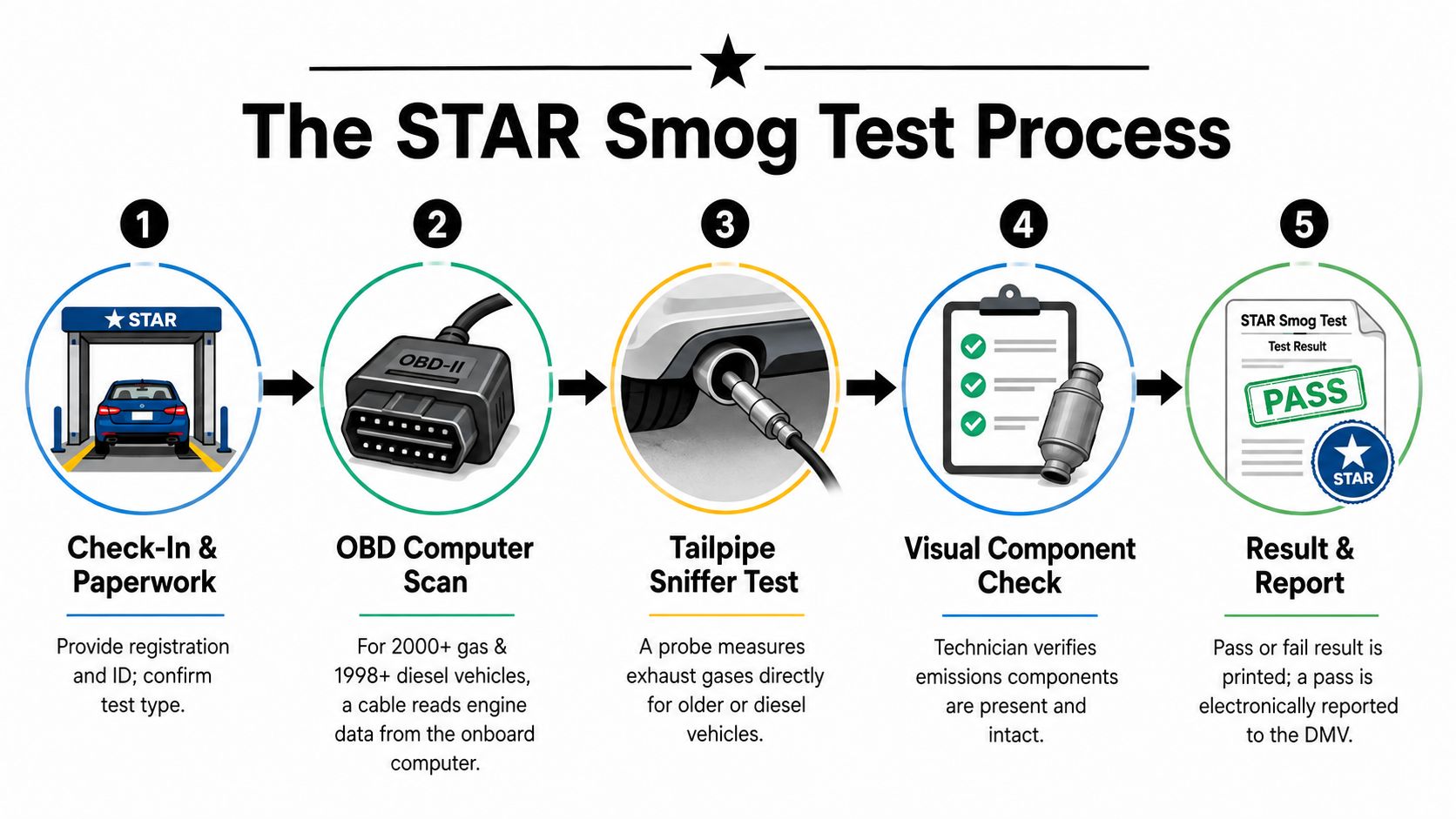
The STAR label changes the station tier, not the basic inspection logic. Once you pull in, the technician is still checking the vehicle's emissions-related systems, but the method depends on the model year and fuel type.
For most 2000 model-year and newer gasoline vehicles and 1998 model-year and newer diesel vehicles, California uses an OBD-focused test rather than a tailpipe dynamometer test California inspection method rules. For 1976 to 1999 vehicles, the inspection generally uses loaded-mode or two-speed idle methods that directly measure exhaust pollutants such as HC, CO, CO2, and NOx.
What the technician touches
For a newer vehicle, the technician usually plugs into the diagnostic port and checks the onboard computer. BAR's readiness-monitor guidance explains that OBD II stores diagnostic trouble codes, tracks emissions self-tests, and shows whether the monitors are ready BAR readiness monitor guidance. The test often works more like a computer health check than a tailpipe sniff.
For older vehicles, the process shifts back toward direct exhaust measurement. That is where the tailpipe probe comes in, and where mechanical condition can show up in the results more plainly.
A visual inspection still happens either way. The technician checks that required emissions parts are present, that nothing obvious has been tampered with, and that the vehicle can be evaluated safely and correctly. If the vehicle passes, the result is electronically reported for DMV registration processing. If you want a plain-language walkthrough before your visit, this STAR smog test prep guide helps explain the same sequence from a driver's point of view.
A normal visit usually does not take long. BAR says the inspection usually takes about 30 minutes BAR smog check page, though the exact time depends on the vehicle and whether the technician finds a problem that needs more checking.
How to Prepare Before You Arrive
The easiest smog failures are the ones a driver could've avoided the day before. That usually means the vehicle wasn't physically broken, but it wasn't ready for the inspection logic the state uses.
Start with the check engine light and readiness
BAR says a vehicle can fail if the check engine light is on, and readiness monitors may need time after a battery change or repair before they're set BAR smog check page. Think of those monitors like a pre-flight checklist. If the computer hasn't finished its checks, the inspector can't treat the vehicle as ready.
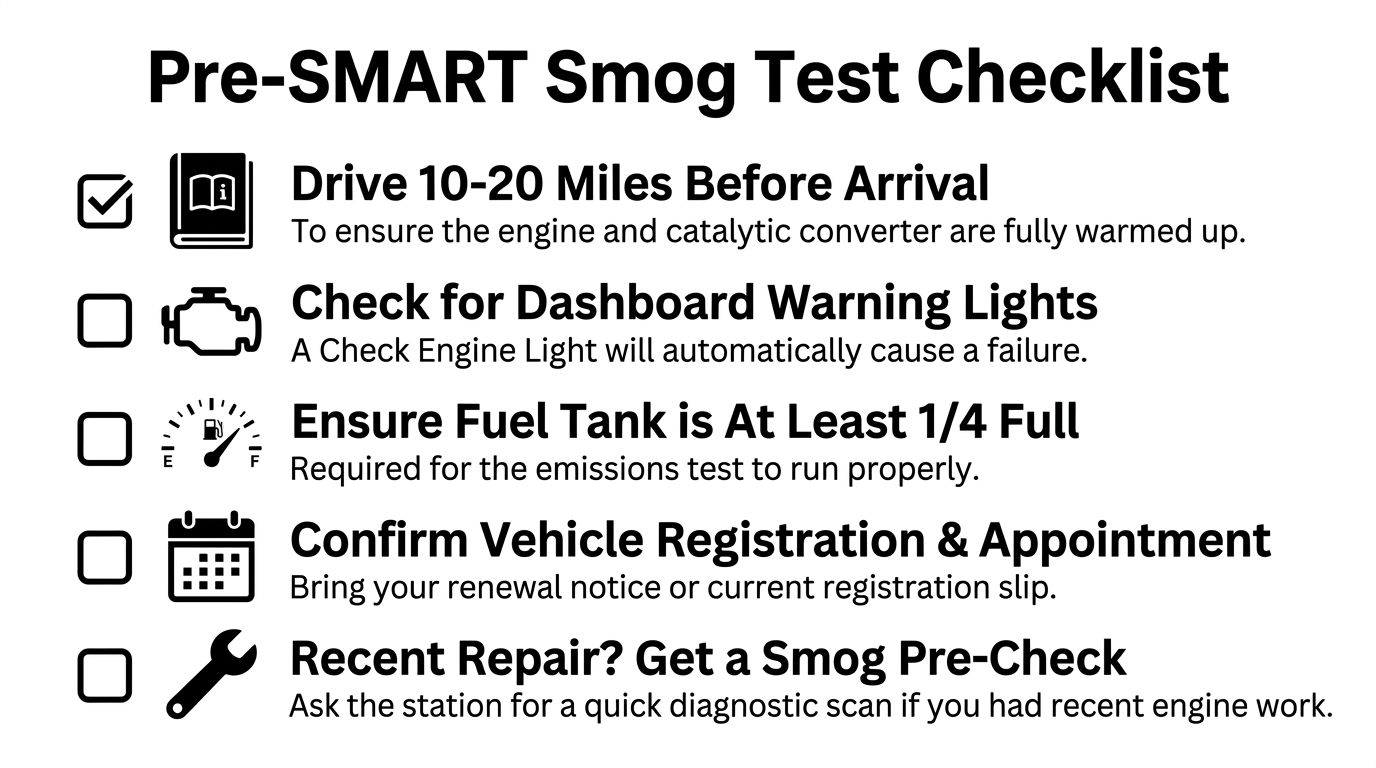
A few practical habits help:
- Drive normally for a while first. Mixed city and highway driving gives the monitors a chance to complete their self-tests.
- Avoid battery disconnects right before the test. BAR notes that recently disconnected or replaced batteries may need one to two weeks of driving for readiness monitors to reset BAR smog check page.
- Don't test with a warning light on. If the MIL is lit, schedule the inspection later, after the cause is fixed and the system stays off.
- Bring the paperwork. Renewal notice, registration, and payment are the basic items you'll want ready.
Practical rule: if you've had battery work, engine work, or a software update, wait until the car has gone through enough normal driving for the monitors to settle.
Use a simple readiness checklist
Fuel level matters too. A tank that's not too low or too full helps the test run smoothly, and many drivers prefer to keep it in the middle range. If you've recently had repairs, a quick pre-check at the station can save a wasted trip, especially for vehicles with OBD-based inspections.
For a practical checklist and prep flow, see this STAR test prep guide.
The best preparation is boring preparation. No warning lights, no last-minute battery swap, no surprise software change, and enough normal driving time for the monitors to say the car is ready.
Common Reasons Vehicles Fail and How to Recover
A failed STAR test usually points to one of three problems. The car's computer may not be ready, the emissions numbers may be out of range, or the vehicle may miss a visual or procedure requirement.
OBD failures are the most common headache on newer cars
For 2000-and-newer gasoline vehicles and 1998-and-newer diesels, the inspection relies heavily on the onboard computer, so a problem there can stop the test quickly California inspection method rules. A check engine light that is on, readiness monitors that have not finished, or stored diagnostic trouble codes are the usual causes.
The fix is usually mechanical, not administrative. A technician or repair shop needs to identify the code, correct the cause, and let the monitors complete their drive cycle again. If a battery was recently disconnected, the answer may be more normal driving time, but do not guess if the light stays on.
Tailpipe failures point to real engine or exhaust trouble
Older vehicles that are tested by tailpipe measurement can fail because their emissions readings are too high. That often points to ignition problems, fuel mixture issues, vacuum leaks, worn spark plugs, or a catalytic converter that is not doing its job. These failures are useful because they tell you the car has a real condition that needs attention, not just a paperwork issue.
Visual and procedural problems can stop a pass too
A missing gas cap, tampered emissions equipment, or an identification mismatch can create a fail even if the car runs fine. The STAR program also looks closely at fraud risk, including clean plugging concerns on newer vehicles, which is one reason visual and electronic checks matter so much BAR STAR FAQ.
A fail is a diagnosis, not a verdict.
Most drivers should ask the station what kind of fail it was. That tells you whether you need repair, more drive time, or a simple retest. If a shop offers a reduced-cost retest window, use it only after the underlying issue is addressed. For a sense of how shops may price the inspection itself, this California smog check price guide can help you compare before you go.
Cost, Timing, and the DMV Renewal Connection
A smog check usually answers three practical questions for a driver, how much it costs, how long it takes, and whether the result will clear the DMV renewal step without extra paperwork. The process is straightforward once you know how the pieces fit together.
California's historical program summary noted an average inspection cost of $48 in the baseline material California Smog Check program summary. STAR stations can price the inspection differently because they operate under a stricter certification layer, but the certificate still serves the same DMV registration purpose.
What happens after the test
For most renewals, the inspection result is sent electronically to the DMV. That means you usually do not mail in a paper certificate yourself, because the shop's report becomes part of the registration workflow. The BAR says the inspection usually takes about 30 minutes BAR smog check page, although an OBD check can feel much quicker when the vehicle is already ready.
California smog checks are tied to the registration cycle, and many vehicles need the test on a repeating schedule. For a lot of drivers, the smog fee is only one part of the DMV bill, so it helps to separate the inspection cost from registration fees before you arrive.
If you want a plain comparison point before you book, this California smog check pricing overview can help frame the conversation.
The practical move is to test early enough that a repair, retest, or extra drive cycle does not slow down your renewal. That keeps the smog certificate and the DMV deadline working together instead of getting in each other's way.
Choosing a STAR Station in the East Bay
A good STAR station should feel orderly before the car ever enters the bay. Look for posted STAR certification, clear pricing, a clean waiting area, and a staff that can explain whether your vehicle is being tested as an OBD car, an older tailpipe car, or a diesel with different requirements.
For East Bay drivers, one practical option is Speedy Smog at 15275 Washington Ave in San Leandro. It's a STAR Certified station, it handles a wide range of vehicle types, and it's set up for quick turnarounds on newer vehicles, with typical tests for 2000+ models completed in about 10 to 15 minutes, according to the shop's published service information.
The right station isn't just about speed. It's about not wasting a trip when your vehicle has readiness issues, a warning light, or a routing requirement that needs a STAR-certified result. If you're in San Leandro, Oakland, Alameda, or Hayward, a station that works cleanly and explains the process plainly can save a lot of back-and-forth.
If your renewal notice points you to a STAR smog test, bring the paperwork, make sure the car is ready, and choose a station that can complete the inspection you need. If you're in the East Bay and want a straightforward visit, Speedy Smog can help with STAR inspections, newer OBD-based vehicles, and older or diesel models, so you can get certified and move on with your day.