You open the mailbox and find your California DMV renewal notice. The registration deadline is approaching, and one line stands out: smog certification required. You may wonder whether you should visit a DMV office, a repair shop, or a special testing station, and whether the test result will reach the state automatically.
For most drivers, a smog check for DMV registration starts at a licensed private smog station, not at a DMV counter. The station examines the vehicle, records the result, and transmits the information electronically so the DMV can complete the registration transaction. Knowing which station to choose and what the technician checks can prevent a rejected test, an unnecessary repair bill, or a missed renewal deadline.
Table of Contents
- Why Your DMV Renewal Depends on a Smog Check
- Which Vehicles Need a Smog Check for DMV
- STAR Stations and Why the DMV Points You There
- What Actually Happens During the Smog Test
- How Results Get From the Station to the DMV
- What to Do When Your Smog Check Fails
- Common DMV Smog Myths That Cost Drivers Time
- Your Pre-DMV Smog Checklist and Final Takeaways
Why Your DMV Renewal Depends on a Smog Check
Your California renewal notice arrives, and one line says smog certification required. The DMV counter cannot perform that inspection. It needs a current passing result attached to your vehicle record before the renewal can be completed. The test happens at a licensed smog station, while the DMV handles the registration transaction.
California generally requires this inspection every other year for vehicles covered by the program. The state's DMV smog inspection requirements explain when certification is connected to renewal and other registration transactions. For a step-by-step explanation, see this guide to how a smog check ties to registration renewal.
The renewal notice is your starting point
Read the notice before choosing a station. It works like a routing slip, showing what the DMV expects on paper and helping the technician understand which transaction is underway.
- Renewal timing: The notice identifies the registration transaction and its deadline.
- Smog requirement: It indicates whether the DMV is waiting for a certification.
- Station instructions: It may point you toward a particular type of authorized station.
- Vehicle information: The technician uses the vehicle identity and registration details to select the proper test.
At the station, a certified technician inspects the vehicle and submits the result through the state testing network. A passing result becomes part of the DMV record and clears the smog-related obstacle. A failure leaves the renewal unfinished until the vehicle passes or the DMV accepts another authorized resolution.
The counter and test bay have different jobs. The DMV reviews the registration record. The station checks emissions-related equipment and reports the outcome. Keeping those roles separate helps explain why visiting a DMV office first usually does not solve a missing certification.
California's Smog Check program processes a large, recurring volume of inspections. The Bureau of Automotive Repair recorded 11,678,011 total tests and 1,084,215 failures in 2023, a 9.28% failure rate, in its 2023 Smog Check executive summary. That workload is why licensed stations conduct the inspections while the DMV manages registration records.
If the notice includes a special station direction, follow it. The station category can affect whether the result satisfies the DMV, and choosing the wrong one may delay renewal.
Which Vehicles Need a Smog Check for DMV
The first question isn't always “Where can I test?” It's “Does this transaction require a test?” California has several exemptions, and the answer can change depending on whether you're renewing registration, transferring ownership, or registering a vehicle brought from another state.
Gasoline and flex-fuel vehicles from 1975 and older are generally exempt from the state's Smog Check requirement. Electric vehicles are also exempt because they don't produce tailpipe emissions from an internal combustion engine. Diesel vehicles have separate rules, including exemptions for diesel vehicles from 1997 and older and certain vehicles above the applicable weight threshold. The state's California Smog Check overview explains the main exemptions and transaction rules.
Match the vehicle to the transaction
A newer vehicle may be exempt from the regular biennial inspection, but that doesn't mean every DMV transaction is automatically exempt. Change-of-ownership and out-of-state registration situations can create separate certification requirements. A vehicle's age, fuel type, origin, and transaction all matter.
The DMV also describes a smog abatement fee option for vehicles under four model years old, applying during the first eight registration years, rather than requiring an inspection in that specific situation. That option shouldn't be confused with a universal exemption for every transaction involving a newer vehicle.
| Vehicle Category | Smog Required for DMV? | Notes |
|---|---|---|
| Gasoline or flex-fuel vehicle, 1975 and older | Generally no | Older gasoline vehicles fall within a state exemption. |
| Electric vehicle | Generally no | Electric vehicles are exempt from the standard emissions inspection. |
| Diesel vehicle, 1997 and older | Generally no | Diesel exemptions follow separate age and weight rules. |
| Most newer gasoline vehicles | Sometimes | Regular renewal rules may allow an exemption, but transaction-specific requirements can differ. |
| Hybrid vehicle | Often yes | A hybrid still uses a gasoline engine and shouldn't be treated like a fully electric vehicle. |
| Out-of-state vehicle | Often yes | First California registration can require a current California-compliant inspection. |
| DMV-directed vehicle | Yes, at the required station type | Follow the direction printed on the renewal notice. |
Don't rely on a neighbor's answer based only on model year. Take the renewal notice, registration record, and transaction type together. If the notice says certification is required, ask a licensed station to verify the exact test path before paying for an inspection.
For a practical vehicle-by-vehicle breakdown, review this guide to which cars need a smog check in California.
STAR Stations and Why the DMV Points You There
A renewal notice can send two different messages: the DMV expects a smog certification, and the station must be authorized to complete the assigned test. California does not treat every smog station as interchangeable. Read the station instruction before choosing a shop, because the wrong location may not be able to submit the certification your vehicle needs.
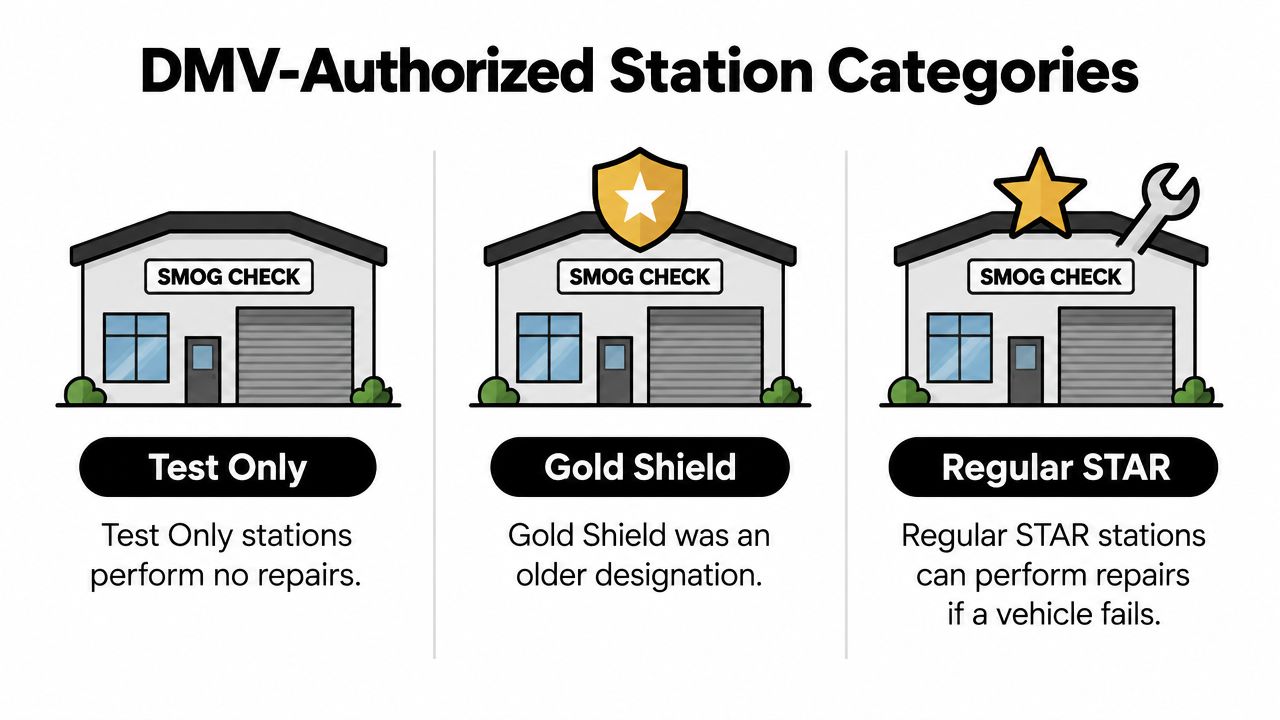
A Test Only station performs inspections but does not repair vehicles. A STAR station meets additional program requirements and may be authorized to inspect vehicles that the DMV directs into the STAR network. Older Gold Shield references can be confusing. The current STAR structure replaced the former Gold Shield and Test Only arrangement beginning January 1, 2013. The state's STAR program information explains the program background.
Read the direction before you choose a shop
A regular licensed station may be suitable when the notice requests only a standard smog inspection. A directed vehicle must follow the station instruction printed on the DMV notice. That instruction may identify a Test Only location or require a STAR-authorized station. The notice is the controlling detail, not a station's advertising or a neighbor's recommendation.
| Station type | Testing role | Repair role |
|---|---|---|
| Test Only | Performs the official inspection | Does not perform repairs as part of its testing role |
| STAR station | Handles qualifying inspections, including directed vehicles where authorized | May have repair capabilities, depending on the station |
| Regular licensed station | Tests vehicles that are not restricted to another category | May test and repair, subject to its authorization |
The difference becomes clearer after a failure. At a Test Only location, you may receive the failure information and then need a separate repair facility. A station that combines testing and repair may be able to explain the emissions issue and discuss repair options, while still following California's separation and certification rules.
A STAR designation is a program certification, not a marketing label. It identifies stations that meet performance requirements for certain testing assignments. For a plain-language explanation of how that designation affects station selection, see what a STAR smog station is. Before paying for a test, compare the station type on the notice with the station's authorization. That small check connects what the DMV expects on paper with what can happen in the test bay.
What Actually Happens During the Smog Test
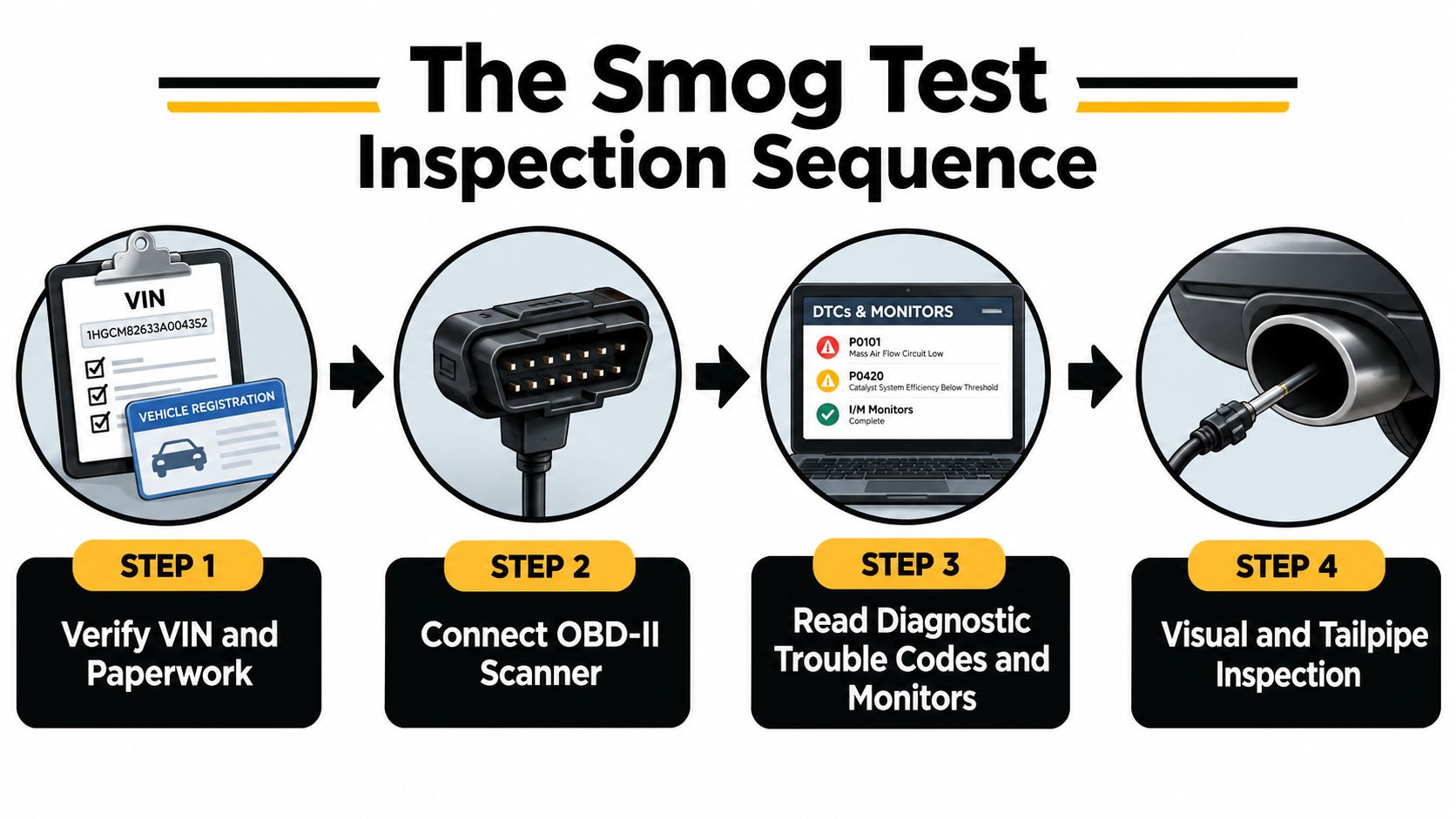
You pull into the station expecting a machine to measure exhaust. The technician first checks whether the vehicle and the DMV-related test request match the record. That means confirming the VIN, registration information, and inspection type before the car enters the test sequence.
The test method depends on the vehicle's model year and technology. California generally sends gasoline and flex-fuel vehicles from 2000 and newer, with a gross vehicle weight rating of 14,000 pounds or less, through an OBD-based inspection. Certain vehicles still require the BAR-97 tailpipe and inspection system. The BAR 2025 executive summary describes these model-year and technology-dependent procedures.
The main inspection points
The technician verifies the VIN and paperwork. The vehicle record must match the car in the bay. This is the station's first check against the information the DMV expects.
The technician connects the OBD-II scanner. The scanner communicates with the vehicle's onboard computer and retrieves emissions-related information.
The system checks trouble codes and readiness monitors. An illuminated check engine light or emissions-related diagnostic trouble code can cause a failure. Readiness monitors show whether the vehicle's emissions systems have completed their self-checks.
The technician performs the required visual and emissions inspection. This may include the emissions components, catalytic converter, gas cap, and other equipment. Older or qualifying vehicles may also receive a BAR-97 tailpipe test.
A monitor marked “incomplete” does not have the same effect for every vehicle. California allows 1996 to 2000 vehicles more incomplete monitors than vehicles from 2001 and newer. Disconnecting or resetting the battery shortly before the test can therefore create a failure risk, even when the check engine light is off.
Official test versus a pre-test
A pre-test can reveal obvious problems, but only the authorized official inspection becomes the result used for the DMV requirement. The technician records the actual outcome as pass, fail, or another result permitted by the process. Diagnostic repairs may require a repair shop, while the testing station must document and conduct the official inspection according to BAR rules.
How Results Get From the Station to the DMV
After the technician completes the official inspection, the station transmits the result through the certified testing network. The process is electronic, so drivers generally don't mail a paper certificate to Sacramento or carry a document to a DMV counter for routine renewal.
The electronic record identifies the vehicle and the inspection. It can include the station number, technician identification, test type, pass or fail status, and odometer information. When the vehicle passes, the DMV can match that certification to the registration record and clear the smog requirement.
What you should do after passing
Ask the station for a receipt or printed copy of the test result for your own records. The electronic submission is the official handoff, but your receipt can help if the DMV record doesn't update as expected or if you need to discuss the transaction with the station.
Don't assume that a passing test means a physical registration sticker arrives instantly. DMV processing can still involve its own timing, payment verification, address information, and mailing steps. If the online record doesn't reflect the pass after the station confirms submission, contact the station first to verify the vehicle information and transmission, then contact the DMV if necessary.
| Aspect | Old Paper System | Current Electronic System |
|---|---|---|
| Result delivery | Driver handled a physical certificate | Station transmits the result electronically |
| DMV matching | Staff processed mailed or presented paperwork | DMV matches the test to the vehicle record |
| Driver action | Mailing or delivering documents could be necessary | Driver usually keeps a receipt and completes renewal |
| Error protection | Paper could be lost or delayed | Electronic records reduce the need for paper handling |
| Proof for the driver | Paper certificate served as the main record | Station receipt remains useful for follow-up |
The important distinction is between station completion and DMV completion. The station certifies and submits the inspection. The DMV then uses that result as part of the registration renewal process.
What to Do When Your Smog Check Fails
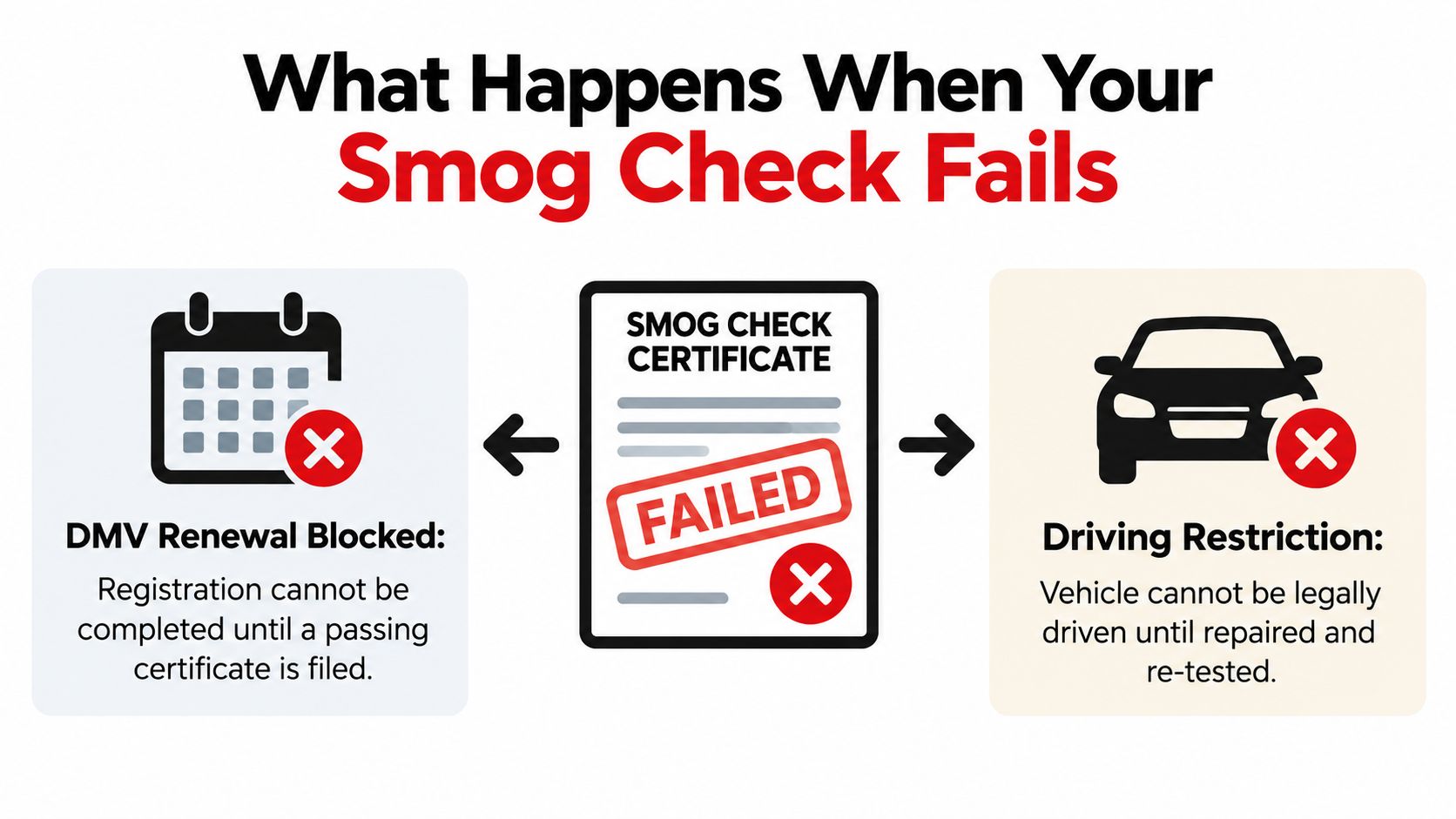
A failed test doesn't automatically tell you which repair will solve the problem. It tells you that the vehicle didn't satisfy one or more required parts of the inspection, such as an emissions-related diagnostic code, incomplete testing conditions, a visual defect, or an emissions reading outside the applicable limit.
The BAR's reporting makes the risk concrete. Its 2026 performance report describes about 1.3 million failures among 19 million tested 2000-and-newer vehicles during calendar years 2024 to 2025, roughly 7%, while a separate BAR summary reports 1,102,337 failures out of 12,200,718 tests, or 9.04% overall. These figures come from different reporting scopes, so they shouldn't be treated as interchangeable, but both show that a failure is a normal possibility within the program rather than an unusual event. See the BAR Smog Check performance report for the reported figures.
Separate the result from the repair decision
Ask the station for the failure information and the diagnostic reason before authorizing work. A technician may identify a check engine light, a failed monitor condition, an emissions component issue, or a visual inspection problem. Some stations can repair the vehicle, while a Test Only station may refer you elsewhere.
If the DMV directed your vehicle to a particular station category, follow that instruction for the retest. Repairing the vehicle at another shop doesn't necessarily change the station requirement for the official follow-up inspection.
A passing certificate is what clears the smog condition for the renewal. If the registration deadline is close, ask the station and the DMV what options apply to your circumstances, including any available extension, waiver, or consumer assistance program. Eligibility depends on the vehicle, household, repair history, and program rules, so don't assume assistance is automatic.
A failure report is a starting point for diagnosis. It isn't permission to replace parts at random.
California's repair and assistance programs have specific eligibility requirements and limits. Confirm the current rules directly with the BAR before committing to repairs, especially if cost or a deadline is making the decision urgent.
Common DMV Smog Myths That Cost Drivers Time
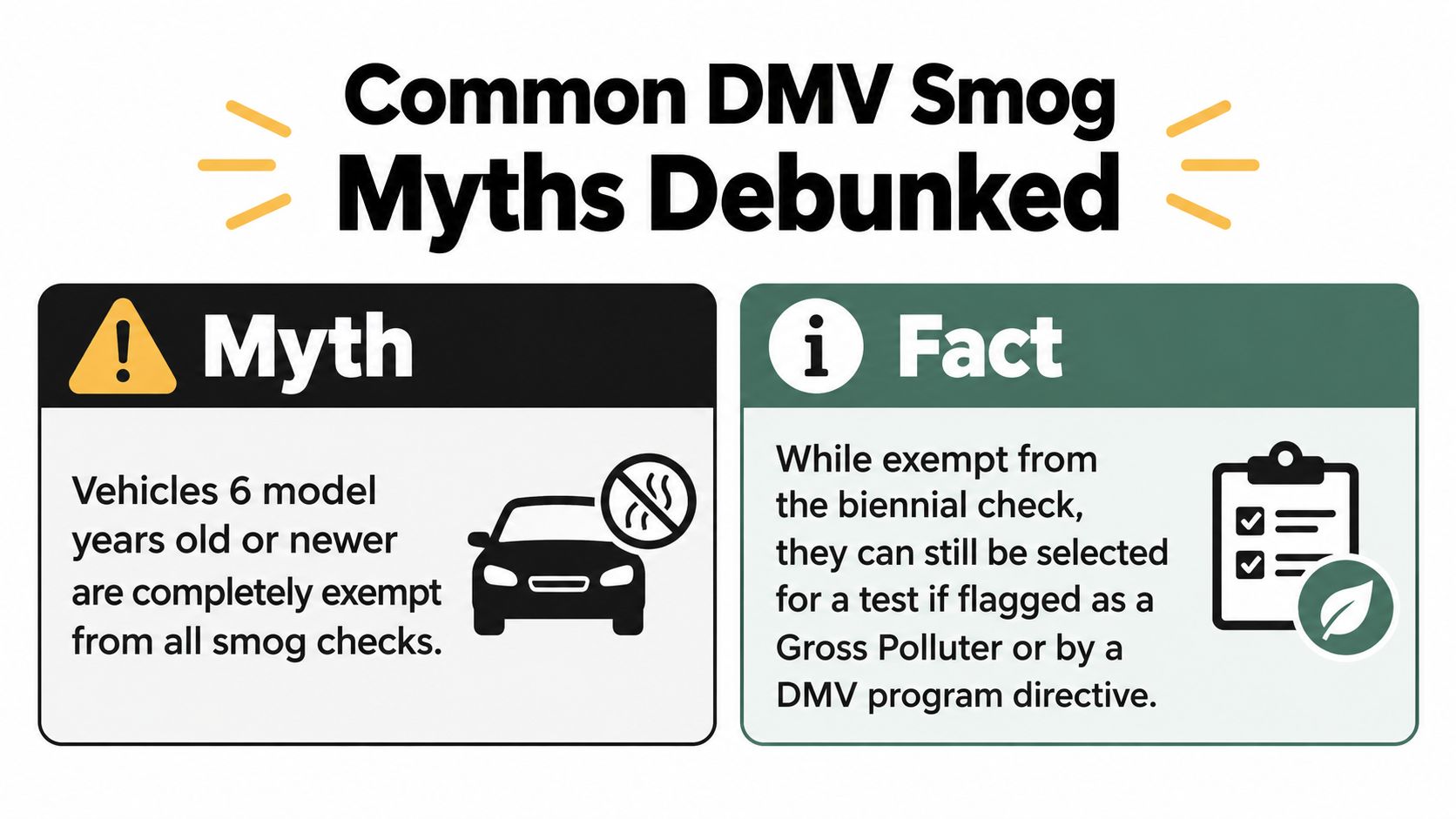
Myth: A newer vehicle never needs a smog check.
A vehicle can be exempt from the regular biennial inspection and still face a different requirement during a change of ownership, an out-of-state registration, or a DMV-directed transaction. The state's exemption rules depend on the vehicle and the transaction, not just the age shown on the dashboard paperwork.
Myth: Any licensed smog station can test any vehicle.
A regular station may be appropriate for a standard inspection, but a DMV-directed vehicle may need a STAR or Test Only location. Read the notice before booking. The station category is part of the compliance path.
Myth: A failed certificate can be ignored or paid away.
A failed result doesn't satisfy the DMV's smog requirement. Registration remains unresolved until the record receives a passing certification or the DMV accepts an applicable alternative.
Myth: A passing test means the sticker arrives immediately.
The station's electronic submission removes the need for routine paper delivery, but DMV processing and mailing still take place separately. Keep the station receipt and verify the registration status if the update doesn't appear as expected.
Myth: Emissions tampering won't be noticed.
The technician performs visual checks, and OBD-based testing reads diagnostic trouble codes and readiness monitor status. Missing, modified, or disconnected emissions equipment can create a failure even when the vehicle seems to drive normally.
These myths all produce the same outcome, a preventable delay. A driver who checks the notice, confirms the exemption or station category, and understands the result process has a clearer path through the DMV renewal.
Your Pre-DMV Smog Checklist and Final Takeaways
A renewal notice arrives, and the deadline is close. Before driving to a smog station, read the notice carefully. It shows whether the DMV requires a smog certification and whether a specific station type, such as a STAR location, applies to your vehicle.
Use this checklist to connect the DMV's paperwork requirements with the station's test-bay process:
- Read the renewal notice: Confirm the smog requirement and any direction to a STAR, Test Only, or other station category.
- Confirm the transaction: Renewal, ownership transfer, and first California registration can follow different rules.
- Bring vehicle information: Take the notice, registration details, and any paperwork the station requests.
- Check warning lights: An illuminated check engine light can signal an emissions problem that needs attention before testing.
- Avoid resetting the battery: Clearing diagnostic information can leave readiness monitors incomplete.
- Inspect obvious items: Check the gas cap, visible emissions equipment, and the vehicle's general operating condition.
- Ask about the test path: The technician can explain whether the vehicle will receive OBD-based testing or another inspection method.
- Keep the receipt: The station submits the result electronically, while the receipt records what was tested and when.
The DMV side and the station side
The DMV reviews the registration record and looks for an accepted certification attached to it. At the station, the technician verifies the vehicle, follows the required inspection procedure, and transmits the result through the authorized system. The driver connects these steps by bringing the correct vehicle, following the notice, and selecting an authorized station.
STAR certification matters when the notice directs a vehicle to that category. A regular station may not satisfy that instruction, even if it performs smog checks. Read the notice before booking, because the station category becomes part of the DMV compliance path.
Preparation also helps during busy periods. California's program handles substantial inspection volume, so arriving with the right paperwork and station choice reduces avoidable questions at the counter and delays in the test bay.
Do not choose a station only by price or distance. Confirm that it can test your vehicle and accept the DMV direction printed on the notice. After a passing inspection, the electronic result supports the renewal, but you still need to complete the registration payment and check for DMV confirmation.
If you're in the East Bay, Speedy Smog provides standard and STAR smog checks in San Leandro and electronically transmits results to the DMV. Bring your vehicle and renewal notice, and contact the station before visiting if the notice specifies a certification category.