
You pull into a smog check station with the DEF warning light on, the tank recently refilled, and one question: will the truck pass? A technician can't answer that by looking at the fluid level alone. Diesel exhaust fluid testing examines whether the fluid has the right concentration, whether something contaminated it, and whether storage conditions have damaged its quality.
That distinction matters at the counter. A tank with diluted DEF needs different attention from a tank contaminated with diesel fuel, and an old container stored in high heat creates another problem entirely. Understanding those differences can help you avoid an unnecessary failed inspection and recognize when the vehicle needs DEF service before testing.
Table of Contents
- What Diesel Exhaust Fluid Testing Actually Covers
- Why Diesel Exhaust Fluid Exists and How SCR Uses It
- How Diesel Exhaust Fluid Testing Works in Practice
- What a Technician Looks For During a DEF Inspection
- Common Reasons Diesel Exhaust Fluid Fails Before a Smog Test
- How Drivers Can Prepare for a Smog Test With a Diesel
- Bringing It All Together Before You Head to the Shop
What Diesel Exhaust Fluid Testing Actually Covers
At a smog check counter, a driver may say, “The truck has DEF.” The technician needs a more useful answer: what condition is that DEF in? A full level does not prove that the fluid is suitable for the emissions system.
Diesel exhaust fluid, also called AdBlue in some markets, is a prepared solution. Concentration testing checks whether its urea-to-water ratio remains within the expected range. Contamination testing looks for fuel, oil, coolant, dust, metal particles, or other unwanted material. Storage-condition assessment considers whether heat, age, packaging, or handling has made the fluid unreliable. DEF quality and testing guidance from Intertek identifies ISO 22241 as the foundation for these checks, including the expected mixture of urea and deionized water.
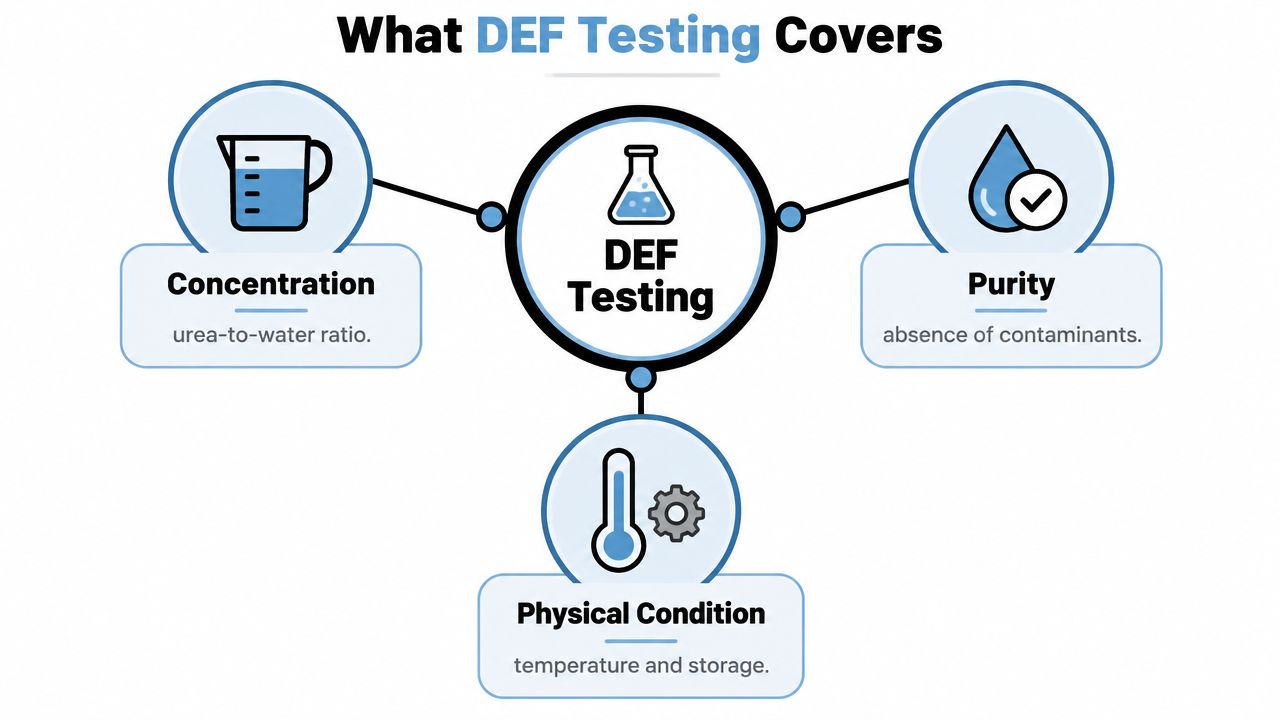
Three checks, three different responses
Suppose a driver added water after seeing a low-fluid warning. The liquid may look clean, yet its concentration can fall outside the operating range. That is a concentration problem. Adding correct fluid may not restore it if the mixture has been substantially changed.
A different truck could show a clear concentration reading while the sample has a brown tint or oily film. A refractometer mainly estimates urea concentration, so it may not reveal the entire problem. The sample needs a contamination evaluation, and the practical response may be to drain, flush, and replace the fluid. Manufacturer guidance warns against correcting contaminated DEF with water, since unwanted material can remain and affect SCR operation (John Deere DEF guidance).
Storage creates another path to failure. DEF kept in unsuitable conditions can lose its reliable service window even inside a sealed container. Temperature, packaging, and handling all affect its condition, particularly in hot climates or bulk storage (DEF storage guidance from Parts for Trucks).
For context on equipment used during emissions work, see diesel emissions testing equipment. At the counter, the distinction is practical: concentration testing measures the mixture, while contamination and storage checks address whether the fluid remains usable.
Why Diesel Exhaust Fluid Exists and How SCR Uses It
At the smog-check counter, a driver may describe DEF as something added to diesel fuel. It is a separate fluid delivered to the exhaust. The engine creates nitrogen oxides, commonly called NOx, and the selective catalytic reduction system, or SCR, uses DEF to help change those compounds into nitrogen and water vapor.
The process follows a clear sequence:
- The diesel engine produces exhaust containing NOx.
- The dosing system injects DEF into the hot exhaust stream.
- Heat helps the urea solution produce ammonia.
- The ammonia reacts with NOx inside the SCR catalyst, producing nitrogen and water vapor.
A simple analogy is a recipe. The SCR system expects an ingredient with a dependable composition, so the fluid must be prepared correctly. Under ISO 22241, DEF is standardized as 32.5% high-purity urea and 67.5% deionized water. That ratio gives the vehicle's control system a predictable chemical input. If the mixture is too weak, the reaction may not produce enough ammonia for the intended treatment. Contamination or another out-of-specification condition can also trigger a fluid-quality fault or reduce the system's ability to control emissions.
Why the engine computer cares
The vehicle's control module coordinates DEF injection with exhaust temperature, engine operation, and sensor feedback. It does not inject a fixed amount at all times. Information from parts such as NOx sensors and the dosing system helps the computer judge whether the emissions treatment is working.
A truck can therefore start, idle, and accelerate normally while a DEF issue develops. The dashboard may still display an SCR or exhaust-fluid warning. Depending on the vehicle's control strategy and the fault, ignoring that warning can eventually bring operating restrictions.
The reason this matters at inspection is straightforward. Diesel emissions standards explain why the aftertreatment system is part of emissions compliance, while a DEF check helps determine whether the fluid can support that system. Concentration, contamination, and storage condition answer different questions.
DEF does not clean engine oil, improve combustion, or replace routine maintenance. It supports a separate exhaust-treatment process. Correct fluid gives the SCR system the material it needs, but a proper concentration reading alone does not establish that the sample is clean or properly stored.
This short visual walkthrough shows where DEF enters the SCR process:
How Diesel Exhaust Fluid Testing Works in Practice
At a smog check counter, a technician usually begins with a small DEF sample and a handheld refractometer. A drop goes onto the instrument's prism, the cover closes, and the technician reads the scale through an eyepiece or display. The device estimates urea concentration by measuring how the sample bends light, much like a quick screening test rather than a full laboratory examination.
The target is 32.5% urea. Field guidance allows a practical range of 32.5% plus or minus 1.5%, or 31.0% to 34.0%, depending on the instrument and measurement conditions. A narrower operational window of 31.8% to 33.2% may be used when assessing good-quality DEF under specified service guidance (ASTM D7821-12 field-testing reference).
Reading the result correctly
A result within the accepted range supports an on-spec concentration finding. It does not establish that the fluid is free of oil, fuel, minerals, or particles. Concentration and cleanliness are separate questions, which is why a normal refractometer result cannot by itself explain every SCR warning.
A result outside the expected range calls for further investigation. The refractometer screens concentration, while ISO 22241-2 laboratory methods examine additional chemical and quality characteristics.
| Concentration Reading | Status | Typical Smog Outcome |
|---|---|---|
| Below the applicable field range | Concentration is out of specification | Further diagnosis is needed before a compliance decision |
| Within the applicable field range | Concentration supports an on-spec finding | DEF concentration itself is less likely to be the cause of an SCR concern |
| Above the applicable field range | Concentration is out of specification | Further diagnosis is needed before a compliance decision |
Laboratory testing makes sense for a borderline reading, suspected contamination, or documentation required by a fleet or repair facility. It can identify quality concerns that an optical reading may miss, including insoluble matter, particle content, or mineral contamination (DEF laboratory analysis services from Fluid Life).
A concentration check can support a diesel car emissions test, but it is only one part of the counter inspection. The technician must also review warning lights, diagnostic information, readiness status, and the emissions procedure that applies to the vehicle.
What a Technician Looks For During a DEF Inspection
At a smog check counter, a technician first needs a trustworthy sample. Fluid may come from the filler neck or a dedicated sampling point. The cap and surrounding bodywork are kept clean so dirt does not enter the container. A contaminated container can make a good fluid look questionable before testing even begins.
The sample then gets a visual check. Usable DEF should not show obvious cloudiness, an unusual color change, floating particles, or an oily surface. A technician may smell it cautiously. A mild ammonia smell can fit a urea-based fluid, while a strong or unusual odor, especially with discoloration, can suggest degradation or contamination.
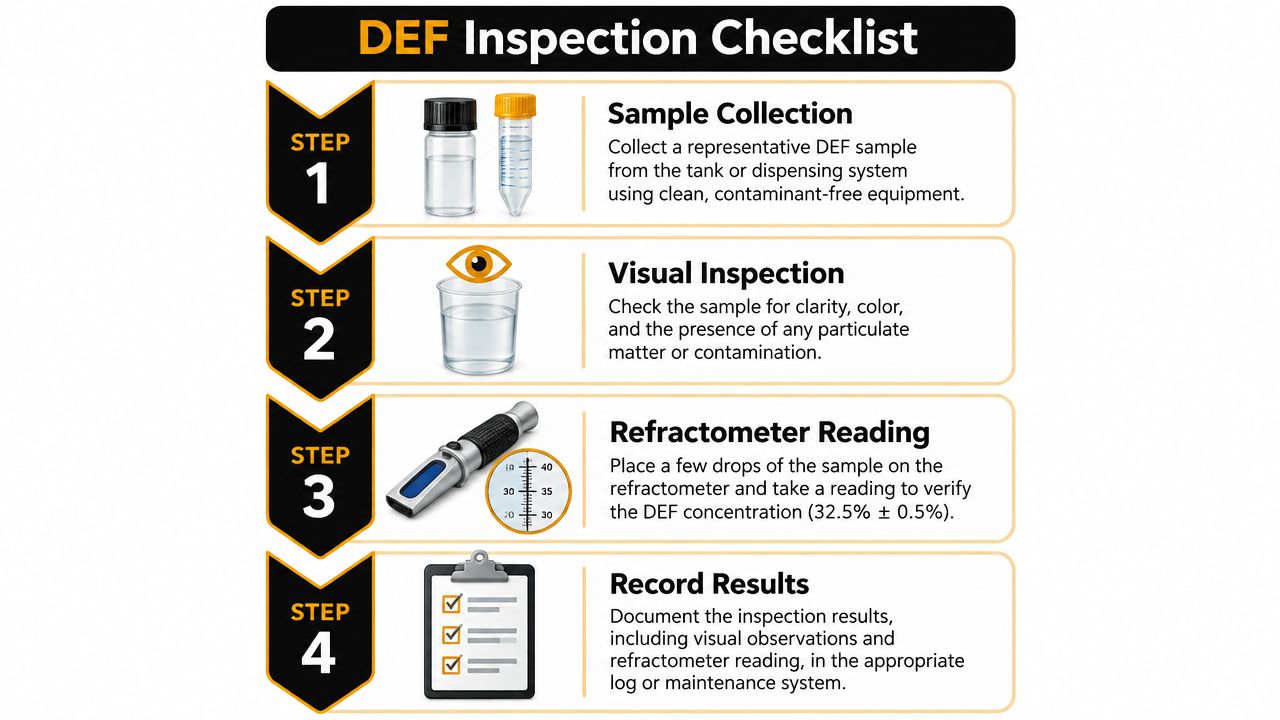
What happens after the sample is collected
A refractometer measures concentration. The technician compares the reading with the expected 32.5% target and the instrument's accepted tolerance. A normal result makes simple dilution less likely, but it does not prove that the fluid is free from every defect. Concentration testing is one check, not a complete diagnosis.
The vehicle and filler area provide the rest of the context:
- Dashboard warnings: An SCR, exhaust-fluid, or check-engine warning may involve fluid quality, a sensor, dosing, or the catalyst.
- DEF level information: A low-fluid warning or implausible gauge reading can point to a level sensor or another system fault.
- Cap and filler area: White, crusty deposits indicate that DEF has dried or crystallized after escaping or spilling.
- Lines and dosing hardware: Deposits near the injector or connections can interfere with delivery.
- Stored diagnostic codes: Scan data may identify a quality, pressure, sensor, or efficiency concern.
Practical rule: A clear-looking sample and a normal refractometer reading do not automatically explain an SCR warning.
The technician separates a fluid-quality concern from a vehicle-system problem. A cloudy sample or an out-of-range result may justify laboratory analysis instead of an immediate pass-or-fail conclusion. Laboratory evaluation can examine insoluble material, particle count, and mineral content, while field testing mainly checks concentration (Fluid Life's DEF analysis overview).
This distinction helps prevent unnecessary parts replacement. It also keeps a technician from calling contaminated or degraded DEF healthy because one optical reading appears normal. At the counter, concentration testing answers one narrow question. The inspection must still account for storage condition, contamination, warnings, and hardware operation.
Common Reasons Diesel Exhaust Fluid Fails Before a Smog Test
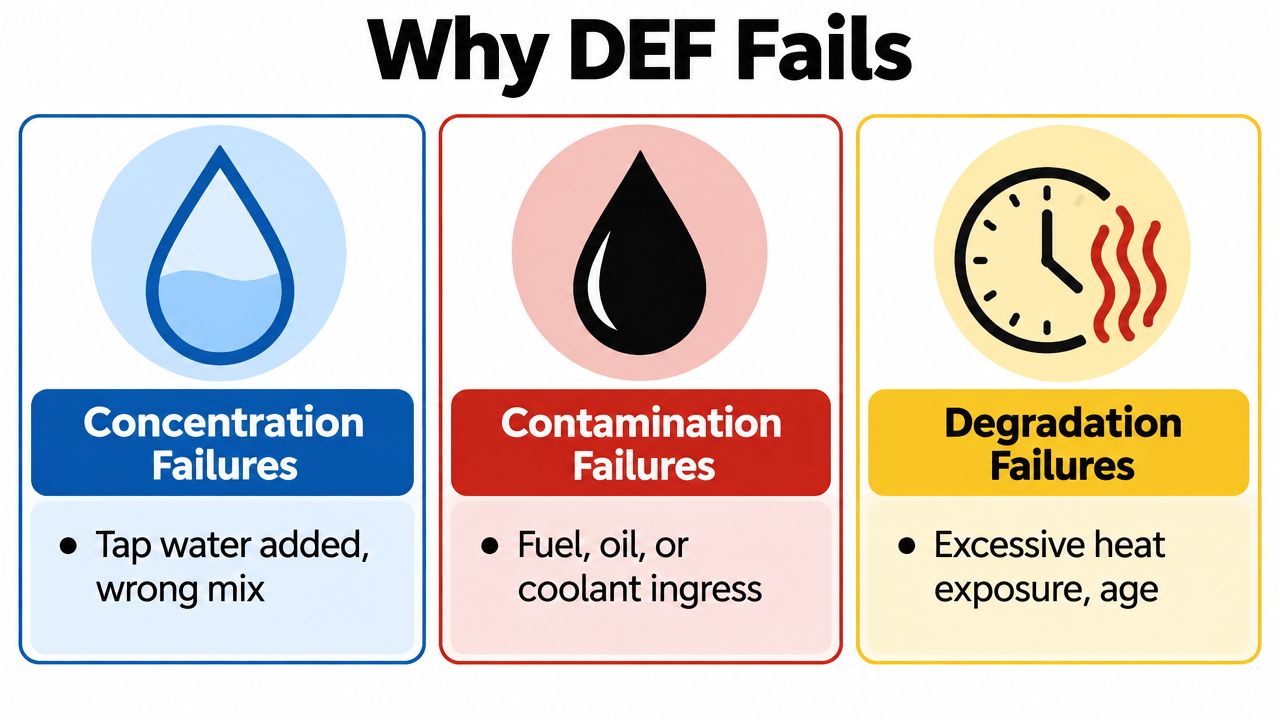
At a smog check counter, a DEF concern usually falls into concentration, contamination, or degradation. These categories can look similar, but each points to a different next step. A refractometer checks concentration, while contamination and age require a broader inspection.
Concentration problems
DEF concentration can change if the tank receives the wrong liquid, a product outside the required specification, or water. A sample may look clear and still fail the concentration test because appearance cannot show its chemical balance.
A common mistake is treating DEF like a fluid that can be diluted or adjusted at home. Never add tap water, coolant, fuel, or another product. If the mixture seems wrong, use fresh compliant DEF and have the tank checked. Guessing at the chemistry can turn a simple fluid issue into an SCR repair problem.
Contamination is a separate failure
Fuel contamination needs prompt attention because diesel fuel and DEF belong in separate reservoirs. Oil, coolant, dust, and metal particles can enter through an uncapped filler, a dirty container, damaged equipment, or an internal system problem.
Contamination can exist even when the concentration reading looks plausible. A technician therefore compares the refractometer result with the sample's appearance and the vehicle's symptoms. If contamination is confirmed, draining and replacing the fluid is safer than trying to dilute it. Water adjustment does not remove contaminants, and those materials can interfere with SCR dosing or catalyst performance.
A clear reading answers one narrow question. It does not prove that the fluid is clean.
Heat and age reduce confidence
Storage conditions affect how much trust a technician can place in DEF. Heat, time, and an unsuitable container can reduce fluid quality before a driver notices anything unusual. Check the product's date, storage history, and container condition alongside the test result.
An older container has not automatically failed. Its history matters, especially if it spent extended time in high heat or was left open to dust and moisture.
Crystallization adds another layer. Deposits may develop in the exhaust system or dosing hardware even when a tank sample appears acceptable. A satisfactory concentration result therefore cannot explain every SCR fault. At the counter, this distinction keeps a technician from treating a concentration pass as proof that the entire DEF system is healthy.
How Drivers Can Prepare for a Smog Test With a Diesel
A driver arrives for a smog check with no warning light, but the DEF tank was recently refilled from an unmarked container. That detail matters. Preparation starts with the dashboard and refill history, not just the fluid level.
Several days before the appointment
Check for an active exhaust-fluid warning, an SCR message, a check-engine light, or a speed-restriction notice. Watch the fluid gauge after refilling and note whether the level changes normally. These signs can point to a system problem that a routine appointment will not solve by itself.
Inspect the filler cap and the surrounding area for white deposits, dirt, cloudiness, or signs that another fluid entered the tank. If the level is low, add fresh DEF from a sealed container marked as meeting ISO 22241. Do not add water or mix in an unidentified product.
Keep the cap and filler area clean. Dust introduced during refilling can travel to the pump, filter, lines, or injector, much like grit carried through a small plumbing system.
Use this preparation list as a quick screen:
- Check the warnings: Address active DEF or SCR messages before relying on a routine smog appointment.
- Inspect the filler: Look for crystals, debris, cloudiness, or an unusual smell.
- Verify the product: Use sealed, properly identified DEF that meets the required specification.
- Review storage: Consider whether the fluid spent prolonged time in high heat or an unsuitable container.
- Ask about recent refills: Tell the technician what product you added and whether the tank was exposed to another fluid.
The day before testing
Drive normally rather than making only short starts and stops. After maintenance or a battery disconnect, normal driving gives the vehicle time to complete its own diagnostic checks. The goal is an accurate inspection, not a forced pass.
Leave diagnostic codes alone before the appointment. Clearing them can leave readiness checks incomplete and erase fault history that would help the technician identify the problem.
You can inspect the cap, confirm the product, and check the dashboard yourself. A shop should handle suspected contamination, unusual concentration readings, crystallized dosing hardware, persistent SCR codes, or any mistake involving diesel fuel or coolant.
Bring your registration and previous inspection paperwork if available. Keep the cap secured, and be ready to explain when you last added DEF and whether a warning appeared afterward.
Bringing It All Together Before You Head to the Shop
DEF condition is one part of a diesel emissions inspection. At the smog counter, the technician may also check OBD readiness, visible smoke, stored faults, and the emissions test required for that vehicle.
Keep three questions separate. Concentration testing asks whether the urea mixture is near the 32.5% target. The accepted measurement range is 32.5% plus or minus 1.5%, while the operational window for good-quality DEF is 31.8% to 33.2%. Contamination testing asks whether diesel fuel, coolant, dirt, or other unwanted material is present. A storage review asks whether heat, age, or an unsuitable container may have affected the fluid. These problems need different repairs, so an out-of-range reading should lead to diagnosis rather than guesswork.
Before booking, check the dashboard, inspect the filler area for crystals or debris, confirm the product, and consider how it was stored. An active SCR warning, suspected contamination, or persistent fault is a reason to arrange DEF diagnosis first. A STAR station can perform the required inspection, but the final result also depends on the vehicle's overall emissions condition and California's testing requirements.
Bring your registration and prior inspection paperwork if available. Tell the technician when you last added DEF and whether a warning appeared afterward.
Correct concentration helps, clean fluid matters, and good storage protects both.
Speedy Smog performs diesel emissions inspections in San Leandro and can check DEF-related status before the appointment. Visit Speedy Smog to schedule a compliant smog check or ask what to address before bringing in your diesel.