
DMV Smog Check Requirements: CA Rules
Your DMV renewal notice is on the kitchen counter, and one line has created an immediate question: “Smog Certification Required.” You may be wondering whether the car needs a test every year, whether a recent inspection still counts, or whether its hybrid, diesel, or electric powertrain changes the answer.
California's DMV smog check requirements depend on the event you're handling, not just the vehicle itself. Registration renewal, a change of ownership, and first-time registration in California can trigger different obligations. Model year, fuel type, vehicle weight, and the wording on your DMV notice all matter.
Table of Contents
- Decoding Your DMV Renewal Notice
- Navigating Exemptions by Transaction and Vehicle Age
- Understanding OBD and Tailpipe Testing Differences
- STAR Station Mandates and Readiness Monitor Prep
- Special Rules for Hybrids Diesels and Electric Vehicles
- Handling Test Failures and the BAR Referee Process
- Your Action Plan for a Smooth Smog Check Experience
Decoding Your DMV Renewal Notice
California doesn't generally require a smog inspection on a fixed annual calendar. The obligation is tied primarily to vehicle registration, and gasoline-powered, hybrid, and alternative-fuel vehicles from model year 1976 onward generally need testing every other year when the DMV renewal notice says certification is required, according to the California Bureau of Automotive Repair's Smog Check guidance.
Start with the notice itself. Look for language such as:
- “Smog Certification Required” means you can generally use an authorized Smog Check station.
- “Smog Certification Required at a STAR station” means the vehicle must be inspected at a STAR-certified location.
- No smog certification instruction usually means the renewal doesn't currently require a test, although you should still follow any other DMV directions.
The notice is more reliable than guessing from the car's age or from the date of its last inspection. California may require a test for a renewal, a sale, or a first California registration even when the vehicle passed an inspection for a different transaction.
Practical rule: Read the DMV notice before booking an appointment. It tells you whether a test is required and whether the station must have STAR certification.
A registration renewal test is normally required biennially, or every other year, rather than annually. The DMV can't finalize a renewal when required smog certification is missing, even if you've already paid the registration fees, as explained in the DMV registration renewal instructions.
If the notice requires testing, use a service such as Smog Check registration renewal assistance to understand the process, then choose a station that matches the notice. Bring the vehicle, the notice if available, and any relevant repair information. Handling the inspection before the renewal deadline gives you time to respond if the vehicle needs repairs or the DMV record needs attention.
Navigating Exemptions by Transaction and Vehicle Age
The phrase “new car exemption” causes many California drivers trouble because it can describe different rules for different DMV events. A vehicle that avoids a biennial renewal inspection may still face a different requirement during a sale or first California registration.
For renewal, gasoline, hybrid, and alternative-fuel vehicles that are eight model years old or newer generally don't need the biennial inspection. The owner instead pays a smog abatement fee, subject to DMV eligibility rules. California gives a separate transfer rule to vehicles four model years old or newer, which can generally avoid the change-of-ownership inspection through the applicable smog-related fee.
Those exemptions don't automatically apply to every transaction. An out-of-state vehicle being registered in California for the first time generally needs a California Smog Check if it falls within the covered model-year and fuel categories. A recent inspection completed for another state or another DMV event shouldn't be treated as a universal exemption.
California Smog Check Exemption Matrix
| DMV Transaction Type | Vehicle Age / Model Year | Smog Check Required? |
|---|---|---|
| Registration renewal | Gasoline, hybrid, or alternative-fuel vehicle eight model years old or newer | Generally no biennial inspection, but a smog abatement fee may apply |
| Registration renewal | Covered gasoline, hybrid, or alternative-fuel vehicle beyond the newer-vehicle renewal exemption | Generally yes when the DMV notice identifies certification as required |
| Change of ownership | Vehicle four model years old or newer | Generally no transfer inspection, with the applicable smog-related fee |
| Change of ownership | Covered vehicle older than the transfer exemption | Generally yes, unless another exemption applies |
| First California registration | Covered out-of-state vehicle | Generally yes |
| Any transaction | Fully electric vehicle | Exempt |
| Any transaction | Gasoline vehicle from model year 1975 or older | Exempt |
| Any transaction | Diesel vehicle from model year 1997 or older | Generally exempt |
| Any transaction | Diesel vehicle above 14,000 pounds GVWR | Exempt from the standard requirement described here |
The most useful question isn't “Is my car exempt?” Ask instead: What DMV event am I completing, what is the model year, what fuel does it use, and what does the notice say? That four-part check prevents owners from applying a renewal exemption to a transfer or assuming an older out-of-state inspection will satisfy California registration.
If your situation involves an unusual transfer or exemption, review the DMV smog exemption form information before making an appointment. Keep your registration documents available, because the correct answer can depend on the transaction being processed rather than on the vehicle alone.
Understanding OBD and Tailpipe Testing Differences
Two vehicles can visit the same station and receive very different inspections. California chooses the testing method based on the vehicle's configuration, including its model year, fuel type, weight, and whether it has OBD II, the onboard diagnostic system used to monitor emissions equipment.
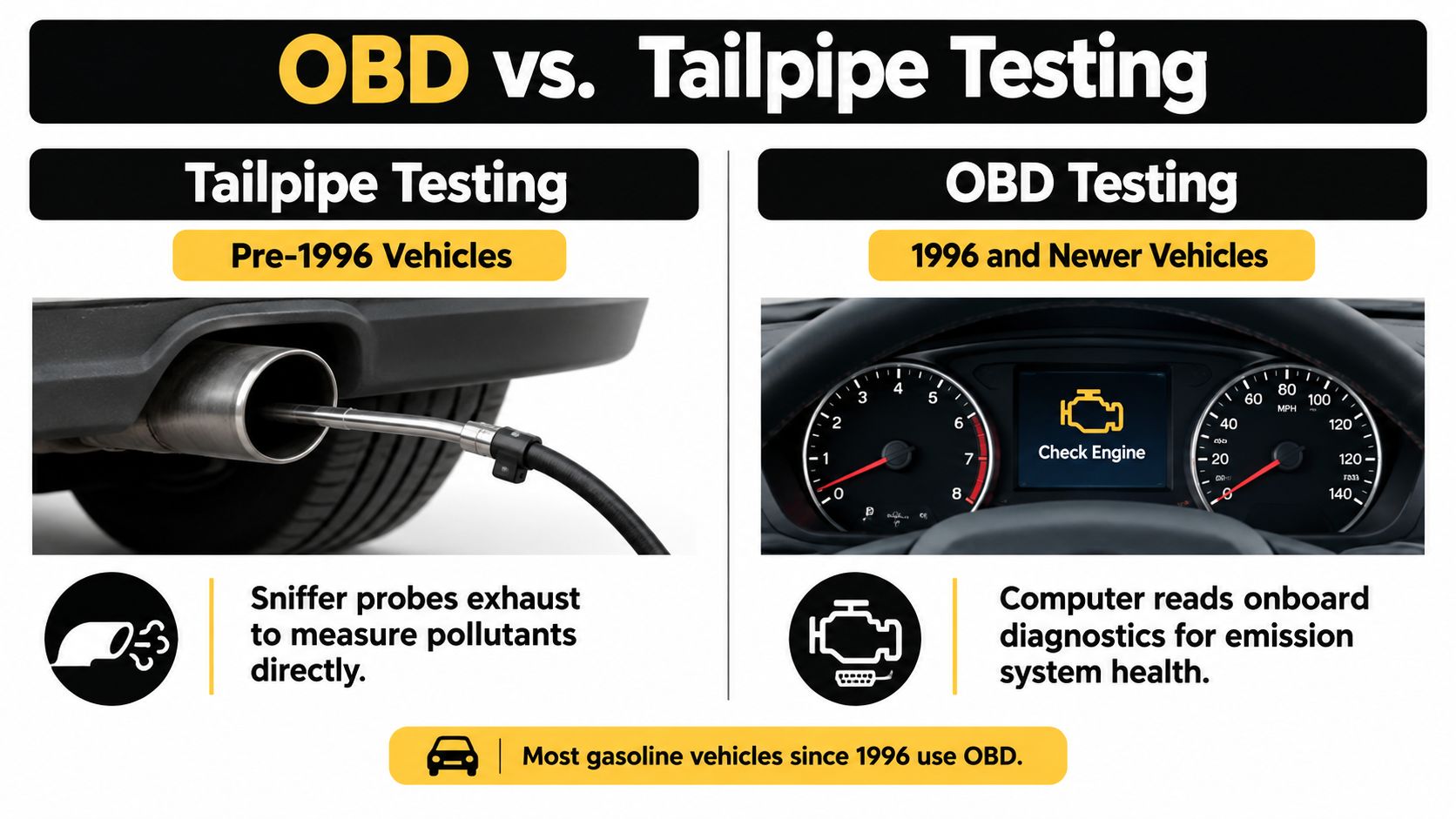
Most gasoline and hybrid vehicles from 2000 and newer, with a GVWR of 14,000 pounds or less and equipped with OBD II, are generally inspected through BAR-OIS. The technician connects approved equipment to the vehicle and electronically evaluates diagnostic information, emissions-related fault codes, readiness monitors, and required vehicle details. The process focuses on what the vehicle's computer reports about the health of its emissions systems.
Gasoline vehicles from 1976 through 1999, heavier gasoline vehicles, and qualifying vehicles without OBD II are generally tested with BAR-97. Instead of relying primarily on onboard computer data, this method measures pollutants directly from the exhaust through a tailpipe test. The BAR Smog Check executive summary describes the distinction between BAR-OIS electronic evaluation and BAR-97 tailpipe measurement.
The difference matters when you prepare:
- OBD-equipped vehicles: Diagnostic trouble codes and incomplete readiness monitors can affect the result, even when the dashboard warning light is currently off.
- Older vehicles: Emissions performance is assessed through measured exhaust, so engine condition, fuel delivery, ignition, and emissions components play a direct role.
- Both types: The inspector must use the procedure that matches the vehicle's configuration. You shouldn't assume a newer vehicle receives a tailpipe test because it has an exhaust system.
For a clearer explanation of how the terms relate, compare Smog Check and smog test terminology before arriving at the station.
STAR Station Mandates and Readiness Monitor Prep
A DMV notice that names a STAR station changes where you can test. STAR is California's standards-based program for vehicles assigned to higher-performing inspection locations. The DMV distinguishes between a notice that says certification is required at any authorized station and one that specifically directs the owner to a STAR-certified station.
Check the exact wording before you leave home. If the notice says “Smog Certification Required at a STAR station,” a regular licensed station isn't enough for that transaction. If it says only “Smog Certification Required,” you can generally choose an authorized Smog Check station.
Prepare the vehicle's diagnostic system
Readiness monitors are internal checks that help the vehicle confirm whether its emissions systems have completed their self-tests. A dead battery, battery replacement, or recent code clearing can erase this stored readiness information. The car may start normally and show no illuminated check-engine light, yet the inspection can still identify the monitors as incomplete.
Avoid disconnecting the battery or clearing codes immediately before testing. If a repair shop has recently erased diagnostic trouble codes, ask whether the vehicle has completed the required driving conditions for its monitors to run. The exact driving pattern varies by vehicle, so consult the owner's manual or a qualified repair professional rather than relying on a universal mileage claim.
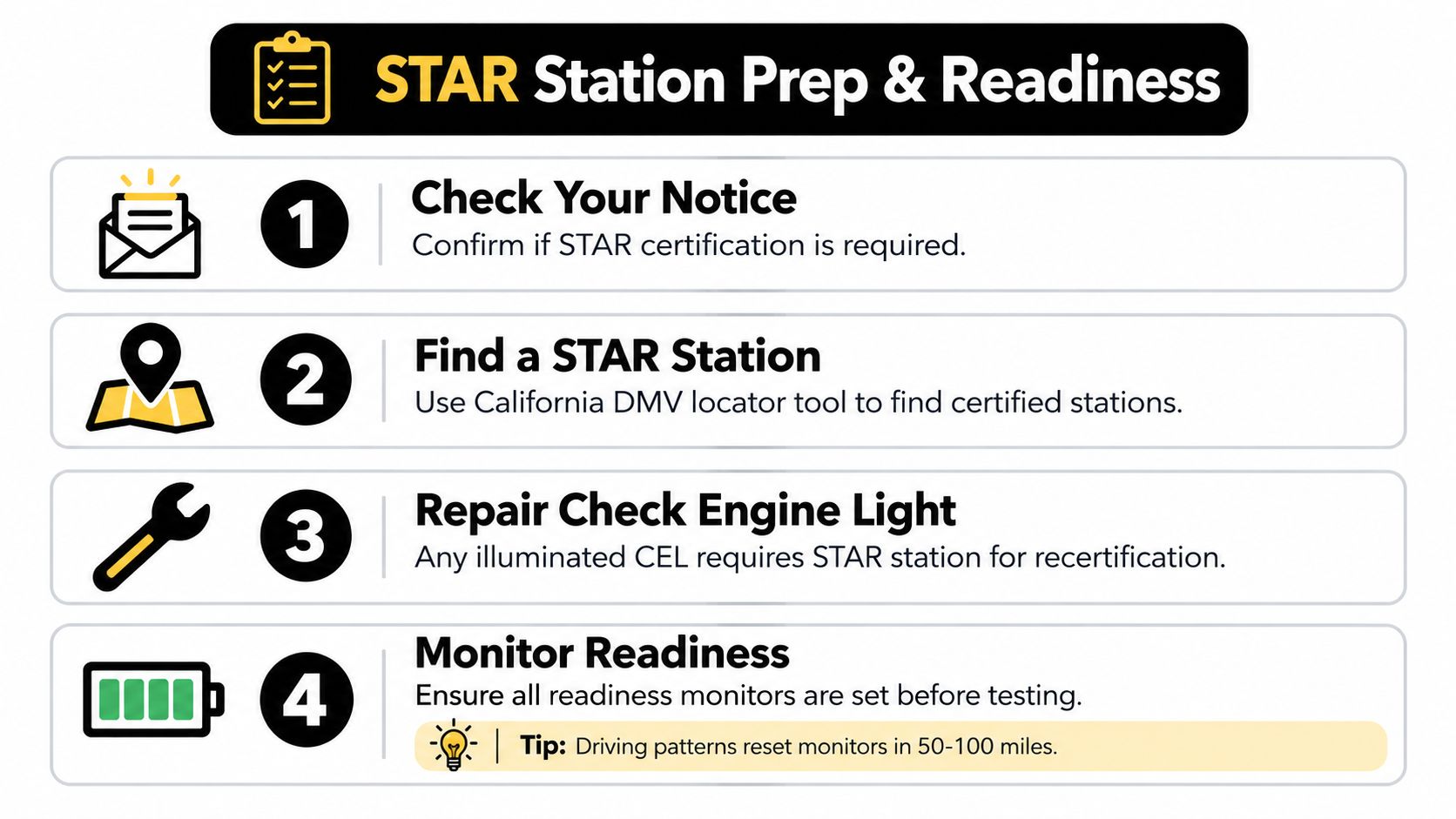
A practical preparation sequence looks like this:
- Read the notice. Confirm whether the DMV requires a STAR station.
- Check the warning light. An illuminated emissions warning lamp needs diagnosis before testing.
- Ask about readiness. If the battery was disconnected or codes were cleared, verify that the monitors have had time to complete.
- Bring the paperwork. Keep the DMV notice and any recent repair documents with you.
California also requires the engine to reach normal operating temperature, and the Smog Check procedure specifies at least three minutes of continuous low-idle operation immediately before the tailpipe test for applicable vehicles. Arriving prepared helps the technician perform a valid inspection instead of encountering a preventable readiness or temperature issue.
Special Rules for Hybrids Diesels and Electric Vehicles
A hybrid owner often asks whether the gasoline engine changes the answer. In California, hybrids generally follow the same broad Smog Check framework as covered gasoline vehicles. Their onboard diagnostic systems can be evaluated electronically when the vehicle meets the applicable BAR-OIS configuration, so the hybrid label alone doesn't create a blanket exemption.
Consider a hybrid during registration renewal. The owner should read the DMV notice, confirm the transaction, and determine whether the vehicle falls within the newer-vehicle renewal exemption. If the notice requires certification, the hybrid needs an inspection at the station type named by the DMV.
Diesel owners need a different decision path. Diesel vehicles from model year 1998 onward and with a GVWR of 14,000 pounds or less generally require testing. The BAR consumer FAQ identifies diesel rules as materially different from the newer-vehicle exemption available to many gasoline and hybrid vehicles.
Three powertrain examples
- Hybrid: Treat it as a covered vehicle unless the DMV notice and applicable exemption rules say otherwise. Its testing method depends on its configuration.
- Diesel: Check both model year and GVWR. A newer diesel may require testing even when a similarly aged gasoline vehicle could use a renewal exemption.
- Fully electric: A battery-electric vehicle is exempt from California's Smog Check requirement because it has no gasoline or diesel emissions system to inspect.
Fuel type is only part of the diesel decision. Weight matters because the standard rule described here applies to diesel vehicles at or below the relevant GVWR threshold, while heavier diesel vehicles are treated differently. If you're unsure, locate the GVWR on the vehicle label or manufacturer documentation and compare it with the DMV notice.
Don't use another owner's experience as your guide. Two vehicles registered in the same household can receive different instructions because one is a hybrid, one is diesel, or one is fully electric.
Handling Test Failures and the BAR Referee Process
A failed inspection gives you information, not an automatic dead end. First, ask for the Vehicle Inspection Report, or VIR, and read the specific reason for the result. The report helps separate an emissions failure from an incomplete-readiness issue, missing information, or another inspection condition.
Use this order of operations:
- Review the VIR. Identify the failed area and ask the technician to explain any unfamiliar code or monitor status.
- Confirm the transaction deadline. A renewal can remain incomplete while required certification is missing.
- Diagnose before replacing parts. A warning light or emissions code identifies a system that needs attention, but it doesn't automatically identify one specific failed component.
- Repair the cause. Use a qualified repair professional when the issue requires specialized diagnostic equipment or emissions-system knowledge.
- Return for the appropriate inspection. If the first result involved incomplete monitors, verify that the vehicle is ready before retesting.
A car that has recently lost battery power may produce a “not ready” result rather than a conventional pollutant failure. That distinction matters because clearing codes again can restart the readiness process and delay a valid inspection.
The DMV directs owners with Smog Check failures toward the Bureau of Automotive Repair Referee Program when additional help is needed. The Referee can be relevant for complex cases, disputed situations, or vehicles that need a state-level review of their emissions compliance. Ask the station or consult BAR guidance about whether your circumstances fit the program before scheduling.
A failed test should lead to a documented diagnosis. Replacing parts at random can add cost without resolving the condition that caused the result.
Keep the VIR, repair invoices, and any follow-up test documentation together. Those records give the repair shop and, when appropriate, the BAR Referee a clear timeline of what the vehicle reported and what work was performed.
Your Action Plan for a Smooth Smog Check Experience
You open your DMV notice and just want one clear answer. Start with the transaction on that notice, because a renewal, a transfer, and a first California registration can trigger different smog obligations even for similar vehicles. Then check the vehicle type. A hybrid often follows gasoline-based rules, a diesel follows its own year and weight rules, and a fully electric vehicle is exempt.
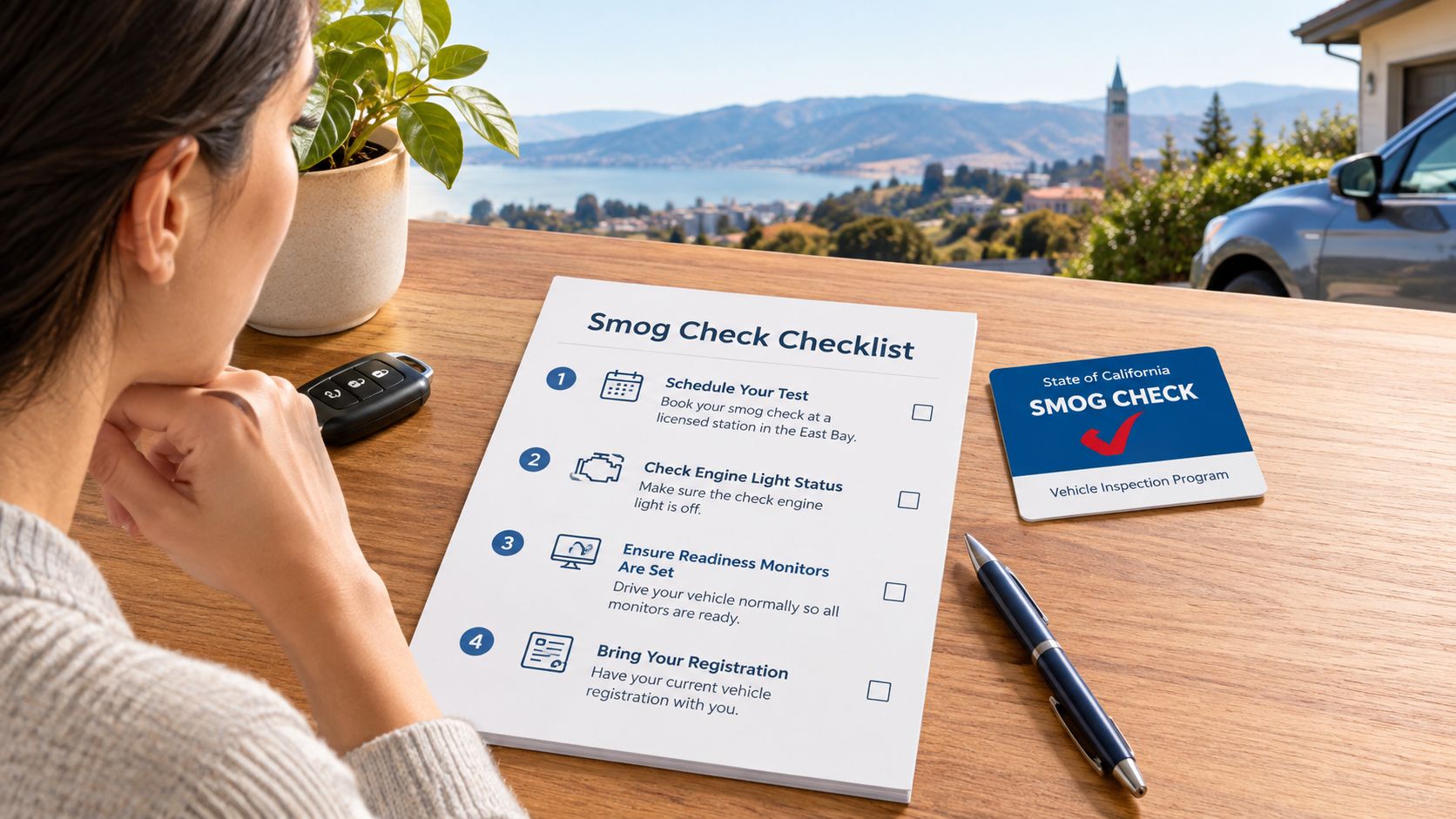
Use this quick check
- Renewal: Read the notice to confirm whether biennial certification is required.
- Ownership transfer: A recent renewal inspection may not satisfy the transfer requirement.
- New California registration: An out-of-state vehicle that is covered usually needs a California inspection unless a specific exemption applies.
- Hybrid: Apply the gasoline and vehicle-configuration rules, then follow the notice.
- Diesel: Check model year and GVWR separately. Diesel exemptions differ from gasoline exemptions.
- Electric: Fully electric vehicles are exempt from Smog Check.
- STAR instruction: Use a STAR-certified station if the notice requires one.
- OBD preparation: Do not clear codes or disconnect the battery right before testing.
- Failed result: Keep the VIR, get a targeted diagnosis, and contact BAR resources if the case may need Referee help.
That order matters. The notice tells you what DMV needs, and the powertrain tells you which smog rules apply to the vehicle in front of you. If you skip either step, you can end up at the wrong station or arrive before the car is ready to test.
For East Bay drivers, Speedy Smog in San Leandro is one local option. It is a STAR-certified station at 15275 Washington Ave, San Leandro, and it performs inspections for many gasoline, hybrid, older, and diesel vehicles, with results transmitted electronically for DMV registration processing. Its published service information also describes a comfortable indoor waiting area and typical testing for many newer vehicles in about 10 to 15 minutes.
Visit Speedy Smog with your DMV notice so the team can confirm whether your vehicle needs a standard or STAR inspection and help you address the correct registration requirement. The San Leandro station provides Smog Checks for newer vehicles, older cars, diesels, and hybrids, giving East Bay drivers a practical place to complete certification before renewal or transfer paperwork.