DMV Smog Certificate: How to Get It and Pass
A passed smog check remains valid for 90 days, and the certificate is sent electronically to the DMV, so you generally don't carry paperwork to the registration counter. For 2000-and-newer vehicles, about 7% failed their initial check in California's 2024–2025 cycle, which makes preparation worthwhile rather than optional.
You're probably looking at a renewal notice, a recently purchased car, or a dashboard light that appeared at the worst possible time. The practical question is simple: how do you get a DMV smog certificate, and what should you do if the car doesn't pass?
California's system connects the inspection directly to registration. The licensed station records the result, the Bureau of Automotive Repair processes the inspection data, and the DMV uses the passing result to clear the registration requirement. That electronic path is convenient, but it also means a failed test can stop renewal until you resolve the underlying issue.
Table of Contents
- What a DMV Smog Certificate Actually Is
- Where to Get Your Smog Check Done
- How the Smog Test Works for Different Vehicles
- What Happens After You Pass
- What to Do If You Fail a Smog Check
- How to Improve Your Chances of Passing
What a DMV Smog Certificate Actually Is
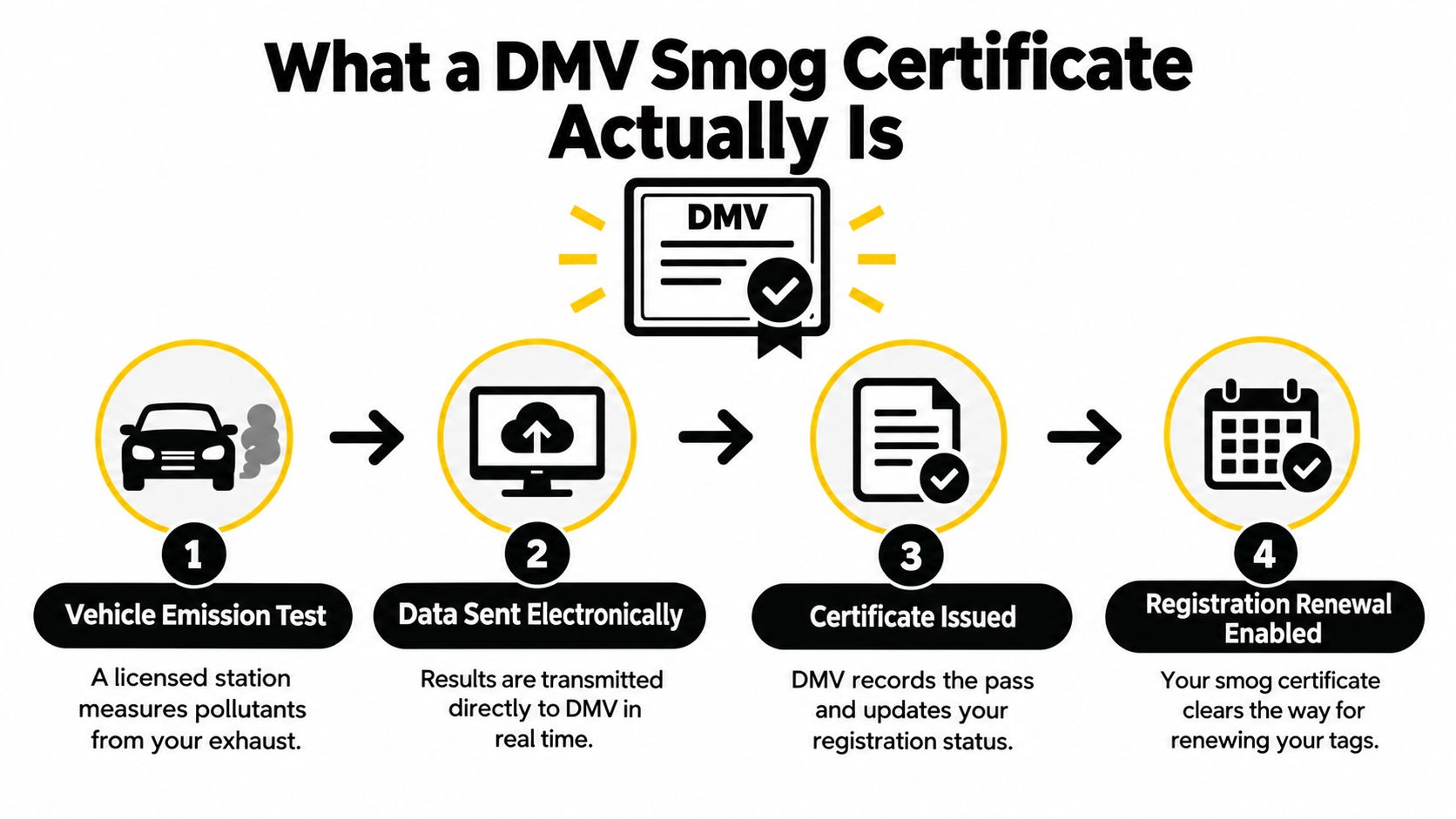
Your renewal notice is on the counter, the deadline is close, and you are checking whether a paper certificate must go to the DMV. Usually, it does not. California requires a Smog Check for many registration renewals, and the licensed station submits the result electronically after testing. The California Bureau of Automotive Repair's Smog Check guidance explains the certificate and reporting process.
The electronic result becomes part of your DMV record. A passing inspection satisfies the emissions requirement attached to that registration transaction, while a failure leaves no passing result for the DMV to apply. You then have to address the diagnostic work, repairs, and retest before the renewal can clear.
Why the certificate matters
The certificate is a state-recorded inspection outcome, not a form a driver can type up or replace with a repair invoice. The station must enter the vehicle and test information correctly, and the state system must accept the passing result before it can support the DMV transaction.
California's program has operated through a large network for decades. An OECD and International Transport Forum presentation on California Smog Check describes the program's history, vehicle coverage, inspections, stations, and inspection personnel. That scale is why electronic reporting matters: the DMV relies on a standardized record rather than documents handled individually at each renewal.
Practical rule: After the station confirms a pass, check that the result has been transmitted before leaving if your registration deadline is tight. Keep the invoice and test paperwork for your records, but do not assume either document can replace the electronic DMV record.
A failed result also creates a repair decision. Ask the shop to identify the failure component, separate required repairs from maintenance suggestions, and provide an estimate before authorizing work. If qualifying repairs become expensive, ask whether a state repair-cost waiver could apply. A waiver is not automatic, and it does not erase the failed test, but checking the option can prevent paying for repairs that do not make financial sense.
For a second explanation of how the result is checked, review this smog check verification information. The working sequence is simple: the station performs and records the inspection, the result moves through the state system, and the DMV uses the accepted passing record for the registration requirement.
Where to Get Your Smog Check Done
If your DMV notice names a STAR station, do not book at the nearest shop and hope it qualifies. Confirm the station's STAR certification on the California BAR website before making an appointment. A regular renewal may allow more station choices, while a STAR-directed notice can require that specific inspection category.
STAR stations participate in California's performance-based inspection network. The designation matters when the DMV requires a STAR inspection, and it can also indicate that the shop regularly handles electronically reported certification work. Certification alone does not guarantee a pass, so confirm that the station can test your vehicle before you arrive.
A simple booking checklist
Ask these questions while scheduling:
- Station type: Is the shop STAR certified, and does that status match the wording on your DMV notice?
- Vehicle details: Can it test your fuel type, model year, and configuration? Mention if the vehicle is a hybrid, diesel, modified, unusually old, or recently repaired.
- Registration purpose: Are you completing a routine renewal, transferring ownership, or responding to a directed notice? The answer can affect which station you need.
- Retest policy: If the vehicle fails, is a retest available, and what conditions apply after repairs?
- Price and timing: What is the total inspection price, and how long should the appointment take?
Use the BAR station listing to verify certification instead of relying only on a sign, search result, or verbal assurance. Ask the shop to confirm the station type when the notice is unclear.
Station experience and appointment availability vary by location. A properly certified shop may process a routine inspection efficiently, but older vehicles, diesels, modified cars, and vehicles with recent repairs often require more discussion before testing. This guide to finding a place to get your car emissions tested can help you organize those local questions.
Here's the video placement for drivers who want to see the basic process before booking:
Bring the vehicle in normal operating condition. Do not arrive immediately after clearing a warning light or disconnecting the battery, and tell the technician about recent work. If a repair has left the emissions monitors incomplete, the station may not be able to issue a passing certificate. Ask about the likely repair path and waiver eligibility before approving expensive work, since a costly repair does not automatically mean the waiver requirements are met.
How the Smog Test Works for Different Vehicles
A car that runs smoothly can still fail its smog inspection. The test method depends on the vehicle's age, fuel system, and emissions equipment. For many 2000-and-newer gasoline vehicles, the station performs an OBDII inspection. The technician connects a scan tool, confirms communication, checks readiness monitors, and looks for emissions-related trouble codes or an active malfunction indicator lamp.
Older vehicles follow a different process. A 1999-and-older vehicle may undergo BAR-97 testing, which measures tailpipe emissions and checks emissions-control equipment. A vehicle can drive normally while failing because its monitors are incomplete, its emissions exceed the limit, or required hardware is missing.
Newer vehicles and OBDII readiness
Battery replacement, clearing diagnostic codes, or recent emissions repairs can reset readiness monitors. The vehicle then needs normal driving under varied conditions before the monitors complete. Arriving too soon can prevent the station from issuing a passing certificate, even when the warning light stays off.
Communication problems can stop the inspection before emissions performance is evaluated. An active warning light, stored emissions codes, or a scan tool that cannot communicate with the vehicle all require attention.
The BAR's January 2026 performance report placed OBDII-related failures near 6.8% at OIS stations and about 9.3% at BAR-97 stations. Across approximately 19 million 2000-and-newer vehicles, the broader 2024–2025 initial failure rate was roughly 7%, according to the BAR Smog Check performance report.
| Station Type | Failure Rate Context |
|---|---|
| OIS stations | OBDII-related failures near 6.8% |
| BAR-97 stations | OBDII-related failures about 9.3% |
| 2000-and-newer vehicles statewide | Overall initial failure rate about 7% |
Older vehicles and tailpipe testing
Before testing an older vehicle, inspect visible emissions hardware, vacuum lines, hoses, the catalytic converter area, and related controls. A missing component, obvious leak, or altered system will not be fixed by extra highway driving.
Repair cost deserves a separate decision. If a failure points to expensive work, ask the station or repair shop which repairs are required and whether a repair-cost waiver could apply before authorizing the job. Paying for a repair that does not satisfy waiver rules can still leave the registration unresolved.
Hybrid owners should confirm the vehicle's requirements and choose a station familiar with the procedure. This hybrid smog check service information explains why hybrid testing may require different handling. The technician should understand the vehicle's limited engine runtime and identify unusual conditions before starting.
What Happens After You Pass
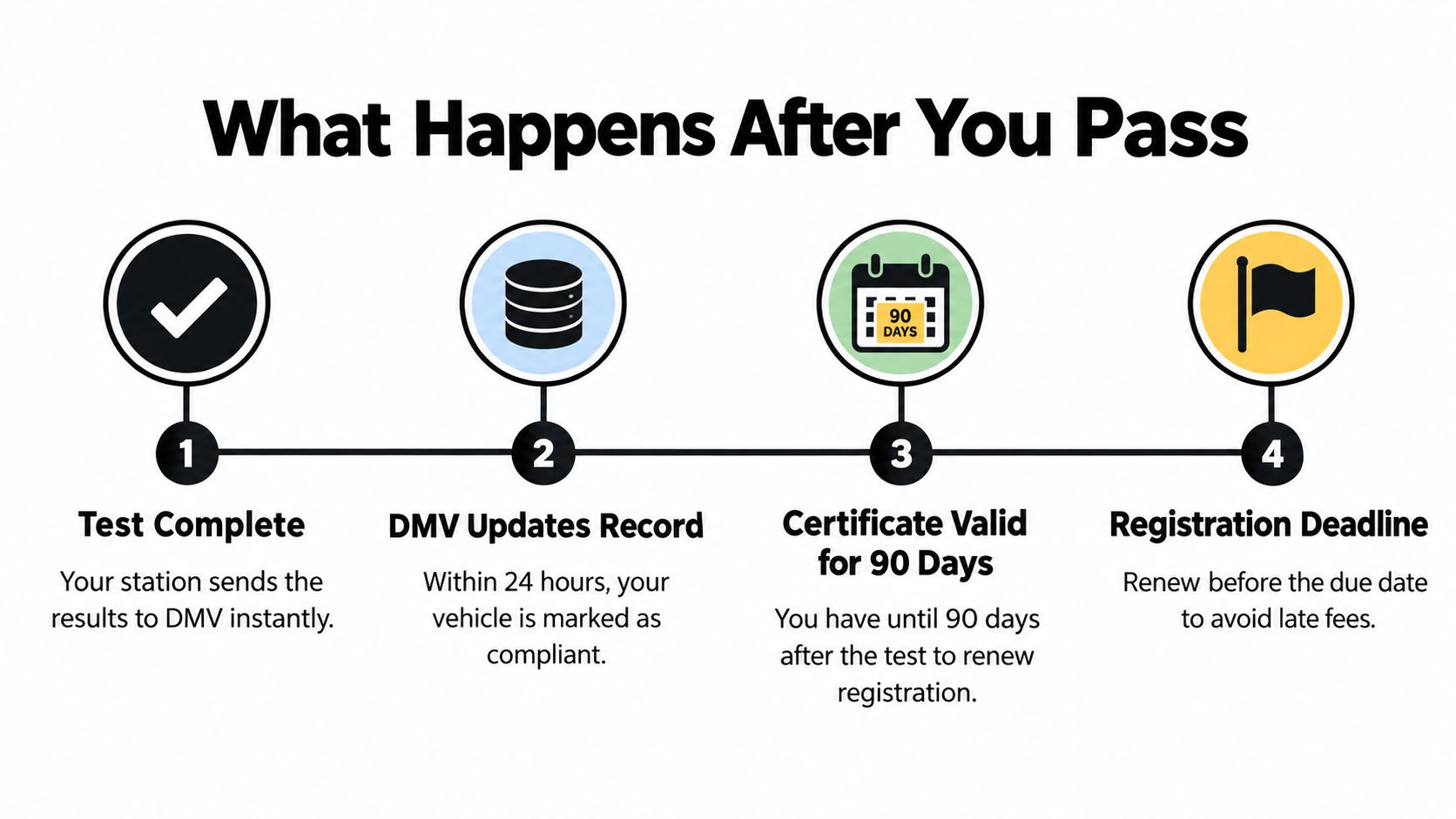
You leave the station with a passing result, but the registration task still needs to be completed. The station normally sends the result electronically to the DMV, so you generally do not have to mail or hand-deliver a paper certificate. Confirm that the renewal, transfer, or other registration action is finished while the result remains valid.
The 90-day validity period limits how long you can use the passing result for the applicable DMV transaction.
Confirm the electronic record
Use this sequence after the inspection:
- Confirm the pass: Ask the technician to verify that the result was recorded as passing.
- Check the DMV record: Allow time for the electronic submission, then review your online renewal or registration status. If the result does not appear, contact the station before assuming the test was rejected.
- Finish the transaction: Submit any remaining fees, forms, insurance information, title documents, or transfer details required for your situation.
- Keep your paperwork: Retain the inspection receipt and DMV confirmation. For a transfer or dealer purchase, keep the smog receipt with the purchase and title records until the transaction is complete.
The electronic record should connect the passing inspection to the vehicle and the relevant DMV transaction. A handwritten note or an altered paper document does not replace that accepted record. If the DMV system shows no passing result, ask the station to verify the vehicle identification and submission details.
Transfer transactions deserve extra attention. A valid pass does not resolve separate title, fee, insurance, or ownership requirements. Ask the seller or dealer what remains outstanding, and confirm which party is responsible for completing the DMV filing.
A repair shop or seller may tell you that a passing result settles everything. It does not. If the record is missing or the transaction is stalled, request a clear explanation before paying additional fees or allowing the validity window to close.
A passing test helps only after the DMV receives it and the registration task is completed.
Schedule the inspection with enough time to correct a data mismatch or handle another DMV requirement. Keep the receipt even when the submission is electronic, especially for ownership transfers where proof of the inspection date and result may be requested. For program rules and electronic certificate guidance, consult the official Smog Check program information.
What to Do If You Fail a Smog Check
A failed smog test does not authorize a repair bill. Start with the failure report and identify the specific reason for the denial. An emissions code, incomplete readiness monitor, communication error, visible equipment problem, and high tailpipe emissions each require a different fix. The failure result also helps you decide whether to repair, seek a waiver, or stop spending on the vehicle.
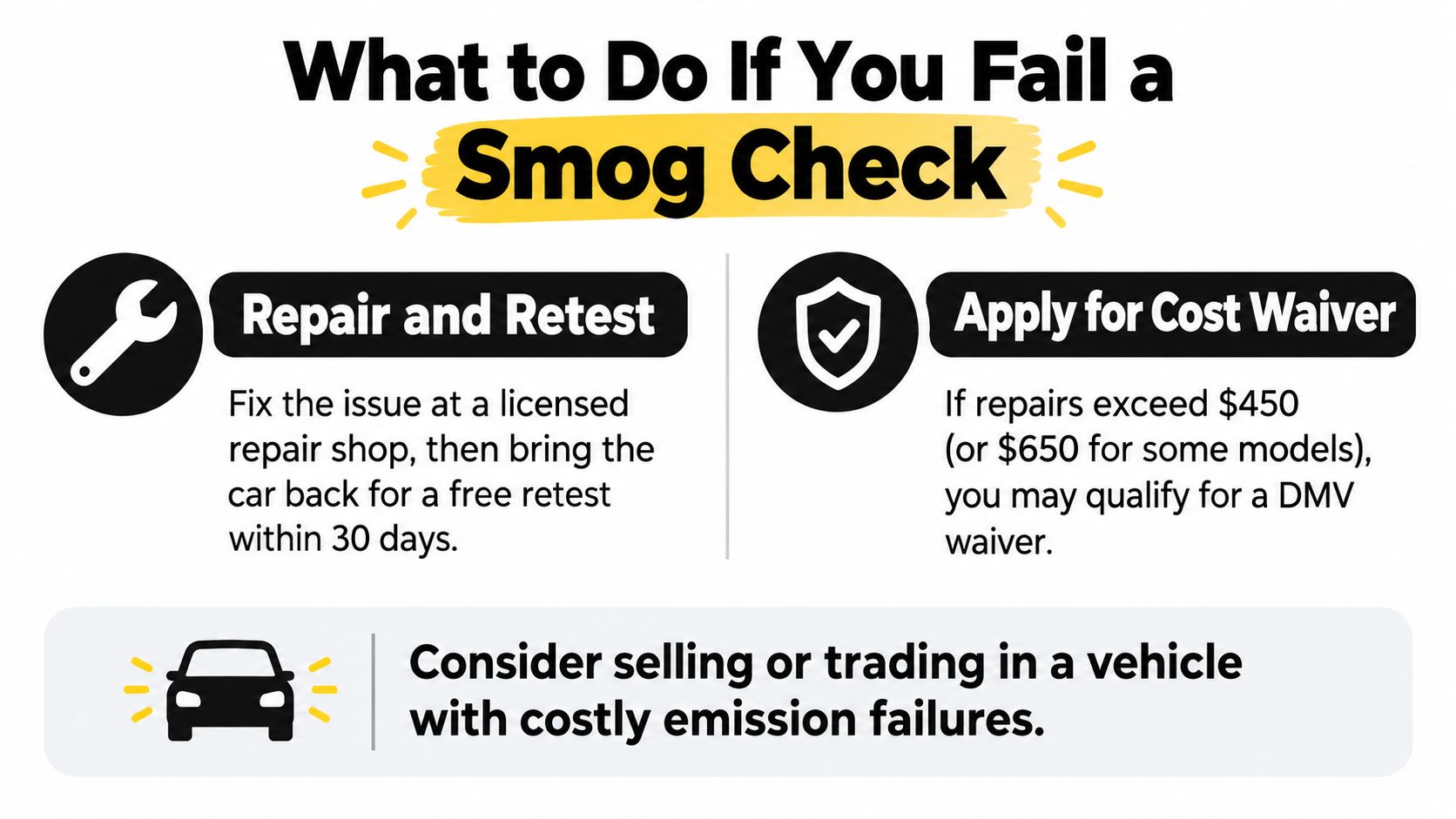
Diagnose before authorizing repairs
Ask the technician to explain the failure in plain language. If the recommended work is expensive, request the diagnostic basis in writing and get a second opinion from a shop that regularly handles emissions faults. Parts-swapping can add cost without correcting the recorded problem.
Use this order:
- Read the failure details: Separate an incomplete monitor from an emissions-output failure or equipment violation.
- Check recent work: A disconnected battery or cleared code may explain incomplete monitors.
- Verify the diagnosis: Confirm that the proposed repair addresses the exact failure recorded by the station.
- Assess the vehicle as a whole: A major emissions repair may be reasonable for a dependable car, but difficult to justify when the vehicle has several unrelated problems.
- Plan the retest: Confirm with the repair shop and testing station what must happen before paying for another inspection.
Failure rates vary by vehicle condition, maintenance history, emissions system, and inspection type. A failed result alone does not prove that every recommended repair is necessary. Ask what test evidence supports the estimate and whether another fault could produce the same symptom.
When a waiver may make sense
California's repair-cost waiver is a limited alternative when the required work no longer makes financial sense. The BAR Smog Check Reference Guide states that the waiver can postpone the DMV smog certificate requirement for up to two years. Eligibility requires at least $650 in repairs, and the process must be handled through a Referee facility.
The limits matter. A waiver does not cover a tampered emissions system, and repeated waivers under the same ownership can disqualify the vehicle. Reaching the repair threshold does not guarantee approval. Keep invoices, diagnostic records, and proof of qualifying work, then ask the Referee facility to determine eligibility.
Before approving a large repair: Ask whether the work addresses the recorded failure, whether the vehicle can be retested afterward, and whether a Referee waiver is realistic.
Selling or trading may be reasonable after comparing the estimate with the vehicle's condition and registration consequences. Disclose the failed result to any buyer. Do not approve costly work under pressure when the diagnosis is unclear or the waiver route has not been checked.
How to Improve Your Chances of Passing
The most effective preparation starts with the inspection type, not a generic “drive it hard” routine. Confirm whether the vehicle will receive an OBDII-based inspection or an older BAR-97-style evaluation, then prepare for the checks that control the result.
For a newer vehicle, scan for trouble codes and readiness status before the appointment. If the battery was disconnected or a repair recently cleared codes, allow the monitors to complete through normal driving. Don't clear the codes again just before testing. That can erase useful diagnostic information and leave the monitors incomplete.
For an older vehicle, look at the physical emissions system first. Check for disconnected vacuum hoses, damaged wiring, missing emissions components, exhaust leaks, and obvious modifications. A visual problem can fail the vehicle even when it appears to drive normally.
Use this short pre-test list:
- Warning lights: Resolve an active check-engine light before booking.
- Recent repairs: Tell the station what was repaired and whether the battery was disconnected.
- Maintenance records: Bring invoices or diagnostic notes if the vehicle has a recurring emissions issue.
- Vehicle eligibility: Verify the correct rules for hybrids, diesels, older cars, and modified vehicles.
- Station capability: Confirm that the location is certified for your vehicle and registration requirement.
- Timing: Leave enough room for diagnosis or a retest before the DMV deadline.
The statewide data supports a practical expectation. Most newer vehicles pass, but roughly 1.3 million of about 19 million tested 2000-and-newer vehicles failed during the 2024–2025 cycle, according to the BAR Smog Check data. Preparation won't guarantee a pass, but it helps you avoid preventable denials and makes a real failure easier to diagnose.
If you're in San Leandro or the East Bay, Speedy Smog offers STAR Certified inspections with electronic submission of passing results to the DMV. Contact the station before arriving to confirm it can handle your vehicle type, inspection requirement, and registration timing.