
Do Diesel Cars Need Emissions Test? a 2026 Guide
Most diesel cars and light-duty diesel trucks in California from model year 1998 and newer do need a smog check every two years for registration renewal. The test is different from a traditional gasoline tailpipe test, and diesel vehicles from 1997 and older are generally exempt from that standard program.
You may be asking this while looking at a DMV renewal notice, standing beside a diesel pickup, or trying to decide whether a trip to a San Leandro smog station is necessary. The confusion is understandable. California doesn't decide the answer by fuel type alone. Model year, gross vehicle weight rating, registration category, and the inspection program that applies to the vehicle all matter.
A newer diesel may need an emissions-related inspection even though the technician doesn't place the familiar gasoline-style probe into the tailpipe. A heavier truck may avoid the ordinary biennial smog program yet still face separate California Air Resources Board compliance requirements. The useful question isn't, “Is it diesel?” It's, “Which California testing pathway applies to this vehicle?”
Table of Contents
- The Short Answer on Diesel Emissions Testing
- Which Diesel Vehicles Need a Smog Check
- How a Diesel Test Differs From a Gasoline Smog Check
- What Happens During a Diesel Smog Inspection
- The Heavy-Diesel Rule Most Owners Overlook
- How to Prepare Your Diesel Before the Appointment
- Common Reasons Diesels Fail and How to Fix Them
- What East Bay Drivers Can Expect at Speedy Smog
The Short Answer on Diesel Emissions Testing
A diesel owner in California can reach the registration-renewal counter expecting a routine answer, then discover that the result depends on the vehicle's age, size, and inspection pathway. For most diesel cars and light-duty trucks, a 1998 or newer model with a gross vehicle weight rating of 14,000 pounds or less generally falls under the state Smog Check program when renewal requires an inspection. The California Bureau of Automotive Repair Smog Check program explains why diesel vehicles in this group are not automatically exempt.
The inspection can look different from the gasoline test many drivers know. Instead of relying on the familiar gasoline dynamometer and tailpipe measurement, California's diesel process may use on-board diagnostics, visual verification of emissions equipment, and smoke-related compliance. The technician checks for emissions faults reported by the vehicle computer, confirms that required components are still installed, and looks for an unacceptable smoke condition.
The key point is:
A diesel can need a smog check without receiving a traditional gasoline tailpipe test.
Model year helps determine which technology the station uses. Newer qualifying vehicles generally follow OBD inspection procedures, while older vehicles use another inspection path. The rules also include specific readiness-monitor requirements for 2007-and-newer light-duty diesel vehicles, with updated requirements beginning in July 2023. Drivers should review the California Bureau of Automotive Repair Smog Check program before scheduling an appointment.
Why the answer isn't just yes or no
A 2005 diesel passenger car and a 1996 diesel sedan can receive different results. A light-duty diesel pickup also may follow a different route from a commercial truck above the heavy-vehicle threshold. Fuel type starts the conversation, but it does not finish the decision.
Your DMV renewal notice provides a useful clue. Confirm the vehicle's model year and GVWR as well, because those details determine whether the ordinary biennial program applies. If the vehicle qualifies, the station electronically reports the outcome so registration can proceed. If it falls outside that program, another emissions rule may still apply, particularly for commercial use or heavy-duty operation.
Which Diesel Vehicles Need a Smog Check
Two figures usually settle the first part of the question: model year and GVWR. GVWR means gross vehicle weight rating, the maximum loaded weight assigned by the manufacturer. It isn't the vehicle's current scale weight, and it isn't the same as curb weight.
A qualifying 1998-and-newer diesel car or light-duty truck at 14,000 pounds GVWR or less generally needs a biennial California Smog Check for registration renewal. A 2005 diesel pickup used as a personal vehicle is the familiar example. Its diesel engine doesn't create an automatic exemption.
A 1997-and-older diesel vehicle is exempt from the standard biennial diesel Smog Check program described by California BAR. A 1996 diesel sedan may therefore fall outside that ordinary renewal inspection, even though it remains subject to other vehicle-maintenance and emissions laws.
Vehicles above the light-duty GVWR boundary need more careful handling. They generally don't follow the ordinary passenger-car Smog Check route, but “not subject to the standard smog inspection” doesn't mean “free from emissions compliance.” Heavy-duty vehicles can fall under CARB's separate Clean Truck Check system, discussed later.
| Vehicle Category | Model Year | GVWR | Smog Check Required? | Notes |
|---|---|---|---|---|
| Diesel passenger car or light-duty truck | 1998 and newer | 14,000 pounds or less | Generally yes | Biennial inspection for registration renewal, using diesel-specific procedures |
| Diesel passenger car or light-duty truck | 1997 and older | 14,000 pounds or less | Generally no | Exempt from the standard biennial diesel Smog Check program |
| Diesel vehicle above the light-duty threshold | Any applicable model year | Over 14,000 pounds | Not through the ordinary light-duty program | Separate heavy-duty compliance rules may apply |
| Diesel vehicle with a special registration or operating role | Varies | Varies | Depends | Commercial, fleet, agricultural, and government classifications can change the pathway |
For a vehicle-specific explanation, compare the state's rule with the diesel smog check requirements for California vehicles. Check the door-jamb label or registration paperwork for GVWR rather than guessing from the truck's appearance.
The practical decision sequence
Use this order:
- Read the model year. If the diesel is 1997 or older, it generally falls outside the standard biennial diesel program.
- Find the GVWR. Use the manufacturer's label, not the vehicle's present load.
- Identify the vehicle's use. Personal-use and commercial operation can lead to different obligations.
- Read the DMV notice. It often tells you whether a smog certificate is needed for renewal.
- Ask which program applies. A heavy-duty exemption from one inspection doesn't rule out another compliance system.
This approach prevents the common mistake of treating every diesel as either automatically tested or automatically exempt.
How a Diesel Test Differs From a Gasoline Smog Check
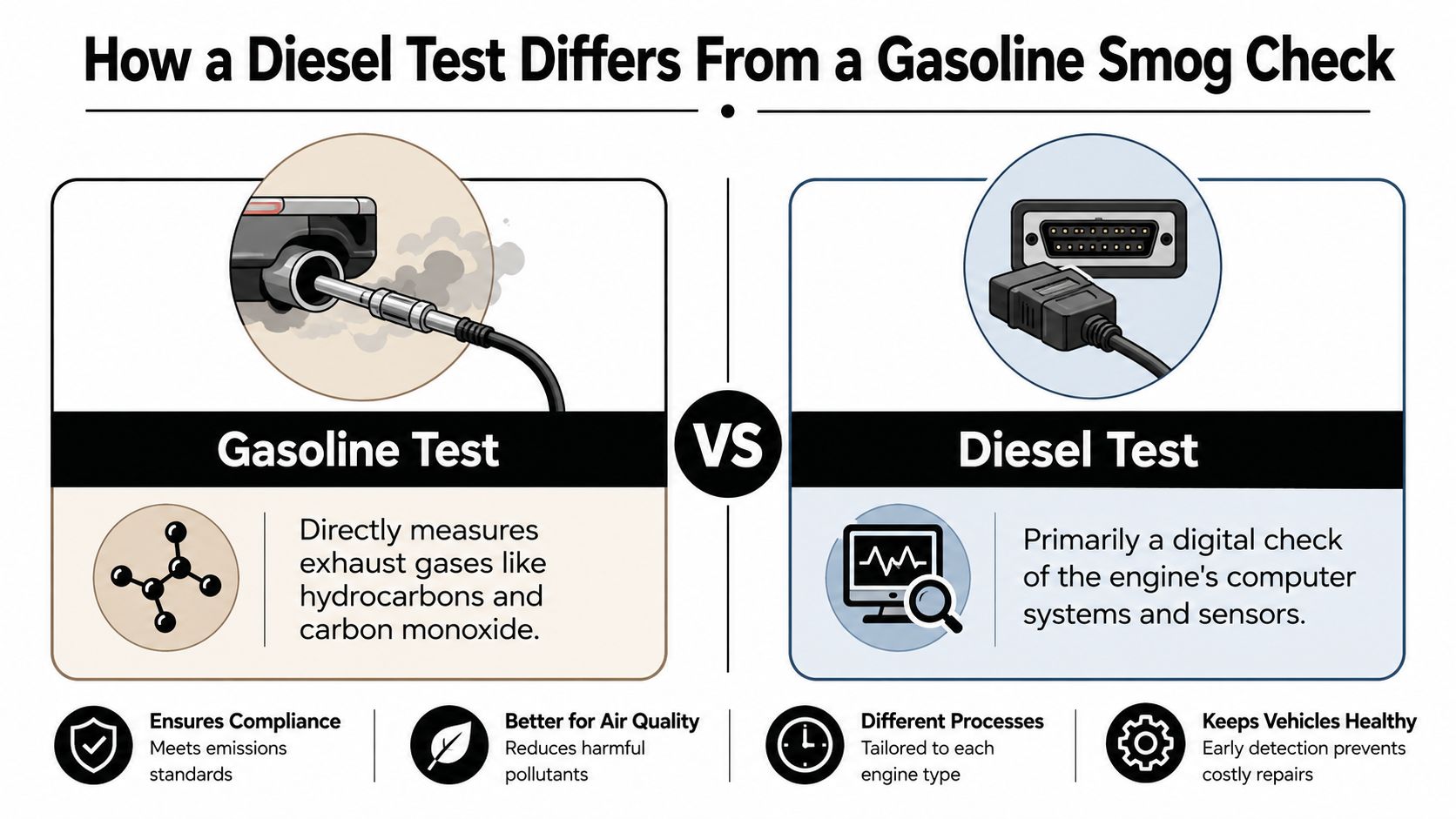
A gasoline inspection often makes the process visible. The technician may place a probe in the tailpipe and measure exhaust gases during an idle or dynamometer procedure. The familiar pollutants include hydrocarbons, carbon monoxide, and oxides of nitrogen.
A qualifying diesel inspection follows a different logic. Instead of relying primarily on a tailpipe gas sample, the technician connects to the vehicle's diagnostic system, checks readiness information and emissions-related fault data, inspects required hardware, and evaluates smoke-related compliance. The California diesel and gasoline smog comparison shows why a diesel test can look less dramatic while still being a formal emissions inspection.
What the technician is checking
OBD readiness tells the inspector whether the vehicle's emissions monitors have completed their self-tests. A recently disconnected battery or cleared diagnostic codes can leave those monitors incomplete.
The malfunction indicator lamp matters because the engine computer may identify an emissions fault even when the vehicle drives normally. A diesel doesn't need to produce obvious smoke to have a computer-detected problem.
The visual inspection confirms that emissions-control equipment remains present and connected. Depending on the vehicle, that may include exhaust-gas recirculation hardware, particulate-filter equipment, sensors, and related components.
Smoke compliance addresses visible exhaust. Diesel testing has historically focused more on opacity and visible particulate output than on the gasoline-style measurement of several tailpipe gases. California's current approach therefore combines digital information with physical inspection rather than depending on one reading alone.
The result is a test designed around how a diesel controls emissions. Don't assume that no tailpipe probe means no emissions test.
What Happens During a Diesel Smog Inspection
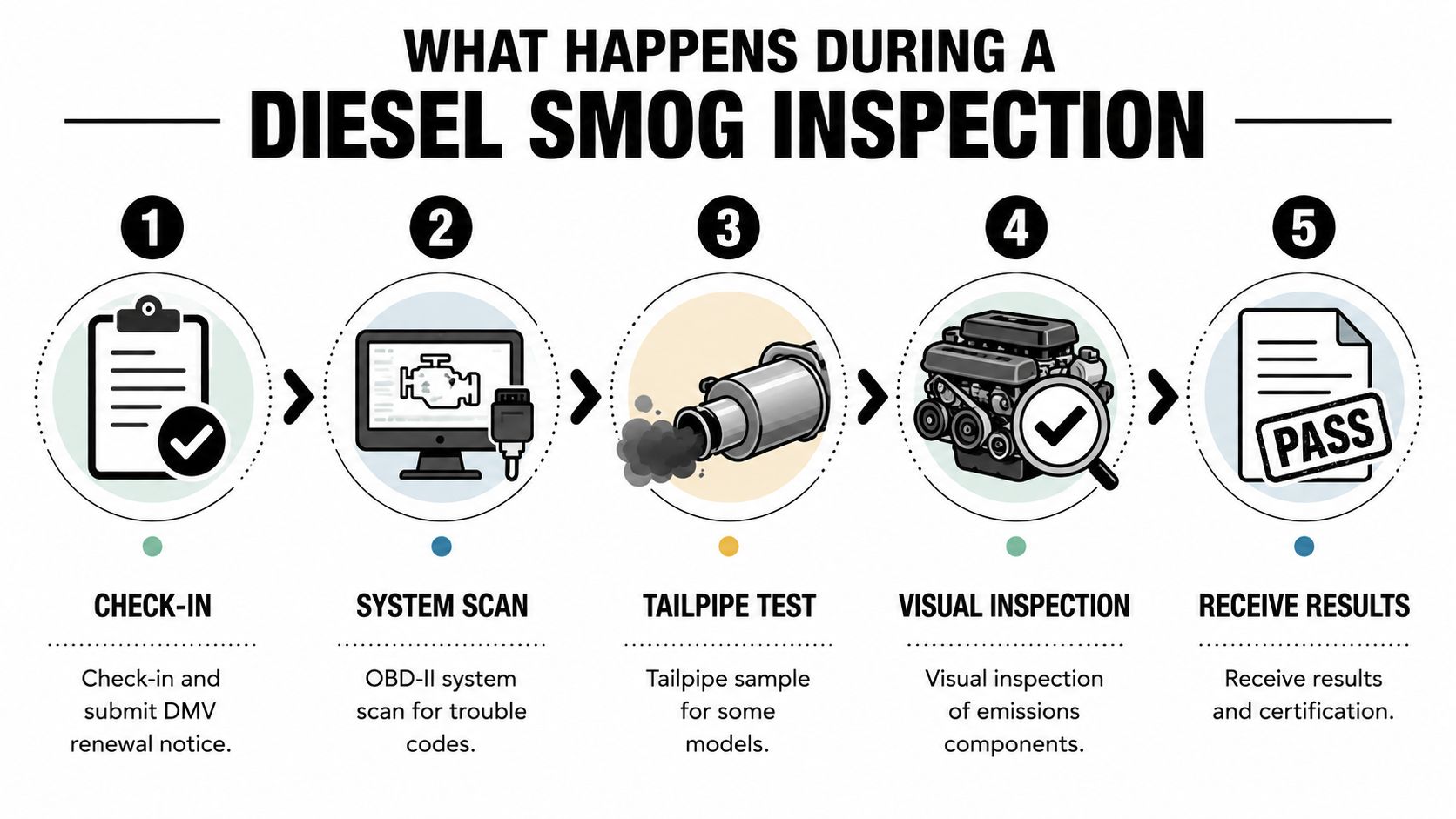
At a STAR station, the visit begins with identification and paperwork. Bring the DMV renewal notice if you have it, along with current registration and any repair records that could help explain recent emissions work.
The technician then confirms the vehicle information and looks over the emissions system. The inspection isn't a search for cosmetic flaws. It focuses on whether required diesel equipment is installed, connected, and unaltered. Missing sensors, disconnected wiring, or removed aftertreatment parts can create a problem before the scan is complete.
The inspection sequence
- Check-in and vehicle review. The station records the vehicle details and confirms why the certificate is needed.
- Visual emissions inspection. The technician checks components such as EGR equipment, turbo-related plumbing, and aftertreatment hardware for presence and apparent tampering.
- OBD connection. A scan tool connects to the standard diagnostic connector to read readiness monitors, the MIL status, and emissions-related trouble information.
- Smoke-related evaluation. The applicable procedure may include an opacity or acceleration-related check. Most qualifying newer diesels don't receive the gasoline-style tailpipe sniffer test.
- Electronic reporting. The station submits the result electronically for the registration process and provides the customer with the inspection outcome.
The exact procedure depends on the vehicle's model year and the applicable California inspection rules. The diesel emissions testing equipment used during inspection is intended to gather the information required by that procedure, not to force every diesel through the same gasoline test.
A vehicle with completed monitors and no active emissions fault usually moves through the process more smoothly than one with recently cleared codes. Allow enough time for the station to check the vehicle and complete the electronic paperwork, and ask about the expected appointment length when scheduling.
For a visual walkthrough of the process, the following video provides additional context:
The Heavy-Diesel Rule Most Owners Overlook
A heavy diesel truck isn't automatically outside California emissions oversight. It may be outside the ordinary light-duty biennial Smog Check program while still being covered by Clean Truck Check, CARB's separate heavy-duty compliance system.
CARB says nearly all diesel and alternative-fuel heavy-duty vehicles operating on California roads above 14,000 pounds GVWR must report into the Vehicle Inspection System, pay an annual compliance fee, and pass periodic emissions compliance testing. OBD-equipped vehicles are scanned electronically. Non-OBD diesels use smoke-opacity testing and a visual emissions-control inspection under the applicable procedure. See the CARB Clean Truck Check requirements before assuming a weight-based exemption ends every obligation.
The pathway depends on more than weight
Fleet owners and owner-operators commonly encounter this system, but the operating category matters too. Agricultural, government, and other vehicles may have limited exemptions or special treatment, so the owner needs to verify the exact classification rather than rely on a general rule.
| GVWR Class | Biennial Smog Check | Clean Truck Check Required | Reporting System |
|---|---|---|---|
| 14,000 pounds or less | Generally applies when the vehicle qualifies by model year and registration | Usually not the ordinary pathway | Standard California registration and Smog Check reporting |
| Over 14,000 pounds, heavy-duty diesel | Not the ordinary light-duty pathway | Generally applies to covered vehicles operating on California roads | CARB Vehicle Inspection System |
| Covered fleet or commercial vehicle | Depends on vehicle details | May apply even when the owner doesn't expect a passenger-car test | CARB compliance reporting |
| Vehicle with a specific exemption | May be exempt from one program | Must be verified against the separate rule | Applicable CARB or registration system |
The testing schedule is also distinct. CARB describes testing as semiannual for most covered vehicles, with testing increasing to quarterly for many OBD-equipped vehicles in October 2027. The future cadence is a scheduled rule, not a reason to wait. A truck can fail because its emissions hardware or OBD data shows a fault even when the driver sees little or no smoke.
For an East Bay commercial driver, the key question is whether the truck needs a light-duty smog certificate, Clean Truck Check compliance, or both under the vehicle's actual use and classification.
How to Prepare Your Diesel Before the Appointment
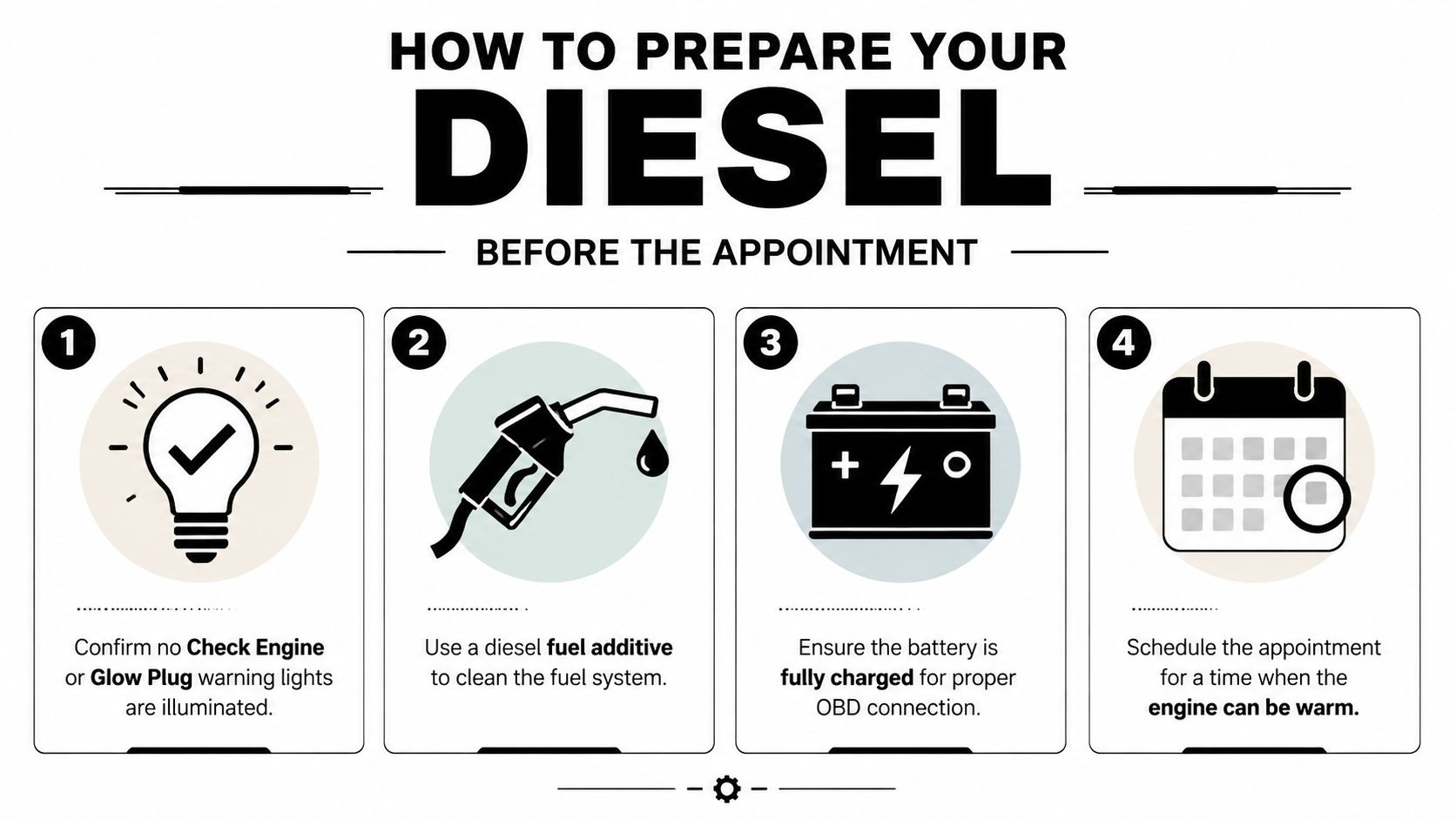
Preparation starts with the dashboard. An illuminated check-engine or emissions warning light signals that the vehicle's computer has identified a problem. A glow-plug light may indicate a diesel-system issue, although its meaning varies by vehicle, so don't ignore it because the engine still starts.
Don't clear codes just before the appointment. Disconnecting the battery or erasing diagnostic information can reset readiness monitors, leaving the vehicle unable to demonstrate that its emissions systems have completed their self-checks.
A practical pre-appointment checklist
- Scan before scheduling: Use a compatible OBD scanner to check for stored codes and monitor status. A parts store scan can identify clues, but a diesel technician may need manufacturer-level equipment for deeper diagnosis.
- Drive normally after repairs: A mixed city-and-highway drive helps the vehicle complete its required self-tests. The exact drive cycle depends on the make, engine, and emissions system.
- Inspect visible hardware: Look for loose sensor wiring, disconnected hoses, damaged intake plumbing, and missing EGR or aftertreatment components. Don't modify or remove emissions equipment.
- Check basic condition: Confirm that the fuel cap seals, the battery is charged, and the tires are in usable condition. These simple details can prevent avoidable delays.
- Bring paperwork: Take the DMV renewal notice, registration, prior certificates, and repair invoices if available.
- Arrive with the engine warm: A normal drive before the appointment can help the vehicle reach operating temperature, but don't use aggressive driving as a substitute for diagnosis.
A warning light that returns after clearing is useful information, not a minor nuisance. Have the underlying fault repaired first, then allow the monitors to complete before paying for another inspection.
Common Reasons Diesels Fail and How to Fix Them
Diesel failures often point to a specific system rather than a mysterious overall problem. The inspection result and diagnostic code should guide the repair. Guessing, repeatedly clearing codes, or replacing unrelated parts can make the process longer and more expensive.
Readiness monitors remain incomplete
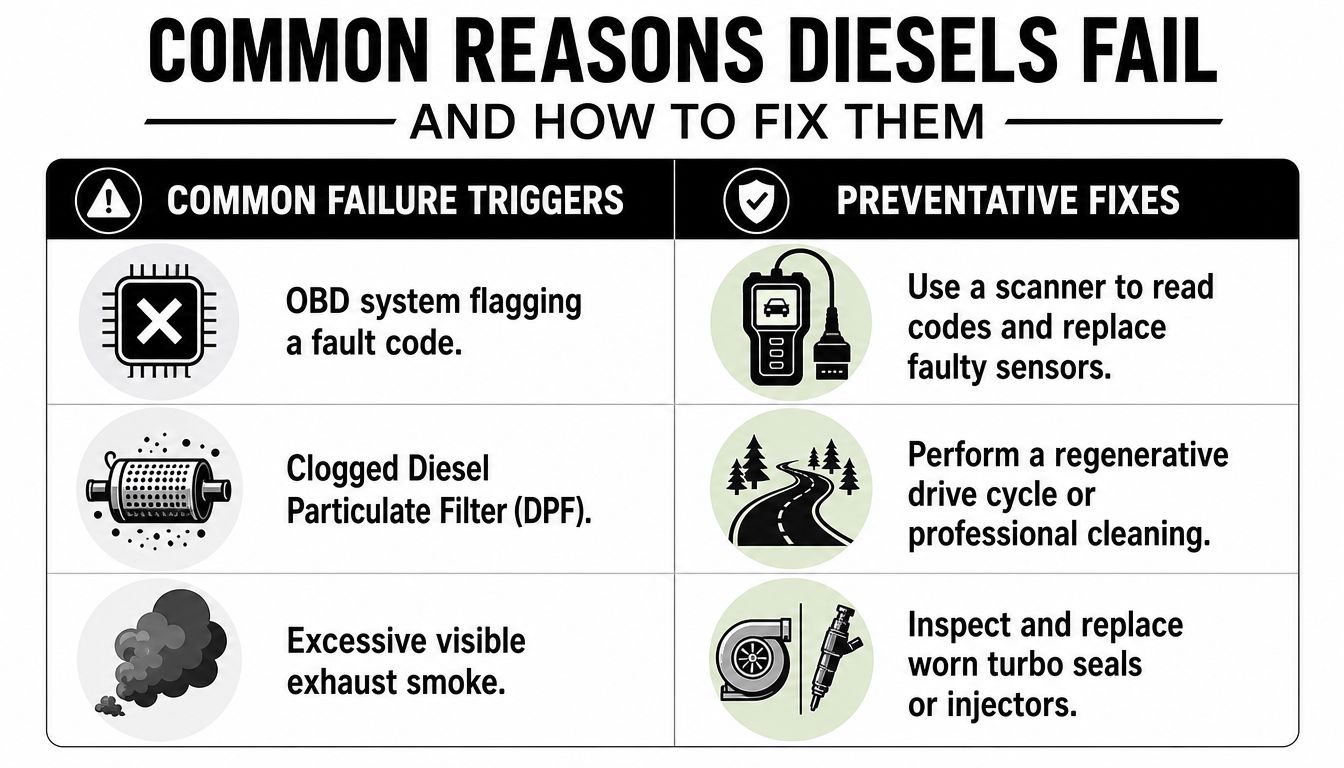
A battery disconnect or code-clearing event can reset the monitors. The driver may notice no change in performance, yet the inspection computer still sees incomplete self-tests. The next step is to identify which monitor remains incomplete, repair any underlying problem, and complete the vehicle-specific drive cycle.
An emissions warning light is active
A check-engine or aftertreatment warning can result from a sensor fault, DPF issue, EGR problem, or another emissions-system condition. Read the code with a suitable scanner before replacing parts. If a regeneration is required, a qualified technician should determine whether the vehicle can complete a normal regeneration or needs a service procedure.
Smoke is visibly excessive
Heavy black or blue smoke can direct attention toward air delivery, fuel injection, turbocharger seals, or related engine faults. The repair may involve testing injectors, checking boost plumbing, or inspecting turbo components. Don't treat smoke as something an additive alone will solve.
Hardware is missing or tampered with
A deleted DPF, disconnected sensor, altered exhaust, or removed EGR component can create a visual or compliance failure. Restoring the original emissions configuration is the proper remedy, followed by code checks and monitor completion.
A fuel-system fault appears
Worn injectors and fuel-control problems can affect combustion and trigger emissions-related codes. A diesel specialist can test the fuel system and match the repair to the stored fault rather than relying on a general tune-up.
Keep the inspection failure report and repair invoice. Those documents help the technician understand what failed originally and whether the repair addressed the same condition.
What East Bay Drivers Can Expect at Speedy Smog
An East Bay diesel owner should arrive with the DMV renewal notice, current registration, payment, and any paperwork from recent emissions repairs. If the vehicle is a newer light-duty diesel, the technician will generally focus on the applicable OBD information, visual emissions equipment, and smoke-related requirements rather than treating it like a gasoline car.
A STAR-certified station is important when the DMV directs you to a station with that certification. The station's role is to perform the approved inspection and transmit the result through California's reporting system. Ask about diesel capability when booking, especially if the vehicle has unusual equipment or a higher GVWR.
Make the visit easier
Call before arriving if the vehicle is a diesel pickup, commercial truck, modified work vehicle, or anything near the GVWR boundary. Ask which location and inspection pathway fit the vehicle, whether appointments are available, and what documents the technician wants to see.
Speedy Smog in San Leandro states that it performs diesel smog checks for qualifying diesel vehicles from 1998 to the present and serves drivers who need California registration certification. The station is located at 15275 Washington Avenue in San Leandro, and its service information describes support for newer vehicles, older vehicles, diesels, and hybrids. Confirm current availability and pricing directly with the station before visiting.
The clearest answer to “do diesel cars need emissions test” is therefore conditional but manageable. Check the model year, read the GVWR label, identify personal or commercial use, and ask whether the vehicle belongs in the regular Smog Check program or a separate heavy-duty system. That four-part check prevents most surprises at the counter.
Bring your DMV renewal notice and vehicle details to Speedy Smog in San Leandro for help identifying the correct diesel inspection pathway. Call ahead if you're bringing a heavier truck or a vehicle with recent emissions repairs, so the team can confirm the appropriate service before you arrive.