
Diesel Emissions Testing Equipment: Your 2026 Smog Check
Your DMV renewal notice shows up, and somewhere in the fine print you see that your diesel needs a smog check. That's usually when the questions start. Do diesels get the same test as gas cars? Will they plug into the computer, test the tailpipe, or both? If your truck runs fine, why does any of this matter?
At the counter, I hear the same concern from East Bay drivers all the time: they don't mind doing the test, they just want to know what's happening to their vehicle and what could hold up their registration. That's fair. Diesel smog checks feel more technical because the equipment is more specialized, and the results can point to problems you won't always notice in everyday driving.
That equipment matters on a big scale, too. In 2024, systems designed specifically for diesel vehicles accounted for 56% of all market installations in the automotive emission test equipment sector, which shows how central diesel testing is to compliance work across the industry, according to Industry Research's automotive emission test equipment market report.
For California drivers, the useful question isn't “What's the whole global market doing?” It's simpler than that. What tool is being used on your vehicle, what is it checking, and what do those results mean for passing your smog check and keeping your DMV registration moving?
Table of Contents
- Your Diesel Smog Notice Arrived What Now
- The Tools of the Trade Key Diesel Testing Equipment
- The Diesel Smog Check Process at a STAR Station
- Why STAR Certification Matters for Your Diesel Test
- Decoding Your Test Results What the Readings Mean
- How to Prepare Your Diesel for an Easy Pass
- Your Partner for a Fast and Compliant Smog Check
Your Diesel Smog Notice Arrived What Now
A lot of diesel owners have the same first reaction: confusion, not panic. The vehicle may be running well, there may be no warning lights on, and then the DMV notice lands anyway. If you haven't dealt with a diesel smog check recently, it's easy to assume it works just like a gas car inspection. It often doesn't.
One customer type I see often is the owner of an older diesel pickup who's convinced the shop will just “plug it in and print a pass.” Another is the owner of a newer diesel SUV who's worried they're heading into a long, expensive diagnostic session. Usually, reality lies somewhere in between. The inspection follows a process, the equipment has a specific purpose, and most of the stress comes from not knowing what each step means.
Why the notice feels more confusing for diesel owners
Diesel testing has more moving parts because diesel emissions problems show up differently. A gas car owner usually thinks in terms of a check engine light or a failed monitor. Diesel owners also have to think about smoke output, visible exhaust behavior, and whether the emissions hardware is present and working as intended.
That's why it helps to think of the smog check as both a compliance test and a health check. The machine isn't just looking for a pass or fail. It's looking for signs that the engine and emissions system are behaving the way California expects them to.
Most diesel smog stress comes from uncertainty, not from the test itself.
What you actually need to know first
Start with three basics:
- Bring the vehicle in warmed up. A cold diesel can give you misleading behavior and rougher results.
- Expect more than one kind of check. The inspection may involve a visual review, a computer check, and for some vehicles, a smoke or opacity measurement.
- Treat the notice like a deadline, not a suggestion. If the test is tied to registration, waiting until the last minute removes your repair options if something fails.
If you understand what the tools are doing, the process stops feeling mysterious. That's the difference between walking into a test lane worried and walking in prepared.
The Tools of the Trade Key Diesel Testing Equipment
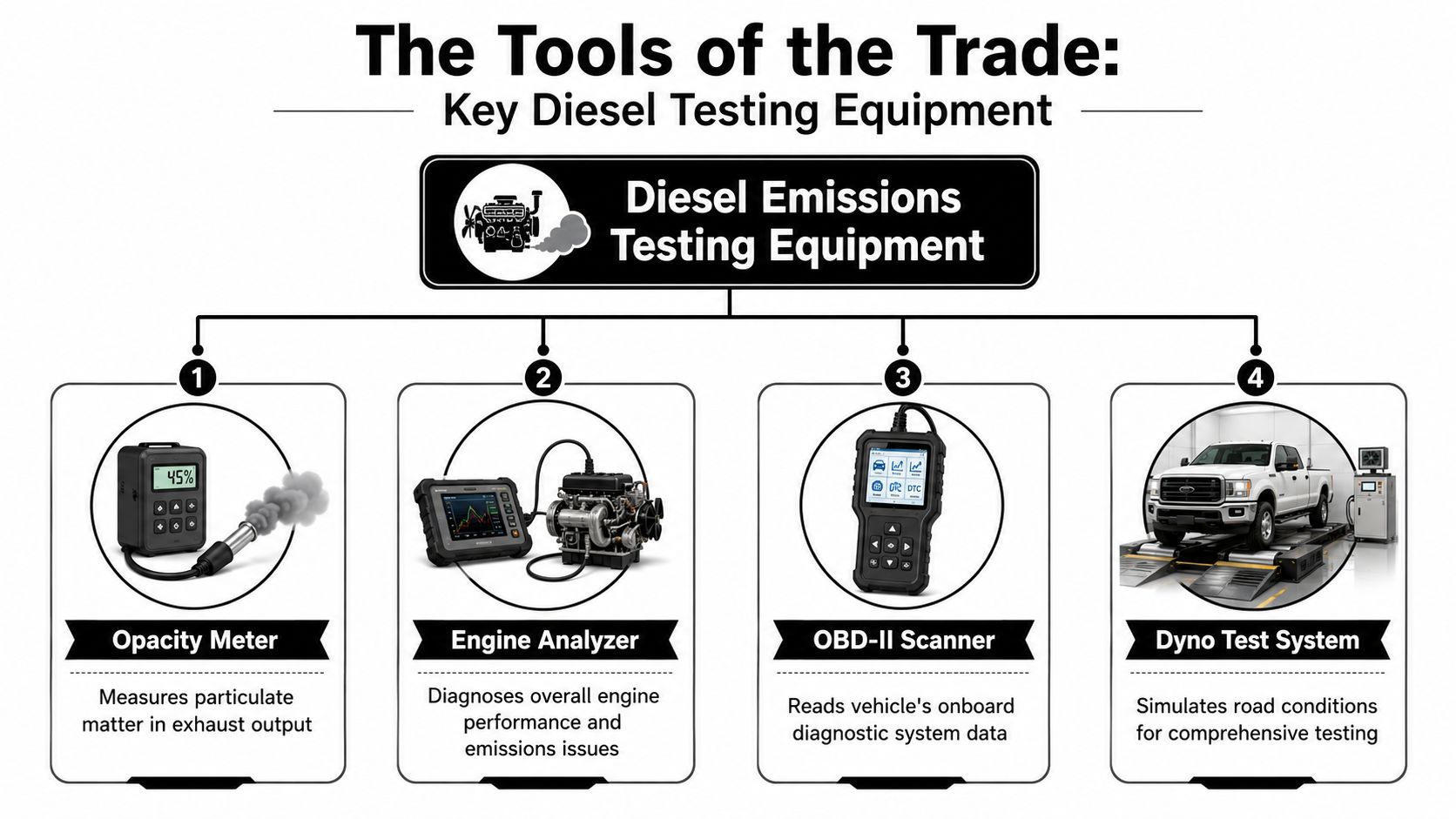
Diesel emissions testing equipment works like a doctor's toolkit. One tool looks for symptoms you can see. Another checks what the vehicle reports about itself. Another helps confirm whether the engine behaves properly under load or under a specific test condition. No single tool tells the whole story.
What each tool is actually checking
The opacity meter is the classic diesel-specific tool. It measures visible smoke in the exhaust stream, which gives the technician a direct read on particulate output. That matters because smoke isn't just cosmetic. It's often a clue that combustion is incomplete or that the aftertreatment system isn't doing its job. Opacity meters are also the leading product category in this market, projected to hold 45.00% of total automotive emission test equipment market revenue in 2025, according to Future Market Insights on automotive emission test equipment.
The OBD-II scanner reads the vehicle's onboard diagnostics. That's the electronic side of the inspection. It checks whether the vehicle has stored trouble codes, whether emissions-related systems are reporting faults, and whether the onboard data lines up with a healthy emissions system. For many drivers, this is the part they expect. But on a diesel, it's only one part of the picture.
An engine analyzer helps the technician interpret overall engine behavior. It's less about one pass-fail number and more about connecting symptoms. If a diesel has a rough idle, poor throttle response, or signs of an air-fuel imbalance, that can point toward the reason behind smoke output or fault activity.
A dyno test system is the “stress test” version of the toolkit. It simulates road conditions so the vehicle can be checked under controlled load instead of just sitting still. California procedures vary by vehicle and program requirements, but the idea is simple: some emissions problems show themselves better when the engine has to work.
If you're trying to understand how these systems fit into the state test itself, this overview of a California diesel smog check process gives useful context.
Practical rule: If a diesel owner says, “My truck feels fine, so it should pass,” that's not always enough. Some failures only show up when the tool checks smoke, data, or load in a structured way.
Diesel Smog Check Equipment at a Glance
| Equipment Type | What It Measures | Role in a California Smog Check |
|---|---|---|
| Opacity Meter | Visible exhaust smoke and particulate output | Verifies whether tailpipe smoke stays within the required test standard for applicable diesel vehicles |
| OBD-II Scanner | Emissions-related fault codes and system status | Checks the onboard computer for problems that can trigger a smog failure |
| Engine Analyzer | Overall engine behavior and related performance clues | Helps identify why a vehicle is smoking, idling poorly, or setting faults |
| Dyno Test System | Vehicle behavior under simulated driving load | Used when a test procedure requires controlled operating conditions rather than a simple idle check |
Why the right tool matters
Drivers sometimes ask whether one machine can do it all. It can't. A scanner won't tell you how much smoke is coming out of the tailpipe. An opacity meter won't explain why the computer set a fault. A dyno won't replace a visual inspection.
That's the core value of diesel emissions testing equipment when it's used correctly. Each tool answers a different question, and together they give a reliable picture of whether the vehicle is compliant or whether something needs attention before registration can move forward.
The Diesel Smog Check Process at a STAR Station
At a STAR station, the diesel smog check is structured. It's not a random set of shop opinions, and it's not a mechanic taking a guess based on how the exhaust smells. The sequence matters because each step screens for a different kind of problem.
What happens when your vehicle enters the bay
The first step is usually the visual inspection. The technician checks that the emissions-related components that should be on the vehicle are present and haven't been tampered with. Missing, disconnected, or obviously altered equipment can stop the process fast.
Then comes the electronic inspection for vehicles that use onboard diagnostics as part of the program. The scanner communicates with the vehicle and checks for emissions-related faults and system readiness. If the computer is reporting a problem, the test result reflects that. This is one reason clearing codes right before a smog check usually backfires. The system still needs to show that it has completed the right self-checks.
For some diesels, especially older ones, the key moment is the opacity test, often associated with the Modified Snap Acceleration approach. The technician uses the meter at the tailpipe and measures visible smoke under a defined test procedure rather than relying on guesswork.
If an older diesel smokes only when you get on the throttle, the tailpipe test is where that problem usually shows itself.
If you're not sure why your registration notice points you toward this kind of facility, the explanation of what a smog STAR station is clears up why California routes some vehicles to higher-performing stations.
Why some diesel tests are different from lab testing
Shop testing and development testing are not the same thing. In engineering and regulatory work, advanced diesel emissions measurement can involve Portable Emission Measurement Systems (PEMS) for real-world operation, along with engine dynamometer testing over standardized cycles using Constant Volume Sampling (CVS) for exhaust dilution, as described by DieselNet's overview of emissions measurement methods.
That matters for one reason only to the average driver. Professionals use different tools for different jobs. A laboratory setup can study emissions in extreme detail. A STAR station uses the approved field equipment and procedures that determine whether your vehicle meets the requirement for registration.
What drivers usually notice during the test
From the waiting room, the process can look simple. In the bay, it's methodical.
- The vehicle is identified and checked in. Paperwork and vehicle details have to match.
- The inspection follows the required sequence. Skipping steps isn't how compliant testing works.
- The final result is based on the approved test outcome. Not on a technician's hunch, and not on whether the vehicle “sounds healthy.”
That consistency is what makes the result valid for DMV purposes.
Why STAR Certification Matters for Your Diesel Test
For diesel owners, STAR certification matters because accuracy matters. You don't want a rushed inspection, and you don't want a sloppy one. You want a result the DMV accepts and a process that follows the rules the same way every time.
A STAR station operates under tighter performance expectations than a basic testing site. For the driver, that means the station is expected to maintain a higher level of consistency in how testing is performed and reported. If your registration notice requires a STAR inspection, choosing anything else doesn't help. If it doesn't require one, a STAR station still gives you confidence that the result will fit California's standards.
Why accuracy matters more than speed alone
Fast service is nice. Accurate service is the point.
A diesel smog check can affect your registration timeline, your next repair decision, and your understanding of whether the problem is electronic, mechanical, or both. That's why station quality matters more on diesels than many owners realize. A weak process creates confusion. A disciplined process gives you a result you can trust.
Here's the practical side. Some vehicles are directed to STAR stations. Others aren't. But if you drive a diesel and want the inspection handled by a shop that's used to regulated testing standards, STAR is the safer lane.
A good diesel test doesn't just give you an answer. It gives you an answer that holds up when registration is on the line.
That's why experienced diesel owners tend to care less about flashy promises and more about whether the station follows the process cleanly, uses the right equipment, and submits a result that won't create headaches later.
Decoding Your Test Results What the Readings Mean
A pass is easy to understand. A fail usually isn't. What most drivers want to know is what the machine saw, what that says about the vehicle, and whether they're dealing with a simple repair issue or a bigger emissions problem.
What a smoke reading is telling you
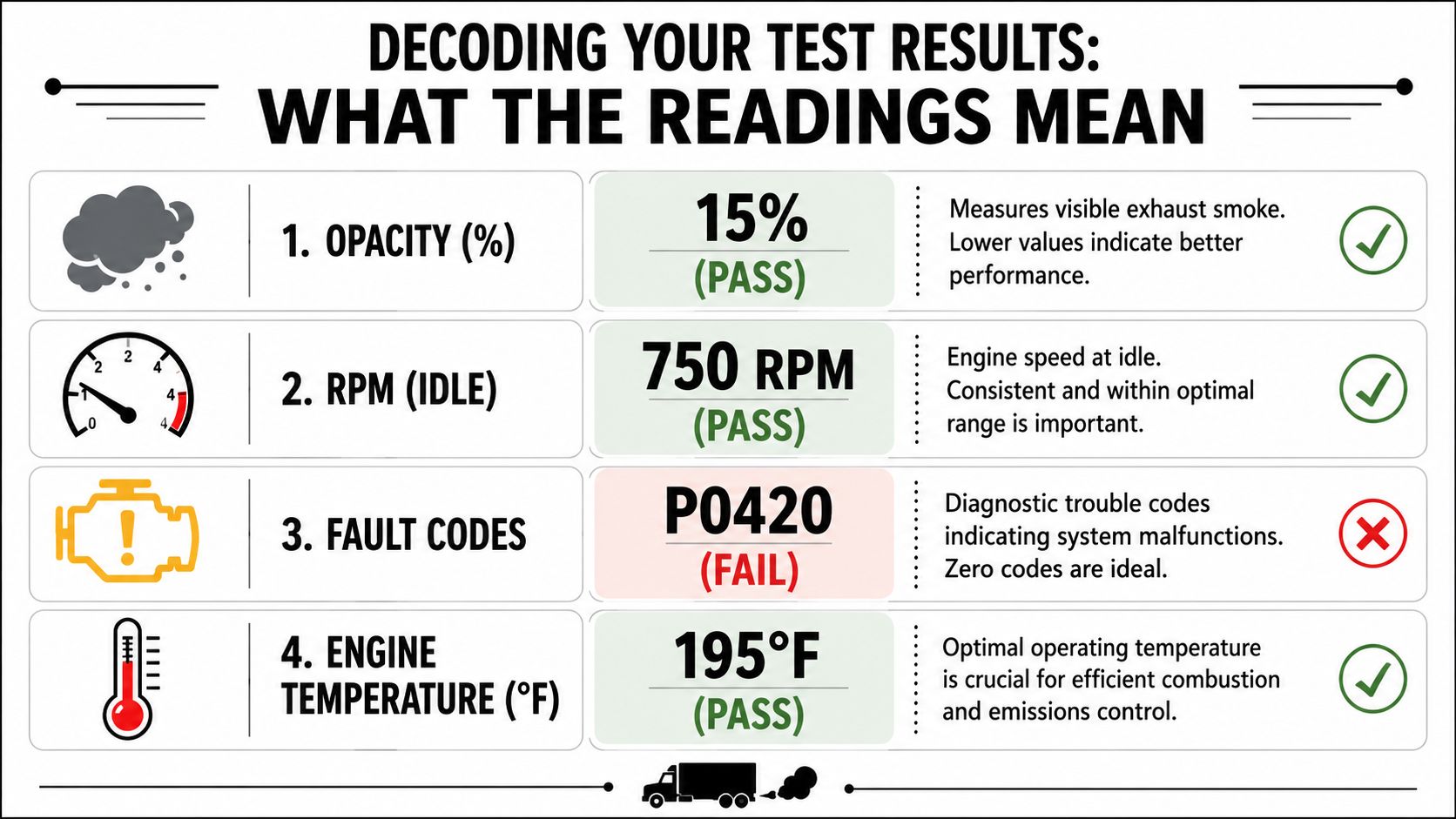
On a diesel, an opacity result is often the clearest real-world clue. If the reading is high, the engine may be producing excess soot, burning fuel poorly, or failing to control particulate output the way it should. In plain English, the tailpipe is showing that combustion and emissions control aren't lining up.
That doesn't mean the cause is always dramatic. A restricted air path, injector issue, turbo problem, or aftertreatment weakness can all show up as smoke behavior. The reading doesn't repair the vehicle. It tells you where to start looking.
What computer data can and cannot prove
Fault codes matter because they tell you the vehicle has detected a problem in an emissions-related system. If the check engine light is on for the wrong reason, that can lead straight to a fail. But code data has limits.
The big misunderstanding with diesels is assuming onboard sensor data can replace a tailpipe measurement. It can't. The clearest statement on this point is that the only way to definitively know a diesel's emissions status, especially for older vehicles, is to measure directly at the tailpipe with an opacity meter, because DPF sensor data alone cannot confirm real-world performance during a Modified Snap Acceleration test, as discussed in this diesel opacity testing video reference.
That's why one vehicle can “look good on the scanner” and still fail when tested properly at the exhaust.
How to read the result like a technician
When I explain results to drivers, I usually translate them this way:
- Clean computer report, clean tailpipe behavior: good sign. The vehicle is usually doing what it should.
- Clean computer report, dirty tailpipe behavior: something mechanical or combustion-related may be slipping past what the onboard system can confirm.
- Fault codes present: the vehicle is telling on itself. Even if it seems to drive normally, the system has identified an emissions issue.
- Intermittent symptoms: these are the frustrating ones. The truck may behave on the way to the shop and act up only under test conditions.
Don't treat a failed reading as a verdict on the whole vehicle. Treat it as evidence. Good diagnosis starts there.
A useful diesel smog result isn't just pass or fail. It narrows the problem so you can make a smarter repair decision.
How to Prepare Your Diesel for an Easy Pass
Most smog failures aren't surprises to the vehicle. They're surprises to the owner. A little prep goes a long way, especially with diesels that spend a lot of time on short trips, sit between uses, or have had recent battery disconnects or repairs.
A simple pre-test checklist
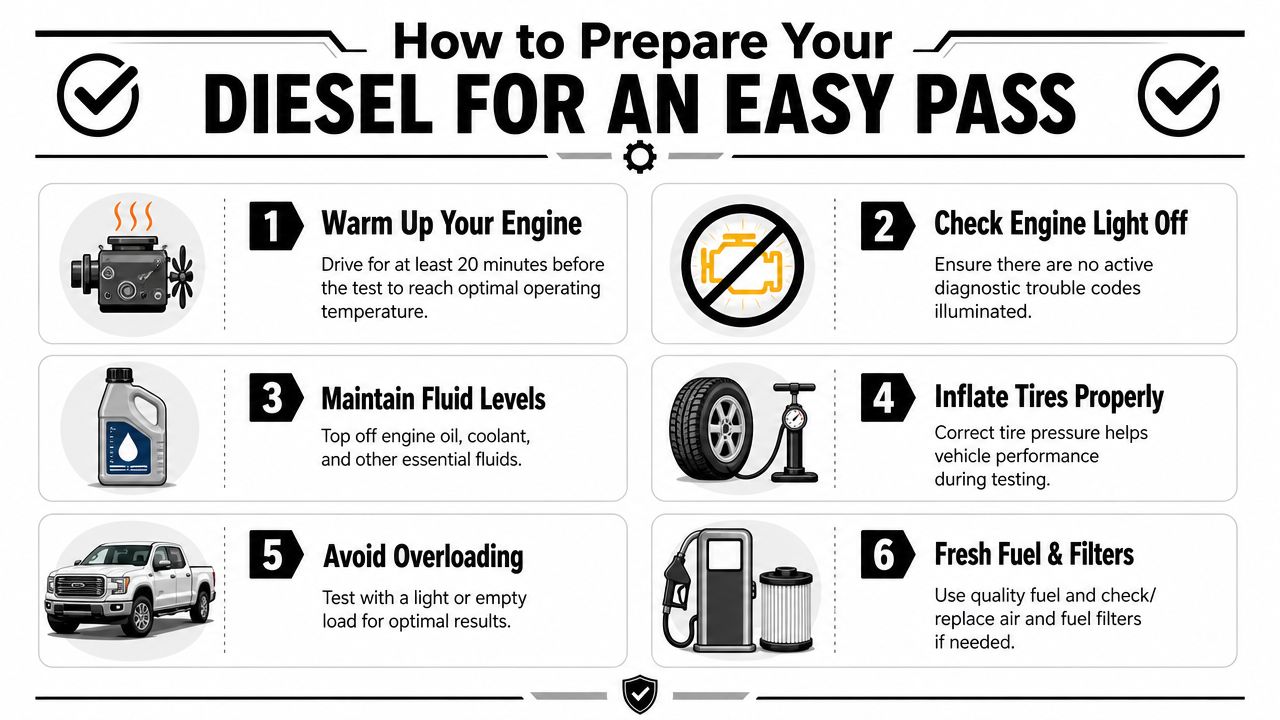
Use a basic routine before you head to the station:
- Warm the engine fully. A proper drive before the test helps the engine and emissions system operate normally.
- Make sure the check engine light is off. If the light is on, don't assume the shop can “test around it.”
- Look for obvious under-hood issues. Loose hoses, disconnected sensors, or recent repair leftovers can create avoidable failures.
- Stay current on maintenance. Dirty filters, overdue oil service, and neglected intake issues can hurt diesel combustion quality.
- Avoid last-minute code clearing. If you recently disconnected the battery or reset faults, the system may not be ready for inspection.
For a more shop-focused prep list, this guide to diesel smog check prep in California is worth reviewing before your appointment.
A quick visual walkthrough can help, too:
Why California drivers need to be more proactive
Some diesel owners move here from other states and assume the rules will be similar. They often aren't. States including Illinois, Georgia, and Utah explicitly exempt light-duty diesel vehicles from mandatory emissions testing, as noted by Illinois Air Team's diesel testing FAQ. California drivers face a stricter and more hands-on compliance environment, so preparation matters more.
That difference catches people off guard. A driver may have owned a diesel for years elsewhere without ever thinking about smoke behavior, readiness status, or emissions hardware condition. In California, those details become registration issues.
What doesn't work
A few habits waste time:
- Showing up with a cold engine
- Ignoring a warning light because the vehicle “still drives fine”
- Assuming recent repairs automatically mean test-ready status
- Waiting until the registration deadline to find out if there's a problem
The easiest pass is usually the result of normal maintenance, a warmed-up vehicle, and no unresolved warning signs.
Your Partner for a Fast and Compliant Smog Check
Diesel emissions testing equipment can look intimidating if you only see it from the waiting room. Once you know what the tools are checking, the process makes a lot more sense. One tool reads the vehicle's own diagnostics. Another checks the exhaust directly. The station follows a set sequence so the result is accurate, consistent, and valid for DMV use.
That understanding helps in two ways. First, you're less likely to walk into the test guessing. Second, if the vehicle doesn't pass, you'll have a better sense of what the result is telling you instead of treating it like a mystery printout.
For East Bay diesel owners, the goal is simple: get a compliant inspection, get clear answers, and keep registration moving without drama.
If you need a diesel smog check in San Leandro or the East Bay, Speedy Smog offers STAR-certified testing with the kind of clear, practical service drivers appreciate. Whether you're coming in with a renewal notice, an older diesel that needs proper tailpipe evaluation, or a newer vehicle that needs a clean DMV-compliant inspection, the team can help you get it handled quickly and professionally.