
Smog Test: What Every Driver Needs to Know
A smog test is required for most vehicles in California — and if you're renewing your registration or buying a used car, you can't skip it. Many drivers dread the process because they don't know what to expect or worry their car might fail.
This guide covers exactly what a smog test checks, when you need one, how to prepare, what happens during the inspection, and what to do if your vehicle doesn't pass.
What Is a Smog Test?
A smog test — sometimes called a smog check or emissions inspection — is a mandatory vehicle inspection that measures the pollutants your car's engine releases into the air. The test verifies that your vehicle's emissions control systems are working correctly and that exhaust output stays within the legal limits set by the California Air Resources Board (CARB).
California's smog check program is one of the strictest in the country. The state has required periodic emissions testing since 1984, and the program has helped reduce smog-forming pollutants by more than 75% compared to pre-program levels, according to the California Air Resources Board. That's a meaningful environmental win — and every registered vehicle in the state contributes to it.
The smog test evaluates three main things:
- Exhaust emissions: Levels of hydrocarbons (HC), carbon monoxide (CO), and oxides of nitrogen (NOx) measured directly from the tailpipe
- OBD-II system check: For vehicles 2000 and newer, the test reads your car's onboard diagnostic computer to confirm all emissions-related monitors have completed and no fault codes are present
- Visual and functional inspection: A technician checks that emissions equipment — the catalytic converter, gas cap, exhaust system — is present and properly connected
Key Insight: The OBD-II check is now the primary test method for most modern vehicles. If your check engine light is on, your car will almost certainly fail — even if the actual emissions are within limits.
Why Do I Need a Smog Test?
California requires the smog test for two reasons: to protect air quality and to keep vehicles on the road operating as cleanly as the manufacturer intended.
The Los Angeles Basin and Central Valley have historically had some of the worst air quality in the United States. Vehicle exhaust is a major contributor to ground-level ozone — the component of smog that causes respiratory problems and damages lungs. The smog check program exists to catch vehicles that are polluting far above normal levels and get them repaired.
From a practical standpoint, you need a passing smog test certificate to:
- Renew your vehicle's registration with the DMV
- Complete the sale or transfer of a used vehicle (in most cases)
- Re-register a vehicle that was previously registered out of state
Skipping the smog test isn't an option if you want legal plates. The DMV will not process your registration renewal without a current smog certificate on file.
When Is a Smog Test Required?
Not every vehicle needs a smog test every year. Here's how the schedule works in California:
Vehicles required to test every two years
Most gasoline-powered vehicles model year 1976 and newer need a smog test every two years. The DMV sends a renewal notice indicating whether a smog test is required for that cycle.
Vehicles exempt from smog testing
- Gasoline-powered vehicles 8 years old or newer: These are exempt from biennial testing under the "new motor vehicle" exemption. A 2022 model year vehicle, for example, would be exempt until the 2030 registration cycle.
- Electric vehicles: Zero-emission vehicles don't produce tailpipe emissions and are fully exempt
- Diesel vehicles 1997 and older with a GVWR under 14,000 lbs: These follow different rules
- Motorcycles: Not subject to the smog check program
- Vehicles 1975 and older: Exempt from the standard smog check
When buying or selling a used car
The seller is typically responsible for providing a valid smog certificate — issued within 90 days — at the time of sale. There are exceptions for transfers between family members and certain dealer transactions, but private party sales almost always require a fresh smog test.
Vehicles moving to California from another state
If you're registering a vehicle in California that was previously registered elsewhere, a smog test is required regardless of the vehicle's age (with limited exceptions).
Comparison of smog test requirements by vehicle type
| Vehicle Type | Testing Frequency | Key Exemptions |
|---|---|---|
| Gas vehicles, 8+ years old | Every 2 years | None — must test |
| Gas vehicles, under 8 years old | Exempt | New motor vehicle exemption |
| Electric vehicles | Never | Zero-emission exemption |
| Diesel vehicles (1998+) | Every 2 years | Different opacity test applies |
| Motorcycles | Never | Exempt from program |
| Vehicles 1975 and older | Never | Classic vehicle exemption |
This table covers the most common scenarios. If you're unsure whether your specific vehicle needs a smog test, the California DMV's online vehicle registration system will tell you when your renewal notice is generated.
How to Prepare Your Vehicle for a Smog Test
Most vehicles that are properly maintained pass without any issues. A few simple steps before your appointment can improve your odds and help you avoid a retest fee.
Check for warning lights first
Turn on your ignition and look at your dashboard. If your check engine light, service engine soon light, or any emissions-related warning light is illuminated, address it before going in for a smog test. An active fault code is an automatic failure on the OBD-II portion of the test.
Drive the car before the test
OBD-II monitors need to complete their self-checks before the smog test can read them. If your battery was recently disconnected — or if you cleared fault codes — those monitors may show as "not ready." Drive your vehicle through a mix of highway and city driving for at least 100 to 200 miles after any battery work or code clearing.
Warm up the engine
Drive your car for 15 to 20 minutes before arriving at the station. A fully warmed-up engine burns fuel more efficiently and produces lower emissions. Cold starts often produce higher hydrocarbon readings.
Check your gas cap
A loose or cracked gas cap triggers an evaporative emissions fault. Make sure your cap clicks securely when you tighten it. Gas caps are inexpensive to replace if yours is worn.
Check the oil
Dirty or low engine oil can increase hydrocarbon emissions. If you're overdue for an oil change, get one before your smog test — not after.
Inflate your tires to the correct pressure
Some testing equipment uses a dynamometer (a set of rollers your drive wheels spin on). Proper tire inflation ensures accurate readings and prevents damage during the test.
What Happens During a Smog Test?
The smog test itself is straightforward. Here's what to expect from start to finish.
-
Check-in: You'll provide your vehicle registration and ID. The technician enters your vehicle information into the state's STAR program database, which records all test results.
-
Visual inspection: The technician checks that your catalytic converter is present, your gas cap is intact, and there are no obvious tampering or modifications to emissions equipment.
-
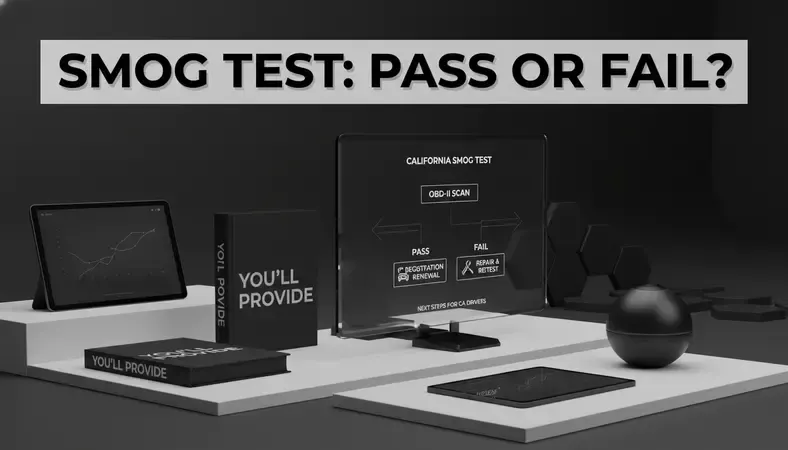
OBD-II scan (2000 and newer vehicles): A diagnostic scanner connects to the port under your dashboard — typically near the steering column. The system reads your vehicle's onboard computer for fault codes and confirms that all emissions monitors show "ready."
-
Tailpipe test (older vehicles): For pre-2000 vehicles and some diesels, a probe is inserted into the tailpipe to measure exhaust gases directly. The vehicle is run at different RPM levels to simulate driving conditions.
-
Functional checks: The technician may check that the EGR (exhaust gas recirculation) valve, evaporative emissions system, and other components are functioning.
-
Results: The test typically takes 15 to 30 minutes. You receive a printed report showing pass or fail, and the results are automatically transmitted to the DMV.
A passing certificate is valid for 90 days. If you don't use it within that window, you'll need to retest.
How Much Does a Smog Test Cost?
Smog test pricing in California varies by station type, vehicle, and location. STAR-certified stations — which are required for certain vehicles flagged by the DMV — may charge slightly different rates than regular test-only or test-and-repair stations.
Typical pricing ranges from around $30 to $80 for most passenger vehicles. The state also charges a $8.25 smog abatement fee as part of your DMV registration, separate from what you pay the testing station.
Some stations offer coupons or discounts. If cost is a concern, call ahead and ask about current pricing before you drive over.
What If Your Vehicle Fails the Smog Test?
Failing a smog test doesn't mean you're stuck. Here's what happens next.
Understand why it failed
The test report identifies exactly which component or reading caused the failure. Common reasons include:
- Check engine light / active fault codes: The most common cause for modern vehicles
- Catalytic converter failure: A failing cat causes dramatically elevated HC and CO readings
- Oxygen sensor failure: Affects fuel mixture and emissions output
- EGR valve issues: Causes elevated NOx readings
- EVAP system leaks: Evaporative emissions faults from a bad gas cap or cracked hose
- OBD-II monitors not ready: Incomplete drive cycle after recent battery work
Get the repairs done
Take the failure report to a licensed repair shop. The report tells the mechanic exactly what to look for. After repairs, return to a smog check station for a retest.
Consumer Assistance Program (CAP)
If your vehicle fails and repairs are expensive, California's Consumer Assistance Program may help. CAP offers repair assistance up to $500 for income-eligible vehicle owners. Vehicles that cannot be repaired cost-effectively may qualify for a retirement buyout — the state pays you to retire the vehicle permanently. More information is available through the Bureau of Automotive Repair.
One free retest within 30 days
Many STAR-certified stations offer one free retest within 30 days if you had repairs performed at their facility. Ask about this policy before you commit to a repair shop.
Common Questions About Smog Tests
How long does a smog test take?
Most smog tests take between 15 and 30 minutes for a standard passenger vehicle. If the station is busy or your vehicle requires a more thorough inspection, it may take longer. STAR-certified stations with modern equipment typically complete the process quickly — Speedy Smog, for example, completes most vehicles in under 15 minutes.
Can I drive my car if it fails a smog test?
Failing a smog test doesn't make your car illegal to drive immediately. You can still drive the vehicle while you arrange repairs. What you can't do is renew your registration until you have a passing certificate. Operating a vehicle with expired registration is a separate violation.
Does a smog test check for mechanical problems beyond emissions?
The smog test is specifically an emissions inspection — it's not a full safety or mechanical inspection. It won't catch brake problems, suspension issues, or tire wear. If you want a comprehensive vehicle inspection, ask a repair shop for a full multi-point inspection separately.
What's the difference between a STAR station and a regular smog station?
STAR stations are licensed by the Bureau of Automotive Repair and meet higher performance standards for equipment and technician training. The DMV requires certain vehicles — typically older models or those with a history of emissions problems — to be tested at a STAR-certified station. If your renewal notice says "STAR required," you can't use a regular smog station.
Does a hybrid or plug-in hybrid need a smog test?
Yes. Hybrid vehicles that have a gasoline engine — like the Toyota Prius — are subject to the same smog check requirements as conventional gas vehicles. Only fully electric vehicles (BEVs) are exempt. Plug-in hybrids with a combustion engine must test on the same schedule as standard gas-powered cars.
Can I get a smog test before my renewal notice arrives?
Yes. You can get a smog test up to 90 days before your registration renewal date. The certificate is valid for 90 days, so timing it close to your renewal date makes sense. Some drivers prefer to test early to avoid last-minute issues.
Wrapping Up
A smog test is a straightforward process when you know what to expect and your vehicle is properly maintained. Keep up with routine service, address warning lights promptly, and you'll pass without trouble most of the time.
Book your smog check at Speedy Smog in San Leandro — STAR certified, most vehicles done in under 15 minutes, open 6 days a week. Save $25 on your visit by calling (510) 614-7664. Ready to get started? Visit Speedy Smog to learn more.