
You're staring at a DMV renewal notice, your registration deadline is getting closer, and Google has returned a crowded map full of shops calling themselves an “inspection” station. The nearest pin isn't automatically the right choice. Some locations only test, some also repair, some handle specific vehicle types, and some may not be approved for the test your DMV notice requires.
A good search for vehicle inspection near me ends with more than an address. You need the right inspection category, a station that can handle your vehicle, clear pricing, workable hours, and a result that moves your registration forward without a second unnecessary trip.
Table of Contents
- When Your Car Actually Needs a Smog Check
- How to Search for a Vehicle Inspection Near You
- Why STAR Certification Matters for Your Inspection
- Comparing Stations on Hours, Price, and Convenience
- What to Bring and How to Avoid a Failed Test
- A Local Example That Checks Every Box
- Getting Certified and Back on the Road
When Your Car Actually Needs a Smog Check
The usual trigger is simple. Your California DMV renewal notice arrives, and the renewal process requires a Smog Check before you can complete registration. California requires a Smog Check every other year to renew registration, according to the California DMV's Smog Inspections guidance.
There's an important exception for newer vehicles. Since January 1, 2019, vehicles less than 4 model years old may pay a smog abatement fee instead of undergoing inspection for the first 8 registration years. Check the notice rather than guessing from the vehicle's purchase date. California uses the vehicle's model year and registration history to determine whether the exemption applies.
Match the test to your vehicle
A California Smog Check examines emissions and emissions-control components. It isn't a general mechanical inspection, brake inspection, or pre-purchase evaluation. If you're trying to transfer ownership, resolve a registration issue, or meet a special DMV instruction, read the notice carefully because the required station type may differ.
Use this quick decision:
- Newer vehicle: Check whether the abatement-fee exemption applies before booking a test.
- 2000 and newer gasoline vehicle: Confirm that the station accepts the vehicle and can complete the applicable emissions test.
- Older vehicle, diesel, or hybrid: Ask directly before driving over. Vehicle coverage varies by station.
- DMV-directed inspection: Look for any instruction requiring a STAR station or a specific test pathway.
The demand for compliant local stations stays steady because California ties recurring emissions testing to registration renewal. At the same time, newer vehicles can avoid the full test during their early registration years, so not every driver searching today needs the same service.
Practical rule: Let the DMV notice determine the requirement, then let the vehicle's model year and fuel type determine which station you call.
How to Search for a Vehicle Inspection Near You
Typing “vehicle inspection near me” into Google Maps is a reasonable first move, but stopping at the first result is how drivers end up paying more or arriving at a shop that doesn't handle their car. Build a shortlist instead.
Start with specific searches that combine location and service:
- “Smog check near me” for a standard California emissions test.
- “STAR smog station near me” when the DMV requires STAR certification.
- “Test-only smog check” if you want a station focused on inspection rather than repair.
- “Smog check diesel” or “hybrid smog check” when your vehicle needs specialized coverage.
- Add your city or neighborhood, such as “San Leandro STAR smog check” or “Oakland emissions test.”
Inspection content often treats every inspection as the same errand, even though the requirement may be a safety inspection, emissions test, or specialized compliance review. Industry coverage of segmented inspection workflows reinforces the practical point: your vehicle type and compliance context should shape the search.
Build a realistic shortlist
Keep three or four stations that are convenient, not a dozen map pins scattered across the East Bay. Use the map's open now filter, but verify the posted hours on the station's own website or by phone. A location that closes before you finish work isn't convenient, even if it's close.
Read reviews for operational details, not just star ratings. Look for comments about:
- Wait times: Do customers describe quick walk-ins or long lines?
- Price surprises: Do drivers mention fees added after arrival?
- Vehicle coverage: Do reviews mention older cars, diesels, or hybrids?
- Retests: Does the station explain what happens if the vehicle fails?
- Staff communication: Do customers say the test requirements were explained clearly?
Then call your finalists. Ask whether they test your exact vehicle type, whether the quoted price includes all standard charges, whether they accept walk-ins, and whether a coupon is available. That short call often saves more time than another ten minutes of map browsing.
Why STAR Certification Matters for Your Inspection
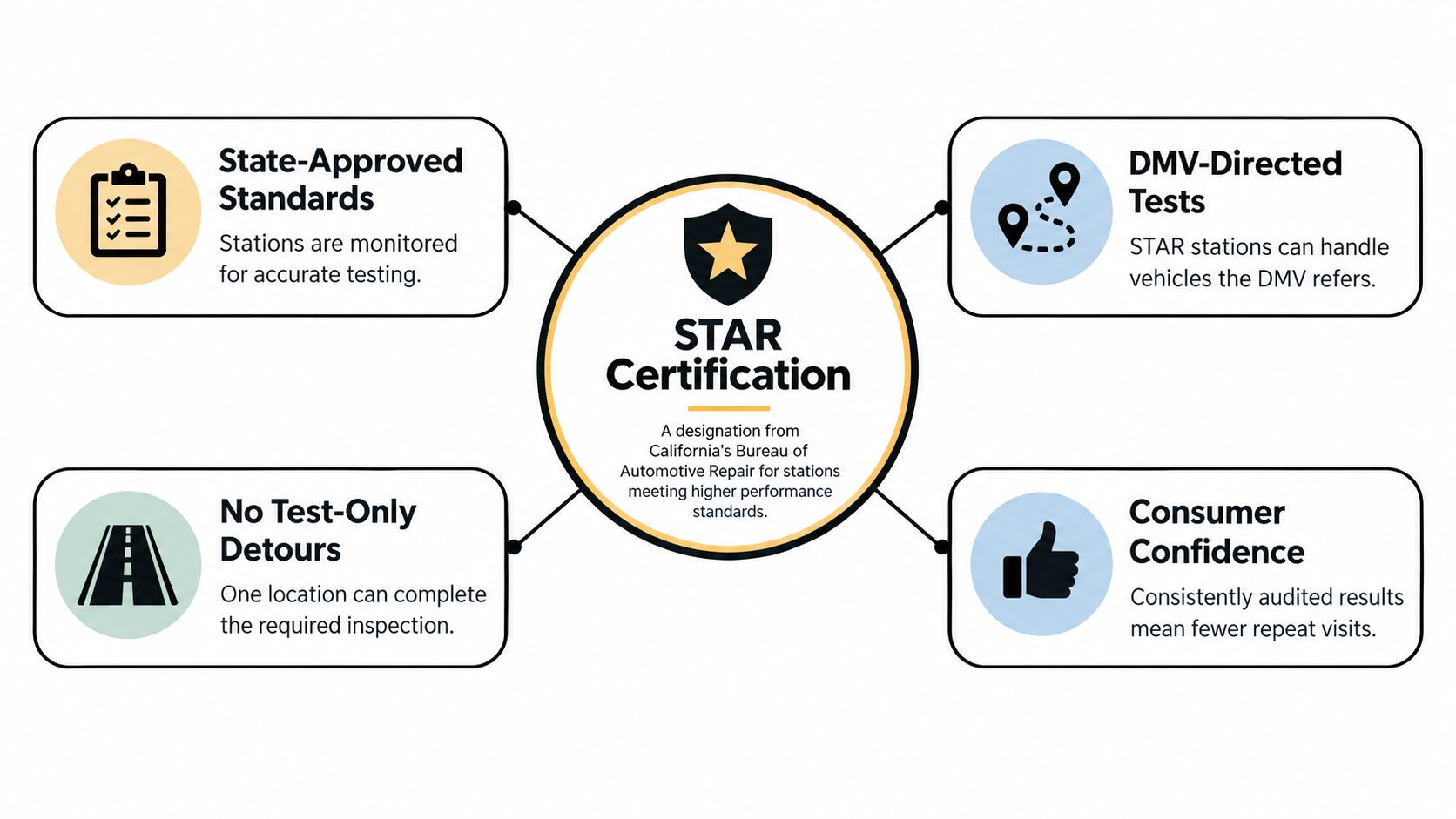
STAR certification is a California Bureau of Automotive Repair designation for stations that meet higher performance standards. It gives drivers a meaningful quality filter, especially when the DMV notice directs them to a STAR station.
STAR isn't a luxury add-on. It's a compliance requirement in situations where the DMV specifically sends you to a STAR location, and it can provide added confidence that the station is operating within California's required inspection standards. Ask the station directly, then verify its current status through California's official station information before booking.
When STAR is non-negotiable
Read the DMV notice before choosing between a STAR and non-STAR station. If the notice says the vehicle must visit a STAR station, a cheaper nearby alternative won't solve the problem. You'll only create another appointment and another drive.
STAR status also matters when you want a straightforward registration experience. A compliant electronic result should be recognized through the normal DMV process, while choosing the wrong station can leave you sorting out why the test didn't meet the stated requirement.
You can also ask whether the location is test-only or test-and-repair. Those labels describe the station's business model, not necessarily its STAR status. A test-only shop can be a sensible choice when you want the inspection separated from repair work. A test-and-repair shop may be useful when you already expect diagnostic work. Choose based on the requirement in your notice and the kind of service you want.
For a plain-language explanation of the designation, see this guide to what a STAR smog station is. Verify the station before you arrive. Don't rely on an old directory listing or a faded sign.
Comparing Stations on Hours, Price, and Convenience
Once you have a shortlist, compare the stations like a practical errand, not like a popularity contest. The best station is the one that meets the requirement, accepts your vehicle, gives you a clear price, and fits your schedule.
| Factor | What to Look For | Why It Matters |
|---|---|---|
| Hours | Morning, evening, and Saturday availability | A nearby station is useless if you can't reach it while open |
| Price | Posted price, coupon terms, and out-the-door total | A low advertised price may not apply to your vehicle |
| Turnaround | Typical test time and walk-in policy | The wait can matter more than the drive |
| Vehicle coverage | 2000+ cars, older vehicles, diesels, and hybrids | Not every station handles every configuration |
| Station type | Test-only or test-and-repair | The right choice depends on whether you want diagnosis or separation |
| Waiting area | Clean indoor seating and clear customer process | Useful when you're staying for the result |
Ask three questions before you leave home
First, “Do you test my exact vehicle?” Give the model year and fuel type. Don't assume a station that tests newer gasoline cars also handles an older vehicle, diesel, or hybrid.
Second, “What is the total price for this vehicle?” Ask whether the figure includes the standard inspection and whether any coupon has restrictions. A coupon that excludes your vehicle won't help you budget.
Third, “How long should I expect to be there?” A stated test time isn't the same as a guaranteed total visit time. Ask whether walk-ins wait behind appointments and whether the station transmits the result electronically after completion.
Test-only versus test-and-repair
Test-only stations can reduce the concern that repair recommendations will influence the inspection conversation. You receive the result and can decide where to take the vehicle if it fails. Test-and-repair stations can be more convenient if you want one location to diagnose a failure, but you should still ask for a clear explanation before authorizing work.
A transparent quote and an honest wait-time estimate are more valuable than a prominent map position.
What to Bring and How to Avoid a Failed Test
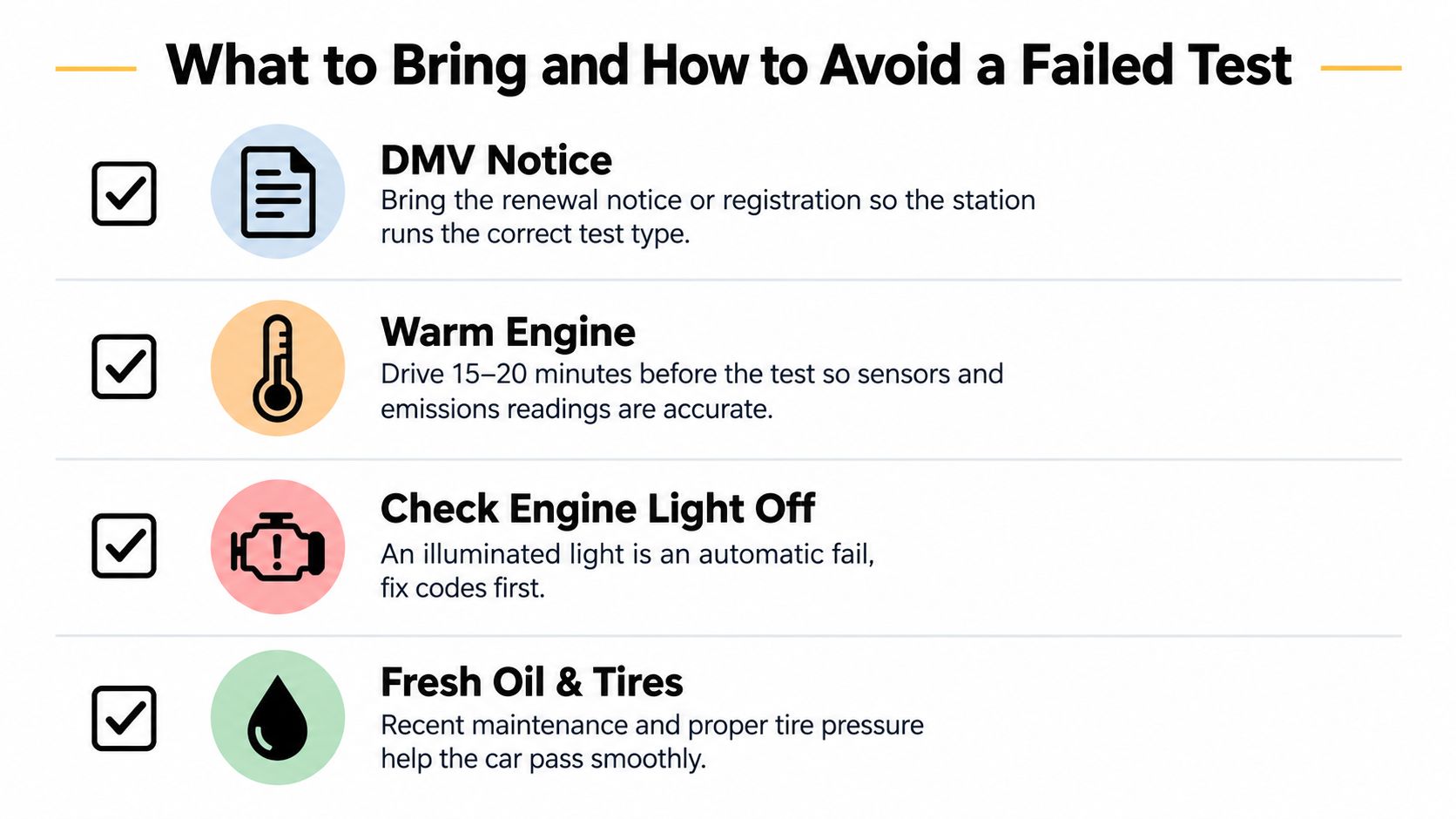
Bring your DMV renewal notice or registration information so the station can confirm the correct test path. Arrive with the engine warmed up, and don't treat the inspection as a diagnostic appointment for a warning light you've ignored for months.
Government guidance identifies three dominant emissions-test failure modes: Diagnostic Trouble Codes, incomplete readiness monitors, and failure to communicate with the vehicle computer. The same emissions-test guidance lists common mechanical culprits such as oxygen-sensor or EGR problems, dirty air filters, misfiring spark plugs, vacuum leaks, and a poor-fitting fuel cap.
What those failure modes mean
A Diagnostic Trouble Code, or DTC, means the vehicle computer has detected a fault. The code may relate to emissions equipment, sensors, ignition, or another system that affects emissions performance.
Readiness monitors are the vehicle computer's internal checks. If you recently disconnected the battery, cleared codes, or completed repairs, the monitors may not have finished their checks. In that condition, the vehicle can fail even when the check-engine light is off.
Non-communication means the testing equipment can't establish a reliable connection with the vehicle computer. A damaged connector, electrical issue, or computer problem can stop the test before emissions performance is even evaluated.
Before driving to the station, run through this checklist:
- Check the dashboard: Don't arrive with an active check-engine light or recently cleared codes.
- Consider recent battery work: A disconnected battery can leave readiness monitors incomplete.
- Inspect the fuel cap: Make sure it fits correctly and seals properly.
- Listen for rough running: Misfires, hesitation, or unstable idling deserve attention before testing.
- Look for leaks: Vacuum leaks can trigger emissions problems and drivability symptoms.
- Ask for diagnostics when needed: If the light is on, find out what the code means before paying for the inspection.
For additional preparation guidance, use this pre-smog-check checklist. The goal isn't to manipulate the result. It's to remove obvious problems so the test reflects a vehicle that's actually ready for inspection.
A Local Example That Checks Every Box
A useful local benchmark is the STAR Certified station at 15275 Washington Ave, San Leandro, California 94579. It handles 2000 and newer vehicles, 1999 and older vehicles, diesels, and hybrids, so drivers can ask about coverage without assuming that every vehicle follows the same path.
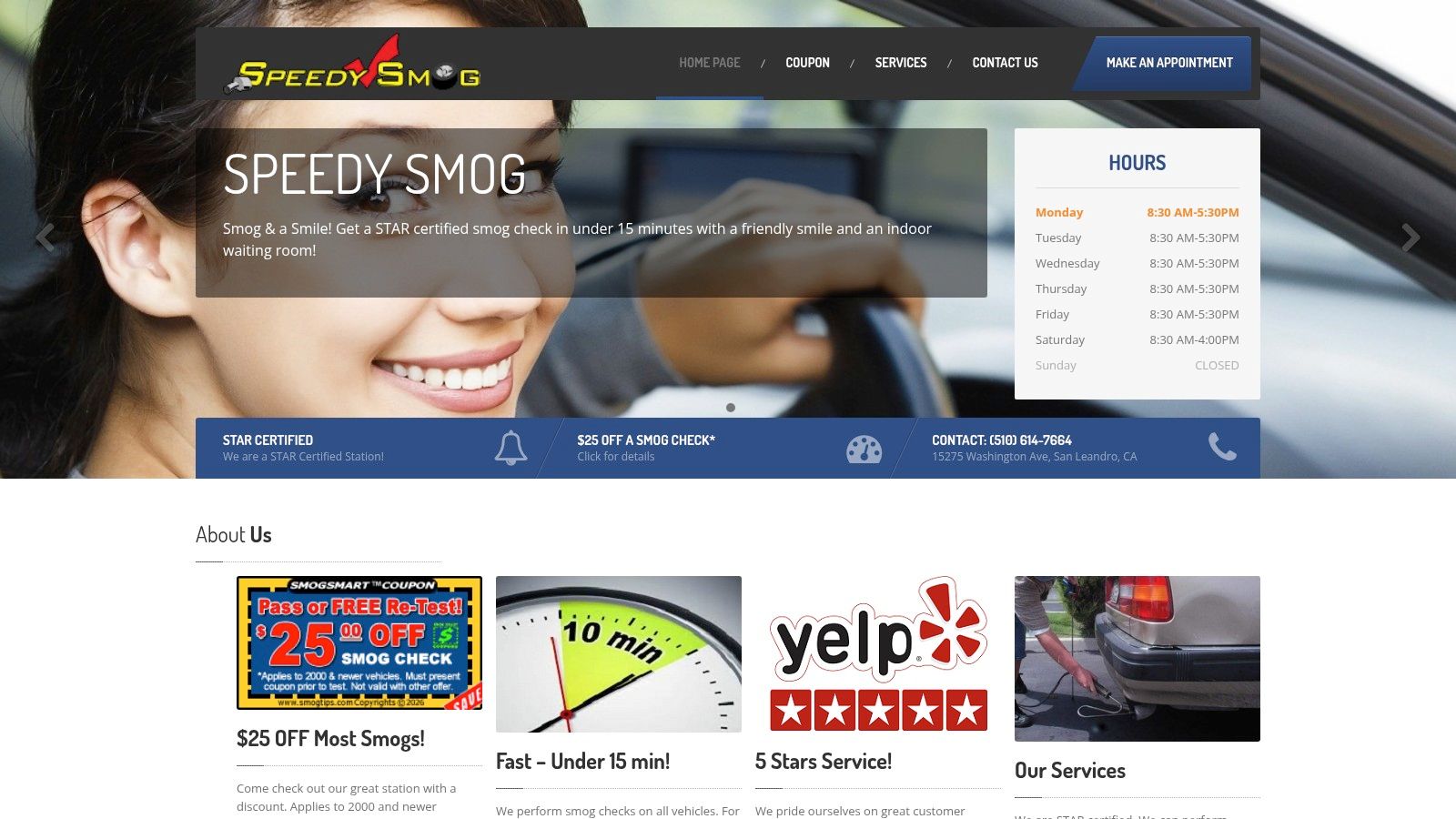
The station typically completes tests for 2000+ vehicles in about 10–15 minutes and is open Monday through Saturday. It also publishes transparent pricing, offers periodic $25-off coupons for most smogs on newer vehicles, and provides a clean indoor waiting room. Those details are exactly what you should compare at any station, coverage, schedule, price clarity, turnaround, and a reasonable place to wait.
The point isn't to choose a station because it appeared first in search. It's to see how a concrete option measures against the checklist. A station that can handle your vehicle, meet the STAR requirement, explain the price, and fit your schedule has earned a closer look.
Ask about the current price and coupon terms before arriving, since promotions and vehicle eligibility can change.
Getting Certified and Back on the Road
The cleanest process is straightforward: read the DMV notice, identify the required test, shortlist stations that handle your vehicle, verify STAR status when required, compare hours and price, then prepare the car before arriving.
If the vehicle passes, the station can transmit the result electronically to the DMV, allowing you to complete the registration renewal through the normal process. Keep the confirmation and renewal details until the registration is complete.
A failure isn't unusual, particularly as vehicles age. About 1.3 million of 19 million 2000+ model-year vehicles tested in the 2024–2025 cycle failed Smog Check, an approximate 7% fleet failure rate, while roadside inspections recorded a fleet-weighted average failure rate of about 14%, according to vehicle emissions-test information from CARFAX. A station result and a roadside condition aren't identical measurements, so treat a failure as a reason to diagnose the vehicle, not as a reason to guess at another station.
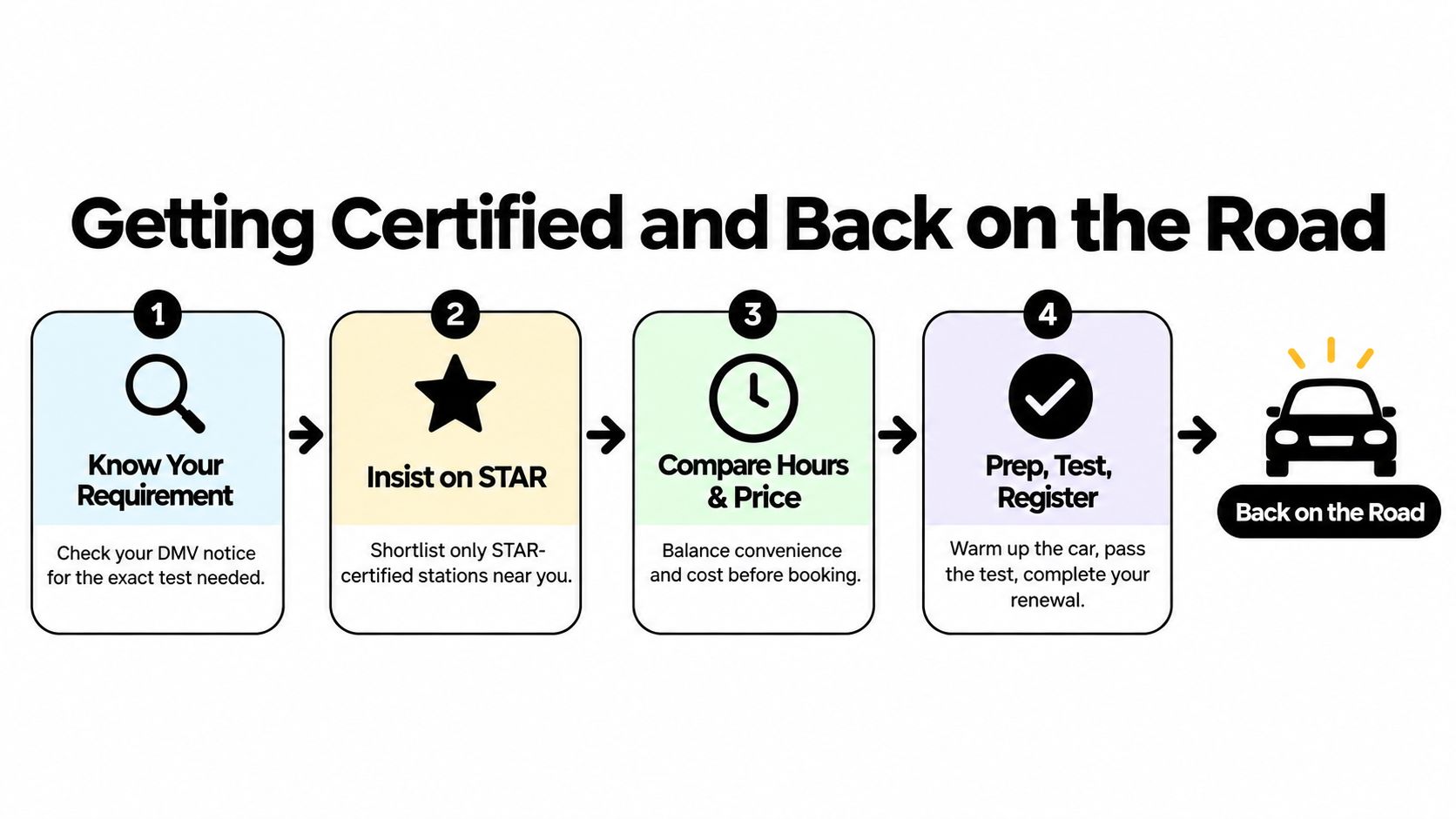
Put the next renewal date on your calendar, watch for relevant coupons, and deal with a check-engine light before renewal week. That small amount of planning keeps a routine inspection from becoming an expensive registration emergency.
If you need a STAR-certified inspection in San Leandro, Speedy Smog handles 2000 and newer vehicles, older vehicles, diesels, and hybrids, with typical 2000+ tests completed in about 10–15 minutes. Review the current details and visit Speedy Smog before you drive in.