
Gasoline, hybrid, and alternative-fuel vehicles that are eight model years old or newer are exempt from California's biennial Smog Check, but owners pay a smog abatement fee instead until the first required test. A 2020 model-year vehicle, for example, would first need a renewal Smog Check in 2028.
You've just bought a new car, the DMV renewal notice mentions smog, and now you're wondering whether California expects you to find a test station immediately. I see this confusion constantly at the shop, especially from drivers who assume “new” means “no emissions paperwork.” California's rule is simpler than the notice makes it sound, but the clock is based on the vehicle's model year, not the day you bought it.
That distinction matters when a car changes owners, arrives from another state, or reaches the end of its exemption window. The right calendar date can save you an unnecessary appointment. The wrong assumption can send you to the DMV without the certificate you need.
Table of Contents
- Why New Car Owners Ask About California Smog Checks
- The 8 Model Year Exemption Explained
- First Time Registration Rules for New California Vehicles
- What Happens at a Smog Check for 2000 and Newer Cars
- When You Need a STAR Certified Station Instead
- Common Myths That Trip Up New Car Owners
- Your Quick Checklist Before Your Next Smog Test
Why New Car Owners Ask About California Smog Checks
A driver may buy a 2025 RAV4 Hybrid from a California dealership, enjoy it for months, and then receive a renewal notice that includes smog-related language. The notice doesn't necessarily mean the vehicle needs an immediate inspection. It may reflect the DMV's registration process and the applicable smog abatement fee during the new-car exemption period.
California's emissions program and the DMV registration system work together, but they aren't the same thing. The California Air Resources Board establishes emissions-control requirements, while the DMV uses Smog Check compliance information when processing certain registrations and renewals. The California DMV's Smog Inspections guidance confirms that newer gasoline, hybrid, and alternative-fuel vehicles generally follow an exemption pathway rather than disappearing from the program.
Four situations that create confusion
The question usually comes from one of these situations:
- A renewal notice arrives early: The driver sees “smog” on the notice and assumes a test is due, even though the vehicle may still be inside the exemption window.
- An out-of-state title comes to California: Initial California registration can involve requirements that don't apply to a California dealer sale.
- The paperwork has no obvious smog line: Owners may not know whether the dealer handled the matter or whether they must visit a station.
- A dealer inspection gets confused with a state inspection: A dealer may inspect a vehicle before sale, but that doesn't automatically answer every DMV registration requirement.
Three owner groups ask me about this most often. Recent buyers want to know whether the dealer completed everything. Owners approaching the eight-model-year boundary need a precise first-test year. Buyers of cars that sat on a dealer lot may see a current model year while the registration timeline has already begun.
The practical answer is to separate the questions. First, identify the model year and fuel type. Next, determine whether the registration is a California renewal or an initial California registration. Finally, check whether the DMV issued a directed requirement. That process tells you whether you need a test, a fee, a VIN verification, or just a normal renewal.
The 8 Model Year Exemption Explained
California's current rule gives gasoline, hybrid, and alternative-fuel vehicles eight model years or newer an exemption from the biennial Smog Check required for registration renewal. During that period, the owner pays a smog abatement fee with DMV renewal fees instead of bringing the vehicle to a test station, as described by the Bureau of Automotive Repair's vehicle inspection guidance.
The clock follows the model year printed on the vehicle records. It doesn't restart when you purchase the car, move to another county, or sell it to another California driver. A vehicle keeps the same model-year age throughout its life.
Use the model year, not the purchase date
Take a 2018 model-year vehicle. Under the eight-model-year calculation, it remains exempt through the 2025 renewal cycle and faces its first required test for the 2026 registration year. The owner may have bought it new, used, or from another state. Those purchase details don't change the model-year calculation.
The state extended the exemption from six model years to eight under AB 1274, effective January 1, 2019, and added a $25 annual smog abatement fee during the added exemption period, according to SEMA's explanation of California's new-car exemption change. The fee is the replacement for the inspection during the applicable exemption period. It isn't proof that the vehicle has passed a Smog Check.
Practical rule: If the renewal notice says a test is required, follow the notice. If you believe the notice conflicts with the model-year calculation, resolve it with the DMV before assuming the vehicle is exempt.
The exemption discussed here applies to regular biennial registration renewals. It doesn't erase every possible inspection obligation. A transfer-of-ownership transaction or a directed DMV notice can create a separate requirement. Electric vehicles and diesel vehicles also follow separate rules, so don't apply the gasoline and hybrid timeline blindly to every powertrain.
Find your first required test year
| Model Year | Exempt Through | First Required Test For |
|---|---|---|
| 2018 | 2025 renewal cycle | 2026 registration year |
| 2019 | 2026 renewal cycle | 2027 registration year |
| 2020 | 2027 renewal cycle | 2028 registration year |
| 2021 | 2028 renewal cycle | 2029 registration year |
| 2022 | 2029 renewal cycle | 2030 registration year |
For the broader rules and renewal details, keep the California smog check rules handy. The fastest approach is to write down the model year, add eight, and treat that year as the first renewal year to verify with the DMV. Don't wait until the registration deadline if the notice and your calculation disagree.
First Time Registration Rules for New California Vehicles
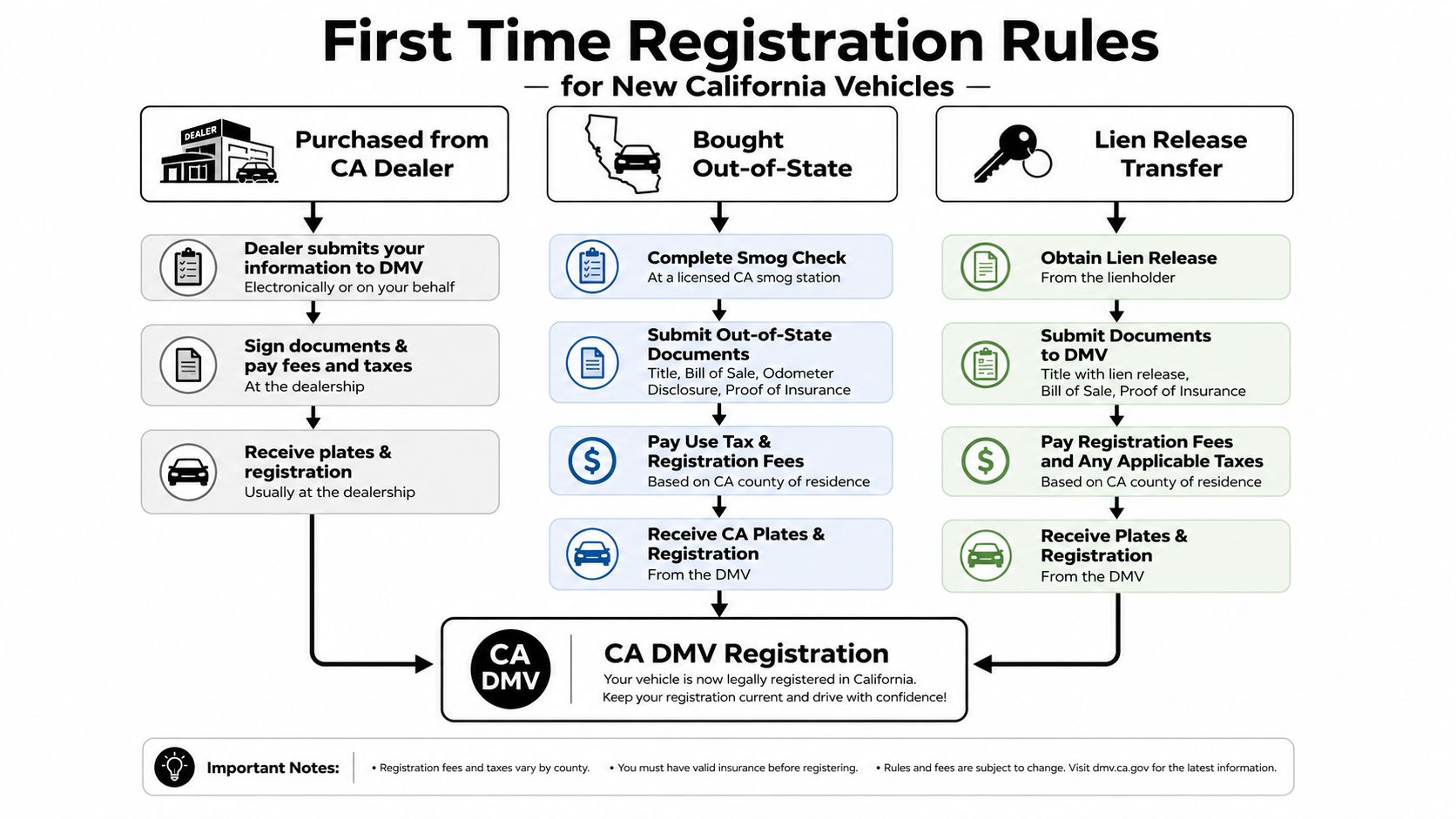
A new vehicle follows a different path depending on where the transaction occurred. A California dealer sale is usually the cleanest case. The dealer submits the initial registration paperwork, and the buyer typically doesn't need to arrange a separate Smog Check for that initial California registration because the vehicle is inside the new-car exemption.
An out-of-state purchase requires more attention. The DMV may need an out-of-state title or equivalent ownership document, a VIN verification, and a smog certificate before completing the California title and registration process for a qualifying gasoline vehicle. A manufacturer's certificate of origin is different from a California title, and neither should be treated as interchangeable with an out-of-state title.
Three paperwork paths
Consider a buyer who brings a recently purchased vehicle from Nevada into California. The buyer may need to complete the VIN verification, obtain the required emissions inspection, and then take the paperwork to the DMV. The inspection station electronically submits a bar-coded certificate that the DMV can use when processing the registration.
A lien release transfer can create its own documentation trail. The owner should follow the DMV's instructions for the title and transfer documents rather than assuming the vehicle's age eliminates every transaction requirement.
Put the inspection in the right order
The common mistake is visiting the DMV first, discovering that a smog certificate is missing, and then making a second trip to a station. For an out-of-state transfer, handle the VIN and emissions requirements before the DMV appointment whenever the DMV directs you to do so.
A California dealer may handle the initial registration, while a private buyer importing a car usually has to coordinate more of the process. The California registration renewal process can help you separate a renewal from an initial registration transaction. Bring the title documents, purchase paperwork, identification, and any DMV notice to the station or DMV so the technician or clerk can identify the exact transaction.
What Happens at a Smog Check for 2000 and Newer Cars
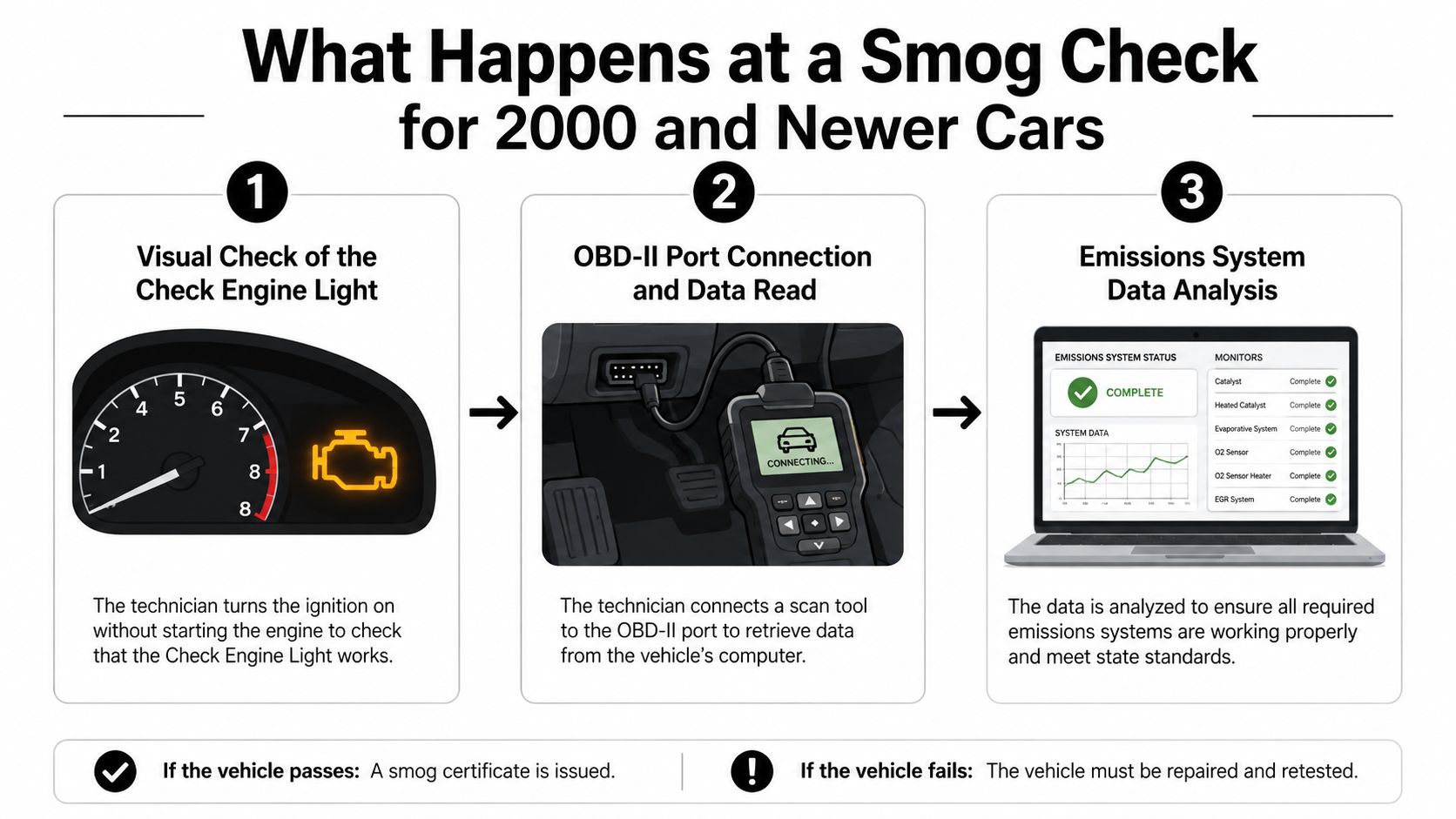
For a 2000-and-newer gasoline vehicle, the inspection is primarily an OBD-II diagnostic check, not the old-style tailpipe routine most drivers picture. The BAR On-Board Diagnostic Inspection System collects data from 2000-and-newer vehicles, according to the BAR Smog Check Manual.
The technician starts by checking the dashboard and the emissions-related warning light. Then the technician connects an approved scan tool to the vehicle's data link connector, generally located under the dashboard. The scan retrieves emissions information from the vehicle's computer rather than relying only on exhaust gas measured at the tailpipe.
The technician reads the emissions computer
The inspection reviews information such as stored diagnostic trouble codes, pending codes, readiness monitor status, and the malfunction indicator lamp status. The vehicle must show that its emissions system has completed the applicable self-checks and that the computer's commanded warning-light status matches what the driver sees.
That's why disconnecting the battery shortly before an appointment can create trouble. The vehicle may run normally while the readiness monitors remain incomplete. A recently repaired vehicle may also need normal driving before its computer can verify that the repair solved the emissions problem.
When a tailpipe test can still appear
The BAR manual identifies limited situations in which a 2000-and-newer gasoline vehicle may still receive a tailpipe test on the BAR-97 analyzer. Examples include a vehicle that lacks OBD-II, exceeds 14,000 pounds GVWR, or has an OBD-II system flagged as problematic. The manual, rather than the vehicle's age alone, determines how the station handles that inspection.
A lit check engine light generally means the vehicle won't pass the emissions inspection. The station gives the owner a failure report, and the owner can choose a qualified repair technician before returning for a retest. Eligible owners may also investigate California's income-based repair assistance, but eligibility depends on the program's requirements.
Watch the inspection flow before you arrive:
When You Need a STAR Certified Station Instead
A regular licensed station can perform authorized inspections within its license scope. A STAR-certified station operates under the Bureau of Automotive Repair's STAR program and handles vehicles that the DMV directs to STAR testing.
The registration notice is the deciding document. If it specifies STAR, book a STAR station. Don't choose a regular station first and hope the DMV will accept the result. A vehicle can also be directed after a previous failure or through the state's high-emitter screening process.
Compare the stations before booking
| Scenario | Regular Station | STAR Station |
|---|---|---|
| Routine renewal without a STAR direction | May perform the inspection if licensed for the vehicle | May also perform it if licensed |
| DMV renewal notice specifies STAR | Not the correct choice | Required destination |
| Vehicle has a directed testing requirement | May not satisfy the direction | Designed for directed inspections |
| New vehicle inside the exemption | No test is normally needed | No STAR test is normally needed |
STAR stations face additional state oversight and inspection requirements. That doesn't mean every new vehicle needs STAR testing. A new gasoline or hybrid vehicle still follows the model-year exemption unless the DMV issues a separate transaction-specific direction.
Read the notice before calling
Look for wording that directs you to a STAR station, especially after a failed renewal inspection or a high-emitter designation. If the notice doesn't direct you to STAR, a licensed station that handles your vehicle's fuel type and model year may be appropriate.
The STAR station explanation from Speedy Smog gives owners a practical overview of the distinction. My recommendation is simple: take a photo of the renewal notice before booking, then show it to the station. That prevents the most avoidable mistake, choosing a shop that can't complete the required transaction.
Common Myths That Trip Up New Car Owners
Myth one: New cars never need a Smog Check. The rule is narrower. Gasoline, hybrid, and alternative-fuel vehicles are exempt from biennial renewal testing only while they remain within the eight-model-year window. The model year controls the clock, not the date on your purchase contract.
Myth two: Hybrid vehicles skip emissions testing permanently. They don't. Hybrids receive the same new-vehicle exemption treatment described in the DMV guidance, then enter the applicable renewal testing schedule after the exemption ends.
Myth three: A new car needs no smog-related paperwork. New owners may not need a test, but they still pay the smog abatement fee during the exemption period. That fee is part of the registration transaction and replaces the inspection for that period.
Myth four: An out-of-state car avoids California testing. Bringing a vehicle into California for initial registration can require a VIN verification and a smog certificate, even when the vehicle is relatively new. The transaction type matters as much as the vehicle's age.
Myth five: Passing once ends the requirement. A pass satisfies that inspection transaction. After the first required test, qualifying vehicles generally return to the biennial renewal schedule, so keep the next registration deadline on your calendar.
The California DMV smog inspection rules are the controlling reference for the exemption and registration connection. If your notice conflicts with an assumption, trust the notice and verify the issue instead of relying on a dealership conversation or an online forum.
Your Quick Checklist Before Your Next Smog Test
Use this checklist the morning you plan the appointment:
- Pull out the DMV notice. Check whether it calls for a Smog Check, a STAR station, or another registration step.
- Write down the model year. Count the eight-model-year exemption from the model year, not your purchase date.
- Confirm the fuel type. Gasoline and hybrid vehicles follow the timeline covered here. Diesel and electric vehicles require separate rule checks.
- Check the warning light. A check engine light should not be illuminated when you arrive.
- Avoid a last-minute battery disconnect. The OBD system may need driving time to reset its readiness monitors after power loss or emissions repairs.
- Choose the correct station. Use the BAR station finder, and select STAR when the DMV directs you there.
- Bring the transaction documents. Out-of-state transfers may need title paperwork, VIN verification, and a certificate that the DMV can match to the vehicle.
- Allow appointment time. A licensed station can tell you its expected turnaround, but don't schedule the inspection so tightly that a failed test leaves no time for diagnosis.
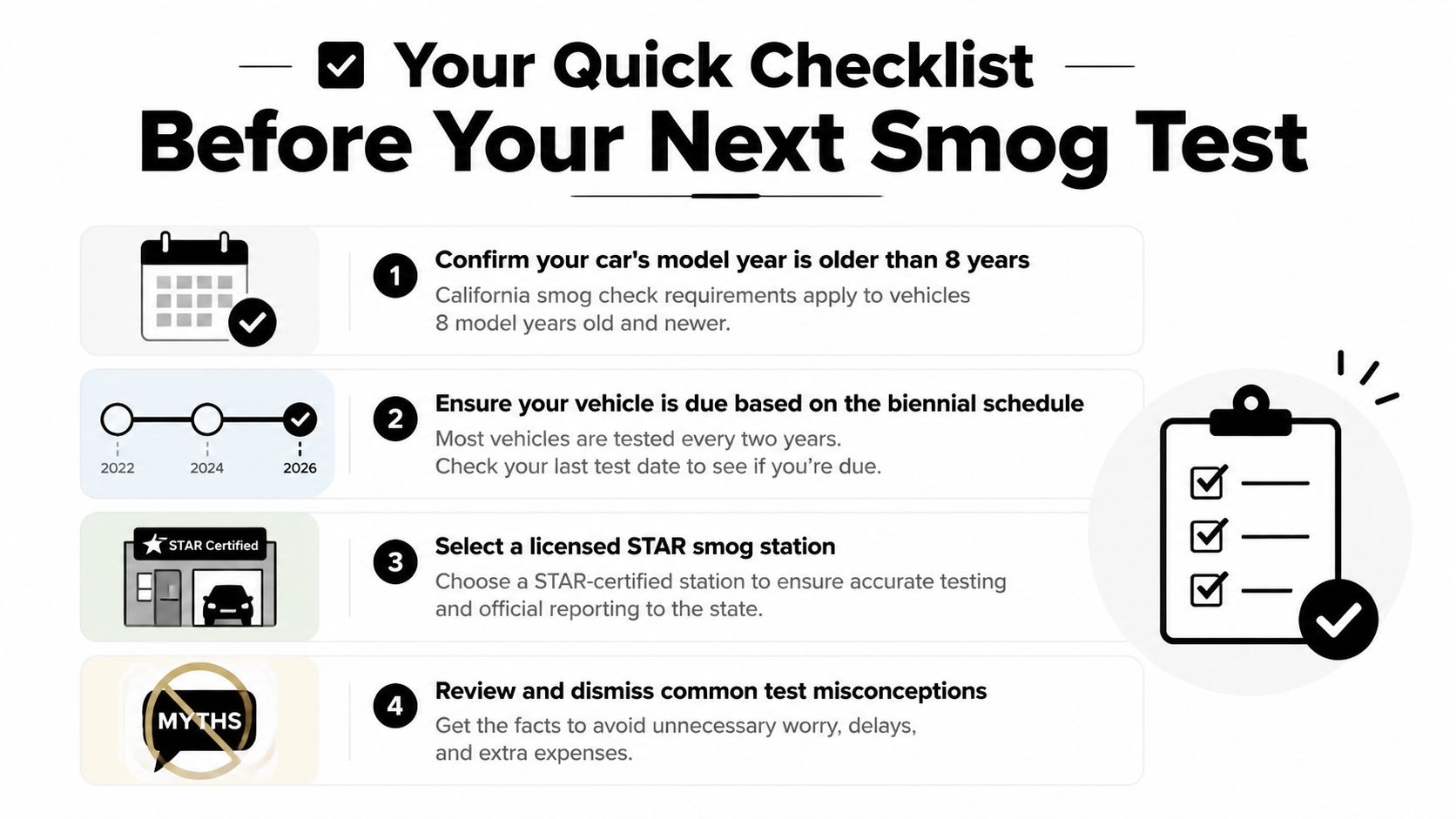
A passing inspection produces the compliance record needed for the applicable DMV transaction. A failure produces a report identifying the problem, not a reason to keep guessing. Have the vehicle diagnosed, complete the emissions repair, and ask the station about the retest process before authorizing unrelated work.
If you're unsure whether your newer vehicle has reached its first required test year, bring the DMV notice and vehicle information to Speedy Smog. The San Leandro shop handles inspections for newer vehicles, hybrids, and other qualifying vehicles, and can help you choose the correct testing path before you make a wasted DMV trip.