California STAR Smog Station: What It Is and Who Needs One
What if the station you choose isn't the decision at all? Most East Bay drivers start by searching for a shop. The smarter first step is smaller. Read one line on your DMV renewal notice. That wording decides whether any licensed station will work, or whether you need a California STAR smog station. Miss that word, and you can pay for a valid test at the wrong kind of station. Then you pay again.
Table of Contents
- What a STAR Smog Station Actually Is
- STAR and Regular Smog Stations Side by Side
- Which Vehicles Need a Smog Check and Which Are Exempt
- When Your DMV Notice Requires a STAR Station
- How to Find a Nearby STAR Station in the East Bay
- Prepare Your Car So the Smog Test Passes
What a STAR Smog Station Actually Is
Does your DMV notice require a STAR station, or will any licensed Smog Check station do? STAR is a certification held by the station, not a different test for your car. The notice's wording is what tells you whether that certification matters.
A California STAR smog station is a Smog Check station certified by the Bureau of Automotive Repair, or BAR, for meeting program performance standards. BAR can assign certain vehicles, called directed vehicles, to STAR stations. That assignment is about where the vehicle can be tested, not a separate kind of inspection.
A STAR station works like a restaurant that has earned a higher inspection grade. The food may be the same, but the kitchen is monitored against a stricter standard and must continue to meet it. For a driver, the practical difference is the station's certification and oversight.
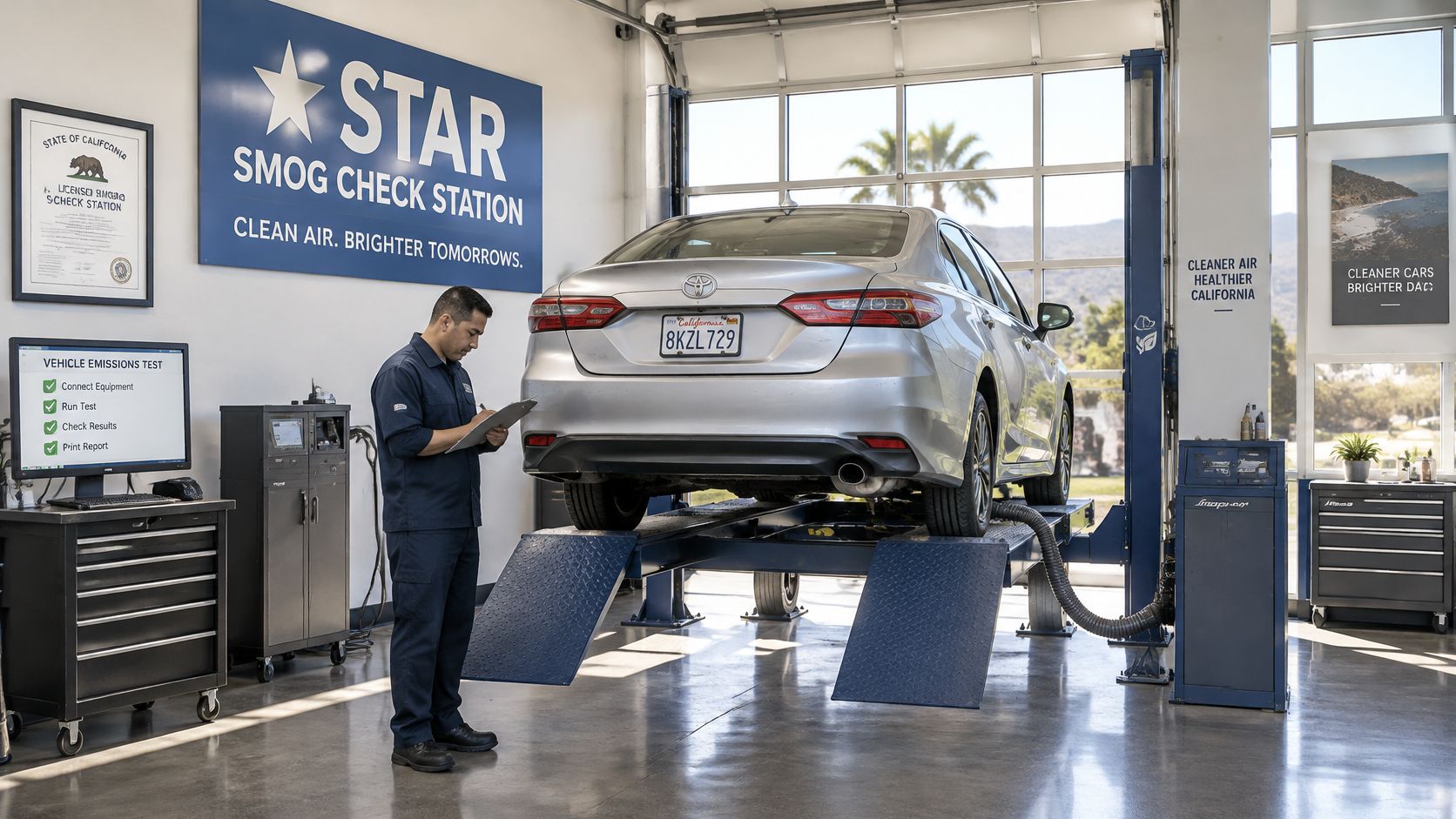
The Same Test at a More Closely Watched Station
The Smog Check procedure does not change because a station is STAR certified. BAR monitors station performance by comparing inspection results with those of other stations and inspectors in the program.
STAR began as a voluntary program in January 2013 for stations seeking authorization to inspect directed vehicles, according to BAR's 2019 Smog Check performance report. A station applies, then must continue meeting the program standard to keep its certification.
Plain rule: STAR describes the station's credential. It does not mean your car gets a different or faster test.
A regular Smog Check station is also licensed by BAR. If a station is not STAR certified, that does not mean it is unlicensed. It means the station does not hold the additional STAR certification.
STAR stations handle most initial Smog Checks, showing that the program is a significant part of California's inspection system. Still, a station's certification does not decide what your vehicle needs. The DMV notice does. Check whether it says your vehicle must go to a STAR station before choosing where to test.
STAR and Regular Smog Stations Side by Side
Start with the table. It shows what separates the two station types, and what doesn't.
| Feature | STAR station | Regular Smog Check station |
|---|---|---|
| Basis of certification | Voluntary BAR designation tied to measured performance | Standard BAR licence to perform Smog Checks |
| Directed vehicles | Eligible to test vehicles BAR assigns to STAR stations | Not eligible for directed tests |
| Performance monitoring | Benchmarked on failure rate, gear-shift incidents, test deviation and follow-up pass rate | Standard station oversight |
| Licensed stations, December 2020 | 3,893 (51%) | 3,715 |
| Initial Smog Check tests, 2020 | About 8.4 million (82%) | About 1.9 million (18%) |
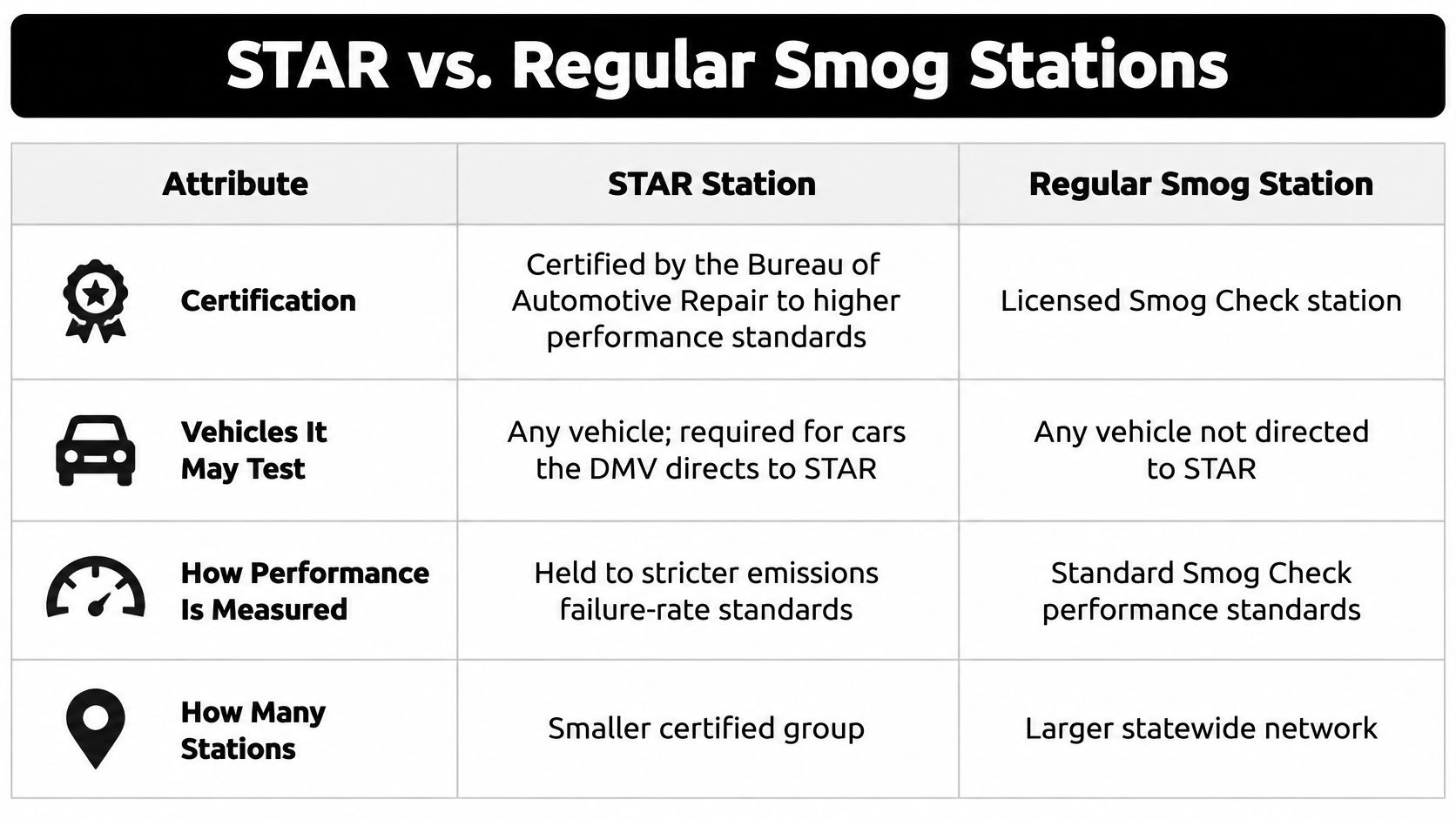
How to Read the Two Share Rows
The station count and the test count tell different stories. In December 2020 there were 7,608 licensed stations statewide, and 3,893, or 51%, were STAR certified, according to BAR's 2020 Smog Check performance report. The regular station count above comes from that same total minus the STAR count.
Yet STAR stations performed about 8.4 million of roughly 10.3 million initial tests that year, or 82%, while non-STAR stations performed about 1.9 million, or 18%. Half the shops did the large majority of the work. So most California drivers end up at a STAR station anyway, even when their notice doesn't require one.
The One Hard Limit on a Regular Station
A regular station can perform a standard Smog Check. It can't take a vehicle BAR has directed to STAR. That's the whole practical difference for a driver choosing where to go.
Certification also isn't permanent. BAR grants it only after a station meets the applicable quarterly performance requirements. A station that slips can lose the credential you were counting on.
A regular station is usually fine for an ordinary renewal. Your DMV notice is the document that decides when it isn't.
Keep that rule in mind. First, though, check whether your vehicle needs a test at all.
Which Vehicles Need a Smog Check and Which Are Exempt
Start with the vehicle details on your registration: fuel type, model year, and weight. They determine whether California requires a Smog Check. Your DMV notice then tells you whether the test must be done at a STAR station.
| Vehicle group | Smog Check status | What the station does |
|---|---|---|
| Gasoline or alternative-fuel, model year 2000 or newer, 14,000 lb GVWR or less | Required | OBD-II check through BAR-OIS |
| Gasoline, model year 1996 to 1999 | Required | OBD and tailpipe testing |
| Gasoline, model year 1995 or older | Required | Test depends on the vehicle and applicable equipment |
| Hybrid vehicle | Required | Test follows its model year and fuel rules |
| Diesel, model year 1997 or older | Exempt | No test required |
| Diesel, model year 1998 or newer, 14,000 lb GVWR or less | Required | Diesel Smog Check |
| Diesel above 14,000 lb GVWR | Exempt | No test required |
What the Station Actually Reads
For most gasoline and alternative-fuel vehicles from model year 2000 onward at 14,000 pounds or less, the test is mainly an OBD-II inspection through the BAR-OIS system. As the California Air Resources Board OBD-II fact sheet explains, the equipment connects to the engine computer and checks trouble codes, check-engine light behavior, and emissions monitor readiness.
Older gasoline vehicles use different testing. Vehicles from 1996 through 1999 typically receive both OBD and tailpipe tests. Gasoline vehicles from 1995 or earlier may require testing based on their equipment and applicable rules. Certain 2000 to 2007 medium-duty or non-OBD-II vehicles can also need tailpipe analysis.
The Two Groups Drivers Get Backwards
- Hybrids aren't exempt: Hybrid vehicles are subject to Smog Check, according to the DMV smog inspections page. The fuel system does not remove the requirement.
- Diesel eligibility depends on year and weight: Diesels from model year 1997 or older are exempt. Diesels from model year 1998 onward require a test if they have a GVWR of 14,000 pounds or less. Diesels above that weight are exempt.
- Check both details: Match the fuel type with the model year and, for diesel vehicles, the weight. Assuming every diesel is exempt can mean an unexpected second trip.
If your vehicle is near one of these cutoffs, which cars need a smog check in California explains the categories in more detail. A vehicle's eligibility tells you whether it needs a test. The exact wording on your DMV notice determines whether that test must be at a STAR station.
When Your DMV Notice Requires a STAR Station
Does your renewal notice say a STAR station is required? Start with that line. The wording on the notice determines where you can test, so read it before choosing a shop.
| Notice wording | What it requires | Where you can test |
|---|---|---|
| Smog Certification Required | A Smog Check at an authorized station | Any licensed Smog Check station |
| Smog Certification Required at a STAR station | A Smog Check at a STAR-certified station | STAR stations only |
Two Notices That Look Almost Identical
A notice reading Smog Certification Required allows you to use any licensed station. A notice reading Smog Certification Required at a STAR station directs you to a STAR-certified station. BAR's Smog Check consumer page explains the distinction between these notice types.
The difference is just a few words. Read the whole smog line, including its ending, before you book or drive to a station.
Check the last words: If the line ends with "at a STAR station," a regular station's certificate will not meet that requirement.
For example, an Oakland driver whose notice specifies a STAR station might choose a regular shop nearby. The test could be performed correctly and the car could pass, but the certificate would not satisfy the STAR direction on the notice. The driver would need another test at a STAR station. The mistake is choosing a shop before checking the full wording.
Two Habits That Prevent the Second Trip
- Bring the notice if you have it: It helps the station confirm your vehicle information. Speedy Smog electronically transmits smog check results directly to the DMV. Bring your vehicle and your registration renewal notice if you have it.
- Handle out-of-state registration separately: Vehicles being registered in California from out of state require a Smog Check regardless of model year. Check the wording on your notice to see whether it also directs you to a STAR station.
STAR is a program with higher performance standards, intended to inspect higher-polluting vehicles. If your notice does not specify a STAR station, a regular licensed station can perform the Smog Check. Let the notice guide your choice rather than paying extra or driving farther without a STAR requirement.
How to Find a Nearby STAR Station in the East Bay
You can do this search on your phone in a few minutes. Follow the steps in order. Each one rules out a common wrong turn.
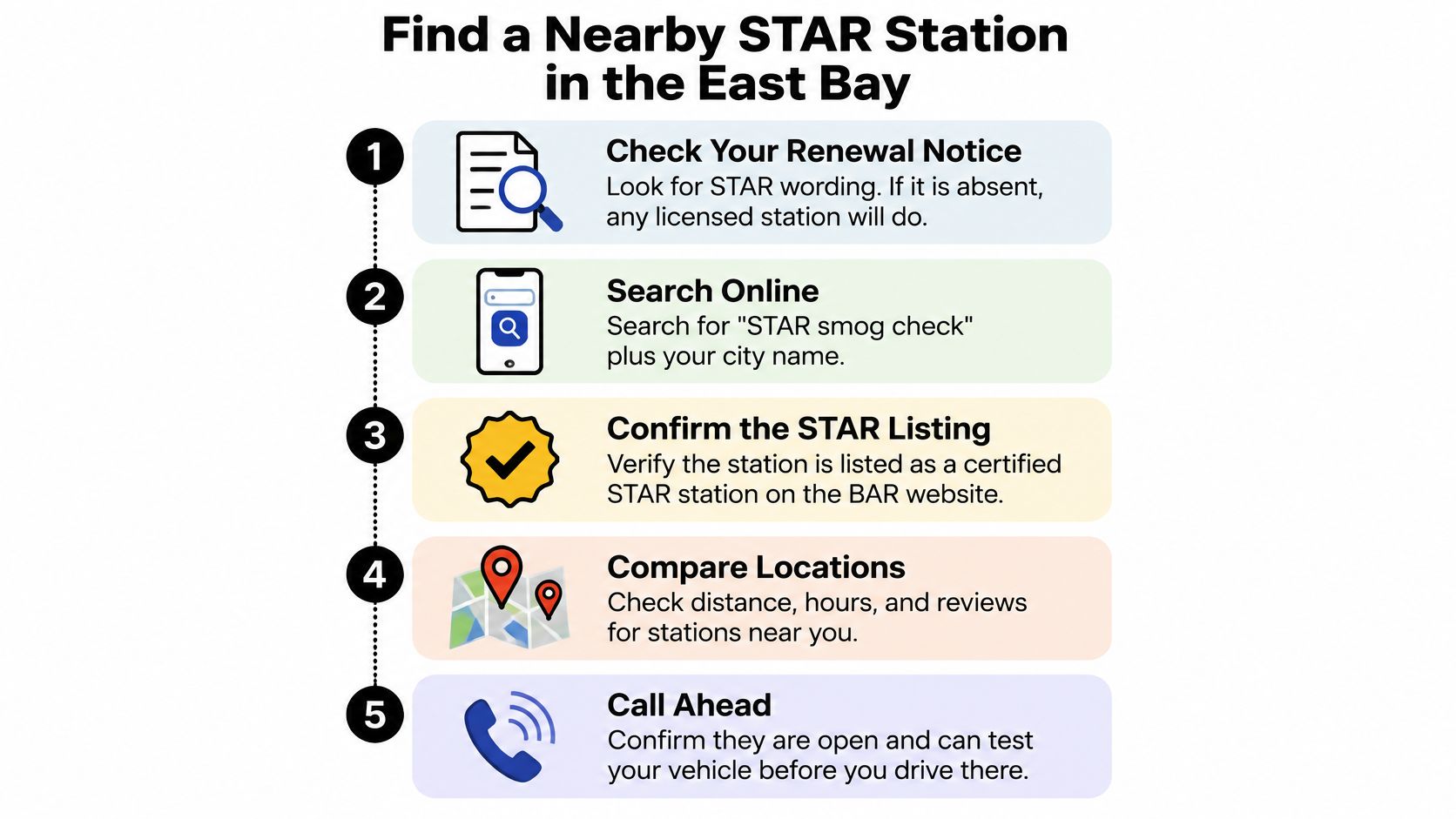
Five Steps Before You Get in the Car
- Read your notice first: Look for the STAR wording. If it's absent, any licensed station will do, and you can pick the closest one.
- Search by city: Search "STAR smog check" with your city name, such as Oakland, San Leandro, Hayward, Alameda, or Fremont. East Bay drivers search by neighborhood, and results follow that pattern.
- Confirm the credential: Look for STAR signage at the shop and check the station's listing. STAR stations must maintain required signage, licenses, records, and properly functioning BAR equipment under BAR's STAR certification requirements.
- Ask test-only or test-and-repair: Some STAR locations perform inspections only. Others also perform repairs. Verify before you arrive, especially if you suspect the car might fail.
- Call ahead: Confirm your vehicle type and the hours. A short call beats a wasted drive.
Step four deserves emphasis. Arriving at a test-only facility expecting repairs is the second most common mix-up we see, right after the notice wording itself. If your check-engine light is on, ask the repair question before you book anything. Our overview of where to get your car emissions tested covers the local search in more detail.
A Worked Example in San Leandro
We're a STAR Certified station at 15275 Washington Ave, San Leandro, CA 94579. You can call us at (510) 614-7664. We serve customers in San Leandro, Hayward, Alameda, and Oakland for smog checks and STAR smog checks.
Use any station you find the same way. Match the address to your route. Match the credential to your notice. Match the services to your car's condition.
One caveat. Certification status can change, because stations must keep meeting BAR's performance standards. Verify directly with the station before you drive over. Don't rely on an old listing or a faded sign.
Prepare Your Car So the Smog Test Passes
Run this checklist the week before your test. Not at the counter. Most avoidable failures are set in motion days earlier, often by a well-meant fix.
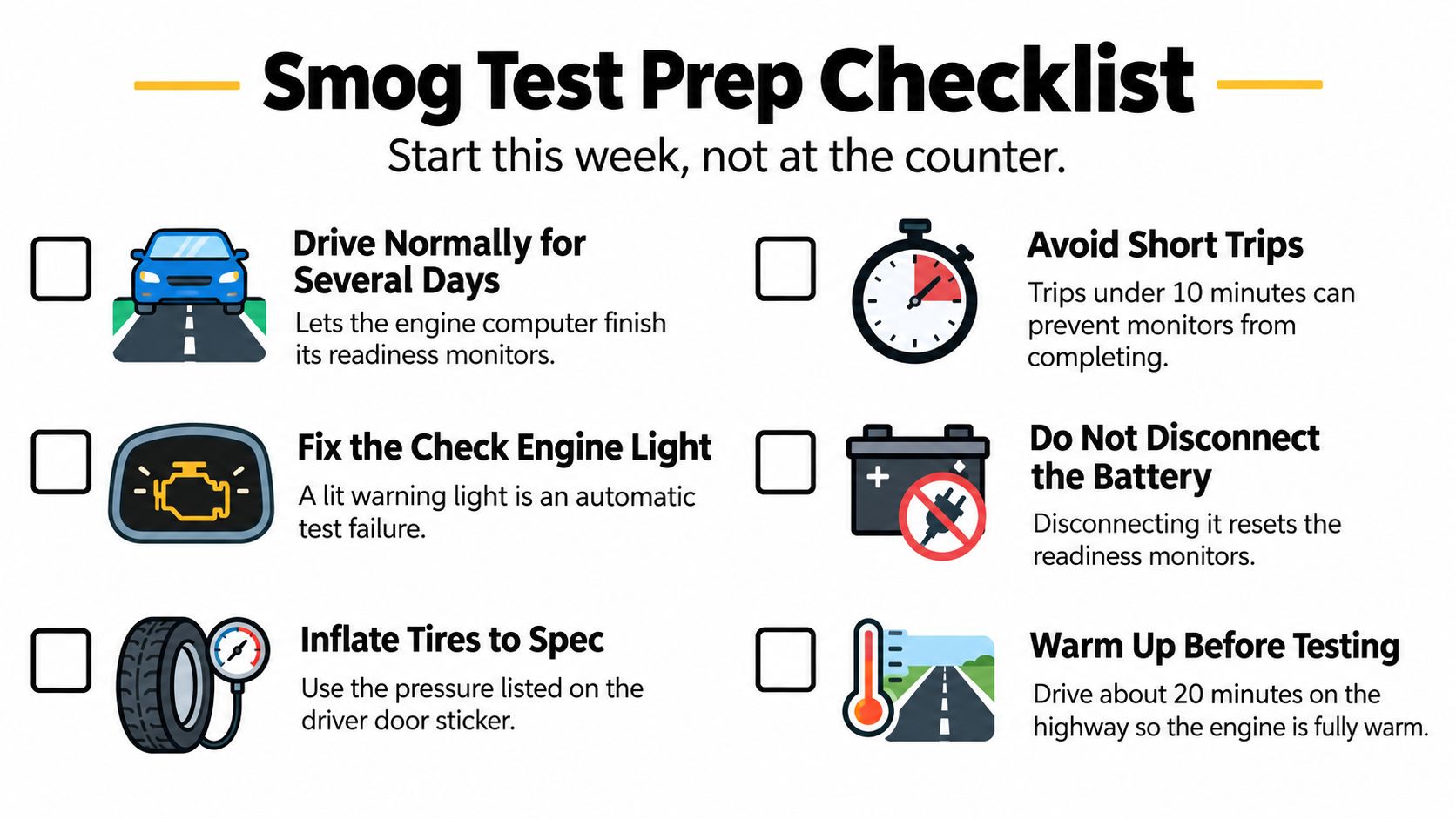
The Week-Before Checklist
- Drive normally for several days: Your engine computer needs completed drive cycles to finish its readiness monitors. Short, scattered trips may not finish them.
- Don't clear codes or disconnect the battery: Doing either right before testing wipes readiness data. That creates an avoidable failure or a required retest.
- Fix a lit check-engine light first: A vehicle can fail when the light is commanded on. Get the fault repaired before you visit, not after you fail.
- Don't erase the evidence: Clearing a code doesn't repair the fault. It only resets the monitors the station needs to read.
That second item is the mistake that costs people a second trip. A driver disconnects the battery to clear a warning, or a shop resets the computer after a repair. The light goes off. The monitors go blank too. The station reads incomplete data and can't pass the car, even if the repair itself was good. Drive first. Test second.
If you want the fuller routine, our page on what to do before a smog check lays out the preparation step by step.
Plan for the Failure Path Too
This short video walks through what happens during the inspection itself.
A failed test needs repair and a retest before registration can be completed. So set aside time for a possible second visit. Ask your station whether it repairs failed vehicles or refers you elsewhere. That answer changes your schedule, not just your bill.
Test early. A failure in the last week before your renewal deadline leaves almost no room for repair and retest.
Timing is the biggest risk for San Leandro and Oakland drivers. We're a fully licensed, state-certified smog inspection station in San Leandro, and we offer a STAR certified smog check in under 15 minutes, with a friendly smile and an indoor waiting room. The test is quick. Repairs aren't. Book while you still have slack.
After a passing test, keep the certificate the station gives you. The DMV needs it to complete your renewal.
If your notice says STAR, or you're not sure what it says, bring it to Speedy Smog and we'll read the wording with you before any test starts. We're a STAR Certified station in San Leandro, and we'll make sure you're at the right kind of shop the first time.