Prepare for Your California Smog Check Station Visit in 2026
You're halfway through your morning in San Leandro when the DMV renewal notice arrives. It says your registration renewal requires a smog check, and suddenly a routine errand has a deadline attached to it. The good news is that most problems happen before the vehicle reaches the bay, not because the inspection itself is mysterious.
A little preparation helps you choose the right California smog check station, understand what the technician is checking, and avoid an unnecessary second visit. This guide is written for East Bay drivers who want a clear explanation of the rules, the newer OBD readiness requirements, and the practical steps that make the appointment easier.
Table of Contents
- Why That DMV Notice Just Arrived in Your Mailbox
- Decoding the California Smog Check Program
- What Happens During Your Smog Inspection
- Your Pre-Smog Check Preparation Checklist
- How to Choose the Right Station in the East Bay
- Your Path to a Quick and Easy Smog Certificate
Why That DMV Notice Just Arrived in Your Mailbox
California's Smog Check program is part of the state's vehicle-registration process and air-quality strategy. The modern program began after lawmakers approved a decentralized inspection system in 1982, with the first extensive version implemented in March 1984. California later expanded it into an enhanced model on June 8, 1998, to address areas with more severe air-quality problems, as documented in the California Air Resources Board program history.
For a driver, the practical meaning is simpler. If your DMV notice says a smog check is required, you need a passing result transmitted to the state before you can complete registration renewal. In many cases, California requires the inspection every other year, so the station network becomes a recurring part of vehicle ownership rather than a one-time event.
Read the notice before choosing a shop
Your renewal notice can tell you more than the due date. Look for language indicating whether the vehicle must visit a STAR station. That detail affects which locations can complete the inspection for your registration.
Before leaving home, confirm:
- The registration deadline: Give yourself time for a diagnostic visit or repair if the vehicle doesn't pass.
- The station requirement: A STAR designation may be mandatory for directed vehicles.
- The vehicle information: Make sure the year, make, and model on your paperwork match the vehicle you're bringing.
- Your ownership details: A change of ownership or a new California registration can trigger a different testing situation.
You can also review the California registration renewal process if you're unsure how the smog result connects to DMV requirements.
Practical rule: Treat the DMV notice as an instruction sheet. Check the station type before you drive across the East Bay.
A smog inspection doesn't guarantee that a vehicle has no mechanical problems. It checks whether the vehicle's emissions controls meet the applicable California requirements at the time of testing. That makes the visit both a compliance step and a useful warning if the vehicle's emissions system needs attention.
Decoding the California Smog Check Program
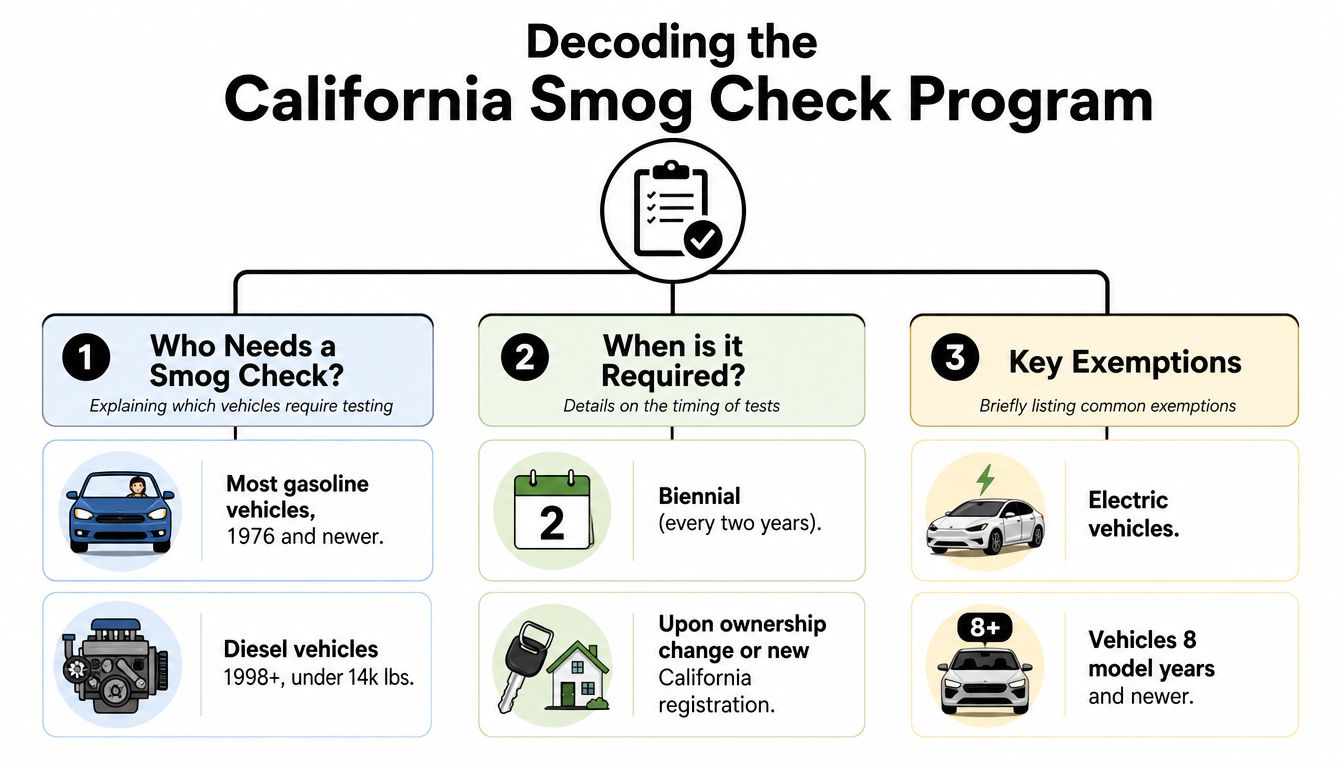
The rules depend on the vehicle, its model year, fuel type, and the reason for testing. Most gasoline-powered vehicles from 1976 onward fall within the program, while diesel vehicles from 1998 onward and under 14,000 pounds are handled under applicable diesel testing rules. Electric vehicles don't produce tailpipe emissions and are generally exempt from Smog Check.
When the test is usually required
For ordinary registration renewal, the inspection is generally biennial, meaning every other year. A vehicle may also need a test when ownership changes or when it receives a new California registration, depending on the circumstances and the vehicle's existing record.
Common exemptions include:
- Electric vehicles: Fully electric vehicles don't use an exhaust system that requires this type of emissions test.
- Newer vehicles: Vehicles within the applicable newer-model exemption period may not need a biennial inspection.
- Certain special vehicles: Some vehicles fall under separate state rules based on fuel, weight, age, or registration status.
Don't rely on a general online list if your situation is unusual. Imported vehicles, diesel trucks, hybrids, modified vehicles, and vehicles being registered after an out-of-state move can require more careful review.
Standard stations and STAR stations
A regular test-only or test-and-repair station performs authorized inspections, but a STAR station must meet higher performance standards established by the Bureau of Automotive Repair. STAR certification isn't based only on having the right equipment. BAR evaluates inspection-quality measures such as Similar Vehicle Failure Rate, Follow-up Pass Rate, gear-shift incidents, and excessive test deviation.
BAR says STAR applicants must meet measurable thresholds, including an SVFR of at least half the industry-wide failure rate for comparable vehicles and gear-shift incidents on no more than 2% of certified vehicles. The applicable Follow-up Pass Rate threshold depends on the reporting period. You can review the BAR explanation of STAR station requirements for the current certification framework.
A STAR station can inspect directed vehicles, including high-polluting vehicles. Your DMV renewal notice should indicate when that certification is required. For a broader explanation of applicable California smog check rules, check the station requirement before booking or driving in.
The simplest decision is this: if the notice requires STAR, choose STAR. If it doesn't, compare location, repair capability, availability, and pricing based on what your vehicle may need.
What Happens During Your Smog Inspection
You pull into the bay, provide the registration information, and answer basic questions about the vehicle. A technician confirms the vehicle identity, checks its condition for testing, and begins the inspection procedure that matches the vehicle's equipment and model year.
The technician first performs a visual inspection of emissions-related components. Missing, disconnected, or visibly altered equipment can create a problem even if the engine feels smooth. If you've installed aftermarket emissions parts, keep any California approval documentation with the vehicle and ask the station about compatibility before testing.
The vehicle's computer is part of the inspection
For many modern vehicles, the technician connects the BAR-approved inspection equipment to the vehicle's diagnostic connector. California's Smog Check Manual describes an OBD-II inspection that includes checking the malfunction indicator lamp, reviewing readiness monitors, and retrieving diagnostic trouble codes.
That means a vehicle can feel perfectly normal and still fail. The computer may record an emissions fault, or one or more monitors may remain incomplete after a battery disconnect, computer reset, recent repair, or failed drive cycle.
Older vehicles without an OBD-II system don't receive an OBD-II functional test. Their procedures use the equipment and test method appropriate to the vehicle, which can involve a tailpipe measurement and, for some vehicles, a dynamometer. The station follows the BAR test prompt rather than allowing the driver to choose the procedure.
A typical inspection for a newer car may be completed quickly, but the exact time depends on the vehicle, station workload, test type, and whether the technician finds an issue that needs clarification.
You can watch a visual overview of the process here:
Once the inspection is complete, the station submits the result electronically. If the vehicle passes, the result supports the registration process. If it fails, the report should identify the reason, such as a diagnostic code, incomplete readiness monitor, emissions reading, or visual equipment concern. Ask the technician to explain the result in plain language before deciding what to repair.
For drivers comparing station types, this guide to what a STAR station is can help you understand why the designation matters.
Your Pre-Smog Check Preparation Checklist
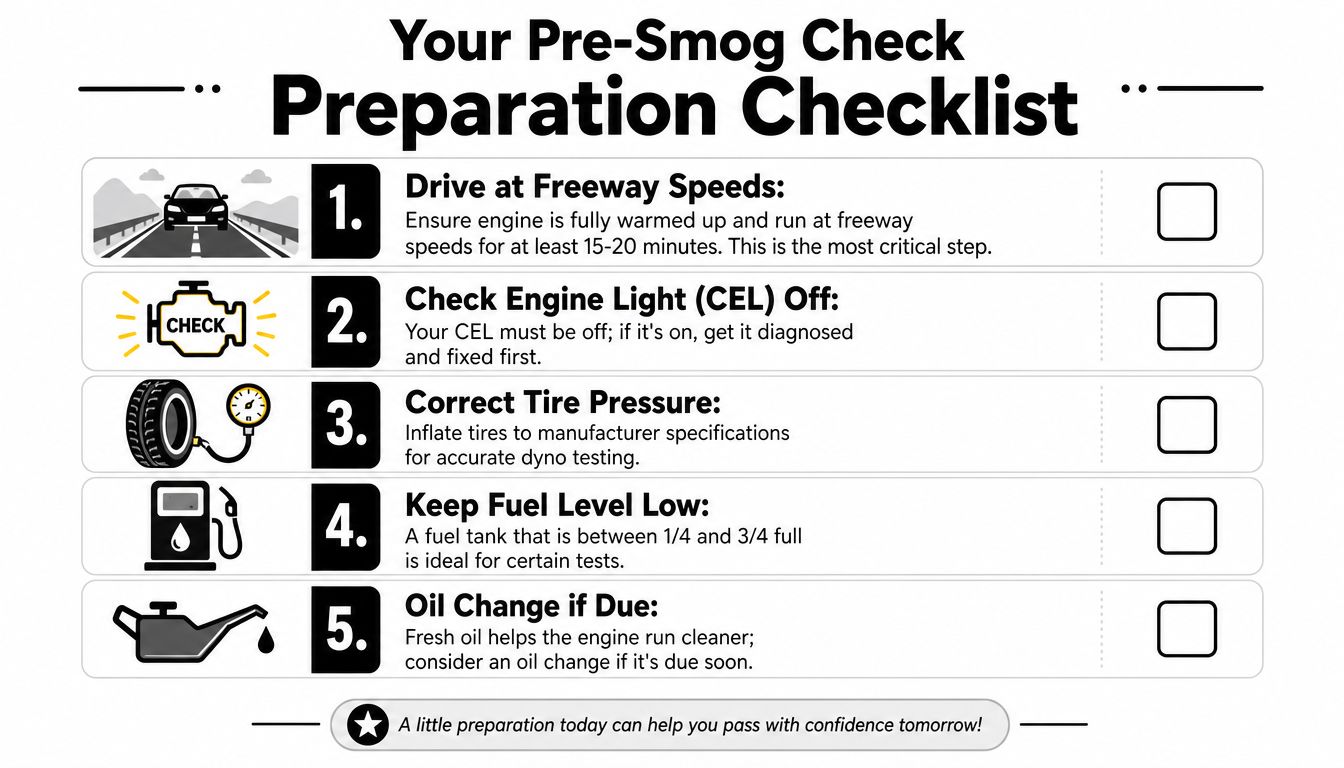
The best preparation starts before you make the trip. A station can test the vehicle, but it can't turn off a genuine emissions fault or complete a repair that hasn't been diagnosed. Your job is to arrive with the vehicle warmed up, the dashboard information understood, and recent repair work properly verified.
A practical inspection-day check
- Look at the malfunction indicator lamp: If the Check Engine light is on, don't erase the code and hope for a pass. Have the cause diagnosed first. Clearing the light can also reset the readiness monitors.
- Warm the vehicle normally: A drive that brings the engine and emissions system to operating temperature can help the vehicle complete its normal self-checks. Follow the vehicle manufacturer's operating guidance rather than aggressively revving a cold engine.
- Confirm tire condition: If the vehicle will use a dynamometer, properly inflated tires help the technician perform the test safely and consistently. Use the manufacturer's specified pressure.
- Bring useful paperwork: Take the DMV notice, registration information, and documentation for any emissions-related replacement part or recent repair.
- Ask before testing if something changed: Tell the technician about a recent battery replacement, computer reset, engine repair, hybrid-system warning, or aftermarket emissions component.
The readiness rule that changed the conversation
Effective October 1, 2025, all readiness monitors must be set for a vehicle to pass, except when BAR grants an exception for a unique design issue in consultation with CARB. The current BAR explanation of the OBD readiness monitor regulations is especially important for hybrid and diesel owners because their testing matrix follows vehicle-specific rules.
A readiness monitor is an internal self-test. It checks systems such as fuel control, oxygen sensors, catalytic-converter performance, or other emissions functions. A dashboard without a warning light doesn't prove that every monitor has completed.
Before you retest: Ask whether the incomplete monitor can finish through the manufacturer's normal drive cycle or whether a diagnostic problem is preventing completion.
“Just drive it more” is no longer a complete answer. Driving may help only when the vehicle is operating correctly and the monitor conditions are being met. If the monitor remains incomplete, a technician needs to determine whether the cause is a repair issue, a recent reset, an unusual design limitation, or a situation that may qualify for a documented exception. Don't pay for repeated tests until you understand why the monitor hasn't completed.
How to Choose the Right Station in the East Bay
Choosing a station is more than finding the closest sign. Start with the DMV notice, then match the station to the vehicle and the likely service you need. A driver with a straightforward newer vehicle may prioritize a short visit, while someone with an older car, diesel, hybrid, or failed test may prefer a location that can explain diagnostic results and perform repairs.
| Your situation | What to prioritize |
|---|---|
| The notice requires STAR | A current STAR-certified station |
| You suspect a failure | Test-and-repair capability and clear explanations |
| You need a certificate quickly | Appointment or walk-in availability and an appropriate test lane |
| The vehicle is older, diesel, or hybrid | Experience with the vehicle's testing procedure |
| You're trying to control the cost | Posted pricing, current coupons, and whether repairs are separate |
BAR's 2026 performance report records about 1,500 inspections per station in calendar year 2025, compared with 1,100 in 2020, indicating that individual locations may handle more workload. The same report describes a statewide network that includes roughly 4,057 test-and-repair stations and 1,991 test-only stations in spring 2025 licensing data. See the BAR 2026 Smog Check Performance Report for those program benchmarks.
Convenience isn't the only consideration
A test-only station may suit a vehicle you expect to pass and can keep the transaction focused on inspection. A test-and-repair station may be more useful when you want one location to diagnose an emissions fault, although you should still ask for the inspection result and repair recommendation separately.
STAR status can matter even when your vehicle seems ordinary. If DMV directs you to STAR, visiting a non-STAR shop first won't satisfy that requirement. Confirm the certification before you leave home, especially when nearby stations have different capabilities.
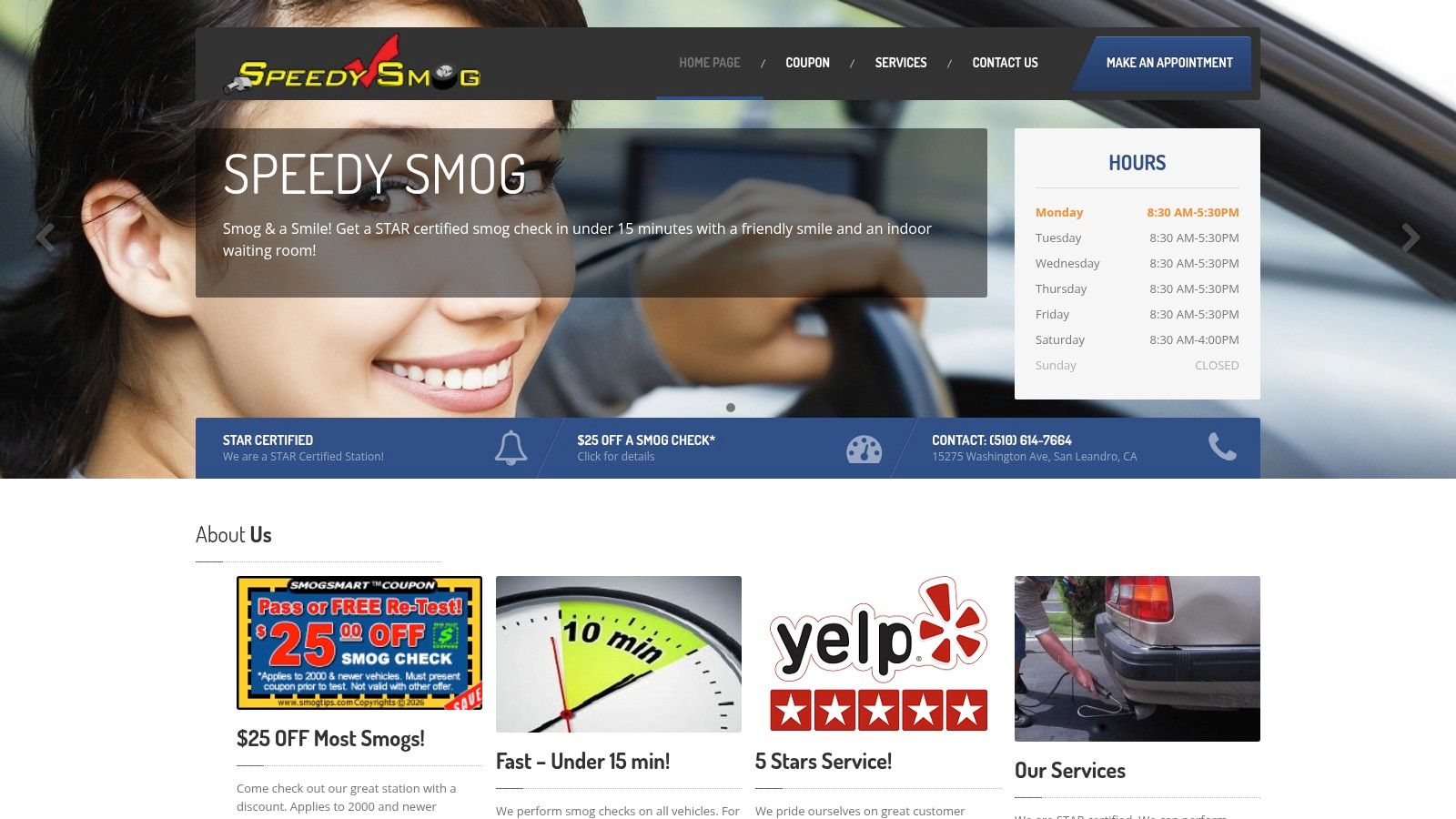
For East Bay drivers, Speedy Smog in San Leandro offers STAR inspections for newer and older vehicles, diesels, and hybrids. The shop lists typical testing for 2000-and-newer vehicles at about 10 to 15 minutes, along with transparent pricing, a waiting room, and occasional coupons. Verify current availability and pricing before visiting.
Call ahead if your vehicle has four-wheel drive, a modified emissions system, a recent computer reset, or an unresolved warning. That short conversation can tell you whether the station can perform the correct inspection and whether you should schedule diagnosis before the certification test.
Your Path to a Quick and Easy Smog Certificate
A smooth smog visit follows three decisions. First, read the DMV notice so you know whether you need a regular station or a STAR-certified location. Second, prepare the vehicle by checking the warning light, allowing normal warm-up, gathering paperwork, and confirming that readiness monitors have completed under the current rules.
Third, choose a station that fits the vehicle rather than selecting only by distance. Older vehicles can need a different inspection workflow, while hybrids and diesels may require careful attention to their applicable OBD rules. If your car recently had its battery disconnected or its emissions system repaired, explain that before the technician starts.
California's statewide program handled 12,200,718 total tests in its 2025 Executive Summary Report, with an overall failure rate of 9.04%, according to BAR's 2025 statewide report. Older vehicles can present a greater preparation challenge, with 1994 model-year vehicles showing a 20.73% initial failure rate in that report. Those figures don't predict your individual result, but they do reinforce a useful habit: diagnose warning lights and incomplete monitors before paying for a formal inspection.
Don't reset the computer solely to make the dashboard look clear. Don't assume a normal-feeling car is ready. And don't wait until the registration deadline to discover that your notice requires STAR or that a recent repair reset the monitors.
For East Bay drivers, Speedy Smog offers STAR-certified smog inspections in San Leandro for newer and older vehicles, diesels, and hybrids. Bring your DMV notice and vehicle information, confirm that your readiness monitors are set, and visit the shop for a clear, efficient inspection that helps you complete registration with less uncertainty.