Economy Smog Check: What It Is and How to Pass
You open your DMV renewal notice, see the smog requirement, and immediately search for the cheapest test near home. That's a sensible first step, but the lowest advertised price doesn't always equal the lowest out-the-door cost. Your vehicle's model year, fuel type, STAR requirement, readiness status, and the station's retest policy can all change what you pay.
An economy smog check can be a practical way to meet California's registration requirement without paying for unnecessary repair or diagnostic services. The key is knowing what the test includes, what the quoted price leaves out, and how to prepare your car before the technician connects the inspection equipment.
Table of Contents
- What an Economy Smog Check Is
- Economy Versus Regular Smog Checks
- Real Costs Behind a Budget Smog Test
- How OBD II Readiness Decides Pass or Fail
- Prep Steps That Cut Your Re-Test Risk
- Why STAR Certification Matters for Drivers
- Getting Tested at Speedy Smog in San Leandro
- Smog Check Myths and Common Questions
What an Economy Smog Check Is
An economy smog check is a lower-priced California Bureau of Automotive Repair inspection. The price changes, but the legal emissions standard does not. A licensed station follows the BAR procedure for the vehicle, then submits the result electronically so California can record the certification for registration.
Lower pricing usually comes from the station's overhead, labor rate, and limited add-on services. In practical terms, you pay less for the shop's business model, not for a weaker inspection. The station still needs approved, properly calibrated equipment and must complete the checks required for your vehicle.
What the technician checks
The procedure depends on the car's equipment and specifications. A technician may perform:
- Visual inspection: Emissions equipment is checked for missing, disconnected, or altered components.
- Functional checks: Required emissions systems and controls are tested.
- OBD II scan: Most gasoline vehicles from the 2000 model year onward are inspected mainly through the diagnostic connector, as explained in the Bureau of Automotive Repair smog program FAQ.
- Tailpipe testing: Some vehicles still require BAR-97 testing. Examples include vehicles without OBD II, vehicles over 14,000 pounds GVWR, and vehicles with problematic OBD II systems.
California's smog program has operated since 1984. State materials describe it as one of the world's largest vehicle-emissions inspection systems. The program removes about 400 tons of smog-forming pollutants every day, while more than 10 million vehicles are tested each year at more than 5,000 independently owned stations, according to the Bureau of Automotive Repair smog program FAQ.
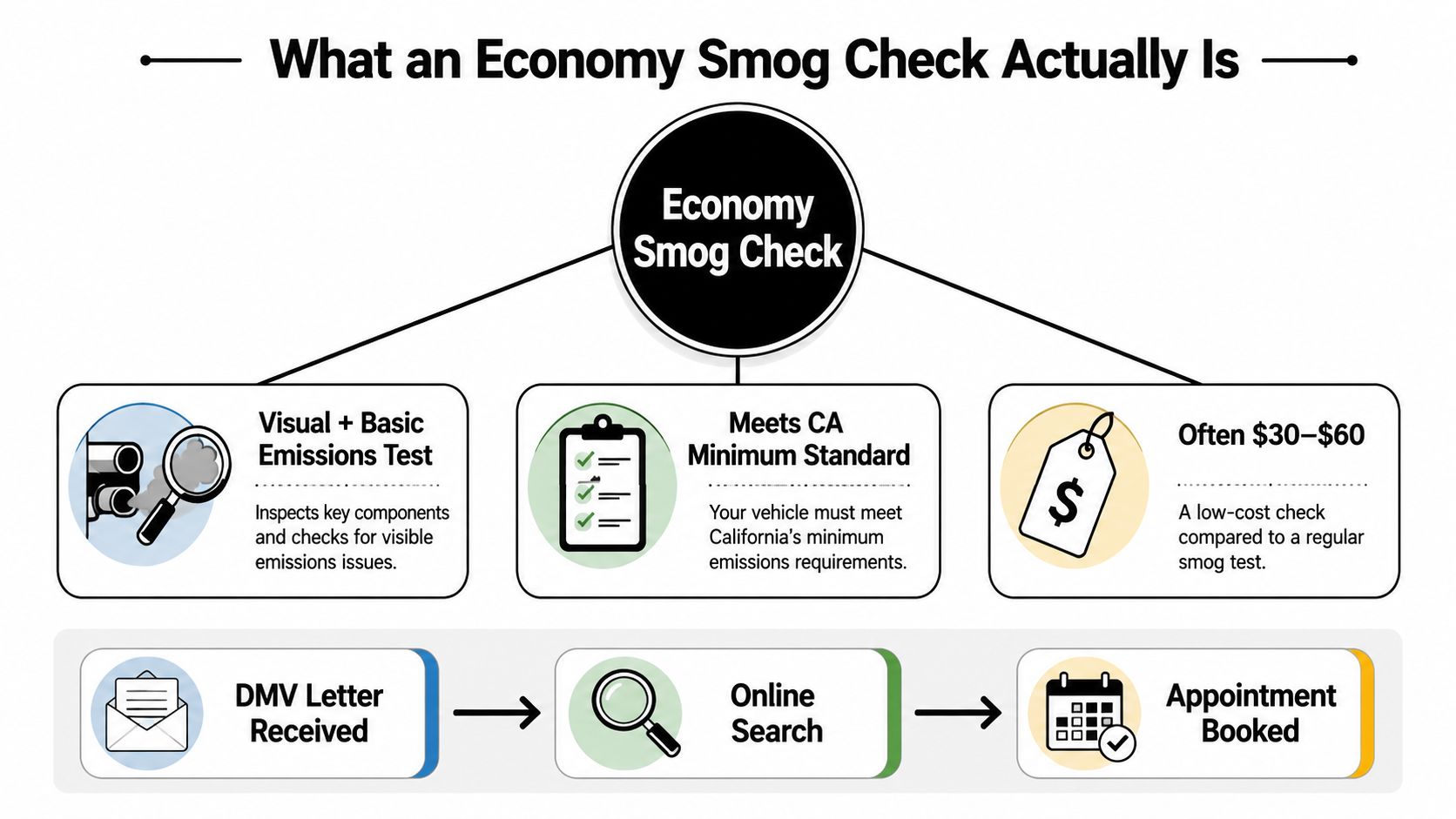
For a first-time customer, the practical takeaway is straightforward: an economy smog check is a lower-cost inspection, not a lower-quality legal certificate. Before booking, ask whether the quote includes the state certificate fee, vehicle-specific surcharges, and a retest. A simple explanation of a California smog inspection can also help you understand what the technician is checking.
Economy Versus Regular Smog Checks
A driver may see two very different prices for the same vehicle inspection. The lower quote does not mean the station can use a shorter legal test. California's rules apply whether you choose an economy-priced station or a shop with a higher advertised rate. Licensed facilities must follow the BAR-approved procedure that matches the vehicle.
The meaningful differences are station type, pricing, eligibility, and the services offered around the inspection. An economy smog check often comes from a Test Only or STAR station focused on inspections. A regular smog check may be performed by a shop that also diagnoses and repairs vehicles. Neither business model changes the emissions limits or the pass and fail requirements.
| Factor | Economy Smog Check | Regular Smog Check |
|---|---|---|
| Inspection procedure | Uses the BAR-required procedure for the vehicle | Uses the BAR-required procedure for the vehicle |
| Equipment standard | Must use approved, properly maintained equipment | Must use approved, properly maintained equipment |
| Typical business model | Inspection-focused, with limited repair or diagnostic services | May combine testing with broader automotive services |
| STAR eligibility | May be STAR certified, but the word “economy” alone doesn't guarantee it | May or may not be STAR certified |
| Price | Lower advertised labor price is common | Labor price varies by shop and vehicle |
| Repair support | May refer failed vehicles elsewhere | May offer diagnosis or repair in-house |
| Directed vehicle acceptance | Must be STAR certified when the DMV requires STAR | A non-STAR station can't certify a STAR-directed vehicle |
Accuracy and pass risk
The price on the sign does not determine test accuracy. Equipment condition, the required procedure, and technician compliance do. A lower price cannot make a failing emissions system pass, while a higher price cannot make a defective system acceptable.
The pass or fail decision is also procedurally the same. An economy station that handles many inspections may check readiness monitors, warning lights, gas caps, and vehicle eligibility efficiently. That experience can reduce delays, but it cannot erase a stored emissions fault or an incomplete monitor.
STAR status is a separate question from price. The BAR STAR certification requirements describe performance measures comparing a station's similar-vehicle failure rate with the industry rate. BAR guidance identifies a 50% of the industry-wide failure rate for similar vehicles threshold among the 2022 STAR changes. A STAR label therefore matters when the DMV directs your vehicle to a STAR station, because you want the lowest advertised price.
Practical rule: Choose the least expensive station that is legally eligible for your vehicle, then confirm exactly what the quote includes.
Ask whether the station can test your vehicle's year, fuel type, and inspection category before booking. Older vehicles and certain directed vehicles may require a specific facility, even when another shop advertises a cheaper economy test.
A budget shop may earn revenue from referrals, parts, or repair services after a failure. That arrangement is not automatically improper, but ask for the inspection price before handing over the keys. If the vehicle fails, request the result and explanation in writing. You are paying for an inspection first, not agreeing in advance to repairs.
Real Costs Behind a Budget Smog Test
The advertised economy price is only one line on the receipt. California's state certificate fee is $8.25, according to consumer guidance summarized by Diamond Certified's California smog check FAQ. The station then adds its own labor charge, and some businesses add an electronic transmission fee or a vehicle-specific surcharge.
That's why two drivers can search for an economy smog check, visit different stations, and receive different totals. Each shop sets its own rate, while the vehicle's inspection category determines how much work the technician must perform.
| Cost Line Item | Typical Range | Notes |
|---|---|---|
| State certificate fee | $8.25 | Added to the station's charge, subject to BAR updates |
| Station inspection charge | Varies | Set by the individual shop and vehicle category |
| Electronic transmission fee | Varies | Some stations add a small processing charge |
| Older-vehicle testing | Higher than newer OBD testing | Older vehicles may require longer tailpipe and dynamometer procedures |
| Diesel or heavy-duty testing | Varies by vehicle | Diesel and heavier vehicles can have a different fee structure |
| Retest | Varies by station | Ask whether a failed vehicle receives a reduced retest price |
Why vehicle type changes the bill
Most gasoline vehicles from 2000 onward use an OBD-focused inspection. Older vehicles can require tailpipe testing, which takes more technician time and uses different equipment. Diesel vehicles, hybrids, and heavier vehicles may also fall into different inspection categories, so a low price advertised for a newer gasoline car may not apply to yours.
The result matters, too. A passing test usually ends with the certificate transmission. A failure may create a second charge, especially if the station doesn't include a free or reduced-price retest. Before booking, ask three direct questions:
- Is the state fee included?
- Does my model year or fuel type carry a surcharge?
- What will I pay if the vehicle fails and returns for a retest?
For a clearer explanation of how stations build the bill, review this smog inspection cost guide. Don't compare only the largest number in a search advertisement. Compare the complete inspection price for your exact vehicle and the policy that applies after a failure.
How OBD II Readiness Decides Pass or Fail
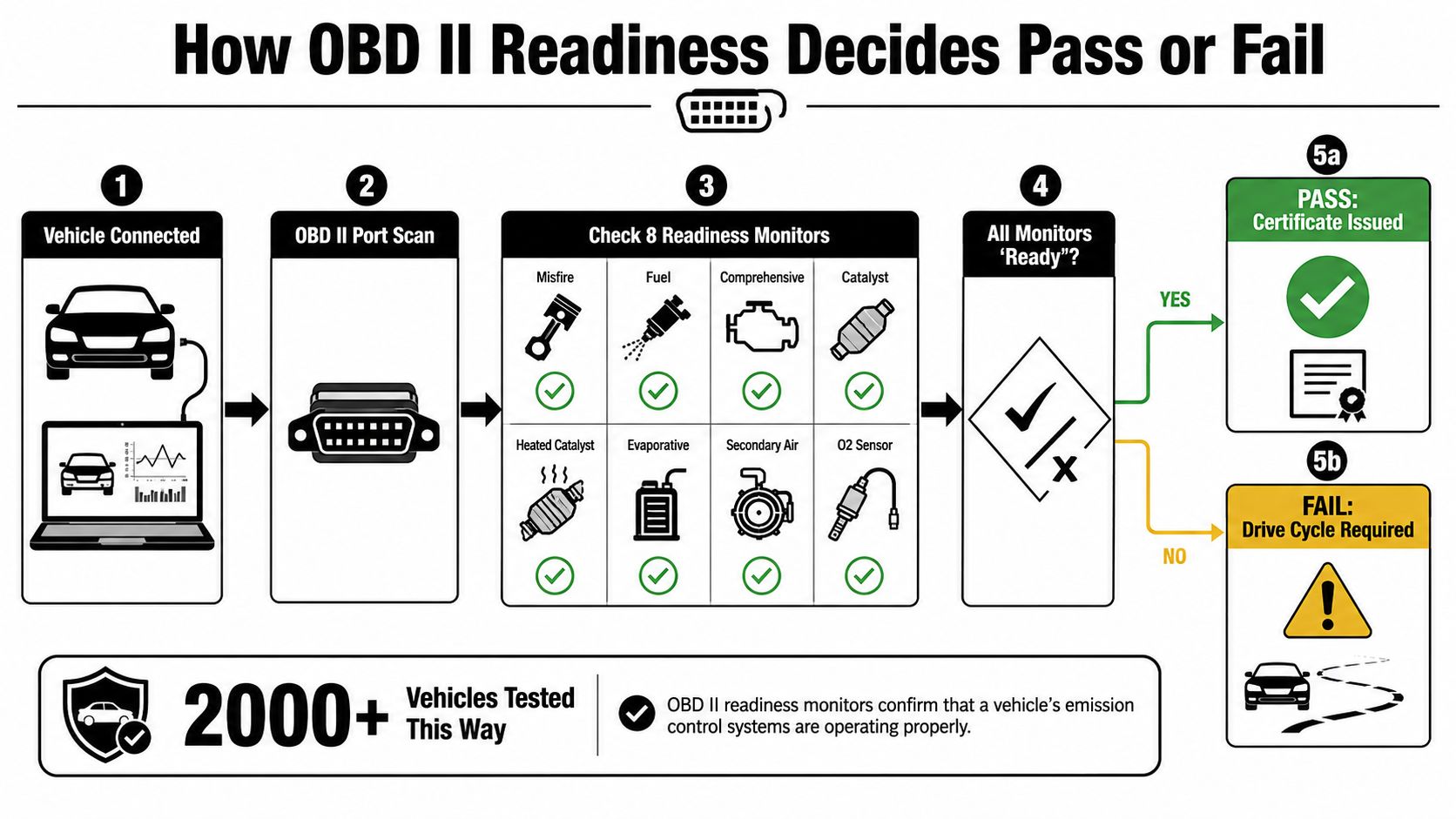
A car can start easily, idle smoothly, and still fail an economy smog check. For most gasoline vehicles from the 2000 model year onward, the technician connects approved equipment to the vehicle's OBD II port. The computer reports whether emissions-related monitors have completed their self-tests and whether active diagnostic trouble codes remain. The inspection measures computer results, not just engine sound or exhaust odor.
Applicable readiness categories include the catalyst, evaporative system, oxygen sensor, misfire, fuel, component, heated catalyst, and secondary air systems. California requires applicable monitors to be ready. For gasoline vehicles from 2000 onward, the evaporative monitor is the stated exception that may remain unset, as noted earlier in the BAR smog check manual.
Why a healthy-feeling car can fail
A vehicle may have no rough idle, hesitation, or warning light while its computer checks are incomplete. Common causes include:
- A recent battery disconnect, which can erase learned data and readiness results.
- A cleared trouble code, even after the repair itself.
- A recent repair that interrupted the normal drive cycle.
- Extended time parked, leaving the vehicle without the conditions needed to run its monitors.
A parts-store scanner can show whether codes are present, but that basic check does not necessarily confirm complete BAR readiness. If the battery was recently replaced or a warning code was cleared, ask the technician to check monitor status before paying for the official inspection. A code reader is like checking one question on a test. Readiness evaluation checks whether the vehicle completed the full set of applicable questions.
A mixed drive cycle can give the monitors the conditions they need. Use normal city traffic, steady cruising, stops, and highway operation instead of making only short trips. Drivers often use roughly 50 to 100 miles of mixed driving after a repair or battery reset, a range discussed in this guide to driving after a check-engine light. The manufacturer's procedure controls the exact speed, temperature, and operating conditions.
An economy smog check station reads the same readiness information as a regular station. The price doesn't change the software state of your car, so preparation matters more than the storefront label. For a plain-language explanation of diagnostic results, see this guide on how to read OBD codes.
Prep Steps That Cut Your Re-Test Risk
The best savings usually happen before the appointment. A short preparation routine can reveal a problem early, help the monitors complete, and prevent you from paying for an avoidable second inspection.
Use the final 48 hours wisely
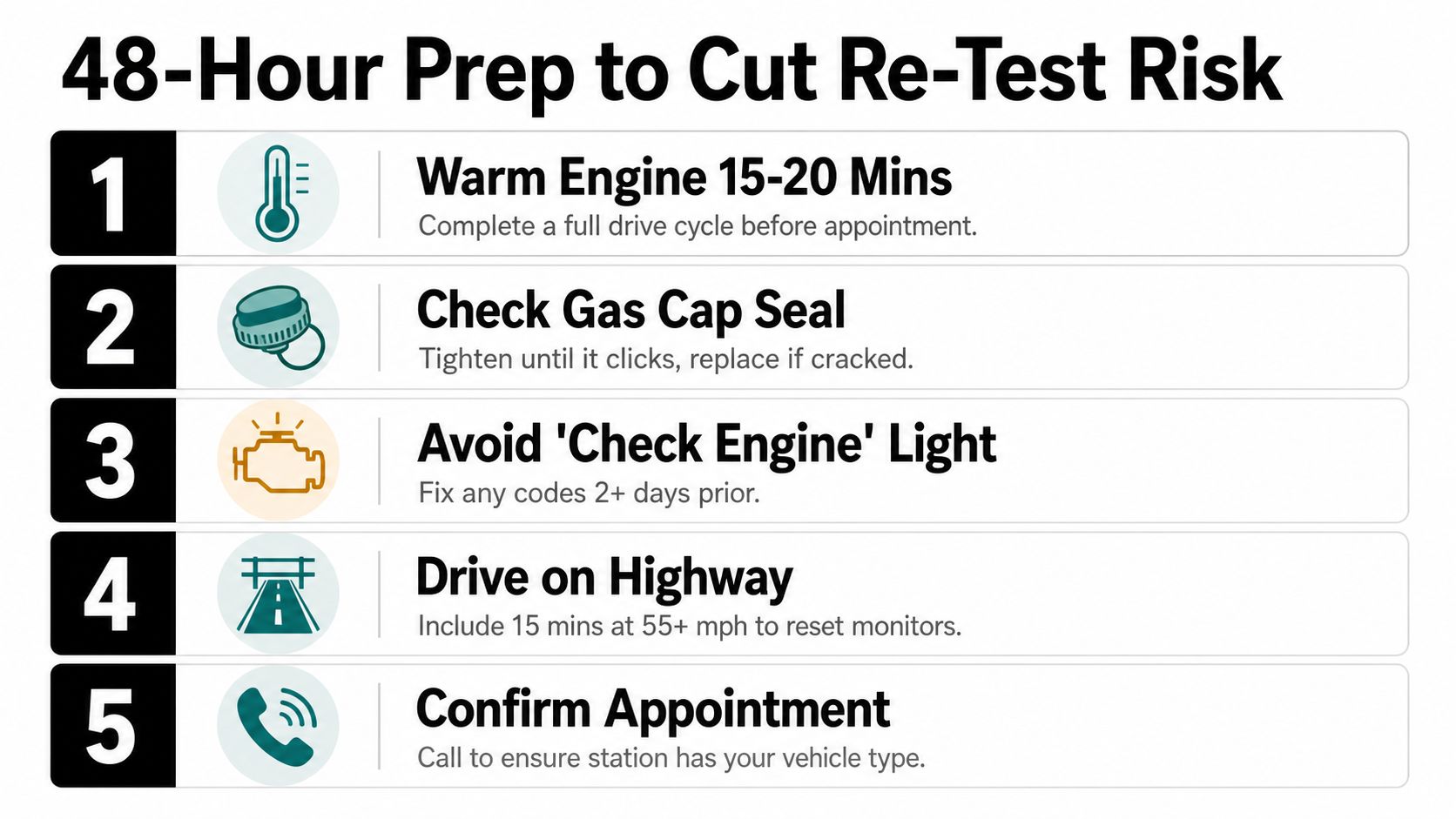
Start with the dashboard. An illuminated check-engine light signals an emissions fault and can prevent certification. Don't erase the code just to make the light disappear, because clearing it can also reset readiness monitors and leave the vehicle unable to complete the inspection.
Check the gas cap next. Remove it, inspect the rubber seal for cracking or flattening, and reinstall it until it clicks securely. A weak seal can allow an evaporative leak, and the EVAP monitor may need specific conditions before it reports ready.
A Bluetooth OBD scanner can show readiness status before the appointment. If you use a consumer tool, treat its result as a preparation check rather than a guarantee, because the station still performs the official inspection through its approved equipment.
A practical appointment checklist
- Warm the vehicle: Drive steadily for about 15 to 20 minutes before the appointment so the engine and emissions components reach normal operating temperature.
- Use mixed speeds: Include both city driving and highway cruising during the day before testing. This gives the vehicle more opportunities to run different monitors.
- Check the fuel level: Keep the tank between roughly one-quarter and three-quarters full so the evaporative system has suitable operating conditions.
- Protect monitor status: Avoid disconnecting the battery or clearing codes shortly before testing.
- Assess the battery: A weak battery can lose voltage and reset monitor progress, especially after the vehicle sits overnight.
- Schedule diagnosis first: If the check-engine light is on, pay for diagnosis before paying for certification. The inspection won't repair the fault.
Technician's advice: Don't drive straight from a code-clearing repair to the test lane. Give the car time to complete its self-checks first.
The warm-up drive helps, but it can't fix a failed component. If a monitor refuses to complete after normal mixed driving, the issue may involve a thermostat, EVAP leak, oxygen sensor, catalyst, wiring fault, or another emissions-control problem. Get the status checked instead of repeatedly paying for tests.
Why STAR Certification Matters for Drivers
A STAR certificate is a performance designation administered through the Bureau of Automotive Repair, not just a label used in advertising. BAR reviews station performance through measures such as the Similar Vehicle Failure Rate, Short-Term Measures, Follow-Up Pass Rate, and citation or disciplinary history. The STAR certification guidance explains how the program evaluates participating stations.
The Similar Vehicle Failure Rate compares a station's results with results for similar vehicles statewide. That comparison helps account for the kinds of cars a station services. A facility inspecting many older or problem-prone vehicles is not judged in exactly the same way as one testing mostly newer cars.
Who needs a STAR station
Your DMV notice or vehicle record determines whether your inspection must take place at a STAR station. The requirement can depend on registration circumstances, vehicle characteristics, or location. If your vehicle is directed to STAR and you choose a non-STAR station, the result may not meet the DMV requirement. You could then pay for another inspection at an eligible facility.
| Factor | Standard Station | STAR Certified Station |
|---|---|---|
| BAR license | Licensed to perform qualifying inspections | Licensed and approved under STAR requirements |
| Performance oversight | Subject to standard program rules | Includes additional STAR performance measures |
| Directed vehicle eligibility | May not accept or certify STAR-directed vehicles | Can handle vehicles that require STAR testing |
| Pricing | May offer economy rates | May charge more because of test eligibility and oversight |
| Best fit | Non-directed vehicles that meet ordinary requirements | DMV-directed vehicles and customers seeking STAR eligibility |
The certificate does not guarantee a passing result. Your vehicle must still satisfy the applicable emissions and readiness requirements. STAR matters because it identifies stations eligible for certain directed inspections and subject to additional performance standards.
Before you book: Read the DMV notice for wording that indicates a STAR requirement. If the notice is unclear, ask the station to confirm eligibility before the test begins.
For a non-directed, newer gasoline vehicle, a licensed non-STAR economy station may be a valid lower-cost option. For a directed vehicle, eligibility comes first. Price comes after you confirm that the station can legally perform the required inspection.
Getting Tested at Speedy Smog in San Leandro
Drivers looking for an economy smog check in the East Bay can use a simple booking checklist at Speedy Smog. The station is located at 15275 Washington Ave, San Leandro, California 94579, and it serves most vehicles from 1976 to the present, including newer gasoline cars, older vehicles, diesels, and hybrids.
The shop is open Monday through Saturday. Its website says a smog check doesn't require an appointment, though calling ahead can still help confirm that the station is ready for your vehicle category, especially if you have a diesel, hybrid, older car, or a DMV-directed test.
What to bring and expect
Bring the DMV renewal notice if you have it, your payment method, and the vehicle keys. At the counter, confirm whether your vehicle needs a standard inspection or a STAR test, ask for the complete price, and clarify the retest policy before the technician begins.
For many vehicles from the 2000 model year onward, the inspection takes about 10 to 15 minutes, according to the publisher information supplied for this article. Older, diesel, or unusual vehicle configurations may take longer because the required procedure can involve additional equipment or checks.
Speedy Smog handles both ordinary and STAR-directed inspections at the San Leandro station, which can prevent an eligible driver from having to move the vehicle to another facility. The business also advertises periodic $25-off coupons for most smogs on newer vehicles through its website. Check the current terms before relying on a coupon, since vehicle type and test category can affect eligibility.
The station says results are transmitted electronically to the DMV. If the vehicle fails, ask the counter staff to explain the reason in plain language and confirm the applicable retest terms. The publisher information supplied for this article states that Speedy Smog offers a free retest within a 90-day window after an initial failure, so verify the policy and conditions when you arrive.
Smog Check Myths and Common Questions
Myth: Disconnecting the battery guarantees a clean result.
It doesn't. Disconnecting the battery can clear trouble codes, but it can also reset readiness monitors. The car may need normal mixed driving before the computer is ready for inspection.
Myth: A new battery guarantees a pass.
A new battery can prevent voltage-related problems, but it won't repair an emissions fault, complete unset monitors instantly, or replace missing equipment. The technician still checks the vehicle's reported emissions status.
Myth: Older cars are automatically exempt.
Some categories are exempt, but age alone doesn't cover every vehicle. California's consumer guidance identifies exemptions including gasoline vehicles built before 1976, alternative-fuel vehicles, and motorcycles. Check the actual vehicle category rather than assuming.
Myth: Any station can certify a directed vehicle.
A DMV-directed vehicle may require a STAR station. A non-STAR test can leave you with a result that doesn't meet the registration requirement, so confirm the notice before choosing the lowest advertised price.
Questions drivers ask at the counter
How quickly does the result reach the DMV?
Licensed stations submit results electronically. Ask the station whether the transmission has completed before leaving, especially if your registration deadline is close.
What happens if I miss the smog requirement?
The registration process can remain incomplete until the required certification is recorded. Contact the DMV or review the notice for deadline and renewal instructions rather than assuming a late test is harmless.
Do out-of-state vehicles need a California smog check?
California generally requires an inspection when an out-of-state vehicle receives initial registration in the state. Ownership changes and periodic renewals can also trigger testing, depending on the vehicle and registration circumstances.
Why can a car with no symptoms fail?
OBD testing checks stored faults and readiness data, not only drivability. A car can feel normal while the computer reports an emissions problem or an incomplete monitor.
How do I challenge a questionable result?
Ask the station for the exact failure reason and inspection record. If the issue remains disputed, contact the Bureau of Automotive Repair for guidance on available review or referee options.
Speedy Smog provides economy and STAR smog checks in San Leandro for newer cars, older vehicles, diesels, hybrids, and DMV-directed inspections. Review your vehicle category, bring your renewal notice, and visit Speedy Smog to check current pricing, coupon terms, and testing availability before you head in.