
San Leandro Smog Test Only: A Complete Driver’s Guide
A San Leandro driver usually reaches for the renewal envelope at the worst possible time, somewhere between dinner, work, and the moment the registration deadline starts feeling real. Inside that envelope is the line that decides the rest of the errand, and if you read it wrong, you can end up at the wrong kind of station, lose time, and still need a second visit.
That's why san leandro smog test only isn't just a search phrase. For most drivers, it's a choice between a normal test-only station and a STAR-certified station, and the DMV notice tells you which one applies. If you understand the notice, your model year, and your vehicle's readiness status before you pull in, the whole visit gets simpler.
Table of Contents
- The DMV Envelope Moment for San Leandro Drivers
- What a Test-Only Station Is (and Isn't)
- Who in San Leandro Needs a Smog Test
- What to Bring and How to Prepare Your Car
- STAR Certified vs Regular Smog Stations
- What a San Leandro Smog Test Visit Looks Like
- Smog Test Pricing and What Affects the Final Cost
- Speedy Smog in San Leandro and Your Next Steps
The DMV Envelope Moment for San Leandro Drivers
A lot of first-time visitors open the renewal notice, skim one line, and assume any smog shop will do. That's where the trouble starts, because the DMV uses specific wording, and that wording controls where you're allowed to go. The California DMV says the notice will explicitly read either “Smog Certification Required” or “Smog Certification Required at a STAR station”. DMV smog inspection notices
If your notice says only Smog Certification Required, you can go to a licensed smog station. If it says at a STAR station, you need a STAR-certified facility, not just any test-only shop. In other words, the paper in your hand matters more than the assumptions you make about the car. The station type is driven by the notice, then matched to the vehicle.
A San Leandro driver often learns this the hard way. They call the closest shop, hear “we do smogs,” and show up with a notice that demands STAR. That's avoidable if you read the exact line before leaving home.
Practical rule: look at the renewal notice first, then choose the station. Don't reverse that order.
The other reason this matters is that California's inspection system now funnels a lot of tests through STAR stations. By CY-2025, 49% of licensed stations were STAR certified, and 83% of all smog tests were performed by STAR-certified stations. BAR STAR FAQ That doesn't mean every driver needs STAR, it means the system depends on it heavily.
What a Test-Only Station Is (and Isn't)
A test-only station performs the inspection and reports the result. It can run the emissions test, submit the outcome, and issue the certificate when the vehicle passes. It does not repair that vehicle after a failure. The inspection and repair roles stay separate, like a referee making the call without coaching either team.
That boundary protects the purpose of the test. If a shop could fail a car and immediately sell the repair, the result could become part of a sales conversation. At a test-only station, you receive a pass or fail decision and, if repairs are needed, take the vehicle to a different shop.
Test only also defines what your visit covers. You pay for the inspection, state submission, and certificate process. Diagnostic labor and repairs are outside that service. A failed vehicle therefore needs a separate repair appointment before it can be retested.
A test-only station can explain the result in plain language, but it cannot repair the same vehicle it inspected.
For a first visit, arrive with the car ready for inspection and allow time for the test and paperwork. Do not expect the inspection bay to become a repair bay. The DVM smog check test only service page offers a station-specific overview, while your DMV notice determines whether this station type fits your requirement.
Who in San Leandro Needs a Smog Test
A DMV renewal notice can answer the first question before you book a station. Read its exact wording, then compare it with your vehicle's model year, fuel type, and reason for testing. California's exemption rules vary between registration renewal and change-of-ownership testing. Gasoline, hybrid, and alternative-fuel vehicles eight model years old and newer are exempt from renewal Smog Checks, while vehicles four model years old and newer are exempt from change-of-ownership testing. California Smog Check program
The vehicles that usually need testing
After a vehicle moves beyond the applicable exemption window, a test is more likely. California also exempts gasoline vehicles 1975 and older, diesel vehicles 1997 and older, and diesel vehicles with a gross vehicle weight over 14,000 pounds. That leaves many newer gasoline cars, hybrids that have aged into the testing window, and diesel vehicles still covered by the inspection rules.
Short version: the renewal notice is the driver. If it requests a Smog Check, treat that instruction as the starting point, then confirm that your vehicle details match.
Age alone does not settle every case. A vehicle may qualify for an exemption during registration renewal but still require an inspection during an ownership transfer. The notice provides the immediate instruction, while the vehicle's age, fuel type, and transaction explain why that instruction applies.
| Vehicle Type | Model Year / Age | Smog Check Required? |
|---|---|---|
| Gasoline | 8 model years old and newer | No for renewal |
| Gasoline | Older than 8 model years | Usually yes for renewal |
| Hybrid or alternative-fuel | 8 model years old and newer | No for renewal |
| Hybrid or alternative-fuel | Older than 8 model years | Usually yes for renewal |
| Gasoline | 4 model years old and newer, transfer of ownership | No |
| Diesel | 1997 and older | No |
| Diesel | 1998 and newer, under 14,000 lbs | Usually yes |
If the notice names a STAR station or another specific station type, follow that wording rather than choosing based only on the vehicle's age. That distinction prevents a common mistake: treating STAR certification and test-only service as interchangeable when the DMV instruction may require one and not the other.
What to Bring and How to Prepare Your Car
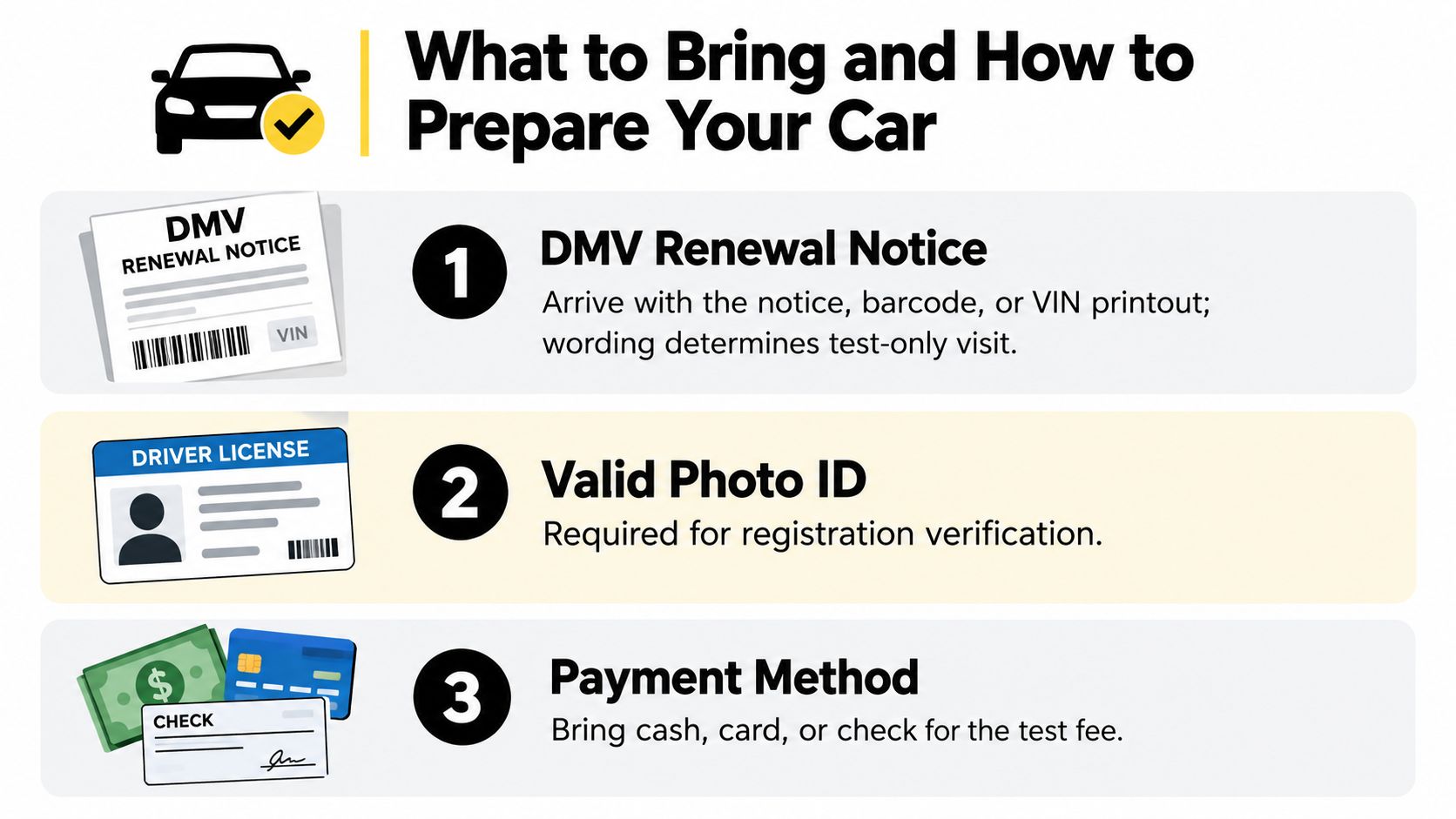
Bring the DMV renewal notice, a valid photo ID, and a payment method before you leave home. The notice is the most important item because it tells the technician whether you're headed to a regular station or a STAR station, and it often contains the barcode or vehicle information needed to match the test to your record. If you're about to throw the envelope away, photograph both sides first.
Before the test, make sure the check-engine light is off. The inspection for most modern vehicles is data-driven, and a lit warning light can send you home without a certificate. If you recently disconnected the battery, replaced it, or cleared codes, give the car time to complete its drive cycle before you arrive.
The fuel level matters too. Keep the tank somewhere between quarter-full and three-quarters full so the evaporative system can be tested under normal conditions. A tank that's nearly empty or completely topped off can create avoidable complications.
Warm the car up with normal driving before you pull in. A cold engine rarely gives the cleanest inspection conditions.
For many drivers, the other key issue is readiness status. California's updated guidance says that effective October 1, 2025, all readiness monitors must be set for a vehicle to pass. BAR readiness monitor guidance That's why a car can feel fine on the road and still fail the scan.
If you want a simple prep checklist, use the what to do before a smog check guidance before you head out. The goal is to arrive scan-ready, not to discover a readiness issue at the window.
STAR Certified vs Regular Smog Stations
The wording on your DMV renewal notice determines whether you need a STAR station. STAR certification is a state performance tier for smog inspection stations, while test-only describes the service the station provides. A station may carry both labels, so read the notice before choosing where to go.
How to choose the right one
If the notice says STAR station, choose a STAR-certified location. The station assignment is part of the renewal instruction, much like being sent to the correct counter for a specific permit. If the notice does not require STAR, a regular licensed test-only station can generally perform the inspection. The BAR STAR FAQ explains the program and its station requirements.
For a newer gasoline vehicle with no special direction on the notice, a regular test-only station is often the straightforward choice. It inspects the vehicle without repairing the same vehicle, which keeps the service focused on the smog check. San Leandro drivers seeking a STAR location can review this San Leandro STAR-certified smog station information before arriving.
| Feature | STAR Certified | Regular Test-Only |
|---|---|---|
| Can inspect vehicles | Yes | Yes |
| Can repair the same vehicle it tests | No | No |
| May be required by DMV notice | Yes | No, unless directed |
| Meets the STAR performance tier | Yes | No |
| Suitable for directed cases | Yes | Only when the notice permits it |
The practical rule is simple: test-only tells you that the station performs inspections rather than repairs, while STAR identifies its state performance category. Check the DMV notice first, then match its wording to the station type. That step prevents an avoidable visit to a station that cannot complete your renewal inspection.
What a San Leandro Smog Test Visit Looks Like
The inspection path depends on the vehicle's model year and fuel type, not its appearance. The technician first reads the DMV renewal notice and confirms that the station can complete the required inspection. That check connects the notice's wording with the correct test procedure, helping prevent a return visit.
For 2000 and newer gasoline vehicles
The technician connects a scan tool to the OBD-II port beneath the dashboard. The system checks diagnostic trouble codes, readiness monitors, and the warning-light status. California generally uses an OBD Inspection System for 2000 and newer gasoline vehicles, 1998 and newer diesel vehicles, and all hybrid vehicles. The BAR reference guide outlines these inspection categories.
The OBD test works like a dashboard conversation with the car's emissions computer. It asks whether the required self-checks have finished and whether the system has recorded an emissions-related fault. A vehicle may drive normally and still fail if a monitor is incomplete or an active code remains.
Readiness can also be affected by a recently disconnected or replaced battery, because clearing power may erase the computer's completed checks. Ask the technician before testing if the battery was disconnected or the vehicle recently underwent emissions-related work.
For older gasoline vehicles and many diesels
Vehicles outside the OBD path use a different approved procedure. Depending on model year and fuel type, the station may use a BAR-97 setup or another state-approved method. California separates 1976 to 1999 vehicles from newer OBD-based vehicles, so an older car should be matched to the procedure listed for its year and fuel type.
The technician records the result electronically for DMV. You leave with a pass confirmation or a failure result identifying the next repair question. A clear notice, the right station type, and a car ready for its applicable test procedure can keep the San Leandro visit to one trip.
Smog Test Pricing and What Affects the Final Cost
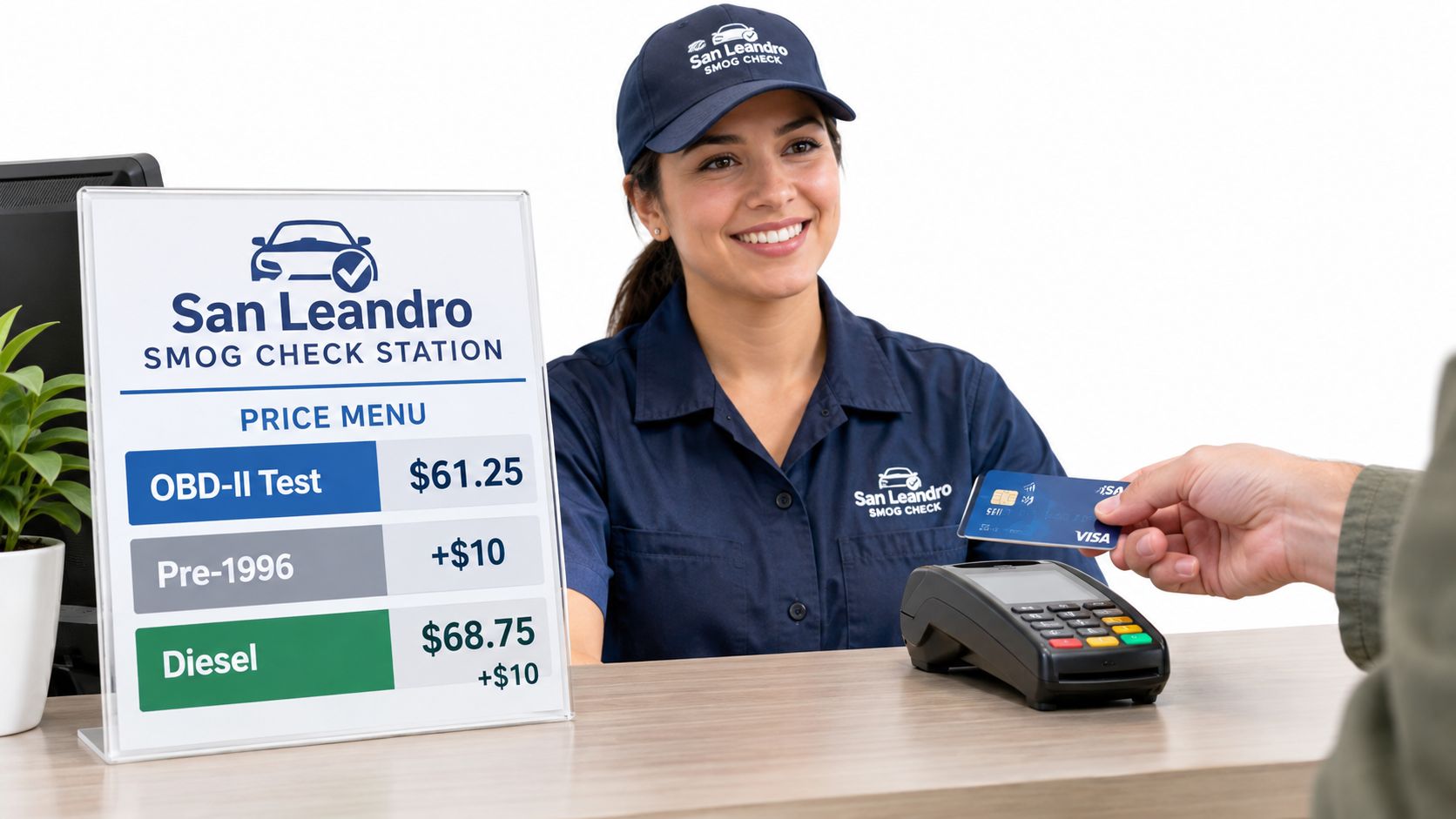
California keeps smog pricing inside a narrow range, so the final bill shouldn't feel random. The Bureau of Automotive Repair sets caps that stations must stay within, and the main driver of cost is the vehicle type being tested. For a standard 1996-and-newer OBD-II test, the cap is $61.25. For pre-1996 vehicles, it's $61.25 plus $10, and for diesels, it's $68.75 plus $10.
Coupons do exist, but they work inside those caps, not outside them. A shop can discount within the legal range, yet it can't turn the inspection into an unregulated price. That's why a posted menu matters, and why the price you see at the counter should line up with the state cap for your vehicle type.
What the invoice usually separates
The smog certificate fee covers the inspection and electronic submission to DMV. If the vehicle passes, that's usually the only smog charge you see for that visit. If it fails, any repair bill comes from a different shop, because a test-only station doesn't do the repair work it just inspected.
If your renewal notice requires STAR, expect that directed vehicles can carry an additional $7.50 STAR fee. That only applies when the notice sends you to that station type. The fee structure makes more sense once you realize the inspection, the certificate, and any repair work are three separate things.
Speedy Smog in San Leandro and Your Next Steps
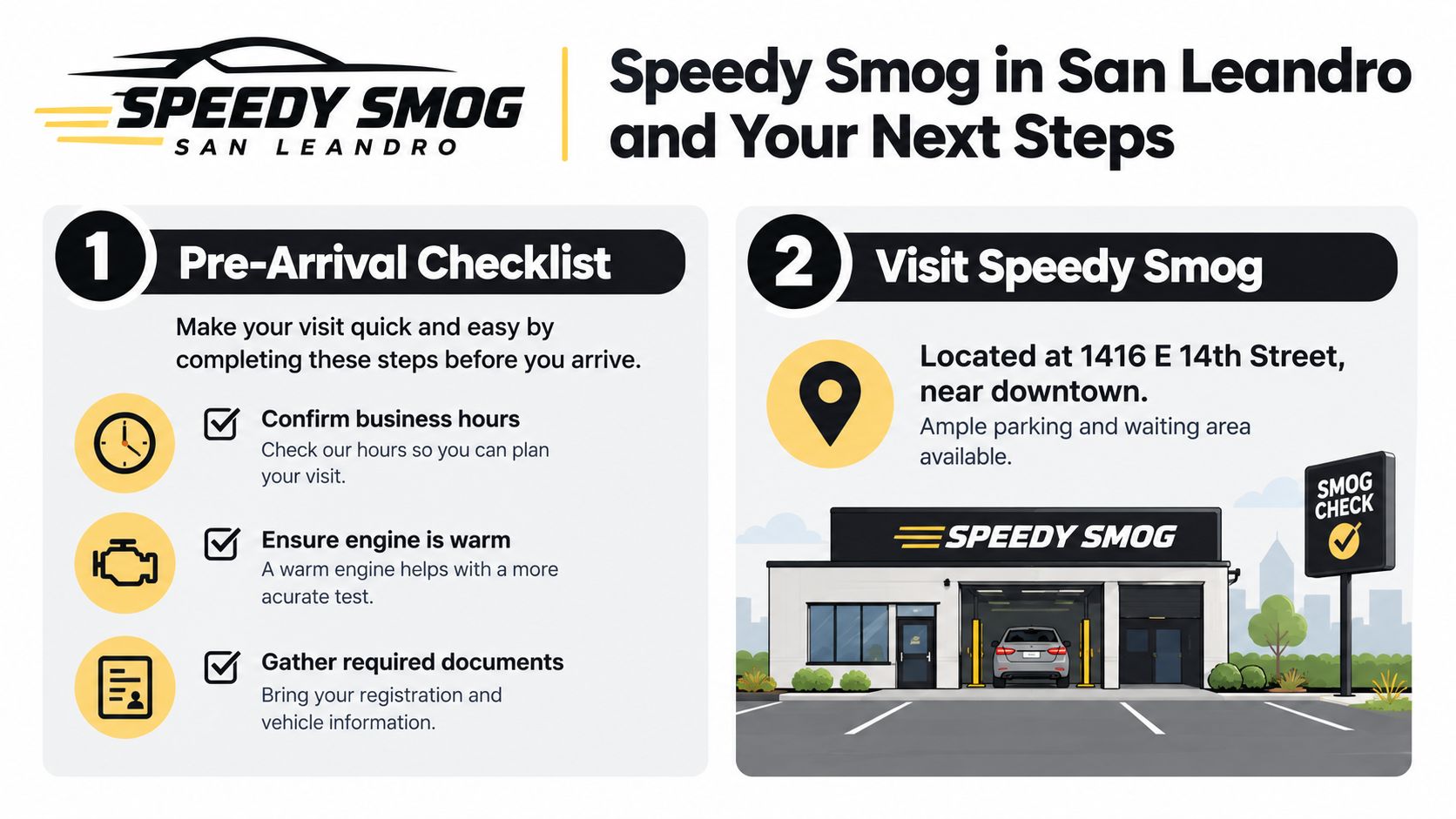
If your notice says you need a regular inspection or a STAR visit, the last step is simple, show up prepared and let the station match the paperwork to the vehicle. Speedy Smog serves San Leandro at 1416 E 14th Street, near downtown, with parking and a waiting area for drivers who don't want to circle the block before a test. Their phone line and current hours are listed on the shop site, which is the fastest way to confirm same-day availability before you head over.
A quick pre-arrival checklist
- Renewal notice in hand: Make sure you can read the exact smog wording before you leave.
- Engine warmed up: Drive a bit before arrival so the car is ready for inspection.
- No warning lights: A check-engine light can stop the visit before it starts.
- Ready to pay: Bring the payment method you plan to use at the counter.
For a typical OBD-II vehicle, the visit is usually the shortest part of the day. You hand over the keys, the technician confirms the station type, and the result is sent to DMV electronically after the test is complete. If the car fails, keep the printout, take it to a repair shop, and return only after the issue is fixed and the readiness status makes sense again.
If you need a San Leandro smog test, bring your renewal notice, read the wording carefully, and choose the right station type the first time. Speedy Smog handles inspection-only and STAR-directed smog visits for East Bay drivers, so you can get the paperwork done, understand the result, and move on with your renewal without extra back-and-forth.