
California Smog Check Requirements: Complete 2026 Guide
You pull your DMV renewal notice from the mailbox in San Leandro, see “smog check required,” and immediately wonder whether your vehicle needs a test. Maybe it's a newer hybrid. Maybe you recently bought it. Maybe the car passed last time and you assume the same result carries over. Those assumptions can send you to the wrong station or leave your registration unfinished.
California's smog check requirements depend on more than the fact that you own a vehicle. Model year, fuel type, registration location, and the transaction you're completing all matter. The rules also changed in a meaningful way for OBD-equipped vehicles on October 1, 2025, so a car with recently cleared trouble codes may no longer have the tolerance it once had.
This guide gives you the practical framework. Check the transaction first, confirm whether the vehicle is exempt, verify whether a STAR station is required, and scan the OBD readiness monitors before paying for an official inspection. That sequence prevents most avoidable surprises.
Table of Contents
- Why Smog Check Requirements Matter for California Drivers
- Which Vehicles Need a Smog Check and Which Are Exempt
- Understanding STAR Certified Smog Check Stations
- OBD Readiness Monitor Rules and the 2025 Changes
- Special Requirements for Diesel Hybrid and Older Vehicles
- How to Prepare Your Vehicle and What to Expect During Testing
- Getting Certified Quickly at Speedy Smog in San Leandro
Why Smog Check Requirements Matter for California Drivers
A San Leandro driver might receive a renewal notice, check the registration date, and assume the next step is finding the nearest inspection shop. Then the vehicle's model year, fuel type, or registration record changes the answer. A newer vehicle may qualify for a registration exemption but still involve a smog abatement fee, while a recently purchased vehicle may need testing because the transaction is a title transfer rather than a routine renewal.
California's system has never been a single rule applied to every car. The state's modern mandatory program took shape in March 1984, after SB 33 was passed in 1982, with biennial inspections in participating counties and visual, functional, and emissions checks. The program later shifted toward onboard diagnostics, and California adopted an OBD II-focused inspection in 2010 for 2000 model-year and newer vehicles. The California Air Resources Board background helps explain why vehicle emissions compliance has continued to evolve.
The transaction changes the answer
A renewal, an initial California registration, and a change of ownership aren't interchangeable. The same vehicle can be exempt during one DMV transaction and require a certificate during another. Registration location matters too, because California's program applies differently depending on the county and the vehicle's registration circumstances.
That's why a driver who recently bought a car shouldn't rely on the purchase date alone. The vehicle's model year and the type of DMV transaction control the requirement.
Practical rule: Read the DMV notice, identify the transaction, then confirm the vehicle's fuel type and model year before booking a test.
Misunderstanding the rule can block registration, create late-payment problems, or send you to a non-STAR station when the DMV requires a STAR inspection. A failed or invalid visit costs more than the inspection fee. It costs time, and it can force a second trip before the DMV accepts the paperwork.
The safest approach is simple: determine eligibility first, choose the required test type second, and prepare the vehicle before arriving. That process is especially important now that readiness-monitor rules have become stricter.
Which Vehicles Need a Smog Check and Which Are Exempt
Start with the DMV transaction, not the age of the vehicle. California uses different thresholds for renewal, ownership transfer, and initial registration, and a recent purchase doesn't automatically eliminate the need for a smog certificate.
Biennial registration renewal
For ordinary gasoline-powered vehicles, the rolling exemption generally covers vehicles that are eight model years old or newer for registration renewal. Once the vehicle reaches the testing threshold, a smog check is generally required on the state's two-year renewal cycle in covered areas.
For 2026 registrations, the practical cutoff described in current guidance exempts 2018 and newer gasoline vehicles from biennial testing. That exemption is based on model year, not the date you bought the car. A vehicle purchased recently can still require a test if its model year falls outside the exemption.
Gasoline, hybrid, and alternative-fuel vehicles may qualify for the newer-vehicle registration exemption, but owners should check whether the DMV applies a smog abatement fee instead. An electric vehicle doesn't produce tailpipe emissions and is generally exempt from a conventional smog check.
Change of ownership
A title transfer follows a different rule. A vehicle sold or transferred in California generally needs a smog certificate unless it falls within the newer-vehicle exemption for that transaction. Current guidance treats vehicles that are four or fewer model years old differently from older vehicles during a transfer.
The key mistake is assuming that a car's current registration status settles the question. It doesn't. A vehicle that didn't need a test for the seller's renewal may still require documentation when ownership changes, depending on its model year and the transfer details. Check the California DMV smog exemption form when the transaction involves an exemption claim rather than a standard certificate.
Initial California registration
An out-of-state vehicle being registered in California for the first time generally requires a smog check regardless of age. The fact that the car passed inspection in another state doesn't replace California certification. California evaluates the vehicle under its own emissions program and registration rules.
Use this table as a first filter:
| Transaction Type | Smog Check Required? | Key Exemption Rule |
|---|---|---|
| Biennial registration renewal | Usually required after the newer-vehicle exemption ends | Gasoline, hybrid, and alternative-fuel vehicles may be exempt while eight model years old or newer, subject to DMV rules and possible abatement fees |
| Change of ownership | Generally required | Vehicles four or fewer model years old may qualify for the transfer exemption |
| Initial California registration for an out-of-state vehicle | Generally required regardless of age | An out-of-state inspection doesn't replace California certification |
| Electric vehicle registration | Conventional smog check generally not required | Electric vehicles are exempt from conventional emissions testing |
Before making an appointment, write down the vehicle's model year, fuel type, county of registration, and transaction type. Those four details usually reveal whether you need a test, an exemption form, or a different DMV step.
Understanding STAR Certified Smog Check Stations
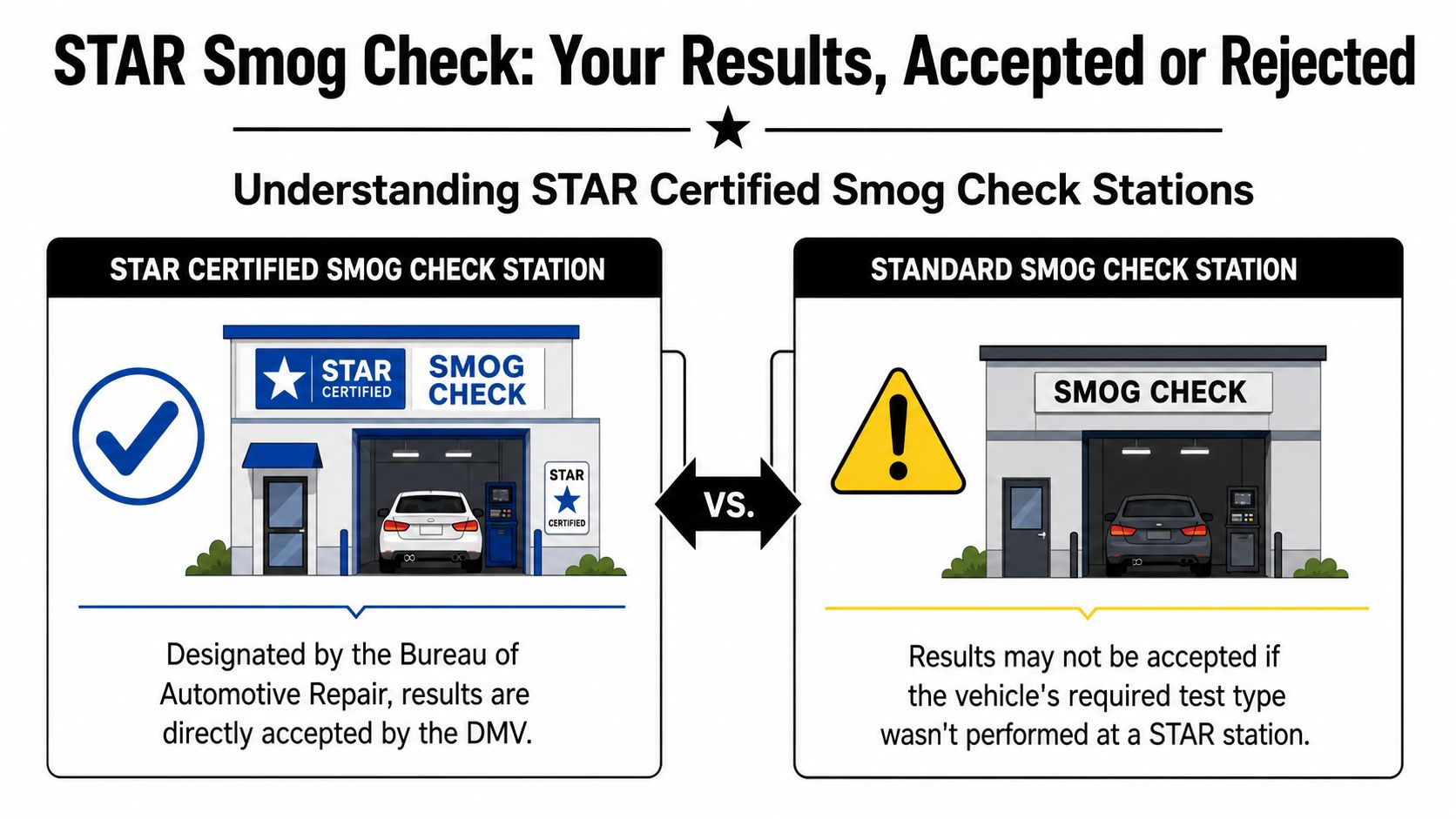
A STAR station isn't just a shop with a different sign. It's a station authorized under California's enhanced inspection program, and the distinction matters when the DMV notice directs you to STAR.
California launched the STAR program on January 1, 2013, replacing the earlier Gold Shield and Test Only structure with higher smog-check standards. The EPA's inspection and maintenance overview places these programs in the broader framework of federal Clean Air Act inspection and maintenance requirements. Federal rules have also evolved, including amendments made in 2015 as part of implementation of the 2008 ozone standards.
When STAR status is mandatory
Some renewal notices require a STAR-certified test. If that instruction appears on your notice, a passing result from a standard non-STAR station may not satisfy the DMV requirement. The problem isn't necessarily that the vehicle was tested incorrectly. The problem is that the station type didn't match the required transaction.
STAR designation reflects performance controls established by the Bureau of Automotive Repair, including station and inspector compliance, equipment standards, and tighter oversight of test accuracy. The designation is useful because it connects the test to the state's required inspection pathway, rather than leaving the driver to interpret whether a result will be accepted.
What East Bay drivers should do
Look at the DMV notice before choosing a location. If it says STAR, use a STAR station. If it doesn't, confirm the required inspection type anyway, especially for an out-of-state registration, ownership transfer, older vehicle, diesel, or vehicle with an emissions-related repair history.
A station such as Speedy Smog's STAR-certified location in San Leandro can submit an eligible result through the correct channel. That doesn't guarantee the vehicle will pass, but it removes one preventable risk: paying for a test that the DMV won't accept because the station designation was wrong.
STAR status also matters when a vehicle is close to the pass threshold. Proper equipment, compliant procedures, and trained inspectors help ensure the recorded result reflects the vehicle's actual condition. Don't treat STAR as a marketing label. Treat it as a requirement when the DMV assigns that test type.
OBD Readiness Monitor Rules and the 2025 Changes
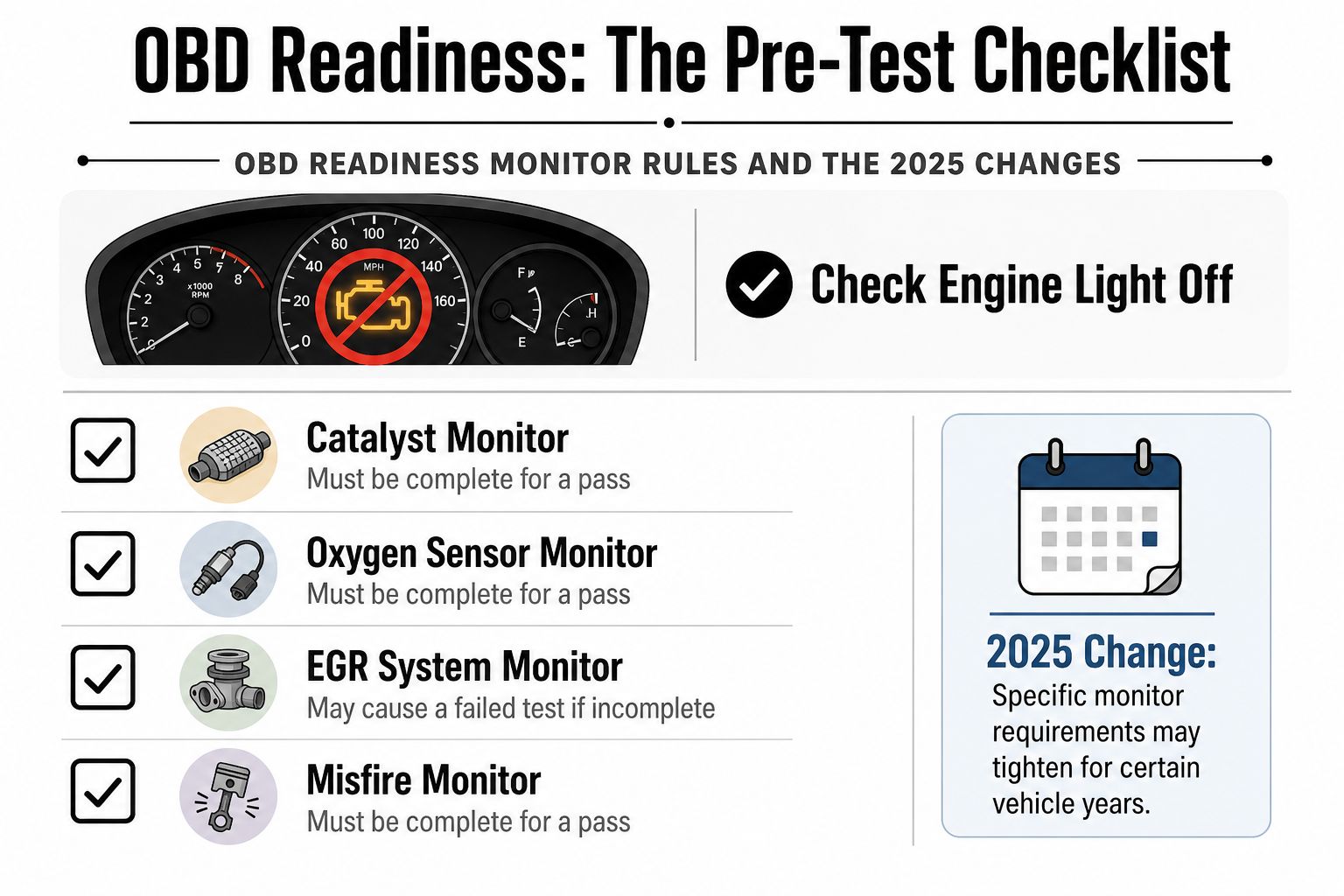
Many modern smog failures happen before the technician performs any tailpipe measurement. The OBD inspection checks the malfunction indicator lamp, readiness indicators, and the vehicle's ability to retrieve fault codes. A vehicle can have no illuminated warning light and still fail because its emissions monitors aren't complete.
For 1996 through 2000 model-year vehicles, more than two incomplete emissions-related readiness monitors causes an OBD II failure. For 2001 and newer vehicles, more than one incomplete monitor causes failure under the earlier rule. These thresholds are defined in California's OBD inspection regulation.
That distinction catches owners who disconnect the battery or clear diagnostic trouble codes just before an appointment. Clearing codes resets monitor status. The check engine light may remain off while the vehicle runs its self-tests, but the monitor screen can still show incomplete.
The October 2025 standard
Effective October 1, 2025, California requires all readiness monitors to be set for a vehicle to pass Smog Check unless the Bureau of Automotive Repair grants an exception for a design-limited case. BAR also states that an OBD-equipped vehicle fails if the MIL doesn't illuminate with the key on and engine off, or if it stays illuminated while the engine runs. The BAR explanation of the new OBD readiness monitor regulations should be your reference for the current standard.
This change makes battery disconnections and recent code clearing more serious. A vehicle that once passed with an incomplete monitor may now fail because the full-readiness requirement applies.
How to prepare the monitors
Don't guess at a drive cycle. The vehicle manufacturer determines the exact conditions, and different monitors may require different combinations of cold starts, steady cruising, acceleration, deceleration, and stop-and-go operation.
Use a practical sequence:
- Don't clear codes before testing. Code clearing or battery disconnection erases useful readiness history.
- Drive normally after repairs. Combine cold-start operation, highway cruising, and city driving rather than idling in the driveway.
- Check the monitor screen. Scan the vehicle before the official inspection and confirm every required monitor shows ready.
- Verify the MIL behavior. The warning lamp must illuminate during the key-on bulb check and turn off when the engine runs, assuming no active fault exists.
- Delay the appointment if monitors remain incomplete. Paying for an official test while the vehicle is visibly not ready is avoidable.
A commute that combines I-880 cruising with local San Leandro stop-and-go driving can help create varied operating conditions, but it isn't a guaranteed manufacturer drive cycle. Have the readiness status scanned before the test.
Special Requirements for Diesel Hybrid and Older Vehicles
Vehicle category determines the inspection path. A newer gasoline sedan, an older gasoline truck, a hybrid, and a diesel pickup don't all receive the same evaluation, so the technician needs accurate vehicle information before starting.
| Vehicle Type | Model Years Tested | Test Method | Key Exemptions |
|---|---|---|---|
| Gasoline vehicles | 1976 and newer when covered by the program | OBD II for later models, tailpipe and visual testing for older models | Gasoline vehicles from 1975 and older are exempt |
| Diesel vehicles | 1998 and newer in applicable categories | OBD or diesel emissions testing based on vehicle configuration, including opacity testing for heavier diesels | Diesel vehicles from 1997 and older are exempt; weight and program category also matter |
| Hybrid vehicles | When they fall outside the applicable newer-vehicle exemption | OBD II and functional emissions inspection | Newer hybrids may qualify for the registration exemption |
| Older gasoline vehicles | 1976 through 1999 when testing is required | ASM or TSI tailpipe testing on a dynamometer, plus visual and functional checks | The newer-vehicle rolling exemption doesn't apply in the same way to these older cars |
Gasoline and older vehicles
Gasoline vehicles from 1976 onward can fall under the program when they aren't exempt by transaction or model year. Later vehicles generally use OBD II, while older gasoline vehicles may require a dynamometer-based tailpipe test, such as ASM or TSI, instead of a simple diagnostic connection.
The state's model-year exemptions shouldn't be confused with a blanket classic-car exemption. California exempts gasoline-powered vehicles that are 1975 model year or older, but a 1980s or 1990s vehicle can still require testing when the transaction and registration conditions call for it. Age alone doesn't create a universal exemption.
Diesel vehicles
Diesel rules depend on model year, vehicle weight, and the applicable emissions program. Diesel-powered vehicles from 1997 model year or older are exempt under the DMV guidance, while newer diesel vehicles can require testing. Heavy diesels may receive a different inspection, including an opacity test, rather than the same procedure used for a light-duty gasoline vehicle.
Bring the vehicle's registration information so the station can identify the applicable weight and fuel category. Don't assume that all diesels are exempt, and don't assume that every diesel receives a standard OBD plug-in test.
Hybrids
Hybrids aren't automatically exempt because they use electric assistance. Once a hybrid falls outside the applicable newer-vehicle exemption, it generally undergoes an OBD and emissions-system inspection. The technician must work around the vehicle's high-voltage systems while checking the emissions controls and diagnostic data.
The right question isn't “Is it a hybrid?” Ask whether its model year and transaction qualify for an exemption, then confirm the station can perform the required inspection.
How to Prepare Your Vehicle and What to Expect During Testing
Preparation starts before you drive to the station. A smog check measures emissions-system operation, not general vehicle quality, so focus on the items that can create a direct inspection failure.
The pre-test checklist
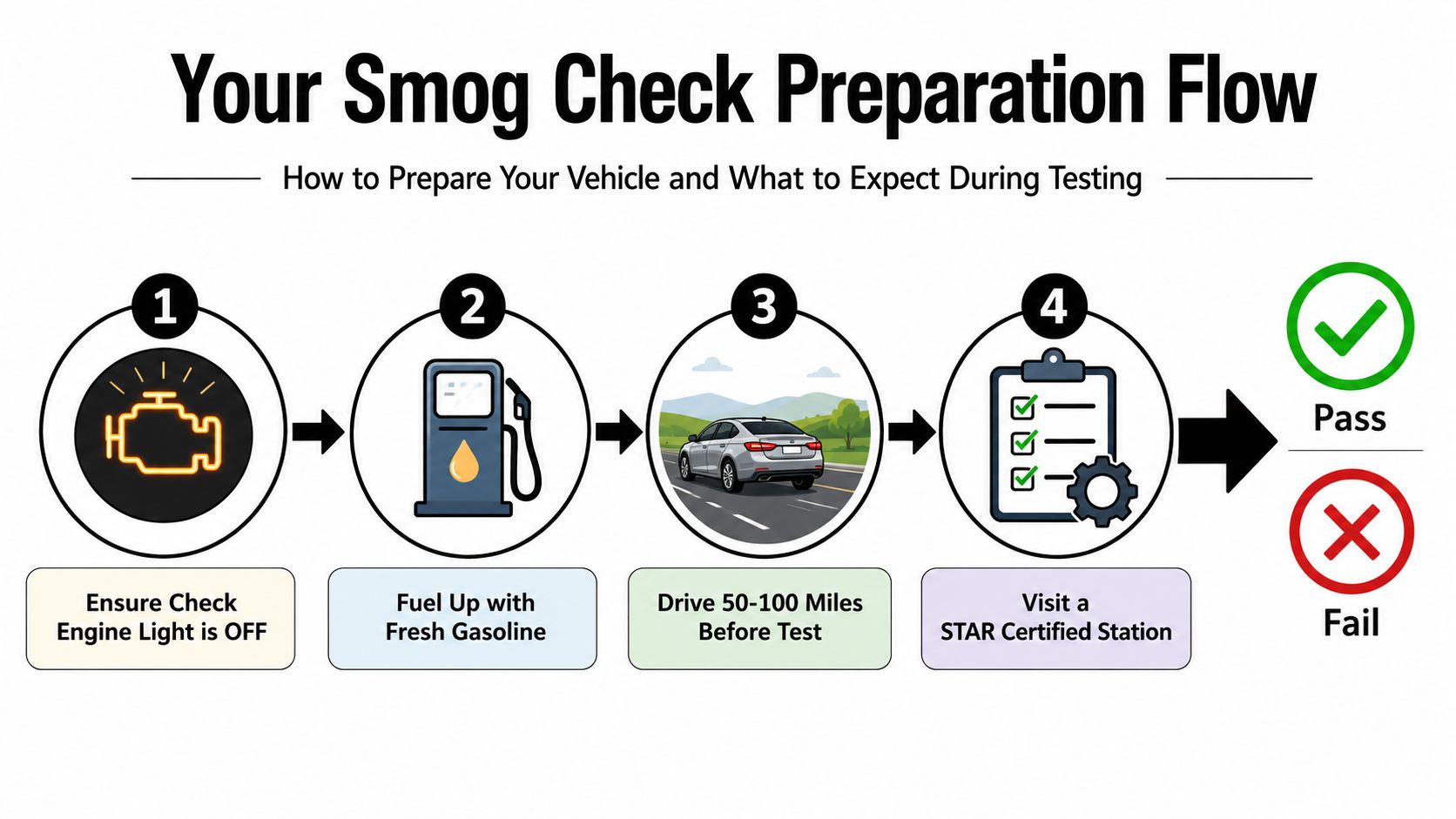
- Check the warning light: The check engine light should be off while the engine runs. If it's illuminated, diagnose the fault before booking the official inspection.
- Protect monitor history: Don't disconnect the battery or clear codes shortly before testing. The vehicle needs time and normal driving to complete its self-checks.
- Bring usable fuel: Arrive with enough fuel for the vehicle to run safely during the inspection. A low fuel level can prevent testing on some vehicles.
- Remove questionable modifications: Non-approved emissions parts, altered exhaust equipment, missing components, or an incorrect gas cap can trigger a visual failure.
- Carry the paperwork: Bring the DMV renewal notice or registration card, payment, and any repair or test documentation relevant to the vehicle.
The exact driving distance needed to complete monitors varies by vehicle, weather, fuel level, and the manufacturer's conditions. Follow the vehicle's drive-cycle guidance rather than relying on a generic mileage promise. A scan showing every monitor ready is more useful than an arbitrary number of miles.
What happens at the station
The technician begins by confirming the vehicle and required test type. The inspection may include a visual review of emissions components and the fuel cap, an OBD II scan for applicable vehicles, or a dynamometer and tailpipe procedure for older models. The station records the result and submits the certification electronically when the inspection passes.
Watch the warning-light behavior carefully. BAR requires the MIL to illuminate during the key-on, engine-off check and remain off once the engine runs. A missing bulb or warning light that stays on isn't a minor dashboard issue. It can produce a direct failure.
Use this short video as a visual overview of the preparation process:
If the vehicle fails
A failure should identify the affected emissions system, monitor, visual component, or diagnostic condition. Don't replace random parts based only on a failed result. Have the report interpreted, repair the confirmed cause, then complete the required retest.
Qualifying owners may be eligible for repair assistance through California's Consumer Assistance Program, but eligibility depends on the program's requirements. Ask the station or review current state guidance before assuming assistance applies.
The most useful service after a failure is a clear explanation of what failed and what needs to happen next. A quick diagnostic scan before the official test can prevent a readiness-related failure and save a second appointment.
Getting Certified Quickly at Speedy Smog in San Leandro
For an East Bay driver, the efficient path is to match the transaction to the correct test, verify readiness, and use a station that can submit the result through the required DMV process. That matters more than selecting the closest location.
Speedy Smog in San Leandro is a STAR-certified station that handles gasoline, diesel, hybrid, older-vehicle, and change-of-ownership inspections. The shop says it can transmit eligible results electronically to the DMV, which reduces paperwork after a passing inspection. Its stated service information also describes typical testing for 2000 and newer vehicles in about 10 to 15 minutes, though the actual time depends on the vehicle and inspection type.
Bring the right information
Take your DMV renewal notice or registration card, the vehicle, and payment. Tell the technician whether you're completing a renewal, an ownership transfer, or an initial California registration. That context helps the station identify the correct test rather than treating every visit as a standard renewal inspection.
If the vehicle has recently had codes cleared, a battery replacement, or emissions repairs, request an OBD readiness check first. A quick scan can reveal incomplete monitors before the official test starts. If the vehicle isn't ready, you can complete the required driving and avoid recording a preventable failure.
Speedy Smog accepts walk-ins according to its published service information and operates Monday through Saturday at its San Leandro location. Confirm current hours and requirements before leaving, especially if your DMV notice specifies STAR testing or a special inspection category.
The recommendation is direct. Don't wait until registration is nearly expired, don't assume a recent purchase means exemption, and don't choose a station without checking whether STAR status is required. Use the rules above to identify the transaction, verify the model year and fuel type, then have the vehicle scanned before certification.
Speedy Smog provides STAR-certified inspections for gasoline, diesel, hybrid, older, and change-of-ownership vehicles in San Leandro, with electronic DMV submission for eligible results. Bring your renewal notice or registration card and ask for a readiness check if the vehicle recently had codes cleared, then visit Speedy Smog to get the correct smog check handled without an avoidable second trip.