
How to Clear Check Engine Light Safely and Legally
You're staring at the dash in the parking lot, the smog appointment is coming up, and that check engine light is sitting there like a warning you can't ignore. In that moment, a lot of drivers want the fastest fix possible, especially if the car still feels fine. The problem is that clearing the light is not the same thing as fixing the fault, and in California that difference can decide whether you leave with a clean result or get turned away.
Table of Contents
- What the Check Engine Light Actually Means
- Using an OBD2 Scanner to Read and Clear Codes
- Alternative Reset Methods and Their Trade-Offs
- Common Causes Behind the Light and When to Seek Repair
- California Smog Test Implications You Cannot Ignore
- Prevention Tips and Your Reset Decision Framework
What the Check Engine Light Actually Means
A driver rolls into the bay after tightening a gas cap, then asks why the light is still on. That's a normal scene, because the dashboard warning does not care whether the problem feels small. It is triggered by the vehicle's ECU or ECM, which watches emissions and engine behavior, stores trouble codes, and turns on the light when something falls outside expected limits.
The light is a diagnostic alert, not a bulb problem
The most important thing to understand is that the light itself is not the issue. The ECU controls the alert, so clearing it only removes the warning, it does not repair the underlying fault. That is why a reset can make the dash look better for a while and still leave the car failing emissions in the background.
Practical rule: if the car needed a code to turn the light on, it still needs a real diagnosis to make the light stay off.
A steady light usually points to a fault that needs attention, but a flashing light is a different situation. That warning usually means a more serious active problem, and it should not be treated like a simple clear-it-and-go job. If the light is flashing, the car needs attention before you keep driving it hard.
What a successful reset looks like
Real success is not a dark dashboard for ten minutes. It is a repaired system, cleared codes, and a vehicle that does not immediately object again after a few trips. In California, that matters even more because the vehicle has to convince the inspection equipment that the emissions systems are behaving normally, not just that someone erased memory.
OBD-II troubleshooting became universal in the 1990s, which is why reset steps are so standardized across brands and models. That universal structure is helpful, but it also creates a trap. It makes code clearing look easy, so people forget that the code existed for a reason.
For a plain-English breakdown of reading and clearing fault codes, see this OBD code guide for California drivers.
Using an OBD2 Scanner to Read and Clear Codes
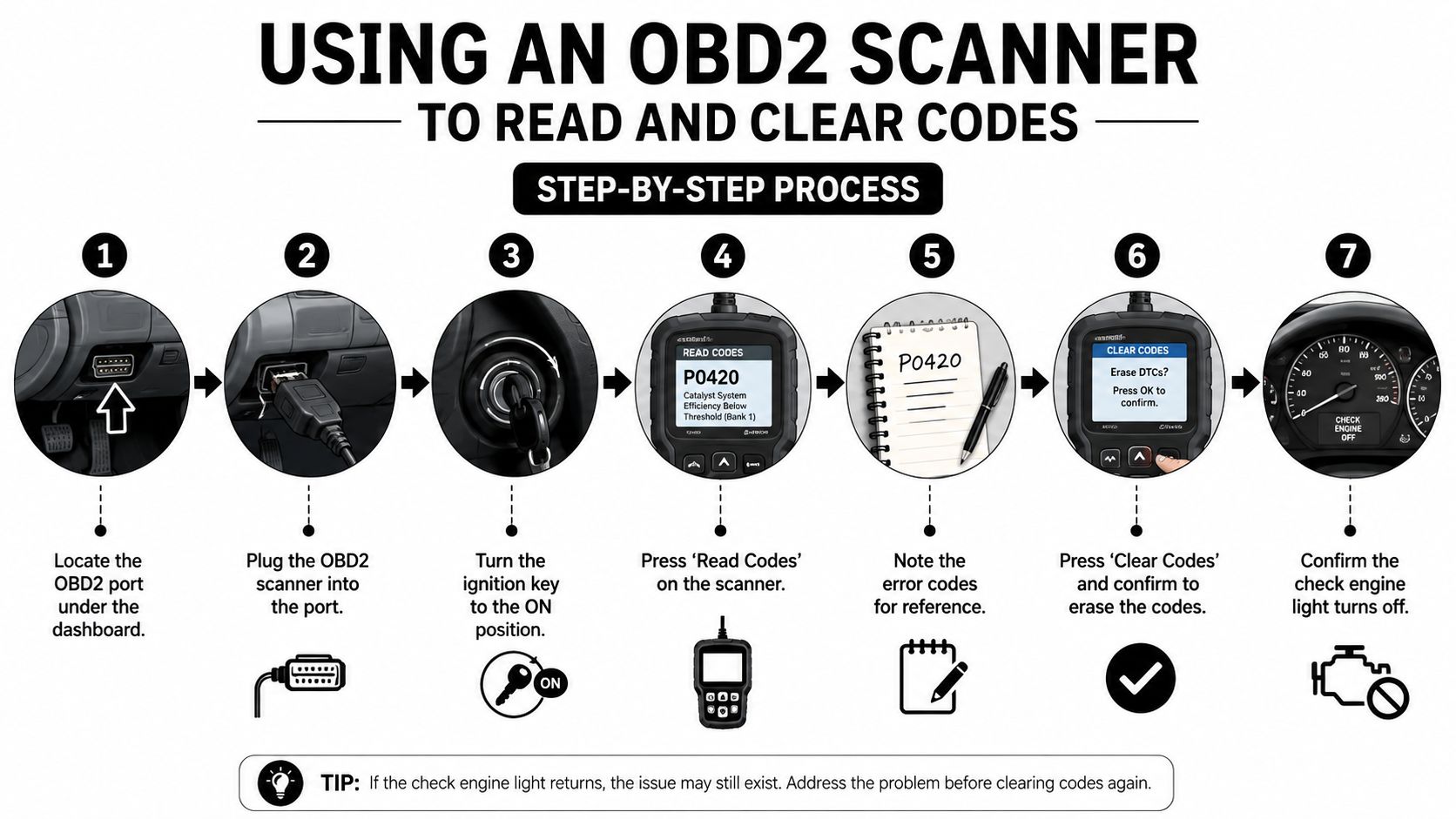
The scanner method works because it matches the way the car's computer stores faults. Plugging in the tool under the dashboard lets you read the codes before you clear them, and that order matters because erasing the memory also erases the clue trail. If you are trying to clear a check engine light before a California smog test, reading first helps you avoid guessing at a fix that may not hold up in inspection.
Read first, clear second
Plug the OBD2 scanner into the diagnostic port with the ignition turned to ON and the engine off. Then read both stored and pending codes, and save or write them down before you touch the erase function. If you skip that step, you lose the most useful information the car can give you.
A lot of drivers try to clear the light first and then see whether it returns. That approach leaves you blind if the fault comes back, and it does nothing to tell you whether the problem is an intermittent sensor issue, a wiring problem, or a repair that did not take. Keep the record even if you do not know what it means yet, because the code family and the freeze-frame context usually tell more than the warning lamp itself.
If you want help understanding the numbers before you clear anything, this OBD code guide for San Leandro drivers is a useful companion.
Clear codes only after the repair is confirmed
The better sequence is straightforward. Fix the fault, reconnect the scanner with the ignition on and the engine off, check the stored and pending codes again, confirm the repair, then use “Erase Codes” or “Clear DTCs” Automotoflux's clear-code guide. If the light goes out, that only means the computer memory was cleared.
Readiness is the part many guides leave out. The monitor status needs to return to “Ready” or “Complete” in Mode 01 PID 01 before the reset means much for smog purposes Automotoflux's clear-code guide. A dark dash and a ready vehicle are not the same thing, and California inspection equipment cares about the second one.
A cleared code is not the same as a fixed car. The scanner can turn off the warning, but it cannot prove the fault stayed gone.
A note on using a professional station
If you do not want to guess, a smog-focused shop can help you check the result after repairs. A station such as Speedy Smog in San Leandro fits that workflow because it performs emissions testing for California drivers who need a compliance result, not just a blank dashboard.
Alternative Reset Methods and Their Trade-Offs
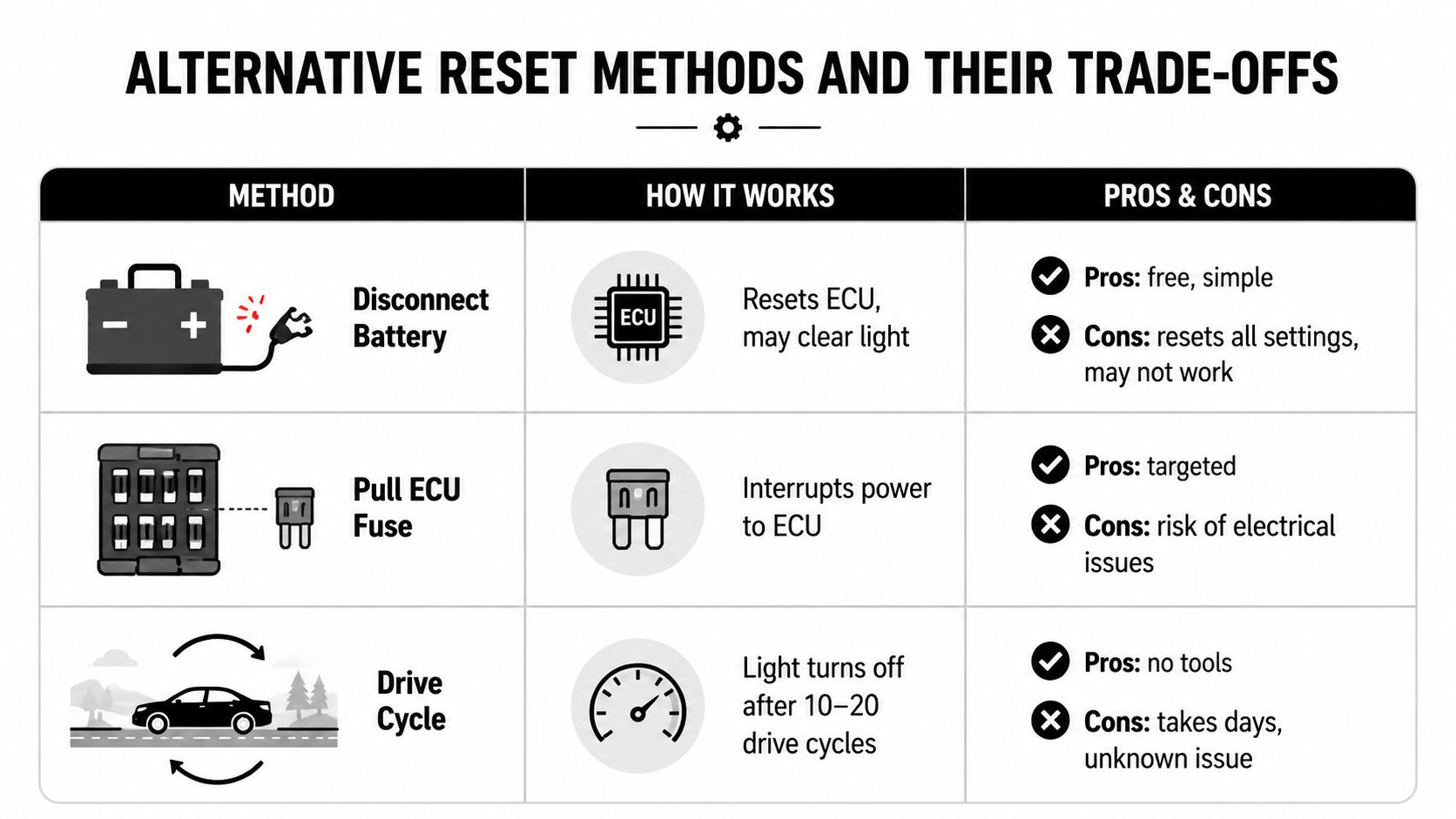
A lot of drivers reach for a power reset when they do not have a scanner handy. It can make the light disappear for a while, but it also skips the part that matters before a California smog test, confirming the fault is resolved AMP Auto's clear-light guide.
Battery disconnect and ECU fuse removal
Disconnecting the negative battery terminal is the common shortcut. Some guides say to wait about 10 to 15 minutes before reconnecting so the ECU reboots and the light turns off AMP Auto's clear-light guide. That can work, but it also wipes radio presets and learned settings, and the same issue can return as soon as the car sees the fault again.
Pulling the ECU fuse does something similar by cutting power to the computer. It is a little more targeted than removing the whole battery, but it still means you are changing the electrical system instead of finding the cause. For a driver trying to quiet the dash before an appointment, that is a risky trade.
Drive cycle resets take patience
The slowest route is letting the car clear itself after the original problem has corrected. One expert source says that after a self-corrected issue such as a tightened gas cap, the ECU may clear the code automatically after 3 to 5 drive cycles, with confirmation recommended over roughly 100 miles of mixed driving AMP Auto's clear-light guide. That approach makes sense only when the problem was temporary and the repair has already happened.
If the fault is still there, a battery disconnect only buys time. The code comes back because the ECU sees the same problem again.
The practical comparison is simple. Battery disconnect is fast but messy. Fuse removal is a little more precise but still a shortcut. Drive cycles are gentle on the vehicle and do not erase settings, but they only make sense when the problem corrected itself and you can afford to wait. For drivers trying to avoid a smog-day surprise, a clear-light trick is not the same as a compliant car. If you want a fuller look at what tends to trigger inspection trouble, this smog fail reasons guide for San Leandro drivers is a useful reference.
Common Causes Behind the Light and When to Seek Repair
A light on the dash doesn't tell the whole story, but the code family usually points in the right direction. A loose gas cap is one of the easiest fixes, while issues tied to sensors, misfires, or the catalytic converter often need more attention. The smart move is to match the symptom to the repair, not to clear the alert and hope the problem behaves.
What the usual suspects look like in practice
| Common Cause | Typical Code | DIY Fixable | Estimated Cost Range |
|---|---|---|---|
| Loose or damaged gas cap | EVAP-related codes | Yes, often | Usually low |
| Oxygen sensor problem | Sensor-related codes | Sometimes, if accessible | Moderate |
| Mass airflow sensor issue | Air metering codes | Sometimes | Moderate |
| Spark plug wear or misfire | Misfire codes such as P0300 | Sometimes, if the service is basic | Variable |
| Catalytic converter issue | Efficiency codes such as P0420 | No, usually not | High |
The exact code matters because different failures affect the car in different ways. A gas cap may be a quick driveway fix, while a catalytic converter concern is a different level of problem altogether. If you want a fuller breakdown of what tends to trip a smog inspection, this smog fail reasons guide for San Leandro drivers is a useful reference.
Which repairs are worth doing yourself
A gas cap replacement is the easiest DIY call when the cap is cracked, loose, or won't seal properly. Some spark plug work is also reasonable if you already know the vehicle and have the right tools. But once the issue involves emissions sensors, misfires that keep returning, or catalyst efficiency codes, the odds favor a proper diagnosis instead of repeated resets.
Real-world test: if the code returns after a reset and a short drive, the car is telling you the fault is still live.
The mistake many drivers make is treating every code like a nuisance. That approach can backfire fast because a small issue left alone can become a larger repair later. A reset is useful only when it follows the right repair, not when it replaces one.
California Smog Test Implications You Cannot Ignore
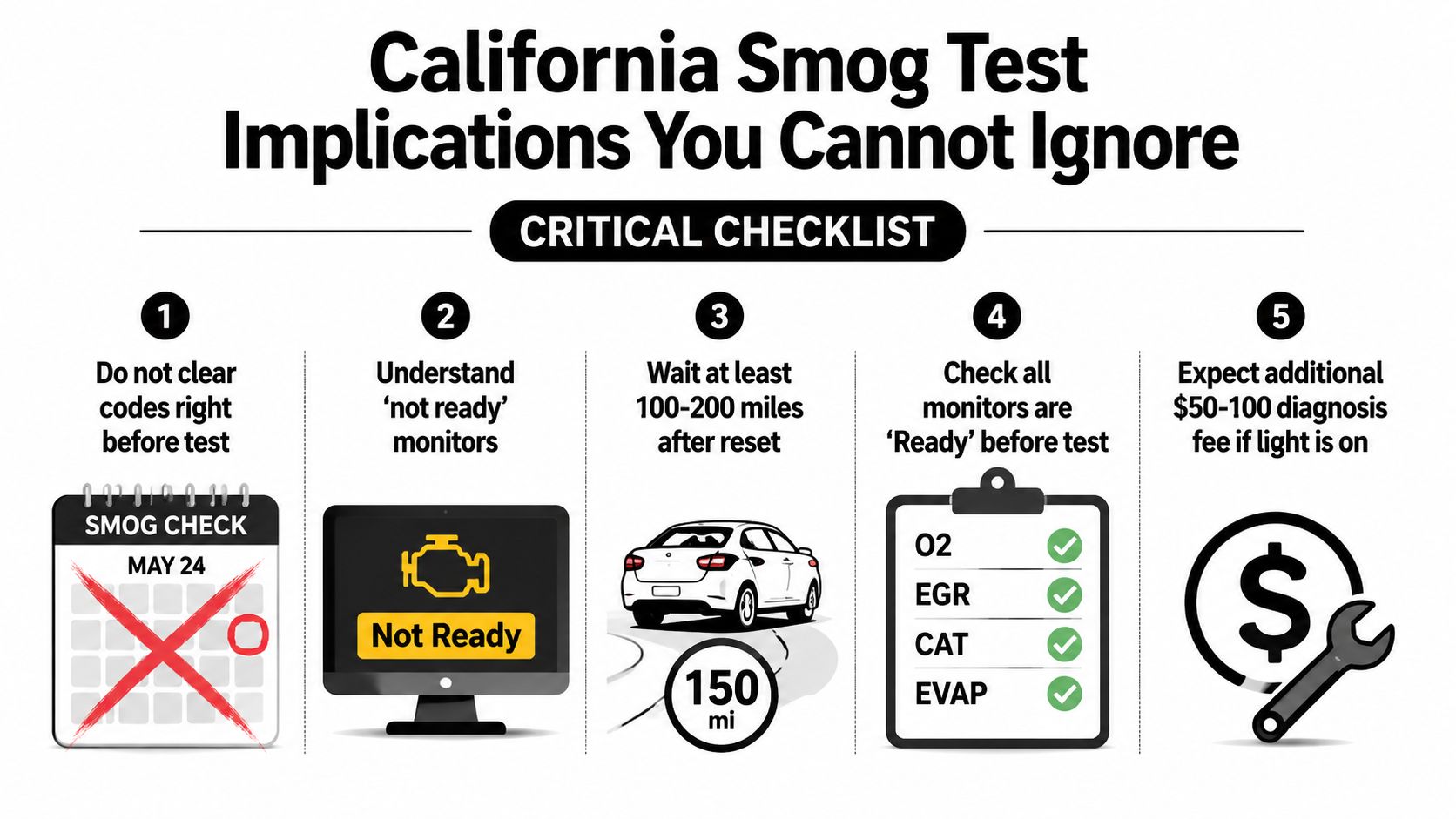
Many East Bay drivers get burned here. Clearing the light right before a smog appointment feels like a fast fix, but it also resets the readiness monitors that inspectors check before the emissions test. If those monitors show Not Ready, the car can be turned away even when the dashboard looks clear.
That is the hidden cost of a quick reset. You may erase the warning on the dash, but you do not erase the inspection problem.
Why timing matters more than most drivers think
After a reset, the vehicle needs time and the right driving conditions to rebuild readiness. Clearing codes the night before a test often leaves the computer without enough time to rerun its self-checks, so the station sees an incomplete snapshot instead of a verified one. A five-step checklist illustrating important tips for passing a California smog test for vehicles. spells out the same basic problem, a recent reset can leave the monitors unfinished when it matters most.
California drivers also need to treat the smog appointment as a compliance check, not a convenience check. If the system is not ready, the station does not give extra credit for a recent reset. It just has less to verify.
Repair first, then drive long enough for the monitors to complete before you book the test. A monitor that says Ready means the car has had a fair chance to run its checks after the repair and reset. That is the condition you want before you pull into a California inspection lane.
Smog stations and the compliance angle
For drivers who want an inspection that lines up with California requirements, a STAR Certified station is usually the safer lane because it follows the higher standard used for DMV-recognized testing. If the goal is a registration renewal that does not come back with another problem, a place like Speedy Smog's check engine light smog test page fits that need because it focuses on the testing process instead of a guess-and-hope reset.
A recent reset can make a car look cleaner than it really is. That matters because a smog lane is checking for readiness and compliance, not just a blank dash. As noted earlier, code clearing has its place, but using it as a last-minute smog strategy usually creates more trouble than it solves.
The practical move is simple. Clear the code after the repair, then give the car time to prove it is ready before the test.
Prevention Tips and Your Reset Decision Framework
The cheapest check engine light is the one that never shows up. Regular maintenance keeps the emissions system from drifting into the kind of fault that turns into a code, a failed test, or a hurried reset attempt. That means handling routine service before the car starts complaining.
Maintenance habits that prevent nuisance codes
- Change oil on schedule: Dirty oil can create avoidable stress on the engine and related systems.
- Tighten the gas cap properly: A sloppy seal is one of the simplest ways to invite an emissions warning.
- Replace air filters when they're due: Restricted airflow can make the engine work harder than it should.
- Keep spark plugs in good shape: Old plugs can contribute to rough running and misfire behavior.
- Take longer drives now and then: Short trips alone don't always let the system run its checks cleanly.
Use a simple decision tree
If the light is steady, read the codes first. If the code points to a clear mechanical issue, repair it before clearing anything. If the issue looks minor and the fault has already been corrected, a proper scanner reset makes sense, followed by a drive cycle and monitor check.
If the light is flashing, stop treating it like a maintenance task and get help. If the code comes back after a reset, the fault wasn't solved. If your smog deadline is close and the monitors haven't finished, don't gamble on a last-minute clear.
A final practical note for East Bay drivers. Speedy Smog handles smog checks for 2000 and newer vehicles, 1999 and older models, diesels, and hybrids, and typical tests for newer vehicles are completed in about 10 to 15 minutes at its San Leandro location Speedy Smog about page. That makes it a sensible stop when you want a compliant result instead of a rushed reset.
If your check engine light is on, bring the car in after the repair and let a proper smog station confirm where it stands. Visit Speedy Smog for a fast, California-compliant inspection in San Leandro, and avoid the mistake of clearing codes right before your test only to get sent back for unreadiness.