
Car Emissions Explained
Every car on the road produces exhaust. But what exactly is in that exhaust, why does it matter, and what happens when your emissions car fails a smog check? These are questions most drivers never think about until a test is due — and then they need answers fast.
This guide covers everything you need to know about car emissions: what they are, what your vehicle produces, how testing works, and what you can do to keep your emissions car running clean.
What Are Car Emissions?
Car emissions are the gases and particles your vehicle releases into the air as a byproduct of burning fuel. Every internal combustion engine does this — it's a basic consequence of the chemical reaction that powers your car.
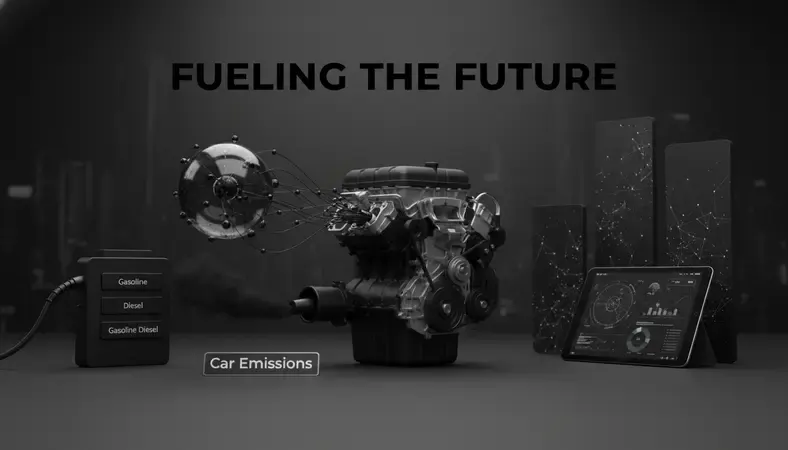
When gasoline or diesel burns inside your engine, it doesn't combust perfectly. Some fuel burns incompletely. Some nitrogen in the air reacts with heat. The result is a mix of gases that exit through your exhaust system and enter the atmosphere.
The term "emissions car" is often used loosely to describe any vehicle subject to emissions testing requirements — essentially any car that burns fuel and must prove its exhaust meets legal limits before it can be registered.
Key Insight: The Environmental Protection Agency estimates that transportation accounts for the largest share of greenhouse gas emissions in the United States — making emissions car testing one of the most direct ways states can improve air quality.
Understanding what your emissions car produces is the first step to understanding why testing exists and what inspectors actually measure.
Types of Emissions Cars Produce
Not all exhaust is the same. An emissions car produces several distinct pollutants, each with different effects on health and the environment.
The main pollutants
-
Hydrocarbons (HC): Unburned fuel particles that escape through the exhaust. High HC levels usually indicate incomplete combustion — often caused by a misfiring spark plug, a failing catalytic converter, or a rich fuel mixture. Hydrocarbons react with sunlight to form smog.
-
Carbon monoxide (CO): A colorless, odorless gas produced when fuel burns without enough oxygen. CO is toxic to humans at high concentrations and is one of the primary targets of any emissions test.
-
Nitrogen oxides (NOx): Formed when nitrogen and oxygen in the air react under the extreme heat of combustion. NOx contributes to smog formation and acid rain, and is a key indicator of engine efficiency.
-
Carbon dioxide (CO₂): The primary greenhouse gas from vehicle combustion. Unlike HC, CO, and NOx, CO₂ isn't directly regulated in most state-level emissions tests — but it's central to broader climate policy.
-
Particulate matter (PM): Tiny solid particles, more common in diesel vehicles. Particulates are linked to respiratory disease and are regulated under federal clean air standards.
Emissions comparison by vehicle type
How Emissions Vary by Vehicle Type
| Vehicle Type | Primary Pollutant Concern | Regulated by Smog Check? | Notes |
|---|---|---|---|
| Gasoline (pre-1975) | HC, CO | Often exempt (older models) | No catalytic converter |
| Gasoline (1975–present) | HC, CO, NOx | Yes | Catalytic converter required |
| Diesel | NOx, particulate matter | Separate diesel inspection | Different test protocol |
| Hybrid | Lower HC, CO, NOx | Yes (in most states) | Smaller engine, less output |
| Electric | None (tailpipe) | Exempt in most states | No combustion emissions |
The type of emissions car you drive determines which pollutants are most relevant and which testing protocol applies to you.
Why Car Emissions Testing Matters
An emissions test — sometimes called a smog check or vehicle emissions inspection — is the mechanism states use to verify that your car isn't polluting beyond legal limits.
California introduced the first statewide smog check program in 1984. Today, more than 30 states require some form of vehicle emissions testing, though the specifics vary significantly. States like Colorado run the Air Care Colorado program for the Denver metro area. Arizona has the ADEQ vehicle emissions testing station network covering Maricopa and Pima counties. Each program targets the same core problem: vehicles that exceed pollution thresholds.
Why does this matter to you as a driver? Three reasons:
-
Registration renewal — Most states tie emissions compliance to your annual registration. An emissions car that fails a smog check can't be legally registered until the problem is fixed and the vehicle passes a retest.
-
Air quality — A single high-emitting vehicle can produce as much pollution as dozens of properly functioning cars. Emissions testing removes the worst offenders from the road.
-
Early diagnosis — Failing an emissions test often means your car has a mechanical problem that's costing you fuel efficiency. Fixing it saves money at the pump.
How Emissions Affect the Environment
The connection between an individual emissions car and broader environmental harm is worth understanding clearly.
Hydrocarbons and nitrogen oxides react in sunlight to form ground-level ozone — the main component of smog. High ozone days trigger health advisories, particularly affecting children, the elderly, and people with asthma. The Los Angeles Basin and the San Joaquin Valley in California are among the worst ozone zones in the country, which is a direct reason California's emissions standards are stricter than federal minimums.
Carbon monoxide at street level is a localized health risk, especially in dense urban areas with heavy traffic. At high concentrations near roadways, CO exposure has been linked to cardiovascular problems.
Nitrogen oxides contribute to acid rain, which damages forests, lakes, and crops. They also react with ammonia and moisture to form fine particulate matter — a pollutant linked to lung disease and premature death.
The cumulative effect of millions of emissions cars on the road is measurable. The EPA's National Emissions Inventory tracks pollution levels across the country, and transportation consistently ranks as the largest single source of air pollution in the United States.
Emissions Standards and Regulations
The rules governing what an emissions car can legally produce come from two levels: federal and state.
Federal standards
The Clean Air Act gives the EPA authority to set national emissions standards for new vehicles. These standards tighten over time — a car manufactured today produces roughly 99% less pollution per mile than one built in 1970. The EPA's Tier 3 standards, phased in starting in 2017, require gasoline vehicles to meet a fleet average of 30 milligrams of combined NOx and non-methane organic gases per mile.
California's stricter rules
California operates under a separate waiver from the Clean Air Act, allowing the state to set stricter standards than the federal minimum. The California Air Resources Board (CARB) sets these rules, and 17 other states have adopted California's standards rather than the federal baseline.
State testing programs
State-level smog check programs enforce these standards at the vehicle level. The most common testing methods are:
-
OBD-II testing: For most vehicles 1996 and newer, inspectors plug into the car's on-board diagnostic port and read stored fault codes. If the check engine light is on, the car typically fails.
-
Tailpipe testing: An analyzer probe is inserted into the exhaust pipe to measure actual HC, CO, and NOx concentrations. Used for older vehicles that predate OBD-II.
-
Visual inspection: Inspectors check that emissions control equipment — catalytic converter, EGR valve, oxygen sensors — is present and hasn't been tampered with.
If you're looking for an emissions close to me, the testing method used depends on your vehicle's model year and your state's program requirements.
How to Reduce Your Car's Emissions
If your emissions car is producing more pollution than it should, there are specific steps that address the most common causes.
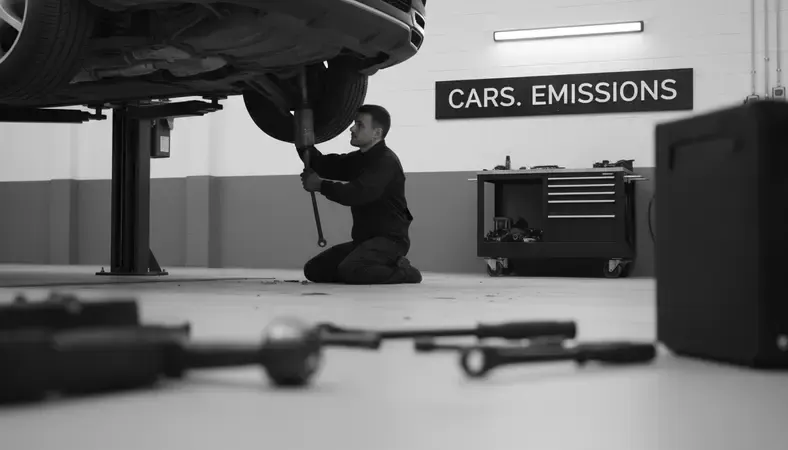
Keep up with basic maintenance
Neglected maintenance is the most common reason an emissions car fails a smog check. The fixes are usually straightforward:
-
Replace spark plugs on schedule. Worn plugs cause incomplete combustion, which raises HC levels directly. Most manufacturers recommend replacement every 30,000–100,000 miles depending on plug type.
-
Change the air filter. A clogged air filter restricts oxygen flow, causing a rich fuel mixture and elevated CO output.
-
Check the oxygen sensors. O2 sensors tell the engine's computer how to balance the fuel mixture. A failing sensor throws off this balance and raises emissions across the board.
-
Service the catalytic converter. The catalytic converter converts HC, CO, and NOx into less harmful compounds before they exit the tailpipe. A failing converter causes a car to fail emissions testing almost immediately.
-
Fix the check engine light before your test. Any active diagnostic trouble code will cause an OBD-II emissions test to fail. Address the underlying issue, not just the light.
Use the right fuel
Higher-octane fuel doesn't reduce emissions in most standard engines. What matters more is fuel quality. Top Tier certified gasoline — sold by major brands — contains detergents that reduce carbon deposits on intake valves and injectors, which helps maintain clean combustion over time.
Avoid short trips when possible
Cold starts produce significantly higher emissions than warm engine operation. A car that's driven only short distances never fully warms up its catalytic converter, which needs to reach about 400°F to function efficiently. If your emissions car is used mainly for short trips, consider a longer drive before your scheduled smog check to warm everything up properly.
What to Expect During Emissions Testing
The emissions test itself is usually faster than people expect. At a station like Speedy Smog, most vehicles are in and out in under 15 minutes.
Here's what actually happens during an emissions inspection:
-
Check-in and vehicle information. The inspector records your license plate, VIN, and odometer reading. This information gets submitted to the state database.
-
Visual inspection. The technician checks that your catalytic converter is present, your gas cap seals properly, and no emissions control equipment has been removed or modified.
-
OBD-II scan (1996 and newer vehicles). A scanner connects to the port under your dashboard and reads your car's diagnostic data. The system checks for active fault codes and confirms that all emissions monitors have completed their readiness cycles.
-
Tailpipe test (older vehicles). For pre-1996 vehicles, a probe is inserted into the exhaust pipe. The analyzer measures HC, CO, and CO₂ concentrations at idle and sometimes at higher RPMs.
-
Results and certificate. If your emissions car passes, you receive a certificate that goes to the DMV for registration renewal. If it fails, you get a report showing which readings were out of range — a starting point for your mechanic.
What causes a failure?
The most common reasons an emissions car fails testing:
- Active check engine light (any stored fault code)
- Incomplete OBD-II readiness monitors (common after a recent battery replacement or ECU reset)
- Failed catalytic converter
- Faulty oxygen sensor
- Vacuum leaks causing a lean or rich mixture
- Broken or missing emissions control components
If you're searching for vehicle emissions testing or need an emissions test station near you, finding a STAR-certified station matters — especially in California, where STAR certification indicates the station meets stricter quality standards set by the Bureau of Automotive Repair.
Common Questions About Car Emissions
How often does my car need an emissions test?
Most states require testing every one or two years, tied to registration renewal. California requires smog checks every two years for most vehicles, though the specific schedule depends on your vehicle's age and county. Newer vehicles (typically less than four years old) are often exempt from testing for the first few years.
Can I drive my car if it fails an emissions test?
Yes, in most states a failed emissions test doesn't prevent you from driving immediately. You have a window of time to make repairs and retest before your registration expires. Driving with an expired registration after that window closes is a separate legal issue.
Why does my car fail emissions after a battery replacement?
When your battery is disconnected, the car's OBD-II system loses its stored readiness data. The emissions monitors need to run through specific drive cycles to reset. If you bring your emissions car in for testing before those cycles complete, the system will show incomplete monitors — which counts as a failure in most states. Drive the car normally for 100–200 miles before testing after any battery work.
What's the difference between a smog check and an emissions test?
They're the same thing, just different names used in different states. California uses "smog check." Other states use "emissions test," "vehicle inspection," or similar terms. The Emissions Inspection process covers the same basic measurements regardless of what it's called locally.
Does a newer car still need an emissions test?
It depends on your state and the vehicle's age. Many states exempt vehicles under a certain age (often three to five years) on the logic that new cars are factory-certified to meet current standards. Check your state's DMV requirements — exemption ages vary.
Final Thoughts
Your emissions car isn't just a registration requirement — it's a direct measure of how cleanly your engine is running. A car that passes emissions testing is a car that's burning fuel efficiently and contributing less pollution to the air around you.
Book your smog check at Speedy Smog in San Leandro — STAR certified, most vehicles done in under 15 minutes, open 6 days a week. Save $25 on your next visit by calling (510) 614-7664. Ready to get started? Visit Speedy Smog to learn more.